Posted tagged ‘U.S. politics’

The Iran Nuclear Deal: What the Next President Should Do

October 2, 2015

The Iran Nuclear Deal: What the Next President Should Do, Heritage Foundation, October 2, 2015

(But please see, The Elephant In The Room. — DM)

The failure of Congress to halt the implementation of the Obama Administration’s nuclear agreement with Tehran means that the U.S. is stuck with a bad deal on Iran’s nuclear program at least for now. Iran’s radical Islamist regime will now benefit from the suspension of international sanctions without dismantling its nuclear infrastructure, which will remain basically intact. Iran’s path to a nuclear weapon is unlikely to be blocked by the Administration’s flawed deal, any more than North Korea was blocked by the Clinton Administration’s 1994 Agreed Framework.

The next President should not passively accept Obama’s risky deal with Tehran as a fait accompli. Instead, he or she should immediately cite any violations of the agreement by Iran, its continued support for terrorism, or other hostile policies as reason to abrogate the agreement. The Bush Administration, faced with bad deals negotiated by the Clinton Administration, eventually withdrew from both the Agreed Framework and the Kyoto Protocol.

Rather than endorsing a dangerous agreement that bolsters Iran’s economy, facilitates its military buildup, and paves the way for an eventual Iranian nuclear breakout, the next Administration must accelerate efforts to deter, contain, and roll back the influence of Iran’s theocratic dictatorship, which continues to call for “death to America.”

How the Next President Should Deal with Iran

Upon entering office, the next Administration should immediately review Iran’s compliance with the existing deal, as well as its behavior in sponsoring terrorism, subverting nearby governments, and attacking U.S. allies. Any evidence that Iran is cheating on the agreement (which is likely given Iran’s past behavior) or continuing hostile acts against the U.S. and its allies should be used to justify nullification of the agreement.

Regrettably, Tehran already will have pocketed up to $100 billion in sanctions relief by the time the next Administration comes to office because of the frontloading of sanctions relief in the early months of the misconceived deal. Continuing to fork over billions of dollars that Tehran can use to finance further terrorism, subversion, and military and nuclear expansion will only worsen the situation.

In place of the flawed nuclear agreement, which would boost Iran’s long-term military and nuclear threat potential, strengthen Iran’s regional influence, strain ties with U.S. allies, and diminish U.S. influence in the region, the new Administration should:

1. Expand sanctions on Iran. The new Administration should immediately reinstate all U.S. sanctions on Iran suspended under the Vienna Agreement and work with Congress to expand sanctions, focusing on Iran’s nuclear program; support of terrorism; ballistic missile program; interventions in Syria, Iraq, and Yemen; human rights violations; and holding of four American hostages (Washington Post reporter Jason Rezaian, Christian pastor Saeed Abedini, former U.S. Marine Amir Hekmati, and former FBI agent Robert Levinson, who has been covertly held hostage by Iran since 2007).

The new Administration should designate Iran’s Islamic Revolutionary Guard Corps (IRGC) as a foreign terrorist organization and apply sanctions to any non-Iranian companies that do business with the IRGC’s extensive economic empire. This measure would help reduce the IRGC’s ability to exploit sanctions relief for its own hostile purposes.

Washington should also cite Iranian violations of the accord as reason for reimposing U.N. sanctions on Iran, thus enhancing international pressure on Tehran and discouraging foreign investment and trade that could boost Iran’s military and nuclear programs. It is critical that U.S. allies and Iran’s trading partners understand that investing or trading with Iran will subject them to U.S. sanctions even if some countries refuse to enforce U.N. sanctions.

2. Strengthen U.S. military forces to provide greater deterrence against an Iranian nuclear breakout.Ultimately, no piece of paper will block an Iranian nuclear breakout. The chief deterrent to Iran’s attaining a nuclear capability is the prospect of a U.S. preventive military attack. It is no coincidence that Iran halted many aspects of its nuclear weapons program in 2003 after the U.S. invasion of and overthrow of hostile regimes in Afghanistan and Iraq. Libyan dictator Muammar Qadhafi, motivated by a similar apprehension about the Bush Administration, also chose to give up his chemical and nuclear weapons programs.

To strengthen this deterrence, it is necessary to rebuild U.S. military strength, which has been sapped in recent years by devastating budget cuts. The Obama Administration’s failure to provide for the national defense will shortly result in the absence of U.S. aircraft carriers from the Persian Gulf region for the first time since 2007. Such signs of declining U.S. military capabilities will exacerbate the risks posed by the nuclear deal.

3. Strengthen U.S. alliances, especially with Israel. The nuclear agreement has had a corrosive effect on bilateral relationships with important U.S. allies in the Middle East, particularly those countries that are most threatened by Iran, such as Israel and Saudi Arabia. Rather than sacrificing the interests of allies in a rush to embrace Iran as the Obama Administration has done, the next Administration should give priority to safeguarding the vital security interests of the U.S. and its allies by maintaining a favorable balance of power in the region to deter and contain Iran. Washington should help rebuild security ties by boosting arms sales to Israel, Saudi Arabia, and other members of the Gulf Cooperation Council (GCC) that are threatened by Tehran, taking care that arms sales to Arab states do not threaten Israel’s qualitative military edge in the event of a flare-up in Arab–Israeli fighting.

To enhance deterrence against an Iranian nuclear breakout, Washington also should transfer to Israel capabilities that could be used to destroy hardened targets such as the Fordow uranium enrichment facility, which is built hundreds of feet beneath a mountain. The only non-nuclear weapon capable of destroying such a target is the Massive Ordnance Penetrator (MOP), a precision-guided, 30,000-pound “bunker buster” bomb. Giving Israel these weapons and the aircraft to deliver them would make Tehran think twice about risking a nuclear breakout.

The U.S. and its European allies also should strengthen military, intelligence, and security cooperation with Israel and the members of the GCC, an alliance of Bahrain, Kuwait, Oman, Qatar, Saudi Arabia, and the United Arab Emirates, founded in 1981 to provide collective security for Arab states threatened by Iran. Such a coalition could help both to contain the expansion of Iranian power and to facilitate military action (if necessary) against Iran.

4. Put a high priority on missile defense. Iran’s ballistic missile force, the largest in the Middle East, poses a growing threat to its neighbors. Washington should help Israel to strengthen its missile defenses and help the GCC countries to build an integrated and layered missile defense architecture to blunt the Iranian missile threat. The U.S. Navy should be prepared to deploy warships equipped with Aegis ballistic missile defense systems to appropriate locations to help defend Israel and the GCC allies against potential Iranian missile attacks as circumstances demand. This will require coordinating missile defense activities among the various U.S. and allied missile defense systems through a joint communications system. The U.S. should also field missile defense interceptors in space for intercepting Iranian missiles in the boost phase, which would add a valuable additional layer to missile defenses.

5. Deter nuclear proliferation. For more than five decades, Washington has opposed the spread of sensitive nuclear technologies such as uranium enrichment, even for its allies. By unwisely making an exception for Iran, the Obama Administration in effect conceded the acceptability of an illicit uranium enrichment program in a rogue state. In fact, the Administration granted Iran’s Islamist dictatorship better terms on uranium enrichment than the Ford and Carter Administrations offered to the Shah of Iran, a U.S. ally back in the 1970s.

The Obama Administration’s shortsighted deal with Iran is likely to spur a cascade of nuclear proliferation among threatened states such as Saudi Arabia, Turkey, Egypt, and the United Arab Emirates. Such a multipolar nuclear Middle East, on hair-trigger alert because of the lack of a survivable second-strike capability, would introduce a new level of instability into an already volatile region. To prevent such an outcome, the next Administration must reassure these countries that it will take military action to prevent Iran from gaining a nuclear capability as well as to deter Iranian military threats to their interests.

6. Expand domestic oil and gas production and lift the ban on U.S. oil exports to put downward pressure on world prices. In addition to sanctions, Iran’s economy has been hurt by falling world oil prices. Its oil export earnings, which constitute more than 80 percent of the regime’s revenue, have been significantly reduced. By removing unnecessary restrictions on oil exploration and drilling in potentially rich offshore and Alaskan oil regions, Washington could help to maximize downward pressure on long-term global oil prices. Lifting the ban on U.S. oil exports, an obsolete legacy of the 1973–1974 energy crisis spawned by the Arab oil embargo, would amplify the benefits of increased oil and gas production. Permitting U.S. oil exports not only would benefit the U.S. economy and balance of trade, but also would marginally lower world oil prices and Iranian oil export revenues, thereby reducing the regime’s ability to finance terrorism, subversion, and military expansion.

7. Negotiate a better deal with Iran. The Obama Administration played a strong hand weakly in its negotiations with Iran. It made it clear that it wanted a nuclear agreement more than Tehran appeared to want one. That gave the Iranians bargaining leverage that they used shrewdly. The Administration made a bad situation worse by downplaying the military option and front-loading sanctions relief early in the interim agreement, which reduced Iran’s incentives to make concessions.

The next Administration should seek an agreement that would permanently bar Iran from acquiring nuclear weapons. At a minimum, this would require:

  • Banning Iran from uranium enrichment activities;
  • Dismantling substantial portions of Iran’s nuclear infrastructure, particularly the Fordow and Natanz uranium enrichment facilities and Arak heavy water reactor;
  • Performing robust inspections on an “anytime anywhere” basis and real-time monitoring of Iranian nuclear facilities;
  • Linking sanctions relief to Iranian compliance;
  • Ensuring that Iran comes clean on its past weaponization efforts; and
  • Determining a clear and rapid process for reimposing all sanctions if Iran is caught cheating.

The Bottom Line

The nuclear deal already has weakened relationships between the U.S. and important allies, undermined the perceived reliability of the U.S. as an ally, and helped Iran to reinvigorate its economy and expand its regional influence. After oil sanctions are lifted, Iran will gain enhanced resources to finance escalating threats to the U.S. and its allies. The next Administration must help put Iran’s nuclear genie back in the bottle by taking a much tougher and more realistic approach to deterring and preventing an Iranian nuclear breakout.

Satire? | Election 2048 – Under the peace of Islam

September 30, 2015

Election 2048 – Under the peace of Islam, Sultan Knish Blog, Daniel Greenfield, September 30, 2015

Election Coverage 2048 – Al-CNN

As the election of 2048 approaches, the candidates from both parties continue to exchange strong views on the issues that affect the lives of Americans. The Party of Democracy and Justice (Hezb-Al-Dimukratie-Wa’al Adalah) continues to maintain that the election will come down to social justice issues.

crescent&stripes.jpeg

“With 34 percent unemployment and the price of goat so far out of range of most working families that they have been forced to switch to chicken, it is time that our opponents stopped dodging the issues and took a serious look at the economic consequences of their policies,” Bashar Mohammed Hussein Al-Hamdani, said during a campaign stop at a HalalBurger in Peoria, Illinois.

However the ruling Freedom and Religion Party (Hezb Al-Hurriyah Wa’al Allah) denounced this as class warfare. Still preoccupied with the ongoing occupation of the Netherlands and Greece, the party has taken criticism for ignoring the economic problems of the United States while being preoccupied with waging foreign wars in the name of Islam.

Nevertheless President Mohammed Al-Thani, fresh off a pilgrimage from Mecca, vigorously defended his record while conducting a photo op at a San Diego Madrassa. “The Freedom and Religion Party believes in creating opportunities, rather than offering hand outs. Our subjugation of infidel nations has opened up new territories to be dominated by the believers and our vigorous drive for national morality has revived the family unit as an economic force. Our program of heavily fining women who go out with their naked hair exposed and raising the Jizya tax on the People of the Book has also raised billions of dollars that will go toward repaying the nation 93 trillion dollar debt.”

The high Jizya tax has provoked outrage in some parts of the United States, but the continuing decline of the nation’s non-Muslim population has made the Christian vote much less of a factor in the election. Hamdani has promised to cut the Jizya tax by 20 percent if elected, but it is unclear whether conservative elements in his own party will allow him to do it. National surveys show that since making the proposal, Hamdani’s ratings have gone down 9 points in Illinois and 14 points in California.

President Al-Thani’s advisors view the 2 million conversions to Islam since the Jizya tax was tripled as a major benefit to the party which lost its Christian support during the Great Transition. Since then the Freedom and Justice Party has picked up a Christian and Jewish bloc vote, but the value of that bloc has not held up well over the last two elections.

Christian rights activists attribute the decline of American Christians to the Jizya tax which has made it impossible for many Christian families to earn a living. They also blame the bloody 2045 Riots which marked the end of the Christian presence in former strongholds such as Nashville and Cedar Rapids, as well as rumors about the kidnapping and forced conversion of Christian girls.

However popular talk show host and pundit, Abdul Greene countered that the decrease was best explained by the large scale immigration of Christians out of the country. “The Christians are too bigoted to live in the same country with us, just like their parents and grandparents. If they can’t control the country, they refuse to live here and accept our laws.”

Christian rights activists have accused Greene of playing a major role in stirring up the 2045 Riots which torched Christian areas in major cities across the United States after a Christian man was accused of having an intimate encounter with a Muslim woman. Greene however insists that the Christians are the ones to blame. Greene’s support of the Freedom and Religion Party has been controversial, but President Al-Thani has refused to disavow him.

The latest round of attacks by Greek guerrillas on liberation forces in Athens led to smaller attacks on Christian businesses in New York, Chicago and Los Angeles last month. They also accentuated the debate over the continuing occupation of Greece which began in 2031 when the United States government intervened to protect the territorial claims of the Turkish Republic of Cyprus. Much as in the Netherlands, the intervention to protect a Muslim community turned into a full blown occupation and a war against an insurgency that is believed to be backed and supplied by rogue states such as the breakaway Arctic Republic and the Zionist Entity.

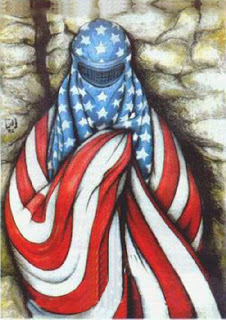
BurkaRedWhitandBlue-vi

The Freedom and Religion Party under President Al-Thani continues to take the position that American prosperity is closely linked to the welfare of the rest of the Muslim world. In the State of the Union address the president stated that, “We cannot repeat the folly of the Americans of the pagan period who believed that they could have material wealth without religion. Our prosperity comes from Allah and it is only by spreading the way of Allah and conducting our Jihad in the way of Allah on behalf of our endangered brothers and sisters in Europe and Asia that we will be deserving of Allah’s bounty.”

Hoping to exploit the widespread economic dissatisfaction, Hamdani, a former Wisconsin governor, has promised to withdraw troops from Greece within two years and the Netherlands within five years with the majority of remaining liberation forces being drawn from other Muslim countries. “We can best aid our fellow believers in the Muslim world by being a model of stability and a beacon of tolerance.”

Yusuf Al-Amiriki, a member of Hamdini’s foreign policy defense team and a first generation convert descended from two American presidents, courted controversy with a proposal to set up a coalition government of Muslim and moderate Christian groups in the Netherlands. Such governments had been tried in Europe before during the 2030’s, but invariably fell apart. Leading Senators from the Freedom and Justice Party accused Hamdani of selling out Muslim interests in order to court the Christian vote. Hamdani’s spokeswoman, Aisha Zubedi, has refused to comment on the Amiriki proposal except to say that Hamdani was open to any solution that would restore peace to the people of the Netherlands and protect the rights of European Muslims.

Hamdani courted further controversy by appearing at the funeral of former President Bob Thompson. Thompson had served two terms and while his administration had worked hard on outreach to the Muslim world, he also engaged in the targeted murder of Muslim religious leaders and provided aid to the Zionist entity. For these reasons, President Al-Thani chose not to appear at his funeral even though President Thompson had been a member of the pre-transition Freedom and Religion Party, which was then known as the Republican Party.

Despite the official disapproval, Thompson was viewed positively by many in the Muslim community. Tens of millions of Pakistani-Americans remember how after the India-Pakistan war, the Thompson Administration generously opened its borders to victims of the nuclear fallout in Pakistan. Without that step it might have taken decades more before America achieved a Muslim majority.

During the beginning of his second term, Thompson became the first president to take the oath of office on both a Bible and a Koran declaring that he wanted to make no separation between the books of god. At the Thompson funeral, Hamdani appeared to promise that he would repeat that gesture, but his spokeswoman quickly disavowed any notion that he would ever take an oath on a text that was not the Koran.

“No American president has taken an oath on a bible in over a decade, all that the governor meant was that he would keep both Christians and Muslims in mind as the people of Allah when he takes his oath to protect and defend the Sharia,” Aisha Zubedi said.

While the Democracy and Justice Party has often appealed to the poor, its missteps have raised concerns in traditional Muslim communities that Hamdani is going too far in pandering to non-Muslims. “Next thing you know he’ll say we should let the Jews come back to America,” Congressman Mohammed Mogabe declared. “If Hamdani wants votes out of Cleveland then he is going to show he will fight for us, not for the enemies of the prophets.”

Hamdani has hurriedly scheduled an upcoming visit to the Ground Zero Mosque, but it may not be enough to improve his image in the eyes those who have accused him of flirting with apostasy. While the Mosque is a traditional stop for presidential candidates, Hamdani is unlikely to pay tribute to the souls of the 19 martyrs as Al-Thani did during the previous election.

Hoping to refocus attention on his economic program, Hamdani called for higher corporate taxes and accused some corporations of abusing Islamic banking, in particular Hibah payments, to avoid paying taxes. Such charges are not new, but particularly galling at a time when over half the country is out of work and tycoons like Ahmed Shalafi and Sheikh Johnson have used their connections with the Al-Thani government to become billionaires.

To counter Hamdani, Al-Thani’s economic advisers have offered up a stimulus plan that raises the Jizya tax on infidels for the second time in a year and vowed to cut spending even further without affecting subsidies to Islamic schools or military preparedness for the Global Jihad. Though the election is still some time away, the Al-Thani campaign has also rolled out a series of ads targeting poor communities which accuse Hamdani of plotting with Jewish and Christian tycoons to subvert the Islamic system of finance through freemasonry and Communist class warfare tactics.

americanislam

Adding further drama to the election is the possibility of a third party campaign. Andrew McMillan who has been running as an independent in elections for almost twenty years without appealing to anyone but the same racist groups who have been disavowed even by most Christians and Jews, but there is talk that McMillan’s America Party might consider replacing the eccentric millionaire with sports star Ted March. As leading goalscorer who helped the United States win the 2042 World Cup, March is one of the most admired non-Muslims in the country. With him on the ticket, the America Party might be able to adopt a new moderate image that is no longer associated with bigotry and intolerance. But frustrating his own party members, the septuagenarian McMillan appeared to an event commemorating the 2045 riots and gave a rousing speech which hit on many of the same old themes. “For thirty-six years I’ve been involved in politics and the only thing that I can tell you about politics is that it’s all bunk. We weren’t talking about the things that mattered thirty-six years ago and we aren’t talking about them now.”

Unnecessary loss of life – The deadly price of politically correct rules of engagement.

September 30, 2015

Unnecessary loss of life – The deadly price of politically correct rules of engagement.

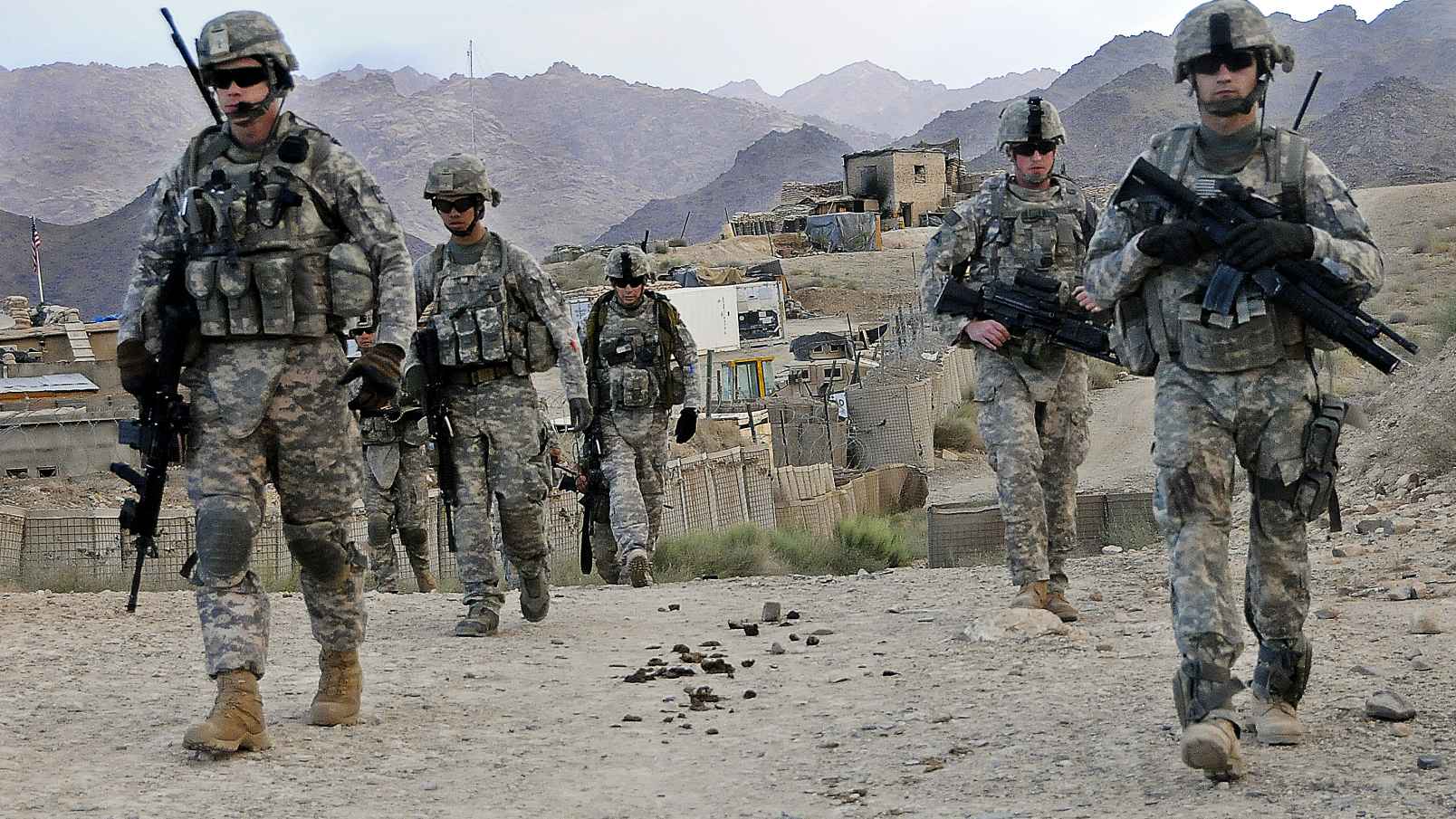
afghanistan_-_american_soldiers_fob_baylough

War is nasty, brutal and costly. In our latest wars, many of the casualties suffered by American troops are a direct result of their having to obey rules of engagement created by politicians who have never set foot on — or even seen — a battlefield. Today’s battlefield commanders must be alert to the media and do-gooders who are all too ready to demonize troops involved in a battle that produces noncombatant deaths, so-called collateral damage.

According to a Western Journalism article by Leigh H Bravo, “Insanity: The Rules of Engagement” (http://tinyurl.com/p59nlqs), our troops fighting in Afghanistan cannot do night or surprise searches. Also, villagers must be warned prior to searches. Troops may not fire at the enemy unless fired upon. U.S. forces cannot engage the enemy if civilians are present. And only women can search women. Retired Air Force Lt. Gen. Thomas McInerney said: “We handcuffed our troops in combat needlessly. This was very harmful to our men and has never been done in U.S combat operations that I know of.” Collateral damage and the unintentional killing of civilians are a consequence of war. But the question we should ask is: Are our troops’ lives less important than the inevitable collateral damage?

The unnecessary loss of life and casualties that result from politically correct rules of engagement are about to be magnified in future conflicts by mindless efforts to put women in combat units. In 2013, then-Defense Secretary Leon Panetta officially lifted the ban on women serving in ground combat roles. On Jan. 1, 2016, all branches of the military must either open all positions to women or request exceptions. That boils down to having women serve in combat roles, because any commander requesting exceptions would risk having his career terminated in the wake of the screeching and accusations of sexism that would surely ensue.

The U.S. Army has announced that for the first time, two female officers graduated from the exceptionally tough three-phase Ranger course.

Their “success” will serve as grist for the mills of those who argue for women in combat. Unlike most of their fellow soldiers, these two women had to recycle because they had failed certain phases of the course.

A recent Marine Corps force integration study concluded that combat teams were less effective when they included women. Overall, the report says, all-male teams and crews outperformed mixed-gender ones on 93 out of 134 tasks evaluated. All-male teams were universally faster “in each tactical movement.” The report also says that female Marines had higher rates of injury throughout the experiment.

Should anyone be surprised by the findings of male combat superiority? Young men are overloaded with testosterone, which produces hostility, aggression and competitiveness. Such a physical characteristic produces sometimes-poor behavior in civilian society, occasionally leading to imprisonment, but the same characteristics are ideal for ground combat situations.

You may bet the rent money that the current effort to integrate combat jobs will not end with simply a few extraordinary women. Secretary of the Navy Ray Mabus told the Navy Times that once women start attending SEAL training, it would make sense to examine the standards. He said, “First we’re going to make sure there are standards” and “they’re gender-neutral.” Only after that will the Navy make sure the standards “have something to do with the job.” We’ve heard that before in matters of race. It’s called disparate impact. That is, if the Navy SEALs cannot prove that staying up for 18 hours with no rest or sleep, sitting and shivering in the cold Pacific Ocean, running with a huge log on your shoulder, and being spoken to like a dog are necessary, then those parts of SEAL training will be eliminated so that women can pass.

The most disgusting, perhaps traitorous, aspect of all this is the overall timidity of military commanders, most of whom, despite knowing better, will only publicly criticize the idea of putting women in combat after they retire from service.

Ben Carson exposes Islamic taqiyya and gets attacked for it by leftist media

September 25, 2015

Ben Carson exposes Islamic taqiyya and gets attacked for it by leftist media, Front Page MagazineRaymond Ibrahim, September 25, 2015

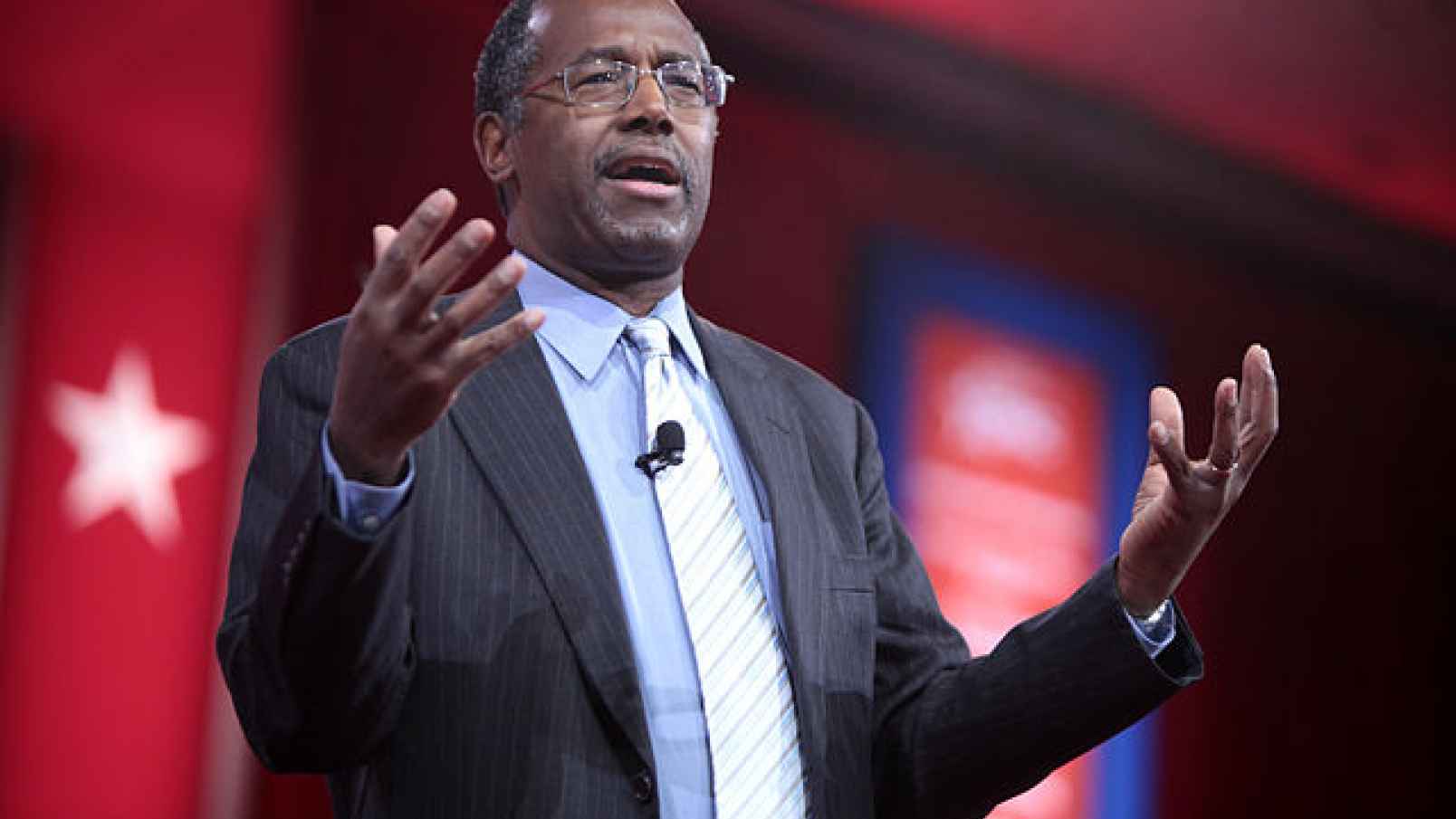
ben_carson_by_gage_skidmore_4

Originally published by PJ Media.

Raymond Ibrahim is a Shillman Fellow at the David Horowitz freedom Center.

Of all the points presidential candidate Ben Carson made in defense of his position that he “would not advocate that we put a Muslim in charge of this nation,” most poignant is his reference to taqiyya, one of Islam’s doctrines of deception.

According to Carson, whoever becomes president should be “sworn in on a stack of Bibles, not a Koran”:

“I do not believe Sharia is consistent with the Constitution of this country,” Carson said, referencing the Islamic law derived from the Koran and traditions of Islam. “Muslims feel that their religion is very much a part of your public life and what you do as a public official, and that’s inconsistent with our principles and our Constitution.”

Carson said that the only exception he’d make would be if the Muslim running for office “publicly rejected all the tenants of Sharia and lived a life consistent with that.”

“Then I wouldn’t have any problem,” he said.

However, on several occasions Carson mentioned “Taqiyya,” a practice in the Shia Islam denomination in which a Muslim can mislead nonbelievers about the nature of their faith to avoid religious persecution.

“Taqiyya is a component of Shia that allows, and even encourages you to lie to achieve your goals,” Carson said.

There’s much to be said here.  First, considering that the current U.S. president has expunged all reference to Islam in security documents and would have Americans believe that Islamic doctrine is more or less like Christianity, it is certainly refreshing to see a presidential candidate referencing a little known but critically important Muslim doctrine.

As for the widely cited notion that taqiyya is a Shia doctrine, this needs to be corrected, as it lets the world’s vast majority of Muslims, the Sunnis, off the hook.  According to Sami Mukaram, one of the world’s foremost authorities on taqiyya,

Taqiyya is of fundamental importance in Islam. Practically every Islamic sect agrees to it and practices it … We can go so far as to say that the practice of taqiyya is mainstream in Islam, and that those few sects not practicing it diverge from the mainstream … Taqiyya is very prevalent in Islamic politics, especially in the modern era.

Taqiyya is often associated with the Shias because, as a persecuted minority group interspersed among their Sunni rivals, they have historically had more reason to dissemble. Today, however, Sunnis living in the West find themselves in the place of the Shia. Now they are the minority surrounded by their historic enemies—Western “infidels”—and so they too have plenty of occasion to employ taqiyya.

Nor would making Muslims swear on Bibles be very effective. As long as their allegiance to Islam is secure in their hearts, Muslims can behave like non-Muslims—including by praying before Christian icons, wearing crosses, and making the sign of the cross—anything short of actually killing a Muslim, which is when the taqiyya goes too far (hence why Muslims in the U.S. military often expose their true loyalties when they finally reach the point of having to fight fellow Muslims in foreign nations).

For those with a discerning eye, taqiyya is all around us.  Whether Muslim refugees pretending to convert to Christianity (past and present), or whether an Islamic gunman gaining entrance inside a church by feigning interest in Christian prayers—examples abound on a daily basis.

Consider the following anecdote from Turkey.  In order to get close enough to a Christian pastor to assassinate him, a group of Muslims, including three women, feigned interest in Christianity, attended his church, and even participated in baptism ceremonies.

“These people had infiltrated our church and collected information about me, my family and the church and were preparing an attack against us,” said the pastor in question, Emre Karaali: “Two of them attended our church for over a year and they were like family.”

If some Muslims are willing to go to such lengths to eliminate the already downtrodden Christian minorities in their midst—attending churches and baptisms and becoming “like family” to those “infidels” they intend to kill—does anyone doubt that a taqiyya-practicing Muslim presidential candidate might have no reservations about swearing on a stack of Bibles?

Precedents for such treachery litter the whole of Islamic history—and begin with the Muslim prophet himself: During the Battle of the Trench (627 AD), which pitted Muhammad and his followers against several non-Muslim tribes collectively known as “the Confederates,” a Confederate called Naim bin Masud went to the Muslim camp and converted to Islam. When Muhammad discovered the Confederates were unaware of Masud’s deflection to Islam, he counseled him to return and try somehow to get his tribesmen to abandon the siege. “For war is deceit,” Muhammad assured him.

Masud returned to the Confederates without their knowledge that he had switched sides and began giving his former kin and allies bad advice. He also intentionally instigated quarrels between the various tribes until, thoroughly distrusting each other, they disbanded and lifted the siege, allowing an embryonic Islam to grow.  (One Muslim website extols this incident for being illustrative of how Muslims can subvert non-Muslims.)

In short, if a Muslim were running for president of the U.S. in the hopes of ultimately subverting America to Islam, he could, in Carson’s words, easily be “sworn in on a stack of Bibles, not a Koran” and “publicly reject all the tenants of Sharia.”  Indeed, he could claim to be a Christian and attend church every week.

It speaks very well about Carson that he is aware of—and not hesitant to mention—taqiyya.  But that doctrine’s full ramifications—how much deceiving it truly allows and for all Muslim denominations, not just the Shia—needs to be more widely embraced.

The chances of that happening are dim.  Already “mainstream media” like the Washington Post are taking Carson to task for “misunderstanding” taqiyya—that is, for daring to be critical of anything Islamic.  These outlets could benefit from learning more about Islam and deception per the below links:

  • My expert testimony used in a court case to refute “taqiyya about taqiyya.”
  • The even more elastic doctrine of tawriya, which allows Muslims to deceive fellow Muslims by lying “creatively.”
  • My 2008 essay, “Islam’s Doctrines of Deception,” commissioned and published by Jane’s Islamic Affairs Analyst.
  • Recent examples of how onetime good Muslim neighbors turn violent once they grow in strength and numbers.

Iran Openly Declares That It Intends To Violate UNSCR 2231 That Endorses The JCPOA

September 23, 2015

Iran Openly Declares That It Intends To Violate UNSCR 2231 That Endorses The JCPOA, Middle East Media Research Institute, September 22, 2015

(Please see also, Iran wants to renegotiate parts of the nuke “deal.” That may be good. Iran’s declaration that it intends to violate UNSCR 2231, dealing with missile development and related sanctions, should further prompt the U.S. Congress to repudiate the “deal.”– DM)

When the Americans moved the sanctions on the missile program to UNSCR 2231, Iran did not object, as, according to their statements above, they can violate Security Council resolutions, as they have done in the past, and this will not be regarded as a violation of the JCPOA.

**************************

In statements, three Iranian leaders – President Hassan Rohani, Foreign Minister Zarif, and Deputy Foreign Minister and senior negotiator Abbas Araghchi – emphasized that Iran has no intention of abiding by UNSRC 2231, which includes the JCPOA and another element; rather, that they will abide only by the original JCPOA.

The Iran nuclear deal consists of the following:

A.   A set of understandings between Iran and the P5+1 powers (as well as the remaining disagreements) all in a single package called the JCPOA. It is not a contract between Iran and the P5+1 countries as a group or any single one of them, and hence no document was signed.

B.   This set of mutual understandings (as well as disagreements) packaged in the JCPOA was transferred, following the conclusion of negotiations in Vienna on July 14, 2015, to the UN Security Council, for endorsement as a UN Security Council resolution. The resolution, UNSCR 2231, was passed on July 25, 2015 and it includes, in addition to the JCPOA, another element (Annex B) with further stipulations regarding Iran. For example, it addresses the sanctions on Iran’s missile development project.

To understand why UNSCR 2231 is structured in this way, we can look at statements by top Iranian negotiators about the process that led up to it:

In a July 20, 2015 interview on Iranian Channel 2, Iranian Deputy Foreign Minister and senior negotiator Abbas Araghchi said that there had been tough bargaining between the Iranian and American delegations over the issue of the arms embargo on Iran and the sanctions related to Iran’s missile development project. “The Americans sought their inclusion in the JCPOA, claiming that otherwise they could not face criticism from Arab countries in the region. When they said that they could not lift the sanctions altogether, we told them explicitly that in that case there is no agreement. We told them that the national security issues are non-negotiable and that we will not accept an agreement which continues the embargo on weapons and the sanctions on missile development. In the end, the Americans said, We will put the issue of the embargo and the missiles in the UN Security Council Resolution separate from the agreement.”

In the same interview, Araghchi was asked whether Iran could refrain from carrying out UNSCR 2231; he replied: “Yes we can; just as we refrained from complying with UN Security Council resolutions, we can do so with regards to 2231.”

Araghchi also referred to the Iranian Foreign Ministry statement issued following the passage of UNSCR 2231: “The Iranian Foreign Ministry statement explicitly noted that Iran does not attach legitimacy to any restriction and any threat. If UNSCR 2231 will be violated by Iran, it will be a violation of the Security Council resolution and not of the JCPOA, similar to what happened 10 years ago when we violated Security Council resolutions and nothing happened. The text of the JCPOA notes the fact that the content of the JCPOA and of the UN Security Council resolution are two separate things.”[1]

Foreign Minister Zarif, in an August 9, 2015 media interview, reiterated the Iranian position regarding the difference between the JCPOA and UNSCR 2231, with a focus on the consequences of possible violation of the two by Iran. He said: “There is a difference between the JCPOA and UNSCR 2231. Violating the JCPOA has consequences, while violating UNSCR 2231 has no consequences.”[2]

Indeed, the restrictions regarding missiles are mentioned only in UNSCR 2231, and not in the JCPOA.

On August 29, 2015, Iranian President Hassan Rohani said: “There is nothing about the topic of missiles, defense, and weapons in the JCPOA.  Whatever we have about it is in Resolution [UNSCR] 2231… Moreover, we have formally announced that we are not committed to all the sections that appear in the resolution [2231], and we specified in the JCPOA that violation of the resolution [2231] does not mean violation of the JCPOA…[3]

The meaning of all this is that in everything related to the issue of missile development, Iran will disregard UNSCR 2231. Already during the negotiations, it insisted on no imposition of sanctions on Iran regarding its missile development (and no sanctions at all). When the Americans moved the sanctions on the missile program to UNSCR 2231, Iran did not object, as, according to their statements above, they can violate Security Council resolutions, as they have done in the past, and this will not be regarded as a violation of the JCPOA.

Endnotes:

[1] ISNA.ir/fa/news/94042915462/%D9%85%D9%85%D9%86%D9%88%D8%B9%DB%8C%D8%AA-%D9%87%D8%A7%DB%8C-%D8%AA%D8%B3%D9%84%DB%8C%D8%AD%D8%A7%D8%AA%DB%8C-%D9%88-%D9%85%D9%88%D8%B4%DA%A9%DB%8C-%D8%A8%D9%87- .

[2] Foreign Minister Javad Zarif said this at an August 9, 2015 conference sponsored by the Iranian daily Ittil’atwith other senior negotiators in attendance. See text in Farsi here.

[3] President.ir/fa/89047, August 30, 2015.

Ben Carson in CAIR’s crosshairs

September 21, 2015

Ben Carson in CAIR’s crosshairs, Front Page MagazineRobert Spencer, September 21, 2015

(Isn’t it shameful that Dr. Carson is a politically incorrect “Islamophobe?” What is that, anyway?

Don’t we want another a Muslim in the White House? Then Obama could be truly proud of America. What could possibly go wrong? — DM)

ben-carson

Carson was right. But now the media sharks, ever eager to do the bidding of Hamas-linked CAIR and other Islamic supremacists, will be circling – and hungry. If he is forced to drop out for saying things CAIR doesn’t like, it will be just one more nail in the coffin of the free society that CAIR disingenuously professes to love and support, but which it is actually doing all it can to subvert.

****************************

If Ibrahim Hooper of the Hamas-linked Council on American-Islamic Relations (CAIR) has any say in the matter, whoever the next President is, it won’t be Ben Carson. “He is not qualified to be president of the United States,” fumed CAIR’s Ibrahim Hooper, no doubt an unimpeachable authority on who is and is not qualified to be President, on Sunday. “You cannot hold these kinds of views and at the same time say you will represent all Americans, of all faiths and backgrounds.” What views? Carson said: “I would not advocate that we put a Muslim in charge of this nation. I absolutely would not agree with that.” He said that this was because Islam contradicted important Constitutional principles.

CAIR, designated a terror organization by the United Arab Emirates, sent out an email Sunday saying it would hold a news conference demanding that Carson withdraw from the presidential race for daring to say these things. “Mr. Carson clearly does not understand or care about the Constitution, which states that ‘no religious test shall ever be required as a qualification to any office,’” said CAIR top dog Nihad Awad. “We call on our nation’s political leaders – across the political spectrum – to repudiate these unconstitutional and un-American statements and for Mr. Carson to withdraw from the presidential race.”

But the problems with a Muslim being President aren’t religious, they’re political. Islamic law infringes upon the freedom of speech, forbidding criticism of Islam. Islamic law denies equality of rights to women. Islamic law denies equality of rights to non-Muslims. If a Muslim renounced all this, he or she could be an effective Constitutional ruler, but in today’s politically correct climate, no one is even likely to ask for such a renunciation. Instead, no one even acknowledges that these really are elements of Islamic law.

No one, that is, except the Muslim clerics who agree with Carson. Syrian Islamic scholar Abd Al-Karim Bakkar said in March 2009: “Democracy runs counter to Islam on several issues….In democracy, legislation is the prerogative of the people. It is the people who draw up the constitution, and they have the authority to amend it as well. On this issue we differ” — because in Islamic thought, only Allah legislates.

Abd Al-Karim Bakkar was reflecting a common view. Pakistan Muslim leader Sufi Muhammad said in May 2009: “I would not offer prayer behind anyone who would seek to justify democracy.” Mesbah Yazdi, leader of the Shia Taliban in Iran, said in September 2010 that “democracy, freedom, and human rights have no place” — in Islam, that is. Australian Muslim cleric Ibrahim Saddiq Conlan said in June 2011: “Democracy is evil, the parliament is evil and legislation is evil.”

In January 2013, the Saudi Islamic scholar Sheikh Abdul Rahman bin Nassir Al Barrak declared: “Electing a president or another form of leadership or council members is prohibited in Islam as it has been introduced by the enemies of Moslems.” The idea of popular elections, he said, “has been brought by the anti-Islam parties who have occupied Moslem land.”

Some Muslims in the West hold these views as well. In April 2015, Muslims in Wales plastered Cardiff with posters reading: “Democracy is a system whereby man violates the right of Allah and decides what is permissible or impermissible for mankind, based solely on their whims and desires. This leads to a decayed and degraded society where crime and immorality becomes widespread and injustice becomes the norm. Islam is the only real, working solution for the UK. It is a comprehensive system of governance where the laws of Allah are implemented and justice is observed.”

And two Muslim groups in Denmark last June called on Muslims to boycott the elections that were held that month. One explained: “We are committed to being active participants in our society, but it has to be on Islam’s terms, without compromising our own principles and values. Democracy is fundamentally incompatible with Islam, and it is a sinking ship.” The Grimshøj mosque in Aarhus agreed, issuing a statement saying that “people should stay clear of the voting booths. We have concluded that only Allah can pass laws, as he says himself in the Koran that this is so.”

Tunisian author Salem Ben Ammar wrote last month: “‘To hell with democracy! Long live Islam!’ One hundred percent of Muslims agree with that. To say anything else is apostasy from Islam. These two competing political systems are antithetical to each other. You can’t be democratic and be a Muslim or a Muslim and be a democrat. A Jew can’t be a Nazi and a Nazi can’t be a Judeophile.”

Question for Hamas-linked CAIR’s Hooper and Awad: are all these Muslims “Islamophobes” for saying that Islam and democracy are incompatible, or is that honor reserved only for Carson (and other infidels)? And are either or both of you cognizant of the irony of pretending to uphold Constitutional values while demanding that a man drop out of the Presidential race for the crime of exercising his freedom of speech? Are either or both of you aware that you have thereby just become poster children for how correct Ben Carson really was?

Carson was right. But now the media sharks, ever eager to do the bidding of Hamas-linked CAIR and other Islamic supremacists, will be circling – and hungry. If he is forced to drop out for saying things CAIR doesn’t like, it will be just one more nail in the coffin of the free society that CAIR disingenuously professes to love and support, but which it is actually doing all it can to subvert.

Off topic (?) | To bring America back we need to break some stuff

September 15, 2015

To bring America back we need to break some stuff, Dan Miller’s Blog, September 14, 2015

(The article is not immediately pertinent to Israel because the current President will continue to be Obama and his tame Congress will continue to go along to get along. However, the 2016 U.S. presidential elections are very pertinent to Israel’s future, so I am taking the liberty of posting it here. For those not familiar with the acronym “RINO,” it is a term of disparagement referring to Republicans who would probably be happier if they were Democrats. Needless to say, the views expressed in the article are mine and do not necessarily reflect those of Warsclerotic or its other editors. — DM)

In December of 2011, I wrote an article titled The U.S. Constitution and Civil War. A remark by Cokie Roberts — that we need to ignore parts of the Constitution to save the rest — inspired my article. To bring America back, we don’t need to, nor should we, ignore or otherwise break the Constitution; it is America’s foundation. We do need to destroy and rebuild much of the mess that has been wrongly erected atop that foundation.

Obama and Constitution

Who should be our next President?

Daniel Greenfield, in an article titled This is the America We Live in Now, wrote,

We are not this culture. We are not our media. We are not our politicians. We are better than that.

We must win, but we must also remember what it is we hope to win. If we forget that, we lose. If we forget that, we will embrace dead end policies that cannot restore hope or bring victory.

What we have now is not a movement because we have not defined what it is we hope to win. We have built reactive movements to stave off despair. We must do better than that. We must not settle for striving to restore some idealized lost world. Instead we must dream big. We must think of the nation we want and of the civilization we want to live in and what it will take to build it. [Emphasis added.]

Our enemies have set out big goals. We must set out bigger ones. We must become more than conservatives. If we remain conservatives, then all we will have is the America we live in now. And even if our children and grandchildren become conservatives, that is the culture and nation they will fight to conserve. We must become revolutionaries. [Emphasis added.]

If we don’t, perhaps we should surrender and petition to join the European Union. Our unelected and unaccountable bureaucracy could merge with that of the EU and our Congress could merge with the impotent EU Parliament.

Joining the EU would not fit well with the U.S. Constitution, but so what? Obama and “pragmatic” judges have twisted and distorted it. They pay but scant attention to its clear language or that of the statutes they misconstrue. Most in the current crop of Republicans in the Congress have been willing to surrender whenever Obama blows His dog whistle and run to Him with hopes that He may offer them small bones.

Our once great nation is itself broken, but not necessarily beyond repair. It needs to be fixed before it gets to the point where it can’t be, and we are rapidly approaching that point. Our Constitution must be revived, and as revived survive, if America herself is to survive. America can’t be fixed with fresh paint and new floral arrangements featuring a “new” Bush.

When Ronald Reagan was first mentioned as a possible Republican presidential candidate, my first thought was that we don’t need a washed-up grade B movie actor/former Democrat leftist as President. I was wrong. He became the best President America has seen in my thus far seventy-four years on Earth. We need another Reagan, but who should it be? There are only a few good candidates and the Republican establishment opposes, with such insipid vigor as it can muster, all of them. It wants Jeb Bush, or in any event a Bush clone, to march stolidly toward a new Amerika.

Donald Trump

The mainstream media cannot understand why Trump continues to lead in the polls. Neither can the RINOs. Trump can’t possibly continue to lead; why, he is not even a politician! On September 12th, Sharyl Attkisson posted an article titled Donald’s Duck: 7 Reasons Why Nothing Sticks to Teflon Trump. In it, she explored seven of the reasons why it is claimed that Trump “can’t win.”

1. Trump doesn’t know the names of terror leaders.

2. Trump doesn’t have a plan.

3. Trump isn’t conservative enough.

4. Trump has flip-flopped.

5. Trump personally insults people.

6. Trump is against immigrants.

7. Trump won’t apologize.

Please read her analysis pointing out the fallacies behind these talking points as seen by Trump supporters; I think they are correct.

On September 13th Sundance, writing at The Last Refuge, posted an article titled The GOPe Roadmap, Status Update and The Event Horizon… There, he pointed out the RINOs’ multifaceted plan to defeat Trump and to install Jeb Bush as “our” next President. Jeb wants to lead us to more of the same namby-pamby nonsense that gave us Obama, the “great healer.” I don’t want to go there and want to stay as far away from there as possible. Please read Sundance’s article in its entirety. It’s excellent and so is this sequel about the upcoming CNN debate and the night of the long knives.

What will Trump do if elected?

I don’t know what Trump will do if elected President. He probably can’t make things worse, will try very hard to make them better and may well succeed. Please watch “lunatic” Trump respond to questions during this interview.

The only thing I am confident that the RINO candidates would do is to continue America’s collective swirl down the toilet. I very much like Ted Cruz (he would also be an excellent Secretary of State) and Ben Carson (Secretary of Health and Human Services?). Carina Fiorina? I like her thus far but need to learn more.

Trump has captured the public attention and, in many cases, its admiration and trust. Apparently many of his supporters feel as I do and are “mad as hell and don’t want to take it anymore.”

Please compare and contrast these Obama and Hillary campaign videos:

Obama won His last two elections by campaigning for change “we” can believe in. Trump has thus far campaigned for change those who think America was great before Obama got to mucking around with her do believe in and want to have implemented.

Much is yet unknown about where and how Trump will lead the nation as her President. One thing seems clear, at least to me: he will discard that which is broken and replace it with what we need. So long as he does not muck around with the Constitution (as Obama has done with abandon), I think we should give him an opportunity to try.

gop-elite

H/t Vermont Loon Watch

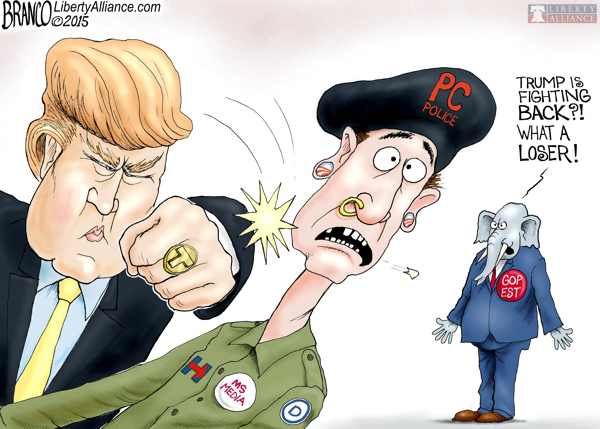
trump-punch-600-la

H/t Kingjester’s Blog

Our World: The Republican fall guys

September 9, 2015

Our World: The Republican fall guys, Jerusalem Post, Caroline Glick, September 8, 2015

Whenever the Iranians leave, they can be depended on to blame US for their decision to vacate their signature. And the Democrats in turn will blame the Republicans for pushing the Iranians over the edge.

***********************

The ayatollahs will ride their nuclear pact with the Great Satan all the way to a nuclear arsenal and regional hegemony, repeating the cycles of brinksmanship, extortion, respite and brinksmanship that they learned from their North Korean teachers.

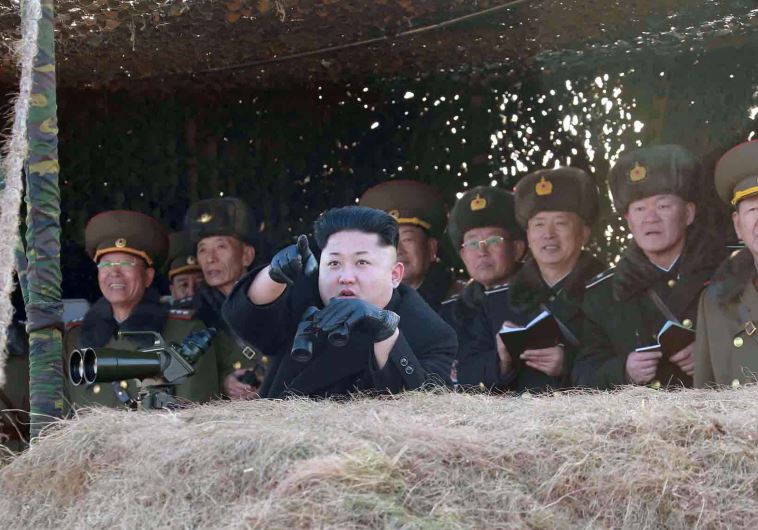
ShowImage (11)Kim Jong-un, North Korea leader. (photo credit:KNS / KCNA / AFP)

The Iran nuclear deal is presented as an international agreement between the major powers and Iran. But the fact is that there are really only two parties to the agreement – President Barack Obama and his Democratic Party on the one hand, and the Iranian regime on the other.

Over the past week or so, more and more Democrats have fallen into line behind Obama. At the same time, word is getting out about what Iran is doing now that it has its deal. Together, the actions of both sides have revealed the role the nuclear pact plays in each side’s overall strategies for success.

On the Iranian side, last Wednesday the National Committee of Resistance of Iran revealed that North Korean nuclear experts are in Iran working with the Revolutionary Guards to help the Iranians prevent the UN’s nuclear inspectors from discovering the scope of their nuclear activities.

The NCRI is the same opposition group that in 2003 exposed Iran’s until then secret uranium enrichment installation in Natanz and its heavy water plutonium facility in Arak.

According to the report, the North Koreans “have expertise in ballistic missile and nuclear work areas, particularly in the field of warheads and missile guidance.”

“Over the past two years the North Korean teams have been sharing their experiences and tactics necessary for preventing access to military nuclear sites,” NCRI added.

Although, as The Washington Times reports, NCRI’s finding have yet to be verified, it is unwise to doubt them.

North Korea has been assisting Iran’s nuclear program for nearly 20 years. The US began applying sanctions on North Korea for its ballistic missile proliferation activities in Iran 15 years ago. Iran’s Shahab and Ghadr ballistic missiles are modeled on North Korea’s Nodong missiles.

The Syrian nuclear installation that Israel reportedly destroyed in 2007 was a duplicate of the Yangbyon heavy water reactor in North Korea. The Deir al-Zour reactor was reportedly built by North Korean nuclear personnel and paid for by Tehran.

North Korea’s heavy involvement in Iran’s nuclear weapons program tells us everything we need to know about how Iran views the nuclear deal it signed with the Obama administration and its international partners.

For the past 22 years, the North Koreans have been playing the US and the international community for fools. Ever since February 1993, when inspectors from the International Atomic Energy Agency first discovered that North Korea was conducting illicit nuclear activities, Pyongyang has been using its nuclear program to blackmail the US.

The pattern repeats itself with maddening regularity.

First, the US discovers that North Korea is engaging in illicit nuclear activities. Over the years, these activities have gone from illicit development of plutonium-based nuclear bombs to expelling UN inspectors, to testing long-range ballistic missiles, to threatening nuclear war, to testing nuclear bombs and threatening to supply the bomb to terrorist groups.

Second, the US announces it is applying sanctions to North Korean entities.

Third, North Korea responds with more threats.

The sides then agree to sit down and negotiate the scaling back of North Korea’s nuclear activities. In exchange for Pyongyang’s agreement to talk, the US provides the hermit slave state with whatever it demands. US concessions run the gamut from sanctions relief, to cash payments, provision of fuel, assistance in developing “peaceful” nuclear sites at which the North Koreans expand their nuclear expertise, removal of North Korea from the State Department’s list of state sponsors of terrorism, the provision of formal US commitments not to use force to block North Korea’s nuclear progress, to more cash payments and sanctions relief.

The North then formally agrees to scale back its nuclear program and everyone is happy.

Until the next time it is caught cheating and proliferating.

And then the cycle starts again.

In each go around, the US expresses surprise at the scope of North Korea’s illicit nuclear and missile activities. In every cycle, US intelligence failed to discover what North Korea was doing until after the missiles and bombs were tested and UN inspectors were thrown out of the country.

Despite North Korean brinksmanship and ballistic missile warhead development, the US prohibits its ally South Korea from developing its own nuclear deterrent or even taking steps in that direction.

For their part, while negotiating with the Americans, the North Koreans have proliferated their nuclear technologies and ballistic missiles to Iran, Syria, Pakistan and Libya.

Given North Korea’s clear strategy of using nuclear blackmail to develop its nuclear arsenal and maintain the regime’s grip on power, you don’t need to be a master spy to understand what the presence of North Korean experts in Teheran tells us about Iran’s strategy for nuclear empowerment.

The ayatollahs will ride their nuclear pact with the Great Satan all the way to a nuclear arsenal and regional hegemony, repeating the cycles of brinksmanship, extortion, respite and brinksmanship that they learned from their North Korean teachers.

Given how well the strategy has worked for the psychotic North Koreans who have no economy, no allies and no proxies, it is clear that Iran, with its gas and oil deposits, imperial aspirations, terrorist proxies and educated population believes that this is the strategy that will launch it to world-power status.

This then brings us to the Democrats.

Depending on their pro-Israel protestations, the Democratic position in support of the deal ranges from optimism to pessimistic minimalism. On the side of the optimists, we have the Obama administration.

Obama, Secretary of State John Kerry and their advisors insist that the deal is fantastic. It blocks Iran’s path to the bomb. It opens the possibility of Iran becoming a positive actor on the world stage.

On the other end of the Democratic spectrum are the pessimists like New Jersey Senator Cory Booker and Congresswoman Debbie Wasserman-Schultz.

As they see it, the deal is horrible. It empowers and enriches Iran and legitimizes its nuclear program.

But still, they claim, the deal keeps Iran’s nuclear ambitions at bay for a few years by forcing Iran to submit to the much touted UN inspections regime.

So it is a good deal and they will vote in favor of it and then vote to sustain a presidential veto of a congressional decision to oppose it.

Obviously, the presence of North Korean nuclear experts in Tehran makes a mockery of the notion that Iran has any intention of exercising good faith with UN inspectors. But that isn’t the point.

The point is that the Democrats have no intention of doing anything to prevent Iran from becoming a nuclear power. They just don’t want to be blamed for Iran becoming a nuclear power. They want the Republicans to shoulder the blame. The purpose of the deal from their perspective to set the Republicans up to be blamed.

Obama and his Democratic followers insist that if Iran doesn’t act in good faith, the US will reimpose sanctions. Worse comes to worst, they insist, the US can just walk away from the deal.

This of course is utter nonsense.

Obama won’t walk away from his signature foreign policy. He will devote his energies in his remaining time in office to covering up for Iran. That is why he is breaking the law he signed and refusing to hand over the side deals regarding the farcical nature of UN inspections of Iran’s nuclear sites to Congress.

Moreover, after insisting that the deal is the best way to prevent a holocaust or that it is the only way a Jewish mother can protect the homeland of her people, Democratic lawmakers are not going to rush to acknowledge that they are lying. Now that they’ve signed onto the deal, they own it.

Of course, the Iranians are another story. While the Democrats will not abandon the deal no matter what, the Iranians signed the deal in order to abandon it the minute it outlives its usefulness. And that works just fine for the Democrats.

The Democrats know that the Iranians will use any step the Republicans take to try to enforce the deal’s verification regime or condition sanctions relief on Iranian abidance by the deal’s restrictions on its nuclear activities as an excuse to walk away from the deal. They also know the Iranians will remain in the deal as long as it is useful to them.

Since the Iranians intend to hide their nuclear activities, the Democrats assume Tehran will stay in until it is financially and militarily ready to escalate its nuclear activities.

The Democrats believe that timetable will extend well beyond the lifespan of the Obama administration.

Whenever the Iranians leave, they can be depended on to blame US for their decision to vacate their signature. And the Democrats in turn will blame the Republicans for pushing the Iranians over the edge.

You have to give credit to the administration and its Iranian chums. At least they are consistent. They have constructed an agreement that gives them both what they care about most. Iran, as always, wants to dominate the region and develop the means to destroy Israel and its Arab adversaries at will. The administration, as always, wants to blame the Republicans.

Israel and the Arabs understand the game that is being played. It is time for the Republicans to get wise to it.

Rep. Gohmert Introducing Resolution to Declare Iran Deal a Treaty

September 7, 2015

Rep. Gohmert Introducing Resolution to Declare Iran Deal a Treaty, Town HallCortney O’Brien, September 7, 2015

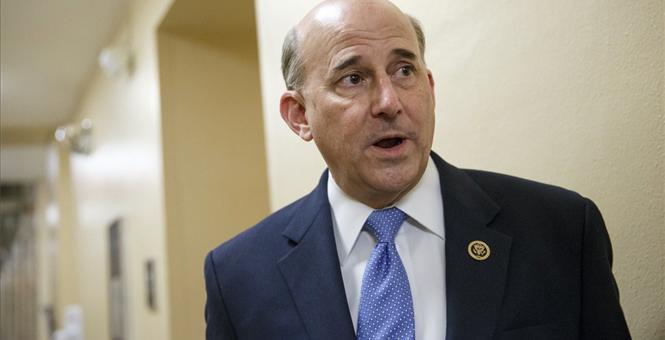
cda995d7-4ffe-417b-8d94-702f8bfdaa92

On March 11, 2015, Secretary of State John Kerry said the Obama administration was “not negotiating a legally binding plan” with Iran and therefore their nuclear agreement did not have to be submitted to Congress for approval. Rep. Louie Gohmert (R-TX) is ready to challenge that notion by putting forward a resolution that would define the Joint Comprehensive Plan of Action as a treaty.

The Corker-Cardin bill, a.k.a. the Iran Nuclear Agreement Review Act of 2015, was introduced as an accountability tool for the Iranian deal, requiring a ‘yes’ or ‘no’ vote from Congress. Yet, as more details about the Joint Comprehensive Plan Of Action (JCPOA) have surfaced, Corker and Cardin’s effort has become basically null, Rep. Gohmert is convinced. The Obama administration, he asserts, left Congress in the dark about the specifics of JCPOA. For instance, the Corker-Cardin bill was only meant to rein in nuclear sanctions, but JCPOA allows for a lifting of sanctions on ballistic missiles and international arms embargoes. Congress also had no clue about the side deals allowing Iran to inspect itself at nuclear sites.

In his resolution, Gohmert also exposes Secretary of State Kerry’s hypocrisy regarding his refusing to label the Iran deal a treaty.

Whereas, on June 4, 2015, less than two months before Secretary Kerry testified that it has become “physically impossible” for the Senate to ratify treaties, he stated that the State Department is “preparing the instruments of ratification of [several] important treaties” and that he “want[s] to personally thank the U.S. Congress . . . for their efforts on” the implementing legislation for the nuclear security treaties;

Gohmert is not the only legislator to demand the Iran agreement be defined as a treaty. Sen. Tom Cotton (R-AR), the only senator not to vote for the Corker-Cardin act, demanded the clarification be made back in May:

“A nuclear-arms agreement with any adversary—especially the terror-sponsoring, Islamist Iranian regime—should be submitted as a treaty and obtain a two-thirds majority vote in the Senate as required by the Constitution,” he said.

Such a consequential handshake should be accompanied by some oversight from our elected representatives. It’s what Americans want.

Should the resolution pass, Gohmert says the Senate should deliberate on the ratification of the Iran Deal within 30 days hence.

Kerry Promises Israel, Saudis Money In Wake of Iran Nuclear Deal

September 2, 2015

Kerry Promises Israel, Saudis Money In Wake of Iran Nuclear Deal, Washington Free Beacon, , September 2, 2015

U.S. Secretary of State John Kerry takes a drink during a news conference after the closed-door nuclear talks with Iran, in Vienna, Austria, Monday, Nov. 24, 2014. Facing still significant differences between the U.S. and Iran, negotiators gave up on last-minute efforts to get a nuclear deal by the Monday deadline and extended their talks for another seven months. The move gives both sides breathing space to work out an agreement but may be badly received by domestic sceptics, since it extends more than a decade of diplomatic efforts to curb Iran's nuclear prowess. (AP Photo/Ronald Zak)  (AP Photo/Ronald Zak)

“No amount of conventional weapons can neutralize the threat posed by the mullahs acquiring nuclear weapons,” the [congressional] source said. “This type of appeasement is a slap in the face to our closets allies and a wink-wink to the dictators in Tehran.”

****************

Secretary of State John Kerry on Wednesday moved to reassure Congress that Israel and America’s Gulf State allies would be fully taken care of in the wake of the Iran nuclear deal, which Kerry acknowledged would not stop Iran’s support for terrorism, according to a letter sent by the secretary of state to lawmakers.

Just moments after the White House secured enough votes to override a congressional veto of the Iran deal, a letter from Kerry appeared in the inboxes of congressional offices across Capitol Hill.

Kerry admits that, despite the deal, Iran will continue to back terrorist groups across the globe and promises to boost military support and funding to Israel and Gulf states such as Saudi Arabia, according to a copy of the letter obtained by the Washington Free Beacon.

The letter comes in response to concerns among lawmakers, Israel, and other Gulf region allies that the nuclear accord will boost the Islamic Republic’s support for terrorism, while leaving traditional U.S. allies on the defense.

“Important questions have been raised concerning the need to increase security assistance to our allies and partners in the region and to enhance our efforts to counter Iran’s destabilizing activities in the region,” Kerry writes. “We share the concern expressed by many in Congress regarding Iran’s continued support for terrorist and proxy groups throughout the region, its propping up of the Assad regime in Syria, its efforts to undermine the stability of its regional neighbors, and the threat it poses to Israel.”

The Obama administration, Kerry claims, is under “no illusion that this behavior will change following implementation of the JCPOA,” or Joint Comprehensive Plan of Action.

“The president has made clear that he views Israel’s security as sacrosanct, and he has ensured that the United States has backed up this message with concrete actions that have increased US military, intelligence, and security cooperation with Israel to their highest levels ever,” the letter states.

Kerry then goes on to outline the ways in which the Obama administration will enhance security cooperation with Israel and Gulf State allies.

Israel, for instance, will be the first country in the region to get a U.S.-made next-generation F-35 fighter aircraft in 2016.

An additional $3 billion in U.S. aid also will go to secure Israel’s missile defense programs, such as the Iron Dome system. The administration also stands ready “to enhance” funding to next-generation missile defense systems, such as Arrow-3 and David’s Sling.

The administration, Kerry writes, recently “offered Israel a $1.89 billion munitions resupply package that will replenish Israel’s inventories and will ensure its long-term continued access to sophisticated, state of the art precision guided munitions.”

The administration will additionally work to secure a new 10-year “Memorandum of Understanding” with the Jewish state that “would cement for the next decade our unprecedented levels of military assistance,” Kerry writes.

Kerry also proposes to collaborate with Israel on “tunnel detection and mapping technologies to provide Israel new capabilities to detect and destroy [terrorist] tunnels before the could be used to threaten Israeli civilians.”

President Barack Obama has further proposed to Prime Minister Benjamin Netanyahu that the two governments “begin the process aimed a further strengthening our efforts to confront conventional and asymmetric threats.”

Gulf States, such as Saudi Arabia and the United Arab Emirates (UAE), also will benefit from increased arms shipments and new security deals, according to Kerry.

The administration is “working to expedite the delivery of capabilities needed to deter and combat regional threats, including terrorism and Iran’s destabilizing activities in the region,” Kerry writes.

In July, for example, the administration notified Congress of new arms sales to Saudi Arabia and the UAE “that will provide long-term strategic defense capabilities and support for their ongoing operations,” the letter states.

Another goal is to strengthen ballistic missile defense capabilities in the region. This goal, Kerry says, “is a strategic imperative and an essential component to deterring Iranian aggression against any GCC member state.”

One senior Congressional aide who received the letter said that it is a clear attempt by the administration to placate regional fears about the deal.

“Let’s not be fooled about what the letter represents. This desperate move to placate Israel and our Gulf partners is a tacit acknowledgment that Iran will expand its international terror regime thanks to the nuclear agreement,” the source said. “If this is such a good deal, why does the administration feel compelled to immediately offer arms packages as compensation to our regional allies?”

“No amount of conventional weapons can neutralize the threat posed by the mullahs acquiring nuclear weapons,” the source said. “This type of appeasement is a slap in the face to our closets allies and a wink-wink to the dictators in Tehran.”