Andrew Klavan: Obama’s Nuclear Disaster, Truth Revolt, May 1, 2015
Clever new Rubio amendment to Corker’s Iran bill: The final deal must match this month’s WH “fact sheet” Hot Air, Allah Pundit, April 30, 2015
(Rubio has a good sense of humor. — DM)
Doesn’t matter which is true, says Marco Rubio. The White House gave us the “fact sheet.” They told us that Iran had agreed to those terms. Those terms should therefore be absolutely essential provisions in any final deal. If the White House is uncomfortable with that, it can only be because either (a) they lied on the “fact sheet” or (b) they told the truth but are prepared to cave to whatever new demands Iran’s come up with to wriggle free of its previously agreed-to obligations. In other words, Rubio’s going to make Obama and/or Iran live up to their own BS.
********************
You remember the “fact sheet,” don’t you? That’s the document the White House released on April 2nd, the day it reached a “framework” deal with Iran, describing the terms that Iran had allegedly agreed to. Snap nuclear inspections of all suspicious sites, a greatly reduced number of centrifuges, delayed sanctions relief until Iran satisfied its denuclearization obligations — it wasn’t half bad, and certainly better than what an Obama skeptic might have expected. The only problem: Apparently no one told Iran that this is the deal they had agreed to. Within a week, Iran’s supreme leader claimed the U.S. “fact sheet” was full of lies; Iran’s defense minister claimed the deal didn’t include inspection of military sites; and, most dramatically, Iran’s president claimed that all sanctions would need to be lifted on day one after a final deal, not gradually as Iran complied with its duties under the deal. Either Iran had suddenly gotten cold feet after the “framework” deal was struck and reneged on what it had promised John Kerry or … the “fact sheet” was itself filled with distortions about what Iran had actually agreed to, a political ploy designed to build support in the U.S. for a deal that was still secretly very much in flux.
Doesn’t matter which is true, says Marco Rubio. The White House gave us the “fact sheet.” They told us that Iran had agreed to those terms. Those terms should therefore be absolutely essential provisions in any final deal. If the White House is uncomfortable with that, it can only be because either (a) they lied on the “fact sheet” or (b) they told the truth but are prepared to cave to whatever new demands Iran’s come up with to wriggle free of its previously agreed-to obligations. In other words, Rubio’s going to make Obama and/or Iran live up to their own BS.
Rubio’s amendment simply quotes that fact sheet verbatim and says the president may not waive or lift any Congressional sanctions until he certifies Iran has met the White House conditions.
“For the life of me, I don’t understand why that would be controversial,” Rubio said Wednesday. “Yet somehow, I was told this would box the White House in.”…
Rubio’s fact-sheet amendment is different [from other GOP amendments]. It doesn’t challenge the presidential authority to sign an executive agreement. Republicans supported that power when their party controlled the White House. Rubio’s fact-sheet amendment is also germane to the Iran legislation before the Senate. An argument used against other amendments–like Rubio’s one on recognizing Israel–is that it asks Iran to meet conditions not related to the nuclear negotiations.
Rubio’s fact sheet amendment only asks Democrats to vote on whether a final Iran deal should meet the conditions as described by the leader of their own party. If Democrats vote that it should, then Obama may be forced to issue a veto over his own fact sheet as he seeks to make a final agreement more palatable to Iran. If the Democrats vote that it shouldn’t, then they will appear to be conceding the White House either misled the public or bungled the negotiations earlier this month.
It’s a clever tactic by a guy who, I think, has a knack for clever tactics. But … does it have a chance of ending up in the final Corker-written Senate bill on Iran? Obama can only be boxed in if Congress passes the bill with Rubio’s amendment attached, and the odds of that happening seem, shall we say, modest. The takeaway from my earlier post about his amendment on Israelis that there’s a strong bipartisan consensus in the Senate, backed by none other than AIPAC, that’s determined to protect Corker’s bill as written by defeating any amendments that might split the bipartisan coalition of senators that are currently lined up behind it. Rubio’s amendment could do that. If it ended up passing, Democrats would probably vote no on the final bill to prevent the “fact sheet” from tying Obama’s hands during the final negotiations with Iran, even though O himself claims Iran already agreed to everything in it. Without those Democratic votes, the bill would fail and Congress would be left with nothing. In theory that would supply the GOP with a nice talking point about the bill’s defeat — “Senate Dems were afraid to make Obama live up to his own rhetoric” — but in practice there are various RINOs who would likely give Democrats political cover by voting with them to kill Rubio’s amendment. For some Republicans, like Corker and Lindsey Graham, the most important thing is to pass some sort of bill that would grant Congress a vote on the final deal, even if it means sacrificing each and every amendment that might potentially inconvenience President Precious in his negotiations.
All of which is to say, how you feel about Rubio’s amendment depends mainly on how you feel about Corker’s bill. There’s no denying, as Ace says, that it’s a sham: Even if a bunch of Democrats join with the GOP now to pass it, guaranteeing a vote on the final deal with Iran this summer, it’s a cinch that at least 34 Senate Dems will vote yes when the time comes to approve that deal, ensuring that it’ll take effect. There’s no way they’ll stab Obama in the back on his greatest foreign policy “achievement” by helping the GOP to block it, which means all the talk of “bipartisanship” right now is, to borrow Ace’s phrase, “failure theater.” It’s bipartisan only as long as it doesn’t create headaches for Obama during negotiations; once it does, as Rubio’s amendment threatens to do, Democrats will go back to voting a (mostly) party line. The whole process is a kabuki designed to make it look like Republicans are doing something meaningful to stop the deal with Iran when in reality it’s entirely up to Reid’s Democrats whether it ends up being blocked or not. The only thing that hinges on whether the Senate passes Corker’s bill is the sort of spin available to the GOP later once the deal with Iran is implemented. If Corker’s bill passes now, setting up a vote later on the final Iran deal, and that final deal draws, say, 66 “no” votes, then Republicans can say a heavy bipartisan majority of the U.S. Senate disapproved of it. If Corker’s bill doesn’t pass now, Congress will effectively remain silent on the deal, which at least has the virtue of them not engaging in a sham vote that perverts the Treaty Clause in the Constitution. Either way, the deal takes effect despite Rubio’s best laid plans. Which outcome is better?
Column One: The Marshall Islands’ cautionary tale, Jerusalem Post, Caroline Glick, April 30, 2015
 Iranian navy ship.. (photo credit:REUTERS)
There is a thread that runs between Obama’s policy toward Iran and his policy toward Israel.
On Tuesday, the Iranian Revolutionary Guard Corps forcibly commandeered the Maersk Tigris as navigated its way through the Straits of Hormuz. Iran controls the strategic waterway through which 40 percent of seaborne oil and a quarter of seaborne gas transits to global markets.
The Maersk Tigris is flagged to the Marshall Islands. The South Pacific archipelago gained its independence from the US in 1986 after signing a treaty conceding its right to self-defense in exchange for US protection. According to the treaty, the US has “full authority and responsibility for security and defense of the Marshall Islands.”
Given the US’s formal, binding obligation to the Marshall Islands, the Iranian seizure of the ship was in effect an act of war against America.
In comments to Bloomberg hours after the ship was seized, Junior Aini, chargé d’affairs at the Marshall Islands Embassy in Washington, indicated that his government’s only recourse is to rely on the US to free its ship.
Immediately after the incident began, the US Navy deployed a destroyer to the area. But that didn’t seem to make much of an impression on the Iranians. More significant than the naval movement was the fact that the Obama administration failed to condemn their unlawful action.
If the administration continues to stand by in the face of Iran’s aggression, the strategic implications will radiate far beyond the US’s bilateral ties with the Marshall Islands. If the US allows Iran to get away with unlawfully seizing a Marshall Islands flagged ship it is treaty bound to protect, it will reinforce the growing assessment of its Middle Eastern allies that its security guarantees are worthless.
As the Israel Project’s Omri Ceren put it in an email briefing to journalists, “the US would be using security assurances not to shield allies from Iran but to shield Iran from allies.”
But President Barack Obama apparently won’t allow a bit of Iranian naval piracy to rain on his parade. This week Obama indicated that he feels very good about where his policy on Iran now stands. And he has every reason to be satisfied.
With each day that passes, the chance diminishes that his nuclear deal with the mullahs will be scuppered.
On the one hand, the Iranians are signaling that they are willing to sign a deal with the Great Satan. And this makes sense. For them the deal has no downside.
First there’s the money. Last week the State Department indicated that it won’t rule out paying Iran a $50 billion “signing bonus.”
The $50b. would be an advance on Iranian funds that have been frozen in Western banks under the terms of the sanctions regime that would be lifted in the event a deal is concluded.
Iran can do a lot with $50b.
Iran is spending $3b. a month to finance its war in Syria. With $50b. in their pockets the ayatollahs can fight for another year and a half without selling a barrel of oil.
According to a report earlier this week on Channel 10, during Syrian Defense Minister General Fahd al-Freij’s visit to Tehran this week, he was instructed to enable Hezbollah to open a front against Israel on the Golan Heights. Iran’s “signing bonus” would pay for Iran’s new war against Israel.
As for their nuclear weapons program, even Obama admitted that when his deal expires in 10 years, Iran will have the capacity to build nuclear weapons at will.
Iran can get around the ideological issue of signing with its theological foe by focusing its hatred on the US Congress, something Foreign Minister Mohammad Javad Zarif did effortlessly at a press conference in New York on Wednesday.
At home as well, Obama no longer faces serious opposition to his Iran policy. The Iranian Nuclear Agreement Review Act, the bill now being debated on the Senate floor, ensures that Congress will have no ability to stand in the way of the deal. In contrast to the provisions of the US Constitution that require a two-third Senate majority to approve an international treaty, the Senate bill requires a two-third majority of senators to block the implementation of Obama’s nuclear deal with the greatest state sponsor of terrorism.
Obama has successfully bullied centrist Democrat senators into abandoning their concern for US national security and supporting his deal.
They in turn have convinced centrist Republicans – and AIPAC – to push forward the legislation and so turn Congress into partner in Obama’s nuclear gambit.
Attempts by Republican senators, including presidential candidate Sen. Ted Cruz, to attach amendments to the bill that would require Congress to either treat the deal as an international treaty, or at the very least require a simple majority to reject it, have been strenuously opposed not only by the Democrats, but by the Republican leadership as well.
Obama’s confidence that his deal will go through has freed him up to mark the next target of his foreign policy in what he recently referred to as the “fourth quarter” of his presidency: Israel.
According to a report in Foreign Policy, the administration is now seeking to delay anti-Israel resolutions at the UN Security Council – including a French draft resolution that would require Israel to surrender all of Judea and Samaria and northern, southern and eastern Jerusalem to the Palestinians – until after the deal with Iran is concluded at the end of June. According to the report, the administration doesn’t want to upset pro-Israel Democrats while it still needs them to approve the deal with Iran.
But Obama has no problem with marking the target.
And so, on Monday, Undersecretary of State for Political Affairs Wendy Sherman did just that.
In an address before Reform Jews, Sherman issued a direct threat against Israel.
In her words, “If the new Israeli government is seen to be stepping back from its commitment to a two-state solution, that will make our job in the international arena much tougher… it will be harder for us to prevent internationalizing the conflict.”
In an apparent attempt to soften the harsh impression Sherman’s statement made on the Israeli public, on Wednesday US Ambassador Dan Shapiro gave an interview to Army Radio.
Although his American-accented Hebrew is always a crowd pleaser, Shapiro’s statements were simply a more diplomatic restatement of Sherman’s threat.
As he put it, “We are entering a period without negotiations [between Israel and the Palestinians] and this leads us to two important challenges.
One – how do we make progress toward the two-states for two-peoples solution, and two – negotiations have always been critical to preventing the delegitimization of Israel.”
In other words, Shapiro signaled that the Obama administration expects Israel to make significant concessions to the Palestinians in return of nothing, in the absence of negotiations.
And if we fail to make such unreciprocated concessions, we will have no legitimacy and the US will have no choice but to act against Israel at the UN.
That is, by Shapiro’s and Sherman’s telling, Israel’s unwillingness to bow to Palestinian and US demands for concessions to the Palestinians is what has caused and what feeds the international campaign to delegitimize its right to exist.
For anyone who entertains the thought that Shapiro and Sherman are correct to blame Israel for the movement to delegitimize it, this week we received new proof of its falsity.
This week, the leaders of the Boycott, Divestment and Sanctions movement condemned Israel not for failing to make concessions to the Palestinians. This week they condemned the Jewish state for helping Nepal earthquake victims.
Ever since the Israeli humanitarian aid mission set off for Nepal earlier this week, leading figures in the BDS movement have been working overtime to attribute ill and even demonic intentions to their mission.
Kenneth Roth, the executive director of Human Rights Watch, tweeted on his Twitter account, “Easier to address a far-away humanitarian disaster than the nearby one of Israel’s making in Gaza. End the blockade!” Max Blumenthal, a Jewish anti-Semite who has risen to prominence in the BDS campaign, tweeted, “For a country responsible for so many man-made catastrophes, natural disasters can’t come often enough.”
Ali Abumiah, the editor of Electronic Intifada, intoned that Israel was racist to evacuate newborn infants born to surrogate mothers in Nepal and leave the surrogates behind. He also tweeted, “Propaganda operation goes into high gear to exploit Nepal earthquake to improve Israel’s blood-soaked image.”
These assaults, which attribute malign, exploitative designs to Israel’s humanitarian relief efforts, make clear that there is no connection between Israel’s actions and hostility toward Israel.
The purpose of the BDS movement is not to pressure Israel to make concessions to the Palestinians.
Its purpose is to delegitimize Israel’s right to exist and delegitimize support for Israel’s right to exist.
If Israel is evil for sending hundreds of soldiers and relief workers to Nepal to rescue earthquake victims, clearly Israel will be attacked as evil for making concessions to the Palestinians that the Palestinians and the Obama administration will insist are insufficient.
Shapiro’s claim that negotiations between Israel and the PLO, or Israeli unilateral concessions to the Palestinians, protect Israel from its Western detractors is totally unfounded.
There is a thread that runs between Obama’s policy toward Iran and his policy toward Israel.
That common threat is mendacity. Obama’s actual goals in both have little to do with his stated ones.
Obama claims that he wishes to prevent Iran from acquiring nuclear weapons. But as we see from his willingness to allow Iran to become a nuclear threshold state while running wild in the Straits of Hormuz, committing mass slaughter in Syria, building an empire that includes Iraq, Syria, Lebanon and Yemen, and threatening its Arab neighbors and Israel, the purpose of the administration’s negotiations with Iran is not to prevent Iran from becoming a nuclear power.
The purpose of the negotiations is to build an American-Iranian alliance on Iran’s terms.
So, too, Obama says his goal is to advance the cause of peace between Israel and the Palestinians.
But his pressure and hostility toward Israel does nothing to achieve this goal. The goal of a policy of acting with hostility toward Israel is not to promote peace. It is to distance the US from Israel and align America’s Israel policy with Europe’s preternaturally hostile treatment of the Jewish state.
Three days after a ship sailing under their flag was seized by Iran’s Revolutionary Guards, citizens of the Marshall Islands discovered that their decision to place their security in America’s hands is no longer the safe bet they thought it was 29 years ago.
Anyone who entertains the belief that Israel will gain diplomatic acceptance or even a respite from American pressure if it makes concessions to the Palestinians is similarly making a high risk gamble.
In the United States, the Obama Administration finds itself on the same side of the argument as Moqtada Al-Sadr, opposing the bill to permit arms for Kurdish forces.
******************
Shia leader Moqtada Al-Sadr, head of the Jaish al-Mahdi (JAM), issued a stark denunciation of the U.S. Defense Bill currently in front of the U.S. House of Representatives this week, threatening to fight U.S. interests both in Iraq and overseas, in the event that the bill passed.
Al Sadr opposes the bill, because it would authorize the direct transfer of military aid to Kurdish Peshmerga and Sunni tribal forces in order to fight the Islamic State, outside of the direct control of the central government in Baghdad.
“The U.S. House of Representatives intends to pass a draft law on Iraq making each sect independent from the other, and this will be the beginning of Iraq’s division,” Sadr said in a statement. If the U.S. passes such law, “then we will be obliged to lift the freeze on the military wing which is tasked with (fighting) the American side, to start hit the U.S. interests in Iraq and even abroad possibly,” Sadr warned.
Al Sadr’s JAM was one of the primary Shia militia forces used by Iran during Operation Iraqi Freedom, and responsible the deaths of numerous American fighting men and women. Iraq has primarily leaned on the use of Shia militias, operating under the rubric of the Popular Moblization Forces, but many of the 30,000+ militia fighters operate under direct command and control from the Iranian Islamic Revolutionary Guards Corps.
The Baghdad government, which is heavily supported by Iran, has also vocally opposedthe measure:
We will reject the arming of the Peshmerga directly by the US,” Iraq’s Defense Minister Khalid Al-Obeidi, told Rudaw on Thursday.
Kurdish forces have repeatedly complained that aid designated for use by their forces has repeatedly been redirected by the Baghdad government to Shia militias, some of whom are responsible for sectarian war crimes. Kurdish forces have also expressed concern over the entry of Shia forces into areas viewed by the Kurds as traditionally Kurdish, such as Kirkuk.
Supporters of the Peshmerga took to twitter to complain about the double standard:
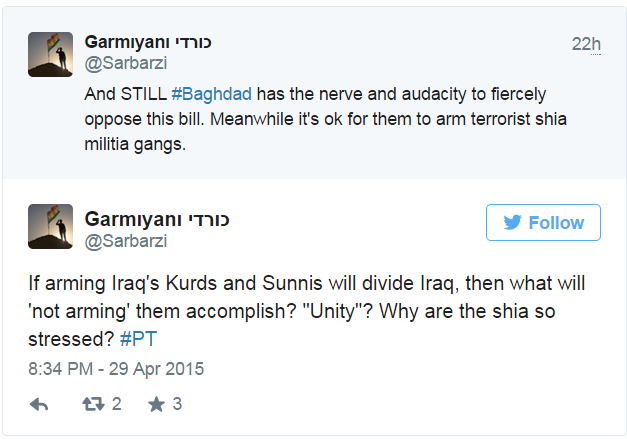
In the United States, the Obama Administration finds itself on the same side of the argument as Moqtada Al-Sadr, opposing the bill to permit arms for Kurdish forces. As State Department Spokeswoman Marie Harf confirmed yesterday:
QUESTION: Yes. Do you have any comment about this draft resolution at the Armed Services Committee that calls for the recognition of the Sunni fighters and the Kurdish Peshmerga forces as a country, and so they can be – directly receive aid and weapons from the U.S., not through the central government?
MS HARF: I saw that. I saw that. And to be very clear: The policy of this Administration is clear and consistent in support of a unified Iraq, and that we’ve always said a unified Iraq is stronger, and it’s important to the stability of the region as well. Our military assistance and equipment deliveries, our policy remains the same there as well, that all arms transfers must be coordinated via the sovereign central government of Iraq. We believe this policy is the most effective way to support the coalition’s efforts.
So we look forward to working with congress on language that we could support on this important issue, but the draft bill, as you noted, in the House – this is very early in the process here for the NDAA – as currently written on this issue, of course, does not reflect Administration policy.
By opposing the direct arming of Sunni and Kurdish forces (and the Kurdish forces in particular), the administration is continuing a policy arc in the region that continues to serve the interests of the Iranians because it creates a dynamic where the only viable players are either Sunni jihadists (whether Islamic State, or in the case of Syria, Al Qaeda-linked groups such as Jabhat al-Nusra), or Iranian-backed forces, such as Assad and the Shia militias operating in Iraq, who are no less committed enemies of the United States. Bringing supplies directly to Kurdish forces will give the United States a third option to positively affect the outcome of events in Iraq without requiring the modus vivendi with the Iranians.
(Who is fibbing?– DM)
 AP
AP
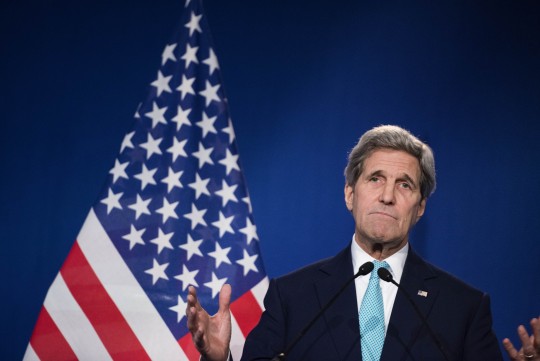
Secretary of State John Kerry told his Iranian counterpart that he wished the United States had a leader more like Supreme Leader Ayatollah Khamenei, according to comments made by a senior Iranian cleric and repeated in the country’s state-run media.
Ayatollah Alam al-Hoda claimed during Friday prayer services in Iran that in negotiations over Tehran’s contested nuclear program, Kerry told the country’s foreign minister that he “wished the U.S. had a leader like Iran’s supreme leader,” according to a Persian-language report on the remarkspublished by the Asriran news site.
“In the negotiations Kerry told [Iranian Foreign Minister Javad] Zarif that he [Kerry] wished U.S. had a leader like Iran’s supreme leader,” according to Alam al-Hoda, who is a senior member of the Iran’s powerful Assembly of Experts.
A senior administration official told the Washington Free Beacon that such a contention is patently absurd.
The remarks are the latest in a string of comments made by Iranian leaders purporting to reveal private details of the talks.
Iranian newspapers have carried multiple reports in recent months suggesting that Iranian Foreign Minister and chief negotiator Javad Zarif was ordered to stop screaming at Kerry behind closed doors.
In his Friday remarks, al-Hoda went on to say that Obama is set on striking a deal with Iran by June.
“Both Republicans and Democrats want these negotiations with Iran, but they fight each other for partisan interests,” he was quoted as saying. “Obama wants the negotiation to succeed so his party can win the next election and Republicans want to stop him.”
Alam al-Hoda also celebrated Iran’s expansion in the region and controversial activities in war-torn countries such as Syria and Yemen.
“Today, the resistance crescent has gone beyond Syria and Lebanon and reached to Yemen,” he said. “Today the resistance front is in control of Strait of Hormuz and Bab-el-Mandeb.”
The “U.S. and Israel have not been so weak anytime before,” he continues. “All these events are being managed by the hidden Imam,” a revered religious figure in Shia Islam.
Saeed Ghasseminejad, an Iranian dissident and fellow at the Foundation for Defense of Democracies (FDD), said U.S. overtures to Iran at the negotiating table have failed to win it any respect from the Islamic Republic’s leaders.
“President Obama thinks that by making more concessions he can gain the trust and respect of Iranian leaders,” Ghasseminejad said. “However, Iranian leaders neither trust him nor respect him.
“Seeing unprecedented weakness in the U.S. president, Iranian leaders do not fear the United States anymore. Partnership, trust, and alliance between the radical Islamist regime of Tehran and United States cannot and should not exist.”
Meanwhile, Zarif said over the weekend that fighting between the Obama administration and Congress over a potential final deal could not stop America from implementing any agreement the White House signs.
“As we have stated since the beginning, we consider the U.S. administration responsible for implementing the agreement and internal problems and conflicts in the U.S. are not related to us and to the implementation of the agreement, and based on the international laws, the countries’ internal problems don’t exempt them from implementing their undertakings and this is the main framework that we attach importance to,” Zarif said, according to the Fars News Agency.
On Monday, Zarif urged the United States to woo Iran.
“Maintaining an uncertain and unstable situation is not acceptable to Iran and the Americans should take practical and confidence-building measures to reach a comprehensive nuclear agreement,” Zarif was quoted as telling reporters.
A timely message from Iran, Power Line, Scott Johnson, April 28, 2015
What the hell are the Iranians doing playing chicken with the U.S. Navy on the same day that the full Senate takes up debate on Corker-Menendez?
*****************
Omri Ceren provides this email update on today’s developments in the Persian Gulf, reported in this brief Reuters story:
It’s been a busy two hours, but some clarity is starting to emerge about the Iranian seizure of a cargo vessel in the Strait of Hormuz. The vessel is the M/V Maersk Tigris and sails under a Marshall Islands flag. It was intercepted by Iranian navy patrol crafts earlier today and sent a distress call, and which point it was contacted by US naval assets who streamed to the area to monitor the confrontation. The vessel was ordered to sail into Iranian waters and refused, at which point the Iranians fired shots across her bow, and the master complied. It’s now in the Iranian port of Bandar Abbas.
There is a dispute over whether the M/V Maersk Tigris was in international waters when it was initially intercepted. The Pentagon seems to have told journalists this morning that it was transiting through Iranian territorial waters. Defense analysts are posting maps showing otherwise (https://twitter.com/PatMegahan/status/593073911786377216).
A few things you’re likely to be hearing as the afternoon kicks off:
(1) The U.S. is treaty-bound to defend the security of the Marshall Islands. To what extent will the US be obligated to act in response to functionally unspinnable Iranian aggression? Keep in mind that in two weeks the President will be personally in a room floating security assurances to the Gulf, promising that the U.S. will protect them from future Iranian aggression.
The Republic of the Marshall Islands (RMI) is a sovereign nation. While the government is free to conduct its own foreign relations, it does so under the terms of the Compact. The United States has full authority and responsibility for security and defense of the Marshall Islands, and the Government of the Marshall Islands is obligated to refrain from taking actions that would be incompatible with these security and defense responsibilities. (http://www.state.gov/r/pa/ei/bgn/26551.htm)
(2) The administration just wrapped up a week of insisting that under no circumstances would it allow Iran to interfere with shipping in the area. It’s unclear how that can be reconciled with what the Iranians just did.
White House Press Secretary Josh Earnest, April 21: “principal goal of this operation is to maintain freedom of navigation and free flow of commerce in the Gulf of Aden and the Red Sea… would send a clear signal about our continued insistence about the free flow of commerce and the freedom of movement in the region… this is a clear statement about our commitment to ensuring the free flow of commerce in this important region of the world” (https://www.whitehouse.gov/the-press-office/2015/04/21/press-briefing-press-secretary-josh-earnest-4212015)
State Department Spokesperson Marie Harf, April 21: “I think the Defense Department may have already addressed this in their briefing today, but there were reports about these U.S. ships that have been moved. And I want to be very clear, just so no one has the wrong impression, that they are not there to intercept Iranian ships, to do issues like that; that the purpose of moving them is only to ensure the shipping lanes remain open and safe. I think there was some misreporting and confusion on this, and I just wanted to be very clear.” (http://www.state.gov/r/pa/prs/dpb/2015/04/240950.htm)
Pentagon spokesman Col. Steve Warren, April 21: “[U.S. warships] are operating [in the Arabian Sea] with a very clear mission to ensure that shipping lanes remain open, to ensure there’s freedom of navigation through those critical waterways, and to help ensure maritime security…By having U.S. ships in the region, we…preserve options should the security situation deteriorate to the point where there is a problem or a threat to freedom of navigation or to the shipping lanes or to overall maritime security.” (http://www.defense.gov/news/newsarticle.aspx?id=128634)
(3) What the hell are the Iranians doing playing chicken with the U.S. Navy on the same day that the full Senate takes up debate on Corker-Menendez? Business Insider’s national security and military editor Armin Rosen had one of the early lines on this:
Whatever else is going on, IRGCN just baited a Burke-class US destroyer into a confrontation in the world’s busiest oil choke point. (https://twitter.com/ArminRosen/status/593076865922891779)
A Senate staff member told me yesterday there is a classified version of the nuclear framework with Iran that members of the Senate are having difficulty assessing because it has been classified secret and is locked up in the Senate security office. I was told that few Senate staffers are being allowed to read this classified version of the framework.
This revelation raises several serious questions about President Obama’s desperate effort to get a nuclear deal with Iran.
First, this classified version of the framework agreement must be different from the fact sheet on the framework released by the State Department on April 2. We already know, based on a revelation by the French, that the Obama administration withheld from the fact sheet a controversial provision of the framework on advanced centrifuges. Were other controversial provisions withheld? Did Obama officials selectively release parts of the framework to block congressional action against a nuclear deal?
Second, since Iranian officials have denounced the fact sheet as a lie, does the classified version show what was actually agreed to? Does it show major differences in areas where Obama officials are claiming the United States and Iran are in agreement?
Third, the U.S. government classifies information to prevent disclosure to our adversaries. Who is the adversary here? Not Iran, since the classified framework document reflects discussions and agreements with Iranian diplomats. It is pretty clear that the framework documents have been classified to keep them from the American people, not hostile foreign governments, and to make it as difficult as possible for members of Congress and their staffs to access them.
With Iran rejecting U.S. claims that a final nuclear deal will have strong provisions on verification and lifting sanctions, and a new report that President Obama has offered Iran a $50 billion “signing bonus” for agreeing to a nuclear deal, opposition to the president’s dangerous nuclear diplomacy with Iran is growing on Capitol Hill. Every member of Congress must review the classified documents on the framework with their staffs to determine the full extent of the Obama administration’s concessions to Iran in the nuclear talks and how to respond if important U.S. concessions have been kept from the American people.
An EMP attack on America seems likely, Dan Miller’s Blog, April 19, 2015
(The views expressed in this article are mine and do not necessarily reflect those of Warsclerotic or any of its other editors. — DM)
Some consider North Korea to be the rogue nation most likely to use an electromagnetic pulse (EMP) to attack America; Iran is also seen as quite likely to do it. It matters little which succeeds.
Here is a lengthy 2013 video about an EMP attack, what would happen and why:
The possibilities and consequences of an EMP attack on America are too horrific to contemplate; the “legitimate news media” generally ignore them. We therefore tend to relegate them to the realm of remote “tin foil hat conspiracy theories” and to focus instead on more congenial stuff — the latest sex scandal, Hillary Clinton’s campaign van parking in a disabled-only space and other matters unlikely to impact America to an extent even approaching that of an EMP attack. Meanwhile, most of “our” Congress Critters, who should know better, focus on opinion polls, filling their campaign coffers and getting richer personally while neglecting our atrophying missile defense systems and other potential means of avoiding or recovering from an EMP attack.
Here is a 2013 video about the likelihood of an Iranian EMP attack on America that would paralyze the country for a very long time.
North Korea and the Islamic Republic of Iran have long cooperated in the development of nukes and means to deliver them. I wrote about their cooperation here, here, here and elsewhere. It now appears that Iran intends to use them for an EMP attack on America.
The issue of a nuclear EMP attack was raised in the final hours of this week’s elections in Israel when U.S. authority Peter Vincent Pry penned a column for Arutz Sheva warning of Iran’s threat to free nations.
“Iranian military documents describe such a scenario — including a recently translated Iranian military textbook that endorses nuclear EMP attack against the United States,” he wrote. [Emphasis added.]
Here is a March 7, 2015 video about the impact of the P5+1 “negotiations” on Iran getting (or keeping) nukes and the likelihood of an Iranian EMP attack on America:
In April of this year, John Bolton had this to say about the Iran – North Korea connection, how much we don’t know and the ongoing P5+1 “negotiations.”
Perhaps Israel can take out Iran’s nuke capabilities.
Here is a February 2015 video about what’s (not) being done to harden our domestic power grid:
As of February of this year, Govtrack US opined that the chances of passage of the SHIELD act were zero percent. Be that as it may, simply hardening the power grid would not solve communications or transport problems — most modern communications devices, as well as vehicles built after 1987, depend on computer chips and, when the chips are fried, will not function. Even if food and water could be processed, getting them to consumers in sufficient quantities to keep them alive would be an enormous if not impossible task.
Problems of a human nature would also arise and remaining alive would be difficult. If one’s family were about to starve, how many would try to steal food and water from those who still have even enough for a few days? How many roving gangs of armed criminals, quite willing to kill, would do the same? The police would likely have no communications ability and might well be otherwise occupied, tending to their own families. Military forces not confined to base would likely have the same problems and be doing the same.
That suggests another problem in restoring infrastructure seriously damaged or destroyed by the EMP attack. It would not only require the availability of transport, communications and undamaged equipment. It would also require the availability of personnel, not otherwise occupied in scrounging for food, water, medical supplies and other resources to care for their own families, while protecting them from those lacking such resources, as well as from armed gangs.
Now, the U.S. military is taking steps to protect itself by reopening a cold war bunker at Cheyenne Mountain, abandoned in 2006.

Cheyene Mt. Complex
The Pentagon last week [early April 2015] announced a $700 million contract with Raytheon Corporation to oversee the work for North American Aerospace Command (NORAD) and US Northern Command.
Admiral William Gortney, head of NORAD and Northern Command, said that ‘because of the very nature of the way that Cheyenne Mountain’s built, it’s EMP-hardened.’
. . . .
‘And so, there’s a lot of movement to put capability into Cheyenne Mountain and to be able to communicate in there,’ Gortney told reporters.
‘My primary concern was… are we going to have the space inside the mountain for everybody who wants to move in there, and I’m not at liberty to discuss who’s moving in there,‘ he said. [Emphasis added.]
The Cheyenne mountain bunker is a half-acre cavern carved into a mountain in the 1960s that was designed to withstand a Soviet nuclear attack. From inside the massive complex, airmen were poised to send warnings that could trigger the launch of nuclear missiles.
But in 2006, officials decided to move the headquarters of NORAD and US Northern Command from Cheyenne to Petersen Air Force base in Colorado Springs. The Cheyenne bunker was designated as an alternative command center if needed.
Now the Pentagon is looking at shifting communications gear to the Cheyenne bunker, officials said.
‘A lot of the back office communications is being moved there,’ said one defense official.
Officials said the military’s dependence on computer networks and digital communications makes it much more vulnerable to an electromagnetic pulse, which can occur naturally or result from a high-altitude nuclear explosion.
Under the 10-year contract, Raytheon is supposed to deliver ‘sustainment’ services to help the military perform ‘accurate, timely and unambiguous warning and attack assessment of air, missile and space threats’ at the Cheyenne and Petersen bases.
Raytheon’s contract also involves unspecified work at Vandenberg Air Force Base in California and Offutt Air Force Base in Nebraska.
When will the site be fully operational, for what and who will be allowed to go there?
Some other military bases are probably being hardened, at least to an extent that might (or might not) preserve their electrical grids. If it works, they may serve as refugee centers for adjacent civilian populations. However, the military installations would likely run out of food and potable water before very long and, with food and water processing centers no longer operational, there would be substantial difficulties in getting — as well as transporting — large quantities of food and water. Were the processing centers to become operational, transportaion difficulties would remain. Communications between the military installations and the outside world? Likely zilch, at least initially, because radios, telephones and other modern communications devices (as most now are) depend on computer chips and would be fried by an EMP attack. Some might eventually be restored at some military bases, but that is not likely to be the case with those not on those bases.
Conclusions
What would you do in the event of an EMP attack? In a major metropolitan area, you would probably be SOL very quickly. In a small town? Marginally but not much better off. An isolated small farm, close to a mountain spring and adequately stocked with food, medical supplies, firearms and ammunition, could provide reason to hope that you might eventually be able to grow or slaughter sufficient food and have access to enough potable water to survive; at least until roving armed gangs arrive and overpower you.
This video is about a massive world-wide pandemic. In the event of a pandemic, electricity, automobiles and communications would still function, at least for a while. Following an EMP attack, the consequences would likely be substantially worse and last far longer.
Here is a link to a novel about one family in a small city and its efforts to survive an EMP attack on America. It does a reasonable job of summarizing the potential consequences.
Obama says US open to talks with Iran on immediately lifting sanctions, Times of Israel, April 17, 2015
 President Barack Obama listened as Italian Prime Minister Matteo Renzi speaks during their news conference in the East Room of the White House in Washington, Friday, April 17, 2015. (Photo credit: AP Photo/Susan Walsh)
Obama also said Friday that a bill introduced by Congress seeking a review and approval of a nuclear deal with Iran would not derail negotiations with Tehran, set to resume next week, and that the proposed legislation was a “reasonable compromise” he planned to sign off on.
The legislation would block Obama from waiving congressional sanctions against Iran for at least 30 days after any final agreement, which would give lawmakers time to weigh in. Obama said he still has concerns that some lawmakers are treading on his unilateral power as president to enter into a political agreement with another country, but the bill has language that makes it clear that lawmakers’ review will be limited to the sanctions imposed by Congress.
***********************
U.S. President Barack Obama on Friday left open the door to “creative negotiations” in response to Iran’s demand that punishing sanctions be immediately lifted as part of a nuclear deal, even though the initial agreement calls for the penalties to be removed over time.
Asked whether he would definitively rule out lifting sanctions at once as part of a final deal aimed at keeping Iran from developing a nuclear weapon, Obama said he didn’t want to get ahead of negotiators in how to work through the potential sticking point. He said his main concern is making sure that if Iran violates an agreement, sanctions can quickly be reinstated — the so-called “snap back” provision.
“How sanctions are lessened, how we snap back sanctions if there’s a violation, there are a lot of different mechanisms and ways to do that,” Obama said. He said part of the job for Secretary of State John Kerry and the representatives of five other nations working to reach a final deal with Iran by June 30 “is to sometimes find formulas that get to our main concerns while allowing the other side to make a presentation to their body politic that is more acceptable.”
Iran’s Supreme Leader Ayatollah Ali Khamenei and President Hassan Rouhani insisted last week that they would not sign a deal unless all sanctions are lifted right after an agreement is signed. Obama initially portrayed their comments as a reflection of internal political pressure, while pointing out that the initial framework agreement reached earlier this month allows for sanctions to be phased out once international monitors verify that Tehran is abiding by the limitations.
Obama also said Friday that a bill introduced by Congress seeking a review and approval of a nuclear deal with Iran would not derail negotiations with Tehran, set to resume next week, and that the proposed legislation was a “reasonable compromise” he planned to sign off on.
The legislation would block Obama from waiving congressional sanctions against Iran for at least 30 days after any final agreement, which would give lawmakers time to weigh in. Obama said he still has concerns that some lawmakers are treading on his unilateral power as president to enter into a political agreement with another country, but the bill has language that makes it clear that lawmakers’ review will be limited to the sanctions imposed by Congress.
“That I think at least allows me to interpret the legislation in such a way that it is not sending a signal to future presidents that each and every time they’re negotiating a political agreement, that they have to get a congressional authorization,” Obama said. He said he takes lawmakers who have drafted the legislation at their word that they will not try to derail negotiations.
The president also weighed in on Russia’s announcement earlier this week that it would lift a five-year ban on delivery of anti-aircraft missiles, giving the Islamic republic’s military a strong deterrent against any air attack. The White House initially objected, but Obama said, “I’m frankly surprised that it held this long.”
Russia signed the $800 million contract to sell Iran the S-300 missile system in 2007, but suspended their delivery three years later because of strong objections from the United States and Israel. “Their economy is under strain and this was a substantial sale,” Obama said.
Russia, which also is party to the talks along with China, France, Britain and Germany, said the preliminary nuclear agreement made its 2010 ban on sending missiles to Iran no longer necessary.
EXCLUSIVE: Iranian Parliament Releases “Factsheet” for Revision of Lausanne Statement, FARS News Agency (Iranian), April 15, 2015
(Note: all bold print and italics are in the original. Iran now insists on a five year term for an agreement and the immediate lifting of all sanctions, among other things. — DM)
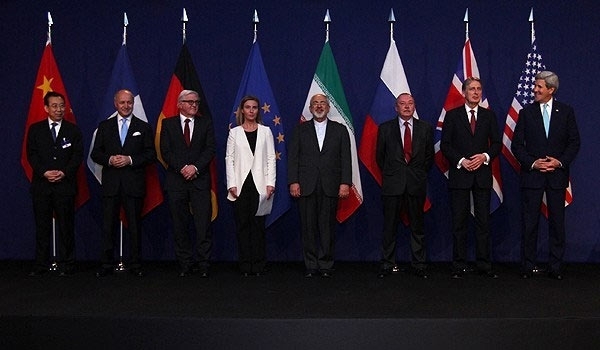
The factsheet which was presented by Head of the Nuclear Committee Ebrahim Karkhaneyee on Wednesday stresses the necessity for respecting the redlines and guidelines specified by Supreme Leader of the Islamic Revolution Ayatollah Seyed Ali Khamenei, making Iran’s decisions and undertakings reversible to enable the country to resume its nuclear operations in case of the other side’s non-commitment to its undertakings, and immediate termination of all sanctions in a single step and on the first day of the implementation of the final agreement.
The factsheet also necessitates commitment of both sides to their undertakings based on the Geneva agreement, a fair and reasonable balance between the gives and takes, taking good care not to impair the country’s security and military boundaries and national interests, providing 190,000 SWUs (Separative Work Units) of nuclear fuel enrichment capability needed by Iran to produce fuel for the Bushehr nuclear power plant immediately after the end of contract with Russia, safeguarding the nuclear achievements, actual operation of all nuclear facilities of Iran not in words, but in action, continued Research and Development (R&D) works and scientific and technological progress in Iran and immediate application of R&D findings in the country’s industrial-scale uranium enrichment cycle.
The factsheet urges operation of 10,000 centrifuge machines at Natanz and Fordo, a maximum 5-year-long duration for the deal and for Iran’s nuclear limitations, replacement of the current centrifuges with the latest generation of home-made centrifuge machines at the end of the five-year period.
Enrichment Program:
The period for the Join Comprehensive Plan of Action (JCPOA) should be limited to five years, in which about 10,000 active centrifuges operating at Natanz and Fordo now will continue nuclear fuel production by enriching uranium below the 5% grade.
The UF6 enriched reserves which are under the supervision of the International Atomic Energy Agency (IAEA) should be kept at Fordo nuclear plant and will be turned into nuclear fuel complex based on the existing capabilities.
During the five-year period, the Islamic Republic of Iran will continue to keep the excess centrifuges installed at Natanz and Fordo or will gradually dismantle them, and at the end of the 5-year period, it will replace all the existing centrifuges, including the active or inactive ones, with the new generation of (IR-N) centrifuge machines with the help of the new spaces and infrastructures which will have been already prepared and will use them without any limitation.
Justification:
Based on the Geneva agreement, the period for the final step should merely include a single period which has been considered as to be five years in the present factsheet. But in the Lausanne statement, different periods of 10, 20, 25 years and higher have been considered.
Given the Geneva agreement, the amount of enrichment should be specified based on the country’s practical needs and the number of 10,000 centrifuges has also been specified on this basis.
The 5-year period in this factsheet has been has been specified with respect to the date when Iran’s nuclear fuel contract with Russia for the Bushehr nuclear power plant will end; hence, the rules and limitations for the components of the enrichment cycle should be set in such a way that the Islamic Republic of Iran will be able to supply the fuel needed for the power plant after the end of the contract with Russia.
Operation of 10,000 centrifuges and developing and having a 10-ton enriched uranium stockpile will enable the Islamic Republic of Iran to supply the fuel needed for the Bushehr power plant in the year when the fuel supply contract with Russia (28-30 tons) ends.
Fordo installations:
Fordo nuclear facility will remain an enrichment and nuclear Research and Development (R&D) center. 4 enrichment cascades with 656 centrifuges will continue operation and production of fuel for purity levels lower than 5% by maintaining the current chain arrangements.
If the country would need 20%-degree (enriched) uranium, the nuclear fuel production line for purity levels lower than 5% will be altered to enrich uranium to the 20%-grade after connecting the centrifuge cascades to each other again.
Justification:
Based on the above, Fordo will remain an actual and active center, and the Islamic Republic of Iran will maintain its capability to reverse its decision and restore the 20%-grade enrichment.
Research and Development (R&D):
In a bid to use R&D findings in the country’s industrial-scale enrichment chain, R&D should be planned in a way that the necessary possibilities and infrastructures will be provided for replacing the first generation of centrifuges with the latest generation of centrifuge machines (IR-N) when the Joint Comprehensive Plan of Action comes to an end after 5 years.
The R&D program should undergo no limitation before it comes into use for industrial-scale operation.
Justification:
Accordingly, the advanced centrifuges will enter the chain of nuclear fuel production without any restriction at the end of the 5-year deal.
Arak Heavy Water Reactor:
Given the Group 5+1 countries’ mere concern about the plutonium existing in the spent nuclear fuel (SNF) of the Arak 40-MW heavy water reactor, the fuel used by the reactor will be sent abroad.
The G5+1 states will be committed to cooperate and take the necessary measures for relevant international licensing and permissions.
Justification:
Given the SNF export abroad, the insistence of the G5+1, specially the US, on redesigning the said reactor is merely a pretext and doesn’t have any scientific rationale.
What is more important than the heavy water nature of Arak reactor is the core of the reactor which is due to be taken out and then be redesigned and renovated. Such a move is irreversible in nature, and thus means crossing the specified redlines.
Supervision and Inspection:
Supervision and inspections of the Islamic Republic of Iran’s nuclear program should be carried out within the framework of the the Non-Proliferation Treaty (NPT) safeguards agreements.
Justification:
Once done, the principle stated by the Supreme Leader of the Islamic Revolution – that security and military sanctities and boundaries shouldn’t be violated and that the inspections should be carried out at conventional levels similar to all other countries – will be respected and materialized. Given the Islamic Republic of Iran’s opposition to the world arrogance, endorsing and implementing the Additional Protocol will provide the world arrogance (a term normally used for the US and its western allies) with legal grounds to stage their preplanned plots against the Islamic Republic of Iran.
Sanctions:
Concurrently with the start of the JCPOA, all the US and EU sanctions will be terminated and Iran will start fulfilling its undertakings based on the verification of the IAEA.
The UN Security Council sanctions resolution against Iran will be annulled and all nuclear-related sanctions will be terminated and the Islamic Republic of Iran’s case will be normalized.
The G5+1 countries, the EU and the UNSC will avoid imposition of new nuclear-related sanctions against Iran.
Justification:
By terminating all sanctions in a single step right at the start of the implementation of the final comprehensive agreement, the Supreme Leader’s statement that termination of sanctions is part of the agreement and not its result will be materialized.
Based on the Geneva agreement, after the implementation of the JCPOA, all UNSC, US and EU sanctions should be terminated and no new (UNSC) resolution would be needed in this regard; Hence, terminating the UNSC sanctions will close the case and no new resolution which would pave the ground for new plots will be issued.
International cooperation:
The Islamic Republic of Iran’s nuclear cooperation with the world states, including the G5+1 members, in areas of building nuclear power plants, research reactors, nuclear fuel production, nuclear safety medicine and nuclear agriculture, etc. will be possible and will improve. Based on the JCPOA, Iran will be provided with access to the global market, trade and finance and technical know-how and energy.
Reversibility:
In case of the two sides’ non-commitment to their undertakings, there will be a possibility for reversing all measures.
Justification:
Based on the aforementioned proposal, the Islamic Republic of Iran will be provided with reversible measures at the lowest level of damage and, therefore, the G5+1’s commitment to its undertakings will be in fair balance (with those of Iran).
Duration of the JCPOA:
After the end of the five-year period and the JCPOA exercise, all restrictions will be lifted and based on the Geneva agreement, the case with the Islamic Republic of Iran’s nuclear program will be similar to that of the other NPT member states.
The Iranian Parliament factsheet for a revision to the Lausanne agreement came after the US released a factsheet different from the joint statement issued by Iran’s Foreign Minister Mohammad Javad Zarif and Federica Mogherini, the High Representative of the European Union for Foreign Affairs and head of the G5+1 in nuclear talks with Iran, at the end of the latest round of Iran-world powers nuclear talks in Switzerland on April 2, known as the Lausanne statement.
The US factsheet that was released only a few hours after the Lausanne framework understanding caused fury in Iran, encouraging many to raise deep doubt about the results of the talks and US accountability and trustworthiness.
In only a few weeks, a bipartisan bill was also presented to the Congress for vote that would give the US legislature oversight of a final deal, a move seen by many across the globe, including both Iran and the US, as furthering impediments to the endorsement of a final deal between Iran and the sextet.
Senate Foreign Relations Committee Chairman Senator Bob Corker, who wrote the bill, said the White House had agreed to go along with the bill only after it was clear there was strong Democratic support. The legislation was passed unanimously by the committee and is expected to pass the full Senate and then the House of Representatives.
“That change occurred only when they saw how many senators were going to vote for this,” Corker said.
Bipartisan support for the bill had grown in recent weeks to near the 67 votes needed to override any presidential veto. But senators from Obama’s Democratic Party did succeed in adding amendments to water down the bill, making it more palatable to the White House.




 anneinpt
 artaxes
 danmillerinpanama
 davidking1530
 Peter Hofman
 Joseph Wouk
 Peter
Peter Louisiana Steve
 WarSclerotic
Recent Comments