Phoenix, AZ, (September 25, 2016) – Dr. M. Zuhdi Jasser, the son of Syrian immigrants who fled Baathist tyranny, today condemned the disturbing move by the White House to block a bipartisan bill aimed at imposing sanctions against the genocidal Assad regime. The Caesar Syria Civilian Protection Act, a bill authored primarily by Democrat Rep. Eliot Engel (N.Y.), would impose new sanctions on the Assad regime and its supporters, initiate investigations into war crimes carried out by the regime, foster negotiation to end the crisis in Syria, and force the U.S. to take action against those who do business with or finance the Syrian government or its military, intelligence, airline, telecommunications and energy services.
Dr. Jasser and AIFD learned over the weekend that White House officials sadly had staffers call leaders in both parties, pushing for them to quietly shelve the bill, despite the fact that it its supporters are mostly Democrats.
In response to the news, Dr. Jasser said: “I am stunned that a president who claimed to hold a ‘red line’ standard in the use of chemical weapons would repeatedly hand civilians over to a murderous dictator – even when there is an option on the table – sanctions – which would at least make a small dent in the regime’s finances, which it uses to murder civilians, including with chemical weapons.
It is deplorable and criminal that we have not taken these measures already. How could we refrain from punishing those who finance the murder, torture and rape the bill’s namesake presented to us with undeniable evidence? It is beyond reason or comprehension. It seems our government – at its highest level – has completely forgotten our national commitment to ‘never again’ allow the genocide of a people. I encourage the bill’s bipartisan supporters to remain steadfast, and dissent with the Obama administration at once.”
(The views expressed in this article are mine and do not necessarily reflect those of Warsclerotic or its other editors. — DM)
However, the Department of Homeland Security does not provide the security the rest of us need and want; instead, it does its level best to diminish it. Providing a reasonable level of security would contradict Obama’s view of Islam, Life, the Universe and Everything.
Refugee Fraud
On September 22nd, members of the U.S. Congress made public an internal Department of Homeland Security memo in which it was acknowledged that Refugee fraud is easy to commit and much tougher to detect:
The U.S. has relaxed requirements for refugees to prove they are who they say they are, and at times may rely solely on testimony. That makes it easier for bogus applicants to conspire to get approved, according to the department memo, which was obtained by the House Judiciary and Oversight committees. [Emphasis added.]
“Refugee fraud is easy to commit, yet not easy to investigate,” the undated memo says.
The memo said there are clear instances where “bad actors … have exploited this program,” gaining a foothold in the U.S. through bogus refugee claims.
The revelation comes just a week after the administration said it was boosting the number of refugees it wants to accept next year to 110,000, up from 85,000 this year. Officials also said they’ll take more Syrians than the 12,000 they’ve accepted so far this year — and they are on pace to resettle as many as 30,000 in 2017. [Emphasis added.]
The President’s decision to increase overall refugee resettlement – and specifically that of Syrian refugees – ignores warnings from his own national security officials that Syrians cannot be adequately vetted to ensure terrorists are not admitted. Revelations about fraud, security gaps, and lack of oversight have demonstrated that the program is creating national security risks,” Reps. Jason Chaffetz and Bob Goodlatte said in a letter to Homeland Security on Thursday. [Emphasis added.]
The Director of the U.S. Immigration and Customs Enforcement acknowledged that she had never seen the internal DHS memo. Why not? Isn’t ICE in charge of enforcing “our” immigration laws?
Countering Violent Extremism
The video provided above explains how CVE has been implemented thus far.
George Selim, director of the Office of Community Partnerships at DHS, was repeatedly asked by members of the House Homeland Security Thursday why he could not provide a document outlining the organization’s $10 million plans for countering the spread of terrorism.
. . . .
Selim finally admitted the plan is not finished, stating that a finalized version is “nearly ready.”
He added that he didn’t want to give the impression that the organization is without any strategy after being up and running for a year, and stressed that he takes the use of taxpayer dollars seriously.
Congress appropriated $10 million in funding to the Countering Violent Extremism initiative, which can issue grants to nonprofit organizations working in local communities to prevent radicalization. [Emphasis added.]
But when asked by Rep. Barry Loudermilk R-Ga., to provide evidence that the program was not a “black hole” for taxpayers, Selim could only answer that he has seen positive changes “anecodally” and could not provide any metrics for success.
“I can’t sit hear before you today and definitively say that person was going to commit an act of terrorism with a pressure cooker bomb, but we’re developing that prevention framework in a range of cities across the country,” said Selim.
When asked whether any of the funding provided to DHS for its “countering violent extremism” was being given to terror-linked groups, Mr. Selim responded that
there is no blacklist of non-governmental organizations prohibited from applying for federal funding in the government. He did not say whether their current vetting process has ever mistakenly funded groups that jeopardize national security when questioned, but argued there is always room for improvement when a program is in its infancy. [Emphasis added.]
Mr. Selim’s reply was not responsive; there may be no Federal blacklist, but that an NGO is not on one should not authorize DHS to fund it. The Council on American-Islamic Relations (CAIR) is, of course, one of the principal Hamas/Muslim Brotherhood-linked Islamist organizations upon which the “countering violent extremism” farce relies. Secretary Johnson recently delivered an address to the Islamic Society of North America, which is similarly linked. The countering violent extremism farce focuses, not on root problem of preventing Islamist terrorism, but on rooting out “Islamophobia.”
Here’s a video of Dr. Zuhid Jasser’s testimony before Congress on September 22nd
on Identifying the Enemy: Radical Islamist Terror. This hearing examines the threat of radical Islamist terrorism, the importance of identifying the threat for what it is, and ways to defeat it.
Former Congressman and Chairman of the House Intelligence Committee Pete Hoekstra at the Subcommittee on Oversight and Management Efficiency of the House Homeland Security Committee of the U.S. Congress. Congress must ask the Obama administration about PSD-11, which made official the US Government’s outreach to the Muslim Brotherhood and other Islamist groups. [emphasis added.]
In His efforts to push the narrative that the Islamic State has nothing to do with Islam, Obama has (a) shared His erroneous perception of the Islamic State and (b) tried to suggest that the Islamic State is the only entity which diverges from “true” Islam. His argument as to (a)
is a strawman argument: the real question isn’t whether ISIS “represents” Islam, but whether ISIS is a byproduct of Islam. And this question can easily be answered by looking not to ISIS but Islam. One can point to Islamic doctrines that unequivocally justify ISIS behavior; one can point to the whole of Islamic history, nearly 14 centuries of ISIS precedents.
Or, if these two options are deemed too abstract, one can simply point to the fact that everyday Muslims all around the world are behaving just like ISIS. [Emphasis added.]
For example, Muslims—of all races, nationalities, languages, and socio-political and economic circumstances, in Arab, African, Central and East Asian nations—claim the lions’ share of Christian persecution; 41 of the 50 worst nations to be Christian in are Islamic. In these countries, Muslim individuals, mobs, clerics, politicians, police, soldiers, judges, even family members—none of whom are affiliated with ISIS (other than by religion)—abuse and sometimes slaughter Christians, abduct, enslave and rape their women and children, ban or bomb churches, and kill blasphemers and apostates.
. . . .
Or consider a Pew poll which found that, in 11 countries alone, at least 63 million and as many as 287 million Muslims support ISIS. Similarly, 81% of respondents to an Arabic language Al Jazeera poll supported the Islamic State. [Emphasis added.]
Do all these hundreds of millions of Muslims support the Islamic State because they’ve been suckered into its “narrative”—or even more silly, because we have—or do they support ISIS because it reflects the same supremacist Islam that they know and practice, one that preaches hate and violence for all infidels, as America’s good friends and allies, the governments of Saudi Arabia and Qatar—not ISIS—are on record proclaiming? [Emphasis added.]
It is this phenomenon, that Muslims the world over—and not just this or that terrorist group that “has nothing to do with Islam”—are exhibiting hostility for and terrorizing non-Muslims that the Obama administration and its mainstream media allies are committed to suppressing. Otherwise the unthinkable could happen: people might connect the dots and understand that ISIS isn’t mangling Islam but rather Islam is mangling the minds of Muslims all over the world. [Emphasis added.]
Hence why White House spokesman Josh Earnest can adamantly dismiss 14 centuries of Islamic history, doctrine, and behavior that mirrors ISIS: “That is mythology. That is falsehood. That is not true.” Hence why U.S. media coverage for one dead gorilla was six times greater than media coverage for 21 Christians whose heads were carved off for refusing to recant their faith.
As to (b),
The powers-that-be prefer that the debate—the “narrative”—be restricted to ISIS, so that the group appears as an aberration to Islam. Acknowledging that untold millions of Muslims are engaged in similar behavior leads to a much more troubling narrative with vast implications. [Emphasis added.]
Conclusions
Obama has what one might wish were a unique world view. However, as Obama has not yet discovered, wishing that something were true does not make it true. He elucidated His world view in His recent address to the United Nations.
U.S. President Barack Obama sang his swan song this week at the United Nations, and seemed baffled by the stubborn refusal of the world to reform itself in his image and on his say-so. [Emphasis added.]
How can there still be “deep fault lines in the international order,” Obama wondered aloud, with “societies filled with uncertainty and unease and strife?”
Shouldn’t his identity as a man “made up of flesh and blood and traditions and cultures and faiths from a lot of different parts of the world” have served as a shining and irresistible example of blended global peace? How can it be that, after eight years of his visionary leadership, peoples everywhere aren’t marching to his tune of self-declared superior “moral imagination”? [Emphasis added.]
It is indeed a “paradox,” Obama declared.
In his preachy, philosophical and snooty address to the U.N. General Assembly on Wednesday, Obama expressed deep disappointment with the world. Alas, it seems peoples and nations are just not sophisticated enough to comprehend his sage sermonizing, smart enough to follow his enlightened example, or deep enough to understand his perfect policies. [Emphasis added.]
Why does the world not snap to order as he imperiously wishes and drool in his presence?
. . . .
The words “enemy, “threat” or “adversary” do not appear even once in Obama’s 5,600-word address. They are not part of his lexicon, nor are concepts like “victory” for the West or “beating” the bad guys. He won’t even names foes, such as “radical Islam” or “Islamist terror.”
All this high-minded intellectualizing, self-doubt and equivocation leave the U.S. with little ability to actually drive towards a more ordered world and provide a modicum of global security.
Instead, we have only Obama’s “belief” that Russia’s imperialist moves in Ukraine and Syria, China’s power grabs in Asia, and Iran’s hegemonic trouble-making in the Middle East (and by inference, Israel’s settlement policies in Judea and Samaria) will “ultimately backfire.”
Obama has many such unsubstantiated and illusory “beliefs.” It is very important for him to tell us what he “believes,” and he does so repeatedly. Clearly, he believes in the overwhelming potency of his own beliefs, despite the global security collapse. In fact, the U.N. speech reads like chapter one of the expected Obama memoirs, which surely will be filled with more inane “beliefs” and other ostentation. [Emphasis added.]
Fortunately, Obama will soon leave the presidency.
It falls to Congress and the next president to redirect U.S. policy and hopefully base it less on whimsical, wayward beliefs and more on a hard-nosed, forceful reassertion of Western interests.
Unfortunately, Hillary shares many of not most of Obama’s delusions.
Fortunately, Trump does not and seems to have a pretty good chance of becoming our President.
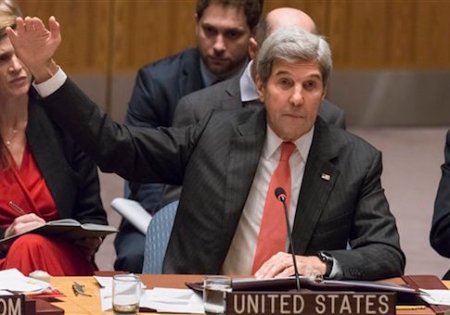
US Secretary of State John Kerry addresses the United Nations Security Council during an open, high-level debate regarding the ongoing Syrian crisis, at UN Headquarters in New York, NY, USA on September 21, 2016. (Credit Field)
The Obama administration is pushing a pathway to ensure it can continue sending Iran cash payments amid mounting accusations it laundered some $1.7 billion to the Islamic Republic as part of a “ransom payment” to free U.S. hostages earlier this year, according to statements by the White House and sources familiar with the matter.
The White House late Wednesday promised to vetonew legislation—first disclosed by theWashington Free Beacon—that would bar the administration from making “future ransom payments to Iran,” prompting outrage from key members of Congress who have been investigating how U.S. officials delivered nearly $2 billion in cash to Iranian officials.
The administration’s veto threat comes as top lawmakers on a range of investigatory committees launch efforts to uncover details about the cash exchange still being hidden by the Obama administration.
Congressional sources who spoke to the Free Beacon raised questions as to why the Obama administration would threaten to veto the bill, given its insistence that the cash payments to Iran were not part of a ransom.
“President Obama’s veto threat on our ransom legislation puts the lives of U.S. citizens around the world at risk,” Rep. Mike Pompeo (R., Kan.), a member of the House Intelligence Committee who helped spearhead the ransom legislation, told the Free Beacon.
“Instead of admitting wrongdoing, this administration is sticking to talking points. But selective noun use cannot explain away criminality, nor does it excuse eight months of lying to the American people,” Pompeo said. “It is unprecedented and reckless for the U.S. to be doling out billions to the Islamic Republic of Iran—under wraps and in cash—which is why our bill is necessary.”
Sen. Marco Rubio (R., Fla.), a lead sponsor of the legislation to ban future payments to Iran, told theFree Beacon that he would continue to push the legislation, despite threats by the administration.
“This effort by the President to defend his ransom payments to Iran at all costs amounts to doubling down on a policy that has made Americans less safe,” Rubio told the Free Beacon. “Democrats may be swayed by this threat, but I will continue to fight to prevent the U.S. government from sending taxpayer dollars to the world’s foremost state sponsor of terrorism.”
Sen. Mark Kirk (R., Ill.) told the Free BeaconWednesday evening that the Obama administration is betraying U.S. victims of Iranian terrorism, who are owed billions under federal court rulings.
“Under U.S. court judgments, Iran owes $55.6 billion to American victims of Iranian terrorism,” Kirk told the Free Beacon. “The Administration should stop finding ways to send more cash to Iran, and start working to bring a measure of justice to American families whose loved ones were killed or injured due to Iran-backed terrorists.”
One source familiar with the matter said Iran prefers cash because it can more easily be used to fund terrorism.
“There is no credible reason for the administration to oppose this bill. We already know, contrary to what the president initially said, that the administration can in fact wire money to Iran,” the source said. “So why do we need the option to pay in cash? Simple. This money can fund terrorism, and there’s nothing we can do to know of stop it.”
The Obama administration maintains the legislation is “ill-advised” and would “undermine U.S. obligations” to Iran.
The bill is “an ill-advised attempt to respond to a problem—so-called ‘ransom’ payments to Iran—that does not exist, in a way that would undermine U.S. obligations and ultimately benefit Iran at the expense of the United States,” the White House said in a statement.
The administration said it plans to award Iran further payments, which would not be possible under the ransom legislation.
“This bill, while styled as prohibiting future purported ‘ransom payments,’ instead bars virtually any payment from the U.S. government to Iran, including those permitted or even required by law,” the administration said.
The $1.7 billion cash payment was given to Iran as part of an effort to resolve decades-old legal disputes, many of which are still outstanding. The administration said further payments could be made to Iran in order to settle these disputes.
“Specifically, this bill would effectively prevent the United States from paying out awards rendered by the Tribunal and, thus, risk putting the United States in violation of our obligations under the Algiers Accords—an agreement concluded by President Carter, endorsed by President Reagan and honored by every President since that time,” according to the White House.
Questions remain about why the administration chose to pay Iran in cash installments routed through the New York Federal Reserve and several European banks.
Lawmakers such as Pompeo and Sen. Ted Cruz (R., Texas) have described the administration’s process as tantamount to a money laundering scheme.
UPDATE 8:40 P.M.:This piece was updated to include comments from Sens. Marco Rubio (R., Fla.) and Mark Kirk (R., Ill.).
Congress on Friday launched a wide-ranging probe into a secret Obama administration-funded campaign to unseat Israeli Prime Minister Benjamin Netanyahu, according to information exclusively obtained by the Washington Free Beacon.
The probe comes on the heels of an internal government report determining that the State Department provided hundreds of thousands to an organization that plotted to unseat Netanyahu in the country’s 2015 election.
Obama administration officials were found to have deleted emails from State Department accounts containing information about its relationship with OneVoice, the non-profit group that led the effort.
OneVoice, which was awarded $465,000 in U.S. grants through 2014, has been under congressional investigation since 2015, when it was first accused of funneling some of that money to partisan political groups looking to unseat Netanyahu. This type of behavior by non-profit groups is prohibited under U.S. tax law.
A group of nine leading lawmakers led by Sen. David Perdue (R., Ga.) are now formally petitioning the State Department to come clean about the effort and provide answers about how U.S. taxpayer dollars were permitted to be spent on an organization working against the elected leader of America’s closest Middle East ally, according to a readout of the investigation obtained by the Free Beacon.
“State Department officials failed to properly vet the OneVoice grant proposal because they failed to properly conduct an analysis of risks in the pre-award phase,” the senators wrote in a letter to Secretary of State John Kerry. “Unfortunately, it seems that inconsistency and apathy toward oversight of such grants at the State Department is not new. Our aid dollars should be going toward solving real problems, not contributing to the destabilization of allied governments.”
The lawmakers—including Sens. Ted Cruz (R., Texas), Mark Kirk (R., Ill.), Orrin Hatch (R., Utah), Mike Lee (R., Utah), and Johnny Isakson (R., Ga.) among others—wrote that the State Department turned a blind eye to OneVoice’s highly partisan activities and failed to perform proper oversight about how U.S. funds were being spent by the group.
“State Department officials utterly failed to follow established procedures and guidelines to properly identify, mitigate, or guard against any risk that OneVoice would misuse these funds before, during, and after the grant period,” the letter said. “As a direct result of these failures, OneVoice was able to use the more than $300,000 grant to build campaign infrastructure and resources which later were deployed in support of a negative campaign against Prime Minister Benjamin Netanyahu, his Likud Party, and the democratically elected coalition government of Israel during the 2015 Israeli parliamentary election.”
State Department officials were aware of OneVoice’s partisan activities, but still permitted the grant money to be awarded, according to the senators, who are pushing for the administration to take disciplinary action against the officials involved.
“Despite knowledge of such activities, State Department officials failed to adequately document any assessment of the risk that OneVoice might continue obstructive efforts against a certain political party in the event of an election,” the letter stated.
“State Department grant policies and procedures are in place to ensure that taxpayer dollars are used to fund U.S. government initiatives and further U.S. interests,” the letter said.
The senators require the State Department to answer a series of questions about the grant, including how it vetted OneVoice and why proper oversight methods were not employed.
They also are seeking to determine what “disciplinary action” is being taken against U.S. officials who knew about the plan to unseat Netanyahu but failed to take action to report this behavior.
Rep. Mark Meadows, R-N.C., blasted the State Department on Thursday for moving quickly to provide a requested email from Hillary Clinton’s server to Democrats on the House Oversight Committee while stonewalling requests from Republicans and the public.
During a hearing about the agency’s handling of Freedom of Information Act requests, Meadows questioned why the State Department handed over an email chain between Colin Powell and Clinton just five days after Rep. Elijah Cummings, the committee’s top Democrat, and seven other minority members asked for it while ignoring a FOIA request for that same email since 2014.
“We try to the best of our ability to respond to committees of Congress,” said Patrick Kennedy, undersecretary for management at the State Department, in defense of his agency’s treatment of records requests.
“It is with unbelievable speed when it fits the narrative that you want to do,” Meadows argued.
The email in question showed Powell had advised Clinton on ways to skirt security rules when using a personal device for official communications as he said he did during his tenure.
Meadows said the State Department has engaged in “a slow walk when [a request] comes from the chairman,” citing numerous letters from Rep. Jason Chaffetz, chairman of the Oversight Committee, that have collected dust at the agency.
Kennedy argued it would be “physically impossible” for the State Department to produce all of Hillary Clinton’s emails before the election given the high volume of FOIA requests pending before the agency.
But many of the media outlets and watchdog groups fighting for records began pursuing those documents years before Clinton launched her presidential bid.
The Associated Press, for example, first asked for Clinton’s official schedules in 2010. Meadows and Chaffetz demanded to know why the agency has said it will struggle to provide thousands of pages of her schedules by November despite having six years to process that request.
Senior Obama administration officials, under the threat of a subpoena, were forced to appear on Capitol Hill on Thursday to explain why lawmakers and the American public were kept in the dark about a $1.7 billion cash payment to Iran that has been widely viewed as a ransom to free imprisoned U.S. hostages.
Four senior administration officials declined to provide in-depth explanations of how U.S. funds were transferred to Iran, but said that at least $1.3 billion was withdrawn from a U.S. taxpayer fund and sent to Iran only after it released the hostages.
The payments to Iran were made in hard currency after the United States delivered the funds to European banks. The money was converted into hard currency and bank notes before being transferred to an official from the Central Bank of Iran for transport to Tehran, according to the officials.
Administration officials confirmed that the $1.7 billion payment only went through once the United States was able to secure the release of several U.S. hostages being held in Iran—though the officials would not say this amounted to a ransom.
The Obama administration also could not guarantee lawmakers that the money would not be spent by Iran to fund terror operations.
These disclosures appear to confirm key details about the payment that the administration had either denied or declined to elaborate on for months.
Details are only becoming public now following several news reports and leaks from Congress about the source of the payment, which has been shrouded in mystery since January, when it was first announced.
“This committee requested records … more than a month ago and to date the self-proclaimed most transparent administration in our history has failed to provide any, not one document to this committee,” said Rep. Sean Duffy (R., Wis.), a member of the House Financial Services Committee, during the hearing.
“The witnesses today only agreed under threat of subpoena” to appear before Congress, Duffy said.
The testimony by these administration officials is likely to fuel claims that the payment amounted to a ransom, following the admission that the administration only went through with the cash delivery after it was able to confirm that the U.S. hostages had left Iran.
“You can’t tell me that you guaranteed our prisoners would have been released had your money not been sent,” Duffy said to Christopher Backemeyer, a deputy assistant secretary for Iranian affairs at the State Department.
Backemeyer also could not provide a guarantee that the money would not be spent by Iran on terrorist operations.
“I can’t speak to every dollar that’s going to go in or out of Iran,” he said.
“There is a risk you have taken in providing $1.7 billion to the leading state sponsor of terrorism in the world,” Duffy said.
European officials handed off the first payment of $400 million in cash to Iran on Jan. 17, only after Iran agreed to release the U.S. hostages following an evening of negotiations that included Secretary of State John Kerry, officials said.
After converting the U.S. funds to European bank notes and cash, the money was given to an “official from the Central Bank of Iran for transfer to Tehran,” according to Paul Ahern, assistant general counsel for enforcement and intelligence at the Treasury Department. “The funds were under U.S. government control until their disbursement.”
The remaining $1.3 billion was withdrawn from a U.S. taxpayer fund operated by the Treasury Department and sent to Europe. Once there, the money was converted into foreign currency and transferred to a representative of Iran’s central bank on Jan. 22 and Feb. 5.
Information about the payment and the circumstances surrounding it remains a mystery.
The administration officials made the decision to pay Iran in cash, even though other options existed.
“Iran had to have it in cash,” Ahren said. “Iran was very aware of the difficulties it would face in accessing and using the funds if they were in any other form than cash, even after the lifting of sanctions.”
A cash delivery “was the most reliable way that they received the funds in a timely manner and it was the manner preferred by the relative foreign banks,” Ahren said.
“For them,” Backemeyer added, “the critical need was they [Iran] got immediate access.”
The administration officials would not provide in-depth details, citing diplomatic sensitivities.
“My guess is, if any private citizen had done what this administration did, they’d be indicted on money laundering and the administration calls in diplomacy,” said Rep. Jeb Hensarling (R., Texas), who questioned why the deal was hidden from the public
“Why did the administration go to such great lengths to hide it from the American people?” Hensarling asked. “Why did I have to threaten subpoenas to get the administration to show up in the first place?”
The State Department’s Backemeyer explained that some details could only be divulged in a classified setting.
“There will be limitations to what I and my colleagues can say in an open setting,” he explained. “There are a number of litigations and diplomatic sensitivities that could jeopardize U.S. interests if we were to go into too much detail.”
When asked why the United states agreed to pay $1.3 billion in interest to Iran from a taxpayer fund, a State Department official bristled.
“The details of why we settled for this amount are litigation sensitive,” said Lisa Grosh, a legal adviser in the State Department’s office of international claims and investment disputes. “Iran’s lawyers would try to use my words or maybe even your words against us to help their position at the [claims] tribunal. I believe this settlement was the best thing for the United States.”
A new report revealed by Reuters shows that there were more secret deals made with Iran, and not reported to Congress, in violation of US law. The President of the United States has knowingly and repeatedly violated a law he himself signed, for the express purpose of avoiding Congressional oversight of his actions mandated both by the law and the Constitution.
During the so-called “Iran Deal” negotiations, it became known that the State Department had agreed to allow Iran to make a “secret side deal” with the International Atomic Energy Agency (IAEA) to which the United States would not be a party. The intent was to dodge a provision of the law governing the “Iran Deal”‘s negotiation, a law that President Barack Obama had himself signed into law. He signed this into law in the hope of avoiding the Constitutional requirement that the Senate should advise and assent to treaties by a two-thirds majority. The law he negotiated as an alternative to obeying the Constitution required that the entire deal, including any side arrangements, be made available to Congress for consideration before approval.
Congress objected to this first ‘secret deal,’ especially Representatives Tom Cotton and Mike Pompeo. Pompeo said at the time of this revelation, “Not only does this violate the Iran Nuclear Agreement Review Act, it is asking Congress to agree to a deal that it cannot review.” In a letter to Secretary of State John F. Kerry, he reminded the Secretary that “pursuant to H. Res. 411, the House of Representatives considers the documents transmitted on July 19, 2015 incomplete in light of the fact that the secret side deals between the International Atomic Energy Agency (IAEA) and the Islamic Republic of Iran were not provided to Congress.”
Now we learn that there were many more such deals, none of which was reported to Congress. In a way, this has been obvious for some time. The IranTruth site reported in July that there were more secret deals, and asked,“Does the President Know?” Jeff Dunetz, writing at the same site, identified two more secret deals specifically by August of last year. French and Iranian officials agreed last summer that the presentation of the deal being made by Secretary Kerry to the US Congress was a distortion of what was being actually negotiated, with the French expressing a concern that the deal was always being weakened in Iran’s favor.
According to Reuters today:
The report is to be published on Thursday by the Washington-based Institute for Science and International Security, said the think tank’s president David Albright, a former U.N. weapons inspector and co-author of the report. It is based on information provided by several officials of governments involved in the negotiations, who Albright declined to identify.
Reuters could not independently verify the report’s assertions.
“The exemptions or loopholes are happening in secret, and it appears that they favor Iran,” Albright said.
Among the exemptions were two that allowed Iran to exceed the deal’s limits on how much low-enriched uranium (LEU) it can keep in its nuclear facilities, the report said. LEU can be purified into highly enriched, weapons-grade uranium.
Will Congress continue to accept this lawless erosion of its Constitutional role? Will they, at any point, stand up and assert that the President must at least obey the laws he himself signs? If not, what role does Congress intend to serve? What future is there for the system of checks and balances that once restrained the executive branch from imperial ambitions?
The matter is even more important than that. The so-called “Iran Deal” has been a manifest disaster for the interests of the United States abroad. Tearing it up is one of the five most crucial steps that the United States can take right now. (The pertinent segment of the video provided below begins at 1:14 — DM)
Congress must reassert its role in balancing what has become a lawless executive branch. It must do so because the Constitution requires it, because the stability of the Republic requires it, but also because this particular deal has badly damaged American interests. A great deal rides on whether the legislative branch has the political will to reaffirm its Constitutional role in the United States.
In Monday’s Wall Street Journal, columnist Gordon Crovitz sounds an urgent warning about President Obama’s plans, during his final months in office, to fundamentally transform the internet. It’s an intricate tale, but the bottom line is that unless Congress acts fast, the World Wide Web looks likely to end up under control of the UN.
That would be the same UN that serves as a global clubhouse for despotic regimes that like to wield censorship as a basic tool of power. Russia and China occupy two of the five veto-wielding permanent seats on the UN Security Council. Iran since 2012 has presided over one of the largest voting blocs in the 193-member General Assembly, the 120-member Non-Aligned Movement. Among the current members of the Human Rights Council are Venezuela, Vietnam and Saudi Arabia — where blogger Raif Badawi was sentenced in 2014 to 10 years in prison and 1,000 lashes, for blog posts the Saudi government considered insulting to Islam.
We’re talking here about the same UN which for generations has proven incorrigibly corrupt, opaque and inept at managing almost anything except its own apparently endless expansion and self-serving overreach. This is the UN of the Oil-for-Food worldwide web of kickbacks; the UN of the evidently chronic problem of peacekeepers raping minors they are sent to protect; the UN that can’t manage to adequately audit its own books, and offers its top officials an “ethics” program of financial disclosure under which they are entitled to opt out of disclosing anything whatsoever to the public.
This is the UN where a recent president of the General Assembly, John Ashe, died this June in an accident that reportedly entailed a barbell falling on his neck, while he was awaiting trial on fraud charges in the Southern District of New York — accused by federal authorities of having turned his UN position into a “platform for profit.”
So, how might this entrancing organization, the UN, end up controlling the internet? Crovitz in hisJournal column explains that Obama’s administration is about to give up the U.S. government’s longstanding contract with Icann, the Internet Corporation for Assigned Names and Numbers, which, as a monopoly, operates “the entire World Wide Web root zone.”
If that sounds like a good idea, think again. This is not a case of Obama having some 11th-hour 180-degree conversion to the virtues of minimalist government. It works out to the very opposite. Here’s a link, again, to Crovitz’s column on “An Internet Giveaway to the UN.” Crovtz explains that as a contractor under government control, Icann enjoys an exemption from antitrust rules. When the contract expires, the exemption goes away, unless Icann can hook up with another “governmental group” so as to “keep its antitrust exemption.” What “governmental group” might that be? Well, some of the worst elements of the UN have already reached out. Crovitz writes:
Authoritarian regimes have already proposed Icann become part of the U.N. to make it easier for them to censor the internet globally. So much for the Obama pledge that the U.S. would never be replaced by a “government-led or an inter-governmental organization solution.”
This is far from the first time the UN has cast a covetous eye at the internet. For years, there have been UN proposals, shindigs and summits looking for ways to regulate and tax the Web. Recall, as one example among many, the 2012 UN jamboree in Dubai. Or 2007 in Rio. Or the 2009 Internet Governance Forum gathering in Egypt, inspired by the 2005 conference of wannabe-be web commissars in Tunis.
All that hoopla pales next to the alarming reality of Obama’s plan to cut loose Icann this fall, and let the economic and political currents carry it straight into the waiting clutches of the United Nations. Crovitz notes that the Obama administration, while preparing to drop Icann’s contract, has already “stopped actively overseeing the group,” with dismal results inside Icann itself. Crovitz concludes, “The only thing worse than a monopoly overseen by the U.S. government is a monopoly overseen by no one — or by a Web-censoring U.N.”
Lest that sound hopeless, Crovitz adds: “Congress still has time to extend its ban on the Obama administration giving up protection of the internet.” But not a lot of time. The deadline is Sept. 30th.
A Republican on the House Oversight and Government Reform Committee who has read the FBI’s investigative file on Hillary Clinton told Fox News on Thursday that Clinton’s team used a software program called “BleachBit” to prevent the FBI from accessing her deleted emails.
The disclosure sheds new light on Clinton’s odd phrasing last year when she was asked about wiping her email server clean. “Like with a cloth or something?” she had joked. “BleachBit” does sound remarkably like disinfecting wipes. South Carolina Rep. Trey Gowdy said that Clinton’s use of the product had erased her emails so cleanly that “even God can’t read them.”
Clinton told reporters last year in a rare press conference that the more than 33,000 emails she ordered deleted concerned personal, non-work-related subjects like yoga sessions and the planning of her daughter Chelsea’s wedding.Gowdy suspected that Clinton considered all her emails related to the controversial Clinton Foundation to be personal messages, and got rid of them instead of handing them over to the State Department.
‘You don’t use BleachBit for yoga emails or for bridemaids emails,’ Gowdy charged. ‘When you’re using BleachBit, it is something you really do not want the world to see.’
Clinton has avoided for months answering questions about classified material in emails that the State Department recovered from her.
FBI Director James Comey said during his press conference last month that it was likely there were other work-related e-mails that were not turned over, but those are gone forever “because they deleted all e-mails they did not return to State, and the lawyers cleaned their devices in such a way as to preclude complete forensic recovery.” They sure did.
The FBI managed to recover 14,900 emails from Clinton’s server despite her team’s attempts to prevent their recovery, and now a federal judge has ruled that the State Department has until Sept. 13 to show which emails are government-related. Fox News reports:
The chief investigators for conservative watchdog group Judicial Watch, which is seeking the records in court, also told Fox News that records about Benghazi were among the deleted files.Gowdy, meanwhile, has questioned FBI Director James Comey’s claim to Congress and the public that a reason Clinton was not charged in connection with her private email use as secretary of state was because there was no evidence of criminal intent.
Based on the FBI investigative file, including notes from Clinton’s July interview, Gowdy said it doesn’t appear agents pressed Clinton on why she set up the server.
“I didn’t see any questions on that,” Gowdy said. “She said she did it for convenience, but I didn’t see the follow-up questions.”
Application developer Andrew Ziem wrote in a BleachBit user forum that his website’s traffic spiked after Gowdy mentioned the product on Fox News.







 anneinpt
 artaxes
 danmillerinpanama
 davidking1530
 Peter Hofman
 Joseph Wouk
 Peter
Peter Louisiana Steve
 WarSclerotic
Recent Comments