Posted tagged ‘Turkey’

Does ISIS Owe Its Success to Turkey?

November 29, 2015

Does ISIS Owe Its Success to Turkey? Clarion Project, Meira Svirsky, November 29, 2015

(Please see also, Obama’s favorite Muslim dictatorships. — DM)

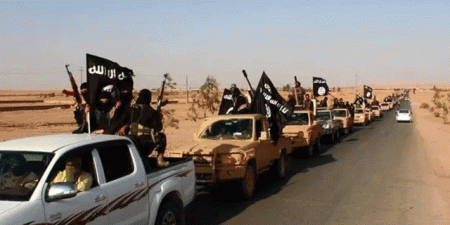
Islamic-State-Victory-Parade-HP_3An Islamic State victory parade (Photo: Video screenshot)

The downing of a Russian fighter jet on its way back from an Islamic State bombing mission has put Turkey in the crosshairs of scrutiny regarding their role in facilitating the success of the Islamic State.

Turkey’s arms transfers to Al-Qaeda-linked Islamist jihadis in Syria has been long-documented and largely ignored by the Western media. Similarly, the fact the Turkey has been the top financial sponsor of Hamas since 2012, with President Recep Tayyip Erdogan arranging for the transfer of $250-300 million to the terrorist group annually, is another inconvenient fact that has been studiously ignored.

This summer, a major raid by the U.S. on an Islamic State safe house in Syria this summer gleaned large amounts of intelligence linking Turkey to the Islamic State. In the words of one senior Western official, the connection is now “undeniable.”

As investigative journalist Nafeez Ahmed writes, “In a rare insight into this brazen state-sponsorship of ISIS, a year agoNewsweek reported the testimony of a former ISIS communications technician, who had travelled to Syria to fight the regime of Bashir al-Assad.

“The former ISIS fighter told Newsweek that Turkey was allowing ISIS trucks from Raqqa to cross the ‘border, through Turkey and then back across the border to attack Syrian Kurds in the city of Serekaniye in northern Syria in February.’ ISIS militants would freely travel ‘through Turkey in a convoy of trucks,’ and stop ‘at safehouses along the way.’

“The former ISIS communication technician also admitted that he would routinely ‘connect ISIS field captains and commanders from Syria with people in Turkey on innumerable occasions,’ adding that ‘the people they talked to were Turkish officials… ISIS commanders told us to fear nothing at all because there was full cooperation with the Turks.’”

Trucks, arms and fighters are not the only commodities that are flowing freely between Turkey and the Islamic State in Syria and Iraq. The life-blood of the Islamic State, crude oil, which serves to finance the terror group’s operation, is being sold in Turkey. Estimates of ISIS oil sales in Turkey to date are as high as $1 billion.

Senior Iraqi politician Mowaffak Baqer al-Rubaie announced yesterday that the Islamic State is selling oil through Turkish black-market channels at $20 per barrel, less than half the current market price.

Rubaie also pointedly commented that Turkey is the recruitment hub for all new Islamic State fighters – both foreign and Arab. “The new recruits meet with ISIS officials in Istanbul and are then transferred over the Turkish borders with Iraq, to Mosul, and over the border with Syria to Raqqa,” he said.

Rubaie also blamed Turkish security forces for “studiously ignoring the transfer of ISIS terrorists from Turkey to north Iraq and Syria. [In addition,] the wounded of the ISIS gangs … are getting treatment and medical care in the hospitals of Turkey.”

Besides their ideological similarities, Erdogan and his ruling AK Islamist party view the Islamic State as an easy ticket to smashing their nemesis, the Kurds, an ethnic group vying for independence from Turkey. As one AK party member said, “They are like us, fighting against seven great powers in the War of Independence.” Another senior party member said, “Rather than the PKK [Kurdistan Working Party] on the other side, I would rather have ISIL as a neighbor.”

Hundreds of flash drives and documents were seized in the summer raid on the Islamic State safe house in Syria last summer. At the time, a senior Western official predicted that “the links [between Turkey and ISIS] are already so clear that they could end up having profound policy implications for the relationship between us and Ankara.”

Yet, this has clearly not been the case. Turkey, a member of NATO, has been flaunting its support of the Islamic State under Western leaders’ noses. After finally agreeing to get involved in the fight between coalition forces and the Islamic State (after years of sitting out the fight militarily), Turkish planes have mainly used the bombing raids to attack Kurdish forces in Syria, Iraq and Turkey.

And the oil keeps flowing, filling Turkey’s coffers. As Professor David Graeber of the London School of Economics notes, “Had Turkey placed the same kind of absolute blockade on ISIS territories as they did on Kurdish-held parts of Syria… that blood-stained ‘caliphate’ would long since have collapsed — and arguably, the Paris attacks may never have happened. And if Turkey were to do the same today, ISIS would probably collapse in a matter of months. Yet, has a single western leader called on Erdoğan to do this?”

Sadly, the answer is an obvious “no.”

The Accomplices Have Their Backs Against the Wall

November 29, 2015

The Accomplices Have Their Backs Against the Wall NATO knows its Turkish member’s ties to ISIS will be revealed if Russia succeeds in Syria

German Economic News

Source: The Accomplices Have Their Backs Against the Wall

Originally Appeared at German Economic News; Translated by Susan Neumann

NATO is extremely nervous, because it knows that the truth about the relationship of NATO-member Turkey to the Islamist terror group (IS) will come to light if there is a Russian victory in Syria. If the refugees are able to return, Erdogan won’t have them as a pawn to extort money [from the EU]. It’s clear who’s interested in an escalation of the conflict.

The reaction of the Western alliance on the shooting down of a Russian bomber show that NATO is very nervous. It’s on the verge of losing control of Russia in Syria. The great Turkish ride out, which was most likely planned by the secret services, looks more like a desperate symbolic act than a carefully considered commando operation. The Russian Ambassador to NATO, Alexander Grushko, called it shadow theatre.

The reason why NATO is looking for shady place to hide is the fact that Putin named those who shot down the Russian aircraft accomplices of the terrorists. Turkey is a NATO country. The alliance is confronted with the official accusation of terrorism for the first time. Until now, NATO has been the only one to slap others with the terrorist label. The real reason for their nervousness is tangibly rooted in the military.

The hopes of NATO and their secret services are being dashed on the rocks. US President Barack Obama has been running a different political course than that which NATO and their secret services would want. Obama wants to get out of the Syria war. He’s admitted that the mission has failed — and the idea of “regime change” has taken a heavy beating, to say the least. Obama has arranged it with Russian President Vladimir Putin that the Russians take over the IS-project. This has been devastatingly humiliating for the neocons, NATO, and the secret services.

After that, Russia began fighting terrorists who were allies of the US military. From the very beginning, Putin has stood in the way of the western military’s desire to cover up their manipulations Syria. The Islamic State and the military advisers of both Turkey and the Pentagon are now facing defeat in Syria.

US President Obama knows this as well. His message to Putin is therefore remarkably diplomatic. After a meeting at the White House with French President Francois Hollande, President Barack Obama said that if Moscow had a “change of strategy,” there would be “great potential” for cooperation. “Russia is welcome to be a part of our broad coalition.” It’s Obama’s half-hearted attempt to make it appear to NATO that they can bring Russia under control.

Why indeed, should Russia change its strategy, above all now? The Russians have kept repeating that the reason they’ve involved themselves militarily in Syria is because NATO has failed. One can believe that, because the Russians know that a fight to uncover terrorist cells is anything but easy. In order not to end up like the Americans in no man’s land, the Russians have made skillful alliances with Iran, Iraq, and China; and have even allowed Israel to have access to their information.

The military successes of the past few weeks have put the Western mercenary troops in dire straits. Obama’s added invitation for the Russians to join in is the real reason why NATO is so nervous. Obama says Moscow should work in close military cooperation and target their air strikes on the IS rather than the moderate rebels. They should also support political change in Damascus.

Russia has supported the change in Damascus for weeks. Moscow has repeatedly said that it doesn’t insist on Assad being president in the long run. The Russians do say, however, that it must be the decision of the Syrian people. This position is also shared by Iran. Russia has also submitted a transition plan of Syria, post-war. Within 18 months a new constitution could be drafted and new elections could be held. If anybody needed to make a strategic change, it would be the Western alliance. They have presented no political concept other than the battle cry, “Assad must go!”

The main worry of NATO, and Turkey in particular, lies in the risk that a Russian victory could uncover all the goings-on, of how the West and especially the Turkish government cooperated with the terrorists in the region. [If the Russians are victorious,] it will show the refugee debate in a completely different light, and it will become clear how the Turkish President Recep Tayyip Erdogan cynically abused the refugees as bartering chips for his ambitions. It will also show that Erdogan’s war against the PKK is a completely disproportionate war, one in which the Kurdish civilian population was brutally attacked. One will also recognize that the West only has the Turkish government and Saudi Arabia as its allies, in a region with two Islamist governments.

Erdogan can still blackmail the totally incompetent EU and the German chancellor, who is totally over her head — by demanding billions of euros in protection money for the refugees. If the Russians truly succeed, however, in bringing peace to Syria — and in such a way that a majority of the refugees can return to their homeland — then Erdogan suddenly has a bad poker hand. Turkey is of course totally unsuitable to be included in the EU under Erdogan. Everybody in Brussels knows it. The visa-free travel is also a grotesque idea. Every day there are new incidents of how business can be conducted with fake Turkish passports — especially in Turkey. Then there’s the three billion euros that Erdogan demands from European taxpayers for the refugees. What’s going to happen with the money? Integration of refugees in Turkey? Better accommodation in the camps? No corruption, complete transparency?

This whole outlook makes Erdogan’s government and its intelligence agencies feel justified in shooting down a Russian fighter jet. They need an escalation of the situation, because they have their backs to the wall. That also makes Erdogan unpredictable in this conflict. He has a lot to lose.

For documentation purposes, we’ve published the report by the Germany Press Agency on NATO’s statement about the shoot-down. It proves that military units were not invented to think.

Turkey: Wrong Partner to Fight Terror

November 29, 2015

Turkey: Wrong Partner to Fight Terror, Gatestone InstituteBurak Bekdil, November 28, 2015

  • In Erdogan’s usual Sunni supremacist language, he accused the victims of jihad rather than the jihadists.
  • “New tragedies will be inevitable,” Erdogan said, “if the rising racism in Europe and other countries is not stopped.” Yet Erdogan willingly ignores the rising racism, xenophobia, and anti-western, jihadist sentiments that increasingly command the hearts and minds of his fellow Turks.
  • How should Erdogan fight Islamic terror — something he does not believe exists? One of Erdogan’s famous remarks is, “there is no Islamic terror.” But he thinks that “just like fascism,” Zionism is a crime against humanity.
  • It is so funny that the free world cannot see that its ally in fighting the jihadists is another jihadist.

Racism is bad, no doubt. But it cannot be the reason why jihadists kill “infidels,” including fellow Muslims in Muslim lands. Sadly, the free world feels compelled to partner with the wrong country in its fight against Islamic terror.

The host of this year’s G-20 summit, which came right after the Nov. 13 Paris attacks, was Turkey’s President Recep Tayyip Erdogan. In his usual Sunni supremacist language, he accused the victims of jihad rather than the jihadists. “New tragedies will be inevitable,” he said, “if the rising racism in Europe and other countries is not stopped. Racism, coupled with enmity against Islam, is the greatest disaster, the greatest threat.”

Yet Erdogan willingly ignores the rising racism, xenophobia, and anti-western, jihadist sentiments that increasingly command the hearts and minds of his fellow Turks. A quick look at a few sports games and fan behavior in recent weeks would reveal much about the Turkish mind and heart.

On October 13, three days after a twin suicide bomb attack in Turkey’s capital, Ankara, killed more than 100 Kurds and pro-Kurdish, leftist and secular Turks, the central Anatolian province of Konya, a hotbed of political Islam in Turkey, hosted a Euro 2016 football qualifier between Turkey and Iceland. Before the kick-off, both teams stood for a moment of silence to protest the bomb attack — a typical gesture to respect the victims. Sadly, the moment of silence was marred by whistles and jeers: apparently the football fans of Konya were protesting the victims, not their jihadist killers.

Anyone under the impression that the whole world stands in solidarity with Paris should think again. Hundreds of Turkish fans booed and chanted “Allahu Akbar” (“Allah is greater” in Arabic) during a moment of silence for the Paris attack victims before a Turkey-Greece soccer friendly. Once again, the Turks were exhibiting solidarity with the terrorists, not their “infidel” victims.

More recently, on Nov. 21, Turkish police had to deploy 1,500 policemen so that Turkish fans could not harm the visiting Israeli women’s national basketball team. One thousand five hundred police officers at a women’s basketball game! Despite that, Turkish fans threw objects at Israeli players as they were singing Israel’s national anthem. Fans also booed the Israeli players while others applauded the fans who threw the objects.

Unsurprisingly, Turkish fans waved Palestinian flags. Israeli women basketball players were barred from leaving their hotel other than for training and the game.

None of that is surprising although, at least in theory, Turkey is a candidate state for membership in the European Union. A new study by Pew Research Center revealed that 8% of Turks have a favorable opinion of the Islamic State (IS), higher than in the Palestinian territories, where support for IS stands at 6%, and only one point lower than in Pakistan. Nineteen percent of Turks “do not know” if they have a favorable or unfavorable opinion of IS — which means 27% of Turks do not have an unfavorable opinion of the jihadist killing machine. That makes more than 21 million people! Of the countries polled, Lebanon boasted a 100% unfavourable opinion of IS and Jordan, 94%. In Indonesia, the world’s most populous Muslim country, 4% reported a favourable opinion of IS, half of Turkey’s.

This is Erdogan’s “neo-Ottoman” and increasingly Islamist Turkey. After the Paris attacks, this author saw tweets that called the victims “animal carcass;” that said “now the infidels will lose their sleep out of fear;” and others that congratulated the terrorists “who shouted Allah-u aqbar.”

Meanwhile, and so funny, the free world cannot see that its ally to fight the jihadists is another jihadist. How should Erdogan fight Islamic terror – something he does not believe exists? One of Erdogan’s famous remarks is, “there is no Islamic terror.” But he thinks that “just like fascism,” Zionism is a crime against humanity.

826 (2)Turkish President (then Prime Minister) Recep Tayyip Erdogan, right, meeting with Hamas leaders Khaled Mashaal (center) and Ismail Haniyeh on June 18, 2013, in Ankara, Turkey. One of Erdogan’s famous remarks is, “there is no Islamic terror.” (Image source: Turkey Prime Minister’s Press Office)

There is a Turkish saying that could perhaps describe the free world’s alliance with Erdogan’s Turkey against jihadist terror: “Kuzuyu kurda emanet etmek” (“to trust the wolf with the sheep”).

Russian S-400 missiles turn most of Syria into no-fly zone, halt US air strikes

November 28, 2015

Russian S-400 missiles turn most of Syria into no-fly zone, halt US air strikes, DEBKAfile, November 28, 2015

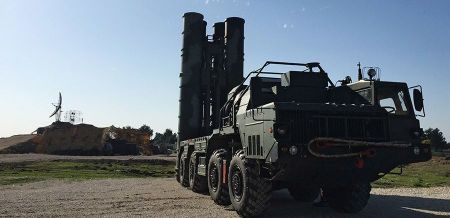
2746772 11/26/2015 An S-400 air defence missile system is deployed for a combat duty at the Hmeymim airbase to provide security of the Russian air group's flights in Syria. Dmitriy Vinogradov/Sputnik

2746772 11/26/2015 An S-400 air defence missile system is deployed for a combat duty at the Hmeymim airbase to provide security of the Russian air group’s flights in Syria. Dmitriy Vinogradov/Sputnik

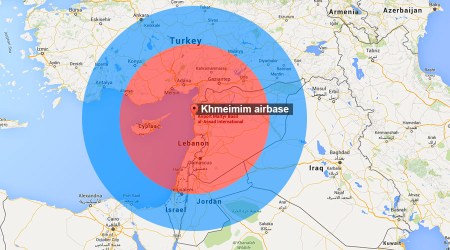
S-400_range_map_25.11.15

The deployment of the highly advanced Russian S-400 anti-air missiles at the Khmeimin base, Russia’s military enclave in Syria near Latakia, combined with Russia electronic jamming and other electronic warfare equipment, has effectively transformed most of Syria into a no-fly zone under Russian control.

Moscow deployed the missiles last Wednesday, Nov. 25, the day after Turkish warplanes downed a Russian Su-24. Since then, the US and Turkey have suspended their air strikes over Syria, including bombardments of Islamic State targets. The attacks on ISIS in Iraq continue without interruption. Turkey is now extra-careful to avoid flights anywhere near the Syrian border.

Both the US and Turkey are obviously wary of risking their planes being shot down by the S-400, so long as Russian-Turkish tensions run high over the Su-24 incident.

Friday, a US-led coalition spokesperson denied that the absence of anti-IS coalition air strikes had anything to do with the S-400 deployment in Syria. He said “The fluctuation or absence of strikes in Syria reflects the ebb and flow of battle.”

However, DEBKAfile’s military sources confirm that neither the US, Turkey or Israel have any real experience in contending with the Russian S-400, which uses multiple missile variants to shoot down stealth aircraft, UAVs, cruise missiles and sub-strategic ballistic missiles. Its operational range for aerodynamic targets is about 250 km and for ballistic targets 60 km. The S-400 can engage up to 36 targets simultaneously.

Thei range covers at least three-quarters of Syrian territory, a huge part of Turkey, all of Lebanon, Cyprus and half of Israel.

Since the downing of their warplane, the Russians have put in place additionally new electronic warfare multifunctional systems both airborne and on the ground to disrupt Turkish flights and forces, Lt. Gen. Evgeny Buzhinksy revealed Friday. Turkey has countered by installing the KORAL electronic jamming system along its southern border with Syria.

An electronic battlefield has spread over northern Syria and southern Turkey, with the Russian and Turks endeavoring to jam each other’s radar and disrupt their missiles. In this, the Russians have the advantage.

With the Americans, Russians and Turks locked in a contest over Syria, and the Israeli Air Force’s freedom of action restricted by objective conditions, some comments made at week’s end by Israeli military and security officials sounded beside the point.

Thursday, Nov. 26, a senior Air Force officer remarked that Israel is being careful to avoid friction with Russia, despite that country’s expanding military presence in Syria. “Russia is now a central player and can’t be ignored. But we each go our own way, according to our own interests,” the officer noted.

“Our policy is not to attack or down any Russian plane. Russia is not our enemy.”

The officer said that Israeli and Russian officers maintain telephone contact. “We don’t notify or ask for anything; we just do our jobs,” he said.

According to DEBKAfile’s military sources, this is not a true picture. Israel does get in touch with the Russians when their planes get too close to Israeli aircraft. There was no need to state that Israeli won’t shoot down Russian planes, as though this was self-evident, because in the current volatile situation, circumstances may change in a trice. Is it in Israel’s interest to fly into air space loaded with electronic warfare waves? But what if Russian warplanes come over the Golan as part of a blitz to destroy Syrian rebels in southern Syria, some of which are backed by Israel?

Erdogan: Downing of Turkish jet with S-400 missile would mean aggression

November 27, 2015

Erdogan: Downing of Turkish jet with S-400 missile would mean aggression

27 November 2015 / 11:19

Source: APA – Erdogan: Downing of Turkish jet with S-400 missile would mean aggression

Baku. Malahat Najafova – APA. In case a Turkish jet gets shot down by the Russian S-400 surface-to-air missile system in Syrian airspace, Ankara will regard it as an aggression.

Turkish President Recep Tayyip Erdogan made the remarks in a statement to CNN International of the possibility of the Russian S-400 surface-to-air missile system targeting Turkish warplanes in case they enter Syrian airspace.

Erdogan did not rule out the possibility of such an incident.

“In this case Turkey will be forced to take measures that will certainly not be discussed. And of course it would be an aggression against our rights of sovereignty and it’s the natural right of the state to protect those rights. We do not want to see any escalation of the situation in the region. We do not want to become a party to that. But those who side with Syria and escalate the tension, I think, are the responsible parties to this,” the Turkish president stressed.

Asked whether he saw the moving of the Russian S-400s into western Syria as a threat to Turkey and other coalition members who may be flying sorties in this region, the Turkish president said Russia has been providing military support to Syria since long ago – since the rain of Bashar Al-Assad’s father.

“Russia has sold or given this kind of systems to Syria. It’s impossible to say that this is something new and did not take place last year,” said Erdogan.

Share

Erdogan’s Mistake: Russia May Now Initiate Own ‘No-Fly Zone’ Over Syria

November 27, 2015

Erdogan’s Mistake: Russia May Now Initiate Own ‘No-Fly Zone’ Over Syria

17:33 27.11.2015

Source: Erdogan’s Mistake: Russia May Now Initiate Own ‘No-Fly Zone’ Over Syria

President Erdogan’s mistake in shooting down the Russian Su-24 bomber ‘has waived the green light’ for Russia to initiate a ‘no-fly zone’ by deploying additional fighter power and air defense systems in Syria, US columnist Jim W. Dean notes.

 The US-led coalition’s recent provocation against the Russo-Syrian counter terrorism campaign has “put nothing but torpedoes into its own sinking international credibility,” according to US columnist and managing editor for Veterans Today Jim W. Dean.

Dean stresses that the destruction of the ISIL oil tanker fleet, which NATO had been “somehow” unable to detect for over a year, has predictably prompted outrage from those who have long been benefitting from the illicit oil trade.

We suspected the tanker-crushing move would make the people who had been marketing ISIL’s oil, the Kurds and Turkey, unhappy enough to be provoked into a blunder themselves. We did not have to wait long, with the militarily-senseless shooting down of the Russian SU-24 bomber by the Turkish F-16s,” Dean narrates in his recent article for New Eastern Outlook.

The US columnist emphasizes that it is obvious that Turkey would never dare to carry out such a provocation “without clearing it with the US and NATO, as they would be dragged into anyway.”

Turkish reports that they knew nothing about the origin of the Su-24 bomber jet sound completely unconvincing.

“Did they expect us to believe that their radar was not working, nor the US-coalition drones or spy satellites that monitor the Syria-Iraqi battlefield 24/7?” Dean asks with a trace of irony.

However, NATO with Secretary General Stoltenberg has supported Turkey. Still, there were a number of NATO envoys who expressed their concerns regarding the matter. They pointed to the fact that Turkey did not make attempts to escort the Russian bomber out of its airspace.

The Turkish claim that the Russian plane had entered the country’s airspace has fallen apart at the seams since Russia presented the recording of their air combat radar plotting maps.

“They showed the Russian planes flying near the border, and the Turkish planes making their attack runs south, which actually took the Turks into Syria,” Dean underscores.

The whole incident looks very fishy: the Turkish provocation has triggered justified suspicions among  European lawmakers. Some of them have gone even so far as to blame Ankara for collaboration with ISIL, the US columnist notes.

Still, Turkey’s provocation has not worked: the Kremlin immediately disavowed any hints of a military response, Dean emphasizes.

Instead, Russia has deployed its advanced S-400 Triumf air defense system with the capability of hitting targets at ranges of up to 400 kilometers to Hmeymim air base in Syria. Furthermore, Russia’s Moskva 11,500-ton warship has reached the shores of Syria in order to ensure the security of Russian aircraft in the region.

Interestingly enough, the Turkish Hurriyet media outlet reported Friday that “the Turkish army has suspended flights over Syria as part of an ongoing joint military campaign with the United States against the Islamic State of Iraq and the Levant (ISIL) after it shot down a Russian jetfighter.”

Turkey used its last ‘freebie’ by shooting the Russian plane down. There will be no Western coalition no-fly zone in northern Syria, for which some Senators and presidential candidate crazies were trying to get headlines advocating; at least not the kind they wanted,” Dean points out.

Now, Russia can create a “defensive bubble” over Syria. Moscow does not want to do this, he notes, but it has been forced to. Russia has repeatedly made attempts to form a real coalition with Western countries and their partners in order to smash ISIL, but the West turned a deaf ear to its proposal.

“Erdogan’s mistake in shooting the bomber down has waived the green flag for Putin to bring in enough fighter power for the Syrian coalition to initiate a no-fly zone on any uninvited airstrikes anywhere inside Syrian if attacks on Russian planes were continue,” the US columnist emphasizes.

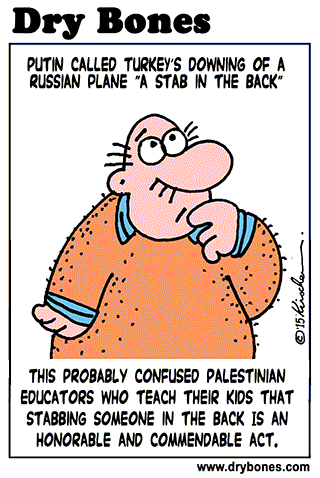
Cartoon of the day

November 27, 2015

H/t Dry Bones

D15B26_1

US Says Turkey Downed Russian Jet While in Syrian Airspace

November 27, 2015

US Says Turkey Downed Russian Jet While in Syrian Airspace If US officials are correct, Turkey committed a textbook war crime by shooting down a plane that was operating in Syrian airspace at the invitation of the Syrian government

Source: US Says Turkey Downed Russian Jet While in Syrian Airspace

A brief report by Reuters has completely shattered Ankara’s story of the Russian jet joyriding in its airspace:

The United States believes that the Russian jet shot down by Turkey on Tuesday was hit inside Syrian airspace after a brief incursion into Turkish airspace, a U.S. official told Reuters, speaking on condition of anonymity.

The official said that assessment was based on detection of the heat signature of the jet.

Even if we assume that the Russian jet briefly entered Turkish airspace, it would be a clear violation of international law for Turkish fighter jets to attack the plane inside Syria.

 What’s puzzling is that it’s highly unlikely that Turkey acted without consent from the United States. Is Washington having second thoughts about this clear provocation?

It’s interesting that Obama has expressed support for Turkey, without explicitly stating that Russia violated Turkish airspace:

[This incident] points to an ongoing problem with the Russian operations. They are operating very close to a Turkish border, and they are going after moderate opposition that are supported by not only Turkey but a wide range of countries.

The problem with the “moderate opposition” line is that Reuters reported today that al Qaeda’s Nusra Front operates in the region that was being targeted by Russia during the time of the shoot-down.

And just a reminder: NATO still “stands in solidarity” with Turkey.

Meet The Man Who Funds ISIS: Bilal Erdogan, The Son Of Turkey’s President

November 26, 2015

Meet The Man Who Funds ISIS: Bilal Erdogan, The Son Of Turkey’s President

Source: Meet The Man Who Funds ISIS: Bilal Erdogan, The Son Of Turkey’s President | Zero Hedge

Russia’s Sergey Lavrov is not one foreign minister known to mince his words. Just earlier today, 24 hours after a Russian plane was brought down by the country whose president three years ago said “a short-term border violation can never be a pretext for an attack”, had this to say: “We have serious doubts this was an unintended incident and believe this is a planned provocation” by Turkey.

But even that was tame compared to what Lavrov said to his Turkish counterparty Mevlut Cavusoglu earlier today during a phone call between the two (Lavrov who was supposed to travel to Turkey has since canceled such plans).

As Sputnik transcribes, according to a press release from Russia’s Ministry of Foreign Affairs, Lavrov pointed out that, “by shooting down a Russian plane on a counter-terrorist mission of the Russian Aerospace Force in Syria, and one that did not violate Turkey’s airspace, the Turkish government has in effect sided with ISIS.

It was in this context when Lavrov added that “Turkey’s actions appear premeditated, planned, and undertaken with a specific objective.

More importantly, Lavrov pointed to Turkey’s role in the propping up the terror network through the oil trade. Per the Russian statement:

“The Russian Minister reminded his counterpart about Turkey’s involvement in the ISIS’ illegal trade in oil, which is transported via the area where the Russian plane was shot down, and about the terrorist infrastructure, arms and munitions depots and control centers that are also located there.”

Others reaffirmed Lavrov’s stance, such as retired French General Dominique Trinquand, who said that “Turkey is either not fighting ISIL at all or very little, and does not interfere with different types of smuggling that takes place on its border, be it oil, phosphate, cotton or people,” he said.

The reason we find this line of questioning fascinating is that just last week in the aftermath of the French terror attack but long before the Turkish downing of the Russian jet, we wrote about “The Most Important Question About ISIS That Nobody Is Asking” in which we asked who is the one “breaching every known law of funding terrorism when buying ISIS crude, almost certainly with the tacit approval by various “western alliance” governments, and why is it that these governments have allowed said middleman to continue funding ISIS for as long as it has?

Precisely one week later, in even more tragic circumstances, suddenly everyone is asking this question.

And while we patiently dig to find who the on and offshore “commodity trading” middleman are, who cart away ISIS oil to European and other international markets in exchange for hundreds of millions of dollars, one name keeps popping up as the primary culprit of regional demand for the Islamic State’s “terrorist oil” – that of Turkish president Recep Erdogan’s son: Bilal Erdogan.

His very brief bio:

Necmettin Bilal Erdogan, commonly known as Bilal Erdogan (born 23 April 1980) is the third child of Recep Tayyip Erdo?an, the current President of Turkey.

After graduating from Kartal Imam Hatip High School in 1999, Bilal Erdogan moved to the US for undergraduate education. He also earned a Masters Degree in John F. Kennedy School of Government at Harvard University in 2004. After graduation, he served in the World Bank as intern for a while. He returned Turkey in 2006 and started to his business life. Bilal Erdogan is one of the three equal shareholders of “BMZ Group Denizcilik “, a marine transportation corporation.

Here is a recent picture of Bilal, shown in a photo from a Turkish 2014 article, which “asked why his ships are now in Syria”:

In the next few days, we will present a full breakdown of Bilal’s various business ventures, starting with his BMZ Group which is the name implicated most often in the smuggling of illegal Iraqi and Islamic State through to the western supply chain, but for now here is a brief, if very disturbing snapshot, of both father and son Erdogan by F. William Engdahl, one which should make everyone ask whether the son of Turkey’s president (and thus, the father) is the silent mastermind who has been responsible for converting millions of barrels of Syrian Oil into hundreds of millions of dollars of Islamic State revenue.

By F. William Engdahl, posted originally in New Eastern Outlook:

Erdogan’s Dirth Dangerous ISIS Games

More and more details are coming to light revealing that the Islamic State in Iraq and Syria, variously known as ISIS, IS or Daesh, is being fed and kept alive by Recep Tayyip Erdogan, the Turkish President and by his Turkish intelligence service, including MIT, the Turkish CIA. Turkey, as a result of Erdogan’s pursuit of what some call a Neo-Ottoman Empire fantasies that stretch all the way to China, Syria and Iraq, threatens not only to destroy Turkey but much of the Middle East if he continues on his present path.

In October 2014 US Vice President Joe Biden told a Harvard gathering that Erdogan’s regime was backing ISIS with “hundreds of millions of dollars and thousands of tons of weapons…” Biden later apologized clearly for tactical reasons to get Erdo?an’s permission to use Turkey’s Incirlik Air Base for airstrikes against ISIS in Syria, but the dimensions of Erdogan’s backing for ISIS since revealed is far, far more than Biden hinted.

ISIS militants were trained by US, Israeli and now it emerges, by Turkish special forces at secret bases in Konya Province inside the Turkish border to Syria, over the past three years. Erdo?an’s involvement in ISIS goes much deeper. At a time when Washington, Saudi Arabia and even Qatar appear to have cut off their support for ISIS, they remaining amazingly durable. The reason appears to be the scale of the backing from Erdo?an and his fellow neo-Ottoman Sunni Islam Prime Minister, Ahmet Davuto?lu.

Nice Family Business

The prime source of money feeding ISIS these days is sale of Iraqi oil from the Mosul region oilfields where they maintain a stronghold. The son of Erdogan it seems is the man who makes the export sales of ISIS-controlled oil possible.

Bilal Erdo?an owns several maritime companies. He has allegedly signed contracts with European operating companies to carry Iraqi stolen oil to different Asian countries. The Turkish government buys Iraqi plundered oil which is being produced from the Iraqi seized oil wells. Bilal Erdogan’s maritime companies own special wharfs in Beirut and Ceyhan ports that are transporting ISIS’ smuggled crude oil in Japan-bound oil tankers.

Gürsel Tekin vice-president of the Turkish Republican Peoples’ Party, CHP, declared in a recent Turkish media interview, “President Erdogan claims that according to international transportation conventions there is no legal infraction concerning Bilal’s illicit activities and his son is doing an ordinary business with the registered Japanese companies, but in fact Bilal Erdo?an is up to his neck in complicity with terrorism, but as long as his father holds office he will be immune from any judicial prosecution.” Tekin adds that Bilal’s maritime company doing the oil trades for ISIS, BMZ Ltd, is “a family business and president Erdogan’s close relatives hold shares in BMZ and they misused public funds and took illicit loans from Turkish banks.”

In addition to son Bilal’s illegal and lucrative oil trading for ISIS, Sümeyye Erdogan, the daughter of the Turkish President apparently runs a secret hospital camp inside Turkey just over the Syrian border where Turkish army trucks daily being in scores of wounded ISIS Jihadists to be patched up and sent back to wage the bloody Jihad in Syria, according to the testimony of a nurse who was recruited to work there until it was discovered she was a member of the Alawite branch of Islam, the same as Syrian President Bashar al-Assad who Erdogan seems hell-bent on toppling.

Turkish citizen Ramazan Bagol, captured this month by Kurdish People’s Defence Units,YPG, as he attempted to join ISIS from Konya province, told his captors that said he was sent to ISIS by the ‘Ismailia Sect,’ a strict Turkish Islam sect reported to be tied to Recep Erdogan. Baol said the sect recruits members and provides logistic support to the radical Islamist organization. He added that the Sect gives jihad training in neighborhoods of Konya and sends those trained here to join ISIS gangs in Syria.

According to French geopolitical analyst, Thierry Meyssan, Recep Erdogan “organised the pillage of Syria, dismantled all the factories in Aleppo, the economic capital, and stole the machine-tools. Similarly, he organised the theft of archeological treasures and set up an international market in Antioch…with the help of General Benoît Puga, Chief of Staff for the Elysée, he organised a false-flag operation intended to provoke the launching of a war by the Atlantic Alliance – the chemical bombing of la Ghoutta in Damascus, in August 2013. “

Meyssan claims that the Syria strategy of Erdo?an was initially secretly developed in coordination with former French Foreign Minister Alain Juppé and Erdogan’s then Foreign Minister Ahmet Davuto?lu, in 2011, after Juppe won a hesitant Erdogan to the idea of supporting the attack on traditional Turkish ally Syria in return for a promise of French support for Turkish membership in the EU. France later backed out, leaving Erdogan to continue the Syrian bloodbath largely on his own using ISIS.

Gen. John R. Allen, an opponent of Obama’s Iran peace strategy, now US diplomatic envoy coordinating the coalition against the Islamic State, exceeded his authorized role after meeting with Erdogan and “promised to create a “no-fly zone” ninety miles wide, over Syrian territory, along the whole border with Turkey, supposedly intended to help Syrian refugees fleeing from their government, but in reality to apply the “Juppé-Wright plan”. The Turkish Prime Minister, Ahmet Davutoglu, revealed US support for the project on the TV channel A Haber by launching a bombing raid against the PKK.” Meyssan adds.

There are never winners in war and Erdogan’s war against Syria’s Assad demonstrates that in bold. Turkey and the world deserve better. Ahmet Davutoglu’s famous “Zero Problems With Neighbors” foreign policy has been turned into massive problems with all neighbors due to the foolish ambitions of Erdogan and his gang. 
No, the Islamic State Will Not Be Defeated — and if It Is, We Still Lose

November 25, 2015

No, the Islamic State Will Not Be Defeated — and if It Is, We Still Lose, BreitbartBen Shapiro, November 24, 2015

GettyImages-497044984-640x480

Barack Obama has now created an unwinnable war.

While all of the 2016 candidates declare their strategies for victory against ISIS, President Obama’s leading from behind has now entered the Middle East and the West into a free-for-all that cannot end any way but poorly.

The best way to understand the situation in Syria is to look at the situation and motivation of the various players. All of them have varying agendas; all of them have different preferred outcomes. Few of them are on anything approaching the same page. And Barack Obama’s failure of leadership means that there is no global power around which to center.

ISIS. ISIS has gained tremendous strength since Barack Obama’s entry to power and pullout from Iraq. They currently control northern Syria, bordering Turkey, as well as large portions of northern Iraq. Their goal: to consolidate their territorial stranglehold, and to demonstrate to their followers that they, and not other competing terrorist groups like Al Qaeda, represent the new Islamic wave. They have little interest in toppling Syrian dictator Bashar Assad for the moment. They do serve as a regional counterweight to the increasingly powerful Iranians – increasingly powerful because of President Obama’s big nuclear deal, as well as his complete abdication of responsibility in Iraq.

Iran. Iran wants to maximize its regional power. The rise of ISIS has allowed it to masquerade as a benevolent force in Iraq and Syria, even as it supports Assad’s now-routine use of chemical weapons against his adversaries, including the remnants of the Free Syrian Army (FSA). Iran has already expanded its horizons beyond Iraq and Syria and Lebanon; now it wants to make moves into heretofore non-friendly regions like Afghanistan. Their goal in Syria: keep Bashar Assad in power. Their goal in Iraq: pushing ISIS out of any resource-rich territories, but not finishing ISIS off, because that would then get rid of the global villain against which they fight.

Assad. The growth of ISIS has allowed Assad to play the wronged victim. While the FSA could provide a possible replacement for him, ISIS can’t credibly do so on the international stage. Assad knows that, and thus has little interest in completely ousting them. His main interest is in continuing to devastate the remaining FSA while pretending to fight ISIS.

Egypt/Saudi Arabia/Jordan. As you can see, ISIS, Iran, and Assad all have one shared interest: the continued existence of ISIS. The same is not true with regard to Egypt, Saudi Arabia, and Jordan, all of whom fear the rise of radical Sunni terrorist groups in their home countries. They are stuck between a rock and a hard place, however, because openly destroying ISIS on behalf of Alaouite Assad, they embolden the Shia, their enemies. Egypt, Saudi Arabia, and Jordan would all join an anti-ISIS coalition in the same way they did against Saddam Hussein in 1991, but just like Hussein in 1991, they won’t do it if there are no Sunni alternatives available. Tunisia, Saudi Arabia, and Jordan are the top three sources of foreign fighters for ISIS.

Turkey. The Turks have several goals: to stop the Syrian exodus across their borders, to prevent the rise of the Iranians, and to stop the rise of the Kurds. None of these goals involves the destruction of ISIS. Turkey is Sunni; so is ISIS. ISIS provides a regional counterweight against Iran, so long as it remains viable. It also keeps the Kurds occupied in northern Iraq, preventing any threat of Kurdish consolidation across the Iraq-Turkey border. They will accept Syrian refugees so long as those other two goals remain primary – and they’ll certainly do it if they can ship a hefty portion of those refugees into Europe and off their hands.

Russia. Russia wants to consolidate its power in the Middle East. It has done so by wooing all the players to fight against one another. Russia’s involvement in the Middle East now looks a good deal like American involvement circa the Iran-Iraq War: they’re playing both sides. Russia is building nuclear reactors in Egypt, Jordan, Turkey and Iran. They’re Bashar Assad’s air force against both the FSA and ISIS. Russia’s Vladimir Putin doesn’t have a problem with destroying ISIS so long as doing so achieves his other goal: putting everyone else in his debt. He has a secondary goal he thought he could chiefly pursue in Eastern Europe, and attempted with Ukraine: he wants to split apart the North Atlantic Treaty Organization, which he rightly sees as a counterbalance to check Russian aggression. Thanks to today’s Turkish attack on a Russian plane, and thanks to the West’s hands-off policy with regard to the conflict, Putin could theoretically use his war against ISIS as cover to bombard Turkish military targets, daring the West to get involved against him. Were he to do so, he’d set the precedent that NATO is no longer functional. Two birds, one war.

Israel. Israel’s position is the same it has always been: Israel is surrounded by radical Islamic enemies on every side. Whether Iranian-backed Hezbollah or Sunni Hamas and ISIS, Israel is the focus of hate for all of these groups. Ironically, the rise of Iran has unified Israel with its neighbors in Jordan, Egypt, and Saudi Arabia. All three of those countries, however, can’t stand firmly against ISIS.

All of which means that the only country capable of filling the vacuum would be the United States. Just as in 1991, a major Sunni power is on the move against American interests – but unlike in 1991, no viable option existed for leaving the current regime in power. And the US’ insistence upon the help of ground allies is far too vague. Who should those allies be, occupying ISIS-free ISISland?

The Kurds have no interest in a Syrian incursion. Turkish troops movements into ISIS-land will prompt Iranian intervention. Iranian intervention into ISIS-land would prompt higher levels of support for Sunni resistance. ISIS-land without ISIS is like Iraq without Saddam Hussein: in the absence of solidifying force, chaos breaks out. From that chaos, the most organized force takes power. Russia hopes that should it destroy ISIS, Assad will simply retain power; that may be the simplest solution, although it certainly will not end the war within the country. There are no good answers.

Barack Obama’s dithering for years led to this. Had he lent his support in any strong way to one side, a solution might be possible. Now, it’s not.