Posted tagged ‘Trump agenda’

Dr. Jasser participates in a panel discussion about the state of the Middle East & ISIS

February 25, 2017

Dr. Jasser participates in a panel discussion about the state of the Middle East & ISIS, AIFD via YouTube, February 24, 2017

(It’s an about thirty-five minute long video about Middle East related topics, including America’s relations with Russia, Islamist terrorism, Islamist nations, the clash between Judeo-Christian and Islamist cultures and what the Trump administration can and should do. — DM)


Iraq hits ISIS in Syria – with Russia, without US

February 25, 2017

Iraq hits ISIS in Syria – with Russia, without US, DEBKAfile, February 25, 2017

If indeed President Donald Trump gave a quiet nod to the four-way Russian-Iranian-Syrian-Iraqi military partnership for fighting this enemy, it would signify the start of US-Russian cooperation for the war on Islamic terror in the Middle East and mean that the two powers were running local forces hand in hand.

But if the Iraqis chose to work in conjunction with Moscow and Tehran, cutting America out, that is a completely different matter. It would indicate that President Vladimir Putin, having noted Trump’s difficulties in lining up his team for a deal with Moscow – and the opposition to this deal he faces from his intelligence agencies – had given up on the US option and was going forward in Syria and Iraq with Tehran instead.

****************************

The Iraqi air force Friday, Feb. 24, conducted its first ever bombardment of the Islamic State in Syria. The target was the southeastern town of Abu Kemal near the Iraqi border, to which ISIS has removed most of its command centers from its main Syrian stronghold in Raqqa. Iraqi Defense Ministry spokesman Brig. Gen. Tahseen Ibrahim stated that Baghdad had coordinated the attack with Moscow, Damascus and Tehran using shared intelligence.

When he was asked if the United State military was involved, he said he did not know.

Likewise, in referring to the Abu Kemal attack, Iraqi Prime Minister Haydar al-Abadi said: “We are determined to follow the terrorism that is trying to kill our sons and our citizens everywhere.” He made no mention of the United States, despite ongoing US support for the Iraqi army’s long offensive to retake Mosul from ISIS.

This omission is of pivotal importance for the future of the war on the Islamic State and America’s involvement in that campaign.

If indeed President Donald Trump gave a quiet nod to the four-way Russian-Iranian-Syrian-Iraqi military partnership for fighting this enemy, it would signify the start of US-Russian cooperation for the war on Islamic terror in the Middle East and mean that the two powers were running local forces hand in hand.

But if the Iraqis chose to work in conjunction with Moscow and Tehran, cutting Ameica out, that is a completely different matter. It would indicate that President Vladimir Putin, having noted Trump’s difficulties in lining up his team for a deal with Moscow – and the opposition to this deal he faces from his intelligence agencies – had given up on the US option and was going forward in Syria and Iraq with Tehran instead.

The Iraqi prime minister’s actions in this regard must have been critical. He may be playing a double game – working with the US commander in Iraq and Syria, Lt. Gen. Stephen Townsend, for the capture Mosul from the jihadis, while at the same time, using Russian and Iranian partners on other anti-ISIS fronts.

DEBKAfile’s military and counterterrorism sources say that in any event the Iraqi air strike presented a major affront to President Donald Trump’s avowed determination to fight radical Islamic terror to the finish. Its timing is unfortunate: Defense Secretary Gen. James Mattis and Joint Chiefs of Staff Chairman Gen. Joseph Dunford are due Monday to submit the review the president commissioned from the Pentagon on policy planning for Syria and the war on terror. Trump’s foreign policy address to Congress is scheduled for the next day.

If the Pentagon’s recommendations hinge on the enlistment of regional military strength for the campaign against ISIS, then Moscow will be seen to have snatched the initiative first.

There are more signs that the war on ISIS may be running away from Washington. The Trump administration has made it clear that it objects to any role for the Turkish army in the offensive to capture Raqqa from ISIS. However, on Saturday, Turkish Foreign Minister Mevlut Cavusoglu, after hailing the victory of the Turkish army over ISIS in the northern Syrian town of Al-Bab, announced that Turkey was planning to lead an operation for the recovery of Raqqa, in cooperation with… France, Britain and Germany, after holding consultations with their representatives. America was not mentioned.

Gorka & Jasser: We Are Fighting ‘Not a War with Islam, but a War Inside Islam’

February 24, 2017

Gorka & Jasser: We Are Fighting ‘Not a War with Islam, but a War Inside Islam’, BreitbartJohn Hayward, February 24, 2017

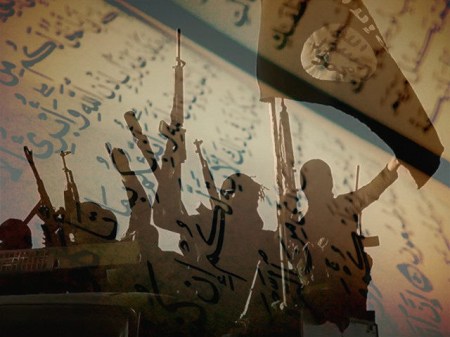
isis-koran-640x480Flickr/AFP

Broadcasting live from CPAC 2017, SiriusXM host Alex Marlow spoke with Dr. Sebastian Gorka and Dr. Zuhdi Jasser about national security, Islamist terrorism, and their panel discussion, “When Did World War III Begin?”

(Audio at the link. — DM)

Marlow began by asking his guests what they expected from the national security segment of President Donald Trump’s scheduled address to the Conservative Political Action Conference.

“Exactly what we’ve heard before,” Gorka replied. “If you really want to understand the direction of the White House and how much everything changed at 12:01 on January the 20th, you look at two things: you look at a speech that really wasn’t carefully addressed or really paid enough attention to, that’s the Youngstown campaign speech, which was about the threat of jihad in general and what we’re going to do about ISIS.”

“Specifically, it really bears repeating, the inauguration, the address that the president gave at the inauguration, was explicit,” he continued. “Number one, we are going to eradicate the Islamic State – not degrade, not manage, not ameliorate – eradicate. And secondly, words have meaning. When he says our enemy is ‘radical Islamic terrorism,’ that is a 180 degree  change from the last eight years, when we weren’t allowed to even say who the enemy was.”

“Zuhdi knows it better than anybody because he understands that this isn’t about poverty or lack of education. It’s about people who are fighting for the soul of Islam – not a war with Islam, but a war inside Islam; as King Abdullah, as General Sisi has said, for which version is going to win,” Gorka said.

Marlow asked Dr. Jasser about the topic of language control Gorka touched upon and the previous administration’s reluctance to use explicit language like “radical Islamic jihad” to describe the enemy.

“We got to this point because we had an administration who was being whispered to by Muslim Brotherhood sympathizers, by apologists, by governments that might be our allies against al-Qaeda and ISIS, but they love a whack-a-mole program. They don’t want to treat the disease, which is not ‘violent extremism’ but violent Islamism,” Jasser charged.

“We have to start focusing on our own values,” he urged. “There’s nothing more American than fighting theocracy, and yet the Left for the last eight years has invoked blasphemy laws in America by telling us we can’t criticize Islamist political movements.”

Jasser predicted the new administration would succeed in destroying ISIS but warned that “it will come back in another form – two, three, four years later – unless we engage Muslim reformists, like our Muslim reform movement, to treat the underlying theocracy.”

Marlow complained that the mainstream media swiftly denounce candid talk about the problem of radical Islam as “hate speech” even when confined to straightforward reporting without editorial opinion, making it difficult to have a constructive discussion about the problem.

“I think this is exactly what the Saudi regime, the Iranian Khomeinists, the Brotherhood want, is they want to dominate what Islam means,” Jasser said. “And yes, it’s not my Islam, but we have to thread that needle. Because if you don’t call it political Islam or Islamism as the threat, you’re not going to be able to figure out who to engage. We want to engage anti-Caliphate, anti-violent jihad Muslims who are pro-freedom, pro-equality of men and women, who share our values. If we don’t do that discernment in our verbiage, we’re going to miss it and actually end up helping our enemies and end up actually not only being the firefighters, but the arsonists. We have to stop that cycle.”

“Let’s just take it one level deeper. It’s not just empowering our enemies, which would be bad enough,” Gorka added. “If you don’t talk truthfully about who the enemy is, how are you going to win? What we saw in the last eight years is a policy that actually weakened our most important allies.”

“So when you’ve got the president of the most populous Arab nation in the world say this is a war for the heart of Islam, General Sisi, when you’ve got King Abdullah with his Amman statement saying, ‘Look, we have to stop the jihadis hijacking the religion’ – we have a president here who stands up and says, ‘No, no, no, these are not the droids you’re looking for, the religion has nothing to do with this,’” he elaborated, referring to the Obama administration’s insistence on framing the war as a struggle against generic violent extremism.

“Do you know who we hurt the most? Those Muslims who are on the front lines with the jihadis, who understand this isn’t about poverty or lack of education; it’s about an ideology. So we’ve actually hurt the people who are on the front line the most. We’re not prepared to do that anymore. This administration’s going to help the Jordanians, help the Egyptians, help them fight this war,” Gorka vowed.

“I think we have to own what it means to be diverse,” Jasser suggested. “What is ‘diversity’ in the Muslim community? It’s not ethnic diversity. Being Muslim is not an identity movement of a monolithic homogenous group. It is a diverse ideological movement that has fundamentalist, orthodox, liberal, secularists that are all in this Muslim diverse group. So if the Left actually believes in diversity different from what Pelosi whispered into Andre Carson’s ear – ‘Tell them you’re Muslim’ – Islam is not a race. They’re racializing the faith. That’s the biggest obstacle.”

“I think the other thing I hope to see is not only us being against jihadists, but what are we for,” he added. “I think that will be the difference between some of the dictators in the Middle East, that yes, some of them have been on our side against jihad, the militants, but we are the adults in the world, in being for liberty and freedom. I hope that will be part of a Trump Doctrine.”

Gorka agreed, saluting Jasser as “the point man here in America for sense, for common sense in this battle.”

“The saddest part is there are people like him in the Middle East. There are people every day risking their lives on their blog sites, in North Africa, in the Middle East pushing back on this, saying, ‘I’m a Muslim, but I don’t think an infidel needs to be killed.’ That means he’s put the crosshairs on his chest,” Gorka noted. “In some parts of the Muslim world, that’s an instant death sentence.”

“That’s why the four million Muslims in America need to step up and act because we can do things here that you just can’t do in the Middle East,” Jasser said. “They end up in prison. They end up slaughtered, tortured.”

Marlow proposed that “the stifling of speech in the Muslim world is really what has allowed a lot of the jihadist movements to flourish.”

“Why do you think they use the term ‘Islamophobia’ instead of talking about, yes, there might be some bigotry against Muslims in the West?” Jasser asked. “They use the term Islamophobia because they want to anthropomorphize Islam so that you don’t criticize it, and they suppress free speech. That’s how they invoke blasphemy laws in the West.”

“You’re absolutely right. The freedom of speech issue is huge in the Middle East because it’s a life and death issue in many cases,” Gorka said. “But here, it’s almost as important. It’s not life and death, but it is closing down the discussion.”

“You look at what’s happened in the last four weeks with this administration,” he said. “There’s a phrase in soccer: you play the man on the ball. We’re not going to talk about policies; we’re going to attack individuals, whether it’s Kellyanne, the president, myself, Steve Bannon. They do that how? ‘We don’t want to talk about the threat to America. You’re a racist. You’re an Islamophobe. You’re a xenophobe. Oh, well, in that case, we can’t talk to you.’ That’s as dangerous as just the constant ad hominem attacks because then there is no discussion.”

Jasser said his message to CPAC was that “there is hope” for a lasting victory in the long war against Islamist extremism.

“The first step is to defeat the militants, which this president will finally do,” he said. “The second step is to go back to our American roots and defeat theocracy, work with Muslims and our Muslim reform movement. We have a two-page declaration that can be used, I hope, not only to vet refugees, to figure out which groups are with us and against us. I hope we start doing security clearances through those who share our values.”

“There are so many that are – not in this administration, but that are in the government from the previous administration – that I think are Islamists, that might not be violent extremists, but we need to shift the axis of the lens of Homeland Security, foreign policy, to countering violent Islamism. There’s nothing this group here and the country can do to better empower reform-minded Muslims that share our values than to shift from this blasé CVE to CVI,” Jasser said, lampooning the Obama administration’s acronym for “Countering Violent Extremism.”

Gorka referred to CVE as “garbage from the last eight years that obfuscated the threat.”

He said the most important step taken by the new administration was President Trump’s executive order to temporarily limit immigration from the most unsecure Middle Eastern nations.

“Whatever the final version of the reform measures are, the fact is, when an Iraqi collars me in the halls of Congress and says, ‘My friends back home in Iraq applaud this measure because they know how many bad guys are in Iraq that want to come over here, so do it. Thank you,’” Gorka said.

Dr. Sebastian Gorka is deputy assistant to President Trump and was formerly national security editor for Breitbart News. He is the author of Defeating Jihad: The Winnable War. Dr. Zuhdi Jasser is the founder and president of the American Islamic Forum for Democracy and author of A Battle for the Soul of Islam: An American Muslim Patriot’s Fight to Save His Faith.


Newly Installed NSA McMaster Reassures National Security Staff: No Witch Hunts Coming

February 24, 2017

Newly Installed NSA McMaster Reassures National Security Staff: No Witch Hunts Coming, Washington Free Beacon, February 24, 2017

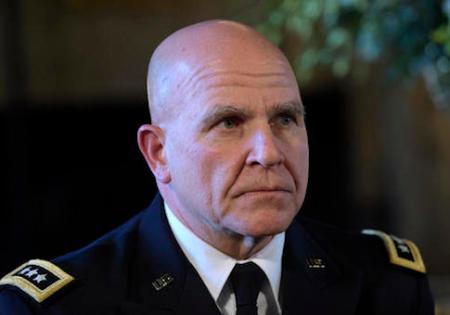
Army Lt. Gen. H.R. McMaster listens as President Donald Trump makes the announcement at Trump's Mar-a-Lago estate in Palm Beach, Fla., Monday, Feb. 20, 2017. McMaster will be the new national security adviser. (AP Photo/Susan Walsh)

Army Lt. Gen. H.R. McMaster listens as President Donald Trump makes the announcement at Trump’s Mar-a-Lago estate in Palm Beach, Fla., Monday, Feb. 20, 2017. McMaster will be the new national security adviser. (AP Photo/Susan Walsh)

To help with this effort, McMaster recommended several books meant to help current White House officials understand his own foreign policy vision.

One senior White House official who spoke to the Free Beacon described the reading list as pleasantly surprising and a vast departure from the former Obama administration’s own national security vision.

***************************

Incoming White House National Security Adviser Lt. Gen. H. R. McMaster sought to reassure senior Trump administration officials during his first “all hands” staff meeting Thursday, according to those who attended the get together and told the Washington Free Beacon that McMaster informed staffers he does not intend to pursue a major shakeup of President Donald Trump’s national security team.

McMaster, who replaced Michael Flynn following his resignation last week, plans to navigate a vast departure from the Obama administration’s foreign policy vision, according to senior White House officials who described the meeting as “reassuring.” McMaster emphasized that he will not dismantle the team that Flynn had built.

As part of his discussion with White House national security staff, McMaster recommended a comprehensive reading list that included President Trump’s book, “The Art of the Deal,” and several other tomes by leading historians about how to get the upper hand on America’s enemies. White House staff are said to have been mostly “thrilled” when hearing about the book list.

Sources who spoke to the Free Beacon about McMaster’s vision, as laid out in the Thursday meeting, expressed optimism about his appointment and pushed back on what they described as false media narratives centered around White House disarray following Flynn’s departure.

“It’s no secret we’ve had a few more all-hands meetings than we intended in our first month—but General McMaster used this event to both reassure the NSC staff and to give us the tools to continue the mission,” said one senior White House National Security Council official who requested anonymity while discussing internal White House meetings.

McMaster explicitly told White House officials that he does not aim to dismantle Trump’s foreign policy team or push out those perceived as still loyal to Flynn. These comments run counter to a recent New York Times report claiming that McMaster is pursuing a massive reorganization of the president’s national security team.

“He made it clear he wasn’t there to grind a political axe or engage in a witch hunt,” the senior White House official said. “He was there to provide leadership, including direction on how to think about the task in front of us.”

To help with this effort, McMaster recommended several books meant to help current White House officials understand his own foreign policy vision.

One senior White House official who spoke to the Free Beacon described the reading list as pleasantly surprising and a vast departure from the former Obama administration’s own national security vision.

In addition to Trump’s “Art of the Deal,” McMaster recommended reading his own book, “Dereliction of Duty,” which catalogues the mistakes that led the United States into a quagmire in Vietnam.

He also requested that White House staffers read Peter Rodman’s “Presidential Command,” which McMaster reportedly referred to as the “gold standard” in foreign policy history. Rodman was an top official in the Richard Nixon, Gerald Ford, Ronald Reagan, and both Bush administrations.

Senior White House staff are said to have found the mention of the book “very reassuring.”

“It’s certainly encouraging to see General McMaster highlighting his legacy,” one source said.

McMaster went on to further recommend two books by Zachary Shore, a historian and international conflict expert who teaches at the Naval Postgraduate School.

One Shore book, “Blunder: Why Smart People Make Bad Decisions,” was described as “a cautionary tale for the staff” at the White House. The other, “A Sense of the Enemy,” examines methods to overtake rival forces.

Lastly, McMaster recommended staff read an essay by Canadian historian Margaret MacMillan titled, “The Rhyme of History,” which tackles lessons from World War I.

Senior White House officials who took part in the meeting described the reading list as encouraging and part of an effort to restore conservative principals focused primarily on defending the U.S.’s best interests.

The mention of MacMillan’s essay in particular “suggests General McMaster does not consider the 21st century a sort of post-historical bubble, but rather that there is a great deal to be learned from history as we chart our path forward,” said one official who described McMaster as advocating a wholesale reversal from the Obama administration’s vision.

Several historians currently serve on the White House’s national security team, including Col. Derek Harvey, a former advisor to Gen. David Petraeus; Michael Anton, a former speechwriter for George W. Bush, and Victoria Coates, a former top aide to Sen. Ted Cruz (R., Texas) and art historian.

Trump’s Immigration Guidance: The Rule of Law Returns

February 22, 2017

Trump’s Immigration Guidance: The Rule of Law Returns, PJ Media, Andrew C. McCarthy, February 22, 2017

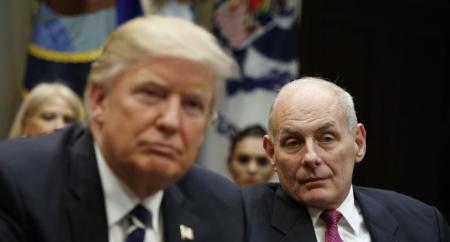
homelandsecheadHomeland Security Secretary John Kelly, right, watches during President Donald Trump’s meeting on cyber security in the Roosevelt Room of the White House in Washington, Tuesday, Jan. 31, 2017. (AP Photo/Evan Vucci)

On Tuesday, John Kelly, President Trump’s secretary of Homeland Security, published a six-page, single-spaced memorandum detailing new guidance on immigration enforcement. Thereupon, I spent about 1,500 words summarizing the guidance in a column at National Review. Brevity being the soul of wit, both the memo and my description of it could have been reduced to a single, easy-to-remember sentence:

Henceforth, the United States shall be governed by the laws of the United States.

That it was necessary for Secretary Kelly to say more than this — and, sadly, that such alarm has greeted a memo that merely announces the return of the rule of law in immigration enforcement — owes to the Obama administration abuses of three legal doctrines: prosecutorial discretion, preemption, and separation of powers (specifically, the executive usurpation of legislative power).

To the extent President Obama declined to enforce immigration law (notwithstanding his constitutional obligation to execute the laws faithfully), he did so under the guise of prosecutorial discretion. In the pre-Obama days, prosecutorial discretion was an unremarkable, uncontroversial resource-allocation doctrine. It simply meant that since resources are finite, and since it would be neither possible nor desirable to prosecute every crime, we target law-enforcement resources to get the most crime-fighting bang for the taxpayer buck. That means prioritizing enforcement action against (a) the worst offenders and (b) the unlawful causes of the activity.

This is easily illustrated by federal drug enforcement. There are comparatively few federal narcotics agents, compared, say, to police in a major city. But while both feds and cops have authority to arrest traffickers and consumers of illegal drugs, only federal jurisdiction is interstate and international. Consequently, the best use of finite federal enforcement resources is to limit them to prosecutions of significant felony importation and distribution offenses, leaving it to the states and municipalities to handle street pushers and misdemeanor violations involving the use of drugs.

Significantly, the fact that federal enforcement policy, which is made by the executive branch, does not target lesser felons or users does not mean this policy effectively repeals federal drug laws, which are written by Congress.

The non-targeted crimes are still crimes, and the feds reserve the right to prosecute them in appropriate cases (e.g., if they encounter these offenses in the course of carrying out other criminal enforcement missions).

In the area of immigration enforcement, Obama contorted this resource allocation doctrine into a de facto immunity scheme. That is, the Obama Homeland Security Department announced what it labeled enforcement “priorities.” If an illegal alien did not fit into the priorities, it was as if the alien were insulated against prosecution — effectively, it was as if there was nothing illegal about being an alien unlawfully present in the United States; it was as if Obama’s policies were a legal defense against Congress’s duly enacted laws.

This was complemented by a second legal distortion: Obama’s mangling of the so-called preemption doctrine. As we’ve noted, there are certain areas of law — like immigration and narcotics enforcement — in which the federal and state governments have concurrent jurisdiction: both are permitted to regulate and prosecute. This can work well (it generally does in drug enforcement); but it can be counterproductive if the dual sovereigns work at cross-purposes.

In some areas, like immigration, the courts have ruled that the federal government is supreme (on the dubious but now well-rooted theory that immigration law enforcement is primarily a federal responsibility). This means that the federal government has the power to preempt state action. Importantly, preemption is a power of Congress. That is, in an area of federal supremacy, states are prohibited to act in a manner that would contravene federal law.

Obama, to the contrary, took the position that states were forbidden to take action that contravened Obama immigration policy.

This was brought into sharp relief by the administration’s conflict with the state of Arizona. Far from seeking to countermand federal law, Arizona sought to enforce Congress’s statutes. Yet, Obama took the position that the state was bound not by Congress’s statutes but by Obama’s proclaimed enforcement policies — even if those amounted to non-enforcement of Congress’s statutes.

This was a perversion of both preemption and prosecutorial discretion. As long as Arizona was taking action consistent with federal law, its enforcement measures could not be preempted. Moreover, even if Arizona’s enforcement policy was broader than Obama’s, that should not have mattered: as we’ve seen, a federal exercise of prosecutorial discretion just means lesser crimes are not targeted, not that they are no longer crimes. If Arizona took action against those lesser crimes, that was completely appropriate; it was filling a gap in federal enforcement, not defying federal law.

The obstacles imposed by Obama’s immigration proclamations bring us to the third legal abuse: the usurpation of legislative authority. In effect, Obama’s announced priorities became not guidelines for immigration enforcement but new federal laws. According to the administration, only those aliens who fit Obama’s guidelines could be prosecuted. The Homeland Security Department was instructed to halt enforcement action at the earliest possible stage — i.e., once it was understood that an illegal alien did not fit a priority category, all investigative activity was to stop, even though it was known that the alien was acting illegally.

In effect, the Obama priorities operated like law. They controlled what federal investigators and prosecutors could do, and they were used to block states from enforcing their own laws. In this, at least for as long as Obama was president, they supplanted Congress’s laws — a clear violation of separation of powers.

All the Trump guidance announced in Secretary Kelly’s memo really does is repeal Obama’s decrees. The memo essentially says: the law of the United States is back to being the law of the United States. That’s the way it’s supposed to be.

An Émigré Explains Why The U.S. Should Want Russia As An Ally

February 22, 2017

An Émigré Explains Why The U.S. Should Want Russia As An Ally, TheFederalist, February 22, 2017

(Please see also, Is a Trump-Putin Detente Dead? — DM

I am a Russian-born U.S. citizen. Since my old country is all in the news now, unsurprisingly, several people have asked me about the latest spat between the two countries. I have rounded up a few frequently asked questions (FAQ) in no particular order, and here they are.

Question: Is Russia our foe or ally?

Answer: Neither. Lord Palmerston famously quipped, “Great Britain has no friends, only interests,” and the same applies to other countries. The United States and the Union of Soviet Socialist Republics (USSR) were geopolitical adversaries during the Cold War. Prior to that, they were allies in World War II when both faced an existential threat from Nazi Germany and Japan. Now both Russia and the United States are facing a threat of radical Islam, which may bring the two countries together again.

Q: But can we cooperate with the Russians after they captured large chunks of Ukraine and Georgia?

A: Well, the Soviet Union captured Lithuania, Latvia, and Estonia in 1939, yet Franklin Delano Roosevelt and Winston Churchill cooperated with Joseph Stalin and actively supported his war efforts. The West never recognized the annexation of the Baltic republics; it just put that matter on the back burner for the sake of a more urgent goal. Henry Kissinger calls this realpolitik.

Q: Donald Trump has picked Rex Tillerson, the former CEO of Exxon Mobile, as his secretary of State. Tillerson has warm relations with Russian President Vladimir Putin. How do we know which side Tillerson is on?

A: Let me cite a historical precedent. Another famous American oil executive was friendly with Soviet leaders. His name was Armand Hammer. He had numerous personal and business ties with the USSR, starting in the 1920s. In 1957, Hammer became president and CEO of Occidental Petroleum. He used his connections to end the Cold War between the two countries. According to his biographer, Hammer was “a go-between for five Soviet General Secretaries and seven U.S. Presidents.” Paradoxically, Hammer’s efforts on behalf of the USSR made him a darling of the American Left, even though he supported the Republican Party.

Q: Has Putin ordered the murder of Russian journalists and other political opponents?

A: That has not been proven conclusively, but is plausible. Regardless of whether that is the case, it should not determine American foreign policy. That was clear to FDR and Churchill, who were well aware of Stalin’s atrocities.

Q: Did Russia side with Trump in the 2016 U.S. presidential race?

A: Of course, it did. Nations do take sides and interfere in other nations’ internal affairs all the time. For example, the United States actively encouraged the Arab Spring in several countries and even supported Syrian and Libyan “moderate” rebels. It was the job of the sitting U.S. president to prevent any Russian interference in U.S. elections.

Q: Is Russian spying on U.S. institutions a new phenomenon?

A: Absolutely not! However, things change. Between the 1940s and the 1960s, it was the conservative Right that was alarmed by Russian spying and Communist infiltration of the federal government. The Left dismissed that concern, mocking it as looking for “reds under the beds.” Julius and Ethel Rosenberg, who were convicted of spying for Russia and executed, became martyrs of the Left. Even in the 1970s when I arrived in the United States, the Left’s favorite motto was “it’s better be red than dead.” Things really changed in the 1980s.

Q: What happened in the 1980s?

A: When Ronald Reagan became president, he faced fierce opposition from the Left. The media elite ridiculed him as an unsophisticated cowboy and right-wing warmonger for calling the USSR an evil empire. The opposition became violent when Reagan proposed an anti-missile defense system, which the media dismissed as a “star wars” program. However, when an opportunity came up, Reagan held productive summits with former Russian President Mikhail Gorbachev. These summits eventually led to the end of the Cold War.

Q: Is Putin a reincarnation of Stalin?

A: The two leaders represent two different generations separated by a period of 70 years. During those 70 years, the world has changed, and so has Russia. Stalin ruled Russia with an iron fist, while today’s Russians enjoy a degree of freedom. Putin is more pragmatic than Stalin. Yet contemporary Russian society is still quite different from its Western European counterparts, which is perhaps just fine, given that the latter are in a deep crisis now.

Q: Can the United States rely on Russia in the war on radical Islamic terrorism?

A: If it were a matter of life or death, I would always choose to have Russia on my side, rather than a Western ally, such as France. When Russians wage a war, they do it to win, not to satisfy lawyers by following every rule specifying acceptable ways of killing the enemy.

Here is an example. Somalian pirates threatened international shipping in the Indian Ocean between 2005 and 2013 by taking hostages. The American, French, Italian, and other navies rescued many hostages, caught pirates, and sent them to their countries. The arrests, trials, appeals, and imprisonment cost hundreds of millions of dollars. According to a Guardian report, there was a fear that “trials in European courts would encourage, rather than deter, pirates from committing crimes of piracy.”

In contrast, when a Russian destroyer rescued a Russian tanker with its crew from pirates in 2010, they did not arrest the pirates. They disarmed the pirates and set them adrift in an inflatable boat. The released pirates did not reach the coast. Rumor has it that the rescuers made a hole in the boat before releasing it.

DHS Removes Obama’s ‘Handcuffs’ on Border Patrol Agents

February 21, 2017

DHS Removes Obama’s ‘Handcuffs’ on Border Patrol Agents, BreitbartBob Price, February 21, 2017

us-border-patrol-stop-640x480File Photo

The Department of Homeland Security (DHS) removed “handcuffs” placed on Border Patrol agents by the Obama Administration, freeing them to expand border enforcement operations.

DHS Secretary John F. Kelly lifted most of the restrictions imposed on Border Patrol agents under the previous administration and ordered Border Patrol agents expand their efforts to enforce laws against illegal border crossings. The order came in a memo obtained by Breitbart Texas from DHS officials and discontinued President Obama’s “catch and release” program known as the “Priority Enforcement Program” (PEP) enacted on November 20, 2014. The order leaves in place, President Obama’s deferred action programs for children brought to the U.S. illegally by their parents.

“Except as specifically noted above, the Department no longer will exempt classes or categories of removable aliens from potential enforcement,” Secretary Kelly wrote in the memorandum. “In faithfully executing the immigration laws, Department personnel should take enforcement actions in accordance with applicable law.”

To support the expanded enforcement actions, Kelly ordered the hiring of an additional 5,000 Border Patrol agents and 500 U.S. Customs and Border Protection (CBP) Air and Marine Operations (AMO) officers. “CBP has insufficient agents/officers to effectively detect, track, and apprehend all aliens illegally entering the United States,” Kelly continued. “The United States needs additional agents and officers to ensure complete operational control of the border.”

Leaked Border Patrol training materials released in an article by Breitbart Texas Managing Director Brandon Darby revealed the frustrating requirements placed on Border Patrol agents under the PEP program.

“Nothing says don’t arrest, but it clearly says don’t waste your time because the alien will not be put into detention, sent back or deported,” an official within U.S. Customs and Border Protection (CBP) told Darby at the time. “There is literally no reason to arrest an illegal alien because they are specifically telling Border Patrol there will be no consequence for the illegal alien. It is a waste of time and resources to arrest someone who is off limits for detainment or deportation and the documents make that fact clear. Border Patrol agents are now being trained to be social workers, not law enforcement.”

After the Obama Administration had put the PEP program in place, a high percentage of migrants apprehended at the border were released with a “notice to appear.”

“[The Obama] administration has handcuffed the Border Patrol,” Babeu told reporters in a March 2016 press conference reported by Breitbart Texas.

This new set of orders from Secretary Kelly effectively removes those handcuffs and ends Obama’s catch and release programs.

“A country has a duty and obligation to secure its border. That didn’t change because Obama was the president,” Jackson County, Texas, Sheriff Andy Louderback told Breitbart Texas on Tuesday. “We are back to the rule of law now, and the gloves are off now, there’s no PEP. We are now allowed to do our job. I am on cloud 80 right now.” Louderback previously served as president of the Texas Sheriff’s Association.

Breitbart Texas was at a press conference when sheriffs from across the state descended upon the Texas Capitol in August 2015 to decry the federal policies of the Obama administration saying, criminal aliens have free rein.

“Policies that facilitate the release of removable aliens apprehended at and between the ports of entry, which allow them to abscond and fail to appear at their removal hearings, undermine the border security mission,” Kelly stated. “Such policies, collectively referred to as ‘catch-and-release,’ shall end.”

Russian Reactions To Flynn’s Resignation

February 21, 2017

Russian Reactions To Flynn’s Resignation, MEMRI, February 21, 2017

(Please see also, Is a Trump-Putin Detente Dead? — DM)

While part of Russian officialdom dodged comment on Michael Flynn’s resignation from the post of national security adviser or downplayed its importance, the consensus view was that this represented a negative signal for Russia. Russia would have to retrench its hopes for improved Russia-US relations under President Trump as the new president was finding it difficult to exercise control over an anti-Russian establishment. Some commentators believed that an anti-Russia cabal was behind Flynn’s ouster and that Flynn was merely the appetizer with Trump being the main course. These rogue officials backed by the media would not rest till they had ousted Trump and set back Russian-American relations.

We present a sampling of official and press reactions to the Flynn resignation.

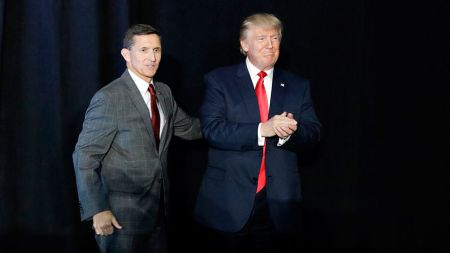
trumpandflynn1Source: Gazeta.ru)

Senator Pushkov’s Tweetstorm

Senator Alexey Pushkov, a member of the Russian Federation Council’s Committee on International Affairs and an avid tweeter, took to Twitter to present his categorical assessment of the forces behind the resignation and their motivation:

“Flynn ‘was forced out’ not due to his missteps, but due to a vast aggressive campaign. “Russian –get out ” clamored the newspapers. This is paranoia and witch hunt.”

(Twitter.com/Alexey_Pushkov, February 14, 2017)

“Flynn leaves, but the Russian problem at Trump’s White House persists” – his enemies write. Flynn’s banishment was only the first act. Now – Trump is the target.”

(Twitter.com/Alexey_Pushkov, February 13, 2017)

“Flynn’s departure is probably the earliest resignation of a US National Security Advisor in history. Yet, Flynn was not the target, relations with Russia were.”

(Twitter.com/Alexey_Pushkov, February 13, 2017)

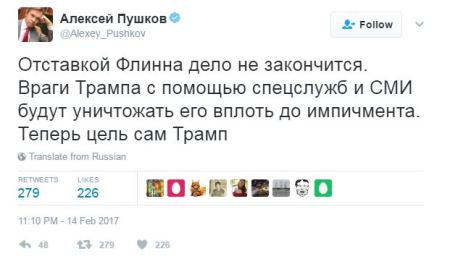
“It’s not going to end  with Flynn’s resignation. Trump’s enemies with the help of the security special services and media will eradicate him ( Trump) until the impeachment. Trump himself is now the objective.”

impeach(Twitter.com, February 14, 2017)

“Lots of money invested in the new cold war against Russia. Those who oppose the war are at high risk. Flynn’s massacre is clear evidence.”

(Twitter.com, February 14, 2017)

push-shove(Alexey Pushkov, Source: Pravda-tv.ru)

Senator Kosachev: ‘Russophobia Has Already Engulfed The New Administration From Top To Bottom’

Russian Senator Konstantin Kosachev, who chairs the Russian Federation Council’s Committee on International Affairs, wrote on his Facebook page: “Dismissing the national security adviser for contacts with Russia’s ambassador (ordinary diplomatic practice) is not just paranoia, but something much worse.” He then added: “Either Trump has not gained the desired independence and he is being consistently (and not unsuccessfully) pushed into a corner, or Russophobia has already engulfed the new administration from top to bottom.”

(Tass.com, February 14, 2017)

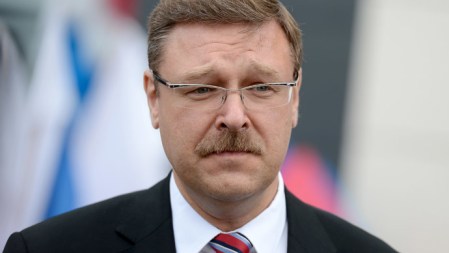
kosKonstantin Kosachev (Source: Rt.com)

Valery Garbuzov, Director of the Institute for US and Canada Studies at the Russian Academy of Sciences, told Russian news agency TASS: “I believe the Russian issue is one of the most difficult for the U.S. administration in the sense that it has not yet developed recipes for tackling the Russian issue in general and in particular. These are the issues of sanctions, the issue of Ukraine, Crimea and so on.” He then said: “The U.S. president’s national security adviser is a significant figure who, along with the US secretary of state, takes part in shaping the country’s foreign policy. Flynn’s resignation indicates that internal contradictions, perhaps, internal struggles, begin to appear in the emerging US administration. Flynn’s resignation was a manifestation of this struggle. He was considered if not a pro-Russian member of Trump’s team, then a person who was committed to resuming pragmatic dialogue with Russia.”

(Tass.com, February 14, 2017)

The Deputy Chair of the Duma’s International Affairs committee, Alexey Chepa: “Flynn has just begun working, he did not have an opportunity build himself a reputation. Before the inauguration he’d had some consultations with our ambassador Kislyak. I don’t know to what extent he informed his superiors regarding the consultations. I don’t know either how it could lead to a possible blackmailing… In general, there was not enough time to arrange improved contacts, so I think this [resignation] won’t strongly affect [our relations with the US]”

(Ria.ru, February 14, 2017)

Presidential spokesperson Dmitri Peskov declined comment on Flynn’s resignation: “We do not want to comment on it in any manner. It’s America’s internal affair, the Trump administration’s internal affair. It’s not our business.”

(Ria.ru, February 14, 2017)

The Resignation Reduces Russia’s Confidence In The Trump Administration

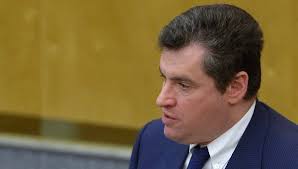
According to Leonid Slutsky, chair of the Duma’s International Affairs Committee: “The situation regarding the resignation of national security advisor Michael Flynn, bears a provocative character. This is a form of negative signal concerning the building of a Russia-US dialog. It’s obvious that Flynn was forced to write the resignation announcement under pressure. Trump received this resignation. The excuse, which was chosen, is contacts with the Russian ambassador, though it’s common diplomatic practice.  In these circumstances, the conclusion arises that the Russia-US relations were the set target. This erodes confidence in the US administration”.

(Ria.ru, February 14, 2017)

The TASS agency quotes Slutsky a bit differently: “Flynn’s resignation might be a provocation – it could well be that he will pop up again in US public administration. At the moment, it looks like a thrust and a sort of  negative signal towards Russia, implying that we had discussed something improper with the US national security advisor, for which he paid for with his job … It’s an incredible assumption that Flynn, a very experienced person, divulged some state secrets”. According to Slutsky, “the whole buzz is aimed at Russia’s positioning as a strategic opponent amongst the American establishment”.

(Tass.ru, February 14, 2017)

slutLeonid Slutsky (Source: Polytika.ru)

According to Vladimir Batyuk, head of the Center for Military-Political Studies at the Russian Academy of Sciences’ US and Canada Institute and professor of world politics at the Higher School of Economics :

“Flynn’s resignation is a powerful blow to the US administration. Flynn, as a national security advisor, was one of the key figures. Given that this man turned out to be undisciplined and incompetent, it’s a definite blow to the administration’s authority and to US-Russia relations. Moscow, from now on, will have far less confidence in the new administration and its ability to conduct confidential negotiations on delicate international matters and problems of bilateral relations. It will have negative consequences for the future Russo-American dialog.”  Representatives of the Russian Federation will now fear approaching Trump administration officials. “When Ambassador Kislyak communicated with Flynn he was completely sure that he was talking to the Trump’s representative, rather than to private person, Mr. Flynn. Now, it’s not the case as it turns out and this is a blow to Moscow’s trust in the new administration. This trust usually carries high importance in diplomacy.”

(Ria.ru, February 14, 2017)

The Russian government daily Rossiiskaya Gazeta published an article by Igor Dunaevsky, where the author assumes that Flynn’s resignation was initiated by the secret services:

“It can’t be excluded that Flynn was “taken out” by the secret services. His Russian connections presented themselves as an excuse and were not the real reason. According to local media publications, Flynn, who headed MOD intelligence department in the Obama administration, was not popular in the American intelligence community and he reciprocated this attitude.  Flynn’s resignation will not extensively affect White House’s approaches towards a dialog with Russia, but rather it will prove instrumental for those who want to impede that process.”

(Rg.ru, February 14, 2017)

Is a Trump-Putin Detente Dead?

February 21, 2017

Is a Trump-Putin Detente Dead? Rasmussen Reports, Patrick J. Buchanan, February 21, 2017

(Please see also, Highly Classified National Security Information Must Not be Leaked. — DM)

America’s elites still praise FDR for partnering with one of the great mass murderers of human history, Stalin, to defeat Hitler. They still applaud Nixon for going to China to achieve a rapprochement with the greatest mass murderer of the 20th century, Mao Zedong.

Yet Trump is not to be allowed to achieve a partnership with Putin, whose great crime was a bloodless retrieval of a Crimea that had belonged to Russia since the 18th century.

The anti-Putin paranoia here is astonishing.

***************************

Among the reasons Donald Trump is president is that he read the nation and the world better than his rivals.

He saw the surging power of American nationalism at home, and of ethnonationalism in Europe. And he embraced Brexit.

While our bipartisan establishment worships diversity, Trump saw Middle America recoiling from the demographic change brought about by Third World invasions. And he promised to curb them.

While our corporatists burn incense at the shrine of the global economy, Trump went to visit the working-class casualties. And those forgotten Americans in Pennsylvania, Ohio, Michigan and Wisconsin, responded.

And while Bush II and President Obama plunged us into Afghanistan, Iraq, Libya, Yemen, Syria, Trump saw that his countrymen wanted to be rid of the endless wars, and start putting America first.

He offered a new foreign policy. Mitt Romney notwithstanding, said Trump, Putin’s Russia is not “our number one geopolitical foe.”

Moreover, that 67-year-old NATO alliance that commits us to go to war to defend two dozen nations, not one of whom contributes the same share of GDP as do we to national defense, is “obsolete.”

Many of these folks are freeloaders, said Trump. He hopes to work with Russia against our real enemies, al-Qaida and ISIS.

This was the agenda Americans voted for. But what raises doubt about whether Trump can follow through on his commitments is the size and virulence of the anti-Trump forces in this city.

Consider his plan to pursue a rapprochement with Russia such as Ike, JFK at American University, Nixon and Reagan all pursued in a Cold War with a far more menacing Soviet Empire.

America’s elites still praise FDR for partnering with one of the great mass murderers of human history, Stalin, to defeat Hitler. They still applaud Nixon for going to China to achieve a rapprochement with the greatest mass murderer of the 20th century, Mao Zedong.

Yet Trump is not to be allowed to achieve a partnership with Putin, whose great crime was a bloodless retrieval of a Crimea that had belonged to Russia since the 18th century.

The anti-Putin paranoia here is astonishing.

That he is a killer, a KGB thug, a murderer, is part of the daily rant of John McCain. At the Munich Security Conference this last weekend, Sen. Lindsey Graham promised, “2017 is going to be a year of kicking Russia in the ass in Congress.” How’s that for statesmanship.

But how does a president negotiate a modus vivendi with a rival great power when the leaders of his own party are sabotaging him and his efforts?

As for the mainstream media, they appear bent upon the ruin of Trump, and the stick with which they mean to beat him to death is this narrative:

Trump is the Siberian Candidate, the creature of Putin and the Kremlin. His ties to the Russians are old and deep. It was to help Trump that Russia hacked the DNC and the computer of Clinton campaign chief John Podesta, and saw to it WikiLeaks got the emails out to the American people during the campaign. Trump’s people secretly collaborated with Russian agents.

Believing Putin robbed Hillary Clinton of the presidency, Democrats are bent on revenge — on Putin and Trump.

And the epidemic of Russophobia makes it almost impossible to pursue normal relations. Indeed, in reaction to the constant attacks on them as poodles of Putin, the White House seems to be toughening up toward Russia.

Thus we see U.S. troops headed for Poland, Bulgaria, Romania, NATO troops being sent into the Baltic States, and new tough rhetoric from the White House about Russia having to restore Crimea to Ukraine. We read of Russian spy ships off the coast, Russian planes buzzing U.S. warships in the Black Sea, Russians deploying missiles outlawed by the arms control agreement of 1987.

An Ohio-class U.S. sub just test-fired four Trident missiles, which carry thermonuclear warheads, off the Pacific coast.

Any hope of cutting a deal for a truce in east Ukraine, a lifting of sanctions, and bringing Russia back into Europe seems to be fading.

Where Russians saw hope with Trump’s election, they are now apparently yielding to disillusionment and despair.

The question arises: If not toward better relations with Russia, where are we going with this bellicosity?

Russia is not going to give up Crimea. Not only would Putin not do it, the Russian people would abandon him if he did.

What then is the end goal of this bristling Beltway hostility to Putin and Russia, and the U.S.-NATO buildup in the Baltic and Black Sea regions? Is a Cold War II with Russia now an accepted and acceptable reality?

Where are the voices among Trump’s advisers who will tell him to hold firm against the Russophobic tide and work out a deal with the Russian president?

For a second cold war with Russia, its back up against a wall, may not end quite so happily as the first.

Defeating radical Islam

February 20, 2017

Defeating radical Islam, Washington Times, Daniel Pipes and Christopher C. Hull, February 19, 2017

cutislamistsIllustration on plans to defeat radical Islam by Linas Garsys/The Washington Times

ANALYSIS/OPINION:

Who is the enemy? It’s been over 15 years since Sept. 11, 2001, and this fundamental question still rattles around. Prominent answers have included evildoers, violent extremists, terrorists, Muslims, and Islamists.

As an example of how not to answer this question, the Obama administration convened a Countering Violent Extremism (CVE) Working Group in 2010 and included participants who turned up such gems as: “Jihad as holy war is a European invention,” the caliphate’s return is “inevitable,” Shariah (Islamic law) is “misunderstood,” and “Islamic terrorism is a contradiction in terms because terrorism is not Islamic by definition.” The result? The group produced propaganda helpful to the (unnamed) enemy.

In contrast, then-candidate Donald Trump gave a robust speech in August 2016 on how he, as president, would “Make America Safe Again.” In it, he pledged that “one of my first acts as president will be to establish a commission on radical Islam.” Note: he said radical Islam, not some euphemism like violent extremism.

The goal of that commission, he said, “will be to identify and explain to the American public the core convictions and beliefs of radical Islam, to identify the warning signs of radicalization, and to expose the networks in our society that support radicalization.” The commission “will include reformist voices in the Muslim community” with the goal to “develop new protocols for local police officers, federal investigators, and immigration screeners.”

On Feb. 2, Reuters reported that, consistent with the August statement, the Trump administration “wants to revamp and rename” the Obama administration’s old CVE effort to focus solely on Islamism. Symbolic of this change, the name Countering Violent Extremism will be changed to “Countering Radical Islamic Extremism” (or a near equivalent).

To make the most of this historic opportunity, the Middle East Forum has crafted a comprehensive plan for a White House Commission on Radical Islam for the administration to use. Here’s a summary of how we see the commission working and having an impact:

Structure. To be successful, all its members must be selected by the president. Too many commissions have included contrasting ideologies and agendas, grinding out sausagelike self-conflicting reports that displease the administration and end up discarded. Also, learning from the struggles of the Tower Commission, which lacked sufficient powers, and the precedent of the Three Mile Island Commission, which actually had them, the commission needs the power to subpoena documents, compel testimony and grant immunity.

Personnel. The commission should include a mix of experts on political violence and radical Islam, as well as elected officials, representatives of law enforcement, the military, the intelligence and diplomatic communities, technology specialists, Muslim reformers (as the president insisted), and victims of radical Islam. It should also include liaisons to those who ultimately will implement the commission’s recommendations: secretaries of the departments of state, defense, and homeland security, the attorney general, and the CIA director.

Mandate. The commission should expand on President Trump’s commitment to explain the core convictions of Islamists (i.e., the full and severe application of Shariah) to expose their networks, and develop new protocols for law enforcement. In addition, it should examine where Islamists get their resources and how these can be cut off; figure out how to deny them use of the internet; offer changes to immigration practices; and assess how political correctness impedes an honest appraisal of radical Islam.

Implementation. For the commission’s work to be relevant, it must coordinate with federal agencies to gather data and craft recommendations, draft executive orders and legislation, provide supporting documents, prepare requests for proposals, outline memos to state and local governments, recommend personnel, and work out budgets. Finally, the commission should be prepared that its reports may be used as evidence in criminal proceedings, such as was the case several times in the past (e.g., the Warren, Rogers, and Tower commissions).

The overall goal of the White House Commission on Radical Islam should be to bring the American people together around a common understanding of the enemy’s nature, how that enemy can be defeated, and specifics to accomplish this objective.

Perhaps this will start the long-delayed process of winning a war that has already gone on far too long. The United States has all the economic and military advantages; it lacks only a policy and a strategy, which the new administration, relying on a first-rate commission, can finally supply.