A comparison of the progressive approach to the threat of climate warming and that of a nuclear-armed Iran offers interesting insights into the progressive mind.
Let’s start with climate warming, which according to the best measures, inconveniently stopped about 18 years ago. First, what is the magnitude of the threat? The most alarmist predictions of future catastrophe are based on computer-generated climate models that have been consistently refuted by events of the real world. According to the alarmists, there would be fifty million refugees from global warming by 2010. Never happened.
Those models are based on a variety of assumptions about “feedback mechanisms” generated by increased CO2 in the atmosphere trapping more heat. NASA satellite date from 2000-2011 showed far more heat escaping the earth’s atmosphere than predicted by the computer models, according to study in the peer-reviewed journal Remote Sensing.
Nor is clear to what extent the global warming of the 20th century was generated by anthropogenic forces – i.e., increased CO2 emissions. Many leading climate scientists now think that solar activity — about which we can do nothing — may be a larger contributor to temperature variation than carbon emissions. That would be consistent with the wide fluctuations between warm and cold periods over the last millennium, even prior to the onset of the Industrial Resolution.
Scientists at CERN, the European Organization of Nuclear Research, which involves 600 universities and national labs and 8,000 scientists, have shown that cosmic rays promote the formation of molecules that grow and seed clouds. And clouds trap heat in the atmosphere. The magnitude of cosmic rays emitted by the sun depends on variations in the sun’s magnetic field.
Finally, that which the alarmists consider an unmitigated disaster — higher levels of CO2in the atmosphere may have many beneficial effects. A 2012 statement signed by 16 distinguished scientists from universities like Harvard, Princeton, MIT, and the Hebrew University, pointed out that CO2 is “not a pollutant,” but rather a “key component of the biosphere’s life cycle.” Higher concentrations of CO2 spur plant growth.
In sum, the threat, if any, is one for the indeterminate future, of unknown magnitude and causation, and may not even be subject to ameliorative action. Yet climate alarmists propose a Global Green Carbon Treaty of such cost and intrusiveness that Yale’s Walter Russell Mead compares it to the 1928 Kellogg-Brand Pact outlawing war for sheer folly. He describes GGCT as less a treaty and more a constitution for world government regulating all economic production in every country on earth. That constitution would be for a “global welfare state with trillions of dollars ultimately sent by the taxpayers of rich countries to governments (however feckless, inept, corrupt or tyrannical) to poor ones.”
These proposals are put forward seemingly oblivious to the economic cost or loss of liberty involved. In his 2001 book The Skeptical Environmentalist, Danish statistician Bjorn Lonborg calculated that enforcement alone of the Kyoto Treaty would cost $150,000 billion a year, money which could save tens of thousands of lives annually.
The above-mentioned statement of the 16 scientists cited the work of Yale economist William Nordhaus, whos showed that the highest benefit-to-cost ratio would be achieved via a policy of fifty years of economic growth unimpeded by greenhouse gas controls. The least developed countries would benefit most by being able to share some of the advantages of material well-being — i.e., health and life expectancy — with the more developed world.
NOW TO THE OTHER SIDE of the comparison. Even President Obama admits that under the unsigned understanding reached at Lausanne, Iran will have zero breakout time to a nuclear weapon thirteen years from now. (Today, he puts the breakout time at three months.)
That fact alone creates a world with as many tripwires leading to war as Europe on the eve of the assassination of Archduke Ferdinand in August 1914. Only this time the weapons of choice will be nuclear.
The proposed agreement with Iran means the end of nuclear non-proliferation. If the world’s leading rogue state and sponsor of terrorism can have its nuclear weapons program effectively endorsed by the members of the U.N. Security Council, every other nation that was dissuaded in the past by international pressure from expanding its civilian nuclear program to include enrichment to weapons level – e.g., South Korea, Brazil – will reconsider.
The most rapid nuclear proliferation will take place in the world’s most volatile region, the Middle East, in which the millennial hatred of Sunnis and Shiites still burns hot. Saudis have made it clear that they will purchase nuclear weapons off-the-shelf from Pakistan, as per a prior agreement, to counter Iran’s ability to obtain nuclear weapons. Egypt and Turkey will almost certainly follow suit.
An already aggressive Iran would become vastly more so with the hundreds of billions of dollars in revenues from the lifting of sanctions and the ability to provide a nuclear umbrella for its regional proxies. As a consequence, the Middle East would become all the more volatile.
The nations most likely to acquire nuclear arms and unstable, which increases the possibility of terrorist groups acquiring nuclear weapons. Iran has long eyed the “holy cities” of Mecca and Medina, and is already stirring up the Shiite population in Saudi Arabia’s eastern, oil-producing provinces and in Yemen on its southern border. Egypt cannot feed its population.
And Iran might find it useful to supply some of its non-state allies, like Hezbollah or Hamas, with dirty nuclear weapons that do not require missiles to deliver. Non-state actors are far harder to deter or hold accountable.
A nuclear Iran should terrify not only Israel, which it has repeatedly threatened to obliterate. Iranian leaders have publicly speculated for years about the grim calculus of a nuclear exchange with Israel: one bomb wipes out Israel; Israeli retaliation still leaves us with tens of millions survivors. Former CIA Director James Woolsey and Peter Fry, a member of the congressional EMP (electro-magnetic pulse) Commission, stress the vulnerability of the United States. The recent “understanding” (the terms of which are unknown and perhaps unknowable given the wide divergence between American and Iranian descriptions of what has been concluded) makes no reference to any limitations on Iran’s ballistic missile program, on which it works closely with North Korea.
Iran may soon possess long-range missiles capable of reaching the United States or the capacity to launch a nuclear-armed satellite above the United States. Even one nuclear weapon detonated above the United States could potentially knock out much of the national power grid. The congressional EMP Commission estimated that a nationwide blackout lasting one year from such an EMP attack could result in the deaths of nine out of ten Americans, with ISIS-like gangs ruling the streets.
Nor are traditional doctrines of nuclear deterrence relevant to the Middle East, in general, and Shiite Iran, in particular. Former secretaries of state Henry Kissinger and George Schultz ask in their devastating critique of the recent agreement how will traditional doctrines of deterrence based on stable state actors “translate into a region where sponsorship of non-state proxies is common, the state structure is under assault, and death on behalf of jihad is a kind of fulfillment?”
As the dean of Middle East scholars Bernard Lewis has pointed out, for Shiite fanatics awaiting the return of the “hidden Imam,” after a cataclysmic event, the destruction of nuclear war might be an inducement rather than a deterrent.
WHAT DOES PRESIDENT OBAMA offer as the response to this description of a nuclear tinderbox waiting to be lit? Pure fantasy.
He and Secretary of State Kerry have made repeated references to a fatwa of the Supreme Leader Ayatollah Khameini against the use of nuclear weapons, which does not exist and certainly is credited by none of Iran’s enemies.
And he speaks hopefully of a newly mellowed Iran after the conclusion of an agreement. What is it about the Supreme Leader’s repeated chants of “Death to America” and insistence that current negotiations have nothing to do with reconciliation that the President can’t hear?
One option that the President has completely excluded is an air campaign to destroy Iran’s nuclear infrastructure and cut of the “head of snake,” as Woolsey once described the Revolutionary Guard to me. Obama has repeatedly accused the opponents of the Lausanne understanding as being advocates of war.
Clearly, then, all the tough talk about “all options are on the table,” “a bad deal is worse than no deal [followed by military attack],” “I will never allow Iran to acquire nuclear weapons,” had the same truth content as “If you like your plan, you can keep your plan.”
Yet no one doubts that the United States has the capability to destroy Iran’s enrichment infrastructure. (If Russia goes through with the delivery of advanced anti-aircraft batteries, as a consequence of the Lausanne understanding, the task will be complicated.) And there will be consequences that cannot be fully known in advance. Iran has terrorist sleeper cells around the world. But it also has lots of assets, besides its nuclear infrastructure, which would be subject to further attacks if it unleashes those cells.
Whatever the Iranian response, the price to be paid will certainly be less than consigning all humanity to live in a world perpetually poised on the cusp of nuclear war.
SO WHY in the case of global warming are progressives willing to incur unbearable costs to combat a future threat of unknown magnitude and immediacy, and against which their solutions may well prove futile, while with respect to the easily identified and imminent danger of a nuclear-armed Iran, they write off from the start a clear and known remedy?
For progressives the solution of worldwide government, run by the executive decree of “the best and the brightest,” is not a cost too great to be contemplated, but rather the fulfillment of the progressive dream. But they will never countenance military action, even to save millions of lives down the road. Churchill’s dictum, “If you want peace, prepare for war,” remains foreign to them.
If inspections, sanctions, sabotage and political isolation ever had a chance to stop Iran from getting the bomb (this was always a dicey proposition), that certainly is no longer the case. It is more evident than ever that only military action can stop a determined state such as the Islamic Republic of Iran from building a nuclear bomb. It remains to be seen whether Israel has elected the leader to live up to this historic challenge.
***********************
The debate over the pros and cons of the Iran nuclear framework agreement negotiated between the P5+1 and Iran at Lausanne (April 2, 2015) is simply irrelevant. The search for truth in the conflicting versions about the details of the deal coming out of Washington and Tehran is of no consequence. And the steps suggested by Israel and other critics to improve the efficacy of the deal (by more stringent inspections and so on) will not change much. The deal is basically dangerous in nature, and needs to be rejected outright.
The deal permits Iran to preserve stockpiles of enriched uranium, to continue to enrich uranium, and to maintain illegally-built facilities at Fordow and Arak. Even in the absence of a signed full agreement, the U.S. and its negotiating partners already have awarded legitimacy to Iran’s nuclear threshold status. In all likelihood, the United States, quite desperate to get a formal deal, will make additional concessions in order to have a signed formal deal — which won’t be worth the paper on which it is printed.
This outcome has been a foregone conclusion since November 2013, when the U.S. agreed to the “Joint Plan of Action” on Iran’s nuclear program. Already back then, the U.S. decided not to insist any longer on the goal of rolling back the Iranian nuclear program, ignoring several U.N. Security Council resolutions demanding no uranium enrichment, as well as discarding the security concerns of American allies in the Middle East (primarily Israel, Saudi Arabia and Egypt — who better understand the regional realities).
Middle Easterners clearly discern an Iranian diplomatic victory in this accord, which should not surprise anybody. Iranians are much more adept at negotiating than Americans. Iran is getting more or less what it wanted: the capability to produce enriched uranium and to research weapon design; agreement to keep its missile program intact; and no linkages to Iranian behavior in the region. The deal is a prelude to nuclear breakout and Iranian regional hegemony.
Indeed, with no attempt to roll back the Iranian nuclear program, as was done in Libya, we are progressing toward the North Korean model. Those two are the only options in dealing with nuclear programs of determined states such as Iran. Iran’s nuclear program benefited in many ways from assistance that originated in Pakistan and in North Korea (both are nuclear proliferators despite American opposition). Compare the recent statements by President Obama to the speeches of President Clinton justifying the agreement with North Korea (October 1994). Their similarities are amazing; an indication of the incredible capacity of great powers for self-delusion.
What counts is not the Obama’s administration expression of satisfaction with the prospective deal, but the perceptions of Middle East actors. For example, Saudi Arabia and Egypt have deplored the fact that the U.S. is bestowing international legitimacy on Iran’s status as a nuclear threshold state. They probably believe the interpretations of the deal offered by Tehran more than those professed in Washington. Therefore, they will do their best to build a similar infrastructure leading inevitably to nuclear proliferation in the region — a strategic nightmare for everybody.
Unfortunately, no better deal is in the offing. Whatever revisions are introduced cannot change its basic nature. The accord allows Iran to have fissionable material that can be enriched to weapons grade material in a short time and Tehran can always deny access to inspectors any time it chooses. This is the essence of the North Korean precedent.
Obama is right that the only alternative to this deal is an Iranian nuclear fait accompli or the bombing of the Iranian nuclear infrastructure. Obama’s penchant for engagement, his reluctance to use force, and his liberal prism on international relations (which adds rosy colors to international agreements) has led to this miserable result.
Netanyahu is wrong in demanding a better deal because no such deal exists. Yet denying its ratification by the U.S. Congress could create better international circumstances for an Israeli military strike. In fact, criticism of Obama’s deal with Iran fulfills only one main function — to legitimize future military action. Indeed, Netanyahu is the only leader concerned enough about the consequences of a bad deal with the guts and the military capability to order a strike on the Iranian key nuclear installations.
If inspections, sanctions, sabotage and political isolation ever had a chance to stop Iran from getting the bomb (this was always a dicey proposition), that certainly is no longer the case. It is more evident than ever that only military action can stop a determined state such as the Islamic Republic of Iran from building a nuclear bomb. It remains to be seen whether Israel has elected the leader to live up to this historic challenge.
TEHRAN (Tasnim) – Supreme Leader of the Islamic Revolution Ayatollah Seyed Ali Khamenei on Thursday defined the main points that a final nuclear deal between Iran and world powers should involve, but refused to adopt a stance on the Lausanne statement that entails no binding commitment.
Addressing a gathering in Tehran on Thursday, Ayatollah Khamenei said he has not taken a position on a statement released by Iran and the Group 5+1 (Russia, China, the US, Britain, France and Germany) after the most recent round of nuclear talks in the Swiss city of Lausanne, because nothing has been still agreed upon, nor have the parties reached any binding agreement.
“What has happened so far does not guarantee either the principle of an agreement, or the negotiations that lead to an agreement or even the content of an agreement, and it does not even guarantee that these talks would result in a deal, so congratulation has no meaning,” the Leader said.
The comments came after Iran and the six powers on April 2 reached a framework nuclear agreement after more than a week of intensive negotiations in Lausanne, Switzerland, with both sides committed to push for a final, comprehensive accord until the end of June.
Ayatollah Khamenei then reaffirmed strong support for a deal that respects the Iranian nation’s dignity, and rejected as “untrue” the reports on his opposition to any agreement.
The Leader, however, underlined that “no deal is better than a bad deal.”
Imam Khamenei then explained that he has only outlined the “general issues, the main guidelines, frameworks and red lines” regarding the nuclear talks and has not specified the details.
“I am not indifferent to the negotiations, but have not interfered in the details of the talks so far, and will not interfere in future either,” the Leader stressed.
The Supreme Leader then pointed to the unreliable nature of the US, an obvious sign of which he said was a biased fact sheet that Washington issued only two hours after the Lausanne statement was declared.
“Drafting such a statement (fact sheet) within two hours is not possible, so they (Americans) had been busy preparing a flawed and wrong statement contrary to the content of the talks at the same time that they were negotiating with us.”
The Leader further called on the country’s negotiators to hold consultations with the critics of the Lausanne statement to better deal with the talks, something known as “rapport” among Iranians.
Imam Khamenei once again made it clear that the talks with the US revolve only around the nuclear issue and nothing else, but at the same time noted that such nuclear negotiations provide an experience to test the possibility of talking on other subjects if Washington puts aside objections.
But, the Leader added, if the US keeps raising objections, Iran’s experience of mistrust of the US will be corroborated.
Commenting on the main points that have to be stipulated in a possible final nuclear deal, Ayatollah Khamenei pointed to the removal of anti-Iran sanctions all at once, adding, “This issue is very important and the sanctions should be completely terminated at the very day of the agreement.”
“If the removal of sanctions is to be conditioned by a new process, the fundamental of negotiations will be nonsense, because the purpose of the talks is lifting of the sanctions,” the Leader said.
The Supreme Leader also categorically rejected foreign access to the country’s “security and defensive” sectors under the pretext of nuclear monitoring.
Imam Khamenei said Iran’s military capabilities must be upheld and strengthened day by day, stressing that Iran’s backing for its “brothers” in the resistance front in different regions should never be diminished.
Moreover, the Leader voiced opposition to any deal that subjects Iran to “unconventional” monitoring and would make it a special case in the world, underlining that monitoring of Iran’s peaceful nuclear program should be conventional, like the other countries.
Iran’s “scientific and technical developments in different dimensions” was another requirement that the Leader emphasized a deal must include.
Ayatollah Khamenei finally said the responsibility lies with the country’s negotiators to fulfill those necessary demands in the talks, calling on them to “find the correct ways of negotiations” by using the view points of the informed and reliable individuals and listening to the critics.
Iran could build bomb today but isn’t doing so because of ayatollah’s religious decree, not because of sanctions, Iranian FM reportedly tells parliament • “We made significant achievements in exchange for unimportant concessions,” says Iranian lawmaker.
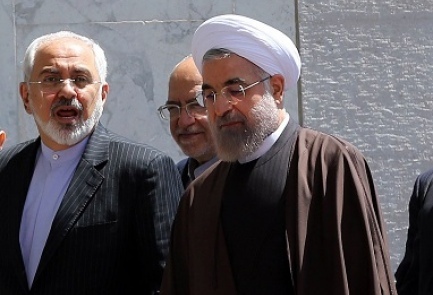
Iran’s Foreign Minister Mohammad Javad Zarif (left) with Iranian President Hassan Rouhani | Photo credit: AFP
Iran could build a nuclear bomb today if it wanted and is only refraining from doing so because of a fatwa (religious decree) issued by Ayatollah Ali Khamenei, not because of international sanctions, Iran’s Foreign Minister Mohammad Javad Zarif reportedly said on Tuesday during a closed hearing at the Iranian parliament, Majlis.
According to one of the participants, Zarif said the country’s foreign ministry would soon publish a “document of facts” about the nuclear deal with world powers.
“Zarif told us that his office hadn’t intended on releasing such a document, but reversed its decision because of the Americans’ lies,” said Iranian lawmaker Hussain Naqvi al-Hussaini.
Another Iranian parliamentarian, Gholamali Jafarzadeh Imenabadi, said Zarif told the parliament that Iran is not going to permit online cameras for inspection purposes at nuclear facilities. The reason for the decision, allegedly conveyed by Zarif, was because cameras have supposedly been used in the past to help assassinate Iranian nuclear scientists.
Also in attendance was Ali Akbar Salehi, the head of Iran’s Atomic Energy Organization, who presented the Majlis with the technical aspects of the framework deal. Salehi, who participated in the negotiations in Lausanne, reportedly told his audience that world powers consented to enter negotiations with Iran because they had no other choice.
“We made significant achievements in exchange for unimportant concessions,” said Iranian lawmaker Nozar Shafi.
Meanwhile, Zarif and Iranian President Hassan Rouhani have reportedly garnered the support of Revolutionary Guard commander Mohammad Ali Jafari, who demanded immediate sanctions relief in exchange for a deal.
Iran’s supreme leader, Khamenei, did not voice his opposition to the deal, widely interpreted as silent consent. With that, some 200 Iranian hardliners protested in Tehran against the framework deal.
THE “KEY parameters” for an agreement on Iran’s nuclear program released Thursday fall well short of the goals originally set by the Obama administration. None of Iran’s nuclear facilities — including the Fordow center buried under a mountain — will be closed. Not one of the country’s 19,000 centrifuges will be dismantled. Tehran’s existing stockpile of enriched uranium will be “reduced” but not necessarily shipped out of the country. In effect, Iran’s nuclear infrastructure will remain intact, though some of it will be mothballed for 10 years. When the accord lapses, the Islamic republic will instantly become a threshold nuclear state.
That’s a long way from the standard set by President Obama in 2012 when he declared that “the deal we’ll accept” with Iran “is that they end their nuclear program” and “abide by the U.N. resolutions that have been in place.” Those resolutions call for Iran to suspend the enrichment of uranium. Instead, under the agreement announced Thursday, enrichment will continue with 5,000 centrifuges for a decade, and all restraints on it will end in 15 years.
In his speech after the announcement, Obama took care not only to repeat the false rhetorical device of the only choice being between this deal and war, he blamed that choice on Israeli Prime Minister Benjamin Netanyahu. David Horvitz at The Times of Israel writes, Defeatist Obama’s deal with the devil:
Extolling the virtues of his deal with Iran on Thursday, President Barack Obama made a false and extremely nasty assertion: “It’s no secret,” he claimed, incorrectly, “that the Israeli prime minister and I don’t agree about whether the United States should move forward with a peaceful resolution to the Iranian issue.”
It is indeed no secret that Obama and Netanyahu don’t agree on how to thwart Iran’s nuclear weapons ambitions. It is emphatically not the case, however, that Israel’s prime minister opposes “a peaceful resolution to the Iranian issue.” It is emphatically not the case, despite Obama’s insinuation, that Israel’s leader regards military intervention as the only means to thwart Iran.
Netanyahu has not been saying no to diplomacy. His endlessly stated contention is not that war is the only alternative to the deal so delightedly hailed by Obama as “the most effective way to ensure Iran doesn’t get a nuclear weapon.” Rather, in Netanyahu’s insistent opinion, what is needed is simply a different, far more potent deal.
Why throw Netanyahu under the bus again? There are plenty of people, including Democrats in Congress, who don’t view this deal as the only non-war choice.
Statement by Prime Minister Benjamin Netanyahu
April 3, 2015
I just came from a meeting of the Israeli cabinet. We discussed the proposed framework for a deal with Iran.
The cabinet is united in strongly opposing the proposed deal.
This deal would pose a grave danger to the region and to the world and would threaten the very survival of the State of Israel.
The deal would not shut down a single nuclear facility in Iran, would not destroy a single centrifuge in Iran and will not stop R&D on Iran’s advanced centrifuges.
On the contrary. The deal would legitimize Iran’s illegal nuclear program. It would leave Iran with a vast nuclear infrastructure. A vast nuclear infrastructure remains in place.
The deal would lift sanctions almost immediately and this at the very time that Iran is stepping up its aggression and terror in the region and beyond the region.
In a few years, the deal would remove the restrictions on Iran’s nuclear program, enabling Iran to have a massive enrichment capacity that it could use to produce many nuclear bombs within a matter of months.
The deal would greatly bolster Iran’s economy. It would give Iran thereby tremendous means to propel its aggression and terrorism throughout the Middle East.
Such a deal does not block Iran’s path to the bomb.
Such a deal paves Iran’s path to the bomb.
And it might very well spark a nuclear arms race throughout the Middle East and it would greatly increase the risks of terrible war.
Now, some say that the only alternative to this bad deal is war.
That’s not true.
There is a third alternative – standing firm, increasing the pressure on Iran until a good deal is achieved.
And finally let me say one more thing.
Iran is a regime that openly calls for Israel’s destruction and openly and actively works towards that end.
Just two days ago, in the midst of the negotiations in Lausanne, the commander of the Basij security forces in Iran said this: “The destruction of Israel is non-negotiable.”
Well, I want to make clear to all. The survival of Israel is non-negotiable.
Israel will not accept an agreement which allows a country that vows to annihilate us to develop nuclear weapons, period.
In addition, Israel demands that any final agreement with Iran will include a clear and unambiguous Iranian recognition of Israel’s right to exist.
Thank you.
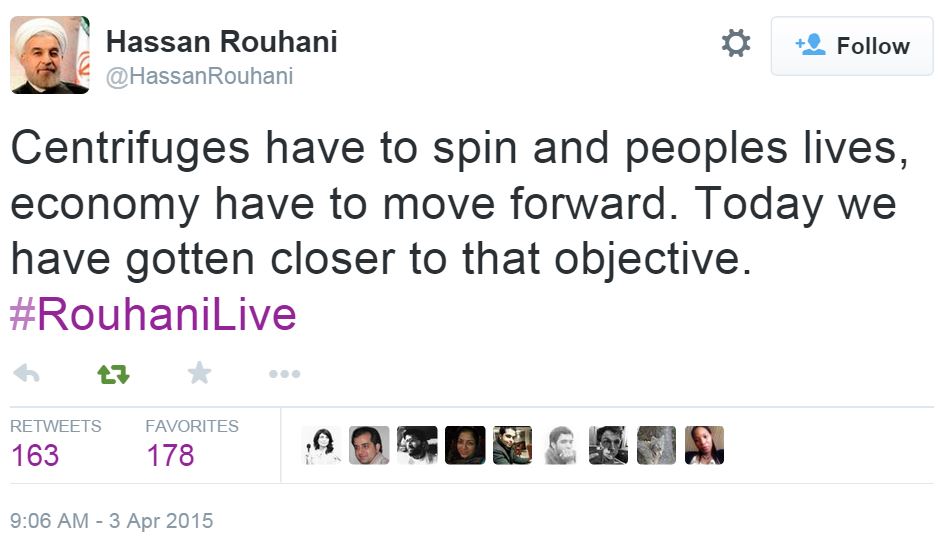
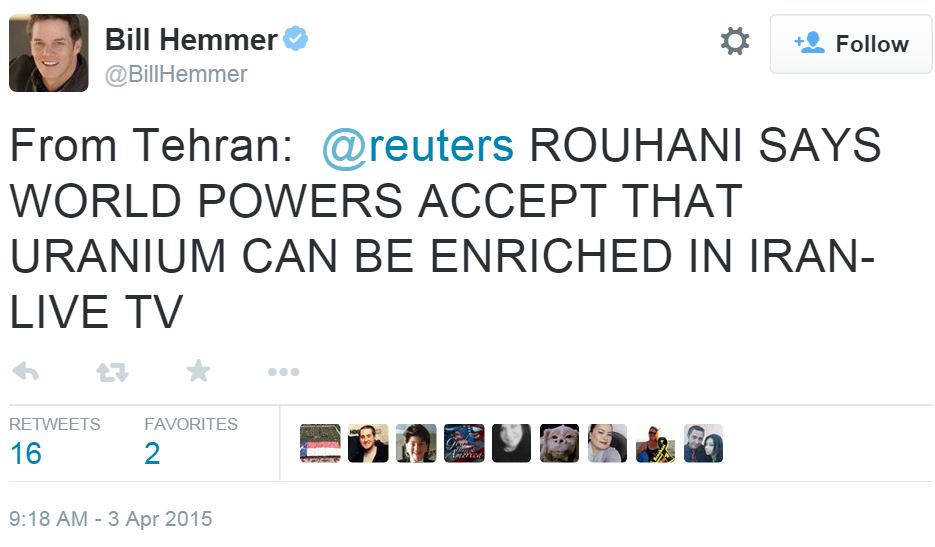
Meanwhile, the Mullah regime crowed at how they got what they wanted (see also tweets in yesterday’s post):
Seems to me the Mullahs know something we don’t.
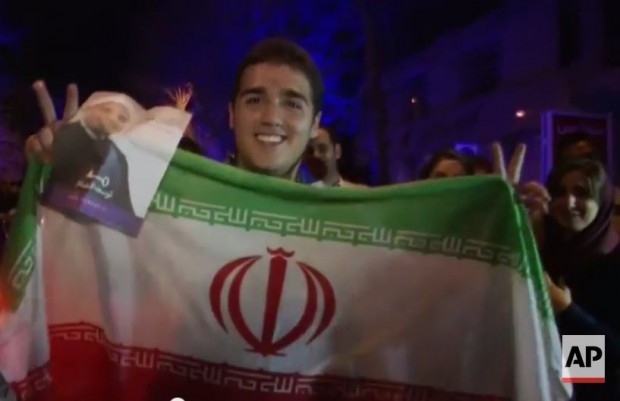
And Iranians took to the streets to celebrate:
There was a better deal to be had. The sanctions were hurting. Obama blinked, the Iranians didn’t.
(Hitler did tell the truth occasionally, in Mein Kampf for example. It was generally ignored until too late. “Death to America and Israel” are spouted by the Iranian Supreme Leader at every opportunity. Obama, et al, ignore it. Will Israel be Obama’s Czechoslovakia? And then what?– DM)
Our dishonor in Lausanne, as with Munich, may avoid a confrontation in the present, but our shame will guarantee a war in the near future.
*********************
Once again our leaders are needlessly appeasing a hostile state that shows them nothing but contempt.
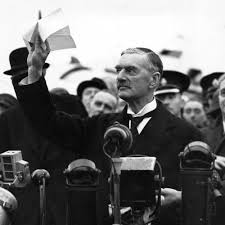
The Western capitulation to Adolf Hitler in the 1938 Munich Agreement is cited as classic appeasement that destroyed Czechoslovakia, backfired on France and Britain, and led to World War II. All of that is true.
But there was much more that caused the Munich debacle than simple Western naiveté. The full tragedy of that ill-fated agreement should warn us on the eve of the Obama’s administration’s gullible agreement with Iran on nuclear proliferation. Fable one is the idea that most people saw right through the Munich folly. True, Europeans knew that Hitler had never once told the truth and was already murdering German citizens who were Jews, Communists, or homosexuals. But Europeans did not care all that much.
Instead, the Western world was ecstatic over the agreement. After the carnage of World War I, Europeans would do anything to avoid even a small confrontation — even if such appeasement all but ensured a far greater bloodbath than the one that began in 1914.
Another myth was that Hitler’s Wehrmacht was strong and the democracies were weak. In fact, the combined French and British militaries were far larger than Hitler’s. French Char tanks and British Spitfire fighters were as good as, or superior to, their German counterparts.
Czechoslovakia had formidable defenses and an impressive arms industry. Poland and perhaps even the Soviet Union were ready to join a coalition to stop Hitler from dissolving the Czech state.
It is also untrue that the Third Reich was united. Many of Hitler’s top generals did not want war. Yet each time Hitler successfully called the Allies’ bluff — in the Rhineland or with the annexation of Austria — the credibility of his doubters sank while his own reckless risk-taking became even more popular.
Munich was hardly a compassionate agreement. In callous fashion it immediately doomed millions of Czechs and put Poland on the target list of the Third Reich.
Munich was directly tied to the vanity of Neville Chamberlain. In the first few weeks after Munich, Chamberlain basked in adulation, posing as the humane savior of Western civilization. In contrast, loud skeptic Winston Churchill was dismissed by the media and public as an old warmonger.
Hitler failed to appreciate the magnanimity and concessions of the French and British. He later called his Munich diplomatic partners “worms.” Hitler said of the obsequious Chamberlain, “I’ll kick him downstairs and jump on his stomach in front of the photographers.”
The current negotiations with the Iranians in Lausanne, Switzerland, have all the hallmarks of the Munich negotiations.
Most Westerners accept that the Iranian government funds terrorist groups such as Hezbollah and Hamas. It has all but taken over Iraq, Lebanon, Syria, and Yemen. Yet the idea of stronger sanctions, blockades, or even force to stop Iranian efforts to get a bomb are considered scarier than Iran getting a bomb that it just possibly might not threaten to use.
The U.S. and its NATO partners are far stronger than Iran in every imaginable measure of military and economic strength. The Iranian economy is struggling, its government is corrupt, and its conventional military is obsolete. Iran’s only chance of gaining strength is to show both its own population and the world at large that stronger Western powers backed down in fear of its threats and recklessness.
Iran is not united. It is a mishmash nation in which over a third of the population is not Persian. Millions of protestors hit the streets in 2009. An Iranian journalist covering the talks defected in Switzerland — and said that U.S. officials at the talks are there mainly to speak on behalf of Iran.
By reaching an agreement with Iran, John Kerry and Barack Obama hope to salvage some sort of legacy — in the vain fashion of Chamberlain — out of a heretofore failed foreign policy.
There are more Munich parallels. The Iranian agreement will force rich Sunni nations to get their own bombs to ensure a nuclear Middle East standoff. A deal with Iran shows callous disagreed for our close ally Israel, which is serially threatened by Iran’s mullahs. The United States is distant from Iran. But our allies in the Middle East and Europe are within its missile range.
Supporters of the Obama administration deride skeptics such as Democratic senator Robert Menendez and Israeli prime minister Benjamin Netanyahu as if they were doubting old Churchills.
Finally, the Iranians, like Hitler, have only contempt for the administration that has treated them so fawningly. During the negotiations in Switzerland, the Iranians blew up a mock U.S. aircraft carrier. Their supreme leader, Ayatollah Khamenei, did his usual “death to America” shtick before adoring crowds. Our dishonor in Lausanne, as with Munich, may avoid a confrontation in the present, but our shame will guarantee a war in the near future.
Tehran is not averse to negotiating ad infinitum – so long as the talks go their way.
So the real gridlock centered on finding a procedure that fitted the US delegation’s instructions to get some sort of a deal signed, and the Iranian group’s directive to sign nothing that could be seen as an accord. So who will give ground first?
***************
It is hard to make out exactly what the seven exhausted foreign ministers of the world powers and Iran were actually talking about in Lausanne this week – especially in the last two days, when the negotiations overran their March 31 deadline for a framework nuclear accord.
The highly-colored reports from the Swiss hotel up until Thursday, April 2, bespoke a mighty battle between the American negotiators led by Secretary of State John Kerry and Energy Secretary Ernest Moniz, and the Iranian group, headed by Foreign Minister Mohammed Javad Zarif, over four key points still at issue between them: the pace of sanctions relief, research and development projects, international inspections – including snap visits to any nuclear facilities they demanded, and, finally, the quantity of low-enriched uranium Iran may retain after the bulk of its stockpile is shipped overseas.
The drama was heightened by the sight of the American delegation marching into a tent set up in the hotel yard “to defeat eavesdropping” for a video conference with President Barack Obama in the White House. Kerry wanted to know whether to carry on the never-ending negotiations, which were looking more and more farcical as the hours ticked by without closure, or quit. This would be tantamount to the failure of the entire structure of nuclear diplomacy.
Obama directed the delegation to carry on talking with the Iranians and disregard the missed deadline as though nothing had changed.
The Secretary of State earlier appeared in an upper hotel window gazing out in the distance. Was he seeing a solution of the impasse visible to no one else?
The French Foreign Minister, Lauren Fabius, fed up with the game playing out between the Americans and the Iranians, left more than once for home. He returned Thursday saying: “We are a few meters from the finishing line, but it’s always the last meters that are the most difficult. We will try and cross them. It’s not done yet.”
Zarif told reporters: “Our friends need to decide whether they want to be with Iran based on respect or whether they want to continue based on pressure. They have tested the other one; it is high time to test this one.”
Those words carried two messages: One that the Iranians were serious when they reiterated in the past weeks that a framework accord for ending the current phase of negotiations was unacceptable, and insisted on the talks carrying straight through to a comprehensive deal by June 30.
The Iranian foreign minister’s second message was a negation of “pressure” – i.e., sanctions, in obedience to supreme leader Ayatollah Ali Khamenei’s directive to the delegation to reject the incremental easing of international sanctions and press Tehran’s demand for immediate relief.
That directive was laid down by the ayatollah on February 18, when he determined that “an agreement would be arrived at not in two stages but in one stage to be completed by the end of June 2015 and the agreement would include the removal of all sanctions on Iran.”
The writing was on the wall for all the parties to see. The current deadline crisis could have been avoided by understanding that there was no way the Iranian delegation would ever disobey the supreme leader’s dictates.
Tehran is not averse to negotiating ad infinitum – so long as the talks go their way.
So the real gridlock centered on finding a procedure that fitted the US delegation’s instructions to get some sort of a deal signed, and the Iranian group’s directive to sign nothing that could be seen as an accord. So who will give ground first?
(The views expressed in this article are not necessarily mine or those of Warsclerotic or its other editors. — DM)
Today, April fool’s day first, Obama was abducted by aliens from Venus who were concerned about His warlike stance toward the peaceful Islamic Republic of Iran.
Mars is the god of war, Venus is the goddess of peace. Aliens from Mars had been slightly disturbed that Obama’s efforts to give Iran nuclear weapons might fail, but had seen that her status as a nuclear power was inevitable and hence did nothing. Aliens from Venus were equally pleased with the prospects of Iranian nuclear weapons but were very concerned that Obama, by failing adequately to praise Iranian attempts to extend its hegemony over the entire Middle East and beyond, had retarded those praiseworthy efforts on behalf of true Islamic peace. Hence, they secretly abducted Him this morning as He deplaned from Air Force One following an off-the-books trip to His spiritual birth place in Manchuria.
Since Obama’s abduction and remedial training required only a few minutes He was not missed, even by His dear soul mate, Valerie Jarrett. Ms. Jarrett was, therefore, pleasantly surprised when Obama called a press conference in the Rose Garden to make an announcement, following a splendid rendition of Hail to the Chief:
Fellow world citizens, I have finally awakened from my slumbers to realize that Iran is the only country in the world capable of bringing true peace through submission in accord with the word of Allah, may His Holy name be forever praised by all. Israel claims to desire peace, but only through war. Saudi Arabia, Egypt, Jordan and other misbegotten specs of excrement on the face of our dear planet — now in peril of imminent death due to climate change to which their vile oil has contributed massively — have dared even to challenge Iran’s peaceful pursuits of peace throughout the Middle East in Iraq, Syria, Yemen and elsewhere.
Henceforth, it will be My supreme duty as your Commander in Chief to promote and otherwise to assist Iran in her glorious efforts for peace. I know in my heart that that’s the principal reason that you, My people, elected Me as your very own Supreme Leader. Accordingly, I pledge that My efforts will be unstintingly directed to the end that you desire.
May Allah bless Iran, Damn America, Israel and all other enemies of true peace, and give a blessed day to you all, inshallah.
Iran’s leaders, due to their extensive relations with the aliens who had abducted Obama, were not at all surprised but pretended that they were. Supreme Leader Khamenei personally accepted Supreme Leader Obama’s gracious words by saying that Obama had finally managed to tame the Great Satan and promised to do everything within his power to help, inshallah. He also commented favorably on Secretary Kerry’s use of “inshallah” in rebutting suggestions by defeatists that the P5+1 negotiations would collapse without giving Iran nuclear weapons.
Even those who had previously viewed Obama as weak and indecisive will now be forced to see Him as He truly is, a towering beacon of strength and light to a world beset with tribulation, turmoil and darkness. His legacy as the Greatest Peace Maker, Ever, is assured, inshallah.
(Don’t worry! Be Happy! Obama is in charge so everything will come up roses for sure.
Just ask Obama, the all-wise, all-knowing. He will set it right, as soon as Iran uses the nukes she deserves. — DM)
American warplanes have begun bombing the Islamic State-held Iraqi city of Tikrit in order to bail out the embattled, stalled ground campaign launched by Baghdad and Tehran two weeks ago. This operation, billed as “revenge” for the Islamic State (IS) massacre of 1,700 Shiite soldiers at Camp Speicher last June, was launched without any consultation with Washington and was meant to be over by now, three weeks after much triumphalism by the Iraqi government about how swiftly the terrorist redoubt in Saddam Hussein’s hometown was going to be retaken.
U.S. officials have variously estimated that either 23,000 or 30,000 “pro-government” forces were marshaled for the job, of which only slender minority were actual Iraqi soldiers. The rest consisted of a consortium of Shiite militia groups operating under the banner of Hashd al-Shaabi, or the Population Mobilization Units (PMU), which was assembled in answer to afatwahissued by Iraq’s revered Shiite cleric Ayatollah Ali Sistani in June 2014 following ISIS’s blitzkrieg through northern Iraq. To give you a sense of the force disparity, the PMUs are said to command 120,000 fighters, whereas the Iraqi Army has only got 48,000 troops.
Against this impressive array of paramilitaries, a mere 400 to 1,000 IS fighters have managed to hold their ground in Tikrit, driving major combat operations to a halt. This is because the Islamic State is resorting to exactly the kinds of lethal insurgency tactics which al Qaeda in Iraq (its earlier incarnation) used against the more professional and better-equipped U.S. forces. BuzzFeed’s Mike Giglio has ably documented the extent to which IS has relied upon improvised explosive devices, and just how sophisticated these have been. Even skilled explosive ordnance disposal teams — many guided by Iranian specialists — are being ripped apart by what one termed the “hidden enemy” in Tikrit.
Because IS controls hundreds of square miles of terrain in Iraq, it has an unknown number of bomb manufacturing plants, and because it knows the terrain so well, it’s been able to booby-trap houses and roads. Even Shiite prayer beads left lying on the ground are thought to be rigged to explosives. One Kurdish official told Giglio that the Kurdish Peshmerga fighters alone have “defused or detonated more than 6,000 IEDs along their 650-mile front with ISIS since the war began in August.”
The toll this has taken on the militias is extraordinary. Cemetery workers in Najaf told the Washington Postthat as many as 60 corpses are arriving per day. Former Defense Intelligence Agency officer Derek Harvey tweeted last week that an Iraqi Shiite source told him the number of militia war dead from the Tikrit offensive so far may be as high as 6,000. So the militias’ triumphalism, much of it no doubt manufactured by Iran’s propaganda machine, proved to be misplaced. Jeffrey White, another former DIA analyst now at the Washington Institute for Near East Policy, notes “there’s a failure of will on the part of the militias and government forces. They just didn’t have the sufficient desire and determination to take the fight forward given the casualties they’ve been sustaining.”
So now, the same Iraqi government which earlier dismissed the need for U.S. airpower had to put in an eleventh-hour request for it, lest an easy victory descend into embarrassing folly. But the past few months ought to have shown that even indirectly relying on Iranian agents to conduct a credible ground war against Sunni extremists was always a lousy idea for three reasons: those agents hate the United States and have threatened to attack its interest in Iraq; they’re guilty of IS-style atrocities themselves; and they’re lousy at fighting an entrenched jihadist insurgency.
Chairman of the Joint Chiefs Martin Dempsey told Congress on March 3: “What we are watching carefully is whether the militias — they call themselves the popular mobilization forces — whether when they recapture lost territory, whether they engage in acts of retribution and ethnic cleansing.” He needn’t watch any longer. They are engaging in exactly that.
The crimes of war
On March 10, the United Nations Office of the High Commissioner for Human Rights (OHCHR) released a comprehensive study of human rights violations committed by both IS and pro-Iraqi forces. The Islamic State, OHCHR concluded, has likely committed genocide against the Yazidis, a ethno-religious minority in Iraq, in a catalogue of war crimes and crimes against humanity that include gang-rape and sexual slavery. But OHCHR’s language is equally unambiguous in condemning the other side on the battlefield: “Throughout the summer of 2014,” the report noted, “[PMUs], other volunteers and [Shiite] militia moved from their southern heartlands towards [Islamic State]-controlled areas in central and northern Iraq. While their military campaign against the group gained ground, the militias seem to operate with total impunity, leaving a trail of death and destruction in their wake.” [Italics added.]
Sunni villages in Amerli and Suleiman Bek, in the Salah ad-Din province, have been looted or destroyed by militiamen operating on the specious assumption that all inhabitants once ruled by IS must be IS sympathizers or collaborators. Human Rights Watch has also lately discovered that the “liberation” of Amerli last October — another PMU/Iranian-led endeavor, only this one abetted by U.S. airstrikes in the early stages — was characterized by wide-scale abuses including the looting and burning of homes and business of Sunni residents of villages surrounding Amerli. The apparent aim was ethnic cleansing. Human Rights Watch concluded, from witness accounts, that “building destruction in at least 47 predominantly Sunni villages was methodical and driven by revenge and intended to alter the demographic composition of Iraq’s traditionally diverse provinces of Salah al-Din and Kirkuk.”
Sunnis weren’t the only demographic subjected to collective punishment. A 21-year-old Shiite Turkmen from the Yengija village was “burned with cigarettes and tied to a ceiling fan” by militants of Saraya Tala’a al-Khorasani, another Iran-backed militia. He told Human Rights Watch: “They kept saying, ‘You are ISIS,’ and I kept denying it. They were beating me randomly on my face, head, shoulders using water pipes and the butts of their weapons…. They went to have lunch and then came back and beat us for an hour and half. Later that night they asked me if I was Shia or Sunni. I told them I was Shia Turkoman and they ordered me to prove it by praying the Shia way…. They kept me for nine days.”
This account tracks with a mountain of social media-propagated video and photographic evidence showing that Iraq’s Shiite militias are behaving rather like the Islamic State — beheading and torturing people they assail as quislings, and then exhibiting these atrocities as a means of recruitment. More worrying, a six-month investigation by ABC News has found that U.S.-trained Iraqi Security Force personnel are also guilty of anti-Sunni pogroms, with officers from Iraq’s Special Forces shown in one video accusing an unarmed teenaged boy of being a shooter (a charge the boy denies) before opening fire on him.
Looking the other way
The Obama administration’s counterterrorism-driven policy for the Middle East, and a quietly pursued diplomatic reconciliation with Iran, has resulted in America’s diminishment of grave war crimes committed by Iran’s clients and proxies, and the problem is hardly just confined to Iraq. In Syria, for instance, the National Defense Force, a conglomerate of militias trained and equipped by Iran’s Revolutionary Guards Corps-Quds Force (IRGC) — a U.S.-designated terrorist entity — has been accused by the Syrian Network for Human Rights and the Euro-Mid Observer for Human Rights, of “[burning] at least 81 people to death, including 46 civilians; 18 children, 7 women, and 35 of the armed opposition fighters,” along with other pro-Assad forces. The State Department has offered condolences to Iran’s President Hasan Rouhani on the death of his mother; to date, it has not said a word about the immolation of these Syrians at the hands of a Quds Force-built guerrilla army.
All of which raises the question: Does the United States have a “common interest,” as Secretary of State John Kerry phrased it, with a regime in Tehran whose proxies are currently burning people alive in their houses, playing soccer with severed human heads, and ethnically cleansing and razing whole villages to the ground?
It really ought to surprise no one in the U.S. government that what amounts to an Iranian occupation of the Levant and Mesopotamia would lead to an increase in jihadist bloodletting. Dempsey has less of an excuse than most. A four-star general, he formerly commanded the First Armored Division in Baghdad, which in 2004 was the unit redirected, as it was about to go home, to fight the Shiite militias who had taken over Karbala and other southern cities, so he would have seen the precursor to the PMUs in action. Yet somehow managed to brief legislators that the Islamic Republic’s role in Iraq might yet prove “positive” — provided, that is, it didn’t lead to an uptick in sectarianism. This is like arguing that death wouldn’t be so bad if it didn’t result in being dead. It did not take much, however, for the scales to fall from Dempsey’s eyes. He took a helicopter tour of Baghdad last week and noticedthe “plethora of flags, only one of which happens to be the Iraqi flag,” The rest, he told reporters to evident dismay, belonged to Shiite militias. (He might have also added that posters of Ayatollah Ruhollah Khomeini and Ayatollah Ali Khamenei are now omnipresent in the Iraqi capital where ones of Saddam Hussein used to be.)
Everyone from Gen. David Petraeus to Kurdish intelligence chief Masrour Barzani is acknowledging the obvious: that Shiite militias pose more of a long-term threat to the stability of Iraq than does the Islamic State. Even Ayatollah Sistani has made noises lately about the rampant abuses committed by the “volunteers” he assembled through a religious edict.
While it is true that most Iraqis do not wish to live in a state of vassalage to Iran, it also true that most of the “units” in the PMUs are well-known subsidiaries of the Quds Force. “The indoctrination they’ve been getting is anti-American, Khomeinist ideology,” said Phillip Smyth, an expert on Shiite militias and author of a comprehensive survey of them put out by the Washington Institute for Near East Policy. “Sectarianism has been promoted whether we like it or not.”
According to Chris Harmer, a former U.S. Naval officer and now an analyst at the Institute for the Study of War, there really is no dressing up who the supposed “good guys” in Iraq now are. “They killed hundreds of Americans during the war,” Harmer said. “These are not ‘affiliated’ organizations — they are same guys, the same organizations. And can you find me anybody stupid enough to say that what Iran wants is a stable, unified, secular, non-sectarian Iraq?”
The enemies of our enemy are our enemy
Indeed, quite apart from having American blood on their hands and American interests furthest from their mind, Shiite militias — following Tehran’s favorite playbook — have also taken to conspiratorially blaming the United States for inventing and militarily supporting the Islamic State, while decrying any American anti-IS involvement in Iraq. Take, for instance, the Badr Corps, headed by Hadi al-Amiri, the commander of Hashd al-Shaabi, and a man infamous for “using a power drill to pierce the skulls of his adversaries,” or so the State Department found in a 2009 cable to Washington, which also alleged that al-Amiri “may have personally ordered attacks on up to 2,000 Sunnis.” (Despite this grim record, al-Amiri was invited to the Obama White House in 2011 when he was Iraq’s transportation minister.)
Lately al-Amiri taken to both boasting that Stuart Jones, the current U.S. ambassador to Iraq, personally offered him close air support, whilereprehending those Iraqis who “kiss the hands of the Americans and get nothing in return.” But when it comes to Tehran, he’s full of praise for the “unconditional” support his country has received. Now al-Amiri has found a more modest tongue. He told the Guardian’s Martin Chulov on March 26: “We did not ask for [U.S. airstrikes on Tikrit] and we have no direct contact with the Americans. From what I understand, Prime Minister Haidar al-Abadi made the request. However, we respect his decision.”
Kataeb Hezbollah may be the only Iraqi Shiite militia in Iraq to be designated a terrorist entity by the United States, but that hasn’t stopped it from driving around in Abrams tanks, Humvees, armored personnel carriers, MRAPs, and toting M4 and M16 rifles — all the accidental largesse of Uncle Sam, which has sent $1 billion in military equipment to Baghdad, but has no oversight as to which actors, foreign or domestic, ultimately receive what. An abundance of U.S. weapons hasn’t dissuaded Kataeb Hezbollah from openly inciting violence against the American-led coalition to destroy the Islamic State.
“Recently we had them accusing the United States of supplying [IS] via helicopters,” said Smyth. “Kataeb Hezbollah then came out with a bullshit article claiming that they shot down a British cargo plane carrying arms to [IS]. They also said they were going to move antiaircraft missile batteries in Anbar and north of Baghdad to counter U.S. airdrops to [IS]. Whenever they sense too much of a U.S. influence in Iraq, they start to threaten American soldiers.” Kataeb Hezbollah, it bears mentioning, is headed by Abu Mahdi al-Muhandis, an Iranian spy who is widely believed to have planned the bombings of both the U.S. and French embassies in Kuwait in the 1980s. There’s even a photograph of him holding up a Kuwaiti newspaper fingering him for this act of international terrorism. Kataeb Hezbollah has also been caught on video playing bongos with severed human heads.
Another prominent Shiite militia is Asaib Ahl al-Haq, or the League of the Righteous, which in 2007 set an ambush which killed 5 U.S. servicemen in Karbala. It, too, now also happily motors around Iraq in U.S. armored vehicles, some of them thought to have been stolen from the U.S. consulate in Basra. One unnamed U.S. official told Al Jazeera that Asaib was most recently responsible for burning down homes in Albu Ajil, a village near Tikrit in retaliation for massacres carried out by the Islamic State. It has also been implicated in the abduction and murder of Sheik Qassem Sweidan al-Janabi, one of the Sunni tribal leaders who worked cheek-by-jowl with U.S. forces in fighting al Qaeda in Iraq during the so-called Awakening period.
Remarkably, the demagogic Shiite cleric Muqtada al-Sadr, once the bane of U.S. forces in Baghdad, condemned al-Janabi’s murder — in language more severe than anything contrived by the U.S. State Department’s Marie Harf or Jennifer Psaki. “Did not I tell you that Iraq will suffer from the brazen militias?” al-Sadr was quoted as saying. “Did I tell you that the army must handle the reins?” Al-Sadr demanded that Shiite head-loppers be punished and actually backed up his rhetoric with action, suspending the participation of his own al-Salam Brigades and al-Yaom ak-Mawood military in ongoing operations. (He unsuspended these militias a week ago to help with the battle in Tikrit, but so far, because of the frozen nature of the ground campaign, none of the Sadrists have seen any real action.)
Assad’s friends in Iraq want to kill Americans
The Basij-ization of Iraq of was both inevitable, given the defunct and corrupted state of the U.S.-trained military, and Iran’s outsize influence in Baghdad even before ISIS conquered a third of the country. “When the Iraqi Army was destroyed last July, this was a gift to Iran to build up these militias,” Gen. Najim Jibouri, the former mayor and police chief of Tal Afar, a crucial Iraqi border town now held by the Islamic State, said in a recent interview. “A few days ago, Khaled al-Obaidi, Iraq’s minister of defense, went to Tikrit, but the militias wouldn’t allow him to enter. He had to stay in Samarra.”
All of which makes risible U.S. officials’ continued emphasis that there is no direct American coordination with Iran or its proxies. Gen. James Terry, the U.S. commander of the coalition, claims that the “ongoing Iraqi and coalition air strikes are setting the conditions for offensive action to be conducted by Iraqi forces currently surrounding Tikrit. Iraqi security forces supported by the coalition will continue to gain territory.”
One of the authors personally witnessed in Baghdad how the IRGC targets make their way into the U.S. targeting queue. Shiite militia commanders pass Quds Force-selected targets to Badr-affiliated Iraqi Security Force commanders on the ground (many of whom are, in fact, agents of the militias), who then pass them on as legitimate targets to Iraq’s Defense Ministry representatives in the Joint Operations Centers where U.S. advisors then put those targets into a queue for aerial sorties. This is the pattern of target development that U.S. forces tried to stop during the American occupation of Iraq — when there was actually a military strategy for countering Iranian influence in the country.
But this nefarious chain of putting intelligence into action — and making the United States do the dirty work — has been resurrected. Soleimani knows it, al-Muhandis knows it, al-Amiri and his Badr agents in the Iraq Security Forces know it — so, too, should the Pentagon, whatever claims to the contrary it puts out. Iranian intelligence operatives are now America’s eyes on the ground.
What does this mean for Tikrit? The Islamic State will no doubt be flushed from the city or bombed to death eventually, but it will be a tactical loss for IS, not a strategic one. They’ll still have Mosul and most of Anbar province. The Institute for the Study of War’s Chris Harmer notes that this will have a direct bearing on bigger fights ahead. “These militiamen will say, ‘This is how badly we got beat up in Tikrit, who wants to volunteer to storm that castle in Mosul?’”
Even if Iran’s proxies do end up massing on Mosul, they’ll remain the ultimate occupying force in post-Islamic State Tikrit. The Washington Post’s Loveday Morris tweeted on March 26 that Kataeb Hezbollah and Asaib Ahl al-Haq have now “suspended” their operations in the city, no doubt out of a desire to not appear to be coordinating with the hated United States. But once the Pentagon declares victory, the militias will no doubt try to hijack it and move right in to serve as the occupying force in Tikrit.
Despite reports on Thursday that three Shiite militias were “withdrawing” from operations in objection to U.S. airstrikes, now the news has come that they’ve called off their boycott, largely owing to another edict by Ayatollah Sistani. Even an alleged accidental hit by U.S. warplanes on Asaib Ahl al-Haq barely raised that militia’s pique, according to the New York Times. A Badr Corps representative also told the newspaper, “We haven’t retreated from our positions near Tikrit.” Still, others have indicated that they’re not going to let a good turn go unpunished and intend to strike at American soldiers in Iraq.
Akram al-Kabi, the leader of the Al Nujabaa Brigade, which has also fought with the Assad regime in Syria, has said: “We are staying in Tikrit, we are not leaving and we are going to target the American led coalition in Tikrit and their creation, ISIS.” Today, one of al-Kabi’s spokesmen reiterated thatthreat. Al-Kabi was once a deputy in Asaib Ahl al-Haq and was associatedwith that militia’s attacks against U.S. and British troops in 2008-2011, including an incident in which British contractors were abducted from the Iraqi Finance Ministry and later murdered. CENTCOM commander Gen. Lloyd Austin’s nevertheless briefed the Senate on Thursday with a straight face that “[c]urrently, there are no [Shiite] militia and as reported by the Iraqis today, no [PMU] in that area as well.” This is either propaganda or sheer ignorance about what is transpiring in Austin’s theatre of operations. The Guardian’s Chulov, who just returned from Tikrit, confirmed to one of the authors, in fact, that both al-Amiri and al-Muhandis were indeed in the center of the city on March 26.
Recrimination and resentment by these militias is no light matter. According to Politico, U.S. military planners are now worried that any decision to engage or isolate the Assad regime in Syria will encourage Iran or its cut-outs to attack the some 3,000 U.S. military trainers currently stationed in Iraq. It’s hard to tell where genuine concern bleeds into further excuse-making on the part of an Obama administration that has shown no intention of engaging or isolating the Assad regime, which is responsible for the vast majority of war dead and war crimes in Syria. Regardless, the result is the same: Washington is now behaving as if it needs Tehran’s permission to pursue its own anti-IS strategy, if it can even be called that.
You call this a plan?
“What strategy?” asks Chris Harmer. “We have only consequentially intervened in one part in Syria — Kobani. What’s the plan for countering [the Islamic State] there? Training 5,000 Syrian rebels per year. That is laughable when you consider the 200,000 dead from four years of attritional warfare, the four million refugees, and slow-motion destruction of the country. Five thousand doesn’t even get you into the ballgame. You have to have a significant portion of the population on your side. Moderate Syrians should be on our side. They’re saying the Americans are unreliable, they’re not on our side. This is why the moderate opposition has collapsed and the beneficiaries of that collapse have been al Qaeda, the Islamic State and Assad.”
The loss of confidence in the United States by moderate Sunnis in Syria is mirrored in Iraq. New polling data has confirmed that most Mosulawis, for instance, welcomed IS back into Iraq’s second city not out of ideological sympathy for the terror group, but out of deep-seated political grievances with the Iraqi government. Yet the Obama administration is doing next to nothing to redress these grievances. The Anbar tribal leader Sheikh Ahmed Abu Risha, whose charismatic brother was notoriously gunned down by al Qaeda just days after meeting with President George W. Bush in Baghdad in 2007, simply could not get a meeting with any significant official in White House during a 10-day tour of Washington last February. Vice President Joe Biden was good enough to drop in on a lesser confab, mainly to smile and pat them on the head and tell them to work constructively with the new government of Prime Minister Haider al-Abadi.
“Many of the people in Mosul will stand with [the Islamic State] if Shiite militias invade,” said Gen. Najim Jibouri. “Eighty percent of the population is does not like [IS], but if the militias are involved — 80 percent will stand very strong with [IS]. I told the Americans before, the image now is not like it was in 2003. Now the Sunni people want American forces. They will throw the flowers on them now, because the battle now is not between them and the United States and [IS], it’s between the Sunnis and Iran.” Yet far too many Sunnis still see the United States as aligned with Iran against them, Jibouri said.
Whether or not a nuclear agreement with Iran gets signed in Lausanne this weekend, whether or not Obama inaugurates a perestroika with Tehran as a result, the unshakable truth is that most of Iraq looks in the long term to remain a satrapy of the mullahs. This will only lead to further sectarian violence and civil war. “I met with almost two dozen national leaders in Iraq last week,” Ali Khedery, the longest consecutively serving U.S. diplomat in the Green Zone, told us. “I heard from Sunni, Shiite, Kurdish officials and virtually all of them told me that the real prime minster of the country is Qasem Soleimani and his deputy is Abu Mahdi al-Muhandis.”








 anneinpt
 artaxes
 danmillerinpanama
 davidking1530
 Peter Hofman
 Joseph Wouk
 Peter
Peter Louisiana Steve
 WarSclerotic

Recent Comments