Posted tagged ‘Terrorism’

‘Next Time in Jerusalem’: Islamic State Supporters Celebrate Baghdad Deadly Suicide Bombings

March 2, 2016

EXCLUSIVE – ‘Next Time in Jerusalem’: Islamic State Supporters Celebrate Deadly Baghdad Suicide Bombings

by Aaron Klein and Ali Waked

1 Mar 2016

Source: ‘Next Time in Jerusalem’: Islamic State Supporters Celebrate Baghdad Deadly Suicide Bombings

AFP

TEL AVIV – Internal messages obtained by Breitbart Jerusalem show Islamic State supporters celebrated the deadly suicide attacks carried out by the organization’s operatives in a Shi’ite part of Baghdad on Sunday, rejoicing in the death and injury of “more than 100 infidels.”

The string of suicide attacks in the Iraqi capital’s Abu Ghraib and al-Sadr districts left at least 70 people dead and many more wounded.

IS released a somewhat laconic statement claiming responsibility, but its supporters were jubilant in messages exchanged in a private encrypted chat utilized by IS and its supporters, vowing that the next such operation would be in Jerusalem.

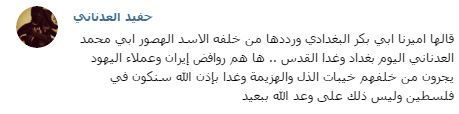
حفيد“Allah is great, my brothers, our jihadi fighters surprised the enemy infidels at the gates of Baghdad,” wrote Abu Jaafar Albagdadi, a high-profile IS operative. “We hurt them and the American officers who fled in panic from our fighters. Today in Baghdad, tomorrow in Jerusalem and Palestine with Allah’s help.”

جعفر 11“Our Caliph Abu Bakr al-Baghdadi made it clear, and repeated the words of our [military] commander Abu Mohammed al-Adnani: Today in Baghdad, tomorrow in Jerusalem,” wrote Eladnani the Grandson, an Iraqi IS member. “Look at Iran and the Jews’ cronies bearing a humiliating defeat. Tomorrow, with Allah’s help, we’ll be in Palestine. Allah promised it and it will happen.”

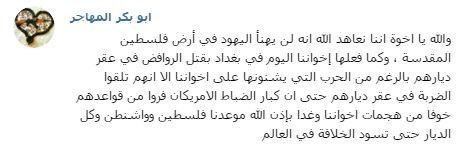
بكرIn the closed chat group, which utilizes the encrypted Telegram messaging service, top IS operative Abu Bakr Almuhager added: “My brothers, we’ve made a vow to Allah that the Jews will not take pleasure in occupying the holy land of Palestine. … Our brothers hit the infidels in the safety of their quarters in Baghdad, despite the ongoing war against us, and chased away the American officers. Our next meeting will be in Palestine, or Washington, or wherever, until the sacred caliphate rules the world.”

Moderate “European” Islam: Stemming Terror with Band Aids

March 1, 2016

Moderate “European” Islam: Stemming Terror with Band Aids

by Judith Bergman March 1, 2016 at 4:00 am

Source: Moderate “European” Islam: Stemming Terror with Band Aids

  • The project of a “French Islam” has failed abysmally. A 2,200-page report, “Suburbs of the Republic,” concluded that Muslim immigrants in France were increasingly rejecting French values and identity, and instead immersing themselves in Islam. The report warned that Islamic sharia law was displacing French civil law in many parts of suburban Paris.
  • The pattern of “importing” imams with no knowledge of the local language and customs is the same all over Europe.
  • Qatar and Saudi Arabia, where the official form of Islam is Wahhabism, are the main financiers of mosques in Europe. Wahhabism discourages Muslim integration in the West, but actively encourages jihad against non-Muslims. Qatar has financed mosques in France, Italy, Ireland and Spain, among other places, thus spreading Wahhabism across the continent.

Last week Austria ordered the first foreign-funded imam to be expelled when his visa expires. The decision was made under the new provisions of an anti-radicalization law, which Austria passed one year ago under considerable controversy. The main aim of the law is to counter extremism by requiring imams to speak German, and to prohibit foreign funding for mosques, imams and Muslim organizations in Austria. It also stresses that Austrian law must take precedence over Islamic sharia law for Muslims living in the country.

“We want a future in which increasing numbers of imams have grown up in Austria speaking German, and can in that way serve as positive examples for young Muslims,” said Integration Minister Sebastian Kurz, who helped draft the law. Another 65 imams are expected to be deported in the coming weeks, after being informed that their visas will not be renewed. The decision to deport the foreign imam has — predictably — been deemed unconstitutional by Austria’s Constitutional Court, which finds the law discriminatory because it targets only Muslims.

In a similar vein, the Belgian government recently earmarked €3.3 million to be able to pay the wages of 80 new imams in order to “help stimulate a moderate European form of Islam,” reported the Flemish daily newspaper De Standaard last week. Justice Minister Koen Geens said that official recognition of mosques forms “part of our strategy to promote a more integrated form of Islam,” one intended to counter radicalization, violent extremism and terrorism. He added: “A recognized mosque is a sign of an integrated Islam. In the fight against radicalization, it is important that young people don’t drift into the arms of radical mosques. This also provides us with more interlocutors.”

Last year, the news outlet Antwerpen revealed that a young Moroccan imam who had preached in the officially recognized “moderate” mosque, the Dome in Borgerhout, had gone to Syria with two other men to join the jihadists. Youssef El G. — the imam in question — had not been monitored, because the mosque was considered moderate. The police said his departure came as a surprise.

Encouraging Muslims toward a more moderate “European” Islam is an old idea, but has not yet succeeded in practice anywhere in Europe and its specific nature remains largely undefined.

In France, the concept of a “French Islam” was put to the test in 2003, when Nicolas Sarkozy, then interior minister, created the French Council for the Muslim Religion (CFCM) to help address issues such as imam training, mosque building and regulating halal slaughter. The purpose was to encourage a homegrown, liberal version of Islam. “What we should be afraid of is Islam gone astray, garage Islam, basement Islam, underground Islam. It is not the Islam of the mosques, open to the light of day,” Mr. Sarkozy said at the time.

The project of a “French Islam” has failed abysmally. Already in 2011 a 2,200-page report, “Banlieue de la Republique” (Suburbs of the Republic), commissioned by the influential French think tank L’Institut Montaigne — directed by Gilles Kepel, a well-known political scientist and specialist in the Muslim world — concluded that Muslim immigrants in France were increasingly rejecting French values and identity, and instead immersing themselves in Islam. The report also warned that Islamic sharia law was rapidly displacing French civil law in many parts of suburban Paris.

The report showed how radical Muslim leaders in France, who are promoting the social marginalization of Muslim immigrants in order to create a parallel Muslim society ruled by sharia law, are exacerbating the problem. The report described a proliferation of mosques and prayer rooms in the suburbs. The religious orientations of the mosques were already heavily influenced by the national origin of the founder or president of a given mosque, in other words, not nearly close to any “French” Islam, regardless of what that concept might actually contain.

Indeed, according to Reuters, only 25-30 percent of practicing imams in France are French nationals. Many do not speak French and have no knowledge of French law or customs. According to Abdelali Mamoun, an imam of Alfortville, just outside Paris, of the roughly 2,500 mosques in France, 800 are Moroccan, 600 Algerian and 400 Turkish-linked. The Grand Mosque in Paris, for example, was assigned to Algeria’s trusteeship by the French government in 1957. Since 1982, Algeria has been responsible for funding the Grand Mosque. Only between 30% and 40% of the mosques in France are independent, says Mamoun. He defines independent mosques as institutions that set out to serve all Muslim communities, that are not sponsored from abroad and do not have imams imported and paid from abroad.

The Grand Mosque in Paris was assigned to Algeria’s trusteeship by the French government in 1957. Since 1982, Algeria has been responsible for funding the Grand Mosque. (Image source: Wikimedia Commons)

Nevertheless, France still holds onto the idea of a French “moderate” Islam. In March 2015, in the wake of the terrorist attacks on the satirical magazine Charlie Hebdo and the concern about the influence of radical foreign imams on Muslims in France, French Prime Minister Manuel Valls announced that France would finance double the number of university courses on Islam — from six to twelve — to stop the influence of foreign funding on the training of French imams.

Valls said he wanted more imams and other religious figures, such as prison chaplains, who have been trained abroad to “undergo more training in France, to speak French fluently and to understand the concept of secularism” that is a core pillar of French Republican values. “The only response to the dangers that we face is the French Republic,” Valls said. “This means the acceptance of the secular state, improving education, universities, understanding and intelligence… But there will be no laws, decrees or government directives to define what Islam means,” Valls said. “The French state will never attempt to take control of a religion.”

After the Paris attacks in November 2015, Anouar Kbibech, president of the French Council for the Muslim Religion, said it would fight extremists by creating a permit to preach for imams, as well as a new religious body to fight jihadist propaganda. The certificate would be given to those imams who promote a “tolerant and open Islam.”

“The time for action has come. The Muslims of France will play their part,” said Kbibech. Actually, the time for action was over more than a decade ago, in 2003, at the founding of the CFCM. By now, any action is probably too little, much too late.

The pattern of “importing” imams with no knowledge of the local European languages and customs is the same all over Europe. Qatar and Saudi Arabia, where the official form of Islam is Wahhabism, are the main financiers of mosques in Europe. Qatar has financed mosques in France, Italy, Ireland and Spain, among other places, thus spreading Wahhabism across the continent. Wahhabism is a version of Sunni Islam that discourages Muslim integration in the West, but actively encourages jihad against non-Muslims. The former emir of Qatar, Sheikh Hamad bin Khalifa al-Thani, vowed a few years ago to “spare no effort” to spread the fundamentalist teachings of Wahhabi Islam across “the whole world.”

In October 2014, General Jonathan Shaw, a former commander of British Forces in Iraq, who retired as Assistant Chief of the Defence Staff in 2012, told The Telegraph that Qatar and Saudi Arabia were primarily responsible for the rise of the extremist Islam that inspires Islamic State terrorists by funding the global spread of radical Islam. “The root problem is that those two countries are the only two countries in the world where Wahhabi Salafism is the state religion – and Isil is a violent expression of Wahhabist Salafism,” said Gen. Shaw.

In December 2015, German vice-chancellor Sigmar Gabriel said that the Saudi regime is funding extremist mosques and communities that pose a danger to public security. “We have to make clear to the Saudis that the time of looking away is over… Wahhabi mosques all over the world are financed by Saudi Arabia. Many Islamists who are a threat to public safety come from these communities in Germany,” the vice-chancellor said. In addition to the mosques it has already built, Saudi-Arabia offered to build an additional 200 mosques for the benefit of the mass migration of Muslims into Germany, one for every 100 migrants and refugees entering the country.

The question that invariably arises is whether European governments genuinely believe in the possibility of a moderate “European Islam” in the face of the failure that attempts to bring about such a concept, still largely undefined, have met with thus far.

Considering the massive Muslim radicalization with which the continent is faced, much of it homegrown — the head of Europol said last week that the terror threat in Europe is the highest in over a decade — trying to foster a hazy concept of a “moderate” European Islam at this late point is like trying to stem a tidal wave with a band-aid.

In some European countries, the most basic concepts of how Islamic radicalization works are seemingly not even understood by the relevant judicial authorities. Denmark’s State Prosecutor recently decided that imam Hajj Saeed will not be prosecuted for his statements in a sermon where he incited Muslims to wage war against Jews, and said that the Western “infidel” civilization has led non-Muslims “to an abyss of deprivation and corruption and has reduced them from being human to being at the level of animals.” Saeed incited war against Jews at a mosque associated with Hizb ut-Tahrir in Copenhagen on February 13, 2015 — in the very same sermon that the terrorist Omar Abdel Hamid El-Husseini attended the day before he murdered two people in separate terrorist attacks at the local synagogue and at a café.

The Danish State Prosecutor, in her decision, writes that the imam’s statements,

“…were part of a sermon about interfaith dialogue. It is my assessment that the statements regarding war against Jews must be understood in that context and as a historical reference to the reaction of the prophet Muhammed in a particular historical situation. It therefore cannot be assumed that this was a direct encouragement to attack Jews. I therefore do not find that there is sufficient evidence to find the imam guilty of breaching § 266b and I do not find that further investigation will bring such evidence.”

The sermon had been organized by Hizb ut-Tahrir, a radical organization that works for the re-establishment of the caliphate — not for “interfaith dialogue.”

When investigations against imam Hajj Saeed began in March 2015, after a private Danish citizen filed a complaint, Hizb ut-Tahrir told Danish journalists that the complaint against the imam was baseless: “The sermon refers to a historical context and it is taken out of context… He has not incited to violence or murder. He is just referring to a historical event.” Conspicuously, Hizb ut-Tahrir’s “explanation” ended up being exactly what the state Prosecutor decided in the end.

It is noteworthy that several European governments have finally come to the realization that foreign funding of local mosques and imams is counterproductive to the security of their states and that it is essential that this foreign funding and training of foreign imams stop. Based on previous experience, however, the hope that a “European Islam” will be fostered is a vain and rather utopian one. In Belgium, the existence of a state-recognized “Belgian mosque” did not stop the “moderate” imam in question from traveling to Syria to join the jihadists there.

Judith Berman is a journalist based in the Middle East.

Palestinians: We Want Our Own Knesset

March 1, 2016

Palestinians: We Want Our Own Knesset

by Khaled Abu Toameh March 1, 2016 at 5:00 am

Source: Palestinians: We Want Our Own Knesset


  • Apparently Najat Abu Bakr forgot that she is a member of the Palestinian parliament and not the Israeli one. She and her colleagues have no right to criticize President Abbas or any senior official in Ramallah. Such criticism is considered an “insult” to top officials and even an act of treason.
  • And so we have two legislators. One is forced to seek shelter within her own parliament for fear of being arrested by the Palestinian security forces. The other receives all the rights and privileges enjoyed by her fellow Arabs inside Israel — in spite of her immensely provocative behavior.
  • That is the difference between a law-abiding country and the Palestinian Authority, which has been functioning for many years as a mafia.
  • Najat Abu Bakr and many Palestinians dream of the day they too will have a Knesset, a true parliament, where leaders are held accountable.

What do Haneen Zoabi and Najat Abu Bakr have in common?

Both women are outspoken members of parliament — Zoabi in Israel and Abu Bakr in the Palestinian territories.

Zoabi, who hails from Nazareth, is a citizen of Israel. Abu Bakr, from the West Bank city of Nablus, is an elected member of the Palestinian Legislative Council (PLC), the parliament that has been effectively paralyzed since 2007, when Hamas expelled the Palestinian Authority (Abbas ) from the Gaza Strip.

Haneen Zoabi (left) and Najat Abu Bakr (right) are outspoken members of parliament — Zoabi in Israel and Abu Bakr in the Palestinian territories. That is pretty much where the similarities end.

But outspoken participation in parliaments is pretty much where the similarities end.

Zoabi, who resides inside Israel, lives a rather different life from her colleague, Abu Bakr, who is a Palestinian citizen.

Zoabi, the Israeli member of parliament, is a provocateur of long standing who regularly enrages the Jewish-Israeli public. She joined a flotilla “aid” convoy to the Gaza Strip — a move that left many Israelis furious.

On other occasions, her statements have also been interpreted as a show of solidarity with Israel’s enemies. More recently, she received a light sentence after signing a plea-bargain admitting she had insulted an Arab working for the Israel Police.

Zoabi was back in the headlines again last month — along with two other Arab members of Israel’s Knesset, Jamal Zahalka and Basel Ghattas — for meeting with families of Palestinians who had carried out terror attacks against Israelis.

By all accounts, for that performance she and the other two Knesset members received a mere “slap on the wrist:” they were suspended from attending parliamentary committee meetings for a few months.

Even though Zoabi’s behavior and rhetoric are thoroughly abhorrent to many Israelis, including some of Israel’s Arab citizens, Israel’s president, Reuven Rivlin, along with other Israelis, came out against expelling her and some other Joint Arab List colleagues from the Knesset.

“We cannot allow the Knesset, whose representatives are chosen by the public, to independently overturn the public’s choice,” Rivlin said, referring to proposed legislation that would allow Knesset members to vote out their colleagues who express support for terrorism.

But let us return to the question: how are Haneen Zoabi and Najat Abu Bakr, our two female parliamentarians, each doing?

While Zoabi, an Arab Muslim citizen of Israel, carries out her duties — and lives her life — freely, Abu Bakr has been forced to seek refuge within the Palestinian Legislative Council building in Ramallah.

In short, the two women are living in different worlds.

Since last week, when President Mahmoud Abbas ordered her arrest, Abu Bakr has been holed up inside the Palestinian Authority parliament building. Her crime: blowing the whistle on the financial corruption of a cabinet minister who is closely associated with President Abbas.

Her claim is that the minister has been privately selling water to Palestinians and has illegally taken more than $200,000 from the Palestinian budget.

But that is not her only alleged crime. A further one concerns her public support for a teacher’s strike in the West Bank. The strike has seriously embarrassed President Abbas and the Palestinian Authority leadership. Abbas has ordered scores of striking teachers arrested and has deployed hundreds of policemen at checkpoints to foil a protest organized by the teachers, who are demanding higher salaries and better conditions.

Apparently, Abu Bakr forgot that she is a member of the Palestinian parliament and not the Israeli one. She and her colleagues have no right to criticize President Abbas or any senior official in Ramallah. Such criticism is considered an “insult” to top officials and even an act of treason.

Members of the Palestinian Authority’s Parliament enjoy none of the rights enjoyed by Arab members of Israel’s parliament, the Knesset.

Parliamentary immunity, for instance, means that Zoabi and her colleagues cannot be detained or summoned for interrogation by the authorities.

In truth, there is no life in the Palestinian parliament. It has been paralyzed, thanks to the PA and strife with Hamas, and mostly functions as the butt of Palestinian jokes.

But the absence of an effective parliament suits President Abbas and his government just fine. No parliament means no one to hold them accountable.

Meanwhile Abu Bakr, the MP who dares to open her mouth against the president or a top-echelon Palestinian Authority official, is grabbed by the long arm of the Palestinian security forces.

Abu Bakr is now a fugitive. Monday was the sixth day she has been huddling in the parliament building. She has refused to leave the building or report for interrogation, and is demanding that Abbas cancel the arrest warrant issued against her.

Where is comrade Zoabi now? The Joint Arab List in Israel has been conspicuously silent about the harassment of their fellow member of parliament in Ramallah.

What a different picture we would have seen had Abu Bakr been delayed at an IDF checkpoint for fifteen minutes. In less time than that, Zoabi would have strung Israel up for violating the rights of a parliament member in the Palestinian territories.

And so we have two legislators. One is forced to seek shelter within her own parliament for fear of being arrested by the Palestinian security forces. The other receives all the rights and privileges enjoyed by her fellow Arabs inside Israel – in spite of her immensely provocative behavior.

That is the difference between a law-abiding country and the Palestinian Authority, which has been functioning for many years as a mafia.

Najat Abu Bakr and many Palestinians dream of the day they too will have a Knesset, a true parliament, where leaders are held accountable. For now – and for the foreseeable future – that day is just a pipedream.

Zoabi and her fellow Arab citizens of Israel will not be packing their bags and heading for Ramallah anytime soon, however. It seems that another Arab dictatorship is not their idea of prime real estate.

Khaled Abu Toameh, an award-winning journalist, is based in Jerusalem.

Turkey’s ‘provocative’ military actions could jeopardize Syria ceasefire

March 1, 2016

Turkey’s ‘provocative’ military actions could jeopardize Syria ceasefire – Russian military

Published time: 29 Feb, 2016 23:27 Edited time: 1 Mar, 2016 01:37

Source: Turkey’s ‘provocative’ military actions could jeopardize Syria ceasefire – Russian military — RT News


Turkey’s “provocative” military buildup on the border and shelling of the Syrian territory could thwart the truce and disrupt the peace process in the Arab Republic, said the head of the Russian ceasefire monitoring center Lt. Gen. Sergey Kuralenko.

Turkey is strengthening its military positions on the border with Syria and is concentrating armored vehicles in the area, Lieutenant General Kuralenko said, denouncing these moves as “obviously provocative steps that could lead to a breakdown of the ceasefire and the peace process in the Syrian Arab Republic.”

The Russian military has examined footage taken by a Russian TV crew near the Syrian city of Tel Abyad located not far from the Turkish border, which demonstrated Ankara’s military “organizing firing positions and concentrating armored vehicles near the border,” Kuralenko said.

Meanwhile Turkish artillery fired at least 50 rounds at alleged Islamic State (IS, formerly ISIS/ISIL) targets north of Aleppo as part of the US-led coalition’s offensive, according to local media reports.

Read more

© Ammar Abdullah

The truce in Syria is generally being observed, the Lt. Gen. added, noting however that terrorist groups shelled populated areas at least seven times on Monday.

“In general, the truce between the governmental troops and the opposition forces on the territory of the Syrian Arab republic holds,” he said adding that a Russian center in Latakia monitors the situation in the six Syrian provinces of Hama, Homs, Latakia, Damascus, Aleppo and Deraa on a 24-hour basis.

“Within the last 24 hours, officers from the Russian [ceasefire monitoring] center as well as Syrian government forces and self-defense forces recorded seven cases of terrorist groups shelling Syrian residential areas,” he told journalists.

Kuralenko said that Al-Nusra militants attacked Syrian Kurdish positions in Aleppo province using artillery, while IS terrorists continued shelling the road between the cities of Hama and Aleppo, making the “delivery of humanitarian aid to Aleppo and nearby provinces impossible.”

The Lieutenant General stressed that governmental forces and the opposition achieved “significant progress” in the reconciliation process in four Syrian provinces, although he did not mention them by name.

The head of the Russian ceasefire monitoring center also discussed the first results of the truce with his US counterpart and they both expressed satisfaction with the joint efforts. “We discussed the first results of the ceasefire and signified satisfaction with the concerted efforts,” Kuralenko told journalists referring to a telephone conversation with representatives of the US ceasefire monitoring center in Amman.

In the meantime, Russian aircraft carried out several air strikes against Al-Nusra front militants to “stabilize the situation” in the regions north of the city of Aleppo, according to the Russian Defense Ministry.

Al-Nusra extremists were shelling the Syrian army positions from the Narb-Nafsa village located north of Aleppo. In response, Russian Air Space Forces “carried out missile and bomb attacks against… Al Nusra units in the region and hit positions of terrorists near Narb-Nafsa…” the statement said.

At the same time, the Russian ceasefire monitoring center once again stressed that Russian aircraft conducted no strikes against the groups which joined the truce.

Secretary of State John Kerry said that Moscow and Washington have worked out a mechanism to track down all reported violations of the ceasefire in Syria through specially set up teams in Geneva and Amman. Kerry specified that he and Lavrov agreed that the mechanism should ensure that any strikes in Syria target only Islamic State and Al Nusra Front.

“We are going to track down each alleged violation and work even more now to put in place a construct which will help us to guarantee that missions are indeed missions against Nusra or missions against Daesh [the Arabic name for IS],” Kerry said at a news conference with German Foreign Minister Frank-Walter Steinmeier.

‘We will participate’: Saudi military admits US coalition mulling ground invasion in Syria

March 1, 2016

‘We will participate’: Saudi military admits US coalition mulling ground invasion in Syria

Published time: 1 Mar, 2016 03:23

Source: ‘We will participate’: Saudi military admits US coalition mulling ground invasion in Syria — RT News

© Faisal Al Nasser
Saudi Arabia has acknowledged that the US-led anti-ISIS coalition has held a “political” discussion about a potential ground troop deployment in Syria. Riyadh’s statements have been criticized by Damascus as destructive and a threat to regional security.

In an interview with Reuters, an aide to Saudi Arabia’s defense minister, Brigadier General Ahmed Asseri, confirmed that defense ministers from the anti-Islamic State (IS, formerly ISIS/ISIL) coalition debated placing ground troops on the ground in Syria during a ministerial meeting in Brussels last month.

“It was discussed two weeks ago in Brussels,” Asseri said, clarifying that the discussions took place on the “political” level only without going into details of a potential “military mission.”

Read more

© Bulent Kilic

The general stressed that if the decision is made, Saudis would be more than willing to contribute troops – a move that Syria strongly warned against on a number of occasions. Asseri also acknowledged that Riyadh has been working on the military implementation of a possible Syria invasion.

“Once this is organized, and decided how many troops and how they will go and where they will go, we will participate in that,” he said.

“We need to discuss at the military level very extensively with the military experts to make sure that we have a plan.”

The Saudi general stressed that for the time being, the Kingdom’s air force is ready to strike Islamic State targets from Turkey’s Incirlik air base, where four Saudi fighter jets were deployed last month.

Washington also confirmed Saudi Arabia’s’ willingness to strike targets in Syria, with State Department spokesman John Kirby saying that the US would welcome the Kingdom’s participation.

“But there’s a lot that needs to be discussed in terms of what they would do, what their makeup would be, how they would need to be supported by the coalition going forward. So there’s a lot of homework that needs to be done,” Kirby said.

Read more

© Ammar Abdullah

Saudi Arabia’s push for ground incursion into Syria comes at a time when Moscow warned that Turkey is strengthening its military positions on the border with Syria at a time when US and Russia are doing their best to cement a fragile ceasefire in the country.

On Monday, an official source at the Syrian Foreign and Expatriates Ministry told Syria’s official SANA news agency that Saudi Arabia is playing a “destructive role” in the peace process while “threatening security and stability” of the world.

The statement came in reply to Saudi Foreign Minister Adel Al-Jubeir comments that he made on Sunday, accusing Syrian troops of violating the ceasefire brokered by Russia and the US, and reiterating the Kingdom’s position that Bashar Assad has no place in the future of Syria.

The Syrian official stressed that Al-Jubeir’s statements violate UN Security Council resolution 2268 that endorses the ceasefire. The resolution specifically demands that all parties to the agreement use their influence to ensure that parties to the Syrian conflict fulfill their commitments and create the conditions for a durable ceasefire.

In this regards, the source told SANA that Damascus requests that the UN Secretary-General form a committee to examine the possibility of “crimes that were committed and are still being committed by the Saudi regime and in the Arab world.”

Meanwhile, a US defense official told Reuters that Washington will continue to support forces on the ground in Syria that fight against Islamic State terrorists.

“We will continue to provide equipment packages to vetted leaders and their units so that over time they can make a concerted push into territory still controlled,” the official said. “As a matter of policy, we won’t comment or speculate on potential future operations.”

Snipers from Hebron arrested

February 29, 2016

2 brothers from Hebron arrested for carrying out shooting attacks It has been released that 2 Palestinian brothers were arrested during a Shin Bet, IDF and Israeli Police joint operation. They are suspected of carrying out shooting attacks against IDF soldiers and civilians in recent months.

Feb 29, 2016, 2:15PM Becca Noy

Source: Snipers from Hebron arrested | JerusalemOnline.com

image description
Photo Credit: Shin Bet/Channel 2 News

The Shin Bet, IDF and Israeli Police arrested 2 Hebron residents who carried out shooting attacks against Israelis in recent months, in which 4 Israelis were injured.

The brothers are 23-year-old Hamas activist Nazar Fisal Muhammad Bedui and 33-year-old Akram Fisal Muhammad Bedui. In the beginning of November, the 2 committed a shooting attack near the Cave of the Patriarchs, in which 2 Israelis were injured. At the end of the month, they fired at a car that was traveling to the same area. No one was harmed in this terror attack. In the beginning of January, the 2 brothers fired again near the same location. A 20-year-old woman was injured in this attack.

image description
1 of the brothers Photo Credit: Shin Bet/Channel 2 News

Nazar was brought in for questioning on January 9th and a week later, his brother carried out another terror attack, in which no one was injured. Akram admitted in his interrogation that he carried out the last attack to deflect the suspicions against his brother who was arrested.

Over 20 blasts in Damascus as ‘terrorists shell residential areas’

February 28, 2016

Over 20 blasts in Damascus as ‘terrorists shell residential areas’ – Russian military

Published time: 27 Feb, 2016 16:41 Edited time: 27 Feb, 2016 18:30

Source: Over 20 blasts in Damascus as ‘terrorists shell residential areas’ – Russian military — RT News

The Syria truce coordinating center has detected shelling of residential areas in Damascus carried out by terror groups, said Sergey Kuralenko, the head of the center launched by Moscow at Khemim airbase earlier in the week.

Over 20 blasts were registered earlier Saturday over a period of five hours, Kuralenko said.

The information on the shelling was immediately passed to the US coordination center in Amman, the military said, RIA Novosti reported.

READ MORE: Russia suspends all Syria airstrikes on areas & armed groups included in ceasefire – General Staff

There were no immediate reports of any casualties, according to SANA news agency.

The Syrian capital came under shelling just a few hours after a nationwide ceasefire was introduced. The deal on “cessation of hostilities” came into effect at midnight Damascus time. Outlined by the US and Russia, it was unanimously adopted by the United Nations Security Council earlier Friday and obliged all parties involved in the conflict to abide by it.

The exceptions are Islamic State group (IS, formerly ISIS/ISIL), Al-Nusra, and other terrorist organizations as designated by the UN Security Council.

The news of the cessation in hostilities was met with mixed reactions in the Syrian capital.

“Do you think people are happy to see blood, devastation and ruins? People should have a rest and get back to normal life,” a woman told RT.

“It’s impossible to introduce a ceasefire. Terrorists and their supporters are going to use this time to obtain more weapons, and then the battles with the Syrian army will go on,” a man said.

During their Saturday phone call, Russian Foreign Minister Sergey Lavrov and US Secretary of State John Kerry welcomed the ceasefire and agreed on more intensive military cooperation between the two countries on regular basis.

Syria’s warring parties are expected to sit down to negotiating table again on March 7. However, the peace talks will be canceled if hostilities go on, UN Special Envoy Staffan de Mistura said.

U.S., Europe Fund Torture by Palestinian Authority

February 26, 2016

U.S., Europe Fund Torture by Palestinian Authority

by Khaled Abu Toameh February 26, 2016 at 5:00 am

Source: U.S., Europe Fund Torture by Palestinian Authority

  • A report by the Euro-Mediterranean Human Rights Monitor documented 1,391 cases of Palestinians arbitrarily arrested by the two Palestinian parties, Fatah and Hamas, in 2015.
  • Systematic torture in Palestinian prisons in the West Bank and Gaza Strip was documented in the report — at least 179 cases of torture in Palestinian Authority (PA) prisons in 2015.
  • The PA security forces are trained and funded by several Western countries, including the US. This establishes a direct line between these Western donors and the arbitrary arrests, torture and human rights violations that have become the norm in PA-controlled prisons and detention centers.
  • The report also revealed that the Palestinian Authority regularly disobeys court orders by refusing to release detainees, showing contempt for its courts and judges.
  • Before our eyes, two police states are being built: one in the West Bank and a second in the Gaza Strip — in the face of talk by international parties of establishing an independent Palestinian state. But the last thing the Palestinians need is another police state.

Palestinians who incite violence against Israel are called Palestinian leaders. Palestinians who beg to differ with Palestinian Authority (PA) President Mahmoud Abbas or one of his friends are called criminals and can expect to be interrogated and/or imprisoned.

The PA leadership has always clamped down on its critics, including journalists, editors, academics, human rights activists and parliament members. In this regard, the PA and its president show a distinct similarity to the other dictators that run the Arab world.

Like the legendary Japanese monkeys who see no evil, hear no evil and speak no evil, the international media regularly turns a blind eye to blatant Palestinian Authority abuses. But here’s a newsflash for them: Say you don’t like Abbas and you face arrest or interrogation on charges of “insulting His Excellency.”

Take, for example, the case of Professor Abdul Sattar Qassem, who teaches Political Science at An-Najah University in Nablus.

Qassem, a long-time critic of President Abbas and the Oslo Accords, was arrested earlier this week by Palestinian security forces on charges of “incitement.” Qassem was arrested on the heels of a television interview in which he stated that those who collaborate with Israel should receive the death penalty, according to the PLO’s “Revolutionary Law.” The Palestinian leadership considered this statement “incitement” against President Abbas and Palestinian security personnel.

Professor Abdul Sattar Qassem (left) stated in a TV interview that those who collaborate with Israel should receive the death penalty. The Palestinian Authority leadership considered this “incitement” against President Mahmoud Abbas (right), and arrested Qassem.


Qassem was released on bail after three days in detention, although a Palestinian court had ordered him remanded in custody for 15 days. It is still unclear whether he will be officially charged and put on trial.

No stranger to Palestinian prison, Qassem has been arrested at least three times in the past few years for publicly criticizing President Abbas and other senior Palestinian officials. His outspokenness has also exposed him to violence: his car was torched while parked in front of his home in Nablus, and he escaped an assassination attempt when unidentified gunmen shot several rounds at him outside this home.

The culprits have never been caught. Palestinian sources say the assailants are unlikely to ever be apprehended. Had the perpetrators posted critical comments about President Abbas on Facebook, however, these sources say that they would have been locked up long ago.

A recent report published by the Euro-Mediterranean Human Rights Monitor documented 1,391 cases where Palestinians were arbitrarily arrested by the two Palestinian parties, Fatah and Hamas, in 2015.

The report noted that the bulk of the arrests (1,274) had taken place in the areas controlled by the Palestinian Authority in the West Bank. Among those arrested were 35 Palestinian journalists and civil rights activists, and 476 students and academics.

Cameras and computers were confiscated from the detained journalists before they were interrogated about their work and activities on social media, the report said.

Now let us go to Gaza. How is Hamas doing on this score? Hamas authorities last year arrested “only” 23 journalists and civil rights workers, 24 university students and five teachers and academics.

Thus, the figures show, we might say, some arresting facts: Hamas has a better record than the Western-funded Palestinian Authority when it comes to assaults on public freedoms and human rights violations. The report also revealed that the Palestinian Authority regularly disobeys court orders by refusing to release detainees. In other words, the Palestinian Authority, which repeatedly boasts that it has managed to build an “independent and credible judiciary system” with the help of Western donors, shows contempt for its courts and judges.

Systematic torture — scores of cases — in Palestinian prisons in the West Bank and Gaza Strip was also documented in the report. In 2015, there were at least 179 cases of torture in Palestinian Authority prisons, as opposed to 39 cases in Hamas prisons during the same year.

The Palestinian Authority security forces are trained and funded by several Western countries, including the United States. This establishes a direct line between these Western donors and the arbitrary arrests, torture and human rights violations that have become the norm in Palestinian Authority-controlled prisons and detention centers.

Yet there is silence — until the word “Israel” pops up. Then Western news outlets, including those based in Israel that are tasked with covering Palestinian affairs, go into high gear.

This criminal indifference — one is tempted to say negligence — on the part of the international community permits and even promotes Palestinian Authority and Hamas human rights abuses.

We are witnessing how the two Palestinian parties approach the task of building state institutions. Before our eyes, two police states are being built — one in the West Bank and a second in the Gaza Strip. This is taking place in the face of talk by the same donors and other international parties (at least in relation to the PA) of establishing an independent Palestinian state. But the last thing the Palestinians need is another police state.

President Abbas, who has just entered the 11th year of his four-year term in office, has no cause to be concerned about the human rights violations committed by his security forces. In fact, he has every reason to continue clamping down on his critics. Why should he worry? The international community absolves him of the abuses perpetrated under his rule.

That is why this week Abbas instructed his security forces to launch an investigation into the behavior of a legislator, Dr. Najat Abu Baker. Dr. Abu Baker, it seems, had the temerity to demand an inquiry into the financial practices of a Palestinian cabinet minister.

Soon after she lodged charges of financial wrongdoing, Dr. Abu Baker, an elected member of the Palestinian Legislative Council, was summoned by the Palestinian prosecutor general for interrogation on charges of “slander” and “incitement.” This is quite a way to respect Dr. Abu Baker’s parliamentary immunity.

Dr. Abu Baker’s case is yet a further example of the disregard that the Palestinian Authority shows not only for the judicial system, but also for the legislative body that is meant to serve as a watchdog over the executive branch. But even watchdogs know their owners. By summoning Dr. Abu Baker for interrogation and threatening to arrest her, Abbas is sending a message of deterrence to his detractors, namely that even a member of parliament cannot escape the long arm of the Palestinian security forces.

For now, the international community has some choices. It could continue to close its eyes to the police states being erected with its monies. Alternatively, it could choose a new path: to hold the Palestinian Authority accountable for its actions, including the torture that takes place within its very core. But the West had better hurry up. The PA repression is far from lost on the Palestinians, who are being driven by it into the waiting arms of Hamas and other such groups.

Proper state institutions for the Palestinians is a laudatory goal; what the Palestinians have today are two banana republics.

Khaled Abu Toameh, an award winning journalist, is based in Jerusalem.

Obama Opposes New Pro-Israel Bill

February 25, 2016

Obama Opposes New Pro-Israel Measures, Will Not Follow Provisions to Help Jewish State White House rejects portions of new bill to help Israel

BY:
February 25, 2016 12:35 pm

Source: Obama Opposes New Pro-Israel Bill

President Barack Obama has announced in a rare statement that he will not follow newly passed measures aimed at boosting the Israeli economy and strengthening ties between the United States and the Jewish state, according to a statement issued by the president.

Obama stated that while he would sign the new trade resolution, portions of which focus on combatting economic boycotts of Israel, he would not enforce certain pro-Israel provisions that order the United States to stop partnering with countries that support the Boycott, Divestment, and Sanctions movement, or BDS, which aims to isolate Israel.

The president’s rejection of these provisions comes two weeks after the White House issued a separate statement expressing support for every provision of the trade bill except for those focusing on strengthening the U.S.-Israel relationship.

The Obama administration has repeatedly opposed efforts to fight the BDS movement over the past several months, with several senior officials expressing support for European efforts to explicitly label Jewish-made products produced in disputed areas of Israel.

Obama claimed in the statement that his administration does not back the BDS movement. However, he will not uphold parts of the new trade legislation that seek to combat the BDS-backed labeling of Jewish goods, which the Israeli government has described as anti-Semitic.

“Certain provisions of this Act, by conflating Israel and ‘Israeli-controlled territories,’ are contrary to longstanding bipartisan United States policy, including with regard to the treatment of settlements,” Obama said in the statement.

“Moreover, consistent with longstanding constitutional practice, my administration will interpret and implement the provisions in the Act … in a manner that does not interfere with my constitutional authority to conduct diplomacy,” Obama said, making clear he will not enforce any part of the law that he views as legitimizing Israeli settlements.

Rep. Peter Roskam (R., Ill.), who authored the pro-Israel language along with Rep. Juan Vargas (D., Calif.), criticized the administration for not upholding the will of Congress and the American people.

“This law—including the anti-BDS provisions I was proud to author—passed with overwhelming bipartisan support in both the House and the Senate,” Roskam said in a statement. “Incredibly, President Obama has already announced his intention to prioritize his misguided notions of legacy over the law of the land.”

“We did not provide a statutory menu from which President Obama can pick and choose provisions to enforce,” the lawmaker added. “The president has signed this bill into law—it is now his responsibility to fully and faithfully execute it in its entirety.”

Roskam expressed dismay that “fighting efforts to delegitimize Israel interferes with his diplomacy, but rest assured that I intend to use my authority as chairman of the Ways and Means Subcommittee.”

Congress has undertaken a series of efforts to boost the U.S.-Israel relationship following a contested debate over the Iran nuclear deal that strained relations between the two countries.

Senate lawmakers, led by Sen. Mark Kirk (R., Ill.), recently filed legislation that would help state and local governments divest taxpayer funds from companies that back the BDS movement.

The bill comes as more than 20 state governments pursue efforts to combat the BDS movement and divest from anyone who supports it.

Turkey says Syria ceasefire is not binding if it threatens security

February 25, 2016

Turkey says Syria ceasefire is not binding if it threatens security

February 25, 2016, Thursday/ 11:20:39/ REUTERS | ISTANBUL

Source: Turkey says Syria ceasefire is not binding if it threatens security

Turkey says Syria ceasefire is not binding if it threatens security

Turkish Prime Minister Ahmet Davutoğlu. (Photo: Reuters)

Prime Minister Ahmet Davutoğlu said on Thursday that Turkey would not be bound by the Syrian ceasefire plan if its security was threatened, and would take “necessary measures” against the Syrian Kurdish People’s Protection Units (YPG) and Islamic State of Iraq and the Levant (ISIL) if needed.

The ceasefire process, put in train by Russia and the United States, could be complicated by NATO member Turkey’s deep distrust of the Washington-backed Syrian Kurdish YPG militia, which has made territorial gains in northern Syria near the Turkish border. Turkey regards the YPG as a terrorist group and fears it will further inflame unrest among its own Kurdish population.

“The ceasefire is not binding for us when there is a situation that threatens Turkey’s security; we will take necessary measures against both the YPG and Daesh when we feel the need to,” Davutoğlu said in comments broadcast live on CNN Türk television. “Daesh” is an Arabic acronym for ISIL.

“Ankara is the only place that decides actions regarding Turkey’s security,” he said. However, he also said the ceasefire should not pave the way for new attacks.

Syria’s opposition has indicated it is ready for a two-week truce, saying it is a chance to test the seriousness of the Syrian government’s commitment to a cessation of hostilities.

The YPG told Reuters on Wednesday it would abide by the plan to halt the fighting, but reserved the right to respond if attacked. Turkey has shelled YPG positions in Syria in recent weeks, saying it was retaliating to cross-border fire.

Separately, Foreign Minister Mevlüt Çavuşoğlu said the YPG, like ISIL, sought to divide Syria.

“The aim of the PYD and YPG is clear: just like Daesh, they want to divide Syria to form their own management,” Çavuşoğlu told the Anatolian agency in an interview broadcast live on television. The PYD is the political wing of the Syrian Kurdish militia.

“As the international support group, our aim is not to divide Syrian territory but to protect its territorial integrity,” he said.

He also told Anatolian that Saudi planes, due to take part in air strikes against ISIL, were expected to arrive at Turkey’s İncirlik Air Base “today or tomorrow”.

The Doğan news agency cited army sources as saying Saudi F-15 warplanes would arrive at İncirlik on Friday, and that C-130 cargo planes had been shipping military materials to İncirlik for the last two days.