Posted tagged ‘Syria’

Assad to Netanyahu: Help Me Keep my Seat and I Guarantee You a Calm Golan

July 30, 2016

Assad to Netanyahu: Help Me Keep my Seat and I Guarantee You a Calm Golan, JNi.Medi via Jewish Press, July 30, 2016

(But what about Iran? — DM)

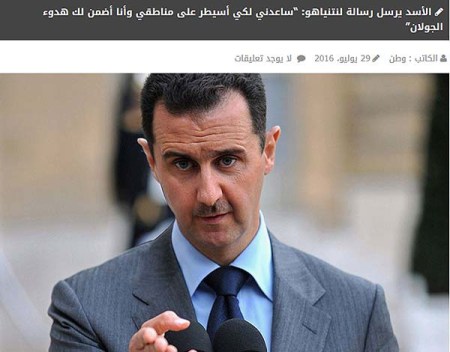
assad to Israel“Assad sends a message to Netanyahu: ‘Help me to control my region and I guarantee you a calm Golan.'”

A Kuwaiti news website on Friday cited a source saying Israeli Prime Minister Benjamin Netanyahu has received a message from Syrian President Bashar al-Assad, in which Assad vowed to keep the Golan as a demilitarized zone, and the rest of Syria committed to a cease-fire with Israel, if Netanyahu commits to not engaging Israel in an effort to topple Assad.

The source commented that Assad was saying to Netanyahu, in effect: “Help me to control my region and I guarantee calm for Israel in the Golan Heights.”

Commenting on rumors that former US ambassador to Israel Martin Indyk is slated to be President Hillary Clinton’s special envoy on the peace process between Israel and its neighbors, the source told the news website that Israel is very concerned over a report that was prepared by Indyk for President Bill Clinton about the Golan Heights. Israel is anxious to point US attention to the fact that the situation on south Syria and south Lebanon has been altered by the five-year civil war, and American notions about returning the Golan to Syria are absurd under these circumstances. Assad apparently wishes to take advantage of an opportunity to strike a deal with the Israelis to secure their neutrality in the war.

Meanwhile, Politico.eu reported Saturday that Saudi Arabia’s Foreign Minister Adel Al-Jubeir said his country is offering Russia access to the Gulf Cooperation Council Market and regional investment funds in return for pulling its support for the Assad regime.

“We are ready to give Russia a stake in the Middle East that will make Russia a force stronger than the Soviet Union, greater than China’s,” the Saudi minister said, adding, “It would be reasonable for Russia to say, that’s where our relations will advance our interests, not with Assad. We don’t disagree on the end game in Syria but on how to get there. Assad’s days are numbered,” he urged, “so make a deal while you can.”

Has the IDF hit the Basij forces commander General Naghdi?

July 30, 2016

Has the IDF hit the Basij forces commander General Naghdi? DEBKAfile, July 30, 2016

EinZivan2 (1)

Gen. Naghdi’s visit to Quneitra undoubtedly presaged some decisions in Tehran with regard to direct Hizballah-Syrian-Iranian action against Israel.

The Iranian, Syrian and Hizballah agencies accuse Israel of the attack because the say it was executed by two Nimrod anti-tank long-range missiles, manufactured by the Israeli Aerospace Industry, for use by the IDF against armored vehicles, ships, bunkers and troop concentrations.

*****************

Iranian, Syrian and Hizballah sources are intimating that the “Syrian officer” injured on July 26 in Quneitra by Israel’s double Nimrod’ missile shot was none other than Revolutionary Guards Gen. Muhammad Resa Naghdi, head of the paramilitary Organization for the Mobilization of the Oppressed, also known as the Basij, which falls under the Islamic Revolutionary Guard Corps (IRGC). The victim was earlier described officially as a Syrian officer.

If he was indeed hurt or killed by an Israeli rocket, Naghdi would become the highest-ranking IRGC general ever hit by the IDF.

On July 27, the semi-official Fars news agency reported that a top Iranian general recently visited the Israeli-Syrian border to tour Quneitra and the Golan demarcation lines between Syria and Israel – the first time the Tehran government had publicized a visit by a senior regime official to the area.

It may be presumed, DEBKAfile’s intelligence sources say, that someone at the IDF lookout posts spotted and reported on Gen. Naghdi’s arrival with an entourage in Quneitra on July 26 and saw him inspecting through binoculars the IDF defense positions. He was then quickly identified.

Any decision to go after a high-ranking Iranian would not have been left to local IDF commanders or even OC Northern Command Maj. Gen. Aviv Kohavi, but passed straight to Prime Minister Binyamin Netanyahu, Defense Minister Avigdor Lieberman and Chief of Staff Lt. Gen. Gady Eisenkot – especially in this case.

General Naghdi is not just another Iranian general. He heads the more than a million-strong Basij militia, which is a pillar of the ayatollahs regime in Tehran, and the backbone of the Iranian internal security forces which maintain the regime’s total control in every corner of the Islamic Republic.

Gen. Naghdi’s visit to Quneitra undoubtedly presaged some decisions in Tehran with regard to direct Hizballah-Syrian-Iranian action against Israel.

The IDF is holding its silence on reports of his injury, declining as usual to comment on reports by foreign publications.

The Iranian, Syrian and Hizballah agencies accuse Israel of the attack because the say it was executed by two Nimrod anti-tank long-range missiles, manufactured by the Israeli Aerospace Industry, for use by the IDF against armored vehicles, ships, bunkers and troop concentrations..

The missile has a semi-active laser guidance system, and is able to operate day and night. Its flight path can be below the clouds, while its operators far behind use a laser to guide it to target.

The launcher platform, with four missiles, can be installed on a Jeep, weapon-bearing vehicle, Abir, or armored vehicles. In addition, it is possible to send it from CH-53 ‘Yasur’ helicopter.

Israel has acted in the past against the establishment of an Iranian and/or Hizballah military presence on its Golan doorstep. On Jan. 19, 2015, an IDF air strike killed the Iranian Brig. Gen, Mohammad Ali Allahdadi and six Hizballah officers while they were on a tour of inspection near Quneitra.

Thursday, July 28, DEBKAfile ran an exclusive report on rising Israel-Russia tensions centering on southern Syria and the Golan.

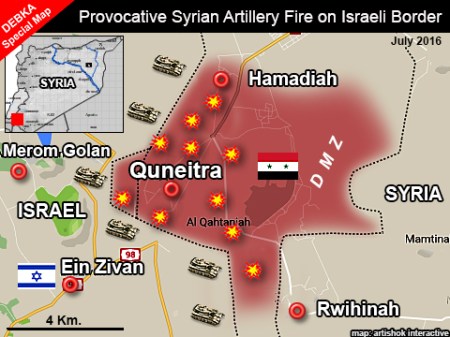
For four days since July 25, the Syrian army has been continuously firing artillery batteries – moved close to Israel’s defense lines on the Golan border – in a manner that comes dangerously close to provoking an Israeli response. This carefully orchestrated Syrian campaign goes on around the clock.

It is the first time in the six years of the Syrian war that Bashar Assad has ventured to come near to provoking Israel. But now he appears to be emboldened by his Russian ally.

The IDF is holding its fire for the moment. But Israeli military and government leaders know that the time is near for the IDF to be forced to hit back, especially since it is becoming evident that the Syrian army’s steps ae backed by Russia.

DEBKAfile’s military sources provide details of the Syrian steps:

  • The Syrian army’s 90th and 121nd battalions have been firing their artillery batteries non-stop across a 10km band along the Golan border from Hamadia, north of Quneitra, up to a point facing the Israeli village of Eyn Zivan. (See attacked map).
    This means that the Syrian army has seized the center of buffer zone between Israel and Syria and made it a firing zone.
  • This artillery fire fans out across a radius that comes a few meters short of the Israeli border and the IDF troops stationed there. It then recedes to a distance of 500 to 600 meters and sweeps across the outposts and bases of the Syrian rebel forces believed to be in touch with Israel or in receipt of Israeli medical aid.
  • The new Syrian attack appears to hold a message for Jerusalem: For six years, you supported the rebels against the Assad regime in southern Syria. That’s now over. If you continue, you will come face to face with Syrian fire.
  • Damascus is also cautioning those rebels:  For years, you fought us with Israel at your backs. But no longer. Watch us bring you under direct artillery fire, while the IDF sits on its hands.
  • On July 26, Russian media published an article revealing that Russia had delivered to the Syrian Air Force, advanced SU-24M2 front-line bombers, which is designed for attack on frontlines of battle. Israeli officials were unpleasantly taken aback by the news. Up until now, the Russians and Syrians refrained from deploying air strength in South Syria near the Israeli border. Now the Syrian air force has the means to do so.
  • DEBKAfile military sources report that the SU-24M2, following recent upgrades and modifications in Russian factories, is now capable of dropping smart bombs – ballistic bombs with a guidance system on their tails that enable them to hit targets with precision.This guidance system does not rely on US GPS satellites but rather the equivalent Russian GLONASS system which is linked to a network of 21 Russian satellites and partially encrypted for military usages.
    In addition, the SU-24M2 is equipped with a system that projects the information the pilot needs (flight details and battle details) on the plane’s windshield (head-up display) and on the pilot’s visor.
  • The Russians delivered to the Syrians two of these sophisticated airplanes this week, out of 10 that they will supply soon.

The IDF has concluded that it is only a matter of time before these planes appear in Southern Syria and so generate a new and highly combustible situation on Israel’s northern and northeastern borders.

The Russians are colluding with Damascus to inform Israel that it will no longer be allowed by either to continue backing the rebel forces in southern Syria or sustain the buffer zone which they man.

Israel may pay dear if Prime Minister Binyamin Netanyahu, Defense Minister Avigdor Lieberman, and Chief of Staff Lt. Gen. Gadi Eisenkot decide to continue to abstain from hitting back at the Syrian fire which is aimed every few hours at the vicinity of IDF posts or the impending arrival of Russian bombers. The price in store would be the weakening of the IDF’s hold on the Golan border.

‘Bloody massacres’: Syria appeals to UN after French & US airstrikes ‘kill over 140 civilians’

July 20, 2016

‘Bloody massacres’: Syria appeals to UN after French & US airstrikes ‘kill over 140 civilians’

Published time: 20 Jul, 2016 12:09 Edited time: 20 Jul, 2016 12:11

Source: ‘Bloody massacres’: Syria appeals to UN after French & US airstrikes ‘kill over 140 civilians’ — RT News

A U.S. Air Force F-15E Strike Eagle © US AIR FORCE / Reuters

Syria is demanding the UN take action after it says French war planes killed more than 120 civilians during airstrikes on Tuesday near the Turkish-Syrian border. The deaths came just a day after US air assaults killed a further 20 people in Manbij.

The Syrian Foreign Ministry sent letters to the UN secretary general and to the president of the UN Security Council, which at present is Japan.

Damascus wants the organization to look into atrocities committed by France, which is a member of the US-led international coalition, after it targeted the village of Toukhan Al-Kubra, located near the Turkish-Syrian border and the city of Manbij.

https://twitter.com/sayed_ridha/status/755359880022601728?ref_src=twsrc%5Etfw

“The French unjust aggression claimed the lives of more than 120 civilians, most of them are children, women and elderly, in addition to tens of wounded citizens, the majority of them are also children and women as reports say that the fate of scores of other civilians who still under debris are unknown too,” the Syrian Foreign Ministry wrote, as cited by the Syrian Arab News Agency.

The mass death toll in Toukhan Al-Kubra came just a day after US war planes killed around 20 people, mainly women and children, while many more were injured in and around the city of Manbij, the Foreign Ministry states.

“The government of the Syrian Arab Republic condemns, with the strongest terms, the two bloody massacres perpetrated by the French and US warplanes and those affiliated to the so-called international coalition which send their missiles and bombs to the civilians instead of directing them to the terrorist gangs… Syria also affirms that those who want to combat terrorism seriously should coordinate with the Syrian government and army,” the ministry added.

In the letter, the Syrian Foreign Ministry added that it condemns the continued support by the US, France, Saudi Arabia, the UK and Qatar to terrorist organizations such as Al-Nusra Front and Jaish Al-Islam, despite these groups having clear links to Islamic State (IS, formerly ISIS/ISIL) and Al-Qaeda.

The human rights watchdog Amnesty International also hit out at the US-led coalition, saying that it needs to do more to prevent the deaths of civilians.

“Anyone responsible for violations of international humanitarian law must be brought to justice and victims and their families should receive full reparation,” Amnesty’s interim Middle East director Magdalena Mughrabi said, as cited by Reuters.

A spokesman for the US Department of Defense says that it is aware of the loss of civilian life in Syria.

“We are aware of reports alleging civilian casualties near Manbij, Syria, recently. As with any allegation we receive, we will review any information we have about the incident,” Matthew Allen said in a statement.

“We take all measures during the targeting process to avoid or minimize civilian casualties or collateral damage and to comply with the principles of the Law of Armed Conflict,” he added.


https://amp.twimg.com/v/a918350f-8013-4f34-bcfc-b82f18a6180a

The US-led coalition has been providing air support to the rebel group the Syrian Arab Coalition, which is involved in heavy fighting around the city of Manbij, currently under the control of Islamic State.

The terrorist group has been in control of the city since it seized large swathes of Syria and Iraq in the summer of 2014.

In an interview with NBC News last week, Syrian President Bashar Assad said that the US is not interested in defeating terrorists in Syria as it really wants “to control and use them.”

“The reality is telling that, since the beginning of the American airstrikes, terrorism has been expanding and prevailing,” he told the channel, specifying that “during the American and alliance airstrikes, ISIS was expanding and taking over new areas in Syria.”

“It’s about being serious, having the will. The United States doesn’t have the will to defeat the terrorists. It had the will to control them and to use them as a card, like they did in Afghanistan. That will reflect on the military aspect of the issue,” Assad said.

Syria post near Golan border bombed, unclear if Israel involved

July 20, 2016

Syria post near Golan border bombed, unclear if Israel involved IDF declines to comment on report of jets hitting Assad government-held building near Quneitra; Hezbollah points finger at Nusra Front

By Ilan Ben Zion

July 20, 2016, 1:33 pm

Source: Syria post near Golan border bombed, unclear if Israel involved | The Times of Israel

Smoke rises following an explosion in Syria’s Quneitra province as Syrian rebels clash with President Bashar Assad’s forces, seen from the Israeli-controlled Golan Heights in 2014. (AP/Ariel Schalit, File)

A Syrian government building near the Golan border was bombed Wednesday, with some reports initially attributing the attack to Israel.

However, Hezbollah and several Arab media outlets indicated the building in Medinat al-Ba’ath had been attacked by rebel groups.

 It wasn’t immediately clear what purpose the building served, or whether it was occupied at the time of the strike. There was no immediate word on casualties.

Unconfirmed reports indicated that the planes targeted Hezbollah operatives in the area.

The Lebanese Al-Mayadeen news agency denied the accuracy of reports attributing the bombing to Israeli airstrikes in Syria, quoting Hezbollah saying the al-Qaeda affiliated Nusra Front launched rockets at Quneitra, inflicting casualties.

The Local Coordination Committees in Syria, meanwhile, claimed Free Syrian Army forces fired rockets at Assad forces in Medinat al-Ba’ath.

The Syrian Qasioun news agency claimed that the building was an Assad government command post that may have been used for Hezbollah activities.

There was no immediate response to the reports in the Syrian official news agency and the IDF Spokesman’s Unit said it didn’t comment on reports regarding Israeli strikes in Syria.

Shortly after the reported strike, the Local Coordination Committees in Syria reported that Assad government helicopters bombed the nearby towns of Umm Batna and Ajraf.

Syrian Army artillery then were said to target and destroy Nusra Front positions in response to the reported rocket attacks on Medinat al-Ba’ath.

Earlier in the day, gunfire hit an army post near the Israeli town of Metulla on the Lebanon border. The IDF said it was investigating but believed the bullets to be stray fire from across the border.

On Tuesday, Prime Minister Benjamin Netanyahu marked 10 years since the Second Lebanon War with Hezbollah by warning that “if the need arises, we will respond to aggression — and the response will be powerful. Whoever thinks they will find ‘spiderwebs’ here will get… an iron fist.”

He was alluding to a 2000 speech by Hezbollah leader Hassan Nasrallah, in which he called the Jewish state “feebler than a spiderweb.”

Israel has maintained an official policy of nonintervention in the Syrian civil war, which has wracked the country for over five years and left over 250,000 dead and millions displaced but Israeli officials have made clear that Israel would act to prevent Hezbollah from obtaining sophisticated weaponry from Syria or Iran.

The IDF has also retaliated when fighting by the various rebel groups and government forces struck Israel.

Earlier this month the IDF struck two Syrian artillery pieces after errant fire struck just inside the border fence with Israel.

On Sunday, the army also attempted to shoot down a drone that infiltrated the Golan from Syria, but failed to hit it with two Patriot missiles and a missile shot from a jet.

The IDF has been bolstering defenses along the northern border, expanding the network of fences and surveillance capabilities, to prepare for a possible war with Hezbollah, the Shiite group that fought a war with Israel in 2006 and has vowed to destroy the Jewish state.

The border has been largely quiet in the ten years since the Second Lebanon War, with Hezbollah’s forces deployed to support Iranian and Assad regime forces in the Syrian civil war.

IDF bulldozers with tanks enter Golan DMZ

July 13, 2016

IDF bulldozers with tanks enter Golan DMZ, DEBKAfile, July 13, 2016

GolanIsrael_Zone

Israeli military bulldozers backed by tanks have crossed into the demilitarized zone dividing the Israeli and Syrian Golan borders. They are building a line of fortifications and anti-tank trenches 300-500 meters inside the DMZ.

This is the first time in the six-year Syrian war that the IDF has openly operated on the Syrian side of the border. The force has not so far run into opposition- or indeed any word of protest – or even mention – by Assad regime officials in Damascus.

The sole reference to Israeli military movements in the DMZ has come from a small Syrian rebel group which described them.

DEBKAfile’s military sources report that the IDF operation was still going forward Wednesday, July 12, on a patch of terrain facing the Israeli Golan village of Ein Zivan, on the one hand, and the Syrian town of Quneitra, on the other.

The enclave splitting the Golan between Syria and Israel is defined in the 1974 armistice agreements as a demilitarized zone under the military control of the UN Disengagement Observer Force (UNDOF) and Syrian civilian administration. It is bounded by two strips of land around 10km deep where each side is permitted to maintain diluted military strength. No ground-to-air missiles may be deployed inside a 25km radius from the DMZ.

It was agreed that Syrian nationals forced by the October 1973 war and its aftermath to leave their homes would be able to return. Ruined Quneitra was later handed back to Syria against a commitment by its government to repopulate the town and ban terrorist activity and infiltrations of Israel from the Golan sector.

Both commitments were given orally to the US government.

However, the Syrian war as it unfolded in the last two years turned the deal on its head. The UN observers abandoned their posts, leaving behind a void that was partly filled by Syrian troops and a motley assortment of rebel groups.

But the DMZ was left mostly unoccupied as both Israel and Syria tried to preserve at least the semblance of the deal intact. However, Assad’s allies Iran and Hizballah have repeatedly attempted to plant a forward military and terrorist presence opposite Israel’s Golan defense lines – with avowed hostile intent.

The silence from Damascus on Israel’s military steps on the Golan may be no more than a respite as the Syrian ruler waits for Tehran’s endorsement of joint Syrian-Iranian-Hizballah counteraction.

Our sources add that IDF military steps on the ground were accompanied by unusual Israeli Air Force movements over Syria and Lebanon, and elevated preparedness on the 10th anniversary this week of the Lebanon war fought between Hizballah and Israel.

It was noted that Hizballah refrained from celebrating the occasion and omitted its customary boasts of a “great victory” – thereby intensifying the sense in Israeli military circles that Iran’s Lebanese proxy may be cooking up a surprise operation.

Russian anti-ISIS war from Syria to Caucasus

July 12, 2016

Russian anti-ISIS war from Syria to Caucasus, DEBKAfile, July 12, 2016

Alexander-Dvornikov-C-in-C-Russian-Syrian-Task-Force

Unimpressed by President Barack Obama’s optimistic assertions about ISIS’ loss of territory and weakening state, the Kremlin judges the counter-terror war to be just beginning. Russian intelligence has found the group to be in full fighting mode and setting up an army of suicide bombers, each team numbering some 20-15 terrorists, ready for strikes in Europe, including Russia, and the Middle East.

************************

In a supreme effort to prevent ISIS suicide units from reaching Russia from Syria, Sergei Shoigu, Russia’s
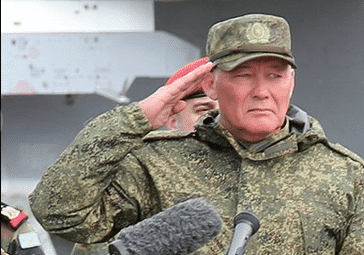
Defense Minister, has promoted the Russian commander in Syria, Colonel-General Alexander Dvornikov. to an expanded command as head of the South Russia military district. This district covers Russian forces including naval units in the Black and Caspian Seas, the Fourth Air Force Defense Army and Russian bases in Abkhazia, South Ossetia and Armenia.  Gen. Dvornikov will also command tens of ground force divisions, including paratroopers, marines and special coastal defense units.

The fact that the Russian Defense Ministry emphasizes in its announcement that “The decision about the appointment of a new commander of the Syrian operation is pending,” indicates that General Dvornikov will remain in charge of Russian forces in Syria from his new Black Sea HQ. His deputy, Gen.-Lt. Alexander Zhuravlyev, will continue to serve under him in the Syrian arena.

Moscow’s realignment of its military command is taken by DEBKAfile’s military and counter terrorism sources as a step towards becoming the first world power outside the Middle East to recognize and address the trans-frontier, global character of the Islamic peril, a lesson drawn from ISIS suicide attacks in Paris, Brussels, the US, Tunisia Egypt and Turkey

Unimpressed by President Barack Obama’s optimistic assertions about ISIS’ loss of territory and weakening state, the Kremlin judges the counter-terror war to be just beginning. Russian intelligence has found the group to be in full fighting mode and setting up an army of suicide bombers, each team numbering some 20-15 terrorists, ready for strikes in Europe, including Russia, and the Middle East.

This is borne out by the information released in Ankara by Turkish intelligence sources on July 11, showing that since the bombing in Istanbul airport, on June 28, in which 42 people were killed, ISIS has discontinued its passageway through Turkey for suicide terrorists trained in Syria to reach Europe. They are now smuggling terrorists across Azerbaijan, Georgia and Cyprus.

This Turkish announcement has serious implications:

First, that the ISIS’ use of Azerbaijan and Georgia as way stations for its suicide squads points to its presence on the Black Sea coast right up to Russia’s frontier. This region has now passed to the command of  Gen. Dvornikov..

Second, that Turkish intelligence can confirm Russian information about large squads of suicide terrorists gearing up for multiple attacks, some of which are already on-site of their targets, with back-up teams in case the first misses out.

The impending massive invasion of suicide terrorists to Europe and the Middle East was, according to DEBKAfile’s sources, an important item on the agenda of the recent meeting between Yossi Cohen, head of the Israeli Mossad, and Mikhail Yefimovich Fradkov, head of the Russian SVR, that took place on July 1, at the Russian organization’s Yasenevo HQ outside Moscow.

The Case for Kurdish Statehood

July 11, 2016

The Case for Kurdish Statehood, Investigative Project on Terrorism, Noah Beck, July 11, 2016

1691

Why has the West been so supportive of Palestinian nationalism, yet so reluctant to support the Kurds, the largest nation in the world without a state?

The Kurds have been instrumental in fighting the Islamic State (ISIS); have generously accepted millions of refugees fleeing ISIS to the Kurdistan Regional Government (KRG); and embrace Western values such as gender equality, religious freedom, and human rights. They are also an ancient people with an ethnic and linguistic identity stretching back millennia and have faced decades of brutal oppression as a minority. Yet they cannot seem to get sufficient support from the West for their political aspirations.

The Palestinians, by contrast, claimed a distinct national identity relatively recently, are less than one-third fewer in number (in 2013, the global Palestinian population was estimated by the Palestinian Authority to reach 11.6 million), control land that is less than 1/15th the size of the KRG territory, and have not developed their civil society or economy with nearly as much success as the Kurds. Yet the United Nations, the European Union, the Arab League, and other international bodies have all but ignored Kurdish statehood dreams while regularly prioritizing Palestinian ambitions over countless other global crises.

Indeed, in 2014 the UK and Sweden joined much of the rest of the world in recognizing a Palestinian state. There has been no similar global support for a Kurdish homeland. Moreover, Kurdish statehood has been hobbled by U.S. reluctance to see the Iraqi state dismantled and by regional powers like Turkey, which worries that a Kurdish state will stir up separatist feelings among Turkish Kurds.

With an estimated worldwide population of about 35 million (including about 28 million in the KRG or adjacent areas), the Kurds are the fourth-largest ethnic group in the Middle East (after the Arabs, Persians, and Turks), and have faced decades of persecution as a minority in Turkey, Iran, and Iraq.

The 1988 “Anfal” attacks, which included the use of chemical weapons, destroyed about 2,000 villages and killed at least 50,000 Kurds, according to human rights groups (Kurds put the number at nearly 200,000). Several international bodies have recognized those atrocities as a genocide.

The Kurds in Turkey have also suffered oppression dating back to Ottoman times, when the Turkish army killed tens of thousands of Kurds in the Dersim and Zilan massacres. By the mid-1990s, more than 3,000 villages had been destroyed and 378,335 Kurdish villagers had been displaced and left homeless, according to Human Rights Watch.

The drive for Kurdish rights and separatism in Iran extends back to 1918, and – during its most violent chapter – cost the lives of over 30,000 Kurds, starting with the 1979 rebellion and the consequent KDPI insurgency.

A 2007 study notes that 300,000 Kurdish lives were lost just in the 1980s and 1990s. The same study states that 51,000 Jews and Arabs were killed in the Arab-Israeli conflict from 1950 until 2007 (and, because that total includes wars with Israel’s Arab neighbors, Palestinians are a small fraction of the Arab death toll).

Perhaps because of the Kurds’ own painful history, the KRG is exceptionally tolerant towards religious minorities and refugees. The KRG has embraced its tiny community of Jews, and in 2014, the Kurds rescued about 5,000 Yazidis trapped on Mount Sinjar after fleeing attempted genocide by ISIS. Last November, the Kurds recaptured the Sinjar area from ISIS, liberating hundreds more Yazidis from vicious oppression.

The KRG absorbed 1.8 million refugees as of December, representing a population increase of about 30 percent. The KRG reportedly needs $1.4 to 2.4 billion to stabilize the internally displaced people in its territory.

“Most of the refugees [in the KRG] are Arab Sunnis and Shia, Iranians, Christians, and others,” Nahro Zagros, Soran University vice president and adviser to the KRG’s Ministry of Higher Education, told the  IPT. “Yet there is no public backlash from the Kurds. And of course, we have been helping the Yazidi, who are fellow Kurds.”

The Kurdish commitment to gender equality is yet another reason that Kurdish statehood merits Western support. There is no gender discrimination in the Kurdish army: their women fight (and get beheaded) alongside the men. Last December, Kurdistan hosted the International Conference on Women and Human Rights.

The Kurds are also the only credible ground force fighting ISIS, as has been clear since the ISIS threat first emerged in 2014. ISIS “would have totally controlled the Baji oil field and all of Kirkuk had the [Kurdish] Peshmerga not defended it,” said Jay Garner, a retired Army three-star general and former Army assistant vice chief of staff who served during “Operation Provide Comfort” in northern Iraq. “Losing Kirkuk would have changed the entire war [against ISIS], because there are billions of dollars [per] week in oil flowing through there. The Iraqi army abandoned their equipment [while the Kurds defended Kirkuk, which has historically been theirs].”

Masrour Barzani, who heads the KRG’s intelligence services, says that Kurdish independence would empower the Kurds to purchase the type of weapons they need without the delays that currently hobble their military effort against ISIS. Under the present arrangement, Kurdish weapons procurement must go through Iraq’s Shia-led central government, which is also under heavy Iranian influence.

Besides bolstering the fight against ISIS, there are other geopolitical reasons for the West to support Kurdish statehood: promoting a stable partition of Syria, containing Iran, balancing extremist forces in the Middle East, and giving the West another reliable ally in a volatile region.

Now that Syria is no longer a viable state, it could partition into more sustainable governing blocs along traditional ethnic/sectarian lines with Sunni Arabs in the heartland, Alawites in the northwest, Druze in the south, and Kurds in the northeast. KRG leader Masrour Barzani recently argued that political divisions within Iraq have become so deep that the country must transform into “either confederation or full separation.”

Southeast Turkey and northwest Iran also have sizeable Kurdish areas that are contiguous with the KRG, but those states are far from disintegrating, and would aggressively resist any attempts to connect their Kurdish areas to the future Kurdish state. However, the Kurdish areas of former Syria should be joined to Iraqi Kurdistan as a way to strengthen the fledgling Kurdish state and thereby weaken ISIS.

In a recent article, Ernie Audino, the only U.S. Army general to have previously served a year as a combat adviser embedded inside a Kurdish Peshmerga brigade in Iraq, notes that Iran currently controls the Iraqi government and Iran-backed fighters will eventually try to control Kurdistan. He also makes the point that Western support for the Kurdish opposition groups active in Iran would force the Iranian regime to concentrate more on domestic concerns, effectively weakening Iran’s ability to pursue terrorism, expansionism, and other destabilizing activities abroad.

Because the Kurds are religiously diverse moderates who prioritize their ethno-linguistic identity over religion, a Kurdish state would help to balance out the radical Mideast forces in both the Shiite and Sunni camps. The Kurds are already very pro-American, thanks to their Western-leaning values, the U.S.-backed-no-fly zone, and the 2003 toppling of Saddam Husssein that made the KRG possible.

A Kurdish state would also have excellent relations with Israel, another moderate, non-Arab, pro-Western democracy in the region. Israeli Prime Minister Benjamin Netanyahu endorsed Kurdish independence in 2014, and Syrian Kurds – after recently declaring their autonomy – expressed an interest in developing relations with Israel.

By contrast, the Palestinian Authority slanders Israel at every opportunity: Abbas recently claimed in front of the EU parliament that Israel’s rabbis are trying to poison Palestinian drinking water. The Authority raises Palestinian children to hate and kill Jews with endless anti-Israel incitement coming from schools, media, and mosques. Palestinians have also shown little economic progress in the territories that they do control, particularly in Gaza, where Palestinians destroyed the greenhouses that donors bought for them in 2006 and instead, have focused their resources on attacking Israel with tunnels and rockets.

By almost any measure, a Kurdish state deserves far more support from the West. After absorbing millions of Syrian refugees while fighting ISIS on shrinking oil revenue, the KRG is battling a deepening financial crisis. Aggravating the situation, Iraq’s central government has refused – since April 2015 – to send the KRG its share of Iraqi oil revenue. The economic crisis has cost the KRG an estimated $10 billion since 2014.

U.S. Rep. Ed Royce, R-Calif., chairman of the House Foreign Affairs Committee, introduced House Resolution 1654 “to authorize the direct provision of defense articles, defense services, and related training to” the KRG. Fifteen months later, the bill is still stuck in Congress.

Helping the Kurds should be an even bigger priority for the European Union, which absorbs countless new refugees every day that ISIS is not defeated. If the EU were to fund the KRG’s refugee relief efforts and support their military operations against ISIS, far fewer refugees would end up on their shores.
 

IDF Intelligence Chief: If our Enemies Knew What We Can Do They’d Give Up

June 15, 2016

IDF Intelligence Chief: If our Enemies Knew What We Can Do They’d Give Up

By: JNi.Media

Published: June 15th, 2016

Source: The Jewish Press » » IDF Intelligence Chief: If our Enemies Knew What We Can Do They’d Give Up

Major General Herzl Halevi, head of Military Intelligence
Photo Credit: FIDF YouTube screenshot / https://www.youtube.com/watch?v=VkvP3ljrPoc

At a session headlined “Israel in a Turbulent Middle East: Strategic Review & Intelligence Assessment” held Wednesday at the 2016 Herzliya Conference, Maj. Gen. Herzl (Herzi) Halevi, Chief of the IDF Military Intelligence Directorate warned Israel’s opponents against initiating a conflict, saying, “I am sure that had Nasrallah or any of our enemies known our military capabilities they wouldn’t risk additional conflict.”

Halevi discussed Israel’s challenges and opportunities in today’s middle east, saying “there are a lot of people who live in the Middle East with no electricity. Looking at the GDP per capita or unemployment rates it is noticeable that very big gaps have formed between us and our neighbors. It should not make us happy – A poor Middle East is a hotbed for terrorist organizations.”

“The Game board in the Middle East has changed,” he added. “Instead of few states, there are now many players. The transition from nation states to organizations is very significant. There are no good and bad guys, and players on the field change their identities.”

Halevi continued to discuss the new ways in which conflicts and wars are formed in the Middle East, in what he calls Dynamics of Escalation’. “We live in an era in which it is most likely for wars to begin even though neither side is interested in it,” he explained.

Regarding Iran, Halevi said: “The nuclear agreement was a great achievement for Iran, allowing them to be accepted among the world’s nations and we believe they will honor [the nuclear deal] for the first few years. At the same time, Iran is investing great efforts against Israel. Iran is supporting the three main threats Israel faces: Hamas, Hezbollah, and Islamic Jihad – in fact, they support 60% of [the threat]. It is [a case of] a Shiite nation giving money to Sunni organizations – they would do that to hurt Israel.”

Regarding Lebanon & Hezbollah, Halevi said, “We have no offensive intentions in Lebanon. We do not want a war but we’re ready for one more than ever. No army has had more intelligence on their enemies as we do about Hezbollah today.”

“The next conflict will not be easy. Hezbollah is suffering heavy casualties in Syria but also experiences significant achievements, and in this process they learn a lot and gain access to new means of combat.”, said Halevi. “Iran is sending weaponry to Hezbollah – some of it gets so Syria, but some of it stays in Lebanon. Syrian industries have resumed the production of weaponry for Hezbollah, and neither the world or Israel should accept it – it could escalate the next conflict.”

Donald Trump’s Full Speech on National Security/Hillary Clinton in Manchester, NH (6-13-16)

June 13, 2016

Donald Trump’s Full Speech on National Security/Hillary Clinton in Manchester, NH (6-13-16) via YouTube

(Trump’s remarks begin at about eleven minutes into the video. — DM)

https://www.youtube.com/watch?v=FFIVXkJWzfA

Ramadan: Islamic State Urges Lone Wolf Attacks in U.S., Europe

June 12, 2016

Ramadan Violence: Islamic State Urges Lone Wolf Attacks in U.S., Europe

by Edwin Mora

24 May 2016

Source: Ramadan: Islamic State Urges Lone Wolf Attacks in U.S., Europe

The Islamic State (ISIS/ISIL), in a new propaganda message, is urging supporters to carry out violent attacks against civilian and military targets within the United States and Europe during the Muslim holy month of Ramadan, which begins in early June.

“Ramadan, the month of conquest and jihad. Get prepared, be ready … to make it a month of calamity everywhere for the non-believers … especially for the fighters and supporters of the Caliphate in Europe and America,” said the audio message, urging ISIS sympathizers in the West to attack if they cannot travel to the group’s self-declared Caliphate in Syria and Iraq, Reuters reports.

“The smallest action you do in their heartland is better and more enduring to us than what you would if you were with us. If one of you hoped to reach the Islamic State, we wish we were in your place to punish the Crusaders day and night,” the message reportedly added.

ISIS encouraged its supporters to launch lone wolf attacks “to win the great award of martyrdom.”

The authenticity of the 31-minute message, purporting to come from Abu Muhammad al-Adnani, an ISIS spokesman, and posted on Twitter over the weekend by alleged supporters and opponents of the group alike, could not be verified, notes Reuters.


According to the International Business Times (IBTimes), the message was officially released on May 21 by al-Furqan, identified as the jihadist group’s media arm.

During the month of Ramadan, Islam adherents abstain from eating, drinking, smoking, having sex, and other physical needs each day, starting from before the break of dawn until sunset.

ISIS has imposed strict Islamic law, sharia, in the large swathes of Iraq and Syria it still controls, which includes a rigorous observance of Ramadan.

The day that marks the birth of the United States, the 4th of July, will fall on Ramadan. In addition, the holy month will take place during the summer, the season for multiple music festivals and concerts across the nation.

Various presidential campaign and election events will also take place during Ramadan 2016, as June will mark the end of the contentious primaries and caucuses held by the states and parties during which ISIS and Islam were debated.

“The period of Ramadan, which carries on into July, happens to coincide with a number of big events in Europe,” including the Euro Soccer Cup, Wimbledon, the Glastonbury Festival, and the London Gay Pride Parade, notes IBTimes.

Millions of Muslims in the United States and Europe are expected to participate in Ramadan.

In June 2015, as ISIS commemorated the first anniversary of the establishment of its Caliphate, the jihadist group made similar “Ramadan calls for violence,” also via an audio message by its spokesman al-Adnani.

ISIS was linked to various terrorist attacks after the message, encouraging followers to make Ramadan a time of “calamity for the infidels,” was released, noted Fox News.

Between then and now, the jihadist group has been associated with several deadly attacks in the United States and Europe.

FBI Director James Comey recently told reporters that the number of Americans who had attempted or successfully traveled to the Middle East to join ISIS had recently dropped dramatically from up to ten per month to an average of one.

In part, the decline has been attributed to ISIS’ recent focus on encouraging its supporters to carry out lone wolf attacks in their homeland.

Air Force Maj. Gen. Peter Gersten, a top deputy commander for the U.S.-led coalition against ISIS, said in late April that the number of overall foreign fighters making the trip to join ISIS in Iraq and Syria had dropped by 90 percent within the past year to 200 per month.

Other analysts have estimated that ISIS’ strength in Iraq and Syria is in decline, as the group loses fighters and territory.

Brett McGurk, President Barack Obama’s envoy to the U.S.-led coalition against ISIS, declared that the jihadist group’s “perverse caliphate is shrinking.”

Gen. Gersten told reporters that ISIS fighters are increasingly deserting, their morale is low, and they are facing difficulty getting paid.

“In every single way, their capability to wage war is broken,” the U.S. general declared.

Maj. Gen. Najm Abdullah al-Jubbouri, a top Iraqi commander, recently told Breitbart News that ISIS is “weaker than it was three months ago.”

Nevertheless, Comey told reporters that the FBI is dealing with “north of 1,000” terrorism-related cases, of which 80 percent are linked to ISIS.

Moreover, Gen. David Rodriguez, head of U.S. Africa Command, recently said that the number of ISIS jihadists in Libya who aspire to attack Europe or the United States has more than doubled to between 4,000 and 6,000 in the last 12 to 18 months.

Despite the reported decline, Director of National Intelligence James Clapper estimated in February that nearly 36,500 foreign fighters seeking to engage in jihad have already traveled from more than 100 countries to Iraq and Syria, including approximately 6,600 from Western nations.