Posted tagged ‘Syria’

Two-State Solutions and Double Standards

September 22, 2015

Two-State Solutions and Double Standards Why is it only the Jewish state, and not Iraq or Syria, that is pressured to split into parts?

September 22, 2015

Joseph Puder

Source: Two-State Solutions and Double Standards | Frontpage Mag

The Assads in Syria and the Sunni-Muslim Saddam Hussein (now deceased) are examples of minorities ruling over majority populations not of their own ethnic or religious branch. The fall of Saddam’s Iraq was like Humpty Dumpty: once broken, it cannot be put together again.  In the Syrian civil-war, the Sunni-Muslim majority is determined to end the Assad dictatorial rule through unprecedented violence and mayhem. Atrocities are perpetrated by both the Assad regime and the Islamic State. It has resulted in fracturing Syria. Millions of Iraqis and Syrians are now displaced, streaming toward European shores. It is fair to ask why the U.S. and the West in general are not openly supporting the new realities in the Levant.

The George W. Bush and Barack H. Obama administrations have displayed double standards toward Israel with respect to the “two-state solution.” One can legitimately ask why not apply the three-state solution to Iraq and the five-state solution to Syria? Why is it that, according to Obama, the Jewish state can be split into parts (two states), while the artificial colonial creations of Iraq and Syria must remain unitary states? In the case of Israel, the territory it occupies from the Jordan River to the Mediterranean was recognized by the League of Nations as the historical homeland of the Jews.

British Colonial Secretary Winston Churchill wrote in June, 1922 that the Jews are “in Palestine as of Right and not on Sufferance.” The text of the League of Nations mandate (July 24, 1922) entrusting the Mandate to Britain reads: “Whereas recognition has thereby been given to the historical connection of the Jewish people with Palestine and to the grounds for reconstituting their national home in that country; and whereas the Principal Allied Powers have selected His Britannic Majesty as the Mandatory for Palestine…”

Charles Krauthammer summarized in the National Post (March 20, 2015) the reasons why a two-state solution to the Israeli-Palestinian conflict is impossible at this time. “The fundamental reality remains: This generation of Palestinian leadership – from Yasser Arafat to Mahmoud Abbas – has never and will never sign its name to a final peace settlement dividing the land with a Jewish State. And without that, no [Israeli] government of any kind will agree to a Palestinian state.”

Israel is being surrounded by jihadist forces in Gaza (Hamas) and in Lebanon (Hezbollah). In the Sinai Islamic state affiliates are attempting to destabilize the government of President al-Sisi of Egypt, and King Abdullah’s Hashemite Kingdom of Jordan. In Syria, both the Islamic State and the Assad regime with its Iranian allies threaten Israel. Should Israel vacate the West Bank (Judea and Samaria) to satisfy the Two-State solution, it will likely fall into Hamas’ hands. Israel’s population centers and industrial infrastructure will then be within range of Hamas’ rockets. Moreover, the Palestinian Authority ruled by Mahmoud Abbas is tottering and with little legitimacy. The two-state solution can only work if the Palestinians accept Israel as a Jewish state, take off the table Palestinian “right of return,” and only when the Middle East finds a modicum of regional stability that might allow Israel to take risks.

It is a different story in Iraq and Syria. Following the bloodbath in Syria that killed 250,000, few, if any, would want to live under the Assad dictatorial regime or the murderous and intolerant Caliphate of the Islamic State. The Kurds, after Kobane, want independence and perhaps a merger with the Kurdistan Regional Government (KRG) in Erbil (Northern Iraq). The Alawis (10-15% of the population of Syria) whose base is in northwestern Syria, expect the Sunni majority to exact revenge for the deadly attacks the Bashar Assad’s regime perpetrated against them. They too, would like an independent state or some form of loose federalism. The Sunni-Arab majority wants to rule Syria again, but that Syria would have to be without approximately 1.8 million Christians, or 10% of the population who would rather join their co-religionists in an expanded Christian Lebanon. The Kurds, Alawis, and Druze (the smallest group) would likewise not want to live in a fundamentalist Sunni-Arab dominated state.

One can easily envision five states (or statelets) in Syria: a large Sunni-Arab state in central-eastern Syria, bordering Iraq’s Anbar province (which contains some of the same tribes); a Kurdish state in the Northeastern corner of Syria bordering the KRG in northeastern Iraq; an Alawi state in northwestern Syria along the Mediterranean Sea; a new Christian state that would bring together the diminished Christians of Lebanon (who at one time led Lebanon and for whom the state was created in 1943 by the French) and the suffering Syrian Christians, in a territorially expanded region that would stretch from Beirut northeastward, including the Mount Lebanon area. Also, the Druze would prefer a small independent state around Jabal Druze in southwestern Syria.

Salman Shaikh, Director of the Brookings Doha Center, had this to say about Syria (January 6, 2015): “We have to recognize that Syria is now a broken, fragmented, divided state.” A regime change in Damascus and the demise of the Assad regime will inevitably bring an end to a unitary Syria.

Jeffrey Goldberg (January/February 2008) writing in The Atlantic pointed out that

[i]t was Winston Churchill who, in the aftermath of World War I, roped together three provinces of the defeated and dissolved Ottoman Empire, adopted the name Iraq, and bequeathed it to the luckless branch of the Hashemite tribe of West Arabia. Churchill would eventually call the forced inclusion of the Kurds in Iraq one of his worst mistakes ­­- but by then, there was nothing he could do about it. The British, together with the French, gave the world the modern Middle East. In addition to manufacturing the country now called Iraq, the grand Middle East settlement shrank Turkey by the middle of the 1920’s to the size of the Anatolian peninsula; granted what are now Syria and Lebanon to the French; and kept Egypt under British control.

The situation in Iraq has been clear since the fall of Saddam Hussein. Only a brutal dictator could keep Iraq together. Appearing on PBS News Hour, David Brooks of the New York Times (May 30, 2015) opined, “I give Joe Biden credit. He’ll renounce it, but years and years ago, probably 2006, 2007, he had an idea for a loose federal Iraq. And that, in retrospect – that looks to me like a smarter and smarter idea. We have tried to keep this country together, but the Shias are not really sharing power with the Sunnis. They’re not willing to give the Sunni forces the weapons and other things they need to defeat ISIS. The political system is still fractured. The soldiers clearly do not believe in that country[.]”

Recent U.S. administrations have pressured Israel to negotiate for an impractical two-state solution. They have, at the same time, insisted on maintaining Iraq and Syria as unitary states when it is clear that these artificial states created by the 1916 Sykes-Picot Agreement are collapsing and are ungovernable. The time has come for the U.S. to support the hopes of the Kurds and others for independence, while supporting Israel’s historical rights to Judea and Samaria and its genuine security needs.

In Moscow, presence of IDF generals sends a message of military urgency

September 21, 2015

In Moscow, presence of IDF generals sends a message of military urgency In rare move, Netanyahu brings both IDF chief and intelligence head to Russia to drive home concerns on Hezbollah, Syria By Judah Ari Gross September 21, 2015, 11:54 am

Source: In Moscow, presence of IDF generals sends a message of military urgency | The Times of Israel

Prime Minister Benjamin Netanyahu sits with IDF Chief of Staff Gadi Eisenkot during a visit to the northern border of Israel on August 18, 2015. (Amos Ben Gershom/GPO)

Prime Minister Benjamin Netanyahu sits with IDF Chief of Staff Gadi Eisenkot during a visit to the northern border of Israel on August 18, 2015. (Amos Ben Gershom/GPO)

n a sign that it has not taken last week’s movement of the Russian military into Syria lightly, Israel sent not one but two members of the IDF General Staff with Prime Minister Benjamin Netanyahu to Moscow Monday, in an effort to hash out the precarious relationships between Israel, Russia, Syria and Hezbollah.

Both IDF Chief of Staff Lt. Gen. Gadi Eisenkot and Military Intelligence Head Maj. Gen. Herzl “Hertzi” Halevi are accompanying Prime Minister Benjamin Netanyahu to discuss the movement of Russian troops into Syria with Russian President Vladimir Putin and his advisers.

The presence of either one of these generals on this trip would be notable in itself. That both are traveling with Netanyahu is meant to demonstrate to both the people of Israel and the government of Russia the gravity of the situation on Israel’s northern border and the IDF’s intention to keep up airstrikes on high-priority Hezbollah targets in Syria.

Israel has admitted to targeting several Hezbollah and Syrian weapons facilities and convoys in the past several years, and it has been assumed that the Israel Air Force has carried out many more, despite officials’ refusal to claim responsibility.

Prime Minister Benjamin Netanyahu and Russian President Vladimir Putin at Netanyahu's residence in Jerusalem on June 25, 2012 (Marc Israel Sellem/POOL/Flash90)

Most such attacks have been against so-called advanced weapons systems — missiles and artillery guns, rather than rifles and grenades.

Putin, however, complicated Israel’s strategies vis-a-vis Hezbollah and Syria when he announced that the Russian military would be moving into the war-torn country, setting up in the port city of Latakia.

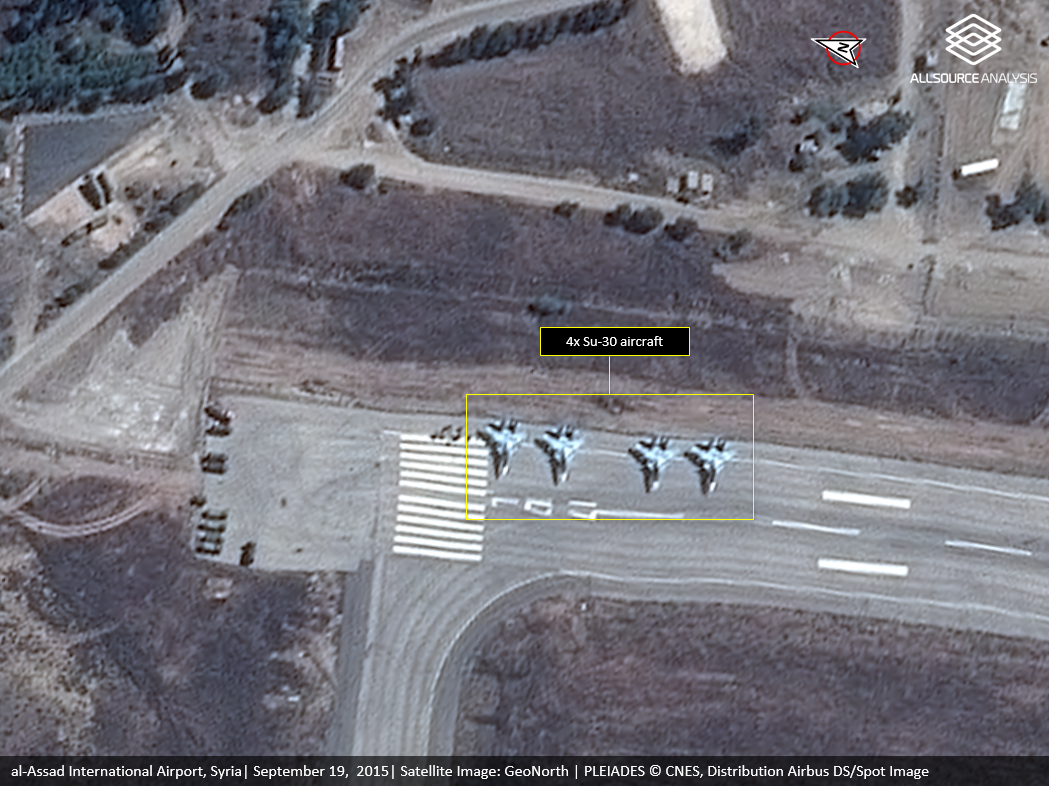
Satellite images already show Russian-made artillery guns and SU-30 combat planes in the northwestern Syrian city.

The presence of Russian soldiers in the country is an added obstacle for the IDF, which must now continue to prevent Israel’s enemies from obtaining dangerous weapons, without causing an international incident by killing an ally’s soldiers.

In 2013 and 2014, Israel was suspected of having carried out airstrikes on weapons sites in Latakia. With Russian military now present in the city, similar attacks may be more difficult to carry out.

An armored personnel carrier, likely a Russian made BTR-82A, firing large-caliber bullets during a battle in Latakia, Syria, is seen in a video posted online on August 23, 2015. (Screen capture YouTube)

Though the Israeli government has not released an itinerary for Monday’s trip, Eisenkot and Halevi will likely meet with their Russian army counterparts to address two related issues: preventing Hezbollah from obtaining Russian-made weaponry and Israel Air Force strikes against the advanced weapons systems already in the possession of the Iran-aligned militia.

Though some of Hezbollah’s arsenal comes from Iran, several of its deadliest weapons — the Kornet anti-tank missile, which has been deadly in combat against Israeli Merkava tanks, and the Katyusha rocket, which rained down on Israel’s northern cities during the Second Lebanon War in 2006 — come from Russia.

Though many of these weapons systems were intended for Syria, some have nevertheless ended up in the hands of Hezbollah, according to Nadav Pollak, a senior fellow at the Washington Institute for Near East Policy.

Some of the systems sold by Russia include anti-aircraft guns and surface-to-air missiles, which could be devastating to Israel’s air superiority in a future conflict with Hezbollah, Pollak said.

As head of intelligence, Halevi will likely present information to the Russian military, showing how these Russian-made weapons end up in the hands of Hezbollah, Pollak explained.

Brig. Gen. Herzi Halevi speaking Thursday. (photo credit: Mitch Ginsburg/Times of Israel)

In addition to attempting to prevent further such transfers, Netanyahu, Eisenkot and Halevi will also discuss Israel’s plans to destroy those advanced systems the terrorist organization has already acquired.

As Hezbollah has been closely aligned with Russia’s ally Assad, this may be a sticking point with Putin, though it is not one Israel is prepared to give up on, Yossi Cohen, national security adviser to the prime minister, told the Israel Hayom newspaper Monday.

Netanyahu will tell Putin that Israel won’t accept restrictions on its response capabilities in Syria, Cohen said.

As Israel’s strikes against Hezbollah have taken place on Syrian territory, which violates its sovereignty, Pollak explained, “there is a chance that Russia will express its objection to this policy.”

The United States has also voiced concerns over Putin’s role in the Syrian civil war.

“Continued military support for the regime by Russia or any other country risks the possibility of attracting more extremists and entrenching Assad, and hinders the way for resolution,” US Secretary of State John Kerry told reporters in Germany on Sunday.

Kerry has proposed military-to military talks with Russia to prevent any clashes between US and Russian forces in the region, to ensure that “there’s no potential of a mistake or of an accident of some kind that produces a greater potential of conflict.”

Video: Greek island turns into war zone as Syrian and Afghan migrants clash

September 8, 2015

Video: Greek island turns into war zone as Syrian and Afghan migrants clash, BreitbartDonna Rachel Edmunds, September 8, 2015

The Greek island of Lesbos has been turned into a war zone by rioting migrants, leaving the island’s 85,000 residents in despair. Around 25,000 migrants are currently camped out on the island with hundreds more arriving daily, leading to frequent violent clashes and rioting despite their claim to be fleeing violence.

Located just 6 miles from the Turkish shore, the migrants come over in inflatable boats which they cut up on arrival to prevent being turned back, expecting to be able to quickly travel on by ferry to mainland Europe, German station RTL has reported.

Instead, they are being held on the Island while the police issue emigration documents, a delay which can take days. The wait is causing tension between groups as Afghans accuse Syrians of getting preferential treatment by the authorities, leading to vicious violent clashes.

As rocks, bottles and municipal bins fly, one tearful local woman told RTL “We are in danger, every day, every minute. We need someone to protect us. They come into our houses. I want to go to work, but I can’t. Our children want to go to school, but they can’t. They have stolen our lives!”

Another yells at the migrants flinging rocks as they pass his house: “Go away from here! This is private land! Respect Greece!”

WATCH:


The full video is here.


The main town of Lesbos, Mytilene, now resembles a war zone as the migrants rip apart the infrastructure and use the town as a urinal. Mayor Galinos helpless in the face of such an onslaught is out of ideas, and is calling on the European Union to do something.

“This is a ticking time bomb that will go off soon,” he said. “We have managed to avert some catastrophes, but we need help, more ferries. This island is so small, we can’t solve a worldwide humanitarian crisis by ourselves. The European Union needs to act.”

Monday night saw fresh clashes as 2,500 surged towards a government chartered ferry bound for Athens. Just a dozen police and coastguards, armed with batons, struggled to control the crowd by shouting “keep back”.

Junior interior minister Yiannis Mouzalas told local radio “the situation is on the verge of explosion.” It is a scene being replicated on islands all along Greece’s coastline.

Evangelos Meimarakis, leader of Greece’s right wing New Democracy party which could retake power this month, said the country should strengthen its borders to as to dispel “the message that ‘it’s good over here, come over’”.

US Warns Russia Over Military Buildup in Syria

September 6, 2015

The US warned Russia this weekend that its military building in Syria could lead to an unwanted escalation in the area. By: Hana Levi Julian Published: September 6th, 2015

Source: The Jewish Press » » US Warns Russia Over Military Buildup in Syria

UN troops look at smoke rising from Quneitra on the Syrian side of the Golan Heights.

UN troops look at smoke rising from Quneitra on the Syrian side of the Golan Heights.
Photo Credit: Flash 90

The U.S. warned Russia over the weekend that its military buildup in Syria could further escalate the conflict in the region.

U.S. Secretary of State John Kerry called Russian Foreign Minister Sergei Lavrov “to discuss Syria, including U.S. concerns about reports suggesting an imminent enhanced Russian military buildup there,” the State Department said in a statement. “The secretary made clear that if such reports were accurate, these actions could further escalate the conflict, lead to greater loss of innocent life, increase refugee flows and risk confrontation with the anti-ISIL Coalition operating in Syria,” the statement continued.

ISIL is the Obama administration acronym for ISIS, or Da’esh. The two men agreed to continue their conversation at the United Nations General Assembly in New York later this month.

According to American intelligence reports, Russia has delivered prefab housing for hundreds of people and a portable air traffic station to an airfield near Latakia.

The U.S. government warned that Russian air strikes could interfere with current operations being conducted by the United States-led coalition against Da’esh (ISIS) in Syria.

It is also possible that Russian operations could strike opposition forces the Americans support.

The United States and Russia have very different ideas about how to solve the crisis in Syria; on Friday, Russian President Vladimir Putin called for “early elections” in Syria and suggested bringing “healthy” elements of the opposition to a new coalition government.

But Putin, who had first cleared his plan with Syrian President Bashar al-Assad, did not specify which opposition elements would be acceptable.

Palestinians: Turning Refugee Camps into Weapons Warehouses

September 1, 2015

Palestinians: Turning Refugee Camps into Weapons Warehouses, The Gatestone InstituteKhaled Abu Toameh, September 1, 2015

  • Most of the Palestinian camps in Lebanon and Syria have long served as large weapons warehouses controlled by various militias belonging to different groups. This has been happening while the United Nations Relief and Works Agency for Palestine Refugees in the Near East (UNRWA), which is formally in charge of the refugee camps, continues to look the other way.
  • The 120,000 Palestinians living in Ain al-Hilweh are “unfortunate” because they are not being targeted by Israel. Otherwise, there would have been an international outcry and the UN Security Council would have held an emergency session to condemn Israel and call for an immediate cessation of hostilities. Instead, Ain al-Hilweh may soon fall into the hands of Al-Qaeda and Islamic State terrorists.
  • The Syrian Army has also been dropping barrel bombs on the camp almost on a weekly basis. But because Israel cannot be blamed, Palestinians killing Palestinians is not something that the international media and community are interested in.
  • Instead of admitting their responsibility for turning the camps into military bases, Palestinian leaders often prefer to blame others, preferably Israel, for the plight of their people.

Palestinians are once again paying a heavy price for allowing terror groups and armed gangs to operate freely inside their communities. But this is not happening in a refugee camp in the West Bank or the Gaza Strip. Rather, it is taking place in Lebanon, one of three Arab countries that host hundreds of thousands of Palestinians.

This explains why the international media and human rights organizations have shown little interest in what is happening inside the largest Palestinian refugee camp in Lebanon, Ain al-Hilweh.

For the past two weeks, dozens of Palestinian families from Ain al-Hilweh have fled their homes after fierce clashes that erupted between Fatah militiamen and terrorists belonging to a radical Islamist gang affiliated with Al-Qaeda and Islamic State.

The UN Security Council has clearly not heard of the fighting in Ain al-Hilweh. That is why it has not even issued a statement expressing “concern” over the plight of the Palestinians in the camp.

The international media, for its part, has thus far shown little interest in the story. Why? The answer, as usual, is simple: No Israeli involvement.

The 120,000 Palestinians living in n Ain al-Hilweh are “unfortunate” because they are not being targeted by Israel. Otherwise, there would have been an international outcry and the UN Security Council would have held an emergency session to condemn Israel and call for an immediate cessation of hostilities.

But, because Israel cannot be blamed, Palestinians killing Palestinians is not something that the international media and community are interested in.

The clashes in Ain al-Hilweh have so far resulted in the killing of four Fatah militiamen. At least 35 people were wounded in the fighting, which has been described as the worst in years. According to eyewitnesses, the rival parties have used various types of weapons to attack each other, including rocket-propelled grenades.

The four dead men have been identified as Fadi Khdeir, Ala Othman, Rabi Mashour and Hussein al-Saleh.

1233Smoke from explosions rises from Ain al-Hilweh refugee camp in Lebanon, Aug. 25, 2015. (Image source: Arab Tomorrow video screenshot)

The latest round of fighting in Ain al-Hilweh began after Islamist terrorists tried unsuccessfully to assassinate Abu Ashraf al-Armoushi, a senior Fatah security commander. Earlier, the terrorists managed to kill another top Fatah official, Talal al-Urduni.

Palestinian refugee camps in Lebanon have always been considered “extraterritorial” zones, managed exclusively by various armed groups. The Lebanese police and army have no role in maintaining law and order inside the camps. As in most similar situations, where armed clashes have erupted inside refugee camps, all that is left for the Lebanese Army to do is monitor the situation from a distance.

In 2007, however, the Lebanese Army was forced to intervene to stop armed clashes at another refugee camp, Nahr al-Bared. Dozens of people, many of them soldiers, were killed in the fighting, which also resulted in the near destruction of the camp. Nearly 30,000 Palestinians were displaced, and Nahr al-Bared remains a closed military zone.

Residents of Ain al-Hilweh are worried that they will meet the same fate as Yarmouk refugee camp in Syria. Yarmouk was once home to some 200,000 Palestinians. Today, the number of the residents has dropped to 12,000. Hundreds of Yarmouk residents have been killed and injured in fierce fighting between rival militias during the past four years. The Syrian Army has also been dropping barrel bombs on the camp almost on a weekly basis.

Yarmouk, Nahr al-Bared and Ain al-Hilweh continue to pay an extremely heavy price for agreeing to turn their camps into military bases. Most of the Palestinian camps in Lebanon and Syria have long served as large weapons warehouses controlled by various militias belonging to different groups. This has been happening while the United Nations Relief and Works Agency for Palestine Refugees in the Near East (UNRWA), which is formally in charge of the refugee camps, continues to look the other way.

As the fighting in Ain al-Hilweh shows, the Palestinians have once again fallen victim to what many of them describe as the “chaos of weapons.” It is this type of anarchy that allowed Hamas to expel the Palestinian Authority from the Gaza Strip in 2007. Refugee camps in the West Bank and Gaza Strip are also full of weapons and gunmen belonging to various groups, including Fatah and Hamas.

Maher al-Shawish, a Palestinian writer and political analyst from Lebanon, says that Ain al-Hilweh is now facing a serious humanitarian crisis due to the ongoing fighting. “If you see the destruction inside the camp, you will realize that it is facing a real catastrophe that needs to be stopped immediately,” al-Shawish said. “The clashes are disgraceful for the Palestinian cause.”

But instead of admitting their responsibility for turning the camps into military bases, Palestinian leaders often prefer to blame others, preferably Israel, for the plight of their people.

Ain al-Hilweh may soon fall into the hands of Al-Qaeda and Islamic State terrorists. Yet instead of facing this threat and calling on the international community to assist in foiling the terrorists’ plan, Gen. Subhi Abu Arab, a top Fatah security commander in Lebanon, chose to hold Israel responsible. Needless to say, Israel has nothing to do with the latest round of fighting in Ain al-Hilweh or the “chaos of weapons” inside Palestinian refugee camps.

Still, Palestinian officials such as Gen. Abu Arab never miss an opportunity to lay the blame at Israel’s door. They also continue to lie to their people by claiming that Israel is behind Islamic State. Referring to the clashes in Ain al-Hilweh, Gen. Abu Arab had no problem explaining that, “This is a Zionist scheme to eliminate the right of return, displace the Palestinians and stir trouble inside the camp by using a fifth column.”

As long as Palestinian and Arab leaders continue to believe conspiracy theories and refuse to wake up to the reality of the dangerous situation inside the refugee camps, the Palestinians of Ain al-Hilweh, like those of Yarmouk, sadly will face a bleak future.

Netanyahu: ‘You Rush to Embrace Iran, They Fire Rockets at Us’

August 21, 2015

Netanyahu: ‘You Rush to Embrace Iran, They Fire Rockets at Us’, Israel National News, August 21, 2015

The attack ordered by Iran comes after a report in April, when  Iranian officials reportedly told the Syrian regime to strike Israel and open a war front on the Golan Heights.

**************************

PM warns ‘we’ll harm those who try to harm us,’ slams world powers for nuclear deal after ‘Iranian commander ordered rocket strike.’

Prime Minister Binyamin Netanyahu released a statement on Friday, shortly after the IDF airstrike that took out the Islamic Jihad terror cell backed by Iran that launched four rockets into Israel from Syria the day before.

“I said this week that those who try to harm us – we will harm them. And that’s what we did,” said the prime minister.

“The IDF struck the cell that conducted the (rocket) fire, and the Syrian forces that enabled it. We don’t intend to escalate the incidents, but our policy remains as it was,” he said. At least 14 targets were hit by the IDF overnight, including a strike on an army post which Syria said killed one soldier.

Turning his attention to the IDF reports that Iranian military sources funded and directed the Islamic Jihad cell, Netanyahu condemned the world powers that sealed a nuclear deal with Iran just last month and are now advancing economic trade and diplomatic ties.

“The countries that rush to embrace Iran need to know that an Iranian commander is the one who gave the cover and direction to the cell that fired on Israel,” he said.

As noted by Netanyahu, the one who gave the order for the rocket strike was said to be the head of the Palestinian department in Iran’s Al-Quds force, the covert foreign operations unit of the Iranian Revolutionary Guards.

Netanyahu on Friday ordered the Foreign Ministry to send an official letter to Western governments, saying Israel has “reliable information that this attack was carried out by the Palestinian Islamic Jihad, ordered directly by the Iranian terrorist Said Izadhi of the Iranian Revolutionary Guards.”

“This is further clear indication of Iran’s increasing involvement in attacks against Israel in particular and against regional targets in general. The ink on the nuclear agreement has not yet dried, and this attack shows clearly how Iran plans to act the moment after the international sanctions are removed.”

The attack ordered by Iran comes after a report in April, when  Iranian officials reportedly told the Syrian regime to strike Israel and open a war front on the Golan Heights.

At least 5 said killed in IDF strike on Syria rocket-firing cell

August 21, 2015

At least 5 said killed in IDF strike on Syria rocket-firing cell

Military says it targeted Islamic Jihad men who fired projectiles on northern Israel Thursday; PM says Israel has no interest in escalation but maintains policy of retaliation

By Judah Ari Gross and Times of Israel staff August 21, 2015, 11:33 am

via At least 5 said killed in IDF strike on Syria rocket-firing cell | The Times of Israel.

.A large fire raging near Kfar Sold, caused by missiles fired from the Syrian side of the Israeli-Syrian border and hitting open areas in the Golan Heights in northern Israel on August 20, 2015. (Photo by Basel Awidat/Flash90)

A large fire raging near Kfar Sold, caused by missiles fired from the Syrian side of the Israeli-Syrian border and hitting open areas in the Golan Heights in northern Israel on August 20, 2015. (Photo by Basel Awidat/Flash90)

he Israeli military said it carried out a new raid Friday morning, targeting the cell that launched rockets on northern Israel from Syria on Thursday. At least five people were said to have been killed in the strike on a car some 10 kilometers from the Syrian-Israeli border, in territory held by the Syrian army.

“We targeted a vehicle this morning in which there were at least five people,” an IDF source was quoted by Israeli media as saying Friday.

“We were monitoring this cell and it was attacked some 10-15 kilometers from the border, on territory firmly in the control of the Syrian military. This is an Islamic Jihad cell directed by Iran,” added the source.

Prime Minister Benjamin Netanyahu said Friday that despite the strike, Israel had no interest in an escalation.

“We have no intention of ratcheting up this confrontation, but our policy [of retaliating for attacks against Israeli civilians] remains as it was,” he said.

Israeli Prime Minister Benjamin Netanyahu seen during his visit to the northern border of Israel on August 18, 2015. Defense Minister Yaalon is behind him. (Amos Ben Gershom/GPO)

“Those who are quick to embrace Iran [following the nuclear agreement on July 14] should know that an Iranian commander directed and backed this cell that attacked Israel,” he added, echoing comments made by senior military sources.

Defense Minister Moshe Ya’alon said the strike against the cell was proof that Israel will not tolerate efforts to harm the security of its citizens.

“We have no intention of compromising on this issue, and I suggest no one test our resolve on this matter,” he said in a brief statement after the attack.

Syrian state television said the fatalities were unarmed civilians.

Israel says that the Palestinian Islamic Jihad (PIJ), a terror group that operates mostly out of the Gaza Strip, but whose headquarters are in Damascus, carried out the Iran, with Iranian direction and Syrian complicity.

The Islamic Jihad has denied involvement but called an urgent meeting Friday after midday prayers to discuss the targeting of the cell.

Also Friday, a Syrian military source said that at least one person was killed in a series of air strikes carried out by Israel late Thursday after the rocket attacks earlier in the day.

“The enemy aircraft struck a military position in the area of Quneitra at 11:30 p.m. (20:30 GMT Thursday), martyring one and wounding eight soldiers,” said the source, quoted by the official news agency SANA.

According to Israeli media — citing the London-based Syrian Observatory for Human Rights — at least two people were killed in the strikes, possible two military officials close to Syrian President Bashar Assad. According to the report, the Israeli strikes included a raid on a target outside Damascus and one on a weapons depot belonging to the Syrian military.

The Israeli military said that it carried out strikes on 14 Syrian army positions in the Golan Heights on Thursday night.

“The Israel Defense Forces targeted 14 Syrian military posts in the Syrian Golan Heights,” the Israeli army said in a statement early Friday, without elaborating.

The strikes hit artillery batteries near Quneitra, several army outposts and communications antennae, local news sites reported.

The Israeli retaliation Thursday was its largest assault on Syrian territory in decades.

The Israeli government said it held the Syrian government responsible and indicated that Iran was directly behind the rocket fire on northern Israel Thursday afternoon.

A commander of the Iranian Revolutionary Guards orchestrated Thursday’s rocket fire from Syria, military sources said late Thursday night.

According to a senior Israeli security official, it was Saeed Izadi, the head of the Palestinian Division of the Iranian al-Quds Force, who planned the attack.

Throughout the Syrian civil war, mortar shells have occasionally strayed into Israel, but this was not the case on Thursday when four rockets struck the Upper Galilee and Golan Heights, the official said.

“We understand that this attack was clearly a deliberate one,” he said.

Ya’alon warned Thursday that the rocket fire was merely a “coming attraction” for future Iranian-funded attacks on Israel. With sanctions relief as part of the Iran nuclear deal, Tehran will increase support for its Middle East proxies, he maintained.

From right, Maj. Gen. Aviv Kochavi, Prime Minister Benjamin Netanyahu and Defense Minister Moshe Ya'alon on a tour of the northern border, August 18, 2015. (Amos Ben-Gershom/GPO)

“What we have seen tonight is just a coming attraction for a richer and more murderous Iran,” Ya’alon said in a statement Thursday.

“This is the intention of the bloody regime from Tehran, and the Western world cannot just sweep that fact under the rug,” he added.

Newly-Declassified U.S. Government Documents: The West Supported the Creation of ISIS Washington’s Blog

August 8, 2015

Newly-Declassified U.S. Government Documents: The West Supported the Creation of ISIS

Posted on May 24, 2015 by WashingtonsBlog

via Newly-Declassified U.S. Government Documents: The West Supported the Creation of ISIS Washington’s Blog.

Judicial Watch has – for many years – obtained sensitive U.S. government documents through freedom of information requests and lawsuits.

The government just produced documents to Judicial Watch in response to a freedom of information suit which show that the West has long supported ISIS.   The documents were written by the U.S. Defense Intelligence Agency on August 12, 2012 … years before ISIS burst onto the world stage.

Here are screenshots from the documents. We have highlighted the relevant parts in yellow:

ISIS1Why is this important? It shows that extreme Muslim terrorists – salafists, Muslims Brotherhood, and AQI (i.e. Al Qaeda in Iraq) – have always been the “major forces driving the insurgency in Syria.”

This verifies what the alternative media has been saying for years: there aren’t any moderate rebels in Syria (and see this, this and this).

The newly-declassified document continues:

ISIS 2Yes, you read that correctly:

there is the possibility of establishing a declared or undeclared Salafist Principality in eastern Syria (Hasaka and Der Zor), and this is exactly what the supporting powers to the opposition want, in order to isolate the Syrian regime ….

In other words, the powers supporting the Syrian opposition – the West, our Gulf allies, and Turkey wanted an Islamic caliphate in order to challenge Syrian president Assad.

Sure, top U.S. generals – and vice president Vice President Joe Biden – have said that America’s closest allies support ISIS.  And mainstream American media have called for direct support of ISIS.

But the declassified DIA documents show that the U.S. and the West supported ISIS at its inception … as a way to isolate the Syrian government.  And see this.

This is a big deal.  A former British Army and Metropolitan Police counter-terrorism intelligence officer and a former MI5 officer confirm that the newly-released documents are a smoking gun.

This is a train wreck long in the making.

Russia slams U.S. attempts to provide air cover to Syrian rebels

August 6, 2015

Russia slams U.S. attempts to provide air cover to Syrian rebels

Middle East

August 4, 2015

via Russia slams U.S. attempts to provide air cover to Syrian rebels – The Journal of Turkish Weekly.

Is this a declaration of war ?

Kremlin denounced Monday the U.S. attempts to provide air cover for Syrian rebels, indicating it will ultimately destabilize the country’s situation.

“We have repeatedly stressed that the assistance, especially financial or technical one, to the Syrian opposition would further destabilize the situation in the country,” Kremlin spokesman Dmitry Peskov said.

Once implemented, the plans would benefit the so-called Islamic State (IS) terrorists, weakening the counter potential of the Syrian capital Damascus, Peskov said.

“This is a fundamental disagreement between Moscow and Washington over Syria,” he added.

On Sunday, U.S. President Barack Obama reportedly authorized air defense to U.S.-backed Syrian rebels against attacks from terrorists or Syrian government forces.

More here .

The U.S. directly stated Tuesday that it would protect its nascent force of Syrian rebels from Syrian government attacks.

“What we are trying to convey is that we’ll also do defensive efforts in case or in the hypothetical that they would come under fire from Syrian forces,” State Department spokesman Mark Toner told reporters.

He ruled out that any such attack would be offensive, however, Toner said “any type of effort to protect them from Syrian forces would be defensive in nature”.

White House spokesman Josh Earnest hinted at the policy Monday, saying previous warnings that Washington issued to Damascus to not interfere with its aerial bombardment of Daesh and other Syrian extremists holds true for the U.S.-trained opposition forces.

He added that the U.S. and its coalition partners are “committed to using military force where necessary to protect the coalition-trained and equipped Syrian opposition fighters that are operating against ISIL inside of Syria right now”.

The decision by President Barack Obama could potentially further Washington’s stake in the Syrian conflict, and drag the U.S. deeper into ongoing hostilities – action the Obama administration has been reluctant to take.

http://www.turkishweekly.net/2015/08/05/news/us-explicitly-warns-damascus-not-to-attack-its-rebels/


Qatari Group Accused of Funding Hamas Hires D.C. Lobbyist

August 4, 2015

Qatari Group Accused of Funding Hamas Hires D.C. Lobbyist

Founding member Abd al-Rahman al-Nu’aym funneled millions to al Qaeda in Syria, Iraq

BY:
August 4, 2015 5:00 am

via Qatari Group Accused of Funding Hamas Hires D.C. Lobbyist | Washington Free Beacon.

A Qatar-based charity accused of funding Hamas has hired a lobbyist to represent it in the United States.

The Sheikh Eid Bin Mohammed al-Thani Charitable Foundation, located in Doha, Qatar, recently brought aboard Wendell Belew, a Washington D.C.-based lawyer, to lobby on its behalf. Belew, who will work on issues dealing with “NGO regulations and charity best practices,” previously served as chief counsel of the House Budget Committee.

The foundation was one of 36 organizations banned in Israel in July 2008 for its links to fundraising for Hamas.

“This is a significant step against the global network which assists Hamas in raising funds. The order outlaws a great number of bodies that are active abroad and which are responsible for raising very large sums,” the Israeli ministry of foreign affairs said at the time of the foundation bans.

Abd al-Rahman al-Nu’aymi, a founding member of the organization, was said by U.S. officials in 2013 to have funneled millions of dollars to al Qaeda in Syria and Iraq.

The Department of the Treasury imposed sanctions on Nu’aymi in December 2013 after he was named a specially designated global terrorist for being a “financier and facilitator who has provided money and material support and conveyed communications to al-Qa’ida and its affiliates in Syria, Iraq, Somalia and Yemen for more than a decade.”

Nu’aymi ordered the transfer of $600,000 through an al Qaeda representative in Syria with the intention of transferring at least $50,000 more at a later date, according to the Treasury. Additionally, he oversaw a transfer of $2 million per month to al Qaeda in Iraq for an unspecified period of time.

This is not the first time that Belew has worked on behalf of a group with ties to terrorist organizations.

Belew previously represented the Saudi Arabia-based Al-Haramain Islamic Foundation, an organization that was found to be a significant backer of al Qaeda.

In July 2004, Aqeel Abdulaziz Aqeel al-Aqeel, the foundation’s leader, was put on the United Nations Security Council Special Notice list of terrorists associated with al Qaeda.

In September 2004, the Treasury announced that the foundation’s American branch, which is based out of Oregon, had direct connections with Osama Bin Laden.

The Treasury investigation found “direct links” between the American branch and Osama bin Laden. It also alleged that the foundation had violated tax laws and engaged in other money laundering offenses. Individuals associated with the branch tried to conceal funds intended for Chechnya by omitting the information from their tax returns and instead claimed that the money was intended to purchase a prayer house in Springfield, Mo.

The Al-Haramain Islamic Foundation is now defunct. Wendell Belew could not be reached for comment.