Posted tagged ‘Sisi’

Muslim Brotherhood in Desperate Campaign in US

May 4, 2017

Muslim Brotherhood in Desperate Campaign in US, Clarion ProjectRan Meir, May 4, 2017

U.S. Capitol building (Photo: JEWEL SAMAD/AFP/Getty Images)

Lectures, discussions and events are being held in prominent American universities, including Harvard and Georgetown, about the “constructive contribution” the Brotherhood has made to Egypt since the Arab Spring began.

****************************

CLICK HERE to Tell Your Members of Congress to Designate the Brotherhood as a Terror Organization

The Muslim Brotherhood in Egypt is mounting a desperate campaign in the U.S. to avoid being designated as a Foreign Terrorist Organization, according to The Seventh Day, one of Egypt’s largest news outlets.

The political winds have changed in Washington and the Brotherhood is running scared. U.S. President Donald Trump has made clear his support of Abdel Fattah el-Sisi, announcing he stands with the Egyptian president in his fight against terror and extremist groups that are threatening one of American’s key allies in the Middle East.

After tens of millions of Egyptians took to the streets to protest the abuse and power grabs of former Egyptian president Mohammed Morsi (a member of the Brotherhood’s political party) in the summer of 2013, El-Sisi and the military took control of Egypt. He was elected president in 2014.

El-Sisi’s recently successful meeting with Trump in Washington set a Brotherhood plan in motion to gain support of members of Congress and academia to block a move to designate the organization as terrorists.

See Clarion Project’s Fact Sheet about the Muslim Brotherhood and its links to terrorism.

Lectures, discussions and events are being held in prominent American universities, including Harvard and Georgetown, about the “constructive contribution” the Brotherhood has made to Egypt since the Arab Spring began.

For example, speaking under the title “The Nobility in Justice,” Mahmoud a-Sharkawi, a Brotherhood official in Washington, lectured about the “positive” role the Brotherhood has played in Egypt since January 25, 2011 (the date marking the beginning of the Arab Spring in Egypt) in a conference at St. John’s University in New York.

The group is also reaching out to members of Congress, trying to re-brand the way it is perceived in Washington after al-Sisi’s successful visit.

Testifying in Congress, Tarek a-Zimer, head of the Building and Development Party, the political party of the Egyptian Brotherhood, urged Americans to change their views about the organization. Other officials of the Brotherhood who attended the hearing used their presence to incite against el-Sisi and the current Egyptian government.

Writing in a blog, A-Zimer asked, “Have the Americans internalized the lesson and fully understood the danger of the current situation to their interests?”

Sources close to the Brotherhood say the purpose of the campaign being waged on American university campuses is to put pressure on Trump in light of the negative opinions about the Brotherhood that are now prevalent in Washington due to the change in administrations.

What they fear most is a decision by the administration to designate the Brotherhood as a terror organization.

Hisham a-Naggar, an Islamic scholar, agreed. He said the purpose of the Brotherhood campaign is to confront the new negative shift in American opinions toward the Brotherhood. These opinions include support for el-Sisi and allying with him against terror – positions that include a crackdown on Brotherhood activities.

Formerly, having the support of the West (and the American president) was the Brotherhood’s “ace in the hole” – the most important card the group could play in its multi-faceted moves to take over Arab countries and their current regimes. Now that support has been taken away, and the group is reeling.

Tarek al-Bashabishi, a former Brotherhhood official who now works against the organization, commented that ever since the Brotherhood lost power in June 2013, it’s been been inciting various Arab countries and international institutions against Egypt to weaken el-Sisi so the Brotherhood can return to power.

Al-Bashabishi added that after Trump was elected, a huge political shift occurred. The U.S. administration is now against the Brotherhood and in support of el-Sisi’s fight against them. Now, he says, the Brotherhood’s only option is to try to bribe Trump’s rivals in Congress so they can be used as mouthpieces for the Brotherhood.

He said the Brotherhood is engaged in a fight for its life, playing all its cards – including using financial support from Turkey and Qatar and the Brotherhood lobby in America – to avoid being designated as a terror organization.

Al-Bashabishi also noted the same phenomenon in the UK, where he said the Brotherhood is trying to bribe members of the House of Commons to support the anti-Egypt opinions of the Brotherhood.

Hamas Wants Quiet As It Prepares For Next Assault on Israel

April 27, 2017

Hamas Wants Quiet As It Prepares For Next Assault on Israel, Investigative Project on Terrorism, Yaakov Lappin, April 27, 2017

In the long run, Sinwar and his regime plan to continue to prepare for the ‘grand’ destiny they have chosen for Gaza. So long as Hamas rules Gaza, it will be the base of unending jihad against Israel, buffered by tactical ceasefires, until conditions are ripe for a new assault.

**************************

Strategically, Hamas remains as committed as ever to its objective of destroying Israel and toppling the Fatah-run Palestinian Authority in the process. Tactically, however, Hamas exhibits pragmatism and won’t rush into wars with Israel when conditions are ill suited.

Hamas looks at the long run, and remains convinced that it can eradicate Israel, even if it takes decades or centuries. Yet it would prefer to bide its time, and build up its force until the next clash while working to decrease its acute regional isolation. For this to happen, Hamas needs to avoid plunging Gaza into a new war any time soon. Yet it remains far from clear that it will be able to do this.

Should a war erupt in the near future, it likely will be triggered by unplanned dynamics of escalation.

Gaza’s woeful living standards and infrastructure are among those factors. Crises such as the ongoing electricity supply problem plaguing the Strip could facilitate an early conflict, as Hamas may try to distract the population’s frustrations from its failings, and divert them to Israel.

The Palestinian Authority (PA) is threatening to make matters worse by cutting off cash for Gaza’s power plant. It’s part of the ongoing feud between the Fatah-run PA in Ramallah and Hamas in Gaza. Gazans now receive electricity only four to six hours a day due to this feud. In January, Gazans took the unprecedented step of protesting power cuts, making Hamas extremely nervous.

In addition to tensions over the electricity crisis, a Hamas-run terror cell could spark conflict if it carries out a mass casualty attack that spawns Israeli retaliation.

The sheer scope of such plots that Israel thwarts every year is enormous.

Last year, 184 shooting attacks, 16 suicide bombings, and 16 kidnapping plots were foiled, Shin Bet chief Nadav Argaman testified last month before the Knesset’s Foreign Affairs and Defense Committee. Hamas had “significantly increased” efforts to pull off attacks in the West Bank and in Israel, he said, adding that Israeli security forces arrested more than 1,000 Hamas members in the West Bank last year and broke up 114 cells.

These are risks Hamas is prepared to take, since the day that it ceases all attempts to carry out jihadist terrorism against Israel is the day that it stops being Hamas.

Yet Hamas is also a government now, and it must consider the Gazans it rules. Hamas is keenly aware of Palestinian sentiment. Its leaders grew up in Gaza’s refugee camps and always have their finger on the pulse of Gazan society.

Hamas leaders seem to understand that the public opposes a new damaging war with Israel. They recognize that the Palestinian public cannot stomach a war with Israel every two years. The reconstruction program in Gaza following the 2014 conflict is far from complete. There are still Gazans whose homes haven’t been repaired from the damage inflicted in 2014.

The general population, despite being exposed to Hamas’s daily propaganda diet of jihadist rhetoric, would likely be reluctant to be again be used as human shields by the military wing, barely three years since the end of the last clash.

The price of Hamas’s policy of embedding its rocket launchers and fighters in Gaza’s civilian areas also is not alluring to many Gazans.

On the flip side, one of Hamas’s worst fears is of being perceived as weak. After one of its senior operatives was mysteriously killed recently, it executed three people it accused of collaborating with Israel.

Hamas also responded to Mazen Fuqaha’s murder by sending threatening messages to Israel promising vengeance. Hamas videos suggest it will target senior Israeli security officials for assassination.

Fuqaha was a key figure in the Izzadin Al-Qassam Brigades, and reportedly in charge of setting up multiple terrorist cells in the West Bank. His bullet-ridden body was found last month outside of his Gazan apartment building.

The Israeli defense establishment takes these Hamas threats seriously. Despite the noise, however, Hamas has not rushed to respond just yet – underlining the fact that Hamas is aware of the restraints factors that it is under.

Since the end of the 2014 war with Israel, the Islamist regime has shied away from escalating the security situation with Israel.

Hamas’s leadership sees unfavorable regional conditions. They lack any powerful regional backer following the 2013 downfall of Muhammad Morsi, the Muslim Brotherhood president in neighboring Egypt, in whom Hamas staked so many of its hopes.

In the past, Hamas enjoyed many partnerships, enjoying arms support and funding from the Shi’ite axis (Iran and Hizballah) – and forming relationships with Sunni powers.

But the Middle Eastern regional upheaval, which pits Sunnis against Shiites, and Islamists against non-Islamists, forced Hamas to make choices. It could no longer be on the same side of both Shi’ite Iran and Sunni Saudi Arabia, who are locked in a transnational proxy war. In the same vein, Hamas cannot be on the same side as both the Assad regime and the Sunni rebels fighting to remove him.

Worst of all from Hamas’s perspective, Morsi’s departure means it cannot rely on its primordial impulse to attach itself to a Sunni Muslim Brotherhood-led backer.

Five years ago, there were initial signs of a regional wave of Muslim Brotherhood successes. The Brothers rose to power in Egypt, Turkey, Tunisia, and had Qatari backing. Morsi’s 2013 fall changed Hamas’s fortunes for the worse. The rise of Egyptian President Abdel Fattah El-Sisi, a leader who identifies Hamas as a Gazan branch of his domestic arch-enemy, the Egyptian Muslim Brotherhood, guaranteed Hamas’s isolation.

Relations with Cairo remain rocky despite recent Hamas attempts to improve ties. Egypt may open its Rafah border crossing a few days a week, but this does not change its core view of Hamas as a true enemy, to be held at bay, weakened, and deterred.

Hamas has also fallen out with Saudi Arabia. And Hamas and Iran do not get along very well either, despite Iran continuing to be the chief sponsor of the military wing, paying it $50-$60 million a year, according to various estimates.

This leaves Hamas with just two stalwart friends: Qatar and Turkey, neither of which can back them substantially. Turkey is not an Arab state, meaning that its role in the Arab world is limited, and its desire to lead the Arab world will always be met with suspicion. A failure by Turkey to infiltrate the region means that it can only do so much to assist Gaza. Qatar, though wealthy, is politically weak, and geographically distant.

New Hamas leader Yihyeh Sinwar, despite his fundamentalist inclinations, must consider these constraints and see that his Islamist-run enclave has little real backing.

To compound its problems, Hamas also has serious financial issues. It has three main sources of income: Donations from states, donations from private individuals, and Hamas’s network of investments.

Hamas gets far less money than it used to from its donors, according to Israeli assessments. Only Qatar and Turkey donate on a regular basis, while Iran continues to finance the military wing, but not the entire movement.

Hamas is a large organization, with operations in the West Bank, Qatar, and Turkey in addition to Gaza. In the Strip, it needs to pay salaries, and prepare for its next clash with Israel. Hamas also seeks to export terrorism to the West Bank and build up political support among West Bank Palestinians. All of this costs money. It is has offices and headquarters in multiple states overseas that require annual budgets.

Private Gulf State donors are drying up. Wealthy Saudis are more interested in supporting Syrian rebels. Hamas’s cause has moved to the back of the line.

Its investments, meant to be saved for a rainy day, now must be tapped.

So what can Hamas do? First and foremost, it continues its domestic military build-up, mass producing rockets, mortar shells, variants of shoulder-fired missiles, drones, and digging tunnels – all at the expense of the welfare of the 2 million Palestinians it rules.

That’s because Hamas drew many operational lessons from its last conflict with Israel, and is keen on rebuilding its terrorist-guerrilla army without interruptions.

One lesson was to focus on a perceived Israeli vulnerability through short-range strikes. To that end, it is building new rockets that carry 200 kilogram warheads – significantly larger than past rockets made in Gaza.

These projectiles are not accurate, but would cause enormous damage if they slammed into a southern Israeli town or village.

Hamas weapons factories produce simple RPGs as well.

Second, Hamas is trying to becoming more ‘acceptable’ to the region and to the world. It is about to unveil a new charter which will be an attempt to obfuscate its jihadist ideological leanings and ties with the Muslim Brotherhood, and present itself as being merely a national “resistance” organization.

In the long run, Sinwar and his regime plan to continue to prepare for the ‘grand’ destiny they have chosen for Gaza. So long as Hamas rules Gaza, it will be the base of unending jihad against Israel, buffered by tactical ceasefires, until conditions are ripe for a new assault.

Yaakov Lappin is a military and strategic affairs correspondent. He also conducts research and analysis for defense think tanks, and is the Israel correspondent for IHS Jane’s Defense Weekly. His book, The Virtual Caliphate, explores the online jihadist presence.

The Pope’s Pilgrimage to Al-Azhar

April 27, 2017

The Pope’s Pilgrimage to Al-Azhar, Gatestone InstituteLawrence A. Franklin, April 27, 2017

“They cannot take the texts of the seventh century literally as they are in the Quran. He [the Pope] does not dare to say something like that because he doesn’t know the Quran well enough, and so on. So I understand his position, but it would be better to have a clearer and more frank discussion — with openness, but also with some realism.”

******************************

During a meeting between the former Papal Nuncio to Cairo, Archbishop Jean-Paul Gobel, and Grand Imam Sheikh Ahmed el-Tayeb, the Grand Imam warned Gobel that “speaking about Islam in a negative manner was a ‘red line’ that must not be crossed.” If there are any condemnations of violence against the Coptic Christians, they are likely to be articulated only by the Grand Imam and the Egyptian President.

If the Pope’s humble bearing is excessive, however, it might be interpreted even by peaceable Muslims as a submission. If Francis is asked by the Grand Imam to pray at al-Azhar’s mosque, that is a piety that el-Tayeb would not likely reciprocate in a Coptic Church in Egypt.

Facilitating the establishment of an Islamic-Christian relationship that excludes Judaism can only serve the Islamist goal of isolating Jews and Israel. Although relations between the Vatican and al-Azhar will improve in the near future, the honeymoon will not. The Grand Imam will doubtless protect his own theological power base and keep his distance from both the Vatican and the Egyptian regime.

The twin Palm Sunday bombings at Coptic Christian Churches by Islamic terrorists in Egypt, which killed 44 worshipers, draws attention to what is probably the principal reason for the upcoming visit of Pope Francis to Cairo on April 28-29. The Pontiff will likely seek the assistance of Egypt’s Muslim hierarchy to help protect Egypt’s Coptic Christians, the indigenous inhabitants of the country who now number about 9 million and constitute at least 10% of the population.

During his stay, Francis will meet with the Grand Imam of Cairo’s al-Azhar Mosque, Sheikh Ahmed el-Tayeb. Al-Azhar’s theological complex, which houses Islam’s oldest university, is considered the most influential center of Sunni Islam.

The Pope possibly hopes that the meeting with el-Tayeb will fully repair relations between the Vatican and al-Azhar. These were restored as a result of a letter sent by Pope Francis to the Grand Imam last year. The Papal letter was followed up by a visit to the Holy See by el-Tayeb in May 2016. Relations between the Holy See and al-Azhar had been severed in 2011 by el-Tayeb after he took offense at comments made by the previous Pope, Benedict XVI, on the persecution of Christians in Muslim countries.

Grand Imam el-Tayeb now appears more disposed towards normalizing relations with the Vatican, especially since his amicable visit to the Holy See in May 2016. Al-Azhar’s Grand Imam is likely to be more agreeable toward Francis than he was toward Benedict. This show of flexibility might possibly also be an effort by el-Tayeb to get in line with President Abdel Fatah al-Sisi’s own call for reform within Islam. However, Al-Azhar, determined to maintain its authority over theological matters, has initiated no substantive, doctrinal reforms in response to President Sisi’s declaration. In fact, Al-Azhar has pushed back against attempts by some Muslim reformists who have suggested a more liberal policy concerning women’s rights, including the ability to divorce.

El-Tayeb, even if he accepted responsibility for protecting the Copts, may prove unable to prevent Islamic terrorist groups from targeting Egypt’s minority Christian population. The alleged cooperation between the Islamic State and the Muslim Brotherhood makes it especially difficult for Cairo to prevent terrorist acts. Islamic terrorist cells in Alexandria and the Sinai Peninsula, where many of the attacks on Copts have occurred, act independently of Egypt’s political and religious leaders. The targeting of Christians by these groups may also be part of a larger objective to destabilize the regime of al-Sisi, who has promised security to Egyptians, particularly Coptic Christians. Radical Islamists such as the Muslim Brotherhood and ISIS view the Copts as their enemies; many members of this Christian sect support the Sisi government.

It was, in any event, al-Sisi who invited Pope Francis to visit Egypt during the Egyptian president’s visit to the Vatican in November 2014. Anti-regime elements might well attempt to stage a spectacular terrorist incident during the Pontiff’s visit, particularly targeting Francis himself.

The Pope’s upcoming visit is being organized by French Cardinal Jean-Louis Tauron, who chairs the Pontifical Council of Inter-Religious Dialogue. Cardinal Tauron is, no doubt, cognizant of the “red line” laid down by the Grand Imam if the Vatican wishes to have amicable relations with the Muslim leadership. During a meeting between the former Papal Nuncio to Cairo, Archbishop Jean-Paul Gobel, and el-Tayeb, the Grand Imam warned him that “speaking about Islam in a negative manner was a ‘red line’ that must not be crossed.” However, given the Pope’s past reluctance to condemn radical Islamic concepts, it is unlikely that, during his visit to Egypt, he will depart from this cautious public posture. Comments, if any, by Pope Francis on Muslim violence against Christians will, no doubt, be diplomatic and muted. If there are any condemnations of violence against the Coptic Christians, they are likely to be articulated only by the Grand Imam and the Egyptian President.

Nevertheless, Pope Francis will, it appears, publicly demonstrate his solidarity with fellow Christians by championing the Coptic Pope Tawadros II during memorial services for the recently martyred Copts. Francis, who is known to be fond of Tawadros, might express his deep personal concern for the welfare of the Coptic Pope — who was celebrating Mass inside St. Mark’s Cathedral when the bomber detonated his explosives just outside.

Francis is apparently most anxious to bring Copts and Catholics closer together, in the hope that the Egyptian Church will ultimately formally reunite with the Holy See. The Coptic Church first split from Rome in 451 A.D. However, the Vatican maintains deep respect for the Egyptian Church, which was established by one of the four authors of the Gospels, St. Mark, in Alexandria as early as 42 A.D.[1]

Catholic Pope Francis greets Egyptian Coptic Pope Tawadros II at the Vatican, on May 10, 2013. (Image source: News.va Official Vatican Network)

If the Pope’s humble bearing is excessive, however, it might be interpreted even by peaceable Muslims as submission. If Francis is asked by the Grand Imam to pray at al-Azhar’s mosque, that is a piety that el-Tayeb would not likely reciprocate in a Coptic Church in Egypt.

The public stance of the Vatican concerning Islam has been routinely cautious. The most recent example of the Pontiff’s less-than-direct criticism of Islamist violence is his April 22 statement at a prayer service paying tribute to 21st Century Christian Martyrs in Rome:

Francis said the legacy of modern-day martyrs “teaches us that with the strength of love, meekness, one can combat arrogance, violence, war, and with patience, achieve peace.”

A professor of Islamic Studies at the Pontifical Institute in Rome, Father Samir Khalil Samir, also an Egyptian, characterizes the Pope’s diplomatic approach to Muslims, “who are the second-most important group in the world, to have a dialogue and understanding.” Khalil adds:

“I think it’s important to say things with charity, with friendship, but to say things as they are: that it cannot continue like this; we have to rethink Islam. This is my vision. They cannot take the texts of the seventh century literally as they are in the Quran. He [the Pope] does not dare to say something like that because he doesn’t know the Quran well enough, and so on. So I understand his position, but it would be better to have a clearer and more frank discussion — with openness, but also with some realism.”

This clearly modulated posture was apparent during a session of the Geneva Center of Human Rights Advancement and Dialogue. The theme of the Geneva sessions was “Islam and Christianity: The Great Convergence.” The March 15 Conference, attended by Muslim and Christian delegates, studiously avoided key issues of doctrinal divergence, and stressed instead alleged areas of common interest. The key sponsors of the conference were Algeria, Pakistan, and Lebanon, all of which are Muslim majority countries. The only non-Muslim state sponsor of the Conference was Malta. One of the oft-repeated themes of the sessions in Geneva was the ‘feel-good’ concept of the ‘common Abrahamic root’ of Islam, Christianity and Judaism — although no representatives of the Jewish faith were invited to the conference. Statements by representatives of Christian churches seemed overly optimistic about the prospects of developing positive relationships with Islamic societies.

The failure to invite Jewish or Israeli representation by conference organizers was presumably not an oversight. This omission would be consistent with the UN Arab bloc’s objective of isolating Israel in an apparent effort to destroy and replace it. That campaign includes efforts by Arab states to marshal support at the United Nations for suffocating Israel through diplomatic subversion as well as through economic strangulation. Facilitating the establishment of an Islamic-Christian relationship that excludes Judaism can only serve the Islamist goal of isolating Jews and Israel.

After the visit of Pope Francis to Egypt, mass murders of Egyptian Copts are likely to continue. Although relations between the Vatican and al-Azhar will improve in the near future, the honeymoon will not. The Grand Imam will doubtless protect his own theological power base and keep his distance from both the Vatican and the Egyptian regime.

Dr. Lawrence A. Franklin was the Iran Desk Officer for Secretary of Defense Rumsfeld. He also served on active duty with the U.S. Army and as a Colonel in the Air Force Reserve, where he was a Military Attaché at the U.S. Embassy in Israel.


[1] Tradition has it that Mark founded the Church in Alexandria as early as 42 A.D. but some Coptic documents assert that Mark came to Alexandria for the first time in 61 A.D. after several missionary trips with St. Paul and St. Barnabas.

US Tomahawk cruise missiles for ISIS-Sinai HQ

April 18, 2017

US Tomahawk cruise missiles for ISIS-Sinai HQ, DEBKAfile, April 18, 2017


A final decision to go ahead with a US missile assault on central Sinai rests with Defense Secretary James Mattis. He is due to arrive in Cairo on Wednesday, April 19.

*****************************

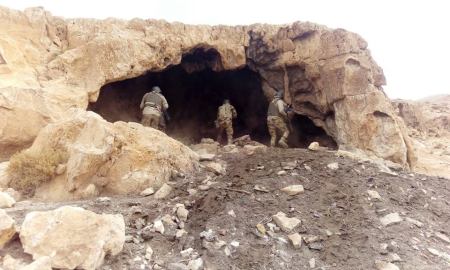
The US Mediterranean fleet is moving into position ready for a decision to launch Tomahawk cruise missiles for a crushing assault on the Islamic State’s mountain strongholds in central Sinai, DEBKAfile’s military and counterterrorism sources report.

This would be the second American strike in a month against a Middle East target, after 59 cruise missiles destroyed one-fifth of the Syrian air force at the Shayrat air base on April 7 in response for Assad’s chemical attack on Syrian civilians.

The prospective American missile attack in Sinai would raise the war on ISIS in the Middle East to a new plane. It would have been discussed during the Egyptian President Abdul-Fatteh El-Sisi’s visit to the White House on April 3. He explained to his host, President Donald Trump, the immense difficulty of overcoming the Islamic State’s affiliate when its headquarters were dug into an interconnected web of tunnels and caves in the central Jabal (Mount) Halal of the peninsula. Nicknamed the “Tora Bora of Sinai,” approach roads to this mountain fastness are few and far between, in common with the Afghan cave network near the Pakistan border destroyed on April 13 by the biggest non-nuclear bomb, the GBU-43/B, in the American arsenal.

The last Egyptian assault on ISIS’ towering mountain stronghold took place on April 2, shortly before El-Sisi travelled to Washington. The Egyptian military announced that 31 terrorists had been killed and a number of caves holding arms and ammunition destroyed.

But the damage was not devastating enough to disrupt the Islamist terrorists’ operations, DEBKAfile’s military sources report. Most of the terrorists escaped with the help of allied Bedouin tribesmen who, familiar with every nook and cranny in the desert peninsula, guided them to safety in new caves in Jabal Halal that were even more inaccessible to Egyptian troops.

Their new headquarters can only be destroyed by cruise missiles capable of exploding underground.

The Egyptians and Americans believe that if the Jabal Halal cave system sheltering the ISIS-Sinai core command center is destroyed, its long campaign of terror will be curtailed. The flow of terrorist manpower, arms and explosives from the mountain to the networks which terrorize the population and Egyptian forces of northern Sinai will dry up.

Jabal Halal is also the hub of the ISIS smuggling networks, through which fighters and arms are moved from southern Libya into Sinai and Egypt. Knocking it out will also deliver a resounding blow to that traffic.

A final decision to go ahead with a US missile assault on central Sinai rests with Defense Secretary James Mattis. He is due to arrive in Cairo on Wednesday, April 19.

Rephidim, Amalek then: Bir Gafgafa, ISIS now

April 10, 2017

Rephidim, Amalek then: Bir Gafgafa, ISIS now, DEBKAfile, April 10, 2017

Bir Gafgafa’s mission is to provide the Egyptian forces fighting in Sinai with a shield, as well as securing the Suez, one of the world’s most important waterways, against ISIS attack.

It will also serve as a hub for coordinating air operations over Sinai and the Libyan border. It is vitally important to prevent the jihadist networks based in ungoverned Libya and the lawless heartland of the Sinai Peninsula from reaching Egypt’s main cities.

**********************************

They camped at Rephidim, but there was no water for the people to drink. The people quarreled with Moses, and said, “Give us water to drink.” Moses said to them, “Why do you quarrel with me? Why do you test the Lord?” The Lord said to Moses, take in your hand the staff with which you struck the Nile, and go. Strike the rock, and water will come out of it.” Moses did so, in the sight of the elders of Israel. He called the place Massah and Meribah, because the Israelites quarreled and tested the Lord. Then Amalek came and fought with Israel at Rephidim.  Whenever Moses held up his hand, Israel prevailed; and whenever he lowered his hand, Amalek prevailed. And Joshua defeated Amalek and his people with the sword. (Exodus 17)

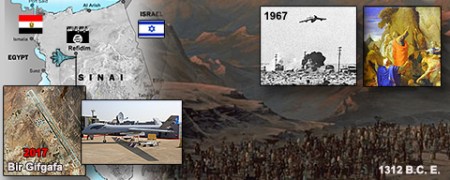
About 3,200 years later, Moses would not have recognized Rephidim. In 1967 it was called Bir Gafgafa and was the site of the Egyptian Air Force’s biggest air facility in Sinai, known as “Egyptian Air Force Base 244.”

From there, Egyptian ruler Gemal Abdul Nasser declared that year: “If Rabin wants war, let’s go!”

And so when the Israeli Air Force preemptively wiped out Nasser’s air force on the ground at the outset of the Six-Day war, Bir Gafgafa was hit first. Rephidim was next transformed into Baha 3, the main Israeli Air Force operations base in Sinai during the War of Attribution and the Yom Kippur war. It was supported 8 kilometers away by a radar and electronic warfare station.

But then, Rephidim aka Bir Gafgafa stepped back into history in its next reincarnation as the very first base from which Israeli withdrew in late 1979 after Israeli Prime Minister Menachem Begin and Egyptian President Anwar Sadat signed the Camp David peace accords, Israel’s first peace pact with an Arab nation.

Another 37 years went by and in 2017 Rephidim now serves another Egyptian President, Abdul-Fatteh El-Sisi, for his life-and-death struggle with the Islamic State’s Sinai affiliate.

The Egyptian Air Force is in the course of transforming the small air field there into the largest air base in Egypt, this time with Israel’s concurrence. The base is being tailored to serve a wide variety of warplanes, attack helicopters and UAVs, with long runways, hangars and storage depots for bombs, missiles and fuel.

The Egyptian have built an enormous hangar 70×57 meters for housing long-range Wing Loong UAVs purchased from China, which are 9 meters long with a 14-meter wing spread. The Wing Loongs are also being deployed at the Uthman Air base in the Western Desert just 68km from the Libyan border.

The huge base will also have a large civilian passenger terminal at its northeastern end to serve the large army contingents deployed in Sinai. Today the 2nd and 3rdArmies are waging war against terror in Sinai supported by Border Guard units which are undertaking special training in anti-terror warfare.

Rephidim is today hemmed in by packs of the new Amalek, the Ansar Beit al-Maqdis which has pledged loyalty to the Islamic State and its leader Abu Bakr al-Baghdadi El-Sisi and is battling Egypt under his direction. The base is accessible only by air or convoys escorted by armored vehicles.

But El-Sisi has big plans for defeating them, DEBKAfile’s military sources report. Bir Gafgafa’s mission is to provide the Egyptian forces fighting in Sinai with a shield, as well as securing the Suez, one of the world’s most important waterways, against ISIS attack.

It will also serve as a hub for coordinating air operations over Sinai and the Libyan border. It is vitally important to prevent the jihadist networks based in ungoverned Libya and the lawless heartland of the Sinai Peninsula from reaching Egypt’s main cities.

The importance of this mission was demonstrated this week. On April 9, President El-Sisi reported that three gangs of terrorists had infiltrated the country from Libya and sent two suicide bombers to blow up two Coptic churches celebrating Palm Sunday, taking the lives of 45 people and injuring 150.

The jihadist menace points more than one way. The next day, Israel closed the Taba crossing into Egyptian Sinai to Israeli holidaymakers bound for the beach resorts, after its security services had received intelligence of an imminent ISIS death-cum-abduction attack afoot for the 10,000 Israeli trippers.

Middle East: A Shift from Revolution to Evolution

April 8, 2017

Middle East: A Shift from Revolution to Evolution, Gatestone InstituteNajat AlSaied, April 8, 2017

The lesson the Trump administration might learn from the disastrous mistakes of its predecessor is that the main sources of terrorism in the region are political Islam and all its related religious groups. All these radical groups, including ISIS, Al-Qaeda, Jabhat Al-Nusra and Hamas have been spawned by a political Islam driven by the ideology of the Muslim Brotherhood.

The fight, therefore, should not be against Islam, but against political Islam. Islam needs to be practiced the way other religions are, as a private personal faith that should be kept separate from public life and politics, and whose expression should be confined to worship only.

Mosques, whether in the Arab and Muslim world or in the West, should be places of worship only and must not transformed to centers for polarizing society or for recruitment by political religious groups.

After each Islamist terrorist attack in the West, the public is divided into two camps: one angry and one indifferent. The problem with defeating Islamist terrorism seems to be that either it is attacked by conservatives who call Islam an evil cult or it is forgiven entirely by liberal apologists. What, then, is the answer?

One of the main failures in Western analyses of the origins of terrorism in the Middle East and North Africa is that the West attributes them to a lack of democracy and a lack of respect for human rights. This is, indeed, part of the cause, but the root of the problem is a lack of development and modernity. U.S. President Donald Trump did not exaggerate when he said that the Obama administration’s foreign policy was disastrous. It was catastrophic mainly for two reasons. One was the knee-jerk support for the “Arab Spring” and for extremist Islamic political groups such as the Muslim Brotherhood. The second was the alliances the Obama administration built with unreliable countries such as Qatar, which supports radical political groups such as the Muslim Brotherhood. In addition, Obama made the mistake of continuing to try to appease Iran’s theocratic regime.

The Arab Spring’s uncalculated, hasty attempt to establish so-called democracy only generated more turmoil and chaos in the region. Certain radical political groups simply exploited the elections to serve their own political and sectarian agendas; that swoop for power only resulted in more authoritarian and dictatorial regimes, as have played out, for instance, in Egypt, where we have witnessed the murder of civilians and police officers by the Muslim Brotherhood. In other countries, the situation is even worse; attempts to install democracy have totally destroyed the state and facilitated the spread of terrorist militias, as in Libya.

It is ironic that Western countries and their advocates stress the need to apply democratic practices in Arab countries, but evidently do not recall that development and secularism preceded democracy in Western Europe. The United Kingdom, which has the oldest democratic system, did not become fully democratic until 1930. France became fully democratic only in 1945, 150 years after the French Revolution.

The Emir of Qatar, Sheikh Tamim bin Hamad Al-Thani, at the Arab Summit in Jordan on March 28, 2017 delivered a speech in which he indicated his continuous support for the Muslim Brotherhood:

“If we are serious about focusing our efforts on armed terrorist organizations, is it fair to consider any political party we disagree with as terrorist? Is our goal to increase the number of terrorists?”

Many Arab leaders were infuriated by his speech; at the forefront was President Abdel Fattah el-Sisi of Egypt, who left the Arab Summit Hall during the speech to meet King Salman of Saudi Arabia.

Most Arab leaders and analysts, in fact, are enraged by Qatar’s continuous support for Islamist political groups such as the Muslim Brotherhood, because these groups are a threat to their national security.

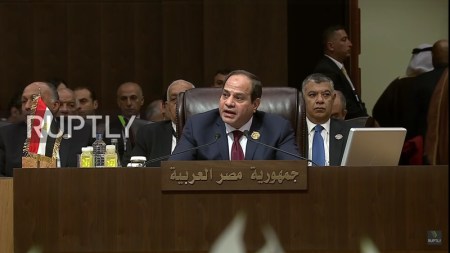
President Abdel Fattah el-Sisi of Egypt speaks at the Arab Summit, on March 29. The previous day, Sisi walked out of a speech by the Emir of Qatar, Sheikh Tamim bin Hamad Al-Thani. Sisi was infuriated by Al-Thani’s declaration of support for the Muslim Brotherhood. (Image source: Ruptly video screenshot)

Another consequence of Obama’s foreign policy — in particular attempts to get close to Iran’s hostile regime — has been a fraying of relationships with old Arab allies of the United States. Some of Obama’s advisors thought that replacing Saudi Arabia with Iran was somehow “better” for the United States, if Iran “is beginning to evolve into a very civilized and historically important country” — an analysis that can be described as completely short-sighted.

The Saudi regime, with all its flaws, is a monarchy run by princes; the Iranian regime is a theocracy run by clerics. The Saudi regime is not a theocratic regime but a hybrid structure, which is neither wholly secular nor wholly religious. As such, the religious class functions under the authority of the ruling class. Princes are driven by self-interest; clerics are driven by ideology. In terms of extremism, the Iranian regime is pushing for hegemony, whilst Saudi Arabia has been taking only a defensive, rather than an expansionist, position.

The motivation of Saudi Arabia in exporting mosques world-wide and installing radical Saudi imams is defensive, not expansionist as in Iran. Saudi Arabia’s impetus is to confront Iran’s hegemony and the spread of its hostile ideology. It is this strategy, which Saudi Arabia has practiced since 1979 to balance Iran’s power and to combat its rebellious ideology, that must change.

That Iran’s Khomeini regime sought to embarrass Saudi Arabia — a country that is home to Islam’s two holiest mosques, in Mecca and Medina — by portraying it as not sufficiently Islamic, meant that the foundational Islamic Wahhabism of the Saudi Kingdom was aggressively reinforced. This emphasis resulted in even more constraints being put in place in Iran: especially on entertainment. Since the Khomeini revolution in 1979, all plays, fashion shows, international events, and cinemas have been banned. As for women, the Commission for the Promotion of Virtue and Prevention of Vice has increasingly harassed them. As for minorities, especially Shia challenging the Iranian Shia regime and its support for Shia militias — particularly the dominant Revolutionary Guards — books were published attacking the Shia:

More books appeared, attacking the Shias and especially Khomeini’s views. These books – like the arguments of Khomeini’s followers – rejected modern thinking as an “intellectual invasion.” Saudi Arabia, considered the guardian of Sunni Islam, spent billions of dollars on challenging the Khomeini-backed Shiites.

This religious one-upmanship — a competition over which body can be the “most religious” — must stop. Saudi Arabia would do well to understand that in order to confront the hegemony of the Iranian theocratic regime, the answer is not to radicalize Saudi society but to return to the way it was before 1979.

The best way to defeat the rebel hostile regime in Iran might be through creating an inclusive and tolerant society in Saudi Arabia. Saudi Arabia needs to change its approach towards Iran because the current strategy has not worked. The current strategy has done nothing except to strengthen the Iranian regime’s dominance; distort, globally, the image of Saudi Arabia and accelerate terrorism.

The lesson the Trump administration might learn from the disastrous mistakes of its predecessor is that the main source of terrorism in the region are political Islam and all its related religious groups. All these radical groups including ISIS, Al-Qaeda, Jabhat Al-Nusra and Hamas have been spawned by a political Islam driven by the ideology of the Muslim Brotherhood. Extremist jihadists such as Osama bin Laden, Abdullah Azzam and Ayman al-Zawahiri were all taught by the Muslim Brotherhood.

Political Islam practiced by the Iranian theocratic regime has been comfortably generating Shia radical militias, including the terrorist group, Hezbollah. The fight, therefore, should not be against Islam, but against political Islam. Islam needs to be practiced the way other religions are, as a private personal faith that should be kept separate from public life and politics, and whose expression should be confined to worship only. Mosques, whether in the Arab and Muslim world or in the West, should be places of worship only and must not transformed to centers for polarizing society or for recruitment by political religious groups. Unfortunately, Western countries have turned a blind eye to the political activities inside these mosques.

The danger of these religious political groups is that they do not believe in democracy or human rights; they just use elections to grasp power in order to impose a system of “Islamic Caliphate” as their only form of government. Most of these groups use religion as an ideology to oppose governments other than their own, and when they are criticized or attacked, they play the role of the oppressed.

The Trump administration needs to take advantage of the fact that the majority of people in the Middle East and North Africa have lost faith in religious political groups, especially since the failure of the Muslim Brotherhood in Egypt and Tunisia.

Before the Arab Spring, support for these groups was huge; now it stands at less than 10% of the population. This study was conducted in the Arab world, not including Turkey. The Muslims who support Turkish President Recep Tayyip Erdogan are the Muslim Brotherhood.

Most recent polls indicate that the majority of people in Arab and Muslim countries prefer religion to be kept separate from politics.

The country that is working the most systematically to fight these religious political groups in the region is the United Arab Emirates (UAE). There are several institutes and think tanks researching how to combat these groups. Dr. Jamal Sanad Al-Suwaidi, Director General of the Emirates Center for Strategic Studies and Research (ECSSR), has given a robust analysis of these groups and how to combat them in his book, The Mirage. In it, he cites a study on public opinion on political religious groups: A survey of the UAE population, on how these groups are able to influence the public by taking advantage of certain flaws in the system: 53.9% because of corruption; 47.9% because of poverty and 29.1% because of an absence of civil society groups that confront these opportunists.

The Middle East-North Africa region will undoubtedly have to go through several stages before it can successfully establish democracy. An evolutionary developmental approach will definitely be better than the failed revolutionary democratic one pursued by the Obama administration.

Secularization is also crucial in the fight against terrorism. Trying to build a democracy before going through the stages of secularism and political reformation — which includes rectifying existing flaws, such as corruption; modernization which means the liberation of the region from extremist totalitarian religious dogma and all other forms of backwardness in order to kick-start a renaissance; and scientific development — will not only be inadequate but will actually generate more terrorism by helping radicals to keep gaining power. It would be like a farmer who wants to plant roses in arid desert soil full of thorns.

Sisi as key to Arab anti-ISIS pact with Israel

April 3, 2017

Sisi as key to Arab anti-ISIS pact with Israel, DEBKAfile, April 3, 2017

(Please see also, Restore the U.S.-Egyptian Strategic Alliance, Designate the Muslim Brothers as Terrorists. — DM)

Our Washington sources report that President Trump aims to complete his plan for bringing together Egypt, Saudi Arabia, Jordan and Israel on a new footing by September.

*********************************

US President Donald Trump’s first face to face with Egyptian President Abdel-Fatteh El-Sisi at the White House Monday, April 3, focuses on four main topics, DEBKAfile reports: The fight against Islamist State terror rampant in Egyptian Sinai and neighboring Libya; topping up US military assistance to Cairo, aid for easing Egypt’s dire economic straits and, finally, the effort to bolster normal relations between the Arab world (including the Palestinians) and Israel.

From the moment he assumed the Egyptian presidency in June 2014, El-Sisi has waged a never-ending war on Islamist terror against Ansar Beit-al Maqdis, which later pledged alliance to the Islamic State’s leader Abu Bakr Al-Baghdadi. The Egyptian army has so far been worsted.  The Egyptian president is not deaf to the criticism of the Second and Third Armies’ failure to overcome a few thousand armed men, even though they can at a moment’s notice raise several thousand more fighters from the Bedouin tribes of Sinai. US intelligence has rated the Egyptian forces as slow-moving and unwieldy; but for limited forays, its contingents preferring to sit safely in their barracks rather than risk going out and pursuing the enemy across the Peninsula.

Shortly before President El-Sisi’s trip to Washington, the Egyptian air force conducted intense bombardments of ISIS concentrations around the northern town of El Arish, killing at least 14 terrorists, nabbing 22 and seizing large caches of roadside bombs. But they too long delayed bearding the Islamists in their main stronghold atop Mount Jabal Hala in central Sinai. ISIS is therefore free to move around the territory and strike at will, the while expanding its operations into Egypt proper.

The weekend air strikes came after months in which ISIS overran sections of El Arish, Sinai’s biggest town (pop: 100,000). Their grip is such that Egyptian forces no longer dared venture into those lawless neighborhoods, especially at night. Earlier this year, terrible persecution including executions forced the few thousand indigenous Christians, most of them Copts, to flee their homes in El Arish. Egyptian forces proved unequal to safeguarding the US-led international observer force (MFO) monitoring the 1972 Egyptian-Israel peace treaty at a nearby station.

American military aid to Egypt stands today at $1.3bn a year. Even though the US president means to slash foreign aid programs, he may make an exception in this case and expand military assistance -, possibly in the coin of advanced military hardware, given the country’s unending frontline battle against Islamist terror.

Its presence in El Arish, 130km from the Egyptian-Israeli border, plants the peril on the doorsteps of Egypt’s neighbors as well: Northern Sinai borders on Israel, its northwestern district shares a border with the Gaza Strip, abutting in the east on Jordan and in the southwest on Libya. The cities of western Sinai sit on the banks of the Suez Canal.

The Islamic State’s Sinai affiliate is closely allied with Salafi organizations in the Gaza Strip and works hand in glove with its Palestinian Hamas rulers, especially in the lucrative arms-smuggling business.

Al-Baghdadi last year posted a group of Iraqi officers in his service to the Sinai contingent. They travelled through southern Jordan to reach the peninsula. The Islamist cells in Libya have moreover made ISIS-held turf in Sinai their safe highway for traveling undetected to their other strongholds across the Middle East.

To stamp out this sprawling, multi-branched menace, the Trump administration needs to bring Egypt, Jordan and Israel into a coalition for a sustained, common campaign.

The Obama administration, which boycotted President El-Sisi for persecuting Egypt’s Muslim Brotherhood, tried unsuccessfully to build Turkey, Egypt and Israel into a counterterrorism pact. The Trump administration, for which the Brotherhood is anathema, has a better chance. But first, relations between the Arab world and Israel need to be placed on a regular footing. Some groundwork already exists in the informal bilateral military ties Egypt and Jordan maintain with Israel. DEBKAfile’s military sources have revealed in past reports the limited give-and-take relations for fighting terror Saudi Arabia and Abu Dhabi maintain with Israel.

The US President’s advisers recognize that before a broad, effective front against ISIS and Al Qaeda can be put together from these partial, often covert ties, progress is necessary towards normalizing relations between the Arab governments and the Jewish state, including the Israeli-Palestinian track.

Trump will certainly want to hear what role his Egyptian guest is willing to take for bringing this process forward. He will ask his next Middle East visitor, Jordan’s Abdullah II, the same question, when he arrives in Washington Tuesday. As for the Palestinian leader Mahmoud Abbas, he was promised an invitation to the White House this month, but not yet been given a date. He is clearly being left to wait until the senior players in the region have had their say. Our Washington sources report that President Trump aims to complete his plan for bringing together Egypt, Saudi Arabia, Jordan and Israel on a new footing by September.

Egypt’s Sisi to Visit Washington in First Week of April: Newspaper

March 19, 2017

Egypt’s Sisi to Visit Washington in First Week of April: Newspaper, Breitbart, March 19, 2017

Adam Berry/Getty

CAIRO (Reuters) – Egyptian President Abdel Fattah al-Sisi will make his first state visit to Washington during the first week of April at the invitation of U.S. President Donald Trump, Egyptian state-owned newspaper Al-Ahram reported on Sunday.

The trip will be Sisi’s first U.S. state visit since being elected president in 2014 as former U.S. President Barack Obama had never extended an invitation.

Sisi was elected a year after leading the military’s ousting of the Muslim Brotherhood’s President Mohamed Mursi after mass protests. Trump invited Sisi in January but the date of the visit had not been announced.

Read more here. (But there is no more there. — DM)

Reports On Creation Of Muslim Brotherhood Lobby In U.S. To Prevent Trump Administration From Designating The Movement A Terrorist Organization

March 17, 2017

Reports On Creation Of Muslim Brotherhood Lobby In U.S. To Prevent Trump Administration From Designating The Movement A Terrorist Organization, MEMRI, March 16, 2017

(As I understand the Muslim Terrorist Designation Act, passage would impair CAIR and other Islamist organizations in America previously supported by the Obama administration and its “countering violent extremism” program. That would be a good thing. — DM)

Introduction

Following Donald Trump’s election to the U.S. presidency, the issue of designating the Muslim Brotherhood (MB) a terrorist organization resurfaced. During and after his presidential campaign, Trump’s Middle East advisor Walid Phares repeatedly stated that the new president would act for the passage of a bill doing so. For example, following Trump’s September 2016 meeting with Egyptian President ‘Abd Al-Fatah Al-Sisi on the margins of the UN General Assembly, Phares told the Egyptian daily Al-Watan that Trump had promised Al-Sisi that he would promote a bill that is already before Congress that designates the MB a terrorist organization.[1] After the election, Phares reiterated these remarks to the press.[2]

It should be mentioned that in November 2015, Senator Ted Cruz (R-TX) and Rep. Mario Diaz-Balart (R-FL) announced that they had introduced a bill designating the MB a terrorist organization.[3] In January 2017, Cruz tweeted that he and Diaz-Balart had reintroduced the bill on this matter: “Proud to introduce Muslim Brotherhood Terrorist Designation Act w @MarioDB [Mario Diaz-Balart]. It’s time to call the enemy by its name.”[4]

Ted Cruz’s tweet

In light of this bill, and in light of statements by Trump administration officials about its intent to promote it, the MB began preparations to confront the bill and prevent its passage. Launching a widespread informational media campaign, including the hiring of U.S. lobbying and legal firms, outreach to the press in the U.S., and dissemination of informational content aimed at improving its image in the West, particularly in the U.S., the MB attempted to convey that it is not a terrorist organization, but rather an ideological movement whose methods of operation are peaceful.

On the other hand, the Egyptian regime has been working to persuade the new U.S. administration that the MB is indeed a terrorist organization, as well as an umbrella organization for other terrorist outfits. In addition it was reported that Egyptian intelligence too had hired an American lobbying firm to improve the image of the Egyptian regime in the U.S.[5] Egyptian parliamentary representatives met in January 2017 with U.S. members of Congress to impress upon them the necessity of designating the MB as terrorist. Another visit by an Egyptian parliamentary delegation was scheduled for January but has apparently been postponed to April. Additionally, the Egyptian daily Al-Yawm Al-Sabi’, which is close to the regime, has in recent weeks been criticizing Western media, particularly The New York Times, for providing a platform for the promotion of MB ideas. The Egyptian press in general expressed criticism of the regime for failing to sufficiently counter the MB’s media campaign.

This report will review MB media efforts to counter U.S. legislative and legal moves to designate it a terrorist organization, efforts by the Egyptian regime and official media to prove that it does indeed engage in terrorism, and claims by Egyptian writers that the regime is not doing enough to combat the MB’s campaign in the West.

MB Works To Create U.S. Lobby

In fact, already in November 2016, immediately after Donald Trump’s victory in the U.S. presidential elections, the movement began preparing to counter U.S. moves to designate it terrorist. The Egyptian Institute for Political and Strategic Studies, which belongs to the MB and operates from Turkey under the directorship of Amr Darrag, who served as minister of planning and international cooperation in the administration of former Egyptian president Mohamed Morsi, published a document by Dr. Badr Shafi’i on November 26 with recommendations for the movement on how to deal with America’s intent to promote a terrorist designation of the MB. The recommendations include: Appointing elements within the movement to supervise these steps and make contact with experts on international relations; contacting politicians, clerics, and countries that could sympathize with the MB in order to improve its image in Congress; establishing a legal-media team and hold ties with members of Congress; hiring a U.S. law firm and public relations teams; and establishing a substantial Islamic lobby in the U.S., while strengthening ties with movements opposing Trump’s policy.[6]

Recommendations published by the Egyptian Institute for Political and Strategic Studies (Eipss-eg.org, November 2016)

In January and March 2017, the institute published two more documents by Shafi’i that also dealt with this issue, in which he reiterated his recommendations.[7]

In addition, in recent months, the Arab press in general, and the Egyptian press in particular, reported on MB efforts to prevent the Trump administration from listing it as a terrorist organization. Thus, for example, MB sources outside of Egypt told the daily Al-Shurouq that the global MB organization was conducting widespread activity to this end. According to these sources, the movement was being assisted by the governments of Turkey, Tunisia, and Morocco, and by the governments of countries where the MB has substantial parliamentary blocs such as Kuwait, Jordan, and Algeria. The sources also disclosed that the movement’s steps, not only in Egypt but in 82 countries around the world, as well as its contacts with members of Congress and senior U.S. writers and civil society organizations, are meant to prevent the decision.[8]

Evidence of these moves could be seen in comments by London-based MB official Mohamed Soudan, who said in late January that MB elements were speaking to American politicians, State Department officials, members of Congress, and academics, in order to explain the nonviolent history of the movement since its establishment in 1928.[9]

In other statements to the media, Soudan said that most of the MB’s contacts in the U.S. were done via a public relations firm, and added: “We will defend our history and the movement’s future with all possible legitimate and legal means.” According to him, the MB will not sit idly by but rather operate on all fronts and conduct meetings with all American parties in order to prevent a U.S. decision designating it a terrorist organization.[10]

On February 5, the Saudi website Elaph reported that the MB had signed a contract with an American lobbying firm, paying it $4.8 million to help it establish ties with Trump administration officials in order to improve its image in U.S. media. According to the report, the contract included organizing meetings with Trump administration officials, submitting documents on Egyptian government mistreatment of the movement and its members, publishing articles in American media, and providing platforms for movement officials in American print and TV media. Elaph added that elements close to the Obama administration had helped the movement sign the contract with this firm, whose officials include figures close to Obama’s election campaign  and to Hillary Clinton. According to Elaph, the firm employs dozens of former White House and State Department staffers who have extensive ties to members of Congress and political and strategic research centers in the U.S.[11]

Furthermore, former MB official Tareq Abu Al-Sa’ad claimed that as part of its efforts to improve its image in the U.S., the movement relies on specific American families who are members of the MB and have close ties to the U.S. administration. He mentioned a family which he said has ties to American officials and research institutes, as well as other MB officials that are expected to contact human rights organizations to help improve its image in Washington.[12]

One example of the MB’s efforts on this front is a New York Times article by Gehad Al-Haddad, a former Egyptian MB spokesman who was arrested in 2013 and is currently incarcerated in Tora Prison in Egypt. Gehad is the son of Essam Al-Haddad, an aide to former Egyptian president Mohamed Morsi.[13] In the February 22 article, titled “I Am a Member of the Muslim Brotherhood, Not a Terrorist,” Al-Haddad rejected claims that the MB was a terrorist organization, stating that its ideology stems from the Islamic interpretation based on social justice, equality, and rule of law. He stressed that despite the Egyptian regime’s hostility, the movement always fought for the weak in society and that it believes in democracy and pluralism, adding that during the Mubarak era, it even worked together with democratic movements to prevent him from bequeathing the presidency to his son Gamal. He added that the MB opposes violence and has always operated peacefully, and that violent movements that are said to have grown out of the MB actually left the movement because it could not accept their violent methods.[14] Elements close to the movement said it had chosen Gehad Al-Haddad to pen the article because he had held close ties with U.S. officials during Morsi’s presidency.[15]

Al-Haddad’s New York Times article (New York Times, February 22, 2017)

Another New York Times article on February 20, by Declan Walsh, argued that a terror listing for the MB, which has millions of followers, could have negative consequences, especially for countries where MB-linked parties are in power or are prominent in Parliament, with serious implications for domestic politics, American diplomacy and the broader fight against Islamist extremism.  It stated further that marginalizing this movement could mean discouraging some of its moderate branches that have won wide praise for their democratic engagement, while empowering jihadist groups. Moreover, the proposed designation would reaffirm Trump’s embrace of Egyptian President Al-Sisi, who has faced severe international criticism for Egypt’s dismal human rights record in recent years and its ruthless persecution of the MB.

It should be mentioned that on February 23, Al-Masri Al-Yawm quoted Mohamed Soudan as saying that the MB had managed to convince Congress to not designate it a terrorist organization. The report quoted Soudan as saying that the global MB organization had managed to hold contacts with administration and Congress officials and had used documents to convince them that the MB was not and would never be involved in terrorist attacks, and that it routinely issues condemnations for attacks that take place in most countries of the world.”[16] However, the following day Soudan denied the statements attributed to him by Al-Masri Al-Yawm, and posted an article from the Egyptian daily Al-Misriyyoun on his Facebook page with the comment: “I know nothing of this statement and these comments, and I don’t know where they (Al-Masri Al-Yawm) got this fiction.”[17]

Al-Sisi Regime Responds To MB Media Campaign

The Egyptian regime does not seem to working as intensively to promote the U.S. Congressional bill to designate the MB terrorist as the MB is to prevent such a designation. In January 2017, Mohamed Al-‘Orabi, former Egyptian foreign minister and current member of the Egyptian parliament’s foreign relations committee, and Ahmed Al-Fadaly, head of the Independent Party Current, attended President Trump’s inauguration, and also met with members of Congress and administration officials. They presented President Trump with a memo demanding quick action to designate the MB as terrorist. Al-‘Orabi said during the visit that the Egyptian parliament would soon launch a widespread campaign to advance this issue.[18]

However, besides this visit, and MP statements about their intentions to act on the matter, no actual measures are reported to have been taken to promote the U.S. Congress’s anti-MB bill.

In mid-January 2017, it was reported that a delegation on behalf of the Egyptian parliament’s Foreign Relations Committee would travel to the U.S. later that month to meet with members of Congress and deliver a report on “the MB’s violent and terrorist acts.” Tarek Radwan, a representative of the committee, said that attempts were being made to arrange a meeting between the delegation and Sen. Cruz and Rep. Mario Diaz-Balart.[19] The visit, however, apparently never took place. On March 6, it was reported that delegation would visit the U.S. in April.[20]

Egyptian Foreign Minister Sameh Shoukry, asked by the daily Al-Watan whether he had discussed the designation of the MB as terrorist during his late February 2017 visit to the U.S., responded: “I did not address this matter, but I told [U.S. officials] that it was important to note that the MB provides the philosophical and religious basis for radical ideology, and that we cannot combat terrorism [solely] by designating [organizations] in different ways, since all terrorist organizations are interconnected. Thus, [for example] even if ISIS is eliminated, new groups will continue to spring up as long as the source of radical ideology exists.” Shoukry added that the U.S. officials had grasped his point, that he was following the efforts of several members of Congress on the issue, and that the issue remains controversial.[21]

Egyptian Daily: New York Times Supports Terrorism, Slandered Egypt

In contrast to Egyptian officials, the daily Al-Yawm Al-Sabi’, which is close to Egyptian authorities and intelligence apparatuses, dealt extensively with the issue of designating the MB as terrorist, publishing a number of articles attacking the organization. It also criticized the U.S. media, particularly The New York Times, stating that it was enabling MB terrorism. On February 23, the day after The Times published Gehad Al-Haddad’s op-ed, Al-Yawm Al-Sabi’ published an article titled “New York Times Supports MB Terrorism, Publishes Article by Gehad Al-Haddad…”[22] On February 24, it published an article titled “Questionable MB Plot to Slander Egypt in Western Media… Islamist [elements]: Organization Spending Millions of Dollars to Spread Its Poison.”[23]

On March 2, Al-Yawm Al-Sabi’ published an article headlined “New Disgrace for New York Times: Paper Refuses to Publish Article Proving MB Terrorism; [Egyptian-American journalist and researcher] Michael Morgan after His Article Was Rejected for Publication…: ‘The Paper Has Become an [MB] Movement Platform and the U.S. Will Pay the Price.”[24]

Another Al-Yawm Al-Sabi’  article, published March 12, stated: “Since the onset of the June 30 [2013] revolution that ousted the MB regime, The New York Times has specialized in improving the MB’s image and slandering Egypt.” It quoted Islamic affairs expert Ahmed ‘Atta as saying that the MB International Organization secretary-general Ibrahim Munir Mustafa had paid global media outlets, chiefly the Times, $50 million to continue its attacks on Donald Trump because of Trump’s anti-MB stance.[25]
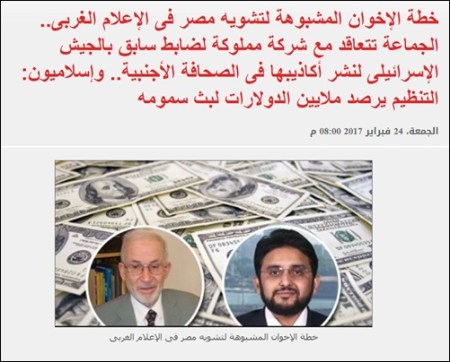
Al-Yawm Al-Sabi’ February 24 article attacking the New York Times

Egyptian Journalists To Al-Sisi Regime: Be More Decisive In Countering MB Media Campaign

Several Egyptian writers criticized the regime’s inertia in the face of the MB’s media campaign. On February 22, Al-Ahram columnist Ahmed ‘Abd Al-Tawab wrote that the MB’s media campaign shows that the movement fears being designated a terrorist organization. He wrote that it is “Egypt’s responsibility” in this matter, “due to its decades-long experience with MB crimes, to provide the Trump administration with information and historical and current evidence that will help it combat the movement on the legal, political, and cultural levels, in accordance with the human rights [principles] that the MB endangers…”[26]

Al-Ahram writer Muhammad Salmawi also wrote of the need for Egypt to step up its activity vis-à-vis the U.S. on the MB issue. In an article titled “The Voice of the MB – and Our Silence,” Salmawi wrote of his surprise  at Egypt’s feeble reaction to Gehad Al-Haddad’s New York Times article. The MB, he said, realizes that the way to influence American society is through public relations and lobbying firms, and the Egyptian regime needs to do likewise: “Those who follow the American press at this time cannot help but notice the intense campaign to improve the MB’s image and cleanse them of any blood spilled now or in the past in the name of Islam. This campaign has a specific goal – to stop the Trump administration from designating the movement a terrorist organization, thus fulfilling one of [Trump’s] campaign promises. To this end, the campaign twists facts with reckless abandon, made possible by the absence of an opposing viewpoint that could have corrected the erroneous information and responded to [the MB’s] notorious lies. How much longer will we remain silent in light of a campaign that has raised its voice and spread throughout the American media since the onset of the June 30, 2013 revolution?

“Last week I read the article by the former official MB spokesman [Gehad Al-Haddad], penned from his Egyptian prison cell and published by The New York Times. I was surprised that some of the few [Egyptian writers] who addressed this matter settled for pondering how such a message was smuggled out of prison in Egypt… The problem is not how it was leaked, but how we could not deliver a similar message [in Western media]…

“How easy it is to criticize security measures that allow messages to be smuggled out of Egyptian prisons and given to newspaper offices… in New York. How easy it is to step up measures against all the prisoners [as a result]. But the MB continues to be heard in the American press – while our position cannot be found in the international arena…

“First, we must examine how the other side managed to gain such a noticeable presence in Western media – and such an examination is not difficult. The ongoing publication of pro-MB positions in Western media, and [this media’s]  disregard for the Egyptian popular will, stems not from some global plot against us or global sympathy with the mother movement that birthed all the groups that accuse others of heresy – but mostly from [the MB’s] accurate grasp of how to operate vis-à-vis American social institutions, and of the active role played by large PR firms in society – whether in the press, the media, in Congress, or elsewhere…

“The way to actively operate in the U.S. is by arriving at an understanding with these large institutions – whether during a presidential or congressional campaign, or in the fight to influence decision-making circles by means of the press and media, or by means of members of Congress. Such a campaign is undoubtedly costly, but losing is costlier still…”

Salmawi, who is known for his antisemitic views,[27] added: “The Jewish lobby in the U.S. has already understood the power of the PR institutions and the influence they wield over American society on all levels. Using this and other methods, they control the political decision[-makers] in the U.S. The MB and the other international elements that fund them have [also] understood this. Is it not time for us to understand what our enemies already have?!”[28]

* C. Meital is a research fellow at MEMRI; H. Varulkar is Director of Research at MEMRI.


[1] Al-Watan (Egypt), September 20, 2016.

[2] Al-Ahram (Egypt), November 11, 2016.

[3] Cruz.senate.gov, November 4, 2015.

[4] Twitter.com/SenTedCruz, January 10, 2017.

[5] Rassd.com, March 5, 2017.

[6] Eipss-eg.org, November 26, 2016.

[7] Eipss-eg.org, January 28, March 3, 2017.

[8] Al-Shurouq (Egypt), February 8, 2017.

[9] Aa.com.tr, January 31, 2017.

[10] Elaph.com, February 5, 2017; Al-Masri Al-Yawm (Egypt), February 23, 2017.

[11] Elaph.com, February 5, 2017. Elements in Egypt affirmed the reports about the MB’s efforts to form a lobby. Gamal Al-Minshawi, an Islamic affairs researcher and former official in Al-Gama’a Al-Islamiyya, told the daily Al-Yawm Al-Sabi’ that the MB pays millions of dollars to foreign newspapers and news sites for positive coverage. Al-Yawm Al-Sabi’ (Egypt), February 24, 2017.

[12] Al-Yawm Al-Sabi’ (Egypt), February 17, 2017.

[13] Al-Yawm Al-Sabi’ (Egypt), February 24, 2017. It should be mentioned that in 2007-2012 Al-Haddad was director of the Clinton Foundation’s Climate Initiative in Egypt. Washingtontimes.com , September 18, 2013.

[14] New York Times (U.S.), February 22, 2017.

[15] Al-Yawm Al-Sabi’ (Egypt), February 24, 2017. It should be mentioned that after Al-Haddad’s article was published, a website close to the MB reported that Egyptian prison authorities had penalized him by placing him in solitary confinement. Rassd.com, February 27, 2017. MB associates also said that Al-Haddad and other MB prisoners manage to smuggle writings out of prison with the help of their lawyers, but an Egyptian security source said that Al-Haddad did not pen the article himself, and that smuggling such writings out of prison was impossible. Al-Watan (Egypt), February 23, 2017; Al-Yawm Al-Sabi’ (Egypt), February 24, 2017.

[16] Al-Masri Al-Yawm (Egypt), February 23, 2017.

[17] Al-Misriyyoun (Egypt), February 24, 2017; Facebook.com/FreedomJusticeFrMohamedSoudan, February 25, 2017.

[18] Al-Yawm Al-Sabi’ (Egypt), January 20, 2017; Al-Watan (Egypt), January 22, 2017.

[19] Al-Yawm Al-Sabi’ (Egypt), January 12, 2017.

[20] Motamemservice.com, March 6, 2017.

[21] Al-Watan (Egypt), March 10, 2017.            `

[22] Al-Yawm Al-Sabi’ (Egypt), February 23, 2017.

[23] Al-Yawm Al-Sabi’ (Egypt), February 24, 2017.

[24] Al-Yawm Al-Sabi’ (Egypt), March 2, 2017. Michael Morgan is an Egyptian-American researcher at the London Center for Policy Research, who promotes the designation of the MB as a terrorist organization.

[25] Al-Yawm Al-Sabi’ (Egypt), March 12, 2017.

[26] Al-Ahram (Egypt), February 22, 2017.

[27] In an article he published in the French-language Egyptian weekly Al-Ahram Hebdo, titled “Look for the Jews,” Salmawi criticized  the French law criminalizing antisemitism and Holocaust denial, stating that it does not forbid denying crimes against humanity but only crimes against six million Jews who “allegedly” suffered a holocaust during World War II. He also wrote that whoever wants to understand the connection between the Monica Lewinsky affair in the U.S., the trial against “French thinker” Roger Garaudy (who was convicted in 1998 of Holocaust denial) and the barring of Holocaust denier David Irving from several countries needs to “look for the Jews.” Al-Ahram Hebdo, Egypt, February 4-10, 1998.

[28] Al-Ahram (Egypt), March 5, 2017.

Rift widens between Egyptian president, Al-Azhar

February 27, 2017

Rift widens between Egyptian president, Al-Azhar, Al Monitor

(A debate/discussion between President Sisi and Muslim reformer Zuhdi Jasser about the reformation of Islam would be interesting. Perhaps something can be arranged when President Sisi visits President Trump in Washington.– DM)

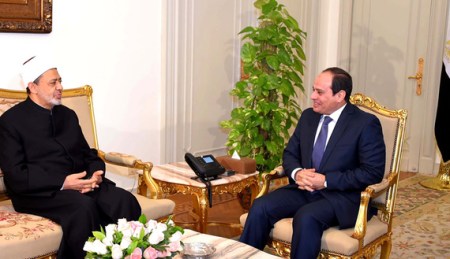
al-sisi-and-islamistEgyptian President Abdel Fattah al-Sisi (R) meets with Al-Azhar’s Grand Imam Ahmed el-Tayeb at the Ittihadiya presidential palace in Cairo, Feb. 26, 2017. (photo by Reuters/Egyptian Presidency)

Al-Azhar’s rejection of Sisi’s proposal places the religious institution on a direct collision course with the head of state, signaling a marked shift in the relationship and possibly the beginning of a tug of war for greater autonomy for the institution — perceived as “politicized” by some analysts. In the meantime, Sisi’s push for religious reforms hangs in the balance. 

**************************

When Field Marshal Abdel Fattah al-Sisi, then defense minister, gave a televised speech on July 3, 2013, announcing that President Mohammed Morsi had just been overthrown, he was flanked by Egypt’s top religious leaders, Pope Tawadros, the head of Egypt’s Coptic Orthodox Church, and Sheikh Ahmed el-Tayeb, the grand imam of Al-Azhar. Tayeb, who had earlier called on Morsi  — the country’s first democratically elected president — to step down to end the bloodshed, threw his weight behind the military man who helped rid Egypt of the Muslim Brotherhood, since designated by the country as a “terrorist group.”

Now, nearly four years later, cracks have appeared in the alliance between Sisi (himself a devout Muslim), who became president in 2014, and Al-Azhar, Sunni Islam’s oldest seat of learning. Al-Azhar has resisted repeated appeals by Sisi to “renew Islamic discourse” and “modernize the faith.” Any doubts skeptics might have had about Tayeb and Sisi not seeing eye to eye in regard to “modernizing Islam” vanished when the president publicly took a jab at the grand imam last month, telling him, “You wear me out.” While the remark was made jokingly, it signaled underlying tensions in their relationship, suggesting Sisi’s patience with Al-Azhar’s intransigence on reforms may be wearing thin.

Sisi first made his impassioned plea for what he called a “religious revolution” two years ago during a New Year’s Day speech at Al-Azhar, lamenting that ”radicalized thinking is antagonizing the entire world and tearing the umma [Islamic nation] apart.” His bold comments earned him praise from Western supporters who noted that Sisi had done something that no Western leader had had the courage to do. Skeptics, however, cautioned that Sisi was an unlikely reformer as “he champions the application of Islamic law [Sharia].” Furthermore, Sisi had given no specifics regarding the revolution he seeks, argued Daniel Pipes in an article published by the Middle East Forum think tank he heads.

At home, Al-Azhar scholars took Sisi’s exhortations for religious reforms with a grain of salt. “Any change must come from scholars of Islam, not from the government,” an Al-Azhar official, who declined to be named because he was not authorized to speak to the press, told Al-Monitor. Hinting that Al-Azhar preachers resent state interference in their religious affairs, he criticized the decision by the Ministry of Religious Endowments to unify sermons at Friday congregational prayers in mosques across the country.

“The Ministry of Religious Endowments decides on the topics the imams will be preaching on each week, but often the sermons prepared by the ministry are insensitive to the circumstances of the place where they are being delivered,” he complained. “A sermon on cleanliness may be well received by mosque-goers in Cairo but would be unsuitable when preached in mosques in the northern Sinai town of el-Arish, a hotspot for violence in recent months.”

He also rejected claims by some critics that Al-Azhar’s curriculum promotes fundamentalism and violence. “Tens of thousands of students — local and foreign — study at Al-Azhar. How many of them have become terrorists?” he asked. The grand imam, too, has rebutted the allegation that the centuries-old Islamic institution was spreading radical ideas, insisting that “Al-Azhar is the pulpit of moderate, centrist and tolerant Islam.”

A special committee of educational experts, created in 2015 at the behest of Sisi, has been reviewing and updating Al-Azhar’s educational curriculum, weeding out content perceived to be inciting violence. Meanwhile, a YouTube channel launched two years ago and overseen by Al-Azhar scholars has the declared aim of “countering Islamic State propaganda.” Plans are also underway to launch a new Al-Azhar TV channel in the coming months ”to promote moderate thought.” While these are all steps in the right direction, they fall well short of Sisi’s aspiration of “revolutionizing Islam.” Much more needs to be done if Al-Azhar wants to show it is serious about combating the surge in terrorist attacks and curbing the spread of extremism, alongside the government, which is battling IS-affiliated groups in the Sinai Peninsula.

Al-Azhar‘s senior scholars have thus far refused to accuse IS of heresy, arguing that “Islam prohibits accusations of heresy as only God knows what is in someone’s heart.” They claim that IS cannot be considered heretical as long as its members have uttered the shahada (the Muslim declaration that there is no God but Allah and that Muhammad is his prophet.) The institution’s clerics have also failed to back calls by rights activists to annul the country’s controversial blasphemy laws that allow citizens to be prosecuted for “insulting religion” despite Sisi’s giving a nod to such calls.

Islamic thinker and TV talk show host Islam El-Beheiry spent the most part of 2016 behind bars on the charge of contempt of religion for questioning the authenticity of various religious texts interpreting the Quran and calling for their revision on his show on the privately owned Al-Kahira Wal Nas Channel. A legal complaint was filed against him by a private citizen after Al-Azhar demanded the suspension of his show for “defaming Islam.” Beheiry was originally handed down a five-year sentence that was reduced to one year by an appeals court in December 2015. He was released in November after Sisi granted him amnesty and has since vowed to continue to speak out against “radical thought.” In his first television appearance on the privately owned Al-Mehwar channel days after his release, he denied having committed a crime and paid tribute to Al-Azhar. However, he said that “the problem lies with the Salafists within the institution who continue to defend problematic religious texts upon which IS practices are based. Al-Azhar condemns the actions of IS, saying IS members are misinterpreting the texts. They are not; the texts tell them to kill and it is these texts that should be condemned.”

Beheiry told Al-Monitor that Sisi is serious about reforming Islamic discourse, but unifying the sermons in mosques will not change anything. “To counter the threat of terrorism, Al-Azhar needs to acknowledge that the problem lies in outdated Islamic heritage books that were written in the medieval period or earlier. These books promote jihad [holy war] and intolerance. Terrorist attacks will continue as long as these books are available, poisoning people’s minds,” he said.

Eslam Abdel Raouf, an assistant professor of journalism at Al-Azhar, acknowledged that there are internal divisions within the institution. “Like any other institution in the country, Al-Azhar has reformists and ultraconservatives. The former group supports Sisi’s calls for reform while the latter is against it,” he told Al-Monitor. “The dominant view among Al-Azhar clerics is that change is welcome as long as it does not touch the fundamentals of the religion. While it is fine to modernize religious discourse to make it more appealing to the youth, state interference in religious edicts [fatwas] is considered a red line that must not be crossed.”

Sisi was perceived by the clerics as having crossed that line when he recently called for a law banning verbal divorce in Egypt in an attempt to reduce the country’s burgeoning divorce rate, which in 2015 went up by 10.8%, according to Egypt’s Central Agency for Public Mobilization and Statistics. Sisi had lamented in a speech he gave at the Police Academy on the eve of National Police Day on Jan. 25 that 40% of all marriages in Egypt end within the first five years. He urged the grand imam, who was present in the audience, to lend his support to the proposed legislation.

In a rare show of defiance, however, Al-Azhar rejected the plan, drawing a clear line between religion and politics. A statement released by Al-Azhar’s Council of Senior Clerics stated, “Verbal divorce, when meeting all the conditions — the husband has to be fully conscious and of sound mind when uttering the words ‘I divorce you’ — has been an undisputed practice since the days of the Prophet Muhammad.“

Al-Azhar’s rejection of Sisi’s proposal places the religious institution on a direct collision course with the head of state, signaling a marked shift in the relationship and possibly the beginning of a tug of war for greater autonomy for the institution — perceived as “politicized” by some analysts. In the meantime, Sisi’s push for religious reforms hangs in the balance.