The Buckley Program Stands Up for Free Speech, Front Page Magazine, Bruce Thornton, September 17, 2014
(When I was a Yale undergraduate (1959-63), I was proud of its then liberal (in the old fashioned sense of the word) affirmation that voices offensive to some should not on that account be banned. Things have changed since then, so I was encouraged by the decision to allow Ayaan Hirsi Ali to speak. Based on reports, there were three hundred in the audience, she received three standing ovations, and about one hundred students who wanted to attend could not because there was insufficient room in the auditorium. Three cheers for my Alma mater! There may still be hope for her.– DM)
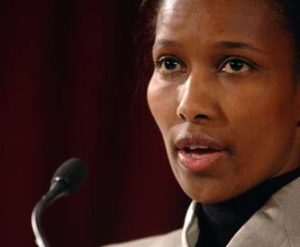
The William F. Buckley Program at Yale University lately showed bravery unusual for an academic institution. It has refused to be bullied by the Muslim Students Association and its demand that the Buckley Program rescind an invitation to Ayaan Hirsi Ali to speak on campus September 15. Hirsi Ali is the vocal Somalian critic of Islamic doctrine whose life has been endangered for condemning the theologically sanctioned oppression of women in Islamic culture. Unlike Brandeis University, which recently rescinded an honorary degree to be given to Hirsi Ali after complaints from the Council on American-Islamic Relations, the Buckley Program rejected both the MSA’s initial demand, and a follow up one that Hirsi Ali share the stage with one of her critics.
The Buckley Program is a rare instance of an academic organization staying true to the ideals of free speech, academic freedom, and the “free play of the mind on all subjects,” as Matthew Arnold defined liberal education. Most of our best universities have sacrificed these ideals on the altar of political correctness and identity politics. Anything that displeases or discomforts campus special interest groups––mainly those predicated on being the alleged victims of American oppression–– must be proscribed as “slurs” or “hateful,” even if what’s said is factually true. No matter that these groups are ideologically driven and use their power to silence critics and limit speech to their own self-serving and duplicitous views, the modus operandi of every illiberal totalitarian regime in history. The spineless university caves in to their demands, incoherently camouflaging their craven betrayal of the First Amendment and academic freedom as “tolerance” and “respect for diversity.”
In the case of Islam, however, this betrayal is particularly dangerous. For we are confronting across the world a jihadist movement that grounds its violence in traditional Islamic theology, jurisprudence, and history. Ignoring those motives and their sanction by Islamic doctrine compromises our strategy and tactics in defeating the jihadists, for we cripple ourselves in the war of ideas. Worse yet, Islamic triumphalism and chauvinism–– embodied in the Koranic verse that calls Muslims “the best of nations raised up for the benefit of men” because they “enjoin the right and forbid the wrong and believe in Allah”–– is confirmed and strengthened by the way our elite institutions like universities and the federal government quickly capitulate to special interest groups who demand that we endorse only their sanitized and often false picture of Islam. Such surrender confirms the jihadist estimation of the West as the “weak horse,” as bin Laden said, a civilization with “foundations of straw” whose wealth and military power are undermined by a collective failure of nerve and loss of morale.
This process of exploiting the moral degeneration of the West has been going on now for 25 years. It begins, as does the rise of modern jihadism, with the Ayatollah Khomeini and the Iranian Islamic revolution. The key event took place in February 1989, when Khomeini issued a fatwa, based on Koran 9.61, against Indian novelist Salman Rushdie for his novel The Satanic Verses, which was deemed “against Islam, the Prophet, and the Koran,” as Khomeini said. Across the world enraged Muslims rioted and bombed bookstores, leaving over 20 people dead. More significant in the long run was the despicable reaction of many in the West to this outrage against freedom of speech and the rule of law, perpetrated by the most important and revered political and religious leader of a major Islamic nation.
Abandoning their principles, bookstores refused to stock the novel, and publishers delayed or canceled editions. Muslims in Western countries publicly burned copies of Rushdie’s novel and encouraged his murder with impunity. Eminent British historian Hugh Trevor-Roper suggested Rushdie deserved such treatment. Thirteen British Muslim barristers filed a formal complaint against the author. In their initial reactions, Western government officials were hesitant and timorous. The U.S. embassy in Pakistan eagerly assured Muslims that “the U.S. government in no way supports or associates itself with any activity that is in any sense offensive or insulting to Islam.”
Khomeini’s fatwa and the subsequent violent reaction created what Daniel Pipes calls the “Rushdie rules,” a speech code that privileges Islam over revered Western traditions of free speech that still are operative in the case of all other religions. Muslims now will determine what counts as an “insult” or a “slur,” and their displeasure, threats, and violence will police those definitions and punish offenders. Even reporting simple facts of history or Islamic doctrine can be deemed an offense and bring down retribution on violators. Ayaan Hirsi Ali, for example, earned the wrath of Muslims in part for her contribution to Theo van Gogh’s film Submission, which projected Koranic verses regarding women on the bodies of abused women. Van Gogh, of course, was brutally murdered in the streets of Amsterdam. And this is the most important dimension of the “Rushdie rules”: violence will follow any violation of whatever some Muslims deem to be “insulting” to Islam, even facts. In effect, Western law has been trumped by the shari’a ban on blaspheming Islam, a crime punishable by death.
The result is the sorry spectacle of groveling and apology we see almost daily from our government, the entertainment industry, and worse yet, universities. Trivial slights and offenses that civilized nations leave to the market place of ideas to sort out are elevated into “slurs” and “hate speech” if some Muslim organization deems them so. A reflexive self-censorship has arisen in American society, one based on fear of violent retribution or bad publicity harmful to profits and careers.
Thus the government officially proscribes words like “jihad” or “Muslim terrorist” from its documents and training materials in order to avoid offending Muslims. Similarly the Muslim terrorist, a fixture in recent history since the PLO started highjacking airliners in the 60s, has nearly disappeared from television and movies, replaced by Russians, white supremacists, and brainwashed Americans. And when a Muslim terrorist does appear, his motivations and violence are rationalized as the understandable response to the grievous offenses against his faith and people committed by the U.S. and Israel. Islam is airbrushed from the plot, as in the recent series Tyrant, a dramatization of a fictional Arab Muslim state that somehow manages to ignore Islam as a political force. More seriously, universities disinvite speakers at the faintest hint of protest from Muslim organizations, even as they accept Gulf-state petrodollars to create “Middle East Studies” programs that frequently function as apologists and enablers of terrorist violence.
“Free men have free tongues,” as the Athenian tragedian Sophocles said. One of the pillars of political freedom is free speech. When the ability to speak freely in the public square is extended beyond an elite to a large variety of people with clashing views and ideals, speech necessarily becomes rough and uncivil. Feelings get hurt, passions are aroused, and language becomes coarse and abusive. That’s the price we pay for letting a lot of people speak their minds, and for creating a process in which truth and good ideas can emerge from all this rambunctious, divisive conversation. But when we carve out a special niche for one group, provide it with its own rules, and protect it even from statements of uncomfortable facts, then we compromise that foundational right to have our say without any retribution other than a counterargument. So three cheers for the Buckley Program. It has stood up against intimidation and defended one of our most important and precious freedoms.




 anneinpt
 artaxes
 danmillerinpanama
 davidking1530
 Peter Hofman
 Joseph Wouk
 Peter
Peter Louisiana Steve
 WarSclerotic
Recent Comments