Posted tagged ‘Russia – Syria war’

The Most Dangerous Man In the World

October 2, 2015

The Most Dangerous Man In the World, American ThinkerAndrew Logar, October 2, 2015

…is neither Russia’s Vladimir Putin nor China’s Xi Jinping, nor at this time, Ayatollah Khamenei – it’s none other than America’s Barack Hussein Obama.  This is not because of any aggressive, risk-laden actions he has taken, far from it.  It is because of those he has failed to take at critical times to credibly dissuade strategic competitors and potential aggressors, such as Russia and China, from actions that may suddenly compound into  destabilizing confrontations, even war.  When the Middle East cauldron spawned the barbaric ISIS, Obama’s indecisive, pusillanimous response allowed this Islamic malignancy to rapidly metastasize, compounding and accelerating an existing refugee problem that will involve America.  Additionally, throughout his tenure, overt actions Obama has taken served to steadily and materially, degrade American military capabilities, while enemies grow stronger.

In retrospect, divining Obama’s foreign policy should have been relatively easy given his background – a world seen through the eyes of someone whose father was a Muslim, as was his step-father, whose early education was in a Muslim madrassa, followed by mentoring from the known communist Frank Marshall Davis, associations with Columbia University’s Palestinian activist Edward Said and later, Harvard’s leftist Brazilian socialist Roberto Unger, later close association with admitted communist and Weatherman terrorist Bill Ayers, then followed by 20 years of anti-American and anti- Semitic sermons by Reverend Jeremiah Wright who, placing much of the world’s ills at America’s doorstep, culminated a post 9-11 sermon sententiously intoning, “…America’s chickens have come home to roost.”

Ironically, other chickens have indeed come home to roost.   American liberalism’s pernicious obsession to eradicate the odium of slavery long gone and any vestiges of remaining discrimination in one fell swoop, blindly promoted the candidacy of the first black president, propelling a relatively unknown, unvetted and remarkably unqualified candidate to two electoral victories.  That most unfortunate occurrence followed by resultant deleterious fallout at home and abroad, are liberalism’s chickens coming home to roost – in the White House – where they’ll cluck away until January 20, 2017.

After winning the 2008 election, Obama launched his now infamous “Apology Tour,” covering three continents in some 100 days, during which the Heritage Foundation identified 10 major apologies Obama made for America’s past behavior.  Mitt Romney, in his book, “No Apology,” correctly criticized Obama’s gratuitous apologies.  Indeed, unnecessary apologies by our president projected a weakness in resolve, confidence and appreciation of our nation’s accomplishments, our beliefs and values.  While in Europe, when asked if he believed in American “exceptionalism,” he said yes – in the same way that, “ …the Brits believe in British exceptionalism and the Greeks in Greek exceptionalism.”

This was an arresting, if not downright stupefying statement – coming from the head of state of the world’s most powerful nation, with a manifestly unrivaled history.  This is a nation which in 239 years since the Declaration of Independence, grew from 13 colonies and 3 million people to 50 states and 320 million people, a nation victorious in its Revolutionary War, the War of 1812 and which fought its bloodiest of wars, the Civil War, to expunge slavery; this is a nation victorious in the Mexican-American War, the Spanish-American War, WWI and WWII, that introduced the incontestably successful Marshall Plan critical in European post war recovery, that sent men to the moon and back, 6 times – and the nation that won the Cold War – a nation that has consistently led the world in Nobel prizes in medicine, science and technology. This is unequivocally a nation like none other, a nation of unparalleled achievements and sadly, one whose president does not consider particularly exceptional.

The historical record now shows global competitors and enemies have taken their measure of Obama: the Russians have acted with impunity in Crimea, Ukraine and Syria, the Chinese are establishing a stranglehold on the South China Sea while Russians, Chinese and Iranians are engaged in flagrant cyber-espionage against America, ISIS is growing, while Syria, Iraq and Afghanistan are all in play.

Barack Obama’s sophomoric efforts at geopolitics derived from his warped, kaleidoscopic misreading of 20th century history have now spiraled into a veritable tragicomedy of incompetence.  Witness his administration’s $500 million program to train Syrian rebels to fight ISIS: not only didn’t that produce the projected 5,000 trained fighters, or even 500, but only, according to General Lloyd Austin, “…four or five.” This is grist for a Marx Brothers movie and attributable to abysmally poor leadership, planning and organization which can only be placed at the doorstep of the White House.

An objective review of the Obama administration’s policies reveals they have consistently posed a direct or indirect threat to national security:

– The unilateral cancellation of the Easter Europe ABM deployment without securing a tangible quid pro quo from Moscow and no counter to Russia’s recent decision to sell the potent S-300 anti-aircraft system to Iran.

– The ill-advised support for the overthrow of long-term ally of the West, Egypt’s Mubarak and the inexplicable enthusiastic White House support of the Muslim Brotherhood.

– The equally ill-advised and ill-planned toppling of Libya’s Gaddafi, resulting in a country without a functional government now overrun with Islamists, where at Benghazi four Americans died needlessly.

– The withholding of vital intelligence from the Senate that Russia had been flagrantly cheating on the existing INF treaty to advance ratification of New START in 2010. Seventy-one Senators voted for ratification without full background knowledge.

– The 2011 withdrawal of all American troops from Iraq by Obama while blaming the Bush administration for inadequacies of the 2008 Status of Forces Agreement (SOFA).  This allowed Iraq to descend back into sectarian chaos, giving rise to ISIS and advantage to Iran.  A war won at high cost in blood and treasure was thus lost.

– The military drawdown in Afghanistan – mindlessly pre-announced to the enemy – may lose that war as well if continued.

– The release of five dangerous Taliban in exchange for Sgt. Bergdahl is beyond rational justification and/or discussion.

– The manifest dereliction of duty in not taking strong measures to protect America from devastating EMP attack – which can be done at very affordable cost.

– The lack resolute policy has turned Syria into a graveyard of American credibility. Nothing substantive has been achieved to slow, let alone destroy, rapidly metastasizing ISIS, unconscionably leaving a compounding problem to future administrations.

– The opening of our southern border to a tsunami of illegal immigration, arguably to permanently bias future voter demographics toward a one-party (Democratic) state. That many of those gaining easy entry may wish us harm is apparently of no concern to Obama.

– The continuing undermining of America’s military superiority is increasing the likelihood of confrontation with adversaries. According to the Heritage Foundation Index of Military Strength, our Commander-In-Chief has allowed our military power to degrade to “Marginal,” leaving the US Army at its relatively weakest level since the end of WWII, while our antagonists pour money into their armed forces.

– Finally (but Obama is not through yet!) – during recent post-summit remarks, China’s Xi Jinping suggested tough U.S. response to Chinese hacking would bring retaliation; obligingly, Obama affirmed sanctions wouldn’t be directed against governments. Essentially, Xi stepped forward, Obama blinked and stepped back – signaling a major geopolitical sea change. Cyberespionage by Russia and Iran haven’t been addressed.

Before winning the 2008 election and still a senator, during the Bush administration’s then ongoing nuclear negotiations with Iran, Obama, in a brazen and historically unprecedented move, secretly sent a personal emissary to Iran, William G. Miller, a former Ambassador to Ukraine, essentially conveying this message: Obama will very likely to be elected president, after which time Iran will find negotiating with him far easier.  The Bush negotiations reportedly then reached a stalemate.  Fast-forward to 2015, through Obama’s and Kerry’s “hard” bargaining, we’ve reached an agreement with Iran whereby monitoring Iran’s programs will be left to the Iranians as they now have the right to self-inspect” and so as to take the sting away from such an onerous deal, we’ll give them $100 billion of frozen assets  – with which to do as they please – while America agrees to protect Iran’s nuclear facilities from cyber warfare.

Though Red China, Russia and Iran increasingly challenge America, the Middle East bloodshed continues and ISIS grows stronger, President Obama has declared “…no challenge–poses a greater threat to future generations than climate change.” This extraordinarily vacuous statement is from either a hopelessly delusional ideologue, woefully untutored in world history, geopolitics and the unequaled greatness of America, or a brilliant Manchurian Candidate marching to his own drumbeat.  In any case, Obama is a president like none other – and may we never see the likes of him again.


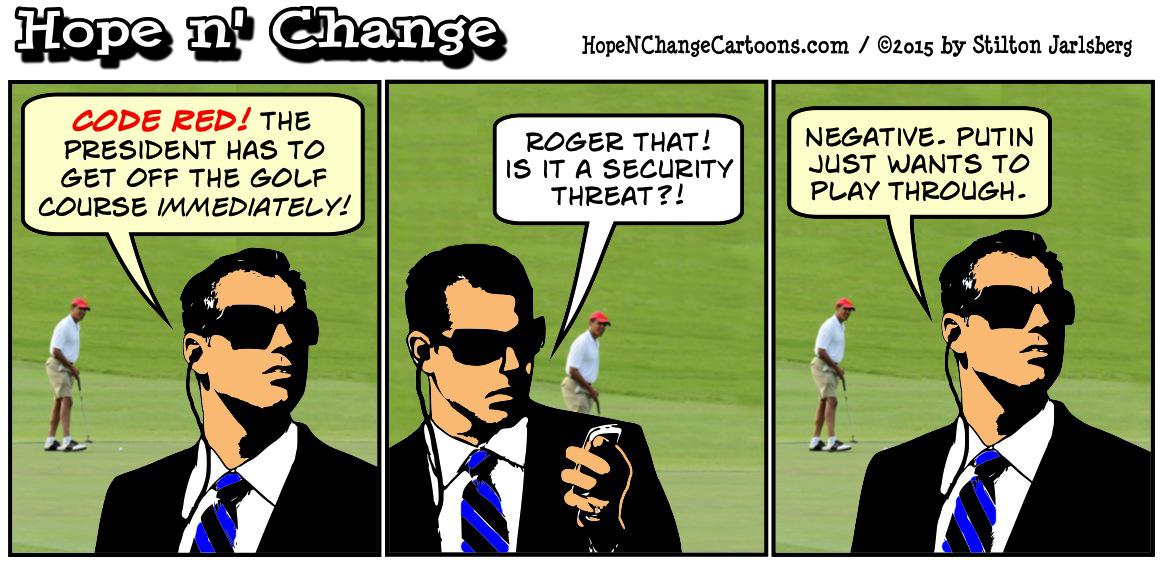
Cartoons of the day

October 2, 2015

H/t Vermont Loon Watch


the-red-line


H/t Hope n’ Change Cartoons

Russian His Swing

Chinese warplanes to join Russian air strikes in Syria. Russia gains Iraqi air base

October 2, 2015

Chinese warplanes to join Russian air strikes in Syria. Russia gains Iraqi air base, DEBKAfile, October 2, 2015

Russia_China_480

Russia’s military intervention in Syria has expanded radically in two directions.DEBKAfile’s military and intelligence sources report that China sent word to Moscow Friday, Oct. 2, that J-15 fighter bombers would shortly join the Russian air campaign that was launched Wednesday, Sept. 30. Baghdad has moreover offered Moscow an air base for targeting the Islamic State now occupying large swathes of Iraqi territory

Russia’s military intervention in Syria has five additional participants: China, Iran, Iraq, Syria and Hizballah.

The J-15 warplanes will take off from the Chinese Liaoning-CV-16 aircraft carrier, which reached Syrian shores on Sept. 26 (as DEBKAfile exclusively reported at the time). This will be a landmark event for Beijing: its first military operation in the Middle East as well the carrier’s first taste of action in conditions of real combat.

Thursday night, China’s foreign minister Wang Yi, made this comment on the Syrian crisis at a UN Security Council session in New York: “The world cannot afford to stand by and look on with folded arms, but must also not arbitrarily interfere (in the crisis).”

A no less significant development occurred at about the same time when Iraqi Prime Minister Haider al-Abadi, speaking to the US PBS NewsHour, said he would welcome a deployment of Russian troops to Iraq to fight ISIS forces in his country too. As an added incentive, he noted that this would also give Moscow the chance to deal with the 2,500 Chechen Muslims whom, he said, are fighting with ISIS in Iraq.

DEBKAfile’s military sources add that Al-Abadi’s words came against the backdrop of two events closely related to Russia’s expanding role in the war arena:

1.  A joint Russian-Iranian-Syrian-Iraqi war room has been working since last week out of the Iraqi Defense Ministry and military staff headquarters in Baghdad to coordinate the passage of Russian and Iranian airlifts to Syria and also Russian air raids. This command center is also organizing the transfer of Iranian and pro-Iranian Shiite forces into Syria.

2.  Baghdad and Moscow have just concluded a deal for the Russian air force to start using the Al Taqaddum Air Base at Habbaniyah, 74 km west of Baghdad, both as a way station for the Russian air corridor to Syria and as a launching-pad for bombing missions against ISIS forces and infrastructure in northern Iraq and northern Syria.

Russia has thus gained a military enclave in Iraq, just as it has in Syria, where it has taken over a base outside Latakia on the western coast of Syria. At the same time, the Habbaniyah air base also serves US forces operating in Iraq, which number an estimated 5,000.

‘Yesterday Russia Turned A New Page In The History Of The World’

October 1, 2015

Chairman Of The Hizbullah-Affiliated ‘Al-Akhbar’ Daily On Russian Air Campaign In Syria: ‘Yesterday Russia Turned A New Page In The History Of The World,’ Middle East Media Research Institute, October 1, 2015

In an article published in the Hizbullah-affiliated Lebanese daily Al-Akhbar on October 1, 2015, the chairman of the newspaper’s board of directors, Ibrahim Al-Amin, predicted that Russia’s air campaign in Syria will be merely a prelude to a larger military offensive involving ground operations by the Syrian Army, Iran, Hizbullah, and even the Iraqi Popular Mobilization Forces. Al-Amin is known to have close ties to Hizbullah, and in the past he has proven a reliable source on matters relating to the Iran-Syria-Hizbullah axis.

24967Ibrahim Al-Amin (source: Siyese.net)

The following is the translation of the article:

“…This is the first test for the granddaughter of the Eastern dynasty [i.e. Russia] since World War II, and it is the first field test of whether America’s unipolar position in the world over the past quarter century has truly been broken. Above all, this is a repositioning of Russian military force in the direct labor market of the regions of ‘cold’ confrontation with the U.S.-led West… Today we find ourselves before the best opportunity of putting Syria on a path to a true solution, even if it be prefaced by fire.

“As for the facts, the Russian air force carried out the first missions of a working program laid out in detailed form in an existing plan of cooperation between Moscow and its allies in the war in Syria and Iraq. This is a plan that is coordinated down to the finest details with the two allies Syria and Iran, and consequently with Hizbullah [as well]… What happened yesterday, and which will soon reach its culmination, is a necessary preface to a larger military action that will include a land component undertaken by other forces in the alliance. To put it more directly, [Russia’s] aerial bombardment of [the rebels’] command and control centers, major weapons arsenals, and artillery positions will be a preface to a military operation carried out by the Syrian army on the ground, with direct support from Iran and Hizbullah, and even from the Iraqi Popular Mobilization Forces… It may be emphasized that Russia’s activity yesterday means clearly that all the discussions in New York didn’t change an iota in the military plan of action…

“The signs of surprise and astonishment on [the faces of] the Americans, the Westerners, the Israelis, the Turks, and the Saudis are an additional proof of the weakness of the prior coordination regarding the fate of the initiatives surrounding the Syria crisis. In fact, the step taken by Russia is a kind of dare to all those who employed every violent means they could against the Syrian regime. If they decide to broaden the confrontation, they will be forced to deal with the new realities, which today are openly represented by the Russian military presence, and tomorrow will be represented by an open Iranian military presence as well…

“This must not hide from our eyes the picture of the complicated reality, which tells us that the joy felt by the regime elements in Syria must not turn into any slackening, not on the part of the regime itself, and not on the part of all those who fight alongside it. It would be naive to consider the Russian strikes sufficient to counter the enemies. It would rather be realistic to profit from the support of Russia – which is a supporting actor, and is not [itself] a member of the axis of resistance – in order to prepare to wage harsh and decisive battles in a number of places in Syria. This is a matter that requires raising the level of readiness and mobilization, and the creation of operative means of benefitting from the Russian military arsenal that is present in or coming to Syria.

“Yesterday Russia turned a new page in the history of the world. However far its military action in the field reaches, it is the political and strategic results that will remain more important. These results will invite those who delude themselves in thinking that America is still the leader of the world and controller of its fate to revise their stance. Those who do not want to change their minds, let them stay as they wish, but they should take into account that they must rely on themselves more than at any time in the past. This goes for Syria, Iraq, Palestine, and even the Arabian Peninsula and North Africa!”

Obama’s U.N. message — kick me, I won’t feel a thing

September 30, 2015

Obama’s U.N. message — kick me, I won’t feel a thing, Power LinePaul Mirengoff, September 30, 2015

Obama’s options are to counteract the expansion or offer lectures while Russia gives him a “back kick.” Like so much of his conduct, Obama’s U.N. speech amounts to pasting a “kick me” sign on his backside.

*********************************

“History, Stephen said, is a nightmare from which I am trying to awake. . .What if that nightmare gave you a back kick?”

This passage from Ulysses captures the Obama presidency in the realm of foreign policy. History, the nightmare from which the president is trying to escape, has given him a “back kick” — in Iraq, Syria, Libya, Ukraine, and Yemen for example — and he risks becoming a laughingstock as a result.

But there’s a twist. President Obama denies he has been kicked. His nightmare thus becomes ours.

Obama’s speech to the United Nations illustrates the problem. Elliott Abrams, describing the speech as “surreal,” writes that it “is filled with nice lines that unfortunately bear no relationship to his seven years of foreign policy — and in some cases, no relationship to reality.”

Abrams supports this claim by analyzing what Obama had to say about Syria, Libya, Ukraine, and Cuba. The analysis is well worth reading.

I want to focus, though, on a portion of just one passage. Obama stated:

I stand before you today believing in my core that we, the nations of the world, cannot return to the old ways of conflict and coercion. We cannot look backwards. We live in an integrated world — one in which we all have a stake in each other’s success. . . .And if we cannot work together more effectively, we will all suffer the consequences. That is true for the United States, as well.

The disdain for history is evident and, in a sense, warranted. But it doesn’t follow from the fact that history has been unpleasant that we cannot (or should not) look back at it. History has much to teach us.

One lesson is that Obama’s claim that “we cannot return to the old ways of conflict and coercion” is rubbish. The world not only can “return” to them, it has (and never stopped).

Another lesson is that conflict and coercion don’t necessarily cause “all” to “suffer” bad “consequences.” Often conflict and coercion produce winners and losers. The losers suffer, but the winners, though often paying some price, thrive for decades and sometimes centuries.

The fact that we “live in an integrated world” doesn’t alter this reality. If Obama knew anything about history, he would understand that integration isn’t new. Europe and large portions of Asia were integrated by trade and migration more than two thousand years ago. In important ways, today’s world, with its religious wars and mass movement of peoples, bears more resemblance to the ancient one than to yesterday’s world of seemingly solid nation states (which was also integrated).

Obama wasn’t offering a history lesson, though. The speech was an exercise in self-justification — an attempt to demonstrate that although he looks like a loser, he isn’t really one because the old world of losers and winners has been extinguished. This farcical claim will only enhance Obama’s status as a laughingstock.

But the speech had a serious side, I think. It seems to me that Obama was sending this message to Putin: Russia will suffer if you don’t cooperate with the U.S. In fact, Obama mentioned the sanctions against Russia and their consequences (“capital flight, a contracting economy, a fallen ruble, and the emigration of more educated Russians”) in his speech.

The message isn’t implausible. Russia reportedly is starting to run short on foreign currency reserves, thanks in part to sanctions. Russia also runs the risk of military overreach if it continues to become more involved in Syria. Its dirty little war in Ukraine enjoys only mixed support at home and polls show little appetite by Russians for large scale military involvement in Syria. (Just as we had Vietnam, Russia had Afghanistan).

But Putin is a skillful operator. He doesn’t need lessons from Obama.

Taking on ISIS to a serious degree would require a level of military engagement that might erode Putin’s domestic support. But it’s unlikely that Putin is serious about doing ISIS in (though I’m pretty sure he would like to). He just dangles this prospect, as Iran does, to tantalize Obama.

Putin’s goals, it seems to me, are (1) to work with Iran to help Assad maintain control over a portion of Syria, (2) cement relations with Iran, and (3) diminish U.S. influence in the region. He may well be able to accomplish these objectives without a level of military involvement that might hurt him at home.

As for Russia’s finances, they appear to be a looming problem. Ironically, however, Obama has undercut the Russia sanctions by lifting those on Iran. The Iran deal will boost the Russian economy by enabling Russians to sell all manner of weapons to the mullahs.

These sales alone won’t solve Russia’s economic problems. It needs a strong rebound of oil prices, which may or may not be in the cards.

But history suggests that “capital flight, a contracting economy, a fallen ruble, and the emigration of more educated Russians” won’t be sufficient to dissuade an autocrat like Putin from expanding Russia’s influence in Eastern Europe and the Middle East.

Obama’s options are to counteract the expansion or offer lectures while Russia gives him a “back kick.” Like so much of his conduct, Obama’s U.N. speech amounts to pasting a “kick me” sign on his backside.

First US-Russian air clash builds up as Moscow orders US planes to exit Syrian air space

September 30, 2015

First US-Russian air clash builds up as Moscow orders US planes to exit Syrian air space, DEBKAfile, September 30, 2015

SU-25-30.9.15Russian warplanes head to Syria

A day after the White House said that “clarity” on Russian intentions in Syria had been achieved at the Obama-Putin summit in New York, the Russian President Vladimir Putin notched up the military tensions around Syria Wednesday, Sept. 30. A senior US official said that Russian diplomats had sent an official demarche ordering US planes to quit Syria, adding that Russian fighter jets were now flying over Syrian territory. US military sources told Fox News that US planes would not comply with the Russian demand. “There is nothing to indicate that we are changing operations over Syria,” a senior defense official said.

Earlier, Putin sought from the Russian upper house, the Federation Council, authorization for the use of military force abroad. He did not specify the country or region, but the only part of the world where Russia is currently building up its ground, air and naval forces outside the country is Syria.

A short time after the request, the Federation Council announced that it had unanimously authorized the use of Russian military force in Syria. The last time Putin sought this authorization was in early 2014 when he decided to annex the Crimean Peninsula from Ukraine. His action now contradicts his assertion to CBS on Sept. 28: “Russia will not participate in any troop operations in the territory of Syria or in any other states. Well, at least we don’t plan on it right now.”

DEBKAfile’s military sources report that Russian preparations for military action in Syria are clearly not limited to that country. They are being run by a joint coordination forward command and war room established a few days ago by Russia, Iran, Iraq and Syria in Baghdad. It is designed as the counterpart of the US Central Command-Forward-Jordan war room established north of Amman for joint US-Saudi-Qatari-Israeli-Jordanian and UAE operations in support of Syrian rebel operations against the Assad regime.

Two rival power war rooms are therefore poised at opposite ends of the Syrian arena – one representing a US-led alliance for operations against Assad, and the other a Russian-led group which is revving up to fight on his behalf.

Conspicuous in the swiftly evolving Syrian situation is the detailed advance planning which went into the Russian military buildup and partnerships, and the slow perception of what was going on, on the part of the United States and Israel.

Tuesday, US Defense Secretary Ashton Carter instructed his staff to establish a communication channel with the Kremlin to ensure the safety of US and Russian military operations and “avoid conflict in the air” between the two militaries. The Russian defense ministry shot back with a provocative stipulation that coordination with the US must go through Baghdad, an attempt to force Washington to accept that the two war rooms would henceforth communicate on equal terms.

Israel’s Defense Minister Moshe Ya’alon denied Tuesday night that Israel was coordinating its operations with the Russian army, stressing that Israel reserves the IDF’s right to freedom of action over Syria and would continue to prevent arms supplies reaching terrorist organizations such as Hizballah.

Meanwhile, six advanced Russian SU-34 strike fighter jets landed at Latakia’s Al-Assad international airport, after flying to their destination through Iraqi airspace.

The Russian military buildup is assuming far greater proportions than either imagined, far outpacing US or Israeli efforts at coordination.

Russia and Iran, the UN’s darlings

September 29, 2015

Russia and Iran, the UN’s darlings, Israel Hayom, Boaz Bismuth, September 29, 2015

The situation in the Middle East is very complicated these days, particularly when it comes to the ongoing strife in Syria. On Monday, Russian President Vladimir Putin and Iranian President Hassan Rouhani both gave speeches at the U.N. General Assembly in New York that in normal times could have been dismissed as amusing. But in the era of Islamic State, everyone is suddenly trying to appear to be righteous, including Putin and Rouhani.

Putin, for example, believes that Syria’s future must include Bashar Assad, the tyrant who is responsible for the deaths of 250,000 of his own people. As Putin said, “Only Assad is fighting against Islamic State.” Meanwhile, Rouhani declared, “No country should use terrorism to interfere in another country’s affairs.” Let us remember that these were addresses delivered to the world, rather than jokes uttered on a satire program. What a farce.

The sad reality that exists in the Middle East these days is what allowed these two leaders to make such “comical” statements. The growth of Islamic State and the failure of the U.S.-led coalition against it have given Russia and Iran a great opportunity to bolster their international status.

For the Russians, this is a chance to erase memories of their actions in Ukraine and the Crimean Peninsula. For the Iranians, this provides an opening to deflect attention away from 35 years of exporting terrorism around the globe. Russia and Iran are both fortunate that Islamic State exists.

Putin met with U.S. President Barack Obama on Monday to tell him that the purpose of Russia’s increased military presence in Syria was to fight Islamic State. He also told Obama that the rebuilding of Syria would require the rebuilding of the Assad regime.

Obama was right on Monday when, in his own address to the U.N. General Assembly, he said that Assad must have no political future in Syria. Unfortunately, there are two small things that contradict Obama’s view of the situation. First, the pre-civil war Syria no longer exists. And second, all reconstruction proposals for Syria include a transition period during which a role for Assad would be necessary. And who knows how many years this transition would take?

Obama may not want Assad in power, but in reality, an Assad regime backed by Russia and Iran is what there is in Syria. Since Obama reiterated on Monday that the U.S. cannot solve global problems by itself, perhaps he should have added how wonderful it is to have Russia and Iran to help him. This is the woeful state of our world today.

Obama’s General Assembly address was his second-last before he leaves the White House in January 2017. In Monday’s speech, he tried to outline what his legacy will be. One must give Obama credit for adhering to his outlook, even after all of the mishaps he has been personally responsible for.

Russia and Iran were the big winners in New York on Monday. Putin, who was ostracized after Russia’s annexation of Crimea last year, is now the world’s great hope in the fight against Islamic State. And Iran is already talking about a “new world order,” thanks to the nuclear deal it signed with world powers in July.

And what does this all mean for Israel? “The Zionist regime is the root of all terrorism,” Rouhani said in his speech on Monday. How hopeful!

What is the solution for all this? Who knows? Perhaps we will get the answer at the U.N. General Assembly in 2016.

Putin’s offer to shield & develop Israel’s gas fields predated Russia’s military buildup in Syria

September 13, 2015

Putin’s offer to shield & develop Israel’s gas fields predated Russia’s military buildup in Syria, DEBKAfile, September 13, 2015

(Nice little gas field you have there. It would be a shame if something happened to it. — DM)


Leviathan480

More than a fortnight ago, Russian President Vladimir put a proposition to Israel for Moscow to undertake responsibility for guarding Israel’s Mediterranean gas fields, along with the offer of a Russian investment of $7-10 billion for developing Leviathan, the largest well, and building a pipeline to Turkey for exporting the gas to Europe, DEBKAfile reports. The offer was made to Prime Minister Binyamin Netanyahu in confidential phone conversations and through quiet envoys.

At the time, Putin did not share with Netanyahu his plans for an imminent buildup of marines, air force units, warships and missiles in Syria, although the plan had been worked out in detail with Tehran in late July. The Russian ruler put it this way: Leviathan abuts on the fringes of Lebanon’s economic water zone and is therefore vulnerable to potential sabotage by Iran, Syria or Hizballah, whether by commando or rocket attack.

A multibillion Russian investment in the field would make it a Russian project which neither Syria nor Hizballah would dare attack, even though it belongs to Israel.

But now the situation has assumed a different face. Russian forces are streaming to Latakia, and Moscow has declared the area from Tartous, Syria up to Cyprus closed to shipping and air traffic from Sept. 15 to Oct. 7 in view of a “military exercise including test firings of guided missiles” from Russian warships.

When he offered a shield for Israeli gas fields in late August, The Russian ruler knew that implementation would rest with Russian military forces on the spot, rather than Iranian and Syrian reluctance to harm Russian interests.

Then, on Aug. 30, Netanyahu discussed the new Russian proposition with Italian Prime Minister Matteo Renzi when they met in Florence, in the context of the former Italian Prime Minister Silvio Berlusconi’s involvement in Middle Eastern and European energy business and his close ties with Putin.

Berlusconi and Netanyahu are also good friends.

The Israeli prime minister never explicitly confirmed to Putin that he would consider the Russian transaction.

He hesitated because he sensed that a deal with Moscow for gas projects would be unacceptable to Washington and Noble Energy of Texas, which holds a 39.66 percent share in the consortium controlling Leviathan, as well as stakes in the smaller Tanin and Tamar gas wells.

Meanwhile, two Israeli ministers, Moshe Kahlon, finance, and Arye Deri, economy, consistently obstructed the final government go-ahead for gas production, tactics which also held Netanyahu back from his reply to Putin.

But when the fresh influx of Russian troops and hardware to Syria became known (first revealed by DEBKAfile on Sept.1), Netanyahu began to appreciate that, not only had Israel’s military and strategic situation with regard to Syria and the eastern Mediterranean been stood on its head, so too had foreign investment prospects for development projects in Israeli gas.

Israel’s strategic landscape had in fact changed radically in four respects:

1.  Its government can no longer accept as a working hypothesis (which never, incidentally, held up) the short term expectancy of the Assad regime. The injection of Russian military might, combined with the Iranian Revolutionary Guards forces, have given Assad a substantial lease of life.

The Israel Defense Forces must therefore revamp its posture on the Syrian front, and reassess its sponsorship of the select rebel groups which are holding the line in southern Syria against hostile Iranian or Hizballah cross-border attacks on northern Israel.

The changing attitude was suggested in views heard in the last couple of days from top Israeli security officials, who now say that leaving Assad in office might be the better option, after all.

2.  The new Russian ground, air and sea buildup taking shape in Syria provides a shield not just for the Assad regime but also Hizballah. This too calls for changes in Israel’s military posture.

3.  The Russian military presence in Syria seriously inhibits Israel’s flexibility for launching military action against Iranian or Hizballah targets when needed.

4. Three aspects of the new situation stand out prominently:

a)  The Russian air force and navy are the strongest foreign military force in the eastern Mediterranean. The US deplloys [sic] nothing comparable.

b)  Israel’s military strength is substantial but no one is looking for a military clash with the Russians, although this did occur four decades ago, when Israel was fighting for its life against Russian-backed Arab invasions.

c)  In view of the prevalence of the Russian military presence in the eastern Mediterranean, it is hard to see any foreign investor coming forward to sink billions of dollars in Israeli gas.

d)  Although Russia called Saturday, Sept. 12, for “military-to-military cooperation with the United States” to avert “unintended incidents” amid its naval “exercises” off the coast of Syria, the tone of the call was cynical. It is more than likely that Moscow may revert to the original Putin offer of a Russian defense shield for Israeli gas fields. But with such strong Russian cards in place in Syria, he may well stiffen his terms for this deal.

Russian submarine with 20 ICBMs and 200 nuclear warheads is sailing to Syria

September 7, 2015

Russian submarine with 20 ICBMs and 200 nuclear warheads is sailing to Syria, DEBKAfile, September 7, 2015

Dmitriy_Donskoy_BDmitri Donskoy TK-208 submarine heads for Syria

The world’s largest submarine, the Dmitri Donskoy (TK-208), Nato-coded Typhoon, has set sail for the Mediterranean and is destined for the Syrian coast, DEBKAfilereports exclusively from its military and intelligence sources. Aboard the sub are 20 Bulava (NATO-code SS-N-30) intercontinental ballistic missiles with an estimated up to 200 nuclear warheads. Each missile, with a reported range of 10,000km, carries 6-10 MIRV nuclear warheads.

The Russian sub set sail from its North Sea base on Sept. 4, escorted by two anti-sub warfare ships. Their arrival at destination in 10 days time will top up the new Russian military deployment in Syria.

President Vladimir Putin’s introduction of a nuclear force opposite Syrian shores builds up what first looked like an operation to fortify Assad’s regime in Damascus into a military expedition capable of an air and sea confrontation with US forces in the Middle East.

US Secretary of State John Kerry suggested as much Saturday, Sept. 5, when he expressed concern over reports of Russia’s “increasing military build-up in Syria” in a phone call to Russian Foreign Minister Sergey Lavrov. The State Department reported: “The Secretary made clear that if such reports were accurate, these actions could further escalate the conflict, lead to greater loss of innocent life, increase refugee flows and risk confrontation with the anti-ISIL coalition operation in Syria.”

Kerry was referring to potential Russian interference with US-led coalition air strikes against the Islamic State in Syria.

DEBKAfile’s sources in Washington and Moscow report that the dispatch of a nuclear sub to Syrian waters is taken as a strong message that the Kremlin will not let the US impede its military intervention in the Syrian conflict and will go to extreme lengths to keep the way open for the flow of Russian troops to the war-torn country.

This situation has gone a long way beyond Obama administration intentions when US-Russian talks were initially held for US forces posted in Turkey and Iraq, together with the Russian troops arriving in Syria, to launch a combined effort against the Islamic State. Those talks came to naught.

In its coming issue out Friday, Sept. 11, DEBKA Weekly 678 will reveal for the first time how Putin intends to array the Russian forces he is consigning to Syria, their operational planning, their military coordination with Iran and, above all, how the new Russian intervention in Syria may impact US Middle East policy and Israel.