Posted tagged ‘Russia – Middle East’

Between Putin and Obama

February 7, 2016

Between Putin and Obama, Israel Hayom, Boaz Bismuth, February 7, 2016

The tide has turned in Syria: Aleppo, the rebel stronghold, is on the verge of falling to President Bashar Assad’s army. Hezbollah’s Shiite militias, the Iranian army and the massive Russian air strikes have been the difference.

In contrast to the rebels, Assad can count on his partners. On the Syrian dictator’s side, backed by Russia, action is being taken. On the rebel side, backed by the Americans, there has been a lot of talking. This perhaps explains why in January 2017 U.S. President Barack Obama will exit the White House, and Assad will still be in power. We can add this legacy to the American president’s splendid list of achievements.

And we haven’t even mentioned the millions of Syrian refuges, the terrible migrant crisis in Europe (leading to the rise of far-right parties across the continent), and the escalation of hostilities between Shiites and Sunnis. It’s not a short list.

Since last Monday, Aleppo has been under heavy attack from Assad’s forces. The gains on the ground have been considerable. Russia’s intervention has tipped the balance of power. No one can say this was unexpected. Washington, meanwhile, continues to grumble. U.S. Secretary of State John Kerry lambasted Moscow on Friday for the large number of dead Syrian women and children. Moscow isn’t exactly heeding his criticism. Washington still fails to understand that instead of talking, maybe it would be better to take action already. In August of 2013, however, after Assad had attacked his own people with chemical weapons for the 14th time, the Americans did nothing (red lines, remember?). Why should things be any different today?

Washington, you will say, has worked hard to find a diplomatic solution. This is a good time to remind everyone that the peace talks in Vienna have again hit a dead end. The talks aren’t likely to succeed for a number of reasons, namely that the two main players — Saudi Arabia and Iran — have reached a point of open hostilities, thanks to American foreign policy. Instead of cooperating to resolve the Syrian crisis, these two regional powers are closer than ever to a full-fledged military conflict. Riyadh is threatening to send ground forces into Syria to support the rebels. The commander of Iran’s Revolutionary Guard has already vowed that any such intervention would result in immense casualties for the Saudis. This is where things stand.

Over the weekend Turkey’s foreign minister discussed opening his country’s borders to the steady stream of refugees, but the crossings remain as shut as they were in September, 2014, when thousands of Kurds tried to flee the border town of Kobani. The European Union is trying to remind the Turks that they were given $3 billion for the expressed purpose of absorbing these 2 million refugees. But who expects agreements to be kept in today’s Middle East?

Who does have faith in agreements?

The refugee issue is becoming the hot button topic of the Syrian civil war. “The markets solved the economic crisis, the voters will solve the refugee crisis,” a French lawmaker said a few days ago. In the meantime, as Assad solidifies his power the far-right parties in Germany, Sweden, Denmark and Holland, and of course in France, are all growing in strength. It appears that everyone outside the Obama camp is thriving. And here is yet one more legacy to tell the grandchildren about.

The Russian Federation’ Strategic Equation in Syria

February 4, 2016

The Russian Federation’ Strategic Equation in Syria, Israel DefenseGiancarlo Elia Valori, February 4, 2016

Bombs away

According to Western sources, ISIS has recently reduced its size by 40% overall and by 20% in Syria, while it had lost only 14% of its territory throughout 2015 when the Caliphate’s ISIS expanded – without recovering the same amount of territory – in Eastern Syria.

Another area where the Caliph Al Baghdadi has lost much of his territorial control is the area along the border with Turkey – while the Caliphate has arrived up to the areas along the border with Jordan, the traditional area of smuggling and transit of its militants. Areas towards the Lebanese border and in the Palmira region are reported to be under ISIS control.

Hence, so far, both the US Coalition’s and the Russian-Syrian pressures do not seem to be sufficient to definitively destabilize Al-Baghdadi’s Caliphate, despite its current territorial losses.

Therefore ISIS is likely to restructure itself in the form of a first-phase Al Qaeda, as indeed it already appears to do.

This means that ISIS could create – or has already done so – a small and centralized organizational structure, with informal peripheral networks in Europe, North Africa and Central Asia, with a view to organizing mass terrorist actions and blocking the Western resistance against the jihad, as well as finally disrupting the European security forces.

Nevertheless, why the Russian-Syrian actions and the other US-led action do not work fully?

Firstly, we must analyze the Caliphate’s weapons: it has acquired most of the stocks abandoned by the Iraqi and Syrian armies, including sufficiently advanced weapons to counter the Russian and the Coalition’s weapon systems.

Absolute technological superiority is not needed. The will to fight and the higher mobility of the Caliphate’s armies are more than enough.

In essence, ISIS can avoid attacking the best equipped areas of both coalitions, while it can predict and avoid the West’s points of attack thanks to a joint and unified command/control center located far from the lines. Said center employs the same technologies as the anti-jihadist forces, as well as similar logics of action. Mimicking the enemy is an effective way of fighting it.

Furthermore, mobility replaces technological superiority and currently nobody – except for the Russian Federation – wants to fight “for Gdansk”, which today means fighting for Damascus.

A Caliphate’s conventional strategy “from the weak to the strong” – just to use the same terminology as the philosophers of war, Beaufre and Ailleret – where the Western weakness is twofold: both on the ground, where ISIS is much more mobile and causes politically unacceptable damage to the West (with the exception of Russia and the Kurdish and Yazidi militias) and within the Western public, slackened off by the fairy tale of “good” immigration which blocks the European governments’ reactions on the necessary presence of Western troops on the ground.

Not to mention the fact that ISIS has taken possession, on its own territory, of the Hamas line in Gaza: a very thick and dense network of underground tunnels, which protects from air attacks and allows the economic activities needed to support the organization.

Another primary goal of the Caliph Al Baghdadi is to saturate Western police forces and making them actually unusable since they are already scarce in number and weapons, while Europe dies in “multiculturalism”.

This is a primary goal of ISIS which, in the future, will certainly attack – probably also territorially – some areas in European countries “from the weak to the strong”.

The bell tolls for us, too – just to make reference to John Donne’s verse, which became famous as the title of Ernest Hemingway’s novel on the Spanish Civil War, which in fact paved the way for World War II.

Hence, we will soon have a core of militant jihadists not necessarily trained in Syria, but connected via the Internet, and a vast network of “fellow travelers” who can serve as cover, logistical support, recruitment area, political and media manipulation for the more gullible or fearful Westerners.

This will be – and, indeed, it already is – the structure of Al Baghdadi’s Caliphate in Europe.

The “branches” of Al-Baghdadi’s Caliphate are equally efficient: in the Barka province in Libya – and now in the Sirte district with the agreement between the ISIS and Gaddafi’s tribes – as well as Jund-al-Kilafah in Algeria, Al Shaabab in Somalia, Boko Haram in Northern Nigeria, Jundallah in Pakistan and Abu Sayyaf in Malaysia.

The void of Western inanity is immediately filled by ISIS, which does not know international law, but only a miserably manipulated Koran.

Hence, a mechanism similar to communicating vessels is in place: the more the ISIS crisis deepens on its territory of origin, the more threatening and powerful the peripheral groups become.

While, at the same time, in Europe we are witnessing some mass radicalization maneuvers which rely on Al Qaeda’s old techniques: at first, the more or less crazy “Manchurian candidates”, who played havoc in small areas.

Later – as today – mass actions, like that in front of the Cathedral and train station in Cologne, which will certainly bring good results to the Caliph in the future; then again real, visible and very effective terrorist attacks. Not to mention similar mass actions in Hamburg and Zurich.

Finally, when and how it will be logistically possible, we will witness the creation of small “Caliphates” in Europe, in the areas which the enormous long-term stupidity of EU leaders has left fully in the hands of Islamic mass immigration that has seized neighborhoods and cities.

The war against the Caliphate is and will be a very long war and the West – probably with the only exception of the Russian Federation – has in no way the political and psychological ability, nor the power to fight it with a view to winning it.

The West will die of soft power, as well as of a lot of talk with Islamists who do not want to hear it – all convinced of their alleged cultural, religious and military superiority.

Years of peacekeeping, “stabilization” and peace-enforcing have turned the European Armed Forces – already largely undersized at that time – into traffic guards and organizers  of elections – always rigged – just to be as quick as possible and go away without disturbing the sleep of European peoples.

The very size of the European Armed Forces, considered individually or in a ramshackle coalition “against terror”, is not even comparable with those of the United States or Russia, after decades of equally unreasonable reduction of investment in the military and in the public safety sectors, even after the first Al Qaeda attacks.

On the contrary, Russia has implemented a thorough reform of its Armed Forces in 2008, after the war with Georgia, and it has worked much more on the “human factor” than on technology which, however, has not been neglected.

So far the Russian forces in Syria have deployed artillery groups and other ground forces while, according to reports coming from Russian sources, Russia is deploying batteries of S-400 anti-aircraft missiles again on Syrian territory, over and above providing “Buk” anti-aircraft missile systems to the Arab Syrian Army.

The S-400 missile – also known as “Growler”, according to the NATO designation – is an anti-aircraft missile which intercepts aircrafts flying up to 17,000 kilometers per hour, while “Buk” (also known as SAM 17) is a surface-to air missile system (also known as “Gainful” according to the NATO designation) with radars for the acquisition of targets, which are the enemy cruise missiles and strike aircrafts.

Nevertheless, why does Russia deploy such an advanced anti-aircraft structure if ISIS has no planes?

The simple answer to this question is because Russia wants to reduce and eventually eliminate Western raids, often objectively inconclusive or scarcely effective, also due to the lack of a network for target acquisition.

Conversely, Russia wishes to take Syria as a whole, after destroying or minimizing Al Baghdadi’s Caliphate.

President Putin needs a victory in Syria – firstly because the defeat of Al Baghdadi’s Caliphate avoids the jihadist radicalization of the over twenty million Muslim residents and citizens of Russia.

If the Russian and Central Asian Islam takes fire, Russia can no longer control – militarily or economically – the energy networks towards Europe and the Mediterranean region, which is the central axis of its geoeconomy.

Moreover, Vladimir Putin wants to become the only player of the Syrian crisis because, for Russia, ousting the West from a NATO neighboring country, which is pivotal for control over the Mediterranean region, means to become – in the future – one of the two players or even the first player  in the Mare Nostrum, with strategic consequences which are unimaginable today.

Finally, the Russian anti-aircraft missile systems are needed to wipe out the aircrafts of the powers not coordinating with Russia and to strengthen military cooperation with the countries which have accepted the Russian air superiority.

For example Israel which, for the time being, offsets by Russia the de facto breaking of military and strategic relations with the United States and the political anti-Semitism mounting in Europe.

Furthermore, Putin also holds together – in a hegemonic way – Iran, Bashar al-Assad’s Syria and the Lebanese Hezbollah, thus setting himself up as a mediator and power broker between the Shi’ite bloc and the West when, in all likelihood, the clash between the Sunnis and the “Party of Ali” will become disastrous and fatal for European security.

Furthermore, the Russian President wants to push the United States away from the Middle East definitively, regardless of the United States maintaining or not their preferential relations with Saudi Arabia.

Finally, within the UN Security Council, Russia will do its utmost to capitalize on its hopefully future victory against ISIS, by exchanging it with the achievement of other Russian primary interests: the management of the Arctic; the forthcoming militarization of the Shanghai Cooperation Organization; the regionalization of NATO eastward and possibly a new military agreement with China, which would make the composition of the UN Security Council completely asymmetrical.

Not to mention the great attraction which Russia would hold for a Eurasian peninsula left alone by the United States and devoid of acceptable defenses in the Southeast.

In this case, the Eurasia myth of the Russian philosopher and strategist, Alexander Dugin, would come true very quickly.

Iran-Saudi crisis spurs Hizballah strike on Israel

January 4, 2016

Iran-Saudi crisis spurs Hizballah strike on Israel, DEBKAfile, January 3, 2016

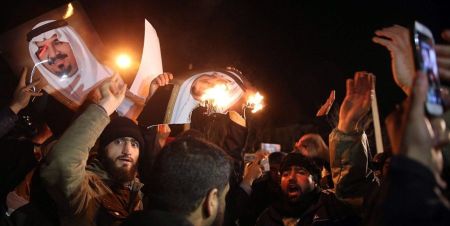
Iranian_protesters_set_fire_to_pictures_of_the_Saudi_royal_family_3.1.16

The heated verbal battle between Tehran and Riyadh over Saudi Arabia’s execution of a Shiite cleric escalated Sunday night, Jan 3, with the severance of diplomatic relations. On the broader front, the repercussions from the quarrel between the two leaders of the Muslim world’s Shia-Sunni split are widely seen in Middle East military and intelligence circles as spurring a fast-track Hizballah attack on Israel.

Among the 47 people executed by Saudi Arabia Saturday on terrorism charges was Sheikh Nimr al-Nimr, Saudi Shiite leader and a prominent Shiite cleric in the region. Put to death with him were several Saudi Shiite and Sunni activists, which enraged Iran’s supreme leader Ayatollah Ali Khamenei to the point of threatening the Saudi royal family with “divine revenge.”

From Iran’s perspective, the Saudis committed the unpardonable act of executing Shiites together with Sunni Al Qaeda and ISIS terrorists. This made the House of Saud the first ruling power ever to treat Shiite and Sunni terrorists alike. This, more than anything, incensed Iran and its Lebanese proxy Hizballah, who are deep in a bloody war against the Sunni Islamic State and the Nusra Front terrorists in Syria. Iran’s Revolutionary Guards are additionally locked in a bitter conflict with ISIS in Iraq.

The Iranian war effort is backed by the US in Iraq and by Russia in Syria.

By the mass executions of both classes of terrorist at the same time, Riyadh issued four messages:

1. Washington and Moscow are wrong. The Iranians and the forces they back in the Persian Gulf, Syria and Iraq are just as much terrorists as ISIS and Al Qaeda.

2. The House of Saud is determined to fight both with equal resolve and severity

3. Riyadh has already taken Tehran on in Yemen, and indirectly in Syria, and is now ready to take the fight against Tehran all the way to the war on terror.

4. Taking off the diplomatic gloves, Saudi Foreign Minister Adel al-Jubeir Monday night severed relations with Iran and ordered all Iranian diplomats to leave the kingdom within 48 hours. The foreign ministry said that by condemning the Nimr execution, Iran was supporting terrorism.

Saudi diplomats were already gone after protesters in Tehran torched and ransacked the Saudi embassy Saturday.

Amid all the sound and fury, Tehran’s attention was drawn to comments made by Israeli Prime Minister Binyamin Netanyahu in the light of a major terrorist attack in Tel Aviv. He pointed out that, in addition to the Palestinians, Israel is threatened by two streams of radical Islam, the Shiites and the Sunnis.

He was clearly referring to Iran and its terrorist arm, Hizballah, on the one hand, and ISIS and Al Qaeda, on the other, inspired less by the Tel Aviv outrage than by the gathering clouds of terror darkening the region, which place the Saudi royal family and Israel on the same side, sharing a similar perception of the two foes facing both countries.

Policymakers in Jerusalem noted the odd statement by Turkish President Tayyip Erdogan to reporters on Saturday, January 1 on the way home from a visit to Riyadh. After years of reviling the Jewish state, he said, “Israel is in need of a country like Turkey in the region. We have to admit that we also need Israel.”

He sounded as though he was urging the resumption of the old political and military alliance binding the two countries years ago.

DEBKAfile’s Middle Eastern sources point out that, since his comment came directly after his talks with Saudi King Salman in Riyadh, it appeared to open a path toward the possible creation of a new Middle East bloc consisting of Turkey, Saudi Arabia, perhaps Egypt, and Israel, bound by the same enemies. This grouping could serve as a counterweight against the Sunni-Shiite bloc of Iran, Iraq, Syria and Hizballah, which has the backing of the US and Russia on one hand, and fights ISIS on the other.

Iran’s leaders may curse the House of Saud without restraint, but they are canny enough not to go from words to deeds, knowing they would be on their own if they attacked the oil kingdom and earn no backing from either Washington or Moscow.

However, it might be easier for Tehran to take advantage of Netanyahu’s tough predicament in his war on terror, by sending Hizballah to strike Israel and, meanwhile, pre-empt the formation of a new anti-Tehran alliance. Speeding up Hassan Nasrallah’s promised revenge for the assassination of its master terrorist Samir Quntar would serve this purpose.

This possibility has prompted the IDF to keep artillery units pounding areas bordering on Israel during the past few days. The IDF says this action is necessary to stop Hizballah exploiting the stormy, snowy winter weather to attack Israel. Its military chiefs appear to be acting on information received of an approaching Hizballah operation as its leader has threatened.

To Strike or Not to Strike, That is the Question

December 17, 2015

To Strike or Not to Strike, That is the Question, The Investigative Project on Terrorism, Paul Alster, December 16, 2015

1310 (1)

[C]ould there still be a window of opportunity, unpalatable as much of the international community might find it, of Israel launching a pre-emptive strike against what is widely perceived as a massive and increasing threat to its security?

**********************

Israeli estimates of the number of missiles terrorist powerhouse Hizballah has in Lebanon increased last summer from 100,000 to 150,000. The Shi’ite army continues to gain strength, unhindered by the token presence of United Nations troops in what was supposed to be a de-militarized zone following the 2006 Second Lebanon War.

Hizballah’s promises of capturing the Galilee – that have inspired a feature-length Lebanese movie on the subject – are oft-repeated. The imminent release (as a result of the P5+1 nuclear deal) of billions of dollars to its guardian angel and guiding hand, the Islamic Republic of Iran, promise more money and materiel will be placed at the disposal of an organization that has already fought two vicious wars against the Jewish state, a state whose existence it refuses to recognize.

Hizballah’s growing strength, and its acquisition of advanced weapons, (undoubtedly aided of late by Russian air strikes in support of the Syrian army), has Israeli leaders thinking hard about how long they can allow such a build-up to go unchecked, and whether there is a growing case for something more than sporadic cross-border interventions to temporarily stem Hizballah’s growing firepower.

“We operate in Syria from time to time to prevent it turning into another front against us,” Israeli Prime Minister Benjamin Netanyahu acknowledged Dec. 1 at the Galilee Conference in Acre. “We act, of course, to prevent the transfer of deadly weaponry from Syria to Lebanon.”

His surprise comments came on the back of two reported airstrikes on Syrian weapons convoys – attributed to the IAF – apparently destined for Hizballah.

Two days later, Defense Minister Moshe Ya’alon again highlighted the increasing danger posed by Iran’s overt support of the Hizballah, telling members of the U.S. Congress, “We are very worried about Iran’s presence in Syria… This regime generates terrorism and undermines many of the regimes in the Middle East, and this is not good news for the region, not only Israel.”

Reports last week of Iran completing a second medium-range ballistic missile test in contravention of U.N. Security Council resolutions did little to ease Israeli fears. On Dec. 10, in another indication of the urgency with which it views the Iran-Hizballah threat, Israel successfully tested its Arrow 3 missile defense system, an extra layer of defense on top of the Iron Dome, David’s Sling, and the Arrow 2 system that may well prove critical in defending against the Iranian-made Shihab 3 longer ranger missiles.

In an exclusive interview with the Investigative Project on Terrorism, a senior IDF official – who for security reason must remain anonymous – spelled out the likely scenario should Hizballah live up to its promises and attack Israel from the north. He did not discuss the likelihood of an Israeli pre-emptive strike against Hizballah, but painted a sometimes grim assessment of what the Israeli public can expect.

“The next war will be different. As an Israeli citizen, father to two boys in the army, I really hope we will find a solution to peace in the area… but we have to deal with this,” the IDF official explained. “I believe that in the next war we will see that Hizballah and Hamas will both launch missiles. They have the same interest here.”

Earlier this month, subsequent to this interview taking place, Israel’s Channel 2 news reported that Shadi el-Meni, the Islamic State leader in the Sinai Peninsula, met with Hamas leaders to discuss increased weapons supplies to the Gaza-based terrorists. The ideological differences between the two sides seemingly set aside in the pursuit of preparing an enhanced assault on Israel.

The IDF officer suggested that during the 2014 Gaza War more than 70 percent of the Israeli population was covered by the Iron Dome as it intercepted missiles coming from the Hamas-controlled enclave. But with rockets raining down from Israel’s north and south, Iron Dome’s use would be limited. There will be occasions when civilians will not be protected when defending strategic installations take priority.

“We understand that Iron Dome next time will not do the same work,” he said, “because you will not always put it on populations; you will put it in strategic locations that we need to defend like chemical factories, and gas [installations], of course.”

Israel’s third largest metropolitan area, Haifa, is home to a huge Mediterranean port and a major Israeli naval base. Defending such a massive target will be “very hard” he said. “We have Iron Dome, the Arrow and the Patriot as well, but when you have 150,000 missiles from Lebanon, you cannot assume that every missile they will launch will [be intercepted]. This is what we need to explain to the Israeli population. A lot of [apartment blocks], a lot of industrial zones, a lot of factories will be targeted, and at the same time Hamas will launch from Gaza. This is our understanding.”

He suggested there will be sustained bouts of simultaneous rocket attacks in the north, although there is no doubt that Hizballah’s arsenal offers the capability to reach as far as Tel Aviv and Jerusalem.

“I think the enemy has [learned] very well. Today we see Hizballah fighting in Syria. Hizballah a few years ago said they are just defensive, now we see they are an offensive force. After the [2014] operations near Israel’s Gaza border, we understand that kibbutzim near the [Lebanese] border may be ‘evacuated and moved back.’ We think it is possible [Haifa] will be without electricity for 72 hours,” he continued. “No phones. No talking to your family. We have practiced evacuations to shelters and built civilians rescue teams in the towns and villages.”

Civilian teams have trained to help get people into shelters and in emergency response in Jewish towns and Arab villages alike. Haifa, for example, is home to a wide variety of communities, including around 30,000 Israeli Arabs, (both Muslim and Christian), Druze, and followers of the Baha’i faith.

“We assume everything Hizballah sees in Syria they can try to bring into Lebanon, so I assume that they will try to bring missiles such as Scuds and try and launch them all over Israel. In [the Haifa] district what we will see is the 122mm – they have thousands of these Katyushas that have a range of up to 45 kms – and that would take them from the [Lebanese] border to Tirat HaCarmel [on the south side of Haifa]. This is the main problem for the first days of the war.”

“Hizballah has advanced weapons. You don’t need to be in uniform to know that if they take the C-802 that they launched at Eilat in 2006 they will try launching it [again]. They have very good, advanced weapons, anti-tank missiles – a huge stockpile.”

And, under the cover of missile fire, the senior IDF officer said he has little doubt Hizballah will attempt some degree of land invasion.

“I think that there are maps of this,” he said. “We understand this when [Hizballah leader Hassan] Nasrallah says he will be in the Galilee and will take it from Israel. I don’t think that he will [achieve] it. So, they will take Metula, or Shlomi, or Hanita for a few hours and they’ll raise a flag. Okay, so they will launch thousands of rockets. It will be hard, but Israel will continue to exist. With Hizballah fighting in Syria in offensive attacks with tanks, infantry, UAV’s, you understand they are building a very powerful military with much practical experience.”

During the long and bloody fight against ISIS, Al Nusra and others in Syria, Hizballah has picked up large amounts of weaponry from the battlefield, weapons manufactured around the globe, some likely from the U.S. who have armed the Free Syrian Army. Whatever they captured could be fired on Israel when the war everyone expects finally breaks out.

With the exception of its border with Jordan, Israel faces non-state actors at all points of the compass. Hizballah in south Lebanon, Hizballah, ISIS and the Al Nusra Front in Syria, Hamas and Islamic Jihad in Gaza, and ISIS and al-Qaida in Sinai. There are also signs that the Fatah-run Palestinian Authority is increasingly vulnerable to radical Islamists from Hamas or ISIS as the stabbing terror spree against Israelis continues into a third month.

Could the awful Paris attacks in November have finally brought Europeans around to understanding the Israeli predicament in facing terror organizations on virtually all sides?

“I think that all over the world we have problems with radical Muslims. What we see… is a common enemy. These radical terror organizations have similar tactics and I hope the world will understand what Israel has [faced] in the last decades. I think maybe we don’t know how to explain our story [very well]. I hope that maybe now they will understand what a threat the world has, facing non-state actors and terrorist organizations – and we know it is Iran that gives money to Hizballah and tries to give them missiles to hit every place in Israel.”

The best opportunity for Israel to intervene might have presented itself last summer, when Hizballah appeared to be on the ropes.

“One can conclude that Israel may see an auspicious opportunity to make a preemptive attack to destroy Hezbollah’s massive ordnance in southern Lebanon, stockpiled since the 33-day Israel-Hezbollah war in 2006,” Iranian-Canadian political analyst Shair Shahidsaless wrote at the Huffington Post in June.

That was before the game-changing Russian entry into the conflict that has seen the balance of power sway back towards Assad and Hizballah. But could there still be a window of opportunity, unpalatable as much of the international community might find it, of Israel launching a pre-emptive strike against what is widely perceived as a massive and increasing threat to its security?

Under secret Moscow-Cairo deal, first Egyptair passenger flights to Damascus, Aleppo

December 7, 2015

Under secret Moscow-Cairo deal, first Egyptair passenger flights to Damascus, Aleppo, DEBKAfile, December 7, 2015

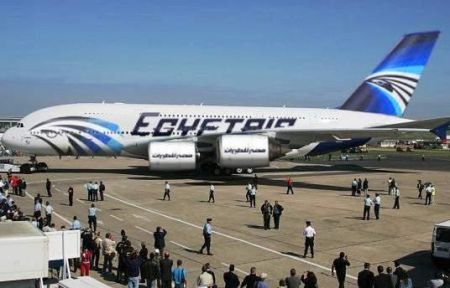
Egyptair_resume_flights_toDamascus-and-Aleppo_2.12.15

A new secret pact has taken shape in the Middle East. Last week, the offices of Russian Vladimir Putin and Egyptian President Abdel-Fatteh El-Sisi secretly formulated a tripartite accord for strengthening the ties between Moscow, Cairo and the Assad regime in Damascus, DEBKAfile’s exclusive military sources reveal. The pact had its first visible manifestation in the unannounced landings last Wednesday, Dec. 2, of the first Egyptair passenger flights at Damascus international airport and Aleppo in northern Syria.

The Egyptian national airline thus became the first of any Arab airline to renew flights to the war-torn Syrian capital since 2012. (see photo)

President El-Sisi’s gesture was tantamount to an eloquent vote of support for the Syrian ruler Bashar Assad in the face of his opponents in the Arab arena. It was also a demonstration of confidence in the Russian policy of preserving the Syrian ruler in power in the face of powerful voices in the West and the region calling for his ouster.

By sending a passenger plane to a Syrian airport, Egypt’ signaled its affirmation that Russian military intervention in Syria was making the embattled country a safer place where airliners could land without fear.

Moscow therefore attached supreme importance to the opening of the Egyptian-Syrian civilian air route, so much so that President Vladimir Putin pushed hard for it to take place ahead of the conference of Syrian rebel groups opening in Saudi Arabia Tuesday, Dec. 8.

In diplomatic communications with Riyadh, the Russians urged the Saudi hosts to prevail on the rebel groups whom they support with arms and cash to agree to enter into direct negotiations with Assad for ending the war.

Putin rewarded the Egyptian president for his gesture by ordering Russian airlines to resume their flights to Egypt. Those flights were suspended after the Russian Metrojet airliner was downed over Sinai by terrorists on Oct. 31 and 224 lives were lost in the crash. Their resumption will see Russian tourists again visiting Egypt, restoring a precious source of revenue to the strapped Egyptian economy, estimated at $5 bn per annum.

Our sources in Moscow declined to say whether the Russian passenger planes would again be calling at Sharm El-Sheikh like the ill-fated Metrojet. For the time being, they will most likely land at Cairo.

The Russian president is now trying to persuade El-Sisi to carry on making gestures for enhancing Assad’s standing.

Oh by the way, Turkey is trying to get into a war w/Iraq

December 6, 2015

Oh by the way, Turkey is trying to get into a war w/Iraq, Front Page Magazine, Daniel Greenfield, December 6, 2015

hqdefault_1

Open question: What does Turkey’s deranged Islamist leader have to do to be disavowed by NATO, Europe and the US?

Erdogan armed terrorists in Syria, but pretty much everyone is doing that. He nearly began a war with Russia. Now Iraq keeps ordering Turkish troops off its soil. But they’re there at the supposed request of Sunnis militias around Mosul. Possibly to fight ISIS. But considering Turkey’s track record and Baghdad’s protests, probably not.

It’s a given that Baghdad, which has become a puppet regime for Iran, would oppose arming Sunni militias. Its preferred means of operation is through Iranian trained Shiite militias.

Since Turkey is really in Syria to overthrow Assad, it looks like its version of the Sunni-Shiite conflict is spreading to Iraq. Essentially Turkey is advancing into a war with the Shiite axis of Iran-Syria and its Russian patron, not to mention all the various Shiite terror militias.

I won’t object if Sunni and Shiite terrorists and their state sponsors shoot and bomb each other. Especially if it’s Turkey and Iran, but as long as Turkey is in NATO, its lunatic tyrant trying to revive the Ottoman Empire has the ability to drag us into his wars.

And that’s an obvious problem.

Turkey should not be in NATO. And only a madman would consider it for EU membership.

But Erdogan’s migrant games have forced Germany to come crawling to him offering cash and EU membership acceleration.

Obama, who was once closest to Erdogan, is obviously not about to cut him off no matter what he does. But the United States is now in the strange position of having a ridiculously confused presence in a Muslim civil war.

Obama is backing Sunni Jihadists in Syria and Shiite Jihadists in Iraq. He refuses to arm Sunni militias in Iraq, but stands by while Turkey carries out what is effectively an illegal invasion of Iraq. (Remember that one the next time Kerry squeals about Jews living in Jerusalem.) He backs Kurdish militias that Turkey is bombing. He’s trying to appease Iran and Turkey at the same time and it can’t work.

The only thing Obama has managed to do is shove the United States in the middle of a Muslim civil war while making occasional noises about un-Islamic ISIS.

Was Thucydides right about democracies in peril?

November 20, 2015

Was Thucydides right about democracies in peril? National Review, Victor Davis Hanson, December 7, 2015 print issue

President Obama is not so much complacent as an appeaser of radical Islam — an identification he refuses to employ. Yet the president condemns Christianity by reminding us at prayer breakfasts of its violent Crusader roots, or he lists false glories of the Muslim world, as in his Cairo speech. Obama’s rhetoric of the last seven years has been predicated on the false assumption that his own supposed multicultural fides and his father’s Islamic connections would make him the perfect Western emissary to defuse radical Islam. This has not come to pass, as we see from the recent Paris mass murders. Never has the Middle East been more unhinged and never has the U.S. been more disliked by it.

During the Obama administration, radical Islam finally has grasped that the way to destroy Western societies is to employ Western political correctness against them, leading eventually to their paralysis — as long as the war is waged carefully, insidiously, and over decades.

************************

The historian Thucydides felt that democracies were characteristically volatile and yet complacent when existential dangers loomed on the horizon. But once faced with impending doom — such as the near collapse of Athens after the disaster of the Sicilian Expedition — they usually proved the most capable of marshaling the entire population for war. Accordingly, the recent ISIS terrorist strike in Paris — a result of lax security and failure to monitor borders — even at the eleventh hour should wake up the French to the existential danger they face.

America’s wars of the 20th century seem to confirm that ancient wisdom. A complacent, naïve, and isolationist United States came late to both world wars. Nonetheless, once engaged, the United States almost immediately amassed huge armies ex nihilo and produced unprecedented quantities of arms to ensure Allied victories in both conflicts. No other power fought in so many theaters of battle to such effect and with such consideration for reducing its own casualties.

The pattern of the ensuing Cold War was hauntingly similar: initial Western-democratic naïveté about the vicious nature of the erstwhile wartime ally the Soviet Union, precipitate post-war disarmament — and finally, during the Korean War, an abrupt remaking of the American military, characterized by the development of a sophisticated deterrent strategy that kept the global, Communist Soviet Empire contained until its collapse in 1989.

Ostensibly, that same pattern of initial blinkered indifference and lack of attention ended by sudden reawakening and panicked mobilization marked the American response to radical Islam. The fall of the shah of Iran, the subsequent Khomeini revolution, and the appeasement embraced by the Carter administration between 1979 and 1980 — all in the depressed landscape of the post-Vietnam era — illustrated how the United States was initially baffled by and indifferent to the rise of radical Islam.

At first the U.S. assumed that radical Islam was primarily an aberrant Iranian and Shiite phenomenon uncharacteristic of our Sunni and Wahhabist friends in the Gulf. Some Cold War–era analysts of the time believed that the Iranians were analogous to Marxist-inspired Palestinian terrorists of the 1960s and 1970s, even though the latter were secular and were funded and often trained by Moscow and its appendages. Later, leftists sought to cite proof of American culpability — colonialism, neo-imperialism, racism, capitalist exploitations, etc. — that might in some fashion contextualize the seemingly illogical anger of the Muslim world toward the United States.

In the 20-year interval between the Tehran hostage-taking and the cataclysmic September 11 suicide attacks, radical Islamists, of both the Shiite and Sunni varieties, declared a veritable war against the West in general and in particular the United States — most notably with the Beirut Marine-barracks/U.S.-embassy bombing (1983), the first World Trade Center bombing (1993), the Khobar Towers bombing (1996), the East Africa embassy bombings (1998), and the attack on the USS Cole (2000). But in these two decades before 9/11, radical Islamists, especially those of al-Qaeda organized by Osama bin Laden, were never directly confronted by the United States in any lethal way. Islamists were explained away as either an irritant incapable of inflicting existential damage given their lack of a nation-state arsenal or a passing phenomenon in the manner of former Middle East terrorists of the sort led by Abu Nidal against Western and especially Israeli interests.

There were grounds to be baffled at first, perhaps in the fashion of bewilderment at Hitler’s fanaticism in 1936 or Stalin’s betrayal of his wartime Western allies in 1946. After all, in the 1930s and 1940s, the Islamic Middle East had been enamored of secular fascism inspired by Nazi Germany. Subsequent Pan-Arabism, Baathism, Soviet-inspired Communism, and Palestinian nationalism were likewise mostly secular in nature. And these ideologies similarly proved transient manifestations of the Middle East constant of tribalism, poverty, statism, authoritarianism, anti-Semitism, and religious and cultural intolerance.

Why, then, at the end of the 20th century, had terrorist movements reverted back to seventh-century fundamentalism? Why was it that the wealthier the petroleum-rich Middle East became, the more globalized — and Western-oriented — communications, entertainment, and popular culture grew, the more knowledge that the Islamic world gained of relative global wealth and poverty, and the more the post–Cold War United States proved postmodern in its attitude about the causes and origins of war, all the more did radical Islamists despise the West? Islamists apparently were confident either that Western economic and military power was a poor deterrent against their own supposedly ancient martial courage or that such material and technological power would never fully be unleashed by confused elites uncertain about their own degree of culpability for the mess they found themselves in.

In any case, deterrence was lost. A 20-year path of appeasement of radical Islam inexorably led to 9/11. Then, as with past aroused democracies, 2001 seemingly changed everything, as the West seemed to gear up to restore its security and strategy of deterrence. Almost every aspect of American life was soon altered by just a handful of Islamist planners in Afghanistan and their suicide henchmen in hijacked planes, even as economic recession followed the 9/11 attacks. Intrusive new security standards changed forever the way we boarded airline flights, took the train, and visited public buildings. The Patriot Act accorded intrusive powers of surveillance to government agencies to monitor communications that fit particular criteria learned from prior terrorist attacks.

These Patriot Act measures and their affiliated protocols played a key role in ensuring that in the subsequent 14 years  there was no attack on the United States analogous to 9/11, despite horrific but isolated killings such as the Fort Hood massacre and the Boston Marathon bombing. A cultural war erupted over the causes of Islamic violence, with both Republican and Democratic administrations seeking some magical formula that might reassure the world’s billion Muslims, in and outside the West, that the United States did not see any innate connection between Islam and Islamist terrorism. Such a profession was supposed to remind the Islamic world to police its own, on the assumption that there were no logical grounds for any Muslims to hate the U.S. The age-old antithesis — that the West did not much care what the non-West thought of it as long as it understood preemptory attacks against the West were synonymous with the aggressors’ own destruction — was apparently unpalatable to a sophisticated and leisured public that even after 9/11 did not see the Islamic threat as intruding into the life of their suburb or co-op.

How, then, is the supposed war on Islamic-inspired terror currently proceeding, especially in comparison with past U.S. efforts in World Wars I and II and the Cold War? At first glance, it appears the realists were correct that Islamism is hardly an enemy comparable to the Nazis or Soviets. First, other than the case of Iran after 1980, the terrorists still have not openly and proudly assumed the reins of a large nation-state with a formidable arsenal. Second, for all the talk of the spread of WMD, they have not staged a major nuclear, biological, or chemical attack. Third, fracking and horizontal drilling inside the United States, along with petroleum price wars among Middle Eastern exporters, crashed the price of oil, robbing terrorists of petrodollars and aiding Western economies.

That price drop — coupled with a supposed Western exhaustion with war after the experience of Afghanistan and Iraq — has fooled Westerners into thinking the Middle East is now less strategically important than it has been in the past, as if most of the world were becoming as self-sufficient in oil and gas as is the United States. Are the realists correct in reminding us that we still do not face from radical Islamic terrorists an existential threat analogous to those of the 20th century during World War II and the Cold War?

In the decade and a half after September 11, the Islamists have influenced Americans far more than we them — well aside from inflicting a level of destruction inside the United States, in New York and Washington, that neither Nazi Germany nor Soviet Russia was ever able to achieve. Everyday life has been radically altered, from using public transportation to entering a government building for minor business. Westerners are losing the propaganda war: While al-Qaeda and ISIS have matched their blood-curdling rhetoric with equally savage snuff videos, we have been emasculated by euphemisms. “Death to America” is matched by “workplace violence,” “man-caused disasters,” and “overseas-contingency operations.” Jihad is redefined by American-government officials as a personal spiritual odyssey and the Muslim Brotherhood as a largely secular organization. After the Danish-cartoon attacks and the Charlie Hebdo killings, fearful Westerners are voluntarily self-censoring in a manner that Islamists themselves do not have to enforce by direct coercion.

President Obama is not so much complacent as an appeaser of radical Islam — an identification he refuses to employ. Yet the president condemns Christianity by reminding us at prayer breakfasts of its violent Crusader roots, or he lists false glories of the Muslim world, as in his Cairo speech. Obama’s rhetoric of the last seven years has been predicated on the false assumption that his own supposed multicultural fides and his father’s Islamic connections would make him the perfect Western emissary to defuse radical Islam. This has not come to pass, as we see from the recent Paris mass murders. Never has the Middle East been more unhinged and never has the U.S. been more disliked by it. Westerners are as likely to join ISIS as reformed terrorists are to enlist in the fight against the jihadists in their midst.

In other words, the Islamist threat is so far unquenchable because it has the West’s number: Radical Islam understands that the more pre-modern it becomes, the more postmodern is the likely Western response — a situation analogous to a deadly parasite that does not quickly kill but slowly sickens a host that in turn scratches at, but does not kill, the stealthy tormenter. Obama has described ISIS as a “JV” organization and al-Qaeda as “on the run.” On the eve of the Paris attacks, he deprecated ISIS as “contained,” while Secretary of State John Kerry warned that its “days are numbered.” A supposedly right-wing video maker, not a pre-planned al-Qaeda assault, explained our dead in Benghazi. Such euphemism is not just symptomatic of political correctness and an arrogant assumption that postmodern Westerners have transcended the Neanderthalism of war, but also rooted in a 1930s-like fear of expending some blood and treasure now to avoid expending far more later.

The first decade and a half of the current phase of the Islamic war were characterized by insidious alterations in Western life to accommodate low-level but nonetheless habitual terrorist attacks. As long as the Islamists did not take down another Western skyscraper, blow up a corner of the Pentagon, or kill thousands in one operation, Westerners were willing to put up with inconvenience and spend trillions of dollars in blood and treasure on anti-terrorism measures at home and the killing abroad of thousands of Islamists from Kabul to Baghdad.

But conflicts that do not end always transmogrify, and the war on terror of 2015 is not that of 2001, much less that of 1979.

Time for now is on the Islamists’ side. Not if but when Iran will acquire nuclear weapons is the question. Not if but when ISIS strikes a major American city is what’s in doubt. As America abdicates from its role in the Middle East, Vladimir Putin creates an Iran–Syria–Hezbollah arc of influence, reassuring the terrified Sunni Gulf states that he is a far better friend — and could be a far worse enemy — than the United States.

More important, Russia, Iraq, and Iran — and the Gulf monarchies — could act in concert under the aegis of Putin and thereby control 75 percent of the world’s daily exports of oil. It is also conceivable that ISIS could fulfill something akin to its supposedly JV notion of creating a caliphate, given that it has already carved out a rump state from Syria and Iraq. A nuclear Iran could play the berserker role with Russia of a crazy nuclear North Korea cuddling up to China. Meanwhile, our new relationship with Iran makes it hard to partner with moderate Sunni states against ISIS, given that the Iranians enjoy the bloodsport that ISIS plays among both Westerners and Sunni regimes.

In short, on four broad fronts — the emergence of terrorist nation-states, the acquisition of nuclear weapons, the global reach of terrorists, and the ability to alter global economic contours — the Islamists are making more progress than at any time in the last 35 years.

Was Thucydides, whose notions of democracy were echoed from Aristotle to Winston Churchill, correct that democracies in the eleventh hour galvanize to meet existential threats?

So far, not this time. During the Obama administration, radical Islam finally has grasped that the way to destroy Western societies is to employ Western political correctness against them, leading eventually to their paralysis — as long as the war is waged carefully, insidiously, and over decades. In their various rantings, Osama bin Laden and his successor Ayman al-Zawahiri referenced the Western failure both to enact campaign-finance reform and to address global warming — topics not usually associated with the agendas of radical Islam. While ISIS mowed down Parisians, Al Gore was on the top of the Eiffel Tower doing a marathon webcast about the existential danger of climate change and prepping for a Parisian global conference that will now take place amid the detritus of a recent mass terrorist attack — all echoing President Obama’s assertion that the greatest danger to our security is carbon, not radical Islamic terrorism.

The war will be lost when listless and weak Westerners no longer realize that they are in a war but have largely become exactly what their enemies had envisioned them to be all along.

ISIS launches its winter terror offensive with first 274 deaths

November 13, 2015

ISIS launches its winter terror offensive with first 274 deaths, DEBKAfile, November 13, 2015

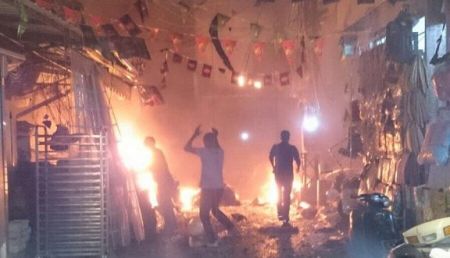
Borj_al-Barajneh12.11.15Suicide bombers strike Hizballah in Beirut
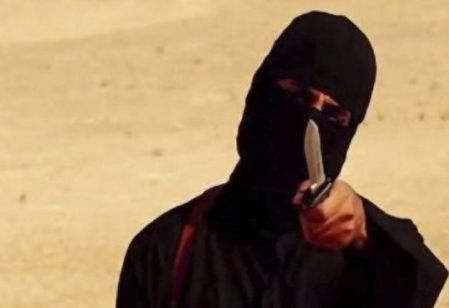
Execution of Steven Sotloff (1983 – 2014) by Jihadi John of ISIS. In August 2013, Sotloff was kidnapped in Aleppo, Syria, and held captive by militants from the Islamic State of Iraq and the Levant. Jihadi John (Mohammed Emwazi, born August 1988) a British man who is thought to be the person seen in several videos produced by the Islamic extremist group ISIL showing the beheadings of a number of captives in 2014 and 2015. (Photo by Universal History Archive/UIG via Getty Images)

Execution of Steven Sotloff (1983 – 2014) by Jihadi John of ISIS. In August 2013, Sotloff was kidnapped in Aleppo, Syria, and held captive by militants from the Islamic State of Iraq and the Levant. Jihadi John (Mohammed Emwazi, born August 1988) a British man who is thought to be the person seen in several videos produced by the Islamic extremist group ISIL showing the beheadings of a number of captives in 2014 and 2015. (Photo by Universal History Archive/UIG via Getty Images)

The US drone strike Thursday night, Nov. 11, targeting the Islamic State’s infamous executioner known as “Jihad John” in the northern Syrian town of Raqqa may or may not have hit the mark – the Pentagon says it is too soon to say. The hooded, masked terrorist with the British accent has been identified as a British Muslim born in Kuwait called Mohamed Emwazi. He appeared on videos worldwide showing the cold-blooded murders of US, British, Japanese and other hostages.

The drone attack occurred shortly after the latest ISIS atrocity: Thursday night, two or three suicide bombers blew themselves up, killing 43 people and injuring at least 240 in the Hizballah stronghold of southern Beirut opposite Burj Barajneh.

Ten days earlier, the Islamic State brought down the Russian Metrojet airliner over Sinai killing all 224 people aboard. This spectacular act of terror was apparently the first strike of the jihadist group’s winter offensive. It achieved its objectives of multiple murder; mortal damage to Egypt’s tourism industry and a blow to the prestige of its president Abdel-Fatteh El-Sisi.

The attack also punished President Vladimir Putin for bringing the Russian military into the center of the Syrian conflict.

The next Islamic State assault was aimed to undermine the credibility of Jordan’s King Abdullah and his security services: On Nov. 8,  a Jordanian police captain opened fire at a high-security US training facility outside Amman, killing two American trainers, a South African and two Jordanians. The number of US personnel injured in the attack was not released. This attack was timed to coincide with the 10thanniversary of the massive al Qaeda assault on Amman’s leading hotels, all American owned, which left 61 dead.

In northern Sinai, the murder of a family of 9 Egyptians at El Arish Thursday morning raised the total of ISIS murders in less than a month to 274.

DEBKAfile’s counterterrorism sources discern three objectives in the attack Thursday night in Beirut

1. A lesson for Tehran and Hizballah’s leader Hassan Nasrallah to show them that the Islamic State is able to reach them on their home ground, no matter how many troops they deploy to fight the jihadis in Syria (Iran and Hizballah together field an estimated 13,000 soldiers in Syria). ISIS was capable of inflicting terrible casualties both on the battlefield and in their homeland, first in Beirut and eventually in Tehran.

2.  The day before, Wednesday, Nov. 11, in a speech marking the “Day of the Shahid,” Nasrallah gloated over Hizballah’s triumph in a battle outside Aleppo. He also boasted that his domestic security shield in Lebanon presented an impenetrable barrier against ISIS or Nusra Front terrorist intrusions.

The Islamic State’s tacticians determined to blow up both claims in Nasrallah’s face. He and Iran were to be shown that they could not stop ISIS or prevent the Syrian war’s spillover into Lebanon.

3.  By blowing up the Russian airliner over Sinai, the Islamists sought to underscore this point for Moscow too. Russia might send a powerful military force to Syria, but the Islamists would hit Putin from the rear at a location of its choosing anywhere in the Middle East. Moscow may have opted to defend Bashar Assad, but what can it do to protect Hizballah and its other allies?.

DEBKAfile’s counterterrorism sources note that US and Russia have taken lead roles in the broad military effort to defeat ISIS – often by means of pinpointed operations. At the same time, under their noses, the Islamist terrorists have launched their winter campaign, striking with extreme ferocity and agility in unexpected places that are outside the regular battle fronts in which the big powers are engaged.

Russia warns that Syria war could become a ‘proxy war’

November 1, 2015

Russia warns that Syria war could become a ‘proxy war’ BreitbartJohn J. Xenakis, November 1, 2015

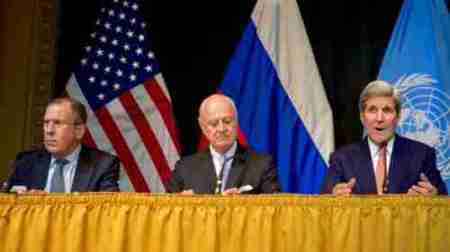
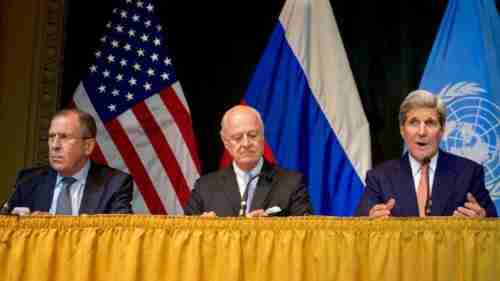
g151031bL-R: Sergei Lavrov, United Nations Special Envoy for Syria Staffan de Mistura, and John Kerry in Vienna on Friday (state.gov)

Russia has poured millions of dollars of heavy weapons into Syria, and is now sending in Russian troops to establish bases there. Recently, Russia launched 27 cruise missiles from the Caspian Sea to targets in Syria. Iran is pouring new troops into Syria. Iran has also given Lebanon’s Hezbollah terrorist group a great deal of money, and Hezbollah has sent thousands of troops into Syria to support Syria’s president Bashar al-Assad.

Al-Assad’s genocidal attacks on innocent Syrian Sunnis, killing hundreds of thousands and forcing millions from their homes, has caused Sunni jihadists from all of the world to fight against al-Assad, Russia, Hezbollah, and Iran in Syria. Along the way, these jihadists formed the so-called Islamic State (IS or ISIS or ISIL or Daesh).

And now, on Friday, Russia’s Foreign Minister Sergei Lavrov made a pronouncement that Barack Obama was going to trigger a “proxy war” in Syria by sending in 50 special operations forces, as we reported yesterday.

You can’t make this stuff up.

Thanks to Iran, Russia, al-Assad and Hezbollah, there are now tens of thousands of foreign troops fighting each other in Syria, with al-Assad in particular supported by massive amounts of foreign weapons.

But somehow, those tens of thousands of foreign fighters don’t make it a “proxy war,” but America’s 50 special forces troops do.

You can’t trust any garbage that comes out of Lavrov’s mouth, or out of al-Assad’s mouth, or out of Vladimir Putin’s mouth, but I listen to BBC, al-Jazeera, FOX, CNN, and other media sources all the time, and I see these news anchors report this crap with a straight face all the time. I don’t know whether it is more sickening to watch those fatuous news anchors, or to watch the fawning Secretary of State John Kerry suck up to Lavrov and Putin, which has happened in issues involving Ukraine, Iran’s nuclear development, and Syria.

All this verbiage is coming out of a meeting in Vienna whose purpose is to find a “political solution” to the Syria problem. With hundreds of thousands of Syrian migrants pouring into Europe, and with hundreds of ISIS militants returning to Russia to fight Putin, there is a lot of pressure to find a “political solution.” But this week’s announcement that Iran will fully enter the war in Syria on the side of the Syrian regime makes any “political solution” farther away than ever. On the contrary, Saudi Arabia and other Gulf countries will never agree to anything like the emerging situation. Actions by Russia and Iran, intervening militarily in Syria, is an emerging disaster, likely triggering a sectarian Sunni versus Shia war throughout the region. BBC and International Business Times and Reuters

Syria’s civil war and Generational Dynamics

In the 12 years that I’ve been doing this, I’ve posted about 4,000 articles with hundreds of Generational Dynamics predictions.

In 2011, when the Syrian civil war began, I said that the war should fizzle within a year or two. Of all the hundreds of Generational Dynamics predictions, this is the one where I’ve clearly been (depending on how you look at it) either wrong or poorly described.

Syria’s last generational crisis war was civil war that climaxed in 1982 with the massacre at Hama. There was a massive uprising of the 400,000 mostly Sunni citizens of Hama against Syria’s president Hafez Assad, the current president’s father. In February, 1982, Assad turned the town to rubble, 40,000 deaths and 100,000 expelled. Hama stands as a defining moment in the Middle East. It is regarded as perhaps the single deadliest act by any Arab government against its own people in the modern Middle East, a shadow that haunts the Assad regime to this day.

(As a related matter, the civil war in Lebanon also climaxed that year, with the bloody massacre at Sabra and Shatila occurring in September 1982. And it occurred as the Iran/Iraq war was ongoing, three years after Iran’s bloody Great Islamic Revolution in 1979. At that time, much of the Mideast was re-fighting World War I and the collapse of the Ottoman Empire, 60 years earlier.)

So, in 2011, I said that the civil war in Syria would fizzle, and could not turn into a crisis civil war. And that’s both wrong and true. There are too many survivors who remember the 1982 slaughter, and do not want to see it repeated. And so there’s been no massive anti-government uprising, as there was in 1982, and Bashar al-Assad’s Shia/Alawite troops have been fighting half-heartedly, with many soldiers defecting or deserting.

But the war did not fizzle.

It should have fizzled in 2011 or 2012, but Hezbollah and Iran starting pouring troops in to support al-Assad. And foreign fighters from around the world arrived to fight al-Assad and to form ISIS. That’s not something that Generational Dynamics could have predicted.

Earlier this year, it looked like al-Assad’s army was near collapse. In July, a desperate al-Assad gave a national speech in which he admitted he was losing. The war should have fizzled this year. But now, Russia and Iran are pouring tens of thousands more troops into Iran to bolster al-Assad. And that also is not something that Generational Dynamics could have predicted.

So the problem for me is: How should I have characterized the situation in 2011? The prediction that it wouldn’t turn into a crisis civil war was correct, but the war did not fizzle, because it turned into a proxy war.

Well, I don’t think there’ll be a next time, but if there is, I’ll try to characterize the situation differently, without simply using the word “fizzle.” NPR (1-Feb-2012)

Generational Dynamics and crisis civil wars

I write about a number of civil wars going on in the world today, so this is a good time to discuss civil wars from the point of view of Generational Dynamics.

Among generational crisis wars, an external war is fundamentally different than a civil war between two ethnic groups. If two ethnic groups have lived together in peace for decades, have intermarried and worked together, and then there is a civil war where one of these ethnic groups tortures, massacres and slaughters their next-door neighbors in the other ethnic group, then the outcome will be fundamentally different than if the same torture and slaughter is rendered by an external group. In either case, the country will spend the Recovery Era setting up rules and institutions designed to prevent any such war from occurring again. But in one case, the country will enter the Awakening era unified, except for generational political differences, and in the other case, the country will be increasingly torn along the same ethnic fault line.

The period following the climax of a crisis war is called the “Recovery Era.” One path that the Recovery Era can take is that the leader of one ethnic group decides that the only way to prevent a new civil war is for him to stay in power, and to respond to peaceful anti-government demonstrations by conducting massive bloody genocide, torture and slaughter of the other ethnic group, in order to maintain the peace. (Dear Reader, I assume you’ve grasped the irony of the last sentence.)

For example, in a July article about Burundi, I described how Burundi’s Hutu president Pierre Nkurunziza was using such violence to quell Tutsi protests, supposedly to avoid a repeat of the 1994 Rwandi-Burundi genocidal war between Hutus and Tutsis.

As another example, in a June article about Zimbabwe, I described how Zimbabwe’s president Robert Mugabe was even worse. His 1984 pacification campaign was known as “Operation Gukurahundi” (The rain that washes away the chaff before the spring rain). During that campaign, accomplished with the help of Mugabe’s 5th Brigade, trained by North Korea, tens of thousands of people, mostly from the Ndebele tribe, were tortured and slaughtered. Later, Mugabe single-handedly destroyed the country’s economy by driving all the white farmers off the farms, resulting in one of the biggest hyperinflation episodes in world history.

That is what Bashar al-Assad is doing in Syria. Fearing a Sunni uprising, like the one in 1982, al-Assad is conducting a massive “peace campaign” by slaughtering and displacing millions of innocent Sunnis. As I wrote above, this should have fizzled in 2011 or 2012, but it’s turned into a proxy war, and it’s a disaster for the Mideast and the world.

But none of the above three examples is a crisis civil war. A crisis war has to come from the people, not from the politicians. So, for example, there’s a massive crisis civil war going on today in Central African Republic (CAR), between the Muslim ex-Seleka militias fighting Christian anti-Balaka militias.

Unlike the previous examples, CAR is in a generational Crisis era. CAR’s last generational crisis war was the 1928-1931 Kongo-Wara Rebellion (“War of the Hoe Handle”), which was a very long time ago, putting CAR today deep into a generational Crisis era, where a new crisis war is increasingly likely. That’s why the CAR is a genuine crisis civil war, and won’t fizzle out. In fact, it won’t end until it has reached some kind of explosive conclusion — of the kind we described in Hama or Sabra and Shatila. ( “2-Oct-15 World View — Violence resurges in Central African Republic crisis war”)

Generational Dynamics and war between Palestinians and Israelis

I’ll discuss one more example — not a civil war, but very similar to a civil war, with the same kinds of issues.

In the last few years, there have been three non-crisis wars between Israelis and Palestinians in Gaza. In each case, the Israelis destroyed Hamas’s infrastructure, ending the war. The war began again each time when Hamas’s infrastructure was rebuilt.

But the point I want to make is that these three non-crisis wars were all directed by politicians. Palestinians attacked when the leadership told them to, and stopped attacking when the leadership told them to stop.

What I have been describing in numerous articles recently is that there is emerging a major, fundamental, historic change.

In the emerging situation, young people today are no longer willing to listen to these leaders. According to the CIA World Fact Book, 20% of Gaza’s population are in the 15-24 age range, and so are 21% of the West Bank — about 200,000 males in each territory, or 400,000 young males total.

On the Israeli side, there are over 600,000 young males in the same age range. There have been unconfirmed reports of young Israelis also disgusted with the leadership. It is possible that, like the young Palestinians, they are willing to take matters into their own hands.

So in this environment, what could happen next? The last three Gaza wars were non-crisis wars, but the next one could be a crisis war between Israelis and Palestinians.

How can a crisis war begin? How about if those 200,000 young male Gazans blow holes in the walls, pour across into Israel and start killing Israeli citizens en masse in their homes and villages? And how about if they are joined by those 200,000 young male Palestinians on the West Bank, who start with the Jewish settlers and continue with the Jews in Jerusalem. And how about if the young Israeli males strike back and start killing Palestinians in their homes and villages?

Israel’s tanks and bombers would not be of much use. You can’t bomb Jerusalem, and you can’t bomb Israeli villages and settlements to kill Palestinians.

That is the difference. That is what a generational crisis war is like. It is not two tanks shooting at each other. It is hand to hand combat in homes, neighborhoods and streets by people armed with sticks and knives. It is what happened in Central African Republic last year, it is what happened in Rwanda in 1994, in Bosnia in 1994, and in Palestine in 1947.

And by the way, that assumes that the bloody mess stays confined to Israel and the Palestinian territories. The Palestinians are likely to be joined by tens or hundreds of thousands from Jordan, Lebanon and Egypt.

The recent widely reported changes in the attitudes and behaviors of young Palestinians is a sign that this kind generational crisis war is coming.
The New Cold War: The Russia-Shia Alliance VS the Islamic State

November 1, 2015

The New Cold War: The Russia-Shia Alliance VS the Islamic State, Counter Jihad Report, Brian Fairchild, October 31, 2015

(An excellent summary and analysis of the consequences of the Obama Middle East vacuum. — DM)

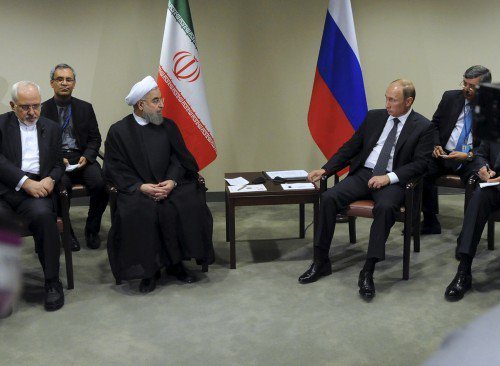
rtx1sy30_iran_russia_un_092015-e1443810243164Russia’s President Vladimir Putin (2nd R) meets with Iran’s President Hassan Rouhani (2nd L) on the sidelines of the United Nations General Assembly in New York, September 28, 2015. REUTERS/Mikhail Klimentyev.

Just one month ago, the US was the only major military player in the Middle East, but that has all changed.  Russia’s aggressive and well-planned military campaign in Syria has tilted the balance of power in the region away from the US and toward Russia and its new Shia-dominated quadrilateral alliance.  As a result, the US plan to effect regime change in Syria is now impossible, but more importantly, US influence in Iraq is steadily diminishing, and thus, the number of options available to American military commanders to degrade the Islamic State are also diminishing.

***********************

The New Cold War:

In late-September 2015 Russia and Iran launched a clandestine strategic military campaign to support Syria’s Bashar al-Assad.  Russia’s bold move took the West by surprise and changed the balance of power in the Middle East in Russia’s favor.  It will go down in history as the milestone depicting Russia’s first aggressive military action outside of its own sphere of influence since the fall of the Soviet Union, and, when viewed from a global strategic perspective, will be remembered as the first clear sign that a New Cold War had erupted between the US and Russia.

Russia’s Middle Eastern campaign is formed around the new “quadrilateral alliance”, which has divided the region into two sectarian blocs:  the Russian-led Shia Muslim alliance, which forms a powerful “Shia Crescent” stretching from Iraq, through Iran and Syria, to Lebanon, and the Sunni Arab bloc led by Saudi Arabia with minimal backing by the United States.

Thus far, Russia’s campaign has been executed seamlessly. Upon entering Syria clandestinely, Russian forces immediately deployed sophisticated surface to air missile defense batteries as well as top-of the-line jet fighters to protect Russian and Syrian forces from the US coalition.  Once air defenses were in place, Moscow began a barrage of airstrikes targeting anti-Assad rebels in order to re-establish and consolidate Assad’s power.  The airstrikes were subsequently integrated with ground operations carried-out by Syrian military units, Iranian Quds forces, Shia militia from Syria and Iraq, and Hezbollah fighters.  There are also credible news reports that Cuban Special Forces have joined the fray for the first time since Cuba’s proxy wars in Angola and central Africa in the 1970’s on behalf of the Soviet Union.

The Russia-Shia Alliance and its Effect on Iraq, Jordan, and the Kurds:

Iraq:

In tandem with its military campaign, Russia launched a diplomatic campaign that has been just as effective.  Iraq is the geographical base for US coalition operations against the Islamic State in Iraq and Syria, but American influence in Iraq has steadily diminished over the past year.

In early October 2015, Iraq secretly established a new Russia-Iran-Syria-Iraq intelligence center in the middle of Baghdad that surprised and angered American military commanders.  Worse, after Russia’s increasingly effective Syrian air campaign, Iraqi Prime Minister Haider al-Abadi called for Russia to begin unilateral airstrikes against the Islamic State in Iraq.  The Pentagon became so alarmed by the possibility that Russia might get a strategic foothold in Iraq that on October 21, 2015, it dispatched Chairman of the Joint Chiefs of Staff General Joseph Dunford to Baghdad to deliver an ultimatum to the Iraqi leadership.  Dunford told the Iraqi Prime Minister and Defense Minister that Iraq had to choose between cooperating with Russia or the US.  Upon his departure from Baghdad, General Dunford told the media that he received assurances that Iraq would not seek Russian assistance, but just three days later, Iraq officially authorized Russian airstrikes in-country.

Jordan:

On that same day, another of America’s most dependable allies, the Kingdom of Jordan, announced its agreement to create a new Russian-Jordanian military coordination center to target the Islamic State and that this center would go well beyond just a formal information exchange.  According to Jordan’s Ambassador to Russia:

  • “This time, we are talking about a specific form of cooperation — a center for military coordination between two countries. Now we will cooperate on a higher level. It will not be just in a format of information exchange: we see a necessity ‘to be on the ground’ as Jordan has a border with Syria”

The Kurds:

Moscow is attempting to undermine US relations with the Kurds.  Since the rise of the Islamic State, the US has sought to provide anti-Islamic State military support to the Kurdish Regional Government (KRG) in northern Iraq via the Iraqi central government, but the Iraqi government has no desire to see the KRG gain additional power in the north so this mission has been largely ineffective.  The US has had a measure of success providing limited support to the Kurdish People’s Protection Units (YPG), but has balked at providing full support because any support whatsoever angers Turkey due to contacts between the YPG and the Kurdish Worker’s Party (PKK), a separatist organization, that seeks to overthrow the Turkish government.  On October 29, 2015, Turkish president Erdogan demonstrated this anger when he vehemently criticized US support for the YPG and stated that Turkey would attack the YPG on the Iraqi side of the border if it attempts to create a separatist Kurdish administrative zone.  Because Turkey is a NATO ally, Turkish threats cause the US significant political and diplomatic problems, but they will not deter Putin from moving to organize and utilize Kurdish forces in pursuit of his goals; in early October, he went out of his way to show disdain for Turkey and NATO by allowing his Syrian-based jets to illegally invade Turkish airspace.

No Kurdish group is happy with the current situation of getting limited support from the United States to fight the Islamic State, but all of them have expressed interest in cooperating with Russia.  Significantly, Sergey Ivanov, the head of the Kremlin administration, specifically urged cooperation between the Syrian Kurdish militia and the US-backed YPG.

The Russia-Shia Alliance and the Islamic State:

The Shia composition of the quadrilateral alliance is extremely significant because it plays directly into the Islamic State narrative.  The Islamic State and the majority of the world’s Muslims are Sunni, but in the heart of the Middle East, the Shia governments of Iran, Iraq, Syria, and Lebanon, with Russian support, dominate, and these countries surround the Islamic State’s new “caliphate” on three sides.  Understanding this strategic disadvantage, the Islamic State knows that it must muster as much international Sunni support as possible to survive, so it carries-out a relentless policy to polarize the international Sunni population against the Shia.

The chance to remove Bashar al-Assad, who represents the Shia Alawite sect, was the primary reason the Islamic State moved to Syria from Iraq, and removing al-Assad from power served as its initial rallying cry to the global Sunni community.  It was this rallying cry that created the dangerous “foreign fighter” phenomenon that subsequently brought more than 30,000 radical Sunni Muslims from around the world to the new caliphate.

The Islamic State repeatedly emphasizes in its official publications and statements its contention that Shia Muslims are not true Muslims and must be eradicated, and, in these communications, it refers to Shia Muslims as “Rafidah” (rejecters).  But of all the Shias in the world, the Islamic State has a particular hatred for the Shia Iranians, who are Persian rather than Arab, and who ruled Islam during the ancient Safavid (Persian) empire, which the Islamic State regards as religiously illegitimate.  It therefore refers to Iranians as the “Safavid Rafidah”.

Moreover, the Islamic State accuses the US and Russia of being modern day “crusaders” who have joined forces with the Iranians to destroy Sunni Islam, a contention made clear on March 12, 2015, when its spokesman Abu Mohamed al-Adnani stated:

  • The Safavid Rāfidah (Shia Iranians) today have entered a new stage in their war against the Sunnis. They have begun to believe that it is within their power to take areas of the Sunnis and control them completely. They no longer want a single Muslim from the Sunnis living in the empire they desire…O Sunnis…if the Islamic State is broken…then there will be no Mecca for you thereafter nor Medina…Sunnis! The Crusader-Safavid (Christian-Iranian) alliance is clear today.  Here is Iran with its Great Satan America dividing the regions and roles amongst each other in the war against Islam and the Sunnis…We warned you before and continue to warn you that the war is a Crusader-Safavid was against Islam, and war against the Sunnis…”

The Shia Alliance and the Saudis:

Saudi Arabia considers itself to be the leader of the world’s Sunni population and the custodian of Islam’s two most holy places:  the mosques of Mecca and Medina where the prophet Muhammad received Allah’s revelations.  Because Iran is the Kingdom’s religious and regional nemesis the Islamic State’s anti-Shia narrative resonates greatly among many Saudis who are increasingly alarmed at Iran’s growing military influence and power.  In a letter signed by 53 Saudi Islamic scholars in early October 2015, the clerics lashed out at Iran, Syria and Russia and echoed the main points made by the Islamic State:

  • “The holy warriors of Syria are defending the whole Islamic nation. Trust them and support them … because if they are defeated, God forbid, it will be the turn of one Sunni country after another”

Saudi King Salman was willing to allow this unofficial letter to be published because it permitted the Saudi government an indirect manner to issue a warning to Iran, but as the Russian-Iran alliance continued to make military gains throughout October, the Kingdom’s anxiety was such that it decided to allow its Foreign Minister to issue the following direct warning to Iran:

  • “We wish that Iran would change its policies and stop meddling in the affairs of other countries in the region, in Lebanon, Syria, Iraq and Yemen…We will make sure that we confront Iran’s actions and shall use all our political, economic and military powers to defend our territory and people…”

Conclusion:

The New Cold War:

Just one month ago, the US was the only major military player in the Middle East, but that has all changed.  Russia’s aggressive and well-planned military campaign in Syria has tilted the balance of power in the region away from the US and toward Russia and its new Shia-dominated quadrilateral alliance.  As a result, the US plan to effect regime change in Syria is now impossible, but more importantly, US influence in Iraq is steadily diminishing, and thus, the number of options available to American military commanders to degrade the Islamic State are also diminishing.

Five days after Iraq rejected General Dunford’s ultimatum and authorized Russian airstrikes in Iraq, Secretary of Defense Ashton Carter ignored this fact in his testimony before the Senate’s Armed Forces Committee when he stated that the United States plans to increase the number of airstrikes in Iraq as well as direct action raids by US special operations forces in Iraq.

Unfortunately, such an increase in US military actions require Iraqi permission, and for the second time in a week, Iraq rejected the United States.  On October 28, 2015, Prime Minister al-Abadi’s spokesman told the media that Iraq has no intention of allowing increased American participation because:

  • “This is an Iraqi affair and the government did not ask the U.S. Department of Defense to be involved in direct operations…”

If Iraq enforces this restriction, and limits the US to only training and arming Iraqi forces while allowing Russia to conduct aggressive operations in-country, the situation could become untenable for the United States, further reducing America’s ability to degrade the Islamic State.

The Islamic State:

Once Russia consolidates Assad rule in Syria, Putin will undoubtedly use the new Russia-Shia alliance to move against the Islamic State.  Because the alliance dominates the geographical terrain on three sides of the “caliphate” and has demonstrated a willingness to engage in unified military air and ground operations, it is likely that Russian airpower and Shia ground forces will succeed in dismantling many Islamic State elements in Syria and Iraq.

Such success by the Russia-Shia alliance, especially if it forces the evacuation of the capital of the Islamic State’s “caliphate” in Raqqa, Syria, will further polarize and enrage radical Sunnis and likely increase the number of foreign fighters from Europe and the Middle East.  It will also likely result in more domestic lone jihad attacks in the US and Russia, a call the Islamic State has already made in its October 13, 2015statement:

  • “…the Islamic State is stronger today than yesterday, while at the same time America is getting weaker and weaker…America today is not just weakened, it has become powerless, forced to ally with Russia and Iran…Islamic youth everywhere, ignite jihad against the Russians and the Americans in their crusaders’ war against Muslims.”

If the Islamic State experiences set-backs and defeats in Syria and Iraq such defeats would likely motivate it to launch mass casualty attacks in the United States and Europe in order to prove to its followers that it remains relevant. Mass casualty attacks in tandem with increased lone jihad attacks would make an already bad domestic security situation, grave.

On October 23, 2015, FBI Director Comey revealed that the FBI is pursuing approximately 900 active cases against Islamic State extremists in the United States and that this number continues to expand.  Comey added that should the number of cases continue to increase, it won’t be long before the FBI lacks the adequate resources to “keep up”.   Europe, too, faces grave security challenges.  A few days after Comey’s revelations, the head of MI5, Britain’s domestic intelligence service, stated that the terror threat in the United Kingdom from the Islamic State and al Qaeda is the highest he has “ever seen”.