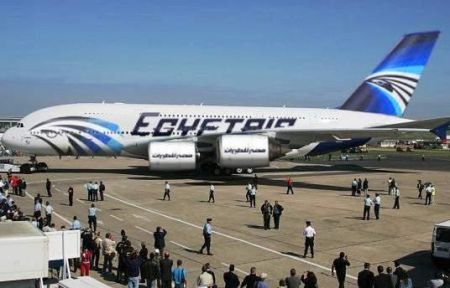
A new secret pact has taken shape in the Middle East. Last week, the offices of Russian Vladimir Putin and Egyptian President Abdel-Fatteh El-Sisi secretly formulated a tripartite accord for strengthening the ties between Moscow, Cairo and the Assad regime in Damascus, DEBKAfile’s exclusive military sources reveal. The pact had its first visible manifestation in the unannounced landings last Wednesday, Dec. 2, of the first Egyptair passenger flights at Damascus international airport and Aleppo in northern Syria.
The Egyptian national airline thus became the first of any Arab airline to renew flights to the war-torn Syrian capital since 2012. (see photo)
President El-Sisi’s gesture was tantamount to an eloquent vote of support for the Syrian ruler Bashar Assad in the face of his opponents in the Arab arena. It was also a demonstration of confidence in the Russian policy of preserving the Syrian ruler in power in the face of powerful voices in the West and the region calling for his ouster.
By sending a passenger plane to a Syrian airport, Egypt’ signaled its affirmation that Russian military intervention in Syria was making the embattled country a safer place where airliners could land without fear.
Moscow therefore attached supreme importance to the opening of the Egyptian-Syrian civilian air route, so much so that President Vladimir Putin pushed hard for it to take place ahead of the conference of Syrian rebel groups opening in Saudi Arabia Tuesday, Dec. 8.
In diplomatic communications with Riyadh, the Russians urged the Saudi hosts to prevail on the rebel groups whom they support with arms and cash to agree to enter into direct negotiations with Assad for ending the war.
Putin rewarded the Egyptian president for his gesture by ordering Russian airlines to resume their flights to Egypt. Those flights were suspended after the Russian Metrojet airliner was downed over Sinai by terrorists on Oct. 31 and 224 lives were lost in the crash. Their resumption will see Russian tourists again visiting Egypt, restoring a precious source of revenue to the strapped Egyptian economy, estimated at $5 bn per annum.
Our sources in Moscow declined to say whether the Russian passenger planes would again be calling at Sharm El-Sheikh like the ill-fated Metrojet. For the time being, they will most likely land at Cairo.
The Russian president is now trying to persuade El-Sisi to carry on making gestures for enhancing Assad’s standing.
Russian President Vladimir Putin lashed out at “part of the leadership in Turkey” during his annual address to the parliament, accusing Ankara of having trade ties with terrorist groups in Syria and Iraq. He also promised more sanctions for Turkey over downing of the Russian jet.
Putin said Russia still cannot comprehend why the downing of the plane happened.
“We were prepared to cooperate with Turkey on most sensitive issues and go further than their allies. Allah knows why they did it. Apparently Allah decided to punish the ruling clique in Turkey by taking their sanity,” Putin said.
Putin stressed that Moscow’s anger over the incident is directed at particular individuals and not at the Turkish people.
“We have many friends in Turkey,” he said. “They should know that we do not equate them and part of the current Turkish leadership, which holds a direct responsibility for the deaths of our troops in Syria,” he said.
He added that the killing of Russian officers would have long-term consequences for those responsible.
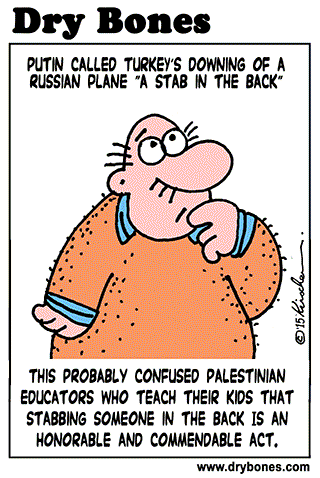
“We will not forget this aid to terrorists. We have always considered betrayal the worst and most shameful act. Let those in Turkey know it who shot our pilots in the back, who hypocritically tries to justify themselves and their actions and cover up the crimes of terrorists,” he said.
Putin said Russia would not resort to saber-rattling to respond to the Turkish actions, but neither would it limit itself to the economic sanctions it imposed since the incident.
The incident with the Russian Su-24 bomber shot down by Turkish warplanes near the Turkish-Syrian border has greatly deteriorated relations between the two countries. Turkey insists it acted in response to a brief violation of its airspace and was justified in using lethal force. Russia insists no violation took place and has accused Turkey of supporting terrorists in Syria.
The downing of the bomber resulted in the deaths of two Russian troops, who were the first combat losses during the two month-long Syrian campaign. The pilot of the downed plane was killed by a pro-Turkish militant group as he was parachuting to the ground. A marine was killed by militants when a helicopter dispatched to rescue the bomber crew came under fire from the ground.
Putin’s address started with a minute’s silence to commemorate the two troops. The widows of the dead Russians were present at the event.
Putin stressed that the Russian operation in Syria is aimed first and foremost at preventing fighters who went to the Middle East from Russia and its neighboring countries from returning home and bringing the threat of terrorist attacks to Russian soil.
“They are getting money, weapons, gathering strength. If they get stronger, winning there, they will inevitably come here to sow fear and hatred, blast, kill and torture people,” Putin said.
Putin called on all nations that have pledged to fight terrorism to join forces and abandon the notion that terrorist groups can be used for country’s own goals. He stressed that the rise of terrorism in the Middle East over the last few years was caused to a large degree by foreign meddling.
“Some countries in the Middle East and North Africa, which used to be stable and relatively prosperous – Iraq, Libya, Syria – have turned into zones of chaos and anarchy that pose a threat to entire world,” Putin said.
“We know why it happened. We know who wanted to oust unwanted regimes, and rudely impose their own rules. They triggered hostilities, destroyed statehoods, set people against each other and simply washed their hands [of the situation] – giving way to radicals, extremists and terrorists.”
Russia’s lost thousands of lives over two decades of terrorist attacks and is still not safe from terrorist attacks, as evidenced by the bombings in Volgograd in 2014 and the bombing of a Russian passenger plane in Egypt in October, Putin reminded.
“Breaking the bandits’ back took us almost 10 years,” he said. “We practically pushed the terrorists out of Russia, but we are still engaged in a fierce fight against the remainder of the gangs. This evil still comes back occasionally.”
Putin said the rise of jihadists in the Middle East in our time is not unlike the rise of Nazism in the mid-20th century, and that the world should learn from the mistakes of the past, when a failure to act in time resulted in the loss of millions of lives.
“We are facing a destructive barbaric ideology again and we have no right to allow those new obscurants to achieve their goals. We have to abandon all differences, create a single fist, a single anti-terrorist front, which would act in accordance with the international law and under the aegis of the United Nations,” he said.
Putin was speaking on Thursday before the Federal Assembly, a joint session of the two chambers of the Russian parliament, plus regional governors and the cabinet. The annual address is a traditional key policy report of the executive, which focuses on domestic politics rather than international relations.
‘Business as usual’ with Turkish President Recep Tayyip Erdogan is now over, Sergey Ivanov, the head of Putin’s office, confirmed to RT after the Russian president’s address:
“Yes, it is definitely over. But fighting terrorism is ‘business as usual’, as the Russian president said,” Ivanov said.
The Turkish leadership “must acknowledge that a tragic mistake was committed and to beg for [forgiveness], or this leadership will not play any significant role in bilateral relations between Russia and Turkey. We will not be able to have any ties with Turkey under this leadership if it doesn’t change its attitude,” Konstantin Kosachev, the chair of the State Duma Committee for Foreign Relations, told RT.
Moscow may be giving Hizballah and Iran an umbrella for achieving their longstanding design to displace the Syrian rebels with Revolutionary Guards and Hizballah forces and deploy them along Israel’s Golan border.
**********************
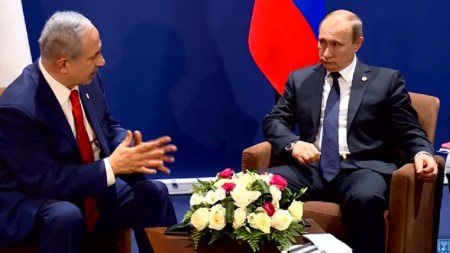
On the outside, Israel is all smiles and full of praise for way the coordination with Moscow is working for averting clashes between its air force and Russian warplanes over Syria. This goodwill was conspicuous in the compliments Prime Minister Binyamin Netanyahu and President Vladimir Putin traded when they met on the sidelines of the Paris climate summit Monday, Nov. 30.
But the first disquieting sign appeared Tuesday, Dec. 1. Senior Russian and Israeli officers were due to meet in Tel Avid to discuss strengthening the cooperation between the two army commands. But no word from Moscow or Jerusalem indicated whether the meeting had taken place.
DEBKAfile’s military sources report that this week, the show of optimism is giving way to an uneasy sensation in the offices of the prime minister, Defense Minister Moshe Ya’alon and the IDF Chief of Staff Lt. Gen. Gady. They suspect an ulterior motive behind Russia’s military movements in southern Syria, especially its air strikes against Syrian rebels, just across from Israel’s Golan border.
In particular, Moscow may be giving Hizballah and Iran an umbrella for achieving their longstanding design to displace the Syrian rebels with Revolutionary Guards and Hizballah forces and deploy them along Israel’s Golan border.
This suspicion gained ground when Tuesday, Dec. 1, the day after the Putin-Netanyahu encounter, the combined Iranian-Syrian-Hizballah units expanded their thrust from the southern Syrian town of Deraa to the Golan town of Quneitra, within sight of Israel’s defense positions.
All that day, heavy battles raged over the rebel-held line of hills running from a point just south of Quneitra to the Israeli-Syrian-Jordanian border junction. The combined force was supported by Russian air strikes and heavy tanks and artillery, seen for the first time in this war arena.
When the fighting resumed Wednesday, the IDF placed its Golan units on high alert and an extra-vigilant eye was trained on this battle.
The Iranian-Syrian-Hizballah side is gaining a distinct advantage from the deep feud dividing rebel ranks. The Islamic State and the al-Qaeda-affiliated Syrian Nusra Front forces are tearing into each other with suicide bombers and explosive cars. Tuesday, an ISIS-rigged bomb car blew up at Nusra headquarters near Quneitra (see photo).
But this also means that an Islamic State force has come dangerously close to the Israeli border.
However, even more perils are in store if Bashar Assad’s army backed by Iran, Hizballah and Russia manages to capture the hills opposite the Golan:
1. Two years of unrelenting Israeli military and intelligence efforts to keep Hizballah and Iranian forces away from its Golan border will have gone to naught.
2. Hizballah will open the door for Iranian Revolutionary Guards officers to set up a command center right up to the Israeli border.
3. Israel’s steadfast policy and military action to prevent advanced Iranian weapons reaching Hizballah in Lebanon via Syria will be superseded. On the Golan, Hizballah will have gained direct access to any weapons it wants directly from Syria and be able to deploy them at far shorter distances from Israeli targets than from their firing positions in Lebanon.
4. Vladimir Putin attaches extreme importance to recovering southern Syria from the rebel forces backed by the US and Israel, because he regards the threat to the Assad regime as great from the south as it is from the north or the center.
5. Israel faces a grave dilemma between keeping up its “honeymoon” with Moscow by giving way on its essential security interests, or taking the bull by the horns and keeping the enemy at bay, whatever the cost to the understanding reached with Putin.
Officials in Jerusalem point out that the threat to Golan peaked just hours after the Russian leader met the prime minister in Paris. Putin is conducting a hands-on policy on Syria and keeps close track of the slightest occurrence on the battlefield. He must have been perfectly aware of the state of play on the Golan when he met Netanyahu, but nonetheless kept it out of their conversation.
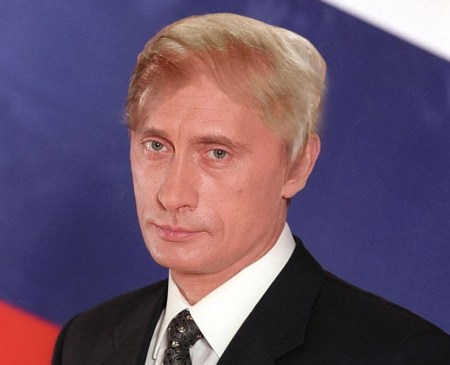
WASHINGTON—Presidential candidate and military prep school veteran Donald Trump was revealed this morning to actually be Russian President Vladimir Putin wearing an outlandish hairpiece. The revelation came after weeks of investigation by the Federal Bureau of Investigation and the State Department.
“We really can’t comment at this time,” said FBI spokeswoman Michael P. Kortan, “except to say that Trump is definitely Prime Minister Putin. This is strictly off the record, but you can quote me on that. And this investigation has nothing to do with the fact that in most polls, Trump would handily win over any Democrat opponent. The FBI is not at all a political organization.”
Kortan then added that she would take any questions about the investigation into the Tea Party.
Investigators and watchdog groups were first alerted to the Trump/Putin impersonation when it was pointed out that the two were never seen in pubic together.
“The failure of two arrogant loudmouth braggarts to ever appear in the same place, at the same time, spoke volumes by itself,” according to Chris Farrell, Director of Investigations at Judicial Watch. “From there, it was just a matter of putting together the pieces.”
“In retrospect it makes so much sense that I’m surprised we didn’t realize sooner,” said Diplomatic Security Special Agent Derek McDaniel. “Who would claim that a couple years in a paramilitary reform school is the same as being a combat veteran, other than the same colossal ego that justifies the forcible annexation of huge swaths of Georgia and Ukraine by claiming that it’s merely ‘protecting ethnic Russians’?”
Suspicions were reinforced, McDaniel added, when investigators noticed that both Putin and Trump have been romantically involved with a long series of “models” that are essentially extremely high-end prostitutes.
In light of revelation, the Federal Election Commission has rescinded its approval of Trump’s campaign announcement paperwork, declaring him ineligible to seek election to the American Presidency. Putin/Trump, in spite of this, insisted that he will continue to campaign.
“The FEC is a buncha yuuuuge loosahs,” said Trump/Putin during a press conference from the bow of a yacht named Trump’s Pride, which is currently docked in the swimming pool of a larger yacht named Trump’s Talent. “I bet they’re all a buncha broads with tiny boobs. Maybe they need a little roughing up. They got no class. I’m not gonna stop campaigning. To the White House, comrades! Boosh moi, I mean, uh, God Bless America!”
In July, the New York Times was reporting that three full Islamic battalions were fighting in eastern Ukraine.
What a mess. The question for the West now is who they would rather having controlling Ukraine’s territory in the near future — ISIS or Russia — and the answer is clearly the latter. If the West wants to build a common coalition against the Islamic State, the best approach may be to remove the Islamic State of Turkey from NATO, allow Russia to take Ukraine, and then invite Russia into NATO (or whatever new alliance seems appropriate) in our common cause against the global jihad.
***********************
Back in February, The Intercept was the first media outlet to reveal clear linkages between ISIS and Ukraine. The article by Marcin Mamon begins by recounting how the leader of the Islamic State’s underground branch in Istanbul was headed to Ukraine to join other members of ISIS in fighting those from Eastern Ukraine that want further autonomy from Kiev and a likely political alliance with Moscow.
Immediately we have a problem. It is unlikely that many average citizens in the West are aware that ISIS is fighting on the side of the Ukraine nationalists. If they were, public opinion might drastically shift towards support for Russia — as it should. Better to have Ukraine be a proxy state of Russia than yet another budding member of the global Islamic Caliphate taking shape.
Any arguments that ISIS is helping Ukrainian nationalists fight the Russian backed separatists out of the goodness of its heart, and that ISIS will just pack up and leave Ukraine if a victory is won, strain all measures of credulity. If the Russian separatists lose in eastern Ukraine, Ukraine may very well be on the path to falling under control — at least partially — of ISIS, placing ISIS with a state under its control on the borders of several NATO members. Did the West possibly back the wrong horse in Ukraine? Should we instead have supported Russia?
Ukraine is now becoming an important stop-off point for the brothers, like Ruslan. In Ukraine, you can buy a passport and a new identity. For $15,000, a fighter receives a new name and a legal document attesting to Ukrainian citizenship. Ukraine doesn’t belong to the European Union, but it’s an easy pathway for immigration to the West. Ukrainians have few difficulties obtaining visas to neighboring Poland, where they can work on construction sites and in restaurants, filling the gap left by the millions of Poles who have left in search of work in the United Kingdom and Germany.
Remarkably, Justin Raimondo at the website Antiwar.com predicted the problems this would cause back in early March of this year:
We are told that ISIS is planning terrorist attacks in Europe, and security forces are busy rounding up suspects all across the continent – and yet here is this gaping hole in the West’s defenses, where “the brothers” are quietly infiltrating without much notice in the Western media. In cooperation with ultra-nationalist groups like Right Sector, which have also formed their semiautonomous battalions, the Islamists of Ukraine, brandishing Ukrainian passports, have opened a gateway to the West …
As US aid flows into Ukraine, how much of it will trickle down to these allies of ISIS — and to what future use will it be put? If John McCain and Lindsey Graham have their way, US arms will soon find their way into the hands of these terrorists, whose jihad against the Russians is bound to turn westward and strike at the capitals of Europe.
This is blowback with a vengeance: we are creating our own enemies, and giving them the weapons to harm us, even as we claim the need for universal surveillance in order to fight them. The mad scientists formulating US foreign policy are raising an army of Frankenstein monsters — who are sure to come after their deluded creators.
Like clockwork, eight months later we have the Paris attacks.
In July, the New York Times was reporting that three full Islamic battalions were fighting in eastern Ukraine. At about the same time, Elliot Friedland in The Jewish Voice was warning against the problems arising from this Islamic incursion in Ukraine:
Yet there are Islamist paramilitary battalions fighting alongside Ukrainian forces, which are aligned with the Islamic State and Chechen Islamist factions. If the U.S. steps up military aid to Ukraine, whose army is notoriously corrupt it may fall into the hands of Islamist battalions currently funded by a mixture of Ukrainian oligarchs, Gulf patrons, violent crime and extortion. The Ruskayya Blatina website said that a few militias belonging to the terrorist group ISIS began to fight against the Russian soldiers in Ukraine with support from the American authorities who gave recommendations to the Ukrainian government regarding the Islamic State … Islamic State-aligned fighters also use Ukraine as a cheap and easy place to buy weapons, which can then be smuggled to Iraq and Syria and Chechenya.
During the past two months, connections between Ukraine and ISIS have moved up the chain of command, as evidenced by a top Ukrainian official giving his public support for ISIS. Just last week, weapons — including a FN-6 antiaircraft missile system — from the Ukrainian military “magically” ended up in the hands of ISIS which “were meant to be delivered to the militant group in Syria via smuggling routes in Turkey.”
Soon after, the Russian hacking group CyberBerkut claimed it is “in possession of documents indicating that employees of the Ukrainian state-owned defense conglomerate Ukroboronprom had discussions with Qatari government officials over the possible sale of surface-to-air missiles [the S-125-2D Pechora-2D (NATO reporting name SA-3 Goa)] in September,” weapons that were almost undoubtedly destined for ISIS. According to the leaked documents, the U.S. embassy in Doha also approved the deal.
What a mess. The question for the West now is who they would rather having controlling Ukraine’s territory in the near future — ISIS or Russia — and the answer is clearly the latter. If the West wants to build a common coalition against the Islamic State, the best approach may be to remove the Islamic State of Turkey from NATO, allow Russia to take Ukraine, and then invite Russia into NATO (or whatever new alliance seems appropriate) in our common cause against the global jihad.
“Oh what a tangled web we weave, When first we practise to deceive!” — Sir Walter Scott, Marmion, Canto vi. Stanza 17
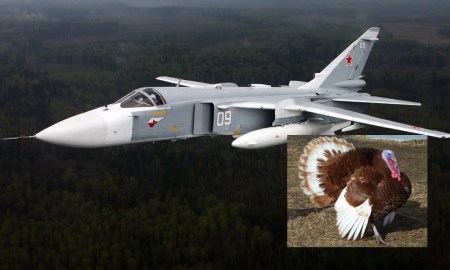
Turkey photo: “Bourbob red turkey Tom-r2” by Mtshad – Own work. Licensed under CC BY-SA 3.0 via Commons. Su-24
WASHINGTON — White House Spokesman Josh Earnest quietly announced this morning that President Obama would cancel Wednesday’s traditional “Turkey Pardon,” a presidential staple since the Kennedy administration, citing protests and complaints by Russian President Vladimir Putin. The complaints follow Monday’s downing of a Russian fighter by Turkish forces.
“The Sov—er, Russians were a little concerned at how pardoning a turkey might look, after the unfortunate misunderstanding between an Su-24 Fighter-bomber and a Turkish AIM-9 Sidewinder a few days ago,” Earnest said.
The State Department said initial reports indicated the downing was the fault of “a turkey, you know — the bird,” as Secretary of State John Kerry told reporters. “It was apparently sucked into the intake around 10,000 feet over the Turkish-Syrian border.”
Later, State Department Spokesman John Kirby clarified Kerry’s remarks. Kirby quoted the secretary as saying, “As God is my witness, I thought turkeys could fly.”
Sources in Moscow indicate that Putin has used the so-called “hotline” with Obama to privately threaten “to race right through the Fulda Gap all the way to the Channel if you pardon that proklyatiye turkey.”
The Department of Defense has announced what it calls “proactive moves to calm the situation,” including canceling all turkey dinners for Thursday, and the destruction of approximately 425,000 slices of pumpkin pie.
In Brussels, NATO leaders are privately exploring whether or not being exclusively in the Mediterranean “really qualifies a country to join the ‘North Atlantic Treaty Organization’ anyway,” according to a high-level, four star supreme commander with knowledge of the situation who requested anonymity.
This morning you’re probably wondering why there’s something about Turkey shooting down a Russian plane in the news. Why is this story taking up valuable space in your news feed and taking away time from reading about how stupid Donald Trump and Ben Carson are, or how yoga is cultural genocide or how oppressed Yale students are? And didn’t Obama already fix the Syrian Civil War with a hashtag?
You’re probably worrying over which side is the progressive one in the Turkey-Russia spat. So I’ve written this helpful guide just for you.
1. Progressive rating
Russia – Ex-Communist dictatorship run by KGB operatives like Putin and has jails full of political prisoners.
Turkey – Islamist dictatorship run by “moderate” Islamists like Erdogan with jails full of political prisoners.
So both Russia and Turkey are both pretty progressive. But since Islam is now officially at the top of the victim list, Turkey is more progressive.
2. Gay rights
Putin – Anti-Gay
Erdogan – “Their biggest ally is Doğan Media. The Armenian lobby, homosexuals” – Anti-Gay and Anti-Armenian
Split decision?
3. Socialist
Erdogan – “Let’s earn a little less than you currently do. Share your wealth with the low-income group.”
Putin – “Income inequality is unacceptable, outrageous.”
Can’t we get Bernie Sanders to replace them both?
4. Abortion
Erdogan – Abortion is murder and a plot against Turkey
Putin – Abortion is murder and a plot against Russia
5. Islam
Putin – “Some scholars of (Eastern) Christianity say it is much closer to Islam”
Erdogan – “The mosques are our barracks, the domes our helmets, the minarets our bayonets and the faithful our soldiers”
6. Racism
Erdogan– “Kilicdaroglu is striving every bit he can to raise himself from the level of a black person to the level of a white man.”
Putin – “What?”
7. The Kardashians
Putin – In favor
Erdogan – “In my country there are 170,000 Armenians. Seventy thousand of them are citizens. We tolerate 100,000 more. So, what am I going to do tomorrow? If necessary I will tell the 100,000: OK, time to go back to your country.”
There you have it. Now you can decide which side to cheer for and which side to hate based on all the compelling issues that progressives care about.
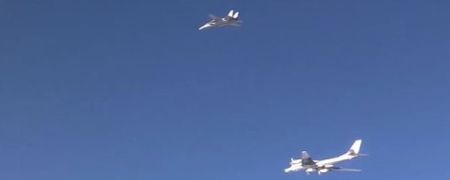
A series of videos apparently leaked by the Russian Defense Ministry reveal the presence of Iranian F-14 and MiG -29 fighters in Syrian skies for the first time. They were shown by “The Aviationist,” Italian magazine, escorting heavy Russian bombers, including the Tupolev TU-160, the heaviest, fastest and most destructive bomber ever built, on missions no more than 150 km from Israel’s northern border.
The ageing F-14s, built in the 1970s by American aviation giant Grumman, were originally sold to Iran when the Shah was in power and taken over by the reorganized Iranian air force after the 1979 Islamic revolution. Upgraded many times, the F-14s now feature state-of-the-art avionics, weapons and navigation systems, procured byTehran despite the strict UN embargo on their sale to the Islamic Republic.
Dozens of these upgraded warplanes, upgraded with intelligence-collection and tracking systems, have begun operating in Syrian air space near the Israeli border, under the pretense of escorting the Russian bombers. Iranian eyes in the sky are therefore studying the frontier area and gather valuable intelligence on Israel’s air defenses. Normally, if Iranian warplanes had turned up in Syrian air space, the Israeli Air Force would have fought them off and shot them down, but by flying alongside Russian bombers they are protecting themselves against Israeli action.
As DEBKAfile reported on Saturday, November 21, Russian air and missile attacks are systematically destroying Raqqa, the ISIS capital in Syria, without consideration of civilian casualties. The Russian general staff is now gearing up to embark on an unprecedented assault on rebel and ISIS strongholds, a blitz involving hundreds of simultaneous sorties by warplanes and bombers, as well as cruise missile attacks from planes and warships in the Mediterranean and the Caspian Seas.
High-altitude surveillance planes as well as low-altitude drones, fitted with imaging and targeting systems that will send live video and images to the command center in Moscow, will provide an umbrella for the attack.
Russian President Vladimir Putin will personally manage the multilayered military coordination between Russia and Iran when he visits Tehran on Nov. 23, accompanied by top military officers.









 anneinpt
 artaxes
 danmillerinpanama
 davidking1530
 Peter Hofman
 Joseph Wouk
 Peter
Peter Louisiana Steve
 WarSclerotic
Recent Comments