PM Netanyahu at the 37th Zionist World Congress, PM Netanyahu, October 20, 2015
’ The Palestinian Authority is ruled by anarchy, Israel has no choice but to kill or be killed, so the U.N. will gallop in next week on its horse called the “peace process.”
By: Tzvi Ben-Gedalyahu
Published: October 8th, 2015
Source: The Jewish Press » » U.N. Officials on Way to ‘Rescue’ Israel and PA with ‘Peace Process’

The “peace process.”
Photo Credit: Asher Schwartz
There is no “Third Intifada” nor is there “war.” Plain and simple, Jerusalem and Palestinian Authority Arabs are on a murder spree.
The United Nations announced Thursday it will send high-ranking officials to Jerusalem and Ramallah next week to try to dig up the “peace process” and save Israel and the Palestinian Authority from themselves.
Or at least, that is how they see it.
This is an old scene, played hundreds of times. Whenever Israel does not give the Palestinian Authority what it wants, Mahmoud Abbas calls for “peaceful resistance” in English while his Fatah party call for the murder of Jews in Arabic.
For example, the official PA daily Al-Hayat Al-Jadida on Wednesday reported on a statement by Fatah Central Committee Member Jamal Muhaisen, according to a translation and posting by the Palestinian Media Watch (PMW):
Muhaisen stated that the Palestinian people has proven that its life and blood have little value [compared] to support for the Al-Aqsa Mosque and achieving freedom and independence… Muhaisen stressed that it is important that the popular uprising) increases, in order to deal with the occupation’s crimes and the settlers. He clarified that the settlers’ presence is illegal, and therefore every measure taken against them is legitimate and legal.
In plain Arabic, Arabs have a license to kill Jews.
But maybe Hamas terrorists and not Fatah terrorists or behind the murders of Rabbi Eitam and Naama Henkin?
A host on official Palestinian Authority TV asked PLO Executive Committee member Mahmoud Ismail, according to PMW:
Are they [killers of the Henkin couple] from the Al-Aqsa Martyrs’ Brigades (Fatah’s military wing) or from Hamas?
He answered:
There is no need to return to the argument and dispute about who carried out the operation… There is no need to announce it and boast of having done it. One fulfills his national duty voluntarily, as best as one can.
In plain Arabic, that is more than license to kill. It is a “national duty.”
Abbas has the instincts of a hunting dog. He knows exactly when the time is ripe for the “international; community” to step in and save his neck from being slit by his political opponents, which is just about everyone.
He can count on the U.N. delegation to blame Israel for anything and everything at a time when the Obama administration and even most foreign media are having a hard time blaming the “occupation” for attempted murders in Tel Aviv, Petach Tikvah and Kiryat Gat, let alone the “occupied territory.”
Abbas also knows very well that if he breaks off security arrangements with Israel, he has to make sure his will is in order and that a burial plot is ready.
He also knows that Israel always deals from weakness when international leaders get involved.
Prime Minister Binyamin Netanyahu does not have many cards to play and that he also cannot make much more concessions.
He may have to promise that no new Jewish outposts will be built, even if it means preventing a new community near the location where the Henkins were murdered.
There are a lot of things the Prime Minister “should” do, such as reinstating roadblocks and checkpoints in Judea and Samaria, but like it or not, he cannot do it. Israel cannot roll back concessions, at least not now.
It has to wait until the Palestinian Authority regime totally disintegrates, and that is not going to happen before the United Nations fulfills Abbas wish and flies to his rescue next week.
Netanyahu curtails German trip to deal with worsening Palestinian terror crisis, DEBKAfile, October 7, 2015
 Palestinian riot in Issawiyeh, Jerusalem
After the Israeli cabinet launched measures Tuesday, Oct. 6, for “strengthening anti-terror defense” – such as cameras in the sky – and officials labored to spread word that the surge of Palestinian violence of the past week was beginning to ebb, Israel was hit that night from offside by a vicious pro-Palestinian upheaval in the Tel Aviv suburb of Jaffa. Hundreds of Israeli Arabs swarmed onto the streets to hurl rocks and burning containers at police, passing buses and Jews on the street. Six police officers were injured. Fired up by the radical Israeli Northern Muslim Movement, the rioters brandished Palestinian flags and yelled “Allah is Great!” and “With our blood we shall redeem Al Aqsa!”
The Army Radio Station studio was besieged for five hours.
At length, the police announced the disturbance had been brought to an end by negotiations with Arab community leaders in Jaffa.
That strategy was part and parcel of the efforts made by IDF officers to bring an end to the surge of Palestinian violence besetting Jerusalem and the West Bank through revived negotiations with Palestinian security chiefs and soothing rhetoric poured out for the public by government and military officials. But the gap between that rhetoric and the unruly situation on the ground was impossible to bridge. The rocks and firebombs kept on flying – even after three killer-terrorists’ homes were demolished in Jerusalem Monday night.
Here too, the measure failed to impress as a deterrent because the punishment was meted out for terrorist crimes committed in 2014 and were therefore a year old – evidence of Israeli’s extremely slow response to murderous terror.
Prime Minister Binyamin Netanyahu finds himself cornered by two conflicting crises. While facing popular demands to quell Palestinian violence that caused four Israeli deaths and 30 people injured during the High Festivals, he is confronted with a mutiny within the government coalition and his own Likud party. At least half a dozen ministers angrily reject the line taken by the prime minister and Defense Minister Moshe Ya’alon for the past year – that the terror crisis must be handled “calmly and responsibly” – as nothing but softness on Palestinian terror.
Netanyahu has shot back by threatening to break up the government, which is less than a year old – either by inviting the opposition parties to join a new national unity government or calling a snap election.
This threat is fairly hollow. Replacing the mutinous ministers with members of the Labor opposition is a non-starter since its leader Yitzhak Herzog scarcely controls his own party. A coalition with Yair Lapid’s Future party and Avigdor Lieberman’s Yisrael Beitenu would be harder to control than the present lineup.
Netanyahu finds himself in this corner because he is handling the two crises by political means as part of the same problem.
This tactic is taken by Palestinian extremist leaders as a sign of Israeli weakness and encourages them to pour more fuel on the fire of anti-Israel violence. Ineffective measures, such as the cameras in the sky, which never worked on the 443 highway to Jerusalem, for instance, make things worse. The trickle of rockets from Gaza contradicts Ya’alon’s pledge to stop it. A proactive, creative hand against the escalating Palestinian violence would gain the support of all the ministers and ease the popular sense of pervasive insecurity.
Three cheers for Terroristine, Sultan Knish Blog, Daniel Greenfield, October 1, 2015
(He refers, of course, to “Palestine.” — DM)
We need a terrorist state. Where the politicians are terrorists, the police are terrorists and even the men sitting at the desk when you come in to drop off a form are terrorists.

There are states that support terrorists, and give safe harbor to them, but that’s not good enough. We don’t want another Pakistan or Iran. We’re not half-assing it this time. What we want is the genuine article. Terrorists from the top down. Terrorists everywhere. A state where every branch of government and the entire country is nothing but terrorists.
Terroristine has been an ancient dream since 1973 or was it 1967. A generation of keffiyah draped thugs, KGB operatives and human rights activists have looked out into the darkness and called it into being. It is a vision of a country where everyone is a murderer and children are taught from a very young age that their purpose in life is to die killing people who don’t share their religion.
And now after decades of negotiations, treaties, suicide bombings, mutilations, billions of dollars in vanishing into Swiss bank accounts and the death of its Egyptian born leader of AIDS– Terroristine is closer than ever to coming into being.
Abbas, its unelected dictator, who has struggled long and hard so that one of his sons might have his own cigarette monopoly in Gaza, has come to the UN to promise that Terroristine will have “will actively contribute to the achievement of economic, cultural, and humanitarian progress of civilization.”
And who can doubt him? Certainly not Terroristinians who don’t have elections or a free press.
Terroristine, whose noble flag (that looks like nearly every other Arab flag) flies over the UN, has done wonders for civilization. Consider the airplane hijacking. The suicide bomber. Has there ever been a civilization that did as much for civilized living as the Terroristinians?
Every time you get groped at an airport, thank Terroristine. Without the Terroristinian contribution to civilization, you might actually be able to get on a plane in peace. Or visit the Twin Towers.
The Terroristinian contribution to human progress is unquestionable. But only one thing stands in the way of it unleashing its full Terroristinian potential for all mankind.
Them. Those pesky people who live in that country that is always in the way. You know the ones, with too many Nobel prizes, newly invented tomatoes and microchips. They stand in the way of the great cultural contributions of Terroristine. They must die so that Terroristine must live.
They must be thrown out of their homes, village by village and city by city, so that the noble Terroristinians can plant their rockets on the rubble of their houses, the charred remains of their fields, and point them at their cities.
Trying to end terrorism by creating a terrorist state makes is like trying to put out a fire with more fire. It can’t work, but we must try. So that we can say that we tried. Over and over again. We’ll keep trying until we run out of land to try with. And people to try with.
Until there’s nothing left but Terroristines everywhere. Until all the world is Terroristine. The question is can we make it happen? Yes, we can. Oh sweet Allah, yes we can.
Israel must return to the 1967 borders, which are really the 1948 borders. Why are the borders of the 1948 war, so much better than the borders of the Six Day War? Because the Terroristinians came closer to winning that war. Came closer to driving the Yahood into the sea and ululating over miles of their corpses.

But the dream failed. Farmers armed with outdated rifles. Volunteer pilots from America and Canada. Refitted cargo ships filled with half-dead men, women and children straight from the camps. Used Czech artillery. They held off the armies of seven Terroristinian nations. Farm by farm, they stood off tanks and infantry. In Jerusalem, they fought for every house. And so the Zionist entity survived.
Allah curse them. They survived.
But now it’s back to 1948 again. Every war undone. Every defeat turned to victory. Cut Jerusalem in two. Drive out the farmers. Burn their land. Dig up their graves. March the borders back to 1948. And fly the Terroristinian flag over dust and rubble. Had they won in 1948 or 1967 or 1973, there would be no Israel and no Terroristine. The land would have become part of Syria, Egypt and Jordan. And only when the mobs of the faithful would drive out the tyrants to replace them with Islamic states, would there finally be a Terroristine.
But despite what Abbas says, there is still hope for a two state solution. And we must do everything in our power to salvage the two state solution so that there will be a state of civilization on one side and a state of terrorists on the other. Hospitals here, launching pads there. Schools here, bomb factories there. Life here, death here. We all know the story. Olive trees and bomb belts. Rocks and dead families in burning cars by the side of the road. Children with their throats cut.
A dream. A nightmare. Who even knows anymore.
Why do we need Terroristine? Peace. There can be no peace without a terrorist state. Not a chance of it. The only way we’ll ever have peace is to give the terrorists a country of their own. A country dedicated to terrorism. Only then will the Terroristinians finally give up on all the killing, and dedicate themselves to medical research, quantum mechanics and the arts. It hasn’t happened yet to. But it’s bound to.
After decades as an autonomous territory, spreading death and destruction, it’s time for Terroristine to finally be recognized as an independent state. With contiguous borders cutting Israel in half. It is the only hope for peace in the region. Would Sunnis and Shiites be killing each other from Yemen to Iraq? Assuredly not. The moment the flag of Terroristine rises above the wounded hills, and its peaceful anthem, “Palestine is My Revenge” is heard in the land, then a great echoing sigh will rise up from the mouths of one billion Muslims. And the violence will cease.
The international community is impatient. They want Terroristine and they want it now. Whatever Israel has offered in the past, it isn’t enough. It must offer more and more. Whatever it takes. We know the Terroristinians want their own state. Every time they walk out of negotiations or end them with a round of terrorist attacks, it shows their deep and abiding passion for a state. They want it so badly they aren’t willing to make a single concession for it. Or even negotiate for it.
That’s how committed they are to realizing their great dream to Terroristine. And who can blame them? Have any people suffered the way the Terroristinians have? (Besides all the people the Terroristinians have killed over the last 1,400 years.) Have any other people been wholly subsidized by a UN agency dedicated only to them? Have any other people inspired such a stylish fashion statement? No more excuses. The world demands Terroristine. Middle East peace demands Terroristine.
How much longer can Israel expect to draw out the necessary concessions with weak justifications about terrorism. We know they’re terrorists. That’s why we’re giving them a state. If they weren’t terrorists, they could go to the back of the line with the Jews, Kurds and Armenians.
From one corner of the Muslim world to the other, a cry goes out. “We Are All Terroristinians.” They cry it it Cairo and Damascus, in Tehran and Islamabad, in Dubai and Paris. They mosques go up, the asses go up and the bombs go off. And off to the peace negotiations we go.
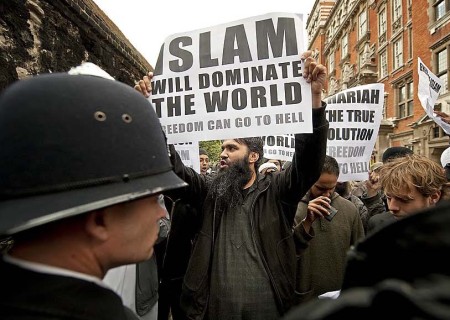
Everyone is impatient. Everyone is on fire. Especially the Terroristinians. Jewish store windows are smashed in London, Terroristinians butcher Rabbis in Jerusalem synagogues, fuming Terroristinians shoot up American recruiting centers. And the crowds cheer. “We Are All Terroristinians Now.”
It is a great day, I tell you. A great day for negotiating. ISIS impatiently beheads infidels to create its own Islamic Terroristine. In Afghanistan the word goes out, “We are the Taliban, we are the Afghan people, we are Terroristinians.” In Egypt and Turkey, they cry, “Khaybar Ya Yahood”. Churches burn. Soldiers die. The smoke rises to heaven. A man waits in line at the airport. His passport is Dutch, Welsh, German, American, it doesn’t matter. He is a Terroristinian. Yallah.
One day the borders of Terroristine will stretch from Spain to Pakistan. Or beyond Why settle for Jerusalem, when we can have London, Paris and Hamburg too. Why settle for anything at all? Allah is generous to the believers. Our people are in Africa. Even China. The Great Satan himself bows toward Mecca. The old governments are falling. The pawns of the Kufir are fleeing before our eyes.
We are all Terroristinians now. There is no other book on our shelves than the Koran. No law but Sharia in our hearts. And no nation but Terroristine. The ghost of Chamberlain stands outside No. 10 Downing Street promising peace. A Terroristinian refugee beheads him and holds up his spectral head to the cheers of the crowd. Rockets sail through the sky. The crowd cheers. Hip Hip Hooray. Hierosylma Est Perdita. Three cheers for Terroristine.
Dividing the Arabs: America and Europe’s Double Game, The Gatestone Institute, Bassam Tawil, August 29, 2015
The United States is playing a double game in the Middle East: empowering Shiite Iran, while at the same time enabling Sunni ISIS to overthrow the moderate Arab regimes, as if to stop Iran.
The Americans are well aware that the Sunni Arab countries around Iran will now have to arm themselves to the teeth, thereby gutting the Nuclear Non-Proliferation Treaty (NPT).
America, despite its power and the image it projects of working against ISIS in Iraq, does not touch ISIS in its real headquarters, Syria, where ISIS actually could actually be hurt. So nothing really changes, and both Iran and ISIS continue to strengthen.
Even as the members the UN Security Council, eager do business with Iran, voted to allow Iran to build nuclear weapons, the Iranians continue to fund Hezbollah, Hamas and the Palestinian Islamic Jihad in the Gaza Strip — all Iranian proxies — in order to split the Arab ranks.
In other words, the hypocritical Obama administration, in backing the Iranians, keeps trying to sabotage the Arabs and provoke dissension.
The U.S. “divide-and-conquer” policy can also be seen in America’s ongoing support for Turkey and Qatar, both loyal to the Muslim Brotherhood. Turkey and Qatar, however, do nothing but foment incitement and support terrorist organizations. Both countries have totally abandoned the real existential interest of the Arab nation: its historic battle against Iran.
Qatar’s role is duplicitous. It plays host to U.S. military bases at the same time that it funds and supports ISIS, which is working against the West and against moderate Arab regimes.
The worst, however, is Turkey, which supports ISIS — the enemy of the West — despite Turkey being a member of NATO. Turkey also expends inordinate efforts at retaining its control of occupied Cyprus. Above all, its hypocrisy is scandalous. While it claims to care about the independence and human rights of the Palestinians, Turkey is really nothing but a radical Islamist country now denying independence and human rights to its own Kurdish citizens. At the same time, it supports Hamas and Iran in their effort to crush the unity of the Palestinian Authority (PA) and the PLO as the only legitimate representatives of the Palestinian people.
Turkey, like many other nations, including the countries that negotiated with Iran, is just waiting for the sanctions to be lifted from Iran, so that its dubious military and economic relations with the Mullahs will finally be acceptable.
Turkey and Qatar have also divided the Sunni Islamic camp and fragmented the Arab ranks. Both countries give the Palestinians political support, the deluded hope of “return,” and funding that is used for rebuilding Hamas’s military capabilities and kidnapping tunnels.
It is both folly and underhandedness for the United States to provide these countries with even a tattered umbrella of military aid.
Not only the U.S. but Europe, which supports Iran, would like to see Hamas — a terrorist offshoot of the Muslim Brotherhood — become stronger at the expense of the Palestinian people.
Europe would like to empower Hamas even further by handing it diplomatic and political support. There are rumors that the UN is planning to grant Hamas observer status in the General Assembly, as it did the Palestinian Authority.
We all know that the issue of Palestine could have been resolved long ago by establishing a demilitarized Palestinian state next to Israel, and giving the descendants of the original Palestinian refugees living in the Arab states full citizenship. But the manipulations employed by the Europeans and Americans deliberately perpetuate the Palestinian issue by using “good cop – bad cop” tactics. (Emphasis added. — DM)
Europe and the U.S. whitewash not only Hamas’s threats to Israel, but also, more importantly, its deadly subversion of Palestinian Authority. Both Europe and America totally disregard Hamas’s planned coup against PA leader Mahmoud Abbas last year, Hamas’s war crimes in the Gaza Strip, and the unspeakable treatment of its own people at home. Only one year ago, Hamas was murdering its own citizens extra-judicially, and ordering them to be cannon fodder for the benefit of international television crews.
Hamas, since then, has chosen to use its scant resources to rebuild its kidnapping tunnels and war capability, instead of to develop businesses and turn the Gaza Strip into a magnificent Arab Riviera, as Dubai has become. Hamas’s failure does not come from a lack of resources; it comes from a deliberate choice of how to use them.
Hamas and Palestinian Islamic Jihad are now operating against Egypt and Israel not only from the Gaza Strip, but from the Sinai Peninsula as well. Thus, in addition to allowing Iran to sail to nuclear weapons capability, President Obama encourages the Muslim Brotherhood and other Islamist terrorist organizations such as the Islamic State in the Sinai Peninsula with one hand, while with the other hand he claims to support Israel.
After all is said and done, if we Arabs had joined ranks — even temporarily and even with Israel — we could have long ago put a stop to Iran’s plans for expansion.
But because of our own shortsightedness, we waited too long and now the Iranians have established footholds in the Arabian Gulf and the Red Sea, and are increasing their control of Arab states such as Iraq, Syria, Lebanon and Yemen.
Iran is on its way in a few years to having nuclear weapons capability. The breakout time, according to President Obama, would effectively be “zero.” Iran could then make as many bombs as it would like, along with intercontinental ballistic missiles to delver them to the major cities of the “Great Satan,” the United States, directly from Iran, from South America, or — making identification and retaliation impossible — from submarines submerged off the U.S. coast.
The Iranians, in opposing American policy, which is a tissue of amateur plans and plots, are flexible and exploit Islam’s taqiyya [dissimulation] — religious approval to lie in the cause of Allah and to further Islam. However, they are not even bothering with that, they are telling the truth: “Death to America; Death to Israel.”
 U.S. President Barack Obama (left). Iranian President Hassan Rouhani (right).
By this point, near the end of the process of Sunni Muslim self-destruction, a large part of the Arabs’ energy has been wasted on internal wars and the misallocation of resources to the barren, useless confrontation with Israel, even while many Arab states secretly collaborate with the Zionists.
All that will be left for the Arabs will be to continue to argue among themselves and with the Israelis about the Palestinian issue. We should instead stop the distractions and the wounds we are inflicting upon ourselves, and put the Palestinian problem behind us by granting equal rights and citizenship to Palestinians residing in Arab countries, in order to shift our focus totally, if belatedly, to the real battle: The Islamic Republic of Iran.
Our World: The anti-peace administration, The Jerusalem Post, Caroline B. Glick, August 11, 2015
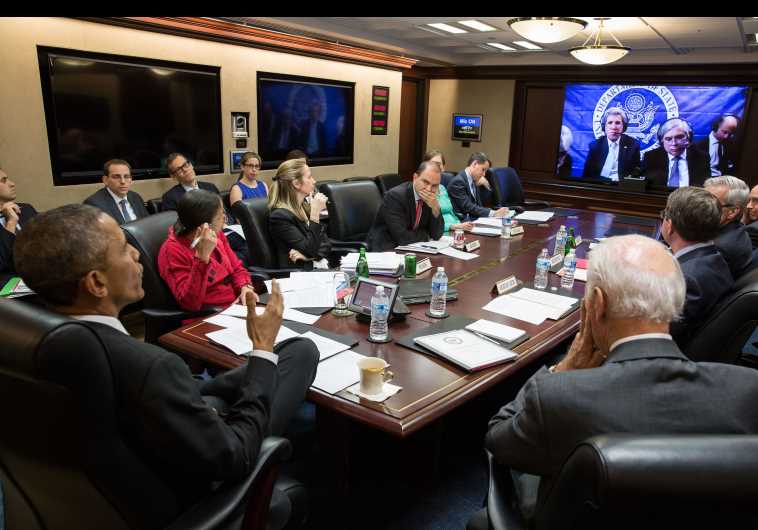 President Barack Obama, Vice President Joe Biden, and White House aides receive an update from Secretary of State John Kerry and Secretary of Energy Ernest Moniz via teleconference in Lausanne. (photo credit:WHITE HOUSE)
The US has striven to achieve peaceable relations between the states of the Middle East for nearly 70 years. Yet today, US government is disparaging the burgeoning strategic ties between the Sunni Arab states and Israel.
In a briefing to a delegation of visiting Israeli diplomatic correspondents in Washington last week, a senior Obama administration official sneered that the only noticeable shift in Israel-Arab relations in recent years is that the current Egyptian government has been coordinating security issues “more closely” with Jerusalem than the previous one did.
“But we have yet to see that change materialize in the Gulf.”
If this is how the US views the state of Israel’s relations with the Arabs, then Israel should consider canceling its intelligence cooperation with the US. Because apparently, the Americans haven’t a clue what is happening in the Middle East.
First of all, to characterize the transformation of Israeli-Egyptian relations as a mere question of “more closely” coordinating on security issues is to vastly trivialize what has happened over the past two years.
Before then Egyptian defense minister Abdel Fattah el-Sisi overthrew the US-backed Muslim Brotherhood regime headed by Muhammad Morsi in July 2013, there was a growing sense that Morsi intended to vacate Egypt’s signature to the peace deal with Israel at the first opportunity. Just a month after Morsi ascended to power in January 2013, the Muslim Brotherhood began threatening to review Egypt’s continued commitment to the peace treaty.
The main reason Morsi did not cancel the peace deal with Israel was that Egypt was bankrupt. He needed US and international monetary support to enable his government to pay for imported grain to feed Egypt’s destitute population of 90 million.
During his year in power, Morsi used Hamas as the Brotherhood’s shock troops. He embraced Iran, inviting president Mahmoud Ahmadinejad to visit Cairo in February 2013.
If Morsi were still in power today, with its $150 billion in sanctions relief Iran would have been in a position to support Egypt’s economy. So it is possible that if Morsi were still president, he would have felt he had the financial security to walk away from the peace treaty.
In happy contrast, under Sisi, Israeli-Egyptian ties are closer than they have ever been. Just last week Egyptian diplomats told Al Ahram that Israel’s support was critical for building administration support for Sisi.
Over Ramadan, Egyptian television broadcast a pro-Jewish mini-series.
Israel is closely working with the Egyptians on defeating the growing threat of Islamic State, Hamas and other Islamic terrorist groups waging a bloody insurgency against the regime in Sinai.
Last summer, it was due to the close coordination between Sisi and Israel that the US failed to force Israel to accept Hamas’s cease-fire terms, as those were represented by the Islamist regimes of Qatar and Turkey.
In part due to Israel’s critical support for Sisi’s government, and in part owing to their opposition to Iran’s rise as a regional hegemon armed with nuclear weapons, Saudi Arabia, the UAE and Jordan have all joined Egypt in viewing Israel as a strategic partner and protector.
Last year Saudi Arabia together with the UAE and Jordan supported Israel and Egypt in opposing Hamas and its American, Turkish and Qatari defenders. Had it not been for this massive Arab support, it is very likely that Israel would have been forced to accept the US’s demands and grant Hamas control over Gaza’s international borders.
In June, as negotiations between the US and the other five powers and Iran were moving toward an agreement, the Council on Foreign Relations in New York hosted a meeting between then incoming Foreign Ministry director general Dore Gold and retired Saudi General Anwar Eshki, a former advisor to the Saudi ambassador to the US. The two revealed that over the previous 18 months, they had conducted five secret meetings to discuss Iran.
Although President Barack Obama harangued Israel in his speech at American University last Wednesday, claiming that the Israeli government is the only government that has publicly opposed his nuclear deal with the Iranians, Monday US congressmen now shuttling between Egypt and Israel told Israeli reporters that Egypt opposes the nuclear deal.
As for the Gulf states, according to the US media, last week they told visiting US Secretary of State John Kerry that they support the nuclear deal.
Kerry addressed his counterparts in the Gulf Cooperation Council.
But the fact is that the only foreign minister who expressed such support was Qatari Foreign Minister Khaled al-Attiyah. To be sure, Attiyah was charged to speak for all of his counterparts because Qatar holds the GCC’s rotating chairmanship. But given that Qatar has staked out a pro-Iranian foreign policy in stark contrast to its neighbors and GCC partners, Attiyah’s statement is impossible to take seriously without the corroboration of his colleagues.
As for Qatar’s statement of support, Qatar has worked for years to cultivate good relations with Iran. It might have been expected therefore that Attiyah’s endorsement of the deal would have been enthusiastic. But it was lukewarm at best.
In Attiyah’s words, Kerry promised that the deal would place Iran’s nuclear sites under continuous inspections. “Consequently,” he explained, “the GCC countries have welcomed on this basis what has been displayed and what has been talked about by His Excellency Mr. Kerry.”
The problem of course is that Kerry wasn’t telling the truth. And the Arabs knew he was lying. The deal does not submit Iran’s nuclear sites to a rigorous inspection regime. And the GCC, including Qatar, opposes it.
In his briefing with Israeli reporters, the high-level US official rejected the importance of the détente between Israel and its Arab neighbors because he claimed the Arabs have not changed their position regarding their view of a final peace deal between Israel and the Palestinians.
But this is also nonsense. To be sure, the official position of the Saudis and the UAE is still the so-called Arab peace initiative from 2002 which stipulates that the Arabs will only normalize relations with Israel after it has ceded Jerusalem, Judea, Samaria and the Golan and allowed millions of foreign-born Arabs to freely immigrate to the shrunken Jewish state. In other words, their official position is that they will only have normal relations with Israel after Israel destroys itself.
But their official position is no longer their actual position. Their actual position is to view Israel as a strategic ally.
The senior official told the Israeli reporters that in order to show that “their primary security concern is Iran,” then as far as the Arabs are concerned, “resolving some of the other issues in the region, including the Palestinian issue should be in their interest. We would like to see them more invested in moving the process forward.”
In the real world, there is no peace process. And the Palestinian factions are fighting over who gets to have better relations with Iran. Monday we learned that PA leader Mahmoud Abbas wishes to visit Iran in the coming months in the hopes of getting the money that until recently was enjoyed by his Hamas rivals.
Hamas for its part is desperate to show Tehran that it remains a loyal client. So today, no Palestinian faction shares the joint Israeli-Saudi-Egyptian interest in preventing Iran from becoming a nuclear armed regional hegemon.
The administration showed its hand in that briefing with the Israeli reporters last week. For all their talk about Middle East peace, Obama and his advisors are not at all interested in achieving it or of noticing when it has been achieved.
Contentions | Has Obama Read the Khamenei Palestine Book? Commentary Magazine, Jonathan S. Tobin, August 4, 2015
(Another interesting question would be, does Obama agree with any of Khamenei’s statements and, if so, which? — DM)
The Khamenei Palestine book is important not in and of itself but because the regime’s obsession with Israel is a key to its foreign policy. . . . But as much as Iran is focused on regional hegemony in which Sunni states would be brought to heel, as Khamenei’s Palestine illustrates, it is the fixation on Israel and Zionism that really animates their expansionism and aid for terror groups.
******************
It turns out President Obama isn’t the only world leader who writes books. His counterpart in Iran – Supreme Leader Grand Ayatollah Ali Khamenei — has also just published a new book. But while it may not be as introspective as Obama’s Dreams From My Father, it does tell us at least as much about the vision of the person in charge in Tehran (as opposed to Hassan Rouhani, the faux moderate who serves as its president) as the president’s best-selling memoir. As Amir Taheri reports in the New York Post, Palestine is a 416-page diatribe against the existence of the state of Israel and a call to arms for it to be destroyed. Supporters of the nuclear deal the president has struck with Khamenei’s regime may dismiss this book as merely one more example of the Supreme Leader’s unfortunate ideology that must be overlooked. But as the New York Times noted last week, the administration’s real goal here isn’t so much in delaying Iran’s march to a nuclear weapon (which is the most that can be claimed for the agreement) as it is fostering détente with it. Seen in that light, the latest evidence of the malevolence of the Islamist regime should be regarded as yet another inarguable reason for Congress to vote the deal down.
In his interview with The Atlantic’s Jeffrey Goldberg on May 21, President Obama was asked directly about the significance of Iran’s anti-Semitism and its commitment to destroying Israel. The president said the anti-Semitism of the Iranian leadership did not mean they weren’t also “interested in survival” or being “rational.” As far as he was concerned, the ideology of the regime was not something that would influence its decisions.
But everything Khamenei says and, even more importantly, everything the regime does, by funding terrorist groups at war with Israel such as Hamas and Hezbollah or by embarking on a ruinously expensive nuclear project that placed it in conflict with the West, speaks to its commitment to policies that Obama may think are irrational but which are completely in synch with what he called its “organizing principle.” Why would a nation so rich in oil need to risk international isolation or war seek nuclear power if not to help Khamenei fulfill his pledge to “liberate” what is now Israel for Muslims?
The president told Goldberg that the American military option would be a sufficient deterrent to ensure that Iran didn’t violate the nuclear pact or behave in an irrational manner. But since the president has ruled out the use of force in a categorical manner, it’s hard to see why the Iranians would fear it once the U.S. and Europe are doing business with them. Even if it was a matter of snapping back sanctions, assuming that such a concept is even possible? Once the restrictions are unraveled, it’s fair to ask why would they work then when the president repeatedly tells us additional sanctions won’t work now and require us to accept the current deal that doesn’t achieve the objectives that the administration set for the negotiations when they began.
The Khamenei Palestine book is important not in and of itself but because the regime’s obsession with Israel is a key to its foreign policy. Iran constitutes a grave threat to Neighboring Arab countries that are at least as angry about the president’s embrace of Tehran as the Israelis since their nuclear status would undermine their security. But as much as Iran is focused on regional hegemony in which Sunni states would be brought to heel, as Khamenei’s Palestine illustrates, it is the fixation on Israel and Zionism that really animates their expansionism and aid for terror groups.
As Taheri notes in his article on the book, Khamenei distinguishes his idée fixe about destroying Israel from European anti-Semitism. Rather, he insists, that his policy derives from “well established Islamic principles.” Chief among them is the idea that any land that was once ruled by Muslims cannot be conceded to non-believers no matter who lives there now. While the Muslim world seems to understand that they’re not getting Spain back, the territory that constitutes the state of Israel is something else. Its central location in the middle of the Muslim and Arab worlds and the fact that Jews, a despised minority people, now rule it makes its existence particularly objectionable to Islamists like Khamenei.
Khamenei’s book shows that not only is he serious about wanting to destroy Israel and uproot its Jewish population, he regards this project as a practical rather than a theoretical idea. The administration ignores this because it wants to believe that Iran is a nation that wants to, as the president put it, “get right with the world.” But what it wants is to do business with the world while pursuing its ideological goals. The nuclear deal is a means to an end for the regime and that end does not involve good relations with the West or cooperation with other states in the region, let alone coexisting peacefully with Israel.
What is curious is that this is the same administration that regarded the announcement of a housing project in Jerusalem by low-level Israeli officials as an “insult” to Vice President Biden. But it chooses to regard the “death to America” chants led by regime functionaries in Iran as well as a book by the country’s leader indicating that Obama’s ideas about its character are fallacious as non-events. The only explanation for this remarkable lack of interest in Iranian behavior is an ideological fixation on détente with Tehran that is every bit as hardcore as any utterances that emanate from the mouth or the pen of the Supreme Leader.
Taken out of the context of a vision of friendship with the Iranian regime, the nuclear deal makes no sense. Yet squaring that vision with Khamenei’s literary effort is impossible. Members of the House and Senate must take note of this conundrum and vote accordingly.
Iran’s Supreme Leader Khameni publishes book on how to eliminate Israel, American Thinker, Thomas Lifson, August 2, 2015
Ayatollah Ali Khameni has published his version of Mein Kampf, a 416 page book outlining his strategy to eliminate Israel, which he describes as “a cancerous tumor.” Although it is currently available only in Iran, an Arabic translation is underway, and sooner or later it will achieve wide readership in the Muslim world. The Obama administration is no doubt hoping it will achieve no notice in the United States until after the Iran deal is voted upon, because the plan advocated will be immensely aided by its implementation.
Amir Taheri of the New York Post obtained a copy from Iran:
Khamenei makes his position clear from the start: Israel has no right to exist as a state.
He uses three words. One is “nabudi” which means “annihilation.” The other is “imha” which means “fading out,” and, finally, there is “zaval” meaning “effacement.”
Khameni does not call for wiping out Israel with a nuclear bomb. He states that one of his fondest desires is to pray in Jerusalem. Instead, his plan is one of terrorism and pressure, keeping Israel from fighting back against Iran, the sponsor of terror, with the implicit threat of nuclear retaliation.
What he recommends is a long period of low-intensity warfare designed to make life unpleasant if not impossible for a majority of Israeli Jews so that they leave the country.
His calculation is based on the assumption that large numbers of Israelis have double-nationality and would prefer emigration to the United States and Europe to daily threats of death.
Iran has many allies in this effort, including the BDS movement in the United States. Cripple Israel economically, and her economically productive people will leave. Make the political cost of supporting Israel high. That will pave the way for an internationally-sponsored plebiscite engineered to produce a Muslim state:
Under Khamenei’s scheme, Israel, plus the West Bank and Gaza, would revert to a United Nations mandate for a brief period during which a referendum is held to create the new state of Palestine.
All Palestinians and their descendants, wherever they are, would be able to vote, while Jews “who have come from other places” would be excluded.
Double standards are inherent in Islamic thinking. Any land that once fell under Muslim control belongs to Muslims by right. So Israelis who only boast a few generations in Israel are excluded, while Arabs whose families once lived in Israel generations ago are automatically qualified.
Khamenei does not mention any figures for possible voters in his dream referendum. But studies by the Islamic Foreign Ministry in Tehran suggest that at least eight million Palestinians across the globe would be able to vote against 2.2 million Jews “acceptable” as future second-class citizens of new Palestine. Thus, the “Supreme Guide” is certain of the results of his proposed referendum.
With a $150 billion war chest, thanks to the Obama deal, and the prospect of oil exploration and other business expansion in Iran, there will be plenty of money available to subsidize Hezb’allah, Hamas, and other terror attacks against Israelis and Jews (such as the attack on the Jewish Community Center in Buenos Aires).
Khamenei boasts about the success of his plans to make life impossible for Israelis through terror attacks from Lebanon and Gaza. His latest scheme is to recruit “fighters” in the West Bank to set up Hezbollah-style units.
“We have intervened in anti-Israel matters, and it brought victory in the 33-day war by Hezbollah against Israel in 2006 and in the 22-day war between Hamas and Israel in the Gaza Strip,” he boasts.
Far from a spittle-flecked madman, Khameni is coldly calculating, and explains a plan that is already underway with considerable success. And he has many allies in this country, some of them in high places.
Make him uneasy’ — Clinton emails reveal debate on handling Netanyahu
Newly released exchanges between ex-secretary of state and Sandy Berger show US administration saw PM as obstacle to peace
By Sara Miller and AP August 1, 2015, 8:39 am
via ‘Make him uneasy’ — Clinton emails reveal debate on handling Netanyahu | The Times of Israel.
A new batch of emails released Friday to and from Hillary Clinton show that the then-secretary of state was advised in 2009 to pressure Prime Minister Benjamin Netanyahu into restarting peace talks with the Palestinians by making “his politics uneasy.”
In September of that year, Clinton took counsel from her husband’s former national security adviser Sandy Berger on how best to handle Netanyahu on the stagnant peace process.
Berger, who served as former president Bill Clinton’s security adviser from 1997 to 2001, told Hillary Clinton that she should take advantage of Israel’s discomfort at the prospect of a hostile American administration to press her case.
In an email dated September 22, 2009 and entitled “Bibi/Abu Mazen” — Netanyahu and Palestinian Authority President Mahmoud Abbas’ respective commonly used monikers — Berger advised Clinton that the public debate should shift “from settlement freeze to final status.”
“Going forward, if Bibi continues to be the obstacle, you will need to find the ground from which you can make his politics uneasy,” Berger wrote. “I think you can do that even with current concerns in Israel about US posture.”

Berger also recommended that Clinton should “be mindful of Abu Mazen’s politics,” saying that he was “[t]aking a lot of criticism for meeting with Bibi without settlement freeze.”
In another email three days earlier, Berger wrote: “The objective is to try shift the fulcrum of our current relations with Bibi from settlements — where he thinks he has the upper hand — to ground where there is greater understanding in Israel of the American position and where we can make him uneasy about incurring our displeasure… Ironically, his intransigence over 67 borders may offer us that possibility to turn his position against him.”
Berger also suggested sending then-Middle East envoy Gorge Mitchell back to the region in an effort to find “a common basis to relaunch negotiations.”

Berger wrote: “This includes: a safe, secure and recognized Israel living side by side in peace with a safe, secure and sovereign Palestine and an end to the occupation that began in 1967. This 67 formulation was used in the Road Map, by Bush, Sharon and Olmert.”

The former security adviser was referencing the 2004 road map promoted by the Bush administration and agreed with then-prime minister Ariel Sharon, and Sharon’s deputy and later his successor Ehud Olmert.
Berger also suggested that Netanyahu’s political opposition to the pre-1967 borders as a basis for territorial negotiations would cast the prime minister in the role of peace rejectionist.
“Assuming Bibi will accept no formulation that includes 67 borders, it suggests that Bibi is the obstacle to progress and backtracking on his part on an issue that previous Israeli governments have accepted. It begins shifting the discussion from settlements to the more fundamental issue of ultimate territorial outcome,” Berger wrote.

In November 2009, Netanyahu announced in a press conference from Jerusalem that Israel was embarking on a limited 10-month settlement freeze, as a gesture to kick-start peace talks. The freeze covered new building permits and the construction of new residential buildings in the West Bank.
“We hope that this decision will help launch meaningful negotiations to reach an historic peace agreement that will finally end the conflict between Israel and the Palestinians,” the prime minister said, adding that he hoped the Palestinians would “take full advantage” of the opportunity to restart talks during that time.
The Friday release brings the volume of emails publicly released by the State Department to roughly 12 percent of the 55,000 pages Clinton had turned over to department lawyers earlier this year. That falls short of the 15% goal set by a court ruling in May, a lag the State Department attributed to interest by the inspector general of the US intelligence community in the possible compromise of classified information.
The emails released Friday raised new questions about Clinton’s stated reason for routing all her work-related emails through a private server. On several occasions, Clinton received messages not only at her home email server — hdr22@clintonemail.com — but also on a BlackBerry email account through her cellphone provider.
In March, a Clinton spokesman said the only reason Clinton had her own account is because she “wanted the simplicity of using one device” and “opted to use her personal email account as a matter of convenience.”
There was no indication from emails released so far that Clinton’s home computer system used encryption software that would have protected her communications from the prying eyes of foreign spies, hackers or any other interested parties on the Internet.
Current and former intelligence officials have said they assume the emails were intercepted by foreign intelligence services.
Earlier this year, a district court judge mandated that the agency release batches of Clinton’s private correspondence from her time as secretary of state every 30 days starting June 30.
The regular releases of Clinton’s correspondence all but guarantee a slow drip of revelations from the emails throughout the Democratic presidential primary campaign, complicating her efforts to put the issue to rest. The goal is for the department to publicly unveil all 55,000 pages of her emails by Jan. 29, 2016 — just three days before Iowa caucus-goers cast the first votes in the Democratic primary contest.




 anneinpt
 artaxes
 danmillerinpanama
 davidking1530
 Peter Hofman
 Joseph Wouk
 Peter
Peter Louisiana Steve
 WarSclerotic
Recent Comments