Posted tagged ‘Obama’s America’

The Islamist state of Iran scoring victories

July 13, 2015

The Islamist state of Iran scoring victories, Front Page MagazineDr. Majid Rafizadeh, July 13, 2015

iran-photo

Why negotiations are shaping up to be a win-win for the Mullahs

The mainstream media have ignored and overlooked the Islamic Republic’s recent moves, which threatened regional security. The Islamic Republic’s search for regional hegemony has also been overshadowed by President Obama’s prioritization of signing a nuclear deal.

Iranian leaders and media outlets have given an estimate of how much they have so far gained from the nuclear talks. The Iranian leaders and state-owned media have recently boasted about receiving approximately $12 billion in assets over the period of the nuclear talks by July 7th.

The ruling clerics in the Islamic Republic and Iran’s Revolutionary Guard Corps have also unveiled and are celebrating the deployment of a new and second long-range Ghadir radar. According to an Iranian state-owned outlet, Brigadier General Farzad Esmaili, commander of the Islamic Revolutionary Guards Corps’ (IRGC) air defense force, who unveiled the Ghadir phased-array radar, pointed out that “Discovering and tracking micro aerial vehicles (MAV)… is one of the special qualities of the Ghadir radar system.”

This is part of long-range and air defense system. The Islamic Republic is attempting to completely shield its nuclear facilities when it is close to obtaining nuclear weapons. Russia has also made a deal with the Islamic Republic to ship the S-300 advanced missile system to Iran.

The Islamic Republic also continues to receive billions of dollars due to the nuclear talks. One recent example includes a side deal that the Islamic Republic worked out at the nuclear talks with the Obama administration, which would give Tehran 13 tons of gold worth about $700 million.

The winners of these nuclear talks are primarily President Obama, the Iranian government, Shiite proxies in the region, Iran’s Revolutionary Guard Corps, President Rouhani, the Syrian government and Bashar Al Assad, and Western corporations and companies.

President Obama desires to seal and achieve his final legacy. President Obama and his administration are creating the narrative that the deal is a historic and good one.

On the other hand, the easing of sanctions creates a whole array of other winners in the Islamic Republic including the IRGC, office of the Supreme Leader, and the Quds force (elite branch of IRGC which operates in extraterritorial landscapes).

As the economic power of the IRGC and the Quds force increases, Iran’s Shiite proxies in the region will benefit from the trickling down of these funds. Al Assad can also be more assured and confident that the Islamic Republic will continue supporting his government financially, economically, militarily, and through intelligence and advisory roles.

Entities or governments which will not benefit from these nuclear talks or latest developments are countries which are threatened by extremist militia groups in the region and are concerned with Iran’s hegemonic ambitions, it’s search for regional preeminence and supremacy, Iran’s attempts to tip the balance of power in its favor.

The Islamic Republic fuels extremism in the region, gives birth to militias and is the major root of atrocities, terrorism, human rights abuses and the vicious cycle we are witnessing in the Middle East and beyond. In fact, there is a powerful correlation between the Islamic Republic’s rising military buildup and the rising power of extremism and terrorism in the region.

As Israeli Prime minister Benjamin Netanyahu stated, the Islamic State (IS) threat is nothing in comparison to the Islamic Republic’s threat.

The Iranian government is also scoring further victories with regard to the nuclear talks. When we comprehensively and meticulously look at the deal, the agreement will not only maintain Iran’s nuclear ambitions, but it will create whole new security and geopolitical concerns in the region. The agreement is not final but temporary, broadly speaking. After 10 years, economic sanctions will have lifted, Iran’s breakout capacity will be nearly complete, and Iran can reinitiate its program with full speed.

As a result, Iranian leaders will have it both ways.

President Obama is treating the Islamic Republic completely differently from groups such as the Islamic State. He calls Iran a successful regional player.

Obama fails to recognize the fact that any victory or military capability that the Islamic Republic gains is a step towards more militarization, terrorism, violence and regional insecurity. As Israeli PM Benjamin Netanyahu stated, “Obviously no one thinking with a clear mind would consider giving Islamic State nuclear weapons,” and he adds, “But in the negotiations taking place now with Iran, this extreme state that spreads terrorism around the world is being given the ability to develop a nuclear weapons arsenal with many nuclear bombs, together with the means to deliver them… We should not strengthen one at the expense of the other…We need to weaken both and prevent the aggression and military buildup of both of them.”

It is the time to pay closer attention to the Islamic Republic’s covert military buildup and treat it the same way the international community treats the Islamic State, not as a successful regional player.

Addicted to self-deception

July 13, 2015

Addicted to self-deception, Israel Hayom, Dr. Reuven Berko, July 13, 2015

There is an Arab proverb that says, “What is written on the brow will inevitably be seen by the eye,” meaning that one will inevitably meet one’s destiny.

But the eyes of the West do not see the writing. The negotiators responsible for the talks between Iran and the world powers see the sights and hear the voices, but ignore reality and engage in the wishful thinking of those who sent them to Vienna.

Like failed psychologists, U.S. Secretary of State John Kerry and his team are managing the negotiations with the unquestionably stubborn Iranians as if they were therapy sessions. The Iranians, following the directives of a cynical ayatollah whispering to them from the wings, are deliberately displaying manic personality shifts, up and down, playing the West like a marionette between hope and despair.

The West watches eagerly as Iran continues to develop its missiles and its nuclear program, as the centrifuges constantly whirl throughout this period of intentional procrastination. World leaders hear the threats of Ayatollah Ali Khamenei and his band of clerics, who shun the deal and preach the destruction of Israel, while declaring that the Iranian nation’s struggle against the “boastful” United States will continue and that there will be no access to the sites where the bomb is being developed. If that is what the leader thinks, then the masses will follow. And indeed, the Iranian media, defense establishment, and the crowds in the streets of Tehran parade their zealous hatred and their anti-Western incitement as they demand that sanctions be lifted while American and Israeli flags go up in flames.

It appears the leaders in the talks are using “denial” and “repression” as psychological tricks to delude themselves, and not, God forbid, as negotiation tactics to achieve the desired deal from the enemy. These masters of self-deception respond to threatening declarations from Iran’s supreme leader that his country will never giver up its nuclear achievements by saying that it is his way of preparing the masses in Iran for the concessions to come. This is like saying that the harsh and radical comments repeatedly made are simply a way to “vent” the feelings of rage in the Iranian public and are a sign “from above” of the concession of the nuclear project.

Those who have eyes in their heads understand that things are not going well. Lifting the sanctions will swell Iran’s purse, which funds global terrorism, particularly in Syria, Yemen, Jordan, Lebanon and Iraq, and seeks urgently to import Chinese and Russian weapons. Can the leaders of the negotiations admit that they were mistaken and were led astray by the masters of Iranian diplomacy? Will they be able to take a step back and admit that Prime Minister Benjamin Netanyahu was right to call the deal a disaster? Since we are dealing with deception, it appears that Kerry and his staff are trapped in cognitive dissonance of the same sort as a person who buys a beautiful car and then discovers that he has been deceived and the engine is burned out, yet still takes comfort in the fact that the horn works just fine.

From a psychological perspective, this is the line between the impulse for a collective Shiite suicide mission in the name of Allah and the megalomaniacal desire to control the world at the cost of the lives of everyone who opposes. However, in a Persian bazaar, what you see is what you buy. Iran is declaring, planning and working toward destroying every country in the Middle East — especially Israel — with its nuclear program, and no deal with Kerry will change that. Instead of the simple solution — the complete dismantling of the Iranian nuclear program — the West has become addicted to the process of self-deception and procrastination. At least therapy is discreet.

Cartoons of the day

July 13, 2015

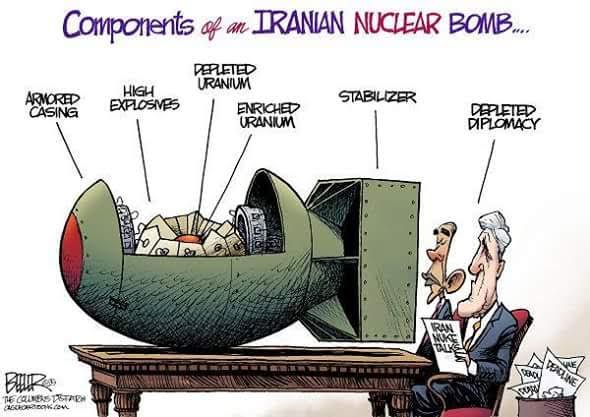
H/t Freedom is just another word

depleted


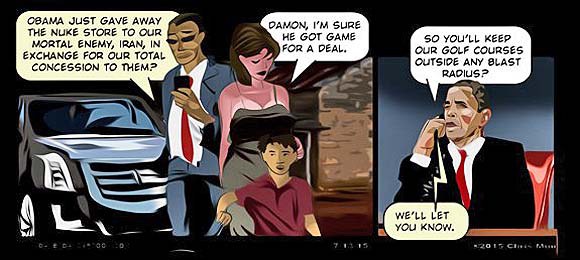
H/t Vermont Loon Watch

071315-575x258


Hillary Clinton is the X-factor for the Iranian nuclear deal’s congressional survival

July 13, 2015

Hillary Clinton is the X-factor for the Iranian nuclear deal’s congressional survival, DEBKAfile, July 13, 2015

Clinton_7.15Hillary Clinton faces tough decision

“A parade of concessions to Iran,” was Israeli Prime Minister Binyamin Netanyahu’s comment on the nuclear accord expected to be announced and fully revealed later on Monday July 13 in Vienna. He underscored his point by playing back President Bill Clinton’s words upon signing the nuclear deal with North Korea 21 years ago: “North Korea will freeze and then dismantle its nuclear program,” Clinton announced then. “South Korea and our other allies will be better protected. The entire world will be safer as we slow the spread of nuclear weapons.”

Despite Bill Clinton’s pledge of carefully monitoring, Pyongyang broke through to a nuclear bomb in October 2006, twelve years later. By comparison; a ten-year limit on the period during which Iran is allowed to develop a bomb is believed to be incorporated in the Vienna accord. Its full text of100 pages plus is still to be fully disclosed.

By playing back the Clinton clip, Netanyahu aimed to place high on Washington’s agenda, the leverage in the hands of his wife, Hillary Clinton, in determining whether the deal survives the US Congress, which will have 60 days to review it.

Hillary is currently rated by the polls with a 62 percent lead in her run for the Democratic nomination in the 2016 presidential election. She tops the lists of alll declared Democratic and Republic contenders combined.

In the first week of July, she is quoted as supporting Obama’s relentless drive for a deal when she said: “I so hope that we are able to get a deal in the next week that puts a lid on Iran’s nuclear weapons program because that’s going to be a singular step in the right direction.”

Before that, she echoed Obama’s words that “no deal is better than a bad deal.”

Now that the accord is in its last stage, she has held back from judging whether it is good or bad – only in private conversations with wealthy Jewish contributors to her campaign, she has promised to be “a better friend to Israel than President Barack Obama.”

But once the final accord is in the bag – expected in the coming hours – Clinton will have to come out in the open, because she holds the key to a Senate majority for blocking it. The 54 Republican senators are committed to voting against it: Senate Majority leader Mitch McConnell told Fox News Sunday: “I think it’s going to be a very hard sell, if it’s completed, in Congress. We already know it’s going to leave Iran as a threshold nuclear state. It appears as if the administration’s approach to this was to reach whatever agreement the Iranians are willing to enter into,” he said.

But the 44 Democratic senators are wobbling between being loyal to the president and their profound misgivings about the deal with Iran. It would take 13 Democrats to cross the floor and join the Republicans to achieve the necessary majority for annulling the promised presidential veto of a negative vote.

A Clinton declaration against the deal could swing those 13 senators against the accord – so painfully crafted in 13 months of agonizing bargaining led by Secretary of State John Kerry – and leave Obama in the position of a lame duck president.

Iran’s leaders, after reading the map in Washington, took the precaution of submitting to the Majlis a motion that would require a parliamentary review every few months of the US performance in complying with the accord with the power to annul it if this performance was judged unsatisfactory.

This pits the Iranian parliament against the US Senate and, by implication, puts Hillary Clinton in the driving seat in Washington versus Ayatollah Ali Khamenei in Tehran.

Whatever she decides now – whether for or against the Iranian deal – will have consequences for her campaign for president. That campaign has almost a year and a half to run before the November 2016 election. If she backs the deal and lets the Democratic senators refrain from voting against it, she will be held accountable – not only by Jewish campaign donors, but, up to a point, the American voter too. Israeli and Saudi intelligence will certainly use a microscope to discover the tiniest particles of evidence of Iran’s non-compliance. They will be thrown in her face.

Republican rivals will certainly fuel their campaigns with allegations of the total surrender to Iran by Obama and Kerry – with consequences for the prospects of Obama’s former secretary of state, Hillary Clinton.
Backing Obama would therefore cast a shadow over her presidential hopes, whereas taking the lead of a   Democratic senatorial mutiny against it may well undo the deal before the year is out.  Either way, Clinton faces one of her toughest decisions since she decided to run as the first American woman president.

Iran State Media Says Final Nuclear Agreement Meets All Khamenei’s Demands

July 13, 2015

Iran State Media Says Final Nuclear Agreement Meets All Khamenei’s Demands, Algemeiner, July 12, 2015

(Please see also, Back in Tehran… Khamenei adds red lines, Rouhani tries to resign, Jaafari hints at “fait accompli” soon. — DM)

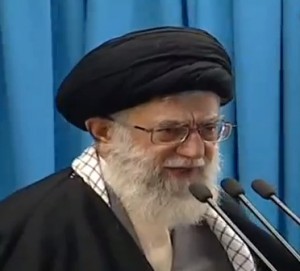
Khamanei-300x271Iranian Supreme Leader Ayatollah Ali Khamenei. Photo: Screenshot.

The final nuclear agreement between Iran and the P5+1 world powers reportedly set to be announced on Monday complies with all the “red lines” set out by Supreme Leader Ayatollah Khamenei, Iranian semi-official news agency Fars reported citing a “source privy to the talks.”

The deal, to be known as the Joint Comprehensive Plan of Action (JPOA), amounts to “a collection of multiple agreements that all fall within the red lines specified by the Iranian Supreme Leader Ayatollah Seyed Ali Khamenei,” Fars said.

Khamenei doubled down on his set of demands during a meeting with Iran’s President Rouhani in Tehran on June 23rd, Agence France-Presse reported at the time. His bottom line contradicted a number of positions previously outlined by world powers.

Among the P5+1 concessions, according to the Fars report, is the immediate lifting of sanctions following the signing of the deal and the full removal of the United Nations arms embargo.

“According to the Joint Comprehensive Plan of Action, all sanctions against Iran are terminated and Iran will no more be recognized as a sanctioned nation,” the source cited by Fars said. “The JCPA only envisages a set of temporary restrictions that will be removed after a limited and logical period of time, as stated earlier by the Iranian Supreme Leader.”

“All economic, financial and banking sanctions against Iran will be terminated for good on day one after the endorsement of the deal, again as the Iranian Supreme Leader has demanded.”

The source continued: “Iran will no more be under any arms embargo, and according to a UN Security Council resolution that will be issued on the day when the deal is signed by the seven states, all arms embargoes against Iran will be terminated, while its annex keeps some temporary restrictions on Iran for a limited period.”

“The upcoming UN Security Council resolution – that will call all the previous five resolutions against Iran null and void – will be the last resolution to be issued on Iran’s nuclear program and withdraws Iran’s nuclear dossier from under Chapter 7 of the UN Charter. This last resolution will remain valid and will be implemented for a specifically limited period of time and will then automatically end at the end of this period,” the source added, according to Fars. “This is the first time that a nation subject to Chapter 7 of the UN Charter has managed to end its case and stop being subject to this chapter through active diplomacy.”

In terms of Iran’s commitments to the international community, Fars characterized them as a “set of temporary and limited measures that will remain valid for different periods of time.”

Earlier on Sunday, the Associated Press cited unnamed diplomats who said that negotiators at the Iran nuclear talks will announce on Monday that they’ve reached a deal to limit the country’s atomic program in return for sanctions relief.

Later in the day, a source cited by Iranian media rejected the AP report.

The source added that “in case of striking a final deal, the agreement has to be approved by the Iranian parliament in the same manner that it has to be approved by the US Congress,” Fars said.

Israeli deterrence in the eye of the hurricane

July 12, 2015

Israeli deterrence in the eye of the hurricane, Jerusalem PostLouis Rene Beres, July 12, 2015

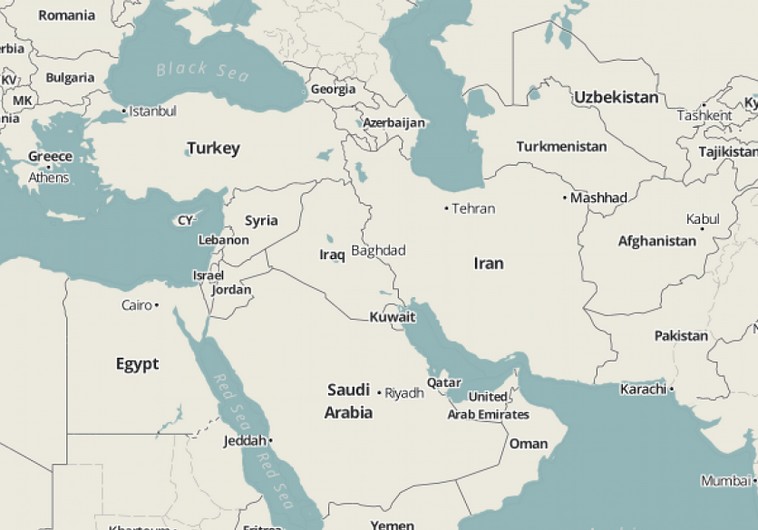
ShowImage (1)Map of Middle East. (photo credit:Courtesy)

Everything is very simple in war, but the simplest thing is difficult.”
– Carl von Clausewitz, On War

To prevent a nuclear war amid steadily growing regional chaos, especially as Iran will soon be fully nuclear (and the grateful beneficiary of US President Barack Obama’s pretend P5+1 diplomacy), Israel will need suitably complementary conventional and nuclear deterrents.

**********************

Left to themselves, especially as more “normal” hostilities dissolve into a full-blown regional chaos, Israel’s adversaries could drive the Jewish state toward an unconventional war. This fateful endangerment could be produced singly or collaboratively, by deliberate enemy intent or by the “collateral damage” of sectarian strife. Militarily, these Islamic adversaries of Israel, both Sunni and Shi’ite, could be either non-nuclear, or, in the future, nuclear.

They might also include certain wellarmed sub-state or terrorist forces. Already, Iranian-backed Hezbollah may have more usable missiles than all NATO countries combined.

To most effectively deal with such interpenetrating threats – including reasonably expected “synergies” and “force multipliers” – Israel’s leaders will first need to consider some largely-opaque factors. These include: 1) probable effects of regional chaos upon enemy rationality; 2) disruptive implications of impending Palestinian statehood; and 3) re-emergence of a corrosively Cold War-style polarity between Russia and the United States. Apropos of a “Cold War II,” there is already evidence of growing contact between Russia and Saudi Arabia, the world’s two largest oil producers.

In essence, Jerusalem must take all necessary steps to successfully manage an expectedly unprecedented level of adversarial complexity and weaponization. Israel’s leaders, in this connection, must take proper measures to ensure that any conceivable failures of its national deterrent would not spark biological or nuclear forms of regional conflict. To accomplish this indispensable goal, the IDF, inter alia, must continue to plan carefully around the core understanding that nuclear deterrence and conventional deterrence are inherently interrelated and meaningfully “seamless.”

Sometimes, in strategic matters, seeing requires distance. A nuclear war in the Middle East is not beyond possibility. This is a sensible assessment even if Israel were to remain the only nuclear weapons state in the region.

How is this possible? A bellum atomicum could come to Israel not only as a “bolt from the blue” enemy nuclear attack (either by a state or by a terrorist group), but also as the result, intended or otherwise, of certain uncontrolled military escalations.

Needed prudence in such narratives calls for additional specificity and precision. If particular Arab/Islamic enemy states were to launch conventional attacks upon Israel, Jerusalem could then respond, sooner or later, with calculated and more-or-less calibrated nuclear reprisals. Alternatively, if some of these enemy states were to launch large-scale conventional attacks, Jerusalem’s own still-conventional reprisals could then be met, perhaps even in the not-too-distant future, with enemy nuclear counterstrikes.

How should Israel prepare for such perilous contingencies? More than likely, Israel has already rejected any doctrinal plans for fielding a tactical/theater nuclear force, and for assuming any corollary nuclear war fighting postures. It would follow further from any such well-reasoned rejection that Israel should do whatever is needed to maintain a credible conventional deterrent.

By definition, such a measured threat option could then function reliably across the entire foreseeable spectrum of non-nuclear threats.

Still, any such strategy would need to include an appropriately complementary nuclear deterrent, a distinctly “last resort” option that could display a “counter-value” (counter-city) mission function. Si vis pacem, para bellum atomicum: “If you want peace, prepare for atomic war.”

A persuasive Israeli conventional deterrent, at least to the extent that it might prevent a wide range of enemy conventional attacks in the first place, could reduce Israel’s growing risk of escalatory exposure to nuclear war. In the always arcane lexicon of nuclear strategy, a complex language that more-or-less intentionally mirrors the tangled coordinates of atomic war, Israel will need to maintain firm control of “escalation dominance.” Otherwise, the Jewish state could find itself engaged in an elaborate but ultimately lethal pantomime of international bluster and bravado.

The reason for Israel’s obligation to control escalatory processes is conspicuous and unassailable. It is that Jerusalem’s main enemies possess something that Israel can plainly never have: Mass.

At some point, as nineteenth century Prussian military thinker Carl von Clausewitz asserts in On War: “Mass counts.”

Today, this is true even though Israel’s many enemies are in chaotic disarray. Now, amid what Clausewitz had famously called “friction” and the “fog of war,” it could become harder for Israel to determine real and pertinent differences between its allies, and its adversaries.

As an example, Jordan could soon become vulnerable to advancing IS forces.

Acknowledging this new vulnerability, an ironic question will come immediately to mind: Should Israel support the Jordanian monarchy in such a fight? And if so, in what specific and safe operational forms? Similarly ironic questions may need to be raised about Egypt, where the return to military dictatorship in the midst of surrounding Islamist chaos could eventually prove both fragile and transient.

Should President Abdel Fattah Sisi fail to hold things together, the ultimate victors could be not only the country’s own Muslim Brotherhood, but also, in nearby Gaza, Palestinian Hamas. Seemingly, however, Hamas is already being targeted by Islamic State, a potentially remorseless opposition suggesting, inter alia, that the principal impediment to Palestinian statehood is not really Israel, but another Sunni Arab terrorist organization. Of course, it is not entirely out of the question that IS’s Egyptian offshoot, the so-called “Sinai Province of Islamic State,” could sometime decide to cooperate with Hamas – the Islamic Resistance Movement – rather than plan to it.

To further underscore the area’s multiple and cross-cutting axes of conflict, it is now altogether possible that if an IS conquest of Sinai should spread to Gaza, President Sisi might then “invite” the IDF to strike on Egypt’s behalf. Among other concerns, Egypt plainly fears that any prolonged inter-terrorist campaign inside Gaza could lead to a literal breaking down of border fences, and an uncontrolled mass flight of Palestinians into neighboring Sinai.

Credo quia absurdum. “I believe because it is absurd.” With such peculiar facts in mind, why should Israel now sustain a conventional deterrent at all? Wouldn’t enemy states, at least those that were consistently rational, steadfastly resist launching any conventional attacks upon Israel, for fear of inciting a nuclear reprisal? Here is a plausible answer: suspecting that Israel would cross the nuclear threshold only in extraordinary circumstances, these national foes could be convinced, rightly or wrongly, that as long as their initial attacks were to remain conventional, Israel’s response would remain reciprocally non-nuclear. By simple extrapolation, this means that the only genuinely effective way for Israel to continually deter large-scale conventional war could be by maintaining visibly capable and secure conventional options.

As for Israel’s principal non-state adversaries, including Shi’ite Hezbollah and Sunni IS, their own belligerent calculations would be detached from any assessments of Israeli nuclear capacity and intent. After all, whatever attacks they might sometime decide to consider launching against the Jewish state, there could never be any decipherable nuclear response.

Nonetheless, these non-state jihadist foes are now arguably more threatening to Israel than most enemy national armies, including the regular armed forces of Israel’s most traditional enemies – Egypt, Jordan and Syria.

Some other noteworthy nuances now warrant mention. Any still-rational Arab/ Islamic enemy states considering firststrike attacks against Israel using chemical and/or biological weapons would likely take Israel’s nuclear deterrent more seriously. But a strong conventional capability would still be needed by Israel to deter or to preempt certain less destructive conventional attacks, strikes that could escalate quickly and unpredictably to assorted forms of unconventional war.

If Arab/Islamic enemy states did not perceive any Israeli sense of expanding conventional force weakness, these belligerent countries, now animated by credible expectations of an Israeli unwillingness to escalate to nonconventional weapons, could be more encouraged to attack. The net result here could be: 1) defeat of Israel in a conventional war; 2) defeat of Israel in an unconventional (chemical/biological/ nuclear) war; 3) defeat of Israel in a combined conventional/unconventional war; or 4) defeat of Arab/Islamic enemy states by Israel in an unconventional war.

For Israel, even the presumptively “successful” fourth possibility could prove too costly.

Perceptions are vitally important in all calculations of nuclear deterrence. By continuing to keep every element of its nuclear armaments and doctrine “opaque,” Israel could unwittingly contribute to the injurious impression among its regional enemies that Jerusalem’s nuclear weapons were unusable. Unconvinced of Israel’s willingness to actually employ its nuclear weapons, these enemies could then decide to accept the cost-effectiveness of striking first.

With any such acceptance, Israeli nuclear deterrence will have failed.

If enemy states should turn out to be correct in their calculations, Israel could find itself overrun, and thereby rendered subject to potentially existential harms.

If they had been incorrect, many states in the region, including even Israel, could eventually suffer the assorted consequences of multiple nuclear weapons detonations. Within the directly affected areas, thermal radiation, nuclear radiation and blast damage would then spawn uniquely high levels of death and devastation.

To prevent a nuclear war amid steadily growing regional chaos, especially as Iran will soon be fully nuclear (and the grateful beneficiary of US President Barack Obama’s pretend P5+1 diplomacy), Israel will need suitably complementary conventional and nuclear deterrents. Even now, at the eleventh hour, it will also require a set of residual but still-available preemption options. Under authoritative international law, actually exercising any such last-resort options would not necessarily represent lawlessness or “aggression.”

On the contrary, such strikes could readily meet the long-established and recognizable jurisprudential standards for “anticipatory self-defense.”

Going forward, Israeli nuclear deterrence – reinforced, of course, by ballistic missile defense – must become an increasingly central part of the Jewish state’s overall survival plan. Fulfilling this requirement should in no way suggest any corresponding violations of international law. After all, every state in world politics has an overriding obligation to survive.

International law is not a suicide pact.

Still too eager for a deal

July 12, 2015

Still too eager for a deal, Israel Hayom, Prof. Abraham Ben-Zvi, July 12,2015

(According to an article at the Washington Post, a “deal” is expected today and will be announced tomorrow. — DM)

Russia strengthening its position as an ally and a main weapons supplier to Iran worries the U.S. The 44th president is steadfast on reaching a deal, and even the current dispute won’t prevent him from achieving his dream, even at the price of laying the groundwork for an extremist regional power that would attempt to threaten its strategic environs. There is nothing left to do but hope that the U.S. Senate, which will have 60 days to scrutinize the agreement after it is signed, will meet the challenge it is faced with.

******************

The fact that the latest deadline for a final nuclear deal between Iran and the world powers is behind us, without smoke billowing over the negotiating room in Vienna, is astonishing. After all, there are no signs indicating that Washington’s eagerness for a successful end to the talks has weakened. In fact, it is the opposite. In recent months, it has become clearer that U.S. President Barack Obama has made a deal with Iran a main goal of his legacy. In his view, a deal with Iran will obfuscate all his failures in the Middle East and herald a new regional agenda, with the new partner from Tehran at its center.

Obama seems steadfast in his belief that a conciliatory, compensatory policy based on a range of trust-building economic steps, will quickly set the regime of ayatollahs on a moderate, pragmatic path. The carrot of economic investment and the cancelation of the rule of sanctions will lay the cornerstone for a strong diplomatic and strategic partnership between Washington and Tehran, central to which will be the Iranian regime’s willingness to take on a key role in containing the Islamic State group. To bring that vision to fruition, the Obama administration is charging ahead toward a final nuclear deal at almost any price, while shutting its eyes and continuing to put the agreement together, the ongoing terrorist activity and widespread subversion emanating from the Iranian capital and spreading out over the entire area.

It’s not only that no link whatsoever between nuclear weapons and conventional and semi-conventional weapons exists in the almost final version of the “Vienna Treaty,” but also that the nuclear core of the nascent deal is spotty and full of holes that will give the Iranian regime a golden opportunity to surge ahead toward a nuclear bomb a decade from now, when all oversight of the regime comes to an end.

In light of that, the fact that the official signing ceremony did not take place on July 9 as expected makes one wonder. The explanation, which is only tangentially related to the nuclear issue, does not at all indicate that the American superpower is coming to its senses at last, but is anchored in the web of U.S.-Russian relations. The last pitfall on the way to a deal is basically about Obama’s relations with Russian President Vladimir Putin, which center on the Kremlin’s ongoing military activity in the eastern Ukraine and the economic sanctions the West applied to Russia in response. Given this highly charged relationship, the White House has no interest in any step that could even slightly improve Russia’s grim economic situation. This is the connecting thread between the Russian-American axis and the current field of negotiations with Iran.

Russia, which because of the sanctions in place against it desperately needs foreign currency, wants a fast entry into the Iranian weapons market. So, together with China, it is lending its fervent support to Iran’s demands that the deal also lift the embargo against supplying it with conventional weapons, which the U.N. Security Council decreed in 2006. Especially since a deal for Russia to sell Iran S-300 surface-to-air missiles by 2007 has been frozen since 2010. Thus, Russia’s growing economic distress joins the rest of Putin’s geostrategic considerations and is creating an aggressive Russian position in favor of a quick removal of military sanctions from Iran, which in turn encourages Iranian President Hassan Rouhani and Iranian Foreign Minister Javad Zarif to dig in their heels.

Russia strengthening its position as an ally and a main weapons supplier to Iran worries the U.S. The 44th president is steadfast on reaching a deal, and even the current dispute won’t prevent him from achieving his dream, even at the price of laying the groundwork for an extremist regional power that would attempt to threaten its strategic environs. There is nothing left to do but hope that the U.S. Senate, which will have 60 days to scrutinize the agreement after it is signed, will meet the challenge it is faced with.

Back in Tehran… Khamenei adds red lines, Rouhani tries to resign, Jaafari hints at “fait accompli” soon

July 12, 2015

Back in Tehran… Khamenei adds red lines, Rouhani tries to resign, Jaafari hints at “fait accompli” soon, DEBKAfile, July 12, 2015

(To the extent accurate, this is a fascinating account of what happened on June 29th, when Rouhani returned to Tehran for “consultation.” — DM)

ROUHANI-JAFARIPresident Rouhani vs Ali Jaafari

Iran’s top leaders remain ambivalent about whether or not to sign the comprehensive nuclear accord with the six world powers in Vienna as 22 agonizing months of negotiation falter on the brink. The all-powerful supreme leader Ayatollah Ali Khamenei’s latest comment was far from helpful. Saturday, July 11, he said publicly: “The US is the true embodiment of global arrogance,” the fight against which “could not be interrupted” even after the completion of the nuclear talks. He also boasted that the Islamic Republic had “managed to charm the world” by sticking with those negotiations.

DEBKAfile’s Iranian sources report that Khamenei’s remarks reflect the struggle between the pro- and anti-nuclear deal factions at the highest level of the Iranian leadership. For now, President Barack Obama’s odds of less than 50 percent on a final accord may well describe the balance in Tehran.

On June 29, President Hassan Rouhani was planning to resign when he asked the supreme leader to receive him first. He was upset by Foreign Minister Mohamed Zavad Zarif’s recall from Vienna to Tehran for a tough briefing. Zarif had warned the president that the talks were doomed unless Iran gave some slack. The foreign minister said that the six foreign ministers were preparing to leave Vienna in protest against Iran’s intransigence.

Rouhani when he met Khamenei warned him that Iran was about to miss the main diplomatic train to its main destination: the lifting of sanctions to save the economy from certain ruin.

The supreme ruler was unconvinced: He referred the president to the conditions for a deal he had laid down on June 23 and refused to budge: Sanctions must be removed upon the signing of the final accord; international atomic agency inspectors were banned at military facilities, along with interviews with nuclear scientists; and the powers must endorse Iran’s right to continue nuclear research and build advanced centrifuges for uranium enrichment.

Rouhani hotly stressed that those conditions had become a hindrance to the deal going through and insisted that sanctions relief was imperative for hauling the economy out of crisis.

Khamenei disputed him on that point too. He retorted that the revolutionary republic had survived the eight-year Iranian-Iraqi war (1979-187) with far fewer resources and assets than it commanded at present.

For back-up, the supreme ruler asked two hardliners to join his ding-dong with the president: Defense Minister Hosseim Dehqan and Revolutionary Guards chief Mohammad Ali Jaafari.

Both told Rouhani in the stiffest terms that Tehran must not on any account bow to international pressure for giving up its nuclear program or the development of ballistic missiles.

In a broad hint to President Rouhani to pipe down, Khamenei reminisced about his long-gone predecessor Hassan Bani-Sadr (president in 1980-1981) who was not only forced out of office but had to flee Iran, and the former prime minister and presidential candidate Mir Hossein Moussavi, who has lived under house arrest for six years since leading an opposition campaign.

The supreme leader then set out his thesis that the danger of Iran coming under attack had declined to zero, since Europe was in deep economic crisis (mainly because of Greece) and because the US president had never been less inclined to go to war than he is today.

Jaaafri added his two cents by commenting that after a succession of fiascos, Obama would go to any lengths to reach a nuclear deal with Iran as the crowning achievement of his presidency.  The Revolutionary Guards chief then added obliquely: “Before long we will present the West with a fait accompli.”

He refused to elaborate on this when questioned by the president, but it was taken as a reference to some nuclear event.

Rouhani left the meeting empty-handed, but his letter of resignation stayed in his pocket.

The next day, when Zarif landed in Vienna to take his seat once more at the negotiating table, he learned about a new directive Khamenei had sent the president, ordering him to expand ballistic missile development and add another five percent to its budget – another burden on Iran’s empty coffers.

Khamenei’s office made sure this directive reached the public domain. Zarif too was armed with another impediment to a deal. Khamenei instructed him to add a fresh condition: The annulment of the sanctions imposed against Iran’s missile development and arms purchases.

Goodnight Vienna (9)

July 11, 2015

Goodnight Vienna (9), Power LineScott Johnson, July 11, 2015

Omri Ceren reports by email from Vienna:

Happy Saturday from Vienna, where we continue to slouch towards a deal.

The Iranians went into meetings this morning talking about progress and predicting breakthroughs. Kerry came out of his meetings later and tweeted “Met with @FedericaMog and @JZarif this AM. Still have difficult issues to resolve” [1]. That language was read by some journalists as evidence that the talks remain stalled. Other journalists are passing around rumors that R&D issues have been solved, that the Americans have collapsed on inspections, and that the Iranians have agreed to drop their new demand for ending the United Nations arms embargo. Could be anything.

For his part [U.S.] Energy Secretary Moniz tweeted this last night [2]:

CJkQa3TWoAErjWz
Ernest Moniz

Now back to business. We’re working hard to reach a good deal that is based on hard science.

The big unanswered question about pending Iran deal

July 11, 2015

The big unanswered question about pending Iran deal, Harretz, July 11, 2015

(Harretz includes the obligatory swipes at PM Netanyahu but then backs off, while raising an interesting question: Why does Obama continue to buckle to Iranian demands? Is it more than his need for a legacy, his affection for Islam, the likely that nobody will stop him, incompetence and/or a lack of interest? — DM)

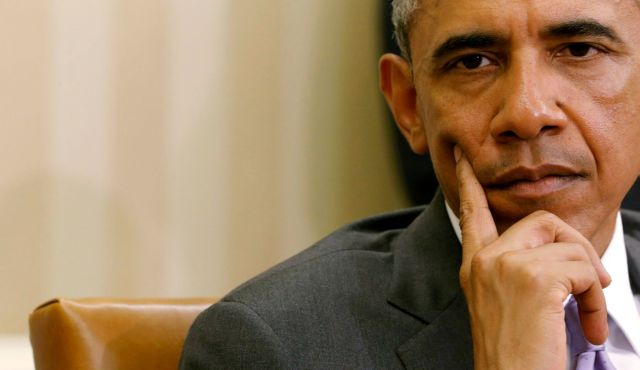
866182083President Barack Obama, July 7, 2015. What is he thinking with his Iranian strategy? Photo by Reuters

It’s hard to overstate the importance of cracking the code that has caused the administration to capitulate. It’s liable to put us, albeit not in the near-future, in a situation where all hope will be lost.

*********************

The inevitable revenge for Prime Minister Benjamin Netanyahu’s deluded flirtation with the Republicans and Congress has arrived. It’s crystal clear: Because of Netanyahu’s contrarian and irresponsible behavior, bridges with the U.S. administration were burned and Israel was ousted from the circle of influence on the pending nuclear deal with Iran. Netanyahu bears part of the responsibility for the bad deal that will be signed with Iran.

If any Israeli figures had a real impact on our inability to prevent a bad deal, however, it was Meir Dagan, Yuval Diskin and Gabi Ashkenazi – the principal opponents who leaked their objections to a military operation. They, along with the noisy chorus of America’s proxies in Israel, torpedoed the credibility of the brinkmanship strategy Netanyahu was leading. Iran, free of Israeli pressure, kept galloping toward the bomb.

True, Netanyahu’s mistakes – even in the area of Iran – are not few in number. However, anyone who assigns him responsibility, even indirect, for the heap of failings of the U.S. administration with regard to Iran discounts the American president and insults the memory and intelligence of the public.

The accusers, whatever their obligations to the United States, have exempted themselves from the need to think more deeply about the interests underlying America’s capitulation to Iranian chutzpah. For the sake of the future, it is dependent upon Israel to solve the big unknown: what motivates President Barack Obama to ease – in reality, cancel – sanctions before the Iranians prove, within a significant time frame, that they have left the path of nuclear arms, terror and fraud. Why is he providing the ayatollahs’ state with economic power – and therefore political and military power – to continue harming its allies in the region. And, finally, why doesn’t the agreement include an explicit demand for Iran to completely turn away from the path of terror?

Cracking America’s unclear, scarcely believable code of conduct is a major challenge. It is simply not logical that the American president, who bears responsibility for the fate of the world, should capitulate to the Iranians – unless he has a decisive reason – and cede effective supervision of nuclear sites.

The Iranians need American benevolence – not the other way around. So why are the Iranians able to bend the Americans, and not vice versa? In any event, the reason for their success does not lie, as many tend to think, in typical American naïveté – and certainly not in weakness or foolishness, as some say about Secretary of State John Kerry.

Israel’s point of departure needs to be – and this is the truth – that the U.S. president is acting in line with his nation’s interests, and that John Kerry is executing his policy. The latter’s behavior, as reflected in caricatures and articles criticizing him, is in accordance with the president’s directives, and not because he is a weak or shallow figure.

It’s hard to overstate the importance of cracking the code that has caused the administration to capitulate. It’s liable to put us, albeit not in the near-future, in a situation where all hope will be lost. Then, we will be forced to make it clear to the Americans: You, who pushed us into a corner, like in the words of the Book of Isaiah – “And I looked, and there was none to help; and I beheld in astonishment, and there was none to uphold” – bear responsibility. In a situation of no choice, we will act – and we will have to act – for as the verse continues, “And My fury, it upheld Me / And I trod down the peoples in Mine anger.”