Posted tagged ‘Obama’s affinity for Iran’

Obama’s shameful betrayal of America

August 18, 2015

Obama’s shameful betrayal of America, Front Page MagazineDr. Majid Rafizadeh, August 18, 2015

secretary_kerry_meets_with_iranian_foreign_minister_zarif_in_paris_to_continue_nuclear_program_negotiations_16107653417

Thanks to President Obama, radical Islam is the winner of the nuclear deal and the US emerges as the biggest loser when it comes to its national, economic, geopolitical and strategic interests. In addition, except for Israel and the United States, almost every country in the world (as well as Shiite militia groups) appear to be benefiting from the nuclear deal – economically, strategically, and geopolitically — as a result of rekindling relationships with the Islamic Republic. Not only does this deal damage the US and Israel’s national and economic interests, but it also strengthens the same forces and axis which have repeatedly sworn war and violence against Americans. 

A strong argument can be made that one of the major birthplaces of fundamentalist Islamism, which at its core aims at opposing and fighting the United States, is the Islamic Republic of Iran.

The mission of anti-Americanism and anti-Semitism began heavily when the ruling mullahs of Iran, with the leadership of Ayatollah Rooh Allah Khamenei, came to power.  This mission remains and will continue to remain the major pillar of the Islamic Republic as well as the keystone of the mullah’s political and ideological establishments.

Since then, the Islamic Republic, with IRGC and its proxies, has been attacking and slaughtering Americans. They also attempt to scuttle US foreign policy. The United States is not their sole target. They also interfere with the national and economic interest of several countries in the Middle East and beyond including Iraq, Lebanon, Syria, Yemen, etc.

Without a doubt, this is a regime that breeds anti-Americanism and hatred towards Jewish and Christian people. So, what is President Obama’s solution to offset such a threat? Surrender — while continuing to give bonuses and gifts to the Iranian regime.

After Russia and China, Switzerland was the first European country to officially lift economic and political sanctions against the Islamic Republic citing the nuclear deal which was reached between the Islamic Republic and six world powers. The sanctions included restrictions on trade in precious metals, petrochemical products, petroleum products as well as the transport of Iranian crude oil. Switzerland issued a statement pointing out that the “Federal Council (government) wishes today’s steps to be seen as a sign of its support for the implementation of the nuclear agreement and its interest in deepening bilateral relations with Iran.” It also added that it will seek to “promote a broad political and economic exchange with Iran.”

Other European countries are going to follow as well. What is going to happen next? Billions off dollars are going to flow into a government whose primary objective is to fight with the United States.

Russia, China, and other rivals will benefit economically, politically, strategically, and ideologically from the nuclear deal. It is the United States which not only is not gaining anything (economically, geopolitically, security-wise, or strategically) from this deal, but also is significantly empowering its rivals.

In the next phase, the nuclear deal will significantly tip the balance of power in favor of US rivals and the anti-American axis. China, Russia and the Iran-Assad-Hezbollah-Haman’s alliance will be considerably strengthened.

What does President Obama think that a political regime — that has been fighting the United States tooth and nail and that is responsible for the killing of many Americans in the Middle East — is going to use the billions of dollars it earns to promote? It certainly will not be pro-American or pro-Israel ideology, democratization, social justice, rule of law, human rights, or freedom of speech, press, and assembly.

Mr. Obama recently delivered a speech at American University pointing out that “just because Iranian hardliners chant ‘Death to America’ does not mean that that’s what all Iranians believe.” He added, “In fact, it’s those hardliners … chanting ‘Death to America’ who’ve been most opposed to the deal. They’re finding common cause with the Republican Caucus.”

There are several fallacies in his statements. First of all, he is implying the Republicans are similar to those Iranian politicians who are anti-American. Republicans are attempting to preserve the national and economic interest of their country when it comes to the Islamic Republic, but Iranian politicians are sworn to fight American interests and wipe out Israel.

Secondly, President Obama argues that Iranian hardliners are against the nuclear deal. This is absolutely inaccurate. It was because of the approval of  Iran’s Supreme autocrat, Ayatollah Ali Khamenei, that the deal was signed. The hardliners are the ones who will gain the most from this deal.

Third, it is true that not all Iranian people believe in “Death to America,” but Mr. Obama is dodging the major point. When it comes to international politics and the mission of fighting America, it honestly does not matter what Iranian people believe or do not believe. What matters is the political establishment of the Islamic Republic and the government which has the hard power (weapons, military, financial means, oil, etc) to fight with the US.

Finally, it is not only the hardliners that chant “Death to America,” but the entire group of ruling clerics and leaders of the Islamic Republic that believe this with a passion. We should not forget that a major slogan of President Rouhani (the so-called “moderate”) is: “Saying ‘Death to America’ is easy. We need to express ‘Death to America’ with action.” Or, as the other supposed “moderate” and “pragmatist,” Rafsanjani pointed out, “If a day comes when the world of Islam is duly equipped with the arms Israel has in possession, the strategy of colonialism would face a stalemate because application of an atomic bomb would not leave anything in Israel[.]”

United Nations and European Union sanctions on some of Iranian war criminals will also be lifted as part of the nuclear pact. One of these figures is General Qassem Suleimani, the head of Iran’s Islamic Revolutionary Guard Corps—Qods Force, who is the mastermind behind creating Shiite militia groups and terrorists across the region. He oversaw the training, financing, and arming of these militia groups. These groups are directly or indirectly fighting the United States and American soldiers as well.

As Lt. Gen. (ret.) Michael Barbero stated Sunday in The Weekly Standard, the lifting of international sanctions against Gen. Soleimani is a “shameful betrayal” of the “the American families of Suleimani’s casualties, and …those of us who lost friends and comrades.”

What if the Iranian leaders circumvent the guidelines put into place by the deal down the road? Then, too bad. If the Iranian leaders, as predicted, are caught deceiving their way towards obtaining a nuclear bomb, it will be too late to do anything. The economic and political sanctions will have been lifted, leaving the Iranian government with a surplus of funds. The US, which was in a stronger position when sanctions were imposed on the Islamic Republic, will become the weaker player. Russia and China will block any re-imposition of sanctions on the Islamic Republic. At that point, unfortunately, it will be the US in the desperate position, not the Islamic Republic. Radical Islam will exponentially spread against the US, as well as democratic and Western values around the globe.
Compromised – John Kerry has much to hide on his ties to Iran.

August 11, 2015

Compromised – John Kerry has much to hide on his ties to Iran, Front Page MagazineKenneth R. Timmerman, August 11, 2015

John Kerry has much to hide on his ties to Iran. As I revealed more than ten years ago, Mr. Kerry has long been sympathetic to the Islamist regime in Tehran.

******************

Secretary of State John Kerry is becoming increasingly frantic as he takes his case for the deeply flawed Iran nuclear deal around the country. 

His latest argument, that congressional disapproval of the deal will be the “ultimate screwing” of Iran’s clerical Supremo – and that we should care – verges on hysteria.

Whether it’s hysterically funny or a psychotic condition would be a tough call, if only the stakes weren’t so high for our security and the security of our friends and allies, starting with the Iranian people.

John Kerry has much to hide on his ties to Iran. As I revealed more than ten years ago, Mr. Kerry has long been sympathetic to the Islamist regime in Tehran.

In June 2002 – just nine months after the 9/11 attacks on America – Mr. Kerry headlined a fund-raising gala for the American-Iranian Council, a pro-regime lobbying group seeking to roll back U.S. sanctions and promote U.S. investment in Iran.

The next day, AIC members returned the favor and hosted a fund-raiser for Senator Kerry’s re-election campaign at the Ritz Carlton in San Francisco that netted more than $26,000. Many of those same fund-raisers became bundlers for Mr. Kerry’s failed 2004 presidential bid.

Among those opening their wallets was a stunning 34-year-old Iranian woman named Susan Akbarpour, aka Zahra A. Mashadi. “I am an actor in U.S. politics,” Ms. Akbarpour boasted to a reporter. “I am a fund-raiser for all candidates who listen to us and our concerns.”

The only problem was, her political contributions were illegal because she did not have a green card. The Kerry campaign never returned those contributions and the Federal Election Commission never investigated.

Mr. Kerry has been accused of behaving as “Iran’s lawyer” in the nuclear negotiations, finding excuses for Iran’s bad behavior and justifications for a seemingly endless stream of U.S. capitulations to Iran.

But that behavior is not new. In fact, during a debate with President George W. Bush during the 2004 campaign, Mr. Kerry pledged that had he been president since 2001, he would have “offered the opportunity to provide the nuclear fuel” to Iran, to “test them, see whether or not they were actually looking for it for peaceful purposes.”

Why would the United States appoint as lead negotiator a politician whose long-held views favoring our adversary in those negotiations were well-known?

Much has been made recently of Secretary Kerry’s family ties to Iran, a fact that was never raised during his confirmation hearings as Secretary of State.

Vanessa Kerry tartly dismissed rumors that have circulated in the Iranian-American community in Los Angeles since her 2009 wedding that the son of Iran’s Foreign Minister, Mehdi Zarif, was best-man for her husband, Behrouz Vala Nahed, an American-born neuro-surgeon. “Happy 2 verify. No wedding party when we married. No Zarif’s son. Sorry 2 disappoint,” she tweeted recently.

An Iranian website close to the father, Mohammad Javad Zarif, initially reported that Brian Nahed and Mahdi Zarif had “only” been college roommates, but later changed the on-line version of the article without noting the correction.

Mahdi Zarif attended the City University of New York and lived in the United States for more than a decade while his father was the Islamic Republic’s ambassador to the United Nations (and repeatedly met with U.S. Senators in Washington, DC, including now vice-president Joe Biden). Dr. Nahed took his pre-med undergraduate degree several years earlier at UCLA.

But the presence or not of Zarif the son at Kerry the daughter’s wedding is a side show and detracts from an examination of Mr. Kerry’s fundamental conflict of interest in serving as chief U.S. negotiator with Iran.

The facts are indisputable:

  • Mr. Kerry took illegal campaign cash from an Iranian national who, while claiming to be a political refugee, assaulted anti-regime protesters in Los Angeles, promoted U.S. computer and software investment in Iran in violation of U.S. sanctions, and boasted of influencing U.S. politicians with a pro-Tehran agenda. Taking that illicit cash tainted Mr. Kerry and identified him a “soft target” to agents of the Iranian regime.
  • Mr. Kerry carried through his side of the bargain, embracing the pro-Tehran agenda during his 2004 presidential campaign, while his Iranian backers kicked in substantial fresh cash to his campaign.
  • Mr. Kerry met Zarif at a private reception hosted by George Soros in New York in 2005, shortly after Soros’s Open Society Institute hosted Zarif at a policy luncheon for New York media elites.
  • Mr. Kerry sought to travel to Tehran to jumpstart diplomatic negotiations in December 2009, but was rebuffed by Tehran.

As I wrote earlier this year, a former aide to Iranian president Rouhani, who defected while covering the nuclear talks, revealed that Mr. Kerry and the U.S. delegation were seen by the Iranian negotiating team as secret allies who helped arm-twist reluctant partners such as France into making major concessions.

I know Iranian-Americans who volunteered for U.S. military service who were forced to leave the military when family members traveled to Iran. Why? Because counter-intelligence professionals who understood the Iranian government track record of exploiting family relationships for intelligence or political purposes indicated they could be compromised.

After all, the Soviets used family relationships all through the Cold War to compromise unwilling individuals to collaborate with their cause.

The game is as old as the intelligence business itself: find some string to manipulate or blackmail your adversary, then pull as hard as you can.

When it comes to Iran, John Kerry is about as compromised as they get.

Column One: Obama’s enemies list

August 6, 2015

Column One: Obama’s enemies list, Jerusalem Post, Caroline Glick, August 6, 2015

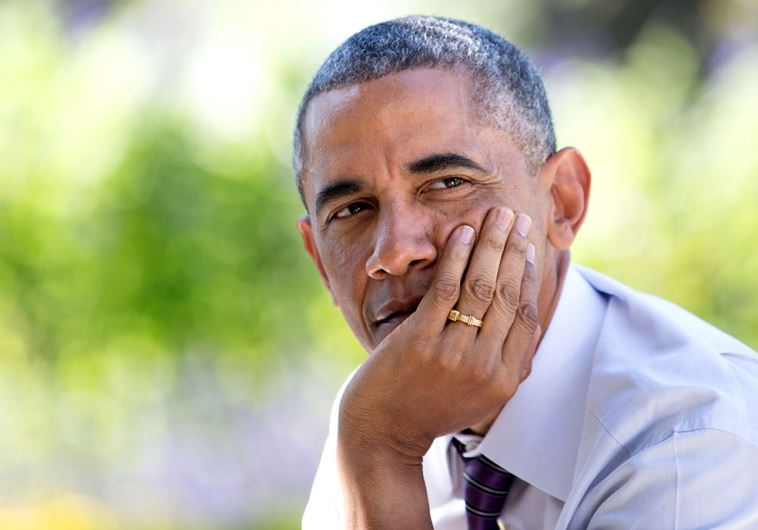
ShowImage (8)US President Barack Obama at the Rose Garden of the White House. (photo credit:OFFICIAL WHITE HOUSE PHOTO / PETE SOUZA)

[T]he real question lawmakers need to ask is whether the deal is good for America. Is Obama right or wrong that only partisan zealots and disloyal Zionists could oppose his great diplomatic achievement? To determine the answer to that question, you need to do is ask another one. Does his deal make America safer or less safe? The best way to answer that question is to consider all the ways Iran threatens America today, and ask whether the agreement has no impact on those threats, or whether it mitigates or aggravates them.

***********************

In President Barack Obama’s defense of his nuclear deal with Iran Wednesday, he said there are only two types of people who will oppose his deal – Republican partisans and Israel- firsters – that is, traitors.

At American University, Obama castigated Republican lawmakers as the moral equivalent of Iranian jihadists saying, “Those [Iranian] hard-liners chanting ‘Death to America’ who have been most opposed to the deal… are making common cause with the Republican Caucus.”

He then turned his attention to Israel.

Obama explained that whether or not you believe the deal endangers Israel boils down to whom you trust more – him or Prime Minister Benjamin Netanyahu. And, he explained, he can be trusted to protect Israel better than Netanyahu can because “[I] have been a stalwart friend of Israel throughout my career.”

The truth is that it shouldn’t much matter to US lawmakers whether Obama or Netanyahu has it right about Israel. Israel isn’t a party to the deal and isn’t bound by it. If Israel decides it needs to act on its own, it will.

The US, on the other side, will be bound by the deal if Congress fails to kill it next month.

So the real question lawmakers need to ask is whether the deal is good for America. Is Obama right or wrong that only partisan zealots and disloyal Zionists could oppose his great diplomatic achievement? To determine the answer to that question, you need to do is ask another one. Does his deal make America safer or less safe? The best way to answer that question is to consider all the ways Iran threatens America today, and ask whether the agreement has no impact on those threats, or whether it mitigates or aggravates them.

Today Iran is harming America directly in multiple ways.

The most graphic way Iran is harming America today is by holding four Americans hostage. Iran’s decision not to release them over the course of negotiations indicates that at a minimum, the deal hasn’t helped them.

It doesn’t take much consideration to recognize that the hostages in Iran are much worse off today than they were before Obama concluded the deal on July 14.

The US had much more leverage to force the Iranians to release the hostages before it signed the deal than it does now. Now, not only do the Iranians have no reason to release the hostages, they have every reason to take more hostages.

Then there is Iranian-sponsored terrorism against the US.

In 2011, the FBI foiled an Iranian plot to murder the Saudi ambassador in Washington and bomb the Saudi and Israeli embassies in the US capital.

One of the terrorists set to participate in the attack allegedly penetrated US territory through the Mexican border.

The terrorist threat to the US emanating from Iran’s terrorist infrastructure in Latin America will rise steeply as a consequence of the nuclear deal.

As The Wall Street Journal’s Mary Anastasia O’Grady wrote last month, the sanctions relief the deal provides to Iran will enable it to massively expand its already formidable operations in the US’s backyard. Over the past two decades, Iran and Hezbollah have built up major presences in Cuba, Venezuela, Nicaragua, Ecuador and Bolivia.

Iran’s presence in Latin America also constitutes a strategic threat to US national security. Today Iran can use its bases of operations in Latin America to launch an electromagnetic pulse attack on the US from a ballistic missile, a satellite or even a merchant ship.

The US military is taking active steps to survive such an attack, which would destroy the US’s power grid. Among other things, it is returning the North American Aerospace Defense Command (NORAD) to its former home in Cheyenne Mountain outside Colorado Springs.

But Obama has ignored the findings of the congressional EMP Commission and has failed to harden the US electronic grid to protect it from such attacks.

The economic and human devastation that would be caused by the destruction of the US electric grid is almost inconceivable. And now with the cash infusion that will come Iran’s way from Obama’s nuclear deal, it will be free to expand on its EMP capabilities in profound ways.

Through its naval aggression in the Strait of Hormuz Iran threatens the global economy. While the US was negotiating the nuclear deal with Iran, the Revolutionary Guards unlawfully interdicted – that is hijacked – the Marshall Islands-flagged Maersk Tigris and held its crew hostage for weeks.

Iran’s assault on the Tigris came just days after the US-flagged Maersk Kensington was surrounded and followed by Revolutionary Guards ships until it fled the strait.

A rational take-home message the Iranians can draw from the nuclear deal is that piracy pays.

Their naval aggression in the Strait of Hormuz was not met by American military force, but by American strategic collapse at Vienna.

This is doubly true when America’s listless response to Iran’s plan to use its Houthi proxy’s takeover of Yemen to control the Bab el-Mandab strait is taken into consideration. With the Bab el-Mandab, Iran will control all maritime traffic from the Persian Gulf and the Red Sea. Rather than confront this clear and present danger to the global economy, America abandoned all its redlines in the nuclear talks.

Then there is Iran’s partnership 20-year partnership with al-Qaida.

The 9/11 Commission found in its report that four of the 9/11 terrorists transited Iran before traveling to the US. As former Defense Intelligence Agency director Lt.-Gen. (ret.) Mike Flynn told Fox News in the spring, Iranian cooperation with al-Qaida remains deep and strategic.

When the US Navy SEALs killed Osama bin Laden in 2011, they seized hard drives containing more than a million documents related to al-Qaida operations. All but a few dozen remain classified.

According to Flynn and other US intelligence officials who spoke to The Weekly Standard, the documents expose Iran’s vast collaboration with al-Qaida.

The agreement Obama concluded with the mullahs gives a tailwind to Iran. Iran’s empowerment will undoubtedly be used to expand its use of al-Qaida terrorists as proxies in their joint war against the US.

Then there is Iran’s ballistic missile program.

The UN Security Council resolution passed two weeks ago cancels the UN-imposed embargoes on conventional arms and ballistic missile acquisitions by Iran. Since the nuclear deal facilities Iranian development of advanced nuclear technologies that will enable the mullahs to build nuclear weapons freely when the deal expires, the Security Council resolution means that by the time the deal expires, Iran will have the nuclear warheads and the intercontinental ballistic missiles required to carry out a nuclear attack on the US.

Obama said Wednesday that if Congress votes down his nuclear deal, “we will lose… America’s credibility as a leader of diplomacy. America’s credibility,” he explained, “is the anchor of the international system.”

Unfortunately, Obama got it backwards. It is the deal that destroys America’s credibility and so upends the international system which has rested on that credibility for the past 70 years.

The White House’s dangerous suppression of seized al-Qaida-Iran documents, like its listless response to Iran’s maritime aggression, its indifference to Iran’s massive presence in Latin America, its lackluster response to Iran’s terrorist activities in Latin America, and its belittlement of the importance of the regime’s stated goal to destroy America – not to mention its complete collapse on all its previous redlines over the course of the negotiations – are all signs of the disastrous toll the nuclear deal has already taken on America’s credibility, and indeed on US national security.

To defend a policy that empowers Iran, the administration has no choice but to serve as Iran’s agent. The deal destroys America’s credibility in fighting terrorism. By legitimizing and enriching the most prolific state sponsor of terrorism, the US has made a mockery of its claimed commitment to the fight.

The deal destroys the US’s credibility as an ally.

By serving as apologists for its worst enemy, the US has shown its allies that they cannot trust American security guarantees. How can Israel or Saudi Arabia trust America to defend them when it is endangering itself? The deal destroys 70 years of US nonproliferation efforts. By enabling Iran to become a nuclear power, the US has made a mockery of the very notion of nonproliferation and caused a nuclear arms race in the Middle East.

The damage caused by the deal is already being felt. For instance, Europe, Russia and China are already beating a path to the ayatollahs’ doorstep to sign commercial and military deals with the regime.

But if Congress defeats the deal, it can mitigate the damage. By killing the deal, Congress will demonstrate that the American people are not ready to go down in defeat. They can show that the US remains committed to its own defense and the rebuilding of its strategic credibility worldwide.

In his meeting with Jewish leaders Tuesday, Obama acknowledged that his claim – repeated yet again Wednesday – that the only alternative to the deal is war, is a lie.

Speaking to reporters after the meeting, Greg Rosenbaum, chairman of the National Democratic Jewish Council, which is allied with the White House, said that Obama rejected the notion that war will break out if Congress rejects the deal with veto-overriding majorities in both houses.

According to Rosenbaum, Obama claimed that if Congress rejects his nuclear deal, eventually the US will have to carry out air strikes against Iran’s nuclear facilities in order to prevent them from enriching uranium to weapons-grade levels.

“But,” he quoted Obama as saying, “the result of such a strike won’t be war with Iran.”

Rather, Obama said, Iran will respond to a US strike primarily by ratcheting up its terrorist attacks against Israel.

“I can assure,” Obama told the Jewish leaders, “that Israel will bear the brunt of the asymmetrical responses that Iran will have to a military strike on its nuclear facilities.”

What is notable here is that despite the fact that it will pay the heaviest price for a congressional defeat of the Iran deal, Israel is united in its opposition to the deal. This speaks volume about the gravity with which the Israeli public views the threats the agreement unleashed.

But again, Israel is not the only country that is imperiled by the nuclear deal. And Israelis are not the only ones who need to worry.

Obama wishes to convince the public that the deal’s opponents are either partisan extremists or traitors who care about Israel more than they care about America. But neither claim is true. The main reason Americans should oppose the deal is that it endangers America. And as a consequence, Americans who oppose the deal are neither partisans nor turncoats.

They are patriots.

Obama’s Strategy Of Equilibrium

August 6, 2015

Obama’s Strategy Of Equilibrium, Middle East Media Research Institute, Yigal Carmon and Alberto M. Fernandez, August 5, 2015

(The conflict between Shiite and Sunni factions has been going on since shortly after the death of Mohamed. Obama is not likely to bring reconciliation. — DM)

This article will analyze the strategy of creating an equilibrium between Sunnis and Shiites as a means to promote peace in the Middle East. It will examine the meaning of the strategy in political terms, how realistic it is, and what its future implications might be on the region and on the United States.

“It is worth noting that the first Islamic State created in the Middle East in the last 50 years was not the one created in the Sunni world in 2014 and headed by Abu Bakr al-Baghdadi.” Rather, it was the Islamic Republic of Iran created in 1979 by Ayatollah Ruhollah Khomeini and currently ruled by his successor, Supreme Leader Ali Khamenei, who maintains – even following the Iran deal – the mantra “Death to America,” continues to sponsor terrorism worldwide, and commits horrific human rights violations.

********************

Introduction

In an interview with Thomas Friedman of The New York Times (“Obama Makes His Case on Iran Nuclear Deal,” July 14, 2015), President Obama asked that the nuclear deal with Iran be judged only by how successfully it prevents Iran from attaining a nuclear bomb, not on “whether it is changing the regime inside of Iran” or “whether we are solving every problem that can be traced back to Iran.” However, in many interviews he has given over the last few years, he has revealed a strategy and a plan that far exceed the Iran deal: a strategy which aims to create an equilibrium between Sunnis and Shiites in the Muslim world.

President Obama believes that such an equilibrium will result in a more peaceful Middle East in which tensions between regional powers are reduced to mere competition. As he told David Remnick in an interview with The New Yorker, “…if we were able to get Iran to operate in a responsible fashion…you could see an equilibrium developing between Sunni, or predominantly Sunni, Gulf states and Iran in which there’s competition, perhaps suspicion, but not an active or proxy warfare” (“Going the Distance,” January 27, 2014).

In discussing the Iran deal, the President recalled President Nixon negotiating with China and President Reagan negotiating with the Soviet Union in order to explain the scope of his strategy for the Middle East and the Muslim world. President Obama seeks, as did Presidents Reagan and Nixon with China and the Soviet Union, to impact the region as a whole. The Iran deal, even if major, is just one of several vehicles that would help achieve this goal.

This article will analyze the strategy of creating an equilibrium between Sunnis and Shiites as a means to promote peace in the Middle East. It will examine the meaning of the strategy in political terms, how realistic it is, and what its future implications might be on the region and on the United States.

The Meaning Of The Equilibrium Strategy In Political Terms

Examining the strategy of equilibrium requires the recollection of some basic information. Within Islam’s approximately 1.6 billion believers, the absolute majority – about 90% – is Sunni, while Shiites constitute only about 10%.  Even in the Middle East, Sunnis are a large majority.

What does the word “equilibrium” mean in political terms? In view of the above stated data, the word “equilibrium” in actual political terms means empowering the minority and thereby weakening the majority in order to progress toward the stated goal. However, the overwhelming discrepancy in numbers makes it impossible to reach an equilibrium between the two camps. Therefore, it would be unrealistic to believe that the majority would accept a policy that empowers its adversary and weakens its own historically superior status.

Implications For The Region

Considering the above, the implications of the equilibrium strategy for the region might not be enhancing peace as the President well intends; rather, it might intensify strife and violence in the region. The empowered minority might be persuaded to increase its expansionist activity, as can be already seen: Iran has extended its influence from Lebanon to Yemen. Iranian analyst Mohammad Sadeq al-Hosseini stated in an interview on September 24, 2014, “We in the axis of resistance are the new sultans of the Mediterranean and the Gulf. We in Tehran, Damascus, [Hizbullah’s] southern suburb of Beirut, Baghdad, and Sanaa will shape the map of the region. We are the new sultans of the Red Sea as well” (MEMRITV Clip No. 4530). Similarly, in a statement dedicated to the historically indivisible connection between Iraq and Iran, advisor to President Rouhani Ali Younesi stressed that, “Since its inception, Iran has [always] had a global [dimension]; it was born an empire” (MEMRI Report No. 5991).

In view of this reality, this strategy might create, against the President’s expectations, more bitterness and willingness on the part of the majority to fight for their status. This has already been realized; for example, when Saudi Arabia intervened in Yemen after facing the Houthi/Shiite revolution, which it perceived as a grave danger to its survival, and created a fighting coalition within a month to counter it. Similarly, Saudi Arabia has previously demonstrated that it regards Bahrain as an area where any Iranian attempt to stir up unrest will be answered by Saudi military intervention. According to reports, Saudi Arabia has been supporting the Sunni population in Iraq, and in Lebanon, a standstill has resulted because Saudi Arabia has shown that it will not give up – even in a place where Iranian proxy Hizbollah is the main power. Hence, the strategy of equilibrium has a greater chance of resulting in the eruption of regional war than in promoting regional peace.

Implications For The United States

Moreover, this strategy might have adverse implications for the United States and its interests in the Sunni Muslim world: those countries that feel betrayed by the strategy might, as a result, take action against the United States – hopefully only politically (such as changing international alliances) or economically. These countries might be careful about their public pronouncements and might even voice rhetorical support to U.S. policy, as the GCC states did on August 3, but the resentment is there.

Realpolitik Versus Moral Considerations

The analysis presented here is based on principles of realpolitik: in politics, one does not align with the minority against the majority. However, sometimes other considerations take precedence. Morality is such an example: the Allies could not refrain from fighting Nazi Germany because it was a majority power – ultimately, they recognized the moral obligation to combat the Third Reich. However, with regard to the Middle East, the two adversaries are on equal standing: the Islamic Republic of Iran is no different than the Wahhabi Kingdom of Saudi Arabia. President Obama and Secretary Kerry would be wrong to think that Mohammad Javad Zarif, the sophisticated partygoer in New York City, represents the real Iran. Zarif, his negotiating team, and President Rouhani himself, all live under the shadow and at the mercy of the Supreme Leader, the ayatollahs, and the IRGC.

“It is worth noting that the first Islamic State created in the Middle East in the last 50 years was not the one created in the Sunni world in 2014 and headed by Abu Bakr al-Baghdadi.” Rather, it was the Islamic Republic of Iran created in 1979 by Ayatollah Ruhollah Khomeini and currently ruled by his successor, Supreme Leader Ali Khamenei, who maintains – even following the Iran deal – the mantra “Death to America,” continues to sponsor terrorism worldwide, and commits horrific human rights violations.

Analysis: Arabs see US-trained anti-Islamist force as only fit to ‘play paintball’

August 6, 2015

Analysis: Arabs see US-trained anti-Islamist force as only fit to ‘play paintball’, Jerusalem PostAriel Ben Solomon, August 6, 2015

ShowImage (7)AN ISIS member rides on a rocket launcher in Raqqa in Syria two months ago. (photo credit:REUTERS)

The deal with Iran and the cooperation with Iranian forces against Islamic State, include “Shi’ite militias that are no less criminal.”

*********************

The Arab world perceives the dramatic failure of the small US-trained Syrian rebel force as a further indication that it cannot be a reliable ally against the Iran led Shi’ite axis.

A US defense official, who spoke to Reuters on condition of anonymity, said on Tuesday that at least five Syrian rebels it has trained are believed to have been captured by the Nusra Front.

That followed an attack by the Nusra Front on Friday thought to have killed one member of the so-called “New Syrian Forces,” in what would be their first battlefield casualty.

The incidents underscore the extreme vulnerability of the New Syrian Forces, a still tiny group estimated to number less than 60, who only deployed to the battlefield in recent weeks.

The Pentagon is far behind on its goals to train around 5,000 fighters a year.

Kirk Sowell, principal of Uticensis Risk Services, a Middle East-focused political risk firm, who closely follows Arab media summed it up this way on Twitter: “Pentagon: Arab media are laughing at you.”

Sowell posted a broadcast by pro-opposition Orient News, which expressed astonishment as to why the US would send in a force of only 50 to 60 fighters to help destroy Islamic State.

Aymenn Jawad al-Tamimi, a fellow at the Middle East Forum who closely follows Islamist opposition groups in Syria and Iraq, told The Jerusalem Post that “for many Sunni Arabs and Syrian Sunni Arab rebels in particular, this train-and-equip program has had no credibility from the outset.”

This is because the notion of fighting Islamic State while ignoring regime forces does not make sense for them, said Tamimi.

“US policymakers’ sense of reality on the ground is seriously in question with the apparent failure to anticipate a clash with the Nusra Front, which has a notable presence in the Azaz district into which the force of 50-60 men was inserted,” he continued.

Since the US has targeted Nusra Front in air strikes it is not surprising that the group would view a US backed group as a threat, he said.

Middle East researcher Ali Bakir, who also writes for Arab publications, told the Post on Wednesday that “no one in the Arab world takes this program seriously; I mean you would need around 50 to 60 people to play paintball but definitely not to fight Islamic State.”

“There is a profound general perception in the Arab world that the Obama administration is no less responsible than Iran and Russia in the Syrian crisis,” he said.

The deal with Iran and the cooperation with Iranian forces against Islamic State, include “Shi’ite militias that are no less criminal.”

This situation is increasingly seen in the Arab world as siding with the Shi’ites at the expense of the vast majority of Muslims, he asserted.

The US administration is more concerned about not jeopardizing the Iran deal than helping the Syrian people, Bakir added.

Contentions | Has Obama Read the Khamenei Palestine Book?

August 4, 2015

Contentions | Has Obama Read the Khamenei Palestine Book? Commentary Magazine, August 4, 2015

(Another interesting question would be, does Obama agree with any of Khamenei’s statements and, if so, which? — DM)

The Khamenei Palestine book is important not in and of itself but because the regime’s obsession with Israel is a key to its foreign policy. . . . But as much as Iran is focused on regional hegemony in which Sunni states would be brought to heel, as Khamenei’s Palestine illustrates, it is the fixation on Israel and Zionism that really animates their expansionism and aid for terror groups.

******************

It turns out President Obama isn’t the only world leader who writes books. His counterpart in Iran – Supreme Leader Grand Ayatollah Ali Khamenei — has also just published a new book. But while it may not be as introspective as Obama’s Dreams From My Father, it does tell us at least as much about the vision of the person in charge in Tehran (as opposed to Hassan Rouhani, the faux moderate who serves as its president) as the president’s best-selling memoir. As Amir Taheri reports in the New York Post, Palestine is a 416-page diatribe against the existence of the state of Israel and a call to arms for it to be destroyed. Supporters of the nuclear deal the president has struck with Khamenei’s regime may dismiss this book as merely one more example of the Supreme Leader’s unfortunate ideology that must be overlooked. But as the New York Times noted last week, the administration’s real goal here isn’t so much in delaying Iran’s march to a nuclear weapon (which is the most that can be claimed for the agreement) as it is fostering détente with it. Seen in that light, the latest evidence of the malevolence of the Islamist regime should be regarded as yet another inarguable reason for Congress to vote the deal down.

In his interview with The Atlantic’s Jeffrey Goldberg on May 21, President Obama was asked directly about the significance of Iran’s anti-Semitism and its commitment to destroying Israel. The president said the anti-Semitism of the Iranian leadership did not mean they weren’t also “interested in survival” or being “rational.” As far as he was concerned, the ideology of the regime was not something that would influence its decisions.

But everything Khamenei says and, even more importantly, everything the regime does, by funding terrorist groups at war with Israel such as Hamas and Hezbollah or by embarking on a ruinously expensive nuclear project that placed it in conflict with the West, speaks to its commitment to policies that Obama may think are irrational but which are completely in synch with what he called its “organizing principle.” Why would a nation so rich in oil need to risk international isolation or war seek nuclear power if not to help Khamenei fulfill his pledge to “liberate” what is now Israel for Muslims?

The president told Goldberg that the American military option would be a sufficient deterrent to ensure that Iran didn’t violate the nuclear pact or behave in an irrational manner. But since the president has ruled out the use of force in a categorical manner, it’s hard to see why the Iranians would fear it once the U.S. and Europe are doing business with them. Even if it was a matter of snapping back sanctions, assuming that such a concept is even possible? Once the restrictions are unraveled, it’s fair to ask why would they work then when the president repeatedly tells us additional sanctions won’t work now and require us to accept the current deal that doesn’t achieve the objectives that the administration set for the negotiations when they began.

The Khamenei Palestine book is important not in and of itself but because the regime’s obsession with Israel is a key to its foreign policy. Iran constitutes a grave threat to Neighboring Arab countries that are at least as angry about the president’s embrace of Tehran as the Israelis since their nuclear status would undermine their security. But as much as Iran is focused on regional hegemony in which Sunni states would be brought to heel, as Khamenei’s Palestine illustrates, it is the fixation on Israel and Zionism that really animates their expansionism and aid for terror groups.

As Taheri notes in his article on the book, Khamenei distinguishes his idée fixe about destroying Israel from European anti-Semitism. Rather, he insists, that his policy derives from “well established Islamic principles.” Chief among them is the idea that any land that was once ruled by Muslims cannot be conceded to non-believers no matter who lives there now. While the Muslim world seems to understand that they’re not getting Spain back, the territory that constitutes the state of Israel is something else. Its central location in the middle of the Muslim and Arab worlds and the fact that Jews, a despised minority people, now rule it makes its existence particularly objectionable to Islamists like Khamenei.

Khamenei’s book shows that not only is he serious about wanting to destroy Israel and uproot its Jewish population, he regards this project as a practical rather than a theoretical idea. The administration ignores this because it wants to believe that Iran is a nation that wants to, as the president put it, “get right with the world.” But what it wants is to do business with the world while pursuing its ideological goals. The nuclear deal is a means to an end for the regime and that end does not involve good relations with the West or cooperation with other states in the region, let alone coexisting peacefully with Israel.

What is curious is that this is the same administration that regarded the announcement of a housing project in Jerusalem by low-level Israeli officials as an “insult” to Vice President Biden. But it chooses to regard the “death to America” chants led by regime functionaries in Iran as well as a book by the country’s leader indicating that Obama’s ideas about its character are fallacious as non-events. The only explanation for this remarkable lack of interest in Iranian behavior is an ideological fixation on détente with Tehran that is every bit as hardcore as any utterances that emanate from the mouth or the pen of the Supreme Leader.

Taken out of the context of a vision of friendship with the Iranian regime, the nuclear deal makes no sense. Yet squaring that vision with Khamenei’s literary effort is impossible. Members of the House and Senate must take note of this conundrum and vote accordingly.

Israeli Preemptive Action, Western Reaction

August 4, 2015

Israeli Preemptive Action, Western Reaction, National Review, Victor Davis Hanson, August 4, 2015

[W]e should conclude that any deal that leads, now or in the near future, to an Iranian bomb is unacceptable to Israel — a nation that will likely soon have no choice but to consider the unthinkable in order to prevent the unimaginable.

*********************

Will Israel do the unthinkable to stop the unimaginable?

The Obama administration seems peeved that almost everyone in Israel, left and right, has no use for the present Iranian–American deal to thwart Iran’s efforts to get the bomb. Indeed, at times John Kerry has hinted darkly that Israel’s opposition to the pact might incur American wrath should the deal be tabled — even though Kerry knows that the polls show a clear majority of Americans being against the proposed agreement while remaining quite supportive of the Jewish state. President Obama, from time to time, suggests that his agreement is being sabotaged by nefarious lobbying groups, big-time check writers, and neoconservative supporters of the Iraq war — all shorthand, apparently, for pushy Jewish groups.

Obama and his negotiators seem surprised that Israelis take quite seriously Iranian leaders’ taunts over the past 35 years that they would like to liquidate the Jewish state and everyone in it. The Israelis, for some reason, remember that well before Hitler came to power, he had bragged about the idea of killing Jews en masse in his sloppily composed autobiographical Mein Kampf. Few in Germany or abroad had taken the raving young Hitler too seriously. Even in the late 1930s, when German Jews were being rounded up and haphazardly killed on German streets by state-sanctioned thugs, most observers considered such activities merely periodic excesses or outbursts from non-governmental Black- and Brownshirts.

The Obama administration, with vast oceans between Tehran and the United States, tsk-tsks over Iranian threats as revolutionary hyperbole served up for domestic consumption. The Israelis, with less than a thousand miles between themselves and Tehran, do not — and cannot. Given the 20th century’s history, Israel has good reason not to trust either the United States or Europe to ensure the security of the Jewish state. Israel has learned from the despicable anti-Semitism now prevalent at the U.N. and from the increasing thuggery directed at Jews in Europe that the world at large would shed crocodile tears over the passing of Israel on the day of its destruction, but, the next day, sigh and get right back to business in a “that was then, this is now” style.

In 1981 the Israelis took out the Iraqi nuclear reactor — sold to Saddam Hussein by France. They were ritually blasted as state terrorists and worse by major U.S. newspapers and at the United Nations — though not by Khomeini’s Iran, which earlier had failed in a preemptive bombing strike to do much damage to the Osirak reactor. Today, in retrospect, most nations are privately glad that the Israelis removed the reactor from a country that had hundreds of years’ worth of natural-gas and oil supplies and no need for nuclear power — and that is now under assault from ISIS.

In 2007, when the Israelis preempted once more, and destroyed the al-Kibar nuclear facility that was under construction in Syria, the world, after initial silence, again in Pavlovian fashion became outraged at such preemptive bombing. The global chorus claimed that there was no intelligence confirming that the North Koreans had helped to launch a Syrian uranium-enrichment plant.

Yet eight years later, most observers abroad once again privately shrug that Bashar Assad most certainly had hired the Koreans to build a nuclear processing plant — and are quietly satisfied that the Israelis took care of it. Note that the al-Kibar site lies in territory now controlled by ISIS. One can imagine a variety of terrifying contemporary scenarios had the Israelis not preempted. Most of those who condemned Israel’s attack would now be worrying about an ISIS improvised explosive device, packed with dirty uranium, that might go off in a major Western city.

In all these cases, the Israelis assumed that Western intelligence about nuclear proliferation in the Middle East was unreliable. They took for granted that Westerners automatically would blame Israelis for any preemptive attack against an Islamic nuclear site. And they likewise concluded that, privately and belatedly, Westerners would eventually be happy that the Israelis had belled the would-be nuclear cat.

But in a larger sense, the Israelis also recall the sad story of the West and the Holocaust less than 75 years ago — a horror central to the birthing of a “never again” Jewish state. By 1943, the outlines of the Nazis’ Final Solution were well known in both Washington and London; Jews were already being gassed at German death camps in Poland in an effort to kill every Jew from the Atlantic Ocean to the Volga River.

It was also a matter of record that the major Western democracies — America, Britain, and prewar France — had refused sanctuary to millions of Jewish refugees who had been stripped of their property by the Third Reich and told to leave Germany and its occupied territories. In some notorious cases, shiploads of Jews were turned away after docking in Western ports and were sent back to Nazi-occupied Europe, where the passengers were disembarked and soon afterward gassed. Moreover, Israelis understand that Hitler’s Final Solution would have been far more difficult to implement without the active participation of sympathetic anti-Semites in occupied European nations, who volunteered to round up their own Jews and send them on German trains eastward to the death camps.

In the case of the United States, anti-Semitic or indifferent officials high up in the State Department and elsewhere within the Roosevelt administration went out of their way to hide data about the plight of Jewish refugees, and circumvented protocol in order to refuse entry into the United States to the vast majority of Jews fleeing the Holocaust. The British were nearly as exclusionary, and also did their best to stop Jewish refugees from fleeing to Palestine to escape the death camps.

As it happens, Fascist and Nazi-allied Japan was sometimes more sympathetic to Jews desperate to leave Europe than were the Allies. Indeed, Hitler and his Nazi top echelon constantly bragged about the fact that neither the Allied powers nor occupied European nations wanted to take Jews off Berlin’s hands — proof, in Nazi eyes, of a supportive wink-and-nod attitude to the Holocaust. Each time the Allies published a threat to the Nazi leadership that there would be an accounting and war-crime trials after the war, Hitler, Goebbels, and Himmler remembered that none of these outraged governments wanted to accept Jews themselves, and thus they must secretly still have remained indifferent to their fate. Thus the threats rang hollow to the Nazis, and the crematoria burned on.

By mid-1943 at the latest, American authorities had comprehensive knowledge — from firsthand reports by camp escapees, from photo reconnaissance, and from brave Germans who passed on detailed inside information through the neutral Swiss — of the vast scope of the Holocaust. They were constantly beseeched by international Jewish advocates to at least bomb the crematoria and gas chambers at Auschwitz, which were within range of the Allies’ four-engine heavy bombers. Indeed, an Allied bombing mission would on occasion hit one of the key German factories that surrounded Auschwitz itself — to the delight of the doomed inmates of the death camps.

Given that eventually over 10,000 Jews per day were being gassed and cremated at Auschwitz, almost every Jewish leader advocated bombing the camps to destroy the rail links, the intricate camp machinery, and the SS guards so essential to the perpetration of the Holocaust. Again, such pleas were met with both indifference and lies, once more offered up by heralded American statesmen like U.S. Assistant Secretary of State Breckinridge Long and well-connected consigliere and future “wise man” John McCloy of the War Department. The latter falsely argued at times that the camps were not really in reach of Allied bombers, or that the numbers of Jews being slaughtered were exaggerated, or that the diversion of even one or two missions from the strategic bombing of Germany would hamper the entire Allied war effort.

After the war, with rising Cold War tensions and a need to ensure that the West German public remained firmly in the new NATO alliance, many Nazi war criminals either were let out of prison early, had their sentences commuted, or were never charged at all. For all the Western empathy about the horrific Final Solution, Jews remembered (1) that it would once have been possible to save many fleeing Jews, if only the democracies had just allowed in political refugees; (2) that many of the death camps could have been leveled by Allied bombers in their last year or two of full-bore operation, saving perhaps 2 to 3 million of the doomed; and (3) that the political expediency of the postwar Western alliance had trumped bringing Nazi war criminals to a full accounting for their horrendous acts.

The Israelis have taken to heart lots of lessons over the last 70 years. They have concluded that often the world quietly wants Israel to deal with existential threats emanating from the Middle East while loudly damning it when it does. They have learned from the experience of the Holocaust that, for good or evil, Jews are on their own and can never again trust in the world’s professed humanity to prevent another Holocaust. And they are convinced that they can also never again err on the side of the probability that national leaders, with deadly weapons in their grasp, do not really mean all the unhinged things they shout and scream about killing Jews.

Given all that, we should conclude that any deal that leads, now or in the near future, to an Iranian bomb is unacceptable to Israel — a nation that will likely soon have no choice but to consider the unthinkable in order to prevent the unimaginable.

More bad news for Obama from Iran about the secret deals

August 4, 2015

More bad news for Obama from Iran about the secret deals, Dan Miller’s Blog, August 4, 2015

(The views expressed in this article are mine and do not necessarily reflect those of Warsclerotic or its other editors. — DM)

An Iranian official recently stated that no International Atomic Energy Agency (IAEA) personnel will be permitted to enter military or missile sites. Another stated that “no country is permitted to know the details of future inspections conducted by the IAEA.” Their statements are probably consistent. There may well be other secret deals we don’t know about and perhaps never will. Meanwhile, Iran is preparing to test long range ballistic missiles “to prove that the missile ban was invalid.”

It's not MY fault.

It’s not MY fault.

I. No IAEA inspections of the sites that matter most

Entry-into-Iran-military-sites-forbidden (1)

In an interview on Al Jazeera TV last week Ali Akbar Velayati, Security Adviser to Iran’s Supreme Leader, stated that

United Nations nuclear inspectors from the International Atomic Energy Agency would not be given access to Tehran’s sensitive military nuclear sites.

. . . .

“First, allow me to emphasize that the issue of the missiles and of Iran’s defensive capabilities were not part of the negotiations to begin with,” Velayati said. [Emphasis added.]

“No matter what pressure is exerted, Iran never has negotiated and never will negotiate with others – America, Europe, or any other country – about the nature and quality of missiles it should manufacture or possess, or about the defensive military equipment that it needs. This is out of the question.” [Emphasis added.]

A video of Mr. Velayati remarks, with translations by the Middle East Media Research Institute (MEMRI), is available here. Since I have been unable to find it on You Tube I have no way to embed it.

Unfortunately, Mr. Velayati is essentially correct. The November 2013 Joint Plan of Action focused almost exclusively on Uranium enrichment, to the exclusion of the “possible military dimensions” of Iran’s military nuclear activities including missile research, development and testing.

II. Details of IAEA inspections will not be disclosed

Reza Najafi, Iran’s ambassador and permanent envoy to the IAEA, stated over the weekend that “no country is permitted to know the details of future inspections conducted by the IAEA.”

Najafi’s statement could mean (a) that no details about inspection methodology will be disclosed, (b) that no details about inspection results will be disclosed or (c) both. If inspection methodologies — who did the inspections as well as when, where and how, are not disclosed, what useful purpose will they serve, other than for Iran? If details of the results of inspections are not disclosed, that will also be the case. How, in either or both cases, will the members of the P5+1 negotiating teams have sufficient information to decide whether to “snap back” sanctions — if doing so is now even possible — or anything else?

III. Even details about inspections of non-military sites will be hidden

Considering Parts I and II together, and assuming that the statements of Iranian officials are reasonably consistent and not mere gaffes, IAEA personnel will be permitted to inspect non-military sites only and hence only to keep tabs on Uranium enrichment; even the details of those inspections will not be disclosed. Is that what Kerry and the other P5+1 negotiators had (pardon the expression) in mind?

IV. Iran says, Ballistic missile testing and development are OK

games

As reported by DEBKAfile,

Shortly before US Secretary of State John Kerry was due in Qatar Monday, Aug. 3, Iran’s highest authorities led by supreme leader Ayatollah Ali Khamenei Sunday launched a public campaign to support Tehran’s noncompliance with the Vienna nuclear accord and UN Security Council Resolution 2231 of July 20, on its ballistic missile program. The campaign was designed by a team from Khamenei’s office, high-ranking ayatollahs and the top echelons of the Revolutionary Guards, including its chief, Gen. Ali Jafari. [Emphasis added.]

It was kicked off with a batch of petitions fired off by the students of nine Tehran universities and Qom religious seminaries to Iran’s chief of staff Maj Gen. Hassan Firouzabadi, demanding immediate tests of long-range ballistic missiles to prove that the missile ban was invalid. [Emphasis added.]

. . . .

The Security Council Resolution, which unanimously endorsed the Joint Comprehensive Plan of Action (Vienna nuclear accord) signed by Iran’s Foreign Minister Mohammed Javad Zarif, called on Iran “not to undertake any activity related to ballistic missiles designed to be capable of delivering nuclear weapons, including launches using such ballistic technology until the date eight years after the JCPOA Adoption Day.” [Emphasis added.]

Tehran retorted that none of its ballistic missiles were designed to deliver nuclear weapons, and so this provision was void. Shortly after its passage, the foreign ministry in Tehran issued an assurance that “…the country’s ballistic missile program and capability is untouched and unrestricted by Resolution 2231.” [Emphasis added.]

This appears to confirm that all of Iran’s ballistic missile sites are off-limits to inspectors.

V. What does Kerry know?

When questioned by members of Congress on the secret deals, Secretary Kerry testified that he had neither seen nor read them but that he had been fully briefed and knew “exactly” what they say. Put charitably, it seems unlikely that he knew that much.

Less charitably, Kerry knew far more than he said and declined to be forthcoming. Now that two Iranian officials have provided highly important information, thus far probably unknown to Congress, will Kerry have additional comments? Not if he can help it.

VI. Conclusions

I wrote early and often about the miserable “deal” about to be entered into by P5+1 under Obama’s dubious leadership. As Iranian officials provide additional information it should be clear — even to the most enthusiastic “deal” supporters — that the “deal” is far worse than earlier thought possible and that the U.S. Congress is obligated to disapprove it and to override any Obama veto, partisan politics notwithstanding.

Funding the Mullahs’ exeution spree

August 4, 2015

Funding the Mullahs’ exeution spree, Front Page MagazineDr. Majid Rafizadeh, August 4, 2015

(Yet “progressive” supporters of the “deal” seem not to be bothered — unless an African lion is killed. — DM)

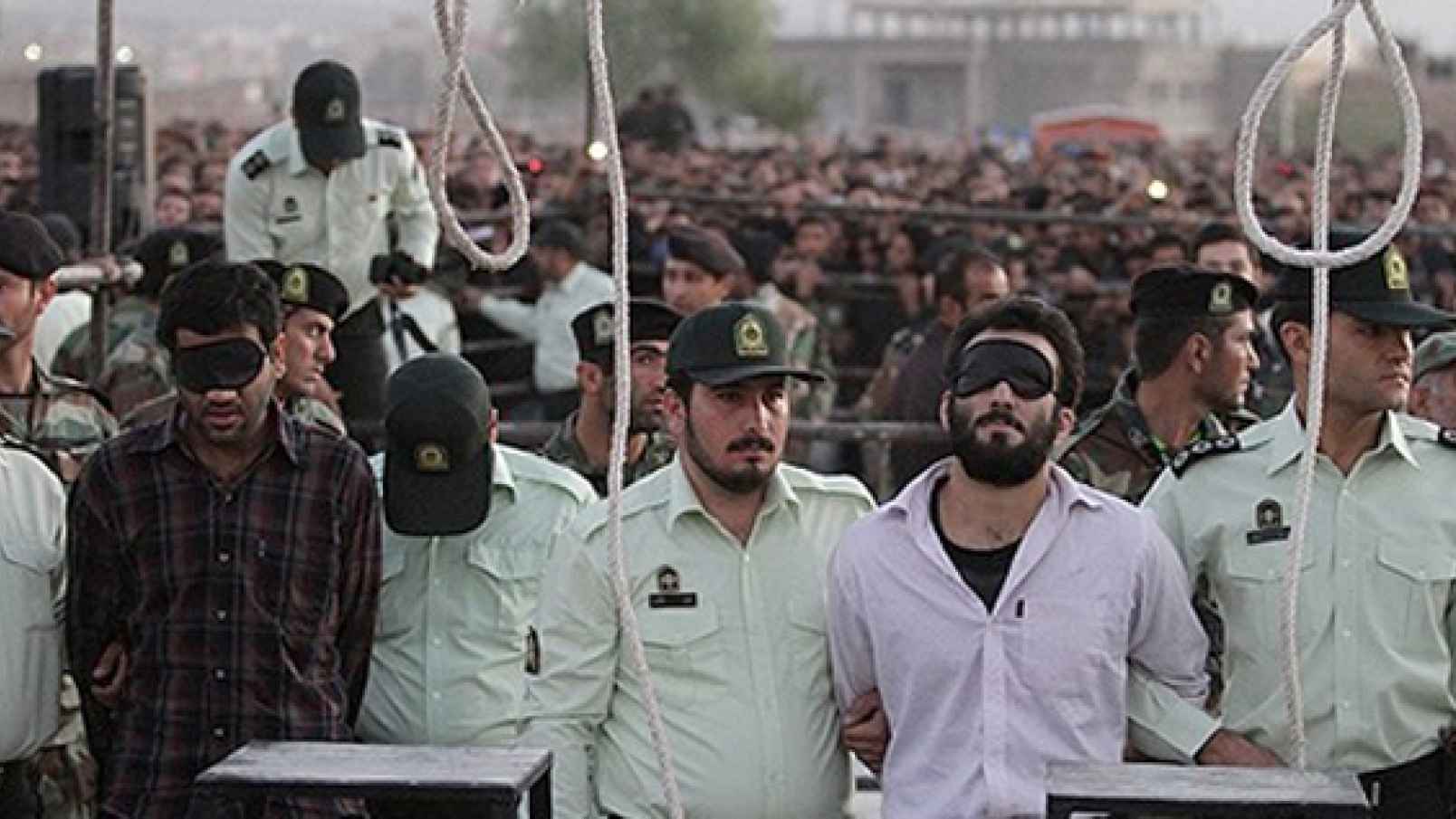
hangings_in_iran_wikimedia_groundreport.com_640_0

Unfortunately, although President Obama is very vocal about defending the nuclear deal, the lifting of economic sanctions on the Ayatollah, the release of over a hundred of billion dollars to the ruling clerics of Iran, he has not issued any serious criticism against the leaders of the Islamic Republic with regards to the execution spree.

***********************

How the Obama administration is facilitating Iran’s unprecedented killing binge.

President Obama is determined to defend the Islamic Republic as a legitimate government that should receive sanctions relief. He has even overstepped his constitutional authority by signing the nuclear deal (a treaty) in the United Nations Security Council without getting the two-third vote of the Senate. He did not give Congress time to review the nuclear deal as he previously promised.

The Obama administration is advocating for a regime that has been on an execution spree on an unprecedented level, according to Amnesty International’s latest report. Since the beginning of this year, the Islamic Republic has executed approximately 700 people.

People being executed are usually not told about their death sentence until the noose is put around their neck and until they reach the gallows. Family members of the victims often do not know about the execution until weeks after.

As Said Boumedouha, deputy director of Amnesty’s Middle East and North Africa program said, “Iran’s staggering execution toll for the first half of this year paints a sinister picture of the machinery of the state carrying out premeditated, judicially-sanctioned killings on a mass scale.” He added, “The use of the death penalty is always abhorrent, but it raises additional concerns in a country like Iran where trials are blatantly unfair.”

I regularly speak with Iranian people living in various cities in Iran including Esfahan, Tehran, Tabriz, and Khorasan in order to obtain a better understanding on the ground. My family lives there too. The words of every one of them (about the current situation in Iran after the nuclear deal was reached) echoes what Zahra, an English teacher in the province of Esfahan, told me. She said, “Any cash given to the these Sheikhs in the government (the clerics) by the powers because of the nuclear deal, will not be distributed to the people. The money will not be used to improve people’s economic standards. The people on top will steal the money, saving it in their bank accounts, or send it to their Arab allies, Bashar Al Assad, Hezbollah, and the Iraqi government. They [Iranian leaders] are also going to increase domestic suppression if they begin seeing the flow of cash.”

If we look at the history of the Islamic Republic closely, we see that when a “reformist” president (Mohammad Khatami) was in power in Iran, the nation witnessed the same increase in executions and suppression. It was one of the worst periods of oppression and crackdowns on civil liberties. In addition, the number of executions normally rises under the so-called “moderates” and “reformists” rules.

When Iranian people feel that they might finally have a better relationships with the West, the ruling establishments ratchets up their imprisonment, torture, suppression and killings in order to show the people who is in charge and in order to impose fear. By using these tactics, they send a clear message that the Islamists are in charge, not the youth.

This staggering number of executions suggests that, as the ruling clerics of the Islamic Republic were gaining global legitimacy due to the nuclear negotiations and “normalizing” relationships with the Obama administration, they have also increased their mass scale killings of their own citizens. At the same time, several American citizens are still spending time in Iran’s prison.

Unfortunately, although President Obama is very vocal about defending the nuclear deal, the lifting of economic sanctions on the Ayatollah, the release of over a hundred of billion dollars to the ruling clerics of Iran, he has not issued any serious criticism against the leaders of the Islamic Republic with regards to the execution spree.

In the Islamic Republic, one can be executed for actions which might not even be a crime or it might be a misdemeanor in other democratic countries. For example, one can be executed for “enmity against Allah” or “corruption on earth.” In addition, a non-Muslim man can be executed for having sex with a Muslim women, but not vice versa. One can be executed or stoned if he/she is married and has sex with an unmarried person. One can also be executed for cursing or using bad words against the prophet.

As the report by Amnesty International described, “They [death sentences] are imposed either for vaguely worded or overly broad offenses, or acts that should not be criminalized at all, let alone attract the death penalty… Trials in Iran are deeply flawed, detainees are often denied access to lawyers, and there are inadequate procedures for appeal, pardon and commutation.”

Boumedouha observed, “For years, Iranian authorities have used the death penalty to spread a climate of fear in a misguided effort to combat drug trafficking, yet there is not a shred of evidence to show that this is an effective method of tackling crime…”

The more the Iranian leaders are empowered and emboldened financially, economically and politically, the more they tighten the noose on all freedoms (including speech, assembly, press, etc.), as well as basic inalienable human rights.

There are currently thousands of innocent people on death row waiting to be unfairly executed in the Islamic Republic. While President Obama finds it urgent to overstep his constitutional authority to quickly sign the nuclear deal with Iran and push for sanctions relief against the ruling clerics, he needs to pay close attention to how the empowerment of the ruling Islamists in Iran is adversely affecting the lives of millions of innocent people.

Iran: U.S. Banned from Knowing Details of Iran Nuclear Inspection Agreement

August 3, 2015

Iran: U.S. Banned from Knowing Details of Iran Nuclear Inspection Agreement, Washington Free Beacon,  , August 3, 2015

(Mr. Najafi states in the highlighted paragraph that “no country is permitted to know the details of inspections. That likely refers to the P5+1 negotiators as well as to nations other than Iran. Does it refer to the results of the inspections or to how and by whom they were conducted when? Either way, how will the P5+1 negotiators know whether Iran continues to seek nuke weaponization and whether to “snap back” sanctions? If they are told little more than “everything is just peachy,” will that be satisfactory evidence that Iran has not violated the “deal?” Please see also, Iran Openly Refuses UN IAEA Inspectors Access to Military Sites.– DM)

Reza Najafi, Iran’s ambassador and permanent envoy to the IAEA, stated over the weekend that no country is permitted to know the details of future inspections conducted by the IAEA. In addition, no U.S. inspectors will be permitted to enter Iran’s nuclear sites.

**********************

Iran’s ambassador to the International Atomic Energy Agency (IAEA) said the nuclear inspection organization is barred from revealing to the United States any details of deals it has inked with Tehran to inspect its contested nuclear program going forward, according to regional reports.

Recent disclosures by Iran indicate that the recently inked nuclear accord includes a series of side deals on critical inspections regimes that are neither public nor subject to review by the United States.

Reza Najafi, Iran’s ambassador and permanent envoy to the IAEA, stated over the weekend that no country is permitted to know the details of future inspections conducted by the IAEA. In addition, no U.S. inspectors will be permitted to enter Iran’s nuclear sites.

“The provisions of a deal to which the IAEA and a second country are parties are confidential and should not be divulged to any third country, and as Mr. Kerry discussed it in the Congress, even the U.S. government had not been informed about the deal between IAEA and Iran,” Najafi was quoted as saying by Iran’s Mehr News Agency.

Due to the secretive nature of these agreements, IAEA officials vising with lawmakers are barred from revealing to them the details of future inspections.

The revelation has rattled lawmakers on Capitol Hill, several of whom are now rallying colleagues to sign a letter to President Barack Obama protesting these so-called side deals.

Rep. Mike Pompeo (R., Kansas) and at least 35 other lawmakers are circulating a letter to Obama to provide Congress the text of these agreements as is required under U.S. law.

“It has come to our attention that during the recent negotiation of the Joint Comprehensive Plan of Action (JCPOA) with Iran, at least two side deals were made between the International Atomic Energy Agency (IAEA) and Iran,” the letter states, according to a copy obtained by the Washington Free Beacon.

“These side deals, concerning the ‘roadmap for the clarification of past and present outstanding issues regarding Iran’s nuclear programs,’ have not been made available to the United States Congress,” it states. “One deal covers the Parchin military complex and the other covers possible military dimensions (PMDs) of Iran’s nuclear program.”

An informational email being circulated to lawmakers explains, “according to the International Atomic Energy Agency (IAEA) and the Obama Administration, these agreements have been negotiated in secret between the IAEA and Iran.”

Secretary of State John Kerry has personally “stated he has not seen these agreements and the Administration failed to submit these agreements as part of the JPCOA,” the email states.

Under the terms of a bill meant to give Congress a final say over the deal, the Obama administration is required to provide text of all agreements, the lawmakers write to Obama.

“Under the clear language of the Iran Nuclear Agreement Review Act, which you signed into law, members of Congress are entitled to the text of these two side deals,” it states. “Specifically, members have a right to all ‘annexes, appendices, codicils, side agreements, implementing materials, documents, and guidance, technical or other understandings and any related agreements, whether entered into or implemented prior to the agreement or to be entered into or implemented in the future.’”

“Congress’s legal right to these documents creates a corresponding legal obligation for your administration to provide them for our review,” the letter says.

The lawmakers are demanding that the White House “immediately secure” these documents from IAEA “and then provide them to Congress” for review.

Pompeo and Rep. Tom Cotton (R., Ark.) sent a separate letter to Obama administration official last week asking for them to disclose the nature of all secret side agreements with Iran.

Iran’s IAEA ambassador claims the agreements with the IAEA are separate from the actual nuclear accord inked with global powers.

“The Agency would know the nature of confidential documents and Iran have clearly briefed the IAEA on this; we have agreed on implementation of a roadmap which is not a part of the JCPOA, with the implementation already on process even before the Congress could examine and approve the deal,” Najafi was quoted as saying.

One senior congressional source familiar with the effort to obtain further information about the deal told the Free Beacon the Obama administration is not being transparent in the review process.

“On top of all the concessions–from ballistic missiles to conventional arms to a 24-day inspection period–we now learn that additional side deals were struck between the IAEA and Iran,” said a senior congressional source familiar with the effort to obtain further information about the deal.

“The Administration promised a transparent review process that would allow Americans and their elected representatives to assess the deal for themselves, but as it turns out, that was just utter bullsh**,” the source added. “The Administration signed off on an agreement that included a series of Iranian Eastern eggs, including secret deals regarding the possible military dimensions of Tehran’s nuclear program, to which Congress and the public are not privy.”