Posted tagged ‘Obama’

Israel’s Revenge Is That “We Are Still Here”

June 7, 2015

Israel’s Revenge Is That “We Are Still Here” The Legal Insurrection, June 7, 2015

My wife and I are back, after an intense two weeks in Israel.

From the Lebanese to Gaza borders, from the Mediterranean Sea to Judea and Samaria, from the cool evenings of Jerusalem to the heat of the Negev Desert, from an apartment in the Jewish Quarter of the Old City of Jerusalem to Bedouin villages in the north and south, from university campuses to military bases, from faculty to students, from Jews to Muslims … I can’t say we saw it all, but we saw a lot.

I’ve documented most of our big events in daily posts, with the exception of our emotional meetings with the families of Edward Joffe and Leon Kanner, students killed in the 1969 Supersol supermarket bombing by Rasmea Odeh; that post is coming, but I still have new photos, documents and information I have to work through.

Here are my 5 Big Takeaways from the trip:

1. Our Revenge Is That “We Are Still Here”

Near the start of our trip, we visited Moshav Avivim straddling the Lebanese border, where we met Shimon Biton, a survivor of the 1970 bazooka attack on a school bus by the Popular Front for the Liberation of Palestine.

Biton, who was six and one-half years old, lost his father in the attack, and himself was shot point blank range by the terrorists when they realized he survived the bazooka attack.  Ten days before we met Biton, he was reunited for the first time in 45 years with the nurse who helped save him.  (Featured Image)

When we asked whether he ever wanted revenge, Biton told us that the revenge was that “we are still here and building for another 70 families.”

Moshav-Aviviv-Shimon-Biton-e1432683043370[Shimon Biton, Moshav Avivim, Israel]

When we related that story to numerous people we met along the rest of the trip, heads vigorously shook up and down.  It struck a chord, since almost every Israeli has a relative or friend impacted by terror.

Despite several decades of terrorism, particularly intense during the Second Intifada, and a world campaign against it, the People of Israel are still there.

The will to resist is underestimated.  Israel has a longer-term view, and a history.  It will not give in to boycotts, or Obama, or outside pressure that puts its security at risk.

2. “I don’t like Bibi, BUT….”

For whatever the reason, most of the people with whom we interacted self-identified as center-left or left.

There was no shortage of criticism of Israeli Prime Minister Benjamin Netanyahu: He’s egotistical, he doesn’t keep his tough promises, he is only interested in his own political survival, he’s a liar, his pre-election comment about Arab voting was shameful, and so on.

Yet with only a couple of exceptions, the negative comments always were followed with a big BUT.
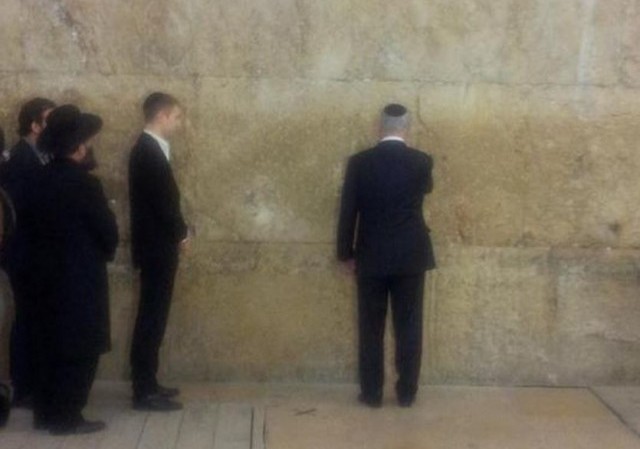
Benjamin-Netanyahu-at-Western-Wall-post-election-2015-e1426681806959[Israeli Prime Minister Benjamin Netanyahu at Western Wall after 2015 election victory.]

But he is the only Israeli politician who has the stature to handle the world pressure; but I don’t envy the position he is in with so many forces against us; but [opposition leader Yitzhak “Bougie” Herzog] Bougie is weak and no one will fear him; and so on.

These opinions pretty much were reflected in polling and the election results — Many people may not like Netanyahu, but he is the only Israeli politician capable of standing up for Israel in a hostile world.

3. I don’t like Obama, no BUTs about it

Polling in Israel shows Obama is hugely unpopular.  Our anecdotal interactions with Israelis confirmed that polling.

I  can’t recall anyone, from left to right, who had anything nice to say about Obama.  The most consistent theme was that Obama is naive and weak, and that naivitee and weakness had resulted in disaster in the Arab world as it encouraged the most aggressive Islamist elements.

They see Syria falling apart with al-Qaeda or ISIS groups likely to control large parts of the country; or if not, then Iran in control. There are no good outcomes for Israel’s Golan Heights border. Along the Lebanese border there is Hezbollah, and in Gaza Hamas and increasingly even more radical Salafist-ISIS groups.

Against this background of being surrounded by a sea of increasing threats resulting from Obama administration policy, not a single person thought the Iran nuclear deal made any sense, or trusted the Obama administration on it.

In other words, Israelis live in the real world, not the world of Obama’s delusional hope.  And they don’t appreciate Obama taking risks with their lives.

4. Are we really that popular in the United States?

The anti-Israel Boycott, Divestment and Sanctions movement was a frequent topic of conversation, almost always brought up by us as part of describing the type of coverage at Legal Insurrection.  This coincided with what I consider an irrational panic the past two weeks in the Israeli press and political discourse about BDS (more on that in a later post.)

I tried to explain that there is a complete disconnect between the BDS movement in the U.S. and the vast majority of Americans.  Gallup and Pew polling shows Israel at or near historical highs in terms of Israel’s favorability both abolutely and relative to favorability of Palestinians.  The gap between those who pick Israel over Palestinians when the question forces a choice, also is historically high.

Virtually every Israeli we met was shocked that Israel is actually so popular in the United States.  Even Israelis who have extensive American contacts and visit the U.S.

That’s not all so surprising.  Both the U.S. and Israeli media focus on the negative, though for different reasons.  The U.S. media long has had in implicit anti-Israel bias, compounded by the rise of left-leaning new media, while the Israeli media competes for readers with a “sky is falling” outlook.

(added) Israel’s enormous popularity among Americans is a strategic asset.  That strategic asset needs to be used more effectively to minimize the damage from the narrow but influential slices of the American population — radical faculty, some students, and mainstream journalists — who have explicit or implicit anti-Israel biases. The American people as a whole are the “Israeli Lobby.”

5. The Next War is Only a Matter of Time

While we were in Jerusalem, Israel underwent a national defense drill, including sirens warningof incoming rockets.

Our tour along the Gaza border, particularly near Sderot, also reflected preparation for the next round of rocket fire through reinforcing key civilian infrastructures, such as schools.

Sderot-Israel-bomb-shelter-street-e1433110130989[Sderot, Israel, street bomb shelter with “Shalom” grafitti]

There was a pervasive feeling that the calm cannot last.  And sure enough, while we were there and just after we left, rockets were fired from Gaza to Israel by Salafists suffering from a Hamas crackdown, and groups competing with Hamas for control.

That’s the logic of the region in which Israel lives: Radical groups retaliate against each other by firing rockets at … Israel.

The next war is coming.  Every Israeli knows it. It’s only a matter of time.

*  *  *  *  *

Those are my big takeaways.  I hope you enjoyed the coverage.

We will be back in Israel, hopefully next year.

Why Does the Iranian Regime Rape its Own Citizens?

June 7, 2015

Why Does the Iranian Regime Rape its Own Citizens? The Clarion Project,  Elliot Friedland, June  7, 2015

(Don’t worry. Once The Islamic Republic of Iran gets the bomb, it may become as civilized as the Islamic State. — DM)

Iran-Basij-Hooded-Men-IP_1In 2009 the Basij militia (pictured here) raped protesters as a matter of policy. (Photo: Reuters)

In prisons, virgin girls who are sentenced to death (the death penalty covers a wide variety of crimes, including the nebulous charge of Moharabeh, “enmity against God”) are typically forced into “temporary marriages” with the prison guards and raped on the night before their execution.

According to the Iran Human Rights Documentation Center this is “because the guards believed young girls executed while virgins would go to heaven” and they wanted to prevent that.

Rape and other forms of sexual assault are a means of humiliation and degrading the regime’s opponents – and are also a potent means of intimidating others into cowed obedience.

******************

Like all countries which use sharia law as state law, the Islamic Republic of Iran institutionalizes a litany of women’s rights abuses.

These include:

  • The husband is the head of the family, and his wife is legally bound to obey him. Article 1,105 of the civil code states: “In relations between husband and wife, the position of the head of the family exclusively belongs to the husband.”
  • A married woman cannot leave the country without her husband’s permission.
  • A woman’s testimony as a witness is worth half that of a man, in compliance with the Sharia basis of the legal system.
  • Women are forced to wear the hijab, a headscarf, in all public places. More broadly, Islamic modesty requirements are enforced by a morality police.
  • Polygamy and temporary marriage are permitted for men (up to four wives are allowed, subject to certain restrictions), but not for women.

Moreover, women are frequently subject to honor killings. In cases where the father kills his daughter, he is not liable for the death penalty, but only for imprisonment. This is further compounded as when someone is murdered, the family of the victim can forgive the murderer and choose to forgo punishment.

As harsh as the everyday discrimination is, however, the most serious violations are meted out against dissenters.

Use of rape as a method of torture against political opponents has been deployed widely against both men and women, as well as sexual taunts, threats and other forms of assault.

The International Campaign for Human Rights in Iran told PBS that in the aftermath of the disputed 2009 election, “rape was routinely practiced as a matter of policy to intimidate young ordinary people from ever coming out to protest again.”

In prisons, virgin girls who are sentenced to death (the death penalty covers a wide variety of crimes, including the nebulous charge of Moharabeh, “enmity against God”) are typically forced into “temporary marriages” with the prison guards and raped on the night before their execution.

According to the Iran Human Rights Documentation Center this is “because the guards believed young girls executed while virgins would go to heaven” and they wanted to prevent that.

A former Iranian Basij militia man spoke to The Jerusalem Post on the condition of anonymity and recorded his role in perpetrating these rapes when he was a prison guard.

He said, “I could tell that the girls were more afraid of their ‘wedding’ night than of the execution that awaited them in the morning. And they would always fight back, so we would have to put sleeping pills in their food. By morning, the girls would have an empty expression; it seemed like they were ready or wanted to die. I remember hearing them cry and scream after [the rape] was over. I will never forget how this one girl clawed at her own face and neck with her fingernails afterwards. She had deep scratches all over her.”

Rape and other forms of sexual assault are a means of humiliation and degrading the regime’s opponents – and are also a potent means of intimidating others into cowed obedience.

Thus, the Islamic Republic inflicts on the bodies of its citizens the purest demonstration of raw power, reminding them who rules Iran.

D-Day invasion and Those were the days

June 6, 2015

(Please see also, Forfeiting America’s Military Leverage. Are “we” still willing to sacrifice our lives and those of others, including “collateral damage,” to defeat even our relatively weak enemies?– DM)

Forfeiting America’s Military Leverage

June 6, 2015

Forfeiting America’s Military Leverage, American ThinkerAbraham Katsman, June 6, 2015

International diplomacy, it is said, is the art of letting the other party have your way.  While there are numerous diplomatic strategies to accomplish that, one of history’s more effective means of pursuing foreign policy goals was for a superior power to conspicuously display naval forces in the waters of the weaker power, posing a military threat until satisfactory terms with the weaker nation could be reached. Such “gunboat diplomacy” could be remarkably persuasive.

But if there is such a thing as the opposite of gunboat diplomacy, we are witnessing it in the nuclear negotiations with Iran.  There will be repercussions.

The United States and other leading nations taking part in the negotiations have military capabilities that dwarf those of Iran, at best a second-rate power. Yet, in spite of the huge military advantages — not to mention the moral gulf between the U.S and Iran, or the huge stakes of allowing Iran to go nuclear — negotiations have proceeded as if between equals.

U.S. military spending is greater than that of the next seven countries combined. Superpower America has a near-monopoly on those gunboats, as well as military aircraft and cruise missiles. But that power is only useful if there is a willingness to use it — or, more precisely, if America’s enemies believe that that there is such a willingness.

If there were ever thoughts that the U.S. under Obama would lay down the law with Iran and order, under overt military threat, the “voluntary” dismantling of the mullah’s nuclear program, they have passed quietly. Sure, President Obama occasionally makes some perfunctory mention that the military option is still on the table, but no one takes his half-hearted warning seriously, least of all the Iranians.

It doesn’t help matters when Obama says, as he did on Israeli TV this week, “A military solution will not fix [the Iranian nuclear problem]. Even if the United States participates, it would temporarily slow down an Iranian nuclear program but it will not eliminate it.”

Obama has effectively forfeited America’s military leverage. He has taken the position that the only alternative to his Iranian appeasement approach is war, and that war is not an outcome acceptable to him under any circumstances.

No Iranian misconduct disrupts Obama’s pacifism. Against American interests and those of America’s allies, Iran has expanded its reach into Syria, Lebanon, Iraq, and Yemen, ethnically cleansing Sunni communities in Iraq. It has seized a cargo ship under U.S. protection, and holds several Americans hostage (complete with an ongoing farcical “trial” against Washington Post reporter Jason Rezaian for espionage). It has increased its nuclear stockpile and violated its existing international agreements, including regarding type and number of centrifuges it may operate, and announced that it will build additional reactors with the help of China and Russia.

In fact, America’s gunboats notwithstanding, it is Iran that has been dictating the terms of a prospective agreement. Iran’s intransigence in the nuclear negotiations has been rewarded: the U.S. has already backed off demands regarding Iranian nuclear enrichment, centrifuges, missile technology, and duration of the prospective agreement — and gotten nothing in return.

Not only is the United States administration going along with all this, but it has released some $11 billion in cash assets to the Islamic Republic. On top of that, it is offering a “signing bonus” of tens of billions of additional dollars to Iran for coming to a nuclear agreement, irrespective of Iranian behavior, support for terror or holding Americans prisoners.

In this context, with no credible American military threat on the table, we should not be surprised that Iran is getting everything it wants from the negotiations at no cost and no risk. As a bonus, it gets to show the world how unserious its American arch-enemy has become.

For the last century, the United States has asserted a global foreign policy, the core of which is being ready, willing, and able to impose its military might to protect its vital interests. Is there a more compelling current American interest than to keep nuclear weapons out of the reach of a rabidly anti-American, anti-Semitic, destabilizing, theocratic, apocalyptic regime, which also threatens the world’s major oil suppliers and is the world’s greatest supporter of terror? If Obama cannot even consider the military protection of that interest, he has rendered American foreign policy impotent, and its military capabilities irrelevant.

That abandonment of longstanding American projection of military power to protect global interests does not go unnoticed, by either friend or foe. The American military’s deterrent effect has been eroded; its security umbrella to its allies looks a lot less secure. The effect on alliances both current and future is corrosive.

From Riyadh to Taipei to Jerusalem, from Moscow to Beijing to Pyongyang, the world is paying close attention. As much as these nuclear negotiations are about Iran, they are even more about America.


Cartoon of the day

June 6, 2015

H/t You Viewed Editorial

cg556fbf6cdc16d

The Islamic State Is Here to Stay

June 5, 2015

The Islamic State Is Here to Stay, VICE NewsAhmed S. Hashim, June 6, 2015

(Please see also, The Kurd-Shia War Behind the War on ISIS. — DM)

The victories against IS in early 2015 have proven ephemeral — or have been nullified by IS gains elsewhere. On Sunday, CIA director John Brennan said on Face the Nation, “I don’t see this being resolved anytime soon.” Assad’s vaunted offensives of February 2015 have fallen short as the regime faced stiff resistance from a wide variety of opposition fighters, including elements from IS. The failure was alarming in part because the campaign was designed and aided by both Hezbollah and the Iranians, two seemingly ascendant Shia powers.

************************

Just a few months ago, analysts and policy-makers were certain that the defeat of Islamic State (IS) forces was simply a matter of time.

Coalition airstrikes would degrade the group’s capabilities and eventually allow Iraqi forces and Kurdish Peshmerga — though discredited by their poor military showing in mid-2014 — to push back the extremists. And indeed, IS fighters were ejected from Tikrit in March 2015 by the Iraqi army and thousands of motivated fighters from Shia militias. In Kobani in northern Syria, IS fighters were defeated by Syrian Kurdish fighters. Elsewhere in the country, the regime of Bashar al-Assad was going on the offensive with help from Hezbollah and advisers from the Iranian Revolutionary Guard.

The Islamic State, however, rose like a phoenix from the ashes of every setback. And today, the situation is not so rosy.

The victories against IS in early 2015 have proven ephemeral — or have been nullified by IS gains elsewhere. On Sunday, CIA director John Brennan said on Face the Nation, “I don’t see this being resolved anytime soon.” Assad’s vaunted offensives of February 2015 have fallen short as the regime faced stiff resistance from a wide variety of opposition fighters, including elements from IS. The failure was alarming in part because the campaign was designed and aided by both Hezbollah and the Iranians, two seemingly ascendant Shia powers.

The situation in Iraq is just as complicated, something that the Obama administration appears either oblivious to or reluctant to acknowledge. Much of the US strategy continues to hinge on what is increasingly a mirage: a unified, albeit federal, Iraq under the control of Baghdad. Meanwhile, the resilience of IS is greatly enhanced by the ability of its military forces to innovate and adapt faster on the ground than its lackluster opponents.

In light of the constant aerial strikes by the US and its allies, IS has dispersed and made its forces more mobile, no longer presenting dense concentrations of fighting men as it did when it seized Mosul in mid-2014. Instead, when IS seized Ramadi in May 2015, it made use of inclement weather and sent several small units from different directions simultaneously into the city aided by suicide bombers. Moreover, the fact that the group faced ill-equipped and poorly motivated Sunni fighters in and around Ramadi did not do anything for Baghdad’s standing with the country’s already alienated Sunni community, which had pleaded for arms while caught between the unfathomable brutality of IS and revengeful Shia militias.

Many Sunnis are now angling for their own “super-region,” one that would have considerable independence from Baghdad. The problem? In order to have it, the Sunnis would need to first defeat IS. Currently, they’re unable to do so because they lack the resources; despite all the talk from Baghdad and Washington about arming Sunni tribes, Baghdad is not actually keen to do so.

And besides, the Sunnis seem relatively ambivalent about defeating IS. They took an unequivocal stance between late 2006 and 2009, when they joined with the Americans and the Iraqi government to deal the Islamist militants what was then seen as a decisive blow. Now, however, despite Sunnis’ resentment and fear of IS, the Islamists’ existence is seen as a kind of insurance policy against Shia revanchism should Baghdad succeed in retaking the three Sunni provinces of Anbar, Salahuddin, and Ninevah.

(Please see video at the link. — DM

The “victory” of the Iraqi government in Tikrit was more propaganda than reality; a few hundred IS fighters managed to inflict considerable damage on the Shia militias that had been mobilized to fight alongside the Iraqi army, then withdrew because they were outnumbered and wished to avoid being surrounded. The IS forces in Tikrit simply felt that they had done enough damage; there was no need to waste further assets in an untenable situation.

Militarily, the Iraqi Shia militias are better motivated and more dedicated than the regular army. Anecdotal information out of Baghdad suggests that Iraqi Shias are wondering whether the government should invest more effort building these forces into an effective and more organized parallel army. Even that parallel army, however, might be reluctant to commit to any significant long-term offensive to reclaim provinces full of “ungrateful” Sunnis.

But the Shia are willing to die to defend what they have, and there is increased sentiment among the Shia in central Iraq and Baghdad, along with the southern part of the country, that they would be better off without the Sunnis. There also exists the belief that the Kurds have more or less opted out of the Iraqi state despite the fact that they maintain a presence within the government in Baghdad. The Shia would seemingly not be sorry to see them exit the government in a deal that would settle as best as possible divisions of resources and territory. However, whether the Kurds would take the plunge and opt for de jure rather than de facto independence is a question that is subject to regional realities — How would Ankara and Tehran react? — rather than merely a matter of a deal between Baghdad and Erbil.

The Islamic State will continue to be a profound geopolitical problem for the region and the international community, and a long battle lies ahead. Syria and Iraq are more or less shattered states; it is unlikely that they will be put back together in their previous shapes. If Assad survives 2015, it will be as head of a rump state of Alawites and other minorities protected by Hezbollah, Iran, and Alawite militias. Shia Iraq will survive, and will possibly dissociate itself from the nettlesome Sunni regions. The Kurds will go their own way step by step. The international community is currently at a loss for how to stem the flow of foreign fighters to the IS battlefields — and even more serious is the growing sympathy and admiration for the group in various parts of the world among disgruntled and alienated youth.

If the US is serious about defeating IS, it needs to take on a larger share of the fight on the ground. This means more troops embedded with regular Iraqi forces in order to bring about better command, control, and coordination. It also means advisors who can continue to train these forces so that they improve over time. If this is not done, the regular Iraqi military will continue to be nothing more than an auxiliary to the more motivated — and pro-Iranian — Shia militias. Currently, militia commanders are giving orders to the regular military; that cannot be good for morale.

This month, the Islamic State celebrates the first anniversary of its self-declared caliphate. The group has little reason to fear it will be the last.

Iran Will Walk

June 5, 2015

Iran Will Walk, The Gatestone InstituteLawrence A. Franklin, June 5, 2015

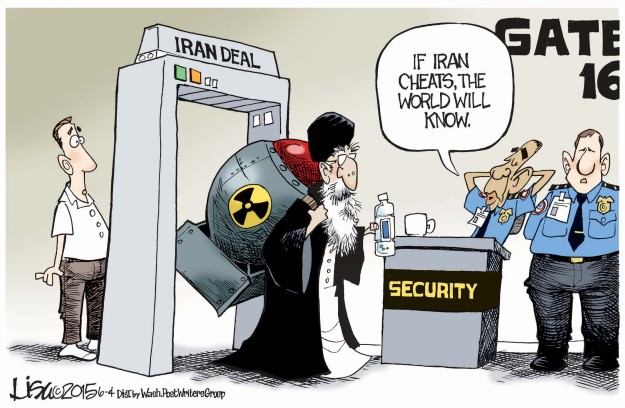
(What if the article is otherwise correct but Obama agrees to a “deal” anyway? — DM)

  • The Islamic Revolutionary Guard Corps (IRGC), the Praetorian Guard of Iran’s regime, controls most of the economy, as well as the black-market, alternative economy. The IRGC therefore actually benefits from sanctions; it is private firms, such as those involved in international commerce, that suffer. Why would IRGC operatives want to see the playing field made more level by private investment, transparency and a competitive economy?
  • Sanctions never hurt the regime’s ruling class; lifting them only helped the regime solidify its power over its people.
  • The objective of these two demands [an immediate lifting of all sanctions and no, or severely limited, inspections] is either to have them accepted, or to render it untenable for the Obama administration to offer Congress any deal that could be accepted – thereby shifting blame for the collapse of the talks to the U.S.
  • The U.S should also be on guard against the mullahs’ belief that the Obama administration is weak both politically and its aversion to using force. The mullahs might find great pleasure in humiliating Obama, as they did President Jimmy Carter, by dragging out hostage crisis negotiations by running out the clock until his term was over. They clearly believe that the Obama administration, simply to say it got “a deal,” is ready to sign anything.

From Washington to Riyadh, not to mention Jerusalem, statesmen are gritting their teeth at the possibility of a U.S.-Iran nuclear deal that seems overly generous to the theocratic-terror state of the Islamic Republic.

1008Representatives of the P5+1 countries pose with Iranian Foreign Minister Javad Zarif after nuclear negotiations in Lausanne, Switzerland on April 2, 2015. (Image source: U.S. State Department)

Most intelligence analysts and journalists assume that because Iran’s leadership endorsed the negotiations and has been the beneficiary of several key concessions by the P5+1 (the five permanent members of the UN Security Council, plus Germany), that an agreement is imminent. Forecasters have been predicting what the likely consequences of such a deal would be: negative.

But what if the Iranians walk?

Sanctions never hurt the regime’s ruling class; lifting them only helped the regime to solidify its power over its people.

A nuclear deal combined with an improvement in the commercial and business relations with the West would be inimical to IRGC interests.

The Islamic Revolutionary Guard Corps (IRGC), the Praetorian Guard of the regime, controls most of the economy as well as the black-market, alternative economy. IRGC-controlled conglomerates operate outside the law and reap huge profits through their control of the black market. The IRGC therefore actually benefits by sanctions; it is the private firms, such as those involved in international commerce, that suffer.

Furthermore, IRCG naval vessels, and private ships under their control, have been engaging in sanctions-breaking deliveries of imports across Persian Gulf waters to Dubai. The IRGC then sells the products at a profit by filtering them through the many foundations they control in Iran.

The most recent example of IRGC’s skirting of sanctions involved the illegal acquisition of aircraft through front-organizations with offices in both Europe and the Arabian Peninsula. Mahan Air, an IRGC front, was able to purchase 15 used commercial aircraft for $300 million. Another front, al-Naser Air, was about to purchase two more aircraft, this time from a U.S. owner. Israeli intelligence, however, passed details of the planned sale to the U.S. government, and on May 21, the deal was scuttled by the Office of Export Enforcement of the Department of Commerce.

Why would IRGC operatives want to see the playing field made more level by private investment, transparency and a competitive economy?

Moreover, if a nuclear deal indicated improved relations with the United States, Iranian hardliners, whether clerical revolutionaries or intelligence operatives, might fear seeing their ideological legitimacy erode. The Iranian regime’s only remaining fig leaf of legitimacy is its anti-American animus, with its accompanying pledge to “protect” Iran’s interests against the U.S.-Israel-Sunni “alliance.”

Improved relations with Washington might raise false hopes among Iran’s citizens that the regime may ultimately improve its woeful record on human rights. There remains only a thin patina of clerical control over Iranian society; if the hoped-for social and political reforms were not implemented, the result could produce a destabilizing political environment, harmful to the interests of the regime.

Another fallacy embraced by many “inside-the-beltway” analysts is that, as the Supreme Leader Ayatollah Khamenei endorsed the negotiations, a legitimate deal is now probable.

The once all-powerful Office of the Supreme Leader no longer calls all the shots. The current Iranian regime resembles a military junta or a security state as much as a theocracy. While the reach of Ayatollah Khamenei, through his network of representatives, still penetrates all dimensions of Iranian society, he does not have the final decision on key security matters. The regime’s strategic assets, for instance, such as its ballistic missile programs, are firmly under the control of the IRGC. Decisions related to Iran’s expansionist presence in the region are made by IRGC Quds Force Commander Qasem Soleimani. The role of Khamenei’s representative to the IRGC resembles more that of a handler than of an action officer.

The principal task for the regime is to find a way to back out of the negotiations while avoiding the blame. Iran’s efforts at disengagement may already have been underway for the past few weeks; the pace of decoupling from the talks seems to be accelerating. Iran has been increasing its demands apparently in the hope that they will either be accepted, or else rejected like the “poison pills” they are — such as inspectors no longer being allowed on its military sites.[1]

Another way to make the talks no longer palatable for the Obama administration was to create a hostile incident with the United States in the Persian Gulf, as it has tried to do by aggressively tailing American warships. Iranian ships affiliated with the IRGC Navy also seized a commercial ship, the Maersk Tigris, in the Strait of Hormuz, and temporarily detained both vessel and crew. Then, on May 14, IRGC boats fired several shots across the bow of a Singapore flagged vessel, but it escaped unharmed.

By this type of reckless comportment, the IRGC Navy appears intent on producing a clash with American naval vessels in the Gulf waters. Western negotiators have only to recall the presidency of Mohammad Khatami, when the IRGC and Iran’s Ministry of Intelligence and Security operated independently after they felt that the reformers had gone too far, thus threatening hard-liner control of the regime. The IRGC may have decided that Rouhani along with his American-educated Foreign Minister Zarif have reached a similar tipping point. This independent IRGC initiative is being executed even though a deal would release Iranian monetary assets that would in turn boost the sagging economy.[2]

Iran’s combative posture in Gulf waters against international shipping is also a direct challenge to international maritime law, which guarantees freedom of navigation through the world’s shipping lanes such as the Strait of Hormuz. A key principle of U.S. foreign policy is to enforce this freedom of navigation, if it is challenged by any foreign power, as one also hopes the U.S. will do in the South China Sea.

Iranian military and political spokesmen have also raised the temperature of their anti-American and anti-Israeli rhetoric of late. Leading members of the regime, including its Supreme Leader, Ali Khamenei, keep repeating, “Death to America” as well as its theological “obligation” to destroy Israel. While the Obama administration has alleged that these threats are just for “internal consumption,” an old Persian saying goes: “They spit in his eye and he calls it rain.”

Mojtaba Zolnour, Ayatollah Khamenei’s Deputy Representative to the IRGC, stated that the Islamic Republic of Iran, “has the divine permission to destroy Israel.” This media assault on Israel was designed to widen the divergence between the Obama administration and the Israeli government regarding the efficacy of the framework of a nuclear agreement negotiated so far.

Additionally, various Iranian principals have drawn “lines in the sand” designed to cause the Americans to disengage from the talks, such as the assertion that Iran will never accept inspection of its declared military sites. Another is Tehran’s repeated statement that it will not accept a gradual lifting of sanctions. Iranian leaders have insisted on immediate and irreversible lifting of all sanctions immediately after a nuclear deal is signed. The objective of these two demands is either to have them accepted, or to render it untenable for the Obama administration to offer Congress any deal that could be accepted — thereby shifting the blame for the collapse of the talks to the U.S.

Regime hard-line representatives to the majlis [Iranian Parliament] have already been mobilizing members to denounce the talks as detrimental to Iran’s national sovereignty. Eighty majlismembers signed a petition on May 12, calling upon the regime to suspend the nuclear talks until Washington halts its rhetorical threats against Iran. Hardliners in the majlis and elsewhere within the regime’s bureaucracy will likely continue to lobby against any deal.

Western analysts should be looking for the Iranian regime’s hard-line media outlets to increase domestic commentary condemning alleged U.S. deception in the negotiations as a reason to abandon the talks.

The death knell for the nuclear negotiations could come from newspapers such as Kayhan, a pro-regime newspaper run by Hossein Shariatmadari, and often characterized as a Khamenei mouthpiece.

The regime’s Friday-prayer Imams in key Iranian cities might also start opposing the talks. The themes of their noonday khutbahs [sermons] are likely to appeal to Iranian people’s patriotism, and suggest that it is more important for Iran to endure continued sanctions rather than submit to intrusive monitoring that offends Iran’s sovereignty.

Finally, hardliners who oppose any possibility of Iran’s improved relations with the U.S. may launch personal attacks on Iran’s negotiators to the nuclear talks, and, in an effort to discredit them, challenge their loyalty to the Iranian revolution. Their point of attack on Foreign Minister Mohammad Javad Zarif’s loyalty might be his alleged obsequious behavior to Secretary of State John Kerry. Zarif, on account of his many years of residency and education in the United States, can be depicted as an Americanized Iranian.

The United States should also be on guard against the mullahs’ belief that the Obama administration is weak — both politically and in its reluctance to use force. The mullahs might find great pleasure in humiliating Obama as they did President Jimmy Carter, when they dragged out hostage crisis negotiations by running out the clock until his term was over. They clearly believe that the Obama administration, simply to say it got “a deal,” is ready to sign anything.


[1]Iran’s powerful Guard rejects inspection of military sites” by Ali Akhbar Dareini, Associated Press, 19 April 2015. Deputy Chief of the IRGC General Hossein Salami is quoted and several more statements by IRGC officials since have repeated the same prohibitive statements regarding Iran’s military sites.

[2]U.S. to Award Iran $11.9 Billion Through End of Nuke Talks,” Washington Free Beacon, 21 January 2015. In the first of many subsequent denunciations, Senator Mark Clark of Illinois attacked the Obama administration’s plan to free Iran’s frozen assets if nuclear deal is reached.

Barack Obama: Born-Again Jew

June 5, 2015

Barack Obama: Born-Again Jew, Front Page Magazine, Daniel Greenfield, June 5, 2015

were

The Yiddish description of a hypocritical fraud is “As Kosher as a pig’s foot.” Obama supporters who partake of his particular set of Jewish values are unlikely to be familiar enough with the Bible to understand the significance of a pig’s split hoof, the Midrashic tale of the pig that stretches out its cloven hooves and squeals, “See how Kosher I am” or even the Kosher status of a pig.

But those Jews who do, recognize “The First Jewish President” for the Kosher pig hoof that he is.

*********************

Obama introduced himself to the nation as the son of black and white parents. He has gone back and forth between Christianity and Islam like a philanderer in a bar.

Now he has added a third religion and race to complete his identity politics trinity.

At the last White House Chanukah dinner, he claimed to have a Jewish soul. At a synagogue speech last month, he called himself “an honorary member of the tribe”. Now his former senior advisor has quoted him as saying, “I think I am the closest thing to a Jew that has ever sat in this office.”

Of course Barack Obama has also been Irish. He stated, “I consider myself an honorary Italian, because I love all things Italian”. Newsweek dubbed him “The First Woman President” in 2008 for “bending gender conventions” and promoted him to “The First Gay President” four years later. Cabinet Secretary Lu and Congressman Honda argued that he was “The First Asian American President”.

If you make up an ethnic group or race, by tomorrow Barack Obama will be a member of it. By next week, he will be lecturing it on why it isn’t living up to their shared values.

Obama’s Jewish toadies, like his multicultural frog pond toadies of all races and ethnicities, have been trying to sell Barack Obama as a “Born-Again Jew” for seven years.

His left-wing mentor Abner Mikva claimed during the original campaign, “When this all is over, people are going to say that Barack Obama is the first Jewish president.” But Abner hedged his bets, baptizing Obama in a Mikvah by urging him to study the speaking patterns of Baptist preachers instead.

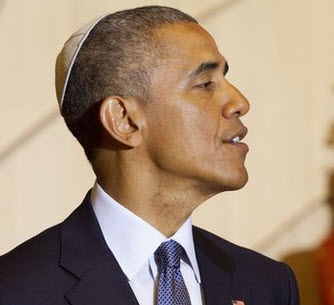
New York Magazine put Obama on the cover under a photoshopped Kippah as “The First Jewish President” and whined inside that, “Barack Obama is the best thing Israel has going for it right now. Why is that so difficult for Netanyahu and his American Jewish allies to understand?”

And that’s always the conclusion. Photoshop a Kippah on Obama’s head, dub him an honorary Jew and then use that to excuse his attacks on Israel.

Jerry Seinfeld accused his dentist of converting to Judaism to be able to tell Jewish jokes. Obama undergoes an honorary conversion to be able to bash Israel.

As an “honorary member of the tribe” he is entitled to all the anti-Semitic jokes and all the anti-Semitic policies he wants. When he signs off on nukes for Iran and a PLO state cut through the heart of Jerusalem accompanied by demands for the ethnic cleansing of half-a-million Jews, it’s as “The First Jewish Anti-Israel President” who cares about the Jewish State so much that he has to destroy it.

When Peter Beinart switched his career from the New Republic hawk who after September 11 wrote “The left has proved remarkably creative over the years at blaming virtually any Middle Eastern malfeasance…on the Jewish State” to the Daily Beast’s Israel basher who could blame bad weather or a lost sock in a dryer on Israel, he declared that he was bashing Israel because he was a “Liberal Zionist”.

Beinart, among others, has argued that Obama only bashes Israel because he too is a liberal Zionist.

Jeffrey Goldberg, the White House’s choice for heading up its media anti-Israel campaign to relay vital tidbits like the fact that the administration thinks Netanyahu is “Chickens__t” has been pushing the “Jewish Obama” meme the hardest. After his latest agonized interview with Obama featuring the kind of journalism usually only found when teen girls interview their movie idols for Tiger Beat, he explained that “The First Jewish President” only hated Israel because he was “The First Woody Allen President”.

Or as he put it, “Obama’s impatience with Israel, and his dislike of Netanyahu, is rooted in the fact that he is a very specific kind of Jew – an intellectual, Upper West Side, social action-oriented, anguished-about-Israel liberal values Jew.”

Not the bad kind of Jew who peers through a rifle scope on the Golan or pores over a Bible.

Obama’s finest Jewish toady was reassuring liberal Jewish tribals that the man in the White House didn’t hate Israel because he was one of “them”, but because he was one of “us”. Obama’s hatred of Israel is in the finest tradition of neurotic Manhattan liberals who can’t decide whether to bemoan Israel’s descent into nationalistic warmongering or take nude photos of their adopted Asian stepdaughters.

Or, as Woody Allen preferred it in the late nineties, both.

In his synagogue speech, Obama made the pitch that he embodies Israel’s classic leftist values of the Kibbutz and its Labor politicians. His disagreements with Israel are based on “our shared values”. He was turning the language of values commonality so often used by American politicians into appropriation.

Not only was Obama the country’s first Jewish president, but he is also its first Israeli president. He can’t be anti-Israel, because he represents Jewish and Israeli values better than Netanyahu.

The correct Jewish term for Obama contending that he is more Jewish than the Jews is “Chutzpah”.

Goldberg foresees a “civil war” between the Woody Allens and the Benjamin Netanyahus. “A civil war… between an American Jewry that has been nurtured on the values of the Civil Rights Movement, and an Israeli Jewry that has been taught, harshly, that the Middle East is not a place of mercy.”

As entertaining as it might be to watch a boxing match between Woody Allen and Netanyahu, he has missed the real civil war.

Obama does embody the Jewish values of a Goldberg or a Beinart because their Jewish identity is synonymous with the left. He equally embodies the Catholic values of Irish or Italian leftists or the Cherokee values of Elizabeth Warren. When your religious values have no religion in them, when your culture is a punchline and you want to sacrifice your heritage for an inspiring speech, then why not?

While Goldberg claims that the “anguished-about-Israel liberal values Jew” is the dominant Jewish archetype, demographics are reducing it to a minority in New York within a generation.

Even the Upper West Side is turning Modern Orthodox. And Woody Allen, whom I witnessed yelling at a white-bearded Orthodox Rabbi over the Palestinians a few decades ago, came out in defense of Israel during the last war and suggested that a lot of the criticism of Israel is disguised anti-Semitism.

When you’ve lost Woody Allen, then you’ve lost your “anguished-about-Israel liberal values Jew” vote.

The civil war has already been fought and won. Jews in the UK are voting conservative and support Netanyahu. So do the majority of Canadian and Australian Jews. Being anguished about values is a luxury for those whose synagogues aren’t being bombed and whose children aren’t being beaten.

When you have something to really agonize about, then you stop agonizing about your values.

The liberal Jews “nurtured on the values of the Civil Rights Movement” are dying out and are being replaced by Jews nurtured on the values of the Bible. They see no contradiction between Jewish values and a Jewish State because their values come not from the Torah of Tikkun Olam, but the Torah of Moses and Joshua, of King David and King Solomon, of Maimonides and the Maccabees.

Obama appears confident that American Jews will accept him as more Jewish than the Jewish State, but Romney picked up the most Jewish votes since Reagan and Jewish midterm support for Democrats fell 21 percent in eight years. As his pal Bill Ayers, who recently called for a boycott of Israel, could tell him, “You don’t need a Weatherman. To know which way the wind blows.”

Goldberg insists that “Obama is asking Israel (pleading with Israel, in fact) to be… more Jewish.”

And Obama’s way of trying to make Israel more Jewish is by denouncing Jews for building houses in Jerusalem. Similarly “Liberal Zionists” denounce Netanyahu for wanting Israel to be a “Jewish State” because they want it to live up to the Jewish values of Barack Obama, Bill Ayers and Jeremiah Wright.

It’s all a matter of definitions.

To the Goldbergs, making Israel more Jewish means making it less Jewish. By surrendering land to terrorists, expelling Jews from their homes, dividing up Jerusalem and giving up on a Jewish State, Israel will become more “Jewish”. And when its last Jewish Prime Minister, Mohammed Hussein Osama, informs them that Jewish values demand the end of Israel, they will applaud him for his Jewishness.

The other way of being Jewish is by having Jews live in a Jewish State where they speak the Jewish language and live lives based on thousands of years of Jewish tradition, heritage and religion.

The left’s values are self-nullifying. They destroy whatever they touch. The American left must destroy America for the sake of “American values”. The Catholic left must destroy the Catholic Church. The Jewish left must destroy Jews. Its idea of Jewish values is unmaking Jews, Judaism and the Jewish State.

The left has boldly appropriated Jewish values and identity. It has tried to pass off its politics as Tikkun Olam and the Democratic Party as the new synagogue. The Judaization of Obama is the last effort by a discredited ideology to fool its followers into believing that its anti-Jewishness is Jewish.

The Yiddish description of a hypocritical fraud is “As Kosher as a pig’s foot.” Obama supporters who partake of his particular set of Jewish values are unlikely to be familiar enough with the Bible to understand the significance of a pig’s split hoof, the Midrashic tale of the pig that stretches out its cloven hooves and squeals, “See how Kosher I am” or even the Kosher status of a pig.

But those Jews who do, recognize “The First Jewish President” for the Kosher pig hoof that he is.

Cartoon of the day

June 5, 2015

H/t Freedom is just another word

under

Did Obama threaten to withhold support from Israel at the UN during an Israeli TV interview?

June 4, 2015

Did Obama threaten to withhold support from Israel at the UN during an Israeli TV interview? | Anne’s Opinions, 3rd June 2015

(Obama continues with his war against Bibi. He’s incapable of separating the personal from the national — anneinpt)


Barack Obama is interviewed by Ilana Dayan for Israeli TV channel 2

US President Barack Obama has once again opened his mouth and put his foot in it, compounding all the errors he made in his speech at the Washington synagogue last week. Certainly that is the strong impression have received from watching his interview with Ilana Dayan on Israeli TV channel 2. While I don’t always like Dayan’s style, her agenda and her leading questions – including in this interview – she also presented Netanyahu’s standpoint fairly, and it was unpleasant, if unsurprising, to hear Obama’s veiled threat against Israel. Although we’ve heard similar words and threats from Obama previously, and quite recently, it’s a different matter altogether when they are spoken to Netanyahu’s “home audience”.

Watch and listen to the video excerpt of his interview embedded in the Arutz Sheva report linked here below.

Here is Arutz Sheva’s analysis:

US President Barack Obama gave an interview with Israeli media on Tuesday, in which he threatened that an Israeli refusal to renew peace talks with the Palestinian Authority (PA) will “make it hard” for the US to veto motions in the UN against Israel.

In an interview with Ilana Dayan for Channel 2‘s “Uvda” (Fact) TV show aired Tuesday night, Obama commented on Prime Minister Binyamin Netanyahu’s statements before elections in which he said that a Palestinian state won’t be founded on his watch.

Obama noted that later Netanyahu distanced from the statement and “suggested that there is the possibility of a Palestinian state. But it has so many caveats, so many conditions, that it is not realistic to think that those conditions would be met anytime in the near future.”

Those conditions have included the recognition of Israel as a Jewish state and demilitarization, conditions that proved problematic in the last round of peace talks that Obama pushed into existence in late 2013.

The president continued, “and so the danger here, is that…Israel as a whole loses credibility. Already the international community does not believe that Israel is serious about a two states solution…the statement the Prime Minister made compounded that…belief that there’s not a commitment there.”

I find it fascinating in a sick sort of way that Obama makes no such demands for credibility from the Palestinians. (I mentioned this point in my earlier post on Obama’s speech to the Washington synagogue).

Describing Netanyahu, Obama said, “I think that he also is someone who has been skeptical about the capacity of Israelis and Palestinians to come together on behalf of peace. I think that he is also a politician, who’s concerned about keeping coalitions together and maintaining his office.”

Goodness me! Netanyahu is a – gasp! – politician! And behaving like one too! Who’d ever have thunk it?

“Netanyahu…is somebody who’s predisposed to think of security first. To think perhaps that peace is naive,” he continued. “To see the worst possibilities, as opposed to the best possibilities in Arab partners or Palestinian partners, and so I do think that right now, those politics, and those fears are driving the government’s response. And, I understand it, but…what may seem wise and prudent on the short-term, can actually end up being unwise over the long-term.”

Obama then issued a threat to Israel, referring to his remarks after the recent Israeli elections when he said America would have to reasses its policy towards Israel, and clarifying that at the time he was referring to something specific.

“If there are additional resolutions introduced in the United Nations…up until this point we have pushed away against European efforts for example, or other efforts. Because we’ve said, the only way this gets resolved is if the two parties worked together,” he said, referring to European moves to unilaterally recognize the PA as a state.

The president said security aid to Israel won’t cease, but warn that, “if in fact, there’s no prospect of an actual peace-process, if nobody believes there’s a peace process, then it becomes more difficult, to argue with those who are concerned about settlement construction, those who are concerned about the current situation, it’s more difficult for me to say to them ‘be patient! wait! Because we have a process here.’ Because, all they need to do is to point to the statements that have been made saying there is no process.”

Obama returned to his personal image of Israel as it was in the glorious 1960s, as he referenced in his Washington synagogue speech too:

Referencing the Jewish nature of Israel, Obama said, “I am less worried about any particular disagreement that I have with Prime Minister Netanyahu. I am more worried about…an Israeli politics that’s motivated only by fear. And that then leads to a loss of those core values, that when I was young and I was admiring Israel from afar…were…the essence of this nation. There are things that you can lose, that don’t just involve rockets.”

And then we come to the main event – the existential threat faced by Israel from Iran’s nuclear weapons program – and the President is either woefully ignorant or lying through his teeth:

Turning his attention to Iran and the deal being formed with it on its nuclear program ahead of a June 30 deadline, he claimed that sanctions have caused Iran to keep its agreements in negotiations.

“I’ve said that, in exchange for some modest relief in sanctions, that Iran is going to have to freeze its nuclear program, roll back on its stockpiles of very highly enriched Uranium – the very stockpiles that Prime Minister Netanyahu had gone before the United Nations, with his picture of the bomb and said that was proof of how dangerous this was.”

“At that time, everybody said ‘this isn’t going to work! They’re going to cheat, they’re not going to abide by it.’ And yet, over a year and a half later, we know that they have abided by the letter of it,” claimed Obama.

His assertion is in fact false; Iranian nuclear fuel stockpiles grew by a massive 20% over the past 18 months of negotiations between Iran and world powers, as revealed in a report last month by the International Atomic Energy Agency (IAEA).

Arlene Kushner has more to say on the subject in her aptly titled article “Outrageous!”:

Intoned Obama:

“I can, I think, demonstrate, not based on any hope but on facts and evidence and analysis, that the best way to prevent Iran from having a nuclear weapon is a verifiable, tough agreement.

“A military solution will not fix it. Even if the United States participates, it would temporarily slow down an Iranian nuclear program but it will not eliminate it.”

http://www.timesofisrael.com/obama-a-deal-only-way-stop-iran-no-military-option/

It’s difficult to know where to begin.

Perhaps what is most outrageous here is that he has just announced to Iran that no matter what, the US will not be attacking.

We all knew that, of course. But the US policy, enunciated every so often, has been that all options, including the military option, were on the table.

What Obama has done here, in pulling the military option off the table, is not something that should be done when in the midst of negotiations. Not if the desire is to come out with the best possible deal: then you negotiate from strength and, at the very least, keep the your adversary guessing.

This tells us a great deal about Obama’s lack of seriousness in the negotiations.

~~~~~~~~~~

Or perhaps this is the most outrageous aspect of what he has said: He is trying to convince the Israeli public that there is no point in attacking Iran, because a military solution won’t work.

My friends, at this point in time, a military solution is the only thing that will work!


What is more, it is not true that a military solution would only slow down Iran’s operation. Let’s parse what he said, for a moment. He didn’t refer to the US attacking Iran, but to the US “participating,” which means Israel would have the lead. This is different from a determined attack from strength directly by the US.

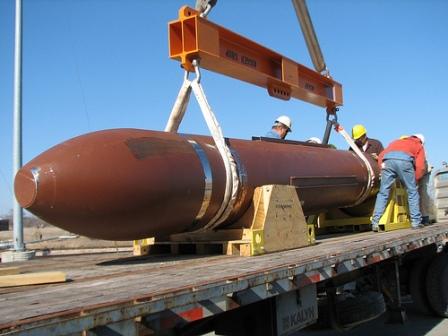
It is true that Israel can only set back Iran’s operation – I’ve been told by three to five years (which would be no small matter). That’s because Israel does not have the enormous 30,000 pound bunker busters – the Massive Ordnance Penetrators – that would be required to break through Iran’s underground fortifications.

But the US has them, and has the B-2 and B-52 bombers required for carrying them.

~~~~~~~~~~

In fact, let me carry this one step further:

A mere two months ago, it was announced that the Pentagon had just upgraded and tested its bunker busters

“According to senior officials, the results show the improved bomb—when dropped one on top of the other—is now more capable of penetrating fortified nuclear facilities in Iran or in North Korea, The Wall Street Journal reported. The Pentagon also designed the bunker buster to challenge Iran’s Fordow facility, which is built into a mountain to protect it from potential airstrikes.

bunker-buster bomb


“It’s believed that the above mentioned measures will allow the destructive weapon to be targeted with a precision previously possible only for far smaller guided US bombs.”

http://rt.com/usa/246753-pentagon-ugraded-bunker-bomb/

Clearly, the Pentagon and the Obama administration are not of the same mind. Also not news. But in light of the Pentagon’s improvements to the bunker busters, Obama’s statement about the military option not being able to “fix” the situation is a glaring misrepresentation. In other words, it’s a lie.

So Obama is (probably) lying about the Iranians freezing their stockpile and he’s lying about the chances of success with the military option.

At the risk of repeating myself, as was pointed out in my earlier post, he’s also lying to himself or to us about the rationality and antisemitism of the Iranian regime. Even a Lebanese journalist has noted that Obama will defend antisemitism in order to spin his miserable deal with the Iranians.

Is there anything this man says that we can trust?