H/t Power Line



H/t Joop


H/t Freedom is Just Another Word


Obama Administration Denies Jerusalem Is Located in Israel
30 Sep 2016
Source: Obama Administration Denies Jerusalem Is Located in Israel – Breitbart
An image of the press release can be seen here:

McClatchy reported:
The administration initially sent out a copy of President Barack Obama’s remarks at former Israeli Prime Minister Shimon Peres’ funeral in Jerusalem, indicating that the remarks had been given in Jerusalem, Israel. But later Friday afternoon, the press office sent out a correction to the previous email, striking out “Israel” from the header of the transcript.
Obama delivered the eulogy at Israeli national cemetery Mount Herzl.
Official U.S. policy refrains from recognizing Jerusalem as Israel’s capital until the conclusion of final-status talks aimed at creating a Palestinian state, ostensibly incorporating eastern sections of Jerusalem. The State Department forbids Americans born in Jerusalem to list their capital as Israel, a practice reaffirmed by a 2015 Supreme Court decision.
McClatchy adds:
The U.S. embassy in Israel is in Tel Aviv, but the country maintains a consulate in Jerusalem. Congress passed a law in 1995 calling for the embassy to be moved to Jerusalem, but presidents since then have used their waiver authority to prevent the change.
Report: Obama Admin Signed Secret Document to Lift U.N. Sanctions on Iranian Banks
BY:
September 30, 2016 1:23 pm
Source: Obama Admin Signed Secret Doc to Lift UN Sanctions on Iran Banks
The Obama administration signed a secret document to lift United Nations sanctions on two Iranian state banks that were previously blacklisted for their involvement in financing Iran’s ballistic-missile program the same day Tehran released four American prisoners, the Wall Street Journal reported Friday.
Based on the nuclear agreement between Iran and six world powers, the two banks were initially under sanctions until 2023, but the administration agreed to delist the entities on Jan. 17. Senior U.S. officials told the Journal that State Department official Brett McGurk and an Iranian government representative met in Geneva and signed three documents that day.
One document committed the U.S. to dropping criminal charges against 21 Iranian nationals, and Tehran to releasing the Americans imprisoned in Iran.
Another committed the U.S. to immediately transfer $400 million in cash to the Iranian regime and arrange the delivery within weeks of two subsequent cash payments totaling $1.3 billion to settle a decades-old legal dispute over a failed arms deal.
The U.S. agreed in a third document to support the immediate delisting of the two Iranian banks, according to senior U.S. officials. In the hours after the documents were signed at a Swiss hotel, the different elements of the agreement went forward: The Americans were released, Iran took possession of the $400 million in cash, and the U.N. Security Council removed sanctions on Bank Sepah and Bank Sepah International, these officials said.
In February, a documentary by Iranian media outlet Tasnim News Agency, which is affiliated with the Islamic Revolutionary Guard Corps, claimed that Iranian government officials demanded that Bank Sepah be delisted from U.N. sanctions as part of the deal to release four Americans. Despite previous sanctions on the bank by the Treasury Department, the Obama administration agreed to lift the sanctions under the nuclear deal reached in July 2015.
After the nuclear accord was inked, senior officials said they continued to have dialogue with Iran about the two banks before the three documents were officially signed in January. Tehran argued that Bank Sepah and Bank Sepah International were critical to international trade and their economy, the Journal reported.
Bank Sepah is Iran’s oldest bank and one of its three largest in terms of assets. Bank Sepah International, based in London, was key to financing Iran’s international trade before sanctions were imposed.
The U.S. Treasury was vehemently opposed to the banks back in 2007 for their alleged role in financially backing Iran’s missile program.
At the time, the Treasury said that Bank Sepah and Bank Sepah International had provided financial support to Iranian-state owned companies and organizations developing Iran’s missile program. These included Iran’s Aerospace Industries Organization and the Shahid Hemmat Industries Group.
“Bank Sepah is the financial linchpin of Iran’s missile procurement network and has actively assisted Iran’s pursuit of missiles capable of carrying weapons of mass destruction,” the Treasury said in a January 2007 statement.
Since the nuclear agreement was reached in July 2015, Iran has conducted up to 10 ballistic missile tests. The U.N. has been critical of these launches but has not imposed any new sanctions.
Senior Pentagon officials are upset about the prisoner deal, the Journal noted, despite U.S. officials saying the Obama administration closely vetted all entities and people associated with Bank Sepah before they agreed to the lifting of sanctions.
The dispute in Washington has only deepened in recent weeks, as senior Pentagon officials, including Secretary of Defense Ash Carter, told Congress in a hearing that they weren’t notified by the White House about the cash transfer. The chairman of the Joints Chief of Staff, Marine Gen. Joe Dunford, said at a hearing last week that he found it “troubling” that the U.S. provided Tehran with so much cash, which he argued could be used for “spreading malign influence.”
The Obama administration has repeatedly denied accusations that it sent $1.7 billion to Tehran to secure the release of four American prisoners. Many lawmakers have called the money transfer a ransom payment. A majority of lawmakers supported legislation last week that would legally ban the Obama administration from sending more cash payments to Tehran.
The Washington Free Beacon previously reported on House Majority Leader Kevin McCarthy (R., Calif.) praising the legislation.
While the Obama administration has threatened to veto the bill, McCarthy said the majority of Congress disagrees with the administration’s decision to pay Iran $1.7 billion prior to the release earlier this year of several U.S. hostages.
“The Obama administration paid a cash ransom to Iran for American hostages,” McCarthy told the Free Beacon. “No matter how the Obama administration chooses to redefine this payment, the message to Iran is crystal clear: You will be rewarded for taking hostages—not punished.”
FBI Dump Reveals Obama’s Pseudonym Use, Private Email Traffic with Hillary’s Private Email
23 Sep 2016Washington

Is it possible that it goes crazier than this, only if the tell us that the aliens from mars are coming !
Posted at the FBI’s Vault site, the revelation was part of a 189-page document dump of interview notes from conversations its agents conducted about how Clinton handled classified electronic correspondence, other documents, and her private email scheme during her tenure as secretary of State.
Clinton confidante Huma Abedin was interviewed April 5, 2016 in a meeting in the FBI’s Washington field office with FBI agents, her attorneys, and a representative from the Department of Justice’s Counterintelligence and Export Control Office.
During the interview Abedin was showed a June 28, 2012 email sent to Clinton with the subject header “Re: Congratulations!”
The Supreme Court ruled that day that the president’s landmark healthcare reform legislation, the Patient Protection and Affordable Care Act, was not unconstitutional.
Abedin told the FBI she had no idea who the email’s sender was and when agents told her it was the president’s pseudonym, she exclaimed: “How is this not classified?”
The confidante also told the agents that the president’s official email account had filters, so that certain emails could not get through to him–which came to her attention because when the former first lady changed private email accounts, her emails were bounced from the president’s official email account.
In addition to the news that the president, like many other members of his administration, used a fake name and his own private email account, it also means that Obama’s public statements about Clinton’s email arrangement were contrary to his own working knowledge and experience.
Obama told CBS News March 7, 2015 that he did not know about Clinton’s private email while she was his secretary of state from Jan. 21, 2009 to Feb. 1, 2013.
Q: Mr. President, when did you first learn that Hillary Clinton used an email system outside the U.S. government for official business while she was secretary of state?
Obama: The same time everybody else learned it through news reports.
In March 2013, The Smoking Gun website posted an article describing Clinton’s private email scheme, but it was not until The New York Times reported March 2, 2015 a full description of how Clinton used not only a private email address, but also a private server, and used this setup for all of her official electronic correspondence when she led State.
White House Press Secretary Josh Earnest walked back the president’s outright denial March 9:
The president was referring specifically to the arrangement associated with Secretary Clinton’s email. Yes, the president was aware of her email address. He traded emails with her. That shouldn’t be a surprise that the president of the United States is going to trade emails with the secretary of state. But the president was not aware of the fact that this was a personal email server and that this was the email address that she was using exclusively for all her business. The president was not aware of that until that had been more widely reported.
Normative Behavior, PJ Media, Richard Fernandez, September 22, 2016
 President Barack Obama pauses during a news conference following the G-20 Summit in Antalya, Turkey, Monday, Nov. 16, 2015. (AP Photo/Susan Walsh)
The devastation of Syria, according to the Guardian, will be Obama’s legacy but it won’t entirely be the story of naive neglect. Some pundits think active incompetence must have played a part too. After all, when the administration conceived of an alliance with Russia as a way the conflict could be shifted to the negotiating table, any reasonable person could have foreseen the possible dangers. Events proved the administration completely miscalculated the way in which Putin and Assad would act. How could they not have foreseen it?
“The crux of the deal is a US promise to join forces with the Russian air force to share targeting and coordinate an expanded bombing campaign against Jabhat al-Nusra, al-Qaeda’s branch in Syria, which is primarily fighting the government of President Bashar al-Assad.” To say Obama was stabbed in the back would only be to repeat Samantha Power’s belated regret at Putin’s “uniquely cynical and hypocritical stunt”.
Obama should have seen it coming but didn’t. All too frequently he never does. Noting this, Charles Lister, writing at Foreign Policy, headlines his piece “Obama’s Syria Strategy Is the Definition of Insanity.” He says “none of this should come as a surprise, even as the consequences are potentially devastating.
The Russian government, much less the Assad regime, has never been a reliable partner for peace in Syria. But even after Russia’s alleged bombing of the aid convoy, U.S. President Barack Obama’s administration is still plowing its energies into a deal that aims to work with the Russian government.
But Lister doesn’t accuse Obama of being actually a crazy person, just of acting like a one. Yet the suggestive evidence goes much further than Syria. Whether at social policy (which yielded riots), health policy (which resulted in Obamacare), or economic policy (which has created unemployment), the administration has shown a willingness to double down on failure. In many and varied contexts, it acts like it’s insane.
The explanation, as Michael Barone hints at, is the belief these setbacks are an acceptable price to pay for guaranteed re-election. Because liberal politics succeeds at electing candidates by promising impossible things, it promises them. That it fails to deliver is beside the point, because, quoting Dan McLaughlin at National Review, the Democrats believe their “party had unlocked the demographic code to a permanent majority.” Since misleading the electorate was the key to power, they would continue to turn it.
For all their blunders, “Republicans have lost four of the six presidential elections between 1992-2012” and Obama’s approval rating in the twilight of his term is over 50%. Since there’s no reason to hit the brakes and every incentive to step on the liberal gas, they do.
Two decades ago, lots of self-described moderates and even conservatives voted in Democratic primaries. Not so these days. The slump in Democratic primary and caucus turnout, from 38 million in 2008 to 31 million in 2016, was due to a sharp decline in turnout by self-described moderates.Hillary Clinton’s move from her husband’s 1990s triangulation to her near-total acceptance this year of Bernie Sanders’s left-wing platform was a rational response to changes in the Democratic primary electorate.
Hillary Clinton doesn’t say what she thinks but what her focus groups say the constituency wants to hear. She just channels the base, consequences be damned. Political catastrophe alone, argues Barone, can shock the system back into sanity. Absent negative feedback that hits politicians where they live, no changes can be expected from the party of Washington. Barone’s hypothesis reassuringly asserts that liberal politics is only optionally crazy and that after a few electoral defeats things could return to normal. Sleep tight: we can leave the asylum any time we want. However, he may have overlooked a crucial possibility. In his classic experiment, Yale psychologist David Rosenhan found it was easy to join the ranks of the insane but almost impossible to leave it on terms the asylum would accept.
Rosenhan’s study was done in two parts. The first part involved the use of healthy associates or “pseudopatients” (three women and five men, including Rosenhan himself) who briefly feigned auditory hallucinations in an attempt to gain admission to 12 different psychiatric hospitals in five different states in various locations in the United States. All were admitted and diagnosed with psychiatric disorders. After admission, the pseudopatients acted normally and told staff that they felt fine and had no longer experienced any additional hallucinations. All were forced to admit to having a mental illness and agree to take antipsychotic drugs as a condition of their release.
This raises the possibility that dysfunction is rather more permanent than Barone believes. The Rosenhan experiment provides an explanation for the what could be called “the liberal trap,” where there is no way out of an irrational policy regime except on terms that irrational people will accept. In that line of argument, the persistence of Obama’s “insane” foreign and domestic policy is partly the result of being unable to change his policy to anything his constituency can mentally follow. There is no workable escape from Syria, for example, on any self-consistent basis the left would accept and therefore there is no escape.
Being the head lefty doesn’t mean they’re in there with him. It means he’s in there with THEM.
And maybe he can’t get out. Having promised them a fantasy universe, he has to pretend to attain it. By that logic “Hillary Clinton’s move from her husband’s 1990s triangulation to her near-total acceptance this year of Bernie Sanders’s left-wing platform” will make her president yet will confine her as much as it did Obama. The reader will have noted there is of course yet another possibility which will not here be discussed. Our political leaders act crazy because they are. But if that were so, how would we know?
Iran’s Rouhani: Tactical Shift at the UN
by Majid Rafizadeh September 19, 2016 at 4:00 am
Source: Iran’s Rouhani: Tactical Shift at the UN
Iran’s President Hassan Rouhani and Foreign Minister Mohammad Javad Zarif will be attending the 71st session of the UN General Assembly in New York this week.
Based on the latest developments, all signs point to a tactical shift by Rouhani, in which his messages and tone will be quite different this year.
In the previous sessions of the UN General Assembly, Rouhani and his team adopted a diplomatic tone in order to have the UN Security Council lift sanctions against Iran. He praised the success of the nuclear agreement, its contribution to peace and its prevention of more tension and potential conflagration in the region. Iran’s objective was achieved: a few months later, when all four rounds of the Security Council sanctions were removed, billions of dollars and billions of cover-up stories arrived, all cost-free gifts from the U.S.
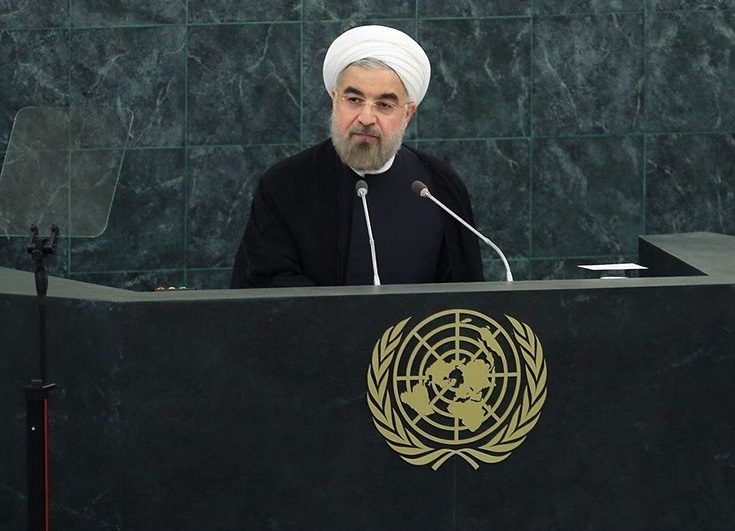 Iranian President Hassan Rouhani speaks at the UN General Assembly, September 26, 2013. (Image source: president.ir) Iranian President Hassan Rouhani speaks at the UN General Assembly, September 26, 2013. (Image source: president.ir) |
After achieving these goals for Iran’s ruling politicians, Rouhani’s message this year will switch to blaming the U.S. for all sorts of injurious shortcomings in the nuclear agreement, which Iran, incidentally, still has not signed.
U.S. President Barack Obama’s administration has sent hundreds of billions of dollars to Iran, and has hidden Iran’s supposed non-compliance with the nuclear deal to which it never officially agreed in the first place. The deal, in fact, seems only to have existed in the overheated imaginations of the US and other gullible members of the Joint Comprehensive Plan of Action (JCPOA). Nevertheless, the U.S. has ignored what Iran’s violations could be, and has assisted Tehran in evading any terms of the nuclear agreement it wished.
In addition, now that Iran has seen that the U.S. had lost all political leverage to pressure Tehran through the Security Council sanctions, and that, as critics of the deal had repeatedly and urgently warned, sanctions could not be “snapped back,” partly due to the veto power of Russia and China, Rouhani will be openly delivering the hardline messages of Iran’s Supreme Leader, Ayatollah Ali Khamenei, and the generals of Iran’s Islamic Revolutionary Guard Corps (IRGC), who enjoy power over Iran’s economic and political systems.
Khamenei and the senior cadre of the IRGC draw their legitimacy and power from the revolutionary principle of opposing the U.S., the “Great Satan.”
After the billions of dollars from the nuclear deal were delivered, the regime’s anti-American remarks and behavior only increased. For Rouhani, any expectation of rapprochement with the U.S. must be prevented, and also any domestic political liberalization prevented from occurring.
Reasons for Rouhani’s tactical shift in more publicly adhering to Iran’s revolutionary principle of anti-Americanism also include Iran’s leaders’ awareness that President Obama is tightly and desperately clutching the nuclear agreement until he leaves office: he considers the deal his crowning foreign policy accomplishment and legacy. By criticizing and blaming the U.S. for not honoring the terms, Rouhani plans to exploit President Obama’s weak point, as the negotiating team has been doing all along, by invoking Obama’s fear that Tehran might pull out of the nuclear deal — a move that would highlight the failure of the accord. This tactic will, as usual, successfully pressure the administration to give Tehran even more geopolitical and economic “carrots,” and pursue a policy with Iran of agreeing to even more concessions. Rouhani and Zarif will, as usual, conduct bilateral talks with American diplomats behind the closed doors to make sure they are achieved.
Rouhani’s public shift to Iran’s hard-line political spectrum is also partially pitched to Iran’s upcoming presidential elections. He needs the firm support of the hard-line leaders — fundamentally that of Supreme Leader Khamenei, who enjoys the final say in Iran’s domestic and foreign policy, and that of the IRGC leaders — in order to assure his election to a second term.
By more publicly delivering Khamenei’s message — that the US is not adhering to the terms of the nuclear deal and that it is supposedly the U.S. that has been “breaking oaths and not acting on their commitments and creating obstacles” —
Rouhani is most likely hoping further to endear himself to Khamenei and the IRGC and prove his loyalty.
A recent poll by the Center for International and Security Studies at the University of Maryland revealed that the moderate camp’s popularity has not only decreased, but that Iran’s former president, Mahmoud Ahmadinejad,
“now represents the single largest threat to Rouhani’s re-election, and trails the once-popular incumbent by only eight points. Suddenly, the ex-president [Ahmadinejad] seems once again to be a real political contender.”
Rouhani had also promised the Iranian people that the nuclear deal would improve their economic life. Since the implementation of the nuclear deal, however, the Iranian people have (unsurprisingly) not seen the fruits of the deal and the billions of dollars that the government has received. Rouhani will undoubtedly be trying to distract people’s attention from blaming the Iranian government by pointing to the U.S. as the culprit.
In one of his latest speeches, Khamenei pointed out that the U.S. is attempting to “destroy Iran’s economic relationships with other countries.” He added:
“Was it not supposed to be so that the unjust sanctions would be removed and it would have an effect on people’s lives? After six months, is there any tangible effect on the lives of the people? If not for America violating its oaths, would the administration not be able to do many things during this time? … Of course it has been some years that I have been repeating this about the lack of trust with America, but for some it was hard to accept this reality.”
Another issue on Rouhani’s agenda will be to promote, at the governmental level, business deals and trade, which will further financially benefit the IRGC and Khamenei, not Iran’s private sector.
Rouhani will more likely attempt to justify Iran’s military adventurism in the region by playing the anti-terrorism card, even though Iran is still the leading sponsor of terrorism.
Rouhani’s government will most likely focus on spreading the narrative of Khamenei and the IRGC, that Iran is an indispensable force in fighting the Islamic State and other extremist groups; that regional and global powers need to join Iran in this battle, and that Iran is the victim of terrorism in the region. In addition, Rouhani will presumably attempt to buttress the argument that the international community needs to support the Syrian President Bashar al-Assad in order to defeat terrorism.
Rouhani’s tactical shift is intended to reinforce Iran’s entrenched revolutionary ideal of anti-Americanism, appease Khamenei and the IRGC, and ensure his second term presidency.
Dr. Majid Rafizadeh, political scientists and Harvard University scholar is president of the International American Council on the Middle East. He can be reached at Dr.rafizadeh@post.harvard.edu.
White House: We’re in a ‘Narrative Battle’ With ISIS
BY:
September 19, 2016 9:11 am
Source: White House: We’re in a ‘Narrative Battle’ With ISIS
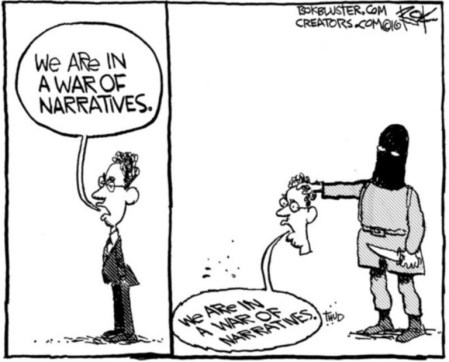
White House press secretary Josh Earnest said the U.S. was in a “narrative battle” with the Islamic State terrorist organization during an appearance Monday on CNN’s New Day.
Brought on to discuss the bombings in New York and New Jersey and the possible connections to international terrorism, Earnest cautioned against painting with a “broad brush” regarding terrorism and Islam.
“When it comes to ISIL, we are in a fight, a narrative fight with them, a narrative battle, and what ISIL wants to do is they want to project that they are an organization that is representing Islam in a fight and a war against the West, and a war against the United States,” he said. “That is a bankrupt, false narrative. It’s a mythology, and we have made progress in debunking that mythology.”
After laying out advances made militarily against ISIS, which the Obama administration calls ISIL, Earnest again repeated the U.S. had made progress in “debunking this mythology.”
“We can’t play into this narrative that somehow the United States or the West is fighting against the Muslim religion,” he said. “The fact is there are millions of patriotic Muslims in this country right now that make our country proud. They serve in our armed services. They serve in our law enforcement … These are individuals who make a substantial and positive contribution to our country, and that is an inconvenient fact for the ISIL narrative.”
Earnest used a similar line earlier on MSNBC’s Morning Joe, saying the fight against ISIS was in some ways “just a war of narratives.”
‘Position of strength’: NATO to deploy 4,000-strong ‘deterrent’ near Russia’s borders by May
Published time: 18 Sep, 2016 23:35

The announcement of the 4,000-strong contingent took place as military leaders from the military bloc gathered in Split, Croatia over the weekend. At the summit, Czech Army Gen. Petr Pavel said four battle groups will be sent to the region at different times in the first half of 2017.
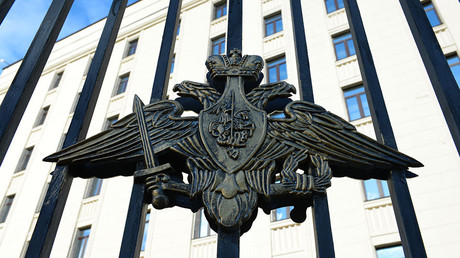
“With these four battle groups, we are not talking about exclusively about a training presence,” he said, according to Wall Street Journal.
“This force is to serve as a deterrent and if necessary as a fighting force. The rules will be different,” Pavel added.
The Croatian General pointed out that the new NATO force in the Baltic is planned to be commanded from the Polish division headquarters with US Army Gen. Curtis Scaparrotti overseeing any deployment of the new NATO force.
US officials told the publication that about 1,000 soldiers, will come from the 2nd Cavalry Regiment based in Vilseck, Germany, and are due to arrive in Poland by April. In addition to US contingent that will be sent to Poland, Germany will send forces to Lithuania. Canada is expected to offer troops to Latvia and the UK will deploy a battle group in Estonia. Norway, Denmark and France as well as other NATO states will be supplementing those forces.
“There are many strands of work,” Gen. Pavel said. “We are trying to come up with the big picture so we are assured the measures we are taking are well-coordinated, mutually supportive and we are not working in different directions.”
The military personnel will be deployed in close proximity to Russia’s northwestern borders in line with the newly-approved multinational task force that was agreed at the NATO summit in Poland in July.
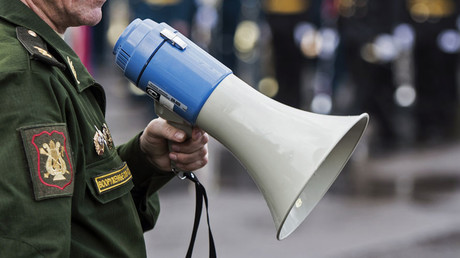
At the summit in Croatia, the head of NATO operations in Europe tried to unite the alliance’s members to approach Russia from a “position of strength.”
While stressing that opportunities to collaborate with Russia do exist, Scaparrotti noted that “In the view of the allies, I can tell you from this conference that they recognize Russia’s a challenge in many areas.”
Pavel, meanwhile, called for a “pragmatic” but “firm” approach to Russia.
READ MORE: Russia forms brand-new task force to counter NATO buildup in Eastern Europe
Following the Warsaw summit, Russia has proposed that NATO follows a “positive program” for developing relations, aimed at decreasing tensions between Moscow and the US-led military bloc. Relations between Moscow and NATO soured sharply after Russia’s reunion with Crimea and the eruption of the military conflict in Ukraine in 2014.
Moscow considers NATO’s new troop deployment, as well as the increased number of military drills near Russian territory, the creation of anti-ballistic missile sites in Europe and other moves, a threat to Russia’s national security.




 anneinpt
 artaxes
 danmillerinpanama
 davidking1530
 Peter Hofman
 Joseph Wouk
 Peter
Peter Louisiana Steve






 WarSclerotic
Recent Comments