Posted tagged ‘Obama and Turkey’

Turkey – Roger Out

July 22, 2016

Turkey – Roger Out, Front Page MagazineCaroline Glick, July 22, 2016

turkey roger out

Originally published by the Jerusalem Post

On Wednesday, NATO Secretary-General Jens Stoltenberg insisted that the purge of thousands in the Turkish military – including a third of the serving generals – did not weaken the military.

Stoltenberg told Reuters, “Turkey has a large armed force, professional armed forces and… I am certain they will continue as a committed and strong NATO ally.”

It would be interesting to know whether the 1,500 US soldiers who have been locked down at Incirlik Air Base along with several hundred soldiers from other NATO countries since the failed coup Friday night would agree with him.

Following the failed coup, the Erdogan regime cut off the base’s external electricity supply and temporarily suspended all flights from the base.

The base commander Gen. Bekir Ercan Van and 11 other service members from the base and a police officer were placed under arrest.

Incirlik is the center of NATO air operations against Islamic State in Syria. It also reportedly houses 50 nuclear warheads. The atomic bombs belong to the US. They deployed to Turkey – under US control – as a relic of the Cold War.

It took US President Barack Obama two years of pleading to convince Turkish President Recep Erdogan to allow NATO forces to use the base at Incirlik. It was only after the Kurdish political party secured unprecedented gains in Turkey’s parliamentary elections last year, and Tayyip Erdogan decided to expand his operations against the Kurds of Iraq and Syria to dampen domestic support for the Kurds, that he agreed to allow NATO forces to use the base.

His condition was that the US support his war against the Kurds – the most effective ground force in the war against Islamic State.

Stoltenberg’s statement of support for Turkey is particularly troubling because Erdogan’s post-coup behavior makes it impossible to continue to sweep his hostility under the rug.

For nearly 14 years, since his AK Party first won the national elections in late 2002, Erdogan and his followers have made clear that they are ideologically – and therefore permanently – hostile to the West. And for nearly 14 years, Western leaders have pretended this reality under the rug.

Just weeks after AKP’s first electoral triumph, the Turkish parliament shocked Washington when it voted to reject the US’s request to deploy Iraq invasion forces along the Turkish border with Iraq. Turkey’s refusal to permit US operations from its territory are a big reason the Sunni insurgency in Iraq was able to organize.

It took the US some two months to take over northern Iraq. By that time, the Ba’athists had organized the paramilitary militias that later morphed into al-Qaida in Iraq and then, following the US withdrawal from Iraq in 2011, Islamic State.

Ever since then, Erdogan has paid lip service, and even assisted NATO and the EU from time to time, when it served his momentary interests to do so. But the consistent trend of his behavior has been negative.

Since taking power, Erdogan has galvanized the organs of state propaganda – from the media to the entertainment industry to the book world – to indoctrinate the citizens of Turkey to hate Jews and Americans and to view terrorists supportively.

This induced hatred has been expressed as well in his foreign policy. Erdogan was the first major leader to embrace Hamas after its electoral victory in the 2006 Palestinian Authority elections. He treated Hamas terror chief Ismail Haniyeh like a visiting monarch when he hosted him shortly after those elections.

During Hezbollah’s 2006 war against Israel, Turkey was caught red-handed as it allowed Iran to move weapons systems to Hezbollah through Turkish territory.

Erdogan has turned a blind eye to al-Qaida. And he has permitted ISIS to use Turkey as its logistical base, economic headquarters and recruitment center. Earlier this year the State Department claimed that all of the 25,000 foreign recruits to ISIS have entered Syria through Turkey.

As for Iran, until Obama engineered the lifting of UN sanctions against Iran through his nuclear deal with the ayatollahs, Turkey was Iran’s conduit to the international market. Turkey was Iran’s partner in evading sanctions and so ensuring the economic viability of the regime. According to a series of investigative reports by Turkish and foreign reporters, Erdogan’s family was directly involved in this illicit trade.

Then there is Europe. For ISIS, Turkey has been a two-way street. Fighters have entered Syria through Turkey, and returned to Europe through Turkey. Turkey is behind the massive inflow of Syrian refugees to Europe.

German Chancellor Angela Merkel tried to cut a deal with Erdogan that would stem the flow. Erdogan pocketed her economic concessions and did nothing to stop the hemorrhage of refugees to Europe.

As for the US, the years of anti-American incitement and indoctrination of Turkish society are now coming into full flower in the aftermath of the coup. Even before the dust had settled, Erdogan was pointing an accusatory finger at Washington.

Insisting that the failed coup was the brainchild of exiled Islamic cleric – and erstwhile ally of Erdogan – Fetullah Gulen, who took up residence in Pennsylvania’s Poconos Mountains 16 years ago – Erdogan demanded that the US immediately put Gulen on an airplane with a one-stop ticket to Turkey.

In the days that followed, the Erdogan regime’s accusations against the US became more and more unhinged. Prime Minister Binali Yildirim said that failure to comply with Erdogan’s extradition demand would be viewed as a hostile act by the US.

And Turkish Labor Minister Suleyman Soylu flat out said that “America is behind the coup,” in a media interview.

In other words, after arresting the base commander and other forces at Incirlik, and while effectively holding US-led NATO forces and 50 nuclear warheads prisoner for the past six days, Turkey is accusing the US of engineering the coup attempt.

But apparently, NATO has decided to try to again sweep reality under the rug, once more. Hence, Stoltenberg’s soothing insistence that there is no cause for worry. Turkey remains a trusted member of the alliance.

This isn’t merely irresponsible. It is dangerous, for several reasons.

First of all, Stoltenberg’s claim that the Turkish military is as strong as ever is simply ridiculous.

A third of the serving generals are behind bars along with thousands of commanders and soldiers, educators, police officers, jurists and judges.

Who exactly can be willing to take the initiative in this climate? Amid at best mixed messages from the regime regarding the war against ISIS, and with the generals who coordinated the campaign with NATO now behind bars, who will maintain the alliance with NATO ? No one will.

The implications of this passivity will be felt on the ground in Turkey as well as in Syria and Iraq.

Thanks to Erdogan’s passive support, ISIS has operatives seeded throughout Turkey. Who can guarantee that they will leave the nuclear weapons at Incirlik alone? Is the US really planning to leave those bombs in Turkey when its own forces are effective prisoners of the regime? And what are the implications of removing them? How can such a necessary move be made at the same time that NATO pretends that all is well with Turkey? Then there is the problem of chemical weapons.

In recent months, ISIS has used chemical weapons in Syria and Iraq. In February, James Clapper, the director of US national intelligence, warned that ISIS is developing a chemical arsenal and intends to use chemical weapons against the US and Europe.

In May it was reported that ISIS is conducting experiments with chemical weapons on dogs and prisoners in labs located in residential neighborhoods in Mosul.

Turkey is a NATO member with open borders to Europe, and the only thing that has prevented ISIS terrorists from bringing chemical weapons to Europe has been the Turkish military and police force. They are now being purged.

Moreover, as Soner Cagaptay reported in The Wall Street Journal this week, Erdogan used out and out jihadists to put down the coup on Friday night and Saturday. He has continued to embrace them in the days that have passed since then.

In so doing, Erdogan signaled that he may well use the post-coup state of emergency to dismantle what is left of Turkey’s secular state apparatus and transform the NATO member into an Islamist state, along the lines of the short-lived Muslim Brotherhood regime in Egypt, which Erdogan enthusiastically supported.

In this climate, it is difficult, if not as a practical matter impossible, to imagine that the military and police will work particularly hard to prevent ISIS terrorists from transporting weapons of mass destruction from Syria to Europe through Turkey.

The Obama administration is partly responsible for the current crisis. Secretary of State John Kerry just agreed to subordinate the US-led anti-ISIS campaign to Russia. In so doing, he made clear that the US will not protect Turkey from Russia. This gives Erdogan little choice other than to strike out a new, far more radical course.

To Erdogan’s own Islamist convictions and US incompetence must be added a third reason to assume the situation in Turkey will only get worse.

As David Goldman has reported in the Asia Times, Turkey is on the brink of economic collapse. Its currency has been devalued by 7 percent just since the failed coup. “With about $300 billion in foreign currency liabilities, Turkish corporations’ debt service costs rise as the currency falls. Stocks have lost more than half their value in dollar terms since 2013,” Goldman warned.

In the current climate, it is hard to imagine Erdogan instituting austerity measures to pay down the debt. So he needs a scapegoat for his failure. The chosen scapegoat is clearly the US.

To make a long story short then, the Turkish military is no longer capable of cooperating in any meaningful way with the US or NATO . Erdogan, never a reliable ally, is now openly hostile.

He is in the midst of committing aggression against NATO forces at Incirlik. And he is embracing Turkish jihadists who are ideologically indistinguishable from ISIS.

The US surrender to Russia means that America cannot protect Turkey from Russia. And Erdogan has chosen to blame American for Turkey’s fast approaching economic doomsday.

Under the circumstances, if NATO takes its job of protecting the free world seriously, it has no choice but to quit with the business as usual routine and kick Turkey out of the alliance, withdraw its personnel and either remove or disable the nuclear weapons it fields in the country.

As for anti-ISIS operations, the US will have to move its bases to Iraqi Kurdistan and embrace the Kurds as the strategic allies they have clearly become.

In the aftermath of the failed coup, Turkey is a time bomb. It cannot be defused. It will go off. The only way to protect the free world from the aftershocks is by closing the border and battening down the hatches.

Can US, Turkey keep up appearances in Syria?

May 30, 2016

Can US, Turkey keep up appearances in Syria? Al-Monitor, May 29, 2016

A terrorist group linked to the Islamic State (IS) claimed responsibility for suicide bombings in Tartus and Jableh in Syria on May 23 that killed more than 150 civilians and wounded more than 200 others. Maxim Suchkov points out that the attack in Tartus occurred deep inside government-controlled territory. Russia maintains a naval base in Tartus and an air base and reconnaissance center in Khmeimim in the Latakia region. The suicide attacks, Suchkov suggests, could be a catalyst for a Russian “first strike” strategy against terrorist and aligned Salafi groups.

Moscow had already signaled the prospect of escalation against Jabhat al-Nusra and allied groups prior to the May 23 attacks. The Russian Ministry of Defense has announced a pause in its air campaign to allow armed groups allied with Jabhat-al Nusra to distance themselves from the al-Qaeda affiliate. On May 26, Jabhat al-Nusra, Ahrar al-Sham and allied groups seized the town of Dirkhabiyah near Damascus. Ahrar al-Sham has coordinated more closely with Jabhat al-Nusra in response to increased US and Russian targeting of the al-Qaeda affiliate over the past few months.

This column last week suggested that the United States take up a Russian offer to coordinate attacks on Jabhat al-Nusra, which is not a party to the cessation of hostilities. For the record, we have no tolerance or empathy for groups or individuals who stand with al-Qaeda. We hope that this is at least part of the message the United States is conveying to its regional partners who have backed these groups.

With the Geneva talks suspended for several weeks, the prospect of a Russian campaign to deliver heavy and potentially fatal blows to Jabhat al-Nusra and its allies, especially in and around Aleppo and Idlib, could signal yet another turning point in the Syria conflict.

Turkey’s failed proxy war

The United States and Turkey are struggling to keep up appearances in Syria, despite even further signs of division and discord.

Gen. Joseph Votel, US CENTCOM commander, met last week with Syrian Kurdish forces during a “secret” visit to northern Syria as part of a regional diplomatic tour that also included a stop in Ankara. Votel told Washington Post columnist David Ignatius that he is seeking to “balance” Turkey’s role as a “fabulous” partner in the battle against IS with that of the People’s Protection Units (YPG), the backbone of the Syrian Defense Forces (SDF), which is a “very good partner on the ground.”

In contrast to the YPG, Turkey’s proxy forces, including a worrying mix of Salafists who are willing to run operations with Jabhat al-Nusra, have been a flop. Last week, IS seized at least seven villages in the northern Aleppo region.

Fehim Tastekin reports that SDF-led military operations to liberate Jarablus, which is an essential gateway along with al-Rai to the outside world via Turkey, were postponed “because of Turkey’s red line against the Kurds.” The offensive against Raqqa has also been slowed, writes Tastekin, because “the SDF’s operational capacity still leaves much to be desired. It is not an option for the Kurdish YPG-YPJ to control Raqqa, because they will encounter local resistance. They also worry that scattering their forces in Arab regions could weaken the defensive lines of Rojava (Syrian Kurdistan). Therefore, Arab forces would have to get in shape to control the situation in the post-IS period.” Laura Rozen reports from Washington that the United States is seeking to boost the numbers of Arab Sunni forces among the SDF in anticipation of an advance on Raqqa.

Meanwhile, the Pentagon found itself in a public relations fiasco after Turkey complained that US special forces in Syria were wearing badges with the logo of the YPG, which Turkey considers the Syrian partner of the Kurdistan Workers Party (PKK) and therefore also a terrorist organization. This might be compared with what in the sports world is known as an unforced error, and made Votel’s already daunting diplomacy that much more complicated.

Air Force Col. Sean McCarthy also told Ignatius that US air operations against IS out of Incirlik Air Base were mostly “autonomous” of Turkish missions, saying that “we don’t discuss with them where we’re going.”

Adding it all up, the US-Turkish “partnership” against IS may be more fable than fabulous. The open secret is that Turkey is preoccupied first with thwarting advances by Syria’s Kurds, and second with shutting down the remaining lifelines for IS in northern Syria. These priorities are of a piece. No doubt Turkey is taking up the fight against IS, but first things first. Tastekin, who previously broke the back story on Turkey’s disastrous proxy efforts to retake al-Rai from IS in April, now concludes that “there is no room for optimism that Ankara will erase its red lines vis-a-vis the Kurds. Instead, Turkey is now trying to put together an even more formidable force with Jabhat al-Nusra, which it is trying to steer away from al-Qaeda.”

The catch might just be that many of the Syrian armed groups backed by Washington’s regional partners are proxies for a sectarian agenda that is mostly about toppling Syrian President Bashar al-Assad, however unlikely that now appears, and, by extension, keeping the heat on Iran. The when and where of taking the fight to IS or Jabhat al-Nusra is more or less negotiable, depending on trade-offs and pressure. We do not feel we are out on a limb in suggesting that efforts by Ankara or others to wean Jabhat al-Nusra from al-Qaeda will come to no good. This column has repeatedly documented the fluidity of foreign-backed Salafi groups such as Ahrar al-Sham and Jaish al-Islam shifting in and out of tactical alliances with Jabhat al-Nusra, all the while preaching an ideology almost indistinguishable from al-Qaeda and IS.

The losers, of course, are the people of Syria, including those who suffer under IS’ tyranny that much longer because of Turkey’s concerns about the Kurds, and as Washington’s policymakers and pundits begin another maddening deep dive into how to rejigger ethnic and sectarian fault lines. Syrians fleeing IS terror in Aleppo, meanwhile, told Mohammed al-Khatieb that living under IS is “like hell … unbearable.” While we acknowledge the complexities and challenges of the raw ethnic and sectarian politics of Syria, as well as the potential for vendettas and mass killings, there is, in our score, an urgency and priority to focus on the destruction of IS and al-Qaeda above all else.

Sur’s aftermath

Diyarbakir’s historic district of Sur has witnessed some of the most brutal fighting between Turkish military and PKK forces over the past year. Mahmut Bozarslan reports from Diyarbakir that “historical landmarks in Sur, which was last year added to UNESCO’s World Heritage List, also suffered their share of destruction. The walls of the Armenian Catholic church are partially destroyed, while the nearby Haci Hamit Mosque is missing its minaret, with a dome riddled with bullets. Another Armenian church, Surp Giragos, had its windows shattered and interior damaged.”

“Still, those ancient monuments were lucky compared with more ordinary structures in the area,” writes Bozarslan. “A building with an intact door was almost impossible to find. The warring parties had used some buildings as fighting bases, others as places to rest. Stairways were littered with empty tins; one was also stained with blood. At the bloodied spot, a piece of paper reading “body #1” was left behind, suggesting that the security forces had been there for a crime scene report. A couple seemed relieved that they had escaped with relatively little damage, but grumbled that their apartment had been broken into, with the bedroom and closets rummaged. They claimed it was the security forces who had entered, while their neighbor showed Al-Monitor binoculars that had been left behind.”

Obama’s Animus toward Israel May Lead to War

May 15, 2016

Obama’s Animus toward Israel May Lead to War, American ThinkerVictor Sharpe and Robert Vincent, May 15, 2016

Will the looming conclusion of the Obama presidency lead him to engineer an all-out war by Iran’s terror surrogates, Hamas and Hezbollah, against the embattled Jewish state?  Will that war conveniently occur in December 2016, as Obama serves out the final days of his presidency?

Is it conceivable that the pro-Muslim president of the United States will use such a conflict to predictably and mendaciously blame Israel as a means to permanently fracture the U.S.-Israeli alliance in a manner that would be difficult for any successor to repair?  As extreme as this may sound, it is entirely possible in view of Obama’s past acts of blatant hatred toward America’s one and only true democracy and ally in the Middle East.

As should be obvious by now, Obama believes that Islam has suffered from British and European Christian colonization and oppression.  After being thoroughly prepared to be receptive to this message by his stridently anti-Western mother and maternal grandparents, such was the indoctrination Obama received from Khaled al-Mansour – a Muslim high-level adviser to Saudi Prince Al-Waleed bin Talal and anti-Jewish hate-monger – during his formative years.

It was al-Mansour who helped Obama gain admittance to the Harvard Law School.  Edward Said, an outspoken anti-Israel professor of Obama’s at Columbia University, and Rashid Khalidi, a former press agent for Yasser Arafat’s PLO, served as Obama’s mentor in the former case and friend in the latter.

These figures, whose entire professional adult lives had been essentially dedicated to eliminating Israel, focused on influencing Obama to support the Arabs who call themselves Palestinians – along with their thugocracy known as the Palestinian Authority.  These overwhelmingly Muslim terrorists amount to little more than cannon fodder in the ongoing Islamist quest to effectively perpetrate yet another Holocaust.

Thus, while Obama weakens America and disparages Western values and the tenets of Judeo-Christian civilization, he always chooses to suppress the reality of Islamic triumphalism and its appalling and inhumane history of slavery, hatred of non-Muslims, brutal Muslim conquests, and slaughter dating back to its 7th-century origins in Arabia.

This is why no one should be surprised that he would bow to a Saudi king and venerate the Islamic call of the muezzin.

Given his background, it is no wonder that Obama fell for the monumental lie that the Jewish state is also a modern colonizer, just as the European powers were.  After all, Obama’s other confidants included, as the principled and worthy Victor David Hanson recently pointed out, “the obscene Reverend Wright and reprobates like Bill Ayers and Father Michael Pfleger.”

But unlike the European colonizers who had no ancestral roots in the Middle Eastern territories they occupied, Israel is the biblical and post-biblical homeland of the Jewish people, and as the native people of its ancestral homeland, the Jews predate the Muslim invasion of Israel by millennia, as is clearly evident in the Bible, which could not have been written when and where it was otherwise.

Even though sovereignty was lost to them after the Roman destruction of the Jewish state, Jews have always lived in their native land in whatever numbers they could sustain under a succession of alien occupiers.

Despite these clearly established historical facts, modern reborn Israel and her democratically elected leader, Prime Minister Netanyahu, have been treated with unprecedented contempt by Obama and his sycophants.

This was evident early on with Obama’s support of and friendship to the Islamist Erdoğan in Turkey, who has reduced once secular Turkey to a growing totalitarian Islamic state that has openly supported terrorism against Israel, as demonstrated by the Gaza flotilla incident of 2010.

Erdoğan’s perfidy – which has included all but open support for ISIS – has in no way dampened Obama’s preferential treatment of this dictator, in contrast to his appalling treatment of Israel’s Prime Minister Netanyahu.

Routinely, the State Department promotes the hypocrisy of the Obama administration by ignoring the aggression and terror of the Palestinian Authority, led by the Holocaust-denying Mahmoud Abbas and the Hamas and Islamic Jihad thugs who rule over the Gaza Strip.

In deplorable contrast, the State Department routinely attacks Israel for building homes in Jerusalem for young couples, or chiding Israel to exercise “restraint” when Israel is forced to defend itself from relentless Palestinian brutality and murder of Israeli civilians.  Was France or Belgium similarly asked to exercise “restraint” in the face of recent Muslim terrorist attacks in those countries?

This spitefulness was exhibited when the U.S., at the behest of a high-level individual in the Obama administration (wonder who!), denied visas to Israelis during Israel’s defensive Gaza war in 2014 against Hamas aggression.

Even as the barrage of thousands of rockets aimed at Israeli villages and towns from Gaza continued, this outrage was compounded when President Obama banned the much needed resupply of armaments to Israel at the height of the Hamas terror blitz and temporarily banned U.S. airlines from flying to Israel on the flimsiest of pretexts (23 international carriers – including British Airways – continued flights to Israel in spite of this ban).

Obama has also treated America’s other traditional allies with insolent disdain and cozied up to the worst enemy of freedom and liberty – namely, the Islamo-Nazi regime of Iran.

Iran’s ongoing implicit threats of nuclear warfare – against the U.S. as well as Israel – including its aggressive development of potentially nuclear-armed ICBMs, which can eventually reach the U.S., does not faze this incumbent in the White House.

The fact that this supposed nuclear “agreement” with Iran was reached, even as his very own State Department admits that Iran has yet to actually sign the agreement and even as Iranian mobs continue to chant “Death to America” to the approving nods of the Iranian mullahs, also fits into Barack Hussein Obama’s distorted world view – a deliberate policy of lies, deception, and dissimilitude.

This was admitted to by one of his closest advisers, Ben Rhodes, who recently disclosed that the Obama administration had deliberately deceived Congress and the American public about the Iran deal – as if this was something to be proud of.

Perhaps one of the most blatant examples of Obama’s anti-Western, anti-American, and anti-Israeli ideology was his support for the Muslim Brotherhood in Egypt and his reluctance to sell arms to President El-Sisi, who overthrew the Brotherhood’s Mohammed Morsi and his vicious anti-Christian regime after it had been in power for only two years and had wrought havoc on that country.

Obama’s support for Morsi should have come as no surprise, given the endless flow of Muslim Brotherhood activists visiting Obama’s White House and the filling of senior positions within the administration, as documented by former CIA analyst Clare Lopez.

Even today, El-Sisi fights al-Qaeda terrorism in the Sinai and the Hamas terrorists in Gaza without any apparent support or approval from Obama.

These examples of the president’s bias, his pro-Islamic sympathies, and his agenda point to a seminal hatred of not only America itself, but most pointedly of the Jewish state – this hatred may override all other practical considerations in the remaining few months of his term in office.

His parting shot at Israel may well be to force her expulsion from the United Nations and turn the Jewish state into another Taiwan.

As suggested at the beginning of this article, he might well encourage both Iranian terror proxies, Hamas in Gaza and Hezb’allah in Lebanon, to attack Israel with a massive missile bombardment sometime this coming December.

Hamas, for its own part, has thousands of lethal rockets and mortars and is feverishly building tunnels into Israeli territory in the hope of sending its terrorist hordes into Israeli villages and towns and slaughtering as many civilians as possible.  Hezb’allah, on the other hand, is estimated to have more than 150 thousand missiles and rockets aimed at all of Israel, hidden in Lebanese schools, hospitals, and apartments.

Even as the deliberate use of civilians as human shields is explicitly spelled out by the Geneva Conventions as a crime against humanity, and though Israel would have no choice but to inflict substantial civilian casualties in her own defense, this circumstance would naturally be used as a pretext by the U.N. to punish Israel in an unprecedented manner.

They would do so knowing that for the first time, an American president would likely stand by and approve whatever the U.N. anti-Israel “lynch mob” might concoct in order to further isolate and delegitimize the Jewish state.  This might include severe economic sanctions or embargoes or might even involve expulsion of Israel from the U.N. entirely.

It should be emphasized here that once the American national election is over, there will be nothing to stop Obama from doing this.  Obama’s entire foreign policy has revolved around undermining Israel.  Such an action on his part in the closing weeks of his administration can be seen as not only possible, but likely, given the pattern of his behavior toward Israel for the whole of his presidency.

This latter punishment would suit Israel’s enemies very well, even though it would change nothing on the ground.  An Israel reduced to a Taiwan-like status – i.e., a de facto sovereign state not officially recognized as such by the U.N. – would obviate the need for Gulf Arabs (who are covertly making common cause with Israel against Iran) to establish any formal diplomatic relations with her.

The “Zionist entity,” as their official propaganda impudently puts it, would remain just that.  This might even, in rhetorical terms, satisfy the requirement of Iran’s mullahs to “wipe Israel from the map.”  What is more, once Israel is expelled from the U.N., it would be very difficult for any future U.S. president, no matter how pro-Israel, to successfully support Israel’s re-admittance into the U.N.

As is the case with Taiwan, the U.S. may maintain a commitment to supplying Israel with arms and supporting her efforts at self-defense, but in practical terms, that may be the extent of the relationship, even in the best-case scenario surrounding Israel’s expulsion from the U.N. under Obama during his final days in office.

While such a turn of events may sound far-fetched to even some of those most critical of Obama, it is entirely possible in view of Obama’s past acts of blatant hatred toward America’s one and only true ally and democracy in the Middle East.


Netanyahu’s dilemma: Détente with Turkey or recognition of Syrian Kurds

April 4, 2016

Netanyahu’s dilemma: Détente with Turkey or recognition of Syrian Kurds, DEBKAfile, April 4, 2016

obama_erdogan_best_friends_2012They were once good friends

Last Friday, April 1, President Reccep Tayyip Erdogan had his first encounter with a group of American Jewish leaders, at his request. The full details of its contents were hard to sort out because the Turkish translator censored his master’s words with a heavy hand to make them more acceptable to his audience. But Erdogan’s bottom line, DEBKAfile’s New York sources report, was a request for help in explaining to the Obama administration in Washington and the Netanyahu government in Jerusalem why they must on no account extend support to the Syrian Kurdish PYD and its YPG militia or recognize their bid for a separate state in northern Syria.

The Turkish president did not spell out his response to this step, but indicated that a Turkish invasion to confront the Kurdish separatists was under serious consideration in Ankara. His meaning was clear: He would go to war against the Kurds, even if this meant flying in the face of President Barack Obama’s expectation that Turkey would fight the Islamic State.

Relations between the Turkish and US presidents have slipped back another notch in the last two weeks. When he visited Washington for the nuclear summit, Erdogan was pointedly not invited to the White House and his request for a tete a tete with Obama was ruled out. The US president even refused to join Erdogan in ceremonially honoring a new mosque built outside Washington with Turkish government funding.

At odds between them is not just the Kurdish question, but Erdogan’s furious opposition to Obama’s collaboration with Russian President Vladimir Putin on the Syrian conflict, and the two presidents’ tacit accord to leave Bashar Assad in power indefinitely until a handover becomes manageable.

On Feb. 7, on his return for a Latin American tour, the Turkish president warned Obama that he must choose between Ankara and the Kurds, whom he called “terrorists.” By last week, the US president’s choice was clear. It was the Kurds.

ObamaErdogan480_Koteret

When Erdogan arrived home from Washington last week, he discovered that the roughly four million Syrian Kurds dwelling in three enclaves touching on the Turkish border had taken important steps to advance their goal for self-rule: They were drafting a plan for establishing a “Federal Democratic System” in their three enclaves – Hassakeh-Jazeera, Kobani and Afrin – and had announced the amalgamation of their respective militias under the heading the “Syrian Democratic Forces”.

Cold-shouldered in Washington as well as Moscow (since Turkish jets shot down a Russian fighter last November), Erdogan found himself let down by the Jewish leaders whom he tried to woo. They refused to support him or his policy on the Kurdish question for three reasons:

1. Ankara had for years consistently promoted the radical Palestinian Hamas organization. To this, Erdogan replied by denying he had backed Hamas  only acted to improve the lives of the Gaza population. And, anyway, he said he had reacyed understandings with Israel on this issue..

2. His hostility towards Egyptian President Abdel-Fatteh El-Sisi. Erdogan’s response to this was a diatribe slamming the Egyptian ruler.

3. No clear reply had been forthcoming from Jerusalem by that time on Israel’s relations with Turkey or its policy towards the Kurds, despite the Turkish leader’s positive presentation of  mended fences.

The current state of the relationship is laid out by DEBKAfile’s sources:

Prime Minister Binyamin Netanyahu is caught on the horns of multiple dilemmas: While reluctant to respond to Ankara’s suit for warm relations with a leader who is shunned by Obama and Putin alike, Turkey is nonetheless offering to be Israel’s best client for its offshore gas.

Israel’s friendship with the Kurdish people goes back many years. The rise of an independent or autonomous state in Syria and its potential link-up with the semiautonomous Kurdish region of Iraq would create an important new state of 40 million people in the heart of the Middle East.

Israel has no wish to make enemies of its longstanding friends by disowning them in favor of Turkey.

Already, Israel’s evolving ties with the Syrian Kurds have given Israel’s strategic position in Syria a new positive spin, upgrading it versus the Assad regime in Damascus and its Hizballah and Iranian allies, who are avowed enemies of the Jewish state. Those ties offer Israel its first foothold in northern Syria.

And finally, Erdogan is not the only opponent of Kurdish separatism; so too are important Sunni Muslim nations like Saudi Arabia and Egypt. By promoting the Kurds, Israel risks jeopardizing its rapidly developing ties with those governments.

Secrets and Lies: Turkey’s Covert Relationship With ISIS

March 29, 2016

Secrets and Lies: Turkey’s Covert Relationship With ISIS, Clarion Project, Meira Svirsky, March 29, 2016

Islamic-State-5-IPWith the aid of Turkish officials, Islamic State fighters’ have been able to travel through Turkey to reach Syria (Photo: Video screenshot)

A hot warning received by intelligence officials revealed that the Islamic State (ISIS/ISIL) is planning an “imminent attack” on Jewish children in Turkey. Officials believe the most likely target is in the Beyoglu district of Istanbul, where a Jewish school is attached to a synagogue and community center.

The information was obtained after Turkey arrested six ISIS operatives in the southern city of Gaziantep last week.

“This is a more than credible threat. This is an active plot,” a Turkey source said.

Less than 10 days ago, a suicide bomber stalked Israeli tourists in Istanbul before blowing himself up near them, killing five people (four of them Israelis) and wounding many more.

“The so-called Islamic State is believed to be behind both sets of attacks and the organization continues in determined efforts to perpetrate further attacks in Turkey and elsewhere,” reported Sky News, quoting from an intelligence report seen by the news outlet.

In addition to the six arrested, another three ISIS operatives were arrested last week. Turkey, it seems is scrambling to protect itself from attacks the terror group has threatened to execute all across Europe.

After the Brussels attacks, Turkish President RecepTayyip Erdogan shocked the world by saying that Turkey had captured one of the perpetrators of the massacre last June and send him back to his country.  Erdogan specifically said that Ibrahim El Bakraoui, one of the suicide bombers in the Brussels airport, was detained in Turkey and sent back to Belgium with a warning (that was ignored) that he was a militant.

Yet, new documents obtained by Kurdish YPG fighters (People’s Protection Units) and the Syrian Democratic Forces (SDF) who are fighting together, refute the claim made by Erdogan that Turkey is preventing ISIS and Al-Nusra (Al Qaeda’s official affiliate in Syria) from travelling through Turkey to reach Syria.

The documents seized from Islamic State headquarters in seven locations, including Kobane, show that ISIS fighters from all over the world – and particularly from Kazakhstan, Indonesia, and Tajikistan  — were given passage through Turkey to Syria.

The Firat News Agency (ANF), a Kurdish outlet whose websites have been repeatedly blocked in Turkey by Turkish courts, reports that the hundreds of documents show that since 2013, ISIS fighters have used the Istanbul and Adana airports and have received permits from the Turkish government to reside in Turkey until they cross over to Syria.

The documents also include bus tickets, electronic Turkish visas, residency permits, and documents with stamps from Turkish immigration officials.

Chillingly, the documents show that chemical and explosive materials was transferred from Turkey to Syria. One such document was signed by the manager of Istanbul’s Police Foreigners’ Department Erkan Aydoga. Manuals in Turkish as to how to use these materials were also given to the jihadis.

A sample of the documents can be viewed here.

Turkey, as has been previously reported, is playing a dangerous and duplicitous game with the West. As Clarion Project has wrote, Turkey’s arms transfers to al-Qaeda-linked Islamist jihadis in Syria have been long-documented, yet largely ignored by the Western media. A major raid by the U.S. on an Islamic State safe house in Syria in the summer of 2015 gleaned large amounts of intelligence undeniably linking Turkey to the Islamic State.

Similarly, the fact the Turkey has been the top financial sponsor of Hamas since 2012, with Erdogan arranging for the transfer of $250-300 million to this U.S.-designated terrorist group annually, is another oft-ignored inconvenience. Similarly, the West has brilliantly avoided confronting Turkey on its abysmal human rights record.

Using air-tight documentation, Nafeez Ahmed, editor of InsurgeIntelligence, writes about the many reasons the West has chosen to look the other way while Turkey facilitates oil sales for the Islamic State, which guarantees its strength and viability.

“There are many explanations,” writes Ahmed, “but one perhaps stands out: the West’s abject dependence on terror-toting Muslim regimes, largely to maintain access to Middle East, Mediterranean and Central Asian oil and gas resources.”

Since 2013, the Turkish government has been building a $100 million mega-mosque in Lanham, Maryland, taking Turkey’s“outreach” in America out of the realm of the subtle. This week in America, U.S. President Barack Obama will join Erdogan at the opening of the mosque, the largest in the U.S.

The show, it seems, must go on.

Pakistan on the Mediterranean

March 28, 2016

Pakistan on the Mediterranean, Washington Free Beacon, March 28, 2016

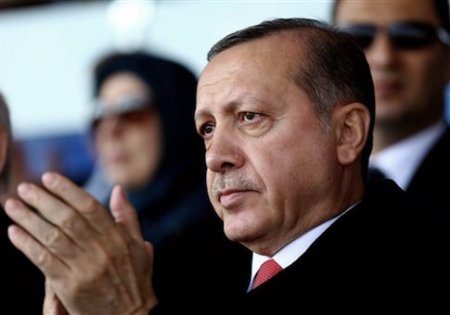
Turkish President Recep Tayyip Erdogan listens during a ceremony to commemorate the 101st anniversary of the Battle of Gallipoli in Canakkale, Turkey, Friday, March 18, 2016. Turkish President Recep Tayyip Erdogan on Friday warned Europe that it, too, could fall victim to attacks by Kurdish militants following a terror attack in Ankara that killed 37 people. (Kayhan Ozer, Presidential Press Service, Pool via AP)

Turkish President Recep Tayyip Erdogan listens during a ceremony to commemorate the 101st anniversary of the Battle of Gallipoli in Canakkale, Turkey, Friday, March 18, 2016. Turkish President Recep Tayyip Erdogan on Friday warned Europe that it, too, could fall victim to attacks by Kurdish militants following a terror attack in Ankara that killed 37 people. (Kayhan Ozer, Presidential Press Service, Pool via AP)

President Obama will welcome Erdoğan to Washington this week for a strategy meeting about countering the ISIS.

**********************

On March 18, European and Turkish diplomats signed off on a comprehensive deal on migrants pouring from Syria, Iraq, and elsewhere in the Middle East through Turkey and into the European Union. Under the terms of the deal, for every illegal migrant the E.U. returns to Turkey, Turkey would send one refugee for resettlement in Europe. Additionally, Turkey and Europe agreed to re-open discussions concerning the Muslim country’s efforts to join the E.U., and Europe agreed to allow Turks visa-free travel throughout the Schengen zone.

Two days after the deal was announced, a Turk who had joined the Islamic State blew himself up among tourists on Istanbul’s Istiklal Street, one of the city’s major shopping and tourism districts. Two days after that, ISIS suicide bombers killed dozens in two separate attacks in Brussels. ISIS called what occurred in Belgium “a drop in the sea” compared with what the terrorists have in store for “nations of disbelief.”

Turkey and its president, Recep Tayyip Erdoğan, have used the growing threat to argue that the West must better conform its policies to Turkey’s desires. In the wake of the Brussels attacks, Prime Minister Ahmet Davutoğlu chided Europe. “Europe has no partner other than Turkey to provide its regional security,” he declared, adding a subtle threat: “They should see this reality and act accordingly.” Meanwhile President Obama will welcome Erdoğan to Washington this week for a strategy meeting about countering the ISIS.

The reality Davutoğlu deliberately ignores, however, is his own country’s role in allowing ISIS to develop and metastasize. The Turkish government is adept at pulling the wool over Western officials’ eyes. Erdoğan pays lip service in meetings with European and American officials to the importance of both democracy and the Turkish partnership with the West, for example, declaring, “Secularism is the protector of all beliefs and religions.” He speaks differently to his Turkish audience. As mayor of Istanbul, he described himself as “the imam of Istanbul” and declared, “Thank God almighty, I am a servant of Shari‘a.” He is famous for his quip, “Democracy is like a streetcar. When you come to your stop, you get off.” In recent years, he has declared his goal to be to “raise a religious generation.”

This “religious generation” is flowing into the cauldron of Syria and Iraq. More than 30,000 foreign fighters from as many as 100 countries now fight with the Islamic State. The bulk of these soldiers—perhaps 90 percent—crossed into the Islamic State from Turkey. Turkish visa policy contributes to the problem. A direct correlation can be drawn between foreign fighters serving ISIS and those nationalities from which Turkish authorities require no visa or provide waivers: Several thousand more Moroccans and Tunisians, who need no visas to transit Turkey, fight with ISIS in Syria and Iraq than Algerians and Libyans, who do. If Erdoğan simply required visas in advance for those under the age of 40 coming from countries like Morocco, Tunisia, Lebanon, and Jordan—or, for that matter, from Russia, the United Kingdom, and Australia—the flood of recruits into the Islamic State would slow to a trickle.

ISIS terrorists regularly traverse the Turkish border, not only for medical care but also for rest and relaxation. Some merchants in Istanbul openly sell ISIS propaganda and promise that proceeds from their sale will benefit the group’s fight in Syria and Iraq. Smugglers peddling contraband oil to fund ISIS rely on Turkey to bring the oil to market, paying off local and perhaps even national officials of the AKP, Turkey’s governing party, along the way.

Turkey has done more than lend passive support to Islamist radicals. In his 13 years in power, Erdoğan has transformed Turkey from a Western-leaning democracy into Pakistan-on-the-Mediterranean. There was, for example,the leak of documents from the Millî İstihbarat Teşkilatı (MİT), Turkey’s intelligence service, showing Turkish support of the Nusra Front, an al Qaeda affiliate operating in Syria. And, rather than give medals to the Turkish soldiers who intercepted truckloads of weaponry destined for Syrian radicals, Erdoğan ordered their arrest.

Likewise, when Turkish journalists exposed—with photographic evidence—the transfer of munitions and other supplies from the Turkish border to ISIS, Erdoğan’s response was not to applaud the media but to seize the newspaper and arrest its editors and many of its reporters.

There is also evidence that, as Kurds fighting ISIS in Kobani in 2014 began to turn the tide against the radical group, Erdoğan and Turkish intelligence officials allowed ISIS fighters to pass through Turkey and attack Kobani from across the border, a flank the town’s largely Kurdish residents assumed was secure.

From the beginning, Erdoğan has looked at the Syrian refugee crisis not as a humanitarian tragedy but an arrow in his quiver. Inside Turkey, he has offered Sunni refugees Turkish citizenship if they settle in Turkish provinces currently dominated by the Shi‘ite offshoot Alevi sect. And, whereas the world condemns ISIS “genocide” against the Yezidi, the Yezidi who sheltered in Turkey were then victimized, again, by local AKP-run municipalities who refused to provide services offered to Sunni refugees.

Allowing Turkey to choose which refugees to send to Europe and promising to eliminate visa restrictions for Turks only rewards Erdoğan for his behavior and gives him additional leverage in his dealings with the West. Nor is this the type of policy Erdoğan’s neighbors would support. Earlier this year, King Abdullah II of Jordan told Congress, “The fact that terrorists are going to Europe is part of Turkish policy and Turkey keeps on getting a slap on the hand, but they are let off the hook.” He added that, “radicalization was being manufactured in Turkey.”

Abdullah’s message fell on deaf in ears in Washington, Brussels, Paris, and Berlin. It is Erdoğan who has the initiative as he pursues the Islamicization of Turkey and neo-Ottoman imperialism. He has built a Pakistan on the Mediterranean: an incubator of terror that markets itself as the only available partner of the West, with tragic results.

A new US-Russian-Turkish military buildup over Syria: In unison or at odds?

January 25, 2016

A new US-Russian-Turkish military buildup over Syria: In unison or at odds? DEBKAfile, January 25, 2016

TurkishAirBase480

The US and Russia are in the process of a military buildup in the Kurdish areas of northern Syria. It is ranged along a narrow strip of land 85 km long, stretching from Hassakeh in the east up to the Kurdish town of Qamishli on the Syrian-Turkish border. Facing them from across that border is a parallel buildup of Turkish strength. This highly-charged convergence of three foreign armies athwart a tense borderland is reported here by DEBKAfile’s military sources. It is too soon to determine whether the three armies are operating in sync or at odds, especially in view of the bitter relations between Moscow and Ankara.

US Forces 

American Special Operations troops and Air Force attack helicopters landed first at Remelan airport. They are the first US troops to operate from a ground base in Syria, accommodated in living quarters built for them in advance by a US engineering corps unit. The airport runway has been widened for US warplanes.

American Special Operations troops and Air Force attack helicopters landed first at Remelan airport. They are the first US troops to operate from a ground base in Syria, accommodated in living quarters built for them in advance by a US engineering corps unit. The airport runway has been widened for US warplanes.

Russian Forces

Next came two Russian military missions on Jan. 16.  One group, led by a general and consisting of air force and Special Operations officers, is preparing to take over a small abandoned base in Syrian army-controlled territory just 80 km from the new US facility at Remelan, and adapt it for Russian use.

The other group, which consists of intelligence officers – some from Russia’s FSB federal security service, the FSB – indicates that Moscow has decided it is high time for professionals to protect the classified information moving around the Russian Task Force in Syria and safeguard it from reaching the wrong hands. .

The abandoned base is less than 3.5 km from the Turkish border, and would act as a Russian barrier between US forces in northern Syria and the Turkish border contingents.

Turkish Forces

This Russian deployment set off alarm bells in Ankara, and so the Turkish army responded with the third troop buildup, arraying tanks and mobile artillery on the border across from Qamishli.

Over the weekend, Turkish President Tayyip Erdogan stated, “We have said this from the beginning: we won’t tolerate such formations (in northern Syria) along the area stretching from the Iraqi border up to the Mediterranean.”

At the same time, US Vice President Joe Biden said Saturday, Jan. 23, that  the U.S. and Turkey are prepared for a military solution against ISIS in Syria should the Syrian government and rebel-opposition forces fail to reach a peace agreement during its upcoming meeting in Geneva.

However, Ankara views its war on terror as focused on both Kurdish separatists and ISIS, which is subjecting Turkey to multi-casualty attacks.

DEBKAfile’s military and intelligence sources note that Turkey’s military options are very limited. Its leaders know they dare not put a foot wrong because the Russian force in Syria is just waiting for an opportunity to avenge the downing of a Russian Su-24 warplane by the Turkish air force on November 24.

Another group of actors stirring the pot in northern Syria is the Kurds, particularly the YPG militia, the only fighting force in Syria capable of defeating ISIS, which has been reinforced by the Iraqi autonomous Kurdish region’s Peshmerga, as well as the outlawed Turkish PKK Kurdish organization.

At this stage, it is impossible to determine how this triple buildup will play out tomorrow – how far the US and Russia are in concert, at what point they may decide to vie for footholds in the Kurdish region of northern Syria and how far the Turks are clued into the joint US-Russian strategy for bludgeoning ISIS.

More On The Turkey-ISIS Connection

January 15, 2016

More On The Turkey-ISIS Connection, MEMRI, January 15, 2016

In recent months, further information about the AKP government’s support for ISIS and other jihadis in Syria has come to light. Turkish journalists who have documented their government’s support for terrorists and who have published evidence of truckloads of arms and ammunition, as well as fighters, being sent into Syria have been threatened, arrested, and imprisoned by Turkish authorities.[1] Foreign media have also extensively covered Turkey’s sponsorship of ISIS and other terrorist organizations, and documented the ease with which thousands of foreign and Turkish jihadis enter and exit Syria under the eyes of Turkish officials.

However, Western governments have refrained from criticizing Turkey’s conduct in this matter, and continue to call Turkey “a partner in the fight against terrorism.” Many in Turkey, including Mehves Evin, columnist for Turkish opposition daily Diken, have asked, in light of this heavy media coverage of Turkey’s sponsorship of jihadi terrorists, “Why isn’t there a peep from the West?”[2]

The following report presents further evidence of the Turkish government’s support and sponsorship of ISIS and other jihadi terrorist organizations:

After Turkish Daily Cumhuriyet Released Video Footage Of Weapons-Filled Syria-Bound Turkish Trucks, Paper’s Editor-In-Chief, Ankara Bureau Chief Are Imprisoned, Charged With Treason, Espionage, And Terrorism

On November 26, 2015, Can Dundar, prominent journalist and editor-in-chief of Turkey’s oldest dailyCumhuriyet, and Erdem Gul, its Ankara bureau chief, were arrested; they are now being held in isolation pending a trial initiated by Erdogan himself, on charges of espionage, treason, and providing support for terrorism. The charges are in connection with the newspaper’s May 29, 2015 publication of video footage of a January 19, 2014 search conducted by Turkish judicial, security, and military officials of three large Syria-bound trucks in the Turkish border province of Adana; the search turned up heavy weaponry concealed under boxes of medicines. The weaponry, including missiles, mortars, anti-aircraft ammunition artillery, and grenades, was being transported by Turkey’s National Intelligence Organization (MIT) to jihadi organizations in Syria. Erdogan, at that time prime minister, immediately intervened to stop the search, and to secure the release of the MIT personnel carrying the arms into Syria.

Earlier, on January 1, 2014, a similar truck was stopped in the border province of Hatay, but no search could be conducted due to intervention by the local governor on behalf of the government.

The Adana and Hatay prosecutors’ investigations into both of the incidents, which came to be known as the “MIT trucks affair,” and all related legal files, were closed; gag orders were issued, and all security personnel, high-ranking military officers, and prosecutors involved in the searches were arrested. Erdogan, the AKP government, and its partisan media claimed that the trucks had only been carrying humanitarian aid to Turkmens in Syria.

Along with the video footage, published 17 months after the incident, Cumhuriyet also published other court documents, under the headline “The Weapons That Erdogan Said Did Not Exist”[3]

The following is the video footage published by Cumhuriyet:


https://www.youtube.com/watch?v=8Gd515Gp7YQ


Following Dundar’s imprisonment, an outcry arose in Turkey and in press organizations in Turkey and internationally; he has since received multiple press awards. Additionally, teams of journalists from the anti-AKP media, along with MPs from the main opposition Republican People’s Party (CHP), and artists and intellectuals, have been sitting in shifts outside the gates of the Silivri prison compound in Istanbul, where the detainees are being held, in solidarity.[4]

MIT Transports Jihadis, Weapons From One Syrian Battlefront To Another – Via Turkey

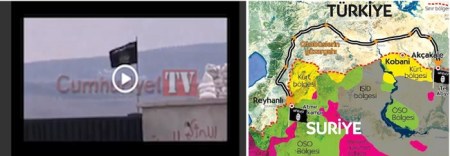
On June 11, 2015, Cumhuriyet also published a video of statements by two bus drivers telling authorities how they had been commissioned by the MIT to transport, on the night of January 9, 2014, over 70 Jabhat Al-Nusra (JN) jihadi fighters, along with a large load of arms and ammunition, from Atme Camp in Syria near the Reyhanli border crossing in the Turkish province of Hatay, to Tel Abyad in Syria, near the Akcakale border crossing in the southeastern Turkish province of Urfa. They showed where they had entered Syria from Turkey, without headlights, stopping near a building in Atme Camp where the JN flag was flying and “La-i-lahe-il-Allah” (“There is no God but Allah”) was painted on the wall. At Atme, they said, they had not been allowed off their buses, and the buses had been boarded there by bearded, Arabic-speaking militants who also loaded large boxes of weapons onto them. The drivers said that they then drove back into Turkey and proceeded without stopping to re-cross into Syria at Akcakale. At around 5:30 AM, near Tel Abyad, the militants disembarked with their weaponry.

It will be remembered that at that time ISIS was fighting to take control of Tel Abyad, and several days later, on January 13, it succeeded in doing so.

According to Cumhuriyet, the jihadis were transported from one point to another in Syria via Turkey because it was unsafe for Islamist fighters to travel through Syrian territory that was under Kurdish Democratic Union Party (PYD) control, such as Kobane.

The drivers also stressed that they had committed no crime, as they had been hired by the MIT to work for the government and had been escorted throughout by MIT operatives in two black vehicles.

The AKP government called the Cumhuriyet report a lie and libel, and, on February 14, 2014, ordered the investigation into the matter and the related files closed, removed the prosecutor from his position, and sealed and covered up the incident.[5]

26456Left: The Cumhuriyet video showing the building in Atme Camp where the drivers picked up the jihadis. Right: The route taken by the buses carrying jihadis from Atme Camp in Syria to Tel Abyad in Syria, via Turkey.

CHP MP Says Sarin Gas Components Were Transferred To ISIS Via Turkey; Erdogan Accuses Him Of Treason; Criminal Investigation Against Him Is Launched

On several occasions – at an October 21, 2015 press conference, in an early December 2015 interview with the Russian news agency RT, and in a December 10, 2105 speech in the Turkish parliament, CHP MP Eren Erdem said that components for sarin gas had been imported from foreign countries, some of them European, by Turkish businessmen on behalf of an ISIS operative, and delivered to a terrorist organization in Syria, for the production of chemical weapons that were later used in Syria.[6]

Erdem said that his claims were based on a 2013 investigation, case file number 2013/139, by the Chief Prosecutor’s Office in the southern province of Adana. According to this investigation, five Turkish citizens the wanted Al-Qaeda/ISIS militant and Syrian citizen Hayyam Qassap were arrested and prosecuted for procuring the toxic components to be transferred to ISIS in Syria.

Erdem stressed that the statements he was making were not his own, but that he had been quoting a Republic’s Chief Prosecutor. He added that in late June 2013 this case had been closed and a news blackout imposed on it, and that on July 1, 2013 the six accused had been released from prison and allowed to cross into Syria.

Erdem launched a parliamentary inquiry in October 2015 demanding government explanations in this matter, but to date Turkish Prime Minister Ahmet Davutoglu has not responded.

On December 18, 2015, Erdogan publicly accused Erdem of treason. The same day, the Ankara Chief Prosecutor’s Office sent a summary of proceedings to the Ministry of Justice for permission to begin legal action against Erdem; if it is sent on to the parliament, the process to strip him of his parliamentary immunity so that he can be tried for treason will begin.[7] Since then, he has been threatened by the pro-AKP media and subjected to a lynching campaign on social media; in addition, he and his family have received death threats.

On December 23, 2015, Erdogan blasted Erdem again, calling him a “traitor,” and also slammed CHP leader Kemal Kilicdaroglu for his defense and protection of Erdem. The previous evening, in a televised interview,[8]Erdem had reiterated that he had accused neither Turkey nor the government, but had only objected to the release of the suspected businessmen and of a Syrian militant who had attempted to procure illegal chemical components to transfer to Syria via Turkey.[9]

“Jihad Hospital” In Turkey For Islamist Terrorists

In September 2015, the Turkish opposition daily Birgun visited a 75-bed “jihad hospital” in the border province of Gaziantep that treats the mujahedeen fighting in Syria, and on September 22 reported:[10] “Turkey… is turning a blind eye to a medical support network serving the Islamic Front militants. The administrators of the six-floor, 75-bed hospital in Gaziantep told Birgun that during the first eight months of 2014 they had treated well over 700 militants; they administrators also expressed their gratitude to the local security officials and the AKP municipality for their assistance, and for the AKP government’s support.”

The Birgun report continued: “The AKP government… continues to assist the jihadi organizations, and by permitting the operations of a medical network that extends from Aleppo to Ankara and Istanbul, is trying to strengthen the hand of the Islamic Front, an umbrella organization for many jihadi groups fighting in Syria, which is structured like ISIS and has at least 45,000 active fighters, especially in the Idlib and Aleppo areas. Their wounded are treated in Gaziantep.

“The treatment of the wounded fighters is made possible by ImkanDer, an Islamist association, whose regional representative is Sait Gokdere. He is the former executive of the Humanitarian Relief Foundation (IHH), that became known in connection with from the 2010 sailing of the Mavi Marmara to break Israel’s blockade on Gaza. Gokdere told us that the IHH focused their activities on Syria when the civil war broke out, and that thanks to the AKP government’s permission and support, ‘may Allah bless them,’ they were able to provide health services to the mujahideen at this rehabilitation facility and in the many houses in the area that have been turned into clinics, reaching a capacity of 150 beds. He said that the hospital personnel were conducting their activities, and exiting and entering Syria officially, with the permission of the authorities.

“Doctors with whom we [Birgun] spoke explained that the treatment of wounded fighters begins with receiving news [of them] from Aleppo, through their local sources there. They then dispatch vehicles into Syria to bring them over. The seriously wounded are taken to state hospitals in Kilis or Gaziantep, and in the rare cases when they are not able to treat their injuries, they are sent to hospitals in Ankara or Istanbul. Once these wounded mujahedeen are out of intensive care, they are taken to the home clinics or to this hospital. Upon their recovery, they return to Syria to resume fighting.”

26457A recovering jihadi in the “jihadi hospital” in Gaziantep. Birgun, September 22, 2015

ISIS In Turkey

Since 2013, the opposition media in Turkey have been reporting on the spread of Salafi ideology within the country, and on the steady stream of thousands of Turkish jihadis who join ISIS, Jabhat Al-Nusra, Ahrar Al-Sham, and other terrorist organizations in Syria. An estimated 10,000 Turkish jihadis have gone to Syria to join the fight, as the AKP government has turned a blind eye.

Turkish ISIS Militant In Ankara: ISIS “Loves Turkey, Because Of The Ease At The Borders And For Its Allowing Safe Passage To Fighters Of Many Nationalities”

Birgun interviewed multiple ISIS militants in the Hacibayram district, in Ankara, which has become an ISIS center. While its report, published July 8, 2015, included names of recruiters and recruits, the Turkish government has done nothing to stem the flow of recruits into Syria.

C.A., 29, told Birgun that initially there had been many Al-Qaeda operatives in the area, but that they had declared their allegiance to ISIS. He recounted how, after he decided to go to the Islamic State in February 2014, he had established contact with some well-known people in order to cross the border. He told how upon arrival he had received education in Koranic verses, Hadith, shari’a law, and the high purpose of ISIS’s fight, and then had received military training. He said he fought there for nine months and could not remember how many people he had killed.

Asked whether he had seen any Turkish police or soldiers during his border crossings, C.A. said: “Turkey permits the crossings to Dawla [the Islamic State]. My first time, I came face to face with a military police officer. They see you, but pretend they don’t,” Only once, he said, the last time he returned to Turkey was he caught – and that time he was taken before a judge, who released him. Asked about how ISIS views Turkey, and whether “talk that ISIS militants may [be planning to or intending to] conduct operations inside Turkey” was true, C.A. answered: “Dawla loves Turkey, because of the ease it provides at the borders and for its allowing safe passage to fighters of many nationalities. The mujahideen there [in the Islamic State] criticize Turkey because it is not ruled by Allah’s rule, but there is no thought or intention to fight Turkey. Turkey, on the other hand, helps us because we fight particularly against the Kurdish PKK. Allah knows, if ISIS is given one month without the [coalition and Russian] air raids, we will eliminate the PKK.”[11]

Turkish Jihadi: “Jihad Is A Religious Obligation, Like Daily Prayers; If A Muslim Is Hurt In The Arctic, We Would Go There Too”

The major mainstream Turkish daily Hurriyet tracked ISIS in five Turkish cities, interviewing the families of many who had joined ISIS, and some jihadis. The report, published September 22, 2014, showed how easy it was for thousands of Turkish and foreign fighters to cross the southeastern border of Turkey into Syria, and how a new breed of Islamist associations, Islamist lodges, Islamist chat rooms, and Islamist bookstores and cafes were popping up around the country encouraging young Turks to join the jihad and to receive Islamic education and preliminary training. The report also mentioned young jihadis who had fought alongside ISIS or the Al-Qaeda affiliate Jabhat Al-Nusra and who had returned to Turkey to receive medical treatment after being wounded.

An ISIS recruit, interviewed in Istanbul, told the reporters that he had entered Syria five times. Like the other recruits, he said, he had been escorted by militants to the border, jumped the fence, and ran into one of the houses on the Syrian side. First, he had joined Jabhat Al-Nusra, but then switched to ISIS. Asked whether he would also go to fight in other Muslim countries, he answered: “It is a religious obligation. Jihad [is] like daily prayers. If a Muslim is hurt in the Arctic, we would go there too.”

Worried families told Hurriyet that that their sons had gone “to die for the Muslims.” A father in Gaziantep said that his son, 22, and nephew, 34, had both left to join ISIS, and that when he reported this to police, he was told: “Everybody goes there [to ISIS]. Don’t mess with this issue, so as not to get yourself into trouble.”[12]

In a July 2015 column titled “ISIS Among Us,” Aydin Engin wrote in Cumhuriyet that not only were the suicide bomber who carried out the July 20, 2015 attack in Suruc, that killed 33, and the bombers who killed over 100 in Ankara on October 10, 2015 Turkish citizens who had joined ISIS, but that there were thousands more like them across Turkey. He wrote that ordinary citizens in all the cities and towns of the southern border provinces of Turkey can easily point out ISIS houses, ISIS cells, the wounded ISIS militants brought in daily from Syria to their hospitals, and groups of ISIS members sitting at tables in restaurants. Engin asked how it would be possible for the AKP government and the MIT not to be aware of what every citizen knows so well – i.e. that ISIS is everywhere in Turkey.[13]  

ISIS Affiliates In Istanbul Hold Events, Call For Jihad – Without Interference By Turkish Security

While Turkish police are always present at protests, and frequently disperse crowds with water cannon, pepper gas, and, sometimes, bullets, Islamist organizations are allowed to openly demonstrate and call for shari’a law and jihad, in major cities. Similarly, the AKP government closes down media outlets and websites of dissenters and Kurds, while Islamist websites disseminating ISIS propaganda are left to operate freely.

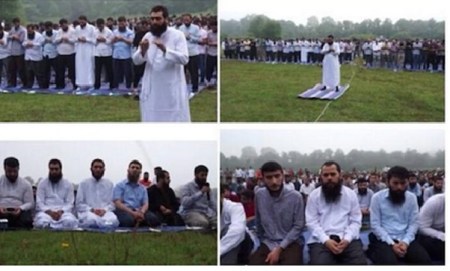
26458ISIS-affiliated group at an encampment in an Istanbul park allocated to them by the AKP celebrates Ramadan, praises ISIS, and calls to jihad. Photos: Rotahaber and Twitter, July 29, 2014.

Endnotes:

[1] See MEMRI Inquiry & Analysis No 1165, Dictatorship In Erdogan’s Turkey – Part II: The Domestic Scene On The Eve Of Crucial General Elections, June 5, 2015.

[2] Diken (Turkey), November 26, 2015.

[3] Cumhuriyet (Turkey), May 29, 2015.

[4] Cumhuriyet (Turkey), November 27-present , 2015

[5] Cumhuriyet (Turkey), June 11, 2015.

[6] See MEMRI Special Dispatch No. 6195, Turkey’s Main Opposition Party CHP Accuses AKP Government Of Crimes Against Humanity: Says 2013 Chemical Attack In Syria Was Carried Out By ISIS With Sarin Gas Supplied By Turkey; Turkish Government Closed Investigation Into This Affair, Released Suspects Into Syria, October 22, 2015.

[7] Cumhuriyet, Zaman (Turkey) December 18, 2015

[8] Halk TV (Turkey), December 22, 2015.

[9] Zaman (Turkey), December 23, 2015.

[10] Birgun (Turkey) September 22, 2014.

[11] Birgun (Turkey), July 8, 2015.

[12] Hurriyet, (Turkey), September 22, 2014

[13] Cumhuriyet (Turkey), July 23, 2015.

Turkey and Israel: A Rickety Handshake

December 23, 2015

Turkey and Israel: A Rickety Handshake, Gatestone InstituteBurak Bekdil, December 23, 2015

(What benefit beyond oil sales to Turkey — a minor one that Turkey could extinguish at its pleasure — would Israel receive? — DM)

♦ It would be truly embarrassing if a Turkey-Israel normalization results in new arms shipments into Gaza and rockets over Israeli skies — with the only achievement being a temporary peace with Turkey’s Islamists, who never hide their ideological kinship with Hamas.

♦ The future Turkish and Israeli ambassadors would always have to keep their bags packed, ready to return to their own capitals at the first dispute – which could be caused by Israeli retaliation against Arab terrorism or anything that may make Erdogan roar in front of cameras.

♦ How do you shake hands with a man whom you know ideologically hates you and wishes to mess up things at his earliest convenience?

None of this happened half a century ago; the timeline here covers only a span of a year and a half: A Turkish-Kurdish pop star wrote on her Twitter account, “May God bless Hitler. He did far less [than he should have done to Jews].” The mayor of Ankara replied: “I applaud you!” Hundreds of angry Turks, hurling rocks, tried to break into the Israeli diplomatic missions in Ankara and Istanbul. The mayor of Ankara said: “We will conquer the consulate of the despicable murderers.” He blamed the Charlie Hebdo massacre in Paris on Israel’s Mossad. Islamist columnists close to the government suggested imposing a “wealth tax” on Turkish Jews (who are full citizens). A governor threatened to suspend restoration work at a synagogue. And a credible research group at the Kadir Has University in Istanbul found in a poll that Turks view Israel as the top threat to Turkey.

Against such a background, Turkish and Israeli diplomats are negotiating a historical deal that will, in theory, end Turkey’s hostility toward the Jewish state and normalize diplomatic ties between Ankara and Jerusalem.

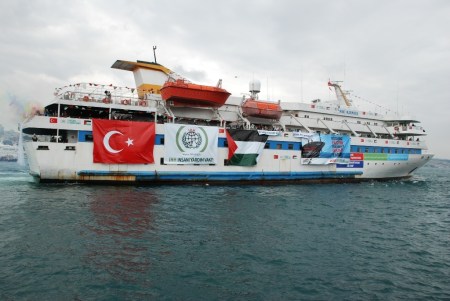
In 2010, a Turkish flotilla, led by the Mavi Marmara with hundreds of jihadists and anti-Israeli “intellectuals” aboard, sailed toward the coast of Gaza, aiming to break Israel’s naval blockade of the Hamas-run strip. Israel’s naval blockade aims to prevent weapons such as rockets being smuggled into Gaza. To stop the flotilla, naval commandos of the Israel Defense Forces boarded the vessel and, during clashes, killed nine aboard.

1080The Turkish-owned ship Mavi Marmara, which took part in the 2010 “Gaza flotilla” that attempted to break Israel’s naval blockade of Gaza. (Image source: “Free Gaza movement”/Flickr)

Since the incident, Turkey’s Islamist leaders have pledged to isolate Israel internationally and have downgraded diplomatic ties with Jerusalem. They have put forward three conditions before any normalization could take place: an Israeli apology, compensation for the families of the victims and the removal of the naval blockade on Gaza.

After President Barack Obama’s intervention, Israeli Prime Minister Benjamin Netanyahu in 2013 apologized for “any error that may have led to the loss of life.” Turkey’s two other conditions remain unfulfilled. But diplomatic teams from Ankara and Jerusalem are apparently working on a deal. There are good reasons why an accord may or may not be possible.

Since the nearest Turkish election is four years from now, neither Turkish President Recep Tayyip Erdogan nor his prime minister, Ahmet Davutoglu, has any reason to cultivate further anti-Semitism at election rallies in order harvest votes from conservative masses who are deeply hostile to Israel and Jews. These are days when Turkey’s leaders need not practice their usual anti-Israeli rhetoric.

There is another reason related to “timing” that makes a deal attainable. After pledging to isolate Israel, Turkey has become the most isolated country in the region, especially after the recent crisis with Russia that emerged after two Turkish F-16 fighters shot down a Russian SU-24 aircraft along Turkey’s Syrian border on Nov. 24.

In its region, Turkey does not have diplomatic relations with Cyprus and Armenia. It has downgraded diplomatic relations with Israel and Egypt. It is confronted by Shiite and Shiite-dominated regimes in Iran and Iraq, respectively. On top of all that, an angry Vladimir Putin, Russia’s president, curses and threatens every day to punish Turkey. Turkey buys over half of its natural gas and 10% of its oil from Russia.

Therefore, a third incentive could be a mutually beneficial future deal for Turkey to buy natural gas from Israel. If the two countries build an underwater pipeline, Turkey can compensate for the potential loss of Russian gas supplies, starting in 2019. For Israel, a pipeline to Turkey would be the most commercially feasible route to export its gas to Turkey and other potential buyers beyond.

A Turkish-Israeli handshake would also be music to ears in Washington. Deep hostility and occasional tensions between its two allies in the Middle East have always been unnerving for the U.S. administration.

The road ahead has its problems. Turkey’s second condition for normalization, compensation, is not too difficult to overcome. But the third condition, that Israel should remove the naval blockade of Gaza — and risk weapons being smuggled into the hands of Hamas (or other terrorist groups) — could be an unsafe move for Israel.

It would be truly embarrassing if a Turkey-Israel normalization results in new arms shipments into Gaza and rockets over Israeli skies — with the only achievement being a temporary peace with Turkey’s Islamists, who never hide their ideological kinship with Hamas.

If Netanyahu decides to take risks and go for a deal, he must make sure that however the naval blockade of Gaza would be eased, it does not expose Israel to the risk of new acts of terror.

Another risk is the potential psychological domino effect any deal could cause. It is certain that Turkish Islamists will portray any deal as a success story — that they were able to “bring Israel to its knees.” This message, relayed through a systematic propaganda machine, could set a dangerous precedent and potentially encourage Arab Islamists to consider more assertive policies toward Israel in the future.

The future Turkish and Israeli ambassadors would always have to keep their bags packed, ready to return to their own capitals at the first dispute – which could be caused by Israeli retaliation against Arab terrorism or anything that may make Erdogan roar in front of cameras, “Our Palestinian brothers … Those murderer Jews again … Go back to your pre-1967 borders or you’ll suffer the consequences!”

Netanyahu’s problem is that he does not trust Erdogan in the least. He is right not to trust Erdogan. But then how do you shake hands with a man whom you know ideologically hates you and wishes to mess up things at his earliest convenience?

The battles in N. Syria will determine the fate of the peace process

December 21, 2015

The battles in N. Syria will determine the fate of the peace process, DEBKAfile, December 21, 2015

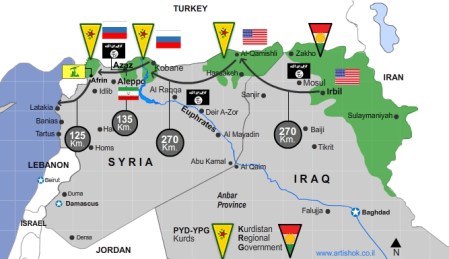
Syria_Iraq_Kurdsweekly

The US-Russian plan, approved by the UN Security Council as the lever for activating a political process towards ending the five-year Syrian war, can only go so far towards its objectives. The process is not capable of halting the fighting or removing Bashar Assad from power; just the reverse: progress in the talks is heavily dependent on the state of play on the battlefields of the north while the Syrian dictator’s ouster is a fading issue.

The limitations and obstacles facing the UN-endorsed US-Russian plan are summed up here by DEBKAfile’s analysts:

1. The understanding reached by the Obama administration and the Kremlin in the past month was first conceived as a stopgap measure. It was never intended to bring the calamitous Syrian war to an end or remove Assad, but rather to provide a pretext to account for the expansion of Russia’s ground operation and gloss over America’s military deficiencies in the Syrian conflict. Taking it as carte blanche from Washington, President Vladimir Putin felt able to announce Saturday, Dec. 19, that “the Russian armed forces have not employed all of their capability in Syria and may use more military means there if necessary.”

2. President Barack Obama has stopped calling for Assad’s removal as the condition for ending the war and is silent on the expanding Russian military intervention. Obama and Putin have in fact developed a working arrangement whereby Putin goes ahead with military operations and Obama backs him up..

3. Almost unnoticed, on Dec. 17, the day before the Security Council passed its resolution for Syria, all the 12 US warplanes that were deployed a month earlier at the Turkish air base of Incirlik for air strikes in Syria were evacuated. This happened at around the same time as Russia deployed to Syria its Buk-M2-SA-17 Grizzly antiaircraft missile systems. The presence of this system would have endangered American pilots had US air strikes over Syria not been halted. The upshot of the two evidently coordinated moves was the US withdrawal of most of its military resources for striking the Islamic State forces in Syria and the handover of the arena to the Russian army and air force.

4. In another related development, Friday, Dec. 18 the German intelligence service, BDN, leaked news that it had renewed its contacts with the Assad regime’s intelligence services and German agents were now visiting Damascus regularly. The import of this change is that Berlin no longer relies on US intelligence briefings from Syria and, rather than turn to Moscow, it prefers to tap its own sources in the Syrian capital.

5. Washington and Moscow are still far apart on the shape of the transitional government mandated by the Security Council resolution

The Obama administration wants Assad to hand presidential powers over the military and of all security-related and intelligence bodies to the transitional government, which is to be charged with calling general and presidential elections from which Assad will be barred.

Putin won’t hear of this process. He insists on a transitional government being put in place and proving it can function before embarking on any discussion of its powers and areas of authority.

The two presidents agree that the transition will need at least two years, overlapping the Obama presidency by about a year and dropping the issue in the lap of his successor in the White House.

6. The US and Russia don’t see to eye to eye either on which Syrian opposition organizations should be represented in the transitional government and which portfolios to assign them. On this question, both Washington and Moscow are at odds with the Persian Gulf states, Saudi Arabia, Qatar and the UAE, which back some of the organizations labeled as terrorist by Moscow.

7. But it is abundantly clear that the Obama administration is ready to wash its hands of the Syrian rebel movement and most of all, abandon Turkish President Tayyip Erdogan to give the Russians an open remit.

On Saturday, Dec. 19, Putin turned the screw again on Erdogan when he said he had no problem with the Turkish people, adding, “As for the current Turkish leadership, nothing is eternal.”

In support of Moscow, Obama meanwhile leaned hard on the Turkish president in a telephone conversation, to remove Turkish forces from northern Iraq. Ankara responded that Putin’s comment was not worth a response and denied hearing of any such US request.

Ankara may be feigning ignorance but it must realize by now that Moscow and Washington have joined forces to pus the Turkish military out of any involvement in northern Syria and Iraq.

8. This US-Russia collaboration against Turkey is having a dramatic effect on the war in northern Syria along the Turkish border. DEBKAfile’s military and intelligence sources report it opened the door to the secret deal between Washington and Moscow to divide the areas of influence in northern Syria between them – essentially assigning the Kurdish enclaves north of the Euphrates river and bordering on Iraq to American influence (see map), and the areas west of the Euphrates up to the Mediterranean to Russian control. This deal (first revealed by DEBKA Weekly 688 on Dec. 4) effectively squeezes Turkey out of any role in the Syrian conflict.

9. The ongoing battles in northern Syria near the Turkish border will have a greater impact in shaping the future of Syria and its unending conflict than any UN resolution. Participating in the fighting at present is a very big mixed cast: Russia, the Kurdish YPG militia, most of the important rebel groups, including radical Sunni organizations tied to Al Qaeda, such as the Nusra Front and Ahram al-Sham, Iran and Shiite Hizballah, and the Islamic State.

It is only when one of these forces gains the upper hand in this free-for-all, that there will be progress toward a political solution on ending the war.