Posted tagged ‘Obama and Iran scam’

Obama Admin Staking Iran Deal Legacy on Doomed Bid to Sell Tehran Aircraft

December 12, 2016

Obama Admin Staking Iran Deal Legacy on Doomed Bid to Sell Tehran Aircraft, Washington Free Beacon, , December 12, 2016

kerry-zarifJohn Kerry, Javad Zarif / AP

The Obama administration is locked in a last minute bid to save last year’s nuclear deal with Iran by promoting the delivery of airliners to the Islamic Republic, despite mass opposition in Congress that has moved the administration to engage in a series of public relations maneuvers and backroom deals meant to secure the multi-billion dollar sale, according to multiple sources familiar with the administration’s thinking who spoke to the Washington Free Beacon.

The Obama administration has been scrambling for weeks to provide Iran with assurances the United States will continue to grant Iran vast relief from economic sanctions and help push through deals with Boeing and AirBus, American and French airplane manufacturers, respectively. The effort comes as the nuclear deal hangs in the balance following a flood of Iranian threats and the election of Donald Trump, a vocal opponent of the deal, as well as several new moves by Congress to increase pressure on Tehran’s global terror operations.

Boeing confirmed Monday it sealed a $16 billion deal to sell Iran 80 jetliners, an announcement that sources told the Free Beacon was meant to provide momentum to the nuclear deal and stop Tehran from walking away.

Multiple sources familiar with the situation told the Free Beacon the administration is promoting a false prognosis and that the pact is likely to collapse by next year, when President-elect Trump assumes control of the White House and is partnered with a Congress that is more than willing to put a kibosh on the sale, which lawmakers say will embolden Iran’s terrorist forces.

“The Obama administration oversold the deal to the Iranians by secretly promising to relieve a range of sanctions that Congress was never going to agree to,” said one senior congressional adviser apprised of the White House’s thinking on the matter.

“The administration then did everything it could do unilaterally, including lifting restrictions on military assets and ballistic missile banks, to try to make good on those secret promises,” the source said. “But Congress was never going to allow Iran to steamroll across the Middle East, even if the Obama administration was willing to look the other way, and so the deal was always going to collapse under its own weight.”

The State Department would not provide more details about the deal, including how it is being financed, by press time.

Tehran has a long history of using its national air carrier, Iran Air, to ferry weapons and support to terror groups across the region, including in Lebanon and Syria. Despite these concerns, the Obama administration has fast tracked special licenses permitting Boeing and AirBus to move forward with the sales without violating sanctions barring such agreements.

Experts have repeatedly warned that Iran Air could easily resell these planes to other Iranian airline companies still targeted by sanctions for their illicit activities.

David Pasch, a spokesman for Rep. Peter Roskam (R., Ill.), who has worked to block the plane sales to Iran, told the Free Beacon that Congress will have an easy time killing the deal next year.

“We will aggressively fight this deal next Congress, though we probably won’t even need new legislation to do it,” Pasch said. “The incoming appointees at Treasury and State will no longer report to a White House willing to bend over backwards and ignore national security concerns to keep Iran from walking away from the nuclear deal.”

One senior congressional aide who works on the issue told the Free Beacon that the flurry of recent news stories casting the deal as a lock is part of a public relations campaign by the White House meant to given the appearance the deal is set in stone, despite multiple obstacles standing in the way.

“The administration is creating a facade of false assurances to assuage Iranian concerns about completing these sales,” the source told the Free Beacon. “They want, in essence, to make this a fait accompli. In reality, there are a number of obstacles in the way of completing this deal. For example, the House has already passed legislation to cut off Ex-Im [export-import] financing for aircraft sales to Iran. I think with a Trump administration we can reasonably expect renewed movement in Congress to block these dangerous deals.”

The planes are not set to be delivered to Iran until 2018, meaning that Congress and the next administration have a couple years to disassemble the deal. There also remain questions about how these Western companies will get financing to seal the deal with Iran, which remains a safe haven for terrorist financing.

These obstacles are expected to grow more daunting under a Trump administration, which has discussed increased transparency for companies willing to deal with regimes that sponsor terrorism such as Iran.

Another issue of top concern to opponents of the sale is a carve out guaranteeing Boeing engineers work with Iran to provide spare parts and technical know-how, a move that immunizes Tehran from future sanctions targeting the airline sector.

“The Obama administration created a fantasy world in which it’s safe to sell airplanes to Iran, then pulled Boeing into that fantasy world,” said the congressional adviser quoted above. “But it’s not safe to sell airplanes to Iran, because the Iranians use their airplanes for all sorts of illegal things, including arming Syria’s war machine. That’s why the sale stalled, because no one wanted to touch it. But the administration is desperate to make it look like the sale was moving forward, so that when it collapses they can blame it on Trump.”

Trump Assembling Team of Fierce Iran Deal Opponents

December 5, 2016

Trump Assembling Team of Fierce Iran Deal Opponents, Washinton Free Beacon, December 5, 2016

President-elect Donald Trump gestures as he speaks during a "USA Thank You" tour event, Thursday, Dec. 1, 2016, in Cincinnati. (AP Photo/Evan Vucci)President-elect Donald Trump gestures as he speaks during a “USA Thank You” tour event, Thursday, Dec. 1, 2016, in Cincinnati. (AP)

President-elect Donald Trump has been assembling a national security team stacked with fierce opponents of last year’s comprehensive nuclear deal with Iran, signaling what is expected to be a major departure from the Obama administration’s final bid to preserve the deal before leaving office, according to multiple sources familiar with Trump’s transition plans.

Trump has been installing well-known opponents of the deal to key national security posts for the incoming administration, including at the White House National Security Council, the CIA, and the Department of Defense.

This includes his selection of retired Marine Gen. James Mattis as secretary of defense, Rep. Mike Pompeo (R., Kan.) as CIA director, and retired Army Lt. Gen. Michael Flynn as national security adviser, picks that have won plaudits for their vocal opposition to the nuclear deal.

“It’s no secret that Flynn considers Iran to be the linchpin of a global alliance of hostile rivals seeking to undermine American interests,” said once source familiar with the backroom talks about future national security picks. “He was in the Middle East during the Iraq war and knows first-hand how Iranian proxies killed hundreds of American troops, and he has seen the intelligence showing that they’ve targeted Americans around the world.”

“As long as Iran keeps acting like an enemy of the United States, his NSC will accurately convey that to the president, and he’s building a staff that will make sure of that,” the source added.

Other recent national security picks include KT McFarland, a longtime national security analyst and commentator who has vocally criticized Iran and the nuclear deal, and Yleem Poblete, who served for nearly two decades as a senior staffer for the House Committee on Foreign Affairs.

A senior congressional aide familiar with Poblete’s work on key national security matters told the Washington Free Beacon that Trump’s picks would not back down from a showdown with Iran as it continues to fund terrorism across the Middle East.

“It’s apparent that President-elect Trump is taking a fundamentally different approach to national security and foreign policy than the current administration,” the source said. “Selecting Rep. Pompeo to head up the CIA, General Flynn as national security adviser, and General Mattis as defense secretary shows that the new administration will not recede from the world stage as the current administration has done, but is willing to reestablish America as a global leader.”

The source said that Trump’s selection of Poblete is a sign that the next president is serious about rewriting America’s policy approach to Iran and other rogue regimes.

Selecting Poblete for the NSC landing team sends a clear signal that the next administration is looking to reverse some of the damage that President Obama has inflicted when it comes to Iran and Cuba and will legitimize and improve the totality of Trump’s foreign policy agenda,” the source said.

Poblete played a key role in crafting sanctions against Iran and was the senior staffer on the Foreign Affairs Committee when they were initially signed into law.

“Poblete is a tough negotiator with the policy chops to advance U.S. national security interests; her vast experience of being one of the main architects of the current sanctions against Iran, her advocacy for freedom and democracy in Cuba, her ardent promotion of transparency and reform at the UN, and her vast experience and expertise with the Middle East will no doubt help strengthen our relationship with Israel,” the source explained.

Trump’s selection of these foreign policy heavyweights comes as Congress overwhelmingly voted last week to extend economic sanctions on Iran for 10 years, a move that elicited an angry response from Tehran.

With Poblete, Flynn, and others steering the ship, the Trump administration is expected to go even further with new sanctions on Iran for its behavior, which includes testing advanced ballistic missiles and threatening actions in the Persian Gulf.

The next administration will likely have to unwind the Obama administration’s final push to provide Iran with continued sanctions relief and cash payouts.

“The Obama administration has 48 days to try and nail down the deal to make it more difficult for the Trump administration to negotiate a follow on agreement that addresses the fatal flaws of the Obama nuclear deal,” Mark Dubowitz, executive director of the Foundation for Defense of Democracies, told the Free Beacon. “Anything they try to do will be at the top of the chopping block when the new administration gets into their seats.”

Senate sends Iran sanctions bill to Obama with 99-0 vote

December 1, 2016

Senate sends Iran sanctions bill to Obama with 99-0 vote, Washington ExaminerSusan Crabtree, December 1, 2016

mcconnelSenate Majority Leader Mitch McConnell, R-Ky., said Thursday that the bill, which would preserve existing sanctions set to expire at the end of the year, is critical given Iran’s “continued pattern of aggression” and “efforts to expand its sphere of influence across the region.” (Graeme Jennings/Examiner)

The Obama administration has opposed the legislation, arguing that it already has the power to extend or impose additional sanctions on Tehran and the sanctions are no longer necessary after the nuclear deal.

********************

The Senate unanimously passed legislation Thursday that would extend sanctions on Iran for 10 years, a move many supported as a way to ensure the U.S. maintains its leverage over Iran in light of questions about its implementation of the Iran nuclear agreement.

The 99-0 Senate vote sends it along to the president’s desk for his signature. The vote came after the House overwhelmingly approved the measure, known as the Iran Sanctions Extension Act, two weeks ago in a 419-1 vote.

Senate Majority Leader Mitch McConnell, R-Ky., said Thursday that the bill, which would preserve existing sanctions set to expire at the end of the year, is critical given Iran’s “continued pattern of aggression” and “efforts to expand its sphere of influence across the region.”

“This is even more important given how the current administration has been held hostage by Tehran’s threats to withdraw from the nuclear agreement, and how it has ignored Iran’s overall efforts to upset the balance of power in the greater Middle East,” he said.

Under the nuclear agreement between Iran, the United States and five other world powers, many sanctions were lifted or eased in exchange for Iran’s agreement to roll back its nuclear program and an inspections regime to try to enforce it. The Obama administration and supporters of the deal insisted that sanctions could easily “snap back” if Iran was found to have violated the terms of the deal.

But critics argued that sanctions, once lifted, could not easily be re-imposed because foreign investors previously barred from doing business with Tehran before the nuclear pact couldn’t easily cancel contracts and abandon their financial ties to the country.

The U.S. sanctions, which Congress first passed in 1996, target any outside investments in Iran’s energy sector to prevent Tehran from developing nuclear weapons, and would have expired at the end of 2016 if Congress hadn’t acted.

In the months since the nuclear deal went into effect, Iran has complained that these non-nuclear related sanctions are preventing businesses from investing in the country, particularly the prohibition on Iranian access to the U.S. financial system. Tehran argues that the strict limits are preventing many companies from engaging in new business deals in Iran, in effect, subverting the economic benefits it expected the nuclear deal to produce.

Critics, however, countered that Iran is still suffering because foreign businesses are nervous about violating the new rules and risking U.S. sanctions on them and are reluctant to contribute to revenue to a top state sponsor of terrorist activity.

The Obama administration has opposed the legislation, arguing that it already has the power to extend or impose additional sanctions on Tehran and the sanctions are no longer necessary after the nuclear deal.

Members of Congress, including key Democrats, are adamant that the existing sanctions remain in effect in order to demonstrate to Iran that the U.S. will respond to any provocations or violations of the nuclear agreement.

Who Will Blink First: Iran, or Trump?

November 30, 2016

Who Will Blink First: Iran, or Trump? PJMediaRobert Spencer,November 29, 2016

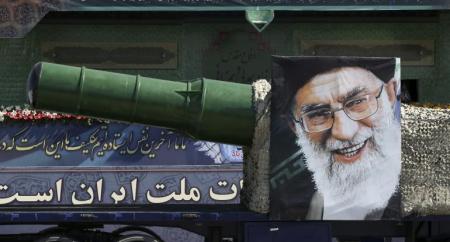
khameneigunsA portrait of Ayatollah Ali Khamenei is placed with weapons during a military parade just outside Tehran on Sept. 22, 2015. (AP Photo/Vahid Salemi)

Assuming that Hillary Clinton will not find some last-ditch bit of Clintonesque chicanery that will put her in the White House after all, Donald Trump will likely be inaugurated president come January 20, and he will have an ultimatum waiting for him.

The Ayatollah Khamenei warned the day before Thanksgiving that if the U.S. dared to extend sanctions on Iran, the Islamic Republic would retaliate. President-elect Trump, meanwhile, has vowed to cancel the deal altogether, which would almost certainly include restored and new sanctions.

Who will blink first?

The House of Representatives already set the confrontation on course last week, when it reauthorized the Iran Sanctions Act (ISA) for ten years. This was an almost entirely symbolic move, however, as the ISA will expire at the end of this year unless the Senate approves it and Barack Obama signs it — and Obama is about as likely to do that as he is to put on a Make America Great Again cap.

Indeed, Obama continues to be notoriously protective of the Iran deal. The known elements of the deal are bad enough, as I explain in my book The Complete Infidel’s Guide to Iran. But the secret codicils just keep making things worse, and administration officials continue to appear determined that they not leak out to the public.

Investigative journalist Adam Kredo reported last Tuesday:

Senior Obama administration officials in their final days in office are seeking to cover up key details of the Iran nuclear deal from Congress, according to documents and sources who spoke to the Washington Free Beacon about continued efforts by the White House to block formal investigations into secret diplomacy with Tehran that resulted in a $1.7 billion cash payment by the United States.

As far as Khamenei was concerned, Obama’s obvious anxiousness to keep the mullahs happy was all for show. He proclaimed: “The current U.S. government has breached the nuclear deal in many occasions.” In reality, Iran is the one breaching the agreement. Recently, according to Reuters, the International Atomic Energy Agency revealed:

[Iran] exceeded a soft limit on sensitive material set under its nuclear deal with major powers. … [This is the] second time Tehran has surpassed the 130 metric tonne threshold for heavy water, a material used as a moderator in reactors like Iran’s unfinished one at Arak, since the deal was put in place in January.

The Obama State Department’s response was feeble: it was all just an accident, you see. State spokesman Mark Toner put the best face on things that he could, confusing impunity with good faith:

It’s important to note that Iran made no effort to hide this, hide what it was doing from the IAEA.

This ongoing Obama administration solicitude for Iran may have fostered complacency in Iranian President Hassan Rouhani, who boasted right after the election that there was no chance of Trump rolling back the deal. Rouhani explained:

Iran’s understanding in the nuclear deal was that the accord was not concluded with one country or government but was approved by a resolution of the UN Security Council and there is no possibility that it can be changed by a single government. … The United States no longer has the capacity to create Iranophobia and to create a consensus against Iran. The constructive engagement policies of Iran towards the world, and the fact that international sanctions have been lifted, have placed the Iranian economy on a road where there is no possibility of going backwards.

Khamenei was apparently a bit less certain that it would be all smooth sailing from here on out, as he felt compelled to add a threat:

The latest is extension of sanctions for 10 years, that if it happens, would surely be against JCPOA [Joint Comprehensive Plan of Action, the official name of the Iran nuclear deal], and the Islamic Republic would definitely react to it.

It remains to be seen whether President-elect Trump will take such threats seriously enough to back off on his pledge to “rip up” the Iranian nuclear deal. It is certain, however, that if he is serious about restoring America’s national security and standing in the world, he will not be able to afford to continue Obama’s policies of ignoring Iranian breaches of the agreement and showering upon them all manner of largesse.

It will either be no deal with Iran and a secure America, or a deal with Iran and continued appeasement and weakness in response to enemies who have vowed to destroy us. This is one swamp in dire need of draining.

Intel: Iran Using Commercial Planes to Smuggle Weapons to Terrorists

November 24, 2016

Intel: Iran Using Commercial Planes to Smuggle Weapons to Terrorists, Washington Free Beacon, November 24, 2016

(Please see also, Israel: Iran is smuggling weapons to Hezbollah on commercial flights  — DM)

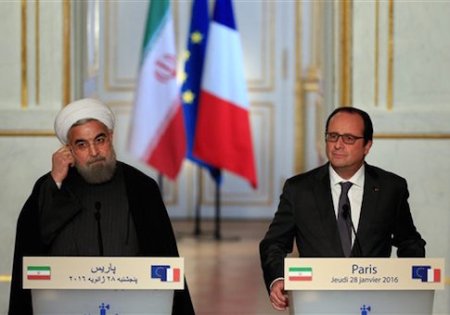
France's President Francois Hollande, right, and Iranian President Hassan Rouhani give a press conference, at the Elysee Palace, in Paris, Thursday, Jan. 28, 2016. Iran Air has signed a deal to buy 118 aircraft from Airbus in the first of an expected host of commercial deals expected to be announced during the visit of Iranian President Hassan Rouhani to Paris. (AP Photo/Thibault Camus)

France’s President Francois Hollande, right, and Iranian President Hassan Rouhani give a press conference, at the Elysee Palace, in Paris, Thursday, Jan. 28, 2016. Iran Air has signed a deal to buy 118 aircraft from Airbus in the first of an expected host of commercial deals expected to be announced during the visit of Iranian President Hassan Rouhani to Paris. (AP Photo/Thibault Camus)

The Obama administration has given clearance to Western airline manufacturers to sell planes to Iran at the same time the Islamic Republic is using commercial airliners to smuggle weapons and other illicit arms to Hezbollah terrorists in Lebanon, according to new intelligence and congressional communications obtained by the Washington Free Beacon.

The disclosure of this new intelligence, which shows that Iran has been using its commercial airline company to smuggle advanced weaponry to Hezbollah and terrorists operating in Syria, has placed renewed focus on a congressional inquiry that has been stymied by Obama administration officials since early October.

Senators, led by Sen. David Perdue (R., Ga.), have been pushing Obama administration officials to explain why they are helping airline manufacturers Boeing and AirBus sell planes to Iran, despite clear evidence that Tehran is using its commercial airline as cover for its continued terrorist operations across the region.

As with multiple other congressional investigations into the Obama administration’s efforts to roll back economic sanctions and conduct secret dealings with Iran, officials have stonewalled Perdue, refusing to answer key questions about the motivation for aiding Tehran’s pursuit of planes that could be used to further its terrorist enterprise.

This new intelligence comes just days after the Obama administration approved a second license for AirBus, a French company, to pursue even more sales with Iran.

The Free Beacon recently disclosed that several American-made planes are currently being flown by Iran’s Air Force, while other jets are being used in its commercial sector to smuggle arms.

Perdue on Wednesday accused the Obama administration of facilitating Iran’s terrorist operations by signing off on the multi-billion dollar deals to sell Iran planes, according to a letter sent to the Treasury Department, which oversees such sales, and obtained by the Free Beacon.

The senator chided the department for ignoring his initial Oct. 6 request for information, describing this lack of response as “troubling.”

“While I find your lack of a response to our last letter troubling, I would not that the issue surrounding commercial aircraft usage for illicit purposes by the Iranian regime has now expanded, given new intelligence information alleging that Iran has indeed been using Mahan Air — a commercial airline that is currently subject to U.S. and UN sanctions — to smuggle weapons and ammunition to Hezbollah in Lebanon,” Perdue writes.

New intelligence unearthed by the Israelis and disseminated to United Nations Security Council members in an “urgent letter” shows that Iran has been using Mahan Air to smuggle a large quantity of arms into Lebanon, where they are then transferred to Hezbollah, which remains committed to destroying the Jewish state.

“These planes fly directly to the airport in Lebanon or Damascus and from there the weapons are transferred on the ground to Hezbollah,” according to the letter sent by Israeli officials to U.N. Security Council members.

This includes weapons, ammunition, and missile technology to Hezbollah, which is placed inside suitcases and placed on Mahan’s commercial flights.

The intelligence further shows that Hezbollah now has about 12,000 missiles hidden underground in Lebanon, or “more than 17 times the number of missiles it possessed 10 years ago, and more than the European NATO allies have above the ground,” according to Perdue’s letter.

The intelligence appears to confirm fears by many in Congress that the easing of airline sales to Iran by the Obama administration will directly fuel Tehran’s global terrorist operation, according to the senator.

“This report confirms precisely the fear we expressed in our October 6 letter: that Iran continues to use commercial aircraft to smuggle weapons and ammunition in violation of UN Security Council Resolution 2231 to support its terrorist proxies,” Perdue wrote, referring to the UN resolution currently governing last year’s comprehensive nuclear deal with Iran.

“We are rightly concerned that Iran may continue to do so with the new commercial aircraft it purchases from Boeing and Airbus, as permitted by the U.S. Treasury Department,” the letter stated.

Despite this intelligence, the Obama administration continues to sign off on and endorse these sales to Iran.

“I was also disturbed to see that Airbus, one of the companies seeking licenses for the sale of commercial aircraft to the government of Iran, was just awarded a second license from U.S. Office of Foreign Asset Control (OFAC) to sell up to 118 jets to Iran,” Perdue wrote. “To echo the concerns of our last letter, what, if any, end-use monitoring controls can you guarantee will follow this license to ensure that these aircraft are not used to further support Iran’s terrorist proxies or support for the Assad regime in Syria?”

One senior congressional aide familiar with the matter told the Free Beacon that the Obama administration’s permissive attitude towards Tehran has only emboldened its bad behavior.

“The sanctions relief President Obama agreed to has allowed Iran to ramp up support for its destructive ambitions,” the source said. “Given this recent discovery by [Israeli U.N.] Ambassador Danon, President Obama and Congress shouldn’t wait to see what this rogue nation has planned for this massive increase in commercial aircraft.”

“It’s been nearly a year since the implementation of President Obama’s nuclear deal and we’ve seen Iran become increasingly aggressive in its support of terrorism,” the source noted. “In fact, Iran is still the number one state sponsor of terrorism. If this isn’t a symptom of a failed deal, what is?”

Iran, Hamas and the Dance of Death

November 23, 2016

Iran, Hamas and the Dance of Death, Gatestone InstituteKhaled Abu Toameh, November 23, 2016

It now appears that the Obama Administration’s failed policies in the Middle East have increased the Iranians’ appetite, such that they are convinced that they can expand their influence to the Palestinians as well.

Iran has one goal only: to eliminate the “Zionist entity” and undermine moderate and progressive Arabs and Muslims.

“Relations between Iran and Hamas are currently undergoing revitalization, and are moving in the right direction,” announced Osama Hamdan, a senior Hamas official. He went on to explain that “moving in the right direction” means that Iran would “continue to support the resistance” against Israel.

Hamas and Iran have no meaningful ideological or strategic differences. Both share a common desire to destroy Israel and replace it with an Islamic empire. Iran expects results: Hamas is to use the financial and military support to resume attacks on Israel and “liberate all of Palestine, from the Jordan River to the Mediterranean Sea.”

As far as Iran is concerned, there is nothing better than having two proxy terror organizations on Israel’s borders — Hezbollah in the north and Hamas in the south.

The biggest losers, once again, will be President Mahmoud Abbas and his Palestinian Authority in the West Bank.

Israel’s presence in the West Bank has thus far thwarted Iran’s repeated attempts to establish bases of power there.

The Iranians and Hamas are exploiting the final days of the Obama Administration to restore their relations and pave the way for Tehran to step up its meddling in the internal affairs of the Palestinians in particular and the Israeli-Palestinian conflict in general.

Emboldened by the nuclear deal framework with the world powers, Iran has already taken the liberty of interfering in the internal affairs of other Arabs, particularly the Iraqis, Lebanese, Syrians, Yemenites and some Gulf countries.

It now appears that the Obama Administration’s failed policies in the Middle East have increased the Iranians’ appetite, such that they are convinced that they can expand their influence to the Palestinians as well.

Thanks to the civil war in Syria, relations between Hamas and Iran have been strained over the past few years. Hamas’s refusal to support the regime of Bashar Assad — Iran’s chief ally in the region — has led the Iranians to suspend financial and military aid to the Islamist movement in the Gaza Strip. However, recent signs indicate that Iran and Hamas are en route to a kind of Danse Macabre — a move that will undoubtedly allow Tehran to become a major player in the Israeli-Palestinian conflict.

1162-2Iran used to funnel money to Hamas because the terrorist group shares Iran’s desire to destroy Israel and replace it with an Islamic empire. Relations between Iran and Hamas foundered a few years back, when Hamas leaders refused to support the Iranian-backed Syrian dictator, Bashar Assad. Pictured above: Hamas leader Khaled Mashaal (left) confers with Iranian “Supreme Leader” Ali Khamenei, in 2010. (Image source: Office of the Supreme Leader)

This, of course, bodes badly for any future peace process between Israel and the Palestinians. Iran has one goal only: to eliminate the “Zionist entity” and undermine moderate and progressive Arabs and Muslims.

The new US administration would do well to take very seriously Iran’s comeback to the Israeli-Palestinian conflict, because of its implications not only concerning prospects for peace, but also because it means that this will lead to an upsurge in violence and terror attacks against Israel.

Proof of Iran’s renewed effort to infiltrate the Palestinian arena was provided this week by statements made by a senior Hamas official, Osama Hamdan, who is in charge of the Islamist movement’s “external affairs.” Asked about Hamas’s relations with Iran, Hamdan was quoted as saying that he had good reason to be optimistic.

“Relations between Iran and Hamas are currently undergoing revitalization, and are moving in the right direction,” Hamdan announced. He went on to explain that “moving in the right direction” means that Iran would “continue to support the resistance” against Israel:

“Relations between Iran and Hamas extend over a period of 25 years. Undoubtedly, any flaw in this relationship has a negative impact. But this relationship is capable of renewing itself. This is a relationship that is based on supporting the resistance and the Palestinian cause.”

In reality, Hamas and Iran have no meaningful ideological or strategic differences. Both share a common desire to destroy Israel and replace it with an Islamic empire. The two entities are also committed to an “armed struggle” against Israel, and are vehemently opposed to any compromise with it.

The crisis between the two sides over the civil war in Syria is no more than a minor, tactical dispute. When it comes to the real agenda, such as destroying Israel and launching terror attacks, Iran and Hamas continue to be in total alignment.

Another sign of the apparent rapprochement between Iran and Hamas came in the form of reports that the Islamist movement has appointed a new leader in the Gaza Strip with close ties to Tehran. According to the reports, Emad El Alami, who previously served as Hamas’s first emissary to Tehran, has been entrusted with temporarily replacing Ismail Haniyeh as the ruler of the Gaza Strip. Haniyeh has in recent months relocated from the Gaza Strip to Qatar. At this stage, it remains unclear when and if Haniyeh will return to the Gaza Strip. Some Palestinians have surmised that Haniyeh may replace the Doha-based Khaled Mashaal as head of the Hamas “Political Bureau.” If this happens, then El Alami, who is regarded by many Palestinians as Iran’s agent, will become the permanent de facto ruler of the Gaza Strip.

El Alami’s rise to power will undoubtedly further facilitate Iran’s ambition to become a significant player in the Israeli-Palestinian conflict through the gates of the Gaza Strip. This means that Hamas can expect more cash and weapons to enter Gaza in the coming weeks and months. Such an influx would significantly increase the likelihood of another war between Hamas and Israel. Iran’s millions will not be used by Hamas for building schools and hospitals, or providing desperately needed jobs for Palestinians in the Gaza Strip. Nor will the Iranian-supplied weapons be stored in Hamas warehouses and tunnels, or used in military parades.

Iran expects results: Hamas is to use the financial and military support to resume attacks on Israel and “liberate all of Palestine, from the Jordan River to the Mediterranean Sea.”

When Hamas leaders talk about Iranian support for the Palestinian “resistance,” they mean suicide bombings, rocket attacks and other forms of terrorism. They are saying with unmistakable clarity that they seek a resumption of Iranian support for the “resistance” — not for the tens of thousands of unemployed and impoverished Palestinians living under the Hamas regime in the Gaza Strip. The well-being of the Palestinians living under its rule is the last thing on Hamas’s mind.

The Iranians, for their part, appear to be extremely eager to resume their role as enablers and funders of any group that vows to eliminate Israel. As far as Iran is concerned, there is nothing better than having two proxy terror organizations on Israel’s borders — Hezbollah in the north and Hamas in the south.

Iran is already backing other terror groups in the Gaza Strip, such as the Palestinian Islamic Jihad and Al-Sabireen. But these are tiny groups compared to Hamas, which has tens of thousands of gunmen and a strong military group, Ezaddin Al Kassam. And there is nothing to prevent Iran from extending its control to the Gaza Strip through Hamas, especially in the wake of the Obama Administration’s policy of appeasing not only the Iranians, but also the Muslim Brotherhood.

In the coming months, Hamas is scheduled to hold secret elections to elect a replacement for Khaled Mashaal. Mashaal’s departure from the scene is also set to facilitate Iran’s effort to infiltrate the Gaza Strip. The three candidates who are seen as potential successors to Mashaal — Ismail Haniyeh, Musa Abu Marzouk and Yehya Al Sinwar — have all pledged to improve their movement’s ties with Iran.

The biggest losers, once again, will be President Mahmoud Abbas and his Palestinian Authority (PA) in the West Bank.

PA officials continue to express deep concern over Iran’s meddling in Palestinian affairs, especially its financial and military support for terror groups in the Gaza Strip and even some parts of the West Bank. Yet Israel’s presence in the West Bank has thus far thwarted Iran’s repeated attempts to establish bases of power there. Abbas has no choice but to work with Israel if he wishes to prevent Iran and its supporters from overthrowing his regime, and perhaps dragging him to the center of Ramallah and hanging him as a traitor.

Abbas and his senior aides are nonetheless plenty worried about Iran’s increased efforts to infiltrate the Palestinian arena. At a lecture in Bahrain last week, PLO Secretary-General Saeb Erekat sounded an alarm bell when he said:

“Iran has no right to interfere in the internal affairs of the Palestinians. Iran must respect the particularity of our country. We hope that Iran will focus on placing Palestine back on the map and not intervene through this or that group.”

But this warning is likely to fall on deaf ears in the waning Obama Administration, which obviously no longer shares the widespread concern among Arabs and Palestinians that Iran remains a major threat to stability and security in the region, including Israel. Perhaps the new US administration will see Iran and its machinations a bit more clearly. The alternative is allowing Iran and its proxy terror groups further to drench the region in blood.

Kredo Discusses House Bill That Forbids US Gov From Funding Boeing Sale to Iran

November 19, 2016

Kredo Discusses House Bill That Forbids US Gov From Funding Boeing Sale to Iran, Washington Free Beacon via YouTube, November 18, 2016

Obama Gave Iran Money that Belonged to Iran’s Terror Victims

November 3, 2016

Obama Gave Iran Money that Belonged to Iran’s Terror Victims, Counter Jihad, November 2, 2016

iranmoney

Once again, it seems as if neither the law nor the American interest are of great concern to this administration.  When Iran is involved, at least, both the law and our national interests are always set aside.

****************

Here at CounterJihad, we have covered the transfer by the Obama administration of $1.7 billion in giant pallets of cash to the terrorist elements within Iran’s government.  None of the administration’s stories justifying this transfer of wealth to the main state sponsor of terrorism have made sense.  It was not necessary to transfer the money in cash, for example.  The transfer really was a hostage ransom payment, in spite of their denials, to take a second example.

Today, we learned that another aspect of their justification was flawed.  The Obama administration has claimed that the money transferred to Iran belonged to Iran anyway, as a kind of refund for weapons sales that did not happen.  This was always a highly questionable claim, as the government that paid us the money was not the same government that now rules over Iran.  It is unclear why the Iranian revolutionary government would be entitled to moneys advanced by the Shah of Iran.  This makes no more sense than if a homeowner had overpaid property taxes, and the government responded by sending the overpaid money not to him but to the squatters who had forcibly occupied his home over his protest.  Of course, the Shah was no longer in a position to receive a refund, so it wasn’t clear that the money should go to anyone.

What we have learned most recently, however, is that the money did have a proper owner:  victims of Iran’s support of terror.

Alisa Flatow, a twenty-year-old Brandeis University honors student spending her junior year abroad in Israel, boarded a bus in Jerusalem bound for a popular resort area in Gaza. It was the height of the “peace process,” celebrated the year before with Nobel Peace prizes. As the bus entered Gaza, a van filled with explosives slammed into it. Eight people, including Alisa, were killed, and more than 40 others were injured. The attack was carried out by a faction of Islamic Jihad controlled, financed, and directed by the highest levels of Iran’s government….  A federal district court issued a 35-page opinion, Flatow v. Islamic Republic of Iran (1998), awarding a total of $20 million in compensatory damages as well as punitive damages, with both types of damages specifically authorized by the U.S. Congress….

In all, sixteen cases were decided against Iran by courts in the United States between 1998 and 2004, with awards of compensatory damages totaling some $400 million and punitive damages totaling $3.5 billion.

Of course, the problem faced by each victorious plaintiff was collecting the judgment. Stephen Flatow, after unsuccessfully seeking to have the damages paid out of various Iranian assets held in the United States, learned of the $400 million in the FMS fund. The Clinton administration had supported the legislation that allowed suits such as Flatow’s, but then strenuously opposed any effort to have the judgments satisfied from that fund.

In other words, the money was spoken for before the Obama administration elected to transfer it to the IRGC.  It belonged, by the authorization of Congress and the decision of Federal courts, to victims of terrorism sponsored by the Iranian government.  Iran owes them all that money, and a great deal more.

The Obama administration has not rethought its position on sending Iran more and more money, whatever the law may say.  The State Department been busy recently trying to drum up investment for Iran instead.  Secretary of State John F. Kerry has been telling unlikely stories about the sanctions still in place on Iran in order to try to convince bankers to send Iran even more cash.  On this question, it should be noted by anyone thinking of investing, the State Department and the Treasury are very much at odds.

Once again, it seems as if neither the law nor the American interest are of great concern to this administration.  When Iran is involved, at least, both the law and our national interests are always set aside.

Obama’s Secret Muslim List

November 2, 2016

Obama’s Secret Muslim List, Front Page Magazine, Daniel Greenfield, November 2, 2016

muslist

Like a warped Islamic version of Santa Claus, Obama had a secret Muslim list. And his people checked it at least twice. The list was of Muslims who were prospects for important jobs and appointments.

It included a Muslim who had described Israel as an “Apartheid State,” Iran’s “go-to guy in New York financial circles” and a number of figures linked to the Muslim Brotherhood.

It was the ultimate religious test from an administration that had vocally rejected them.

Obama had claimed that having religious tests for migration was “shameful” and “not American.”

“When I hear folks say that, well maybe we should just admit the Christians but not the Muslims,” he huffed from Turkey. His Muslim host country was run by a bigoted sponsor of Islamic terror.

“We don’t have religious tests,” he insisted.

Except we did and we do. Obama also had religious tests. His religious tests excluded Christians and favored Muslims. That is why his Syrian refugees were between 98% and 99% Muslim with only 68 Christians and 24 Yazidis, even though both groups are real victims of the Muslim religious war.

Syria is 10% Christian and hundreds of thousands have been displaced. Yet only 68 have made it past Obama’s iron curtain. That’s either an Islamic religious test or the world’s greatest coincidence.

But would the man who piously lectured us on the evils of religious tests really have a religious test?

Of course he would.

The hacked emails include a list of “Muslim American candidates for top Administration jobs, sub-cabinet jobs, and outside boards/agencies/policy committees.”

The list was sent to John Podesta who headed the Obama-Biden Transition Project. It had been put together by a woman who had sat on the Commission on International Religious Freedom, but boasted that she had, “Excluded those with some Arab American background but who are not Muslim (e.g., George Mitchell). Many Lebanese Americans, for example, are Christian.”

How “shameful.” How “not American” of Barack Hussein Obama.

“Most who are listed appear to be Muslim-American, except that a handful (where noted) may be Arab American but of uncertain religion (esp. Christian),” she assured Podesta.

Religious tests are only out of line when they exclude Muslims. Not when they exclude Christians.

That’s the pattern which emerged from the Obama-Biden Transition Project and Obama’s refugee policy. There has been a clear pattern of administration bias against Christians and Jews. And in favor of Muslims. That bias has been obvious in a foreign policy which backed Islamic supremacist groups such as the Muslim Brotherhood over more moderate governments at the expense of non-Muslim populations.

This policy led to the displacement and death of countless Christians, and the persecution of entire communities, by an administration which then denied safe harbor to the victims of its own policies.

Administration bias replicated that same bigoted policy at home when it favored Islamic candidates.

Obama appointed Farooq Kathwari, the first name on the “Muslim list” sent to Podesta, to the President’s Advisory Commission on Asian Americans and Pacific Islanders.

The “Muslim list” email had warned that, “Kathwari’s then 19-year-old American-educated son Irfan (aka Imran), was killed in 1992 fighting Jihad against the Russians in Afghanistan.” The actions of his son, who may have been with the Mujahedeen but was also apparently outraged over India’s defense of Kashmir, is of less relevance than Kathwari’s appearance at an ISNA conference and another conference co-sponsored by the Muslim Students Association. Both groups are linked to the Muslim Brotherhood.

He co-chaired the American Muslim Task Force whose members included Salam Al-Marayati, Director of the Muslim Public Affairs Council, which has defended Hamas and Hezbollah, Yahya Basha, president of the American Muslim Council and a former board member of the Muslim Public Affairs Council, and assorted other Islamists.  Its report complained that Muslims were inhibited from donating to “charities” run by Islamic terrorist groups such as Hezbollah. Yahya Basha also appeared on Obama’s Muslim list.

Also listed was MPAC’s Aslam Abdullah who had claimed that “Zionists,” Christians and Hindus were behind the War on Terror. He had described Israel as an “apartheid state” and a “racist state.”

The second Muslim on the list, Cyrus Amir-Mokri, was named assistant treasury secretary. He became the first Iranian to be named to such a high position and defended the Iran nuclear sellout. Mokri attended a meeting with members of the Iran Lobby at the White House. He also reportedly advised Obama on Iranian sanctions.

Obama had famously told NASA boss Bolden that one of his three tasks at the space agency was Muslim self-esteem. But Bolden almost didn’t make it in. The Muslim list included two alternative candidates for NASA administrator. One of them, Dr. Charles Elachi of JPL was dismissed as “possibly Christian.” Indeed Elachi, who grew up admiring John Wayne and believes that American success is possible because it isn’t “held back by the long-standing, ingrained systems and beliefs found in the Middle East” would have been a rather poor fit. But it is deeply shameful and un-American that his potential NASA appointment questioned his religion. That is an inappropriate religious test that Obama must apologize for.

The other name on the list however is Firouz Naderi, an Iranian board member of the Public Affairs Alliance of Iranian Americans which advocated in support of the Iran nuke sellout.

Eboo Patel, whose name would frequently appear on lists of Islamists in the Obama administration, first made an appearance on the Muslim List. Despite his Islamist ties, he got the posting at the Advisory Council on Faith-Based Neighborhood Partnerships. Also listed were Keith Ellison, Andre Carson and Larry Shaw. Shaw sits on the board of CAIR.

Dilawar Syed, the first name to appear on the list of possible appointments, was named to Obama’s Advisory Commission on Asian Americans and Pacific Islanders. Syed is a co-founder and chair of the Asian Americans and Pacific Islander Victory Fund which has come out for Hillary Clinton. The secret Muslim list describes him as “animated by policy issues relating to the Muslim world.” A similar description is appended to the bio for Kashif Zafar who served as a Co-Chair of the South Asian American Leadership Council at the DNC.

Also on the list was Hamid Biglari. Bloomberg described Biglari as “Iran’s Man in New York” and as the Iranian president’s “go-to guy in New York financial circles.” Biglari was a key Iran Lobby figure.

The recently revealed secret Muslim list is deeply troubling. There should be no religious test for political appointments. Yet Obama had one. And his people sought to screen out Christians and favor Muslims.

This represents behavior that is in Obama’s own words, “shameful” and “not American.” One can’t help but conclude that, based on his own principles, Obama is shameful and not American.

Congress: Attorney General Lynch ‘Pleads Fifth’ on Secret Iran ‘Ransom’ Payments

October 28, 2016

Congress: Attorney General Lynch ‘Pleads Fifth’ on Secret Iran ‘Ransom’ Payments, Washington Free Beacon, October 28, 2016

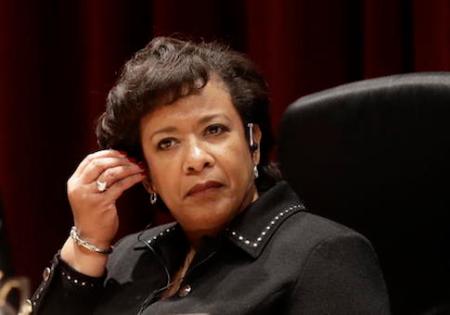
US attorney general, Loretta E. Lynch attends a conference on organised crime in Rome, Thursday, Oct. 20, 2016. (AP Photo/Gregorio Borgia)

US attorney general, Loretta E. Lynch, AP Photo/Gregorio Borgia

Attorney General Loretta Lynch is declining to comply with an investigation by leading members of Congress about the Obama administration’s secret efforts to send Iran $1.7 billion in cash earlier this year, prompting accusations that Lynch has “pleaded the Fifth” Amendment to avoid incriminating herself over these payments, according to lawmakers and communications exclusively obtained by the Washington Free Beacon.

Sen. Marco Rubio (R., Fla.) and Rep. Mike Pompeo (R., Kan.) initially presented Lynch in October with a series of questions about how the cash payment to Iran was approved and delivered.

In an Oct. 24 response, Assistant Attorney General Peter Kadzik responded on Lynch’s behalf, refusing to answer the questions and informing the lawmakers that they are barred from publicly disclosing any details about the cash payment, which was bound up in a ransom deal aimed at freeing several American hostages from Iran.

The response from the attorney general’s office is “unacceptable” and provides evidence that Lynch has chosen to “essentially plead the fifth and refuse to respond to inquiries regarding [her] role in providing cash to the world’s foremost state sponsor of terrorism,” Rubio and Pompeo wrote on Friday in a follow-up letter to Lynch, according to a copy obtained by the Free Beacon.

The inquiry launched by the lawmakers is just one of several concurrent ongoing congressional probes aimed at unearthing a full accounting of the administration’s secret negotiations with Iran.

“It is frankly unacceptable that your department refuses to answer straightforward questions from the people’s elected representatives in Congress about an important national security issue,” the lawmakers wrote. “Your staff failed to address any of our questions, and instead provided a copy of public testimony and a lecture about the sensitivity of information associated with this issue.”

“As the United States’ chief law enforcement officer, it is outrageous that you would essentially plead the fifth and refuse to respond to inquiries,” they stated. “The actions of your department come at time when Iran continues to hold Americans hostage and unjustly sentence them to prison.”

The lawmakers included a copy of their previous 13 questions and are requesting that Lynch provide answers by Nov. 4.

When asked about Lynch’s efforts to avoid answering questions about the cash payment, Pompeo told the Free Beacon that the Obama administration has blocked Congress at every turn as lawmakers attempt to investigate the payments to Iran.

“Who knew that simple questions regarding Attorney General Lynch’s approval of billions of dollars in payments to Iran could be so controversial that she would refuse to answer them?” Pompeo said. “This has become the Obama administration’s coping mechanism for anything related to the Islamic Republic of Iran—hide information, obfuscate details, and deny answers to Congress and the American people.”

“They know this isn’t a sustainable strategy, however, and I trust they will start to take their professional, and moral, obligations seriously,” the lawmaker added.

In the Oct. 24 letter to Rubio and Pompeo, Assistant Attorney General Kadzik warned the lawmakers against disclosing to the public any information about the cash payment.

Details about the deal are unclassified, but are being kept under lock and key in a secure facility on Capitol Hill, the Free Beacon first disclosed. Lawmakers and staffers who have clearance to view the documents are forced to relinquish their cellular devices and are barred from taking any notes about what they see.

“Please note that these documents contain sensitive information that is not appropriate for public release,” Kadzik wrote to the lawmakers. “Disclosure of this information beyond members of the House and Senate and staff who are able to view them could adversely affect the diplomatic relations of the United States, including with key allies, as well as the State Department’s ability to defend [legal] claims against the United States [by Iran] that are still being litigated at the Hague Tribunal.”

“The public release of any portion of these documents, or the information contained therein, is not authorized by the transmittal of these documents or by this communication,” Kadzik wrote.

Congressional sources have told the Free Beacon that this is another part of the effort to hide details about these secret negotiations with Iran from the American public.

One senior congressional source familiar with both the secret documents and the inquiry into them told the Free Beacon that the details of the negotiations are so damning that the administration’s best strategy is to ignore lawmakers’ requests for more information.

“Every Obama administration official and department involved in the Iran Deal appear to be running for cover,” the source said. “Like we feared, the [Iran deal] is turning out to be a disaster and Iran is emboldened in its aggression. Evidently Attorney General Lynch and the Department of Justice have decided ‘refusal to cooperate’ is their best strategy. But this is dangerous and ultimately won’t protect them from anything.”

Update: The headline has been updated to more accurately characterize the story.