Posted tagged ‘Nukes’

Losin’ in Lausanne (8) [Updated]

April 3, 2015

Losin’ in Lausanne (8) [Updated], Power LineScott Johnson, April 2, 2015

The last time Zarif accused the Obama administration of lying on a factsheet was after the JPOA was announced, in the context of granting a “right to enrich.” He was 100% right and the Americans were 100% wrong.

***************

Omri Ceren writes from Lausanne to put today’s announcement of a “framework” for an agreement in perspective:

Zarif just finished his speech, and there’s a break while the President speaks back in DC. But some of what Zarif revealed has already generated controversy. There was a lot of braggadocio in the speech: no closing of facilities, R&D will continue on Iran’s scientific schedule, enrichment will continue, the heavy water at Arak will be modernized, etc.

Perhaps most relevant to people who have been following the day-to-day in Lausanne, is that Zarif confirmed the U.S. has completely caved on the Fordow concession that the AP blew open on Thursday. Recall that Fordow is the underground bunker, built into the side of a mountain, which the Iranians emptied and made into an illicit enrichment facility. The assumption had always been that the Iranians would have to close it under any reasonable deal.

President Obama was saying as late as 2012: “We know they don’t need to have an underground, fortified facility like Fordo in order to have a peaceful program” [1].

The Iranians simply said no [2]. So the Americans caved and said that they could keep it open as a research facility, but they had to remove all the centrifuges for storage [3]. The compromise was the brainchild of Robert Einhorn from Brookings – a top State nonproliferation official stretching back to the Clinton era – and there was a lot of talk of Iranian flexibility when they accepted it [4]. Then this week, it emerged that in fact the Iranians would be allowed to keep centrifuges spinning inside the mountain.

But instead of spinning uranium, the centrifuges would be spinning germanium or similar non-nuclear elements. That’s the administration’s talking point: that there will not be any “enrichment” going on at Fordow. The claim is – bluntly – false. Centrifuges spin isotopes into lighter and heavier elements, thereby “enriching” the material. That’s what they do. In fact that’s all they do. The administration has gone all-in on a talking point can be defeated by a Google search for “centrifuges enrich germanium” (if you’re fastidious you can set the Google search to before the AP scoop, to make sure you’re not getting Fordow-specific articles).

This isn’t a minor point. The concession has the potential to gut the whole deal:

(1) Allows N-generation centrifuge R&D beyond the reach of the West – since the process is the exact same process, Iran will have a hardened facility where it will be able to research and develop N-generation centrifuges. Zarif bragged from the stage in Lausanne that Iranian R&D on centrifuges will continue on IR-4s, IR-5s, IR-6s, and IR-8s, and that the pace of research will be tied to Iranian scientific progress. The development of advanced centrifuges would give the Iranians a leg up if they decide to break out, and will put them instantly within a screw’s turn of a nuke when the deal expires.

(2) Leaves Iranian nuclear infrastructure running beyond the reach of the West – if the Iranians kick out inspectors and dare the world to respond, the West will have zero way to intervene. The Iranians will have a head start on enrichment, and a place to do it beyond the reach of Western weapons. The administration’s early pushback has been that the breakout time will still be a year, so they could in theory reimpose sanctions, but it takes more than a year for sanctions to take an economic toll. So: zero options to stop a breakout.

[1] http://www.wsj.com/articles/bret-stephens-the-capitulationist-1427758881
[2] http://www.jpost.com/Middle-East/Rejecting-US-comments-on-its-nuclear-program-Iran-FM-says-Fordo-Arak-are-non-negotiable-340458
[3] http://articles.chicagotribune.com/2014-07-09/news/sns-rt-us-iran-nuclear-fordow-20140709_1_fordow-enriched-uranium-interim-nuclear-deal
[4] http://www.brookings.edu/research/papers/2014/03/31-nuclear-armed-iran-einhorn

Omni follows up with this:

The issue of sequencing sanctions relief – how, when, and to what extent sanctions will be lifted in exchange for Iranian compliance – was one of the key sticking points over the last week. At some points journalists were describing it as a near-obsession of the Iranians, the suspicion being that they had received some very specific instructions from the Supreme Leader (or had made some very ambitious representations to him).

Achieving an understanding on sanctions would bhave to be counted as a major achievement, and it’s already being claimed as such. But there’s something wrong here. I haven’t figured out what it is yet, but I’m pretty sure I don’t like it.

– The EU/Iran joint statement says sanctions will be terminated “simultaneously” with Iran implementing its obligations (http://www.eeas.europa.eu/statements-eeas/2015/150402_03_en.htm): The EU will terminate the implementation of all nuclear-related economic and financial sanctions and the US will cease the application of all nuclear-related secondary economic and financial sanctions, simultaneously with the IAEA-verified implementation by Iran of its key nuclear commitments.

– The White House factsheet says sanctions will be suspended “after” Iran has taken “all” of its nuclear-related steps (https://www.scribd.com/doc/260719595/Parameters-for-a-Joint-Comprehensive-Plan-of-Action-regarding-the-Islamic-Republic-of-Iran-s-Nuclear-Program): U.S. and E.U. nuclear-related sanctions will be suspended after the IAEA has verified that Iran has taken all of its key nuclear-related steps. If at any time Iran fails to fulfill its commitments, these sanctions will snap back into place.

Zarif is already saying the White House is lying about how sanctions will be lifted:

The solutions are good for all, as they stand. There is no need to spin using “fact sheets” so early on.

Iran/5+1 Statement: “US will cease the application of ALL nuclear-related secondary economic and financial sanctions.” Is this gradual?

Iran/P5+1 Statement: “The EU will TERMINATE the implementation of ALL nuclear-related economic and financial sanctions”. How about this?

The last time Zarif accused the Obama administration of lying on a factsheet was after the JPOA was announced, in the context of granting a “right to enrich.” He was 100% right and the Americans were 100% wrong.

It’s not clear what the actual sanctions deal is, but it’s worrying that there are already differences. If the Americans are right, then the Iranians are setting up unrealistic expectations for their people and making a deal untenable. If the Iranians are right, then the White House is again misleading journalists and lawmakers about the actual scope of their concessions.
Iran Accuses U.S. of Lying About New Nuke Agreement

April 3, 2015

Iran Accuses U.S. of Lying About New Nuke Agreement, Washington Free Beacon, April 2, 2015

(Breaking news: Obama lied! That’s shocking. Who would’a thunk? — DM)

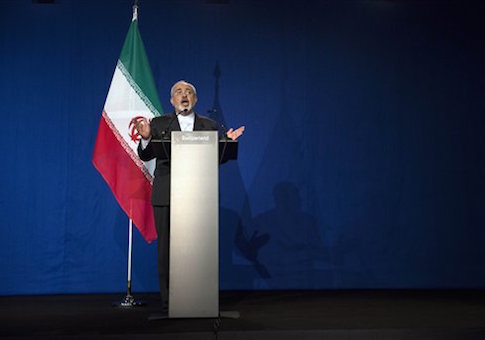
Switzerland Iran Nuclear TalksJavad Zarif / AP

LAUSANNE, Switzerland — Just hours after the announcement of what the United States characterized as a historic agreement with Iran over its nuclear program, the country’s leading negotiator lashed out at the Obama administration for lying about the details of a tentative framework.

Iranian Foreign Minister Javad Zarif accused the Obama administration of misleading the American people and Congress in a fact sheet it released following the culmination of negotiations with the Islamic Republic.

Zarif bragged in an earlier press conference with reporters that the United States had tentatively agreed to let it continue the enrichment of uranium, the key component in a nuclear bomb, as well as key nuclear research.

Zarif additionally said Iran would have all sanctions lifted once a final deal is signed and that the country would not be forced to shut down any of its currently operating nuclear installations.

Following a subsequent press conference by Secretary of State John Kerry—and release of a administration fact sheet on Iranian concessions—Zarif lashed out on Twitter over what he dubbed lies.

“The solutions are good for all, as they stand,” he tweeted. “There is no need to spin using ‘fact sheets’ so early on.”

Zarif went on to push back against claims by Kerry that the sanctions relief would be implemented in a phased fashion—and only after Iran verifies that it is not conducting any work on the nuclear weapons front.

Zarif, echoing previous comments, said the United States has promised an immediate termination of sanctions.

“Iran/5+1 Statement: ‘US will cease the application of ALL nuclear-related secondary economic and financial sanctions.’ Is this gradual?” he wrote on Twitter.

He then suggested a correction: “Iran/P5+1 Statement: ‘The EU will TERMINATE the implementation of ALL nuclear-related economic and financial sanctions’. How about this?”

The pushback from Iran’s chief diplomat follows a pattern of similar accusations by senior Iranian political figures after the announcement of previous agreements.

Following the signing of an interim agreement with Iran aimed at scaling back its nuclear work, Iran accused the United States of lyingabout details of the agreement.

On Thursday evening, Zarif told reporters the latest agreement allows Iran to keep operating its nuclear program.

“None of those measures” that will move to scale back Iran’s program “include closing any of our facilities,” Zarif said. “We will continue enriching; we will continue research and development.”

“Our heavy water reactor will be modernized and we will continue the Fordow facility,” Zarif said. “We will have centrifuges installed in Fordow, but not enriching.”

The move to allow Iran to keep centrifuges at Fordow, a controversial onetime military site, has elicited concern that Tehran could ramp up its nuclear work with ease.

Zarif said that once a final agreement is made, “all U.S. nuclear related secondary sanctions will be terminated,” he said. “This, I think, would be a major step forward.”

Zarif also revealed that Iran will be allowed to sell “enriched uranium” in the international market place and will be “hopefully making some money” from it.

A “preliminary deal” is announced in Lausanne. Zarif: There is no agreement, no commitments

April 2, 2015

A “preliminary deal” is announced in Lausanne. Zarif: There is no agreement, no commitments, DEBKAfile, April 2, 2015

Obama nuke dealBarack Obama hails nuclear “agreement”

Iranian Foreign Minister Mohammed Javad Zarif and EU Foreign Policy Executive Federica Mogherini announced Thursday, April 2 that “a general agreement for a peaceful nuclear program and a lifting of sanctions against Iran” had been reached in Lausanne. “We have reached solutions on key parameters of a join comprehensive plan of action,” the details to be negotiated between now and June 30,” she said.

Speaking after the EU official, Zarif delivered a long statement ending with the declaration: “There is no agreement; and so no commitments” before June 30.

But President Barack Obama, commenting on the event at the White House, hailed the agreement as a historic event that will change the face of the world and make it a safer place.  “It is a deal that meets our core objectives.” There is no way Iran can get round it to build a bomb, or produce plutonium at its Arak plant. Obama stressed that the verification mechanisms built into the agreed framework would ensure that “if Iran cheats, the world with know it.”

This is a long-term agreement which promises that Iran’s nuclear program will be closely monitoried for the next 20 years. There is much work to be done to hammer out the details before June 30, Obama said, and voiced the hope that the Iranians would not back out of the principles they had accepted in Lausanne.

In the his view, there were just three options for dealing with the Iranian nuclear program: Military force that would hold the program back for no more than two years; more sanctions, when the first round had proved to have little impact; or diplomacy, which he had chosen.

Obama said hoped the US Congress would not heap obstacles in the path of an accord, because the majority of the American popular approved of the course he led.

Before the end of the day, the president said he would talk to Israeli Prime Minister Binyamin Netanyahu and Saudi King Salman, the two leading opponents of the nuclear deal.

The parameters outlined by Mogherini agreed for future negotiation:

• Iran’s enrichment capacity and stockpile would be limited, and Iran’s sole enrichment facility would be at the Natanz nuclear facility. Other nuclear facilities would be converted to other uses.

• The nuclear facility at Fordo would be converted to a nuclear physics and technology center and the facility at Arak would be redesigned as a heavy-water research reactor that will not produce weapons-grade plutonium.

• The European Union would terminate all nuclear-related economic and financial sanctions against Iran, and the United States would do the same once Iran’s implementation of the agreement is confirmed.

• The United Nations would terminate all previous resolutions sanctioning Iran, and would incorporate other restrictions for an agreed-upon period.

Iran FM: ‘We’ll continue enriching, we won’t close facilities…all sanctions will be terminated.’

April 2, 2015

Iran FM: ‘We’ll continue enriching, we won’t close facilities…all sanctions will be terminated’ via You Tube, April 2, 2015


The Tricks Obama Is Trying to Play with the Iran Announcement

April 2, 2015

The Tricks Obama Is Trying to Play with the Iran Announcement, Commentary Magazine, April 2, 2015

(When will Iran say what and to whom about Obama’s new “framework?” Will Iran cloud the results of the negotiations as cleverly as did Obama? — DM)

If you look at what happened today between the U.S. and Iran through the lens of domestic American politics, Barack Obama has made a very clever play here—because what might be called “the agreement of the framework of the possibility of a potential deal” gives him new leverage in his ongoing battle with the Senate to limit its ability to play a role in the most critical foreign-policy matter of the decade.

The “framework” codifies the Obama administration’s cave-ins but casts them as thrilling reductions in Iran’s capacities rather than what they are—a pie-in-the-sky effort to use inspections as the means by which the West can “manage” the speed with which Iran becomes a nuclear power.

Obama’s tone of triumph this afternoon was mixed with sharp reminders that the deal is actually not yet done—and that is entirely the point of this exercise from a domestic standpoint. the triumph signals his troops and apologists that the time has come for them to stand with him, praise the deal sheet and pretend it’s a deal, declare it historic, and generally act as though the world has been delivered from a dreadful confrontation by Obama and Kerry.

But since the deal is not yet done, it could still be derailed. And that is where Obama’s truly Machiavellian play here comes in: He may have found a way to put the Senate in a box and keep Democrats from melting away from him on Iran and voting not only for legislation he doesn’t want but also to override the veto he has promised.

The Senate has two provisions at the ready with which it could go ahead any time. One, called Kirk-Menendez, imposes new sanctions on Iran. Obama promised a veto of this bill should it pass, and after today, one ought to presume that it’s dead.

The other, Corker-Menendez, requires the administration to submit any deal to the Senate within 60 days of its signing. This is a key provision because, of course, what the Iranians want—and what they said today they got—was the lifting of all sanctions. The president, in his statement, vowed to lift the “nuclear” sanctions (there are others involving human rights) if the Iranians comply by the terms of the deal.

Existing sanctions legislation features waivers the president can arguably use to do that. But those sanctions were put into place specifically to make it incredibly painful for Iran to retain any nuclear-weapons capability—not as a means of acceding to Iran’s retention of a nuclear capability.

For this reason, and for the reason that the president is essentially negotiating an arms-control treaty with Iran, the Senate should approve any final deal. Obama disagrees and claims this is merely a nuclear-agreement, not a treaty, and therefore Congress has no role.

That’s a very nervy argument. It is not only disrespectful of the Senate but it misrepresents the nature of what’s being negotiated. And that’s why it’s an argument it appeared the president would lose—that senators would not only vote for Corker-Menendez but would override his veto of it.

Which is why the deal-that’s-not-yet-a-deal works in his favor. Talks are now to continue until the end of June. Obama can and will argue to Democrats that they owe it to him, to their base, and to their governing ideology to give him all the room he needs to get to June 30.

Of course, if the legislation does not pass by June 30 and Obama signs a final deal, the game is up; the Senate can’t retroactively insist in July he bring it to them for a vote.

Will there be a deal by June 30? Maybe, maybe not; maybe they’ll finish, maybe they won’t; maybe the Iranians will say they didn’t agree to this or that and blow up the whole thing; who knows. Probably the total collapse, after all this, would bring the Kirk-Menendez sanctions back to life. Which is why there will never be a total collapse—because these talks can simply go on….

Afterburner w/ Bill Whittle: Umbrella Men: Neville Chamberlain and Barack Obama

April 2, 2015

Afterburner w/ Bill Whittle: Umbrella Men: Neville Chamberlain and Barack Obama via You Tube, September 12, 2013.

(Posted in 2013 but still pertinent. Please see also, The Shadow of Munich Haunts the Iran Negotiations. — DM)


Iran, U.S. allies strike agreement on nuclear deal

April 2, 2015

Iran, U.S. allies strike agreement on nuclear deal, Associated Press via Washington Times, April 2, 2015

(??????????????? — DM)

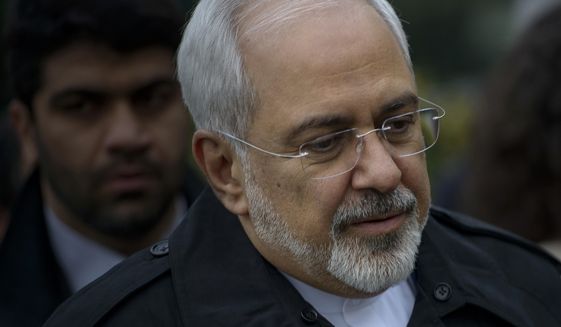
2e738e88a8f2710e720f6a7067008cce_c0-196-4500-2818_s561x327Iranian Foreign Minister Javad Zarif, walks through a courtyard at the Beau Rivage Palace Hotel during an extended round of talks, Wednesday, April 1, 2015 in Lausanne, Switzerland. Negotiations over Iran’s nuclear program appeared headed for double overtime on Wednesday.

LAUSANNE, Switzerland (AP) — Iran and and six world powers have agreed on the outlines of an understanding that would open the path to a final phase of nuclear negotiations but are in a dispute over how much to make public, officials told The Associated Press Thursday.

The officials spoke outside week-long talks that have busted through a March 31 deadline in an effort to formulate a general statement of what has been accomplished and documents setting down what the sides need to do by the end of June deadline for a deal.

Swiss officials facilitating the negotiations set a news conference for later in the day that was expected to announce the results of the talks

In the search for a comprehensive deal, the U.S. and five other countries hope to curb Iran’s nuclear technologies that it could use to make weapons. Tehran denies such ambitions but is negotiating because it wants a lifting of sanctions imposed over its nuclear program.


The Shadow of Munich Haunts the Iran Negotiations

April 2, 2015

The Shadow of Munich Haunts the Iran Negotiations, National Review Online, Victor Davis Hanson, April 2, 2015

(Hitler did tell the truth occasionally, in Mein Kampf for example. It was generally ignored until too late. “Death to America and Israel” are spouted by the Iranian Supreme Leader at every opportunity. Obama, et al, ignore it. Will Israel be Obama’s Czechoslovakia? And then what?– DM)

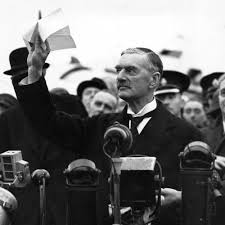
Neville Chamberlain

Our dishonor in Lausanne, as with Munich, may avoid a confrontation in the present, but our shame will guarantee a war in the near future.

*********************

Once again our leaders are needlessly appeasing a hostile state that shows them nothing but contempt.

The Western capitulation to Adolf Hitler in the 1938 Munich Agreement is cited as classic appeasement that destroyed Czechoslovakia, backfired on France and Britain, and led to World War II. All of that is true.

But there was much more that caused the Munich debacle than simple Western naiveté. The full tragedy of that ill-fated agreement should warn us on the eve of the Obama’s administration’s gullible agreement with Iran on nuclear proliferation. Fable one is the idea that most people saw right through the Munich folly. True, Europeans knew that Hitler had never once told the truth and was already murdering German citizens who were Jews, Communists, or homosexuals. But Europeans did not care all that much.

Instead, the Western world was ecstatic over the agreement. After the carnage of World War I, Europeans would do anything to avoid even a small confrontation — even if such appeasement all but ensured a far greater bloodbath than the one that began in 1914.

Another myth was that Hitler’s Wehrmacht was strong and the democracies were weak. In fact, the combined French and British militaries were far larger than Hitler’s. French Char tanks and British Spitfire fighters were as good as, or superior to, their German counterparts.

Czechoslovakia had formidable defenses and an impressive arms industry. Poland and perhaps even the Soviet Union were ready to join a coalition to stop Hitler from dissolving the Czech state.

It is also untrue that the Third Reich was united. Many of Hitler’s top generals did not want war. Yet each time Hitler successfully called the Allies’ bluff — in the Rhineland or with the annexation of Austria — the credibility of his doubters sank while his own reckless risk-taking became even more popular.

Munich was hardly a compassionate agreement. In callous fashion it immediately doomed millions of Czechs and put Poland on the target list of the Third Reich.

Munich was directly tied to the vanity of Neville Chamberlain. In the first few weeks after Munich, Chamberlain basked in adulation, posing as the humane savior of Western civilization. In contrast, loud skeptic Winston Churchill was dismissed by the media and public as an old warmonger.

Hitler failed to appreciate the magnanimity and concessions of the French and British. He later called his Munich diplomatic partners “worms.” Hitler said of the obsequious Chamberlain, “I’ll kick him downstairs and jump on his stomach in front of the photographers.”

The current negotiations with the Iranians in Lausanne, Switzerland, have all the hallmarks of the Munich negotiations.

Most Westerners accept that the Iranian government funds terrorist groups such as Hezbollah and Hamas. It has all but taken over Iraq, Lebanon, Syria, and Yemen. Yet the idea of stronger sanctions, blockades, or even force to stop Iranian efforts to get a bomb are considered scarier than Iran getting a bomb that it just possibly might not threaten to use.

The U.S. and its NATO partners are far stronger than Iran in every imaginable measure of military and economic strength. The Iranian economy is struggling, its government is corrupt, and its conventional military is obsolete. Iran’s only chance of gaining strength is to show both its own population and the world at large that stronger Western powers backed down in fear of its threats and recklessness.

Iran is not united. It is a mishmash nation in which over a third of the population is not Persian. Millions of protestors hit the streets in 2009. An Iranian journalist covering the talks defected in Switzerland — and said that U.S. officials at the talks are there mainly to speak on behalf of Iran.

By reaching an agreement with Iran, John Kerry and Barack Obama hope to salvage some sort of legacy — in the vain fashion of Chamberlain — out of a heretofore failed foreign policy.

There are more Munich parallels. The Iranian agreement will force rich Sunni nations to get their own bombs to ensure a nuclear Middle East standoff. A deal with Iran shows callous disagreed for our close ally Israel, which is serially threatened by Iran’s mullahs. The United States is distant from Iran. But our allies in the Middle East and Europe are within its missile range.

Supporters of the Obama administration deride skeptics such as Democratic senator Robert Menendez and Israeli prime minister Benjamin Netanyahu as if they were doubting old Churchills.

Finally, the Iranians, like Hitler, have only contempt for the administration that has treated them so fawningly. During the negotiations in Switzerland, the Iranians blew up a mock U.S. aircraft carrier. Their supreme leader, Ayatollah Khamenei, did his usual “death to America” shtick before adoring crowds. Our dishonor in Lausanne, as with Munich, may avoid a confrontation in the present, but our shame will guarantee a war in the near future.

Victory Against ISIS in Tikrit Will Embolden Iran

April 2, 2015

Victory Against ISIS in Tikrit Will Embolden Iran, Front Page Magazine, April 2, 2015

370x270xtikrit-450x328.png.pagespeed.ic.9xBCkeIFLH

The downside to playing on the same team as the Iranian regime, even in just this one military campaign against ISIS, is that we are helping to enable a far more dangerous power than ISIS to extend its hegemonic dominance throughout the entire region.

****************

Iraq’s defense minister Khalid al-Obeidi is claiming victory over ISIS forces in the city of Tikrit, which ISIS had captured last summer as its forces advanced across large swaths of territory in northern and western Iraq. “We have the pleasure, with all our pride, to announce the good news of a magnificent victory,” Obeidi said. The Pentagon and a spokesman for the U.S.-led coalition were a bit more cautious, noting some residual ISIS resistance. However, they too reported that significant progress had been made in wresting control of Saddam Hussein’s birthplace from ISIS’s grip.

The next strategic military objective in pushing ISIS back from the territories it controls in Iraq is to re-take Iraq’s second largest city, Mosul.

Iran supplied significant military support to the Shiite militia forces, who were a major part of the Iraqi counter-offensive on the ground. At the same time, U.S. air strikes seemed to have helped in supporting the Iraqi ground forces’ advance into Tikrit. The precise extent of any behind-the-scenes direct or indirect coordination between the U.S. and Iran is unknown at the present time. However, according to DebkaFile {March 26, 2015), “In the last two weeks of the Tikrit operation, liaison between the US and Iranian military in Iraq was routed through the office of the Iraqi Prime Minister in Baghdad.”

There is little question that without the Iranian-backed Shiite militia and substantial military support on the ground from Iran, ISIS would most likely still be in control of Tikrit today. U.S. airstrikes may have been necessary to soften ISIS’s resistance, but only ground troops with Iran’s support could dislodge them.

The downside to playing on the same team as the Iranian regime, even in just this one military campaign against ISIS, is that we are helping to enable a far more dangerous power than ISIS to extend its hegemonic dominance throughout the entire region.

As General David Petraeus, who certainly knows something about Iraq, told the Washington Post recently:

In fact, I would argue that the foremost threat to Iraq’s long-term stability and the broader regional equilibrium is not the Islamic State; rather, it is Shiite militias, many backed by — and some guided by — Iran… Longer term, Iranian-backed Shia militia could emerge as the preeminent power in the country, one that is outside the control of the government and instead answerable to Tehran.

Without downplaying ISIS’s horrific acts, its rapid-fire successes in Syria and Iraq (even with the setback in Tikrit), and its growing allegiances in Libya, Nigeria and areas further away from its home base including Afghanistan, the fact is that ISIS’s ambitions far exceed its current means for achieving them.  ISIS is proficient in using social media for recruitment, propaganda and intimidation purposes, but that can only take ISIS so far.

Iran, by contrast, has built up its military capabilities to the point that it can back up its aggressive threats in the region. And that’s even without the nuclear arms capability that President Obama seems to be willing to risk allowing Iran to achieve in order to secure his legacy with a deal.

As a result, America’s traditional Sunni allies in the region such as Saudi Arabia and other Persian Gulf states are doubting whether they can continue to count on the United States for support. And they are taking matters into their own hands, including a decision to form a multinational Arab military force to respond to Iranian aggression and other perceived threats.

As explained by Gamal Abdel Gawad Soltan, a political scientist at the American University in Cairo and quoted by the New York Times: “The U.S. is much less trusted as an ally, as an insurance policy towards the security threats facing the governments in the region, and so those governments decide to act on their own.”

These governments know their neighborhood well and see Iran as a much graver threat to regional peace and security than ISIS. Iran’s military and financial support of the Shiite Houthi rebels in taking control of major parts of Yemen was the last straw. Saudi Arabia on its own initiative decided to launch an air campaign against Houthi positions in Yemen and has not ruled out a ground attack along with the military forces of other Arab countries.

In response to the air and sea blockade of Yemen that Saudi Arabia is imposing on Yemen, Iran’s supreme leader Ayatollah Ali Khamenei decided to dispatch “two naval task forces to sail to the Red Sea,” according to DebkaFile (March 31, 2015). “The naval task forces are being sent to draw a sea shield around the Houthi forces to defend them against Saudi-Egyptian assaults. This maneuver was orchestrated by the Al Qods Brigades chief Gen. Qassem Soleimani,” DebkaFile reported.

Soleimani certainly gets around. Earlier this month he popped up in Iraq to lead the Shiite militias in their fight against ISIS. Now the man who fought on the same side as us against ISIS in Iraq is apparently coordinating Iran’s fight to hold onto the Houthis’ gains in Yemen where they forced the American and Saudi Arabian-backed president to flee.

Soleimani is “the puppet master controlling numerous Iranian surrogates in various countries,” said Jim Phillips, Middle East analyst for the Heritage Foundation. “His organization is drenched in American blood,” Phillips added. “It’s infused with an anti-American philosophy and a cooperation with him or his followers would not be on a sustainable basis. The U.S. would regret it.”

The Obama administration is now scrambling to catch up with Iran’s multi-pronged offensives, some of which are under Soleimani’s coordination. Thus, President Obama decided to support the Sunni Gulf coalition and Egypt against Iranian-backed action by the Shiite Houthi rebels to take control of Yemen.

However, the Obama administration’s reactive tactics in dealing with the crisis in Yemen are too little too late. Saudi Arabia is reportedly looking to Pakistan for help in acquiring its own nuclear arms to counter the Saudis’ well-founded suspicions that any deal negotiated by the Obama administration with Iran will not prevent Iran from becoming a nuclear armed power. And while Obama finally lifted the arms freeze he imposed against Egypt two years ago, clearing the way for the delivery of F-16 aircraft, Harpoon missiles and tanks, he also decided to end Egypt’s ability to finance purchases of American arms by drawing credits in advance based on future aid Egypt expects to receive starting in the 2018 fiscal year. Obama also wants to reduce Egypt’s flexibility in what it can purchase with the future military aid. Thus, the Egyptian government can be expected to continue on its course to find other sources for military aid and weapons including Russia, because of doubts that the U.S. will remain a reliable supplier.

The Obama administration has been willing to sacrifice the confidence of its Arab allies, not to mention the United States’ historically close alliance with Israel, in a vain effort to lure the Iranian regime into acting as a responsible party in the Middle East that can help stabilize this volatile region. Instead, Obama should listen to the expert on Iraq, General Petraeus, whose surge victory Obama undermined completely with his precipitous withdrawal of all U.S. troops from Iraq in 2011:

The current Iranian regime is not our ally in the Middle East. It is ultimately part of the problem, not the solution. The more the Iranians are seen to be dominating the region, the more it is going to inflame Sunni radicalism and fuel the rise of groups like the Islamic State…Iranian power in the Middle East is thus a double problem. It is foremost problematic because it is deeply hostile to us and our friends. But it is also dangerous because, the more it is felt, the more it sets off reactions that are also harmful to our interests — Sunni radicalism and, if we aren’t careful, the prospect of nuclear proliferation as well.

We can rejoice in the pushback of ISIS out of Tikrit. Perhaps it is a sign of more victories over ISIS to come. However, we should not delude ourselves into thinking that we have more in common with the Iranian regime in combatting ISIS in Iraq or Syria than the Iranian regime ultimately has in common with ISIS. They may be bitter enemies in the struggle over which set of fanatical jihadists should get to rule the global Islamic ummah or caliphate they both fantasize about. However, both fervently believe in the fundamental ideological goal of universal Islamic supremacy. And both are willing to sacrifice the lives of millions of people to reach that goal, no matter how long it takes them. The difference is that a nuclear-armed Iran would be much more capable of carrying out its jihadists’ apocalyptic vision than ISIS and in a much shorter period of time.

Humor? Obama abducted by aliens

April 1, 2015

Obama abducted by aliens, Dan Miller’s Blog, April 1, 2015

(The views expressed in this article are not necessarily mine or those of Warsclerotic or its other editors. — DM)

Today, April fool’s day first, Obama was abducted by aliens from Venus who were concerned about His warlike stance toward the peaceful Islamic Republic of Iran.

Venus

Organizing for Action logo 1

Mars is the god of war, Venus is the goddess of peace. Aliens from Mars had been slightly disturbed that Obama’s efforts to give Iran nuclear weapons might fail, but had seen that her status as a nuclear power was inevitable and hence did nothing. Aliens from Venus were equally pleased with the prospects of Iranian nuclear weapons but were very concerned that Obama, by failing adequately to praise Iranian attempts to extend its hegemony over the entire Middle East and beyond, had retarded those praiseworthy efforts on behalf of true Islamic peace. Hence, they secretly abducted Him this morning as He deplaned from Air Force One following an off-the-books trip to His spiritual birth place in Manchuria.

Since Obama’s abduction and remedial training required only a few minutes He was not missed, even by His dear soul mate, Valerie Jarrett. Ms. Jarrett was, therefore, pleasantly surprised when Obama called a press conference in the Rose Garden to make an announcement, following a splendid rendition of Hail to the Chief:


Fellow world citizens, I have finally awakened from my slumbers to realize that Iran is the only country in the world capable of bringing true peace through submission in accord with the word of Allah, may His Holy name be forever praised by all. Israel claims to desire peace, but only through war. Saudi Arabia, Egypt, Jordan and other misbegotten specs of excrement on the face of our dear planet — now in peril of imminent death due to climate change to which their vile oil has contributed massively — have dared even to challenge Iran’s peaceful pursuits of peace throughout the Middle East in Iraq, Syria, Yemen and elsewhere.

Henceforth, it will be My supreme duty as your Commander in Chief to promote and otherwise to assist Iran in her glorious efforts for peace. I know in my heart that that’s the principal reason that you, My people, elected Me as your very own Supreme Leader. Accordingly, I pledge that My efforts will be unstintingly directed to the end that you desire.

May Allah bless Iran, Damn America, Israel and all other enemies of true peace, and give a blessed day to you all, inshallah.

Iran’s leaders, due to their extensive relations with the aliens who had abducted Obama, were not at all surprised but pretended that they were. Supreme Leader Khamenei personally accepted Supreme Leader Obama’s gracious words by saying that Obama had finally managed to tame the Great Satan and promised to do everything within his power to help, inshallah. He also commented favorably on Secretary Kerry’s use of “inshallah” in rebutting suggestions by defeatists that the P5+1 negotiations would collapse without giving Iran nuclear weapons.

Kerry34

Even those who had previously viewed Obama as weak and indecisive will now be forced to see Him as He truly is, a towering beacon of strength and light to a world beset with tribulation, turmoil and darkness.  His legacy as the Greatest Peace Maker, Ever, is assured, inshallah.

Smoking pot is lots better than making war!

Smoke ganja. War is for sissies!

Let’s hope it’s just April Fool’s Day nonsense.