https://www.youtube.com/embed/sRDctfQDPD0“>Lt. Col Ralph Peters: “The Iranians Negotiate, We BEG!” You Tube, April 11, 2015
https://www.youtube.com/embed/sRDctfQDPD0“>Lt. Col Ralph Peters: “The Iranians Negotiate, We BEG!” You Tube, April 11, 2015
Khamenei Smashes Terms of Nuclear Agreement, Clarion Project, Ryan Mauro, April 12, 2015
(Obama demands, don’t mention Iran’s mumblings about his once in a lifetime deal. Partisan wrangling must stop!– DM)
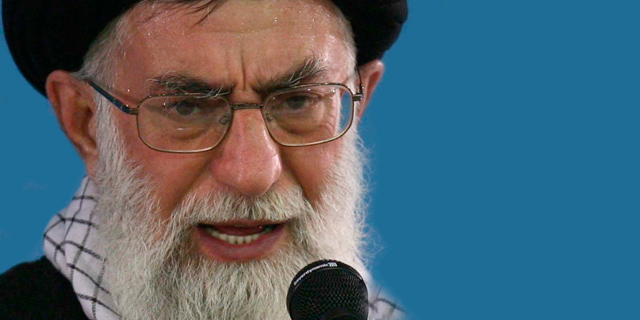 Iranian Supreme Leader Ayatollah Kamenei (Photo: © Reuters)
Khamenei’s accusations make Saudi Arabia a legitimate target under any understanding of jihad. He even went so far as to say the Saudis’ actions are equivalent to Israel’s so-called “genocide” in Gaza. This implies that a violent jihad against Saudi Arabia is as justifiable as one against Israel.
Iran believes that these end times prophesies correlate to the death of Saudi King Abdullah, the Houthis’ overthrow of the Yemeni government, the civil war in Syria, Saudi military action and the fierce fighting in Iraq. The regime sees the confluence of all these crises as beyond the realm of coincidence and signaling the imminent arrival of the “Hidden Imam” which will herald military victory for Iran.
Before the “Hidden Imam” can arrive, two other condition must be fulfilled: instability in Saudi Arabia and the march of a prophetic figure titled “Yamani” who will lead Shiite forces from Yemen into Mecca. The Houthis recently pledged to invade Saudi territory, capture Mecca and overthrow the royal family in Riyadh. They were likely referring to this prophecy.
“We’re not going to respond to every public statement made by Iranian officials or negotiate in public,” said State Department spokesman Jeff Rathke during a daily press briefing.
********************
Iranian Supreme Leader Ayatollah Khamenei ended his eerie silence since the nuclear framework agreement was announced with a fiery speech accompanied with “Death to America” chants. Khamenei essentially smashed the viability of the nuclear framework to pieces, signalled a major escalations in the war in Yemen and essentially endorsed a violent jihad against the Saudi royal family.
Wishful thinkers can’t dismiss the speech as theater for a domestic audience. Khamenei tweeted highlights in English to make sure the world, especially Americans, saw them. The threats and demands are so unequivocal that failing to follow through would sacrifice his entire credibility and prestige.
The Iranian Supreme Leader is unsatisfied with the nuclear framework agreement even though it generously permits Iran to retain the ability to produce nuclear weapons while getting major sanctions relief.
First, he said that the fact sheet published by the U.S. contains lies and does not reflect what Iran agreed to. The statement obliges the regime to seek significant revisions shortly after it gave President Obama the go ahead to make a high-profile victory lap.
Khamenei’s demands are inescapably incompatible with America’s requirements for a deal.
First, Iran is demanding that all sanctions be lifted on the first day that a final deal is signed. The framework only agrees to lift sanctions in phases and only those related to nuclear activity, not terrorism or human rights. Doing so would unfreeze the assets of individuals and entities involved in terrorism around the world, sparking a massive growth in Iran’s terrorist apparatus and proxy warfare.
The inherently flawed hope by the West that “moderate” President Rouhani and other Iranian figures can reign in Khamenei can be immediately ruled out, since Rouhani said the same exact thing.

Second, Iran is insisting that there will be no “unconventional,” “special” or “foreign” inspections or monitoring. In other words, Iran will not be subject to exceptionally intrusive inspections. Khamenei’s tweets do not specify Iran’s standards, but it is clear that Iran does not intend to give the IAEA unlimited access.
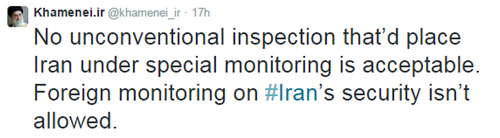
This is almost definitely a reference to military sites, to which Iran consistently says it has the option of denying access. Iran wants the ability to deny access to any location by declaring it a military institution.
This is how Iran denies access to the critical Parchin site, where damning evidence may exist to prove that Iran conducted major nuclear weapons research until at least 2003. An Iranian opposition group identified an alleged nuclear site in February that is within a military compound. It is claimed that the facility is used for uranium enrichment and the production of advanced centrifuges.
Notice the language of the tweets, which was reported to be equally non-compromising in Farsi. There is no wiggle room. Khamenei would have left some ambiguity if he was willing to budge. If you believe this is just talk, then you must believe that Khamenei made the calculated decision to cause an easily avoidable self-inflicted wound for no reason.
Another flurry of tweets related to the war in Yemen, where Iran is backing the Shiite Houthi rebels who have overthrown the government.
A U.S.-supported coalition of Sunni countries intervened militarily to support President Hadi and stop Iran from threatening the strategic Bab al-Mandeb Strait. This alliance includes Saudi Arabia, Egypt, Bahrain, Qatar, Kuwait, the United Arab Emirates, Jordan, Morocco, Turkey, Pakistan and Sudan. The last two are especially significant because of their close ties to Iran. Separately, Al-Qaeda is gaining ground in Yemen and the Islamic State (ISIS) is rising up as a competitor.
Interestingly, the tweets only threatened Saudi Arabia and did not mention any of these other participants by name. Khamenei stopped just short of a formal declaration of jihad, instead laying out the justification for it.
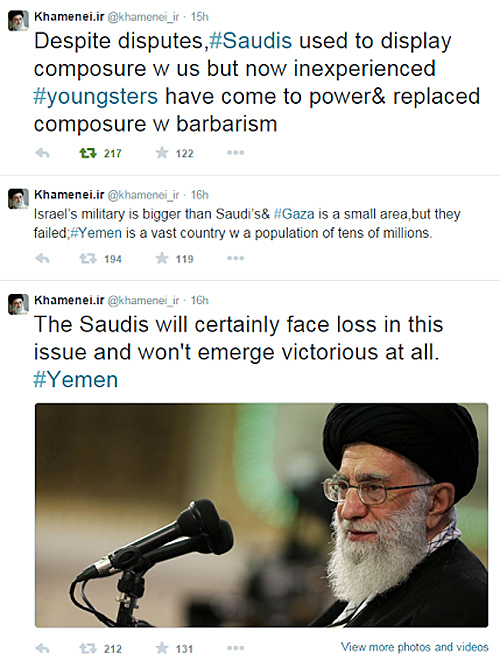

Khamenei’s accusations make Saudi Arabia a legitimate target under any understanding of jihad. He even went so far as to say the Saudis’ actions are equivalent to Israel’s so-called “genocide” in Gaza. This implies that a violent jihad against Saudi Arabia is as justifiable as one against Israel.
Don’t be comforted by Khamenei’s mentioning of prosecuting Saudi leaders in international courts. This is not meant to substitute jihad. Khamenei is making a point about how blatant the Saudi crimes are. He’s not even saying that this is Iran’s chosen course of action.
This comes as Iran dispatches two ships to the front in Yemen, including a destroyer to “safeguard naval routes” — meaning it will challenge the challenge the Saudi-Egyptian naval blockade.
Iran sent a flotilla to Bahrain in 2011 after Saudi and Emirati forces intervened to stomp out a revolution against the Sunni monarchy. The regime blinked at the last moment when the Arabs made it clear they would use force to stop it. However, the Yemen conflict has significant differences that Khamenei’s tweets help explain.
Khamenei is signaling that unprecedented hostilities with Saudi Arabia will now commence. The previous Saudi leaders, he says, could be dealt with. The new Saudi King and his circle must be handled more toughly.
However, Iran orchestrated massive terrorist attacks on Saudi interests even under the previous “composed” leaders, a campaign that put the U.S. economy and homeland at risk.
For example, in 2011, the U.S. prevented an Iranian Revolutionary Guards’ plot to assassinate the Saudi ambassador in Washington, D.C. by blowing up a restaurant, which inevitably would have taken the lives of American citizens as well. The scheme involved hiring a Mexican drug cartel to perpetrate the attack, along with bombings of the Israeli embassy in D.C. and the Israeli and Saudi embassies in Argentina.
In 2012, Iran launched a cyber attack on the Saudi Aramco oil company in response to the country’s policies in Bahrain and Syria. Aramco said the hackers tried to take down the country’s oil and gas production (which failed), but they did erase the data on 30,000 computers, three-fourths of the corporate computers.
Khamenei says that the new Saudi leadership is committing far worse crimes, so we should expect a far worse response.
We must also remember the prophecies cited by the Iranian regime. Iran believes that these end times prophesies correlate to the death of Saudi King Abdullah, the Houthis’ overthrow of the Yemeni government, the civil war in Syria, Saudi military action and the fierce fighting in Iraq. The regime sees the confluence of all these crises as beyond the realm of coincidence and signaling the imminent arrival of the “Hidden Imam” which will herald military victory for Iran.
Before the “Hidden Imam” can arrive, two other condition must be fulfilled: instability in Saudi Arabia and the march of a prophetic figure titled “Yamani” who will lead Shiite forces from Yemen into Mecca. The Houthis recently pledged to invade Saudi territory, capture Mecca and overthrow the royal family in Riyadh. They were likely referring to this prophecy.
Khamenei’s speech wasn’t the typical bluster we are used to hearing from Islamist radicals and dictators. The timing, language and high-profile nature makes it very significant.
Even though the U.S. State Dept. responded by saying that sanctions against Iran would be removed gradually based on verification that Iran had kept its commitments, its response lacked conviction:
“We’re not going to respond to every public statement made by Iranian officials or negotiate in public,” said State Department spokesman Jeff Rathke during a daily press briefing.
Statement by PM Netanyahu, April 12, 2014
Obama still believes in a nuclear deal, although Iran is skittish – even against a military option, DEBKAfile, April 12, 2015
 US Defense Secretary Ashton Carter:The nuclear option is on the table
In the last two days, the Obama administration has swung between conflicting signals on the Iranian nuclear deal. Unable to wave away the tough conditions laid down by Tehran, the US president was nonetheless optimistic about a final deal to curb Iran’s nuclear program in comments he made at the Americas summit in Panama Sunday, April 12. Obama said he was not surprised at the way supreme leader Ali Khamenei had characterized the framework agreement, because “Iran has it own politics and hardliners who need to be satisfied, but there may be ways to structure the final nuclear deal that achieve core objectives while satisfying Iran’s pride.”
Just Saturday, US Defense Secretary Ashton Carter said: “We have the capability to shut down, set back and destroy the Iranian nuclear program.” He referred to the Massive Ordinance Penetrator-MOP, aka the “bunker buster” which is capable of penetrating fortified facilities up to 200 feet underground. “My job is among other things to make sure that the so-called military option is on the table,” he said.
Iranian media headlines screamed: “US Secretary of Defense Ashton Carter has threatened Tehran with war.”
This is exactly what Khamenei was aiming for when on April 9, he laid down two implacable terms for a deal: the removal of sanctions on the day a final deal is signed and a firm refusal to allow international inspections of Iran’s military sites.
Both of these provisions contradicted Washington’s presentation of its core conditions for a comprehensive accord as being gradual sanctions relief and intrusive inspections.
One of Khamenei’s objects was indeed to remove all suspicion on his home front that Iran’s negotiators had given ground to the world powers either in the overt agreement or in any secret annexes.
The Iranian media headlines achieved this purpose.
But underlying the vocal exchanges between the two capitals is Iran’s confidence that President Obama has discarded the option of military force against its nuclear sites. This confidence gave Tehran the edge in round after round of diplomacy with the US and the world powers.
Senior negotiator Foreign Minister Javad Zarif boasted on April 7, that Iran was “capable of producing an atomic bomb at any given moment,” and was contained solely by “religious Islamic injunctions.”
His boast was amply illustrated by the 20,000 centrifuges Iran had built up during the years of negotiations, plus thousands of advanced machines standing by to further accelerate uranium enrichment – even though its stockpile of 3.6 percent had soared to 10 tons – enough to build 4-6 nuclear bombs.
This edge further enabled the Iranians to bring the Arak heavy water plant capable of producing plutonium to its final stages of construction, without encountering a prohibition in Lausanne, any more than the Fordo enrichment site, stealthily installed some years ago, or its ballistic missile program were sentenced to be dismantled.
That Iran would continue to get away with its tactic of talking while enriching was borne out by Obama assurance Sunday that ways would be found “to structure the final nuclear deal that achieve core objectives while satisfying Iran’s pride.”
The negotiating tactics pursued by Secretary of State John Kerry in Lausanne and in the previous round in Geneva not only diluted America’s military option but virtually took it off the table – not only for America but for everyone else, including Israel. To put it back, much more is needed than Ashton Carter’s reference to the bunker-buster. To make it credible, the United States must rebuild its military presence in the Gulf and the Middle East – bringing back two aircraft carriers to reinforce the lone USS Carl Vinson, for starters.
This, however, would contradict the doctrine Obama expounded on April 2 when he said: “When you hear the inevitable critics of the deal sound off, ask them a simple question: Do you really think that this verifiable deal, if fully implemented and backed by the world’s powers, is a worse option than the risk of another war in the Middle East?”
But he failed to explain the multiple versions of the Lausanne deal published in Washington, Tehran and latterly Paris, whose discrepancies can no longer be glossed over.
Speaking after his historic meeting with Cuba’s Raul Castro Sunday, Obama rebuked Republican senators for pointing this out, accusing them of “partisanship which has crossed all boundaries.”
Sen. John McCain shot back that discrepancies between US and Iranian versions of the deal extended to inspections, sanctions relief, and other key issues. ‘‘It is undeniable that the version of the nuclear agreement outlined by the Obama administration is far different from the one described by Iran’s supreme leader,’’ he said.
This exchange took place two days before members of the Senate Foreign Relations Committee plan to vote on Senator Bob Corker’s bipartisan Iran nuclear agreement review act. This would give members of Congress 60 days after a nuclear deal is reached to decide if they want to waive sanctions against Iran.
But most of all it calls into question the Obama administration’s presentation of a tentative set of disputed concepts reached in Lausanne as a finalized framework, which left just a few loose ends for resolving by the next deadline of June 30. The very real gaps have been highlighted and exploited by Tehran.
US tactics don’t work well in the Persian bazaar, where the carpet seller pretends to be unwilling to sell his merchandise to an interested customer, while putting the price up in round after round of haggling.
Khamenei falls naturally into the role of the reluctant carpet seller when he is confronted with an especially keen American customer.
There is no better deal with Iran, Israel Hayom, Prof. Efraim Inbar, April 9, 2015
If inspections, sanctions, sabotage and political isolation ever had a chance to stop Iran from getting the bomb (this was always a dicey proposition), that certainly is no longer the case. It is more evident than ever that only military action can stop a determined state such as the Islamic Republic of Iran from building a nuclear bomb. It remains to be seen whether Israel has elected the leader to live up to this historic challenge.
***********************
The debate over the pros and cons of the Iran nuclear framework agreement negotiated between the P5+1 and Iran at Lausanne (April 2, 2015) is simply irrelevant. The search for truth in the conflicting versions about the details of the deal coming out of Washington and Tehran is of no consequence. And the steps suggested by Israel and other critics to improve the efficacy of the deal (by more stringent inspections and so on) will not change much. The deal is basically dangerous in nature, and needs to be rejected outright.
The deal permits Iran to preserve stockpiles of enriched uranium, to continue to enrich uranium, and to maintain illegally-built facilities at Fordow and Arak. Even in the absence of a signed full agreement, the U.S. and its negotiating partners already have awarded legitimacy to Iran’s nuclear threshold status. In all likelihood, the United States, quite desperate to get a formal deal, will make additional concessions in order to have a signed formal deal — which won’t be worth the paper on which it is printed.
This outcome has been a foregone conclusion since November 2013, when the U.S. agreed to the “Joint Plan of Action” on Iran’s nuclear program. Already back then, the U.S. decided not to insist any longer on the goal of rolling back the Iranian nuclear program, ignoring several U.N. Security Council resolutions demanding no uranium enrichment, as well as discarding the security concerns of American allies in the Middle East (primarily Israel, Saudi Arabia and Egypt — who better understand the regional realities).
Middle Easterners clearly discern an Iranian diplomatic victory in this accord, which should not surprise anybody. Iranians are much more adept at negotiating than Americans. Iran is getting more or less what it wanted: the capability to produce enriched uranium and to research weapon design; agreement to keep its missile program intact; and no linkages to Iranian behavior in the region. The deal is a prelude to nuclear breakout and Iranian regional hegemony.
Indeed, with no attempt to roll back the Iranian nuclear program, as was done in Libya, we are progressing toward the North Korean model. Those two are the only options in dealing with nuclear programs of determined states such as Iran. Iran’s nuclear program benefited in many ways from assistance that originated in Pakistan and in North Korea (both are nuclear proliferators despite American opposition). Compare the recent statements by President Obama to the speeches of President Clinton justifying the agreement with North Korea (October 1994). Their similarities are amazing; an indication of the incredible capacity of great powers for self-delusion.
What counts is not the Obama’s administration expression of satisfaction with the prospective deal, but the perceptions of Middle East actors. For example, Saudi Arabia and Egypt have deplored the fact that the U.S. is bestowing international legitimacy on Iran’s status as a nuclear threshold state. They probably believe the interpretations of the deal offered by Tehran more than those professed in Washington. Therefore, they will do their best to build a similar infrastructure leading inevitably to nuclear proliferation in the region — a strategic nightmare for everybody.
Unfortunately, no better deal is in the offing. Whatever revisions are introduced cannot change its basic nature. The accord allows Iran to have fissionable material that can be enriched to weapons grade material in a short time and Tehran can always deny access to inspectors any time it chooses. This is the essence of the North Korean precedent.
Obama is right that the only alternative to this deal is an Iranian nuclear fait accompli or the bombing of the Iranian nuclear infrastructure. Obama’s penchant for engagement, his reluctance to use force, and his liberal prism on international relations (which adds rosy colors to international agreements) has led to this miserable result.
Netanyahu is wrong in demanding a better deal because no such deal exists. Yet denying its ratification by the U.S. Congress could create better international circumstances for an Israeli military strike. In fact, criticism of Obama’s deal with Iran fulfills only one main function — to legitimize future military action. Indeed, Netanyahu is the only leader concerned enough about the consequences of a bad deal with the guts and the military capability to order a strike on the Iranian key nuclear installations.
If inspections, sanctions, sabotage and political isolation ever had a chance to stop Iran from getting the bomb (this was always a dicey proposition), that certainly is no longer the case. It is more evident than ever that only military action can stop a determined state such as the Islamic Republic of Iran from building a nuclear bomb. It remains to be seen whether Israel has elected the leader to live up to this historic challenge.
Ayatollah Khamenei Outlines Requirements of Final Iran Nuclear Deal, Tasnim News Agency (Iranian), April 9, 2015
(All bold face print is from the original. — DM)

TEHRAN (Tasnim) – Supreme Leader of the Islamic Revolution Ayatollah Seyed Ali Khamenei on Thursday defined the main points that a final nuclear deal between Iran and world powers should involve, but refused to adopt a stance on the Lausanne statement that entails no binding commitment.
Addressing a gathering in Tehran on Thursday, Ayatollah Khamenei said he has not taken a position on a statement released by Iran and the Group 5+1 (Russia, China, the US, Britain, France and Germany) after the most recent round of nuclear talks in the Swiss city of Lausanne, because nothing has been still agreed upon, nor have the parties reached any binding agreement.
“What has happened so far does not guarantee either the principle of an agreement, or the negotiations that lead to an agreement or even the content of an agreement, and it does not even guarantee that these talks would result in a deal, so congratulation has no meaning,” the Leader said.
The comments came after Iran and the six powers on April 2 reached a framework nuclear agreement after more than a week of intensive negotiations in Lausanne, Switzerland, with both sides committed to push for a final, comprehensive accord until the end of June.
Ayatollah Khamenei then reaffirmed strong support for a deal that respects the Iranian nation’s dignity, and rejected as “untrue” the reports on his opposition to any agreement.
The Leader, however, underlined that “no deal is better than a bad deal.”
Imam Khamenei then explained that he has only outlined the “general issues, the main guidelines, frameworks and red lines” regarding the nuclear talks and has not specified the details.
“I am not indifferent to the negotiations, but have not interfered in the details of the talks so far, and will not interfere in future either,” the Leader stressed.
The Supreme Leader then pointed to the unreliable nature of the US, an obvious sign of which he said was a biased fact sheet that Washington issued only two hours after the Lausanne statement was declared.
“Drafting such a statement (fact sheet) within two hours is not possible, so they (Americans) had been busy preparing a flawed and wrong statement contrary to the content of the talks at the same time that they were negotiating with us.”
The Leader further called on the country’s negotiators to hold consultations with the critics of the Lausanne statement to better deal with the talks, something known as “rapport” among Iranians.
Imam Khamenei once again made it clear that the talks with the US revolve only around the nuclear issue and nothing else, but at the same time noted that such nuclear negotiations provide an experience to test the possibility of talking on other subjects if Washington puts aside objections.
But, the Leader added, if the US keeps raising objections, Iran’s experience of mistrust of the US will be corroborated.
Commenting on the main points that have to be stipulated in a possible final nuclear deal, Ayatollah Khamenei pointed to the removal of anti-Iran sanctions all at once, adding, “This issue is very important and the sanctions should be completely terminated at the very day of the agreement.”
“If the removal of sanctions is to be conditioned by a new process, the fundamental of negotiations will be nonsense, because the purpose of the talks is lifting of the sanctions,” the Leader said.
The Supreme Leader also categorically rejected foreign access to the country’s “security and defensive” sectors under the pretext of nuclear monitoring.
Imam Khamenei said Iran’s military capabilities must be upheld and strengthened day by day, stressing that Iran’s backing for its “brothers” in the resistance front in different regions should never be diminished.
Moreover, the Leader voiced opposition to any deal that subjects Iran to “unconventional” monitoring and would make it a special case in the world, underlining that monitoring of Iran’s peaceful nuclear program should be conventional, like the other countries.
Iran’s “scientific and technical developments in different dimensions” was another requirement that the Leader emphasized a deal must include.
Ayatollah Khamenei finally said the responsibility lies with the country’s negotiators to fulfill those necessary demands in the talks, calling on them to “find the correct ways of negotiations” by using the view points of the informed and reliable individuals and listening to the critics.
‘Iran to publish facts document to counter American lies’, Israel Hayom, April 8, 2015
Iran could build bomb today but isn’t doing so because of ayatollah’s religious decree, not because of sanctions, Iranian FM reportedly tells parliament • “We made significant achievements in exchange for unimportant concessions,” says Iranian lawmaker.
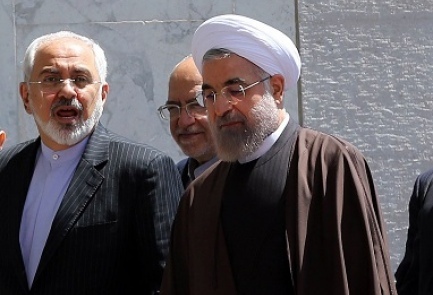 Iran’s Foreign Minister Mohammad Javad Zarif (left) with Iranian President Hassan Rouhani | Photo credit: AFP
Iran could build a nuclear bomb today if it wanted and is only refraining from doing so because of a fatwa (religious decree) issued by Ayatollah Ali Khamenei, not because of international sanctions, Iran’s Foreign Minister Mohammad Javad Zarif reportedly said on Tuesday during a closed hearing at the Iranian parliament, Majlis.
According to one of the participants, Zarif said the country’s foreign ministry would soon publish a “document of facts” about the nuclear deal with world powers.
“Zarif told us that his office hadn’t intended on releasing such a document, but reversed its decision because of the Americans’ lies,” said Iranian lawmaker Hussain Naqvi al-Hussaini.
Another Iranian parliamentarian, Gholamali Jafarzadeh Imenabadi, said Zarif told the parliament that Iran is not going to permit online cameras for inspection purposes at nuclear facilities. The reason for the decision, allegedly conveyed by Zarif, was because cameras have supposedly been used in the past to help assassinate Iranian nuclear scientists.
Also in attendance was Ali Akbar Salehi, the head of Iran’s Atomic Energy Organization, who presented the Majlis with the technical aspects of the framework deal. Salehi, who participated in the negotiations in Lausanne, reportedly told his audience that world powers consented to enter negotiations with Iran because they had no other choice.
“We made significant achievements in exchange for unimportant concessions,” said Iranian lawmaker Nozar Shafi.
Meanwhile, Zarif and Iranian President Hassan Rouhani have reportedly garnered the support of Revolutionary Guard commander Mohammad Ali Jafari, who demanded immediate sanctions relief in exchange for a deal.
Iran’s supreme leader, Khamenei, did not voice his opposition to the deal, widely interpreted as silent consent. With that, some 200 Iranian hardliners protested in Tehran against the framework deal.
Iran news report: Tehran will start using fastest centrifuges on day deal takes effect, Times of Israel, April 8, 2015
FARS agency quotes Zarif, Salehi telling MPs they’ll inject gas into IR-8 centrifuges, a breach of US-published framework terms that would make a mockery of deal.
Iran will begin using its latest generation IR-8 centrifuges as soon as its nuclear deal with the world powers goes into effect, Iran’s foreign minister and nuclear chief told members of parliament on Tuesday, according to Iran’s semi-official FARS news agency.
If accurate, the report makes a mockery of the world powers’ much-hailed framework agreement with Iran, since such a move clearly breaches the US-published terms of the deal, and would dramatically accelerate Iran’s potential progress to the bomb.
Iran has said that its IR-8 centrifuges enrich uranium 20 times faster than the IR-1 centrifuges it currently uses.
According to the FARS report, “Iran’s foreign minister and nuclear chief both told a closed-door session of the parliament on Tuesday that the country would inject UF6 gas into the latest generation of its centrifuge machines as soon as a final nuclear deal goes into effect by Tehran and the six world powers.”
It said that Foreign Minister Mohammad Javad Zarif and Atomic Energy Organization of Iran (AEOI) head Ali Akbar Salehi made the promise when they briefed legislators on the framework agreement, and claimed the move was permitted under the terms of the deal.
“The AEOI chief and the foreign minister presented hopeful remarks about nuclear technology R&D which, they said, have been agreed upon during the talks (with the six world powers), and informed that gas will be injected into IR8 (centrifuge machines) with the start of the (implementation of the) agreement,” FARS quoted Javad Karimi Qoddousi, a member of the parliament’s National Security and Foreign Policy Commission, as saying.
Qoddousi said the Iranian Foreign Ministry plans to release a fact sheet presenting Iran’s version of the framework understandings in the next few days. “Those issues that have stirred serious concern among the Iranians will be revised and released in this fact sheet,” he said.
Earlier Tuesday, Israel Radio reported that Zarif told the lawmakers that Iran was capable of producing an atomic bomb at any given moment, but will refrain from doing so due to religious Islamic injunctions against such a move.
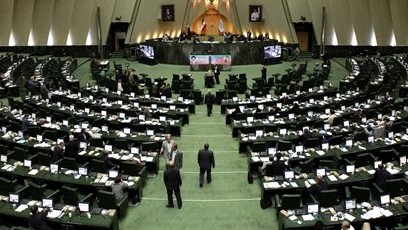 A general view of Iran’s parliament in Tehran, Aug. 28, 2013 (photo credit: AP/Ebrahim Noroozi)
Major differences have emerged between the P5+1 powers and Iran over what was agreed in the framework deal.
“Parameters” detailed by the US leave no doubt whatsoever, however, that the use of anything other than the most basic, first generation IR-1 centrifuges is barred for 10 years, and that even R&D on advanced centrifuges will be severely constrained.
“Iran will only enrich uranium at the Natanz facility, with only 5,060 IR-1 first-generation centrifuges for ten years,” the US parameters state. “Iran has agreed to only enrich uranium using its first generation (IR-1 models) centrifuges at Natanz for ten years, removing its more advanced centrifuges… Iran will not use its IR-2, IR-4, IR-5, IR-6, or IR-8 models to produce enriched uranium for at least ten years,” the US document adds. “For ten years, enrichment and enrichment research and development will be limited to ensure a breakout timeline of at least 1 year. Beyond 10 years, Iran will abide by its enrichment and enrichment R&D plan submitted to the IAEA, and pursuant to the JCPOA, under the Additional Protocol resulting in certain limitations on enrichment capacity.”
A French fact-sheet seen by The Times of Israel takes a similar position. It provides for Iran to gradually introduce the use of IR-2 and IR-4 centrifuges to enrich uranium after 12 years. It does not provide for the use of IR-8 centrifuges. The French fact sheet does specify that Iran will be allowed to continue R&D work on the advanced IR-4, IR-5, IR-6 and IR-8 centrifuges.
A document issued by the Iranian Foreign Ministry on Friday also does not assert an Iranian right to use IR-8 centrifuges. Its only reference to the IR-8 is as follows: “According to the reached solutions, Iran will continue its research and development on advanced machines and will continue the initiation and completion phases of the research and development process of IR-4, IR-5, IR-6, and IR-8 centrifuges during the 10-year period of the Comprehensive Plan for Joint Action.”




 anneinpt
 artaxes
 danmillerinpanama
 davidking1530
 Peter Hofman
 Joseph Wouk
 Peter
Peter Louisiana Steve
 WarSclerotic
Recent Comments