Posted tagged ‘Netanyahu’

Obama sees Netanyahu as most disappointing of all Mideast leaders

March 11, 2016

Obama sees Netanyahu as most disappointing of all Mideast leaders — report

The Atlantic: Israeli PM is ‘in his own category’ when it comes to those who frustrate US president; article cites ‘condescending’ lecture by PM, asserts that Obama sees Netanyahu as ‘too fearful and politically paralyzed’ to secure two-state solution

By Times of Israel staff March 10, 2016, 4:39 pm

Source: Obama sees Netanyahu as most disappointing of all Mideast leaders — report | The Times of Israel

US President Barack Obama and Prime Minister Benjamin Netanyahu at a welcoming ceremony for the president at Ben Gurion Airport, March 20, 2013. (photo credit: Marc Israel Sellem/Pool/Flash90)

Prime Minister Benjamin Netanyahu “is in his own category” when it comes to the Middle East leaders who have most deeply disappointed President Barack Obama, according to a major overview of the Obama presidency, featuring numerous interviews with the president, published online Thursday by The Atlantic.

In the piece, headlined “The Obama Doctrine,” writer Jeffrey Goldberg goes to great lengths to trace the president’s growing disillusionment, over the course of his presidency, with the possibility of changing the region for the better. “Some of his deepest disappointments concern Middle Eastern leaders themselves,” Goldberg writes. Of these, “Benjamin Netanyahu is in his own category.”

 According to Goldberg, “Obama has long believed that Netanyahu could bring about a two-state solution that would protect Israel’s status as a Jewish-majority democracy, but is too fearful and politically paralyzed to do so.”

To illustrate Obama’s impatience with Netanyahu, one of several Middle Eastern leaders said to have questioned the president’s understanding of the region, Goldberg relates an incident during an undated Obama-Netanyahu meeting, at which the Israeli prime minister “launched into something of a lecture about the dangers of the brutal region in which he lives.”

Obama, relates Goldberg, “felt that Netanyahu was behaving in a condescending fashion, and was also avoiding the subject at hand: peace negotiations. Finally, the president interrupted the prime minister: ‘Bibi, you have to understand something,’ he said. ‘I’m the African American son of a single mother, and I live here, in this house. I live in the White House. I managed to get elected president of the United States. You think I don’t understand what you’re talking about, but I do.’”

Turkish Prime Minister Recep Tayyip Erdogan (left) with US President Barack Obama during a bilateral meeting (photo credit: AP/Pablo Martinez Monsivais)

Turkish Prime Minister Recep Tayyip Erdogan, left, with US President Barack Obama during a bilateral meeting in 2011. (photo credit: AP/Pablo Martinez Monsivais)

The piece does not single out Netanyahu as the only regional leader to “frustrate him immensely.” Obama now thinks of Turkey’s President Recep Tayyip Erdoğan, who he had hoped could bridge the East-West divide, as “a failure and an authoritarian, one who refuses to use his enormous army to bring stability to Syria,” Goldberg writes.

He also says Obama two years ago took Jordan’s King Abdullah II aside at an international summit because he was unhappy that the monarch was badmouthing him. “Obama said he had heard that Abdullah had complained to friends in the U.S. Congress about his leadership, and told the king that if he had complaints, he should raise them directly. The king denied that he had spoken ill of him.”

“In recent days,” Goldberg continues, “the president has taken to joking privately, ‘All I need in the Middle East is a few smart autocrats.’ Obama has always had a fondness for pragmatic, emotionally contained technocrats, telling aides, ‘If only everyone could be like the Scandinavians, this would all be easy.’”

US President Obama delivering his famed Cairo Speech in 2009. The president highlighted the need for social progress in his first major address to the Muslim world. (photo credit: screen capture, YouTube)

US President Barack Obama speaks in Cairo on June 4, 2009. (photo credit: screen capture, YouTube)

According to Goldberg, Obama now acknowledges that a goal of his Cairo speech in 2009, early in his presidency, in which he sought to persuade Muslims to look honestly at the sources of their unhappiness and stop blaming Israel for all their problems, has proved unsuccessful.

He quotes Obama as follows: “My argument was this: Let’s all stop pretending that the cause of the Middle East’s problems is Israel… We want to work to help achieve statehood and dignity for the Palestinians, but I was hoping that my speech could trigger a discussion, could create space for Muslims to address the real problems they are confronting — problems of governance, and the fact that some currents of Islam have not gone through a reformation that would help people adapt their religious doctrines to modernity. My thought was, I would communicate that the U.S. is not standing in the way of this progress, that we would help, in whatever way possible, to advance the goals of a practical, successful Arab agenda that provided a better life for ordinary people.”

What unfolded over the following three years, Goldberg goes on, “as the Arab Spring gave up its early promise, and brutality and dysfunction overwhelmed the Middle East,” left Obama bleak. “The unraveling of the Arab Spring darkened the president’s view of what the U.S. could achieve in the Middle East, and made him realize how much the chaos there was distracting from other priorities,” Goldberg writes.

Undated file image posted on a militant website on January 14, 2014, shows Islamic State fighters marching in Raqqa, Syria. (AP/Militant Website)

Undated file image posted on a militant website on January 14, 2014, shows Islamic State fighters marching in Raqqa, Syria. (AP/Militant Website)

More recently, says Goldberg, the rise of the Islamic State terror group has “deepened Obama’s conviction that the Middle East could not be fixed — not on his watch, and not for a generation to come.”

In the piece, Goldberg quotes Obama castigating Islamic State in the most bitter tones, as “the distillation of every worst impulse.” Says Obama: “The notion that we are a small group that defines ourselves primarily by the degree to which we can kill others who are not like us, and attempting to impose a rigid orthodoxy that produces nothing, that celebrates nothing, that really is contrary to every bit of human progress— it indicates the degree to which that kind of mentality can still take root and gain adherents in the 21st century.”

Obama is also quoted praising Israelis’ ability to withstand a relentless climate of terrorism. Writes Goldberg of the US president: “Several years ago, he expressed to me his admiration for Israelis’ ‘resilience’ in the face of constant terrorism, and it is clear that he would like to see resilience replace panic in American society.”

A worker outside the Bushehr nuclear power plant in Iran (photo credit: Vahid Salemi/AP)

A worker outside the Bushehr nuclear power plant in Iran (photo credit: AP/Vahid Salemi)

Relating to last July’s nuclear agreement with Iran, on which he and Netanyahu disagreed so profoundly and so publicly, Obama told Goldberg as recently as January that he wasn’t bluffing when he said in 2012 that he would have attacked Iran to prevent it from getting a nuclear weapon. “I actually would have,” Goldberg quotes Obama saying, in reference to a strike on the Iranian nuclear facilities, “If I saw them break out… This was in the category of an American interest.”

Where he and Netanyahu differed, Goldberg elaborates, is that “Netanyahu wanted Obama to prevent Iran from being capable of building a bomb, not merely from possessing a bomb.”

Much of the article relates to Obama’s decision not to strike at Syria after President Bashar Assad used chemical weapons against his own people in the summer of 2013 — a landmark volte face in his presidency. Goldberg reveals, however, that Secretary of State John Kerry has continued to press Obama “to violate Syria’s sovereignty” and “launch missiles at specific regime targets, under cover of night, to ‘send a message’ to the regime.” The president has insistently refused these requests, Goldberg writes, “and seems to have grown impatient” with Kerry’s lobbying. “Recently, when Kerry handed Obama a written outline of new steps to bring more pressure to bear on Assad, Obama said, ‘Oh, another proposal?’”

President Barack Obama and John Kerry (photo credit: AP/Carolyn Kaster)

US President Barack Obama and US Secretary of State John Kerry (photo credit: AP/Carolyn Kaster)

Goldberg concludes the piece by arguing that Obama “has placed some huge bets” in foreign policy — notably where the Iran deal is concerned. When Goldberg told him last May that he was “nervous” about the deal, Obama replied: “Look, 20 years from now, I’m still going to be around, God willing. If Iran has a nuclear weapon, it’s my name on this… I think it’s fair to say that in addition to our profound national-security interests, I have a personal interest in locking this down.”

For supporters of the president, Goldberg sums up, “his strategy makes eminent sense: Double down in those parts of the world where success is plausible, and limit America’s exposure to the rest. His critics believe, however, that problems like those presented by the Middle East don’t solve themselves — that, without American intervention, they metastasize.”

Cartoons of the Day

March 8, 2016

Via The Jewish Press

Obama-finds-out

H/t Townhall

Republican base

Cartoon of the Day

March 3, 2016

Via The Jewish Press

Expulsion-Incentive

Iran uses Syrian truce to deploy hundreds of Palestinian terrorists on Golan border

February 27, 2016

Iran uses Syrian truce to deploy hundreds of Palestinian terrorists on Golan border, DEBKAfile, February 27, 2016

Al-Sabirin-logo

Under cover of the Syrian ceasefire that went into effect Saturday, Feb. 27, and the Russian air umbrella, Iran’s Revolutionary Guards Corps finally managed to secretly install hundreds of armed Palestinian terrorists on the Syrian-Israeli border face-to-face with the IDF’s Golan positions.

This is reported exclusively by DEBKAfile’s military and intelligence sources.

These Palestinians belong to Al-Sabirin, a new terrorist organization the Iranian Guards and Hizballah are building in the refugee camps of Lebanon and the Gaza Strip. Their agents clandestinely recruited the new terrorists from among young Palestinians who fled the Yarmouk refugee camp outside Damascus and sought refuge in Lebanon. Hizballah organized their return to Syria through south Lebanon – but not before training and arming them for penetration deep inside Israel to carry out mass-casualty assaults on IDF positions, highways and civilians.

So Iran and Hizballah have finally been able to achieve one of the most cherished goals of their integration in the Syria civil war, namely, to bring a loyal terrorist force right up to Israel’s border.

Israel’s military planners went to extreme lengths to prevent this happening. Last December, Samir Quntar, after being assigned by Tehran and Hizballah to establish a Palestinian-Druze terror network on the Golan, was assassinated in Damascus.

Twelve months before that, on Jan. 18, an Israeli air strike hit an Iranian-Syrian military party surveying the Golan in search of jumping-off locations for Hizballah terror squads to strike across the border against Israeli targets. The two senior officers in the party, Iranian General Allah-Dadi and Hizballah’s Jihad Mughniyeh, were killed.

The hubbub in the run-up to the Syrian truce, coupled with Russia’s protective military presence, finally gave the Islamic Republic and its Lebanese proxy the chance to outfox Israeli intelligence and secretly bring forward a terrorist force to striking range against Israel

This discovery was one of the causes of Prime Minister Binyamin Netanyahu’s urgent phone call to President Vladimir Putin Wednesday, Feb. 24, two days before the ceasefire went into effect. He reminded the Russian leader of the understandings they had reached regarding the deployment of pro-Iranian terrorists on the Syrian-Israeli border. He also sent emissaries to Moscow to intercede with Russian officials.

Putin’s answers to Israel’s demarches were vague and evasive, on the lines of a promise to look into their complaints.

He also tried to fob Netanyahu off by inviting President Reuven Rivlin for a state visit to Russia. Putin promised to use that occasion for a solemn Russian pledge of commitment to upholding Israel’s security in a tone that would leave Tehran in no doubt of Moscow support for the Jewish state.
The Rivlin visit has been scheduled for March 16.

But it is clear that the prime minister and defense minister Moshe Ya’alon were too slow to pick up on the new terrorist menace Iran had parked on Israel’s border. Now their hands are tied, say DEBKAfile’s sources. An IDF operation to evict the pro-Iranian Palestinian Al-Sabirin network from the Syrian Golan, before it digs in, would lay Israel open to the charge of jeopardizing, or even sabotaging, the inherently fragile Syrian ceasefire initiated jointly by the US and Russia.

Netanyahu phones Putin for clarifications on the South Syrian ceasefire

February 24, 2016

Netanyahu phones Putin for clarifications on the South Syrian ceasefire, DEBKAfile, February 24, 2016

PutinBibi2-480

Prime Minister Binyamin Netanyahu phoned President Vladimir Putin Wednesday Feb. 24, to find out how the partial Syrian ceasefire due to go into effect Saturday Feb. 27 will affect Israel’s northern border security. According to the Kremlin statement, “The two leaders discussed the Middle East and reached agreement to hold a number of high-level contact meetings.”

Agreement was also reached on “a range of contact [meetings] on the high and highest level, taking into consideration the 25tyh anniversary of the establishment of diplomatic relations between the two countries,” the communiqué went on to say.

The language and content of this communiqué struck DEBKAfile’s diplomatic sources as oddly off the point compared with statements that came after past conversations.

It is hard to believe that the Russian President, while deeply immersed in tense exchanges with President Barack Obama and Iran’s Hassan Rouhani for tying up the ends of the approaching Syrian ceasefire, would give his attention to the celebration of a historic event.

The words did however convey the impression that the Russian leader was making an effort to calm Israel’s apprehensions about the coming stage of the Syrian crisis.

According to our sources, Netanyahu put in the call to Putin when he learned that the Russian and American presidents had agreed to get the partial ceasefire started in southern Syria, namely on the front closest to the borders of Israel and Jordan.

Israeli and Jordanian military officials have been trying to get a picture of how these arrangements would work and affect their national security, but Washington and Moscow are similarly tightlipped on information. This is also the reaction the Israeli Foreign Ministry’s Director General Dore Gold found when he called on Russian Foreign Minister Sergei Lavrov in Moscow on Feb. 18. The minister was polite but avoided direct answers to questions.

Israel is most deeply troubled by the possibility that Syrian army, Iranian and Hizballah forces currently in offensive momentum in South Syria will exploit the cessation of hostilities to advance towards its Golan border with hostile intent.

With only three days to go before the truce goes into effect, Israel has still not received any clear answers about whether the Russian air force will continue to strike Syrian rebel elements deemed “terrorists” unabated in close proximity to its northern borders.

US officials have tried in the last 24 hours to assuage Israel’s concerns, but they are no more forthcoming with clear information than the Russians.

Netanyahu therefore picked up the phone to the Russian president, with whom he maintains a friendly dialogue, to find out what was ahead in the wake of the truce and to ask for guarantees that Syrian, Iranian and Hizballah forces would not permitted to take advantage of the lull to gain ground.

The prime minister also asked Putin about the huge $14bn arms deal in negotiation with Tehran.

He is most unlikely to have been appeased by the bone the Russian president threw him about a joint celebration of an anniversary. The record is not assuring. In early January, Putin promised Netanyahu that he would make sure that Hizballah forces would not be part of the Russian-backed Syrian army offensive in the South. But then, on Jan. 27, a large Hizballah force entered the southern town of Daraa and Russian air strikes drew ever closer to the Israeli border, until explosions could be heard in Israel from a distance of no more than a few hundred meters.

Russia air strikes seal Jebel Druze against attack and refugees

February 21, 2016

Russia air strikes seal Jebel Druze against attack and refugees, DEBKAfile, February 22, 2016

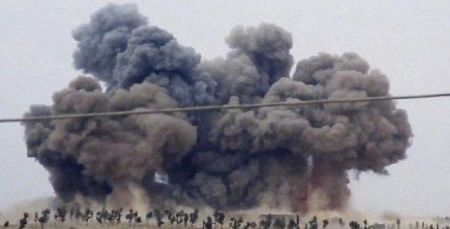
2717545 10/10/2015 Russian Su-25 attack aircraft take off from the Khmeimim airbase in Syria. Dmitriy Vinogradov/RIA Novosti

2717545 10/10/2015 Russian Su-25 attack aircraft take off from the Khmeimim airbase in Syria. Dmitriy Vinogradov/RIA Novosti

While Syrian war reporting focused over the weekend on the battles around Aleppo and along the Turkish border in the north, Russia since Saturday, Feb. 20 has ramped up its air bombardment of southern cities and towns, especially Daraa and Nawa. Thousands of fleeing rebels with their families and other civilians have meanwhile been turned away from the locked Jordanian border and are heading towards the Golan opposite the Israeli border.

The heaviest Russian air strikes seen hitherto in Syria have two strategic goals.

1. To retake the key southern town of Daraa from rebel hands and restore it to Syrian President Bashar Assad’s full control.

2. To crush rebel resistance in the South and force them to accept surrender, collapse or escape in the direction of the Jordanian or Israeli borders.

The intense Russian sorties are opening the door to Syrian, Iranian and Hizballah forces to move into the South and reach the Israeli borders. Prime Minister Binyamin Netanyahu sent Dr. Dore Gold to Moscow last week as his special emissary to explain how this affected Israel’s security. But he was unable to persuade the Russians to scale down their attacks in this sensitive border region.

Those attacks have a third goal, which is to encircle the Jebel Druze region with a “shield of fire” as protection for this ethnic minority of 750,000, most which inhabit mountain villages.

This unusual operation, the first of its kind in the Syrian war, has three objectives:

A. To shield the Druzes villages against ISIS attack from the east, namely Deir az-Zour.

B. To shut the door against fleeing rebels seeking sanctuary in the Druze enclave.

C. To show other Syrian minorities, especially the Kurds in the north, the great advantage of allying themselves with Moscow. Word of Russian protection of the Druzes has undoubtedly spread to Syria’s other minorities.

As for the rebels and refugees, Jordanian troops moved into the border crossings evacuated by Syrian rebels and closed the last crossing at Ramtha.

The exodus from southern Syria is now heading towards the Golan on Israel’s doorstep.

Israel has imposed a media blackout on this development. However, DEBKAfile’s sources warn that it will soon be impossible to keep it dark. Within a few days, many thousands of Syrian refugees will be massing at Israel’s Ein Zivan gate opposite Quneitra. Like Turkey and Jordan, Israel will have to supply large numbers of distressed Syrian refugees with tents, food, water and medicines.

Special Israeli emissary to Moscow over Russian Syria air strikes near border

February 17, 2016

Special Israeli emissary to Moscow over Russian Syria air strikes near border, DEBKAfile, February 17, 2016

Israel_near_border_16.2.16

In view of the crisis building up on the southern Syrian-Israeli border, Prime Minister Binyamin Netanyahu decided immediately on his return home from Berlin early Wednesday, Feb. 17, to send a special  emissary to Moscow to ask for clarifications. Tuesday, Intensified Russian air strikes came to within 6 km of the Israeli border, sparking a growing exodus of Syrian refugees heading towards the Qoneitra border crossing to Israel.

DEBKAfile’s sources reveal that the envoy is Dr. Dore Gold, director-general of the Foreign Ministry and one of the prime minister’s few trusted confidantes.

It was still not clear whom Gold will meet in the Russian capital, but it is assumed that it will be one of Moscow’s senior decision-makers in the loop on its military operation in Syria.

The fact that Netanyahu decided to dispatch a top diplomat rather than a senior military or intelligence officer is a sign that the prime minister is not of one mind with the IDF’s intelligence assessments of the situation on the ground.

Netanyahu’s concerns grew after after the Russian air force on Tuesday widened its massive bombing of southern Syria from the city of Daraa to the Golan town of Quneitra, in order to help the Syria army’s 7th armored division push the rebels east, so they will not attempt to cross the border and seek shelter in Israel.

DEBKAfile’s military sources report that that 12 of the 15 targets bombed by the Russian air force across from the Israeli border were new rebel positions that had not been attacked before, even by the Syrian army. Military sources monitoring the war said Tuesday night that there is no doubt that the Russians are in the process of wiping out the rebel positions along the Israeli border by means of an offensive comparable to their operations in the northern Aleppo sector.

Our sources report that Israel’s concerns grew when, as the Russians bombing raids neared the Israeli border, Syrian officials threatened Jordan with serious consequences if Amman gave the Saudi air force a base for attacking eastern or southern Syria.

The threats began Tuesday, after Jordanian forces took over the Syrian-Jordanian border crossings formerly held by Syrian rebels, as a measure to stem the volume of Syrian refugees in search of sanctuary in the Hashemite Kingdom. But this step was interpreted by the Syrians and their Russian ally as clearing the way for Saudi intervention in the Syrian conflict using Jordan as a jumping-off base.

Meanwhile, Western military sources reported a sub substantial presence Tuesday of both Russian and Israeli warplanes in the skies over and around southern Syria.

Turkey planning $5 billion for Gaza seaport

February 5, 2016

Turkey planning $5 billion for Gaza seaport, Israel National News, Ari Yashar, February 5, 2016

In the midst of ongoing normalization talks with Israel, Turkey is planning to invest $5 billion in reconstructing the Hamas stronghold of Gaza including a seaport – which Israel has fiercely opposed due to the blatant threat of weapons smuggling.

The Turkish Hurriyet Daily News on Friday reported that a team of the Union of Chambers and Commodity Exchanges of Turkey (TOBB) announced the expensive rebuilding plan, which is being prepared by the Center for Multilateral Trade Studies at the Economic Policy Research Foundation of Turkey (TEPAV).

The plans to reconstruct the Hamas-held region came after meetings with Palestinian Authority (PA) and Hamas officials, as well as Israeli officials.

“As the Turkish business world, we can fulfill this work,” said TOBB chairman Rifat Hisarciklioglu, who led the group. TEPAV claims that by 2020, Gaza will be “unlivable” with no drinking water left.

Indicating the subversive nature of the plan, TEPAV Executive Director Guven Sak said, “we made a strategic plan. A Gaza port will be one of the most important projects in this plan.”

Prime Minister Binyamin Netanyahu has rejected the idea of a port or lifting the maritime blockade on Gaza, which is meant to block the influx of weapons and which is fully legal according to international law, contrary to the claims of Israel’s opponents. Surprisingly, Agriculture Minister Uri Ariel (Jewish Home) in December called to build a seaport in Gaza.

The matter of the naval blockade has been a key sticking point in the reconciliation talks with Turkey, which continues to firmly support the Hamas terrorist organization. Turkey also continues to host Hamas terrorists, including those planning attacks in Israel.

With Israeli permission

Regarding the Turkish plan, TEPAV’s Sak said, “Turkish contractors will be an important part of this project,” while Hisarciklioglu said, “our contractors are materializing world-class works. They rank second in the world.”

The group met with Israeli officials unnamed in the report, and also met with Palestine Liberation Organization (PLO) Prime Minister Rami Hamdallah as well as several PA ministers and officials, in addition to Hamas officials and the Gaza Chamber of Commerce.

Israel gave the Turkish team permission to visit Gaza and plan the project according to the report, in an apparent sign of the growing rapprochement between the two states.

“It is not possible to go to Gaza without the permission of Israel,” said Hisarciklioglu. “But we did this. This is an indicator that the tensions between Turkey and Israel are easing.”

Israel’s normalization talks with Turkey have caused outrage in Egypt, where officials have urged Israel not to normalize ties.

Turkish defense sources revealed in December that Turkey is primarily interested in rapprochement so as to buy Israeli military hardware, with Ankara interested in buying more advanced Israeli drones as well as reconnaissance and surveillance systems for its fighter jets.

Turkish Prime Minister Ahmet Davutoglu in December also said that Turkey is only interested in the normalization talks so as to “benefit…Palestine and Gaza.”

Senior Israeli security sources for their part said they doubt Turkey is serious about rapprochement, noting on the crisis in ties with Russia – a key gas supplier for Turkey – that apparently prompted the desire for natural gas trade with Israel as Ankara hurts financially.

Bilateral ties disintegrated in the infamous 2010 Mavi Marmara flotilla incident, when IDF soldiers were forced to board the Turkish ship that had ignored repeated warnings to stop its attempt to breach the maritime blockade on Gaza.

The soldiers were brutally attacked by IHH Islamist extremists on board wielding knives and metal bars, and had no choice but to open fire, killing ten of the IHH members on board. After an investigation, Israeli authorities discovered the vessel to be carrying no humanitarian aid, despite the flotilla’s claims that it was on a “humanitarian” mission.

Russians let Hizballah into Daraa, breaking their promise to Israel

January 28, 2016

Russians let Hizballah into Daraa, breaking their promise to Israel, DEBKAfile, January 28, 2016

Syria_South

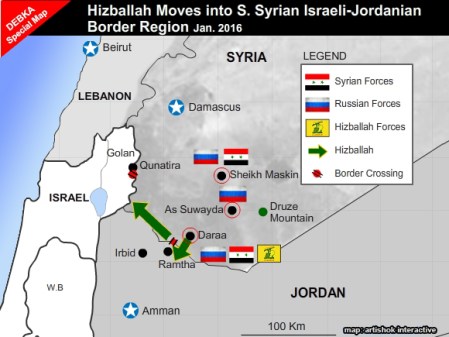
On Wednesday, Jan. 27 a large Hizballah force entered the southern Syrian town of Daraa, a critically dangerous event for Israel’s security. The way to the town, which lies near the Jordanian border and across from the Israeli Golan, was opened before Hizballah by none other than Russian forces. This was a blatant violation of President Vladimir Putin’s commitments to Prime Minister Binyamin Netanyahu and Jordanian King Abdullah not to permit Iranian and Iran-backed forces, such as Hizballah and Iraqi and Afghani Shiite militias, reach their borders in consequence of Russia’s military intervention in the Syria war.

Daraa is just 32 km from the southern Golan and 12 km from the Jordanian border. Hizballah forces in this town are therefore within easy striking distance from northern Israeli and Jordan.

What happened Wednesday was that a sizeable Hizballah contingent made it into Daraa, the day after a Syrian unit under the command of Russian officers captured the town of Sheikh Maskin, cutting off rebel forces east of Daraa from their comrades to the west.

Control of Sheikh Maskin is the key to the crossroads leading to Damascus in the north, the Druze Mountain town of es-Suwaida in the east, and Quneitra on Golan opposite Israel’s northern defenses.

The battle for Sheikh Maskin was the first in the Syrian conflict to be directly fought under Russian command. Its fall sparked accounts of Russian officers commanding Syrian troops in different parts of Syria.

So far, Israel has not reacted to the Hizballah force’s advance, notwithstanding public statements by Prime Minister Binyamin Netanyahu and Defense Minister Moshe Ya’alon that this would never be allowed to happen.

DEBKAfile’s military sources explain this reticence by a persistent misreading of the Syrian crisis in the higher ranks of the Israeli defense establishment. Military Intelligence chief Maj. Gen. Herzl Halevi, who has a good grasp of its complexities, is a lone voice against the defense minister and IDF chief of staff, Lt. Gen. Gady Eisenkot

In Amman, however, King Abdullah and his generals signified both alarm and fury. DEBKAfile’s sources report that Wednesday morning, the king shot off an urgent message to President Putin demanding an explanation for the Russian officers’ action in opening the door of Daraa to hostile Hizballah fighters.

Jordan has fought Hizballah and its conspiracies for three years, ever since its security forces seized an arms cache that Hizballah had smuggled into the kingdom for a terror cell to mount attacks in the northern province of Irbid. Amman is now concerned that Hizballah is close enough to make a grab for Al-Ramtha, the only border crossing between Syria and Jordan. That would be a feather in the cap of Iran’s Lebanese proxy, as the first Arab border crossing to fall to a Hizballah force outside Lebanon, and one, moreover, located athwart a main regional water source, the Yarmouk River.

As of Thursday morning, Jan. 28, Abdullah had not received a reply to his missive from Putin, but a message did come through to Amman from Syrian President Bashar Assad.

Using a back-door intelligence channel, he sent a notice in the name of Gen. Bahjat Suleiman, former Syrian ambassador to Jordan until he was expelled in May 2014, that King Abdullah must now face the consequences of his long support for the rebels of southern Syria.

The monarch was also advised to prepare for the influx of thousands of fleeing rebel fighters whom the combined Syrian and Hizballah forces were pushing towards the Jordanian border.

The next hours will be critical for the development of a similar crisis on the Israel-Syrian border in the Golan region.

Palestinian militia discussed for E. Jerusalem to help bar terror and block ISIS influence

January 21, 2016

Palestinian militia discussed for E. Jerusalem to help bar terror and block ISIS influence, DEBKAfile, January 21, 2016

Palestinian_Police480

Israeli and Palestinian security officers are exploring the possible formation of a new Palestinian militia to take charge of enforcing law and order in the Arab districts of Jerusalem and halting the anti-Israel terrorist attacks emanating from those districts.

DEBKAfile’s intelligence sources disclose that the dialogue is led by senior Israeli Shin Bet and police officials and the Palestinian General Intelligence (Mukhabarat) chief Maj. Gen. Majid Faraj.

Our sources cannot confirm that Prime Minister Binyamin Netanyahu or other top officials, such as Public Security Minister Gilead Erdan, are fully in the picture, but it will certainly have been brought to their notice.
Palestinian Authority Chairman Mahmoud Abbas is kept up to date.

Palestinian Authority Chairman Mahmoud Abbas is kept up to date.

The plan was first broached in top Israeli police circles, who first asked the Shin Bet and IDF if they had any objections to the creation of a special local Palestinian force or militia, whose members would serve under the orders of the Israeli Police, with a status similar to that of Jerusalem Arab permanent residents, who serve in the local police force.

The new militia would undertake responsibility for maintaining order and security in the Palestinian districts of East Jerusalem, and a commitment to prevent the continuation of terror attacks from the districts under their authority.

This plan gained rapid momentum in recent days over concerns on both sides over the rapidity with which the Islamic Sate was gaining adherents in Palestinian communities.

IDF Chief of Staff Lt. Gen. Gady Eisenkott disclosed this week that an estimated 14-16 percent of Palestinians support ISIS – the highest proportion in the Arab world, where the average is no more than 5-6 percent.

In a little-noticed incident on Dec. 3, 2015, a Palestinian General Intelligence officer called Mazen Aribe, 37, suddenly turned his official rifle on Israeli soldiers. After he injured two, their comrades shot him dead.

Investigators of the incident later confirmed that it bore the hallmarks of an ISIS attack.

Aribe, who happened to be the nephew of the senior Palestinian peace negotiator Saeb Erekat, was a highly respected intelligence officer and a loyal supporter of his boss, the a/m Maj. Gen. Faraj.  His sudden turn to violence against Israeli troops set off alarm bells in the Palestinian intelligence services as well as the Shin Bet and Israeli police.

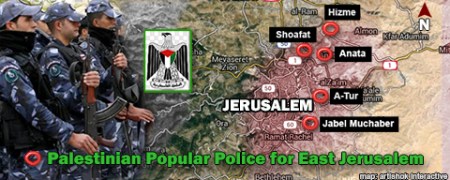
The progress of the talks for establishing the new force, since named the “Palestinian Popular Police for East Jerusalem,” can be measured by Israel’s consent to extend “a measure of autonomy” for certain administrative municipal appointments for its areas of control, provided their work is fully coordinated with Israeli government and municipal authorities.

The discussions cover the Palestinian-populated districts of North Jerusalem – Shoafat, Hizme and Beit Hanina – and the two big refugee camps at Shoafat and Anata. Many of the recent terrorist attacks against Israelis were perpetrated in the last four months by dwellers of these sections of Jerusalem.

The Old City and the Palestinian villages of Issawiya, A-Tur and Jabal Mukabar have not been covered in the bilateral security discussions.

Gen. Faraj is the live wire promoting the initiative. He is motivated most of all by the opportunity for his agency to gain a foothold in East Jerusalem. For decades, Israel has consistently blocked Palestinian attempts to establish their ruling bodies in its capital.

While the two negotiating parties formally agree to the new militia coming under Israel’s security services, its da-to-day operations will effectively be subject to Faraj’s intelligence agency.

In recent interviews, Faraj has made a point of stressing that cooperation between Israel’s army and Shin Bet and Palestinian security forces remains solid and must continue, notwithstanding the current wave of Palestinian terror.

He also claims that his officers have thwarted 200 terrorist attacks and their detention of 100 would-be terrorists with large arms caches, had foiled several more.

Faraj is clearly doing his utmost to bring to Israel’s attention the efficacy of the forces under his command and, by the same token, how valuable the new militia would be as a security, anti-terror asset for the city.

DEBKAfile’s counterterrorism sources note that the realization of the new Palestinian Police Force project – if it does get the green light in Jerusalem – would crown the four-month Palestinian knife intifada with a huge achievement, which has long proved elusive – the Palestinians would plant their first security footholds in the Arab neighborhoods of Israel’s capital. This would no doubt also provoke a flaming controversy on Israel’s political scene.