Posted tagged ‘Nato’

Russia Hints At Nuclear War After US Deploys Ballistic Missile Shield

May 13, 2016

Russia Hints At Nuclear War After US Deploys Ballistic Missile Shield

by Tyler Durden on 05/12/2016 19:02 -0400

Source: Russia Hints At Nuclear War After US Deploys Ballistic Missile Shield | Zero Hedge

In a dramatic development for the global nuclear balance of power, yesterday we reported that starting today, the United States would launch its European missile defense system dubbed Aegis Ashore at a remote airbase in the town of Deveselu, Romania, almost a decade after Washington proposed protecting NATO from Iranian rockets and despite repeated Russian warnings that the West is threatening the peace in central Europe.

As Robert Bell, a NATO-based envoy of U.S. Defense Secretary Ash Carter explained “we now have the capability to protect NATO in Europe. The Iranians are increasing their capabilities and we have to be ahead of that. The system is not aimed against Russia,” he told reporters, adding that the system will soon be handed over to NATO command.

We also noted that the Kremlin, which for years has warned that it would have no choice than to escalate proportionally, was “incensed at such of show of force by its Cold War rival in formerly communist-ruled eastern Europe where it once held sway.” Moscow said that the U.S.-led alliance is trying to encircle it close to the strategically important Black Sea, home to a Russian naval fleet and where NATO is also considering increasing patrols. Russia has good reason to be worried: the US move is a clear defection from the carefully established Game Theory equilibrium in the aftermath of the nuclear arms race, one which potentially removes a Russian first strike threat, thereby pressuring Russia.

We added that “the precarious nuclear balance of power in Europe has suddenly shifted, and quite dramatically: despite U.S. assurances, the Kremlin says the missile shield’s real aim is to neutralize Moscow’s nuclear arsenal long enough for the United States to make a first strike on Russia in the event of war.”

In conclusion we said that “what makes this step particularly dangerous is that Russia will now be forced to retaliate and since it does not have a comparable defensive technology, Putin will have no choice but to deploy more ICBMs on Russia’s borders, which in turn will exponentially escalate the threat of an “inadvertent” launch. Although considering how the “market” responds to newsflow these past few years, this may also be seen as a bullish catalyst for stocks.”

Fast forward to today when as American and allied officials celebrated the opening of a long-awaited missile defense system in Europe with a ribbon cutting and a band…

. the reaction in Moscow on Thursday was darker: a public discussion of how nuclear war might play out in Europe and the prospect that Romania, the host nation for the United States-built system, might be reduced to “smoking ruins.

As expected, Russia was furious. The NYT cites Kremlin spokesman Dmitri Peskov who told reporters in a conference call that “we have been saying right from when this story started that our experts are convinced that the deployment of the ABM system poses a certain threat to the Russian Federation.”

Of course, the US and NATO are well aware of this, which is why they have proceeded with this latest provocation, one which however has far more profound implications to the peace in Europe than the occasional barrel-roll in a fighter plane fly by.

“Measures are being taken to ensure the necessary level of security for Russia,” he said. “The president himself, let me remind you, has repeatedly asked who the system will work against.”

Russian Foreign Ministry spokeswoman, Maria Zakharova, said Russian defense experts consider the site a threat. “We still view the destructive actions of the United States and its allies in the area of missile defense as a direct threat to global and regional security.” She said that the Aegis Ashore launchpad was “practically identical” to a system used aboard Aegis warships that is capable of launching Tomahawk cruise missiles.

As the NYT adds, while the United States says it has no Tomahawk missiles at the site in Romania, the launchpad violates a 1987 treaty intended to take the superpowers off their hair-trigger nuclear alert, the Intermediate-Range Nuclear Forces Treaty, by banning land-based cruise and medium-range missiles with a range from 300 to 3,400 miles.

The problem, as we wrote yesterday, is that the short flight time of these missiles diminished to mere minutes the window Soviet leaders would have had after a warning to decide whether to launch a second strike, raising the risks of mishaps. Any redeployment of nuclear-capable missiles in Central Europe, the NYT writes, would roll the clock back to this nerve-racking 1980s status quo.

And now the ball is in Russia’s court.

“We have to announce this openly, without any additional diplomatic formulations,” Zakharova said of the Russian assertion the site violates the intermediate-range missile ban. “We are talking about violation of this treaty.” Previously Putin has warned that an American antimissile deployment in Eastern Europe could prompt Russia to withdraw from the treaty. The United States last year accused Russia of violating the treaty by failing to declare the true range of two missile types.

One potential response Russia will implement, is a nuclear-armed drone submarine. Last fall, Russian security officials appeared to drop hints of this military response to the missile defense system hinting through the leak that Russia has options. The drone, according to easily decipherable text accompanying the design drawing, would be capable of carrying a large nuclear device into coastal waters and detonating it, touching off a radioactive tsunami to flood and contaminate seaside cities.

In short, the kind of stuff that unleashes new all time highs in stock markets when it all goes wrong.

The submarine would “defeat important economic objects of an enemy in coastal zones, bringing guaranteed and unacceptable losses on the country’s territory by forming a wide area of radioactive contamination incompatible with conducting military, economic or any other activities there for a long period of time,” it said.

As the NYT adds, a Russian commentator, Konstantin Bogdanov, wrote on Lenta.ru, a news portal, that the antimissile sites in Eastern Europe might even accelerate the slippery slope to nuclear war in a crisis.

This is precisely what we said yesterday as well.

Bogdanov added that the missile sites would inevitably become priority targets in the event of nuclear war, possibly even targets for preventive strikes. Countries like Romania that host American antimissile systems might be the only casualties, he wrote, whereas the United States would then reconcile with Russia “over the smoking ruins of the East European elements of the missile defense system.”

* * *

There is, of course, a far simpler response. Recall that in November 2008, then Russian president Dmitry Medvedev made a stark warning to NATO: “Russia will deploy Iskander missile systems in its enclave in Kaliningrad to neutralize, if necessary, the anti-ballistic missile system in Europe.” We also reported in 2013 that in a seeming escalation as the ballistic shield appeared on its way to completion, there were unconfirmed reports that Russia had deployed a “double-digit” amount of SS-26 mobile units within Kaliningrad.

This time, we are absolutely certain, another nuclear ICBM deployment in the proximity of central Europe is imminent as Russia has no choice but to respond and this time it will be very much confirmed.

Russia to form 3 new divisions to counter NATO buildup

May 4, 2016

Russia to form 3 new divisions to counter NATO buildup

Published time: 4 May, 2016 09:04 Edited time: 4 May, 2016 10:03

Source: Russia to form 3 new divisions to counter NATO buildup — RT News

© Vladimir Semenuk / Sputnik

Russia is to deploy two new divisions in the west and one in the south to counterbalance NATO’s increased military presence near Russian borders, Defense Minister Sergey Shoigu announced.

The Defense Ministry is taking a number of measures to respond to the NATO military buildup at the Russian border,” Shoigu said on Wednesday. “Before the year’s end two new divisions will be formed in the Western Military District and one in the Southern Military District.

Earlier there were reports in the Russian media that three new divisions with 10,000 troops each may be deployed in Rostov-on-Don, the Smolensk Region and the Voronezh Region.

NATO has been sending additional forces to Poland, the Baltic States and elsewhere near Russian borders since 2014. It claimed that the deployments were necessary to build confidence of Eastern European members in the face of “Russian aggression.”

READ MORE: US deploys F-22 stealth fighter jets to Romanian base on Black Sea

The perceived aggression was exemplified by the example of Crimea, which seceded from Ukraine after a coup in Kiev. The former Ukrainian region voted in a referendum to join Russia, which was described as an illegal annexation through military force by the new government in Kiev and its foreign allies.

READ MORE: NATO to send 4,000 troops to border with Russia – report

Moscow rejected the reasoning and said that the alliance was using the political crisis in Ukraine to justify its existence by playing the old Russia scaremongering card.

During a top-level meeting at the ministry, Shoigu also said that Russia has rapped-up military training and production of advanced military hardware in response to the NATO threat.

Frank Gaffney: Erdogan Transformed Turkey into an ‘Islamist Police State’ That Is No Longer a ‘Reliable NATO Ally’

April 15, 2016

Frank Gaffney: Erdogan Transformed Turkey into an ‘Islamist Police State’ That Is No Longer a ‘Reliable NATO Ally,’ Breitbart, John Hayward, April 15, 2016

Erdogan Breitbart

Center for Security Policy founder and Sen. Ted Cruz (R-TX) foreign-policy adviser Frank Gaffney joined host Stephen K. Bannon on Breitbart News Daily Friday morning to talk about the recent proclamation of “Islamic unity” from Turkish President Recep Tayyip Erdogan, whose country will now assume the chairmanship of the Organization of Islamic Cooperation (OIC) for two years.

Gaffney argued that Erdogan’s statement was actually an example of taqqiya, the Muslim practice of lying for the greater good of the faith, and Erdogan’s true agenda was Islamic supremacism.

“I think what he’s trying to tell us is different from what he’s trying to tell his own people,” Gaffney said of Erdogan’s proclamation. “He’s telling us that he’s all about solidarity, and tolerance, and ecumenicalism, and we all need to pull together, and so on.”

“But the main message he’s been sending to his own people, for something like 13 years now, is Islamic supremacism,” Gaffney continued. “It has nothing to do with [singing] ‘Kumbaya’ with infidels. It is about forcing them to submit, in the classic tradition of sharia.”

He described Erdogan as “Muslim Brotherhood old Islamist who believes, at the end of the day, that he is going to be the new Caliph.”

“He is going to create a neo-Ottoman Empire. And anything that is communicated to the West – in various international fora, or through proclamations, or through other means – is what is known, in the traditions of sharia, as taqqiya – that is, essentially, lying for the Faith. And I think this should be discounted as such,” said Gaffney.

Gaffney explained that it’s not just permitted, but “obligatory,” for followers of the Islamic supremacist doctrine to “dissemble, to deceive the unbeliever, and to use deception as Mohammed did – the perfect Muslim – to triumph over the infidel, and to successfully create conditions under which they will be effectively enslaved, or reduced to a dhimmi status.”

He thought the Turkish president’s carefully crafted message would play well to Western media and government, which are suffused with the endless hope that “there’s a degree of moderation on the part of people like Erdogan, or others in the Muslim Brotherhood movement – the global jihad movement, for that matter.”

“It just ain’t so,” Gaffney argued. “This is a guy who has transformed his country, let’s be clear, from a secular democratic nation – a Muslim one to be sure, but definitely in the secular tradition of Ataturk – into what is now an Islamist police state.”

“Particularly people in the press, who are trying to portray this in the most rose-colored glass mode, should understand what he’s doing to the press in Turkey,” Gaffney stressed. “He’s crushing it, unless it bends to his will.”

He noted that Erdogan is famous for having said “Democracy is like a bus – you take it to your destination, and then you get off.”

“He’s long since gotten off, internally,” Gaffney warned. “We should be under no illusion: he is not aligned with us. He is aligned with the Islamists around the world – with Iran, with China, with Hamas of course. This is a guy who is no longer, in his country, a reliable NATO ally. And that’s the unvarnished and unhappy truth.”

Breitbart News Daily airs on SiriusXM Patriot 125 weekdays from 6:00AM to 9:00AM EST.


Cruz Hits Trump on NATO ‘Surrender’ in Wake of Brussels Attacks

March 22, 2016

Cruz Hits Trump on NATO ‘Surrender’ in Wake of Brussels Attacks, Newsmax, Sandy Fitzgerald, March 22, 2016

(At least he didn’t blame the Trump rallies for the violence in Brussels. — DM)

Cruz vs Trump(AP)

GOP presidential candidate Ted Cruz said Tuesday that Donald Trump was engaging in a “pre-emptive surrender” to Islamic terror by calling for a “withdrawal” from NATO on the eve of the Brussels terror attacks.

On Monday, Trump told CNN that the U.S. should greatly reduce its support of NATO.

“It’s too much and frankly it’s a different world than it was when we originally conceived of the idea,” Trump said of the US-European security alliance.

Cruz said he found it “striking” that the terror attacks occurred on the day after his rival candidate Donald Trump called for reducing the U.S. role NATO.

“We see Brussels where NATO is headquartered as the subject of a radical Islamic terrorist attack,” Cruz said in a press conference from Washington D.C.

“Donald Trump is wrong that America should withdraw from the world and abandon our allies. Donald Trump is wrong that America should retreat from Europe, retreat from NATO, hand Vladimir Putin a major victory, and while’s he’s at it, hand ISIS a major victory.”

Instead, said the Texas senator, NATO would be crucial in any United States effort in “utterly destroying ISIS.”

“And I would note that NATO  is ready to act in a way our president is not,” said Cruz.

“Donald Trump’s proposal to withdraw from the world, to withdraw from NATO and Europe is sadly consistent with his statement that he intends to be neutral between Israel and the Palestinians.”

Cruz also said Trump’s approach was similar to Obama’s.

“We have seen for 7 years a president that cannot distinguish between our friends and enemies. A president that cannot distinguish between the nation of Israel and Islamic terrorists who seek to murder us, and it would be a mistake to elect another president who buys into the same left-wing moral relativism that equates the terrorist blowing himself you have and murdering innocent civilians to the brave soldiers and law enforcement officers risking everything to keep us safe.”

Cruz was not alone for criticizing Trump on his stand on NATO.

Ohio Gov. John Kasich, appearing on Fox News Tuesday morning, said Trump’s plan for downsizing the U.S. role in NATO was dangerous as we confront the grave threat of Islamic terrorism.

Hillary Emails – NATO Commander on Libya War Mission: ‘Inshallah, Soon’

March 4, 2016

Hillary Emails – NATO Commander on Libya War Mission: ‘Inshallah, Soon’

by Aaron Klein

3 Mar 2016

Source: Hillary Emails – NATO Commander on Libya War Mission: ‘Inshallah, Soon’ – Breitbart

TEL AVIV – James Stavridis, who led the 2011 intervention in Libya as NATO’s 16th Supreme Allied Commander, used unusual terminology to express his hope that the United Arab Emirates would step up its involvement in the Libya war.

In an email forwarded to Hillary Clinton’s private server, Stavridis discussed a mission change that would put U.S. bombs on UAE aircraft for strikes in Libya.

“As to how long … inshallah, soon,” wrote Stravridis, a retired U.S. Navy admiral.

The dispatch was contained in Monday’s batch of roughly 3,900 pages said to be the last of Clinton’s work-related emails. The messages were reviewed in full by this reporter.

Stravridis was replying to an email sent from one of Clinton’s top deputies, Jake Sullivan, to Ivo H. Daalder, the U.S. Permanent Representative on the NATO Council.

“Any way to get the UAE suggestion that they will contribute aircraft for strike missions firmed up and announced by the SYG?” Sullivan asked.

Daalder forwarded the query to Stravridis, asking, “Gather you and Clinton talked about this. When do you think they will be able to start?”

Here is Stavridis’s full reply:

What the UAE For Min said was they wanted US bombs so we’ll have to work that on DoD circuits (Centcom presumably) We’ll also go mil-to-mil via force gen, JFC Naples, and JTF and push them to use their own air to ground ordnance in the interim Suggest you guys work the political side up there

As to how long … inshallah, soon

Best, Jim Admiral, USN Supreme Allied Commander, Europe Commander, US European Command “Stronger Together”

Inshallah is Arabic for “Allah willing” or “if Allah wills it.”

Aaron Klein is Breitbart’s Jerusalem bureau chief and senior investigative reporter. He is a New York Times bestselling author and hosts the popular weekend talk radio program, “Aaron Klein Investigative Radio.” Follow him on Twitter @AaronKleinShow. Follow him on Facebook.

‘Sunshine of the spotless mind’: Russia rebuts NATO accusation of it ‘weaponizing’ migrant crisis

March 3, 2016

Sunshine of the spotless mind’: Russia rebuts NATO accusation of it ‘weaponizing’ migrant crisis

Published time: 3 Mar, 2016 03:57

Source: ‘Sunshine of the spotless mind’: Russia rebuts NATO accusation of it ‘weaponizing’ migrant crisis — RT News

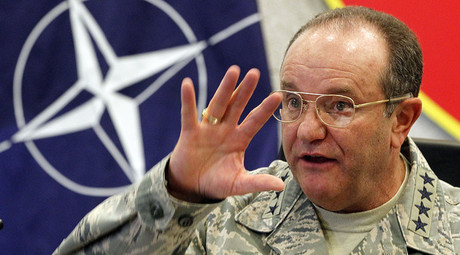
U.S. Air Force Gen. Philip Breedlove, commander of the U.S. European Command and Supreme Allied Commander for Europe © Jonathan Ernst
Moscow was amused by the top NATO General’s claims that it is using the refugee crisis as a “weapon” against the West, with the Defense Ministry’s spokesman saying such rhetoric reaffirms concerns of Breedlove’s apparent dislocation of memory.

In front of the Senate Armed Services Committee this week, top NATO General Philip Breedlove accused Moscow of siding with the Syrian President and deliberately fueling the displacement of Syrians.

“Together, Russia and the Assad regime are deliberately weaponizing migration in an attempt to overwhelm European structures and break European resolve,” Breedlove told the committee.

Read more

U.S. General Philip Breedlove. © Ciro De Luca

Insisting that the influx of migrants to Europe benefited Moscow, Breedlove noted that foreign militants who have been fighting in Syria are now returning back home, where they might use their battlefield skills.

Breedlove added that the alleged strategy was used by both Russian and Syrian presidents to create a distraction for the western countries that have been busy tackling the crisis and did not notice its root cause: “Indiscriminate weapons used by both Bashar al-Assad, and the non-precision use of weapons by the Russian forces.”

Russian Ministry of Defense spokesman Igor Konashenkov called the latest allegations a “recurrence” of the NATO general’s traditional rhetoric which only reaffirms concerns about Breedlove’s “memory dislocation.”

“Taking into account that such recurrence of the ‘sunshine of the spotless mind’ appeared right before the scheduled meeting of the Armed Services Committee, there is no wonder that a decision has been made by the US congressmen to replace him on his post of the Commander-in-Chief of the NATO Joint Force in Europe,” Konashenkov said.

Konashenkov once again pointed out that Moscow could not have possibly been the reason for the refugee crisis, which began long before Russia launched its anti-terror operations in Syria. And unlike the anti-ISIS coalition, Russia’s operations in Syria have alleviated the refugee crisis in the country and led to the first step of the establishment of a peace-making process, Konashenkov added.

“Essential is the fact that as a results of the Russian operation, the UN is registering the reduction of refugee flows from Syria and a process of reconciliation has been initiated, which is something the Western so-called “anti-ISIS coalition” has been unable to achieve over the previous three years of their “fight” against terrorism,” Konashenkov stated.

Responding to the “indiscriminate” and “non-precision” bombing claims, Konashenkov reminded the NATO general that precision of airstrike depends not only on smart weapons, but also on proper intelligence, pilot’s skills and aiming systems of the aircraft.

“Sole reliance on ‘supersmart’ or ‘superprecision’ weapons leads American hawks to tragic mistakes with fatal consequences, as it was repeatedly observed in Afghanistan, Iraq, and since recently – in Syria,” Konashenkov said.

Daesh Terrorists: A Multifunction Tool in Hands of Ankara, Riyadh, NATO

February 20, 2016

Daesh Terrorists: A Multifunction Tool in Hands of Ankara, Riyadh, NATO

Ekaterina Blinova

15:29 20.02.2016

Source: Daesh Terrorists: A Multifunction Tool in Hands of Ankara, Riyadh, NATO

The West and its Mideast partners are playing deceiving Machiavellian games in Syria, F. William Engdahl told Sputnik, adding that Russia is in a most risky situation if it believes that the other actors involved in the conflict, such as Recep Erdogan or King Salman and his impulsive son Prince Mohammed, are reasonable, as hate knows no reason.

While tensions are simmering over the prospect of a Turkish-Saudi invasion of Syria, six members of the UN Security Council, including the US, UK and France, have voiced their objections to a Russian draft resolution aimed at restoring the sovereignty of the Middle Eastern state, fanning the flames.The draft resolution, which denounces any actions that undermine the sovereignty and territorial integrity of Syria and condemns any plans for a foreign military invasion, has been dismissed by the US and French UN ambassadors as “having no future.”

It is rather surprising that the proposed resolution, aimed at peace in Syria and the protection of the fundamental values of the UN charter, has immediately come under fire from Washington and the major European powers. However, there is an obvious explanation: the Western powers have repeatedly violated international law, having acted militarily in Syria without official permission from the legitimate government of President Bashar al-Assad.

In light of this, the contours of the Western strategy in Syria are getting clearer. The question then arises whether the Syrian Arab Army, backed by Russia’s Air Force, will help Damascus restore sovereignty and re-unite Syria?

“What I feel is that at present the energy in Syria is, regrettably, one of death and destruction, everywhere. This cannot easily be healed such that Syria becomes a healthy sovereign nation as it was perhaps a century ago, prior to World War I. This is the destructiveness of war. It is not a question of military reconquest of land lost in the past five years of war. Were it so easy, the world would have healed the scars of all wars centuries ago. No one side ‘wins’ in war, only in peace,” American-German researcher, historian and strategic risk consultant F. William Engdahl told Sputnik in an exclusive interview.

By stepping in in Syria, Russia has actually entered a geopolitical chess tournament with crafty Western players. Will Vladimir Putin and Bashar Assad beat Washington’s geopolitical grandmasters at their own game?”This is a very difficult question to answer. My honest feeling is that the American Patriarchs as I prefer to call them, not grandmasters, have a deep plan with their many wars in the Middle East. The plan is simple — spread hate, destruction, a killing energy, not only in the Middle East oil countries but also in the EU as well as inside the United States, in China, everywhere, with their wars over oil in the end,” Engdahl pointed out.

Fighters of the al-Qaida-inspired Islamic State of Iraq and the Levant (ISIL) parade in a commandeered Iraqi security forces armored vehicle down a main road at the northern city of Mosul, Iraq. (File)
© AP Photo/
Fighters of the al-Qaida-inspired Islamic State of Iraq and the Levant (ISIL) parade in a commandeered Iraqi security forces armored vehicle down a main road at the northern city of Mosul, Iraq. (File)

If the world is busy with such destruction, those Patriarchs have the misguided feeling they will prevail, the strategic risk consultant underscored, adding that we are in a kind of world war already.

“They ignited the Maidan Square coup in February 2014 to disrupt growing, positive economic and political relations, especially between Germany and Russia, to an extent between the EU and Russia. They have demonized Russia and her President in their media. China will be next in their sights,” Engdahl stressed.

Indeed, a belt of instability has stretched from North Africa and the Balkans to Central Asia and beyond. Five years have passed since the “Day of Rage” in Libya which was aimed against the rule of Muammar Gaddafi. The uprising, enthusiastically supported by the West, has lured the country into constant turmoil. Meanwhile, in another part of the world, the Afghani failed state is still desperately fighting against Islamic extremists.”I believe that they felt they were losing their control to nations [which were] acting more independently and sovereign in recent years, like Russia, like Germany, like China, like Iran and other states encouraged to assert national autonomy against the wishes of NATO. Of course, in the end they will only lose, but if we are not conscious of who we are, and who they are, as Sun Tzu said, they will manage to create huge destruction before that point. Simply think about the deep scars of the war 75 years ago,” the researcher told Sputnik.

A soldier of the Syrian Arab Army is seen here in Aleppo
© Sputnik/ Iliya Pitalev
A soldier of the Syrian Arab Army is seen here in Aleppo

Does that mean the notorious Daesh (ISIL/ISIS) is a kind of “agent of destruction”?

“Daesh, simply said, is Saudi Arabia’s monarchy. In my most recent book, The Lost Hegemon: Whom the gods would destroy, I describe in great detail the perverse ‘unholy alliance,’ brokered by the CIA in the early 1950s to mate the Egyptian death cult known as the Muslim Brotherhood with the primitive Saudi Wahhabist branch of Islam. The consequence of that was Mujahedeen, the Chechen wars, Bosnia’s Mujahedeen war against the Serbs, and now Al Qaeda-Al Nusra and Daesh. Erdogan’s family, supported in a perverse alliance by this Saudi monarchy, is embracing Daesh as a weapon to kill Kurds and create some kind of New Ottoman Sultanate, and to enable Saudi control of the oil and gas of Iraq, of Syria and of Yemen,” Engdahl elaborated.

“But they will fail,” the researcher remarked.

Despite the fact that the international community has repeatedly expressed its deep concerns over Daesh’s “extraordinary levels of funding” and the imminent danger this poses to the Western civilization, UN Under-Secretary-General for Political Affairs Jeffrey Feltman admitted on February 9 that the terror group continues to sell stolen oil on the global market.Some experts believe it would be impossible, hadn’t a “tacit agreement” been concluded by European and American decision-makers. Back in June 2014 French intellectual, founder and chairman of Voltaire Network Thierry Meyssan called attention to the fact that Daesh and al-Nusra Front were selling stolen crude on the international market, “so monitored by Washington,” without hindrance. That can only mean one thing, Meyssan suggested: they are either authorized by Washington or linked to storefront oil companies.

So, why do Washington and Western “oil barons” allow Daesh to continue selling stolen oil, replenishing its vaults with more money for war, terror and destruction?

“NATO uses Daesh and allows the oil to flow to that end, luring Erdogan and Salman into a well-planned trap. NATO, of course, is controlled by Washington and those American Patriarchs who steer the military-industrial complex and their oil barons. We need only to look at the statement recently of Hakan Fidan, head of Turkish MIT intelligence, urging the West to see Daesh as legitimate Muslims with a right to be respected and you get the idea,” Engdahl emphasized.

“Everyone in this war is deceiving, playing Machiavellian games — Erdogan, Salman and his son, Prince Salman, Under-Secretary-General for Political Affairs Jeffrey Feltman, John Kerry, Obama, Cameron, Hollande. Russia is in a most risky situation in Syria if it and its leading people have any illusion that the other actors are reasonable. Hate knows no reason,” the researcher warned.


Libya disaster: Have Western leaders learned anything?

February 20, 2016

Libya disaster: Have Western leaders learned anything? Investigative Project on Terrorism via Fox News, Pete Hoekstra, February 19, 2016

(Please see also, Exclusive: Obama Refuses to Hit ISIS’s Libyan Capital. — DM)

That the U.S. has launched airstrikes against ISIS in Libya should demonstrate once and for all the total disaster of the NATO-led adventure to overthrow Muammar al-Qaddafi in 2011.

Libya devolved into a failed state when NATO assisted Qaddafi’s radical jihadist opponents in killing him and then promptly abandoned the country. Left in the wake were two rival governments competing for power, which created space for Islamists to turn Libya into a cesspool of extremism.

Former Secretary of State Hillary Clinton continues to call the debacle American “smart power at its best.” Other presidential candidates still argue that it was the right thing to do.

How will the West ever learn anything if it can’t identify its most obvious failures?

Libya has no central functioning government that can provide security for its citizens. ISIS fights to expand its caliphate along the Mediterranean to points as close as 200 miles from Europe’s vulnerable southern border. It controls Qaddafi’s hometown of Sirte. It has imposed Shariah law in the areas under its control. It exploits Libya as a base to export weapons, jihadists and ideology to Europe, other African countries and the Middle East.

Benghazi and Derna, which have long been hotbeds of radicalism, provided more fighters per capita to Afghanistan and Iraq than nearly any other area in the world. The difference between then and now is that Qaddafi kept the lid on the garbage can long before 2002-2003, when he became a reliable U.S. ally against radical Islam. He changed his behavior, gave up his nuclear weapons program, paid reparations to the victims of his atrocities and provided invaluable intelligence that disrupted numerous Islamist terror plots.

It represented a massive foreign policy success, and the U.S. thanked him by facilitating his murder.

Similarly, the West embraced former Egyptian President Hosni Mubarak in his struggles against Islamist forces, and then it threw him under the bus. Both Qaddafi and Mubarak did everything asked of them, but they ended up dead or in jail.

Any leader would really need to ask why he should trust NATO or the West. Is there any question why Syrian dictator Bashar al-Assad does not negotiate an end to his country’s civil war and clings to Iran and Russia to keep him in power?

Iran cheated on its nuclear program for years. As a result, the U.S. gifted it with more than $100 billion – including $1.7 billion in U.S. taxpayer dollars – and it hasn’t changed its behavior in the slightest. In addition to its military ambitions, Iran will most assuredly spend the money on supporting Assad and its terrorist proxies throughout the Middle East, Africa and, yes, Europe.

I’m amazed by some of the statements now coming from the coalition. The French defense minister is concerned about ISIS fighters blending in with refugees crossing the Mediterranean. Talk about restating the obvious. The British want troops to identify friendly militias in order to avoid targeting them in future airstrikes. Has something changed where we have improved the vetting of “moderate” militia groups?

NATO failed miserably in Libya and in Syria the first time around. What’s different now?

The only official who seems to make any sense is U.S. Secretary of Defense Ash Carter, who said recently, “The Libyans don’t welcome outsiders intruding on their territory.” He was referring to ISIS, but he might as well have been talking about the West. Libyans have not forgotten that NATO all but vanished once Qaddafi was killed.

Western foreign policy is in disarray. The scariest part is that supposed leaders don’t even know it, and therefore they can’t admit to previous mistakes. Allies that brought stability to the region are gone. Former and current antagonists benefited from Western incompetence.

Who would have predicted six years ago that those rulers battling Islamist terror would be deposed and that those committing it would become the West’s new friends?

NATO snatched defeat from the jaws of victory in Libya. Refugees flood Europe. Terrorist attacks continue to spread geographically and in lethality. The Syrian civil war rages on. Iran lavishes its newfound wealth on its nuclear program and campaign of global terror.

Is it any wonder that citizens in Western countries are frustrated and angry with those in positions of authority?

Russian-Turkish clash building up over Syria

February 14, 2016

Russian-Turkish clash building up over Syria, DEBKAfile, February 14, 2016

Turkish-self-propelled_howitzers_13.2.16

Turkish President Tayyip Erdogan clearly took a calculated risk when he ordered a two-our cross-border artillery bombardment Saturday, Feb. 13 of Syrian army forces positioned around the northern Syrian town of Azaz and the Kurdish YPG militia units which two days earlier took control of the former Syrian military air base of Minagh some six kilometers from the Turkish border.

Kurdish troops backed by the Russian air force seized that base last week from rebel militias as part of the operation for cutting the rebel groups under siege in Aleppo from their supply routes. The Turkish bombardment was therefore an indirect attack on the Russian forces backing pro-Assad forces against the rebels in the Syria war.

Erdogan knows that Moscow hasn’t finished settling accounts with Turkey for the shooting down of a Russian Su-24 on Nov. 24 and is spoiling for more punishment. After that incident, the Russians deployed top-of-line S-400 ground-to-air missile batteries and advanced Sukhoi Su-35 warplanes to their base in Latakia near the Turkish border. Ankara therefore limited its strike to a two-hour artillery bombardment from Turkish soil, reasoning that a Turkish warplane anywhere near the Syrian border would be shot down instantly.

Emboldened by the delay in the Russian response, the Turks took another step: Prime Minister Ahmet Davutoglu threatened the Kurdish YPG militia with more attacks if they failed to withdraw from the Menagh air base.

Although the Turkish prime minister had called on “allies and supporters” to back the operation against the Russian-backed  Syrian Kurds, Washington took the opposite line by urging Turkey, a fellow member of NATO, to desist from any further attacks.

Washington’s concern is obvious. An outright clash between Turkey and Russia would entitle Ankara to invoke the NATO charter and demand allied protection for a member state under attack.

The Obama administration would have had to spurn this appeal for three reasons:

1. To avoid getting mixed up in a military clash between two countries, just as the US kept its powder dry in the Russian-Ukraine confrontation after Moscow’s annexation of the Crimean Peninsula in February 2014.

2. To avoid upsetting the secret Obama-Putin deal on the allocation of spheres of influence in Syria: the Americans have taken the regions east of the Euphrates River, and the Russians, the west.

The Kurdish YPG militia forces near Aleppo and the city itself come under the Russian area of influence.

3. Regional tensions were tightened another notch Saturday by Russian comments: Russian Prime Minister Dmitry Medvedev said that his country and the West have “slid into a new Cold War period,” and Foreign Minister Sergei Lavrov said a third World War is actually underway -“I call this struggle a third World War by other means.,” he said.

Washington will avoid any action that risks further stoking this high state of international tension, but will act instead to de-escalate the cross-border Turkish-Russian confrontation over Syria.

All eyes are now on Moscow, Much depends on Russia’s response to the artillery bombardment of its Syrian and Kurdish allies. It is up to Putin to decide when and how to strike back – if at all.

Russia PM says world has slipped into ‘new Cold War’

February 13, 2016

Russia PM says world has slipped into ‘new Cold War’ Dmitry Medvedev criticizes expansion of NATO and EU influence deep into formerly Soviet-ruled eastern Europe

By Frank Zeller February 13, 2016, 12:47 pm

Source: Russia PM says world has slipped into ‘new Cold War’ | The Times of Israel

Russian Prime Minister Dmitry Medvedev speaks during a panel discussion at the second day of the 52nd Munich Security Conference (MSC) in Munich, southern Germany, on February 13, 2016. (AFP / Christof)

Russian Prime Minister Dmitry Medvedev speaks during a panel discussion at the second day of the 52nd Munich Security Conference (MSC) in Munich, southern Germany, on February 13, 2016. (AFP / Christof)

MUNICH (AFP) — Russian Prime Minister Dmitry Medvedev said Saturday that strains between Russia and the West have plunged the world into a “new Cold War.”

With tensions high over the lingering Ukraine conflict and Russia’s backing of the Syrian regime, Medvedev said: “All that’s left is an unfriendly policy of NATO against Russia.”

 “We can say it even more clearly: We have slid into a new period of Cold War,” he said, speaking at the Munich Security Conference.

“Almost every day we are accused of making new horrible threats either against NATO as a whole, against Europe or against the US or other countries.”

Medvedev criticized the expansion of NATO and EU influence deep into formerly Soviet-ruled eastern Europe since the end of the Cold War.

“European politicians thought that creating a so-called belt of friends at Europe’s side, on the outskirts of the EU, could be a guarantee of security, and what’s the result?” he said. “Not a belt of friends but a belt of exclusion.”

He added that “creating trust is hard … but we have to start. Our positions differ, but they do not differ as much as 40 years ago when a wall was standing in Europe.”

He urged better East-West dialogue, citing the “shining example” of the historic meeting of Pope Francis and Russian Patriarch Kirill in Cuba.

Medvedev added that “in the 1960s we were on the brink of nuclear apocalypse, but the two enemy sides understood that no conflict of political systems was worth the lives of people.”

NATO general secretary Jens Stoltenberg had earlier addressed the forum on the subject of tensions with Russia, vowing a firm stance while also offering dialogue.

“We have seen a more assertive Russia, a Russia which is destabilising the European security order,” he said.

“NATO does not seek confrontation and we don’t want a new Cold War. At the same time our response has to be firm.”

NATO was now “undertaking the biggest reinforcement to our collective defence in decades, to send a powerful signal to deter any aggression or intimidation. Not to wage war, but to prevent war.”

Stoltenberg charged that “Russia’s rhetoric, posture and exercises of its nuclear forces are aimed at intimidating its neighbours, undermining trust and stability in Europe.”

He stressed that “for NATO, the circumstances in which any use of nuclear weapons might have to be contemplated are extremely remote” and cautioned that “no-one should think that nuclear weapons can be used as part of conventional conflict”.

The NATO chief said that “some are concerned that we are sleepwalking toward escalation with Russia… I understand those concerns but I do not share them.”

He urged a “more constructive and more cooperative relationship with Russia… I strongly believe that the answer lies with both more defence and more dialogue.”