Posted tagged ‘Nato’

First Trump era war? Serbia versus Muslim Kosovo

January 21, 2017

First Trump era war? Serbia versus Muslim Kosovo

DEBKA file Exclusive Report

January 20, 2017, 11:48 AM (IDT)

Source: First Trump era war? Serbia versus Muslim Kosovo

Just six days before Donald Trump’s inauguration as US President, a Serbian train took up position on the Kosovo border. It was painted ostentatiously with the slogan “Kosovo is Serbian” in several languages along with national Serbian and Orthodox Christian emblems.

The train has been stationary since Friday, Jan. 14. Kosovan security authorities are blocking its advance along the new 213km long rail link from Belgrade to Mitrovica, a town in Muslim Kosovo which has a large Serbian population.
This is more than a symbolic reminder of the brutal Balkan wars of the 1990s. Two armies are already poised for battle: 60,000 Serbian troops, including armored, artillery and air force units, are on war preparedness, facing a much smaller Kosovo security force which, after calling up reserves, numbers around 6,000 combatants.

Serbian President Tomislav Nikolic beat a war drum this week when he declared: “If Serbians are killed, we’ll send our army to Kosovo.”

It was 19 years ago that Serbia signed an agreement for ending its war with Kosovo after NATO forces intervened and US warplanes bombed the Serbian capital of Belgrade into capitulation. The West recognized Kosovan independence, but Russia and China still view the country as an integral part of Serbia.

The Kosovo war was the sequel to the 1992-1995 conflict between Christian Serbia and Croatia, on one side, and Muslim Bosnia, on the other. This war was brought to a close after President Bill Clinton’s intervention forced Serbia to sign the Dayton Accords and cede broad areas of Bosnia to Muslim rule.

In sum, the Balkan conflicts of the 1990s saw many horrors, but also ended in American support for the establishment of independent Muslim enclaves in southern Europe. Orthodox Christian rule and territory, which were under Russian military, religious and national influence, were substantially downsized.
This policy was pursued systematically for 15 years by Presidents Clinton and Obama with the support of Chancellor Angela Merkel. It is widely seen today as the key which in recent years unlocked continental Europe to the influx of millions of Muslim migrants and refugees from the Middle East and Africa.

Four south European nations, Turkey, Bosnia, Kosovo and Albania, provided the arrivals with their gateway into West Europe.

The Serbian train parked on the Kosovo border marked the end of the Obama era and underlined Belgrade’s non-acceptance of the borderline imposed in the last century on Serbia. The train is expected to cross that border after the Trump inauguration Friday, Jan. 20. If it is attacked by Kosovan security forces, the Serbian army will march in. And even if it is not attacked, the Serbian army plans to march behind the train across the border in a bid to eradicate one of President Clinton’s proudest achievements.

Indeed, a statue of Bill Clinton stands at the center of Pristina’s main square, in appreciation of his gift of Muslim independence and liberation from Serbian rule.
When it starts moving, the Serbian train will pose the new US president with his first test in dealing with an international crisis involving the Muslim issue before he has a chance to settle in at the Oval Office.

He will find on his desk an urgent note to the US and members of the European Union from Kosovo’s Foreign Minister Enver Hoxhaj asking for assistance against Serbian aggression. A similar SOS in 1998 brought a NATO elite force, consisting mainly of British units, rushing to Kosovo. In 2017, Kosovo can forget about help from any European government, even sympathetic Germany and France.

This is not just about the presidential transition in Washington. On June 12, 1999, Russian President Boris Yeltsin landed an army contingent at Pristinia airfield to put the brakes on Kosovo’s takeover by the West. The option of backing the Serbian train as it rolls into Kosovo is still available to his successor, Vladimir Putin.

His response will offer an important insight into the secret understandings reached between Trump and Putin for collaboration in the war on Islamist terror and the prevention of further Muslim expansion in Europe.

Nigel Farage says the EU is a threat to NATO nations

December 15, 2016

Nigel Farage says the EU is a threat to NATO nationsRobinHoodUKIP via YouTube, December 14, 2016

https://www.youtube.com/watch?v=t812Fc1mStQ

Russian navy on combat alert as Ukraine begins missile launch drills near Crimea

December 2, 2016

Russian navy on combat alert as Ukraine begins missile launch drills near Crimea – reports

Published time: 1 Dec, 2016 06:37 Edited time: 1 Dec, 2016 15:00

Source: Russian navy on combat alert as Ukraine begins missile launch drills near Crimea – reports — RT News

FILE PHOTO. © AFP

Russian warships from the Black Sea Fleet reportedly took up positions off the Crimean Peninsula to provide air defense as Kiev conducted its missile launch drills near the Russian border.

Ukrainian forces conducted 16 successful launches of S-300 medium-range surface-to-air missiles during the drills, presidential spokesman Svyatoslav Tsegolko said in a Facebook post.

“The Defense Ministry and the General Staff chief have just reported to the president on today’s drills, which were successfully completed. Sixteen Ukrainian missiles were launched. All of them have reached their targets,” Tsegolko said.

Read more

FILE PHOTO: A

“We’ve received the first reports about the success of the launches carried out this morning,” Ukrainian President Petro Poroshenko said in Kiev. “These latest exercises involved combat and transport aircraft, as well as divisions of anti-aircraft and radar troops.” 

“I want to emphasize that the launches are taking place in open sea over Ukrainian airspace, in full accordance with international law. The launches will go on regardless of any statement released by Moscow.”
“The only reason that makes us conduct these exercises is the need to be consistently ready for any full-scale invasion from the side of our aggressive neighbor.”

“The purpose of the exercise is to gain experience in using these anti-aircraft missile systems and to check the quality of the rockets, which were repaired, as well as to improve the skills of the anti-aircraft missile troop units,” he said, as cited by TASS.

Kryzhanovsky said that there had been no response to the launches from the Russian side. He noted that the missiles will come as close as 30 kilometers to Crimean airspace. The missiles are being launched from a spot some 90 kilometers from Crimea’s shores. The Ukrainian military stressed that its current exercises pose no danger to the residents of the Crimean Peninsula.

Still, the Russian Foreign Ministry said on Thursday that Ukrainian missile tests near Crimea were a “dangerous precedent,” as cited by Interfax.

Russian ships from the Black Sea Fleet have taken up positions to the west of the Crimean Peninsula to provide air defense over Russian territory, RIA Novosti news agency reports, citing sources in the military.

The Black Sea Fleet warships integrated in the air defense system of the Southern Military District have taken position off the west coast of Crimea for Ukraine’s missile launch drills, which are scheduled for December 1st and 2nd. The ships’ air defenses are in on high alert,” the source told the agency.

Read more

FILE PHOTO: The Italian frigate ITS Zeffiro (front C) leads a flotilla of NATO warships © CPO Luigi Cotrufo-Italian Navy

Ukraine announced that it would be conducting missile-firing exercises close to Crimea in areas used by civil and state aviation flights earlier this week, warning that they would not be safe for flights. Later, it declared that adjacent areas, partly over neutral waters and partly over Russia’s territorial waters in the Black Sea to the southwest and southeast to Crimea, would also be dangerous.

The Russian aviation agency said that Kiev’s drills breach a number of international laws and agreements, noting that they had not been coordinated with Moscow.

Russia asked the authorities in Kiev to abstain from the exercises, but received no response, Russian transport minister Maksim Sokolov said today, while noting that Moscow had also requested that the International Civil Aviation Organization declare Crimean airspace a danger zone, but that also went unanswered.

There were no emergency incidents detected in the airspace over Crimea, Sokolov later said.

Earlier, the Russian Defense Ministry submitted a military-diplomatic note to the Defense Attaché at the Embassy of Ukraine, in which they protested the illegal restrictions on the use of Russian airspace imposed by Ukraine during the exercises, noting that “the southeastern boundary of the danger area declared by the Ukraine violates the territorial sea borders of the Russian Federation, which is a violation of international law and Russian legislation.”


However, according to the Russian Federal Air Transport Agency, the Ukrainian government changed the boundaries of the danger zone for civil aviation in the Crimea region just ahead of the drills so that they no longer breach Russian airspace.

The boundaries of the danger zone for civil aviation has been shifted to the west of the Russian Federation,” the agency’s representative told Interfax.

The Ukrainian military has a record of suffering from accidents while conducting air defense missile drills. In October of 2001, a Siberia Airlines Tu-154 en route from Tel-Aviv to Novosibirsk was accidentally brought down by a missile launched by the Ukrainian military during an exercise over the Black Sea. Seventy-eight people died in that tragedy. Kiev has also been condemned by the relatives of the victims of the , in which a civilian plane was downed in the eastern part of Ukraine, for not closing the airspace over the war-torn area.

The full-scale drills are to continue on Friday, according to the Ukrainian Defense Ministry.

Erdogan’s true ambitions

November 24, 2016

Erdogan’s true ambitions, Israel Hayom, Dr. Ephraim Herrera, November 24, 2016

(Please see also, Turkey’s Brain Drain — DM)

Turkish President Recep Tayyip Erdogan’s stances have always approximated those of the Muslim Brotherhood, and, in keeping with that, he protects them. Over the last year, he has strongly condemned the death sentence against ousted Egyptian President Mohammed Morsi. He said: “Morsi is the president of Egypt, not [current Egyptian President Abdel-Fattah] el-Sissi.” Hamas representatives feel at home in Turkey. As early as 2012, Hamas leader Ismail Haniyeh was given a royal welcome by Erdogan and the Turkish foreign minister, and Turkey vowed to work toward having Hamas removed from Western terrorist organization blacklists. So his statement to Israeli journalist Ilana Dayan this week, saying that Hamas is not a terrorist organization, is not surprising at all.

In 2009, Erdogan stormed out of a Davos World Economic Forum panel while hurling blame at late President Shimon Peres: “When it comes to killing, you know well how to kill,” he said. Last summer, Erdogan hosted Hamas political leader Khaled Mashaal, further proof of the total cooperation between Turkey and the terrorist organization that controls the Gaza Strip. It appears that it was from Hamas’ office in Istanbul that the cruel murders of three Israeli teenagers near Hebron in 2014 were planned as well as the murder of the Henkin couple last year. Hamas is grateful to the Turkish president. Moreover, Yusuf al-Qaradawi, spiritual leader of the Muslim Brotherhood (to which Hamas belongs), sees Erdogan as the next caliph of the Muslim world, the one who will lead Islam’s rule over the entire world.

He has said the following in media interviews: “The Union of Muslim Scholars declares that the caliphate must be established in Istanbul, because it is the [historical] capital of the caliphates. … The new Turkey brings together religion and state, old and new, Arab and non-Arab and unites the ummah [global Muslim community] in Africa, Asia, Europe, the United States and everywhere. The man who is bringing this about in Turkey is Recep Tayyip Erdogan. … He is the leader that knows his God, knows himself, knows his people, knows the ummah and knows the world. It is up to you to stand by his side, to pledge allegiance to him and to tell him: ‘Step forward.'”

In light of this, it is no wonder that Erdogan’s opinions on Israel perfectly line up with the Muslim Brotherhood’s stance, which is not bound by logic. For them, Israel behaves toward the Palestinians the same way that Hitler behaved toward the Jews in the Holocaust. It’s also no wonder that “Mein Kampf” is a best-seller in Turkey.

Turkey belongs to NATO and appears to be a moderate state. However, anyone who follows Erdogan’s policies will see that he succeeded, following the failed coup, in cruelly suppressing any domestic opposition, while firing tens of thousands of state employees, imprisoning journalists, shutting down opposition media outlets and violently fighting the Kurds.

Europe, in its innocence, cooperates with Turkey, which committed to stopping the waves of Muslim immigration to Europe. But the price tag set by Erdogan is high and dangerous: visa-free entry permits to Europe for Turkish citizens. If this agreement comes to fruition, the number of Turkish Muslims living in Western Europe is expected to grow quickly. It has been estimated that there are between 2 million and 2.5 million Turks living in Germany and another 2 million altogether in France, Holland, Britain and Austria. It seems they have more to lose than to gain.

The lesson for Israel is clear: Beware.

Turkey’s Brain Drain

November 24, 2016

Turkey’s Brain Drain, Counter Jihad, November 23, 2016

lightmosque

The Islamist tyranny from the Erdogan regime is stripping Turkey of many of its best minds.

One of the categories here at CounterJihad is “Colonization by Immigration.”  Normally we are thinking about the effect on cultures and institutions in the West of importing millions from poorly-educated nations with intensely political, radical Islamist cultures.  Today we’re going to talk about another aspect of immigration from the Islamic world, though, which is the way in which it can be used to make the Islamist nations safer for Islamism.

In this case, the immigrants aren’t poorly-educated at all.  They’re the very best that Turkey has to offer.  In forcing them out, President Erdogan is undercutting the future of his nation — but also the danger of the young becoming well-enough educated to see how badly he is leading their country.

Education has been a notable target for the Turkish government since July 15’s coup attempt. Since then, the government has shut down 15 universities and around 1,000 secondary education institutions….

“They fired nearly 3,000 to 4,000 people. If they could, if they had their passports, all of them would leave the country. I believe that nearly all academics that speak fluent English, French or German – those who can continue their work in another language – will leave Turkey within a six-month period.”

We have been following this issue for months here.  Erdogan has been involved in a march against Western values of free inquiry and free expression.  Academics who signed a petition calling for an end to the war crimes against the Kurdish population have been rounded up by his government.

The potential damage of watching Turkey slip further into Islamist tyranny can hardly be overstated.  It certainly includes a threat to the NATO alliance, of which Turkey is a long-time part.

Yet the damage goes beyond the damage that will be suffered by the West.  Turkey’s youth, likewise, are being badly punished in the name of political Islam.  Halil Ibrahim Yenigun, interviewed in by DW, was suspended and then fired from his university.

“Most of us want to return home and pass on our experience to the young people of Turkey. That’s all we wanted to do. Before all this, there were many good academics… [W]e wanted to contribute to the education of young people…. These are people who attended state schools and then studied with taxpayers’ money. They went on to do doctorates overseas. And just as they’ve come back to give back to their country, you pluck them away from contributing to the youth of the nation. This is treason. They’re betraying our country’s future. They’re robbing the young of a good education.”

Perversely, Erdogan is encouraging the emigration of this class in order to make it easier to “colonize” his own universities.  It can be expected that they will become bastions of narrow opinion, and teach lockstep obedience to Erdogan’s personal authority.  At least a generation of young Turks will pay a heavy price for his attempt to romantacize the caliphate.  So too shall all of us who could once look upon Turkey as a friend and ally.

Donald Trump and the Return of European Anti-Americanism

November 21, 2016

Donald Trump and the Return of European Anti-Americanism, Gatestone InstituteSoeren Kern, November 21, 2016

European criticism of Trump goes far beyond a simple displeasure with the man who will be the next president. The condemnation reveals a deep-seated contempt for the United States, and for American voters who democratically elected a candidate committed to restoring American economic and military strength.

The primary cause of the global disorder is the lack of American leadership at home and abroad. A series of feckless decisions by Obama to reduce American military influence abroad have created geopolitical power vacuums that are being filled by countries and ideologies that are innately hostile to Western interests and values.

For the past seven decades, the U.S. has spent millions of dollars annually to guarantee German security, although Germany steadfastly refuses to honor a NATO pledge to spend 2% of GDP on defense spending. Germans are now offended that Trump is asking them to pay their fair share for their own defense.

Although President Obama’s foreign policy missteps have made Europe much less safe than it was eight years ago, European elites have overlooked Obama’s mistakes because he is a “globalist” who seems to favor recreating the U.S. in the European image. Trump, by contrast, is a nationalist who wants to rebuild the U.S. in the American, not the European, image.

European anti-Americanism is certain to escalate in the years ahead, not because of Trump or his policies, but because “globalists” appear desperate to save the failing European Union, an untransparent, unaccountable, anti-democratic, sovereignty-grabbing alternative to the nation state.


European anti-Americanism — which was on the wane during the presidency of Barack Obama, who steered the United States on a course of globalism rather than nationalism — is back with a vengeance.

Europe’s media establishment has greeted Donald Trump’s election victory with a vitriol not seen since the George W. Bush presidency, when anti-Americanism in Europe was at fever pitch.

Since the American election on November 9, European television, radio and print media have produced an avalanche of negative stories, editorials and commentary that seethe with rage over the outcome of the vote.

European criticism of Trump goes far beyond a simple displeasure with the man who will be the next president. The condemnation reveals a deep-seated contempt for the United States, and for American voters who democratically elected a candidate committed to restoring American economic and military strength.

If the past is any indication of the future, European anti-Americanism will be a pervasive feature of transatlantic relations during the Trump presidency.

Although European opinion-shapers have focused much of their indignation on the threat Trump allegedly poses to global order, the president-elect will inherit a world that is significantly more chaotic and insecure than it was when Obama became president in January 2009.

The primary cause of the global disorder is the lack of American leadership — leading from behind — at home and abroad.

A series of feckless decisions by Obama to reduce American military influence abroad have created geopolitical power vacuums that are being filled by countries and ideologies that are innately hostile to Western interests and values. China, Russia, Iran, North Korea and radical Islam — among many others — have all been emboldened to challenge the United States and its allies with impunity.

European elites have been mostly silent about Obama’s foreign policy failures, but are now lashing out at Trump for pledging to restore order by “making America great again.”

As during the Bush administration, anti-Americanism in Europe is once again being driven by Germany, a country that was effectively rebuilt by the United States after the Second World War. The Marshall Plan granted West Germany some $1.5 billion ($15 billion in 2016 dollars) in reconstruction aid between 1948 and 1951.

For the past seven decades, the United States has spent millions of dollars annually to guarantee German security, although Germany steadfastly refuses to honor a NATO pledge to spend a minimum of 2% of GDP on defense spending. Germany spent only 1.16% of GDP on its own defense in 2015 and 1.15% in 2016. German officials are now offended that Trump is asking them to pay their fair share for their own defense.

Following is a small sampling of recent European commentary on Donald Trump and the United States:

In Germany, the Hamburg-based newsmagazine Der Spiegel, one of the largest-circulation publications in Europe, published a cover with an image of a giant meteor in the shape of Trump’s head hurtling towards the earth. The headline reads: “The End of the World (As We Know It). The issue includes more than 50 pages of related content, including an article by Dirk Kurbjuweit entitled, “One-Hundred Years of Fear: America Has Abdicated Its Leadership of the West.” He wrote:

“For 100 years, the United States was the leader of the free world. With the election of Donald Trump, America has now abdicated that role. It is time for Europe, and Angela Merkel, to step into the void….

“Trump, who wants nothing to do with globalization; Trump, who preaches American nationalism, isolation, partial withdrawal from world trade and zero responsibility for a global problem like climate change….

“We now face emptiness — fear of the void. What will happen to the West, to Europe, to Germany without the United States as its leading power?
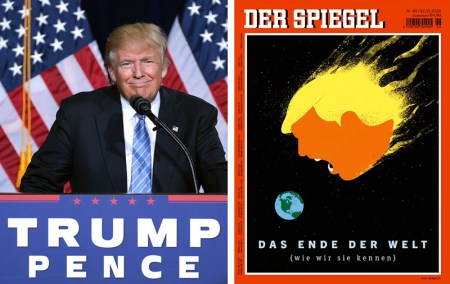
2062In Germany, Der Spiegel, one of the largest-circulation publications in Europe, published a cover, after Donald Trump’s election victory, with an image of a giant meteor in the shape of Trump’s head hurtling towards the earth. The headline reads: “The End of the World (As We Know It)”.

In an article, “Trump’s Victory Ushers in Dangerous Instability,” Spiegel commentator Roland Nelles wrote:

“It really happened. He did it. Donald Trump proved all experts wrong…. A man who… preaches hate and snubs America’s most important partners will run the most powerful country on Earth. It is a political catastrophe.

“Crude populism has triumphed over reason. Trump’s success is a shock for all those who had counted on the political wisdom of American voters….

“The world, and America, is now threatened by a dangerous phase of instability: Donald Trump wants to make America ‘great’ again. If one believes his pronouncements, he will proceed ruthlessly: He wants to throw 11 million migrants out of the country, renegotiate all major trade agreements and make important allies such as Germany pay for US military protection. That will trigger significant conflict, incite new rivalries and spur new crises.”

In an opinion article, “An Absurd and Dangerous President,” Spiegel commentator Klaus Brinkbäumer wrote:

“The United States has voted for a dangerously inexperienced and racist man — one who was swept into the White House by an army of disenfranchised white working- and middle-class Americans. It is a movement that now threatens democracy around the world….

“In other words, 60 million Americans acted stupidly. They cast their votes for xenophobia, racism and nationalism, the end of equal rights and social conscience, for the end of climate treaties and health insurance. Sixty million people followed a demagogue who will do little for them.

“Those who have lived in New York or experienced dinner conversations in Georgetown and debates at Harvard University’s Kennedy School of Government, know how brilliantly intelligent and worldly Americans can be…. Once you get outside such circles, such cosmopolitan thinking isn’t nearly as widespread.”

The Munich-based Süddeutsche Zeitung, in an article, “Trump’s Foreign Policy: What This Election Means for the World,” stated:

“The man who politicians around the world called ‘scary,’ ‘ignorant’ or ‘irrational’ will move into the White House. The uncertainty around the world is great. If cartoonists are to be believed, Donald Trump’s idea of the world is very simplistic. Africa is the birthplace of Barack Obama. Russia is a country that was made great again. Great Britain is a no-go area.”

The Hamburg-based Die Zeit, in an article, “Trump and How He Sees the World,” wrote:

“Wow. The West crumbles before our eyes. What is going on here can be explained by two data points: On November 9, 1989, the wall fell in Berlin…. On November 9, 2016, exactly 27 years later, a man has been elected to the White House whose central election pledge was the construction of a wall.

“The ideas of the new president are neither contradictory nor confused. His demands can be easily summarized on the cap of a beer bottle: integrate Putin, keep Mexicans out and treat American allies as the customers of a security service. There is only protection if one pays cash, even in NATO.

In a commentary, “The End of the Enlightenment,” Zeit essayist Adrian Daub wrote:

“Donald Trump is a remnant of a dying America…. He has turned the country from a multicultural lighthouse into an isolated island of white people who are afraid of their own shadow.

“The idea of American exceptionalism, the lighthouse, was already present at the foundation of the nation…. The idea of American radiance is one with the ideas of the Enlightenment that came from Europe to the colonies. Ideas like universal values or the human striving for truth.

“Trump’s election means the end of this project. The United States is no longer a lighthouse, but a flaming fire of tired shadows armed to the teeth. No trace remains of its prototypical character, its imitability. It is defiant, closed to the world. The nationalism of isolationism… the tumultuous tribalism… are shaking the foundations of the Enlightenment.

“The US upheld the values of the Enlightenment — humanism, an optimistic image of man, human dignity and civil rights — when Europe deviated from them in the thirties. It used humanism as a weapon in the struggle against fascism, its universality as a counterpart to nationalism, and with its re-importation after the Second World War has contributed to the reestablishment of the European project. Today, these values are once more in trouble in Europe, but the view across the Atlantic will not be reassuring as of January.”

Other German headlines include: “Trump has the Charisma of a Drunken Elephant,” “Donald Trump: A Horror Clown as a Security Risk,” “Trump: How Could this Happen?,” “Plans of the New US President: How Trump Wants to Poison the Air,” “Donald Trump: A Blow to Open Society,” “America Chooses the Great Divider,” “Donald Trump: A King Without a Plan,” “Donald is not Ronald,” “Donald is not Churchill,” “Can Trump also Happen in Germany?,” “How to Prevent a German Trump,” “Who Can Stop Trump Now?,” and “Will Berlin Have to Pay More for Defense?

In Britain, the Guardian published an editorial, “The Guardian View on Trump’s Foreign Policy: A Threat to Peace,” which stated:

“The victory of Donald Trump shatters the notion that the US can be counted on by its allies not just for defense guarantees and economic cooperation, but even as a defender of liberal democracy, rather than a threat to it. It calls into question the traditional US role as a protector of a UN-based global architecture of multilateralism….

“For Donald Trump, politics — like business — is about deal making. He thinks man-to-man talk with dictators can instantly dissolve problems, and approaches foreign affairs as zero sum game in which making America great can mean demeaning its traditional friends. His election makes the world a more dangerous place and also a more uncertain place, for it is too early to say precisely how those dangers will materialize — or how the next US president will face up to them.”

The Guardian, in an essay, “A Win for Trump was a Win for Bigotry,” columnist Owen Jones wrote:

“Hang on a minute: who am I as a Briton to interfere in the internal affairs of a foreign country? The problem is the entire world is now subject to the writ of the leader of the last superpower. We are all, to a degree, under his dominion….

“Trumpism is, by nature, an authoritarian movement that regards democratic norms as dispensable if they fail to serve political ends. The aspiration — whether realizable or not — is clear: authoritarian societies such as Putin’s Russia, Erdoğan’s Turkey and Orbán’s Hungary that maintain certain democratic trappings as a convenient front.

“If the American people simply accept the legitimacy of this president, and they normalize this would-be tyrant, it will only embolden him…. Civil disobedience should be employed where necessary. Don’t just do it for yourself, America. The fate of the rest of the world will be determined by your choices.”

Other British headlines include: “Will Donald Trump Destroy America?,” “Why President Donald Trump is an Even Bigger Disaster than You Thought,” “Donald Trump’s Victory is a Disaster for Liberal Values,” “Donald Trump’s Victory is a Disaster for Modern Masculinity,” “Privacy Experts Fear Donald Trump Running Global Surveillance Network,” “Terrifying Trump Will Turn into Tamed Trump? It’s an Illusion,” “The Magnetic Pull of Trump, King Narcissist,” “Will Donald Trump Make School Lunches Unhealthy? Doctors Warn the President-elect’s Penchant for Burgers and Fried Chicken Could Hit Meal Trays,” “In the Age of Trump, Why Bother Teaching Students to Argue Logically?,” and “Donald Trump Believed to be Direct Descendant of Rurik the Viking who Established Russian State.”

In Spain, where anti-Americanism has held sway for many decades, the newspaper El Paíspublished an essay, “Declaration of War against Stupidity,” which showcases the contempt many Europeans have for ordinary Americans. The newspaper’s long-time essayist, John Carlin, wrote:

“The victory of Trump represents a rebellion against reason and decency. It is the triumph of racism, or misogyny, or stupidity — or all three things at once. It is the expression of the poor judgment and bad taste of 60 million Americans, the vast majority of them men and women of white skin who own homes, cars, firearms and eat more than citizens of any other country on earth.

“This is where you see with perfect clarity the stupidity, frivolity and irresponsibility of those who voted for Trump. For all of Clinton’s defects, they are trivial compared to those of Trump, whose ignorance, zero principles and zero experience in governance are joined by all forms of personal vices that every person in their right mind at any latitude of the world considers deplorable.

“I know the kind who voted for Trump. I met them when I made reports in Texas, Montana, Arizona, Oklahoma, Alabama and other typically Republican states. They tend to be kind, religious and honest people, decent in their reduced social orbit. But after sitting down to talk with them for a while I always reacted with the same perplexity: how is it possible that we speak the same language? Their words are familiar to me but their brain circuits operate differently. They are people of simple faith, oblivious to the irony; people who choose their truths not based on facts but on their beliefs or prejudices; people who live far from the ocean and the rest of planet Earth, of which they are afraid. I’ve never experienced a similar sense of disconnection in Europe, Africa or Latin America. Just inside the United States.”

In Austria, Kronen Zeitung published a headline entitled, “Nuclear Suitcase: In 72 Days Trump Could Annihilate Civilization.” Also in Austria, Kurier published a story entitled, “Trump Victory: Boon for Suicide Hotlines.” In France, the newspaper Libération featured a cover with Trump and the words “American Psycho.” Another headline read: “United States: The Empire of the Worst.” L’Obs asked, “With Trump, the Beginning of De-Globalization?Le Figaro wrote: “Donald Trump: From Clown to President,” and “Europe Paralyzed by the Trump Shock.” Le Monde wrote, “Donald Trump’s Victory: A Brexit for America.” In the Netherlands, Telegraaf declared, “Trump is a Nightmare for Europe.”

How is one to interpret the resurgence of anti-American sentiment in Europe?

Although President Obama’s foreign policy missteps, especially those in the Middle East, have made Europe much less safe than it was eight years ago, European elites have overlooked Obama’s mistakes because he is a “globalist” who seems to favor recreating the United States in the European image. Trump, by contrast, is a nationalist who wants to rebuild the United States in the American, not the European, image.

European anti-Americanism is certain to escalate in the years ahead, not because of Trump or his policies, but because “globalists” appear desperate to save the failing European Union, an untransparent, unaccountable, anti-democratic, sovereignty-grabbing alternative to the nation state.

Europeans have time and again overestimated their ability to make a fragmented Europe act like a single unified actor. As it turns out, anti-Americanism is a powerful ideology that has wide appeal across Europe — not just among the elites.

In the past, European federalists have tried to make anti-Americanism the basis of a new pan-European identity. This artificial post-modern European “citizenship,” which demands allegiance to a faceless bureaucratic superstate based in Brussels, has been presented as a globalist alternative to the nationalism of the United States. In essence, to be “European” means to not be American.

As the European Union comes apart at the seams, Europe’s political establishment can be expected to try to exploit anti-Americanism in a desperate attempt to use it as a glue to hold a fractured Europe together.

Whether or not that succeed depends, ironically, on U.S. President-elect Donald Trump. If he can demonstrate that he is able to govern the United States and produce tangible results, especially by growing the economy and curbing illegal immigration, Trump is certain to energize support for anti-establishment politicians in Europe, many of whom are already polling well in a number of upcoming general elections.

Commenting on Trump’s victory, Dutch Parliamentarian Geert Wilders, wrote: “America has just liberated itself from political correctness. The American people expressed their desire to remain a free and democratic people. Now it is time for Europe. We can and will do the same!”

Putin: Russia will oppose any attempts to break global strategic balance, incl. NATO missile system

November 18, 2016

Putin: Russia will oppose any attempts to break global strategic balance, incl. NATO missile system

Published time: 18 Nov, 2016 12:07 Edited time: 18 Nov, 2016 13:27

Source: Putin: Russia will oppose any attempts to break global strategic balance, incl. NATO missile system — RT News

Russian President Vladimir Putin © Sergei Karpukhin / Reuters

Russia will oppose attempts to disrupt the strategic balance around the world, such as NATO’s global anti-ballistic missile defense system, Russian President Vladimir Putin said.

Our goal is to effectively neutralize any military threats to Russia’s security, including those of the [NATO] strategic anti-ballistic missile defense system, the prompt global strike concept and information warfare,” Putin told the Russian military.

We will continue to do everything needed to preserve the strategic balance of power,” he said, adding that the balance was what had prevented a major military conflict between the opposing camps during the Cold War.

Putin was speaking to Russian generals and defense industry captains in Sochi on Friday, concluding a series of defense-related meetings. He said Russia will continue to develop advanced military technology to protect itself.

“Leading world powers are currently using the most advanced scientific knowledge for weapons development. It includes laser technologies, hypersound technologies, and robotics. Russia is conducting such research too,” the president said.

“As we create advanced weapons systems we strictly follow the international obligations that Russia has taken upon itself. But some other nations, as we all know, cancel previous agreements. As was the case with anti-ballistic missile defense,” Putin added, referring to the withdrawal from the ABM Treaty in 2002 by the administration of then US President George W Bush.

Moscow accuses the US and its NATO partners of compromising Russian national security by developing means to counter Russia’s nuclear deterrence, expanding the alliance towards Russian borders and developing advanced conventional strike technology that may be used for a large attack.

NATO Panics As Putin Urges Trump To Force Alliance Withdrawal From Russian Border

November 13, 2016

NATO Panics As Putin Urges Trump To Force Alliance Withdrawal From Russian Border

Source: NATO Panics As Putin Urges Trump To Force Alliance Withdrawal From Russian Border | Zero Hedge

While many in the media have speculated that the Kremlin had a hand in Wikileaks’ procurement of hacked Podesta emails – something Julian Assange denied last week – and US intelligence services officially accused Russian government-supported hackers of interfering with the US election (providing zero proof for the allegation), the truth is that Vladimir Putin is delighted with the outcome from the US elections: not so much for Hillary’s loss as that the sharp, neo-con wing in the Pentagon has been muted for the next four years.

And, in the first test of Trump’s willingness to rebuild bridges with Russia, Putin’s spokesman suggested that President-elect Donald Trump should begin rebuilding the U.S.-Kremlin relationship by urging NATO to withdraw forces from the Russian border.  Dmitry Peskov told the Associated Press that such a move  “would lead to a kind of detente in Europe.” Trump repeatedly praised Putin during his campaign and suggested the U.S. abandon its commitment to the NATO alliance.

The request comes at a time of disturbing, relentless escalations in military tensions between NATO and Russia: this week we reported that NATO has placed as much as 300,000 troops on “high alert” in preparation for confrontation with Russia.

Peskov said in the interview that the NATO presence does not make Russia feel “safe.”  “Of course, we have to take measures to counter,” he said.

Additionally, setting the stage for Trump’s official position on Crimea, in a separate interview with the Associated Press on Thursday, Peskov insisted that Crimea which became part of Russia after the CIA-sponsored Ukraine presidential coup in 2014, will remain such.   “No one in Russia — never — will be ready to start any kind of discussion about Crimea,” he said, refusing to call it “annexation.”

When asked how Trump could approach the Crimea issue, quoted by The Hill, Peskov said it would take time. “We understand that it will take time for our partners in Europe, for our partners here in the United States to understand that. We are patient enough to wait until this understanding occurs here in Washington, in the States, in Europe,” he said.

* * *

But while the Crimea issue is largely moot, with the West resigned to its concession to Moscow, fears that Trump will indeed follow Russia’s advice and pressure the alliance into standing down, or worse, withdraw US support, has resulted in outright panic, and according to German Spiegel, NATO strategists are planning for a scenario in which Trump orders US troops out of Europe.

Spiegel adds that strategists from NATO Secretary-General Jens Stoltenberg’s staff have drafted a secret report which includes a worst-case scenario in which Trump orders US troops to withdraw from Europe and fulfills his threat to make Washington less involved in European security.

“For the first time, the US exit from NATO has become a threat” which would mean the end of the bloc, a German NATO officer told the magazine. During his campaign, Trump repeatedly slammed NATO, calling the alliance “obsolete.” He also suggested that under his administration, the US may refuse to come to the aid of NATO allies unless they “pay their bills” and “fulfill their obligations to us.”

Of course, this is the same Spiegel which after Trump’s victory has predicted the end of the world.

“We are experiencing a moment of the highest and yet unprecedented uncertainty in the transatlantic relationship,” said Wolfgang Ischinger, former German ambassador in Washington and head of the prominent Munich Security Conference. By criticizing the collective defense, Trump has questioned the basic pillar of NATO as a whole, Ischinger added.

Alternatively, by putting into question a core support pillar behind NATO’s endless provocations and troop buildup at Russia’s border, Trump may prevent World War III.

NATO, however, demands its way or no other way at all, and it why Ischinger demands that the president-elect reassure his “European allies” that he remains firm on the US commitment under Article 5 of the NATO charter prior to his inauguration.

This wasn’t the only criticism launched at Trump by the military alliance: earlier this week, Stoltenberg slammed Trump’s agenda, saying: “All allies have made a solemn commitment to defend each other. This is something absolutely unconditioned.” Perhaps the commitment was only contingent on having a resident in the Oval Office who put the interests of the Military Industrial Complex ahead of those of, for example, the American people?

NATO’s panic has grown so vast that out of fear Trump would not appear in Brussels even after his inauguration, NATO has re-scheduled its summit – expected to take place in early 2017 – to next summer, Spiegel said.

The NATO report likley also reflects current moods within the EU establishment as well, as Jean-Claude Juncker, President of the European Commission, has called on the member states to establish Europe’s own military. Washington “will not ensure the security of the Europeans in the long term… we have to do this ourselves,” he argued on Thursday. Because Greek troops just can’t wait to give their lives to defend German citizens and vice versa.

Meanwhile, Spiegel admits that despite NATO’s bluster, Trump has all the leverage, and if Trump is serious about reducing the number of US troops stationed in Europe, large NATO countries like Germany have little to offer, Spiegel said. Even major member states’ militaries lack units able to replace the Americans, which in turn may trigger debate on strengthening NATO’s nuclear arm, a sensitive issue in most European countries for domestic reasons.

How will Trump respond? It is unclear: while in his pre-election rhetoric, Trump pushed for an anti-interventionist agenda, and certainly made it seem that NATO would be weakned under his presidency, that remains to be seen as his transition team currently hammers out the specifics of his rather vague policies. We would not be surprised at all to find that for all the anti-establishment posturing, the “shadow government” – now in the hands of the Bush clan – which Ron Paul warned against earlier, manages to regain dominance, and far from a detente, Trump’s position emboldens NATO to pressure Putin even further. We would be delighted if our cynicism is proven wrong on this occasion.  


Ex-NATO Commander Calls for Non-Cyber Response to Russia

November 4, 2016

Ex-NATO Commander Calls for Non-Cyber Response to Russia’s Election Hacks Breedlove: ‘Null’ response from Obama admin will reward Russia for bad behavior.

BY:

November 3, 2016 4:26 pm

Source: Ex-NATO Commander Calls for Non-Cyber Response to Russia

Philip Breedlove / AP

NATO’s former top commander recommended the U.S. government respond to Russia’s attempts to influence the presidential election through non-cyber means, emphasizing that a “null” answer would merely reward Moscow’s bad behavior.

Gen. Philip Breedlove, former NATO supreme allied commander for Europe and head of the U.S. European Command, said that the United States should considering using a combination of its diplomatic, information, military, and economic tools to punish Russia for directing hacks into U.S. political institutions.

“I don’t believe that a null set is the answer. I believe that we cannot reward bad behavior with no answer,” Breedlove told an audience at the Atlantic Council, a Washington-based international relations think tank, on Thursday when asked to recommend an appropriate U.S. response to the election-related cyber attacks.

“I also believe—and this is discussed quite openly—we rely so much more on cyber than some of our competitors in the world that if we were to start a big fight in cyber, we stand to lose so much more,” Breedlove said. “I don’t think that necessarily is the answer. Again, what I think is that our nation has a broad series of tools—diplomatic, information, military, economic. That’s a crude approximation, but there’s a lot of tools to use and I think that we need to do that creatively, judiciously.”

The retired four-star Air Force general echoed warnings previously sounded by cyber security experts about the vulnerabilities of the United States in starting a “tit-for-tat” cyber conflict with Russia.

Last month, the U.S. intelligence community formally blamed the Russian government for directing cyber attacks on U.S. individuals and organizations, including the Democratic National Committee, in order to influence the presidential election, an accusation that Moscow has denied. The White House has promised to deliver a “proportional” response to Russia for orchestrating the hacks.

Breedlove’s own private emails were released by DC Leaks, a website that has been linked to Russian hackers, earlier this year. The DNC emails, as well as those from the personal email of Hillary Clinton campaign chair John Podesta, have been released by WikiLeaks, which has denied having connections to the Russian government.

Breedlove described Russia’s provocations in cyber space, including the attempted election interference, as an element of Moscow’s “hybrid” warfare or pursuits of conflict “below the threshold.” He criticized the United States for exhibiting “tolerance” for Moscow’s actions.

“What does our tolerance say? What does our action or inaction say as it relates to everything from cyber in an election to continually meddling in the borders in South Ossetia? Where are we setting the bar as it relates to this conflict below the lines or below the thresholds, and what, again, does inaction mean?” Breedlove asked.

The retired general recommended that the next U.S. administration consider using a more “balanced” combination of diplomatic, information, military, and economic tools to deal with Russian aggression, rather than the Obama administration’s current approach of using economic sanctions and pursuing diplomatic relations to turn a corner with Moscow.

Breedlove also said Russia has been emboldened in recent years and views its global influence more positively.

“What Russia wants first and foremost is to be seen as an equal and be treated as a world superpower in a multipolar context. And frankly, what is the view from Moscow right now? They are probably pretty happy,” Breedlove observed. “They see themselves at the center of most of the great power conflict that is going on. They see themselves even at the center of the discussion about the U.S. election. So, I would say that right now Russia feels better about themselves on the world’s stage than they did years before.”

Breedlove retired from his dual-hatted post in May after 39 years of military service. Since his departure, already tense relations between the United States and Moscow have worsened over developments in Syria and a breakdown in cooperation between the powers on nuclear energy. NATO’s decision to deploy four battalions to the Baltic States and Poland on its eastern flank over Russia’s continued intervention in Ukraine has also aggravated Moscow, which has begun deploying forces and military equipment westward.

Breedlove acknowledged the high tensions with Russia but spoke optimistically about the opportunity of the next administration to find a path toward productive dialogue and cooperation with Russia.

At the same time, he expressed concern over Moscow’s pursuit of “below the threshold” competition and its willingness to escalate conflict, as well as the reemergence of the nuclear issue. This week, a high-level Russian official indicated that Norway would become a nuclear target after giving the United States permission to station hundreds of Marines on its borders.

The former commander also highlighted the improvements in Russia’s military capabilities that have been exhibited over the course of Moscow’s interventions in Georgia, Ukraine, and Syria over the last eight years.

“In the western and central and southern military districts, Russia is able to amass force and capability very quickly,” Breedlove explained. “The Russian force is a learning and adaptive force. It did not do so well in the first incursion into Georgia. It got much better when it went into Crimea. It learned in Crimea and was even better when it went into Donbass, and then was even better at several of the things they needed to be good at when they went into Syria.”

“It’s not the 10-foot-tall Soviet Union, but clearly it is a capable force,” he added.

Turkey’s Descent into Islamist Tyranny Deepens

October 31, 2016

Turkey’s Descent into Islamist Tyranny Deepens, Counter Jihad, October 31, 2016

turkey-islamic-1

Turkey’s military forces have just seized the Hagia Sophia, appointing a full-time imam to lead Islamic prayers there after 80 years of it being held as a neutral place for both Christians and Muslims.  The move is symbolic, but shows clearly the designs of Turkey’s Islamist president.

The Turkish government under Recep Tayyip Erdoğan used the abortive coup of this summer to deepen its control over every aspect of Turkish life, but especially the media and education.  Over ten thousand public servants have been purged from the government in recent days, raising the total figure to over a hundred thousand — some 37,000 of whom have been arrested. Erdoğan has pressed the Turkish parliament to reinstate the death penalty so that he can begin disposing of those he has identified as his enemies.

“Our government will take this proposal [on capital punishment] to parliament. I am sure parliament will approve it, and when it comes back to me, I will ratify it…Soon, soon, don’t worry. It’s happening soon, God willing. The West says this, the West says that. Excuse me, but what counts is not what the West says. What counts is what my people say.”

According to CounterJihad’s sources, the detained who are subjected to trial must submit to having all of their conversations with their lawyers recorded whenever the prosecution requests it.  Such recordings are of course admissible as evidence against the client — or the lawyer, if he comes to be considered an enemy of the state from working too hard to defend people already classified as ‘enemies of the state.’

The detained include especially members of opposition media.  The leadership of the Cumhuriyet daily newspaper, which is nearly a century old, were arrested and their laptops seized by the police.  Their paper is not only critical of Erdoğan , but occasionally supportive of the Kurdish minority.  That appears to be grounds for arrest in Turkey now:  even two mayors were seized by order of a Turkish court on suspicion of being sympathetic to Kurdish militants.  In addition to the attacks on the Cumhuriyet daily, 15 Kurdish news outlets have been shuttered by order of the state.  A pro-Kurdish television station was raided by police and forced off the air.

In addition to the media, the state has moved to consolidate control over its system of higher education.  Some 1267 academics who signed a “Peace Petition” last January have been removed from their jobs according to CounterJihad’s sources, and several have been arrested and charged with “terroristic acts” for signing or forwarding that petition.  Our sources tell us that under the new laws, President Erdoğan must personally approve all new university presidents.

At the same time, the Turkish government is pressing NATO to end its naval mission aimed at containing migration flows across the Mediterranean sea.  Turkey claims that the mission is no longer needed, but the siege of Mosul is expected to produce at least a million new refugees in the coming months.  The Russian operations against Aleppo are likewise expected to produce new waves of migrants.

Turkey appears to be using its position within NATO to advance Russia’s interest here, which is to flood Europe with migrants in order to overburden European governments.  That will produce a Europe less able to resist Russian expansion into Eastern Europe.  Turkey and Russia recently signed a major energy deal, clearing the way for at least an economic alliance.  Erd also moved to abandon daylight savings time, a shift that places Turkey in the same time zone as Moscow.  Russia for its part appears to be negotiating a peace between Turkey and Iran on a partition of Iraq, one that would give Turkey greater control over its Kurdish problems.  If Russia succeeds in peeling Turkey off from NATO, it would invalidate the alliance as NATO requires unanimous decisions for all military decisions.