Posted tagged ‘national security’

Obama Orders National Security Workforce to Address ‘Intersectionality’

October 5, 2016

Obama Orders National Security Workforce to Address ‘Intersectionality’ Washington Free Beacon, October 5, 2016

(Islam is tolerant and peaceful; we must root out unconscious Islamophobia! — DM)

President Barack Obama pauses during a discussion with actor Leonardo DiCaprio and Dr. Katharine Hayhoe about climate change as part of the White House South by South Lawn event on the South Lawn of the White House in Washington, Monday, Oct. 3, 2016. (AP Photo/Carolyn Kaster)

President Barack Obama,  Oct. 3, 2016. (AP Photo/Carolyn Kaster)

President Obama is ordering all national security agencies to expand the use of “unconscious bias” training and address “intersectionality” in a late push for diversity and inclusion push in the federal government.

The president issued a memorandum on Wednesday entitled “Promoting Diversity and Inclusion in the National Security Workforce.” The memo requires all 17 intelligence agencies, including the Pentagon, State Department, and Department of Homeland Security, to report back in four months on their progress in collecting information about diversity in their workforces, such as employees’ sexual orientation and gender identity.

Obama listed “diversity” as “our greatest asset” in keeping America safe.

“Our greatest asset in protecting the homeland and advancing our interests abroad is the talent and diversity of our national security workforce,” Obama said in the seven-page memo. “Under my administration, we have made important progress toward harnessing the extraordinary range of backgrounds, cultures, perspectives, skills, and experiences of the U.S. population toward keeping our country safe and strong.”

The memo outlines several requirements for the security agencies, including an order to expand “unconscious bias” and “inclusion” training. Unconscious bias training rests on the theory that “everyone is a little bit racist or sexist.”

Intelligence agencies have already begun to use the training. Last year the intelligence community brought in a Google executive for a seminar on unconscious bias. The Justice Department is also training more than 33,000 federal agents on “implicit bias.”

President Obama is now making unconscious bias training mandatory for senior leadership positions at the FBI, CIA, NSA, and Defense Department, as well as for officials in charge of approving security clearances.

“Agencies shall expand their provision of training on implicit or unconscious bias, inclusion, and flexible work policies and make implicit or unconscious bias training mandatory for senior leadership and management positions, as well as for those responsible for outreach, recruitment, hiring, career development, promotion, and security clearance adjudication,” the memo reads.

The training can be phased in, and priority will be given to divisions that rank low on the New Inclusion Quotient, or “New IQ,” average. The New IQ is calculated by asking employees about the “5 Habits of Inclusion” to see if their work environment is “supportive” and “empowering.”

The unconscious bias training will be used to address “intersectionality.”

“Agencies should give special attention to ensuring the continuous incorporation of research-based best practices, including those to address the intersectionality between certain demographics and job positions,” according to the memo.

Intelligence agencies are also required to “reward and recognize efforts to promote diversity and inclusion.”

“They are also encouraged to create opportunities for senior leadership and supervisors to participate in outreach events and to discuss issues related to diversity and inclusion with the workforce on a regular basis, including with employee resource groups,” according to the memo.

Political correctness has been blamed for intelligence failures in the past. The FBI interviewed Omar Mateen, the terrorist who murdered 49 people at an Orlando nightclub, two times after he made pro-terrorist comments to coworkers, but dropped both investigations. Mateen told the FBI he was the victim of religious discrimination from coworkers because he was Muslim.

The administration is also requiring agencies to collect more information on employees, including voluntary disclosures on sexual orientation and gender identity. The memo orders the agencies to “identify additional categories” of information to collect on current workers so they can meet diversity goals.

“Further, agencies may also collect additional demographic data, such as information regarding sexual orientation or gender identity,” the memo said.

In addition to top security agencies, the memo applies to the United States Agency for International Development, the Department of the Treasury’s Office of International Affairs and Office of Critical Infrastructure Protection, and the Justice Department’s FBI and National Security Division.

The guidance will affect over 3 million people who make up the national security workforce. The agencies must report on their progress in 120 days.

Meet the New Authoritarian Masters of the Internet

September 29, 2016

Meet the New Authoritarian Masters of the Internet

by John Hayward

29 Sep 2016

Source: Meet the New Authoritarian Masters of the Internet – Breitbart

Getty Images

President Barack Obama’s drive to hand off control of Internet domains to a foreign multi-national operation will give some very unpleasant regimes equal say over the future of online speech and commerce.

In fact, they are likely to have much more influence than America, because they will collectively push hard for a more tightly controlled Internet, and they are known for aggressively using political and economic pressure to get what they want.

Here’s a look at some of the regimes that will begin shaping the future of the Internet in just a few days, if President Obama gets his way.

China

China wrote the book on authoritarian control of online speech. The legendary “Great Firewall of China” prevents citizens of the communist state from accessing global content the Politburo disapproves of. Chinese technology companies are required by law to provide the regime with backdoor access to just about everything.

The Chinese government outright banned online news reporting in July, granting the government even tighter control over the spread of information. Websites are only permitted to post news from official government sources. Chinese online news wasn’t exactly a bastion of freedom before that, of course, but at least the government censors had to track down news stories they disliked and demand the site administrators take them down.

Unsurprisingly, the Chinese Communists aren’t big fans of independent news analysis or blogging, either. Bloggers who criticize the government are liable to be charged with “inciting subversion,” even when the writer in question is a Nobel Peace Prize winner.

Chinese citizens know better than to get cheeky on social media accounts, as well. Before online news websites were totally banned, they were forbidden from reporting news gathered from social media, without government approval. Spreading anything the government decides is “fake news” is a crime.

In a report labeling China one of the worst countries for Internet freedom in the world, Freedom House noted they’ve already been playing games with Internet registration and security verification:

The China Internet Network Information Center was found to be issuing false digital security certificates for a number of websites, including Google, exposing the sites’ users to “man in the middle” attacks.

The government strengthened its real-name registration laws for blogs, instant-messaging services, discussion forums, and comment sections of websites.

A key feature of China’s online censorship is that frightened citizens are not entirely certain what the rules are. Huge ministries work tirelessly to pump out content regulations and punish infractions. Not all of the rules are actually written down. As Foreign Policy explained:

Before posting, a Chinese web user is likely to consider basic questions about how likely a post is to travel, whether it runs counter to government priorities, and whether it calls for action or is likely to engender it. Those answers help determine whether a post can be published without incident — as it is somewhere around 84 percent or 87 percent of the time — or is instead likely to lead to a spectrum of negative consequences varying from censorship, to the deletion of a user’s account, to his or her detention, even arrest and conviction.

This was accompanied by a flowchart demonstrating “what gets you censored on the Chinese Internet.” It is not a simple flowchart.

Beijing is not even slightly self-conscious about its authoritarian control of the Internet. On the contrary, their censorship policies are trumpeted as “Internet sovereignty,” and they aggressively believe the entire world should follow their model, as the Washington Post reported in a May 2016 article entitled “China’s Scary Lesson to the World: Censoring the Internet Works.”

China already has a quarter of the planet’s Internet users locked up behind the Great Firewall. How can anyone doubt they won’t use the opportunity Obama is giving them, to pursue their openly stated desire to lock down the rest of the world?

Russia

Russia and China are already working together for a more heavily-censored Internet. Foreign Policy reported one of Russia’s main goals at an April forum was to “harness Chinese expertise in Internet management to gain further control over Russia’s internet, including foreign sites accessible there.”

Russia’s “top cop,” Alexander Bastrykin, explicitly stated Russia needs to stop “playing false democracy” and abandon “pseudo-liberal values” by following China’s lead on Internet censorship, instead of emulating the U.S. example. Like China’s censors, Russian authoritarians think “Internet freedom” is just coded language for the West imposing “cultural hegemony” on the rest of the world.

Just think what Russia and China will be able to do about troublesome foreign websites, once Obama surrenders American control of Internet domains!

Russian President Vladimir Putin has “chipped away at Internet freedom in Russia since he returned to the Kremlin in 2012,” as International Business Times put it in a 2014 article.

One of Putin’s new laws requires bloggers with over 3,000 readers to register with the government, providing their names and home addresses. As with China, Russia punishes online writers for “spreading false information,” and once the charge is leveled, it’s basically guilty-until-proven-innocent. For example, one of the “crimes” that can get a blogger prosecuted in Russia is alleging the corruption of a public official, without ironclad proof.

Human-rights group Agora estimates that Russian Internet censorship grew by 900% in 2015 alone, including both court orders and edicts from government agencies that don’t require court approval. Censorship was expected to intensify even further throughout 2016. Penalties include prison time, even for the crime of liking or sharing banned content on social media.

Putin, incidentally, has described the entire Internet as a CIA plot designed to subvert regimes like his. There will be quite a few people involved in the new multi-national Internet control agency who think purging the Web of American influence is a top priority.

The Russian government has prevailed upon Internet Service Providers to block opposition websites during times of political unrest, in addition to thousands of bans ostensibly issued for security, crime-fighting, and anti-pornography purposes.

Many governments follow the lead of Russia and China in asserting the right to shut down “extremist” or “subversive” websites. In the United States, we worry about law enforcement abusing its authority while battling outright terrorism online, arguing that privacy and freedom of speech must always be measured against security, no matter how dire the threat. In Russia, a rough majority of the population has no problem with the notion of censoring the Internet in the name of political stability, and will countenance absolutely draconian controls against perceived national security threats. This is a distressingly common view in other nations as well: stability justifies censorship and monitoring, not just physical security.

Turkey

Turkey’s crackdown on the Internet was alarming even before the aborted July coup attempt against authoritarian President Recep Tayyip Erdogan.

Turkey has banned social media sites, including temporary bans against even giants like Facebook and YouTube, for political reasons. Turkish dissidents are accustomed to such bans coming down on the eve of elections. The Turkish telecom authority can impose such bans without a court order, or a warning to offending websites.

Turkey is often seen as the world leader in blocking Twitter accounts, in addition to occasionally shutting the social media service down completely, and has over a 100,000 websites blacklisted. Criticizing the government online can result in anything from lost employment to criminal charges. And if you think social-media harassment from loyal supporters of the government in power can get pretty bad in the U.S., Turks sometimes discover that hassles from pro-regime trolls online are followed by visits from the police.

Turkish law infamously makes it a crime to insult the president, a law Erdogan has already attempted to impose beyond Turkey’s borders. One offender found himself hauled into court for creating a viral meme – the sort of thing manufactured by the thousands every hour in America – that noted Erdogan bore a certain resemblance to Gollum from Lord of the Rings. The judge in his case ordered expert testimony on whether Gollum was evil to conclusively determine whether the meme was an illegal insult to the president.

The Turkish example introduces another idea common to far too many of the countries Obama wants to give equal say over the future of the Internet: intimidation is a valid purpose for law enforcement. Many of Turkey’s censorship laws are understood to be mechanisms for intimidating dissidents, raising the cost of free speech enough to make people watch their words very carefully. “Think twice before you Tweet” might be good advice for some users, but regimes like Erdogan’s seek to impose that philosophy on everyone. This runs strongly contrary to the American understanding of the Internet as a powerful instrument that lowers the cost of speech to near-zero, the biggest quantum leap for free expression in human history. Zero-cost speech is seen as a big problem by many of the governments that will now place strong hands upon the global Internet rudder.

Turkey is very worried about “back doors” that allow citizens to circumvent official censorship, a concern they will likely bring to Internet control, along with like-minded authoritarian regimes. These governments will make the case that a free and open Internet is a direct threat to their “sovereign right” to control what their citizens read. As long as any part of the Internet remains completely free, no sector can be completely controlled.

Saudi Arabia

The Saudis aren’t too far behind China in the Internet rankings by Freedom House. Dissident online activity can bring jail sentences, plus the occasional public flogging.

This is particularly lamentable because Saudi Arabia is keenly interested in modernization, and sees the Internet as a valuable economic resource, along with a thriving social media presence. Freedom House notes the Internet “remains the least repressive space for expression in the country,” but “it is by no means free.”

“While the state focuses on combatting violent extremism and disrupting terrorist networks, it has clamped down on nonviolent liberal activists and human rights defenders with the same zeal, branding them a threat to the national order and prosecuting them in special terrorism tribunals,” Freedom House notes.

USA Today noted that as of 2014, Saudi Arabia had about 400,000 websites blocked, “including any that discuss political, social or religious topics incompatible with the Islamic beliefs of the monarchy.”

At one point the blacklist included the Huffington Post, which was banned for having the temerity to run an article suggesting the Saudi system might “implode” because of oil dependency and political repression. The best response to criticism that your government is too repressive is a blacklist!

The Saudis have a penchant for blocking messaging apps and voice-over-IP services, like Skype and Facetime. App blocking got so bad that Saudi users have been known to ask, “What’s the point of having the Internet?”

While some Saudis grumble about censorship, many others are active, enthusiastic participants in enforcement, filing hundreds of requests each day to have websites blocked. Religious figures supply many of these requests, and the government defends much of its censorship as the defense of Islamic values.

As with other censorious regimes, the Saudi monarchy worries about citizens using web services beyond its control to evade censorship, a concern that will surely be expressed loudly once America surrenders its command of Internet domains.

For the record, the Saudis’ rivals in Iran are heavy Internet censors too, with Stratfor listing them as one of the countries seeking Chinese assistance for “solutions on how best to monitor the Iranian population.”

North Korea

You can’t make a list of authoritarian nightmares without including the psychotic regime in Pyongyang, the most secretive government in the world.

North Korea is so repressive the BBC justly puts the word “Internet” in scare quotes, to describe the online environment. It doesn’t really interconnect with anything, except government propaganda and surveillance. Computers in the lone Internet cafe in Pyongyang actually boot up to a customized Linux operating system called “Red Star,” instead of Windows or Mac OS. The calendar software in Red Star measures the date from the birth of Communist founder Kim Il-sung, rather than the birth of Christ.

The “Internet” itself is a closed system called Kwangmyong, and citizens can only access it through a single state-run provider, with the exception of a few dozen privileged families that can punch into the real Internet.

Kwangmyong is often compared to the closed “intranet” system in a corporate office, with perhaps 5,000 websites available at most. Unsurprisingly, the content is mostly State-monitored messaging and State-supplied media. Contributors to these online services have reportedly been sent to re-education camps for typos. The North Koreans are so worried about outside contamination of their closed network that they banned wi-fi hotspots at foreign embassies, having noticed information-starved North Korean citizens clustering within range of those beautiful, uncensored wireless networks.

This doesn’t stop South Koreans from attempting cultural penetration of their squalid neighbor’s dismal little online network. Lately they’ve been doing it by loading banned information onto cheap memory sticks, tying them to balloons, and floating them across the border.

Sure, North Korea is the ultimate totalitarian nightmare, and since they have less than two thousand IP addresses registered in the entire country, the outlaw regime won’t be a big influence on Obama’s multi-national Internet authority, right?

Not so fast. As North Korea expert Scott Thomas Bruce told the BBC, authoritarian governments who are “looking at what is happening in the Middle East” see North Korea as a model to be emulated.

“They’re saying rather than let in Facebook, and rather than let in Twitter, what if the government created a Facebook that we could monitor and control?” Bruce explained.

Also, North Korea has expressed some interest in using the Internet as a tool for economic development, which means there would be more penetration of the actual global network into their society. They’ll be very interested in censoring and controlling that access, and they’ll need a lot more registered domains and IP addresses… the very resource Obama wants America to surrender control over.

Bottom line: contrary to left-wing cant, there is such a thing as American exceptionalism – areas in which the United States is demonstrably superior to every other nation, a leader to which the entire world should look for examples. Sadly, our society is losing its fervor for free expression, and growing more comfortable with suppressing “unacceptable” speech, but we’re still far better than anyone else in this regard.

The rest of the world, taken in total, is very interested in suppressing various forms of expression, for reasons ranging from security to political stability and religion. Those governments will never be comfortable, so long as parts of the Internet remain outside of their control. They have censorship demands they consider very reasonable, and absolutely vital. The website you are reading right now violates every single one of them, on a regular basis.

There may come a day we can safely remand control of Internet domains to an international body, but that day is most certainly not October 1, 2016.

National Security Professionals and Cyber Experts Call for Pentagon Intervention on Surrender of the Internet

September 28, 2016

National Security Professionals and Cyber Experts Call for Pentagon Intervention on Surrender of the Internet, Center for Security Policy, September 26, 2016

csp

Washington, D.C.: Dozens of experienced national security professionals and experts on cyber threats and warfare joined forces today to urge the Secretary of Defense and Chairman of the Joint Chiefs of Staff to oppose the transfer of the last vestige of U.S. control of the Internet to a non-profit organization in less than a week.

As things stand now, on 1 October, President Obama intends to transfer all responsibilities for naming and numbering domain addresses on the Internet to a non-profit organization known as the Internet Corporation for Assigned Names and Numbers (ICANN). Should that happen, the United States will no longer have any control over the addresses that serve to make all websites accessible and allow users to connect to the Internet. Currently, the U.S. Department of Commerce’s National Telecommunications and Information Administration (NTIA) reviews all new addresses and authorizes them to be posted to the authoritative root server (the “A Server”) by Verisign.

In the attached letter to Defense Secretary Ashton Carter and Joint Chiefs of Staff Chairman Gen. Joseph Dunford, current and former leaders in industry, national security, homeland and cyber security express strong concerns about the likely implications of such a step and seek a one-year delay to allow full consideration of these issues:

The Internet Assigned Numbers Authority function is critical to our nation’s ability to effectively defend our national assets and civilian population and ensure integrity in our cyberwarfare capabilities….DoD is reliant upon private sector critical infrastructure for its operations, and the integrity and security of the IP addresses associated with these assets are equally important to the protection of the American people.

Of…immediate concern to us…is the prospect that the United States might be transferring to future adversaries a capability that could facilitate, particularly in time of conflict, cyberwarfare against us. In the absence of NTIA’s stewardship, we would be unable to be certain about the legitimacy of all IP addresses or whether they have been, in some form or fashion, manipulated, or compromised. Given the reliance of the U.S. military and critical infrastructure on the Internet, we must not allow it to be put needlessly at risk.

The signatories, headed by storied leaders of the defense industrial sector and cyberspace, CACI International’s Executive Chairman, J.P. “Jack” London, and the former Chairman of Network Solutions, Michael A. Daniels, represent several centuries’ worth of experience in safeguarding America and its computer systems. They conclude with the bottom line: “There is, to our knowledge, no compelling reason for exposing the national security to such a risk by transferring our remaining control of the Internet in this way at this time.”

To learn more about what is at stake and the necessity of the executive branch and/or the Congress preventing this needless and avoidable disaster, contact Jody Westby, CEO of Global Cyber Risk LLC, at 202-255-2700 or westby@globalcyberrisk.com.

Here is the letter:

September 26, 2016

Hon. Ashton B. Carter
Secretary of Defense The Pentagon
Washington, D.C. 20301

General Joseph F. Dunford, Jr.
Chairman, Joint Chiefs of Staff The Pentagon
Washington, D.C. 20301

Dear Secretary Carter and Chairman Dunford:

As individuals with extensive, first-hand experience with protecting our national security, we write to urge you to intervene in opposition to an imminent action that would, in our judgment, cause profound and irreversible damage to the United States’ vital interests.

On October 1st, the contract between the Commerce Department’s National Telecommunications and Information Administration (NTIA) and the Internet Corporation for Assigned Names and Numbers (ICANN) will expire. Upon expiration, the President will allow the Government’s remaining control over the Internet to transfer to ICANN. This includes the Internet Assigned Numbers Authority (IANA) function and NTIA’s review of all Internet Protocol addresses and authorization for them to be placed on the authoritative root server (the A Server). In simple terms, nothing now is accessible on the Internet until it has undergone an IP address assignment and NTIA review and NTIA has authorized Verisign to post the address to the A server.

The IANA function is critical to our nation’s ability to effectively defend our national assets and civilian population and ensure integrity in our cyberwarfare capabilities. As Congress has considered this transfer of authority, it has stated that ICANN should ensure that .mil and .gov remain exclusive to DoD and that all IP addresses assigned to DoD are used exclusively by the Government. That ignores the fact that DoD is reliant upon private sector critical infrastructure for its operations, and the integrity and security of the IP addresses associated with these assets are equally important to the protection of the American people.

In the absence of U.S. Government involvement in IANA, it seems possible that, over time, foreign powers – including potentially or actually hostile ones – will be able to influence the IANA process. Even coercing the delay in approving IP addresses could impact military capabilities. From a broader view, given the well-documented ambition of these actors to restrict freedom of expression and/or entrepreneurial activity on the Internet, such a transfer of authority to ICANN could have far-reaching and undesirable consequences for untold numbers of people worldwide.

Of more immediate concern to us, however, is the prospect that the United States might be transferring to future adversaries a capability that could facilitate, particularly in time of conflict, cyberwarfare against us. In the absence of NTIA’s stewardship, we would be unable to be certain about the legitimacy of all IP addresses or whether they have been, in some form or fashion, manipulated, or compromised. Given the reliance of the U.S. military and critical infrastructure on the Internet, we must not allow it to be put needlessly at risk.

Indeed, there is, to our knowledge, no compelling reason for exposing the national security to such a risk by transferring our remaining control of the Internet in this way at this time.

In light of the looming deadline, we feel compelled to urge you to impress upon President Obama that the contract between NTIA and ICANN cannot be safely terminated at this point. At a minimum, given the irreversible character of this decision and its potential for grave and enduring harm to our national security and other vital interests, the decision should be delayed.

Sincerely,

J.P. “Jack” London
Executive Chairman CACI International, Inc.

Michael A. Daniels
Former Chairman, Network Solutions

Jody R. Westby
CEO, Global Cyber Risk LLC and
Former Chief Administrative Officer & Counsel, In-Q-Tel

Adm. James A. “Ace” Lyons, USN (Ret.) Former Commander-in-Chief
U.S. Pacific Fleet

Frank J. Gaffney, Jr.
Former Assistant Secretary of Defense (Acting)

Lt. Gen. William “Jerry” Boykin, USA (Ret.)
Former Deputy Under Secretary of Defense for Intelligence

Hon. Pete Hoekstra
Former Chairman, House Intelligence Committee

Oliver “Buck” Revell
Associate Deputy Director (Ret.) Federal Bureau of Investigation

Lt. Gen. Thomas McInerney, USAF (Ret.)
Former Deputy Chief of Staff, United States Air Force

Hon. Michelle Van Cleave
Former Counter-Intelligence Executive

Rep. Brian Babin (TX-36)
Chairman, House of Representatives’ Committee on Science Space and Technology Subcommittee

Hon. Jon Kyl
Former Senate Minority Whip

Dr. Lani Kass
Former Director, Air Force Chief of Staff’s Cyber Task Force

Hon. Charles E. Allen
Former Under Secretary of the Department of Homeland Security for Intelligence and Analysis

Lt. Gen. C. E. McKnight, Jr., USA (Ret.)
Former Director, Command and Control Systems for Nuclear Forces, Joint Chiefs of Staff

Hon. John G. Grimes
Former Assistant Secretary, Networks & Information Integration and
DoD, Chief Information Officer

Lt. Gen. Robert J. Elder, USAF (Ret.)
Former Commander, U.S. Air Force Network Operations

Rep. Dave Brat (VA-7)

Vice Adm. Robert R. Monroe, USN (Ret.)
Former Director, Defense Nuclear Agency

Maj. Gen. Henry Canterbury, USAF (Ret.)
Former Operations and Readiness, Air Staff Pentagon

Daniel J. Gallington
Former General Counsel Senate Select Committee on Intelligence

Maj. Gen. Harold “Punch” Moulton, USAF (Ret.)
Former Director of Operations, U.S. European Command

Maj. Gen. Kenneth R. Israel, USAF (Ret.)
Former Director of Defense Airborne Reconnaissance Office

Andrew McCarthy
Former Chief Assistant U.S. Attorney Southern District of New York

Hon. Paula A. DeSutter
Former Assistant Secretary of State and Professional Staff Member, U.S. Senate Select Committee on Intelligence

Rear Adm. Philip S. Anselmo, USN (Ret.)
Former Director of Command Control Communications Computers and Intelligence (C4I)

Rear Adm. Pierce J. Johnson, USN (Ret.)
Former Chief of Staff, U.S. Regional Headquarters, Lisbon (Portugal)

Lt. Gen. C. Norman Wood, USAF (Ret.)
Former Director, Intelligence Community Staff

Dan Goure
Former Director of the Office of Strategic Competitiveness in the Office of the Secretary of Defense

Thomas H. Handel
Former Executive Director, Naval Information Warfare Activity (now Navy Cyber Warfare Development Group)

Vice Adm. Edward W. Clexton, Jr., USN (Ret.)
Former Deputy Commander, U.S. Atlantic Fleet, Commander, Carrier Strike Group, and Deputy Commander in Chief, US Naval and Marine Forces, Europe

Vice Adm. Jerry L. Unruh, USN (Ret.)
Former Commander, U.S. Third Fleet

Rear Adm. Albert A. Gallotta, Jr., USN (Ret.)
Vice Commander, Naval Electronics Systems Command

Rear Adm. H. Winsor Whiton, USN (Ret.)
Former Commander of the Naval Security Group and former Deputy Director of the National Security Agency for Plans, Policy, and Programs

Lt. Gen. Bennett L. Lewis, USA (Ret.)
Former Deputy Assistant Secretary of Defense, Mobilization and Director, Defense Mobilization Systems Planning Activity

Lt. Gen. Tex Brown, USAF (Ret.)
Former Assistant Vice Chief of Staff, U.S. Air Force

Rear. Adm. Charles R. Kubic, CEC, USN (Ret.)
Former Commander, First Naval Construction Division

Rear Adm. Phillip R. Olson, USN (Ret.)
Former President of the U.S. Navy Board of Inspection and Safety

Victoria Coates
National Security Advisor to Sen. Ted Cruz

Morgan Wright
Senior Fellow, Center for Digital Government

Mike Steinmetz
President & CEO, Digital Executive LTD

Brig. Gen. Peyton Cole, USAF (Ret.)
Former Executive Secretary, U.S. Department of Defense

Capt. David E. Meadows, USN (Ret.)
Former Deputy Commander Naval Security Group

Capt. Scott W. Witt, USN (Ret.)
Former Chief, Weapons and Space, National Security Agency

Capt. Michael Sare, USN (Ret.)
Former Navy Cryptologist / Cyber Warfare Officer

Katherine C. Gorka
President, Council on Global Security

Col. R. J. Peppe, USAF (Ret.)
Former Chief, Selection Board Secretariat

Michael J. Jacobs
Former Information Assurance Director, NSA

Gwyn Whittaker
Former CEO, Mosaic, Inc.

Lynn Schnurr
Former Army Chief Information Officer and Defense Intelligence Senior Executive Service

Frederick Fleitz
Senior VP, Center for Security Policy and former CIA Analyst

Daniel J. Bongino
Former Secret Service Agency, Presidential Protection Division

Col. F. E. Peck, USAF (Ret.)

Lt. Col. Jim Webster, USAF (Ret.)

Lt. Col. Floyd H. Damschen, USAF (Ret.)

Col. Raymond C. Maestrelli, DDS USAF (Ret.)

Col. Ed Leonard, USAF (Ret.)

Maj. Gen. Gary L. Harrell, USA (Ret.)

Christian Whiton
Former State Department Senior Advisor

Maj. Gen. John Miller, USAF (Ret.)

Maj. Gen. Timothy A. Peppe, USAF (Ret.)

Col. Richard W. Dillon, USA (Ret.)

Lt. Col. Ronald King, USA (Ret.)

David P. Goldman
Columnist, Asia Times and PJ Media Capt.

James H. Hardaway, USN (Ret.)

Lt. Gen. Gordon E. Fornell, USAF (Ret.)

Rear Adm. Thomas F. Brown III, USN (Ret.)

Col. Daniel Pierre, USAF (Ret.)

S.C. Robinson, Ret.
Section Manager, Y-12 National Security Complex

Richard T. Witton, Jr. (Ret.)

Col. Michael R. Cook (Ret.)

Roger Kimball Editor and author

Larry Cox
President, Western Slopes Security Services

Angie Lienert
President & CEO, IntelliGenesis LLC

Col. Willard Snell, USAF (Ret.)

David Winks
Managing Director, AcquSight, Inc.

Maj. Gen. Michael Snodgrass, USAF (Ret.)

U.S. Military: We Meant to Attack Islamic State, Not Syrian Army

September 18, 2016

U.S. Military: We Meant to Attack Islamic State, Not Syrian Army

by Breitbart Jerusalem

17 Sep 2016

Source: U.S. Military: We Meant to Attack Islamic State, Not Syrian Army – Breitbart

Putin has to keep his cool til 20 January 2017 when trump is sworn in as president of the USA

AFP

The BBC reports: The US-led coalition has admitted its planes carried out an attack in eastern Syria that the Russian army says killed at least 62 Syrian troops fighting IS.

The US said its planes halted the attack in Deir al-Zour when informed of the Syrian presence and would not knowingly strike them.

The strikes allowed IS jihadists to advance, the Russians said.

…The US Central Command statement said the coalition believed it was attacking positions of so-called Islamic State and the raids were “halted immediately when coalition officials were informed by Russian officials that it was possible the personnel and vehicles targeted were part of the Syrian military”.

Read the full story here.

Yes, Hillary Knows Classified Information Does Not Always Come with a ‘Header’

September 8, 2016

Yes, Hillary Knows Classified Information Does Not Always Come with a ‘Header’, PJ MediaAndres C. McCarthy, September 6, 2016

(Hillary’s comments about “headers” are in the first substantive part of her appearance during the commander in chief forum and during the question and answer segment. — DM)

who-me

Well, it looks like Hillary Clinton’s oft-repeated canard — “I never sent or received any e-mails marked classified” — has been so thoroughly discredited that it now poll-tests poorly. Hence, she broke out a new wineskin for the same old rotgut at last night’s candidate forum: the “header.”

The issue arose when she was bluntly questioned by a military vet who pointed out that, had he recklessly mishandled classified information the way she did, he’d have been prosecuted. She countered:

Classified material has a header that says “top secret,” “secret,” “confidential.” None of the emails sent or received by me had such a header. What we have here is the use of an unclassified system by hundreds of people in our government to send information that was not marked. There were no headers, there was no statement … “top secret,” “secret” or “confidential.”

Obviously, Mrs. Clinton is tactically morphing “marked” into “header” because some of her emails were marked classified.

Were she to repeat the “nothing marked classified” lie and leave it at that, the public would be reminded not only that she is known to have lied about this (FBI director Comey acknowledged as much in his House testimony); but also that she fibbed in ludicrous fashion when called on the markings in her FBI interview — claiming to have believed the “(C)” designation had to do with putting paragraphs in alphabetical order. (Of course, it refers to classified information at the confidential level, something well known to Clinton because, among other reasons, she was for a decade a heavy-duty consumer of classified documents, in which the “(C)” designation is ubiquitous.)

Clinton is also seeking to exploit what little is to be gained from the FBI’s feeble defense of her transmission of documents marked classified. Comey noted that there were “portion markings” within three e-mail documents (meaning there were designations — e.g., “(C)” — that indicated a particular paragraph in the document was classified). Yet, he also testified that those documents did not conform to the proper procedure for marking documents classified. That procedure includes placing on the document a header indicating its classification level (e.g., “confidential,” “secret” or “top secret”), so there is no mistaking its status.

Clearly, the absence of a header does not change the fact that the classified portions of the three documents in question were marked as such. Nor does it alter the fact that Mrs. Clinton, a regular consumer of classified information who claims always to have been careful in handling it, would have known exactly what the markings meant — and, thus, that storing or transmitting a document containing such markings on a private, non-secure system was illegal.

Nevertheless, as I have repeatedly pointed out since the Clinton email scandal came to light in March 2015, this whole brouhaha about “marked” classified — and, in its new iteration, classification “headers” — is a red herring. A great deal of classified information is not marked at all.

If an official with a security clearance sits in on a meeting or briefing at which classified information is presented orally, it would be unlawful for that official to transmit that information via a non-government, non-classified email system. The fact that such an email would obviously not be marked would make no difference — officials trained in handling classified information and given security clearances for access to it are intimately aware of the rules.

To take another notorious example, General David Petraeus, the former CIA director, knew that his diaries contained top secret information notwithstanding the absence of markings and headers designating them as such. That is why, when he pled guilty to mishandling classified information, he did not attempt to use the lack of markings on the diaries as a defense. Such a claim, he had to know, would have been frivolous.

But the most significant point here is that Hillary Clinton knows that what she is saying is nonsense.

As Jeryl Bier recently pointed out at the Weekly Standard, Clinton signed a “Classified Information Nondisclosure Agreement” on January 22, 2009 upon becoming secretary of State. That agreement clearly states (my italics):

As used in this Agreement, classified information is marked or unmarked classified information, including oral communications, that is classified under the standards of Executive Order 12959, or under any other Executive order or statute that prohibits the unauthorized disclosure of information in the interest of national security[.]

Not only does her Agreement elucidate in unmistakable terms that no markings or headers are necessary for information to be deemed classified. It also includes Clinton’s acknowledgment that “I have received a security indoctrination concerning the nature and protection of classified information.” This, despite telling the FBI in her interview that she couldn’t recall any briefing or training regarding the handling of classified information.

Droves of African Migrants in Mexico Awaiting U.S. Asylum Under Secret Pact

September 2, 2016

Droves of African Migrants in Mexico Awaiting U.S. Asylum Under Secret Pact, Judicial Watch, September 1, 2016

The African migrants’ journey begins in Brazil under a South American policy that allows the “free transit” of immigrants throughout the continent. Ecuador, Costa Rica, Nicaragua and Panama facilitate the process by transferring the concentration of foreigners towards Mexico based on an agreement that Mexico will help them gain entry into the U.S. so they can solicit asylum.

The Obama administration has done a great job of promoting its various back-door amnesty programs, which include perpetually extending a humanitarian measure designed to temporarily shield illegal immigrants from deportation during emergencies.

*****************

Herds of African immigrants are being housed in shelters in the Mexican border town of Tijuana while they await entry into the United States under what appears to be a secret accord between the Obama administration, Mexico and the Central American countries the Africans transited on their journey north. A backlog of African migrants is overwhelming limited shelter space in Tijuana and Mexican officials blame the slow pace of U.S. immigration authorities in the San Isidro port of entry for granting only 50 asylum solicitations daily.

Details about this disturbing program come from Mexico’s immigration agency, Instituto Nacional de Migracion (INM), and appear this week in an article published by the country’s largest newspaper. “Mexico is living through a wave of undocumented Africans, due to a humanitarian crisis on that continent, that has saturated shelters in Tapachula, Chiapas, and generated pressure on shelters in Tijuana, Baja California,” the news article states. The African migrants’ journey begins in Brazil under a South American policy that allows the “free transit” of immigrants throughout the continent. Ecuador, Costa Rica, Nicaragua and Panama facilitate the process by transferring the concentration of foreigners towards Mexico based on an agreement that Mexico will help them gain entry into the U.S. so they can solicit asylum.

The Africans are mostly entering Mexico through the southern state of Chiapas, which borders Guatemala. This week alone 424 Africans arrived at the Chiapas immigration station, which is situated in Tapachula. Shelters in Tijuana currently have 154 migrants from African countries waiting on their U.S. asylum solicitations, according to figures provided by the INM. “The undocumented don’t want to stay in Mexico,” the news article clarifies. “They want to make it to U.S. territory to solicit asylum based on the life conditions that prevail in the continent.” Authorities in Tijuana are offering support to migrants from El Congo, Somalia, Ghana and Pakistan to facilitate entering the U.S. through the San Isidro crossing, according to the news story. San Isidro is the largest land border crossing between San Diego, California and Tijuana.

The Obama administration has done a great job of promoting its various back-door amnesty programs, which include perpetually extending a humanitarian measure designed to temporarily shield illegal immigrants from deportation during emergencies. It’s known as Temporary Protected Status (TPS) and in the last few years migrants from several African countries have received it so the new influx is not all surprising. Guinea, Liberia and Sierra Leone got TPS back in 2014 over the lingering effects of the Ebola Virus and earlier this year Homeland Security Secretary Jeh Johnson extended it. The administration cited the “continued recovery challenges” the African countries face for the extension.

Last summer Johnson extended a TPS for Somalians until March 17, 2017, which could have served as a driving force behind the sudden surge via Latin America. A notice in the Federal Register says the extension was warranted because the conditions in Somalia that prompted the TPS designation continue to be met. “There continues to be a substantial, but temporary, disruption of living conditions in Somalia due to ongoing armed conflict that would pose a serious threat to the personal safety of returning Somali nationals, as well as extraordinary and temporary conditions in the country that prevent Somali nationals from returning to Somalia in safety,” the notice states. “The Secretary has also determined that permitting eligible Somali nationals to remain temporarily in the United States is not contrary to the national interest of the United States.”

What’s the Plan for Winning the War?

August 25, 2016

What’s the Plan for Winning the War?, Counter Jihad, August 25, 2016

Who is even thinking about how to win the war?  Will the legacy of the Obama administration be a shattered NATO, a Turkey drawn into Russia’s orbit, an Iranian hegemony over the northern Middle East, and a resurgent Russia?  It certainly looks to be shaping up that way.  Russia is playing chess while the US is playing whack-a-mole.  The absence of a coherent governing strategy is glaring.

**********************

Michael Ledeen makes a clever observation:

Everyone’s talking about “ransom,” but it’s virtually impossible to find anyone who’s trying to figure out how to win the world war we’re facing.  The two keystones of the enemy alliance are Iran and Russia, and the Obama administration, as always, has no will to resist their sorties, whether the Russians’ menacing moves against Ukraine, or the Iranians’ moves against us.

The moves are on the chessboard, sometimes kinetic and sometimes psychological warfare.  Like a chess game, we are in the early stages in which maneuver establishes the array of forces that will govern the rest of the game.  Russia’s deployment of air and naval forces to Syria stole a march on the Obama administration.  Its swaying of Turkey, which last year was downing Russian aircraft, is stealing another.  Its deployment of bombers and advanced strike aircraft to Iran is another.  That last appears to be in a state of renegotiation, as Ledeen notes, but that too is probably for show.  The Iranians have too much to gain in terms of security for their nuclear program, at least until they’ve had time to build their own air force.

Iran is making strategic moves as well.  Ledeen notes the “Shi’ite Freedom Army,” a kind of Iranian Foreign Legion that intends to field five divisions of between twenty and twenty-five thousand men each.  Overall command will belong to Quds Force commander Qassem Suliemani, currently a major figure in the assault on Mosul, having recovered from his injury in Syria commanding Iranian-backed militia in the war there.  The fact of his freedom of movement is itself a Russian-Iranian demonstration that they will not be governed by international law:  Suliemani is under international travel bans for his assassination plot against world diplomats, but was received in Moscow and now travels freely throughout the northern Middle East.

Turkey, meanwhile, has been effectively cut off by Iran’s and Russia’s success in the opening game of this global chess match.  As late as the Ottoman Empire, the Turks looked south through Iran and Iraq to power bases as far away as Arabia.  Now the Ayatollahs are going to control a crescent of territory from Afghanistan’s borders to the Levant, leaving the Turks locked out.  One might have expected the Turks to respond by doubling their sense of connection to Europe and NATO.  Instead, the purge following the alleged coup attempt is cementing an Islamist control that leaves the Turks looking toward a world from which they are largely separated by the power of this new Russian-Iranian alliance.  The Turks seem to be drifting toward joining that alliance because being a part of that alliance will preserve their ties to the Islamic world.

For now, the Obama administration seems blind to the fact that these moves are closing off America’s position in the Middle East.  This is not a new policy.  Eli Lake reports that the Obama administration told the CIA to sever its ties to Iranian opposition groups in order to avoid giving aid to the Green revolution.  Their negotiation of last year’s disastrous “Iran deal” has led to Iran testing new ballistic missiles and receiving major arms shipments from Russia.  Yet while all these moves keep being made around them, the Obama administration proceeds as if this were still just an attempt to crush the Islamic State (ISIS).  The commander of the XVIIIth Airborne Corps has been given a task that amounts to helping the Iranians win.  Our incoherent policy has left us on both sides in Syria.  Our only real ally in the conflict, the Kurds, stand abandoned by America.

Who is even thinking about how to win the war?  Will the legacy of the Obama administration be a shattered NATO, a Turkey drawn into Russia’s orbit, an Iranian hegemony over the northern Middle East, and a resurgent Russia?  It certainly looks to be shaping up that way.  Russia is playing chess while the US is playing whack-a-mole.  The absence of a coherent governing strategy is glaring.

African Migrants Brawl with Locals on French Island of Corsica

August 22, 2016

African Migrants Brawl with Locals on French Island of Corsica

by Thomas D. Williams, Ph.D.

15 Aug 2016

Source: African Migrants Brawl with Locals on French Island of Corsica

Getty

Tense relations between locals and North African migrants led to a violent skirmish between members of the two groups this weekend on the French island of Corsica, leading to several injuries and torched vehicles.

Authorities had to deploy some 100 police officers and firefighters to the small resort town of Sisco to try to restore order after a conflict grew out of hand, moving quickly from strong words to violence. In the end, the use of tear gas was necessary to stop the riot.

Witnesses claimed that an argument broke out Saturday evening when some tourists took a picture of a group of three families of North African Muslims sitting on a beach, with their women all wearing veils. The North Africans vocally objected to being photographed, and then a group of Corsicans arrived and began quarrelling with the migrants.

As the fight continued, a crowd of dozens of local inhabitants gathered and some started throwing stones and bottles, and three vehicles presumably belonging to the North Africans were set on fire.

In the violence that ensued, two Corsicans were wounded, with one being stabbed in the ribs by a spear, and three Africans were injured as well, including a pregnant woman. The five injured people were taken to the hospital but subsequently released.

The French Interior Ministry confirmed that the incident had taken place, but didn’t specify the nationality of the people attacked, simply calling them “foreigners.”

“Four people injured, including a pregnant woman, were evacuated to the hospital in Bastia,” the ministry said in a statement, adding that “three vehicles were burned, causing severe traffic disruption.”

French Interior Minister Bernard Cazeneuve condemned the violence, saying that he would mobilize all his forces to investigate into the incident, promising to get to the bottom of these “intolerable acts” and punish those responsible.

In a statement, the minister also urged citizens to remain calm so as to “avoid any escalation” of the events, and to assume “a sense of responsibility.”

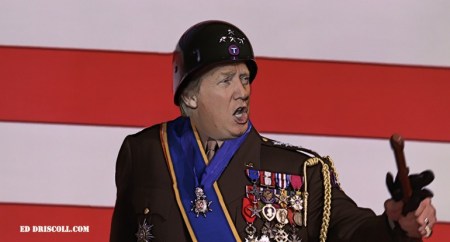
Will National Security Finally Bring Warring Republicans Together?

August 19, 2016

Will National Security Finally Bring Warring Republicans Together? PJ Media, Roger L Simon, August 18, 2016

trump_patton_banner_8-18-16-1.sized-770x415xc

Will national security finally bring warring Republicans together?

That was what was on my mind when I perused an email from Stephen Miller, Donald Trump’s national policy director, describing a roundtable on defeating radical Islamic terrorism the Trump campaign held Wednesday.  It read in part:

The participants talked about improving immigration screening and standards to keep out radicals, working with moderate Muslims to foster reforms, and partnering with friendly regimes in the Middle East to stamp out ISIS. This is a stark contrast to Hillary Clinton who wants to bring in 620,000 refugees with no way to screen them…

All well and good, I thought, but nothing extraordinary there, until I scanned the list of the sixteen participants.  Besides the usual Trump spokespeople—Rudy Giuliani, Jeff Sessions, General Mike Flynn—some surprising names popped up that had been critics of Donald, often severe ones.  Among them were former Attorney General Michael Mukasey, who once called a Trump presidency dangerous in that notorious January 2016 edition of the National Review when a boatload of conservative intellectuals ripped into the real estate tycoon as the Devil’s son; Congressman Peter King, who as recently as August 10 remonstrated with Donald for his “dumb remark” on the Second Amendment that allegedly encouraged gun owners to go after Hillary (King agreed that it didn’t really, but insisted Trump should choose his words better); and Andrew C. McCarthy, the former U. S. attorney famed for his successful prosecution of Sheik Omar Abdel Rahman in the 1993 first bombing of the World Trade Center.

McCarthy—now a best-selling author and columnist for the National Review and PJ Media, among other venues—had this to say on NRO about Trump after his July convention speech:

On Thursday night came the harvest: The party was formally taken over by an incoherent statist whose “conservatism” is not done justice by scare quotes. Oh… and he has trouble telling the good guys from the bad guys.

Whoa. Words like that don’t usually get you invited to the subject’s roundtable, at least without some considerable advance peacemaking.  And yet there was McCarthy, sitting at Trump’s table.

Andy McCarthy has been a friend of mine for some years, so I decided to call him and pick his brain about what went down.

As it turned out, McCarthy told me, the event was not contentious at all. Bygones were apparently bygones.  In fact, Trump was so cordial to him, Andy wondered whether Donald knew who he was.  (I strongly suspect he did.  As we all know, Trump watches The Kelly File—where McCarthy appears frequently—with some devotion.)

The meeting was quite substantive from Andy’s perspective with all agreeing that we are at war not with “terror” (a tactic) but with radical Islam (a violent ideology).  A good deal of time was spent in this lawyer-rich environment on the legalisms of how to pursue that war.  Congress originally authorized the use of military force against terrorists only three days days after September 11, 2001.  Given the gravity of the current situation, would that need to be amended or reauthorized for a Trump administration? And if so, how?  (One can assume a Hillary Clinton administration would not even go near this question.  For them, fighting terror is a police problem.)

McCarthy—who said he spoke seven or eight times, quite a bit for a two-hour session—delineated three goals for the war:

  1. To strike down jihad wherever it arises.
  2. To squeeze all terror-supporting regimes (not give them millions and billions as Obama just did Iran). And:
  3. To rid ourselves of political correctness so we can oppose and destroy the evil doctrine of radical Islam.

Also in attendance were the newbie Trump campaign leaders: new-media mogul Stephen Bannon (now CEO) and pollster Kellyanne Conway (now campaign manager).  Much has been made by the MSM and, alas, by some of Trump’s more persistent Republican critics that the candidate supposedly blew it again by announcing these promotions just after he made a well-received speech on urban policy.  Of course, these same people were complaining a week before that Trump was understaffed.

So it goes in our incessantly back-biting political world where few people want to keep their eye on the ball because that ball—radical Islam—is more than a little frightening.  This roundtable group convened by the Trump campaign evidently intends to keep its eye on that ball and if Republicans have any brains they will rally around them, finally rally around Trump.  Because here’s the painfully obvious truth:  If we don’t extinguish radical Islam, if it continues to spread throughout the world, nothing else matters.  Who cares if the tax rate is 5% or 500% when you don’t have a head.

And now, in his latest speech, Trump has said “in the heat of debate” he “may have caused personal pain.”  Get that?  The long-awaited apology.  Now let’s win!

Gorka: The war is real and the war is here

August 18, 2016

Gorka: The war is real and the war is here, Fox News via YouTube, August 17, 2016