Posted tagged ‘Middle East’

Sinai attacks decline as Egypt’s fight against IS yields results

August 29, 2016

Sinai attacks decline as Egypt’s fight against IS yields results Through targeted bombings on Islamic State’s Jabal Hilal stronghold, Egyptian military deals strong blow to terror group’s capabilities

By Avi Issacharoff

August 29, 2016, 2:51 pm

Source: Sinai attacks decline as Egypt’s fight against IS yields results | The Times of Israel

Smoke rises after a house was blown up in a military operation in Egypt’s Sinai peninsula on November 20, 2014. (Abed Rahim Khatib/Flash90)

There has been a steady and significant decline in terror attacks carried out by the Islamic State in the Sinai Peninsula in recent months, according to both Egyptian and Israeli sources.

Get The Times of Israel’s Daily Edition by email
and never miss our top stories
  Free Sign up!

Though the Islamic State’s armed activities continue apace in the northeast triangle framed by the Israel, Gaza and Egypt borders, there have been fewer terror attacks on the Egyptian army, with a smaller number of casualties than last year, and the attacks have been less ambitious than those IS carried out in 2014 and 2015, as a result of the group’s weakened force and diminished weapons supply.

The Egyptian military’s operations in the central Sinai Peninsula and a series of airstrikes in the Jabal Hilal region — a terrorist-controlled area — have dealt a powerful blow to IS’s military capabilities, the sources said.

For the past few years, Jabal Hilal has been the stronghold of the extremist group in the peninsula, mostly due to its topography.

The region’s extensive cave system — it is considered the “Tora Bora of the Sinai,” an allusion to the rugged region of Afghanistan that Taliban and al-Qaeda fighters made into a bastion against the United States — has made it the preferred destination for IS, the current iteration of the Ansar Bayt al-Maqdis group.

Three months ago, toward the end of May, the Egyptian military spokesperson, Col. Muhammad Samir announced the killings of “88 armed members of the jihadist group in central and northern Sinai.”

May’s large-scale aerial campaign not only took out nearly 100 IS operatives, it also injured hundreds more, dozens of them seriously. In addition to the human casualties, the bombings destroyed the group’s weapons storage facilities and ammunition caches, which had been kept hidden for years.

Essentially, the “logistic front” of the Islamic State in Sinai was destroyed, the sources said.

Around the same time, Egyptian President Abdel-Fattah el-Sissi also discussed the actions against IS, which focused on Jabal Hilal, an area that is seen as particularly problematic. According to Sissi, there had been a significant victory in the fight against terror. However, he clarified, the state of emergency for Egypt would continue.

An image taken from a video clip released by the Sinai affiliate of the Islamic State group on August 1, 2016. (MEMRI)

An image taken from a video clip released by the Sinai affiliate of the Islamic State group on August 1, 2016. (MEMRI)

Earlier this month, the Egyptian military announced another achievement, the execution of Abu Duaa al-Ansari, the presumed commander of the Islamic State in Sinai, formerly known as Ansar Bayt al-Maqdis.

According to the military’s statement, the series of bombings south of el-Arish — the provincial capital of the Sinai — in which al-Ansari was killed came as the result of precise intelligence. During the bombings, a number of weapons storehouses were destroyed and some 45 operatives were killed.

Illustrative: Egyptian security forces in the Sinai, in July 2013. (Mohamed El-Sherbeny/AFP)

Illustrative: Egyptian security forces in the Sinai, in July 2013. (Mohamed El-Sherbeny/AFP)

Throughout 2015, dozens of Egyptian soldiers were killed by IS, with the worst attack taking place during the month of Ramadan in simultaneous assaults on a number of Egyptian military outposts near the town of Sheikh Zuweid that left over 50 dead.

Since the July 1, 2015 attack, however, the Egyptian military’s intelligence has improved. In addition, security collaboration and cooperation with Israel has continued.

Recently, Egypt has made a number of significant gestures in the diplomatic realm, including a rare meet-up between its foreign minister and Prime Minister Benjamin Netanyahu, that testify to the closeness of the two sides.
Turkish army shells Kurds ‘refusing to retreat’ near Jarablus

August 26, 2016

Turkish army shells Kurds ‘refusing to retreat’ near Jarablus – state media Published time: 26 Aug, 2016 01:57

Source: Turkish army shells Kurds ‘refusing to retreat’ near Jarablus – state media — RT News

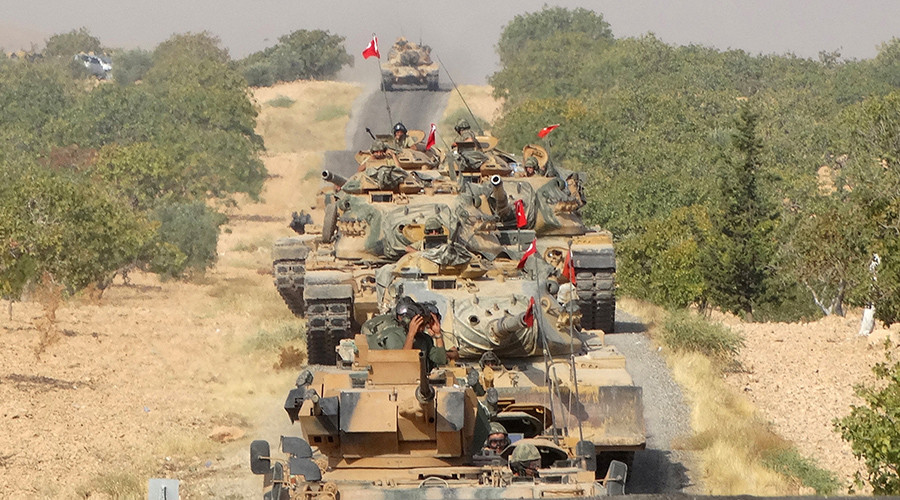
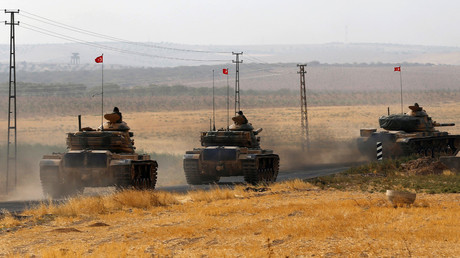
Turkish army tanks make their way towards the Syrian border town of Jarablus, Syria August 24, 2016. © Revolutionary Forces of Syria Media Office / Reuters

Turkish military have targeted US-backed Kurdish YPG militia with artillery fire south of the Syrian border town of Jarablus on Thursday, Anadolu state agency reported, citing a security source. The units allegedly refused to withdraw from the area despite warnings.

The group of YPG fighters were attacked with howitzers at about 6pm local time after they were spotted by Turkish intelligence advancing to Jarablus from the north of Manbij, the report said. Earlier, Washington assured Ankara that the US-backed Kurdish formations have been pulling out forces from the area to the east of the Euphrates River as demanded by Turkey.

READ MORE:Women burn burqas, men cut beards: Manbij celebrates liberation from ISIS (VIDEO, PHOTOS) 

“Kerry [US State Secretary John Kerry] emphasized that the PYD/YPG forces have been withdrawing to the east of the Euphrates,” a Turkish security source was quoted by Hürriyet Daily News as saying following a telephone conversation between the US top diplomat and Turkey’s foreign minister Mevlut Cavusoglu on Thursday morning.

While on a visit to Ankara on August 24, US Vice President Joe Biden pledged to withdraw the support of American forces to Kurdish fighters battling terrorists in Syria if they did not comply with Turkey’s request to remain east of the river.

READ MORE:Turkey shells ISIS & Kurdish positions in Syria

“They cannot, will not and under no circumstances get American support if they do not keep that commitment. Period,” Biden said at a joint news conference with Turkish PM Binali Yildirim.

Read more

Turkish army tanks drive towards to the border in Karkamis on the Turkish-Syrian border in the southeastern Gaziantep province, Turkey, August 25, 2016. © Umit Bektas

Turkey has been conducting Operation Euphrates Shield since Wednesday after its troops entered the borderline territory in the north of Syria with the focus on retaking Jarablus from the Islamic State (IS, ISIS/ISIL) terrorists, which has been occupying it since July 2013. Justifying the incursion, which had not been authorized by the Syrian government, Turkey’s President Recep Tayyip Erdogan said it is aimed at stopping frequent cross-border attacks and repelling “terror groups which constantly threaten our country like Daesh [Arabic derogatory name for IS] and the PYD [the Democratic Union Party of Syria]”.

READ MORE:‘Blatant violation of sovereignty’: Damascus condemns Turkish operation in Jarablus

Meanwhile, Damascus slammed the offensive as “a blatant violation of sovereignty.”

The shelling follows a statement by YPG command saying that Kurdish militia under its control had left Manbij and returned to its bases, turning over the control over the city to the Manbij Military Council, according to Al-Masdar News.

On Wednesday, the YPG denounced the Turkish military offensive in Syria as “a hostile intervention,” refusing to cave in to pressure coming from Turkey.

“We won’t listen to the demands of Turkey or powers outside of Turkey. Turkey cannot impose its own agenda, its own interests on us. Our forces are there. We will not withdraw from west of the Euphrates,” YPG spokesman Redur Xelil said, as cited by Rudaw.

“Its main goal, more than ISIS, is the Kurds,” he pointed out.

Read more

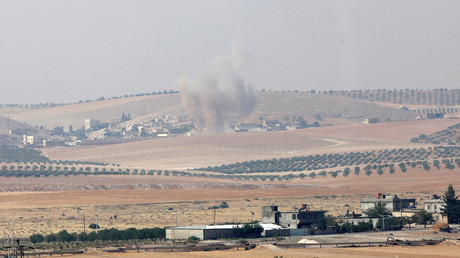
Smoke rises from the Syrian border town of Jarablus as it is pictured from the Turkish town of Karkamis, in the southeastern Gaziantep province, Turkey, August 24, 2016. © Stringer

At the moment, at least 20 Turkish tanks are taking part in operation inside Syria with more armored vehicles are expected to join the effort in the coming days as the Syrian rebels supported by Turkish forces are “cleansing” the city from jihadists.

The former IS stronghold of Manbij was freed by Kurdish-led SDF from jihadists just two weeks ago after months of intense fighting.

The Kurdish People’s Protection Units (YPG) are the armed wing of the Kurdish Democratic Union Party (PYD), close to the Kurdistan Workers’ Party, which Ankara considers a terrorist organization. Turkey has been leading a military campaign against PKK insurgency in the country’s south-eastern Kurdish-populated regions, which has been criticized by rights groups for its brutality. Numerous reports have also suggested that Ankara bombed Kurdish targets inside Syria while allegedly sparing Islamist militants that the YPG have been in bitter battle with.

What’s the Plan for Winning the War?

August 25, 2016

What’s the Plan for Winning the War?, Counter Jihad, August 25, 2016

Who is even thinking about how to win the war?  Will the legacy of the Obama administration be a shattered NATO, a Turkey drawn into Russia’s orbit, an Iranian hegemony over the northern Middle East, and a resurgent Russia?  It certainly looks to be shaping up that way.  Russia is playing chess while the US is playing whack-a-mole.  The absence of a coherent governing strategy is glaring.

**********************

Michael Ledeen makes a clever observation:

Everyone’s talking about “ransom,” but it’s virtually impossible to find anyone who’s trying to figure out how to win the world war we’re facing.  The two keystones of the enemy alliance are Iran and Russia, and the Obama administration, as always, has no will to resist their sorties, whether the Russians’ menacing moves against Ukraine, or the Iranians’ moves against us.

The moves are on the chessboard, sometimes kinetic and sometimes psychological warfare.  Like a chess game, we are in the early stages in which maneuver establishes the array of forces that will govern the rest of the game.  Russia’s deployment of air and naval forces to Syria stole a march on the Obama administration.  Its swaying of Turkey, which last year was downing Russian aircraft, is stealing another.  Its deployment of bombers and advanced strike aircraft to Iran is another.  That last appears to be in a state of renegotiation, as Ledeen notes, but that too is probably for show.  The Iranians have too much to gain in terms of security for their nuclear program, at least until they’ve had time to build their own air force.

Iran is making strategic moves as well.  Ledeen notes the “Shi’ite Freedom Army,” a kind of Iranian Foreign Legion that intends to field five divisions of between twenty and twenty-five thousand men each.  Overall command will belong to Quds Force commander Qassem Suliemani, currently a major figure in the assault on Mosul, having recovered from his injury in Syria commanding Iranian-backed militia in the war there.  The fact of his freedom of movement is itself a Russian-Iranian demonstration that they will not be governed by international law:  Suliemani is under international travel bans for his assassination plot against world diplomats, but was received in Moscow and now travels freely throughout the northern Middle East.

Turkey, meanwhile, has been effectively cut off by Iran’s and Russia’s success in the opening game of this global chess match.  As late as the Ottoman Empire, the Turks looked south through Iran and Iraq to power bases as far away as Arabia.  Now the Ayatollahs are going to control a crescent of territory from Afghanistan’s borders to the Levant, leaving the Turks locked out.  One might have expected the Turks to respond by doubling their sense of connection to Europe and NATO.  Instead, the purge following the alleged coup attempt is cementing an Islamist control that leaves the Turks looking toward a world from which they are largely separated by the power of this new Russian-Iranian alliance.  The Turks seem to be drifting toward joining that alliance because being a part of that alliance will preserve their ties to the Islamic world.

For now, the Obama administration seems blind to the fact that these moves are closing off America’s position in the Middle East.  This is not a new policy.  Eli Lake reports that the Obama administration told the CIA to sever its ties to Iranian opposition groups in order to avoid giving aid to the Green revolution.  Their negotiation of last year’s disastrous “Iran deal” has led to Iran testing new ballistic missiles and receiving major arms shipments from Russia.  Yet while all these moves keep being made around them, the Obama administration proceeds as if this were still just an attempt to crush the Islamic State (ISIS).  The commander of the XVIIIth Airborne Corps has been given a task that amounts to helping the Iranians win.  Our incoherent policy has left us on both sides in Syria.  Our only real ally in the conflict, the Kurds, stand abandoned by America.

Who is even thinking about how to win the war?  Will the legacy of the Obama administration be a shattered NATO, a Turkey drawn into Russia’s orbit, an Iranian hegemony over the northern Middle East, and a resurgent Russia?  It certainly looks to be shaping up that way.  Russia is playing chess while the US is playing whack-a-mole.  The absence of a coherent governing strategy is glaring.

Hamas, Palestinian Authority Target Journalists Ahead of Election

August 23, 2016

Hamas, Palestinian Authority Target Journalists Ahead of Election

by Khaled Abu Toameh

August 23, 2016 at 5:00 am

Source: Hamas, Palestinian Authority Target Journalists Ahead of Election

  • Both of the journalists who were arrested made the mistake of reporting on the suffering of Palestinians living under Hamas rule. These are not the kind of stories that Hamas wishes to see ahead of the local and municipal elections. Rather, Hamas wants to see printed lies of prosperity.
  • It is a puzzle why foreign journalists choose not to report about the campaign of intimidation facing their Palestinian colleagues.
  • One might wonder if the human rights groups neglect these abuses because of their continued obsession with destroying Israel.

Palestinian journalists are at the top of the Palestinian Authority (PA) and Hamas hit-list in the crackdown occurring alongside preparations for the Palestinian local and municipal elections, scheduled for October 8.

The crackdown is part of an ongoing campaign by the two rival parties to silence critics in the West Bank and Gaza Strip. Neither Hamas nor the PA tolerates a free and independent media — especially on the eve of a crucial election that could have far-reaching political implications in the Palestinian arena.

A Hamas victory in the upcoming elections would be catastrophic for President Mahmoud Abbas and his Palestinian Authority. Such an electoral outcome would be tantamount to a vote of no-confidence in their policies and performance.

Hamas, for its part, is investing a huge amount of resources in the election campaign, in hopes that the results would further boost its standing among Palestinians. Hamas fears that a defeat would undermine its power in the Gaza Strip and pave the way for its collapse.

As the election campaign heats up, it is clear that Hamas and the PA agree on one thing: intensifying their repressive measures against Palestinian journalists.

This media crackdown is essentially ignored by international human rights organizations. Why? One reason is that when Israel is not involved, assaults on freedom of the media and expression do not interest them.

Some Western journalists and human rights advocates also treat these cases as “internal Palestinian issues” that are of no relevance to international public opinion. A story about a Palestinian journalist who is arrested by Israel is news. A Palestinian journalist incarcerated or threatened by the Palestinian Authority or Hamas is not.

Take, for example, the case of Ahmed Said, a journalist from the Gaza Strip. Last week, he was arrested by Hamas security forces, who also confiscated his personal computer. Said has a radio show on the Sawt Al Sha’ab (Voice of the People) radio station, where Palestinians call in to voice their grievances and talk openly about the problems they are facing under Hamas rule in the Gaza Strip.

Before he was arrested, Said had phoned the spokesman of the Hamas police force, Ayman Al Batnihi, to discuss the recent rise in cases of homicide in the Gaza Strip. According to the journalist, the furious spokesman threatened him: “You are causing us a lot of problems and inciting people. I know how to deal with people. You need to be hanged.”

Said is no stranger to this sort of encounter. Last year, he was summoned for investigation for “incitement” against the Gaza City Municipality. The move came after Said used his talk show to talk about the case of street vendor Mohamed Abu Assi, who tried to commit suicide by ingesting poison after Gaza City Municipality inspectors banned him from selling corn at the beach.

Earlier, Hamas arrested another Palestinian journalist, this time for no clear reasons. Mahmoud Abu Awwad, who works for the Palestinian daily Al-Quds, was arrested from his home in the Shati refugee camp on July 25. He too had his personal computer and cellular phone seized.

Ahmed Said (left) and Mahmoud Abu Awwad (right) are two journalists living in the Gaza Strip who were recently arrested by Hamas security forces. Both journalists made the mistake of reporting on the suffering of Palestinians living under Hamas rule.

Abu Awwad’s family have since been banned from seeing him in prison. Their son, they were told by Hamas, is being held for “security reasons.” Abu Awwad, who has been working for Al-Quds for the past three years, had been reporting mostly about the hardships facing Palestinians in the Gaza Strip. In addition, he was also reporting for the Saudi London-based pan-Arab daily, Asharq Al Awsat.

“Hamas is trying to spread lies to distort the image of my son and justify his arrest,” Abu Awwad’s father told Al-Quds. “He was arrested because he was critical of the situation in the Gaza Strip and the Hamas government.”

Said and Abu Awwad have something in common. Both journalists made the mistake of reporting on the suffering of Palestinians living under Hamas rule. These are not the kind of stories that Hamas wishes to see ahead of the local and municipal elections. Rather, Hamas wants to see printed lies of prosperity.

In the context of its election campaign, Hamas has released a video featuring new houses and neighborhoods, as well as green and clean parks and smiling children. Entitled, “Thank You Hamas,” the video seeks to persuade Palestinian voters that life under Hamas is the best thing that could ever happen to them. And that is why they need to help Hamas extend its control from the Gaza Strip to the West Bank through the local and municipal elections. Journalists such as Said and Abu Awwad are spoiling the effect with their inconvenient truths.

Hamas, however, is the proverbial pot calling the kettle black. In the face of its own massive journalistic repression, Hamas dares to criticize the Palestinian Authority for taking similar measures in the West Bank.

Like Hamas, the PA leadership has always been intolerant towards Palestinian (and sometimes non-Palestinian) journalists who dare not toe the party line. Hardly a week passes without hearing about another Palestinian journalist who has been arrested or summoned for investigation by the Palestinian Authority.

In recent weeks, the crackdown on journalists in the West Bank seems to have increased in light of the upcoming elections. The PA too wants to remove from the scene any journalist who might harm its loyalists’ chances of winning the local and municipal vote. In this regard, journalists are easy prey.

One of the recent victims is Mohamed Abu Khabisah, who reports on economic issues for the Turkish news agency, Anadolu. Palestinian security officers who raided his home shortly after midnight in Al Bireh, near Ramallah, seized his personal computer and documents before taking him into custody. His wife, Hana, said she too was briefly questioned about her husband’s source of income and the nature of his work. Palestinian sources say he was apparently arrested for reporting about financial corruption in the Palestinian Authority’s official news agency, Wafa.

Abu Khabisah was the sixth journalist to be arrested by the PA since the decision to hold local and municipal elections was taken two months ago. The other four are Yehya Saleh, Raghid Tabisah Ibrahim Al Abed, Mohamed Abu Jheisheh and Ziad Abu Arrah. In another recent incident, Palestinian security officers raided the home of journalist Musab Kafisheh and seized his personal computer, but did not take him into custody.

It is anxiety that is driving Hamas and the Palestinian Authority in their crackdown on Palestinian journalists. The “security reasons” they tout as an excuse for their repression is a foil for their sense of instability: the less politically secure they feel, the more they strip Palestinian journalists of their ability to report how things really stand in the Gaza Strip and the West Bank.

So far, so good, from the point of view of Hamas and the PA. Palestinian reporters have been duly deterred. But they are far from the only ones affected.

Foreign journalists rely almost entirely on Palestinian “fixers” and producers for information about what is happening under the Palestinian Authority and Hamas. Now, local Palestinians will think ten times before they provide their foreign employers with information. Still, it is a puzzle as to why foreign journalists choose not to report about the campaign of intimidation facing their Palestinian colleagues.

One might wonder if the human rights groups neglect these abuses because of their continued obsession with destroying Israel.

Israel strikes Syria

August 23, 2016

Israel strikes Syria After mortar fire landed in the Golan Heights, the Israeli Air Force struck back.

Source: Israel strikes Syria – Defense/Security – News –

Israel Air Force (Illustration)

Israel Air Force

The Israeli Air Force struck a military target in Syria in response to mortar fire which landed in the Golan Heights in the north.

IAF jets scrambled into the air when a mortar strayed over from Syria and exploded in the Golan Heights. The fighter jets targeted a Syrian army missile launcher in retaliation, near Quneitra, Syria.

According to Syrian media, an unmanned aircraft struck a Ba’ath party position at the outskirts of Quneitra.

No one was injured. The mortar landed in open terrain.

No Red Alert rocket sirens sounded when the mortar breached Israeli territory.

Israel maintains a policy that spillover fighting, even of rebels, is the responsibility of the country who allowed it into Israel.

Putin said willing to host Israeli-Palestinian peace talks

August 22, 2016

Putin said willing to host Israeli-Palestinian peace talks Comments by Egypt’s president el-Sissi made to newspaper editors after Israeli delegation arrives in Cairo to discuss peace push

By Times of Israel staff August 22, 2016, 1:39 am

Source: Putin said willing to host Israeli-Palestinian peace talks | The Times of Israel

Russian President Vladimir Putin welcomes Prime Minister Benjamin Netanyahu at the start of a meeting at the Kremlin on June 7, 2016 (screen capture: Facebook)

Amid speculation over a developing Egyptian bid to revive stalled Israeli-Palestinian peace negotiations, Egypt’s President Abdel-Fattah el-Sissi said late Sunday that Russian President Vladimir Putin was willing to host Israeli and Palestinian leaders for direct talks.

In a briefing with newspaper editors in Cairo, Sissi said Israel is increasingly convinced of the need for achieving peace with the Palestinians, according to media reports in Israel and Egypt.

 No peace process could be successful, he told the journalists, without reconciliation between Fatah and Hamas.

He also said Israeli-Palestinian peace, which could enable further burgeoning of Israeli-Arab alliances generally, is the key to regional stability, a sentiment that echoed comments heard in recent months from Jordan’s King Abdullah and other Sunni Arab leaders.

Sissi’s comments follow meetings earlier Sunday between an Israeli delegation in Cairo and Egyptian officials on the Egyptian president’s proposal to revive the peace process.

Israeli officials were scheduled to meet their Egyptian counterparts on Palestinian peace talks, as well as other matters related to the two countries, the Germany news agency DPA reported.

The talks were said to last several hours, according to the report by the Germany agency.

Last week, Palestinian Authority President Mahmoud Abbas reportedly informed Egypt he is no longer opposed to participating in a regional or international peace summit in Cairo.

According to a report on Israel Radio on Friday, the Palestinian leader told an Egyptian delegation in Ramallah that he was willing to attend such a conference, but stressed that the Egyptian peace push would not replace the French initiative to revive talks, which the Palestinians have favored but Israel has strongly opposes.

The PA president also reportedly asked that France, Russia and Switzerland attend the summit.

Abbas urged Egypt to press Prime Minister Benjamin Netanyahu to freeze settlement construction and release Palestinian prisoners ahead of a meeting between the two leaders in Egypt, the report said, but Cairo’s position on the proposed preconditions was not immediately clear.

In July, Palestinian leaders presented several preconditions for participating in a trilateral Israeli-Egyptian-Palestinian peace summit in Cairo, including a freeze on Israeli settlement construction, a Palestinian official told The Times of Israel. Abbas also demanded that Israel acquiesce to negotiations based on the pre-1967 lines and pledge ahead of time to implement any agreements reached in the talks.

Netanyahu in July reportedly told Egyptian Foreign Minister Sameh Shoukry — on a rare visit to Jerusalem — he would be willing to meet with Abbas in Cairo for talks hosted by Sissi. The Prime Minister’s Office did not deny the report by the Saudi-owned, pan-Arab news outlet Al-Arabiya. It said in a statement that “whether the issue was discussed or not, Israel has always said it is prepared to conduct direct bilateral negotiations with no preconditions.”

Prime Minister Benjamin Netanyahu meets with Egypt's Foreign Minister Sameh Shoukry at the Prime Minister's Office in Jerusalem on Sunday, July 10, 2016 (Hadas Parush/Flash90)

Prime Minister Benjamin Netanyahu, right, meets with Egypt’s Foreign Minister Sameh Shoukry at the Prime Minister’s Office in Jerusalem on Sunday, July 10, 2016 (Hadas Parush/Flash90)

Sissi reportedly offered to host direct talks between the sides as part of Cairo’s initiative to kick-start the moribund peace process.

Shoukry’s visit to Israel was the first by an Egyptian foreign minister since 2007. The visit came amid speculation over the renewal of an Arab peace initiative and as Israel’s military recently saluted “unprecedented” intelligence cooperation with Egypt to combat the Islamic State group.

Egyptian President Abdel-Fattah el-Sissi, speaks at the United Nations Sustainable Development Summit in New York, September 25, 2015. (AFP Photo/Dominick Reuter)

Egyptian President Abdel-Fattah el-Sissi, speaks at the United Nations Sustainable Development Summit in New York, September 25, 2015. (AFP Photo/Dominick Reuter)

According to Israel’s Channel 2 television, Shoukry’s surprise visit was also aimed at arranging a first meeting between Netanyahu and Sissi in Egypt in the coming months.

The TV report said Shoukry’s first visit to Israel was coordinated between Egypt and Saudi Arabia, whose Arab Peace Initiative is backed by Sissi and much of the Arab world as the basis of any regional peace effort. Netanyahu has rejected the initiative in its current form, but said in late May that it “contains positive elements that could help revive constructive negotiations with the Palestinians.”

WATCH: Boy Suicide Bomber Stripped of Explosive Belt in Iraq

August 22, 2016

WATCH: Boy Suicide Bomber Stripped of Explosive Belt in Iraq

by Alexander Jones

22 Aug 2016

Source: WATCH: Boy Suicide Bomber Stripped of Explosive Belt in Iraq

Frightening footage has emerged purporting to show Kurdish security forces removing an explosive belt from an alleged Islamic State teenage suicide bomber moments before it was about to be detonated in the northern Iraqi city of Kirkuk on Sunday.

The chilling scene, caught on camera and uploaded to YouTube by Kurdish channel Kurdistan24, shows the boy’s hands being held by two law enforcement officers as another member of the security establishment attempts to disarm the device.

Wearing a Barcelona football shirt before it was cut off, the boy, believed to be 12 or 13 years old, according to Kurdish media network Rudaw, reportedly then burst into tears as he was led away by police.

The arrest is believed to have taken place in Kirkuk’s Huzairan neighbourhood, Rudaw reports, but precise details on where the boy intended to stage his potential attack are unconfirmed — it has been claimed that the boy was planning to blow himself up outside a Shia mosque, however.

The device was later safely destroyed away from the public.

The incident came less than 24 hours after a child as young as 12 killed at least 51 people and injured 69 — 17 of them seriously, according to Turkish president Recep Tayyip Erdogan — in a suicide bombing at a packed wedding ceremony in the southern Turkish city of Gaziantep.

President Erdogan said on Sunday that “Daesh is the likely perpetrator of the attack”, using the Arabic name for ISIS, adding that it is not yet clear whether the youngster detonated the suicide vest or if the explosives were set off remotely by someone else.

What is clear, however, is that IS is mobilizing children at “an ever-accelerating rate”.

According to a report published earlier this year by the West Point-based Combating Terrorism Centre, IS is “mobilizing children and youth at an increasing and unprecedented rate [and] that the number of child and youth militants far exceeds current estimates.”

Contextualizing the upward trend in the terror group’s use of child suicide bombers, the report concluded: “It seems plausible that, as military pressure against the Islamic State has increased in recent months, such operations […] are becoming more tactically attractive.”

Recording instances of young people who were featured in official IS reports as “martyrs” between January 2015 and January 2016, the report found that of the 89 cases surveyed, 39 percent died upon detonating a vehicle-borne explosive device, 33 percent were killed as foot soldiers in unspecified battlefield operations, six percent died while working as propagandists, and four percent committed suicide in mass casualty attacks against the civilian populace.

Israeli Air Force, tanks strike Hamas targets in Gaza after rocket hits Sderot

August 21, 2016

Israeli Air Force, tanks strike Hamas targets in Gaza after rocket hits Sderot

Published time: 21 Aug, 2016 12:37 Edited time: 21 Aug, 2016 13:20

Source: Israeli Air Force, tanks strike Hamas targets in Gaza after rocket hits Sderot — RT News

© Amir Cohen / Reuters

The Israeli military have launched strikes against two Hamas positions in the north of the Gaza Strip, the IDF reported on Twitter, saying the operation was a response to an earlier rocket attack from Gaza.

On Sunday afternoon, both the Israeli Air Force and armored corps on the ground targeted Hamas, who is considered a terrorist organization in Israel.

Earlier in the day, a rocket exploded in the southern Israeli city of Sderot, with the Israeli Defense Force (IDF) saying the missile had been launched from the Gaza Strip.

No injuries or damage have been reported in Sderot, which has a population of 19,000, while the police have called on members of the public to stay away from the scene.

In Gaza, Israeli artillery fire was reported, Haaretz said, citing Palestinian eyewitnesses. Rocket sirens have been sounded in Sderot and nearby communities on the Gaza border, the Israeli media reported.

There so far have been no reports of Palestinian casualties.

In July 2014, rockets from Gaza reportedly left two Sderot residential buildings in ruins. Some 15 people were said to be injured on the Palestinian side in Israel’s attack.

Gazan Rocket Hits Sderot

August 21, 2016

By: Jewish Press News Briefs

Published: August 21st, 2016

Source: The Jewish Press » » Gazan Rocket Hits Sderot

Rocket crossing!
Photo Credit: Asher Schwartz

Two rocket alerts went off in communities near the Gaza border and in Sderot at around 2:25PM on Sunday.

2:35 PM Residents near the Gaza border are reporting that they heard at least one explosion, possibly two.

2:43 PM Confirmed reports that one rocket from Gaza landed in Sderot between 2 houses. No one was injured.

The rocket was launched from Beit Hanoun.

Police are asking citizens to not go to the area where the rocket fell do the the danger.

3:00 PM Arab sources report that the IDF is striking Beit Hanoun area.

There are no reports on why Iron Dome did not take down he rocket.


No ISIS There – Are U.S. Troops In Hasakah “Advising” Kurds To Attack The Syrian Army?

August 20, 2016

No ISIS There – Are U.S. Troops In Hasakah “Advising” Kurds To Attack The Syrian Army?

August 19, 2016

Source: M of A – No ISIS There – Are U.S. Troops In Hasakah “Advising” Kurds To Attack The Syrian Army?

Yesterday a fight broke out between Syrian Arab Army troops and local Kurdish forces in the predominately Kurdish city of Hasakah in north-eastern Syria. Hasakah, with some 200,000 inhabitants, has held a SAA garrison for years. There is some enmity between the Kurds and the soldiers but the situation is generally peaceful.

There have been earlier fights but these were local rivalries between Syrian auxiliary National Defense Forces from local Arab (Christian) minorities and some gangs who form a Kurdish internal security force under the label Asayish. Such fights usually ended after a day or two when grown-ups on both sides resolved the conflict over this or that checkpoint or access route.

The Islamic State (grey on the map) once threatened Hasakah but that danger is now far away.


Map via ISW

Yesterday another fight broke out, but got serious. The Syrian air force was called in to defend against direct attacks on the SAA garrison and minority quarters:

Syrian government warplanes bombed Kurdish-held areas of the northeastern city of Hasaka on Thursday for the first time in the five-year-old civil war, the Syrian Kurdish YPG militia and a monitoring group said.

The Syrian government still has footholds in the cities of Qamishli and Hasaka, both in Hasaka governorate, co-existing largely peacefully with YPG-held swathes of territory.The cause of this week’s flare-up was unclear.

Xelil said government forces were bombarding Kurdish districts of Hasaka with artillery, and there were fierce clashes in the city.

The Syrian Observatory for Human Rights, which tracks the war using a network of activists, said warplanes had targeted Kurdish security forces’ positions in the northwest and northeast of the Hasaka city.

The reason that fighting started might have to do with U.S. troops who, for whatever reason, seem to be in Hasakah. The U.S. military now laments that these troops came under Syrian air force fire:

The Syrian airstrikes took place in the northeastern city of Hasaka, an area that has seen increasing ground clashes between the Kurdish YPG fighters present and the Syrian regime forces. There was a small number of U.S. Special Operators acting as advisers to the YPG when the Syrian airstrikes began.After the Syrian Su-24s began to strike, the U.S. immediately contacted the Russians, Davis said, and made clear that American aircraft would respond if coalition forces were under attack.

The Russians explained that they were not the ones conducting the strikes and the U.S. scrambled manned fighter aircraft to the area to protect the Americans and allies under attack.

By the time the U.S. and coalition aircraft arrived the Syrian attack jets had left.

There is no Islamic State in the area which is now far away from the front line.

  • Why are U.S. troops, who have zero legal grounds of being in Syria at all, in Hasakah city or the wider area?
  • Who are they “advising” there and for what purpose?
  • Why does rare local fighting starts to get serious just when U.S. troops are in the area?

The U.S. has the chutzpah to “warn” the Syrians of defending their own troops on Syrian grounds:

Additional U.S. combat air patrols have been sent to the area yesterday and have been flying there today, as well.Davis said that the Syrians would be “well-advised” not to interfere with coalition forces on the ground in the future.

Syrian government forces are attacked by Kurdish troops who are “advised” by U.S. special forces. According to the U.S. spokesperson the Syrian air force is not allowed to defend them? What has this to do with “fighting ISIS” in eastern Syria which is allegedly the sole reason for U.S. troops being in Syria?

The Syrian air force was back over Hasakah today and continued to bomb position from which the Syrian army was attacked. They would not be flying there without Russian consent. Does the U.S. military want to start a fight with the Syrian air force and its Russian backers?

The YPG Kurds claim they are now evacuating civilians from some city quarters. They seem to expect a prolonged conflict.

Any move against the Syrian army in Hasakah will be watched carefully from Ankara. Turkey fears, with valid reason, that the U.S. supports the Kurdish aim of a  national entity in Syria and Iraq. This would endanger Turkey with its own large Kurdish minority.

If the Kurds expel the Syrian forces from Hasakah with U.S. support, Turkey would know that any U.S. claim to not work against its Turkish ally interest is false. This would deepen already high Turkish animosity against the U.S. and would accelerate its move towards some alliance with Russia and Iran.