Posted tagged ‘Middle East’

Israel’s biggest fears are materializing

September 27, 2015

Israel’s biggest fears are materializing, Israel Hayom, Boaz Bismuth, September 27, 2015

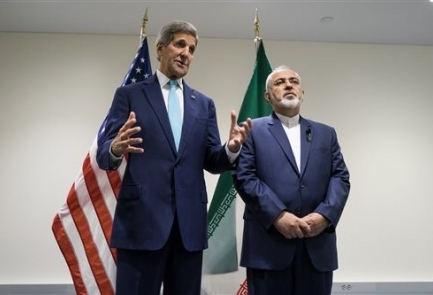
144334028328300476a_bThe Munich moment is upon us. U.S. Secretary of State John Kerry with Iranian Foreign Minister Mohammad Zarif at U.N. headquarters on Saturday | Photo credit: AP

Washington is reaching out to Russia, which is openly helping Syrian President Bashar Assad, who is working in conjunction with Iran, which in turn supports Hezbollah. Now Europe is prepared to talk to Assad, but what about us, for heaven’s sake?

Two years ago to the day, in September 2013, U.S. Secretary of State John Kerry compared Bashar Assad to Adolf Hitler, after the Syrian dictator once again used chemical weapons against his own people. “This is our Munich moment,” Kerry said at the time.

As far as the Americans were concerned, Assad had crossed a line. In those days (more like in those hours, actually), Washington briefly believed that a failure to respond to Assad’s actions would send a dangerous message to Iran regarding its nuclear ambitions.

“Will [Iran] remember that the Assad regime was stopped from those weapons’ current or future use, or will they remember that the world stood aside and created impunity?” Kerry asked at the time. History and retrospect have turned what may have been Kerry’s greatest speech into remarks entirely detached from reality.

The United States did not attack, Assad is still in power, and an ominous nuclear deal has been signed with Iran. It is no wonder that there is a new kind of atmosphere in the region, under American auspices. There are no more good guys and bad guys; everyone is a partner. And thanks to this new reality, Assad now has a renewed license to rule, after having received a license to kill.

Washington is reaching out to Russia, which is openly helping Assad in Syria, who is working in conjunction with Iran, which in turn supports Hezbollah. Europe (Angela Merkel), in the meantime, startled by its refugee crisis, is already prepared to talk with Assad; the same Assad who was compared to Hitler only two years ago. But what about us, for heaven’s sake?

Regretfully, Israel’s biggest fears are now materializing. Instead of being the architects and shaping a new reality in the Middle East, Washington is falling into line with the existing reality. Russia, Syria and Iran are enjoying the consequent vacuum. When the cat is away, the mice will play. Now, all of a sudden, even Hezbollah chief Hassan Nasrallah is letting himself go on television, beaming with joy. Aside from the 75 tanks Damascus is giving him, he now sees his two patrons (Damascus and Tehran) become partners with the West, without having to change one bit.

There is no diplomatic vacuum

The latest developments in Syria are not encouraging: Assad’s first target, with Russia’s help, is expected to be the Nusra Front rebel group, which not only threatens Assad but is also a bitter enemy of the Islamic State group. In other words, somewhat paradoxically, Islamic State could initially benefit from the Russian intervention in Syria.

And one final word about Iran’s rapprochement with the international community: We have been told repeatedly that this was only about the nuclear deal, but in reality we can see cooperation between the U.S. and Iran in Iraq and in the war against Islamic State. We can also see American-Iranian dialogue regarding Syria’s future, and on Saturday night we learned of a gigantic deal worth upwards of $21 billion between Iran and Russia. This time I am forced to agree with Secretary Kerry: This really does look like a Munich moment.

Clearing my spindle, Syria edition

September 26, 2015

Clearing my spindle, Syria edition, Power LineScott Johnson, September 26, 2015

The withdrawal of the United States from Iraq and points elsewhere around the Middle East has created a vacuum that has been filled by forces hostile to the United States. Syria is representative. ISIS has moved into Syria from Iraq. Iran and Hezbollah have both moved into Syria to defend the Assad regime from ISIS.

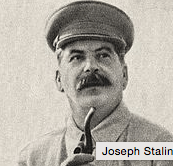
Stalin

The Obama administration has taken a sort of Stalinist tack. Obama has concentrated on building socialism in one country (i.e,, the United States) rather than protecting the national interests of the United States abroad in a difficult foreign theater, especially insofar as doing so might complicate Obama’s dreams of an entente with Iran.

Last week brought a new round of Syria related stories. At the Weekly Standard, Lee Smith noted “Obama’s Syria doctrine.” Obama disclaims responsibility even for his own pathetically failed approach:

In the wake of last week’s embarrassing revelation that only four or five U.S.-trained rebels are currently engaged in fighting the Islamic State, the White House was scrambling to deflect blame. It wasn’t Obama’s fault, said White House press secretary Josh Earnest. The president never wanted to back the rebels in the first place. His hand was forced by administration figures and Republican lawmakers who wanted to aid the rebels. It’s time, said Earnest for “our critics to fess up in this regard as well. They were wrong.”

Enter Russia. Barbara Starr & Ross Levitt report for CNN: Russian fighter jets enter Syria with transponders off”

Lucas Tomlinson & Jennifer Griffin report for FOX News “Russians, Syrians and Iranians setting up military cooperation cell in Baghdad”. Tomlinson and Griffin note:

Russian, Syrian and Iranian military commanders have set up a coordination cell in Baghdad in recent days to try to begin working with Iranian-backed Shia militias fighting the Islamic State, Fox News has learned.

Western intelligence sources say the coordination cell includes low-level Russian generals. U.S. officials say it is not clear whether the Iraqi government is involved at the moment.

Describing the arrival of Russian military personnel in Baghdad, one senior U.S. official said, “They are popping up everywhere.”

The Wall Street Journal published two important stories last week. Dion Nissenbaum & Carol Lee report: “Russians expand military presence in Syria, satellite photos show.” Jay Solomon & Sam Dagher report: “Russia, Iran seen coordinating seen coordinating of Assad regime in Syria.”

And Prime Minister Netanyahu flew to Moscow with two members of the IDF General Staff to meet with Putin about Russia’s moves in Syria. “In Moscow,” the Times of Israel reported, “presence of generals sends a message of military urgency.” President Obama, however, is taking the long view. A couple of weeks ago Obama declared Russia’s Syrian adventure to be “doomed to failure.” Obama’s judgment represents a striking case of projection.

Like it or not, Putin’s is the ‘only game in town’

September 26, 2015

Like it or not, Putin’s is the ‘only game in town’ Gulf News, Mustapha Karkouti, September 26, 2015

(Nature abhors a vacuum and Obama created one in the Middle East. Please see also, A Chinese aircraft carrier docks at Tartus to support Russian-Iranian military buildup. — DM)

With a nearly total absence of any significant US-led coalition presence in Syria, apart from slow-effective air strikes, Moscow seems to be the only dominant player in that region. As the Kremlin clearly stated, Putin’s intention is to prevent a repetition of Libya’s 2011 scenario and avoid the total collapse of Bashar Al Assad’s authority, similar to what happened following Muammar Gaddafi’s overthrow after the badly-planned intervention by Nato. Putin is simply, but clearly, saying to the West: Where you failed in Libya, I’ll do better in Syria.

[W]hatever Putin’s plans are in the long run, his mission in the country is largely seen by the majority of Syrians as a sinister effort to save Al Assad and help him consolidate his authority in Syria.

**********************

It is very rare that a Russian head of state holds top strategic talks with an Israeli prime minister in the Russian capital. This happened just recently when Vladimir Putin met Benjamin Netanyahu to discuss Syria’s latest developments. The two chiefs are not known to have had close and friendly personal relations, but they displayed those sitting side by side in the Kremlin last week. The arrival in Moscow last Monday of Netanyahu accompanied by his chief of staff and head of military intelligence, is by all means unprecedented.

The visit is significant as it is a part of tripartite diplomatic activities that involve discussions with the US as well. The American Defence Secretary Ashton Carter has recently had a long and “useful” discussion with his Russian counterpart over Syria. With the current congestion of military activities in the sky above the region by the Israelis and Americans and the rapidly increasing presence of Russian forces and hardware, there is obviously a need to liaise to avoid any unpredicted conflict, i.e. shooting down one another’s planes by mistake. But both the US and Israel’s main concern goes far beyond the technicalities. They aim mostly at finding out what exactly the Kremlin’s long term purpose in Syria is and how far Moscow is capable of effectively controlling the direction of the tragic game currently being played in this sad country.

Sitting next to Netanyahu, Putin reassuringly explained what he was trying to achieve by stating that Moscow’s main goal was “to protect the Syrian state”, or more accurately, what’s left of it. The Russian president seemed fully aware of Netanyahu’s main concern of the Iran-supported potential attacks by Hezbollah and the Syrian army across the occupied Golan Heights, when he told his visitor that neither Damascus nor the Iranian-financed Lebanese militia was “in any state to open a second front”. In others words, Putin reassured Netanyahu that Moscow was fully engaged with Tehran and Damascus on that front.

Saving Al Assad

With a nearly total absence of any significant US-led coalition presence in Syria, apart from slow-effective air strikes, Moscow seems to be the only dominant player in that region. As the Kremlin clearly stated, Putin’s intention is to prevent a repetition of Libya’s 2011 scenario and avoid the total collapse of Bashar Al Assad’s authority, similar to what happened following Muammar Gaddafi’s overthrow after the badly-planned intervention by Nato. Putin is simply, but clearly, saying to the West: Where you failed in Libya, I’ll do better in Syria.

The timing of Moscow’s build-up along the Syrian coastal area couldn’t be more perfect, particularly with western policy on the country in a state of limbo. Surely, moving dozens of combat aircraft and hundreds of troops to the aid of the encircled Syrian president must have been given the green light a while ago. This is precisely how Putin sees the situation. Under the nose of the Americans and the world community, Russian personnel and Special Forces have re-emerged in large numbers at an old air base of theirs near Al Assad’s stronghold of Latakia. Russia has always had, through the former Soviet Union, significant military presence in Syria during the long years of the Cold War and beyond.

However, whatever Putin’s plans are in the long run, his mission in the country is largely seen by the majority of Syrians as a sinister effort to save Al Assad and help him consolidate his authority in Syria.

After all, Al Assad is the man largely accused of killing thousands of Syrians during the almost five-year war in the country. It has become absolutely clear that all players in the region, including US, Israel, Turkey and Iran are adjusting to the new reality as a result of the speed and scale of Russian’s deployment. It is commonly known now that Israel was made aware of Moscow’s deployment before it began, while Iran had been informed of the move as early as the first week of August. In fact, shipments from Black Sea ports to the Syrian port of Tartous began to pass through the Bosphorus as from August 20.

The Russians had moved by last Tuesday into the coastal stretch between Latakia and Tartous 28 combat jets (12 Su24 bombers, 12 Su25 ground attack aircraft and 4 Su-30 multi-role fighters), two types of drones and 20 multi-purpose helicopters. Almost the equivalent of Al Assad’s entire air power. Pentagon officials have confirmed these deployments and said Russian drones are now fully operating where offensive air attacks could be expected very soon.

Turkey on its part, is willing to dip its hands in ‘Syria’s Cake’ as a highly Turkish informed source told me few days ago, and send troops into the country, provided it gets the green light to set up its ‘no-fly zone’ along Syria’s northern borders. In fact, discussion between Ankara and several European capitals, including Berlin, over the issue has been going on for sometimes as many European leaders consider the no-fly zone option is urgently needed method to help controlling the flow of refugees into European Union countries.

However, with Iran well entrenched behind Al Assad at an annual cost of $6-$10 billion (Dh22-36.7 billion), it is also a decisive regional power of huge influence in shaping events in shrinking Syria and beyond. Additionally, there is newcomer into the killing fields of Syria as China has just officially revealed that it is sending personnel and advisers to assess the situation. And with almost total US absence in the Levant, Russia would militarily and politically remain the most significant power to shore up Al Assad’s regime as long as it is possible.


Progressivism: Easing the Way to Mass Murder

September 26, 2015

Progressivism: Easing the Way to Mass Murder, American ThinkerKenneth Levin, September 26, 2015

The progressive creed as it relates to foreign policy, and as represented most notably by our Progressive-in-Chief, President Obama, holds that the impact of United States behavior in the world has largely been negative. It casts American foreign policy as a variation on European colonialism: exploitative, indifferent to the peoples subjected to American attention and intervention, and inexorably engendering anti-American sentiment among those peoples.

The translation of this comprehension of the world into a progressivism-informed foreign policy has had the effect of making the world safer for mass murder.

President Obama has offered apologies for past American policy to Europeans, to Arabs and the Muslim world more broadly, to the peoples of Central and South America. Various media outlets have noted that, according to a 2011 Wikileaks publication, only a negative response by the Japanese government prevented Mr. Obama from going to Hiroshima in September, 2009, and offering apologies for America’s atomic bomb attack on the city.

But whatever the President’s erstwhile intentions vis-a-vis Hiroshima, the broader focus of his apologetics has been on those nations and peoples that are hostile to America. His key foreign policy syllogism, and that of America’s progressive camp, is that anti-American sentiment is essentially a product of American abuses and that American self-reform and accommodation, a kinder, gentler United States, will bring an end to current hostility and engender a new comity between this nation and its long-time victims.

Most of the world’s nations offer their citizens at best very limited rights. Some authoritarian regimes have close relations with the United States; others are hostile to the United States. One might think that progressives would object to despots of whatever sort and aspire to the liberation of populations from such governments.

But that is not case. The progressivist pattern, rather, is to oppose despotic regimes with which this nation has had positive relations but to be sympathetic and accommodating towards those that have viewed us as the enemy — that view being congruent with progressive orthodoxy.

Moreover, the advocates of genuine democratic reform in closed societies of either sort, pro- or anti-American, are essentially given short shrift. Such advocates typically look to the United States as a model for their aspirations, and that is sufficient to alienate, and preclude any hoped for support from, the progressive camp. Within pro-American authoritarian regimes, American progressives reserve their sympathy primarily for anti-regime forces that likewise look to America as the source of their respective nations’ ills and seek to replace those in power with a despotism of their own, a despotism with an anti-American stamp.

In Latin America, a number of democracies have in recent decades been subverted by left-wing populists who gained power at the ballot box and then proceeded to dismantle their nations’ democratic institutions with, for example, measures against competing parties, a free media and an independent judiciary. The pattern was established by Hugo Chavez, who became president of Venezuela in 1998, and was followed by, among others, Evo Morales in Bolivia and Rafael Correa in Ecuador. The new despots commonly justified their anti-democratic measures as necessary to counter the supposed nefarious aims of parties domestic and foreign, among which the United States is commonly trotted out as key bogeyman.

Obama and his administration displayed a notable sympathy for Chavez and have likewise done so for his emulators. The victims — among media figures or political opponents — that suffered at the hands of the post-democratic strongmen have enjoyed no such sympathy. Amazingly, when President Manuel Zelaya of Honduras likewise sought to undo his nation’s democracy and consolidate his personal control of the country but had his subversion of Honduras’s constitution blocked by the nation’s parliament and courts, the Obama administration backed Zelaya, attacked the “coup” that pushed him from power, and sought his reinstatement.

All of these populist despots were supported, of course, by Castro’s Cuba, which remains the chief example of anti-democratic leftism in Latin America both in terms of its longevity and in terms of its record of thousands murdered and myriad more imprisoned among those who have dared to take issue with the island’s dictatorship. But here, too, the progressive camp, and the Obama administration, have chosen to look upon the regime’s anti-American cant sympathetically, to see the proper way forward as American reform and cultivation of the Castros, and to close their ears and eyes to the regime’s victims.

But this progressivist cultivating of despotic forces which have only their anti-Americanism to recommend them takes on an even more sinister hue — indeed, much more sinister, in terms of the slaughters perpetrated by such forces and essentially ignored by American progressives — in the arena of the Muslim Middle East.

Virtually from its inception, the Obama administration has demonstrated support for the Muslim Brotherhood. The Brotherhood, founded in 1928 and closely linked to the Nazis during World War II, has consistently promoted an anti-American, anti-Western and anti-Semitic agenda. Its offshoot, Hamas, openly declares its dedication not only to the murder of all Israel’s Jews but of all Jews worldwide. Yet the Obama administration has appointed American Muslims associated with the Muslim Brotherhood to government posts and even as liaisons with federal law enforcement and security agencies and the military, and Brotherhood associates have been frequent guests at the White House.

Obama intervened to provide Brotherhood leaders prominent audience placement for his 2009 Cairo speech in which he apologized for America’s past role in the Middle East and sought more generally to propitiate the Arab and broader Muslim world. The President subsequently undercut pro-American Egyptian strongman Hosni Mubarak when the so-called “Arab spring” exploded in Egypt. He helped force Mubarak from office, and, as in Latin America, rather than support moderate, democratically oriented, groups in Egyptian society in the shaping of an alternative to Mubarak (including groups that consisted of Muslims and Coptic Christians working together for a democratic Egypt), threw his support behind the Brotherhood. One expression of this was the administration’s pushing for quick elections, which provided less time for challengers to the Brotherhood — the best organized political group in Egypt — to mount effective campaigns.

The election in June 2012, did bring the Brotherhood to power, with Mohamed Morsi as president and with the White House’s blessing. In the ensuing months, which saw increased murderous Brotherhood assaults on Egypt’s Coptic Christians — more than ten percent of the population and the Middle East’s largest Christian community — as well as Brotherhood cultivation of its Hamas protégés, the Obama administration continued to offer its support. (The only high profile criticism of Morsi came in the wake of the rarest of events, a New York Times front page, above-the-fold piece on Muslim anti-Semitism, in this instance a newly revealed Morsi anti-Semitic diatribe recorded some years earlier. On this occasion, the White House finally felt obliged to break from its typical indulgence of the Brotherhood and its leaders by releasing some comment condemning Morsi’s remarks.)

The Brotherhood ultimately lost popular favor, in large part because of its failure to address Egypt’s economic ills. But Egyptians were also put off by Morsi’s pursuit of the Brotherhood’s Islamist agenda. As, for example, The Economist noted

“… [I]n power the Brotherhood began to abandon its previous caution regarding its foes. Mr Morsi appeared to dismiss secular opponents and minorities as politically negligible. Instead of enacting the deeper reforms that had been a focus of popular revolutionary demands, such as choosing provincial governors by election rather than presidential appointment, or punishing corrupt Mubarak-era officials, the Brothers simply inserted themselves in key positions…

“When nearly all the non-Islamist members of a body charged with drafting a new constitution resigned in November 2012, the Brothers brushed the problem aside. Mr Morsi issued a snap decree rendering him and his constitution-writers immune from court oversight. This was when his popularity started to slide…

“The Brothers pushed through a hastily drafted constitution to a national referendum despite angry criticism from all other parties, and the referendum went Mr Morsi’s way. But his high-handedness lost him a crucial part of the electorate…”

But, again, none of this seemed to dampen Obama’s enthusiasm for Morsi and the Brotherhood, and when the Egyptian army under Abdel Fattah al-Sisi deposed Morsi in July, 2013, with wide popular support, the White House condemned the coup and dismissed its popular backing and the transgressions of the Morsi regime that generated that support. For much of the subsequent two years, the administration has given the pro-American al-Sisi the cold shoulder. Its withholding of military grants and sales to Egypt — only recently softened to some degree — has pushed al-Sisi to renew Egypt’s long dormant military links with Russia.

Before its victory in Egypt, the country where the Muslim Brotherhood had been most successful in gaining power had been Sudan, where its members made up a large part of the government following the 1989 coup d’état by General Omar Hassan al-Bashir. Bashir, who still rules Sudan, led a genocidal campaign against the black and non-Muslim — Christian and animist — population of southern Sudan over many years, until that region successfully seceded and established its independence. He currently continues a campaign of mass murder and displacement of the Muslim — but, again, black rather than Arab — population of Darfur. Bashir is under indictment by the International Criminal Court for genocide in Darfur.

President Obama, during his 2008 campaign as well as in earlier speeches, promised to act against the Darfur genocide. But he has done nothing, even as the slaughter, displacement and suffering continue. On the contrary, the Obama administration has reached out to Bashir. In addition, consistent with the Sudan government’s wishes and despite the horrible consequences for the people of Darfur, the administration appears to be supporting the downsizing of the UN peacekeeping mission in Darfur. Once again, for President Obama, appeasing anti-American entities such as the Muslim Brotherhood, an appeasement consistent with progressive orthodoxy, trumps supporting the victims of those entities.

Obama’s favorite Middle East leader has long been, according to various sources, Turkey’s Recep Tayyip Erdogan. Turkey is, of course, a NATO member and remains so even under Erdogan’s Islamist regime. It is not openly anti-American. But Erdogan has clearly turned away from the West, has developed close ties with the Muslim Brotherhood and has sought to establish himself as the leading figure in a Middle East and broader Muslim world dominated by Islamist policies that emulate those of the Brotherhood.

Having notably described democracy as like a streetcar from which one exits upon reaching one’s destination, Erdogan has done much to undermine Turkish democracy. He has essentially dismantled the nation’s independent judiciary, closed down opposition media and arrested journalists — with Turkey having more journalists incarcerated than either China or Iran — and engineered his Islamist camp’s infiltrating and seizing control over other Turkish institutions, both public and private.

Erdogan was an enthusiastic supporter of the Muslim Brotherhood’s rise to power in Egypt, is reported to have cried over the downfall of Morsi and the Brotherhood, and some months ago declared that he still regards Morsi rather than al-Sisi as Egypt’s president. He remained silent over and apparently indifferent to the Brotherhood’s slaughter of Egyptian Christians both before and during its period in power.

Erdogan likewise supports the Brotherhood offshoot Hamas in its genocidal war against Israel and has, through statements by him and leaders of his party and through his party-controlled media, whipped up domestic anti-Israel and anti-Jewish sentiment. He has opened Turkey as a refuge for members of both Hamas and the Egyptian Brotherhood, and attacks on Israelis, such as the kidnapping and murder of three Israeli teenagers last year, have been orchestrated by senior Hamas agents in Turkey.

Yet none of this seems to have shaken President Obama’s enthusiasm for the Turkish leader. On the contrary, Erdogan’s turning from the West and embracing an agenda close to that of the Brotherhood has, once more consistent with the president’s progressive world view, rendered him worthy of the administration’s propitiation.

Obama’s reaching out to the Iranian mullahs virtually from the moment of his taking office in 2009 is likewise in line with his progressivist comprehension of foreign hostility to the United States as a response to past American transgressions. Following from this, his path to ending the hostility lay in breaking from that past, offering mea culpas for it, and cultivating new policies of understanding and comity.

More particularly, the CIA’s involvement in the overthrow of Iranian Prime Minister Mossadegh in 1953 (which in fact at the time had the support of Iran’s religious establishment) and America’s subsequent ongoing support for Shah Reza Pahlavi are construed as the source of Iranian enmity and the history for which the President seeks to apologize and atone.

The popular uprising that followed the disputed reelection of President Mahmoud Ahmadinejad in June, 2009, led to the regime’s killing of dozens of protesters and the arrest and reported torture and rape of thousands more. Protesters urged the outside world, particularly the United States and President Obama, to support them, but Obama refrained even from offering significant verbal support, apparently not wanting to do anything that might undermine his outreach to the mullahs.

In the ensuing years, torture, including rape, and murder of political prisoners, among them suspected student critics of the regime culled in raids on Iranian universities, have been an ongoing fact of life in Iran. So, too, have been the imprisonment and execution of homosexuals and individuals accused of religious crimes, and abuses targeting members of the embattled Baha’i community and elements of Iran’s ethnic minorities, who represent more than fifty percent of the nation’s population.

But on all of this the Obama administration has been essentially silent as it has pursued its policy of winning over the apocalyptic Iranian theocracy through accommodation and concessions. That policy culminated this summer in the agreement on the Iranian nuclear program, which provides Iran with a path to nuclear weapons and even offers American aid to Iran in defending its nuclear program against sabotage and attack.

Nor has the administration let Iran’s role in killing Americans in Lebanon, Saudi Arabia, Afghanistan and Iraq, and Iran’s assertions of never compromising in its enmity towards America, interfere with Obama’s agenda of pursuing its progressivist fantasies of peace with Iran through accommodation. Nor has the mullahs’ genocidal anti-Semitism, including their openly and repeatedly declared determination to destroy Israel, or their arming and training of Hezb’allah and Hamas to pursue Israel’s annihilation, led to the administration’s wavering from its course. On the contrary, the nuclear agreement appears to offer Iran protection against any Israeli attempt to derail the Islamo-fascist theocracy’s development of nuclear weapons. It also promises to soon provide the regime with tens of billions of dollars in previously embargoed funds, which has already translated into Iran’s embarking on a massive acquisition of advanced warplanes and other major weapons systems from China and Russia and its promising enhanced military aid to Hezb’allah and its other terrorist allies for use in pursuit of Israel’s destruction.

But the off-handedness regarding existential threats to Israel, and regarding as well myriad instances of wholesale human rights abuses, including mass slaughter by those the Obama administration has sought to propitiate, is apparently due to such matters being regarded as of no great consequence when measured against the central international dynamic as construed by progressivism. Administration indifference to the fact of some of those hostile regimes and non-state entities — the objects of American cultivation — having dismantled working democracies or having strangled incipient democratic movements derives from the same worldview. All their various crimes are mere epiphenomena, at most secondary, and potentially an unwelcome distraction, when measured against what is comprehended as the essential world-shaping dynamic: hostility towards America whose roots lie in past American abuses, and an end to hostility and creation of a more peaceful world through American contrition and accommodation.

In this way, Obama’s, and the progressive camp’s, comprehension of reality and playing out of that delusional “reality” on the world stage inexorably makes the world safer for the crimes, including mass murder, of the anti-American forces that are the object of progressivist propitiation.
 

The pope’s misguided defense of Islam

September 24, 2015

The pope’s misguided defense of Islam, Front Page Magazine, Daniel Greenfield, September 24, 2015

pope_francis_in_march_2013


The Pope could have used his forum in Congress to call attention to the plight of Christians.

Unlike Communist Cuba, America hasn’t seized and nationalized Catholic churches and schools. It hasn’t locked up Catholic clergy or installed surveillance equipment in their homes. It hasn’t denounced the Catholic church as “exploiters” and “fascists”. And yet Pope Francis, who had few criticisms of Cuba, came to Congress to denounce the collision between Americans and Indians, and to urge the United States to take in illegal aliens without regard for the law.

There’s a condemnation of the death penalty. Never mind that in the US, the death penalty is used after extensive appeals against some of the worst monsters imaginable, unlike Cuba, where it was used to massacre political opponents of the Castro crime family. And condemnations of selling weapons. Much of this is couched in vague language, but it’s still a sharp contrast from the visit to Cuba.

The Pope even threw in a backhanded defense of Islam…

Our world is increasingly a place of violent conflict, hatred and brutal atrocities, committed even in the name of God and of religion. We know that no religion is immune from forms of individual delusion or ideological extremism. This means that we must be especially attentive to every type of fundamentalism, whether religious or of any other kind…

But there is another temptation which we must especially guard against: the simplistic reductionism which sees only good or evil; or, if you will, the righteous and sinners.

No religion is technically immune from anything if you mean that some members of it might misbehave. But that’s misleading language that tries to avoid the reality by setting up a strawman.

No country is immune from violating human rights, but there’s a big difference between David Cameron and Adolf Hitler. There’s also a huge difference between most religions and Islam when it comes to “violent conflict, hatred and brutal atrocities” committed in the name of religion. Especially when we focus in on the contrast between Western religions in the free world… and Islam.

There’s also a simplistic reductionism in reducing unpleasant truths to strawmen. There are clear cases of evil that have to be addressed. To say that does not mean an inability to see anything except black and white.

To say that no religion is immune to brutal atrocities is true and meaningless. We might as well say that no one human being is immune to evil. It doesn’t get us any closer to dealing with the reality of evil people out there.

It’s easy to talk around problems and Islam is the most talked-around problem today. But the plight of Christians in the Middle East deserves more than more ‘talking around’. Instead of elitist lectures, they need a moral authority to forcefully advocate intervention on their behalf by making it clear that they face genocide. And that it’s up to the West to make Christianity in the region sustainable or evacuate its last remnants.

It’s a much more vital issue than Global Warming, which the Pope mentions repeatedly.

The Pope could have used his forum in Congress to call attention to the plight of Christians in the region and demand action. Instead he talked generally about Syrian refugees, most of whom are Muslims.

Advocates are hoping for more.

Now that Pope Francis is in his first day of his two-day visit to Washington, D.C., advocates for persecuted Christians in the Middle East are urging the pontiff to speak out forcefully on their plight in his meeting with President Obama Wednesday and in his historic address to Congress the following day.

“I’m hoping the Pope points out that thousands of Christians are persecuted, denied their fundamental rights, and killed because of their faith [in the Middle East],” George Marlin, chairman of Aid to the Church in Need USA, told me.

Marlin, who has written a much-praised book on the subject of Christian persecution in the Middle East, emphasized that “someone has to bang pots and pans on this issue. The Administration is not doing it. The national media is not doing it. If the Pope brings this up, it makes front-page news worldwide.”

“If Pope Francis calls it genocide before Congress, there will be a moral clarity added to this issue and it will bring a new ray of hope to persecuted Christians,” said Taimoorazy, herself a refugees from Iran who came to the U.S. in 1991, “The whole world will now be paying attention.”

In underscoring why the Pope must use the word “genocide,” she cited the fact that the Assyrian Christian population in the Middle East was 1.6 million prior to 2003 and “now we only have 300,000.”

I suppose it’s not as important as the critiques of capitalism and Global Warming and illegal aliens and the death penalty.

Mandatory Muslim immigration in the EU

September 24, 2015

Mandatory Muslim immigration in the EU, Front Page MagazineArnold Ahlert, September 24, 2015

syria (1)

Third Worldism, in all its attendant dysfunction, is “breaking the door down on top of us,” even as our unconscionable leaders bemoan those who resist the cultural Armageddon it represents. Leaders whose ongoing love affair with multiculturalism is nothing more than an apology for the Western culture they disdain, even as millions of those Third Worlders are irresistibly drawn to its cornucopia of bounty and beneficence. Bounty and beneficence they will ultimately undermine with the blessings of the apologists who, despite this massive flow of humanity in only one direction, believe no culture is better than any other. It doesn’t get more ironic—or suicidal—than that.

**************************

On Tuesday, national sovereignty gave way to mandatory multiculturalism in the European Union. A plan to relocate an additional 120,000 Middle Eastern migrants was imposed by EU ministers over the objections four Eastern European countries adamantly opposed to the plan. Slovakia’s Robert Fico illuminated the resistance. “As long as I am prime minister, mandatory quotas will not be implemented on Slovak territory,” he declared in Bratislava.

Slovakia was joined by the Czech Republic, Romania and Hungary. Finland abstained from the vote. Yet despite the quartet’s disapproval, the Justice and Home Affairs Committee, led by France and Germany, pushed through the plan proposed by European Commission President Jean-Claude Juncker during his annual State of the Union address in Strasbourg earlier this month. The plan called for 160,000 migrants to be forcibly redistributed from Italy, Greece and Hungary to all other member states, save Britain, Ireland and Denmark, who remain exempt from EU treaties. In addition, Junker called for a review of the “Dublin system” that determines which EU nation is responsible for asylum claims.

In order to make the plan more politically palatable, 66,000 migrants are currently slated for relocation, joining 40,000 migrants approved for asylum in July. The remaining 54,000 had originally been allocated to Hungary where they are currently camped out. But Budapest refused to abide a plan it characterized as an invitation to economic migrants. Thus, those migrants will be reallocated in 2016, possibly among Greece, Italy, Croatia and Austria, bringing the overall total of relocated migrants to 160,000. The plan is ostensibly limited to Syrian, Iraqi and Eritrean asylum-seekers, but the details have yet to be worked out. All of those migrants are people who have purportedly crossed the Mediterranean Sea from Turkey and northern Africa, fleeing the unrelenting violence in Iraq and Syria.

Luxembourg minister and meeting chairman Jean Asselborn stated that ministers “would have preferred to have an agreement by consensus,” but nonetheless expected objectors to fall into line as required by the law. Germany has been the focus of resentment on the issue, no doubt due to German Chancellor Angela Merkel’s Sept. 7 announcement that her nation would take 800,000 refugees this year at a cost of $6.6 billion ,and 500,000 per year over the next few years. Less than a week later, German interior minister Thomas de Maizière announced Germany would be imposing border controls in the southern part of the nation for what Merkel called “urgent security reasons.” Austria and Slovakia followed Germany’s lead shortly thereafter as wishful thinking gave way to the inconvenient reality of as many as half a million migrants flooding into the EU.

The plan itself, whereby the tens of thousands of migrants landing in Italy and Greece will be involuntarily moved by their respective national police forces to other EU nations is the epitome of wishful thinking. Those police forces are already overwhelmed, and the plan to relocate migrants bore little resemblance to the reality expressed by United Nations High Commissioner for Refugees (UNHRC), which insists 120,000 people represents just six days’ worth of arrivals at the current influx rate. “A relocation programme alone, at this stage in the crisis, will not be enough to stabilise the situation,” insists UNHRC spokeswoman Melissa Fleming.

Fleming is correct. After Hungary closed it border, refugees headed west towards Croatia, and that nation allowed tens of thousands to cross into Europe. Now Croatia has blocked off part of its border with Serbia, because they can’t process migrants fast enough. It noted that 35,000 migrants crossed its border in the week following the Hungarian shutdown. In the Austrian town of Nickelsdorf, 8000 new arrivals filled the town square, as local officials insisted no accommodations were available because existing camps were full. And of the more than 4 million migrants that remain in countries near Syria, at least 270,000 Syrians have requested asylum in Europe.

Hungarian Prime Minister Viktor Orban expressed the sense of frustration felt by many in the EU. “They are overrunning us,” he told his nation’s Parliament. “They’re not just banging on the door, they’re breaking the door down on top of us. Our borders are in danger, our way of life built on respect for the law, Hungary and the whole of Europe is in danger. Europe hasn’t just left its door open but has sent open invitation… Europe is rich but weak, this is the worst combination, Europe needs to be stronger to defend its borders.” Hungary has passed a law allowing the army to use rubber bullets, tear gas and net guns to maintain control over migrants on its border.

Unsurprisingly Orban was criticized by European colleagues, such as Czech Foreign Minister Lubomir Zaoralek, who, prior to Tuesday’s meeting, declared Eastern European foreign ministers were “absolutely dedicated” to finding a solution with their EU partners. Since the Czech Republic was one of four nations utterly opposed to the agreement, such optimism was short-lived. “Soon we will find out that the emperor has no clothes,” he tweeted after the plan was announced. “Reason lost today.”

One suspects reason was never in play. As The Telegraph’s Janet Daley warned earlier this month, European elitists have used the now famous image of a dead child washed up on a Turkish beach “to support the notion of Western guilt,” even as Bashar Assad’s murderous regime gets a pass. “For some reason, the appalling photographs of the bodies of children who had been deliberately gassed by the Assad regime, laid out on a concrete floor in Syria two years ago, were not sufficiently moving to compel the world to take action,” she writes. “Are dead children only a moral outrage when they are on the beaches of Europe?”

Elitist outrage is more like it, as Daley notes Germany’s magnanimity, which they and other economically advanced EU nations can afford, stands in stark contrast to the economically struggling eastern bloc nations that must initially accommodate that high-mindedness. “Imagine if you were a poor householder, just managing to keep your financial head above water while you attempted to turn your circumstances around, and a very wealthy neighbour decided to throw open his doors to the needy – and one obvious way that those in need could reach that welcoming haven was by tramping through your house,” Daley explains. “Might you find yourself inclined to be unhelpful in the hopes of discouraging others from taking the same path?”

Millions of ordinary Americans are undoubtedly pondering the same question. In addition to the hordes of illegals embraced by our own ruling class, the Obama administration intends to “significantly increase” the number of “worldwide migrants” this nation takes in over the next two years, reaching a total of 100,000 by 2017. Apparently the reality that the legal and illegal immigrant population in the United States has reached a record-breaking 42.6 million, or about one-out-of-eight residents in the U.S.—more than double what it was in 1980—remains insufficient with regard to the “fundamental transformation of the United States” the American left desires. And while the similar elitist-driven multicultural force-feeding devolving the Europe ethos is much more immediate, make no mistake: both are equally inexorable should current trends on both sides of the Atlantic continue.

In Europe, the bill is coming due for a continent that largely relied on America to do the heavily lifting in response to Islamic terrorism, even as it remained largely contemptuous of the “vulgarities” associated with a military response to the problem. America is facing the twin deficits of a ruling class determined to shove illegal immigration down the throats of a recalcitrant public, and a feckless Obama administration whose foreign policy of phony red lines in Syria, leading from behind in Libya, untimely troop withdrawal in Iraq, and the apparent determination to manipulate intelligence regarding ISIS in the administration’s favor, has precipitated the largest refugee crisis since WWII.

It is a refugee crisis tailor made for ISIS and other Islamic terror groups to exploit with impunity. On both continents, Third Worldism, in all its attendant dysfunction, is “breaking the door down on top of us,” even as our unconscionable leaders bemoan those who resist the cultural Armageddon it represents. Leaders whose ongoing love affair with multiculturalism is nothing more than an apology for the Western culture they disdain, even as millions of those Third Worlders are irresistibly drawn to its cornucopia of bounty and beneficence. Bounty and beneficence they will ultimately undermine with the blessings of the apologists who, despite this massive flow of humanity in only one direction, believe no culture is better than any other. It doesn’t get more ironic—or suicidal—than that.

Petraeus: Fight Against Islamic State ‘Inadequate’

September 22, 2015

Petraeus: Fight Against Islamic State ‘Inadequate’

BY:
September 22, 2015 2:37 pm

Source: Petraeus: Fight Against Islamic State ‘Inadequate’

Retired Gen. and ex-CIA Director David Petraeus testified Tuesday that U.S. progress against the Islamic State (IS, also known as ISIS) terrorist group has been “inadequate.”

“It has been more than a year since the U.S. commenced military action against the Islamic State in Iraq and Syria,” Petraeus said to the Senate Armed Services Committee. “While there have been significant accomplishments, the progress achieved thus far has been inadequate.

The U.S. has carried out thousands of air strikes against IS as part of Operation Inherent Resolve, but the terrorist group shows no signs of retreating.

“In Iraq we have halted and reversed ISIS’s momentum in some areas, but we have seen gains by ISIS in others such as Ramadi,” Petraeus said.

Petraeus said that “some elements of the right strategy” to defeat IS are being utilized by the U.S., but that “several are under-resourced while others are missing.”

Petraeus recommended ramping up U.S. military support for its allies in the area, notably the Iraqi Security Forces and Kurdish Peshmerga. He also recommended embedding U.S. advisors behind the front lines in Iraqi brigades, coordinating airstrikes more closely with Iraqi coalition partners, and broadening the rules of engagement to carry out airstrikes against IS targets.

Petraeus stopped short of recommending the deployment of U.S. troops for combat roles before a “viable” force of Iraqi partners was available to hold onto the areas taken back from IS.

Petraeus’s testimony can be added to a litany of bad news about U.S. progress against IS, although the White House had until recently characterized the fight as successful.

Retired Marine Gen. John Allen, who created the anti-IS coalition, will step down in November after struggling with the White House for control of the war, Bloomberg reported Tuesday.

Last week, Gen. Lloyd Austin, the U.S.’s top commander of Middle East operations, admitted the failure of a program to train and equip moderate rebels to fight IS in Syria.

Hanging over these revelations are serious allegations that senior U.S. officials manipulated intelligence on IS to hide its strength, lending credence to the White House’s narrative that Inherent Resolve was working.

2,000 Russian Troops Head To Syria For “First Phase” Of Mission To Support Assad

September 22, 2015

2,000 Russian Troops Head To Syria For “First Phase” Of Mission To Support Assad Tyler Durden’s picture

Submitted by Tyler Durden on 09/22/2015 09:32 -0400

Source: 2,000 Russian Troops Head To Syria For “First Phase” Of Mission To Support Assad | Zero Hedge

With each passing day, The Kremlin seems less and less interested in observing any niceties with regard to how it describes Russia’s military involvement in Syria.

Initially, it seemed likely that Moscow would go the Ukraine route by providing logistical support and lurking behind the scenes while officially denying – or at least downplaying – its role in the conflict. Over the course of the last two weeks, it’s become increasingly clear that Russia now intends to make no secret of its intention not only to stabilize the Assad regime but in fact to turn the tide completely with the provision of advanced weapons and equipment including combat aircraft, tanks, and drones.

The only remaining question was how long it would be before Syrian Foreign Minister Walid al-Moualem made an official request for ground troops, allowing Moscow to abandon all pretense that Russia isn’t officially at war and while we may not have reached that point yet, you can’t very well build a forward operating base and not staff it which is why now, according to FT, Moscow is set to send 2,000 troops to Latakia as part of the mission’s “first phase”. Here’s more:

Russia is to deploy 2,000 military personnel to its new air base near the Syrian port city of Latakia, signalling the scale of Moscow’s involvement in the war-torn country.


The deployment “forms the first phase of the mission there”, according to an adviser on Syria policy in Moscow.


The force will include fighter aircraft crews, engineers and troops to secure the facility, said another person briefed on the matter.


Three western defence officials agreed that the Russian deployment tallied with the numbers needed to establish a forward air base similar to those built by western militaries in Afghanistan.

Here’s more, from The New York Times, on the buildup at Latakia:

The deployment of some of Russia’s most advanced ground attack planes and fighter jets as well as multiple air defense systems at the base near the ancestral home of President Bashar al-Assad appears to leave little doubt about Moscow’s goal to establish a military outpost in the Middle East. The planes are protected by at least two or possibly three SA-22 surface-to-air, antiaircraft systems, and unarmed Predator-like surveillance drones are being used to fly reconnaissance missions.


Russia has military presences near Latakia and in Tartus.Russian Moves in Syria Widen Role in MideastSEPT. 14, 2015


“With competent pilots and with an effective command and control process, the addition of these aircraft could prove very effective depending on the desired objectives for their use,” said David A. Deptula, a retired three-star Air Force general who planned the American air campaigns in 2001 in Afghanistan and in the 1991 Persian Gulf war.


In addition, a total of 15 Russian Hip transport and Hind attack helicopters are also now stationed at the base, doubling the number of those aircraft from last week, the American official said. For use in possible ground attacks, the Russians now also have nine T-90 tanks and more than 500 marines, up from more than 200 last week.


“The equipment and personnel just keep flowing in,” said the American official, who spoke on condition of anonymity to discuss confidential intelligence reports. “They were very busy over the weekend.”

On Monday, the Russian embassy in Damascus came under mortar fire. That attack, Moscow says, did not emanate from ISIS but rather from other anti-Assad forces backed by “external sponsors”:

The Russian foreign ministry said a shell, which landed near its embassy on Sunday but caused no casualties, came from Jobar, which is held by anti-Assad fighters who were not allied with Isis and had “external sponsors”.


“We expect a clear position with regard to this terrorist act from all members of the international community, including regional players,” the ministry said. “This requires not just words but concrete action.”


It added that the fighters’ “foreign sponsors” were responsible for using their influence on “illegal armed formations”.

Clearly, “foreign sponsors” is a reference to Assad’s US-backed regional enemies including the Saudis, Qatar, and Turkey among others and this certainly seems to indicate that the Russians will not be prepared to tolerate attacks on their assets by groups who enjoy the support of the US-backed coalition. Of course quite a few of the groups battling for control of Syria are supported either directly or indirectly by the US and its regional allies which means that even if Russia manages to avoid direct confrontation with the handful of troops the US overtly backs, avoiding confrontations with the troops covertly supported by the US and other state actors will be impossible by definition, as they, just as much as ISIS, are angling for the ouster of Assad.

Meanwhile, the French took the absurdity to a whole new level on Monday when Foreign Minister Laurent Fabius claimed that the country’s plans to begin bombing Syria were born out of concerns for “self defense”. Here’s the quote:

“We received specific intelligence indicating that the resent terrorist attacks against France and other European nations were organized by Daesh [Arabic derogatory term for IS] in Syria. Due to this threat we decided to start reconnaissance flights to have the option for airstrikes, if that would be necessary. This is self-defense.

And so, as the violence escalates and Syria looks set to become the stage for a not-so-cold war pitting Russia and its regional proxies against the US and its regional proxies, we close with the following graphic which (partially) quantifies the human cost of geopolitical wrangling gone horribly awry:

U.S. Military Trained Top ISIS Commander

September 22, 2015

U.S. Military Trained Top ISIS Commander Written

by Alex Newman

Thursday, 17 September 2015

Source: U.S. Military Trained Top ISIS Commander

U.S. Military Trained Top ISIS Commander


One of the Islamic State’s top military commanders was actually trained by U.S. Special Forces in the nation of Georgia before taking up arms for ISIS in Syria, according to a variety of sources quoted in an explosive new report by the McClatchy news agency. Another member of the Obama administration’s supposed “anti-ISIS” coalition, the Wahhabi-Islamic dictatorship in Saudi Arabia, played a key role radicalizing the jihadist leader through a hard-core Islamist mosque it funded near his village. In other words, without the direct assistance of key “anti-ISIS” governments — including Washington, D.C. — the man said to be ISIS’ most fearsome and skilled military leader would almost certainly never have arrived in Syria to wage ruthless war on infidels in the first place. But ISIS commander Tarkhan Batirashvili (shown), who now calls himself Abu Omar al Shishani, is hardly the only one.

As explosive evidence and news reports continue to emerge highlighting the trend, it is becoming increasingly difficult to tell where ISIS begins and the globalist establishment ends. Among other revelations, Vice President Joe Biden, speaking at Harvard, admitted that Obama’s “anti-ISIS” coalition had funded and armed various terrorist groups in Syria that went on to become ISIS. Later, U.S. Joint Chiefs of Staff Chairman Martin Dempsey revealed in Senate testimony that Sunni Arab dictators in Obama’s “anti-ISIS” coalition were not just supporting ISIS — they were funding it. Next, a 2012 U.S. Defense Intelligence Agency report released under the Freedom of Information Act exposed the fact that Western powers and their Islamic dictator allies were supporting Islamic terrorists and wanted to see a fundamentalist Islamic State created in Eastern Syria. And finally, the former chief of DIA went on TV and spilled the beans on Obama’s “willful” support to Islamic terrorists while distancing himself from the deadly policies.

The McClatchy report, then, is only the latest shoe to drop in a long train of revelations directly linking the U.S. government and its allies to ISIS and jihad more broadly. Headlined “U.S. training helped mold top Islamic State military commander,” the September 15 article by special correspondent Mitchell Prothero contains a treasure trove of information about the U.S.-trained terrorist gathered from interviews with a wide range of sources, including many close to the ongoing Syrian war. In essence, the report paints a troubling picture of Batirashvili’s background, and offers much insight into how he became a leading ISIS commander responsible for a number of critical victories secured by the terrorist group. From his U.S. military training in Georgia to his radicalization in a Saudi-funded mosque, the piece provides still more evidence about the utter failure — or outright insanity, perhaps even criminality — surrounding what Washington, D.C., likes to characterize as “foreign policy.”

According to the McClatchy report, the 30-year-old Batirashvili (a.k.a. Abu Omar) is a “key figure” in ISIS, reportedly serving on the ISIS “governing council” in addition to being the terror group’s “supreme military leader in northern Syria and Aleppo.” The report, citing his military prowess obtained from U.S. training and a number of critical military victories he led over Syrian dictator Bashar al-Assad’s forces, also refers to him as “perhaps the group’s most fearsome ground commander.” And there is a good reason for that: your tax dollars. “We trained him well, and we had lots of help from America,” an unidentified former Georgian defense official told the news agency, asking not to be named because of the sensitivity of the terrorist’s role in ISIS. “In fact, the only reason he didn’t go to Iraq to fight alongside America was that we needed his skills here in Georgia.”

Batirashvili’s former comrades in the Georgian military echoed the praise for the terrorist’s military abilities and told McClatchy that he was “immediately” recruited into Georgia’s U.S.-trained special forces upon enlistment. Again, your tax dollars — and your sons serving in the U.S. military — played a crucial role in transforming Batirashvili from an impoverished Muslim Chechen villager into a brutal and well-trained commander whose forces are now busily decapitating Christians and selling children into sex slavery to fund jihad. “He was a perfect soldier from his first days, and everyone knew he was a star,” explained a former military comrade of Batirashvili, who also requested anonymity because he was violating orders by speaking to the press about the issue. “We were well trained by American special forces units, and he was the star pupil.”

Of course, the U.S. government training for Batirashvili and other soldiers in Georgia did not take place with the explicit goal of producing future military leaders for a group of savages styling themselves the Islamic State. Instead, similar in many ways to what happened with Osama bin Laden and al-Qaeda in Afghanistan, the U.S. government plan, supposedly at least, was to help the government of Georgia defend itself against potential aggression from the Kremlin. And indeed, according to sources interviewed for the McClatchy report, Batirashvili fought well against Russian strongman Vladimir Putin’s forces, first as a Chechen rebel, and later as a U.S.-trained Georgian Special Forces officer.

While Batirashvili came from an isolated Islamic enclave in the largely Christian nation, Batirashvili and others from his region had traditionally followed a moderate strain of Islam, so-called Sufi Islam. But Sufi Muslims are often considered heretics by their more radical coreligionists in places such as Saudi Arabia and Afghanistan. Eventually, thanks to generous funding from the U.S.-allied Saudi dictatorship, hardcore Wahhabi Islam would soon make its mark on the Chechen enclave in Georgia — and on Batirashvili in particular. The same phenomenon has happened around the world.

According to McClatchy, the moderate version of Islam followed by locals from Batirashvili’s region came under pressure in the year 2000, when the Saudi regime financed the construction of a new mosque for the handful of ethnic Chechen villages in the Georgian valley. A local community leader quoted in the article explained that this new mosque “preached a kind of alien Wahhabi-style Islam” — the same radical Islam that the Saudi monarchy, a key member of Obama’s “anti-ISIS” coalition, has for generations been trying to propagate around the world with lavish funding from its oil revenues. “It told our people that it was wrong to pray at graves of saints and ancestors, as our people have done for hundreds of years, and even to share our religious rites with our Christian brothers,” the community leader said. Other residents told the news agency that by the mid-2000s, the new Saudi-backed mosque had split the local Muslim community in two, with older Muslims sticking to their traditional faith while younger villagers became radicalized in the new mosque.

Then, the globalist-engineered civil war broke out in Syria after years of U.S. taxpayer funding for Syrian opposition groups exposed in official U.S. diplomatic cables. At that point, the radicalized young Muslim villagers in Georgia affiliated with the Saudi mosque — prepared for violent jihad through years of Saudi-funded radical teachings — began an exodus to go wage holy war in Syria. “They all started leaving for Syria,” the community elder told McClatchy. “Things are safer here now because all the radicals — our children — have gone to Syria.” The report also notes that the radicalized Batirashvili served as an excellent recruiting tool for ISIS, attracting jihadists from across central Asia to join the jihad on the “apostate” dictator of Syria.

It is impossible to know how many other ISIS fighters from around the world were also radicalized in mosques funded by members of the “anti-ISIS” coalition, or how many of those fighters received training from the U.S. military under various guises. But without a doubt, there are many. In fact, Obama’s alleged plan to fight ISIS — training and equipping so-called moderate jihadists to fight more radical jihadists — was exposed as a monumental failure this week. Testifying before the U.S. Senate Armed Services Committee on September 16, General Lloyd Austin, the top U.S. military commander for the Middle East, admitted that just “four or five” of Obama’s U.S.-trained jihadists were actually fighting against ISIS in Syria. On the other hand, as The New American and others have documented extensively, far more than that are currently fighting with ISIS, al-Qaeda, and other terrorist groups across Syria — often with heavy U.S. weapons. Indeed, entire brigades of U.S.-trained rebels have joined terror groups or signed agreements with them to fight Assad.

As a direct consequence of the Obama administration’s lawless so-called “foreign policy” machinations, hundreds of thousands are dying, millions are fleeing their homes, refugees are swamping Europe, Middle Eastern Christians are facing genocide, and the national security threat to the United States is growing stronger by the day. Now, all those crises are being exploited by the same globalists who created them to push more of the same insanity.

It is time for Congress to shut down this farce and hold everyone responsible for it accountable.

Photo of  Abu Omar al Shishani, taken from a video: AP Images

Alex Newman, a foreign correspondent for The New American, is normally based in Europe. Follow him on Twitter @ALEXNEWMAN_JOU. He can be reached at anewman@thenewamerican.com.

Related articles:

U.S. Intel: Obama Coalition Supported Islamic State in Syria

ISIS: The Best Terror Threat U.S. Tax Money Can Buy

U.S. Defense Intel Chief: Obama Gave “Willful” Aid to Al-Qaeda

Globalists Who Created Refugee Crisis Now Exploiting It

Globalists Using Muslim Terrorists as Pawns  

Globalists Exploit ISIS Threat to Empower UN

Obama and Co. Middle East Policies Aiding Genocide of Christians

Anti-ISIS Coalition Built ISIS (Video) 

Christian Massacres: A Result of U.S. Foreign Policy

ISIS Origins Traced to U.S. Prison in Iraq

U.S.-backed Syrian Opposition Linked to Bilderberg, CFR, Goldman Sachs & George Soros

Bin Laden & Al-Qaeda: U.S. Govt. Creations

Two-State Solutions and Double Standards

September 22, 2015

Two-State Solutions and Double Standards Why is it only the Jewish state, and not Iraq or Syria, that is pressured to split into parts?

September 22, 2015

Joseph Puder

Source: Two-State Solutions and Double Standards | Frontpage Mag

The Assads in Syria and the Sunni-Muslim Saddam Hussein (now deceased) are examples of minorities ruling over majority populations not of their own ethnic or religious branch. The fall of Saddam’s Iraq was like Humpty Dumpty: once broken, it cannot be put together again.  In the Syrian civil-war, the Sunni-Muslim majority is determined to end the Assad dictatorial rule through unprecedented violence and mayhem. Atrocities are perpetrated by both the Assad regime and the Islamic State. It has resulted in fracturing Syria. Millions of Iraqis and Syrians are now displaced, streaming toward European shores. It is fair to ask why the U.S. and the West in general are not openly supporting the new realities in the Levant.

The George W. Bush and Barack H. Obama administrations have displayed double standards toward Israel with respect to the “two-state solution.” One can legitimately ask why not apply the three-state solution to Iraq and the five-state solution to Syria? Why is it that, according to Obama, the Jewish state can be split into parts (two states), while the artificial colonial creations of Iraq and Syria must remain unitary states? In the case of Israel, the territory it occupies from the Jordan River to the Mediterranean was recognized by the League of Nations as the historical homeland of the Jews.

British Colonial Secretary Winston Churchill wrote in June, 1922 that the Jews are “in Palestine as of Right and not on Sufferance.” The text of the League of Nations mandate (July 24, 1922) entrusting the Mandate to Britain reads: “Whereas recognition has thereby been given to the historical connection of the Jewish people with Palestine and to the grounds for reconstituting their national home in that country; and whereas the Principal Allied Powers have selected His Britannic Majesty as the Mandatory for Palestine…”

Charles Krauthammer summarized in the National Post (March 20, 2015) the reasons why a two-state solution to the Israeli-Palestinian conflict is impossible at this time. “The fundamental reality remains: This generation of Palestinian leadership – from Yasser Arafat to Mahmoud Abbas – has never and will never sign its name to a final peace settlement dividing the land with a Jewish State. And without that, no [Israeli] government of any kind will agree to a Palestinian state.”

Israel is being surrounded by jihadist forces in Gaza (Hamas) and in Lebanon (Hezbollah). In the Sinai Islamic state affiliates are attempting to destabilize the government of President al-Sisi of Egypt, and King Abdullah’s Hashemite Kingdom of Jordan. In Syria, both the Islamic State and the Assad regime with its Iranian allies threaten Israel. Should Israel vacate the West Bank (Judea and Samaria) to satisfy the Two-State solution, it will likely fall into Hamas’ hands. Israel’s population centers and industrial infrastructure will then be within range of Hamas’ rockets. Moreover, the Palestinian Authority ruled by Mahmoud Abbas is tottering and with little legitimacy. The two-state solution can only work if the Palestinians accept Israel as a Jewish state, take off the table Palestinian “right of return,” and only when the Middle East finds a modicum of regional stability that might allow Israel to take risks.

It is a different story in Iraq and Syria. Following the bloodbath in Syria that killed 250,000, few, if any, would want to live under the Assad dictatorial regime or the murderous and intolerant Caliphate of the Islamic State. The Kurds, after Kobane, want independence and perhaps a merger with the Kurdistan Regional Government (KRG) in Erbil (Northern Iraq). The Alawis (10-15% of the population of Syria) whose base is in northwestern Syria, expect the Sunni majority to exact revenge for the deadly attacks the Bashar Assad’s regime perpetrated against them. They too, would like an independent state or some form of loose federalism. The Sunni-Arab majority wants to rule Syria again, but that Syria would have to be without approximately 1.8 million Christians, or 10% of the population who would rather join their co-religionists in an expanded Christian Lebanon. The Kurds, Alawis, and Druze (the smallest group) would likewise not want to live in a fundamentalist Sunni-Arab dominated state.

One can easily envision five states (or statelets) in Syria: a large Sunni-Arab state in central-eastern Syria, bordering Iraq’s Anbar province (which contains some of the same tribes); a Kurdish state in the Northeastern corner of Syria bordering the KRG in northeastern Iraq; an Alawi state in northwestern Syria along the Mediterranean Sea; a new Christian state that would bring together the diminished Christians of Lebanon (who at one time led Lebanon and for whom the state was created in 1943 by the French) and the suffering Syrian Christians, in a territorially expanded region that would stretch from Beirut northeastward, including the Mount Lebanon area. Also, the Druze would prefer a small independent state around Jabal Druze in southwestern Syria.

Salman Shaikh, Director of the Brookings Doha Center, had this to say about Syria (January 6, 2015): “We have to recognize that Syria is now a broken, fragmented, divided state.” A regime change in Damascus and the demise of the Assad regime will inevitably bring an end to a unitary Syria.

Jeffrey Goldberg (January/February 2008) writing in The Atlantic pointed out that

[i]t was Winston Churchill who, in the aftermath of World War I, roped together three provinces of the defeated and dissolved Ottoman Empire, adopted the name Iraq, and bequeathed it to the luckless branch of the Hashemite tribe of West Arabia. Churchill would eventually call the forced inclusion of the Kurds in Iraq one of his worst mistakes ­­- but by then, there was nothing he could do about it. The British, together with the French, gave the world the modern Middle East. In addition to manufacturing the country now called Iraq, the grand Middle East settlement shrank Turkey by the middle of the 1920’s to the size of the Anatolian peninsula; granted what are now Syria and Lebanon to the French; and kept Egypt under British control.

The situation in Iraq has been clear since the fall of Saddam Hussein. Only a brutal dictator could keep Iraq together. Appearing on PBS News Hour, David Brooks of the New York Times (May 30, 2015) opined, “I give Joe Biden credit. He’ll renounce it, but years and years ago, probably 2006, 2007, he had an idea for a loose federal Iraq. And that, in retrospect – that looks to me like a smarter and smarter idea. We have tried to keep this country together, but the Shias are not really sharing power with the Sunnis. They’re not willing to give the Sunni forces the weapons and other things they need to defeat ISIS. The political system is still fractured. The soldiers clearly do not believe in that country[.]”

Recent U.S. administrations have pressured Israel to negotiate for an impractical two-state solution. They have, at the same time, insisted on maintaining Iraq and Syria as unitary states when it is clear that these artificial states created by the 1916 Sykes-Picot Agreement are collapsing and are ungovernable. The time has come for the U.S. to support the hopes of the Kurds and others for independence, while supporting Israel’s historical rights to Judea and Samaria and its genuine security needs.