Posted tagged ‘Middle East’

 Obama, 1 Day before Paris Massacres: ‘We’ve Contained ISIS’

November 15, 2015

’ Sunday, he repeated what he said February that he will “redouble” efforts to wipe out ISIS. Santorum: ‘People are dying because this President refuses to face the truth.”

By: Tzvi Ben-Gedalyahu

Published: November 15th, 2015

Source: The Jewish Press » » Obama, 1 Day before Paris Massacres: ‘We’ve Contained ISIS’

ISIS murderers threatening Obama in a YouTube video.

ISIS murderers threatening Obama in a YouTube video.
Photo Credit: YouTube, translation by MEMRI.org

President Barack Obama said Sunday that he will “redouble” efforts to eliminate the Islamic State (ISIS), the same word he uttered last February.

His latest vow comes three days after the President declared in a television interview that he has “contained” ISIS. President Obama  was referring to “containing” ISIS in Iraq and Syria, but the massive ISIS attacks in Paris the following days have come back to haunt him.

A senior administration official tried to fend off complaints that President Obama was talking through his hat, and told news sources:

We, including the President, have said from beginning the fight against ISIL would be long and have both good and bad days.

Friday was not a bad day; it was catastrophic.

The day before, President Obama told George Stephanopoulos on “Good Morning America:

We’ve always understood that our goal has to be militarily constraining ISIL’s capabilities, cutting off their supply lines, cutting off their financing.’

Stephanopolous politely but bluntly tried to tell the President hat ISIS actually is gaining strength, but the Commander-in-Chief rejected the idea and insisted:

I don’t think they’re gaining strength. From the start, our goal has been first to contain and we have contained them. They have not gained ground in Iraq, and in Syria they’ll come in, they’ll leave. But you don’t see this systemic march by ISIL across the terrain.

Friday’s coordinated terrorist attacks in Paris proved that ISIS, or ISIL as President Obama likes to call the Islamic State, has marched right into the terrain of Europe.

The White House bragged about U.S.-led airstrikes freeing an Iraqi city from ISIS rule and possibly having killed “Jihadi John.” but the real impact of ISIS is its terrorist infrastructure that obviously is entrenched in Europe and which has reached the United States.

President Obama came bouncing back Sunday at a meeting with Turkish President Recep Erdoğan and vowed to “redouble” efforts to eliminate ISIS. After exceptionally poetic rhetoric, even for him, that the skies have been darkened” by the Paris attacks, the president stated:

We will redouble our efforts working with other members of the coalition to bring about a peaceful transition in Syria and to eliminate Daesh as a force that can create so much pain and suffering for people in Paris and Ankara and other parts of the globe.

Sound familiar? It should.

Here is what President Obama had to say last February, after ISIS posted a video showing a captured Jordanian pilot being burned alive:

Should in fact this video be authentic…it, I think, will redouble the vigilance and determination on the part of a global coalition to make sure they are degraded and ultimately defeated.

It also just indicates the degree to which whatever ideology they’re operate off of is bankrupt.

Polls have shown that American voters are increasingly placing the threat of ISIS attacks near the top of their list of worries.

The Republican party is having a field day harping on President Obama’s empty claim that “we have restrained ISIS.”

Presidential hopeful Rick Santorum directly blamed President Obama for the attacks in Paris and told reporters in Florida on Saturday:

This President doesn’t plan. … This President has completely abandoned ship.

This is delusional. That’s the only way I can put it. … And people are dying because this President refuses to face the truth.

I would say to a war-weary country that if we do not begin to take back ground back from ISIS, we will see war visit us here more dramatically and repeatedly….

The public relations value that the President gives ISIS every day by engaging in a war that he has no intention of winning is what you saw in France yesterday.

Report: France May Send Force to Fight ISIS on the Ground

November 15, 2015

A global intelligence service says that sending an expeditionary force is one of France’s options to try to defeat ISIS.

By: JNi.Media Published:

November 15th, 2015

Source: The Jewish Press » » Report: France May Send Force to Fight ISIS on the Ground

The picture shows the kepi blanc. the French Foreign Legion

French army soldiers soon may find themselves fighting ISIS terrorists.

French army soldiers soon may find themselves fighting ISIS terrorists.
Photo Credit: Archangel12 / https://www.flickr.com/photos/archangel12/

Stratfor, a global intelligence analysis service, issued a report Saturday contending France may send its “expeditionary force” to Syria to retaliate against ISIS.

The report, titled “After Paris, France Contemplates a Reckoning,” suggests the French response to the Paris attacks is markedly different from that of the Spanish Government following the March 2004 Madrid train bombings. Instead of pulling back from the global coalition working against radical Islamists, “it appears that the French will renew and perhaps expand their efforts to pursue revenge for the most recent assault.”

According to Stratfor, “France has numerous options for retaliation at its disposal.”

First, France has to establish that the attackers were, in fact, members of ISIS. Then:

France will likely ramp up its Syrian air operations. The skies over Syria, however, are already congested with coalition and Russian aircraft. With this in mind, the French may choose to retaliate by focusing instead on the Islamic State in Iraq, or perhaps even other Islamic State provinces in places such as Libya.

Another option would be to increase French programs to train and support anti-Islamic State forces in Iraq and Syria, or even to conduct commando strikes against key leadership nodes.

Finally, says the report, “France also has the option of deploying an expeditionary force like it did in the Sahel, although that would probably require outside airlift capacity from NATO allies, especially the United States.”

One area that is already undergoing a radical change is passage through Europe’s borders, which this weekend are being sealed by many EU members. Bavarian Prime Minister Horst Seehofer said the Paris attack showed border controls are more necessary than ever.

Seehofer, who is critical of the German government’s handling of the refugee crisis, demands permanent border controls and swift repatriation of asylum seekers. It doesn’t appear that Chancellor Angela Merkel will find many allies supporting her soft, pro-refugee stance in light of the Paris bombings.

The anti-Schengen camp, seeking to revoke the agreement making it possible for virtually every European citizen to go anywhere in Europe unheeded, received yet another vindication last week, according to Stratfor, when a Montenegro citizen was arrested on his way to Paris with a stack of weapons.

It isn’t clear whether he was on his way to joining the Friday attacks in Paris, but it’s possible—and frightening. And so the Paris attacks will raise the clout of anti-immigration parties across Europe, chipping away at the Schengen agreement. As of this weekend, France, Germany, Sweden, Slovenia and Hungary have already re-established strict border controls. It is expected that the remaining EU governments will follow suit this week.

ISIS launches its winter terror offensive with first 274 deaths

November 13, 2015

ISIS launches its winter terror offensive with first 274 deaths, DEBKAfile, November 13, 2015

Borj_al-Barajneh12.11.15Suicide bombers strike Hizballah in Beirut
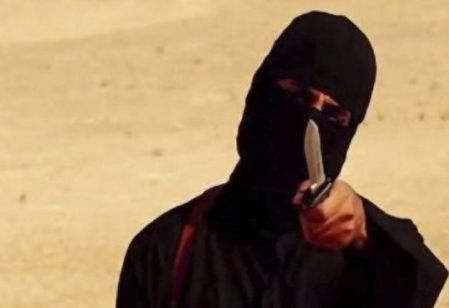
Execution of Steven Sotloff (1983 – 2014) by Jihadi John of ISIS. In August 2013, Sotloff was kidnapped in Aleppo, Syria, and held captive by militants from the Islamic State of Iraq and the Levant. Jihadi John (Mohammed Emwazi, born August 1988) a British man who is thought to be the person seen in several videos produced by the Islamic extremist group ISIL showing the beheadings of a number of captives in 2014 and 2015. (Photo by Universal History Archive/UIG via Getty Images)

Execution of Steven Sotloff (1983 – 2014) by Jihadi John of ISIS. In August 2013, Sotloff was kidnapped in Aleppo, Syria, and held captive by militants from the Islamic State of Iraq and the Levant. Jihadi John (Mohammed Emwazi, born August 1988) a British man who is thought to be the person seen in several videos produced by the Islamic extremist group ISIL showing the beheadings of a number of captives in 2014 and 2015. (Photo by Universal History Archive/UIG via Getty Images)

The US drone strike Thursday night, Nov. 11, targeting the Islamic State’s infamous executioner known as “Jihad John” in the northern Syrian town of Raqqa may or may not have hit the mark – the Pentagon says it is too soon to say. The hooded, masked terrorist with the British accent has been identified as a British Muslim born in Kuwait called Mohamed Emwazi. He appeared on videos worldwide showing the cold-blooded murders of US, British, Japanese and other hostages.

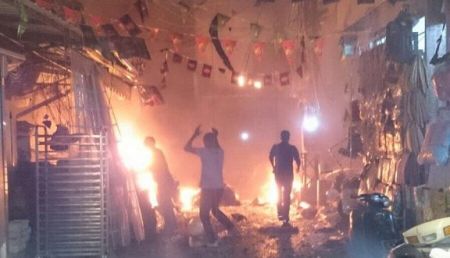
The drone attack occurred shortly after the latest ISIS atrocity: Thursday night, two or three suicide bombers blew themselves up, killing 43 people and injuring at least 240 in the Hizballah stronghold of southern Beirut opposite Burj Barajneh.

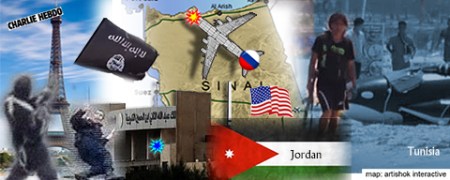
Ten days earlier, the Islamic State brought down the Russian Metrojet airliner over Sinai killing all 224 people aboard. This spectacular act of terror was apparently the first strike of the jihadist group’s winter offensive. It achieved its objectives of multiple murder; mortal damage to Egypt’s tourism industry and a blow to the prestige of its president Abdel-Fatteh El-Sisi.

The attack also punished President Vladimir Putin for bringing the Russian military into the center of the Syrian conflict.

The next Islamic State assault was aimed to undermine the credibility of Jordan’s King Abdullah and his security services: On Nov. 8,  a Jordanian police captain opened fire at a high-security US training facility outside Amman, killing two American trainers, a South African and two Jordanians. The number of US personnel injured in the attack was not released. This attack was timed to coincide with the 10thanniversary of the massive al Qaeda assault on Amman’s leading hotels, all American owned, which left 61 dead.

In northern Sinai, the murder of a family of 9 Egyptians at El Arish Thursday morning raised the total of ISIS murders in less than a month to 274.

DEBKAfile’s counterterrorism sources discern three objectives in the attack Thursday night in Beirut

1. A lesson for Tehran and Hizballah’s leader Hassan Nasrallah to show them that the Islamic State is able to reach them on their home ground, no matter how many troops they deploy to fight the jihadis in Syria (Iran and Hizballah together field an estimated 13,000 soldiers in Syria). ISIS was capable of inflicting terrible casualties both on the battlefield and in their homeland, first in Beirut and eventually in Tehran.

2.  The day before, Wednesday, Nov. 11, in a speech marking the “Day of the Shahid,” Nasrallah gloated over Hizballah’s triumph in a battle outside Aleppo. He also boasted that his domestic security shield in Lebanon presented an impenetrable barrier against ISIS or Nusra Front terrorist intrusions.

The Islamic State’s tacticians determined to blow up both claims in Nasrallah’s face. He and Iran were to be shown that they could not stop ISIS or prevent the Syrian war’s spillover into Lebanon.

3.  By blowing up the Russian airliner over Sinai, the Islamists sought to underscore this point for Moscow too. Russia might send a powerful military force to Syria, but the Islamists would hit Putin from the rear at a location of its choosing anywhere in the Middle East. Moscow may have opted to defend Bashar Assad, but what can it do to protect Hizballah and its other allies?.

DEBKAfile’s counterterrorism sources note that US and Russia have taken lead roles in the broad military effort to defeat ISIS – often by means of pinpointed operations. At the same time, under their noses, the Islamist terrorists have launched their winter campaign, striking with extreme ferocity and agility in unexpected places that are outside the regular battle fronts in which the big powers are engaged.

Iran Threatens to Walk Away from Nuke Deal

November 13, 2015

Iran Threatens to Walk Away from Nuke Deal Rouhani: Any new sanctions are a deal breaker

BY:
November 12, 2015 3:05 pm

Source: Iran Threatens to Walk Away from Nuke Deal – Washington Free Beacon

Iran has threatened to walk away from the recently inked nuclear deal and stop rolling back its nuclear enrichment program, according to recent comments by Hassan Rouhani, the Islamic Republic’s president.

Rouhani, in comments on Thursday, threatened to break the deal if the United States imposes any new sanctions on Iran, even ones concerning the country’s human rights abuses and its ballistic missile program.

The comments are a direct response to promises by the Obama administration to continue pursuing economic sanctions targeted at Iran’s terrorist proxies and efforts to foment unrest across the globe.

The warning from the Iranian president was delivered amid bipartisan calls in Congress to increase pressure on Iran in response to its recent arrest of two Americans, one a dual citizen and one a D.C.-based permanent resident.

Iran “will not fulfill agreements” aimed at curbing its nuclear program if any new sanctions are considered, Rouhani said, according to reports carried by the country’s state-controlled media.

“The obligations are the following: the group of six [global powers] will not impose new sanctions, and we should fulfill the agreements,” Rouhani said. “In case the Unites States or other countries fail to comply with their obligations, we will be forced to do the same.”

Rouhani’s made these comments just days after reports emerged indicating that Iran has stopped dismantling its nuclear centrifuges, a key requirement of the agreement.

Major differences between the United States and Iran have arisen on the issue of sanctions. While Iran maintains that all U.S. sanctions must be terminated, the Obama administration says it is only required to suspend nuclear-related sanctions.

This leaves open the possibility that the United States could reintroduce sanctions if Iran violates the deal and could level new sanctions unrelated to the country’s nuclear program.

Rouhani acknowledged that this has caused tension between the two nations, stating in his remarks, “a U.S. decision to withdraw only nuclear-related sanctions on Tehran but keeping other restrictions in place has led to continuous disagreement between Iran and the United States.”

The Iranian president also demanded in his remarks that the United States “apologize” for its past actions against Iran.

“If they [the U.S.] modify their policies, correct errors committed in these 37 years and apologize to the Iranian people, the situation will change and good things can happen,” Rouhani said.

Sen. Ted Cruz (R., Texas), a vocal opponent of the nuclear deal, told the Washington Free Beacon that the administration is intentionally ignoring Iran’s bad behavior in order to preserve the accord.

“The Obama administration may insist that the nuclear deal is somehow isolated from other bad behavior on the part of the Islamic Republic, but the fact is that this is all part of the same ugly pattern,” Cruz said. “Tehran understands perfectly well that the terrorist activities of the Revolutionary Guard, including the detention last month of American citizen Siamek Namazi and American resident Nizar Zakka, are part of the same anti-American hostility that also fuels their nuclear program.”

“Trying to separate out their activities is a fool’s errand,” Cruz said. “There can be no good-faith deal with a regime that is the world’s leading state sponsor of terrorism and that has been targeting America and our allies for 36 years.”

The Obama administration has reserved the right to pursue new sanctions.

The State Department explained to the Free Beacon earlier this week that it will not remove sanctions relating to certain elements of Iran’s Revolutionary Guard Corps, an organization responsible for waging terror attacks. Other sanctions aimed at curbing Iranian human rights abuses also remain in place.

However, the State Department has declined to go further with its sanctions against the corps, telling the Free Beacon that it is not considering designating the military group as a foreign terrorist organization, which could severely restrict its activities.

“We believe the sanctions we have in place remain the most appropriate and effective tools for targeting the IRGC, and we are making full use of such authorities with respect to the IRGC,” a State Department official told the Free Beacon this week. “In addition to Iran’s designation as a State Sponsor of Terrorism, we have a substantial set of sanctions already in place against the IRGC.”

Questions still remain about whether the United States will respond to the recent arrests of two American citizens in Iran. While members of Congress have called for sanctions as a result of the arrests, the administration has balked.

Sen. Mark Kirk (R., Ill.), among other lawmakers, has demanded that the Obama administration work with lawmakers to strengthen sanctions.

“Iran’s threatening behavior will worsen if the administration does not work with Congress to enact stronger measures to push back, including renewal of the expiring Iran Sanctions Act of 1996 and targeted sanctions against Iran’s Revolutionary Guard and against any Iranian official found to have participated in the unjust detainment of American citizens,” Kirk said in a statement.

“It should come as no surprise that Iranian leaders are trying to blackmail the administration into ignoring Iran’s terrorism, human rights abuses, tests of missiles that can strike Israel, and detention of American citizens,” Kirk told the Free Beacon. While Congress has red lines that Iran passed long ago, the question is whether the administration has any red lines.”

Iran is pursuing a policy aimed a tying the White House’s hands, analysts said.

“Under the deal Iran always has a gun to America’s head,” said Omri Ceren, managing director for press at The Israel Project, a D.C.-based organization that has been critical of the final terms of the deal. “Any time the Iranians don’t like anything the U.S. is doing, they can blackmail Washington by threatening to walk away from the deal. “

“This time they’re telling Congress that lawmakers are prohibited from responding to the arrest of American citizens,” Ceren said. “Who knows what they’ll ban the U.S. from doing next time?”

Other analysts agreed.

Michael Rubin, a former Pentagon adviser and expert on rogue regimes, said that these types of threats by Iran are a hallmark of the hardline administration.

“It’s the traditional Tehran two-step: One step forward and two back,” Rubin said.

Iran is comfortable issuing threats because it has already begun to receive sanctions relief granted under the nuclear accord. Tehran also has leverage over the Obama administration because of the way the deal is structured, according to Rubin.

“Kerry’s team played into Iran’s hands by front-loading Iran’s rewards and removing any incentive for Tehran to adhere to commitments,” Rubin said. “Who besides Obama and Kerry would give a rogue regime and the world’s largest state sponsor of terrorism a free pass against consequence for any of their actions?”

“Kerry essentially handed Iran a get out of jail free card, and the Iranian leadership will respond by seeing how far they can push,” Rubin explained. “Obama stays quiet on the arrest of reporters or businessman? Well, why not execute one or two and see what happens then? Obama ignores Iranian shipment of missiles to Hezbollah? Why not launch a few?”

Hungary’s Migrant Crisis Ends, Europe’s Has Just Begun

November 12, 2015

Hungary’s Migrant Crisis Ends, Europe’s Has Just Begun, The Gatestone InstituteGeorge Igler, November 12, 2015

(Please see also, The annihilating of our western society. — DM)

  • “[H]alf any given year’s total migrants arrive by the start of October. The other half arrives between October and the end of December… If these tendencies remain relevant, we should expect the very opposite of a winter break, and should prepare instead for an increasing flood of people.” — Viktor Orbán, Prime Minister of Hungary, September 21, 2015.
  • The UN High Commission for Refugees announced on Nov. 2 that the number of people who illegally migrated to Europe in October alone (218,394) nearly outstripped the number of those who entered throughout the whole of 2014 (219,000).
  • The reality at Hungary’s central railway station in Budapest had to be seen to be believed. Hungarians were easily outnumbered 200 to 1 by predominantly young Muslim males. These newcomers engaged in sporadic violence, rioted at the sight of camera crews, and left the station littered with human excrement.
  • According to Björn Höcke, of the populist Alternative for Germany Party (AfD), by the end of 2016 there will be as many Muslim males of military age in Germany (5.5 million), as there are young German men of that age.
  • On Nov. 2, Libya threatened to send to Europe millions of migrants from Africa, unless the EU recognizes its self-declared (Islamist) government.

Earlier this year, Hungary’s ferociously articulate Prime Minister Viktor Orbán became the bête noir of European politics. Since then, Orbán has transitioned from being castigated as a threat to European values, into the most recognized defender of his continent’s Christian identity.

In a Europe whose central policy-makers seem in thrall to multiculturalism, Hungarians, after centuries of invasions and attempted invasions, appear unapologetically immune to political correctness. Even in their language, the colloquial phrase for communicating with the bluntest possible candor is magyarul mondva, literally “speaking in Hungarian.”

As over 400,000 predominantly Muslim migrants crossed illegally into Hungary before the completion of a border fence — which ground such incursions to an effective halt by the end of October — there has been a sanctimonious effort in the world’s press either to mischaracterize realities on the ground, or omit them altogether.

The concealment of sobering truths, openly reported in Hungary – ironically a nation whose press freedom has been criticized under Orbán’s leadership – can only have serious long-term consequences, in migrant-friendly countries such as Belgium, Sweden and Germany, especially the scale.

The United Nations High Commission for Refugees (UNHCR) announced on November 2 that the number of people who illegally migrated to Europe in October alone (218,394) nearly outstripped the number of those who entered throughout the whole of 2014 (219,000).

The figures, which even shocked members of the UNCHR, constitute the greatest monthly entry of illegal migrants into the European Union to date. Many had apparently felt that the legal imposition of quotas, initiated on September 22, and aimed at relocating migrants across EU member states, would have at least begun to tackle the EU’s migrant problem.

The quota scheme, which pivoted on forcing non-consenting member states to accept illegal migrants, has, in fact, been an abject failure. Only Sweden has participated directly.

Meanwhile, crossings from Turkey to nearby islands in Greece, the first step in the so-called Western Balkan route — the dominant corridor for illegal migrants at present — have far from peaked, and are accelerating. As winter seas make Mediterranean conditions more difficult, the journey is apparently being offered at a discount.

To observers who speak Hungarian, however, the UNHCR’s figures probably come as no surprise.

Addressing his nation’s parliament, on September 21, and calling this year’s mass migration to Europe an “invasion,” Viktor Orbán declared:

There will be no such thing as a winter hiatus with respect to the illegal immigration issue … If one looks at the tables, graphs and statistics — often available in the public domain — which show the month-by-month influx of illegal immigrants to date, what one sees largely is that half any given year’s total migrants arrive by the start of October. The other half arrives between October and the end of December.

Unlike his European partners, Orbán sees this year’s events not as an unprecedented “crisis,” but the result of a steady and entirely predictable escalation, centered on the unwillingness of member states to defend the union’s external frontiers from human smuggling, which is an obligation under the EU’s freedom-of-movement Schengen Treaty.

Orbán’s analysis led him to conclude:

There will be no let up; we should expect escalating pressure. There is no reason for us to think that people-smugglers will arrange their affairs and the routes they exploit any differently this year than they have in previous years. If these tendencies remain relevant, we should expect the very opposite of a winter break, and should prepare instead for an increasing flood of people.

As Hungary constructed its southern border fence, in line with its Prime Minister’s calculations and in consultation with Israel, experts worldwide called the move both pointless and counter-productive.

Currently, as Germany is opening new migrant reception centers weekly, Hungary is winding up its own.

On November 3, Hungary’s parliament voted overwhelmingly to reject the imposition of mandatory quotas, paving the way for legal action against the EU, in concert with the left-wing government of Slovakia led by Robert Fico. Poland is very likely to follow suit.

Many political analysts have concurred that Orbán has cynically exploited the migration issue to shore up waning domestic popularity. This could not be more wrong. Although Orbán’s poll numbers certainly took a slide in 2014, analysts similarly agreed in April that his national consultation on migration constituted a catastrophic miscalculation.

It is easy to see why. Hungarians, after the 1956 uprising against the Soviet Union, are extremely conscious of their own historic status as genuine refugees. Some national billboards accompanying the nationwide survey were even defaced, as the consultation had posed robust questions on the likely consequences of mass Muslim immigration, which most Hungarians had yet to witness, and which some found discomfiting.

But public opinion swung firmly in Orbán’s favor, with the effective occupation of Budapest’s central railway station (Keleti pályaudvar).

The realities on the ground at Hungary’s international railway terminus had to be seen to be believed. Hungarians were easily outnumbered 200 to 1 by predominantly young Muslim males. These newcomers engaged in sporadic violence; rioted at the sight of passing camera crews, and left the station littered with human excrement.

Migrants refusing to cooperate with authorities who wanted to take them to reception centers, to participate in the EU’s compulsory EURODAC asylum registration process, chanted “no fingerprint” in unison. Frustrated, many charged down motorways towards Austria, a move that led to the closure of major transport arteries.

Unlike the domestic Hungarian media, the international press reported little of the full gravity of events in Hungary. The international press failed to warn nations from Austria to Finland of what was headed their way. Journalists concentrated instead on the handful of children present, to sell a sob story.

Such reporting led Croatia to charge Hungary with the “inhumane” treatment of “refugees,” while Austria claimed, astonishingly, that Hungary’s behavior was reminiscent of the Holocaust. As migrants arrived in those nations, however, both countries rapidly backtracked.

While Hungary was being castigated for supposed xenophobia and for Orbán’s rhetoric, no one seemed to have considered that perhaps the most historically-invaded country in Europe knew what an invasion actually looked like, better than most.

Nor did many of the people criticizing Hungary stop to think that maybe, with such a prominent awareness of once being refugees themselves, Hungarians might be more cognizant of the gratitude, relief and forbearance that marks the conduct of a genuine refugee.

Instead, Hungary was confronted by aggressive economic migrants in numbers so huge that the authorities were “all but submerged.” As the migrants demanded transit to welfare states they had paid handsomely to reach, they threw food and water back at the same Hungarian officials being pilloried by the world’s media for their own efforts to cope.

The nadir of the global press coverage of Hungary came with a defensive action involving tear gas and water cannons, when, on September 16, its frontier post at Röszke was closed to illegal entry. The false story sold by the world’s media led the UN Secretary General, Ban Ki-moon, to condemn Hungary.

No mention was made outside the country of how Hungary’s police had reacted solely with non-lethal crowd control tactics — resorting to these only after a three hour standoff that injured 20 police officers, who had resisted persistent violent efforts to storm the country’s border.

The most conspicuous press failure, however, concerns the key question: With the EU’s border agency Frontex confirming on November 4 that 800,000 have illegally crossed into Europe so far in 2015, each likely paying $1000 to $5000 to a people-smuggler, how is this colossal total expenditure — entirely outside the means of genuine refugee camp residents in Turkey or Jordan — being funded?

Georg Spöttle, an Arabic-speaking German national security expert resident in Hungary, with unique access to the intelligence communities in both countries, has been studying the sources of money used by migrants to traverse Europe. He has frequently identified Gulf States, including Saudi Arabia and the United Arab Emirates, as the true source of the funds.

Spöttle has also examined some of the thousands of pictures and videos found on mobile phones discarded by migrants before entering Hungary. Many images, in his view, are likely to be in the possession only “of those either sympathetic to terrorism or terrorists themselves.”

For other observers, the most alarming evidence thrown up in central Europe by this year’s migrant influx lies in the nature of the identity documents being discarded, at the last stop on the Western Balkan route, before migrants head towards the EU’s freedom-of-movement zone.
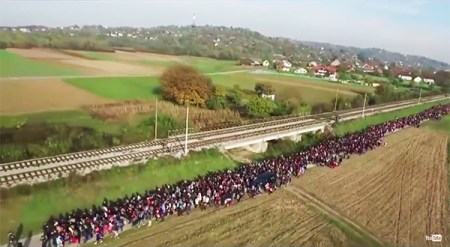
1340Thousands of migrants cross illegally into Slovenia on foot, in this screenshot from YouTube video filmed in October 2015.

In Serbia, the price of superglue has increased 100-fold, given that, when spread across a person’s fingertips, it temporarily allows an imprint of bogus fingerprints on a biometric EURODAC scanner.

Many of the documents thrown away at the Hungarian border include genuine Syrian civilian and military identity papers that would automatically entitle their holder to residence in Germany. The act seems highly irregular: Serbian identity papers, valid Swedish residency documents, papers confirming political refugee status from Jordan, and European passports, have all been found strewn across the border.

The only conclusion that can be drawn from such evidence collected at the EU’s external frontier, argues Hungary’s most notable security analyst, is that it points to the behavior of individuals intent on establishing jihadist sleeper cells in Europe. Or alternatively, that many Muslims with criminal records, already resident in the EU, could be exploiting the migrant crisis to establish entirely new identities for themselves before disappearing across the continent.

The only solution to an ever increasing influx, first from the Middle East, and then, in Orbán’s view, of even greater numbers from Africa, is to intercept and safely return migrant boats to their points of departure. On May 11, however, this “pushback” policy was utterly repudiated by Federica Mogherini, the European Commission’s foreign policy chief. Her announcement may well have acted as the spark for this year’s unprecedented migrant figures.

Orbán’s proposal, a combined European effort to police the narrow stretch of water between Turkey and nearby islands of Greece, has been rejected by the EU’s leaders. As a result, hundreds of thousands of people are still being allowed to enter the EU illegally, thanks to the newly strengthened Islamist government of Turkish President Recep Tayyip Erdoğan. At the moment, he is trying to bully Brussels into giving Turkey the features of an actual European Union membership step-by-step.

Hungary, perhaps to demonstrate how a combined border-protection initiative could work, is already using a joint cooperation force to defend its own EU frontier, with local partners from Slovakia, the Czech Republic and Poland.

The presence and power of Mogherini, whose fondness for political Islam has already been analyzed at the Gatestone Institute, is a damning indictment of the European Union’s claim to democratic legitimacy.

Thanks to what many felt was a profound dissatisfaction with mass migration into the EU, Europe experienced a marked turn to the political right in the 2014 European parliamentary elections.

A conservative European Commission was “elected” in turn — but it nevertheless appointed Mogherini, a former Italian Communist, to the most senior border-protection role in Europe. No matter how its people vote, the commitment of the EU’s institutions to a borderless Europe, both internally and externally, appears to remain undaunted.

It is clear, however, from remarks delivered in his nation’s capital on October 31, that Viktor Orbán’s patience with the EU has finally been exhausted. “Europe is being betrayed,” he told a Christian conference in Budapest. “It is being taken from us.”

Thousands of migrants shipped to the EU daily, Orbán argued, are “not a result of indecisiveness,” but the product of a conscious “left-wing” conspiracy to curb the relevance of Europe’s sovereign nation states by undermining their ethnic foundations.

With the EU having no perceptible mandate, this effort amounts to “treason,” he said, which must be countered by national democracies turning to their people. If not, he said, these people risk losing the ownership of their continent unless a Europe-wide consultation on mass migration immediately takes place.

The next migrant wave (50,000) is scheduled to arrive at the Austrian border next week. A ferry strike in Greece has caused a backlog, which is now moving its way through the Balkans.

According to Björn Höcke, of the populist Alternative for Germany Party (AfD), by the end of 2016 there will be as many Muslim males of military age in Germany (5.5 million), as there are young German men of that age.

Meanwhile, on November 2, Libya threatened to send to Europe millions of migrants from Africa, unless the EU recognizes its self-declared (Islamist) government.

Obama Has a Strategy in the Middle East, and It’s Working

November 12, 2015

Obama Has a Strategy in the Middle East, and It’s Working, Washington Free Beacon, November 12, 2015

Obama CairoPresident Obama in Cairo, 2009 / AP

Consider that if the primary goal of the president is not a certain outcome on the ground, but rather the reset of the American posture in the region from that of a dominant power to that of one nation among many partners collaborating where possible, and, when conflict can’t be avoided, erring on the side of minimalist interventions—well, from the perspective of the Oval Office, it would be possible to conclude that no change of course is required.

As with Obamacare, the “achievement” in all this is to be found less in any one specific policy outcome than in a broad leftward shifting of the conversation, and in the creation of a new normal for January 20, 2017, in which the re-establishment of more sensible policy in the Middle East will be extremely difficult.

************************

The Obama administration is “operating on a crisis basis” in the Middle East, says Leon Panetta, and doesn’t “have any kind of larger strategy” for the region. The president’s recent actions there, including the deployment of 50 special operations troops to Syria, are too incremental and “will not work,” says Fareed Zakaria. Indeed, the situation in that country has “spiraled out of control,” according to Vox’s Max Fisher in a post headlined “Unfixable: How Obama Lost Syria.”

And that’s what liberal critics are saying! The tone on the right is even more harsh—and why shouldn’t it be? Headlines this week from the region inform us that new footage shows about 200 children being shot to death by members of the Islamic State while lying in a row, faces in the dirt; that a Russian airliner that crashed in Egypt was quite likely downed with the use of military grade explosives; and that Russian airstrikes in Syria in support of the Assad regime have increased in intensity. It is Wednesday.

Zooming out, we see Assad in power, the Islamic State not going anywhere, Yemen still the focus of a regional proxy war, and a nuclear deal with Iran that has only empowered hardliners there.

The natural question thus seems to be: Why doesn’t Obama change course? Other presidents have shifted their approaches when confronted with failure—Carter’s late foreign policy and Bush’s Iraq surge both spring to mind. Why not Obama?

One answer to this question we ought to take seriously is that the president thinks things are, on the whole, going just fine.

Consider that if the primary goal of the president is not a certain outcome on the ground, but rather the reset of the American posture in the region from that of a dominant power to that of one nation among many partners collaborating where possible, and, when conflict can’t be avoided, erring on the side of minimalist interventions—well, from the perspective of the Oval Office, it would be possible to conclude that no change of course is required.

This possibility is why I’m not persuaded of Panetta’s charge that the administration lacks a “larger strategy.” It seems entirely possible to explain what might seem to be incompetence as simply the consequence of having as the primary focus of our regional strategy the reduction of the American role.

Evidence for this possibility can be detected through a Kremlinological look at the administration’s own public statements, including the repeated insistence that “local partners” will do the fighting on the ground against the Islamic State, which, in turn, will only “ultimately” be destroyed, as well as the unconventional assertion by Ben Rhodes earlier this year that the avoidance of military casualties is itself a goal of American national strategy. Much of the evidence rounded up by Michael Doran in his excellent essay on the strategy behind the Iran deal points in the general direction I propose. And others have made plausible arguments that the administration has engineered a transition from a Middle Eastern “Pax Americana” system to one where “offshore balancing” prevails—even though such an assessment understates the extent to which responsible outcomes on the ground don’t matter nearly as much to the White House as the nature of the American posture itself.

The most persuasive proof is a form of reductio ad absurdum—denying this assessment seems to require the conclusion that the president and his advisors are profoundly foolish. It seems more likely that they are simply ruthless ideologues.

From their point of view, it is surely lamentable that the region hasn’t responded better to the withdrawal of American power. But there was always going to be a period of transition, and that the shift is somewhat traumatic is not necessarily a surprise. Calls for America to reinsert its military are shortsighted: after all, the presence of the American military in support of corrupt Sunni regimes like Saudi Arabia’s contributed mightily to the targeting of the United States by extremists, and the removal of Saddam led ultimately to the existence of the Islamic State. Our enmity with Iran’s revolutionary government goes back to our backing of the Shah and the ouster of Mossadegh, and anyway, the fact that we are allied with toxic Sunni regimes (not to mention apartheid Israel) but hostile to a religious Shia regime is irrational, at best. Violence may currently be surging, but the death tolls conveyed in lurid headlines must be seen in the context of truly grave global threats, like climate change. Those threats require our best attention, as does the rebuilding of the American economy, and we are better served by working to construct a more equitable and just society at home before taking unilateral, aggressive, and risky actions abroad.

This analysis may be wrong in part or in whole, but it is internally coherent, and if accepted it points to the strategy more or less exactly like the one being pursued. If America is usually part of the regional problem, and if its efforts are better employed elsewhere, then the strategic goal should be to reduce the amount of America in the region. In the administration’s first term, centrist voices in the cabinet would have resisted such an approach—but they are gone now.

The shift in our regional posture has, of course, provoked opposition from hardliners (American hardliners, that is) including conservative politicians and elements of the Pentagon’s leadership, whose actions over the years have empowered Middle Eastern hardliners like the Iranian mullahs. Thus this domestic opposition is also, in a sense, the enemy, and resisting this wing of American politics at home will give moderates in countries like Iran the space to gain influence over time.

This worldview is why Obama isn’t going to change course any time soon, absent a major loss of American life in a terrorist attack and the domestic political pressures that will create. Even then, the response is likely to be conducted with an eye to keeping military engagements highly limited, as with token actions taken in recent weeks in the campaign against the Islamic State. Indeed, seen in this light, incremental deployments of a few dozen troops to Syria need no longer be seen as foolish gestures that are destined to fail, but rather as more or less successful delaying actions meant to placate domestic political opposition.

As with Obamacare, the “achievement” in all this is to be found less in any one specific policy outcome than in a broad leftward shifting of the conversation, and in the creation of a new normal for January 20, 2017, in which the re-establishment of more sensible policy in the Middle East will be extremely difficult.

Ahead of Europe trip, Rouhani won’t disavow desire to destroy Israel

November 12, 2015

Ahead of Europe trip, Rouhani won’t disavow desire to destroy Israel Iran leader tells French TV Tehran eschews ties with ‘illegitimate’ Israel, refuses to say if he agrees with hard-line statements of predecessor

By Times of Israel staff

November 12, 2015, 11:52 am

Source: Ahead of Europe trip, Rouhani won’t disavow desire to destroy Israel | The Times of Israel

The EU has more labeling to do, but do not hold your breath

Iranian president in a televised interview to France 2 posted online on November 11 2015. (Screen capture France 2)

Iranian president in a televised interview to France 2 posted online on November 11 2015. (Screen capture France 2)

Iranian president Hassan Rouhani refused to say whether he agreed that Israel should be wiped off a map, but called for a one-state end to the conflict with the Palestinians, in two interviews published Thursday.

Speaking to French TV ahead of his first trip to Europe, Rouhani also denied that Iran ever sought nuclear weapons.

Asked by France 2 whether he shared his hard-line predecessor Mahmoud Ahmedinejad’s view that Israel “has no place on the map of the Middle East,” Rouhani answered: “How come this question destined for my predecessor returns now to me?”

He then added that Iran does not believe in a two-state solution.

“We are not speaking of two states but a single one. We say that all the people who originated in Palestine as it was in the borders before 1948 and as it was then as a country should reunite and vote, and whichever [political] system they choose, we will be in agreement with that.”

Iranian President Hassan Rouhani (left, seen from the back) interviewed by France 2 ahead of his visit to France, scheduled for 16-17 November 2015. (Screen capture France 2)

Iranian President Hassan Rouhani (left, seen from the back) interviewed by France 2 ahead of his visit to France, scheduled for 16-17 November 2015. (Screen capture France 2)

“Israel in its current form is not legitimate; this is why we don’t have any relations with it, because we do not consider it legitimate,” said Rouhani, according to a France 2 translation.

Speaking to Italian paper Corriere della Sera, Rouhani was asked when the time will come when “Death to Israel” and similar slogans will no longer be part of Friday prayers.

“We respect all monotheistic religions,” he said, including the Hebrew and Christian ones. “The Jewish people have always lived peacefully in Iran […] they have representatives in the Iranian parliament and they can practice their religion freely. But this is different from Zionism’s policies, which is different from Judaism,” the Iranian president said.

“We condemn the persecutions by the Zionist regime in the region, including the killing of Palestinians, and we condemn American policies of unilaterally supporting this regime. What I am trying to say is that the Iranian people can detest Israel and Zionist policies but at the same time love Judaism, the prophets and the book [the Bible].”

Rouhani’s trip next week — the first by an Iranian leader in over a decade — will see him travel to France, Italy and the Vatican, highlighting warming ties with the Continent in the wake of the July nuclear deal.

The visit will largely be devoted to inking new trade agreements. He said there have been discussions regarding future possible collaboration with French companies on several economic ventures.

Ties with the US have remained cold, but he told Corriere della Sera that he could envision a day when the relationship with Washington, accused in Iran of propping up the unpopular Pahlavi regime overthrown in 1979, is restored.

“One day these embassies will reopen, but what matters is the behavior and those who hold the key to this are the Americans. If they change their policies, correct the mistakes they committed during 37 years and apologize to the Iranian people, the situation will change and good things can happen,” he said.

He told the French station that Iran’s nuclear ambitions have never included military use, repeating Tehran’s official line which stands in contrast to Western fears that the country does seek a nuclear weapon.

Asking whether Iran renounces the pursuit of a nuclear bomb, a France 2 interviewer said “for the French there is still a doubt” on this issue. During P+5 negotiations, Paris was seen as the most suspect of Iranian ambitions.

Rouhani said Tehran has “always sought this research uniquely in the domain of civil nuclear power and this continues today.”

Iran has “never wished, at any moment, not yesterday nor today, to manufacture an atomic bomb,” he said.

He added that Iran has long been a signatory of the Nuclear Non-Proliferation Treaty and has cooperated with the UN’s International Atomic Energy Agency.

“Our country has always collaborated with the IAEA. All the reports of this agency show that Iran has collaborated well. Today, we are willing to take on all the obligations [of the nuclear agreement] on the condition that the permanent members of the UN Security Council plus Germany take on theirs,” he said.

Before the nuclear deal, the IAEA had long complained that Iran restricted access to suspected nuclear sites. The watchdog recently said Iran was complying with a new inspections regime put in place as part of the nuclear pact.

When Will Obama and the West Listen to Hamas?

November 11, 2015

When Will Obama and the West Listen to Hamas?

by Khaled Abu Toameh

November 10, 2015 at 5:00 am

Source: When Will Obama and the West Listen to Hamas?

  • What senior Hamas figure Musa Abu Marzouk and other Hamas leaders are saying is very clear: Even if a Palestinian state is established in the West Bank, Gaza Strip and east Jerusalem, Hamas and other Palestinians will continue to fight until Israel is completely destroyed.
  • Hamas is openly stating that it will use any future Palestinian state as a launching pad to attack and eliminate Israel.
  • Hamas is not a small opposition party in the Palestinian territories that can be dismissed as a minor player. Hamas is a large Islamist movement, an offshoot of the Muslim Brotherhood that controls the entire Gaza Strip with its population of 1.8 million Palestinians. Hamas, not much different from Islamic State and Al-Qaeda, has its own security forces, militias, weapons and government institutions.
  • The Obama Administration and Western governments can talk as much as they like about the two-state solution. Even if President Abbas agrees to a Palestinian state, he will never be able to persuade Hamas, Islamic Jihad and many other Palestinians to recognize Israel’s right to exist.
  • Under the current circumstances, where Hamas and other Palestinians continue to dream about the destruction of Israel, any talk about a two-state solution is nothing but a joke.

As President Barack Obama and Israeli Prime Minister Benjamin Netanyahu were talking about the two-state solution during their meeting in the White House yesterday, the Palestinian Hamas movement reiterated its intention to destroy Israel.

Hamas’s announcement shows that the two-state solution is not a recipe for peace between Israel and the Palestinians. The announcement also shows that all those who have been talking about a change in Hamas’s position towards Israel continue to live in an illusion.

As the Obama-Netanyahu meeting was underway, senior Hamas figure Musa Abu Marzouk issued a statement in which he declared: “We will never negotiate with the Zionist entity and we will never recognize its right to exist. We will continue to resist the Zionist entity until it vanishes, whether they like it or not. The soldiers of the Qassam [Hamas’s armed wing] were founded to liberate Palestine, even if some have recognized Israel. We want a state from the (Jordan) river to the [Mediterranean] sea.”

As U.S. President Barack Obama met with Israeli Prime Minister Benjamin Netanyahu yesterday (left), senior Hamas official Musa Abu Marzouk (at far right, holding rifle) reiterated his organization’s commitment to eliminate Israel.

Abu Marzouk’s remarks came in response to statements made by Palestinian Authority (PA) President Mahmoud Abbas during a meeting with Egyptian journalists in Cairo on Sunday night.

Abbas was quoted as telling the Egyptian journalists that Hamas and Israel were conducting “direct negotiations” to establish a Palestinian state in the Gaza Strip and parts of the Egypt’s Sinai Peninsula. Abbas claimed that ousted Egyptian President Mohamed Morsi had offered to annex 1000 square kilometers of Sinai to the Gaza Strip – an offer he (Abbas) had categorically rejected.

Abu Marzouk’s latest threats to eliminate Israel are not only directed against Abbas, but also towards President Obama and those in the international community who continue to support the idea of establishing a Palestinian state alongside Israel. What he and other Hamas leaders are saying is very clear: Even if a Palestinian state is established in the West Bank, Gaza Strip and east Jerusalem, Hamas and other Palestinians will continue to fight until Israel is completely destroyed.

In other words, Hamas is openly stating that it will use any future Palestinian state as a launching pad to attack and eliminate Israel. But Hamas’s message has obviously not reached the White House and other Western governments, where decision-makers continue to bury their heads in the sand, refusing to see or hear what some Palestinians are saying.

Hamas and many other Palestinians are completely opposed to a two-state solution: they believe that Israel has no right to exist — period — in this part of the world. The only solution they are prepared to accept is one that sees Israel wiped off the face of the earth.

Hamas is not a small opposition party in the Palestinian territories that could be dismissed as a minor player. Hamas is a large Islamist movement, an offshoot of the Muslim Brotherhood that controls the entire Gaza Strip with its population of 1.8 million Palestinians. Hamas has its own security forces, militias, weapons and government institutions.

Since its violent takeover of the Gaza Strip in 2007, Hamas and its political allies have turned the coastal area into a semi-independent Islamist emirate.

Since then, Hamas has used the Gaza Strip as a launching pad to attack Israel with tens of thousands of rockets and missiles. And Hamas leaders have repeatedly stated that their chief goal is to “liberate” not only the West Bank and east Jerusalem, but “all of Palestine.” In short, Hamas wants to replace Israel with an Islamist empire where non-Muslims would be permitted to live as a minority.

Hamas considers all Jews as “settlers” and “colonialists” who live in “settlements” such as Beersheba, Rishon Lezion, Ashdod and Bat Yam. Hamas does not differentiate between a Jew living in Ma’aleh Adumim or Gush Etzion (on the West Bank) and Tel Aviv, Haifa and Ramat Gan. That is why the Hamas media and leaders refer to Beersheba and Ra’anana, well within the “pre-1967 borders,” as “occupied” cities.

The Obama Administration and Western governments can talk as much as they like about the two-state solution. But so long as they refuse to listen to what Hamas and other Palestinians are saying, they will continue to engage in self-deception and hallucination. Even if President Abbas agrees to a Palestinian state on the pre-1967 lines, he will never be able to persuade Hamas, Islamic Jihad and many other Palestinians to recognize Israel’s right to exist.

Under the current circumstances, where Hamas and other Palestinians continue to dream about the destruction of Israel, any talk about a two-state solution is nothing but a joke.

The Obama Administration and the rest of the international community also need to understand that that the two-state solution has already been realized. In the end, the Palestinians got two states of their own: one in the Gaza Strip and another in the West Bank. The one in the Gaza Strip is run by folks are not much different from Islamic State and Al-Qaeda, while that in the West Bank is controlled by a president who has entered the 11th year of his four-year-term in office and as such is not even seen by his people as a “rightful” leader. This is a reality that the world, including Israel, will have to live with for many years to come.

It is time for the world to stop listening only to President Abbas and Saeb Erekat, and start paying attention to what many other Palestinians such as Hamas are saying, day and night, regarding their commitment to destroy Israel.

Turkey: Syria land operation possible but not alone

November 11, 2015

Turkey: Syria land operation possible but not alone

Uğur Ergan – ANKARA

Source: Turkey: Syria land operation possible but not alone – MIDEAST

Turkish Prime Minister Ahmet Davutoğlu (R) sitting across CNN International's Christiane Amanpour (L) in an interview on Nov. 9, 2015. AA Photo

Turkish Prime Minister Ahmet Davutoğlu (R) sitting across CNN International’s Christiane Amanpour (L) in an interview on Nov. 9, 2015. AA Photo

Turkish Prime Minister Ahmet Davutoğlu said a ground forces operation in Syria could be possible but Turkey would not conduct such an operation alone, speaking in an interview with CNN International’s Christiane Amanpour on Nov. 9.

“[A] ground forces [campaign] is something which we have to talk [about] together and share. As I told you in our last interview, there’s a need of an integrated strategy, including an air campaign and ground troops,” Davutoğlu told Amanpour on Nov. 9.

“But Turkey alone cannot take on this burden. If there’s a coalition and a very well designed integrated strategy, Turkey is ready to take part in all senses,” he added.

Davutoğlu confirmed once again that he was talking about a possible ground forces operation after Amanpour asked if the strategy also included “the ground.”

“Yes, of course,” Davutoğlu answered.

He said that without an integrated strategy for Syria, which was needed, another terrorist group could emerge apart from the Islamic State of Iraq and the Levant (ISIL).

“We have to solve the Syrian crisis in a comprehensive manner,” Davutoğlu said.

According to Turkish security sources who spoke to daily Hürriyet on condition of anonymity, it was not considered a warm option for the Turkish Armed Forces to enter Syrian territory for a land operation against ISIL without a decision taken in the international arena, either with the United Nations Security Council (UNSC) or the NATO Council. The inclusion of coalition forces in these international decisions is also being sought for Turkey to take part in a ground forces campaign, the sources said.

Since civil war erupted in Syria, sources said, Turkey has been making plans on various scenarios, which included launching a land operation, and were making the necessary changes to them according to new developments. The sources said it was “normal” for Turkey to conduct such plans.

If an attack is launched directly towards Turkey from the Syrian side, then Turkey would respond to this attack without seeking a decision from the UNSC or NATO, according to the sources.

Turkey could launch a special forces unit operation into the area in Syria where a attack on Turkey was launched from, but this would be a limited campaign and it could not be regarded as an extensive operation, the security sources said.

Sources added Turkey would be more involved in airstrikes under a coalition led by the U.S.

Turkish Foreign Minister Feridun Sinirlioğlu’s words last week in Iraq’s Arbil on the possibility of Turkey having “plans to militarily take action against ISIL” could be regarded in this perception, the sources said.

Turkey also needed to take into consideration Russia when making plans on a ground operation in Syria, they said.

November/11/2015

Shortly before the Obama-Netanyahu summit, ISIS hit Americans in Jordan

November 9, 2015

Shortly before the Obama-Netanyahu summit, ISIS hit Americans in Jordan, DEBKAfile, November 9, 2015

Isis_Jordan480

After the Islamic State succeeded in downing a Russian airliner that took off from Sharm El-Sheikh on October 31, causing the deaths of all 224 passengers and crew, the terrorist organization Monday, Nov. 9, put a US military target in its crosshairs. A captain in the Jordanian police opened fire in the cafeteria of the Special Operations Training Center outside the Jordanian capital, Amman, where American instructors train Iraqi troops to fight ISIS. Two trainers from the US and one from South Africa were initially reported killed and another six wounded, including two more Americans and four Jordanians.

A Jordanian government spokesman said later Monday that the number of fatalities had risen to eight, without specifying how many foreigners.

The gunman did not survive. He was variously reported to have committed suicide after the assault or killed by Jordanian troops.

The modus operandi resembled the “green on blue” insider attacks committed in Afghanistan by al Qaeda and Taliban “insiders” against American and British troops serving at the same base.

Jordan’s Al-Rai newspaper identified the shooter as Anwar Abu Ubayd, but other news outlets said his name was Anwar Abu Zaid.

If the downing of the Russian plane rocked the regime of Egyptian President Fattah El-Sisi, there is no doubt that Monday’s attack will shake King Abdullah’s Hashemite throne.

The attack, furthermore, demonstrated that ISIS is rapidly approaching Israel’s borders with Syria in the north, Egypt in the south and Jordan in the east. The assault gained particular attention as it was carried out just hours before the summit Monday between Israeli Prime Minister Binyamin Netanyahu and US President Barack Obama at the White House in Washington.

They met for the first time after more than a year and after a major row over the Iranian nuclear accord. Both leaders made statements strongly indicating that they had determinedly buried the hatchet and were looking to the future of strong and amicable ties and expanded US support for Israel’s security.

A large part of their two-hour conversation was undoubtedly devoted to the threat posed by ISIS, on which they concur.

Until now, Jordan had been home to the most important and secure US forward base for the war on ISIS in Iraq and Syria.  US air strikes come from bases in Turkey, but more than 10,000 ground troops and special operations forces troops are present in Jordan. The kingdom serves as a training, operations and logistical center for US missions in Iraq and Syria, and for that purpose a command center, the US Central Command Forward-Jordan, was established outside Amman.

Until now, ISIS had not managed to infiltrate Jorda for attacks capable of destabilizing Abdullah’s rule. Numerous infiltration and terrorist attacks were thwarted by Jordanian intelligence and security. The Jordanian authorities focused primarily on keeping the jihads out of the refugee camps housing Syrians and Iraqis in flight from war zones, but this came at the expense of efforts to block the threat from reaching inside the Hashemite kingdom and its security facilities.

Their first success will no doubt embolden ISIS to keep on pressing its advantage. Immediately following Monday’s shooting, Jordan’s military went into high alert nationwide and along its borders. The US, Russia, Egypt, Jordan and Israel are all boosting their vigilance as the threat from ISIS continues to grow. But no one can reliably predict where the Islamist terrorists strike next.