Posted tagged ‘Middle East War’

Turkish army shells Kurds ‘refusing to retreat’ near Jarablus

August 26, 2016

Turkish army shells Kurds ‘refusing to retreat’ near Jarablus – state media Published time: 26 Aug, 2016 01:57

Source: Turkish army shells Kurds ‘refusing to retreat’ near Jarablus – state media — RT News
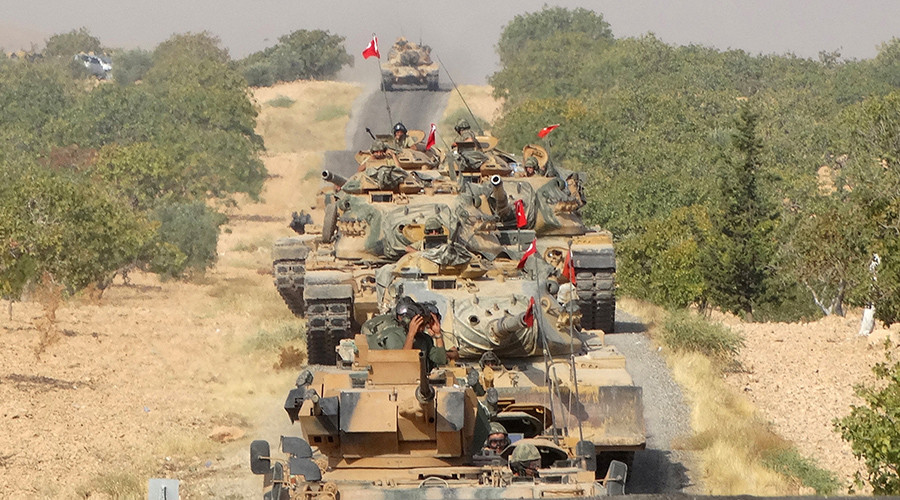
Turkish army tanks make their way towards the Syrian border town of Jarablus, Syria August 24, 2016. © Revolutionary Forces of Syria Media Office / Reuters

Turkish military have targeted US-backed Kurdish YPG militia with artillery fire south of the Syrian border town of Jarablus on Thursday, Anadolu state agency reported, citing a security source. The units allegedly refused to withdraw from the area despite warnings.

The group of YPG fighters were attacked with howitzers at about 6pm local time after they were spotted by Turkish intelligence advancing to Jarablus from the north of Manbij, the report said. Earlier, Washington assured Ankara that the US-backed Kurdish formations have been pulling out forces from the area to the east of the Euphrates River as demanded by Turkey.

READ MORE:Women burn burqas, men cut beards: Manbij celebrates liberation from ISIS (VIDEO, PHOTOS) 

“Kerry [US State Secretary John Kerry] emphasized that the PYD/YPG forces have been withdrawing to the east of the Euphrates,” a Turkish security source was quoted by Hürriyet Daily News as saying following a telephone conversation between the US top diplomat and Turkey’s foreign minister Mevlut Cavusoglu on Thursday morning.

While on a visit to Ankara on August 24, US Vice President Joe Biden pledged to withdraw the support of American forces to Kurdish fighters battling terrorists in Syria if they did not comply with Turkey’s request to remain east of the river.

READ MORE:Turkey shells ISIS & Kurdish positions in Syria

“They cannot, will not and under no circumstances get American support if they do not keep that commitment. Period,” Biden said at a joint news conference with Turkish PM Binali Yildirim.
Read more

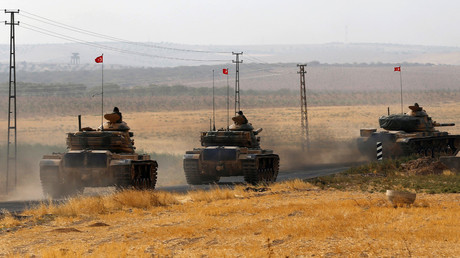
Turkish army tanks drive towards to the border in Karkamis on the Turkish-Syrian border in the southeastern Gaziantep province, Turkey, August 25, 2016. © Umit Bektas

Turkey has been conducting Operation Euphrates Shield since Wednesday after its troops entered the borderline territory in the north of Syria with the focus on retaking Jarablus from the Islamic State (IS, ISIS/ISIL) terrorists, which has been occupying it since July 2013. Justifying the incursion, which had not been authorized by the Syrian government, Turkey’s President Recep Tayyip Erdogan said it is aimed at stopping frequent cross-border attacks and repelling “terror groups which constantly threaten our country like Daesh [Arabic derogatory name for IS] and the PYD [the Democratic Union Party of Syria]”.

READ MORE:‘Blatant violation of sovereignty’: Damascus condemns Turkish operation in Jarablus

Meanwhile, Damascus slammed the offensive as “a blatant violation of sovereignty.”

The shelling follows a statement by YPG command saying that Kurdish militia under its control had left Manbij and returned to its bases, turning over the control over the city to the Manbij Military Council, according to Al-Masdar News.

On Wednesday, the YPG denounced the Turkish military offensive in Syria as “a hostile intervention,” refusing to cave in to pressure coming from Turkey.

“We won’t listen to the demands of Turkey or powers outside of Turkey. Turkey cannot impose its own agenda, its own interests on us. Our forces are there. We will not withdraw from west of the Euphrates,” YPG spokesman Redur Xelil said, as cited by Rudaw.

“Its main goal, more than ISIS, is the Kurds,” he pointed out.
Read more

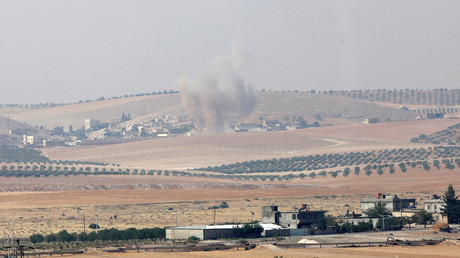
Smoke rises from the Syrian border town of Jarablus as it is pictured from the Turkish town of Karkamis, in the southeastern Gaziantep province, Turkey, August 24, 2016. © Stringer

At the moment, at least 20 Turkish tanks are taking part in operation inside Syria with more armored vehicles are expected to join the effort in the coming days as the Syrian rebels supported by Turkish forces are “cleansing” the city from jihadists.

The former IS stronghold of Manbij was freed by Kurdish-led SDF from jihadists just two weeks ago after months of intense fighting.

The Kurdish People’s Protection Units (YPG) are the armed wing of the Kurdish Democratic Union Party (PYD), close to the Kurdistan Workers’ Party, which Ankara considers a terrorist organization. Turkey has been leading a military campaign against PKK insurgency in the country’s south-eastern Kurdish-populated regions, which has been criticized by rights groups for its brutality. Numerous reports have also suggested that Ankara bombed Kurdish targets inside Syria while allegedly sparing Islamist militants that the YPG have been in bitter battle with.

Turkish tanks roll into Syria to confront Islamic State

August 24, 2016

Turkish tanks roll into Syria to confront Islamic State President Erdogan says operation aims to uproot jihadist group and Syrian Kurdish rebels, ‘put an end’ to border problems

By AP and AFP August 24, 2016, 12:23 pm

Source: Turkish tanks roll into Syria to confront Islamic State | The Times of Israel

A Turkish army tank drives toward Syria in the Turkish border city of Karkamis, in the southern region of Gaziantep, August 24, 2016. (AFP/BULENT KILIC)

ANKARA, Turkey — Turkey’s military launched an operation before dawn Wednesday to clear a Syrian border town of its Islamic State militants, and the country’s state-run news agency said Turkish tanks had crossed into Syria as part of the offensive.

In its report, the Anadolu Agency, which cited unnamed military officals, did not say how many tanks entered Syria. The private NTV television said as many as 20 tanks had crossed into Syria and that clashes were taking place at the border. Earlier in the day, NTV said that a small number of Turkish special forces had crossed into Syria as part of the operation.

NTV television said it was an “intruder mission” to carry out “pinpoint operations” against IS as part of the operation to clear the town of Jarablus of the extremists.

President Recep Tayyip Erdogan said the Turkish operation inside Syrian territory was aimed not just against jihadists but also Kurdish militia and should permanently put an end to problems on the border.

“From 4:00 am (0100 GMT) our forces began an operation against the Daesh (IS) and PYD (Kurdish Democratic Union Party) terror groups,” Erdogan said in a speech in Ankara, adding the move was aimed at “putting an end” to problems on the border.

As he spoke, Turkey’s state-run Anadolu news agency reported that pro-Ankara Free Syrian Army (FSA) rebels had already penetrated three kilometers (two miles) inside Syria toward the IS-held town of Jarabulus.

The office of Turkish Prime Minister Binali Yildirim said the operation, carried out by Turkish and US-backed coalition forces, began at 4 a.m. (0100 GMT), with Turkish artillery launching intense cross-border fire on the town of Jarablus, followed by Turkish warplanes bombing IS targets in the town, Anadolu said.

Smoke billows following air strikes by a Turkish Army jet fighter on the Syrian Turkish border village of Jarabulus during fighting against Islamic S State group targets, August 24, 2016 . (AFP/BULENT KILIC)

Smoke billows following air strikes by a Turkish Army jet fighter on the Syrian Turkish border village of Jarabulus during fighting against Islamic S State group targets, August 24, 2016 . (AFP/BULENT KILIC)

Just a few hours after the operation started, Vice President Joe Biden landed in Ankara for talks that include developments in Syria.

The visit comes at a difficult time for ties between the two NATO allies. Turkey is demanding that Washington quickly extradite a US-based cleric blamed for orchestrating last month’s failed coup. The United States is asking for evidence against the cleric and asking that Turkey allow the extradition process to take its course.

In Syria, Turkey is concerned about the growing power of US-backed Syrian Kurdish forces, who it says are linked to Kurdish groups waging an insurgency in southeastern Turkey. Wednesday’s operation puts Turkey on track for a confrontation with the Kurdish fighters in Syria.

Biden is scheduled to meet with Erdogan and Prime Minister Binali Yildirim.

The operation in Jarablus is meant to safeguard Turkey’s own security, according to Turkish Interior Minister Efkan Ala, who said Ankara “cannot sit and watch.”

“It is Turkey’s legal right, it is within its authority” to take action, the minister said, adding that Wednesday’s operation aimed to support the moderate Syrian opposition and was being carried out in coordination with the US-led coalition forces.

A Turkish army tank and an armored vehicle are stationed near the border with Syria, in Karkamis, Turkey, August. 23, 2016. (IHA via AP)

A Turkish army tank and an armored vehicle are stationed near the border with Syria, in Karkamis, Turkey, August. 23, 2016. (IHA via AP)

Turkey’s Hurriyet newspaper quoted Turkish sources as saying Turkish howitzers and rocket launchers had fired 224 rounds at 63 targets within an hour and 45 minutes, and that the Turkish air raids started just after 6 a.m.

The London-based Syrian Observatory for Human Rights also said Turkish ground troops had entered Syria. The activist group, which tracks the war through a network of local residents and fighters, said Turkish tanks and anti-mine vehicles crossed into Syria and were heading to Jarablus on Wednesday morning.

The Turkish government said the border area had been declared a “special security zone,” and asked journalists not to try to access it, citing safety concerns and threats posed by IS.

The assault followed Turkish Foreign Minister Mevlet Cavusoglu’s pledge on Tuesday of “every kind” of support for operations against IS along a 100-kilometer (62-mile) stretch of Syrian frontier. He said Turkey would support twin operations stretching from the Syrian town of Afrin in the northwest, which is already controlled by Kurdish forces, to Jarablus, in the central north, which is held by the Islamic State group.

Turkish army tank driving towards Syria in the Turkish-Syrian border city of Karkamis, in the southern region of Gaziantep, August 24, 2016. (AFP/BULENT KILIC)

Turkish army tank driving towards Syria in the Turkish-Syrian border city of Karkamis, in the southern region of Gaziantep, August 24, 2016. (AFP/BULENT KILIC)

Jarablus, which lies on the western bank of the Euphrates River where it crosses from Turkey into Syria, is one of the last important IS-held towns standing between Kurdish-controlled areas in northern Syria.

Located 20 miles (33 kilometers) from the town of Manbij, which was liberated from IS by Kurdish-led forces earlier this month, taking control of Jarablus and the IS-held town of al-Bab to the south would be a significant step toward linking up border areas under Kurdish control east and west of the Euphrates River.

In recent days Turkey has increased security measures on its border with Syria, deploying tanks and armored personnel carriers. On Tuesday, residents of the Turkish town of Karkamis, across the border from Jarablus, were told to evacuate after three mortars believed to be fired by IS militants landed there, Turkey’s Dogan news agency said.

Turkey has vowed to fight IS militants at home and to “cleanse” the group from its borders after a weekend suicide bombing at a Kurdish wedding in southern Turkey killed at least 54 people, many of them children. Turkish officials have blamed IS for the attack.

Ankara is also concerned about the growing power of US-backed Syrian Kurdish forces, who it says are linked to Kurdish groups waging an insurgency in southeastern Turkey.

A Turkish army tank and an armored vehicle are stationed near the border with Syria, in Karkamis, Turkey, Tuesday, Aug. 23, 2016. (IHA via AP)

A Turkish army tank and an armored vehicle are stationed near the border with Syria, in Karkamis, Turkey, Tuesday, Aug. 23, 2016. (IHA via AP)

The Kurdish-led group known as the Syria Democratic Forces, or SDF, recaptured Manbij from IS earlier this month, triggering concerns in Ankara that Kurdish forces would seize the entire border strip with Turkey. The US says it has embedded some 300 special forces with the SDF, and British special forces have also been spotted advising the group.

The Kurds’ outsized role in the Syrian civil war is a source of concern for the Syrian government as well. Fierce clashes erupted between the two sides over control of the northeastern province of Hasakeh last week, and Syrian warplanes bombed Kurdish positions for the first time, prompting the US to scramble its jets to protect American troops in the area.

The Syrian government and the Kurds agreed on a ceasefire Tuesday, six days after the clashes erupted. The Kurdish Hawar News Agency said government forces agreed to withdraw from Hasakeh as part of the truce.

Syrian state media did not mention any withdrawal, saying only that the two sides had agreed to evacuate the wounded and exchange detainees. Government and Kurdish forces have shared control of Hasakeh since the early years of the Syrian war.

Israel strikes Syria

August 23, 2016

Israel strikes Syria After mortar fire landed in the Golan Heights, the Israeli Air Force struck back.

Source: Israel strikes Syria – Defense/Security – News –

Israel Air Force (Illustration)

Israel Air Force

The Israeli Air Force struck a military target in Syria in response to mortar fire which landed in the Golan Heights in the north.

IAF jets scrambled into the air when a mortar strayed over from Syria and exploded in the Golan Heights. The fighter jets targeted a Syrian army missile launcher in retaliation, near Quneitra, Syria.

According to Syrian media, an unmanned aircraft struck a Ba’ath party position at the outskirts of Quneitra.

No one was injured. The mortar landed in open terrain.

No Red Alert rocket sirens sounded when the mortar breached Israeli territory.

Israel maintains a policy that spillover fighting, even of rebels, is the responsibility of the country who allowed it into Israel.

WATCH: Boy Suicide Bomber Stripped of Explosive Belt in Iraq

August 22, 2016

WATCH: Boy Suicide Bomber Stripped of Explosive Belt in Iraq

by Alexander Jones

22 Aug 2016

Source: WATCH: Boy Suicide Bomber Stripped of Explosive Belt in Iraq

Frightening footage has emerged purporting to show Kurdish security forces removing an explosive belt from an alleged Islamic State teenage suicide bomber moments before it was about to be detonated in the northern Iraqi city of Kirkuk on Sunday.

The chilling scene, caught on camera and uploaded to YouTube by Kurdish channel Kurdistan24, shows the boy’s hands being held by two law enforcement officers as another member of the security establishment attempts to disarm the device.

Wearing a Barcelona football shirt before it was cut off, the boy, believed to be 12 or 13 years old, according to Kurdish media network Rudaw, reportedly then burst into tears as he was led away by police.

The arrest is believed to have taken place in Kirkuk’s Huzairan neighbourhood, Rudaw reports, but precise details on where the boy intended to stage his potential attack are unconfirmed — it has been claimed that the boy was planning to blow himself up outside a Shia mosque, however.

The device was later safely destroyed away from the public.

The incident came less than 24 hours after a child as young as 12 killed at least 51 people and injured 69 — 17 of them seriously, according to Turkish president Recep Tayyip Erdogan — in a suicide bombing at a packed wedding ceremony in the southern Turkish city of Gaziantep.

President Erdogan said on Sunday that “Daesh is the likely perpetrator of the attack”, using the Arabic name for ISIS, adding that it is not yet clear whether the youngster detonated the suicide vest or if the explosives were set off remotely by someone else.

What is clear, however, is that IS is mobilizing children at “an ever-accelerating rate”.

According to a report published earlier this year by the West Point-based Combating Terrorism Centre, IS is “mobilizing children and youth at an increasing and unprecedented rate [and] that the number of child and youth militants far exceeds current estimates.”

Contextualizing the upward trend in the terror group’s use of child suicide bombers, the report concluded: “It seems plausible that, as military pressure against the Islamic State has increased in recent months, such operations […] are becoming more tactically attractive.”

Recording instances of young people who were featured in official IS reports as “martyrs” between January 2015 and January 2016, the report found that of the 89 cases surveyed, 39 percent died upon detonating a vehicle-borne explosive device, 33 percent were killed as foot soldiers in unspecified battlefield operations, six percent died while working as propagandists, and four percent committed suicide in mass casualty attacks against the civilian populace.

No ISIS There – Are U.S. Troops In Hasakah “Advising” Kurds To Attack The Syrian Army?

August 20, 2016

No ISIS There – Are U.S. Troops In Hasakah “Advising” Kurds To Attack The Syrian Army?

August 19, 2016

Source: M of A – No ISIS There – Are U.S. Troops In Hasakah “Advising” Kurds To Attack The Syrian Army?

Yesterday a fight broke out between Syrian Arab Army troops and local Kurdish forces in the predominately Kurdish city of Hasakah in north-eastern Syria. Hasakah, with some 200,000 inhabitants, has held a SAA garrison for years. There is some enmity between the Kurds and the soldiers but the situation is generally peaceful.

There have been earlier fights but these were local rivalries between Syrian auxiliary National Defense Forces from local Arab (Christian) minorities and some gangs who form a Kurdish internal security force under the label Asayish. Such fights usually ended after a day or two when grown-ups on both sides resolved the conflict over this or that checkpoint or access route.

The Islamic State (grey on the map) once threatened Hasakah but that danger is now far away.


Map via ISW

Yesterday another fight broke out, but got serious. The Syrian air force was called in to defend against direct attacks on the SAA garrison and minority quarters:

Syrian government warplanes bombed Kurdish-held areas of the northeastern city of Hasaka on Thursday for the first time in the five-year-old civil war, the Syrian Kurdish YPG militia and a monitoring group said.

The Syrian government still has footholds in the cities of Qamishli and Hasaka, both in Hasaka governorate, co-existing largely peacefully with YPG-held swathes of territory.The cause of this week’s flare-up was unclear.

Xelil said government forces were bombarding Kurdish districts of Hasaka with artillery, and there were fierce clashes in the city.

The Syrian Observatory for Human Rights, which tracks the war using a network of activists, said warplanes had targeted Kurdish security forces’ positions in the northwest and northeast of the Hasaka city.

The reason that fighting started might have to do with U.S. troops who, for whatever reason, seem to be in Hasakah. The U.S. military now laments that these troops came under Syrian air force fire:

The Syrian airstrikes took place in the northeastern city of Hasaka, an area that has seen increasing ground clashes between the Kurdish YPG fighters present and the Syrian regime forces. There was a small number of U.S. Special Operators acting as advisers to the YPG when the Syrian airstrikes began.After the Syrian Su-24s began to strike, the U.S. immediately contacted the Russians, Davis said, and made clear that American aircraft would respond if coalition forces were under attack.

The Russians explained that they were not the ones conducting the strikes and the U.S. scrambled manned fighter aircraft to the area to protect the Americans and allies under attack.

By the time the U.S. and coalition aircraft arrived the Syrian attack jets had left.

There is no Islamic State in the area which is now far away from the front line.

  • Why are U.S. troops, who have zero legal grounds of being in Syria at all, in Hasakah city or the wider area?
  • Who are they “advising” there and for what purpose?
  • Why does rare local fighting starts to get serious just when U.S. troops are in the area?

The U.S. has the chutzpah to “warn” the Syrians of defending their own troops on Syrian grounds:

Additional U.S. combat air patrols have been sent to the area yesterday and have been flying there today, as well.Davis said that the Syrians would be “well-advised” not to interfere with coalition forces on the ground in the future.

Syrian government forces are attacked by Kurdish troops who are “advised” by U.S. special forces. According to the U.S. spokesperson the Syrian air force is not allowed to defend them? What has this to do with “fighting ISIS” in eastern Syria which is allegedly the sole reason for U.S. troops being in Syria?

The Syrian air force was back over Hasakah today and continued to bomb position from which the Syrian army was attacked. They would not be flying there without Russian consent. Does the U.S. military want to start a fight with the Syrian air force and its Russian backers?

The YPG Kurds claim they are now evacuating civilians from some city quarters. They seem to expect a prolonged conflict.

Any move against the Syrian army in Hasakah will be watched carefully from Ankara. Turkey fears, with valid reason, that the U.S. supports the Kurdish aim of a  national entity in Syria and Iraq. This would endanger Turkey with its own large Kurdish minority.

If the Kurds expel the Syrian forces from Hasakah with U.S. support, Turkey would know that any U.S. claim to not work against its Turkish ally interest is false. This would deepen already high Turkish animosity against the U.S. and would accelerate its move towards some alliance with Russia and Iran.

Report: Russia Working to Pick Off U.S.-Backed Syrian Rebels

August 6, 2016

Report: Russia Working to Pick Off U.S.-Backed Syrian Rebels Rebel leader blames U.S. policy

BY:
August 5, 2016 3:30 pm

Source: Report: Russia Working to Pick Off U.S.-Backed Syrian Rebels

The Russian government is working to pick off Syrian rebels armed and trained by the U.S. to fight against the Islamic State who have often been dissatisfied with Washington’s assistance.

The political leader of a prominent U.S.-backed brigade in Aleppo said he met with a Russian official nearly two weeks ago, who offered him “unlimited amounts of weaponry and close air support” to wage war with ISIS and Jabhat al Nusra, an al Qaeda-linked jihadist group in Syria, the Daily Beast reported Friday.

Mustafa Sejry said members of his Liwa al-Mu’tasim Brigade were concerned about shifting their loyalties to Russia given Moscow’s close alliance with their enemy—the regime of President Bashar al-Assad.

“Honestly, I would have never ever even thought about working with the Russians after their horrific atrocities against us and their slaughtering thousands of my own people,” Sejry said. “But this change of mindset I blame on the Americans.”

Sejry said the Russians told him they wanted to “go back to 2012 when there was a government and an opposition,” which would divert resources from the fights against ISIS and other militant groups in the region.

Sejry said he hoped to use Moscow’s offer to leverage improved support from the U.S., but expressed doubt as he described a year and a half of weak American backing and “broken promises,” the Daily Beast reported.

He said he told two U.S. military officials about the Russian offer, but has yet to receive a response.

Sejry’s claims of Russians attempting to poach U.S.-backed Syrian rebels come roughly three weeks after the Obama administration reached an agreement with Russian President Vladimir Putin that instructs the two military forces to coordinate joint bombing operations against al Nusra.

The provisional deal mandates the U.S. military to share information with Russia about specific targets in Syria, in exchange for Moscow halting its bombing campaign against U.S.-supported rebels.

Opponents of the pact at the Pentagon and CIA said the Obama administration caved into “Russian bullying” and that Moscow could not be trusted to honor the agreement’s provisions.

Sejry is among the 1,000 Syrian rebels who enlisted in the Pentagon’s train and equip operation. The group threatened to leave the program after U.S. Central Command imposed stern restrictions, including a prohibition on rebels from using their U.S.-provided training or weaponry against Assad’s government.

Sejry said the U.S. pays his fighters infrequently, claiming they’ve received only a months-worth pay during the last three months.

“We feel betrayed. Now other options are on the table,” Sejry said. [The Russians] said, ‘We are more reliable and trustworthy. Just look how we stood with Assad all this time. And look at the Americans. They are not truthful, they’re not supporting you guys. We’ll be 100 percent with you.’”


Gun license for soldiers – as soon as they’re released

August 2, 2016

Gun license for soldiers – as soon as they’re released A new amendment will allow people of any age to get a gun license – provided that they finished military service first.

Rachel Kaplan, 02/08/16 16:29

Source: Gun license for soldiers – as soon as they’re released – Defense/Security – News –

Common sense is kicking in .

MK Aliza Lavi Meir Bolka

The Knesset has passed, for its second and third reading, an amendment to the Firearms Law which would allow all soldiers who finish their military service to get a gun license, even if they’re released before they turn 21, the minimum age for firearms licenses.

The amendment, initiated by MK Aliza Lavie (Yesh Atid), would mostly affect women, as their standard draft of two years has them out of the army while they are still too young to apply for a gun license.

The previous legal situation blocked women from many professional fields that require gun licenses, such as security, where newly-released soldiers are in high demand.

After the amendment, newly released soldiers of any age will be immediately allowed to apply for a gun license.

MK Lavie commented, “We are correcting here more outdated legislation, which is appropriate only for the life-stories of men [according to their age of release]. The amendment will assist employment, answering the growing need for security workers, and will also increase equality in the workforce.

“Female employment and employment in general begins at this point: female soldiers are released from the IDF, and they must not be exposed to gender discrimination in their first steps into the world of the workforce.”

The amendment is expected to affect men soon as well, when changes are implemented which will have all soldiers in support positions serving only two years and three months.

‘Obama increased aid to Arab countries, but not to Israel’

July 28, 2016

Obama increased aid to Arab countries, but not to Israel’ GOP Senator Lindsey Graham reveals White House shot down aid package requested by Israel.

David Rosenberg, 28/07/16 14:42

Source: ‘Obama increased aid to Arab countries, but not to Israel’ – Defense/Security – News –

UAE Crown Prince Mohammed bin Zayed al-Nahayan, Barack Obama

Reuters

South Carolina Republican Senator Lindsey Graham blasted President Obama this week, condemning his refusal to increase American aid to Israel, as well as his efforts to bar Israel from spending the aid money within the Jewish state.

Speaking to Haaretz, Graham revealed that Israel had previously requested an increased aid package from the White House, with $4 billion a year for regular military funding, plus $600 million towards Israel’s missile defense network.

But, Graham said, the administration rejected the request, despite similar increases to Arab states, such as Jordan.

“I made a decision, given the deterioration in the region, that Israel needs more funding,” said Graham. “In the last three years, we increased funding to Jordan by $275 million outside of the MoU, because Jordan was under siege.”

“The administration didn’t object to that increase, but they are objecting to the increase to Israel for 2017.”

In 2015 the White House announced plans to raise the amount of aid to Jordan by more than 50%, topping $1 billion per year.

Despite Obama’s rejection of Israel’s aid request, Graham noted, Congress is under no obligations to abide by any agreements the White House makes with Israel.

“I am not bound by the MoU as a member of Congress. Congress is not a party to the MoU and the MoU can’t bind Congress. Everybody in Congress wants to be generous to Israel like we did with Jordan.”

Graham added that Congress overwhelmingly backed not only an increase in funding for Israel, but opposed the president’s goal of ending the convertibility of a portion of the aid package to shekels, allowing Israel to use the money to pay for fuel or purchase arms from domestic producers.

While Israel is currently allowed to spend a portion of the aid money in Israel, Obama has sought to gradually end the practice, requiring that the aid be spent entirely within the US.

“Eighty-three senators signed a letter to the president that we be generous towards Israel. It is my belief that there are not even 10 members of Senate who object to allowing the IDF to buy fuel from U.S. aid money or [object] that the money be used to boost Israeli defense industries. I have never heard one member of Congress concerned about this.”

In voicing his support for elevated levels of military aid to the Jewish state, Graham noted the increased geostrategic threats facing Israel.

“Netanyahu told me Hezbollah received from Iran precision-guided missiles that are military game-changers,” he said. “According to the prime minister and his team, these missiles present a greater threat than presented previously.”

“I want Iran to see that Israel gets more support from the U.S. and not less. I want to send a signal to Iran that while they get stronger, our allies in the region also get stronger. I don’t think it is an American interest for Iran to think we are negotiating a deal with Israel that is less generous.”

‘Bloody massacres’: Syria appeals to UN after French & US airstrikes ‘kill over 140 civilians’

July 20, 2016

‘Bloody massacres’: Syria appeals to UN after French & US airstrikes ‘kill over 140 civilians’

Published time: 20 Jul, 2016 12:09 Edited time: 20 Jul, 2016 12:11

Source: ‘Bloody massacres’: Syria appeals to UN after French & US airstrikes ‘kill over 140 civilians’ — RT News

A U.S. Air Force F-15E Strike Eagle © US AIR FORCE / Reuters

Syria is demanding the UN take action after it says French war planes killed more than 120 civilians during airstrikes on Tuesday near the Turkish-Syrian border. The deaths came just a day after US air assaults killed a further 20 people in Manbij.

The Syrian Foreign Ministry sent letters to the UN secretary general and to the president of the UN Security Council, which at present is Japan.

Damascus wants the organization to look into atrocities committed by France, which is a member of the US-led international coalition, after it targeted the village of Toukhan Al-Kubra, located near the Turkish-Syrian border and the city of Manbij.

https://twitter.com/sayed_ridha/status/755359880022601728?ref_src=twsrc%5Etfw

“The French unjust aggression claimed the lives of more than 120 civilians, most of them are children, women and elderly, in addition to tens of wounded citizens, the majority of them are also children and women as reports say that the fate of scores of other civilians who still under debris are unknown too,” the Syrian Foreign Ministry wrote, as cited by the Syrian Arab News Agency.

The mass death toll in Toukhan Al-Kubra came just a day after US war planes killed around 20 people, mainly women and children, while many more were injured in and around the city of Manbij, the Foreign Ministry states.

“The government of the Syrian Arab Republic condemns, with the strongest terms, the two bloody massacres perpetrated by the French and US warplanes and those affiliated to the so-called international coalition which send their missiles and bombs to the civilians instead of directing them to the terrorist gangs… Syria also affirms that those who want to combat terrorism seriously should coordinate with the Syrian government and army,” the ministry added.

In the letter, the Syrian Foreign Ministry added that it condemns the continued support by the US, France, Saudi Arabia, the UK and Qatar to terrorist organizations such as Al-Nusra Front and Jaish Al-Islam, despite these groups having clear links to Islamic State (IS, formerly ISIS/ISIL) and Al-Qaeda.

The human rights watchdog Amnesty International also hit out at the US-led coalition, saying that it needs to do more to prevent the deaths of civilians.

“Anyone responsible for violations of international humanitarian law must be brought to justice and victims and their families should receive full reparation,” Amnesty’s interim Middle East director Magdalena Mughrabi said, as cited by Reuters.

A spokesman for the US Department of Defense says that it is aware of the loss of civilian life in Syria.

“We are aware of reports alleging civilian casualties near Manbij, Syria, recently. As with any allegation we receive, we will review any information we have about the incident,” Matthew Allen said in a statement.

“We take all measures during the targeting process to avoid or minimize civilian casualties or collateral damage and to comply with the principles of the Law of Armed Conflict,” he added.


https://amp.twimg.com/v/a918350f-8013-4f34-bcfc-b82f18a6180a

The US-led coalition has been providing air support to the rebel group the Syrian Arab Coalition, which is involved in heavy fighting around the city of Manbij, currently under the control of Islamic State.

The terrorist group has been in control of the city since it seized large swathes of Syria and Iraq in the summer of 2014.

In an interview with NBC News last week, Syrian President Bashar Assad said that the US is not interested in defeating terrorists in Syria as it really wants “to control and use them.”

“The reality is telling that, since the beginning of the American airstrikes, terrorism has been expanding and prevailing,” he told the channel, specifying that “during the American and alliance airstrikes, ISIS was expanding and taking over new areas in Syria.”

“It’s about being serious, having the will. The United States doesn’t have the will to defeat the terrorists. It had the will to control them and to use them as a card, like they did in Afghanistan. That will reflect on the military aspect of the issue,” Assad said.

Iranians demand ‘Death to Israel,’ burn flag, at al-Quds Day rallies

July 1, 2016

Iranians demand ‘Death to Israel,’ burn flag, at al-Quds Day rallies US also condemned as tens of thousands of protesters march in Tehran, other demonstrations held nationwide

By AP July 1, 2016, 10:58 am

Source: Iranians demand ‘Death to Israel,’ burn flag, at al-Quds Day rallies | The Times of Israel

Iranian protesters burn an Israeli flag during a demonstration to mark al-Quds (Jerusalem) Day in Tehran on July 10, 2015. (AFP/Atta Kenare)

TEHRAN — Iranians staged anti-Israel rallies across the country Friday for the annual al-Quds Day events established by the late ayatollah Ruhollah Khomeini, with protesters condemning the Israeli occupation of Palestinian territories and chanting “death to Israel.”

Tens of thousands of people marched in the capital Tehran for the rallies held each year on the last Friday of Ramadan. Some protesters trampled the Israeli flag, and also chanted “down with the USA.”

 Iranian state media reports that similar rallies were taking place throughout the country.

Iran, which does not recognize Israel and has called for its destruction, has marked al-Quds Day since the start of its 1979 Islamic revolution. Al-Quds is the historic Arabic name for Jerusalem, and Iran says the day is an occasion to express support for the Palestinians and emphasize the importance of Jerusalem for Muslims.

In this August 2, 2013 file photo, Hezbollah leader Sheikh Hassan Nasrallah speaks during a rally to mark Jerusalem day, or Al-Quds day, in the southern suburb of Beirut, Lebanon. (AP Photo/Hussein Malla)

Hezbollah leader Sheikh Hassan Nasrallah speaks during a rally to mark Jerusalem Day, or al-Quds Day, in Beirut, Lebanon, August 2, 2013. (AP/Hussein Malla, File)

The Lebanon-based Hezbollah terror group on Thursday cancelled its annual al-Quds Day event in Beirut’s southern suburbs, amid security concerns gripping the country in the wake of deadly suicide bombings earlier this week in a Christian village along the Syrian border.

In a statement, the Iran-backed Shiite group said it was scrapping the commemorations, citing the prevailing “security situation.”

It was the first time the group, which also participates as a political party in Lebanon’s government, cancelled the annual commemoration.

Lebanese security forces secure the site of multiple suicide bombings which took place early on June 27, 2016 in the predominantly Christian village of Al-Qaa, in eastern Lebanon near the border with Syria. (AFP/ STRINGER)

Lebanese security forces secure the site of multiple suicide bombings that took place early on June 27, 2016, in the predominantly Christian village of al-Qaa, in eastern Lebanon near the border with Syria. (AFP/Stringer)

Lebanon has been on high alert since nine bombs exploded in the eastern border village of Qaa on Monday, killing five residents. Eight were detonated by suicide bombers. No group has so far claimed responsibility for the attacks.

Violence from neighboring Syria’s devastating civil war has on occasion spilled into Lebanon’s border regions. The Islamic State and al-Qaeda militants briefly seized the Lebanese border town of Arsal in 2014, before security forces pushed them back across the frontier.


