Posted tagged ‘Merkel’

Trump gave Merkel $370 billion ‘invoice’ for NATO debt

March 27, 2017

German chancellor reportedly unfazed by written demand for money president thinks Berlin owes organization, plus interest

March 27, 2017, 1:25 am

Source: Trump gave Merkel $370 billion ‘invoice’ for NATO debt | The Times of Israel


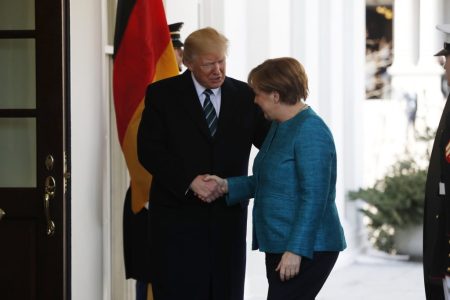
When German Chancellor Angela Merkel visited Washington on March 17, US President Donald Trump reportedly handed her a bill for money he thinks Germany owes NATO.

Trump had the invoice, reportedly for £300 billion ($374 billion, or NIS 1.36 trillion), drawn up by aides for a shortfall in Germany’s NATO contributions going back to 2002, with interest added. He reportedly handed it to Merkel during a private meeting between the two.

 Germany, along with all NATO countries, agreed in 2014 to spend two percent of its GPD on defense. However, of the 28 countries that make up the organization only a few, including the US and UK, spend that amount. Germany currently spends 1.23% of its GDP on defense, although that percentage is increasing.

Trump asked his aides to calculate Germany’s shortfall below 2%, going back to 2002 when then-Chancellor Gerhard Schröder pledged to increase his country’s defense spending, The Sunday Times reported.

After meeting Merkel the president reaffirmed the United States’ “strong support” for NATO, but reiterated his stance that NATO allies need to “pay their fair share” for the cost of defense. Trump said many countries owe “vast sums of money,” though he didn’t identify Germany specifically as one of those nations.

A German government minister responded to the invoice, saying that Merkel was not intimidated by it.

“The concept behind putting out such demands is to intimidate the other side,” the unnamed minister said, “but the Chancellor took it calmly and will not respond to such provocations.”

Another source close to Merkel implied that Trump was confused about the workings of NATO.

“The president has a very unorthodox view on NATO defense spending,” the source told the Times. “The alliance is not a club with a membership fee. The commitments relate to countries’ investment in their defense budgets.”

Even before winning the Republican nomination, Trump questioned whether European countries were paying their share for the North Atlantic Treaty Organization, threatening to withhold US support.

In his first interview after winning the nomination, in July 2016, Trump doubled down on his warning that the US might not meet its mutual defense obligations in NATO under his presidency — if he deemed that a member state was not pulling its weight financially.

After his meeting with Merkel, Trump tweeted that Germany owed vast sums of money to the US for defense.

“Despite what you have heard from the FAKE NEWS, I had a GREAT meeting with German Chancellor Angela Merkel,” he tweeted. “Nevertheless, Germany owes vast sums of money to NATO & the United States must be paid more for the powerful, and very expensive, defense it provides to Germany!”


However, Ivo Daalder, a former US ambassador to NATO, tweeted that the president didn’t understand “how NATO works.” He said that no country owes the US any money for NATO. Instead, the commitment was for each country to spend 2% on its own defense budget, to be spent on its own military.

“Sorry, Mr. President, that’s not how NATO works. The US decides for itself how much it contributes to defending NATO,” he tweeted. “All NATO countries, including Germany, have committed to spend 2% of GDP on defense by 2024.

“So far 5 of 28 NATO countries do. Those who currently don’t spend 2% of their GDP on defense are now increasing their defense budgets. That’s a good thing. But no funds will be paid to the US. They are meant to increase NATO’s overall defense capabilities, given the growing Russian threat.”

https://twitter.com/IvoHDaalder/status/843105839091273728/photo/1?ref_src=twsrc%5Etfw&ref_url=http%3A%2F%2Fwww.timesofisrael.com%2Ftrump-gave-merkel-300-billion-invoice-for-nato-debt%2F


Prior to his inauguration, Trump declared NATO “obsolete” but has since modified his stance, telling European leaders the alliance remains of strategic importance.

News agencies contributed to this report.

Does Germany Owe Us ‘Vast Sums’?

March 20, 2017

Does Germany Owe Us ‘Vast Sums’? PJ MediaMichael Walsh, March 19, 2017

(AP Photo/Evan Vucci)

Merkel, more than anyone, is the woman who destroyed the notion of European cultural cohesion, the unity of its history, and its Western identity. Her folly in throwing open the borders of the European Union (which is itself a Franco-German political fantasy now coming unglued) to the “migrant” hordes of an invading Islamic world will reverberate for decades to come. In an effort to replace the German population — which, largely thanks to its women, is almost wholly uninterested in reproducing itself — the childless chancellor could only see a mechanical solution to a problem of reproductive biology, without ever once (in true East German fashion) asking herself why.

**************************

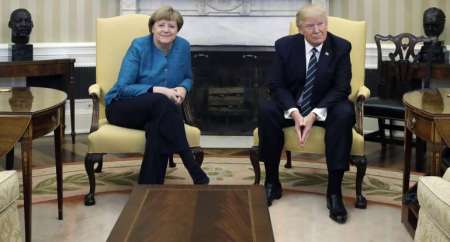
President Trump’s recent meeting with German chancellor Angela Merkel went about as well as could be expected. He treated her with thinly veiled contempt, avoiding her gaze, staring off into the middle distance whenever possible, his body language proclaiming his true feelings. Whether he heard her softly muttered request for a photo-op handshake at the end of their meeting doesn’t matter: his mien made his feelings abundantly clear.

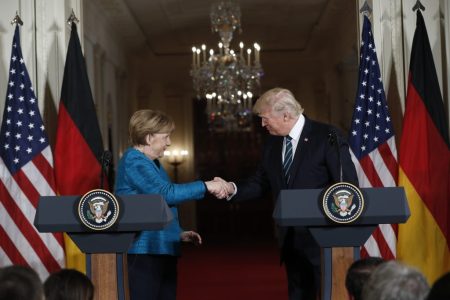
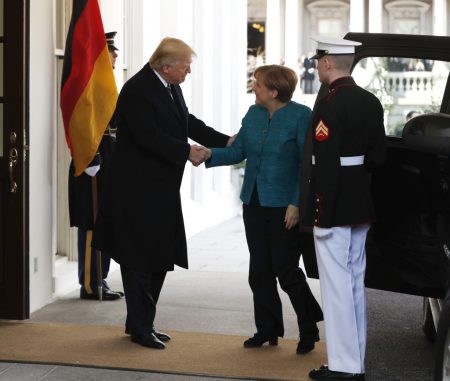
Germany, or bits of it, has gone from being a mortal enemy in 1941 to a four-power protectorate in 1945 to an American client state until 1989, to a nominal ally up to the present. The German media — and the Trump-haters in the American press — acted as if the president had just delivered her an ultimatum about the Sudetenland — even though, as you can see below, Trump shook hands with the chancellor at least three times.

Eins (AP Photo/Pablo Martinez Monsivais)

But Merkel, more than anyone, is the woman who destroyed the notion of European cultural cohesion, the unity of its history, and its Western identity. Her folly in throwing open the borders of the European Union (which is itself a Franco-German political fantasy now coming unglued) to the “migrant” hordes of an invading Islamic world will reverberate for decades to come. In an effort to replace the German population — which, largely thanks to its women, is almost wholly uninterested in reproducing itself — the childless chancellor could only see a mechanical solution to a problem of reproductive biology, without ever once (in true East German fashion) asking herself why.

Trump also spoke some unwelcome truths to the German people, foremost among them their debt to the United States of America from liberating them from Hitler, for midwifing the Federal Republic of Germany, for supporting Germany unification (despite the wretched George H. W. Bush/ James A. Baker III administration’s indifference, if not outright opposition, to it) and, paramount, for the American nuclear umbrella and thousands of troops that allowed the postwar Germans to establish and maintain their cushy social-welfare state. The Allies wanted a defanged Germany, and boy did they ever get it.

And yet that denatured Deutschland is what is killing Germany. When you enter the workforce in your mid-to-late twenties and retire in your fifties, your exposure to the vicissitudes of life is as minimal as it can be. And when that work is punctuated by six weeks of vacations, multiple days off, spa treatments and a strictly regulated set of working-hours… well, Bruder, you were on Easystrasse.

Throw in Germany’s historical notion of Kinderfeindlichkeit — hatred of children — and you have a surefire prescription for national suicide: Germany, literally, has nothing to live for.

But the free ride’s now over, and the Germans don’t like it one bit:

German Defense Minister Ursula von der Leyen on Sunday rejected U.S. President Donald Trump’s claim that Germany owes NATO and the United States “vast sums” of money for defense. “There is no debt account at NATO,” von der Leyen said in a statement, adding that it was wrong to link the alliance’s target for members to spend 2 percent of their economic output on defense by 2024 solely to NATO.

“Defense spending also goes into UN peacekeeping missions, into our European missions and into our contribution to the fight against IS terrorism,” von der Leyen said. She said everyone wanted the burden to be shared fairly and for that to happen it was necessary to have a “modern security concept” that included a modern NATO but also a European defense union and investment in the United Nations.

A “modern security concept” sounds very much like the Obama administration’s notion of “soft power.” And no power in Europe is softer than Germany’s.

Zwei (AP Photo/Pablo Martinez Monsivais)

Trump said on Twitter on Saturday – a day after meeting German Chancellor Angela Merkel in Washington – that Germany “owes vast sums of money to NATO & the United States must be paid more for the powerful, and very expensive, defense it provides to Germany!” Trump has urged Germany and other NATO members to accelerate efforts to meet NATO’s defense spending target…. During her trip to Washington, Merkel reiterated Germany’s commitment to the 2 percent military spending goal.

Big deal. Trump got all kinds of grief from the foreign-policy establishment when he voiced his skepticism about NATO during the campaign, but he was on to something. The rapid expansion of what used to be the North Atlantic Treaty Organization (essentially, the U.S. and Britain, with other spear-carriers, and minus the French) has gobbled up several of the former Soviet client states in eastern Europe, pushing itself right up to the Russian border. To say this is provocative to the Russians under the Soviet-restorationist  (in territory rather than Marxist philosophy) regime of Vladimir Putin is an understatement.

I’m not privy to what Trump told Merkel in private, but it’s hard to imagine the president didn’t put the iron laws of political economics to her in the bluntest possible way. Merkel has had the freedom to import and support a million cultural hostiles a year with no meaningful work skills in large part because Germany pays so little for defense, and can afford to amuse itself with virtue-signalling while its citizens are robbed, raped, and murdered — although even that largesse is coming to an end.

So it’s amusing to watch the knee-jerk Left instantly come to the side of the country they used to love to hate — Germany — the instant Trump criticizes their beloved Angela Merkel. Here’s the Washington Post, which under Jeff Bezos and editor Marty Baron has turned into a snarling, rabid dog of Trump-hatred, spouting the new Party Line:

Since World War II, Germany has intentionally kept its military small. The country defines itself by its pacifism and its commitment to the idea of “never again.” Germany’s defense spending — or lack thereof — has frequently been criticized and mocked in the past. In 2014, for instance, German forces made headlines when they were forced to use broomsticks instead of machine guns during a NATO exercise, exposing the state of its underequipped military.

But, Germans argue, they make up for this in other ways. As Merkel argued in a speech last month, mutual security goes beyond military spending. International development aid on things like hospitals and schools does as much for peace as warheads in Europe. “When we help people in their home countries to live a better life and thereby prevent crises, this is also a contribution to security,” Merkel said in Munich. “So I will not be drawn into a debate about who is more military-minded and who is less.”

She and other German leaders also point out that they’re bearing the brunt of the Syrian refugee crisis, spending 30 to 40 billion euros a year. If that was included in the tally, they say, they’d be putting more than 2 percent of their budget a year toward security. (They’re also quick to note that U.S. military interventions are one reason there are so many displaced people from the Middle East.)

Auf wiedersehen (AP Photo/Pablo Martinez Monsivais)

Now that is the very dictionary definition of chutzpah.

Although it’s — alas! — unlikely to happen, sensible Germans who wish to maintain and further their cultural patrimony need to dump Merkel in the upcoming elections. What will come after her might well be worse — it may well be a Leftist coalition, unlike the current closeted leftism of Merkel’s Christian Democratic Union party — but if Europe is to have any chance at survival, that’s a chance that’s still worth taking. And least then we can see the German government for what it really is.

BREAKING : Nigel Farage On Trump Meeting Merkel is Clash of Cultures

March 18, 2017

BREAKING : Nigel Farage On Trump Meeting Merkel is Clash of Cultures, Fox News via YouTube, March 17, 2017

(Please see also, Dr. Jasser discusses Pres. Trump’s meeting with German Chancellor Merkel & Politico’s headline. — DM)

https://www.youtube.com/watch?v=EqnCkSYLDgQ

Dr. Jasser discusses Pres. Trump’s meeting with German Chancellor Merkel & Politico’s headline

March 18, 2017

Dr. Jasser discusses Pres. Trump’s meeting with German Chancellor Merkel & Politico’s headline, AFID and Fox News via YouTube, March 17, 2017

(Dr. Jasser contends that rather than the “leader of the free world” as referenced at Politico, Frau Merkel is the “undertaker of the free world”. Please see also, A Month of Islam and Multiculturalism in France: February 2017. — DM)

Merkel: Europe Must Take More Migrants, Islam Is Not The Cause Of Terrorism

February 19, 2017

Merkel: Europe Must Take More Migrants, Islam Is Not The Cause Of Terrorism, BreitbartJack Montgomery, February 18, 21017

(According to Islamic scholar Merkel, “The Europeans alone could not cope with fighting international Islamist terrorism. We need the strength and the power of the United States of America, and their support.” Somewhat inconsistently with her reference to “international Islamist terrorism,” she observed, “we will be able to convince people that it is not Islam that is the problem, but a falsely understood Islam, and the religious authorities of Islam have to find strong language in order to delineate themselves and distance themselves from this fundamentalist and terrorist [version of] Islam.” Al-Azhar University, “Sunni Islam’s most prestigious university,” was asked to do just that last year by President Al-Sisi and refused. “Now the highest Muslim authority in Egypt has made clear that Al Azhar never had any intention of changing anything, that the ‘religious discourse’ articulated in the Medieval era—one of hostility and violence for the other, in a word, jihad—is the only ‘discourse’ Muslims can accept.” — DM)

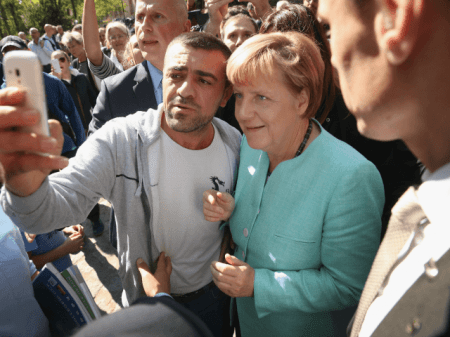
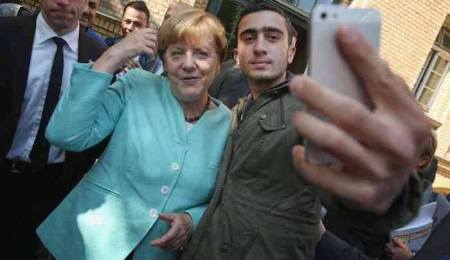
merkelselfie

Angela Merkel claims that the European Union still has a “responsibility” to take in more so-called refugees, and pleaded to Islamic governments to help convince people that terrorism has nothing to do with Islam.

The 62-year-old German chancellor began her speech by acknowledging that “the European Union right now is in a very difficult situation due to the result of the British referendum … which is very regrettable”.

While calling on the bloc “to do more to integrate our military capacity”, she also confessed it could not fight terrorism without U.S. president Donald Trump’s assistance.

“Let me address this very openly. The Europeans alone could not cope with fighting international Islamist terrorism. We need the strength and the power of the United States of America, and their support,” she said.

“I say this because the external borders of the European Union, in a way, are the border that actually separates us from Islamist terrorism, and that very much has an influence on Europe.

“So co-operation with the United States of America is most important for us, but what’s also very important to me is that Islamist, Muslim states have been incorporated in this coalition, because I think those countries, first and foremost, have to give a contribution.”

(Video at the link. — DM)

According to Chancellor Merkel, however, working with such states is the only way “we will be able to convince people that it is not Islam that is the problem, but a falsely understood Islam, and the religious authorities of Islam have to find strong language in order to delineate themselves and distance themselves from this fundamentalist and terrorist [version of] Islam.”

“We cannot do this, we Christians,” she said. “It has to be done by the Islamist clergy and by the religious authorities.”

Having claimed that Western institutions have no authority to tackle extremist ideology, however, the chancellor went on to insist that Europe does still have a duty to absorb more migrants.

“We have a responsibility. The European Union has a responsibility to bear, accepting those refugees.

“Just think, Cyprus, after all, is a neighbouring state to Syria, so you see the external borders of the Union are the borders that separate us from those areas where people amass in great numbers … [W]e cannot simply say it’s got nothing to do with us; we have to deal with this issue.”

Cyprus does not in fact share a land border with Syria, being an island nation some 315 miles from the Syrian coast.

Draft Two – New Immigration Order Could Come This Week – Nigel Farage – Fox & Friends

February 13, 2017

Draft Two – New Immigration Order Could Come This Week – Nigel Farage – Fox & Friends via YouTube, February 12, 2017

https://www.youtube.com/watch?v=wH8xztcsmgw


Germany’s New Propaganda Bureau

January 18, 2017

Germany’s New Propaganda Bureau, Gatestone InstituteJudith Bergman, January 18, 2017

“Considering the [upcoming] federal elections we must act very fast,” the officials urged in the memo, citing the need to combat “fake news.”

In other words, the Interior Ministry’s bureaucrats fear that Chancellor Angela Merkel will lose the elections in September 2017, and are willing to do whatever it takes to prevent that scenario, even if it means using (even more) federal authority to crack down on free speech by inventing an official state propaganda bureau. The current debate on “fake news” is a convenient excuse.

*********************

A married couple, Peter and Melanie M., were prosecuted and convicted in July 2016 of creating a Facebook group that criticized the government’s migration policy. Also, in July 2016, 60 people suspected of writing “hate speech” online had their homes raided by German police.

None of the above seems to be enough, however, for the president of the Bundestag, Norbert Lammert, from Angela Merkel’s CDU party, who believes that what Facebook is already doing against “hate speech” is not enough. According to the CDU politician, there is a need for more legislation.

The German government’s view of what constitutes “hate speech” is highly selective and appears limited to protecting the government’s own policies on immigration from legitimate criticism.

When massive antisemitism swept large German cities in the summer of 2014, for example, no such anti-racist zeal was manifest on the part of the German government. On the contrary, there were instances of authorities practically facilitating hate speech. In July 2014, Frankfurt police let mainly Muslim “protesters” use their van’s megaphone to belt out slogans of incitement in Arabic, including the repeated chanting of “Allahu Akbar” and that Jews are “child murderers”.

Firebombing a synagogue, on the other hand, is simply an “act of protest”.

Officials in Germany’s Interior Ministry are urging Interior Minister Thomas de Maizière to establish a “Defense Center against Disinformation” (Ab­wehr­zen­trum ge­gen Des­in­for­ma­ti­on) to combat what they call “political disinformation,” a euphemism for “fake news.”

“The acceptance of a post-truth age would amount to political capitulation,” the officials told Maizière in a memo, which also disclosed that the bureaucrats at the Interior Ministry are eager to see “authentic political communication” remain “defining for the 21st century.”

One wonders whether by “authentic political communication,” the officials of the Interior Ministry are referring to the way German authorities scrambled to cover up the mass sexual attacks on women on New Year’s Eve a year ago in Cologne? At the time, German police first claimed, surreally, on the morning of January 1, 2016, that the situation on New Year’s Eve had been “relaxed.” Cologne Police Chief Wolfgang Albers later dryly admitted, “This initial statement was incorrect.” Alternatively, perhaps they are referring to the decision of Germany’s public broadcaster, ZDF, not to report on the attacks until four days after they had occurred? Even a former government official, Hans-Peter Friedrich, Chancellor Angela Merkel’s Interior Minister from 2011 to 2013, accused the media at the time of imposing a “news blackout” and operating a “code of silence” over negative news about immigrants. How is that for “authentic political communication”?
2218

“Considering the [upcoming] federal elections we must act very fast,” the officials urged in the memo, citing the need to combat “fake news.”

In other words, the Interior Ministry’s bureaucrats fear that Chancellor Angela Merkel will lose the elections in September 2017, and are willing to do whatever it takes to prevent that scenario, even if it means using (even more) federal authority to crack down on free speech by inventing an official state propaganda bureau. The current debate on “fake news” is a convenient excuse.

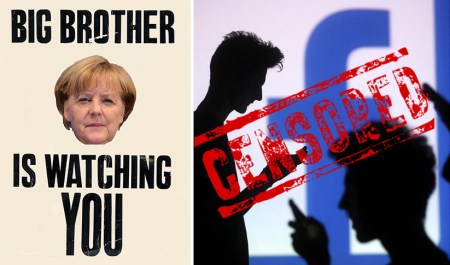
Germany has, of course, been cracking down on free speech for quite a while now. Already in September 2015, Merkel said, “When people stir up sedition on social networks using their real name, it is not only the state that has to act, but also Facebook as a company should do something against these statements”.

Under a government program, which has enlisted the help of the German non-governmental organization, the Amadeu Antonio Foundation, led by Anetta Kahane (who has turned out, in a fine twist of irony, to be a former Stasi agent and informer) German authorities are monitoring how many supposedly “racist” posts reported by Facebook users are deleted within 24 hours. Justice Minister Heiko Maas has pledged to look at legislative measures if the results turn out to be “unsatisfactory”. The program is scheduled to run until March 2017.

A married couple, Peter and Melanie M., were prosecuted and convicted in July 2016 of creating a Facebook group that criticized the government’s migration policy. Their page stated, “The war and economic refugees are flooding our country. They bring terror, fear, sorrow. They rape our women and put our children at risk. Make this end!”

Also, in July 2016, 60 people suspected of writing “hate speech” online had their homes raided by German police.

None of the above seems to be enough, however, for the president of the Bundestag, Norbert Lammert, from Merkel’s CDU party, who believes that what Facebook is already doing against “hate speech” is not enough. According to Lammert, there is a need for more legislation. A law to bring social networks under penalty of fines if they fail to erase “hate messages” and “false news” has just been announced by Volker Kauder, leader of the parliamentary group in Merkel’s current Bundestag and CDU/CSU faction, and Thomas Oppermann, Chairman of the Social Democratic Party (SPD) parliamentary group.

European Commission President Jean-Claude Juncker has also recently called on companies such as Facebook to address “false announcements” on the Internet, saying he felt that the Europeans were increasingly becoming “sensitive to who is fluttering around them and who is telling them the truth.”

All of this, naturally, has Merkel’s strong support. She told the Bundestag in a speech on November 23:

“I support efforts by Justice Minister Heiko Maas and Interior Minister Thomas de Maizière to address hate speech, hate commentaries, devastating things that are incompatible with human dignity, and to do everything to prohibit it because it contradicts our values”.

Those “values” are clearly circumscribed: The German government’s view of what constitutes “hate speech” is highly selective, and appears limited to protecting the government’s own policies on immigration from legitimate criticism.

When massive antisemitism swept large German cities in the summer of 2014, for example, no such anti-racist zeal was manifest on the part of the German government. On the contrary, there were instances of authorities practically facilitating hate speech. In July 2014, Frankfurt police let mainly Muslim “protesters” use their van’s megaphone to belt out slogans of incitement in Arabic, including the repeated chanting of “Allahu Akbar” and that Jews are “child murderers”.

In another such instance, a German court found that the firebombing of a synagogue in Wuppertal by two German Arabs and a juvenile accomplice was not anti-Semitic, but rather “an act of protest” to “bring attention to the Gaza war.” The men were convicted of arson.

In Germany, it is criminal to bring attention to the problems that come with the government’s migration policies, or to criticize those policies, because this constitutes “hate speech.” Firebombing a synagogue, on the other hand, is simply an “act of protest.” Perhaps, once the “Defense Center against Disinformation” is set up, such “acts of protest” will be labeled, “Officially Approved Un-Fake Communication.”
Kerry Attacks Trump for Stepping into “Politics of Other Countries”

January 17, 2017

Kerry Attacks Trump for Stepping into “Politics of Other Countries”, Front Page Magazine (The Point), Daniel Greenfield, January 16, 2017

spacemankerry

And now, a lesson in diplomacy from America’s Worst Living Diplomat.

U.S. Secretary of State John Kerry said on Monday it was “inappropriate” for Donald Trump to brand German Chancellor Angela Merkel’s refugee policy “a catastrophic mistake”.

“I thought frankly it was inappropriate for a president-elect of the United States to be stepping into the politics of other countries in a quite direct manner,” Kerry told CNN’s Christiane Amanpour during a one-day visit to London in the last week of the Obama administration.

You don’t say.

Kerry just came off blasting Israel’s government and blaming it for anything and everything. The British government had lectured Kerry for being undiplomatic by stepping into Israeli politics in a quite direct manner.

The Prime Minister’s spokesman criticised John Kerry, the outgoing US Secretary of State, after he described the Israeli government as the “most Right-wing in history”.

Mrs May does “not believe that it is appropriate” for Mr Kerry to attack the make-up of the democratically elected Israeli government, the spokesman said.

But the State Department claimed in its defense that the Saudis still supported them.

Now a tone deaf Kerry is attacking Trump for stepping into another country’s politics. Kerry claims that’s inappropriate, when he was just guilty of it.

“I think we have to be very careful about suggesting that one’s strongest leaders in Europe, and most important players with respect to where we are heading, made one mistake or another. I don’t think it’s appropriate for us to be commenting on that,” Kerry said.

But his regime had no problem commenting on Brexit and threatening the UK. And his boss had no problem blaming the UK for his illegal Libyan War and assorted policy failures in the region.

He rejected Trump’s description of Merkel’s refugee policy as “catastrophic”.

“I think she was extremely courageous. I don’t think it amounts to that characterization,” Kerry said.

Kerry agrees with Merkel. That’s why he’s putting on this show. He opposes the UK and Israel. That’s the source of this double standard.

European Immigration: Mainly Muslim, Mainly Male, Mainly Young

January 5, 2017

European Immigration: Mainly Muslim, Mainly Male, Mainly Young, Gatestone InstituteDouglas Murray, January 5, 2017

In the wake of the attack in Nice, there should have been a fulsome public discussion over what if anything can be done to ensure that people who have been in France for many years — in some cases their entire lives — are not indoctrinated to hate the country so much that they drive a truck through a crowded sea-front on Bastille Day.

Or there could have been a wide public debate over whether, with so many radicalised Muslims already in France, it was a wise or foolish idea to continue to import large numbers of Muslims into this already simmering situation.

Merkel seems to hope that with this raising of a burka ban the German public will forgive or forget the fact that here is a political leader so devoid of foresight that she unilaterally chose to allow an extra 1-2% of the population to be added to her country in a single year, mainly Muslim, mainly male and mainly young.

The burka and burkini, like the headscarf, are only issues because millions of people have been allowed, unchecked, into Europe for years. The garment is merely the simplest issue at which to take aim. Far harder are the issues of immigration and integration. It is possible that Europe’s politicians cannot answer these questions, because any and all answers would point the finger at their own failings.

The European publics might get fed up with the distraction tactics of talking about garments and instead seek answers to the challenge we now face, as well as retribution at the polls for the politicians who brought us here.

2016 was a fine year for Islamist terrorism and an even finer year for Western political distraction. While Islamic terrorists repeatedly succeeded in carrying out mass-casualty terrorist attacks, as well as a constant run of smaller-scale strikes, the political leadership of the free world continued to try to divert their public.

The most striking example of the year came in the summer with the French debate over whether or not to ban the “burkini” from the beaches of France. The row erupted in the days after another 86 people were murdered in a jihadist terrorist assault — this time in Nice, France. With no one sure how to prevent access to vehicles or any idea how many French Muslims might want to follow suit, the French media and authorities chose to debate an item of beachwear. The carefully staged decision by an Australian Muslim woman to have herself filmed while wearing a burkini on a French beach ignited the row, which was eagerly seized upon by politicians.

At the local and national level, the decision to discuss the burkini allowed all the larger political issues behind Europe’s growing security problem to be ignored. In the wake of Nice, there should have been a fulsome public discussion over what if anything can be done to ensure that people who have been in France for many years — in some cases their entire lives — are not indoctrinated to hate the country so much that they drive a truck through a crowded sea-front on Bastille Day. Or there could have been a wide public debate over whether, with so many radicalised Muslims already in France, it was a wise or foolish idea to continue to import large numbers of Muslims into this already simmering situation.

As it was, neither of these debates did occur, and no meaningful political action was taken. Instead, the issue of the burkini sucked all the oxygen out of the debate, leaving no room to discuss anything more serious or longer term than beachwear.

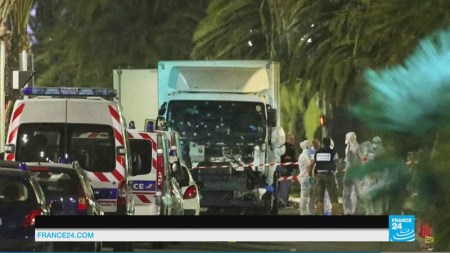
1696-1In the wake of the July 14 attack in Nice, France, in which 86 people were murdered, there should have been a fulsome public discussion over what if anything can be done to ensure that people who have been in France for many years — in some cases their entire lives — are not indoctrinated to hate the country so much that they drive a truck through a crowded sea-front on Bastille Day. (Image source: France24 video screenshot)

Across the continent in 2016, it appeared that other politicians realised the enormous advantage of such distraction debates. For instance, in the Netherlands in November, the country’s MPs voted for a ban on wearing a burka in public places. Prime Minister Mark Rutte apparently found this an enormously convenient debate. Not only did it temporarily reduce some of the pressure that his government is feeling at the rise of Geert Wilders’s Freedom Party to the top of opinion polls, but it also distracted attention from the years of mass immigration and lax integration demands which have been a hallmark of the Dutch experience.

After importing hundreds of thousands of people whose beliefs the Dutch authorities rarely bothered to question, the public would be satisfied — the Rutte government hoped — if only the small number of Dutch Muslim women who wear the burka were prevented from doing so. The Netherlands will have to see whether its implementation of such a law works any better than it does in neighbouring France, where “white knights” routinely show up to pay the fines of women fined for violating the burka ban there.

The Rutte government was not the only one to adopt this cynical strategy. Its most cynical deployment of all came in December, with the announcement by the German Chancellor, Angela Merkel, that she would ban the burka in Germany.

As with the Dutch government, Merkel clearly hoped that in throwing this tidbit to the German public she might head off the threat that the Alternative for Germany party (AfD), among others, now poses to her party in this year’s election. But the move also raises the question of just how stupid does Angela Merkel believe the German people to be? It would seem that Merkel hopes that with this burka ban the German public will forgive or forget that here is a political leader so devoid of foresight that she unilaterally chose to allow an extra 1-2% of the population to be added to her country in a single year, mainly Muslim, mainly male and mainly young.

This is a Chancellor who, even having previously admitted that Germany’s multicultural model had “failed,” revved immigration up to unprecedented and unsustainable levels. Now, like her counterparts across the continent, she must hope that the German public are satisfied by this burka morsel and that, as a result, they will return Merkel and her party to power so that they can repeat whichever of their mistakes they choose in the years ahead.

It is possible, of course, that the European publics are wiser than their leaders and that they will see through these cynical and distracting tactics. There are extremely good reasons to ban any garment which covers a person’s face and allows them to wander as an anonymous stranger in our societies. There are some — though fewer — reasons to ban wearing a burkini on a beach. Certainly the governments of France, the Netherlands and Germany are within their rights to instigate and enforce any and all such bans. Such moves, however, are but the smallest register imaginable of a problem that seems far beyond this generation of politicians.

The burka and burkini, like the headscarf, are only issues because millions of people have been allowed, unchecked, into Europe for years. The garment is merely the simplest issue at which to take aim. Far harder are the issues of immigration and integration. It is possible that Europe’s politicians cannot answer these questions because any and all answers would point the finger at their own failings. Or it is possible that they have no answers to the problems with which they have presented the continent. Whichever it is, they would do well to reflect that in 2017, the European publics might get fed up with the distraction tactics of talking about clothing and instead seek answers to the challenge we now face, as well as retribution at the polls for the politicians who brought us here.

Merkel: Respond to jihad massacres with love and compassion

January 2, 2017

Merkel: Respond to jihad massacres with love and compassion, Jihad Watch,

(Please see also, The Islamization of Germany in 2016. — DM)

Love and compassion to counter jihad terror? Victory is assured!

merkel-and-migrant

“‘Off her rocker’ Merkel mocked for urging Germans to beat terror with love and compassion,” by Nick Gutteridge, Express, January 1, 2017:

ANGELA Merkel was branded “mad” and “off her rocker” today after giving a bizarre New Year’s Eve speech telling Germans to fight the bombs and guns of Islamic State with love and compassion.

The embattled Chancellor, who is surrounded by armed guards around the clock and travels everywhere in a bullet-proof car, said terrified citizens should meet the ISIS terror threat with “openness”.

Her remarks come less than two weeks after a failed asylum seeker drove an articulated truck into families at a Christmas market in Berlin, killing 12 and seriously injuring dozens more.

The shocking tragedy, which followed a spate of jihadi terror attacks earlier this year, has heaped yet more pressure on Mrs Merkel’s hated open door migration policy.

But in her annual New Year’s Eve address the under-fire leader was unrepentant, insisting that ordinary Germans should continue to attend public events despite the risk to their own lives.

She said she was “so convinced” that Germany would emerge from its migrant chaos stronger, and bizarrely stated that the public mourning following the Berlin attack had filled her with confidence for the country’s future.

Speaking on national TV she said: “So what of the confidence that I spoke of at the beginning? Confidence in the midst of deep grief for the dead and injured?

“I think we could feel it here in Berlin and in many other German cities even in these difficult days – in the comfort that we were able to give or to receive.

“And in our firm determination to counter the terrorists’ hate with our humanity and our solidarity.

“By carrying on with our lives and our work, we are saying to terrorists ‘you are murderers, full of hate, but you do not determine how we live and want to live. We are free, humane, open’.”

Mrs Merkel said it was “especially bitter and disgusting” when asylum seekers carried out terror attacks, but said the shocking devastation in Aleppo vindicated her decision to fling open the country borders.

Speaking about her migration policies, she added: “All of that – it is reflected in our democracy, in our rule of law, in our values.

“They are the antithesis of the hate-filled world of terrorism, and they will be stronger than terrorism. We are stronger together. Our state is stronger.”…