Posted tagged ‘Kerry’

Palestinians: Laughing Their Heads Off

March 14, 2016

Palestinians: Laughing Their Heads Off

by Khaled Abu Toameh

March 14, 2016 at 5:00 am

Source: Palestinians: Laughing Their Heads Off

  • As in any comedy, there is a clown, and Biden was played for a fool by a Palestinian Authority leadership that finds that it pays to point its finger at Israel.
  • Here is a dirty little secret: the Palestinian attackers were not driven to murder Jews because of “settlements” and “checkpoints.”
  • Check their Facebook accounts: what fueled their hatred were the lies they had been fed for the past few years by President Abbas and other Palestinian leaders. Palestinian media outlets and spokesmen vomit poison against Israel.
  • And so the curtain rises on another act of the ceremonial, make-believe theater of the Middle East. In Abbas’s sneaky script, it is about settlements. In reality, it is about the refusal of the Americans to read, speak or even translate Arabic.

U.S. Vice President Joe Biden visited Ramallah last week, and Palestinian Authority (PA) President Mahmoud Abbas and his top officials are laughing their heads off.

Why not laugh? Biden arrived in the region hoping to persuade the Palestinian leaders to issue a “condemnation” of the reign of terror, which they continue to describe as a “popular and peaceful uprising.” This in itself reeks of gallows humor.

But what Biden got was even funnier, from the point of view of Abbas and his friends.

The Palestinian president offered “condolences” over the killing of a U.S. citizen in Jaffa the previous day: “The President [Abbas] offered his condolences over the killing of the US citizen, while stressing at the same time that the occupation authorities have killed 200 Palestinians over the past five months,” according to a statement released by the PA leadership in Ramallah.

Abbas’s crocodile tears were shed for Taylor Force, a West Point graduate from Texas who was stabbed to death by a Palestinian during a rampage on the Jaffa beachfront promenade. Abbas is doubtless also upset because Israel has killed Palestinian stabbers and shooters.

Just before Biden arrived in Ramallah, Abbas’s Fatah faction praised the murderer of Force, calling him a “martyr.” But Fatah was quick to delete the posts to avoid embarrassing the Palestinian leadership during Biden’s visit.

It seems that the murder of an American visitor is condemnable, but the murder of some 34 Israelis since last October, including a pregnant woman and civilians, is somewhat less so.

Where was the condemnation of the wounding of nine Israelis in the attack that killed Taylor Force? Where was the condemnation of the attacks the took place on that very day in Jerusalem and Petah Tikva?

But Abbas explained everything to Biden: Israel was in fact fully responsible for the “violence and bloodshed” because of the “occupation” and “settlements.”

Here is a dirty little secret: the Palestinian attackers were not driven to murder Jews because of “settlements” and “checkpoints.”

Check their Facebook accounts: what fueled their hatred were the lies they had been fed for the past few years by President Abbas and other Palestinian leaders, concerning Jews “desecrating” Islamic holy sites and plotting to destroy them. No checkpoint snags, no settlement issues, no protests against construction of new apartments in Jerusalem for Jewish families.

Many of these Palestinians went for Israeli blood because they have been taught — by Mahmoud Abbas, the Palestinian Authority, Hamas and other Palestinian groups — to hate Israel. And they do not give a damn whether that Jew lives in Jaffa or in the West Bank. They also do not give a damn if some of their victims are Arabs.

Yet the comedy continues. Biden is reported to have urged Abbas and the Palestinian leadership to stop the anti-Israel incitement in their official media and on social media. Abbas vehemently denied that this incitement was taking place, and indeed, explained that the US leader had gotten things mixed up entirely: it was Israel that was guilty of incitement against the Palestinians.

While Abbas was busy offering his condolences for the killing of the U.S. citizen, his ruling Fatah faction was busy glorifying Palestinian assailants who killed Israelis.

In one instance, Fatah published an announcement inviting Palestinians to mark the 38th anniversary of the “martyrdom” of Dalal Al-Mughrabi.

Al-Mughrabi was a Fatah member who participated in the 1978 Coastal Road massacre in Israel, in which 38 civilians were killed, including 13 children.

U.S. Vice President Joe Biden visited Palestinian Authority President Mahmoud Abbas in Ramallah on March 10, hoping to persuade Abbas to issue a “condemnation” of the wave of terror attacks against Israelis. The next day, Abbas’s Fatah party invited Palestinians to commemorate the 38th anniversary of the “martyrdom” of Dalal Al-Mughrabi. Al-Mughrabi was a Fatah member who participated in the 1978 Coastal Road massacre in Israel, in which 38 civilians were killed, including 13 children.

The condolence message was also long enough for Fatah to praise Palestinian assailants, including Abdel Malek Abu Kharoub, who carried out a recent shooting attack in Jerusalem. In a post on its official Facebook account, Fatah hailed Abu Kharoub as a “hero and martyr.”

Of course neither Biden nor any of his advisors and aides saw these posts. They prefer to continue burying their heads in the sand and pretending that once the “peace process” is revived, everything will be fine.

So it is business as usual for Abbas and crew. As in any comedy, there is a clown, and Biden was played for a fool by a PA leadership that finds that it pays to point its finger at Israel.

In Arabic, a language in which Western leaders are perhaps not fluent, Palestinian media outlets and spokesmen vomit poison against Israel. Condemnation of attacks on Israelis would be rather unlikely in such a drama.

And so the curtain rises on another act of the ceremonial, make-believe theater of the Middle East. In Abbas’s sneaky script, it is about settlements. In reality, it is about the refusal of the Americans to read, speak or even translate Arabic.

Khaled Abu Toameh, an award-winning journalist, is based in Jerusalem.

  • Follow Khaled Abu Toameh on Twitter


Cartoons of the Day

March 13, 2016

H/t Vermont Loon Watch

a-test
treaty

Will Obama Try to Blackmail Israel?

March 11, 2016

Will Obama Try to Blackmail Israel?

by Shoshana Bryen

March 11, 2016 at 5:00 am

Source: Will Obama Try to Blackmail Israel?

  • President Obama is looking at the fires he lit in the Middle East and North Africa, and desperately hoping to salvage something, anything, from the conflagration before he leaves office. Israel will be pushed to provide at least one “victory.”
  • Iran has come closer to nuclear weapons competence in the past eight years. And Obama’s abandonment of dissidents and pro-democracy advocates in Cuba, Venezuela, China, Turkey and Iran paves the way for waves of repression and bloodshed around the world.
  • It is estimated that more than 17,000 civilians were killed in Iraq in 2014, four times as many as 2012, after the U.S. withdrew its combat forces. This is a far cry from 2011, when Obama announced the U.S. was leaving a “sovereign, stable and self-reliant Iraq.”
  • He needs to find a “success.” Cue the Middle East “peace process.”

As Vice President Biden arrived in Israel this week, word leaked about yet another “peace plan” designed by the Obama administration. There isn’t much new in it. According to The Wall Street Journal, the U.S. might support a UN Security Council resolution calling on “both sides to compromise on key issues,” and it might involve the Middle East Quartet. Israel would be told to stop building in the territories and recognize East Jerusalem as the capital of a Palestinian State. The Palestinians would be told to recognize Israel as a Jewish state and give up the “right of return” for the original 1948/49 refugees and their descendants.

Just do it and voila! Problem solved.

As Vice President Biden arrived in Israel this week, word leaked about yet another “peace plan” designed by the Obama administration. (Image source: Israel Prime Minister’s Office)
Why and why now? Because President Obama is looking at the fires he lit in the Middle East and North Africa, and desperately hoping to salvage something, anything, from the conflagration before he leaves office and needs another job. Israel will be pushed to provide at least one “victory.” Consider the list of Administration failures right now and the terrible destruction they have entailed:

In his first foreign visit, President Obama opened the door in Egypt to an uprising not only of “Google people” in Tahrir Square, but also to the Muslim Brotherhood. Brotherhood representatives were front and center at the President’s speech in Cairo’s Al-Azhar University, to the dismay of longtime ally Hosni Mubarak. After Mubarak’s overthrow, the White House pressed for the inclusion of the Brotherhood in Egyptian elections despite its history of terrorism. Since then, the U.S. and Egypt have been unable to find a way to communicate constructively, despite Egypt’s increasing closeness to Israel and their joint interest in controlling the terrorist Hamas and Iranian-sponsored jihadis in Sinai.

The Muslim Brotherhood was emboldened in Syria by its successes in Egypt.

The Syrian civil war and the rise of ISIS — both in some measure precipitated by the U.S. withdrawal from Iraq – have killed upwards of 350,000 people (more than 55,000 in 2015) and displaced nearly 4 million more. Chemical weapons, starvation, beheadings and aerial bombing are weapons of choice by various sides. Russia is calling the shots (literally) in Syria, while Turkey, Qatar and Saudi Arabia continue to fund various jihadi groups, and Iran operates freely in both Iraq and Syria. Hezbollah, despite taking enormous casualties in Syria, continues to add to its missile arsenal in Lebanon.

This is a far cry from 2011, when President Obama announced the U.S. was leaving a “sovereign, stable and self-reliant Iraq.” An Iraqi non-governmental organization estimated that more than 17,000 civilians were killed there in 2014, double the number from the previous year and four times as many as 2012, after the U.S. withdrew its combat forces.

Lebanon, Jordan, and Turkey have all been destabilized by an influx of refugees from Syria and Iraq. Lebanon, a fragile country of less than 4.5 million people divided into Shiites, Sunnis, Christians and Druze, now has more than one million Syrian refugees.

Afghanistan was the “good war” in President Obama’s narrative. At West Point at the end of 2009, President Obama announced an additional deployment of 30,000 American soldiers to stabilize Afghanistan and nuclear-armed Pakistan. Six years later — 15 years after we got there — American military leaders told him the Afghan government still couldn’t survive without a continuing American military presence. Since the administration decided to leave a contingent of nearly 10,000 soldiers for an indefinite period of time, the Taliban has refused to continue peace talks with the Afghan government, and we’re looking at another bloody summer. Terrorist bombs in Pakistan are a daily occurrence.

Libya was supposed to be a test of our “responsibility to protect.” It also had, from the President’s point of view, the benefit of “leading from behind” and having “no boots on the ground.” After successfully ousting Moammar Gaddafi — who had turned his WMD program over to US and UK intelligence, kept al-Qaeda from moving from Egypt to Western North Africa, and paid reparations for terrorism — the U.S. acknowledged as many as 30,000 Libyan deaths in two months of war.

The war in Mali was a direct result of the demise of the Gaddafi government and the raiding of government weapons depots by al-Qaeda-supported Tuareg forces. Only the direct involvement of French troops saved the government there. The deaths of U.S. Ambassador Christopher Stevens, Sean Smith, Tyrone S. Woods, and Glen Doherty are attributable to the rise of al-Qaeda there as well. Today, there are as many as 1700 armed gangs across Libya and ISIS controls Sirte, a city of more than 100,000. The Pentagon is drawing up plans for U.S. military action to force ISIS out, we are again bombing Libya and there are American Special Forces on the ground.

Meanwhile, the U.S. bombed an al-Shabaab training base in Somalia this week, killing more than 150 members of the group.

Iran has come closer to nuclear weapons competence in the past eight years. And President Obama’s abandonment of dissidents and pro-democracy advocates in Cuba, Venezuela, China, Turkey and Iran paves the way for waves of repression and bloodshed around the world.

The widespread wreckage and carnage that accrues to President Obama’s policies and fantasies should disqualify him from further activity on the international stage when his term ends. But since retirement doesn’t appear in the offing, he needs to find a “success.”

Cue the Middle East “peace process.”

Shoshana Bryen is Senior Director of the Jewish Policy Center.

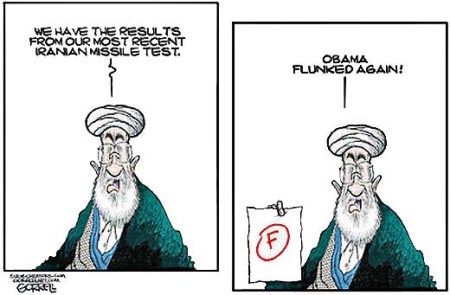
Iranian State Television Flaunts Anti-Israel Ballistic Missile Launches

March 9, 2016

Iranian State Television Flaunts Anti-Israel Ballistic Missile Launches

BY:
March 9, 2016 1:45 pm

Source: Iran | Missile | Israel

For the second day in a row, Iranian state television has broadcast propaganda videos that show the launch of several ballistic missiles with anti-Israel intent.

A video released Tuesday shows the inside of an underground tunnel used for launching the missiles. It features an Israeli flag painted on the ground which Islamic Revolutionary Guard Corps, or IRGC, members are meant to walk over on their way to launch.

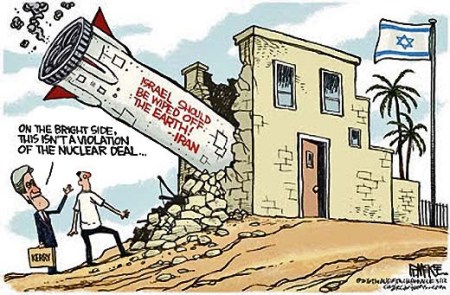
Wednesday’s video shows another two missiles labeled with “Israel must be wiped off the Earth” in Hebrew. Persian-language media headlines included the Hebrew message in order to emphasize the IRGC’s anti-Israel intentions. The missiles were reportedly precision-guided Qadr missiles that put Israel within striking range.

Amir Ali Hajizadeh, commander of the IRGC aerospace division, said that the tests were meant to intimidate Israel.

“The reason we designed our missiles with a range of 2,000 km (1,200 miles) is to be able to hit our enemy the Zionist regime from a safe distance,” Hajizadeh said. “Israel is surrounded by Islamic countries and it will not last long in a war. It will collapse even before being hit by these missiles.”

Iranian officials have brushed off the launches as part of their national defense capabilities, arguing that they are not in violation of the nuclear agreement implemented in January. The nuclear deal will free Iran from ballistic missile restrictions in eight years.

However, the tests do stand in violation of United Nations Security Council Resolution 2231, which states that Iran should not partake in “any activity related to ballistic missiles designed to be capable of delivering nuclear weapons.”

Speaking in Jerusalem Wednesday, Vice President Joe Biden said that the U.S. would “act” if Iran violated the nuclear deal and would keep an eye on threatening conventional military activity.

“There is no need to doubt that the United States has Israel’s back,” Biden said.


Syria Ceasefire Already Collapsing

March 8, 2016

Syria Ceasefire Already Collapsing, Front Page MagazineJoseph Klein, March 8, 2016

syria-bashar

The two week “cessation of hostilities” within Syria is about to run out. Negotiated by the United States and Russia, who were responsible for bringing the parties over which they have influence along, the lull was intended as a confidence building measure and as a way of getting critical humanitarian supplies to besieged and hard to reach areas of Syria. Talks between Syrian government and opposition representatives are supposed to resume in Geneva on March 9th.

Secretary of State John Kerry hailed the agreement to temporarily halt the violence in a conflict that has taken more than 250,000 lives as “a moment of promise.”  While there is evidence that the fighting has dropped noticeably overall since the cessation of hostilities went into effect on February 26, 2016, the violence never really stopped. On the second day alone of the lull, there were reportedly “35 breaches, 27 by violations by government forces, 8 by Russian forces,” according to the Syrian Network for Human Rights.

Airstrikes continued throughout Syria, some by Russia on the pretext that they were aimed at fighting ISIS and al Nusra. Rebel-held enclaves in and around Aleppo have come under particularly intense bombing attacks, said to be by Russian planes.

The Syrian Observatory for Human Rights said last Saturday that 135 people have lost their lives in areas where there was supposed to be a pause in hostilities. According to Israeli sources, the Syrian government has reportedly used chemical weapons against civilians since the cessation of hostilities were supposed to go into effect.

The United Nations has nevertheless been able to use the drop in hostilities to deliver some desperately needed humanitarian relief, although it has been stymied by bureaucratic obstacles put in the UN’s way by Syrian authorities. Sometimes, Syrian officials have gone so far as removing medical supplies from humanitarian convoys that had received permission to deliver their cargoes.

Perhaps the United States and Russia will push for an extension of the cessation of hostilities. Kerry and his Russian counterpart, Russian Foreign Minister Sergei Lavrov, have called for a prompt resumption of the peace talks in Syria, which would be hard to assemble if fighting resumes full throttle. They are evidently hoping that the partial success of the lull in fighting so far will provide momentum for successful talks. If so, they are dreaming. Kerry in particular is relying on the fatally flawed road map to a negotiated political solution in Syria that was laid out in last December’s UN Security Council Resolution 2258 (2015).  As I wrote last December when the resolution was adopted, the players were simply kicking the can down the road to no avail.

The Syrian regime, with Russia’s help, has made major military gains on the ground in recent months. Momentum is on its side. The opposition groups are losing negotiating leverage every day as a result of the regime’s advances and the opposition’s own internal divisions. Though the opposition is at least united on calling for Syrian President Bashar Al-Assad to step down immediately, they are whistling in the wind. Assad has no reason to go as long as Russia and Iran remain willing to stand behind him.

Russia has clearly changed the whole strategic situation in Syria by showing its willingness to engage militarily to the extent necessary to keep Assad in power as long as he serves their purposes. Just as President Obama foolishly dismissed the ISIS threat early on, his dismissal of Russia’s determination and capabilities was premature, to say the least.

The Obama administration’s vacillations in its Syrian policies, which left vacuums for both ISIS and Russia to fill, are now limiting its options going forward. Even in the unlikely case that President Obama now believes that the introduction of a large number of U.S. ground troops has become necessary to fight ISIS, give a nudge to Assad to abdicate and help stabilize what is left of Syria, the American people would not support the prospect of another protracted conflict in the Middle East.

Moreover, the Obama administration cannot even lead the way among its own allies, much less bridge the gap with Russia and Iran who remain committed to Assad. The administration’s efforts to assemble a real coalition of Arab nations willing to commit major ground troops to fight ISIS in tandem with our stepped up airstrikes have gone nowhere. Saudi Arabia and Qatar do not appear willing to cut off the flow of arms and money to the jihadists, whether or not they belong to ISIS or al Nusra. Saudi Arabia is even insisting on which opposition groups should officially represent the opposition in the Geneva talks, with little apparent pushback from the Obama administration.

Turkey is presenting its own headaches for the Obama administration. Its strongman president Recep Tayyip Erdogan accused the Obama administration of adopting a policy that has turned the Mideast into “a sea of blood.” He was particularly upset that the U.S. is relying on Kurdish fighters in Syria to help take on ISIS. The Kurds have been among the most effective ground forces we have to push back ISIS from territories it controls. Erdogan, however, regards the Kurds as terrorists who are more dangerous than ISIS. He blocked the Syrian Kurds from having any official representation in the Geneva peace talks, and is asking the U.S. to choose between Turkey and the Kurds as allies. The way Erdogan has been acting the last several years, we should tell him that unless he starts to fully cooperate and subordinate his parochial concerns to the global fight against ISIS, we will be prepared to support an independent Kurdistan right on his border. That should get his attention.

In short, the cessation of hostilities interlude, even if extended, will do nothing to change the underlying dynamics preventing a viable peace accord leading to the kind of inclusive Syrian government the Obama administration would like to see. However, to the extent lives have been saved and humanitarian relief has been allowed to get through for the first time, the pause in fighting has been a good thing in itself.

North Korea’s Sanctions Loophole

February 29, 2016

North Korea’s Sanctions Loophole, Wall Street Journal, February 28, 2016

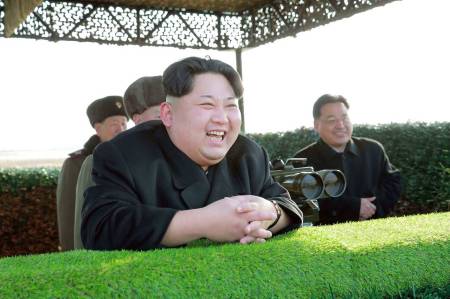
Happy KimThis undated picture released from North Korea’s official Korean Central News Agency on February 27, 2016 shows North Korean leader Kim Jong-Un smiling during the inspection of the test-fire of a newly developed anti-tank guided weapon at an undisclosed location. PHOTO: KCNA VIA KNS/AFP/GETTY IMAGES

The Obama Administration is touting the latest United Nations sanctions as a milestone against North Korea’s nuclear and missile programs. We’d like to believe it too, but a close look at the draft Security Council resolution offers many reasons to doubt.

The resolution would double the number of blacklisted North Korean individuals and state entities, adding Pyongyang’s atomic-energy and space agencies. Luxury goods banned from export to North Korea would grow to include watches, yachts and snowmobiles. A ban on sales of aviation fuel targets state-owned airline Air Koryo, while a ban on sales of rocket fuel targets Kim Jong Un’s missile program.

More significant are efforts to cut Pyongyang’s access to hard currency and smuggled weapons technology. The sanctions expand the list of banned arms and dual-use goods, and they require states to inspect all cargo transiting their territory to or from North Korea by sea, air or land. They would also squeeze North Korean mineral exports, including coal and iron ore, which in 2014 accounted for 53% of Pyongyang’s $2.8 billion in exports to China, per South Korean state figures.

Overall the blacklist of North Korean proliferators is growing by only 12 individuals and 20 entities to a total of 64; the U.N.’s former blacklist on Iran was far larger at 121. In any case, none of these matter if China won’t rigorously enforce them—which it has never done.

There are other loopholes and oversights. The nominal ban on North Korean mineral exports applies only to purchases that demonstrably fund illicit activities, rather than “livelihood purposes.” Yet money is fungible, so Chinese coal purchases excused on livelihood or humanitarian grounds will still channel hundreds of millions of dollars to the regime.

The sanctions also do nothing about the Chinese oil transfers that keep the Kim regime alive. Or Chinese purchases of textiles from mostly state-run North Korean factories that have quadrupled to $741 million a year since 2010 and recently ensnared Australian surf brand Rip Curl in a supply-chain controversy. Or the 50,000-plus North Korean laborers overseas, largely in China and Russia, earning some $230 million a year for their masters in Pyongyang.

U.S. officials say China has new incentive to back sanctions because it wants to block South Korea’s recent moves to deploy the U.S.-built Thaad missile-defense system. That may be why China wants to look cooperative, but the new sanctions aren’t enough to justify walking back on Thaad. China still views the North as a political buffer against South Korea, a thorn in the side of Japan and the U.S., and a diplomatic card to play at the U.N. So China has long played a double game of rhetorically deploring North Korea’s nuclear program while propping it up in practice.

The better way to squeeze the North is closer cooperation among Washington, Seoul and Tokyo to sanction Chinese banks that facilitate trade with Pyongyang. This worked a decade ago until the Bush Administration fell for more of China’s diplomatic promises. China won’t get serious about stopping North Korea until it sees that the U.S. and its allies are serious.

Everyone in Syria is Violating Kerry’s Imaginary Ceasefire

February 28, 2016

Everyone in Syria is Violating Kerry’s Imaginary Ceasefire, Front Page Magazine, Daniel Greenfield, February 28, 2016

obama_kerry_bikes

Good news. The ceasefire in Syria is “holding”. You know the great Kerry diplomatic achievement after letting Iran go nuclear and forcing Israel to free a bunch of terrorists. It’s holding about as well as a leaky roof in the rain because everyone and their cousin is violating the mostly imaginary ceasefire.

The Saudis claim that the Russians are violating the ceasefire.

Saudi Arabia on Sunday accused President Bashar al-Assad’s regime and its ally Russia of “ceasefire violations” in Syria.

“There are violations to the ceasefire from Russian and (Syrian) regime aircraft,” Saudi Foreign Minister Adel Jubeir told reporters in Riyadh.

“We are discussing this with (the 17-nation) Syria Support Group,” co-chaired by Russia and the United States, said Jubeir.

The Syrian Observatory for Human Rights has said that several air strikes hit central and northern Syria on Sunday.

Warplanes, believed to be either Syrian or Russian, bombed seven villages in the provinces of Aleppo and Hama, the monitor said.

The Russians are accusing the Syrian rebels of violating the ceasefire.

The Sunni opposition claims 15 violations. The Russians claim 9 violations. And the ceasefire just began. So it’s off to a great start.

Also nobody is really sure what counts as a violation because this agreement was negotiated by John Kerry.

“We do not know which planes carried out the strikes and also we are not sure if this is considered a breach to the truce because it is not clear if these towns are included in the truce,” Abdulrahman said.

So to summarize, the ceasefire is holding, but no one is sure what the ceasefire involves and everyone is violating it.

If you loved this Kerry diplomatic achievement, just wait till Iran detonates its first bomb.


Abu Mazen rebuffs Kerry’s appeal to cool Palestinian terror against Israelis

February 23, 2016

Abu Mazen rebuffs Kerry’s appeal to cool Palestinian terror against Israelis, DEBKAfile, February 23, 2016

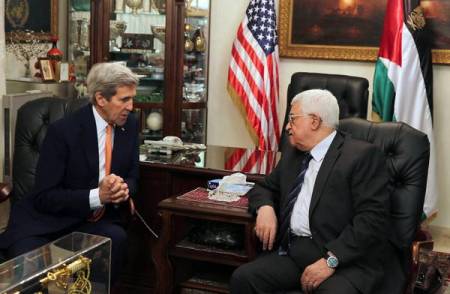
epa05173718 Visiting US Secretary of State John Kerry (L) and Palestinian President Mahmoud Abbas (R) speak to each other during their meeting in Amman, Jordan, 21 February 2016. Kerry arrived in Amman on 20 February for an official visit during which he also will meet Jordan's King Abdullah II to discuss the latest developments in the Middle East. EPA/JAMAL NASRALLAH / POOL

epa05173718 Visiting US Secretary of State John Kerry (L) and Palestinian President Mahmoud Abbas (R) speak to each other during their meeting in Amman, Jordan, 21 February 2016. Kerry arrived in Amman on 20 February for an official visit during which he also will meet Jordan’s King Abdullah II to discuss the latest developments in the Middle East. EPA/JAMAL NASRALLAH / POOL

US Secretary of State John Kerry came away empty-handed from his latest meeting with Palestinian Authority Chairman Mahmud Abbas (Abu Mazen) in Amman on Sunday, February 21,- which shouldn’t have surprised him as it was par for the course.  DEBKAfile’s Middle Eastern sources report that Kerry was finally persuaded that Abbas would not give Israel an inch on any political or security-related matters. The Palestinian leader has never swerved from his conviction that it was the duty of the international community to force Israel to present the Palestinians with a state of their own – without direct negotiations. 

To this end, Kerry found Abu Mazen clinging to the initiative put forward by French President Francois Hollande, for an international conference that will establish a Palestinian state, while letting the Palestinians off the hook of talks with Israel.

France in fact warned Israel that without progress towards a two-state solution of the conflict, Paris would go ahead and recognize a Palestinian state on its own.

The Palestinian leader is determined to campaign on behalf of the French initiative in the coming month, undeterred by the US Secretary’s repeated warning that Washington will not go along with it, even if France puts it before the UN Security Council.

But Kerry was most of all taken aback to find himself rebuffed by Abu Mazen when he asked him to make a speech or issue some statement calling on the Palestinians to halt their terrorist attacks against Israel now entering their fifth consecutive month. Al his efforts to persuade the Palestinian leader to tamp down the violence were in vain.

A senior member of Kerry’s entourage told DEBKAfile’s sources: “Abbas obviously thinks that terrorism in its present form serves his policy, although he won’t admit as much in public.” The source described the US Secretary’s mood after this encounter as “disappointed and shocked.”

DEBKAfile’s military sources note that Abbas is treading a very fine line. While he finds a measure of violence useful for letting the Palestinians vent their resentments, he nonetheless instructs his security services to partially cooperate with Israel so that Palestinian violence does not get out of hand and make him their next target.

And before him is the constant sight of the consequences of Israel’s withdrawal from the Gaza Strip, the rise of Hamas rule. This must be prevented from happening on the West Bank avoided at all costs.

Notwithstanding this reality, the age-old controversy dogging Israeli politics erupted again this week, when the IDF military intelligence chief, Maj. Gen. Herzl Halevi, was quoted (or misquoted) as commenting some weeks ago at a security cabinet session that diplomatic traction between Israel and the Palestinians might cool the current wave of terror,

This theory, disproved each time a new round of peace talks sparked a fresh outbreak of Palestinian terror in the last three decades, was strikingly refuted once again in the Kerry-Abbas meeting in Amman.

Recent leaks from Israel’s security cabinet, although often taken out of context, show that intelligence evaluations are too often wide of the mark – both on the Palestinian issue and the prospects of the Syrian conflict.

This may have something to do with Prime Minister Benyamin Netanyahus delay in appointing a new National Security Council Director to take over from Yossi Cohen who has been appointed Mossad Director.
Netanyahu, it appears, is not happy with the intelligence evaluations put on his table and may decide to dispense with yet another evaluator.

Netanyahu, it appears, is not happy with the intelligence evaluations put on his table and may decide to dispense with yet another evaluator.

Also short on substance were the remarks made by Defense Minister Moshe Ya’alon on Feb. 22 from the deck of the American destroyer, the USS Carney, which is anchored at the port of Haifa in the framework of the joint US-Israeli Juniper Cobra 2016 missile defense.

Yaalon said, “The United States and Russia, both of which are currently active in the Syrian civil war, recognize Israel’s freedom to act in defense of its interests.”

While the two powers may indeed recognize this freedom in principle, Israel will be certain to avoid any action that makes it liable to being accused of damaging the chances of a ceasefire going into effect in Syria on Feb. 27. Both the US and Russia will also make sure that no outside power, whether Turkey, Saudi Arabia or Israel, intervenes militarily in the Syrian conflict whatever their security interests may be.

Palestinians: Kerry and the Game of Obfuscation

February 22, 2016

Palestinians: Kerry and the Game of Obfuscation, Gatestone InstituteKhaled Abu Toameh, February 22, 2016

♦ “intifada” is simply a further phase in a larger plan to destroy Israel. When the plan began officially, with the establishment of the PLO in 1964, there were no “settlements” — not until after the June 1967 War — so what exactly were the Palestinians planning to “liberate”?

♦ The current conflict is not about “defending” any mosque from being contaminated by the “filthy feet” of Jews: it is about seeing Israel forced to its knees. Abbas and others seek to reap delicious political fruits from this “intifada.”

♦ Here is a novel idea: Kerry could put pressure on the Palestinian and Jordanian leadership to cease anti-Israeli incitement and indoctrination. Now that would be pressure well applied.

♦ Abbas is expected to become a partner in the fight against ISIS and radical Islamist groups. All well and good. Why then is he not expected to stop cheering on and glorifying young Palestinians who attack Jewish Israelis?

U.S. Secretary of State John Kerry is back in town. This time he is meeting with Jordanian and Palestinian leaders about “ongoing security issues in the region and continued tensions between Israel and the Palestinians.”

For those not involved in political newspeak, here is a translation:

“Ongoing security issues” = the Islamic State terror group (ISIS).

“Tensions between Israel and the Palestinians” = the ongoing wave of Palestinian stabbing, car-ramming and shooting attacks that began in October 2015.

Jordan and the Palestinian Authority (PA) fighting ISIS? Now that’s an idea! Jordanian King Abdullah and PA President Mahmoud Abbas ending “tensions” between Israel and the Palestinians? Let’s think about that.

Kerry comes back, but never calls a spade a spade. The “tensions” to which he deceptively alludes are knifings and car-rammings. And what is the biggest spade that Kerry avoids calling by its name? The new generation of Palestinians brainwashed to believe that Israel can be defeated with knives and car-attacks.

This “intifada” is simply a further phase in a larger plan to humiliate and destroy Israel. This plan began officially, with the establishment of the Palestine Liberation Organization (PLO), in May 1964. At that time there were no “settlements” — not until after the June 1967 War — so what exactly were the Palestinians planning to “liberate”?

The plan continued in 1974, at the twelfth session of the Palestinian National Council in Cairo, with the 10-point “Phased Plan” (see Appendix below for full text of the Phased Plan). Article 2 called for “armed struggle” (terrorism) to establish “an independent combatant national authority” that is “liberated” from Israeli rule.

Contrary to Palestinian leaders’ pap, the current conflict is not about “defending” any mosque from being contaminated by the “filthy feet” of Jews: it is about seeing Israel forced to its knees. Abbas and others seek to reap delicious political fruits from this “intifada.”

That is why, in his meeting with Kerry, Abbas made it clear that he intends to pursue unilateral moves to impose a solution on Israel, with the help of the international community.

Abbas also told Kerry that he intends to continue with his efforts to seek a UN Security Council resolution condemning Israel over “settlement construction.”

Never mind that on Palestinian maps, all of Israel is regarded as one big “settlement.”

1271Palestinian Authority leaders, official television, schools and media outlets often display maps showing Palestine stretching from the River Jordan to the Mediterranean Sea. The maps do not show the existence of Israel.

But back to Kerry. His “tensions” imply two sides engaged in some kind of a dispute that has aggravated a situation and strained relations between them, instead of what it really is: Palestinians openly trying to supplant Israelis — the entire state.

So the game of obfuscation continues. No doubt, we will witness more pressure on Israel to make concessions that will supposedly ease the “tensions.”

Kerry and his friends either do not “get it” or do not want to “get it.” Palestinians are waging an out-and-out war against Israel with the goal of making Israelis suffer to a point at which they will beg their leaders to capitulate. In the Palestinian view, such behavior pays off royally.

It is a Palestinian commonplace that the two previous uprisings — in 1987 and 2000 — brought major achievements to the Palestinians.

The first “intifada” led to Israel’s recognition of the PLO as the “sole legitimate representative of the Palestinians” — a move that was followed by the signing of the Oslo Accords and the creation of the Palestinian Authority.

The second “intifada,” the Palestinians argue, led to Israel’s full withdrawal from the Gaza Strip in the summer of 2005.

And so we arrive at the newest wave of attacks. As the saying goes: Step-by-step.

Kerry would like to see an end to the Palestinian attacks on Israeli Jews. The only problem is that his vacuous rhetoric prevents him from having a snowball’s chance in a Middle Eastern summer from attaining that goal.

Let us also not underestimate Palestinian Authority rejectionism. On the eve of the Kerry-Abbas meeting, Palestinian Authority officials were quoted as saying that they did not expect anything positive to come out of the talks “because the U.S. remains biased in favor of Israel.”

As always, the Palestinian stance is, “My way or the highway.”

Moreover, Kerry is dreaming if he thinks that President Mahmoud Abbas or King Abdullah are able to stop the attacks on Israelis. Neither has the mandate or the credibility to do so. In any case, they and their media outlets are too busy with their anti-Israeli ranting to do much on that score.

Thus far, not a word has been uttered by either of the two Arab leaders that could be even vaguely interpreted by their people as “stop killing Israelis.” In the Palestinian Looking Glass, it is Israel that is responsible for the deadly attacks. After all, claims that are untrue about Israelis “storming and desecrating the Al-Aqsa Mosque and other Islamic holy sites” are provocative, to say the least.

Here is a novel idea: Kerry could put pressure on the Palestinian and Jordanian leadership to cease anti-Israeli incitement and indoctrination. Now that would be pressure well applied. And it does not even require funding.

President Abbas is expected to become a partner in the fight against ISIS and radical Islamist groups. All well and good. Why then is he not expected to stop cheering on and glorifying young Palestinians who attack Jewish Israelis?

When Kerry and his crew finally wake up to the fact that it is precisely this incitement that is driving Palestinians into the open arms of ISIS, Hamas and other terror groups, perhaps, finally, we will be able to hope for “easing tensions in the region.”

Meanwhile, Kerry is back blathering about peace in the Middle East. Unfortunately, he seems incapable of calling a spade a spade — especially when that spade’s name is Palestinian prevarication.

‘Senior Official’ of Iran-Russia-Syria Alliance Brags About Subverting U.S. Diplomacy

February 17, 2016

‘Senior Official’ of Iran-Russia-Syria Alliance Brags About Subverting U.S. Diplomacy, Washington Free Beacon, Morgan Chalfant, February 17, 2016

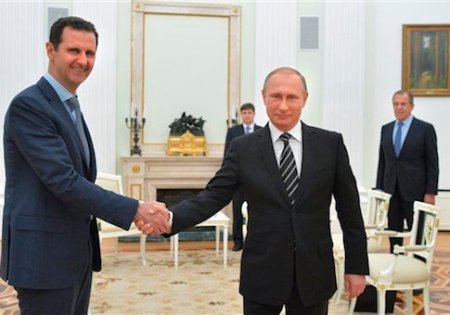
FILE - In this file photo taken on Tuesday, Oct. 20, 2015, Russian President Vladimir Putin, center, shakes hand with Syrian President Bashar Assad as Russian Foreign Minister Sergey Lavrov, right, looks on in the Kremlin in Moscow, Russia. When Russian Foreign Minister Sergey Lavrov said his country is ready to aid Syrian rebels fighting Islamic State militants on the ground, rebel commanders scoffed at the notion, pointing out that Russian aircraft were pounding rebel bases in central and northern Syria on daily basis. (Alexei Druzhinin, RIA-Novosti, Kremlin Pool Photo via AP, File)

FILE – In this file photo taken on Tuesday, Oct. 20, 2015, Russian President Vladimir Putin, center, shakes hand with Syrian President Bashar Assad as Russian Foreign Minister Sergey Lavrov, right, looks on in the Kremlin in Moscow, Russia. (Alexei Druzhinin, RIA-Novosti, Kremlin Pool Photo via AP, File)

A “senior official” of the military alliance between Iran, Russia, and Syria that is currently waging a ground offensive in Aleppo boasted about subverting U.S. diplomacy in a recent interview with an U.S. newspaper.

The official told the Wall Street Journal that military forces from Iran, Russia, and Syria would use a recent ceasefire deal brokered by world powers—including the United States—not to take steps towards a peaceful resolution of the Syrian war, but to consolidate their military gains.

The Journal reported:

“These allies are together in the same command center, working, planning and coordinating their operations in the battlefield,” said a senior official in the Iran-Russia-Syrian regime military alliance. “Retaking Aleppo will restore the regime’s strength and control over Syria; toppling the regime is now a thing of the past.” A cease-fire as proposed by world powers in Munich last week, he said, would simply be a pause for the Iran-led ground forces to consolidate recent territorial gains.

Thousands of fighters organized by Iran—including Hezbollah, the Islamic Revolutionary Guard Corps, and Shia fighters from Afghanistan, Iraq, and other countries—have launched the assault on Aleppo alongside Syrian army forces. Emboldened by Russian airstrikes, the fighters have been able to advance on Syria’s largest city.

There is some doubt regarding whether the ceasefire will be implemented at all. The deal was established by global powers on Friday, though neither Assad nor the Syrian opposition formally signed off on it. The deal was supposed to allow humanitarian aid to be sent to Syria and commence peace negotiations. The United States hoped that the ceasefire would be implemented in a week’s time.

Hours before the ceasefire was announced, Assad vowed to retake Syria in its entirety in an interview published by AFP.

Iran has put billions of dollars toward backing Assad, and Russia has launched a military intervention in Syria to back the Assad regime under the guise of fighting terrorist groups.

While the Obama administration has long said that Assad must be removed from power, the United States has softened that stance since 2011, when the Syrian civil war began. Secretary of State John Kerry said in December that the administration was not seeking a “regime change” in Syria following a meeting with Russian President Vladimir Putin.

“The United States and our partners are not seeking so-called regime change,” Kerry said then, indicating that world powers were focused on achieving a peace process in which “Syrians will be making decisions for the future of Syria.”

Both Russia and Iran have resisted any effort to oust Assad.