Posted tagged ‘Jordan’

Israel and the Four Powers

January 9, 2016

Israel and the Four Powers, Algemeiner, Ben Cohen via JNS Org., January 8, 2016
download-4

JNS.org The rulers of the Arab Gulf states are, it seems, increasingly attentive to what Israel has to say about the balance of power in the region. As a rising Shi’a Iran faces off against a Sunni coalition led by Saudi Arabia, the core shared interest between Israel’s democracy and these conservative theocracies — countering Iran’s bid to become the dominant power and influence in the Islamic world — has rarely been as apparent.

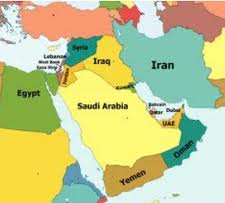
Hence the interview given by a senior IDF officer to a Saudi weekly, Elaph, which laid out how Israel analyzes the present wretched state of the Middle East. In the Israeli view, there are, the officer said, four powers that have coalesced in the region. The first power centers on Iran and its allies and proxies, such as the Bashar al-Assad dictatorship in Syria, Shi’a rebels in Yemen and Iraq, and most pertinently for Israel, Hezbollah in Lebanon. The second power contains what the officer called “moderate” states with whom Israel has “a common language” — Egypt, Jordan and the Gulf countries. The third power, one that is obviously waning, is represented in the form of the Muslim Brotherhood, now vanquished in its Egyptian heartland but still reigning in Hamas-controlled Gaza. Finally, the fourth power is another non-state actor, the combined forces of jihadi barbarism like Al-Qaeda and Islamic State.

Israel’s goal in this situation is a modest one. As the IDF officer put it, “There is a danger that the strife will reach us as well if the instability in the region continues for a long time. Therefore, we need to take advantage of the opportunity and work together with the moderate states to renew quiet in the region.”

The key phrase here, it seems to me, is “renew quiet.” Foremost for the Israelis, that means counteracting Iran and especially its Lebanese proxy Hezbollah, and then minimizing the potential for jihadi terrorists to operate on or near Israeli-controlled territory. A broader strategic vision can also be detected here: Ultimately, both Israel and the conservative Arab states share the common interests of neutralizing Iran and eliminating the jihadi groups.

The partnership between Israel and these states is already in operation, at the levels of intelligence sharing and — not for the first time — cautious exploration of trade relations. That there is a strong military dimension as well to all this is entirely conceivable. And for the time being, it seems that neither side wants to expand or contract on their public ties with each other; Israel has long had embassies in Cairo and Amman, but that doesn’t mean there’ll be an Israeli ambassador in Riyadh anytime soon, much less a film festival or trade expo.

There’s another factor that has accelerated the formation of this undeclared, look-the-other-way alliance: the shift in American Middle East policy under President Barack Obama. Some readers will remember that back in 1991, the first Bush administration pointedly left Israel out of the coalition to expel Saddam Hussein from Kuwait, so as not to antagonize the Gulf states. Now, frustration with Obama has compelled these very same states to recognize that they have an existential interest in cooperating with Israel.

You might say that the president deserves credit for bringing about a situation, in the wake of the nuclear deal with Iran, which has compelled the Gulf states to grasp the reality and permanence of Israel as never before. Still, the visions and prophecies of a Middle Eastern equivalent of the European Union, much indulged during the Oslo Accords years in the late 1990s, are not now in evidence, and that’s welcome. For their own reasons, neither Israel nor the Arab states feel obliged to articulate a sense of what their region should look like in the event that the Iranian threat is overcome.

Indeed, there’s a case that doing so would be counterproductive — it would impose political pressures upon a discreet yet strategically vital relationship that above all requires, in the parlance of the IDF officer, the “moderate” states to remain as moderate states. With the reorientation of American policy towards a rapprochement with Tehran, along with Russia’s active involvement in the Tehran-Damascus axis, Israel is the nearest reliable, not to say formidable, power that these countries can turn to.

In the present Middle Eastern context, then, the realism and discretion which has always underwritten Israeli foreign policy continues to prevail. That realism presumably extends to recognizing that regimes like Saudi Arabia and Bahrain might eventually succumb to their internal instabilities, already exacerbated by the further collapse of the price of oil.

When you consider the alternatives, the region’s architecture could be much worse for Israel than it is currently. Long an anomaly as the only open society in the region, the target of Arab military and economic warfare throughout the latter half of the last century, Israel in this century is now a partner in a regional bloc. To be sure, this is a bloc based upon interests, not common values, and is therefore necessarily limited in scope. But in the present storm, and amidst the appalling human suffering generated by the clash of these rival interests in Syria, it’s the closest thing we have to progress.
Israelis Refused Entry Into Jordan With ‘Jewish Paraphernalia’ in Luggage

December 11, 2015

Israelis Refused Entry Into Jordan With ‘Jewish Paraphernalia’ in Luggage, Algemeiner, Ruthie Blum, December 10, 2015

(Please see also, Trump’s ‘Racist’ Entry Restriction Policy Not Novel, But Response Is. — DM)

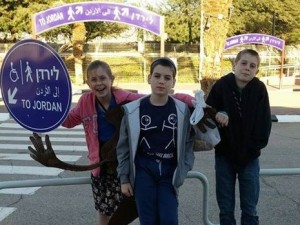
885-300x225Three of the Israeli family’s five children at the Jordanian border. The two brothers were not allowed in with their kippot. Photo: Facebook.

An Israeli family on a Hannukah vacation to Jordan was shocked to be turned away at the border, due to the skull caps (kippot) on the heads of the father and two sons, the Israeli site nrg reported on Thursday.

Tamar Gewirtz Hayardeni, the mother of the family, told nrg about the ordeal, after ranting about it on Facebook.

Tamar, a licensed tour guide who has been to Jordan in the past, described the family’s encounter with Jordanian border authorities, who were adamant that the male members of the family not enter the country with their kippot, claiming it was for their own protection.

Gewirtz Hayardeni said she explained to the border guard that the family had not intended to walk around with the kippot on their heads in any case — as a precaution. They insisted they would wear regular hats, while keeping their kippot in their luggage.

This was not sufficient for the border guard, however, according to Gewirtz Hayardeni, who said that at that point, she didn’t know what to do other than consult with her family. As they were weighing their options, their dilemma was solved, she recounted, when another Israeli was led into the room, “charged with attempting to bring tefillin into Jordan” – phylacteries that were discovered by security x-ray.

“That’s when we understood that the Jordanians might want Israelis to come, but not Jews,” she wrote on Facebook. “So we turned around and went back to Israel.”

On the Israeli side of the border, Gewirtz Hayardeni asked the guards and other people working there whether her experience was common. She was told that the Jordanians have begun forbidding all Jewish paraphernalia from entering the country.

Gewirtz Hayardeni expressed disgust and questioned what would happen if Jordanian tourists to Israel were forbidden to enter with headscarves or other Muslim “paraphernalia.”

According to an Israeli Channel 2 report on Thursday evening, Deputy Foreign Minister Tzipi Hotovely intends to investigate the phenomenon with the Jordanian authorities.

Israel and Jordan signed a peace treaty in 1994, which expanded water, tourism and trade cooperation, as well as a commitment to prevent third parties from using either country’s territory as a staging ground for military strikes.

Media: Saudi Arabia, UAE, Qatar and Jordan may send 90,000 military to fight IS

December 10, 2015

Media: Saudi Arabia, UAE, Qatar and Jordan may send 90,000 military to fight IS

World December 10, 11:16 UTC+3

Source: TASS: World – Media: Saudi Arabia, UAE, Qatar and Jordan may send 90,000 military to fight IS

Iraq Press Agency quoted politician Hanan Al Faltawi as saying she received that information from reliable sources after talks between US Senator John McCain and Iraqi Prime Minister Haider al-Abadi

© EPA/ALI HASSAN

BEIRUT, December 10. /TASS/. Around 100,000 foreign military, including 90,000 from Arab countries, may be deployed to Iraq to fight against the Islamic State (IS) terrorist organization, Iraq Press Agency quoted politician Hanan Al Faltawi as saying.

Al Fatlawi said that she received this information from reliable sources after talks between US Senator John McCain and Iraqi Prime Minister Haider al-Abadi. The meeting took place on November 27 in the joint American-Iraqi operational headquarters in Baghdad that coordinates military actions against IS, she added.

Foreign forces of 100,000 – 90,000 from Saudi Arabia, the United Arab Emirates, Qatar and Jordan and 10,000 from the United States – will be stationed in Iraq’s western parts,” Al Fatlawi noted. The politician added that “the Iraqi prime minister openly expressed bewilderment over McCain’s statement but was told that everything had already been decided.”

Islamic State extremist organization

The Islamic State is an extremist organization banned in Russia. In 2013-2014, it called itself the Islamic State of Iraq and the Levant (ISIL). In June 2014, IS announce the establishment of the “Islamic caliphate” on the territories seized in Iraq and Syria. According to US’ Central Intelligence Agency, the extremist group includes around 30,000 people, while Iraqi authorities claim there are around 200,000 in IS. Among members of the group are citizens of 80 countries, including France, Great Britain, Germany, Morocco, Saudi Arabia, US, Canada, as well as Russia and other CIS countries. According to reports, militants now control around 40% of the Iraqi territory and 50% of the Syrian territory.

No, the Islamic State Will Not Be Defeated — and if It Is, We Still Lose

November 25, 2015

No, the Islamic State Will Not Be Defeated — and if It Is, We Still Lose, BreitbartBen Shapiro, November 24, 2015

GettyImages-497044984-640x480

Barack Obama has now created an unwinnable war.

While all of the 2016 candidates declare their strategies for victory against ISIS, President Obama’s leading from behind has now entered the Middle East and the West into a free-for-all that cannot end any way but poorly.

The best way to understand the situation in Syria is to look at the situation and motivation of the various players. All of them have varying agendas; all of them have different preferred outcomes. Few of them are on anything approaching the same page. And Barack Obama’s failure of leadership means that there is no global power around which to center.

ISIS. ISIS has gained tremendous strength since Barack Obama’s entry to power and pullout from Iraq. They currently control northern Syria, bordering Turkey, as well as large portions of northern Iraq. Their goal: to consolidate their territorial stranglehold, and to demonstrate to their followers that they, and not other competing terrorist groups like Al Qaeda, represent the new Islamic wave. They have little interest in toppling Syrian dictator Bashar Assad for the moment. They do serve as a regional counterweight to the increasingly powerful Iranians – increasingly powerful because of President Obama’s big nuclear deal, as well as his complete abdication of responsibility in Iraq.

Iran. Iran wants to maximize its regional power. The rise of ISIS has allowed it to masquerade as a benevolent force in Iraq and Syria, even as it supports Assad’s now-routine use of chemical weapons against his adversaries, including the remnants of the Free Syrian Army (FSA). Iran has already expanded its horizons beyond Iraq and Syria and Lebanon; now it wants to make moves into heretofore non-friendly regions like Afghanistan. Their goal in Syria: keep Bashar Assad in power. Their goal in Iraq: pushing ISIS out of any resource-rich territories, but not finishing ISIS off, because that would then get rid of the global villain against which they fight.

Assad. The growth of ISIS has allowed Assad to play the wronged victim. While the FSA could provide a possible replacement for him, ISIS can’t credibly do so on the international stage. Assad knows that, and thus has little interest in completely ousting them. His main interest is in continuing to devastate the remaining FSA while pretending to fight ISIS.

Egypt/Saudi Arabia/Jordan. As you can see, ISIS, Iran, and Assad all have one shared interest: the continued existence of ISIS. The same is not true with regard to Egypt, Saudi Arabia, and Jordan, all of whom fear the rise of radical Sunni terrorist groups in their home countries. They are stuck between a rock and a hard place, however, because openly destroying ISIS on behalf of Alaouite Assad, they embolden the Shia, their enemies. Egypt, Saudi Arabia, and Jordan would all join an anti-ISIS coalition in the same way they did against Saddam Hussein in 1991, but just like Hussein in 1991, they won’t do it if there are no Sunni alternatives available. Tunisia, Saudi Arabia, and Jordan are the top three sources of foreign fighters for ISIS.

Turkey. The Turks have several goals: to stop the Syrian exodus across their borders, to prevent the rise of the Iranians, and to stop the rise of the Kurds. None of these goals involves the destruction of ISIS. Turkey is Sunni; so is ISIS. ISIS provides a regional counterweight against Iran, so long as it remains viable. It also keeps the Kurds occupied in northern Iraq, preventing any threat of Kurdish consolidation across the Iraq-Turkey border. They will accept Syrian refugees so long as those other two goals remain primary – and they’ll certainly do it if they can ship a hefty portion of those refugees into Europe and off their hands.

Russia. Russia wants to consolidate its power in the Middle East. It has done so by wooing all the players to fight against one another. Russia’s involvement in the Middle East now looks a good deal like American involvement circa the Iran-Iraq War: they’re playing both sides. Russia is building nuclear reactors in Egypt, Jordan, Turkey and Iran. They’re Bashar Assad’s air force against both the FSA and ISIS. Russia’s Vladimir Putin doesn’t have a problem with destroying ISIS so long as doing so achieves his other goal: putting everyone else in his debt. He has a secondary goal he thought he could chiefly pursue in Eastern Europe, and attempted with Ukraine: he wants to split apart the North Atlantic Treaty Organization, which he rightly sees as a counterbalance to check Russian aggression. Thanks to today’s Turkish attack on a Russian plane, and thanks to the West’s hands-off policy with regard to the conflict, Putin could theoretically use his war against ISIS as cover to bombard Turkish military targets, daring the West to get involved against him. Were he to do so, he’d set the precedent that NATO is no longer functional. Two birds, one war.

Israel. Israel’s position is the same it has always been: Israel is surrounded by radical Islamic enemies on every side. Whether Iranian-backed Hezbollah or Sunni Hamas and ISIS, Israel is the focus of hate for all of these groups. Ironically, the rise of Iran has unified Israel with its neighbors in Jordan, Egypt, and Saudi Arabia. All three of those countries, however, can’t stand firmly against ISIS.

All of which means that the only country capable of filling the vacuum would be the United States. Just as in 1991, a major Sunni power is on the move against American interests – but unlike in 1991, no viable option existed for leaving the current regime in power. And the US’ insistence upon the help of ground allies is far too vague. Who should those allies be, occupying ISIS-free ISISland?

The Kurds have no interest in a Syrian incursion. Turkish troops movements into ISIS-land will prompt Iranian intervention. Iranian intervention into ISIS-land would prompt higher levels of support for Sunni resistance. ISIS-land without ISIS is like Iraq without Saddam Hussein: in the absence of solidifying force, chaos breaks out. From that chaos, the most organized force takes power. Russia hopes that should it destroy ISIS, Assad will simply retain power; that may be the simplest solution, although it certainly will not end the war within the country. There are no good answers.

Barack Obama’s dithering for years led to this. Had he lent his support in any strong way to one side, a solution might be possible. Now, it’s not.

ISIS launches its winter terror offensive with first 274 deaths

November 13, 2015

ISIS launches its winter terror offensive with first 274 deaths, DEBKAfile, November 13, 2015

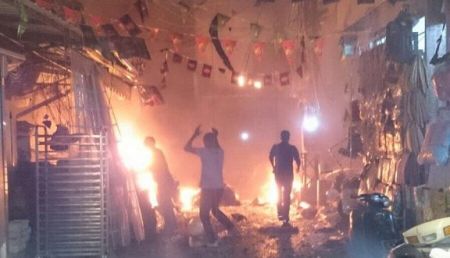
Borj_al-Barajneh12.11.15Suicide bombers strike Hizballah in Beirut
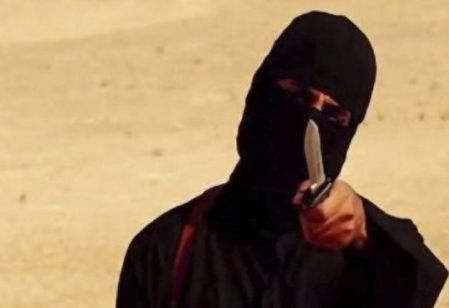
Execution of Steven Sotloff (1983 – 2014) by Jihadi John of ISIS. In August 2013, Sotloff was kidnapped in Aleppo, Syria, and held captive by militants from the Islamic State of Iraq and the Levant. Jihadi John (Mohammed Emwazi, born August 1988) a British man who is thought to be the person seen in several videos produced by the Islamic extremist group ISIL showing the beheadings of a number of captives in 2014 and 2015. (Photo by Universal History Archive/UIG via Getty Images)

Execution of Steven Sotloff (1983 – 2014) by Jihadi John of ISIS. In August 2013, Sotloff was kidnapped in Aleppo, Syria, and held captive by militants from the Islamic State of Iraq and the Levant. Jihadi John (Mohammed Emwazi, born August 1988) a British man who is thought to be the person seen in several videos produced by the Islamic extremist group ISIL showing the beheadings of a number of captives in 2014 and 2015. (Photo by Universal History Archive/UIG via Getty Images)

The US drone strike Thursday night, Nov. 11, targeting the Islamic State’s infamous executioner known as “Jihad John” in the northern Syrian town of Raqqa may or may not have hit the mark – the Pentagon says it is too soon to say. The hooded, masked terrorist with the British accent has been identified as a British Muslim born in Kuwait called Mohamed Emwazi. He appeared on videos worldwide showing the cold-blooded murders of US, British, Japanese and other hostages.

The drone attack occurred shortly after the latest ISIS atrocity: Thursday night, two or three suicide bombers blew themselves up, killing 43 people and injuring at least 240 in the Hizballah stronghold of southern Beirut opposite Burj Barajneh.

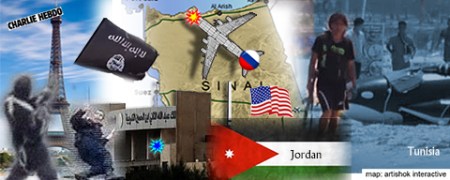
Ten days earlier, the Islamic State brought down the Russian Metrojet airliner over Sinai killing all 224 people aboard. This spectacular act of terror was apparently the first strike of the jihadist group’s winter offensive. It achieved its objectives of multiple murder; mortal damage to Egypt’s tourism industry and a blow to the prestige of its president Abdel-Fatteh El-Sisi.

The attack also punished President Vladimir Putin for bringing the Russian military into the center of the Syrian conflict.

The next Islamic State assault was aimed to undermine the credibility of Jordan’s King Abdullah and his security services: On Nov. 8,  a Jordanian police captain opened fire at a high-security US training facility outside Amman, killing two American trainers, a South African and two Jordanians. The number of US personnel injured in the attack was not released. This attack was timed to coincide with the 10thanniversary of the massive al Qaeda assault on Amman’s leading hotels, all American owned, which left 61 dead.

In northern Sinai, the murder of a family of 9 Egyptians at El Arish Thursday morning raised the total of ISIS murders in less than a month to 274.

DEBKAfile’s counterterrorism sources discern three objectives in the attack Thursday night in Beirut

1. A lesson for Tehran and Hizballah’s leader Hassan Nasrallah to show them that the Islamic State is able to reach them on their home ground, no matter how many troops they deploy to fight the jihadis in Syria (Iran and Hizballah together field an estimated 13,000 soldiers in Syria). ISIS was capable of inflicting terrible casualties both on the battlefield and in their homeland, first in Beirut and eventually in Tehran.

2.  The day before, Wednesday, Nov. 11, in a speech marking the “Day of the Shahid,” Nasrallah gloated over Hizballah’s triumph in a battle outside Aleppo. He also boasted that his domestic security shield in Lebanon presented an impenetrable barrier against ISIS or Nusra Front terrorist intrusions.

The Islamic State’s tacticians determined to blow up both claims in Nasrallah’s face. He and Iran were to be shown that they could not stop ISIS or prevent the Syrian war’s spillover into Lebanon.

3.  By blowing up the Russian airliner over Sinai, the Islamists sought to underscore this point for Moscow too. Russia might send a powerful military force to Syria, but the Islamists would hit Putin from the rear at a location of its choosing anywhere in the Middle East. Moscow may have opted to defend Bashar Assad, but what can it do to protect Hizballah and its other allies?.

DEBKAfile’s counterterrorism sources note that US and Russia have taken lead roles in the broad military effort to defeat ISIS – often by means of pinpointed operations. At the same time, under their noses, the Islamist terrorists have launched their winter campaign, striking with extreme ferocity and agility in unexpected places that are outside the regular battle fronts in which the big powers are engaged.

Shortly before the Obama-Netanyahu summit, ISIS hit Americans in Jordan

November 9, 2015

Shortly before the Obama-Netanyahu summit, ISIS hit Americans in Jordan, DEBKAfile, November 9, 2015

Isis_Jordan480

After the Islamic State succeeded in downing a Russian airliner that took off from Sharm El-Sheikh on October 31, causing the deaths of all 224 passengers and crew, the terrorist organization Monday, Nov. 9, put a US military target in its crosshairs. A captain in the Jordanian police opened fire in the cafeteria of the Special Operations Training Center outside the Jordanian capital, Amman, where American instructors train Iraqi troops to fight ISIS. Two trainers from the US and one from South Africa were initially reported killed and another six wounded, including two more Americans and four Jordanians.

A Jordanian government spokesman said later Monday that the number of fatalities had risen to eight, without specifying how many foreigners.

The gunman did not survive. He was variously reported to have committed suicide after the assault or killed by Jordanian troops.

The modus operandi resembled the “green on blue” insider attacks committed in Afghanistan by al Qaeda and Taliban “insiders” against American and British troops serving at the same base.

Jordan’s Al-Rai newspaper identified the shooter as Anwar Abu Ubayd, but other news outlets said his name was Anwar Abu Zaid.

If the downing of the Russian plane rocked the regime of Egyptian President Fattah El-Sisi, there is no doubt that Monday’s attack will shake King Abdullah’s Hashemite throne.

The attack, furthermore, demonstrated that ISIS is rapidly approaching Israel’s borders with Syria in the north, Egypt in the south and Jordan in the east. The assault gained particular attention as it was carried out just hours before the summit Monday between Israeli Prime Minister Binyamin Netanyahu and US President Barack Obama at the White House in Washington.

They met for the first time after more than a year and after a major row over the Iranian nuclear accord. Both leaders made statements strongly indicating that they had determinedly buried the hatchet and were looking to the future of strong and amicable ties and expanded US support for Israel’s security.

A large part of their two-hour conversation was undoubtedly devoted to the threat posed by ISIS, on which they concur.

Until now, Jordan had been home to the most important and secure US forward base for the war on ISIS in Iraq and Syria.  US air strikes come from bases in Turkey, but more than 10,000 ground troops and special operations forces troops are present in Jordan. The kingdom serves as a training, operations and logistical center for US missions in Iraq and Syria, and for that purpose a command center, the US Central Command Forward-Jordan, was established outside Amman.

Until now, ISIS had not managed to infiltrate Jorda for attacks capable of destabilizing Abdullah’s rule. Numerous infiltration and terrorist attacks were thwarted by Jordanian intelligence and security. The Jordanian authorities focused primarily on keeping the jihads out of the refugee camps housing Syrians and Iraqis in flight from war zones, but this came at the expense of efforts to block the threat from reaching inside the Hashemite kingdom and its security facilities.

Their first success will no doubt embolden ISIS to keep on pressing its advantage. Immediately following Monday’s shooting, Jordan’s military went into high alert nationwide and along its borders. The US, Russia, Egypt, Jordan and Israel are all boosting their vigilance as the threat from ISIS continues to grow. But no one can reliably predict where the Islamist terrorists strike next.

Analysis: Why Palestinians do not want cameras on the Temple Mount

November 3, 2015

Analysis: Why Palestinians do not want cameras on the Temple Mount

Source: Analysis: Why Palestinians do not want cameras on the Temple Mount – Arab-Israeli Conflict – Jerusalem Post

Why is the Palestinian Authority (PA) opposed to Jordan’s proposal to install surveillance cameras at Jerusalem’s Haram al-Sharif (Temple Mount), sacred to Christians, Muslims and Jews?

This is the question that many in Jordan have been asking in light of the recent agreement between Israel and Jordan that was reached under the auspices of US Secretary of State John Kerry. The idea was first raised by Jordan’s King Abdullah in a bid to ease tensions at the holy site in the Old City of Jerusalem.

Shortly after Israel accepted the idea, the Palestinian Authority rushed to denounce it as a “new trap.” PA Foreign Minister Riad al-Malki and other officials in Ramallah expressed concern that Israel would use the cameras to “arrest Palestinians under the pretext of incitement.”

During the past two years, the Palestinian Authority and other parties, including Hamas and the Islamic Movement (Northern Branch) in Israel, have been waging a campaign of incitement against Jewish visits to the Haram al-Sharif. The campaign claimed that Jews were planning to destroy al-Aksa Mosque.

In an attempt to prevent Jews from entering the approximately 37-acre (150,000 m2) site, the Palestinian Authority and the Islamic Movement in Israel hired scores of Muslim men and women to harass the Jewish visitors and the police officers escorting them. The men are referred to as Murabitoun, while the women are called Murabitat (defenders or guardians of the faith).

These men and women have since been filmed shouting and trying to assault Jews and policemen at the Haram al-Sharif. This type of video evidence is something that the Palestinian Authority is trying to avoid. The PA, together with the Islamic Movement, wants the men and women to continue harassing the Jews under the pretext of “defending” the al-Aksa Mosque from “destruction” and “contamination.”

The installation of surveillance cameras at the site will expose the aggressive behavior of the Murabitoun and Murabitat, and show the world who is really “desecrating” the Islamic holy sites and turning them into a base for assaulting and abusing Jewish visitors and policemen.

The cameras are also likely to refute the claim that Jews are “violently invading” al-Aksa Mosque and holding prayers at the Temple Mount. The Palestinian Authority, Hamas and the Islamic Movement have long been describing the Jewish visits as a “provocative and violent incursion” into al-Aksa Mosque. But now the cameras will show that Jews do not enter al-Aksa Mosque, as the Palestinians have been claiming.

Another reason the Palestinians are opposed to King Abdullah’s idea is their fear that the cameras would expose that Palestinians have been smuggling stones, firebombs and pipe bombs into al-Aksa Mosque for the past two years. These are scenes at the PA, Hamas and the Islamic Movement do not want the world to see: they show who is really “contaminating” the Haram al-Sharif. Needless to say, no Jewish visitors have thus far been caught trying to smuggle such weapons into the holy site.

By rejecting the idea of setting up 24-hour surveillance cameras at the Haram al-Sharif, the Palestinian Authority has found itself on a course of collision with Jordan. Jordanian politicians and columnists have voiced outrage over the stance of the PA, and have dubbed it harmful to Palestinian and Islamic interests.

The Jordanian newspaper Al-Ghad, which is close to the government, quoted Jordanian politicians as denouncing the opposition of the Palestinian Authority to the cameras as “inappropriate, clumsy, tasteless and unfair.”

Sources in Ramallah explained this week that the PA’s opposition to cameras should also be seen in the context of the power struggle between the Palestinians and Jordan over control of the Islamic holy sites in Jerusalem. The Jordanians have long been seeking to preserve their status as “custodians” of al-Aksa Mosque and other Islamic holy sites in Jerusalem. This is a status that some Palestinians and the Islamic Movement in Israel have been trying to change during the past two decades, especially after the signing of the Oslo Accords between the PLO and Israel in 1993.

The Palestinian Authority’s opposition to the installation of cameras is seen as an attempt to undermine Jordan’s status at the Islamic holy sites. Many Palestinians argue that they, and not the Jordanians, should be in charge of the Haram al-Sharif. Members of the PA are opposed to the cameras because it is a Jordanian proposal and reinforces Jordan’s role at the holy site.

As such, the Palestinian Authority’s position could be seen as an attempt to change the status quo at the holy site by driving the Jordanians out of the area. King Abdullah is obviously aware of the Palestinian attempt to prevent him from playing any role at the holy site; that is why he was quick to reach a deal with Israel about the installation of cameras. The PA, meanwhile, will continue to work against having cameras in the hope of preventing the world from seeing what is really happening at the site and undermining Jordan’s “custodianship” over Islamic holy sites in Jerusalem.

It now remains to be seen how Secretary Kerry, who brokered the camera deal between Israel and Jordan, will react, if at all, to the latest Palestinian Authority attempt to continue escalating tensions at the holy site. If Kerry fails to pressure the PA to stop its incitement and repeated attempts to exclude the Jordanians from playing any positive role at the Haram al-Sharif, the current wave of knife attacks against Jews will continue.

Murder as politics

October 24, 2015

Murder as politics, The Washington Times, Louis Rene Beres, October 22, 2015

Even as growing numbers of Palestinian terrorists stab madly at Israeli men, women, and children, much of the world still endorses creation of “Palestine.” Such mindless support continues, moreover, despite the fact that the Palestinians themselves reject any sort of two-state solution. Indeed, the latest such poll (September 2015), conducted by Palestinian research organizations, concluded that almost half the resident Arabs strongly favor the use of armed force and generalized violence against Israeli noncombatants.

For the most part, western news reports notwithstanding, knife wielding attackers are not “lone wolves.” Rather, they have been conspicuously spurred on by vitriolic PA incitements, and by carefully synchronized calls from the mosques to murder “The Jews.”

The Palestinian Authority shares with Hamas the irredentist vision of a one-state solution. There is nothing hidden or ambiguous about this true plan for Israel’s disappearance. It is plainly codified on the official maps of both factions, where Israel is identified only as “Occupied Palestine.”

For virtually all Arab forces in the Middle East, the conflict with Israel is never about land. It is about God, and about always-related promises of personal immortality. It is about power over death.

For the Palestinians, their carefully sanitized public rhetoric notwithstanding, the enemy is not the Israelis (that term is just subterfuge, for the media), but “The Jews.” The screaming young Palestinian, who strikes indiscriminately with his serrated blade, fully expects to become a “martyr.” He only risks “death” in order not to die.

There is more. A Palestinian state — any Palestinian state — would rapidly be taken over by ISIS, or by related jihadi adversaries. Already, ISIS is operating in parts of Syria that could bring it to the critical borders of Israel’s Golan Heights. Significantly, it has also set recognizable operational sights on Jordan and West Bank (Judea/Samaria).

Over the next several months, and even while the Palestinian Authority continues to orchestrate more “Third Intifada” attacks on Israelis, ISIS will commence its fated march westward, across Jordan, ending up at the eastern boundaries of West Bank. These boundaries, of course, would represent the territorial margins of what PA/Fatah both already affirm as the geographic heart of “Palestine.”

Palestinian forces, primarily Fatah, would then yield to ISIS, and to its local proxies. Fatah would then have to choose between pleading with the Jewish State to become an ally against a now-common foe, or abandoning all its residual military operations to the IsraelDefense Forces directly. Arguably, without IDF assistance in such desperate circumstances, “Palestine” wouldn’t stand a chance.

One additional irony ought to be noted. In Israel, Prime Minister Benjamin Netanyahu has long made acceptance of any Palestinian state contingent upon prior Palestinian “demilitarization.” Should the Palestinian Authority and Hamas somehow accede to this problematic expectation, it could make ISIS’ predictable destructions in the area much easier to carry out. Paradoxically, a “Palestine” that had properly stood by its pre-state legal concessions to Israel, could effectively increase the overall danger posed to both Palestinians and Israelis.

What about Jordan? Under pertinent international law, the Hashemite Kingdom has incurred certain binding obligations regarding joint cooperation with Israel against terrorism. These obligations, as reinforcing complements to more generally binding legal rules, are expressly codified at the 1994 Treaty of Peace Between the State of Israel and the Hashemite Kingdom of Jordan.

Could this treaty still have any palpable effect upon Jordan’s capacity to militarily block anticipated ISIS advances?

Not at all. The more generic problem of enforcing treaties had already been identified back in the 17th century, by Thomas Hobbes. Said the English philosopher, in his “Leviathan,” a work well known to America’s founding fathers: “Covenants, without the Sword, are but words …”

From the 17th century onward, the world political system has been anarchic, or, in Hobbesian terms, a “state of nature.” In the anarchic Middle East, especially, considerations of raw power routinely trump international law. Here, too, truth here may be counter-intuitive. On those endlessly perplexing matters concerning Palestinian statehood, for example, it is finally time to understand that “Palestine‘s” true enemy in the region is not Israel, but rather a hideously sordid amalgam of Islamist Arab forces. Going forward, any further Palestinian advances toward statehood would likely be solely to the longer-term tactical advantage of ISIS.

Is this the sort of statehood cause that should be enthusiastically supported in Washington, and in most European capitals? It is, but only if we should first want to see an expansion of “Third Intifada” terror to the homeland. Not likely.

If you like Syria, Iraq, and Afghanistan, you’ll love “Palestine.”

Diplomacy: Looking for ways to douse the spark

October 23, 2015

Diplomacy: Looking for ways to douse the spark, Jerusalem PostHerb Keinon, October 23, 2015

(They “dance around in a ring and suppose, but the secret sits in the middle and knows,” with apologies to Robert Frost. — DM)

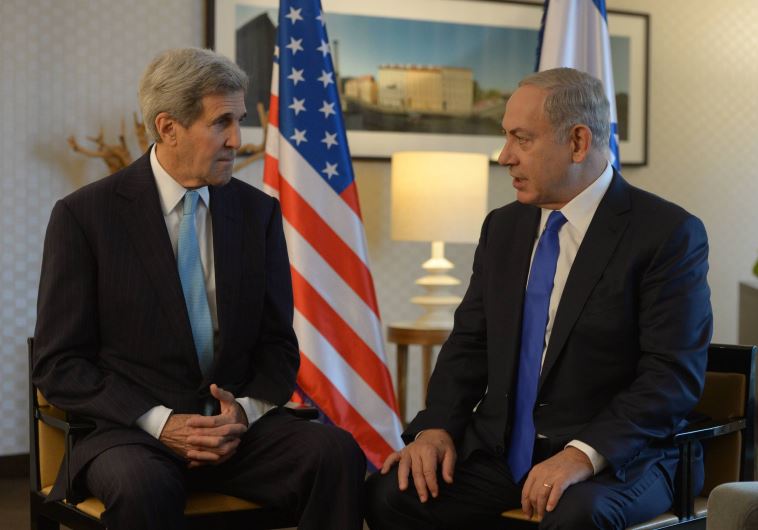
ShowImage (15)Netanyahu and Kerry meeting in Berlin. (photo credit:AMOS BEN-GERSHOM/GPO)

And now the diplomatic dance begins, again.

After three weeks of runaway terrorism on the streets, UN Secretary-General Ban Ki-moon arrived for a quick visit midweek; US Secretary of State John Kerry – after meeting with Prime Minister Benjamin Netanyahu on Thursday in Berlin – is expected to meet on Saturday with Palestinian Authority President Mahmoud Abbas in Amman, along with Jordan’s King Hussein; EU foreign policy chief Federica Mogherini is doing the same; and the French are floating various proposals to take to the UN Security Council.

All predictable, all the traditional steps taken in a time of Mideast crisis.

Ban did what Ban does in these situations – he comes, meets with both sides, issues platitudes about the need for both sides to show restraint, and declares how important it is to keep that light of hope burning.

The UN secretary-general dutifully fulfilled his role in the script. Netanyahu obliged by meeting politely with Ban, who then went on to meet politely with Abbas, to what appears to be absolutely no effect. It’s a dance whose steps – and way of ending – are known far in advance.

Jerusalem does not take Ban’s efforts overseriously, as the organization that he heads is seen as a big part of the problem rather than the solution.

Witness Wednesday’s one-sided resolution adopted by UNESCO, the UN’s cultural heritage agency, condemning “Israeli aggression” on the Temple Mount and declaring that the Jewish holy sites of Rachel’s Tomb and the Cave of the Patriarchs are an “integral part of Palestine.”

Similar disdain, to a certain extent, characterizes Israel’s view of the EU’s efforts. Netanyahu will listen to Mogherini, and lament both Abbas’s incitement and the EU’s acceptance of it, but will place little stock in the EU’s ability to play a constructive role in calming down the situation.

Brussels is not seen in Jerusalem as a particularly honest broker on all things Palestinian but, rather, as the institution that nurtures – perhaps more than any other – the hope among the Palestinians that if they press long enough and hard enough, the international community will deliver to them what they publicly say they want: a Palestinian state along the pre-1967 borders with east Jerusalem as its capital, and some kind of “fair and just” accommodation for the refugees.

The very skeptical Israeli view of the EU in any diplomatic process is reinforced by steps taken by France, which this week considered bringing a resolution to the UN Security Council to place international observers on the Temple Mount.

This idea, which Israel would never accept, and which even Jordan and the Palestinians have apparently rejected, is born of a burning French diplomatic desire to always do something, anything, in the Mideast – especially when there seems to be a stalemate or vacuum.

It is also the product of sour relations currently prevailing between Paris and Jerusalem, as well as a lingering French hope for the internationalization of Jerusalem – for the establishment of a corpus separatum in Jerusalem under a special international regime – which France hopes to be a part of.

So with the UN out, the EU out, and France out, that leaves the US.

But it is not as if Jerusalem is harboring any hopes that Kerry will be able to ride in and save the day.

From Jerusalem’s perspective the US track record in the region is not sterling, and though it appreciates Washington’s desire to help, there is little illusion that high-profile, high-level meetings will have any immediate effect on the ground.

And while Jerusalem is not waiting for Kerry with baited breath, it was clear from the beginning that he would get involved. An uptick in terrorism and violence leads to a well-worn pattern in Washington: condemnations of the terrorism, then statements that anger Israel about proportionality or settlements, followed by calls for restraint on both sides, and then meetings with the leaders.

But this current spurt of terrorism and violence is different from previous rounds, in that there is no identifiable organization – such as Hamas and Fatah’s Tanzim militia – to hold directly responsible for the bloodshed. This time it is more amorphous, individual terrorists incited by calls for Jewish blood on Facebook and from various leaders, going out to kill Jews.

The lack of a clear organizational structure behind the terrorism makes it more difficult for the security services to stop, because it is much more difficult to gather intelligence on an individual who grabs a knife and goes out to kill than on attacks directed by an organization.

Also, there is not one person seemingly in control who may be pressured to cease the violence.

It is not as if Kerry can talk to Abbas and convince him to issue a call to his people to “hold your horses,” and the horses will obediently be held. Abbas does not have anything near that type of control – many of the horses simply do not heed him.

This time around, thankfully, neither the State Department nor Kerry are inflating expectations; they are not talking about Kerry’s separate meeting with the leaders as a potential breakthrough for restarting the diplomatic talks and bringing a peace deal in a number of months.

Washington, it should be remembered, is still engaged in its own Mideast policy reassessment, a policy reassessment brought about after the breakdown of the Kerry-led peace talks in April 2014, and re-announced after Netanyahu’s preelection statement – which he later retracted – of less than full fealty to the notion of a two-state solution.

Rather, this time the bar has been set low, with the goals very limited.

State Department spokesman John Kirby said on Wednesday that the meetings would deal with “practical ways in which political breathing space can be had to help end the violence.”

No overreaching there, just looking for breathing space. The breathing space that Kirby mentioned but did not elaborate upon is likely to be an attempt – in discussions with Netanyahu, Abbas and especially Jordan’s King Abdullah – to come up with a clear set of procedures for governing the Temple Mount.

The Temple Mount has – like so many times over the last century – been the spark to violence against Jews. To douse the fire, there will be some need to deal with the spark, but this has to be done in a way where both Israel and the Palestinians can say that they have not given in.

In recent days Kerry has spoken about the need for clarity. Everyone talks about the status quo on the Temple Mount, but there is little understanding of what that entails.

“Israel understands the importance of the status quo and… our objective is to make sure that everyone understands what that means,” Kerry said at press conference on Monday in Madrid, adding that “we are not seeking a new change or outsiders to come in; I don’t think Israel or Jordan wants that, and we’re not proposing it. What we need is clarity.”

The new “clarity” is expected to involve enhanced coordination and cooperation with Jordan, possibly even more Jordanian representatives on the site, in such a way as to undercut the spurious charge that Israel is somehow threatening al-Aksa Mosque.

Former National Security Council head Yaakov Amidror said in an Israel Radio interview this week that he had little expectation regarding Kerry’s meeting with Netanyahu or Abbas, because the US has little impact on the Palestinians – which is true.

But the US does have leverage on Jordan, and this leverage may now be needed to get Abdullah to take a greater role in day-to- day administration and involvement at the site – if only as a way to suck the oxygen out of the lie propelling the current round of terrorism: that Israel is endangering al-Aksa.

Jordanian Writer: Arafat, The Knives Stabbed Into The Israelis’ Heads Are The Fruit Of Your Revolution

October 16, 2015

Jordanian Writer: Arafat, The Knives Stabbed Into The Israelis’ Heads Are The Fruit Of Your Revolution, Middle East Media Research Institute, October 16, 2015

(A Jordanian writer’s paean to the patron saint of Palestinian terrorists. — DM)

Against the backdrop of the current wave of Palestinian attacks on Israelis in Jerusalem, the West Bank, and other parts of Israel, Jordanian writer Abd Al-Hadi Raji Al-Majali wrote in the Jordanian government daily Al-Rai of his yearning for Yasser Arafat. He stated that Arafat’s influence continued to this day in Palestine, and added that even from the grave he had the power to lead the third intifada and defeat Israel.

Addressing Arafat, Al-Majali said that the seeds of his revolution had borne fruit, since today’s Palestinian youth are leading this uprising and this “revolution of the knives.”

The following are excerpts from the article, which was published October 15, 2015: 

25300

Al-Rai

“When you see the sights in Palestine, you recall the martyr Yasser Arafat. He seems to be monitoring, from Ramallah, the river of Palestinian blood and the new generation of young people that has invented the revolution of the knives. I still remember all his statements, every word of his, how he would rage and grasp his kaffiyeh with his right hand and rearrange it… I remember his khakis… the medals, the flag of Palestine, the gray whiskers on his face, his lips trembling in anger when an interviewer annoyed him.

“This is not just a revolution, but also the blood of Arafat, who [still] rouses the Palestinian blood; even Arafat’s grave energizes the Arabness of the Palestinian land… When I see in the Palestinian arena a new generation of young people – of whom Arafat spoke at length, [as he] dreamed of the day that they would fly the Palestinian flag above the walls of Jerusalem – I imagine that the man is still in Ramallah; that he is instructing [us] to care for the families of the martyrs; that he still makes the decisions and leads a diplomatic effort; that  his companions are bringing him his pistol; that the documents are piling up in his office; that he just now finished breakfast… and that he just now issued a secret revolutionary order to be carried out by the factions. He is the main expert in the tactic of revolution, and he knows how to disturb the sleep [of the Israelis].

“Mr. President, the dew still moistens the dust of your grave, and the birds circle above it, perhaps even bringing you messages and news. The stones [on your grave], sir, have left their place temporarily – [how else] would they enable the sun to peek through, or the air to seep in?

“Oh you who rest in Ramallah, trust and be sure that in the Palestinian dictionary there is no one who is pleased with the current situation. It is you who compiled this dictionary, formulating every word, and every revolution since the Palestinians began to pick up the rifle. Rest assured, the flowers and the lion cubs [i.e. the young Palestinian women and men] of whom you spoke are now the vanguard in the arena, and [it is they who are leading] the stabbing of the heads [of the Israelis], which is the only thing that will satisfy the will of Palestine.

“I cannot imagine a revolution of which you are not a part… and I cannot conceive of the occupation army’s defeat without you planning its details.

“Oh you who rest in Ramallah, it is now your privilege to smile a bit, because the seeds of the revolution that you sowed in the land of Palestine are now sprouting our sharp knives, and their blades are [stabbing] the head and the vein [of the Israelis].

“Oh you who rest in Ramallah, I am sending you regards from Kerak [in Jordan], and I understand that even from your grave you are capable of leading the third intifada. [The Israelis] may besiege your grave as they besieged you in the capitals and in your seat in Ramallah – but this intifada will launch a new turn, the thrust of which is that the graves are triumphant.

“Your grave will defeat Israel, Mr. President.”