Posted tagged ‘Jihad’

Syrian Kurds accuse Turkey of aiding sarin gas delivery to rebels after fresh chemical attacks

March 10, 2016

Syrian Kurds accuse Turkey of aiding sarin gas delivery to rebels after fresh chemical attacks

Published time: 10 Mar, 2016 01:09 Edited time: 10 Mar, 2016 02:18

Source: Syrian Kurds accuse Turkey of aiding sarin gas delivery to rebels after fresh chemical attacks — RT News

In an interview with RT, a spokesman for the Kurdish YPG militia accused Turkey of providing a clear transit route for the chemical weapons that were deployed against them near the city of Aleppo on Tuesday.

READ MORE: ISIS shelled Kurdish-controlled Iraq village with ‘poisonous substances’ – governor

Read more

Aleppo, Syria © Hosam Katan

Syrian anti-government militants “took advantage of the ceasefire” to launch attacks against a Kurdish-controlled area near Aleppo in northern Syria, Redur Xelil told RT. The attackers targeted a civilian district of what was once Syria’s biggest city, and has since become a key battleground. According to Xelil, the shells emitted an “unnatural smell” and “yellow smoke” upon impact, indicating that chemical weapons were involved.

“Our sources inside the rebel groups have confirmed that toxic substances were used. We also have verified information that sarin gas was delivered to them from Turkey. All signs point to the fact that these factions were using banned weapons, but we cannot access the launching area, as it is located on the front between the Turkish and rebel forces,” Xelil told RT by Skype from Rojava in Syria.

Kurdish deputies in the Turkish parliament have previously accused Ankara of supplying Islamic State (IS, formerly ISIS/ISIL) and other jihadist groups inside Syria with chemical weapons, which are used both in their fight against the Syrian government and to pin responsibility for their deployment on the regime of President Bashar Assad.

Tuesday’s attack, which also involved phosphorus, did not result in any severe casualties.

“This attack was a failure, but this doesn’t mean that there won’t be another one. We are convinced the enemy has improvised shells containing phosphorus and sarin gas,” said Xelil.

READ MORE: Who’s behind alleged Aleppo chemical weapons attack?

Last month, the Organization for the Prohibition of Chemical Weapons (OPCW) accused IS of using chemical weapons against Kurdish forces throughout 2015. Reports emerged on Wednesday revealing that the jihadist group had launched a new chemical attack on the Kurdish village of Zaza in northern Iraq, in which more than 40 civilians suffered chemical burns and lung damage.


WATCH: Hamas Emulates Islamic State Executions of Israelis in New Propaganda Videos

March 2, 2016

WATCH: Hamas Emulates Islamic State Executions in New Propaganda Videos

by Deborah Danan

1 Mar 2016

Source: WATCH: Hamas Emulates Islamic State Executions of Israelis in New Propaganda Videos

TEL AVIV – A new propaganda video showing terrorists simulating Islamic State-style executions of Israeli soldiers is one of the latest in a series of Hamas-produced videos showcasing terrorist skills and demonstrations.

The clip shows three masked Hamas terrorists in camouflage carrying out synchronized throat-slittings of three IDF soldiers in front of a cheering crowd.

MEMRI gathered a series of clips shown on Gaza TV, including “how-to” clips for would-be terrorists to carry out suicide bombings, beheadings, and stabbings.

One of the clips shows a rally in the Gaza town of Rafah in which the murder of Eitam and Dalia Henkin is reenacted. The narrator hails the terrorists responsible for the murder as “heroes” and heaps further praise on them for executing the couple in front of their young children, while leaving the children themselves unharmed.

Israeli investigators said the terrorists would likely have continued their massacre had the parents not put up a struggle, which caused one of the gunmen to accidentally shoot his accomplice in the hand, prompting both attackers to flee the scene, Arutz 7 reported.

In another scene, actors dressed as Israeli civilians and soldiers board a bus, followed by a suicide bomber. The bus then explodes, apparently killing all those on board.

Hamas recently aired a music video encouraging terrorists to resume suicide bombings in Israeli cities. The video featured Jewish flesh being “roasted” and the smoking remains of a bombed Egged bus.

‘Next Time in Jerusalem’: Islamic State Supporters Celebrate Baghdad Deadly Suicide Bombings

March 2, 2016

EXCLUSIVE – ‘Next Time in Jerusalem’: Islamic State Supporters Celebrate Deadly Baghdad Suicide Bombings

by Aaron Klein and Ali Waked

1 Mar 2016

Source: ‘Next Time in Jerusalem’: Islamic State Supporters Celebrate Baghdad Deadly Suicide Bombings

AFP

TEL AVIV – Internal messages obtained by Breitbart Jerusalem show Islamic State supporters celebrated the deadly suicide attacks carried out by the organization’s operatives in a Shi’ite part of Baghdad on Sunday, rejoicing in the death and injury of “more than 100 infidels.”

The string of suicide attacks in the Iraqi capital’s Abu Ghraib and al-Sadr districts left at least 70 people dead and many more wounded.

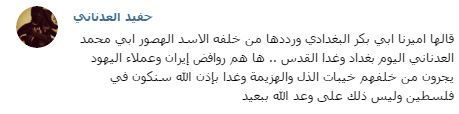
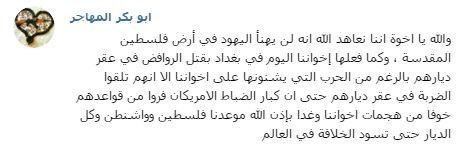
IS released a somewhat laconic statement claiming responsibility, but its supporters were jubilant in messages exchanged in a private encrypted chat utilized by IS and its supporters, vowing that the next such operation would be in Jerusalem.

حفيد“Allah is great, my brothers, our jihadi fighters surprised the enemy infidels at the gates of Baghdad,” wrote Abu Jaafar Albagdadi, a high-profile IS operative. “We hurt them and the American officers who fled in panic from our fighters. Today in Baghdad, tomorrow in Jerusalem and Palestine with Allah’s help.”

جعفر 11“Our Caliph Abu Bakr al-Baghdadi made it clear, and repeated the words of our [military] commander Abu Mohammed al-Adnani: Today in Baghdad, tomorrow in Jerusalem,” wrote Eladnani the Grandson, an Iraqi IS member. “Look at Iran and the Jews’ cronies bearing a humiliating defeat. Tomorrow, with Allah’s help, we’ll be in Palestine. Allah promised it and it will happen.”

بكرIn the closed chat group, which utilizes the encrypted Telegram messaging service, top IS operative Abu Bakr Almuhager added: “My brothers, we’ve made a vow to Allah that the Jews will not take pleasure in occupying the holy land of Palestine. … Our brothers hit the infidels in the safety of their quarters in Baghdad, despite the ongoing war against us, and chased away the American officers. Our next meeting will be in Palestine, or Washington, or wherever, until the sacred caliphate rules the world.”

Moderate “European” Islam: Stemming Terror with Band Aids

March 1, 2016

Moderate “European” Islam: Stemming Terror with Band Aids

by Judith Bergman March 1, 2016 at 4:00 am

Source: Moderate “European” Islam: Stemming Terror with Band Aids

  • The project of a “French Islam” has failed abysmally. A 2,200-page report, “Suburbs of the Republic,” concluded that Muslim immigrants in France were increasingly rejecting French values and identity, and instead immersing themselves in Islam. The report warned that Islamic sharia law was displacing French civil law in many parts of suburban Paris.
  • The pattern of “importing” imams with no knowledge of the local language and customs is the same all over Europe.
  • Qatar and Saudi Arabia, where the official form of Islam is Wahhabism, are the main financiers of mosques in Europe. Wahhabism discourages Muslim integration in the West, but actively encourages jihad against non-Muslims. Qatar has financed mosques in France, Italy, Ireland and Spain, among other places, thus spreading Wahhabism across the continent.

Last week Austria ordered the first foreign-funded imam to be expelled when his visa expires. The decision was made under the new provisions of an anti-radicalization law, which Austria passed one year ago under considerable controversy. The main aim of the law is to counter extremism by requiring imams to speak German, and to prohibit foreign funding for mosques, imams and Muslim organizations in Austria. It also stresses that Austrian law must take precedence over Islamic sharia law for Muslims living in the country.

“We want a future in which increasing numbers of imams have grown up in Austria speaking German, and can in that way serve as positive examples for young Muslims,” said Integration Minister Sebastian Kurz, who helped draft the law. Another 65 imams are expected to be deported in the coming weeks, after being informed that their visas will not be renewed. The decision to deport the foreign imam has — predictably — been deemed unconstitutional by Austria’s Constitutional Court, which finds the law discriminatory because it targets only Muslims.

In a similar vein, the Belgian government recently earmarked €3.3 million to be able to pay the wages of 80 new imams in order to “help stimulate a moderate European form of Islam,” reported the Flemish daily newspaper De Standaard last week. Justice Minister Koen Geens said that official recognition of mosques forms “part of our strategy to promote a more integrated form of Islam,” one intended to counter radicalization, violent extremism and terrorism. He added: “A recognized mosque is a sign of an integrated Islam. In the fight against radicalization, it is important that young people don’t drift into the arms of radical mosques. This also provides us with more interlocutors.”

Last year, the news outlet Antwerpen revealed that a young Moroccan imam who had preached in the officially recognized “moderate” mosque, the Dome in Borgerhout, had gone to Syria with two other men to join the jihadists. Youssef El G. — the imam in question — had not been monitored, because the mosque was considered moderate. The police said his departure came as a surprise.

Encouraging Muslims toward a more moderate “European” Islam is an old idea, but has not yet succeeded in practice anywhere in Europe and its specific nature remains largely undefined.

In France, the concept of a “French Islam” was put to the test in 2003, when Nicolas Sarkozy, then interior minister, created the French Council for the Muslim Religion (CFCM) to help address issues such as imam training, mosque building and regulating halal slaughter. The purpose was to encourage a homegrown, liberal version of Islam. “What we should be afraid of is Islam gone astray, garage Islam, basement Islam, underground Islam. It is not the Islam of the mosques, open to the light of day,” Mr. Sarkozy said at the time.

The project of a “French Islam” has failed abysmally. Already in 2011 a 2,200-page report, “Banlieue de la Republique” (Suburbs of the Republic), commissioned by the influential French think tank L’Institut Montaigne — directed by Gilles Kepel, a well-known political scientist and specialist in the Muslim world — concluded that Muslim immigrants in France were increasingly rejecting French values and identity, and instead immersing themselves in Islam. The report also warned that Islamic sharia law was rapidly displacing French civil law in many parts of suburban Paris.

The report showed how radical Muslim leaders in France, who are promoting the social marginalization of Muslim immigrants in order to create a parallel Muslim society ruled by sharia law, are exacerbating the problem. The report described a proliferation of mosques and prayer rooms in the suburbs. The religious orientations of the mosques were already heavily influenced by the national origin of the founder or president of a given mosque, in other words, not nearly close to any “French” Islam, regardless of what that concept might actually contain.

Indeed, according to Reuters, only 25-30 percent of practicing imams in France are French nationals. Many do not speak French and have no knowledge of French law or customs. According to Abdelali Mamoun, an imam of Alfortville, just outside Paris, of the roughly 2,500 mosques in France, 800 are Moroccan, 600 Algerian and 400 Turkish-linked. The Grand Mosque in Paris, for example, was assigned to Algeria’s trusteeship by the French government in 1957. Since 1982, Algeria has been responsible for funding the Grand Mosque. Only between 30% and 40% of the mosques in France are independent, says Mamoun. He defines independent mosques as institutions that set out to serve all Muslim communities, that are not sponsored from abroad and do not have imams imported and paid from abroad.

The Grand Mosque in Paris was assigned to Algeria’s trusteeship by the French government in 1957. Since 1982, Algeria has been responsible for funding the Grand Mosque. (Image source: Wikimedia Commons)

Nevertheless, France still holds onto the idea of a French “moderate” Islam. In March 2015, in the wake of the terrorist attacks on the satirical magazine Charlie Hebdo and the concern about the influence of radical foreign imams on Muslims in France, French Prime Minister Manuel Valls announced that France would finance double the number of university courses on Islam — from six to twelve — to stop the influence of foreign funding on the training of French imams.

Valls said he wanted more imams and other religious figures, such as prison chaplains, who have been trained abroad to “undergo more training in France, to speak French fluently and to understand the concept of secularism” that is a core pillar of French Republican values. “The only response to the dangers that we face is the French Republic,” Valls said. “This means the acceptance of the secular state, improving education, universities, understanding and intelligence… But there will be no laws, decrees or government directives to define what Islam means,” Valls said. “The French state will never attempt to take control of a religion.”

After the Paris attacks in November 2015, Anouar Kbibech, president of the French Council for the Muslim Religion, said it would fight extremists by creating a permit to preach for imams, as well as a new religious body to fight jihadist propaganda. The certificate would be given to those imams who promote a “tolerant and open Islam.”

“The time for action has come. The Muslims of France will play their part,” said Kbibech. Actually, the time for action was over more than a decade ago, in 2003, at the founding of the CFCM. By now, any action is probably too little, much too late.

The pattern of “importing” imams with no knowledge of the local European languages and customs is the same all over Europe. Qatar and Saudi Arabia, where the official form of Islam is Wahhabism, are the main financiers of mosques in Europe. Qatar has financed mosques in France, Italy, Ireland and Spain, among other places, thus spreading Wahhabism across the continent. Wahhabism is a version of Sunni Islam that discourages Muslim integration in the West, but actively encourages jihad against non-Muslims. The former emir of Qatar, Sheikh Hamad bin Khalifa al-Thani, vowed a few years ago to “spare no effort” to spread the fundamentalist teachings of Wahhabi Islam across “the whole world.”

In October 2014, General Jonathan Shaw, a former commander of British Forces in Iraq, who retired as Assistant Chief of the Defence Staff in 2012, told The Telegraph that Qatar and Saudi Arabia were primarily responsible for the rise of the extremist Islam that inspires Islamic State terrorists by funding the global spread of radical Islam. “The root problem is that those two countries are the only two countries in the world where Wahhabi Salafism is the state religion – and Isil is a violent expression of Wahhabist Salafism,” said Gen. Shaw.

In December 2015, German vice-chancellor Sigmar Gabriel said that the Saudi regime is funding extremist mosques and communities that pose a danger to public security. “We have to make clear to the Saudis that the time of looking away is over… Wahhabi mosques all over the world are financed by Saudi Arabia. Many Islamists who are a threat to public safety come from these communities in Germany,” the vice-chancellor said. In addition to the mosques it has already built, Saudi-Arabia offered to build an additional 200 mosques for the benefit of the mass migration of Muslims into Germany, one for every 100 migrants and refugees entering the country.

The question that invariably arises is whether European governments genuinely believe in the possibility of a moderate “European Islam” in the face of the failure that attempts to bring about such a concept, still largely undefined, have met with thus far.

Considering the massive Muslim radicalization with which the continent is faced, much of it homegrown — the head of Europol said last week that the terror threat in Europe is the highest in over a decade — trying to foster a hazy concept of a “moderate” European Islam at this late point is like trying to stem a tidal wave with a band-aid.

In some European countries, the most basic concepts of how Islamic radicalization works are seemingly not even understood by the relevant judicial authorities. Denmark’s State Prosecutor recently decided that imam Hajj Saeed will not be prosecuted for his statements in a sermon where he incited Muslims to wage war against Jews, and said that the Western “infidel” civilization has led non-Muslims “to an abyss of deprivation and corruption and has reduced them from being human to being at the level of animals.” Saeed incited war against Jews at a mosque associated with Hizb ut-Tahrir in Copenhagen on February 13, 2015 — in the very same sermon that the terrorist Omar Abdel Hamid El-Husseini attended the day before he murdered two people in separate terrorist attacks at the local synagogue and at a café.

The Danish State Prosecutor, in her decision, writes that the imam’s statements,

“…were part of a sermon about interfaith dialogue. It is my assessment that the statements regarding war against Jews must be understood in that context and as a historical reference to the reaction of the prophet Muhammed in a particular historical situation. It therefore cannot be assumed that this was a direct encouragement to attack Jews. I therefore do not find that there is sufficient evidence to find the imam guilty of breaching § 266b and I do not find that further investigation will bring such evidence.”

The sermon had been organized by Hizb ut-Tahrir, a radical organization that works for the re-establishment of the caliphate — not for “interfaith dialogue.”

When investigations against imam Hajj Saeed began in March 2015, after a private Danish citizen filed a complaint, Hizb ut-Tahrir told Danish journalists that the complaint against the imam was baseless: “The sermon refers to a historical context and it is taken out of context… He has not incited to violence or murder. He is just referring to a historical event.” Conspicuously, Hizb ut-Tahrir’s “explanation” ended up being exactly what the state Prosecutor decided in the end.

It is noteworthy that several European governments have finally come to the realization that foreign funding of local mosques and imams is counterproductive to the security of their states and that it is essential that this foreign funding and training of foreign imams stop. Based on previous experience, however, the hope that a “European Islam” will be fostered is a vain and rather utopian one. In Belgium, the existence of a state-recognized “Belgian mosque” did not stop the “moderate” imam in question from traveling to Syria to join the jihadists there.

Judith Berman is a journalist based in the Middle East.

 Israeli Defense Split on Turkey’s Gaza Port Demands

February 25, 2016

Israeli Defense Split on Turkey’s Gaza Port Demands

By: JNi.Media Published:

February 24th, 2016

Source: The Jewish Press » » Israeli Defense Split on Turkey’s Gaza Port Demands

Artist’s rendering of an offshore harbor and airport for Gaza, under Israeli control
Photo Credit: Minister Israel Katz Facebook page

Israeli negotiations with Turkey on renewal of full economic and diplomatic relations hinge, not surprisingly, on an area that isn’t part of Israel or Turkey, namely the Gaza Strip. Or, more to the point, the Turks insist that Israel must allow the Gazans to build a new port, having lived since 2007 under a tight Israeli blockade. With the Hamas’ track record on abusing whatever shipments Israel does allow through the border crossings, using cement to build terror tunnels instead of rehabilitating residential buildings that collapsed during the 2014 war, it’s obvious why Israel would resist such a demand. However, it appears that at least some in the IDF echo the Turkish sentiment, arguing that something must be done to alleviate the suffering of Gaza’s civilian population, and soon.

Military Intelligence chief Major General Hertzi Halevy on Tuesday told the Knesset Foreign Affairs and Defense Committee that the deteriorating economy in Gaza is liable to cause an explosion which would be turned against Israel. MKs who participated in the closed-door meeting told Ha’aretz that Halevy believes the rehabilitation of Gaza is going too slowly, and stresses that an economic improvement would be the best restraining measure against a new war.

But others in Israel’s security apparatus insist that “Whatever enters the Gaza Strip must undergo an Israeli check. If someone is eager to transport goods by sea, they are invited to bring them through the Ashdod harbor.” Responding to news earlier this week that Israel and Turkey are on the way to some agreement on a Gaza harbor, a source in the defense ministry told Walla that “we have no intention to turn a blind eye on anything that’s going into Gaza.”

Only a month ago Israel’s media reported that Hamas has rebuilt its attack tunnels that had been destroyed by the IDF in the summer of 2014, and that, according to IDF intelligence, some of those tunnels reach well into Israeli territory. Meanwhile, reports on the deterioration of the quality of life inside the Strip suggest most Gazans receive only 3 hours of electricity a day, and the Egyptian flooding of the smuggling tunnels reaching into the northern Sinai have eroded the quality of drinking water, especially in the southern Strip. How long, ask those who support the harbor plan, before the suffering population that has nothing to lose throws itself on the border fences, provoking a ghoulish clash with the Israeli military?

There are five alternatives being discussed by the Israeli leadership, to appease to Turks while helping the Gazans without harming Israeli security. One calls for the harbor to be built in El Arish, a sleepy Egyptian town in the north-western Sinai, which is under Egyptian rule. Another is the exotic idea of building an artificial island that would face the Gaza shore, where ships would unload their goods under strict Israeli control. There’s also an idea to build a Gaza harbor in Cyprus; and, of course, there’s the more intuitive idea of building the harbor in Gaza, but wrapping its operation tightly in long-term ceasefire deals. Naturally, as soon as Hamas starts shooting rockets at Israel, Israel could wipe out their nice harbor.

Defense Minister Moshe Ya’alon and most of the military brass are not impressed by any of the above, and continue to insist on delivering the shipments to Gaza the way God intended it to be done — through Ashdod. They boost their position by regularly releasing stories about the frightening things the customs officials are discovering in those shipments — and they’re not making anything up, there’s a hangar down in Ashdod, packed with an arsenal of cleverly concealed weapons and explosives, chemicals and poisons, and, most recently, toy drones.

The Shabak is also against the harbor in Gaza, but for a different reason: they fear that a Palestinian harbor in Gaza would erode the standing of Mahmoud Abbas or his replacement, and permanently dismantle the separation between Gaza and the PA.

Unless the Turks give up on their Gaza harbor principle, this debate is not likely to just fade away. Gazans are paying for their terrible mistake of voting Hamas into power ten years ago, Hamas is there to stay — but can Israel afford to let those Gazan civilians continue to suffer? Perhaps now would be a good time to put into action one of those programs that advocate paying local Arabs to immigrate to better places. At this point it probably won’t require that much money.

Trump: Israel Is Victim In Conflict With Palestine, If Attacked ‘100% I’d Come to Their Defense’

February 23, 2016

Trump: Israel Is Victim In Conflict With Palestine, If Attacked ‘100% I’d Come to Their Defense’

by Ian Hanchett

23 Feb 2016

Source: Trump: Israel Is Victim In Conflict With Palestine, If Attacked ‘100% I’d Come to Their Defense’ – Breitbart


Republican presidential candidate Donald Trump stated that he sees Israel as the victim in the Israeli-Palestinian conflict and he would “100%” come to its defense if it was attacked in an interview broadcast on Monday’s “Hannity” on the Fox News Channel.

Trump was asked about his comments that he would be “neutral” in the conflict between Israel and Palestine, and whether he sees “that Israel is the victim in this?” Trump said that he does and that he’s “a great friend of Israel.”

He added that making a deal between Israel and Palestine would be “the ultimate deal” if it was possible, and “I have been told by people, very high level people, it’s impossible, because the hatred, especially on the one side, I won’t even say which side –”

After host Sean Hannity cut in with, “On the Palestinian side.” Trump continued, “is so intense. It’s so incredible, and from the time they’re 2 years old they’re told to hate, to hate, to hate. It’s got to be taken away.”

Trump concluded that if Israel was attacked, “100% I’d come to their defense. 100%. Now, you know that under the Iran deal… but under the Iran deal, if Israel ends up attacks Iran because they’re — they see they’re doing the nuclear, or if it’s the other way around, we have to fight with Iran. By the way, that’s not happening, folks. I don’t care. Deals are meant to be broken in some cases, all right?”

Terrorist stabber at large – due to IDF rules? –

February 22, 2016

Terrorist stabber at large – due to open fire rules? Armed and dangerous terrorist flees after soldiers follow protocols – did Eizenkot’s orders prevent an elimination of the danger?

By Uzi Baruch

First Publish: 2/22/2016, 3:36 PM

Source: Terrorist stabber at large – due to IDF rules? – Defense/Security – News – Arutz Sheva

Arab terrorist armed with a knife (illustration)
Flash 90

An Arab terrorist was thwarted in an attempted stabbing attack on Monday afternoon, but since fleeing the scene remains at large, raising questions about the IDF opening fire protocols.

The attack attempt took place at Habitot Junction located in Samaria, near the Arab town of Huwara to the south of Shechem (Nablus).

The terrorist ran at an IDF force at the junction, which is near Kfar Tapuach, and in response the soldiers conducted the standard procedures, which include shouting out in Arabic for him to stop and then firing in the air before firing at the lower body.

Apparently at the stage of firing in the air the terrorist turned and fled, and the soldiers did not shoot him as he no longer presented an immediate threat to their lives.

IDF forces are currently scouring the area for the armed and dangerous terrorist, who was left alive despite his attempt to attack with a lethal weapon due to the opening fire protocols.

The incident comes as the topic of open-fire procedures are being closely examined, after IDF Chief of Staff Gadi Eizenkot last Wednesday defended the strict protocols saying soldiers must not “empty magazines” into a 13-year-old female terrorist wielding scissors. He also disparaged a famous Talmudic maxim on self-defense, saying “the IDF cannot speak in slogans like ‘when someone comes to kill you – kill him first.'”

Eizenkot’s statements stirred an outcry, although Prime Minister Binyamin Netanyahu and Jewish Home chairperson Naftali Bennett came to his defense. A poll Sunday found the majority of Israeli Jews oppose Eizenkot’s words.

Regarding the open-fire orders, last August the protocols were made even tighter, mandating soldiers in Judea and Samaria to only fire in the air, and not even shoot the lower extremities of an attacker other than in extreme cases of imminent life-threatening danger. In May, it was reported that IDF soldiers were told to avoid killing terrorists, even if they spot them as they are about to throw a potentially lethal firebomb or rock at a car.

Habitot Junction has become something of a hot spot for attacks, as just a day earlier on Sunday another Arab terrorist arrived at the junction and tried to stab soldiers. In that incident, the terrorist was shot and eliminated before being able to cause injuries.

That stabbing attempt was one of three attempts Sunday; a 14-year-old Arab terrorist tried to conduct a stabbing at Sde Kalev near Hevron in Judea, but was shot by security forces and arrested.

Earlier a 17-year-old from Kusra in Samaria was arrested at Tapuach Junction after raising the suspicions of Border Police officers. He approached the security forces and refused calls to stop, before eventually raising his hands – the alert officers noticed that as he did so he threw aside a knife. The terrorist admitted he planned to conduct an attack after watching inciting videos on social media.

US State Secretary Kerry: Provisional agreement in principle reached on Syria truce terms

February 21, 2016

US State Secretary Kerry: ‘Provisional agreement in principle’ reached on Syria truce terms

Source: US State Secretary Kerry: Provisional agreement in principle reached on Syria truce terms – Daily Sabah

AA Photo

Secretary of State John Kerry said Sunday that a “provisional agreement” has been reached on a cease-fire that could begin in the next few days in Syria’s five-year civil war.

Kerry said he spoke in the morning with Russian Foreign Minister Sergey Lavrov to discuss terms of a cease-fire and the two now must reach out to the parties in the conflict.

He declined to go into the details of the agreement, saying it “is not yet done.” But he said he hoped President Barack Obama and Russian President Vladimir Putin would talk soon and that after that, implementation could begin.

“The modalities for a cessation of hostilities are now being completed,” Kerry said. “In fact, we are closer to a cease-fire today than we have been. A cessation of hostilities … is possible over the course of these next hours.”

The Russian Foreign Ministry seemed to stop short of Kerry’s announcement. The ministry said Lavrov and Kerry spoke on the phone Sunday for a second day in a row and discussed “the modality and conditions” for a cease-fire in Syria that would exclude groups that the U.N. Security Council considers terrorist organizations.

Fighting has intensified in Syria during recent weeks and an earlier deadline to cease military activities was not observed. The United States, Russia and other world powers agreed Feb. 12 on a deal calling for the ceasing of hostilities within a week, the delivery of urgently needed aid to besieged areas of Syria and a return to peace talks in Geneva.

U.N. envoy Staffan De Mistura halted the latest Syria talks on Feb. 3, because of major differences between the two sides, exacerbated by increased aerial bombings and a wide military offensive by Syrian troops and their allies under the cover of Russian airstrikes. The humanitarian situation has only gotten worse, with an estimated 13.5 million Syrians in need of aid, including 6 million children.

“Peace is better than more war,” Kerry said, standing next to Nasser Judeh, the foreign minister of Jordan, which hosts 635,000 Syrian refugees. “A political solution is better than then a futile attempt to try to find a military one that could result in so many more refugees, so many more jihadists, so much more destruction, and possibly even the complete destruction of Syria itself.”

However, he reiterated the long-time U.S. position that any political solution to the conflict will not work if Syrian President Bashar Assad remains at the helm of the nation. “Make no mistake. The answer to the Syrian civil war will not be found in any military alliance with Assad,” Kerry said. “Let me make that clear.”

He said Russia now has to talk with the Syrian government and Iran, which backs Assad, and the U.S. has to talk with the opposition and members of the International Syria Support Group. He said he knows that not every party will automatically agree to the agreement reached for a ceasefire.

“There is a stark choice for everybody here,” Kerry said.

“I know how much work remains and I don’t know if everyone is going to meet their commitments,” Kerry said. “I can’t vouch for that the United States can’t make certain of that.”

He said enforcement issues still need to be resolved in addition to how any breeches will be addressed.

“These are details that have to be determined if it going to be effective,” Kerry said.

Erdoğan to Obama: Turkey to stop shelling YPG only if YPG, Russia, Assad abide by Munich deal

February 21, 2016

Erdoğan to Obama: Turkey to stop shelling YPG only if YPG, Russia, Assad abide by Munich deal

Deniz Zeyrek – ANKARA

Source: Erdoğan to Obama: Turkey to stop shelling YPG only if YPG, Russia, Assad abide by Munich deal – MIDEAST

The fall of the town of Azez in northern Aleppo province where the Turkish military is pushing ahead with its cross-border artillery shelling campaign against U.S.-backed Syrian Kurdish militia positions in Syria would mean emergence of a new refugee influx and security problem for Turkey, Turkish President Recep Tayyip Erdoğan told his U.S. counterpart, President Barack Obama. The People’s Protection Units (YPG), the militia force of Syria’s Democratic Union Party (PYD), and the Assad forces backed by Russia have been acting in cooperation, Erdoğan told Obama in an 80-minute telephone call on Feb. 19.

“Their goal is not fighting against ISIL [the Islamic State of Iraq and the Levant]. If Azez falls, Turkey will face a serious migration and security problem. If [Syrian President Bashar al-] Assad, Russia and the YPG abide by the agreement reached in Munich, then artillery fires will be ceased,” Erdoğan responded, when Obama reiterated the U.S. call for the Turkish Armed Forces’ (TSK) shelling of campaign of the YPG to stop.

The Turkish president was referring to a Feb. 12 deal reached by the 17-nation International Syria Support Group (ISSG) in Munich where many of the key actors in the Syrian conflict, including Damascus ally Russia, agreed on a proposed ceasefire and to increase humanitarian access.

Turkey will not let the continued building of a “corridor” south of its borders, Erdoğan said.

“Our artillery fires have this aim and will continue. We will never sit back and watch formation of such an illegitimate entity at our borders,” he told Obama, according Hürriyet reports citing sources from the Turkish president’s office and Turkish diplomatic sources.

As Obama expressed his condolences to Erdoğan over a Feb. 17 suicide car bomb attack that killed 28 people, many of them soldiers, in the heart of the capital city of Ankara, Erdoğan reiterated that they had “no doubt” that the YPG carried out the attack. As of Feb. 19, the Kurdistan Freedom Hawks (TAK), a group that once had links to the outlawed Kurdistan Workers’ Party (PKK), claimed responsibility for the bombing.

President asks for unconditional US support against YPG

Calling on the United States to give unconditional support in the fight against Syrian Kurdish militants, Turkish Prime Minister Ahmet Davutoğlu said on Feb. 20 he did not rule out the responsibility of the YPG, calling TAK a “proxy” that claimed the bombing to shield the international reputation of the YPG.

The YPG’s political arm has denied the group was behind the Ankara attack and said Turkey was using the bombing to justify an escalation in fighting in northern Syria.

“The only thing we expect from our U.S. ally is to support Turkey with no ifs or buts,” Davutoğlu told a news conference following a five-hour security meeting with members of his cabinet and other officials.

“If 28 Turkish lives have been claimed through a terrorist attack, we can only expect them to say any threat against Turkey is a threat against them,” he said.

Turkish Foreign Minister Mevlut Cavuşoğlu earlier accused the United States of making conflicting statements about the militia group.

Cavuşoğlu has also claimed that U.S. Secretary of State John Kerry told him the YPG could not be trusted, in what Cavuşoğlu said was a departure from Washington’s official position.

“My friend Kerry said the YPG cannot be trusted,” Cavuşoğlu said at a news conference during a visit to Tbilisi on Feb. 19, referring to call with Kerry that took place on Feb. 18.

“When you look at some statements coming from America, conflicting and confused statements are still coming…. We were glad to hear from John Kerry yesterday that his views on the YPG have partly changed.”

As of Feb. 20, Çavuoğlu held telephone conversations with both Kerry and Saudi Foreign Minister Abdel al-Jubair, Turkish diplomatic sources told Hürriyet Daily News on Feb. 21, without elaborating on content of talks or on who initiated the talks.

February/21/2016

Turkey has the right to conduct operations in Syria, elsewhere to combat terror threats:

February 21, 2016

Turkey has the right to conduct operations in Syria, elsewhere to combat terror threats: Erdoğan

ISTANBUL – Anadolu Agency

Sunday,February 21 2016

Source: Turkey has the right to conduct operations in Syria, elsewhere to combat terror threats: Erdoğan – MIDEAST

AA Photo

AA Photo

Turkey has the right to conduct operations not only in Syria but also any other place in which there are terrorist organizations that target Turkey, said President Recep Tayyip Erdoğan.

“Turkey has every right to conduct operations in Syria and the places where terror organizations are nested with regards to the struggle against the threats that Turkey faces,” Erdoğan said Feb. 20, during the event “UNESCO City of Gastronomy: Gaziantep,” which was organized to celebrate the inclusion of Turkey’s southeastern province of Gaziantep on the list of UNESCO’s Creative Cities Network in the gastronomy category.

Erdoğan’s remarks came one day after he and U.S. President Barack Obama talked on the phone for more than an hour regarding the latest developments in Syria and Turkey.

During his address on Feb. 20, Erdoğan said the situation had “absolutely nothing to do with the sovereignty rights of the states that cannot take control of their territorial integrity.”

“On the contrary, this has to do with the will Turkey shows to protect its sovereignty rights,” he said. “We except attitudes to prevent our country’s right [to self-defense] directly as an initiative against Turkey’s entity – no matter where it comes from.”

Erdoğan said the point Turkey has reached is a place of self-defense and that no one had the right to restrict that right.

“The place where we have come is a point of self-defense. No one can restrict Turkey’s right to self-defense in the face of terror acts that have targeted Turkey; they cannot prevent [Turkey] from using it,” Erdoğan said.

Turkey has been shelling targets belonging to the People’s Protection Units (YPG), the military wing of the Democratic Union Party (PYD), which Turkey sees as a terrorist organization due to its links to the outlawed Kurdistan Workers’ Party (PKK), in Syria since Feb. 13.

Turkey and the U.S. differ on the designation of the PYD and YPG and relations between the two NATO allies have been tense for more than a month. While Turkey regards the two groups as a terrorist organization, the U.S. sees the PYD and YPG as an important partner in its fight against the Islamic State of Iraq and the Levant (ISIL) in Syria.

“Turkey will use its right to expand its rules of engagement beyond [responding to] actual attacks against it and to encompass all terror threats, including PYD and Daesh in particular,” Erdoğan said, using the Arabic acronym for ISIL.

His remarks came after a suicide bomb attack in the Turkish capital Ankara killed 28 people and wounded 61 others on Feb. 17.

The Turkish government stated that the Ankara attack was carried out jointly by a YPG member – a Syrian national identified as 1992-born Salih Neccar – and PKK members.

The YPG denied the attack, while the Kurdistan Freedom Hawks (TAK) claimed the attack, saying it was carried out by an operative named Abdülbaki Sönmez.

Erdoğan said that while Turkey was defending itself, they would treat anyone that stands in Turkey’s way as a “terrorist and treat them accordingly.”

“I especially want this to be known this way,” he added.

Erdoğan also lashed out at countries where similar terror attacks have taken place, criticizing them for severely reacting to the attacks when it was their country at stake but “preaching only patience and resoluteness” when it comes to Turkey.

This is “disingenuous,” Erdoğan said.