Posted tagged ‘Israel’

Report: Hizballah Has Russian Technology Capable of Downing Israeli Jets

February 16, 2016

Report: Hizballah Has Russian Technology Capable of Downing Israeli Jets, Investigative Project on Terrorism, February 16, 2016

Hizballah is using advanced radar technology to “lock on” to Israeli aircraft flying reconnaissance missions over Lebanon, according to Israel’s Walla news service and reported by i24 News.

The new technology enables Hizballah to identify Israeli jets and fire missiles at them, Israeli security sources said.

“The connection between Hizballah, Russia and Syria have greatly changed the rules of the game in the region…Hizballah is indicating to Israel that it is ready for the next stage,” said an Israeli security official, quoted in Walla.

Israeli fighter jets are capable of detecting radar that threatens them, allowing pilots to alter their course. Nevertheless, the reports signal a troubling development that could hinder Israel’s freedom of movement in airspace across the northern border and its ability to effectively monitor Hizballah.

Following the 2006 war between Israel and Hizballah, the terrorist organization began acquiring sophisticated anti-aircraft systems and other advanced weapons from Syria and Iran. A recent report suggests that Hizballah is using Iranian anti-tank missiles in Syria that could be used against Israel in a future confrontation.

In light of these developments, Israel has allegedly targeted Hizballah weapons convoys on several occasions coming into Lebanon from Syria over the past few years. Nevertheless, the terrorist organization continues to build up its weapons arsenal and consolidate a base of operations on the Syrian Golan in order to attack the Jewish state.

Last month, Hizballah field commanders with operatives fighting in Syria told the Daily Beast that Russia is providing the terrorist organization with advanced weaponry amid enhanced coordination among both actors. The report outlines that Hizballah is acquiring long-range tactical missiles, anti-tank systems, and laser guided rockets from the Russians.

Op-Ed: Contemplating a US/Russia Alliance

February 16, 2016

Op-Ed: Contemplating a US/Russia Alliance, Israel National News, Ted Belman and Alexander Maistrovoy, February 16, 2016

Before Donald Trump’s blowout win in New Hampshire he shocked the world by saying he would allow the Russians to do the “dirty work” and would “let them beat the s*** out of ISIS also.”. Trump went further, “I have always felt that Russia and the United States should be able to work well with each other towards defeating terrorism and restoring world peace, not to mention trade and all of the other benefits derived from mutual respect,”

Putin, responded by saying: “He (Trump) says that he wants to move to another level of relations, to a deeper level of relations with Russia. How can we not welcome that? Of course we welcome it.”

The condemnation of Trump for his remarks was immediate but certainly not universal. Many American’s are beginning to see Russia in a new light.

Until the fall of the USSR, the 20th Century was dominated by an ideological struggle between American capitalism and Russian communism. But now that Russia has abandoned communism and the US is embracing socialism, as seen by the Sander’s victory in the New Hampshire primary, the two powers are more alike than ever before.

Now we have a different ideological struggle to contend with, namely a civilizational war between the Christian/Secular West and the Islamic Caliphate. They are inimical to each other. North America, Europe and Russia are natural allies in this struggle as they are different daughters of one civilization.

In the past, both Russia and the US have backed different Arab states or Muslim groups, including radical Islamists. The end result of this US/Russia enmity was to destabilize the ME and Europe and to allow an Islamic fifth column into America and Europe.

The reality is that Russia, Europe and the US desperately need each other. Together they can withstand the hydra of pan-Islamism with its countless heads (ISIS, al-Qaeda, Jabhat al-Nusra, Salafis, Muslim brothers, etc.), can stabilize the Middle East, the cradle of Islamic fanaticism and can stabilize Europe.

For Russia, the triumph of the Caliphate in any form will be a deadly threat to its “soft underbelly”: the Caucasus and Volga region with Tatarstan.

Penetration of Islamic militancy from Afghanistan into Central Asia means the appearance of the Islamists on the longest and vulnerable southeastern border of Russia.

From Europe’s point of view, a destabilized North Africa and Middle East is resulting in a mass migration of Muslims including radical Islamists which threaten to tear it apart and irreparably change it. This in turn will have dire consequences for both Russia and America.

Both US and Russia are not able to cope with the global “jihad” separately” especially when they are supporting different sides. Russia has no resources for a war against radical Islam made more difficult by western sanctions and pressure. The West, in spite of its material power, lacks the will needed to defeat such a savage and ruthless enemy.

Thus an alliance is imperative.

“New Middle East”

A new Middle East is in the making. It will not look like the “New Middle East” as envisioned by Shimon Peres.  Syria, Iraq and Libya are no more. Lebanon looks like it will also fracture due to the influx of 1.5 million Sunnis, either Palestinian or Syrian. Hezbollah Shia have been reduced from 40% to 25% of the population by this influx so expect a power struggle to ensue there.

Alawite Syria, a strong Kurdish state in the north of former Iraq and Syria, tribal unions in Libya, Druze enclaves in Syria, a Christian enclave in Lebanon and perhaps in Iraq, all will appear on the map of the new Middle East. They will all need the support, both militarily and diplomatically, of either the US or Russia. In this way, the west will be empowered to keep the radical Islamists out.

Russia already has supported the Kurdish PYD (Democratic Union Party) in northern Syria diplomatically (Kremlin insists on PYD’s participation in negotiations about the future of Syria) and by providing them with weapons. The US is also supportive of the Kurds but bas been restrained by Turkey’s insistence that the Kurds be denied independence.  If the US forms an alliance with Russia it no longer needs an alliance with Turkey.

The American embrace of the Muslim Brotherhood and Turkey must be seen as the aberration it is. Rather than support the Islamization of the Middle East and North Africa, America should fight it. Rather than embrace the Muslim Brotherhood and other Islamists, as Obama did, the US should embrace Russia.

Pressure could then be brought to bear on Turkey to change its Islamist allegiances and to allow greater autonomy to its 10 million Kurdish citizens who otherwise will want to join the newly formed Kurdistan.

The US, by destroying Qaddafi and Mubarak, greatly destabilized North Africa. By waging war against Assad, the US has destabilized the Middle East and Europe. What is needed now is that the US and Russia come together to strengthen President al Sisi of Egypt to enable him to defeat ISIS in Sinai and Libya. Russia should be invited back into Libya to assist in its stabilization.  Europe and Tunisia will also benefit from this stabilization as will African states to the south.

In addition, US and Russia should cut a deal for a political solution for Syria in which Syria is divided into three states based on ethnic lines; Alawite Syria in which Russia holds sway, Kurdish Syria which will join with Kurdistan in Iraq and a Sunni state amalgamating the Sunni areas of both Syria and Iraq.

Such a deal will involve cooperation between Russia, US, Turkey and Saudi Arabia. ISIS must be defeated and non-Islamist Sunnis must be put in charge. Saudi Arabia would have a major role in the creation and maintenance of such a state. It is not inconceivable that Jordan would in the end, amalgamate with this state given the number of Sunni refugees it is now host to. This state would serve as a bulwark to an expansionist Iran.

It is in the interest of Russia to placate Saudi Arabia so that Saudi Arabia will cut down on her oil production and allow the price of oil to rise. Saudi Arabia would be agreeable to doing so and to such a division of Syria if Russia would restrain Iran.

Iran

Today, Russia is the de facto ally of Iran and the US is a wannabe.  The Iranian star reached its zenith with the total capitulation of the US in the Iran Deal. Since then it’s been downhill all the way. Without the help of Russia they would have lost Syria as an ally and their connection to Hezbollah. But with that help, Russia is now calling the shots.

It wasn’t so long ago that Russia supported the sanctions on Iran and didn’t want to remove them because it meant the addition of Iranian oil to the world market and the weakening the already weak ruble. Kremlin couldn’t betray its ally but in fact (aside from rhetoric) will not object to a renewal of sanctions. This will save Russia from a powerful competitor in the energy market.

Moscow needs Iran primarily as a means to put pressure on the West but it can quite easily sacrifice it for the sake of strategic considerations. Iran is not a natural ally of Russian for it doesn’t have any historical or cultural connection similar to the connection both Serbia and Armenia have for example.

The View from the Kremlin

Since the 16th century, the main threat to Russia came from the West. Moscow was occupied by Poles in the 17th century and by Napoleon in the 19th century.  In 1941, the troops of the Wehrmacht came within a few kilometers of Moscow.  St. Petersburg was built by Peter Great to resist the invasion of the Swedes.

The collapse of the Soviet Union was a painful blow to Russia and the West took advantage of this collapse. The bombing of Serbia and recognition of Kosovo, the “color revolutions” in the former Soviet Union, NATO’s extension to the Baltic countries, and the constant hectoring of Russia on human rights served to undermine Russia and make her feel threatened. This formed the impetus for the revival of nationalism under the leadership of Vladimir Putin.

The US, Britain and France intervened in Libya in order to both destroy the Gadaffi regime and oust Russia.  Accordingly, they refused Russia’s mediation efforts.  Similarly they tried to oust Assad. But this time, Russia, who had lost its Mediterranean port in Libya was determined to keep its Mediterranean port in Syria.  After many years of death and destruction in Syria brought about by the desire of the US and Saudi Arabia to oust Assad, Assad was on his “death bed”. Russia and Iran doubled down on their efforts to support him. Russia supplied their air force and air defense radar systems and Iran provided more troops. As a result Assad has gained much ground and is in a much better negotiating position today.

During this period, Russia acquired Crimea from the Ukraine and supported an insurgency in eastern Ukraine. A majority of the population of both areas are Russian. The Russians didn’t understand why the West came to the defense of Ukraine. It’s impossible to believe that EU wanted to bring Ukraine into the EU given its large population and systemic corruption.  Moscow believes the West didn’t do so in order to protect the sovereignty of Ukraine but to weaken Russia.  Ukraine, after all, is the backyard of Russia, as Mexica is backyard of US and Corsica is backyard of France.

Last week Russia’s Prime Minister, Medvedev, urged a “more constructive and more cooperative relationship with Russia… I strongly believe that the answer lies with both more defense and more dialogue.”

Last week Henry Kissinger delivered a speech in Moscow in which he began:

“I am here to argue for the possibility of a dialogue that seeks to merge our futures rather than elaborate our conflicts. This requires respect by both sides of the vital values and interest of the other,”

And concluded,

“It will only come with a willingness in both Washington and Moscow, in the White House and the Kremlin, to move beyond the grievances and sense of victimization to confront the larger challenges that face both of our countries in the years ahead.”

Should the West want to pursue such an alliance, it must recognize Russia’s “Near Abroad” – its traditional zone of influence since the 18th century: Ukraine and Belarus, Crimea, whose history is inseparable from Russia, the Caucasus and Central Asia. Russia also seeks influence in Europe and in the Eastern Mediterranean. This is imperial policy but Russia is no longer obsessed with ideological madness.  Thus, it is possible to negotiate a rapprochement and to respect each other’s sphere of influence.

Israel is not an ally of Russia nor its enemy.  Israel and Russia agreed to respect each other’s spheres of interest in Syria. In addition, Moscow mediated in delicate situations between Israel and Hezbollah.  This model can be used on a global scale by the US.

It is of historical note that the Byzantium, otherwise known as the Eastern Roman Empire, fought a sustained battle against the Ottoman Turks, who had invaded, only to finally succumb in 1453.  The Turks changed the name of their capital city, Constantinople, to Istanbul.  The Ottoman Empire succeeded over the years in conquering more of Europe and finally laid an unsuccessful siege to Vienna in 1529. There followed 150 years of bitter military tension and attacks, culminating in the Battle of Vienna of 1683. This battle was won by the Holy Roman Empire of the German Nations in league with the Polish-Lithuanian Commonwealth thereby saving Europe from Islamic conquest.

What is needed today is a similar resolute stand by both east and west against the Islamic Jihad’s attempt to conquer Europe.

Will the old prejudices and enmity focused on Russia prevail over rational considerations and the instinct for self-preservation?

According to the Munich Accords just signed, perhaps not.

It now appears that Russia and the US have come to an agreement for the implementation of a ceasefire and a division of spheres of influence. The document was signed by 17 nations, including Saudi Foreign Minister Adel al-Jubayr for the Syrian opposition and Iran’s top diplomat Muhammed Javad Zarif in the name of the Assad regime.

DEBKA reports:

“The nub of the Munich accord was therefore the parties authorized to name the terrorists. This was spelled out as follows: “The determination of eligible targets and geographic areas is to be left up to a task force of nations headed by Russia and the United States.”

“This puts the entire agreement in the joint hands of the US and Russia. Lavrov emphasized, “The key thing is to build direct contacts, not only on procedures to avoid incidents, but also cooperation between our militaries.”

“The Munich accord therefore provided the framework for expanding the existing US-Russian coordination on air force flights over Syria to cover their direct collaboration in broader aspects of military operations in the war-torn country.

“Lavrov mentioned a “qualitative” change in US military policy to cooperate with Russia in continuing the fight against the Islamic State, but it clearly goes beyond that.”

“This pact as sets out a division of military responsibility between the two powers: The Americans took charge of areas east of the Euphrates, leaving the Russians responsible for the territory east of the river. “

Hopefully, this accord is just the beginning of a new alliance.

The IAF’s Achilles’ Heel

February 14, 2016

The IAF’s Achilles’ Heel Why Israel might wait for the presidential election to sign a new defense deal with the U.S.

February 12, 2016 Caroline Glick

Source: The IAF’s Achilles’ Heel | Frontpage Mag

This week Prime Minister Binyamin Netanyahu told government ministers that he may wait for the next US president before signing a new military assistance deal with America. Israel’s current military assistance package is set to expire in 2018 and the new package is supposed to include supplemental aid to compensate Israel for President Barack Obama’s nuclear deal with Iran. But to date, the administration has rejected Israel’s requests for additional systems it could use to defend against Iran attacks.

Last October, Defense Minister Moshe Ya’alon asked US Defense Secretary Ashton Carter to provide Israel with a new squadron of F-15s that Israel would outfit with its own electronics systems. Carter reportedly rejected that request as well as one for bunker buster bombs.

Carter instead insisted that Israel use the supplemental aid to purchase more F-35 Joint Strike Fighters, US-made missile defense systems, and the Osprey V-22 helicopter, which Ya’alon didn’t want.

The fact that the administration wants Israel to buy more F-35s instead of F-15s is alarming both for what it tells us about America’s commitment to maintaining Israel’s qualitative edge against Iran and for what it tells us about the F-35, which is set to become the IAF’s next generation combat fighter.

Before considering these issues, it is worth pointing out that the US is not the ally it once was.

This week Britain’s International Institute for Strategic Studies published a report warning that the West’s decades-long military technological superiority over Russia, China and other countries is eroding. The erosion of the West’s military technological advantage over the likes of China and Russia is deeply problematic for Israel. Given the IAF’s complete dependence on US defensive and offensive systems, absent other factors, Israel is imperiled simply by keeping its eggs in America’s basket.

But there are other factors that make continued dependence on the US problematic in the extreme. The erosion of the US’s military technological superiority is matched by its growing weakness internationally. This weakness is most glaring today in Syria.

Last November, Russia deployed an S-400 anti-aircraft system in Latakia. The system is capable of downing jets from a distance of 400 km. Half of Israel, including Ben-Gurion Airport, is within its range. Last December, a member of the IDF General Staff ruminated that never in their worst nightmares did Israeli military planners imagine that the S-400 would be deployed so close to us.

The S-400 ended Israel’s regional air superiority.

It also ended US air superiority.

In late December, Bloomberg reported that right after the Russians deployed the S-400, they began targeting with radar US planes providing air support to rebel forces in Syria.

US officials called Russia’s actions “a direct and dangerous provocation.”

Rather than respond forcefully to Russia’s aggressive move, the US ended all manned flights in the area. It stopped providing air support to rebel forces. There is a direct connection between the US’s docile acceptance of its loss of air superiority in December and the brutal Russian supported assault on Aleppo today.

This week, ambassador Dennis Ross and New York Times military correspondent David Sanger, who are both generally supportive of the Obama administration, published articles excoriating Obama’s policies in Syria.

Ross and Sanger both wrote that Obama was critically mistaken when he said that Russia’s deployment to Syria would not have any significant impact on the region, and that Russia would rue the day it decided to get directly involved.

Sanger noted that the administration’s constant refrain that “there is no military solution” to the war in Syria was wrong.

There is a military solution, it’s “just not our military solution,” a senior US security official admitted to Sanger. It’s Russian President Vladimir Putin’s solution.

Writing in the Los Angeles Times, Ross explained that in deploying his forces to Syria, “Putin aims to demonstrate that Russia, and not America, is the main power broker in the region and increasingly elsewhere.”

In other words, Putin’s involvement in Syria is simply a means to achieve his larger goal of replacing the US as the leading superpower.

This turn of events is dangerous for Israel, not least because the first parties Russia turned to in its anti-American gambit are Israel’s worst enemies – Iran and Hezbollah, along with the Assad regime. By acting in concert, and limiting their operations – as the Iranians have done as well in Iraq – to attacking forces backed by the US, while leaving Islamic State unharmed, the Russians, Iranians, Hezbollah and Bashar Assad make clear that their alliance is first and foremost geared toward reducing US power in the region.

Rather than act on this direct challenge to the US, Obama and Secretary of State John Kerry continue to talk emptily about peace conferences and cease-fires. In so doing their further destroy US credibility as an ally. As America’s primary ally and client in the region, Israel is imperiled by this behavior because it serves to hollow out its capacity to deter its enemies from attacking.

This then brings us to the F-35s and to the IAF’s procurement policies more generally.

Over the past year, the IAF began preparing to take delivery of its first squadron of F-35s. In 2010, Israel placed its first order of 19 planes.

The first two are scheduled to arrive by the end of 2016. The rest are supposed to arrive within two years.

Last year Israel ordered an additional 14 F-35s, and the IAF reportedly wishes to expand that order with an additional 17 aircraft.

By all accounts, the F-35 is an impressive next generation fighter. But at the same time, as Aaron Lerner from IMRA news aggregation service noted this week, the F-35 suffers from one major weakness that arguably cancels out all of its advantages. That weakness is the F-35’s operational dependence on software laboratories and logistics support computers located in the US.

In a manner that recalls Apple’s ability to exert perpetual control over all iPhones by making it impossible for them to long function without periodically updating their operating systems, the US has made it impossible for foreign governments to simply purchase F-35s and use them as they see fit.

As Defense-Aerospace.com reported last November, “All F-35 aircraft operating across the world will have to update their mission data files and their Autonomic Logistic Information System (ALIS) profiles before and after every sortie, to ensure that on-board systems are programmed with the latest available operational data and that ALIS is kept permanently informed of each aircraft’s technical status and maintenance requirements.

“ALIS can, and has, prevented aircraft taking off because of an incomplete data file,” the report revealed.

This technical limitation on the F-35s constitutes a critical weakness from Israel’s perspective for two reasons. First, as the Defense-Aerospace article points out, the need to constantly update the ALIS in the US means that the F-35 must be connected to the Internet in order to work. All Internet connections are maintained via fiber optic underwater cables.

Defense-Aerospace cited an article published last October in Wired.com reporting that those cables are “surprisingly vulnerable” to attack.

According to Nicole Starosielski, a media expert from New York University, all Internet communications go through a mere 200 underwater cables that are “concentrated in very few areas. The cables end up getting funneled through these narrow pressure points all around the globe,” she said.

The Russians are probing this vulnerability.

In October the New York Times reported that “Russian submarines and spy ships are aggressively operating near the vital undersea cables that carry almost all global Internet communications, raising concerns among some American military and intelligence officials that the Russians might be planning to attack those lines in times of tension or conflict.”

According to the report, the fear is that an “ultimate Russian hack on the United States could involve severing the fiber-optic cables at some of their hardest-to-access locations to halt the instant communications on which the West’s governments, economies and citizens have grown dependent.”

Given the F-35’s dependence on the Internet, such an attack, while directed at the US itself, would also ground the IAF’s main combat fighter.

The second reason the F-35’s continuous dependence on a US-based logistics system is a critical weakness is that it would be irresponsible of Israel to trust that the US will not abuse its power to undermine and block IAF operations.

This brings us back to the Pentagon’s insistence that Israel purchase only F-35s and missile defense systems. By giving Israel no option other than purchasing more F-35s, which the Americans control – to the point of being able to ground – even after they are deployed by the IAF, and defensive systems jointly developed with the US and built in the US, the Americans are hollowing out Israel’s ability to operate independently.

Clearly by waiting for the next president to conclude Israel’s military assistance package, Netanyahu is hoping that Obama’s successor will give us a better deal. But the fact is that even if a pro-Israel president is elected, Israel cannot assume that American efforts to erode Israel’s strategic independence will end once Obama leaves office.

George W. Bush, who was more supportive of Israel than Obama, also undermined Israel’s ability to attack Iran’s nuclear installations.

Moreover, given the continuing diminishment of US military power, and America’s expanding strategic vulnerabilities, the possibility that the US will be unwilling or unable to stand by Israel in the future cannot be ruled out.

This week India and Israel were poised to finalize a series of arms deals totaling $3 billion.

The final package is set to be signed during Indian Prime Minister Narendra Modi’s visit to Israel later this year. The deal includes various missile and electronic warfare systems.

In light of the F-35s massive vulnerabilities and the diminishment of US power in the Middle East and beyond, Netanyahu should view India’s enthusiasm for Israeli systems as an opportunity to end the IAF’s utter dependence on increasingly undependable US systems.

Instead of going through with the procurement of the 14 additional F-35s, Netanyahu should offer Modi to jointly develop a next generation fighter based on the Lavi.

Israel’s strategic environment is rapidly changing.

Technological, military and political developments in the region and worldwide must wake our leaders – including IAF commanders – to the fact that Israel cannot afford to maintain, let alone expand, its strategic dependence on the US.

Israel, Russia reportedly say ‘Da’ to free trade agreement

February 12, 2016

Israel, Russia reportedly say ‘Da’ to free trade agreement

Source: Israel, Russia reportedly say ‘Da’ to free trade agreement – Israel News – Jerusalem Post

Russia and Israel are planning to ink a free trade agreement in the very near future, a Kremlin official is quoted as telling the Russian news agency TASS on Friday.

According to Russia’s deputy agriculture minister, Sergey Levin, discussions on the matter with his Israeli counterparts have progressed to the point where an agreement is expected to be reached.

“We’ve discussed the prospects of forming a free trade zone, which the government plans to put on paper within the shortest period of time,” Levin said.

White House Rejects New Pro-Israel Trade Bill

February 12, 2016

White House Rejects New Trade Bill Because It Is Too Pro-Israel Obama admin continues to fight against anti-BDS measures

BY:
February 11, 2016 7:00 pm

Source: White House Rejects New Pro-Israel Trade Bill

The White House has announced its partial opposition to a new bipartisan trade bill because of a portion of the legislation that would strengthen the U.S.-Israel economic relationship, according to a statement issued late Thursday.

The Trade Facilitation and Trade Enforcement Act of 2015, which the White House says it mostly supports, overwhelmingly passed on a bipartisan vote.

“The president intends to sign H.R.644 into law to help strengthen enforcement of the rules and level the playing field for American workers and businesses,” the statement reads.

However, a portion of the bill that seeks to enhance U.S.-Israeli economic ties drew criticism from the White House, which announced that it would not support these new provisions.

The White House did not explicitly express its opposition to any other part of the comprehensive trade legislation.

Congress directed in the bill that the U.S. government work to strengthen its economic ties with Israel and boost efforts to combat international boycotts of the Jewish state.

The Obama administration’s rejection of this effort comes on the heels of a controversial memo mandating that the U.S. trade community label Jewish goods produced in disputed areas of the West Bank.

Elements of the pro-Israel community and many in Congress objected to this order, claiming that it encourages boycotts of the Jewish state. The Obama administration separately has endorsed a European Union effort to label Jewish goods, a policy that Israeli leaders have described as patently anti-Semitic in nature.

Congress moved earlier this week on legislation that would facilitate divestment from anti-Israel companies by state and local governments.

The White House, in its latest statement, expressed opposition to certain congressional efforts aimed at combatting the Boycott, Sanctions, and Divestment movement, also known as BDS, which aims to wage economic warfare on Israel.

“As with any bipartisan compromise legislation, there are provisions in this bill that we do not support, including a provision that contravenes longstanding U.S. policy towards Israel and the occupied territories, including with regard to Israeli settlement activity,” the White House said, referring to efforts to stop the labeling of Jewish goods.

One senior congressional aide who works on these issues expressed surprise at the administration’s statement, saying that it goes out of its way to single out Israel.

“This administration never misses an opportunity to take a swipe at Israel—even if it means criticizing bipartisan anti-BDS measures passed unanimously in the House and Senate,” the source said. “Don’t fall for any White House doublespeak: Opposing efforts to combat BDS equates to supporting BDS. That’s why history will show that President Obama actively advanced a movement solely aimed at delegitimizing the State of Israel.”

The bill seeks to combat the BDS movement. 

Congress “supports the strengthening of United States-Israel economic cooperation and recognizes the tremendous strategic, economic, and technological value of cooperation with Israel,” the legislation states.

It goes on to support “efforts to prevent investigations or prosecutions by governments or international organizations of United States persons on the sole basis of such persons doing business with Israel, with Israeli entities, or in Israeli-controlled territories,” according to the legislation. 

Additionally, Congress extends support to “American States examining a company’s promotion or compliance with unsanctioned boycotts, divestment from, or sanctions against Israel as part of its consideration in awarding grants and contracts and supports the divestment of State assets from companies that support or promote actions to boycott, divest from, or sanction Israel.”

The legislation also mandates that the United States work to eliminate “state-sponsored unsanctioned foreign boycotts against Israel or compliance with the Arab League Boycott of Israel by prospective trading partners,” according to the bill.

Additional portions of the legislation direct U.S. trade partners and companies that may have been participants in efforts to boycott Israel to disclose such behavior, particularly the labeling of goods produced by Jews in the West Bank.


‘IDF must be prepared for possible war with Hamas’

February 11, 2016

IDF must be prepared for possible war with Hamas’ Southern Command officers warn political echelon may ‘lose patience’ and demand immediate action against Hamas terror tunnels.

By Cynthia Blank

First Publish: 2/11/2016, 8:38 AM

Source: ‘IDF must be prepared for possible war with Hamas’ – Defense/Security – News – Arutz Sheva


Senior officers in the IDF’s Southern Command have begun to express concerns that the security situation along Israel’s border with Gaza is nearing the same levels of strain as during Operation Protective Edge.

However, according to one officer, unlike the 2014 campaign, there is now a possibility of the Israeli army taking offensive action against Hamas’ terrorist tunnels – from across the border.

“The various units should prepare for the possibility that the political echelon will lose patience or that the threat of tunnels in the Gaza Strip will not allow for restraint, and they will try to initiate treatment of the tunnels in Palestinian territory,” the officer told Walla! News. 

He added that all military units should maintain a high level of readiness for the possibility of deployment, and that exercises be conducted for entering Gaza, including the scenario of rockets being launched at IDF bases.

Indeed, members of Security Cabinet have already suggested that Israel initiate action against the Hamas tunnels leading into Israel.

According to a Channel 2 report on Monday, Education Minister Naftali Bennett (Jewish Home) recently made such a demand only to be rejected by Prime Minister Binyamin Netanyahu and Defense Minister Moshe Ya’alon.

The two later publicly said that “on this matter we must exercise judgment and responsibility” and equated such action to attacking Hezbollah missiles or Iran’s nuclear facilities.

The topic of Hamas’s terror tunnels has come back in the spotlight in recent weeks, after four tunnels collapsed in the last two weeks killing 11 Hamas terrorists.

According to some estimates Hamas has succeeded in again digging tunnels into Israeli sovereign territory, and Israeli officials have sought to play down fears from residents in southern Israel who say they have heard Hamas diggers underneath their homes.

The IDF however has not ruled out the possibility that Hamas tunnels may succeed in reaching Israeli territory; all forces on the ground are being trained on how to deal with such an infiltration.

 Former PA Minster: We No Longer Abide by Oslo Accords

February 11, 2016

 Former PA Minster: We No Longer Abide by Oslo Accords

By: David Israel

Published: February 11th, 2016

Source: The Jewish Press » » Former PA Minster: We No Longer Abide by Oslo Accords

Dr.Mohammad Shtayyeh
Photo Credit: Wikipedia commons

Dr. Mohammad Shtayyeh, who served as the Palestinian Authority’s Minister of Public Works And Housing and Minister of the Palestinian Economic Council for Development announced on Thursday that the PA is going to inform Israel during Thursday’s security coordination meeting with Israeli officials that it no longer abides by its Oslo agreements with Israel as long as Israel is not keeping them, Israel Radio reported.

“Israel is not a partner — it’s an enemy state that occupies our land,” he said. He revealed that the current Palestinian leadership’s strategy is to internationalize the conflict through various means.

In a conference in Beirut, Lebanon, Shtayyeh said it’s the end of negotiations with Israel under an American monopoly. He supported the “Awakening,” as he called it, by Arab youth on the ground these days, and said that it is at the heart of the PLO’s strategy of its struggle.

Minister Zeev Elkin (Likud) said in response that the PA’s plan to inform Israel it no longer abides by the agreements between the two sides is yet another nail in the PA’s coffin. Elkin noted that the PA has been slowly vanishing from the map for all kinds of reasons. He emphasized that the PA’s existence completely depends on the Oslo Accords, and that security cooperation is a central part of those accords. Should it announce that it no longer keeps them, there will no longer be a basis for said existence and it would “evaporate,” as he put it.

In Elkin’s view, such a move would not cause Israel any damage in the world arena.

Alan Dershowitz destroys in 4 minutes the global lie of “human rights”

February 10, 2016

https://player.vimeo.com/video/154728126%20width=500%20height=281%20frameborder=0%20webkitallowfullscreen%20mozallowfullscreen%20allowfullscreen/iframe

(H/T www.ejbron.wordpress.com )

The Insanity of Jewish Philanthropy Funding Hamas

February 9, 2016

The Insanity of Jewish Philanthropy Funding Hamas Only the insane think that Jews should help Hamas kill Jews.

February 9, 2016 Daniel Greenfield

Source: The Insanity of Jewish Philanthropy Funding Hamas | Frontpage Mag

Daniel Greenfield, a Shillman Journalism Fellow at the Freedom Center, is a New York writer focusing on radical Islam.

Jane Kahn and Michael Bien, two activists with the anti-Israel New Israel Fund, had a complaint about San Francisco’s Jewish Community Federation. They were unhappy that JCF wouldn’t fund Hamas.

Or more specifically, they whined that “we were unable to make donations through our JCF donor-advised philanthropic fund to certain organizations that we support”. One of those organizations was the American Friends Service Committee because the JCF narrow-mindedly refuses to help fund groups that “endorse or promote anti-Semitism” or promote BDS.

The American Friends Service Committee does these things and more. It promotes BDS as if that were its religion right down to a “BDS Summer Institute”. And it has a long and troubled history with anti-Semitism from urging Jews  to “tolerate some anti-Semitic remarks” to throwing a shindig for Iranian madman Ahmadinejad.

But, more importantly, the AFSC has urged the United States to deal with Hamas despite its call for the eradication of the Jewish people. It has a history of supporting Hamas front “charities” and its website defends Hamas and describes its murderous terror attacks against Israeli civilians as “the use of violence in resisting Israel’s occupation”. It tells supporters “U.S. government policy officially supports Israel’s continued siege on Gaza and the Isolation of Hamas.  This is a situation that must end.” It urges supporters to demand a, “complete end to Israel’s siege on Gaza and engagement with Hamas.”

AFSC Palestine-Israel program director Mike Merryman-Lotze justifies anti-Semitic terrorism by arguing that, “Violence is the inevitable response.” AFSC figures advocate the destruction of Israel in various forms. AFSC coordinates with other extreme anti-Israel groups, including JVP.  This isn’t a new development for the AFSC which has an ugly history of defending politically correct genocide.

Like many on the left, including Noam Chomsky, the American Friends Service Committee denied Pol Pot’s crimes for as long as they could, instead describing the horrifying atrocities as “the example of an alternative model of development and social organization.” There is doubtlessly an anti-Semitic component to the AFSC’s hostility toward the Jewish State, but the AFSC has supported enough horrifying dictatorships for ideological reasons that it is simply what the organization does.

The left has become so thoroughly corrupted that it is possible for Judith Butler, the Hannah Arendt Chair at the European Graduate School, and Zaid Jilani, formerly of the Center for American Progress, to argue that Hamas or Hezbollah are “progressive” organizations. The notion that there is a distinction between anti-Semitism and anti-Zionism is swiftly collapsing as a former Doctors Without Borders president argues that Jews wearing Kippahs  have it coming because Jewish religious clothing shows “allegiance to the policies of the state of Israel” or when a respected NPR host casually accuses Bernie Sanders of dual loyalty, despite his anti-Israel credentials, simply because he is Jewish.

The question though is should the Jewish Community Federation be expected to provide aid and comfort to the advocates for an organization that speaks of “Our struggle with the Jews” and states that, “The Day of Judgment will not come about until Moslems fight the Jews (killing the Jews)”?

Is it really too much to ask that a Jewish community group shouldn’t be funding organizations that “endorse or promote anti-Semitism” or promote the revival of Nazi boycotts of Jewish businesses?

According to Jane Kahn and Michael Bien of the New Israel Fund, an organization that is responsible for more than its own share of controversial funding programs to groups that libel, smear and wage an unceasing war against the Jewish State, it is.

This debate did not begin yesterday. The original open letter attacking the Jewish Community Federation’s “No anti-Semites” policy back in 2010 was signed by, among others, Cindy Shamban of the misleadingly named Jewish Voice for Peace, who more recently became the only speaker to oppose a call by Jewish faculty, alumni and students for the University of California to fight anti-Semitism.

There’s a pattern here and it’s a very ugly one. Advocates of boycotting Jews complain that it’s wrong for Jewish charities to boycott them. Endorsers of an academic boycott against Israel warn of a “chilling effect” if they and their groups don’t get the money they want. Activists with organizations that aid anti-Semitism demand civility and respectful dialogue even while their comrades scream hate outside Jewish synagogues and businesses in a twisted hateful reenactment of 1930’s Germany.

All of this is an obscene farce and it should have come to an end long ago.

Jewish charities should not be funding organizations that hate Jews, that kill Jews and that justify the murder of Jews. There is no dialogue, civil or otherwise, to be had about this subject.

These phenomena are not new. Max Naumann and his VNJ blamed Nazi anti-Semitism on the Zionists. They boycotted pro-Israel programming and sponsored a tour by an “Ex-Zionist” to reveal the “Truth About Palestine”. They endorsed Hitler. The Gestapo came for them anyway. The Marxist movements in Russia that became the Yevsektsiya, the Jewish Section, helped the NKVD round up and kill Rabbis and Zionists. Until their turn came and they ended up on the wrong side of the fence.  Just like the VNJ.

JVP is just VNJ. J Street is just the Yevsektsiya. And none of their twisted antics will stop a Muslim terrorist from killing them anyway. A great deal of spilled ink has been wasted on analyzing such pathological behavior.  But it’s a waste of time and energy. Arguing with the insane is insanity.

Aiding those who want to kill you or those who want to help kill you is suicide. Anyone who aids their own killers is by definition insane and their arguments and justifications should be viewed as the ravings of the utterly unhinged who have chosen to commit suicide and want to take everyone else with them.

The insane can have great charismatic powers of persuasion. Not everyone who drank the Kool -Aid at Jonestown was crazy. But those who had a choice, chose to participate in homicidal and suicidal insanity. The Jewish Anti-Israel left is just Jonestown on a multinational scale. Their Kool-Aid is routed through a sophisticated network of NGOs and delivered to students on campuses around the world.

But for all the cleverness and sophistication, the billionaire funders and policy papers, the front groups and brand names, it’s all just a Jewish Jonestown with a much better marketing campaign.

That’s all it was in 1930. That’s all it is today. That’s all it ever will be.

Instead of following insanity through its complex pathways of rationalization in which black turns white and up seems down, insanity is best met with common sense. If you follow the logic of madness far enough, you can come to a point at which mass suicide seems like the logical solution. It takes common sense to say that we should not kill ourselves and we should not fund our killers or those who aid them.

The San Francisco’s Jewish Community Federation’s policy of not funding those who hate Jews and the Jewish State is only controversial to those whose survival instincts have been drowned in ideological insanity. It is elementary common sense to everyone else.

The only people who really think that a policy of not funding anti-Semitism is controversial are anti-Semites and their insane Jewish accomplices.

Cartoon of the Day

February 8, 2016

H/t The Jewish Press


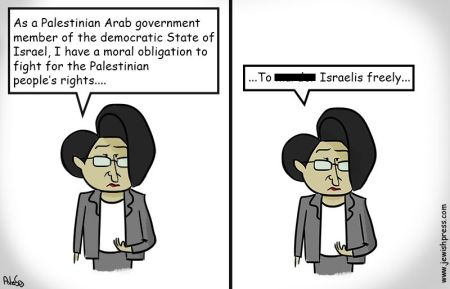
Arab MK loyalty