Posted tagged ‘Israel’

UN, Obama Further Radicalize Palestinians

December 29, 2016

UN, Obama Further Radicalize Palestinians, Gatestone InstituteKhaled Abu Toameh, December 29, 2016

Last week’s UN Security Council resolution sent the following message to the Palestinians: Forget about negotiating with Israel. Just pressure the international community to force Israel to comply with the resolution and surrender up all that you demand.

One thing is certain: Abbas and his Palestinian Authority cronies are not planning to return to the negotiating table with Israel. In fact, they are more belligerent, confrontational and defiant than ever. They have chosen the path of confrontation, and not direct negotiations — to force Israel to its knees.

One of Abbas’s close associates, Mohamed Shtayyeh, hinted that the resolution should be regarded as a green light not only to boycott Israel, but also to use violence against it. He said that this is the time to “bolster the popular resistance” against Israel. “Popular resistance” is code for throwing stones and firebombs, and carrying out stabbing and car-ramming attacks against Israelis.

The resolution has also encouraged the Palestinians to pursue their narrative that Jews have no historical, religious or emotional attachment to Jerusalem or any other part of Israel.

The Gaza-based Hamas and Islamic Jihad see the resolution as another step toward their goal of replacing Israel with an Islamic empire, and to “liberate all of Palestine.” When Hamas talks about “resistance,” it means suicide bombings and rockets against Israel — it does not believe in “light” terrorism such as stones and stabbings against Jews.

The UN’s highly touted “victory,” is a purely Pyrrhic one, in fact a true defeat to the peace process and to the few Arabs and Muslims who still believe in the possibility of coexistence with Israel.

The resolution has encouraged the Palestinians to move toward a diplomatic confrontation with Israel in the international arena, as well as increased terror attacks against Israel’s people — a harmful legacy of the Obama Administration.


Buoyed by the latest United Nations Security Council resolution condemning Israeli settlements as illegal, Palestinian leaders are now threatening to step up their diplomatic warfare against Israel — a move that is sure to sabotage any future effort to revive the moribund peace process. Other Palestinians, meanwhile, view the resolution as license to escalate “resistance” attacks on Israel. By “resistance,” of course, they mean terror attacks against Israel.

The UNSC resolution sent the following message to the Palestinians: Forget about negotiating with Israel. Just pressure the international community to force Israel to comply with the resolution and surrender up all that you demand.

Meanwhile, the Palestinians are not wasting any time by waiting for the international community to act against Israel on their behalf. Rather, they are thinking of ways of taking advantage of the UNSC vote to promote their campaign to isolate and delegitimize Israel, especially in the international arena. One thing is certain: Abbas and his PA cronies are not plotting to return to the negotiating table with Israel. In fact, they are more belligerent, confrontational and defiant than ever.

In the days following the UNSC vote, the voices emerging from Ramallah and the Gaza Strip clearly indicate that Palestinians have put themselves on a collision course with Israel. This bodes badly for any peace process.

Earlier this week, Abbas convened the PLO Executive Committee — a decision-making body dominated by his loyalists — to discuss the implications of the new resolution. The declared purpose of the meeting: to discuss the decisions and strategy that the Palestinian leadership needs to take in the aftermath of the resolution.

The decisions announced following the PLO meeting are a clear sign of the new approach that Abbas and the Palestinian leadership have endorsed. The Palestinian leaders have chosen the path of confrontation, and not direct negotiations, with Israel. They see the UNSC resolution, particularly the US abstention, as a charge sheet against Israel that is to be leveraged in their diplomatic effort to force Israel to its knees.

The PLO decisions include, among other things, an appeal to the International Criminal Court (ICC) to launch an “immediate judicial investigation into Israeli colonial settlements on the land of the independent State of Palestine.” Another decision envisages asking Switzerland to convene a meeting to look into ways of forcing Israel to apply the Fourth Geneva Convention to the West Bank, Gaza Strip and East Jerusalem. The Geneva Convention, adopted in 1949, defines “humanitarian protections for civilians in a war zone.”

The appeal to the ICC and Switzerland is part of Abbas’s strategy to “internationalize” the conflict with Israel by involving as many parties as possible. In this context, Abbas is hoping that the UNSC resolution will ensure the “success” of the upcoming French-initiated Middle East peace conference, which is slated to convene in Paris next month. For Abbas, the conference is another tool to isolate Israel in the international community, and depict it as a country that rejects peace with its Arab neighbors.

In addition, Abbas and his lieutenants in Ramallah are now seeking to exploit the UNSC resolution to promote boycotts, divestment and sanctions against Israel. “The PLO Executive Committee renews its call to the world countries for a comprehensive and full boycott of Israeli colonialist settlements in all fields, as well as all companies working in or dealing with these settlements.” One of Abbas’s close associates, Mohamed Shtayyeh, hinted that the UNSC resolution should be regarded as a green light not only to boycott Israel, but also to use violence against it. He said that this is the time to “bolster the popular resistance” against Israel. “Popular resistance” is code for throwing stones and petrol bombs and carrying out stabbing and car-ramming attacks against Israelis.

The UNSC resolution has also encouraged the Palestinians to pursue their narrative that Jews have no historical, religious or emotional attachment to Jerusalem or any other part of Israel. Sheikh Ekrimah Sabri, a leading Palestinian Islamic cleric and preacher at the Al-Aqsa Mosque, was quick to declare that the Western Wall, the holiest Jewish site in Jerusalem, belongs only to Muslims. Referring to the wall by its Islamic name, Sheikh Sabri announced: “The Al-Buraq Wall is the western wall of the Al-Aqsa Mosque and Muslims cannot give it up.”

So while Abbas and his Palestinian Authority consider the UNSC resolution a license to proceed with their diplomatic warfare to delegitimize and isolate Israel, Hamas and Islamic Jihad, the two groups that seek the elimination of Israel, are also celebrating. The two Gaza-based groups see the resolution as another step toward achieving their goal of replacing Israel with an Islamic empire. Leaders and spokesmen of Hamas and Islamic Jihad were among the first Palestinians to heap praise on the UNSC members who voted in favor of the resolution. They are also openly stating that the resolution authorizes them to step up the “resistance” against Israel in order to “liberate all of Palestine.”

“Resistance is the only means to end the settlements,” said a Hamas spokesman in the Gaza Strip. “We appreciate the position of those countries that voted against settlements.” He also seized the opportunity to renew Hamas’s demand that the Palestinian Authority stop all forms of cooperation with Israel, first and foremost security coordination.

When Hamas talks about “resistance,” it means launching suicide bombings and rockets against Israel. The Islamist movement does not believe in “light” terrorism such as stones and knife stabbings against Jews.

Hamas leader Khaled Mashaal, who is based in Qatar, reacted to the UNSC vote by saying that the world should now support his movement’s terror campaign against Israel. “We want the world to stand with the Palestinian resistance because it is just,” he said. “The armed resistance is the path to liberate Palestine and Jerusalem. Hamas is continuing to manufacture and smuggle weapons in preparation for a confrontation with Israel.” Mashaal did not forget to praise the US Administration’s abstention as a “correction of some American policies.”

Islamic Jihad, for its part, characterized the UNSC resolution as a “victory” for the Palestinians because it enables them to “isolate and boycott Israel” and file charges against it with international institutions. Daoud Shehab, one of the leaders of Islamic Jihad, added that the resolution means that Arabs should stop any effort to “normalize” relations with Israel or conduct security cooperation with it. The Arabs and Muslims should now work toward confronting and deterring Israel, he said.

Clearly, Hamas and Islamic Jihad see the UNSC resolution as a warning to all Arabs and Muslims against seeking any form of “normalization” with Israel. The two groups are referring to the Palestinian Authority, whose security forces continue to conduct security coordination with Israel in the West Bank, and to those Arab countries that have been rumored to be moving toward some form of rapprochement with Israel. The UN’s highly touted “victory,” is a purely Pyrrhic one, in fact a true defeat to the peace process and to the few Arabs and Muslims who still believe in the possibility of coexistence with Israel.

Thus, the UNSC resolution already has had several consequences, none of which will enhance peace between Israelis and Palestinians. Apart from giving a green light to Palestinian groups that wish to destroy Israel, the resolution has prompted Abbas and the Palestinian Authority to toughen their stance, and appear to be more radical than the radicals. Far from moving the region toward peace, the resolution has encouraged the Palestinians to move forward in two parallel paths – one toward a diplomatic confrontation with Israel in the international arena, and the other in increased terror attacks against its people. The coming weeks and months will witness mounting violence on the part of Palestinians toward Israelis – a harmful legacy of the Obama Administration.

Kerry’s Speech on Middle East is Unacceptable. . .to the Palestinians

December 29, 2016

Kerry’s Speech on Middle East is Unacceptable. . .to the Palestinians, Power LinePaul Mirengoff, December 28, 2016

Today, John Kerry delivered his “much anticipated” (by the media) oration on the Middle East. It was long and it was timeworn. Herb Keinon of the Jerusalem Post reports:

What a tired-looking, hoarse Kerry did for more than an hour was pretty much compile the “greatest hits” from numerous speeches he and US President Barack Obama have given over the last number of years on the Mideast.

He talked about the detrimental effects of the settlements; how Israel needs to chose whether it wants two states or one state, meaning it can either be a Jewish state or a democratic one, but not both; and how the settlements are making a two state-solution impossible.

All of this has been said multiple times before by the Administration, no surprises there.

A good part of the speech, however, was devoted to defending the US’ abstention at the UN last week – a sign that the harsh criticism by Prime Minister Benjamin Netanyahu’s, ambassador to the US Ron Dermer and other government ministers had unnerved him a bit.

That last sentence may be giving Kerry too much credit. He seems incapable of being unnerved — not by repeated humiliation by Russia, not by the carnage in Aleppo, and not by earning Israel’s lasting enmity. It’s impossible to take this man seriously.

Keinon argues that, contrary to Kerry’s central assertion, there are alternatives between a one-state and a two-state solution. John Bolton has made the same argument.

But if Kerry is right, the Palestinian reaction to Kerry’s speech confirms that in the foreseeable future there can only by a one-state solution — the solution that’s in place now and is serving Israel rather nicely, thank you.

Mustafa Barghouti of the PLO executive committee delivered the Palestinian reaction. He stated flatly that the Palestinian leadership cannot accept the parameters of Kerry’s proposed two-state solution. Barghouti explained that Kerry’s principles pertaining to refugees, recognition of the Jewish state, and Jerusalem are “unacceptable.”

First, said Barghouti, “you cannot make the issue of Palestinian refugees only an issue of compensation; you cannot deny people their right to return to their home.” This was in response to Kerry’s statement that most refugees will not return to their historic homes, e.g., in Tel Aviv and Haifa, and instead should receive compensation.

“Second,” he added, “recognition of Israel as a Jewish state would deny the right of the Palestinian people who are citizens of Israel and that is totally unacceptable.” In other words, the solution must be one state, not two states.

So that’s that — and has been for decade upon decade.

John Kerry’s speech on Israel: delusional and disgraceful

December 29, 2016

John Kerry’s speech on Israel: delusional and disgraceful | Anne’s Opinions, 29th December 2016


John Kerry delivers his speech on Israel and the peace process at the State Dept. on 28 Dec. 2016

John Kerry delivers his speech on Israel and the peace process at the State Dept. on 28 Dec. 2016

The Obama Administration’s “January surprise” took its next steps today with John Kerry’s absurd and outrageous speech on Israel, in which he claimed to lay out his vision of Middle East peace but which in practice was simply a screed attacking the settlements as he accused the Israeli government of being led by the most extreme elements:

US secretary of state John Kerry on Wednesday laid out his “comprehensive vision” for the future of Middle East peacemaking, saying that a two-state solution was the “only way to ensure Israel’s future as a Jewish and democratic state,” but promising that the US would not seek further UN action on the conflict.

Can we trust him and his boss on that promise that they won’t seek further UN action? I’m not willing to bet on it.

In a speech that lasted well over an hour, Kerry described settlements as a central obstacle to achieving an agreement between the sides and declared that Israeli actions in the West Bank were putting the two-state solution, which he said was the sole path to peace, “in serious jeopardy.”

Kerry argued that settlement construction in the West Bank was being “strategically placed in locations that make two states impossible” and said the “the status quo is leading toward one state, or perpetual occupation.”

Settlement expansion, he declared, “has nothing to do with Israel’s security.”

Castigating the coalition of Prime Minister Benjamin Netanyahu, he said it was “the most right-wing in Israel history with an agenda driven by the most extreme elements. The result is that policies of this government, which the prime minister himself just described as more committed to settlements than any in Israel’s history, are leading … towards one state. In fact,” he added, “Israel has increasingly consolidated control over much of the West Bank for its own purposes.

With less than a month as secretary of state, Kerry sought to champion the two-state outcome he worked to achieve throughout the last four years, saying it was the only path forward. Incoming president Donald Trump has signaled he may not be committed to the two-state framework.

He rambled on in this vein for the rest of his speech. You can read more at the link, and the entire text is here.

What is much more worthwhile is to watch and listen to Netanyahu’s blistering counter-attack:

David Horovitz of the Times of Israel blasted Kerry, saying that he did everything but call Israel apartheid.

About half an hour into John Kerry’s valedictory lecture from the State Department on Wednesday evening, Israel’s most popular television station, Channel 2, stopped broadcasting it live and switched to other programming. The country’s two other main TV stations, Channels 1 and 10, had already electronically left the building. Given that Kerry’s anti-settlement and anti-occupation address was primarily directed at the Israeli public, the ratings-conscious schedulers’ impatient transition to other material rather encapsulates the climate in which the secretary’s extensive remarks were being received here.

Many in the Israel of 2016 would share some of the arguments they largely didn’t hear Kerry deliver on Wednesday evening. Many recognize the dangers of being permanently intertwined with millions of hostile Palestinians, and fear that the expansion especially of those settlements and outposts that lie to the east of the security barrier increases that risk, and thus puts a two-state solution in danger, threatening Israel’s Jewish character, or its democracy, or both. Kerry’s was a fiery critique, indeed, marked by the allegation that the settlement movement is driving the agenda of the Israeli government, and that Netanyahu has been allowing some of the most extreme voices to draw Israel closer to the Zionist nightmare of a single bi-national state between the Mediterranean Sea and the Jordan River. Just about the only charge Kerry didn’t lob, this time, was apartheid.

But the secretary and his president long ago lost much of the Israeli public, even many of the settlement critics, by underestimating the depth of Palestinian opposition to the very fact of the Jewish state’s existence. The president and his secretary have underestimated, too, the consequent scarring — physical and psychological — that the Israeli public has accumulated over decades of war, terrorism, and demonization as the Palestinians and those who championed their cause have sought Israel’s obliteration.

… He mentioned terrorism and incitement. But the Obama administration never truly internalized the impact of these endless decades fighting off attempted destruction. And Kerry has self-evidently never been willing to internalize that in the vicious Middle East of the past few years, talking up the possibility of relinquishing control over adjacent West Bank history — with its recent history of suicide bomb factories, with Hamas angling to take control, with a hostile Iran emboldened to the east by the Obama Administration’s own nuclear deal — is just that for most Israelis: talk.

We left south Lebanon. Hezbollah took over. We left Gaza. Now it’s ruled by Hamas. When the secretary expresses his “total confidence” that Israel’s security requirements in the West Bank can be met via sophisticated multi-layered border defenses and such, he quite simply loses Israel.

We left south Lebanon. Hezbollah took over. We left Gaza. Now it’s ruled by Hamas. When the secretary expresses his “total confidence” that Israel’s security requirements in the West Bank can be met via sophisticated multi-layered border defenses and such, he quite simply loses Israel.

He would have had more chance of success — or at least of creating a climate in which prospects of progress would be brighter — had he focused more of his attentions on the toxic climate among Palestinians. They are relentlessly educated on the illegitimacy of Israel, with that narrative hammered home over social media, by their political and spiritual leadership, sometimes in their schools. He never strategically attempted to tackle that process of indoctrination.

Easier to place overwhelming blame on the settlers rather than the Palestinians. Or, heaven forbid, on yourself.

Herb Keinon at the Jerusalem Post had similar harsh criticisms of Kerry’s viewpoint:

Long, and without many new elements in it. What a tired-looking, hoarse Kerry did for more than an hour was pretty much compile the “greatest hits” from numerous speeches he and US President Barack Obama have given over the last number of years on the Mideast.

Nevertheless, two elements of the speech were striking.

The first was the insistence that the only solution to the conflict is either two-states, or one. This is the mantra that has been repeated for so long, that it has become axiomatic. But it also drowns out any possibility of creatively looking at other options, a different way.

If the efforts to negotiate two states has failed for so long, perhaps it is time to consider whether there may be other options that might bring Egypt and Jordan into the equation. Perhaps what is needed is a reassessment of all the the assumptions over the last 23 years that have ended in the current stalemate — first and foremost that the only option is two states from the Mediterranean to the Jordan River.

For instance, in 2010 former National Security Council Giora Eiland spelled out a plan for a Jordanian-Palestinian federation, in which the West Bank and Gaza would be states in an expanded Jordanian kingdom.

Another idea would see the establishment of a Palestinian state, but it would be based on land swaps between Egypt, Israel and a future Palestinian entity that would significantly expand the size of Gaza, allow Israel to retain a good percentage of the the West Bank, and provide Egypt with a land link to Jordan.

These ideas are too often dismissed as unrealistic, something that the Palestinians would never accept. Kerry reinforces that way of thinking with his stating as truth that it is either two states or one state.

The Kerry speech was also telling in that it included a call for Israel to withdraw from the territories and uproot settlements. This is a demand for Israel to make huge compromises. There was, however, no comparable demand for compromise on the Palestinian side.

Kerry called, and says that the US has done so on innumerable occasions, for the Palestinians to stop the terrorism and the incitement, and to build up good governing institutions. But those are not compromises.

A Palestinian compromise would be to recognize that — given everything going on in the Middle East — Israel must retain security control of the Jordan Valley. A compromise would be for the Palestinians to state that they are giving up on the “right of return,” and that they recognize Israel as the homeland of the Jewish state.

Keinon’s conclusion was absolutely spot-on:

Throughout his career, both in the senate and as secretary of state, Kerry’s speeches on Israel give the listener a sense that he knows what is better for Israel, its future, and security than the Israelis themselves. His speech Wednesday night was true to that rather patronizing form.

The reactions to Kerry’s speech in the United States were similarly scathing. First we have the heart-warming supportive statement from President-elect Donald Trump:

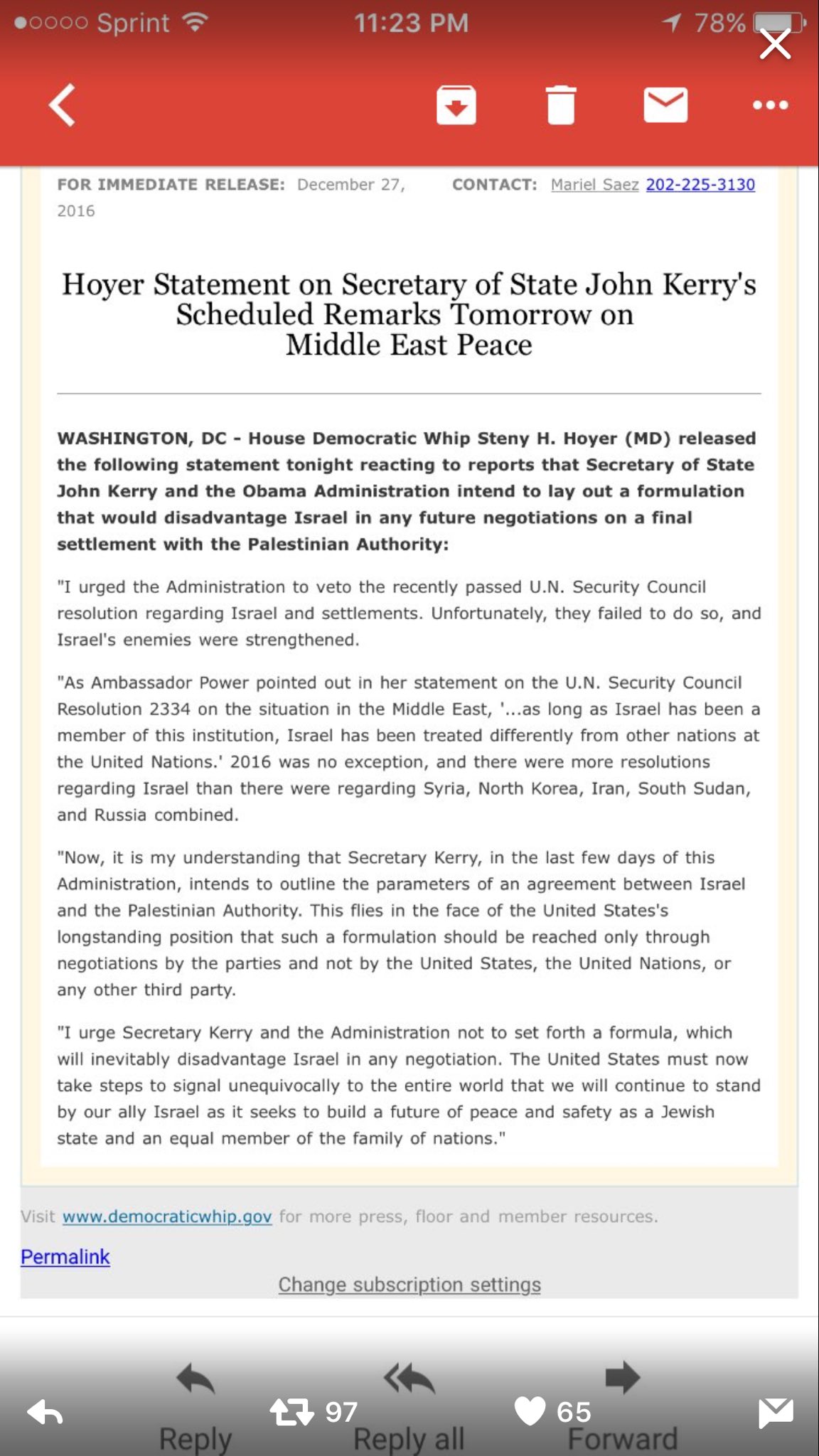
But it’s not only the Republicans who have rejected the Obama regime’s direction. Below is the statement by the House Democratic Whip Steny Hoyer:

Steny Hoyer's reaction

Steny Hoyer’s reaction


Thank you for your support, Mr. Hoyer. You are on the right path towards restoring Israelis’ and Jews’ trust in the Democratic Party.

Here is a selection of other reactions via Twitter:

https://twitter.com/NoahPollak/status/814148546387591169

https://twitter.com/AnneBayefsky/status/814162426711117824

https://twitter.com/VictorShikhman/status/814168167740309505

And one final tweet which includes a map that encapsulates the entire Middle East problem, and at the same time clearly demonstrates Kerry’s (and his boss’s) blindness when it comes to Israel:


Obama and Kerry want Israel to make “peace” with Palestinians for a two state solution

December 28, 2016

How can Israel do that when the Palestinian Authority and Hamas teach children to hate and kill Israeli Jews?


Kerry: “Israel can either be Jewish or democratic. It cannot be both. And it won’t ever really be at peace.”

December 28, 2016

Kerry: “Israel can either be Jewish or democratic. It cannot be both. And it won’t ever really be at peace.” Jihad Watch

The Obama administration’s parting assault on Israel continues.

Kerry is actually right that Israel won’t ever really be at peace, but if he thinks that a two-state solution will bring about that peace, then he is even more delusional than he seems to be. Israel will not be at peace as long as there are believers in the Qur’an, which tells Muslims, “drive them out from where they drove you out” (2:191).

Meanwhile, Kerry’s statement about Israel not being able to be Jewish and democratic is flatly false. There are Israeli Arab Knesset members now. Non-Jews in Israel, including Muslims, enjoy more rights than non-Muslims do in majority-Muslim countries.

john-kerry-state-department-ap-john-dharapak_0

“Kerry: ‘Israel Can Either Be Jewish or Democratic — It Cannot Be Both,’” Grabien News, December 28, 2016:

…”The truth is that trends on the ground, violence, terrorism, settlement expansion and the seemingly endless occupation, they are combining to destroy hopes for peace on both sides and increasingly cementing any reversible — an irreversible one state reality that most people do not actually want.

Today, there are a similar number of Jews and Palestinians living between the Jordan river and the Mediterranean sea. They have a choice. They can choose to live together in one state or they can separate into two states. But here is a fundamental reality. If the choice is one state, Israel can either be Jewish or democratic. It cannot be both. And it won’t ever really be at peace.

Moreover, the Palestinians will never fully realize their vast potential in a homeland of their own with a one state solution.”

LIVE: US Secretary of State to deliver speech on Middle East peace

December 28, 2016

LIVE: US Secretary of State to deliver speech on Middle East peace via YouTube, December 28, 2016

Analysis:The dangers of UN Security Council Resolution 2334 (2016)

December 28, 2016

Analysis: The dangers of UN Security Council Resolution 2334 (2016), Israel National News, Amb. Alan Bake, December 28, 2016

The resolution cannot, in and of itself, serve as grounds for legal proceedings in the International Criminal Court (ICC) or other international tribunals. But clearly, it will be used by the Palestinian leadership as a political tool to buttress existing complaints. This despite the fact that the issues of Palestinian status vis-à-vis the ICC and the court’s jurisdiction regarding the territories have yet to be reviewed juridically. The fact that the ICC Prosecutor has recognized the accession of “the State of Palestine” to the ICC Statute and has accepted their complaints are political decisions.

****************************

The resolution does not make law, and as such, the determinations as to the lack of legal validity of Israel’s settlements are no more than declaratory, but they are a major impediment to negotiations.

The December 23, 2016, resolution adopted by the UN Security Council regarding Israel’s settlement policy has been received with mixed and even extreme reactions.  [Click to read the text of UN Security Council Resolution 2334]

The Palestinian leadership, having initiated the resolution, is celebrating its adoption as an affirmation by the international community, including the United States, of its claims against Israel.

Israel sees this resolution as a major impediment to continued peace negotiations in light of the fact that it by-passes the negotiation process in an attempt to prejudge central issues that are on the negotiating table. As such, it seriously prejudices any possible return to the negotiating process.

Israel considers that the resolution provides political incentives to those in the international community hostile to Israel. It advances boycotts and sanctions and could even be used to support possible litigation against Israeli leaders.

Summary of Implications

Following is a brief summary of the legal and quasi-legal implications of the resolution:

The resolution (as all previous resolutions regarding Israel) was adopted under the sixth chapter of the UN Charter (Pacific Settlement of Disputes) and as such is not mandatory. It contains a series of political determinations and recommendations to the international community. The resolution does not make law, and as such, the determinations as to the lack of legal validity of Israel’s settlements are no more than declaratory.

Much of the terminology repeats UN terminology and language used in previous Security Council and General Assembly resolutions (“inadmissibility of acquisition of territory by force,” “Palestinian territory occupied since 1967 including East Jerusalem,” “secure and recognized borders,” “violation (serious or flagrant) under international law,” the references to the lack of legal validity of settlements, and their being an “obstacle” or “major obstacle” to achieving a two-state solution).

References in the tenth preambular paragraph to the fact that “the status quo is not sustainable” and “entrenching a one-state reality” are new and would appear to be inspired by, or even direct quotes from statements by President Obama, Secretary of State Kerry, and Vice President Biden. Similarly, expressions not previously included in major Security Council resolutions regarding the peace process, such as “two-state solution based on the 1967 lines” (operative paragraph seven), as well as the references in the ninth paragraph to the “Arab Peace Initiative” and the “principle of land for peace” as additional bases for peace, clearly are intended to instill concepts that have never been agreed-upon elements in the negotiating process.

The call upon states in the fifth operative paragraph to distinguish between dealings between Israel-proper and the territories will also be used by BDS activists and states to buttress their boycott campaigns.

The reference in the third operative paragraph to the “4 June 1967 lines” as a basis for negotiations would appear to be a new element, echoing statements by Obama and Kerry, and running counter to the 1967 Security Council resolution 242, which is the basis for all of the Arab-Israeli peace process, which calls for negotiation of “secure and recognized boundaries.” The Israeli-Palestinian Oslo Accords make no specific reference to the 1967 lines. As such this reference would appear to be an attempt to prejudge or unduly influence the negotiating issue of borders.

Despite the declaratory and recommendatory determinations in the resolution attempting to prejudge the status of the territories, east Jerusalem, borders, and settlements, the resolution nevertheless would appear to contradict itself in that it goes on to reaffirm the call for negotiations on “all final status issues” (operative paragraph eight) and for “a comprehensive, just and lasting peace.”

Analysis

While the resolution does not replace Security Council Resolution 242, which is the accepted and agreed basis for the Israel-Arab peace process, it nevertheless contains elements that attempt to modify Resolution 242 and to sway the negotiating process in a particular direction.

The resolution cannot, in and of itself, serve as grounds for legal proceedings in the International Criminal Court (ICC) or other international tribunals. But clearly, it will be used by the Palestinian leadership as a political tool to buttress existing complaints. This despite the fact that the issues of Palestinian status vis-à-vis the ICC and the court’s jurisdiction regarding the territories have yet to be reviewed juridically. The fact that the ICC Prosecutor has recognized the accession of “the State of Palestine” to the ICC Statute and has accepted their complaints are political decisions.

The United States, through its decision not to veto the resolution, enabled acceptance of a Security Council resolution referring to “occupied Palestinian territory including East Jerusalem.” This indicates U.S. acceptance of the fact that the territories and east Jerusalem belong to the Palestinians. This despite the claim that the United States has consistently agreed with Israel that there has never been any legal determination, agreement, treaty, or other binding source determining that.

This represents a serious, and even irresponsible departure from U.S. policy which has consistently advocated negotiated settlement of the issues of permanent status, Jerusalem, and borders. This position taken by the United States (as well as the other members of the Security Council) also undermines the basic obligation of the Oslo Accords, signed by the PLO and witnessed by the United States (as well as the EU, Russia, Egypt and others), that the permanent status of the territories, the issues of Jerusalem, and borders are to be negotiated.

While the United States and Israel have entertained basic disagreements on settlement policy, the United States has consistently rejected, as a matter of basic policy, any attempt by the international community to prejudge this or the other permanent status negotiating issues.

The outrage voiced by Israel with both the resolution itself and the Obama administration’s enabling it to pass stems from five basic components:

  • The text of the resolution, which is unprecedented in the extent of the condemnatory language used.
  • Israel’s frustration at the irresponsible behavior by the Obama administration.
  • The evident irreversibility of the resolution and the potential for future damage.
  • The imbalance between accusations of Israeli violations of the Oslo Accords and the Palestinians’ blatant violations of international law in their incitement and payment to terrorists.
  • The issue of settlements is not the core of the conflict. It remains the Palestinians’ refusal to recognize the Jewish State and its right to any part of the land west of the Jordan River.

Congress Moving to Cut U.S. Funding to U.N. in Wake of Anti-Israel Vote

December 28, 2016

Congress Moving to Cut U.S. Funding to U.N. in Wake of Anti-Israel Vote, Washington Free Beacon, , December 28, 2016

While the Trump administration will not take office until the end of January, Congress will be working overtime before then to stop the Obama administration from further damaging the U.S.-Israel relationship, according to the source, who hinted that a full cut-off of U.S. funding to the U.N. currently is on the table.

********************************

Congress is already setting the stage to cut off U.S. funding to the United Nations in the wake of a contested vote last week in which the Obama administration permitted an anti-Israel resolution to win overwhelming approval, according to congressional leaders, who told the Washington Free Beacon that the current administration is already plotting to take further action against the Jewish state before vacating office.

Other punitive actions by Congress could include expelling Palestinian diplomats from U.S. soil and scaling back ties with foreign nations that voted in favor of the controversial measure, according to multiple sources who spoke to the Free Beacon about the situation both on and off the record.

The Obama administration is still under bipartisan attack for its decision to help craft and facilitate the passage of a U.N. resolution condemning the construction of Jewish homes in Jerusalem, a move that reversed years of U.S. policy on the matter.

The Free Beacon was the first to disclose on Monday that senior Obama administration officials played a key role in ensuring the measure was passed unanimously by the U.N. Security Council. This included a phone call by Vice President Joe Biden to Ukraine’s president to ensure that country voted in favor of the measure.

While Biden’s office continues to dispute the claim, reporters in Israel and Europe confirmed in the intervening days that the call between Biden and Ukrainian President Petro Poroshenko did in fact take place.

With anger over the issue still roiling, leading members of Congress told the Free Beacon on Wednesday that they will not delay in seeking retribution against the U.N. for the vote. This could include cutting off U.S. funding for the U.N. and stripping the Palestinian mission’s diplomatic privileges.

Lawmakers also will work to rebuff further attempts by the Obama administration to chastise Israel on the international stage. This would include freezing funds that could be spent by the administration on further U.N. action.

“The disgraceful anti-Israel resolution passed by the UNSC was apparently only the opening salvo in the Obama administration’s final assault on Israel,” Sen. Ted Cruz (R., Texas) told the Free Beacon. “President Obama, Secretary Kerry, Ambassador Power, and their colleagues should remember that the United States Congress reconvenes on January 3rd, and under the Constitution we control the taxpayer funds they would use for their anti-Israel initiatives.”

“The 115th Congress must stop the current administration’s vicious attack on our great ally Israel, and address the major priorities of the incoming administration,” Cruz said, expressing his desire to work with the incoming Trump administration to reset the U.S. relationship with Israel.< Senior congressional sources currently working on the issue further disclosed to the Free Beacon that lawmakers on both sides of the aisle are in an uproar over the Obama administration, which they accuse of plotting behind closed doors to smear Israel.

“Not content with spending the last eight years using the United Nations to undermine American sovereignty, the Obama administration has finally trained their sights on Israel and is trying to exploit this unelected and unaccountable international body to impose their resolution of the Palestinian issue on Israel,” one senior congressional aide told the Free Beacon. “Enough is enough.”

While the Trump administration will not take office until the end of January, Congress will be working overtime before then to stop the Obama administration from further damaging the U.S.-Israel relationship, according to the source, who hinted that a full cut-off of U.S. funding to the U.N. currently is on the table.

“A new administration will arrive on January 20th, but in the intervening weeks Congress has an important role mitigating the damage President Obama can do in his final hours,” the source said. “Why on earth would we throw good taxpayer dollars after bad in support of the UN, which has proven itself again and again utterly unable to encourage any positive progress? Just take Syria — if they were doing anything over the last five years, it should have been working out a fair and equitable adjudication of the Syrian war.”

“Instead, they’ve proven themselves utterly useless–in fact they’ve probably made a gut-wrenching catastrophe worse,” the source explained. “There’s no reason to think this action will turn out any more favorably.”

A second senior congressional aide working on a package of repercussions expressed fear that the U.N. vote was just the first salvo targeting Israel.

“The question now is whether this was the finale or the prologue of what this administration has planned against Israel,” the source said, adding that “everything is on the table right now — including funding cuts and scaling back diplomatic relations with countries that brought forward this resolution.”

A similar list of punitive actions was confirmed by multiple congressional sources who spoke to the Free Beacon about the matter. The sources were granted anonymity so they could speak freely.

“Obama went to the U.N. because a U.N. resolution is functionally irreversible by normal means,” added a veteran foreign policy insider who is currently working with the incoming Trump administration. “Obama’s goal was to eliminate any limited options that could be used to repair the damage to Israel, and he gambled that Trump and Congress would be too intimidated to use the remaining big stick options. He’s going to lose that gamble.”

“American leaders will now use exactly those options,” the source explained. “Everything is on the table, from systematically going after the U.N., to moving the U.S. embassy into parts of Jerusalem the U.N. says aren’t Israeli, to kicking the Palestinians out of Washington.”

“Members on both sides of the aisle are furious, so our response will be swift and forceful,” the second congressional source said. “With a Trump administration in place, any nation that seeks to delegitimize the Jewish state will need to answer to the United States.”

The UN resolution on Israel

December 28, 2016

The UN resolution on Israel, Israel Hayom, Elliott Abrams, December 28, 2016

Since the adoption last week of the Security Council resolution on Israel, I’ve had my say in ‎The Weekly Standard and The Washington Post condemning the Obama administration’s ‎decision to allow the resolution to pass.

The resolution rewards the Palestine Liberation Organization for refusing to ‎negotiate and adopts its tactic of replacing serious, face-to-face negotiations with useless ‎dramas in New York. It is a danger to Israel. And by refusing to veto the resolution, the Obama ‎administration abandoned the usual American practice of defending Israel from what ‎former U.S. Ambassador to the U.N. Jeane Kirkpatrick called “the jackals” at the United Nations.‎

Over this past weekend, administration spokesmen have tried to defend this abandonment ‎of Israel in truly Orwellian terms, inverting the meaning of their action. This was done to ‎”help” Israel and to “defend” it; we know better than its ‎elected government (and main opposition parties) where its interests lie; we abandoned Israel because we are its ‎friend.‎

These were main themes of the president’s aide Ben Rhodes when he spoke to reporters ‎Friday, saying the resolution “expresses the consensus international view on Israeli settlement ‎activity. … This is consistent with long-standing bipartisan U.S. policy as it relates to ‎settlements. … One of our grave concerns is that the continued pace of settlement activity, ‎which has accelerated in recent years, which has accelerated significantly since 2011. … ‎

“Let’s be clear here: We exhausted every effort to pursue a two-state solution through ‎negotiations, through direct discussions, through proximity discussions, through ‎confidence-building measures, through a lengthy and exhaustive effort undertaken by ‎Secretary [of State John] Kerry earlier in the president’s second term. We gave every effort that we could ‎to supporting the parties coming to the table.‎

“So within the absence of any meaningful peace process, as well as in the face of accelerated ‎settlement activity that put at risk the viability of a two-state solution, that we took the ‎decision that we did today to abstain on this resolution.‎

“Where is the evidence that not doing this is slowing the settlement construction?‎”

Those who enjoy the children’s exercise where the child is asked to find all the things wrong in ‎a picture — signs upside down, dogs with horns, etc. — will enjoy pondering Rhodes’ ‎misleading narrative.‎

Yes, the resolution “expresses the consensus international view on Israeli settlement ‎activity,” and calls them illegal, and that is the point: Until the Obama administration, the ‎United States’ position was that they were unhelpful but not illegal. Therefore, the ‎resolution is not “consistent with long-standing bipartisan U.S. policy.”‎

As to the pace of settlement activity, Rhodes is simply wrong. I reviewed the ‎statistics in Foreign Policy and there Uri Sadot and I concluded that‎: “A careful look into the numbers shows that neither the population balance between Jews ‎and Palestinians, nor the options for partition in the West Bank have materially ‎changed. … Israeli population in the settlements is growing, but at a rate that reflects mostly ‎births in families already there, and not in-migration of new settlers.‎”

In fact, settlement growth has not “accelerated significantly” since 2011, whatever ‎Rhodes says.‎

His most disingenuous remark is about the failure of negotiations. Indeed, the ‎Obama/Kerry efforts failed because the Palestinians refused to come to the table even ‎when Israel undertook a 10-month construction freeze. One of President Barack Obama’s officials, ‎Martin Indyk, was described in Haaretz as saying this in 2014 about those negotiations:‎ ‎”Netanyahu moved to the zone of possible agreement. I saw him sweating bullets to find a ‎way to reach an agreement.”

Indyk continued that Palestinian Authority President Mahmoud Abbas did not show flexibility.

“We tried to get Abu Mazen [Abbas] to the zone of possible agreement but we were ‎surprised to learn he had shut down,”‎ Indyk said.

So what is to be done when the Palestinians refuse to negotiate? Punish Israel. Join the ‎jackals in Turtle Bay. Adopt the PLO view that action in the United Nations will replace face-‎to-face talks. That was Obama’s decision.‎

Rhodes’ twisted formulation of “where is the evidence that not doing this is slowing the ‎settlement construction?” is a kind of epitaph for Obama policy. He said: “We have a ‎body of evidence to assess how this Israeli government has responded to us not taking this ‎kind of action, and that suggests that they will continue to accelerate the type of settlement ‎construction that puts a two-state solution at risk.”

Settlements expand if we veto ‎resolutions, he is saying, so we have decided not to veto resolutions.‎

This is precisely wrong, an inversion of the truth. The Obama account of settlement ‎expansion is invented and avoids the facts to build a case against Israel. Netanyahu is not ‎popular among settlers exactly because he has restrained settlement growth and ‎adopted a 10-month freeze. In 2009, Hillary Clinton said, “What the prime minister has ‎offered in specifics on restraints on a policy of settlements … is unprecedented.” What has ‎been the Obama reaction to his restraint, to his freeze, to the PLO refusal to negotiate?‎

The reaction has been to blame Israel and assault Netanyahu year after year, including with ‎childish epithets. And this attitude culminated finally in the abandonment of Israel at the ‎United Nations. Supporters of strong Israel-American relations can only be glad that the ‎‎22nd Amendment limits presidents to two terms in the White House.‎

Transcript claims to show US worked with Palestinians on UN resolution

December 28, 2016

Transcript claims to show US worked with Palestinians on UN resolution, Times of Israel, December 27, 2016

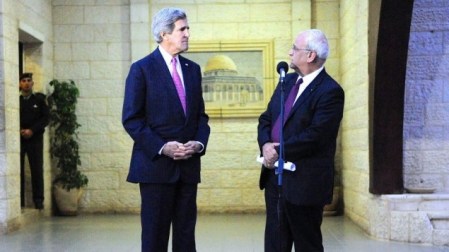
kerryandpalPalestinian Authority lead negotiator Saeb Erekat, right, and US Secretary of State John Kerry in Ramallah, West Bank, on January 4, 2013. (State Department)

Report published in Egypt has Kerry and Rice advising senior Palestinians on strategy at UN and after Trump takes power.

An Egyptian paper published what it claims are the transcripts of meetings between top US and Palestinian officials that, if true, would corroborate Israeli accusations that the Obama administration was behind last week’s UN Security Council resolution condemning Israeli settlements.

An Egyptian paper published what it claims are the transcripts of meetings between top US and Palestinian officials that, if true, would corroborate Israeli accusations that the Obama administration was behind last week’s UN Security Council resolution condemning Israeli settlements.

At the same time, a report in an Israeli daily Tuesday night pointed to Britain helping draft the resolution and high drama in the hours leading up to the vote, as Jerusalem tried to convince New Zealand to bury the Security Council measure.

In a meeting in early December with top Palestinian negotiator Saeb Erekat, US Secretary of State John Kerry told the Palestinians that the US was prepared to cooperate with the Palestinians at the Security council, Israel’s Channel 1 TV said, quoting the Egyptian Al-Youm Al-Sabea newspaper.

Also present at the meeting were US National Security Adviser Susan Rice, and Majed Faraj, director of the Palestinian Authority’s General Intelligence Service.

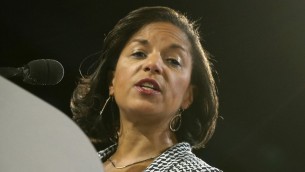
riceniceUS National Security Adviser Susan Rice speaks during the American Israel Public Affairs Committee 2015 Policy Conference, March 2, 2015 in Washington, DC. (photo credit: Mark Wilson/Getty Images/AFP)

Kerry is quoted as saying that he could present his ideas for a final status solution if the Palestinians pledge they will support the proposed framework. The US officials advised the Palestinians to travel to Riyadh to present the plan to Saudi leaders.

Israel fears that Kerry, who is slated to give a speech Wednesday on the subject, will then lay out his comprehensive vision for two-state solution at a Paris peace conference planned for January. Israel has refused to attend. Israel further fears that this Kerry framework could be enshrined in another UN Security Council resolution.

The Egyptian report fits with Israeli claims that it had received “ironclad” information from Arab sources that Washington actively helped craft last week’s UN resolution declaring Israeli settlements illegal.

samanthaSamantha Power, U.S. Ambassador to the United Nations, addresses the United Nations Security Council, after the council voted on condemning Israel’s settlements in the West Bank and East Jerusalem, Friday, Dec. 23, 2016 (Manuel Elias/The United Nations via AP)

Responding to a question about the Al-Youm Al-Sabea report, State Department Spokesman Mark Toner denied that the US discussed the language of the resolution with Erekat or in a meeting with officials from New Zealand.

The Obama administration has denied it was behind the resolution, saying that it only decided not to veto it after reading the final text.

Meanwhile, a report in the daily Haaretz Tuesday cited Western and Israeli officials detailing how Britain, and not the US, worked with the Palestinians to craft the text of the resolution, toning it down to make it palatable enough for Washington to avoid a veto.

“The Israeli diplomats say that from information that reached the Foreign Ministry in Jerusalem, British legal figures and diplomats had been working directly with the Palestinians on the wording of the resolution even before it was distributed by Egypt,” Haaretz said.

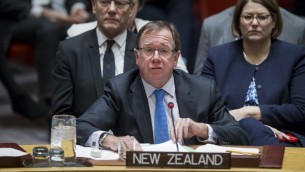
nzdipNew Zealand Foreign Minister Murray McCully addresses a Security Council meeting on the situation in the Middle East on December 16, 2016. (UN/Manuel Elias)

According to Haaretz, in the hours before the resolution went forward, Netanyahu phoned New Zealand Foreign Minister Murray McCully, and warned him that going ahead with the resolution “will be a declaration of war.”

“It will rupture the relations and there will be consequences. We’ll recall our ambassador to Jerusalem,” Netanyahu is reported to have said.

Since the resolution passed, Netanyahu has taken a series of measures against the states that supported the resolutions, minimizing ties with some and calling in their envoys for rebuke.

According to the Egyptian report, the US diplomats expressed their mistrust of Netanyahu, saying he wanted to destroy the two-state solution and was only interested in maintaining the status quo between Israel and the Palestinians.

The transcript showed Kerry and Rice advising the Palestinians not to make any provocative moves when US President-elect Donald Trump takes office on January 20, calling him dangerous.

They warned against such steps as ending security cooperation with Israel, pursuing legal action against Israeli officials in the ICC, or dissolving the Palestinian Authority.

They also said Trump’s administration was likely to adopt a policy on the Israel-Palestinian conflict that would be totally different to that of previous administrations going back to 1967.

mideast-palestinians-_horo-4-305x172In this Friday, Dec. 11, 2015 file photo, Palestinian chief negotiator Saeb Erekat delivers a speech at the Mediterranean Dialogues Conference Forum, in Rome. (AP Photo/Andrew Medichini, File)

When asked how the Palestinians would react if Trump carried out his promise to move the US embassy to Jerusalem, Erekat reportedly said the Palestine Liberation Organization would rescind its recognition of Israel and ask Arab states to expel their US envoys.

Erekat made precisely that threat in a December 19 conference call organized by the Wilson Center policy forum. He said he would immediately resign as the chief Palestinian negotiator, and that “the PLO will revoke its recognition of Israel” as well as all previously signed agreements with Israel. Furthermore, said Erekat, all American embassies in the Arab world would be forced to close — not necessarily because Arab leaderships would want to close them, but because the infuriated public in the Arab world would not “allow” for the embassies to continue to operate.

The Associated Press contributed to this report.