2004 satellite image of the military complex at Parchin, Iran. (AP/DigitalGlobe-Institute for Science and International Security)
WASHINGTON — As top administration officials prepared for what will be their first day of unclassified testimony in Congress Thursday in support of the Iran nuclear deal, a very public row erupted Wednesday over whether the administration could — and would — disclose what some lawmakers called the “secret side deals” of the agreement.
Even as the White House deployed Secretary of State John Kerry and Energy Secretary Ernest Moniz to Capitol Hill for a series of classified briefings Wednesday meant to shore up support for the Iran deal in a dubious legislature, lawmakers demanded more details on agreements reached between the International Atomic Energy Agency (IAEA) and Iran with the consent of the P5+1 group of world powers. Those agreements were not previously revealed to Congress as part of the 60-day review process required under law.
One day after Senator Tom Cotton and Representative Mike Pompeo said that an IAEA official in Vienna had told them about the agreements with Iran, administration officials denied these constituted “secret side agreements” that were kept out of the nuclear agreement presented to Congress for review.
“There’s no side deals, there’s no secret deals, between Iran and the IAEA, that the P5+1 has not been briefed on in detail. These kinds of technical arrangements with the IAEA are a matter of standard practice, that they’re not released publicly or to other states, but our experts are familiar and comfortable with the contents, which we would be happy to discuss with Congress in a classified setting,” State Department Spokesman John Kirby said during his daily press briefing.
Tom Cotton (Courtesy United States Congress)
Kirby explained that the so-called “side deals” involved “issues between Iran and the IAEA,” referring to them as “technical agreements” and emphasizing that such agreements “are never shared outside the state in question in the IAEA.” At the same time, the US had been briefed on the agreements and administration officials were willing to discuss them with lawmakers.
US National Security Adviser Susan Rice during an interview with Charlie Rose on the Public Broadcasting Service, February 24, 2015. (screen capture/YouTube/Charlie Rose)
National Security Adviser Susan Rice on Wednesday confirmed the existence of the side agreements, telling reporters that they dealt with Iran’s documentation of previous military dimensions of its nuclear program, a key aspect of intelligence about the program that enabled a better assessment of its scope and purpose.
Although Rice claimed that the arrangements between the IAEA and Iran were “no secret,” the firestorm began when Cotton and Pompeo, following a meeting in Vienna Friday with representatives of the IAEA, said officials from the watchdog group had told them the agreements would remain secret.
“The agency conveyed to the lawmakers that two side deals made between the Islamic Republic of Iran and the IAEA as part of the Joint Comprehensive Plan of Action (JCPOA) will remain secret and will not be shared with other nations, with Congress, or with the public,” the lawmakers said in a statement.
Senate Foreign Relations Committee Chairman Sen. Bob Corker (R-Tennessee), left, shakes hands with ranking member Sen. Ben Cardin (D-Maryland) during a committee markup meeting on the proposed nuclear agreement with Iran on April 14, 2015. (JTA/Win McNamee/Getty Images)
One of the agreements covers inspection of the Parchin military complex, a site that the IAEA suspects was being used for experiments related to weaponization of Iran’s nuclear technology. The second details how the IAEA and Iran will resolve outstanding issues in determining the possible military dimensions of Iran’s nuclear program, Cotton and Pompeo said.
Although Rice and Kirby claimed that US negotiators were familiar with the contents of the IAEA-Iran agreements, Cotton and Pompeo said that they were told that the agreements would not be released even to the P5+1 member states who negotiated the broader deal.
Under the terms of the Iran Nuclear Agreement Review Act passed earlier this year, the administration is required to provide Congress with all documents related to the agreement, including “annexes, appendices, codicils, side agreements, implementing materials, documents, and guidance, technical or other understandings and any related agreements, whether entered into or implemented prior to the agreement or to be entered into or implemented in the future.”
On Wednesday, the author of the law, Senator Bob Corker, a Republican, teamed up with Senator Ben Cardin, a Democrat, to write their second letter to the administration in as many weeks expressing concern over whether it had adhered to the law’s requirements.
This time, the bipartisan duo reportedly requested that Kerry provide them any available documents related to the IAEA-Iran agreements.
Cardin is one of many Democratic senators who have yet to say whether they will support or oppose the deal with Iran when it comes to key Senate and House votes on deal-killing legislation that will likely be placed before Congress within the allotted 60 days. The administration needs to win over at least 34 senators or 146 House members to ensure President Barack Obama’s veto of any such legislation cannot be overturned.
House Democratic leader Nancy Pelosi, an announced supporter of the deal, has expressed optimism that the White House can prevail, and Senator Dick Durbin, a member of the Senate Democratic leadership, declared his support for the agreement this week.
The ISIS Kornet missile attack on Egyptian Navy vessel
Islamic State affiliates in Sinai and Libya have banded together with the Palestinian Hamas rulers of the Gaza Strip for the shared goals of capturing northern Sinai from the Egyptian army and staging an assassination coup against President Abdel-Fatteh El-Sisi, DEBKAfile’s exclusive military and intelligence sources report.
They are in the throes of four steps for promoting their objectives:
1. Monday, June 29, a rogue group of Egyptian Special Forces accessed the heavily-guarded upscale Cairo district of Heliopolis to plant a bomb car, which they remotely detonated as the convoy of their target, Egypt’s general prosecutor Hisham Barakat, went by. He was killed on the spot. The assassins were members of the Egyptian elite force which had defected to the Islamic State of Iraq and the Levant.
Three weeks later, on July 16, notwithstanding reinforced security in Heliopolis, ISIS killers reached inside the neighborhood once again and planted a roadside bomb. It was detonated as an Interior Ministry special forces security patrol moved past.
Because of the tight official blackout on the event, there are no reliable accounts on casualties. The authorities in Cairo reported that one Egyptian soldier was injured, but this is no doubt only part of the picture.
The following day, July 17, a violent clash erupted In the Talibiya neighborhood of Giza near the pyramids between Egyptian Special Forces and Muslim Brotherhood’s underground cells. Five MB adherents were reported killed, but again no word on military losses.
2. On July 1, ISIS forces launched their most ambitious offensive to date against Egyptian military and police facilities in northern Sinai. Still ongoing three weeks later, the losses the Egyptian military have sustained to date are estimated at 120 dead and hundreds injured. Though fighting fiercely, Egyptian troops have not been able to repel the continuous Islamist assault or contain its advance through the northeastern section of the peninsula.
Tuesday, July 21, Hamas terrorists arrived at ISIS positions in northern Sinai for a joint assault on the base of the Multinational Observer Force at El Gorah, not far from the embattled town of Sheik Zuwaid. It was the first major attack on the US-led force that was installed in Sinai to monitor the 1979 Egyptian-Israeli peace accord – and is still going on..
Here, too, the MFO command and Cairo have combined to impose a blackout on the situation in the camp and the extent of casualties..
3. On July 17, the Islamic state of Sinai sank an Egyptian coast guard vessel with a sophisticated guided Kornet anti-tank missile. The ship was patrolling the Mediterranean shore of Rafah to prevent the smuggling of arms and fighters from Egypt proper and Libya into northern Sinai. This was a landmark incident in that it was the first time ISIS is known to have sunk an adversary’s vessel at sea.
Cairo reported at first that a fire broke out on the ship and there were no casualties.
4. On July 22, an audio message began making the rounds in Cairo and other Egyptian cities claiming to be the voice of Hisham al-Ashmawy, an Egyptian Special Forces officer who defected to ISIS. He said the country had been “overpowered by the new pharaoh” and called on all Egyptians “to come together to confront the enemy.” The message concluded with the words: “Do not fear them, but fear Allah if you are true believers.”
Western and Middle East counter-terror experts have concluded that it was Hisham al-Ashmawy who orchestrated the assassination of the general prosecutor last month. They tag him as the leader of the group of Egyptian officers and men who defected to ISIS. Egypt’s elite military units would appear therefore to be heavily penetrated by the Islamic State.
For Egyptian rulers this is a recurring menace. Thirty-years ago in October 1981, President Anwar Sadat was assassinated by a senior Egyptian intelligence officer who had secretly joined the radical Egyptian Islamic Jihad, one of Al Qaeda’s two parent groups, and went AWOL a short time earlier.
Best speech of the night: Judging by how widely it is being shared on Facebook, this was the winner, from former U.S. Rep. Allen West.
Quote:
I want President Barack Obama to know one thing: You may say that you have done something that no one else has ever done. You know why no one else has ever done it? ‘Cause it’s a damn stupid thing that you just did.
A close second–Caroline Glick’s speech, which brought tears to more than a few eyes:
8:30 p.m. EDT: The rally finally ends. As the speakers continued, a full hour past the scheduled end of the rally, so did the enthusiasm and intensity.
Juan Hinojosa traveled from Brooklyn to participate in the rally. He said, “As an American I am disgusted with President Obama, the Democratic Party and the weak GOP in Congress. They are a disgrace to this nation and I cannot wait until 2016 when Obama’s gone.”
Stop Iran Rally (Breitbart News)
7:30 p.m.EDT: The rally, stretching six blocks long and over 10,000 strong, was due to end at 7:30, but continues with a roster of speakers, including Steven Emerson of the Investigative Project on Terrorism, Former Rep. Pete Hoekstra (R-MI), and many others.
7:10 p.m. EDT: Conservative Jerusalem Post columnist (and occasional Breitbart News contributor) Caroline Glick gives a fiery speech attacking the Iran deal: “This deal gives the mullahs $150 billion as a signing bonus…that’s real money that you’re putting the hands of murderers!”
She warns that even if Iran abides by the agreement, “in ten years’ time it can build nuclear weapons at will.” She calls on Sen. Schumer and several of New York’s Democratic U.S. Representatives.
“You know what to do, unless you have no honor and no shame….You will not only vote against this deal, you will talk to all of your friends in the Democratic Party…you will tell them you can claim to care about the security of the United States of America and support this deal.”
She concludes: “Tell your lawmakers. Tell your friends. Tell the President of the United States to kill this deal. To preserve life, to preserve liberty, to preserve freedom, this deal must be killed.
“Thank you, God bless America, Am Israel Chai.”
6:55 p.m. EDT: Advocates for the American captives, and for victims of Iranian-backed terror, take the stage. The anger against Obama is severe: “You couldn’t even pronounce their names properly….You, Mr. President, have become our national nightmare.”
The organizer takes the stage as well to lead chants: “Where is Chuck? Kill this deal! Where is Chuck? Kill this deal!”
6:45 p.m. EDT: Former CIA director James Woolsey, another Democrat, criticizes the Obama administration for ignoring the pro-democracy protests in 2009, and focuses his remarks on the totalitarian nature of the Iranian regime.
6:35 p.m. EDT: Alan Dershowitz, noted Democrat and Hillary Clinton supporter, comes to the stage. He says that it is important that opposition to the Iran deal remain bipartisan: “It is a bad deal for Demcorats. It is a bad deal for liberals. I am here opposing this deal as a liberal Democrat.”
Dershowitz attacks the way in which the deal is being handled, with democracy being “ignored” as the Obama administration circumventing Congress. “That is not the way democracy should operate. This deal is essentially a treaty. It binds the United States in a multi-national way. This treaty should be submitted to the Senate for two-thirds approval. But the president won’t do that.”
Dershowitz criticizes Obama for taking the military option “off the table,” which allowed Iran “to negotiate with us as equals,” which is how the deal that resulted was so good for Iran and so bad for everyone else.
He warns that Benjamin Netanyahu will take “whatever actions” he has to take to stop Iran. The crowd cheers.
6:20 p.m. EDT: Organizers estimate attendance at the Stop Iran Rally at over 10,000 in Times Square.
The rally hears from presidential candidate and former New York governor George Pataki, who led the state during 9/11.
He takes a dig at Hillary Clinton: “She has embraced this agreement…Hillary, let me tell you one thing: America does not need as our next president another appeaser-in-chief.”
6:10 p.m. EDT: Organizer Jeffrey Wiesenfeld continues the focus on Sen. Chuck Schumer (D-NY), “Where are you, Chuck?” He tells the crowd about White House efforts to twist the arms of wavering Democrats, warning that the Obama administration will give a green light to “pro-Israel” Democrats to vote against the bill once they have enough votes in hand to pass it.
“This is our civil rights! Our right to live! It will not be enough if those Congress members say they are opposing the bill
because they got permission from Valerie Jarrett.”
He warns Schumer to round up votes against the bill, or “we will throw you the hell out.” The crowd roars. He offers Schumer “a chance for redemption” if he stands up to Obama and rallies opposition to the deal. “Chuck, this is your moment! This is your time to make the decision.”
5:50 p.m. EDT: Fox News contributor Monica Crowley offers the most powerful speech of the rally so far: “Everybody who’s here tonight in Times Square wants to save Western Civilization before it’s too late,” she says. “Never again! Seventy years after the Holocaust, have we forgotten already?”
She adds: “Of the countless destructive things President Obama has done, this deal is the most dangerous of all….President Obama says that he can basically do what he wants because ‘he’s got a pen and a phone.’ Well, guess what, Mr. President? We’ve got pens and phones, too.”
Crowley singles out
Sen. Charles Schumer (D-NY)
2%
, daring him to lead. She said that Schumer would not be able to get away with voting against the deal once enough votes were secured for its passage.
Finally, Crowley attacks Hillary Clinton, who received a round of boos from the crowd, taking her to task for supporting the Iranian regime while toppling the Egyptian regime of Hosni Mubarak. At a black-tie dinner in Bahrain, Crowley says, “She [Clinton] literally chased the Iranian foreign minister around the room, and got blown off by the Iranian foreign minister, not once, but twice.”
— Jonathan Margulis (@eliyahumargulis) July 22, 2015
5:40 p.m. EDT: The rally is well under way, kicking off with a speech by prominent publisher and editor Mort Zuckerman. His address is heavy on detail, but mentions of the Iranian regime and Secretary of State John Kerry draw loud boos from the crowd, now apparently several thousand strong.
5:00 p.m. EDT: One very important theme at the rally, as Jacob Kornbluh points out in the tweet below, is the central role that New York’s own Sen. Chuck Schumer (D) will play. The self-described “guardian of Israel” has declined to oppose the Obama administration in recent battles, but is said to be carefully weighing his response to the Iran deal. The entire rally could be described as a giant message to Schumer, because if he opposes the deal, other Democrats will follow (and vice versa).
4:45 p.m. EDT: Demonstrators are arriving in significant numbers, along with national media. Fox News devoted a segment to the rally, and their cameras are there to record the action.
One of the main organizations behind the protest, StandWithUs, has tweeted a list of 19 key U.S. Senators, all Democrats, that it is asking the public to contact.
If just 13 Democrats join Republicans in opposing the deal, they will override a presidential veto and the deal will fail (assuming a similar two-thirds majority can be assembled in the House).
***
The event was coordinated by the Jewish Rapid Response Coalition, a grassroots organization concerned with the potential for a nuclear-armed Iranian regime.Over 100 partners are sponsoring the rally.
Other rallies are scheduled this week and next nationwide. A partial list is here.
The idea for the Stop Iran Rally came to fruition following the nuclear accord agreed to by the P5+1 world powers (US, UK, Germany, France, China, Russia) and the Iranian regime. Organizers expect that thousands of concerned Americans will be at the Times Square rally.
Featured speakers will include:
Caroline Glick (Jerusalem Post Columnist)
Alan Dershowitz (Harvard Law Professor)
George Pataki (Fmr. Gov. of New York and Current Republican Candidate For President)
Monica Crowley (Political Commentator)
James Woolsey (Fmr. Director of the Central Intelligence Agency)
Rep. Trent Franks (R-AZ)
88%
Former Congressman Allen West (R-FL)
Richard Kemp (Fmr. Commander of British Forces in Afghanistan)
Breitbart News will be there with timely interviews from the major players at the event.
It did not take the Europeans long to approve the Iran nuclear deal. On Monday, less than a week after the deal was finalized, the European Union had already given its blessing. Given the fact that the EU is a massive body consisting of 28 countries that rarely agree on any foreign policy issues, certainly not those of such a magnitude, it is rather noteworthy that they could find such sweet unison over the most infamous political deal since Chamberlain’s deal with Hitler.
”It is a balanced deal that means Iran won’t get an atomic bomb,” French Foreign Minister Laurent Fabius said, “It is a major political deal.”
Sure it is.
Especially for the likes of France and Germany, which can barely contain themselves at the prospect of doing business with the Iranian regime. It has been 12 years since the Europeans could legally engage in trade with the genocidal, misogynistic, homophobic and generally murderous regime of the mullahs and they are not wasting any time, now that the opportunity has resurfaced.
In fact, the ink was barely dry on the nuclear deal when German Vice Chancellor Sigmar Gabriel — who also happens to be economy and energy minister and is therefore as senior a German official as Germany could get without actually sending Angela Merkel herself — rushed himself and a group of representatives from German companies and industry groups onto a plane for a three-day visit to Iran.
Trying, yet utterly failing, to make the trip appear a little more dignified than the simple naked greed that it represents, the vice chancellor “urged Iran at the start of [the] three-day visit to improve its relationship with Israel if it wanted to establish closer economic ties with Germany and other Western powers,” according to Reuters.
If Germany wanted Iran to take that poor show of accommodating Israeli concerns seriously, it might have tried to contain itself just a little longer to at least see whether the U.S. Congress approves the deal. However, as we all know, time is money and the Germans are well known for being efficient.
Yet, the Germans are far from the only ones lining up for immediate business with the Iranians. Fabius is due to visit Iran next week. “I find it completely normal that after this historic deal was signed, France and Iran should restart normal relations,” Fabius said. Before the sanctions took effect, French companies Peugeot and Renault were making billions of euros from their involvement with the Iranian auto industry. Similarly, French company Total was heavily involved in the oil sector. France is not missing a beat in bringing this lucrative trade back into la République.
The French employers’ federation, MEDEF, is due to visit Iran in September. So is Austria. The EU, which is eager to find alternative suppliers of energy at a time when relations with Russia are rather tense, may reopen an EU delegation in Tehran.
Notice how the European political elites consider it, in the French foreign minister’s words, “completely normal” to do business with a heinous regime like Iran, which breaks every single rule in the book of human rights, the bible from which the Europeans pedantically lecture Israel on every possible occasion. It is ostensibly in the name of those very same human rights that the EU wants to boycott Israeli products in order to avoid choking on an Israeli orange from beyond the Green Line.
Yet these days the streets of Europe are eerily quiet and completely devoid of protests, as the citizens of Europe demonstrably could not care less about the fact that their countries will now once again be trading in a major way with the Iranian regime.
Where is the outrage, as it becomes increasingly clear that the EU, out of commercial considerations for the lucrative trade and oil flowing from such a deal, has supported the agreement with Iran? Where are the boycotts, divestment and sanctions? Where are the flotillas?
What European lawmaker, bureaucrat or ordinary citizen cares at all that women and children, political prisoners and homosexuals are tortured and summarily executed in Iran, when Iranian oil and money will now flow freely into the EU? Is it of any concern to any of the European that Iran is a regime with genocidal intentions toward Israel and cares for nothing but its own survival?
The hypocrisy and the double standards have become so thick and obvious that Hans Christian Andersen’s proverbial emperor is walking stark naked through the streets of Europe. However, should a child appear to point out that the emperor is not wearing any clothes, no one would care to listen.
Italian Prime Minister Matteo Renzi speaks at the Knesset plenary in a special session scheduled to honor his visit to Jerusalem. Photo Credit: Hadas Parush / Flash 90
The European Union has moved ahead to officially boycott Israelis and Israeli institutions located in Judea, Samaria and post-1967 areas. But Italy’s prime minister, at least, has firmly slammed the idea of such a boycott has “stupid and futile.”
The move comes with the release of a report by the European Council on Foreign Relations (ECFR) which says the EU is legally in contradiction of its own laws. The report claims the EU must “firmly” distinguish in its dealings between pre-1967 Israel and any area restored to the country in the 1967 Six Day War. Proposals made by the ECFR frequently inform policies formulated by the European Union.
“Do day-to-day dealings between European and Israeli banks comply with the EU requirement not to provide material support to the occupation?” asks the report, entitled ‘EU Differentiation and Israeli Settlements.’
“Under its own regulations and principles, Europe cannot legally escape from its duty to differentiate between Israel and its activities in the Palestinian territories,” it says.
Up to this point, the boycott enacted against Israel by Europe had been limited to labeling against manufactured items produced by firms based in Judea, Samaria and post-1967 neighborhoods of Jerusalem.
But the proposals now under discussion reach much farther – into boycotts against banks, loans and mortgages, tax-exempt statuses of European charities dealing with the relevant Israeli communities and negating the qualifications earned at institutions located in those areas as well.
Israel’s government has called the labeling steps “discriminatory” and likens the campaign to that of the Boycott, Divestment and Sanctions (BDS) movement – another form of anti-Semitism.
Italian Prime Minister Matteo Renzi slammed the EU decision.
In a speech to the Knesset on Wednesday, Renzi called for a two-state solution with security for both sides – but said the PA must recognize the right of the Jewish People to a state in their own homeland.
“That right does not exist because of the world’s generosity after the Holocaust,” Renzi said. “Israel existed hundreds of years before.
“It exists despite the Holocaust and it will continue to exist with the support of its friends in Europe and the world.
“You do not only have the right to exist, you must exist and live for the future of your children and mine,” he went on. “You are a fulcrum of the world and we will stand with you.”
As for the European Union boycott against Israel – and any other boycott, for that matter – Renzi said: “Whoever thinks to boycott Israel does not understand that he is harming himself and betraying his future.
“Italy will always stand for cooperation and never for boycotts, which are stupid and futile.
“Peace for Jerusalem is peace for the whole world. Our fate is your fate. Together we will build a more just world.”
President Barack Obama’s strange self-delusion for Iran to become a more “formidable regional power” has already triggered an undeclared new era for nuclear proliferation in the Middle East.
Despite this established ignominy of an emboldened Iran strengthened by Obama’s naive policies at the expense of Israel and Sunni Arab allies, the White House suggestion that they “sought to pursue diplomacy to prevent Iran from obtaining a nuclear weapon that could set off a nuclear arms race” is based on fantasy.
Whichever way they try to spin it, Obama’s rhetoric that the deal “cut off every pathway to nuclear weapons, prevented a nuclear arms race in the Middle East” doesn’t match reality.
The deal explicitly acknowledges that Iran is gaining benefits no other state would gain under the Non-Proliferation Treaty (NPT). In terms of its nuclear development, instead of dismantling Iran’s nuclear program, that program is now protected.
Such a deal, one that allows a leading state sponsor of terror to retain the ability to develop nuclear weapons, threaten Israel, continue their hegemonic ambitions and support for terrorism is a historic nadir of the Obama presidency.
As Obama’s secret letter to Ayatollah Khamenei makes clear, securing the deal simply legitimizes Tehran, a de facto regional US ally standing on the threshold of a nuclear weapon.
It is a shame that the Obama administration’s total capitulations were made in areas that were supposed to prevent Iran from acquiring nuclear weapons. The fake Iran deal does confirm Israeli and Sunni Arab Muslims fears that they can no longer depend on the Obama administration to protect their vital national security interests.
Even worse, Obama had given up on its stated goals of preventing Iran from obtaining a nuclear weapon and his dumb promise to fight a bad deal while underwriting the expansion of Iranian hegemony unquestionably was not just only reckless but cynical.
As it turned out, “détente” with Iran is the main goal of the Obama’s pretend diplomacy. In essence, Obama’s “appeasement” is not diplomacy and his secret back-channel negotiations with the fanatical, corrupt and Machiavellian terrorist regime is treason.
The moment Obama become an advocate for the “Islamic State of Iran” that enjoys the benefits of no real verification regime and no real consequences for serial violations of UN nuclear weapons resolutions, he has lost all credibility to govern our great nation. Similarly, when Obama negotiated away Israel’s existence, he became the real enemy of Israel.
Not surprising, the Obama administration considers both the US and Israel to be key threats to peace in the world. Given that Obama has done all it can to [prevent an Israeli preemptive strike, from leaking Israeli attack scenarios to denying Israel air space over Iraq, the fact that he] coordinated with the Iranian regime –and attempted to cut off weapons shipments to Israel in the midst of its war with Iranian proxy terror group Hamas, his statements about the strength of this deal carry no weight at all.
On the other hand, Obama’s flawed perspective and deception on a grand scale significantly risks the collapse of 50 year US alliance structure in the Middle East, contravenes 70 years of US nonproliferation policy and endangers 45 years of a landmark international treaty (NPT) whose objective is to prevent the spread of nuclear weapons and weapons technology.
Quite unfortunately, the Iran deal set a dangerous precedent that allows rogue states and radical fundamentalist elements in particularly issuing veiled threats to quickly go nuclear. With Iran getting active on the borders of Egypt and Saudi Arabia, those regimes would be foolhardy not to attempt to develop a nuclear capacity –especially given that Obama has shown there are no detriments to doing so.
Equally disturbing, Obama has given all the Sunni Arab Gulf countries the pathways to build civilian nuclear energy programs with possible military dimensions.
Ironically, Obama has created a major void allowing an opening for many potential benefits, that it holds for Russia. In the last six months, Russia has struck three significant nuclear deals with long-time US Middle East allies: Egypt, Jordan and Saudi Arabia.
An unnamed sources told the Al Arabiya TV network that Saudi Arabia and Russia agreed to build 16 nuclear reactors that Russia would play a significant role in operating. France became the first country to sign feasibility studies to build two nuclear reactors in Saudi Arabia potentially worth more than $10 billion.
The Center for Strategic and International Studies (CSIS) also noted that “the Arab Gulf states have acquired and are acquiring some of the most advanced and effective weapons in the world.”
One of many unintended outcomes of the nuclear talks is the emergence of covert Saudi and Gulf State alliance with their former archenemy, Israel. The Saudis and the Israelis have had five “secret” meetings to discuss common defense and intelligence issues related to Obama’s policy of strengthening Iran economically while permitting the terror state to become a potential nuclear power with a breakout capacity that is unknowable.
Tehran’s shocking nuclear bravado aside, the Middle East is going to experience another historic moment with the visit of Saudi Prince Talal bin Waleed to Israel in what could be the most significant move toward peace between the Arabs and Israelis since Egypt’s Anwar Sadat’s iconic trip to Israel.
Saudi Prince Talal denounced the growing waves of anti-Semitism in the region and praised Israel as the region’s sole democratic entity. Calling for Muslims in the Middle East “to desist from their absurd hostility toward the Jewish people,” the prince went on to announce that Saudi King Salman bin Abdulaziz Al Saud has instructed him to open a direct dialogue with Israel’s intellectuals in pursuit of amicable ties with all of Israel’s Arab neighbors.
Amid the despair in the region generated by Obama’s Iran policy, this could be the most promising breakthrough toward peace between Arabs and Israelis.
In arrogantly thinking he alone could decide the future of the Middle East, Obama has unleashed the unintended consequences that frequently shape great events: in this instance for the betterment of all the peoples of the Middle East but ultimately to the detriment of America’s interests.
Now, the moment of decision had finally come, Israelis must accept the risks and unintended consequences of preventive war rather than wait until Iran’s nuclear bombs are built.
Either way, for as long as the highly imperfect Iranian accords have not been ratified or rejected by Congress, a preemptive strike of Iran’s nuclear facilities is not an option.
Unless, Iran’s magical collaboration with the Obama administration ends up restocking its Iranian proxies with sophisticated radars and weapons from Russia, China and the United States, or facing the imminent threat of a nuclear attack- Israel will not hesitate to deploy the “Samson option”.
And as long as the imminent proxy wars in the Golan Heights, Sinai Peninsula, Gaza or Lebanon remain conventional, Israel’s response would remain reciprocally non-nuclear.
To view Khamenei’s statements on Iran’s regional policy as disturbing is like being disturbed by feeding habits of sharks. What’s disturbing here is the combination of naivety and wishful thinking that led the Obama administration to reach this agreement with Iran.
***********************
Towards the end of the nuclear negotiations with Iran, the mullahs’ negotiators talked about the possibility of cooperating strategically with the U.S. on regional matters, in the event the sides reached a deal. Even “Supreme Leader” Ali Khamenei joined in, declaring that “if the other side avoids its ambiguity in the talks, it’ll be an experience showing it’s possible to negotiate with them on other issues.”
This was an enticing prospect to dangle before Barack Obama. For him, the hope of U.S.-Iran cooperation on “other issues” has always been a major incentive for reaching a deal.
But now that the deal has been reached, the mullahs have changed their tune. Last Friday, Khamenei threw cold water on the idea of cooperating with the U.S., making it clear that Iran will continue to be our deadly adversary. Khamenei stated:
Our policy toward the arrogant U.S. government won’t change at all. We have no negotiations with America about various global and regional issues. We have no negotiations on bilateral issues.
We will always support the oppressed Palestinian nation, Yemen, Syrian government and people, Iraq, and oppressed Bahraini people, and also the honest fighters of Lebanon and Palestine.
Khamenei also reiterated Iran’s support for Hezbollah:
Americans can support the child-killing Zionist government, and call Hezbollah terrorist? How can one interact, negotiate, or come to an agreement with such a policy?
The instinct of the liberal foreign policy establishment in cases like this is to dismiss such talk as being for domestic political consumption. But John Kerry knows the Iranian regime is serious and, fearful of being made to look like an idiot when Iran makes good on Khamenei’s promises, he declined to take the liberal default position.
Instead, though raising the possibility that the statement might not reflect policy, Kerry stated: “I don’t know how to interpret it at this point in time, except to take it at face value, that that’s his policy.”
It’s encouraging to see Kerry taking what the “Supreme Leader” says at face value. Unfortunately, it’s also late in the day.
Kerry went on to state that if Khamenei’s statement really is Iran’s policy, “it’s very disturbing, it’s very troubling.”
It is, to be sure. But Kerry acts like Khamenei’s statement came out of the blue. Absurd!
As noted, Iran forbore to some extent on such pronouncements as the parties to the nuclear negotiations closed in on an agreement. But how could Kerry have believed that this obvious negotiating tactic reflected a change in Iran’s fundamental regional aims?
To view Khamenei’s statements on Iran’s regional policy as disturbing is like being disturbed by feeding habits of sharks. What’s disturbing here is the combination of naivety and wishful thinking that led the Obama administration to reach this agreement with Iran.
State Department spokesman John Kirby depicted the arms embargo lift on Iran in the nuclear deal as a victory for the United States Tuesday.
Last week, President Obama announced that a nuclear agreement had been reached with Iran.
As written in the agreement, Iran is allowed to continue uranium enrichment and maintain 6,000 centrifuges. In exchange, the U.S. and the U.N. will lift economic sanctions over time, remove a conventional weapons embargo after five years, and remove a ban on the research and development of ballistic missile technology after eight years.
The agreement said other restrictions on Iran’s nuclear program would last ten years. After ten years, Iran would be free to develop nuclear weapons.
Associated Press reporter Matt Lee asked Kirby, “Can you think of one instance in which what you ended up with was better than what you were seeking?”
“Well I think remember the–on the arms embargo and the–and the missile program sanctions, under the U.N. Security Council resolutions which put those sanctions in place and drove Iran to the negotiating table, it was always understood that all of those sanctions would be lifted at once when Iran complied with their requirements under Lausanne,” Kirby said.
Kirby also said the arms embargo and the ban on ballistic missile technology would have been lifted immediately if it were not for the United States, which held out for a five-year ban and an eight-year ban.
A 2010 U.N. Security Council resolution put a ban for member countries to sell conventional arms such as tanks, missile launchers, and fighter jets. Kirby continued to defend these victories by saying they were only enacted to get Iran to negotiations.
“But the U.N. Security Council resolutions, which put those sanctions on did so with the intent of driving Iran to the negotiating table, specifically over their nuclear program,” Kirby said. “So it was always understood by all the members of the P5- plus-1 members, that as a part of–to have a deal, without the sanctions relief, all of them, there would be no deal.”
Lee said that previous U.N. Security Council resolutions called for stricter restrictions on Iran’s nuclear program.
“But the problem that exists there is that those U.N. Security Council resolutions to which you refer, which have now been superseded by yesterday’s resolution, are stronger,” Lee said. “They call for Iran to suspend or halt enrichment altogether. So, when you say that well, Russia and China wanted the arms embargo and ballistic missile stuff to go immediately, they wouldn’t have gone immediately, because Iran wasn’t in compliance with the terms of the previous resolutions.”
Some Congressional Democrats do not share the Obama administration’s view that the embargo on arms is lifted as a victory.
“But you’d say that those are two things that you exceeded your expectations?” Lee asked.
“Yes, that’s one example, and if you need more, I’m happy to provide that for you,” Kirby said.
The Obama administration will not be able to claim these numerous issues as “victories.”
“Islam belongs in Europe… I am not afraid to say that political Islam should be part of the picture.” — Federica Mogherini.
Under the treaties establishing the EU, there are no democratic checks on figures such as Mogherini or on the enormous power they wield.
“It was Hamas’s strategy, not illegal Israeli action — as this report shamefully alleges without a shred of evidence — that was the reason why over 1,000 civilians died in Gaza.” — Col. Richard Kemp.
As a result of the border policies imposed by Mogherini, ISIS’s scheme to augment such a migrant flow with jihadists is now being accomplished.
Mogherini, the official responsible for the EU’s borders represents a sheltered elite, convinced that the solution to problems in the Middle East and North Africa is importing their populations into Europe.
Given the capitulation to Iran’s geopolitical ambitions represented by the agreement reached in Vienna on July 14, a spotlight is likely to fall on the pivotal role played by Europe’s chief diplomat.
Few guessed that while stating the “security of the world” was at stake during negotiations with the Islamic Republic of Iran, Federica Mogherini also felt “political Islam” should be a part of Europe’s future.
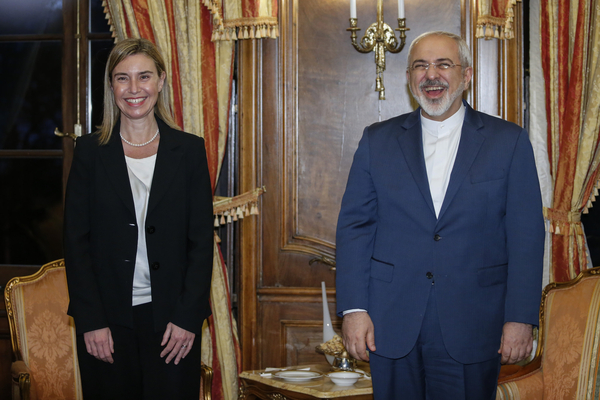
Not funny. Federica Mogherini (left) represented the European Union in nuclear negotiations with the Islamic Republic of Iran, a millenarian Shi’ite theocracy that calls for the annihilation of America and Israel. At right, Iran’s foreign minister, Javad Zarif. (Image source: European Union)
The European Union’s unelected High Representative for Foreign Affairs and Security Policy made her pro-Islamist remarks in a speech delivered last month in Brussels.
While heading up Europe’s combined delegation in the Austrian capital, and purportedly tasked with staving off Iran’s nuclear capabilities, Mogherini, a former member of the Italian Communist Youth Federation, also took to tweeting in Arabic.
The assertions made by Mogherini to the Islam in Europe conference, before she left for Vienna, reveal the thinking of a key figure behind the dangerous concessions given to Iran as a result of its continued intransigence and the West’s continued surrender to it.
It should therefore surprise no one that Syria’s President Assad has congratulated Ayatollah Ali Khamenei on his “great victory” in negotiations from which the Jewish state — which had the most to lose based on Iran’s constant threats to obliterate it — was excluded.
As talks progressed, the Supreme Leader of Iran was pictured trampling on an Israeli flag, with the accompanying caption on Khamenei’s official website reading: “The Zionist regime is condemned to vanish.”
Mogherini first gained notoriety after her statement to the United Nations Security Council on May 11, during which she dismissed pushbacks against the flood of migrants illegally crossing the Mediterranean.
As a consequence of the border policies of the European Commission, of which Mogherini is also Vice-President, the number of immigrants pouring into Europe by land has now exceeded those crossing by sea.
Local authorities in Hungary are struggling to cope with refugee camps filled with rioting migrants shouting “Allahu Akbar!” (Arabic for “Allah is Greater!”).
There seems no recognition of the generosity of a nation that is exhausting its resources to give Muslims asylum from conflict.
The speech given by Mogherini in Brussels on June 24 demonstrates why she believes that the growing migration crisis her actions have orchestrated should be welcomed:
“Islam holds a place in our Western societies. Islam belongs in Europe. It holds a place in Europe’s history, in our culture, in our food and — what matters most — in Europe’s present and future. Like it or not, this is the reality.”
She continued:
“We need to show some humble respect for diversity. Diversity is the core feature of our European history, and it is our strength. … We need to understand diversity, understand complexity. … For this reason I am not afraid to say that political Islam should be part of the picture.”
Under the treaties establishing the EU, there are no democratic checks on figures such as Mogherini or on the enormous power they wield. Only representatives elected to the European Parliament can quiz members of the European Commission.
There is also no democratic way for MEPs to repeal any of the laws applied across the EU, authored by the commission’s bureaucrats, or to fire any of its officials.
Regrettably, Mogherini’s speech chose not to delve into which aspects of the “diversity” represented by “political Islam” Europe should embrace: The subhuman status afforded to non-Muslims such as Christians and Jews, perhaps; or the death sentence faced by Muslims who seek to leave Islam or reform it? Or maybe the codified inferiority of females, or the view that democracy, made by man and not Allah is illegitimate, or that it is permissible to counter free speech with violence?
Mogherini’s speech in Brussels — added to the July 3 vote at the UN Human Rights Council (UNHRC) of several European nations in favor of a resolution condemning Israel for war crimes — also highlight a grim reality when viewed in the context of the West’s concessions to Iran.
While political leaders in Europe seek to placate their Muslim populations, Israel is faced with even fewer reliable allies on the world stage as the prospect of a nuclear Iran looms larger.
The UNHRC’s resolution targeting Israel had been prompted by a UNHRC report into last year’s Gaza conflict, during which the Israeli Defense Force had sought to protect the country’s population against constant and indiscriminate rocket attacks.
In an address on June 29, Britain’s Col. Richard Kemp urged the UNHRC to deal with the reality of events in Gaza last summer:
“Hamas sought to cause large numbers of casualties among their own people, in order to bring international condemnation against Israel, especially from the United Nations. … It was Hamas’s strategy, not illegal Israeli action as this report shamefully alleges without a shred of evidence, that was the reason why over 1,000 civilians died in Gaza.”
With only the US voting against the resulting “anti-Israeli manifesto” it was nevertheless endorsed by European nations including France, Germany, the UK, Ireland, and the Netherlands.
As a consequence of several international treaties, these countries and 23 others have unified executive authority on issues of foreign policy into the institutions of the European Union.
To those arguing with the EU’s head of security policy that, “more Muslims in Europe will be the end of Europe,” Mogherini has a curt answer:
“These people are not just mistaken about Muslims: these people are mistaken about Europe – that is my core message – they have no clue what Europe and the European identity are.”
Claiming that “Islam is a victim,” Mogherini went on to stress that the “caliphate” declared last year by ISIS under the name of the Islamic State, represents “an unprecedented attempt to pervert Islam.”
Led by “caliph” Abu Bakr al-Baghdadi, in February ISIS announced its intention to export 500,000 migrants to Europe to create chaos. As his nom de guerre suggests, the PhD in Islamic Studies possessed by Dr. Ibrahim al-Badri comes from the city where the Koran was compiled.
Federica Mogherini’s claim to have a better grasp of political Islam stems from an undergraduate paper she once authored on the subject.
As a result of the border policies imposed by Mogherini, the president of the EU’s judicial cooperation agency, Michèle Coninsx, confirmed on July 6 that ISIS’s scheme to augment such a migrant flow with jihadists is now being accomplished.
It is hard not to conclude that the official responsible for the EU’s borders represents a sheltered elite, convinced that the solution to problems in the Middle East and North Africa is importing their populations into Europe.
Using an Arabic euphemism to describe the Islamic State, Mogherini’s speech concluded:
“Western media like to refer to Da’esh with the word ‘medieval’. This does not help much to understand the real nature of the threat we are facing. Da’esh is something completely new.”
The EU’s chief representative to the talks in Vienna could have done with visiting the museum located on the city’s Karlsplatz. There can be found the following demand for surrender, issued against the Viennese, which post-dates the medieval period by two centuries:
“We order you to wait for us at your residences in the city so we can decapitate you. It will be a pleasure for me to publicly establish my religion and to pursue your crucified god. I will put your sacred priests to the plough and rape your nuns. Forsake your religion or else I will give the order to consume you with fire.”
It was authored by the Muslim caliph reigning in 1683.
When it comes to political Islam, Federica Mogherini is evidently incapable of differentiating between behaviors that are “completely new,” and those that form an established pattern.
That failure makes the diplomatic surrender to the Islamic Republic of Iran, being portrayed by President Obama as a path to a “more hopeful world,” easier to comprehend.
The West’s negotiations were conducted with a millenarian Shi’ite theocracy that calls for the annihilation of America and Israel.
US freed top Iranian scientist as part of secret talks ahead of Geneva deal’
Mojtaba Atarodi, arrested in California for attempting to acquire equipment for Iran’s military-nuclear programs, was released in April as part of back channel talks, Times of Israel told. The contacts, mediated in Oman for years by close colleague of the Sultan, have seen a series of US-Iran prisoner releases, and there may be more to come
Iranian scientist Mojtaba Atarodi speaks to journalists, upon his arrival at the Imam Khomeini airport outside Tehran, Iran, Saturday, April 27 (photo credit: AP/Vahid Salemi)
The secret back channel of negotiations between Iran and the United States, which led to this month’s interim deal in Geneva on Iran’s rogue nuclear program, has also seen a series of prisoner releases by both sides, which have played a central role in bridging the distance between the two nations, the Times of Israel has been told.
In the most dramatic of those releases, the US in April released a top Iranian scientist, Mojtaba Atarodi, who had been arrested in 2011 for attempting to acquire equipment that could be used for Iran’s military-nuclear programs.
American and Iranian officials have been meeting secretly in Oman on and off for years, according to a respected Israeli intelligence analyst, Ronen Solomon. And in the past three years as a consequence of those talks, Iran released three American prisoners, all via Oman, and the US responded in kind. Then, most critically, in April, when the back channel was reactivated in advance of the Geneva P5+1 meetings, the US released a fourth Iranian prisoner, high-ranking Iranian scientist Atarodi, who was arrested in California on charges that remain sealed but relate to his attempt to acquire what are known as dual-use technologies, or equipment that could be used for Iran’s military-nuclear programs. Iran has not reciprocated for that latest release.
Solomon, an independent intelligence analyst (who in 2009 revealed the crucial role played by German Federal Intelligence Service officer Gerhard Conrad in the negotiations that led to the 2011 Gilad Shalit Israel-Hamas prisoner deal), has been following the US-Iran meetings in Oman for years. Detailing what he termed the “unwritten prisoner exchange deals” agreed over the years in Oman by the US and Iran, Solomon told The Times of Israel that “It’s clear what the Iranians got” with the release of top scientist Atarodi in April. “What’s unclear is what the US got.”
The history of these deals, though, he said, would suggest that in the coming months Iran will release at least one of three US citizens who are currently believed to be in Iranian custody. One of these three is former FBI agent Robert Levinson.
Solomon told The Times of Israel that the interlocutor in the Oman talks is a man named Salem Ben Nasser al Ismaily, who is the executive president of the Omani Center for Investment Promotion and Export Development and a close confidant of the Omani leader Sultan Qaboos bin Said.
The latter tells the fictional tale of John Wilkinson, a successful American businessman who fails in all of his business endeavors in the Gulf until he meets Sultan, who explains to him, according to the book’s promotional literature, how to forgo his hard-charging Western style and “surrender to very different values rooted in ancient tribal customs and traditions.” Those mores have been central to the murky prisoner swaps surrounding the nuclear negotiations, Solomon said.
Solomon said he identified Ismaily’s role back in September 2010, when Sarah Shourd, an American who apparently inadvertently crossed into Iran while hiking near the Iraqi border, was released, for what were called humanitarian reasons. She was delivered into Ismaily’s hands in Oman and from there was flown to the US — the first release in the series of deals brokered in Oman. One year later, in September 2011, her fiancé and fellow hiker, Shane Bauer, was set free along with their friend, Josh Fattal. The two men were also received at Muscat’s Seeb military airport by Ismaily before being flown back to the US.
The US began reciprocating in August 2012, Solomon said. It freed Shahrzad Mir Gholikhan, an Iranian convicted on three counts of weapons trafficking. Next Nosratollah Tajik, a former Iranian ambassador to Jordan — who, like Gholikhan, had been initially apprehended abroad trying to buy night-vision goggles from US agents — was freed after the US opted not to follow up an extradition request it had submitted to the British. Then, in January 2013, Amir Hossein Seirafi was released, also via Oman, having been arrested in Frankfurt and convicted in the US of trying to buy specialized vacuum pumps that could be used in the Iranian nuclear program.
Finally, in April, came the release of Mojtaba Atarodi.
The facts of his case are still shrouded. On December 7, 2011, Atarodi, a faculty member at the prestigious Sharif University of Technology (SUT) in Tehran — a US-educated electrical engineer with a heart condition, a green card and a brother living in the US — arrived at LAX and was arrested by US federal officials.
He appeared twice in US federal court in San Francisco and was incarcerated at a federal facility in Dublin, California and then kept under house arrest. The US government cloaked the contents of his indictment and released no statement upon his release. His lawyer, Matthew David Kohn, told The Times of Israel he would like to discuss the case further but that first he had to “make some inquiries” to see what he was allowed to reveal.
In January, shortly after Atarodi’s arrest, his colleagues wrote a letter to the journal Nature, protesting his detention. “We believe holding a distinguished 55-year-old professor in custody is a historical mistake and not commensurate with the image that America strives to extend throughout the world as a bastion of free scientific exchange among schools and academic institutions,” they said.
Solomon, who compiled a profile of Atarodi, believes that the scientist, prior to his arrest, played an important role in Iran’s missile and nuclear programs. Atarodi, he said, has co-authored more than 30 technical articles, mostly related to micro-electric engineering and, in 2011, won the Khwarizmi award for the design of a microchip receiver for digital photos. “That same technology,” he said, “can be used for missile guidance and the analysis of nuclear tests.”
Solomon further noted that the then-Iranian defense minister and former commander of the revolutionary guards, Ahmad Vahidi, attended the prize ceremony and that Professor Massoud Ali-Mahmoudi, an Iranian physics professor who was assassinated in 2010, was an earlier recipient of the prize.
“There is no doubt in my mind that Atarodi came to the US at the behest of the logistics wing of the IRGC [the Iranian Revolutionary Guard Corps],” Solomon said.
On April 26 Atarodi was flown from the US to Seeb military airbase in Oman, where he met with Ismaily, and onward to Iran. “The release of someone who holds that sort of information and has advanced strategic projects in Iran is a prize,” Solomon said. The US, said Solomon, must have already received something in return or will do so in the future.
Thus far, US-Iran prisoner swaps have been conducted in a manner utterly distinct from the old Cold War rituals, in which, as was the case with Prisoner of Zion Natan Sharansky, spies or prisoners from either side of the Iron Curtain walked across Berlin’s old Glienicke Bridge toward their respective home countries. Instead, with Iran claiming it knows nothing about the whereabouts of former FBI agent Levinson, for instance, and the US eager to show that it will not barter with hostage-takers, the deals have taken the form of a delayed quid pro quo.
There are currently three US nationals — Levinson, Saeed Abedini, and Amir Hekmati — still believed to be held in Iran.
US President Barak Obama raised the issue of the imprisoned Americans in his historic September phone call to Iranian President Hassan Rouhani. Obama’s Deputy National Security Advisor, Tony Blinken, told CNN that aside from the nuclear program it was the only other issue that was brought up in the call.
The interim deal in Geneva did not include any reference to prisoner dealings. Richard Haas, president of the Council on Foreign Relations, told CNN, “you’ve got to decide how much you’re going to try to accomplish, and just tackling all the dimensions of the nuclear agreement is ambition enough.” A spokeswoman for the National Security Council added that the “talks focused exclusively on nuclear issues.”
The omission prompted the chief counsel of the American Center for Law and Justice, Jay Sekulow, who is representing Pastor Saeed Abedini’s wife Naghmeh, to charge Obama and US Secretary of State John Kerry with turning their backs on an American citizen. On the center’s website, he called the decision “outrageous and a betrayal” and said it sends the message that “Americans are expendable.”
Abedini, who was born in Iran and later converted to Christianity, was arrested earlier this year in Iran for what would seem was strictly Christian charity work and sentenced to eight years in prison. He was recently transferred from Evin Prison, a notorious jail for political prisoners in Tehran, Sukelow wrote in a letter to Kerry, “to the even more notorious and brutal Rajai Shahr Prison in Karaj.”
Amir Hekmati, a 31-year-old former Marine from Flint, Michigan, who allegedly obtained permission to visit his grandmother in Iran in 2011, was charged with espionage and sentenced to death in 2012. In September, Hekmati managed to smuggle a letter out of prison. Published in the Guardian, it contended that his filmed admission of guilt had been coerced and that his arrest “is part of a propaganda and hostage-taking effort by Iranian intelligence to secure the release of Iranians abroad being held on security-related charges.”
Levinson, a 65-year-old veteran of the FBI, was last seen on March 9, 2007, on Kish Island, Iran. According to Solomon, Levinson was stationed in Dubai at the time as part of a US task force comprised of former officers operating in the United Arab Emirates, training officials there to combat weapons trafficking, and was tempted to come to Kish for a meeting.
The last person he is known to have had contact with, and with whom he shared a room the night before his abduction, according to a Reuters article from 2007, is Dawud Salahuddin, an American convert to Islam, who is wanted in the US for murder. According to a New Yorker profile of the Long Island-born Salahuddin, he showed up at the home of Ali Akbar Tabatabai’s Bethseda, Maryland door in July 1980, dressed as a mailman, and shot Tabatabai, a Shah supporter, three times in the abdomen, killing him. From there he fled to Canada and on to Switzerland and Iran.
Salahuddin has indicated that Levinson had come to Kish to meet with him.
In September, Rouhani denied any knowledge of Levinson’s whereabouts. In an interview with CNN’s Christiane Amanpour, he said that, “We don’t know where he is, who he is. He is an American who has disappeared. We have no news of him.”
This is highly doubtful. In 2010 and 2011 Levinson’s family received a video and photographs respectively of him in captivity. In January of this year the AP reported that “despite years of denials,” many US security officials now believe that “Iran’s intelligence service was almost certainly behind the 54-second video and five photographs of Levinson that were emailed anonymously to his family.” The photos and the videos traced back to different addresses in Afghanistan and Pakistan, suggesting, perhaps, that Levinson, the longest-held hostage in US history, was imprisoned in Balochistan, a desert region spanning the borders of Iran, Pakistan and Afghanistan.
On Tuesday, Levinson’s son Dan wrote a column in the Washington Post calling Rouhani and Foreign Minister Javad Zarif “well-respected men committed to the goodwill of all human beings, regardless of their nationality.”
Several hours later, White House Spokesman Jay Carney published a statement saying that the US government welcomes the assistance “of our international partners” in attempting to bring Levinson home and, he added, “we respectfully ask the Government of the Islamic Republic of Iran to assist us in securing Mr. Levinson’s health, welfare, and safe return.”
As was the case with the Geneva negotiations, and as is likely happening with the upcoming round of talks regarding Syria, there is good reason to believe, and in this case to hope, that the movements played out under the spotlights of the international stage have been choreographed well in advance, perhaps in the sea-side city of Muscat, under the careful tutelage of Salem Ben Nasser al Ismaily.









 anneinpt
 artaxes
 danmillerinpanama
 davidking1530
 Peter Hofman
 Joseph Wouk
 Peter
Peter Louisiana Steve
 WarSclerotic
Recent Comments