Posted tagged ‘Israel’

Russian marines join Hizballah in first Syrian battle – a danger signal for US, Israel

September 24, 2015

Russian marines join Hizballah in first Syrian battle – a danger signal for US, Israel, DEBKAfile, September 24, 2015
KweirisAir480

[T]he most ominous aspect for the US and Israel of the Russian attack on the Syrian airbase is that Russian marines were combined with Syrian and Hizballah special forces.

*********************

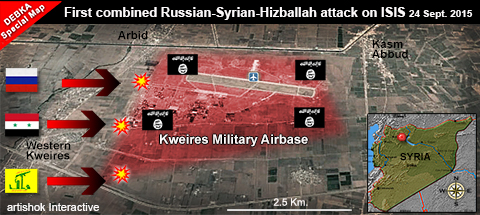
Before dawn on Thursday, Sept. 24, Russian marines went into battle for the first time since their deployment to Syria, DEBKAfile’s military and intelligence sources reveal. Russian Marine Brigade 810 fought with Syrian army and Hizballah special forces in an attack on ISIS forces at the Kweiris airbase, east of Aleppo.

This operation runs contrary to the assurances of President Vladimir Putin to Prime Minister Binyamin Netanyahu on Sept. 21 – just three days ago – that Russian forces in Syria were only there to defend Russian interests and would not engaged in combat with the Syrian army, Hizballah or Iranian troops.

The ISIS force defending the air base is dominated by Chechen fighters under the command of Abu Omar al-Shishani, who is considered one of the terrorist organization’s leading commanders in the last two years. The 27-year-old al-Shishani hails from the Chechen enclave of Pankisi in Georgia, like many others who joined ISIS from 2012.

However, targeting Chechen fighters was not the only reason for the order given by Russian command in Syria to attack the air base.  In DEBKA Weekly 678 of September 11, we predicted that the first Russian mission in Syria would be to break the Syrian rebel siege on Aleppo, Syria’s second-largest city.

As their first step, the Russians would have to prevent the cutoff of highway 5, running from Aleppo to Damascus, and keep it open for Syrian army reinforcements and military equipment to the city.

The offensive to regain Kweiris airbase that fell to ISIS in mid-June is the first step in the implementation of Russia’s operational plan for the Aleppo area.

Meanwhile, little substance was to be found in the reports appearing, mainly in the United States, suggesting that Putin, disappointed by the Obama administration’s unwillingness to send the US Air Force to collaborate with Russia in the fight against ISIS, would try to talk Obama round if and when they meet on the sidelines of the UN General Assembly on September 28.

According to DEBKAfile’s sources, these reports were spread to cover up the serious crisis in the US war against ISIS.

While Russia poured troops and advanced hardware into Syria, establishing bases and launching offensive action, the US anti-Islamic State effort suffered a heavy blow with the decision of Obama’s ISIS war czar, Gen. John Allen, to step down in early November.

Sources close to the general were quoted as referring to his frustration “with the White House micromanagement of the war and its failure to provide adequate resources.”’

The fact that the Russian forces launched their attack on ISIS shortly after the announcement of Allen’s upcoming resignation shows that Putin is not waiting for US cooperation in the war on the Islamist terrorists.    That said, DEBKAfile’s military sources point out that the most ominous aspect for the US and Israel of the Russian attack on the Syrian airbase is that Russian marines were combined with Syrian and Hizballah special forces.

For the first time in 41 years, since the 1974 war of attrition against the IDF on the Golan, Russian troops are fighting alongside Syrian forces. It is also the first time that a world power like Russia is willing to go into battle with an acknowledged terrorist group, such as Hizballah.

Our sources point out that the joint attack was completely counter to the tone and the content of the comments exchanged by Putin and Netanyahu at their summit.

A full report on Russian military activity and strategic objectives in Syria, and a rundown of the content of the Putin-Netanyahu talks in Moscow appear in the coming issue of DEBKA Weekly out Friday, September 25.

Petraeus: Fight Against Islamic State ‘Inadequate’

September 22, 2015

Petraeus: Fight Against Islamic State ‘Inadequate’

BY:
September 22, 2015 2:37 pm

Source: Petraeus: Fight Against Islamic State ‘Inadequate’

Retired Gen. and ex-CIA Director David Petraeus testified Tuesday that U.S. progress against the Islamic State (IS, also known as ISIS) terrorist group has been “inadequate.”

“It has been more than a year since the U.S. commenced military action against the Islamic State in Iraq and Syria,” Petraeus said to the Senate Armed Services Committee. “While there have been significant accomplishments, the progress achieved thus far has been inadequate.

The U.S. has carried out thousands of air strikes against IS as part of Operation Inherent Resolve, but the terrorist group shows no signs of retreating.

“In Iraq we have halted and reversed ISIS’s momentum in some areas, but we have seen gains by ISIS in others such as Ramadi,” Petraeus said.

Petraeus said that “some elements of the right strategy” to defeat IS are being utilized by the U.S., but that “several are under-resourced while others are missing.”

Petraeus recommended ramping up U.S. military support for its allies in the area, notably the Iraqi Security Forces and Kurdish Peshmerga. He also recommended embedding U.S. advisors behind the front lines in Iraqi brigades, coordinating airstrikes more closely with Iraqi coalition partners, and broadening the rules of engagement to carry out airstrikes against IS targets.

Petraeus stopped short of recommending the deployment of U.S. troops for combat roles before a “viable” force of Iraqi partners was available to hold onto the areas taken back from IS.

Petraeus’s testimony can be added to a litany of bad news about U.S. progress against IS, although the White House had until recently characterized the fight as successful.

Retired Marine Gen. John Allen, who created the anti-IS coalition, will step down in November after struggling with the White House for control of the war, Bloomberg reported Tuesday.

Last week, Gen. Lloyd Austin, the U.S.’s top commander of Middle East operations, admitted the failure of a program to train and equip moderate rebels to fight IS in Syria.

Hanging over these revelations are serious allegations that senior U.S. officials manipulated intelligence on IS to hide its strength, lending credence to the White House’s narrative that Inherent Resolve was working.

2,000 Russian Troops Head To Syria For “First Phase” Of Mission To Support Assad

September 22, 2015

2,000 Russian Troops Head To Syria For “First Phase” Of Mission To Support Assad Tyler Durden’s picture

Submitted by Tyler Durden on 09/22/2015 09:32 -0400

Source: 2,000 Russian Troops Head To Syria For “First Phase” Of Mission To Support Assad | Zero Hedge

With each passing day, The Kremlin seems less and less interested in observing any niceties with regard to how it describes Russia’s military involvement in Syria.

Initially, it seemed likely that Moscow would go the Ukraine route by providing logistical support and lurking behind the scenes while officially denying – or at least downplaying – its role in the conflict. Over the course of the last two weeks, it’s become increasingly clear that Russia now intends to make no secret of its intention not only to stabilize the Assad regime but in fact to turn the tide completely with the provision of advanced weapons and equipment including combat aircraft, tanks, and drones.

The only remaining question was how long it would be before Syrian Foreign Minister Walid al-Moualem made an official request for ground troops, allowing Moscow to abandon all pretense that Russia isn’t officially at war and while we may not have reached that point yet, you can’t very well build a forward operating base and not staff it which is why now, according to FT, Moscow is set to send 2,000 troops to Latakia as part of the mission’s “first phase”. Here’s more:

Russia is to deploy 2,000 military personnel to its new air base near the Syrian port city of Latakia, signalling the scale of Moscow’s involvement in the war-torn country.


The deployment “forms the first phase of the mission there”, according to an adviser on Syria policy in Moscow.


The force will include fighter aircraft crews, engineers and troops to secure the facility, said another person briefed on the matter.


Three western defence officials agreed that the Russian deployment tallied with the numbers needed to establish a forward air base similar to those built by western militaries in Afghanistan.

Here’s more, from The New York Times, on the buildup at Latakia:

The deployment of some of Russia’s most advanced ground attack planes and fighter jets as well as multiple air defense systems at the base near the ancestral home of President Bashar al-Assad appears to leave little doubt about Moscow’s goal to establish a military outpost in the Middle East. The planes are protected by at least two or possibly three SA-22 surface-to-air, antiaircraft systems, and unarmed Predator-like surveillance drones are being used to fly reconnaissance missions.


Russia has military presences near Latakia and in Tartus.Russian Moves in Syria Widen Role in MideastSEPT. 14, 2015


“With competent pilots and with an effective command and control process, the addition of these aircraft could prove very effective depending on the desired objectives for their use,” said David A. Deptula, a retired three-star Air Force general who planned the American air campaigns in 2001 in Afghanistan and in the 1991 Persian Gulf war.


In addition, a total of 15 Russian Hip transport and Hind attack helicopters are also now stationed at the base, doubling the number of those aircraft from last week, the American official said. For use in possible ground attacks, the Russians now also have nine T-90 tanks and more than 500 marines, up from more than 200 last week.


“The equipment and personnel just keep flowing in,” said the American official, who spoke on condition of anonymity to discuss confidential intelligence reports. “They were very busy over the weekend.”

On Monday, the Russian embassy in Damascus came under mortar fire. That attack, Moscow says, did not emanate from ISIS but rather from other anti-Assad forces backed by “external sponsors”:

The Russian foreign ministry said a shell, which landed near its embassy on Sunday but caused no casualties, came from Jobar, which is held by anti-Assad fighters who were not allied with Isis and had “external sponsors”.


“We expect a clear position with regard to this terrorist act from all members of the international community, including regional players,” the ministry said. “This requires not just words but concrete action.”


It added that the fighters’ “foreign sponsors” were responsible for using their influence on “illegal armed formations”.

Clearly, “foreign sponsors” is a reference to Assad’s US-backed regional enemies including the Saudis, Qatar, and Turkey among others and this certainly seems to indicate that the Russians will not be prepared to tolerate attacks on their assets by groups who enjoy the support of the US-backed coalition. Of course quite a few of the groups battling for control of Syria are supported either directly or indirectly by the US and its regional allies which means that even if Russia manages to avoid direct confrontation with the handful of troops the US overtly backs, avoiding confrontations with the troops covertly supported by the US and other state actors will be impossible by definition, as they, just as much as ISIS, are angling for the ouster of Assad.

Meanwhile, the French took the absurdity to a whole new level on Monday when Foreign Minister Laurent Fabius claimed that the country’s plans to begin bombing Syria were born out of concerns for “self defense”. Here’s the quote:

“We received specific intelligence indicating that the resent terrorist attacks against France and other European nations were organized by Daesh [Arabic derogatory term for IS] in Syria. Due to this threat we decided to start reconnaissance flights to have the option for airstrikes, if that would be necessary. This is self-defense.

And so, as the violence escalates and Syria looks set to become the stage for a not-so-cold war pitting Russia and its regional proxies against the US and its regional proxies, we close with the following graphic which (partially) quantifies the human cost of geopolitical wrangling gone horribly awry:

U.S. Military Trained Top ISIS Commander

September 22, 2015

U.S. Military Trained Top ISIS Commander Written

by Alex Newman

Thursday, 17 September 2015

Source: U.S. Military Trained Top ISIS Commander

U.S. Military Trained Top ISIS Commander


One of the Islamic State’s top military commanders was actually trained by U.S. Special Forces in the nation of Georgia before taking up arms for ISIS in Syria, according to a variety of sources quoted in an explosive new report by the McClatchy news agency. Another member of the Obama administration’s supposed “anti-ISIS” coalition, the Wahhabi-Islamic dictatorship in Saudi Arabia, played a key role radicalizing the jihadist leader through a hard-core Islamist mosque it funded near his village. In other words, without the direct assistance of key “anti-ISIS” governments — including Washington, D.C. — the man said to be ISIS’ most fearsome and skilled military leader would almost certainly never have arrived in Syria to wage ruthless war on infidels in the first place. But ISIS commander Tarkhan Batirashvili (shown), who now calls himself Abu Omar al Shishani, is hardly the only one.

As explosive evidence and news reports continue to emerge highlighting the trend, it is becoming increasingly difficult to tell where ISIS begins and the globalist establishment ends. Among other revelations, Vice President Joe Biden, speaking at Harvard, admitted that Obama’s “anti-ISIS” coalition had funded and armed various terrorist groups in Syria that went on to become ISIS. Later, U.S. Joint Chiefs of Staff Chairman Martin Dempsey revealed in Senate testimony that Sunni Arab dictators in Obama’s “anti-ISIS” coalition were not just supporting ISIS — they were funding it. Next, a 2012 U.S. Defense Intelligence Agency report released under the Freedom of Information Act exposed the fact that Western powers and their Islamic dictator allies were supporting Islamic terrorists and wanted to see a fundamentalist Islamic State created in Eastern Syria. And finally, the former chief of DIA went on TV and spilled the beans on Obama’s “willful” support to Islamic terrorists while distancing himself from the deadly policies.

The McClatchy report, then, is only the latest shoe to drop in a long train of revelations directly linking the U.S. government and its allies to ISIS and jihad more broadly. Headlined “U.S. training helped mold top Islamic State military commander,” the September 15 article by special correspondent Mitchell Prothero contains a treasure trove of information about the U.S.-trained terrorist gathered from interviews with a wide range of sources, including many close to the ongoing Syrian war. In essence, the report paints a troubling picture of Batirashvili’s background, and offers much insight into how he became a leading ISIS commander responsible for a number of critical victories secured by the terrorist group. From his U.S. military training in Georgia to his radicalization in a Saudi-funded mosque, the piece provides still more evidence about the utter failure — or outright insanity, perhaps even criminality — surrounding what Washington, D.C., likes to characterize as “foreign policy.”

According to the McClatchy report, the 30-year-old Batirashvili (a.k.a. Abu Omar) is a “key figure” in ISIS, reportedly serving on the ISIS “governing council” in addition to being the terror group’s “supreme military leader in northern Syria and Aleppo.” The report, citing his military prowess obtained from U.S. training and a number of critical military victories he led over Syrian dictator Bashar al-Assad’s forces, also refers to him as “perhaps the group’s most fearsome ground commander.” And there is a good reason for that: your tax dollars. “We trained him well, and we had lots of help from America,” an unidentified former Georgian defense official told the news agency, asking not to be named because of the sensitivity of the terrorist’s role in ISIS. “In fact, the only reason he didn’t go to Iraq to fight alongside America was that we needed his skills here in Georgia.”

Batirashvili’s former comrades in the Georgian military echoed the praise for the terrorist’s military abilities and told McClatchy that he was “immediately” recruited into Georgia’s U.S.-trained special forces upon enlistment. Again, your tax dollars — and your sons serving in the U.S. military — played a crucial role in transforming Batirashvili from an impoverished Muslim Chechen villager into a brutal and well-trained commander whose forces are now busily decapitating Christians and selling children into sex slavery to fund jihad. “He was a perfect soldier from his first days, and everyone knew he was a star,” explained a former military comrade of Batirashvili, who also requested anonymity because he was violating orders by speaking to the press about the issue. “We were well trained by American special forces units, and he was the star pupil.”

Of course, the U.S. government training for Batirashvili and other soldiers in Georgia did not take place with the explicit goal of producing future military leaders for a group of savages styling themselves the Islamic State. Instead, similar in many ways to what happened with Osama bin Laden and al-Qaeda in Afghanistan, the U.S. government plan, supposedly at least, was to help the government of Georgia defend itself against potential aggression from the Kremlin. And indeed, according to sources interviewed for the McClatchy report, Batirashvili fought well against Russian strongman Vladimir Putin’s forces, first as a Chechen rebel, and later as a U.S.-trained Georgian Special Forces officer.

While Batirashvili came from an isolated Islamic enclave in the largely Christian nation, Batirashvili and others from his region had traditionally followed a moderate strain of Islam, so-called Sufi Islam. But Sufi Muslims are often considered heretics by their more radical coreligionists in places such as Saudi Arabia and Afghanistan. Eventually, thanks to generous funding from the U.S.-allied Saudi dictatorship, hardcore Wahhabi Islam would soon make its mark on the Chechen enclave in Georgia — and on Batirashvili in particular. The same phenomenon has happened around the world.

According to McClatchy, the moderate version of Islam followed by locals from Batirashvili’s region came under pressure in the year 2000, when the Saudi regime financed the construction of a new mosque for the handful of ethnic Chechen villages in the Georgian valley. A local community leader quoted in the article explained that this new mosque “preached a kind of alien Wahhabi-style Islam” — the same radical Islam that the Saudi monarchy, a key member of Obama’s “anti-ISIS” coalition, has for generations been trying to propagate around the world with lavish funding from its oil revenues. “It told our people that it was wrong to pray at graves of saints and ancestors, as our people have done for hundreds of years, and even to share our religious rites with our Christian brothers,” the community leader said. Other residents told the news agency that by the mid-2000s, the new Saudi-backed mosque had split the local Muslim community in two, with older Muslims sticking to their traditional faith while younger villagers became radicalized in the new mosque.

Then, the globalist-engineered civil war broke out in Syria after years of U.S. taxpayer funding for Syrian opposition groups exposed in official U.S. diplomatic cables. At that point, the radicalized young Muslim villagers in Georgia affiliated with the Saudi mosque — prepared for violent jihad through years of Saudi-funded radical teachings — began an exodus to go wage holy war in Syria. “They all started leaving for Syria,” the community elder told McClatchy. “Things are safer here now because all the radicals — our children — have gone to Syria.” The report also notes that the radicalized Batirashvili served as an excellent recruiting tool for ISIS, attracting jihadists from across central Asia to join the jihad on the “apostate” dictator of Syria.

It is impossible to know how many other ISIS fighters from around the world were also radicalized in mosques funded by members of the “anti-ISIS” coalition, or how many of those fighters received training from the U.S. military under various guises. But without a doubt, there are many. In fact, Obama’s alleged plan to fight ISIS — training and equipping so-called moderate jihadists to fight more radical jihadists — was exposed as a monumental failure this week. Testifying before the U.S. Senate Armed Services Committee on September 16, General Lloyd Austin, the top U.S. military commander for the Middle East, admitted that just “four or five” of Obama’s U.S.-trained jihadists were actually fighting against ISIS in Syria. On the other hand, as The New American and others have documented extensively, far more than that are currently fighting with ISIS, al-Qaeda, and other terrorist groups across Syria — often with heavy U.S. weapons. Indeed, entire brigades of U.S.-trained rebels have joined terror groups or signed agreements with them to fight Assad.

As a direct consequence of the Obama administration’s lawless so-called “foreign policy” machinations, hundreds of thousands are dying, millions are fleeing their homes, refugees are swamping Europe, Middle Eastern Christians are facing genocide, and the national security threat to the United States is growing stronger by the day. Now, all those crises are being exploited by the same globalists who created them to push more of the same insanity.

It is time for Congress to shut down this farce and hold everyone responsible for it accountable.

Photo of  Abu Omar al Shishani, taken from a video: AP Images

Alex Newman, a foreign correspondent for The New American, is normally based in Europe. Follow him on Twitter @ALEXNEWMAN_JOU. He can be reached at anewman@thenewamerican.com.

Related articles:

U.S. Intel: Obama Coalition Supported Islamic State in Syria

ISIS: The Best Terror Threat U.S. Tax Money Can Buy

U.S. Defense Intel Chief: Obama Gave “Willful” Aid to Al-Qaeda

Globalists Who Created Refugee Crisis Now Exploiting It

Globalists Using Muslim Terrorists as Pawns  

Globalists Exploit ISIS Threat to Empower UN

Obama and Co. Middle East Policies Aiding Genocide of Christians

Anti-ISIS Coalition Built ISIS (Video) 

Christian Massacres: A Result of U.S. Foreign Policy

ISIS Origins Traced to U.S. Prison in Iraq

U.S.-backed Syrian Opposition Linked to Bilderberg, CFR, Goldman Sachs & George Soros

Bin Laden & Al-Qaeda: U.S. Govt. Creations

Two-State Solutions and Double Standards

September 22, 2015

Two-State Solutions and Double Standards Why is it only the Jewish state, and not Iraq or Syria, that is pressured to split into parts?

September 22, 2015

Joseph Puder

Source: Two-State Solutions and Double Standards | Frontpage Mag

The Assads in Syria and the Sunni-Muslim Saddam Hussein (now deceased) are examples of minorities ruling over majority populations not of their own ethnic or religious branch. The fall of Saddam’s Iraq was like Humpty Dumpty: once broken, it cannot be put together again.  In the Syrian civil-war, the Sunni-Muslim majority is determined to end the Assad dictatorial rule through unprecedented violence and mayhem. Atrocities are perpetrated by both the Assad regime and the Islamic State. It has resulted in fracturing Syria. Millions of Iraqis and Syrians are now displaced, streaming toward European shores. It is fair to ask why the U.S. and the West in general are not openly supporting the new realities in the Levant.

The George W. Bush and Barack H. Obama administrations have displayed double standards toward Israel with respect to the “two-state solution.” One can legitimately ask why not apply the three-state solution to Iraq and the five-state solution to Syria? Why is it that, according to Obama, the Jewish state can be split into parts (two states), while the artificial colonial creations of Iraq and Syria must remain unitary states? In the case of Israel, the territory it occupies from the Jordan River to the Mediterranean was recognized by the League of Nations as the historical homeland of the Jews.

British Colonial Secretary Winston Churchill wrote in June, 1922 that the Jews are “in Palestine as of Right and not on Sufferance.” The text of the League of Nations mandate (July 24, 1922) entrusting the Mandate to Britain reads: “Whereas recognition has thereby been given to the historical connection of the Jewish people with Palestine and to the grounds for reconstituting their national home in that country; and whereas the Principal Allied Powers have selected His Britannic Majesty as the Mandatory for Palestine…”

Charles Krauthammer summarized in the National Post (March 20, 2015) the reasons why a two-state solution to the Israeli-Palestinian conflict is impossible at this time. “The fundamental reality remains: This generation of Palestinian leadership – from Yasser Arafat to Mahmoud Abbas – has never and will never sign its name to a final peace settlement dividing the land with a Jewish State. And without that, no [Israeli] government of any kind will agree to a Palestinian state.”

Israel is being surrounded by jihadist forces in Gaza (Hamas) and in Lebanon (Hezbollah). In the Sinai Islamic state affiliates are attempting to destabilize the government of President al-Sisi of Egypt, and King Abdullah’s Hashemite Kingdom of Jordan. In Syria, both the Islamic State and the Assad regime with its Iranian allies threaten Israel. Should Israel vacate the West Bank (Judea and Samaria) to satisfy the Two-State solution, it will likely fall into Hamas’ hands. Israel’s population centers and industrial infrastructure will then be within range of Hamas’ rockets. Moreover, the Palestinian Authority ruled by Mahmoud Abbas is tottering and with little legitimacy. The two-state solution can only work if the Palestinians accept Israel as a Jewish state, take off the table Palestinian “right of return,” and only when the Middle East finds a modicum of regional stability that might allow Israel to take risks.

It is a different story in Iraq and Syria. Following the bloodbath in Syria that killed 250,000, few, if any, would want to live under the Assad dictatorial regime or the murderous and intolerant Caliphate of the Islamic State. The Kurds, after Kobane, want independence and perhaps a merger with the Kurdistan Regional Government (KRG) in Erbil (Northern Iraq). The Alawis (10-15% of the population of Syria) whose base is in northwestern Syria, expect the Sunni majority to exact revenge for the deadly attacks the Bashar Assad’s regime perpetrated against them. They too, would like an independent state or some form of loose federalism. The Sunni-Arab majority wants to rule Syria again, but that Syria would have to be without approximately 1.8 million Christians, or 10% of the population who would rather join their co-religionists in an expanded Christian Lebanon. The Kurds, Alawis, and Druze (the smallest group) would likewise not want to live in a fundamentalist Sunni-Arab dominated state.

One can easily envision five states (or statelets) in Syria: a large Sunni-Arab state in central-eastern Syria, bordering Iraq’s Anbar province (which contains some of the same tribes); a Kurdish state in the Northeastern corner of Syria bordering the KRG in northeastern Iraq; an Alawi state in northwestern Syria along the Mediterranean Sea; a new Christian state that would bring together the diminished Christians of Lebanon (who at one time led Lebanon and for whom the state was created in 1943 by the French) and the suffering Syrian Christians, in a territorially expanded region that would stretch from Beirut northeastward, including the Mount Lebanon area. Also, the Druze would prefer a small independent state around Jabal Druze in southwestern Syria.

Salman Shaikh, Director of the Brookings Doha Center, had this to say about Syria (January 6, 2015): “We have to recognize that Syria is now a broken, fragmented, divided state.” A regime change in Damascus and the demise of the Assad regime will inevitably bring an end to a unitary Syria.

Jeffrey Goldberg (January/February 2008) writing in The Atlantic pointed out that

[i]t was Winston Churchill who, in the aftermath of World War I, roped together three provinces of the defeated and dissolved Ottoman Empire, adopted the name Iraq, and bequeathed it to the luckless branch of the Hashemite tribe of West Arabia. Churchill would eventually call the forced inclusion of the Kurds in Iraq one of his worst mistakes ­­- but by then, there was nothing he could do about it. The British, together with the French, gave the world the modern Middle East. In addition to manufacturing the country now called Iraq, the grand Middle East settlement shrank Turkey by the middle of the 1920’s to the size of the Anatolian peninsula; granted what are now Syria and Lebanon to the French; and kept Egypt under British control.

The situation in Iraq has been clear since the fall of Saddam Hussein. Only a brutal dictator could keep Iraq together. Appearing on PBS News Hour, David Brooks of the New York Times (May 30, 2015) opined, “I give Joe Biden credit. He’ll renounce it, but years and years ago, probably 2006, 2007, he had an idea for a loose federal Iraq. And that, in retrospect – that looks to me like a smarter and smarter idea. We have tried to keep this country together, but the Shias are not really sharing power with the Sunnis. They’re not willing to give the Sunni forces the weapons and other things they need to defeat ISIS. The political system is still fractured. The soldiers clearly do not believe in that country[.]”

Recent U.S. administrations have pressured Israel to negotiate for an impractical two-state solution. They have, at the same time, insisted on maintaining Iraq and Syria as unitary states when it is clear that these artificial states created by the 1916 Sykes-Picot Agreement are collapsing and are ungovernable. The time has come for the U.S. to support the hopes of the Kurds and others for independence, while supporting Israel’s historical rights to Judea and Samaria and its genuine security needs.

PM: Israel, Russia establish ‘mechanism’ to prevent ‘misunderstandings’ in Syria

September 21, 2015

PM: Israel, Russia establish ‘mechanism’ to prevent ‘misunderstandings’ in Syria

Source: PM: Israel, Russia establish ‘mechanism’ to prevent ‘misunderstandings’ in Syria – Israel News – Jerusalem Post

Israel and Russia agreed to a create mechanism to prevent accidental confrontation between their forces in Syria, Prime Minister Benjamin Netanyahu said following a meeting on the outskirts of Moscow Monday with Russian President Vladimir Putin.

Netanyahu, in a phone briefing with Israeli diplomatic reporters, said that the meeting was devoted to the complicated situation on Israel’s northern border.

“I made clear our policy to try to prevent through various means the transfer of lethal weapons from Syria to Hezbollah, which is actually done at the direction of Iran,” Netanyahu said.

Netanyahu said that the purpose of the meeting was to prevent “misunderstandings” between IDF and Russian forces. “We established a mechanism to prevent those misunderstandings,” he said, without elaborating. “This is something very important for Israel’s security.

The premier said he also told Putin “in an unequivocal manner” that Israel would not tolerate Iran’s arming its proxies on Israel’s borders, and that Israel will take all actions it needs to prevent this.

“This is our right and obligation,” Netanyahu said, adding that there was no disagreement on that point from the Russians. Netanyahu also said that it was made clear that regardless of Russia’s intentions in Syria, it will not be involved in Iran’s “extreme action against us.”

Netanyahu said that his trip was in no way intended as any kind of signal to the US, and that he coordinated the visit with the US and briefed Washington on its purpose — to prevent any accidental incidents with Russia in Syria.

Syrian army bolstering Iranian terrorism, Netanyahu tells Putin

September 21, 2015

Syrian army bolstering Iranian terrorism, Netanyahu tells Putin PM in Moscow to ‘clarify’ Israeli policy amid Russian buildup; Kremlin leader says Damascus too busy to bother with fighting Israel as both By Times of Israel staff September 21, 2015, 4:39 pm

Source: Syrian army bolstering Iranian terrorism, Netanyahu tells Putin | The Times of Israel

Russian President Vladimir Putin shakes hands with Prime Minister Benjamin Netanyahu, right, during their meeting in the Novo-Ogaryovo residence, outside Moscow, Russia, Monday, Sept. 21, 2015. (AP Photo/Ivan Sekretarev, Pool)

Russian President Vladimir Putin shakes hands with Prime Minister Benjamin Netanyahu, right, during their meeting in the Novo-Ogaryovo residence, outside Moscow, Russia, Monday, Sept. 21, 2015. (AP Photo/Ivan Sekretarev, Pool)

The Syrian army is aiding Iran and Hezbollah in building an anti-Israel terror network on the Golan Heights, Prime Minister Benjamin Netanyahu told Russian President Vladimir Putin Monday, with the Kremlin strongman responding that Damascus has no time to worry about fighting Israel.

Netanyahu’s three-hour meeting with Putin during a lightning trip to the Kremlin Monday came amid reports that Moscow is building up militarily in Syria, and Israeli concerns of a possible clash with Russian forces, which are bolstering embattled Syrian President Bashar Assad.

“Israel and Russia have a shared interest to ensure stability in the Middle East,” Netanyahu told Putin at the start of the meeting, according to an account from the Israeli Prime Minister’s Office. “And I am here because of the security situation, which is becoming more complex on our northern border. As you know, in recent years, and increasingly in recent months, Iran and Syria are arming the extremist Muslim terror group Hezbollah with advanced weaponry, which is pointed at us and has already been fired at us over the years — thousands of missiles and rockets on our cities.”

Syria’s military, Netanyahu added, was giving cover to Iranian efforts to open a new front against Israel.

The West has been concerned over Russia’s military buildup in Syria, which Moscow has said is aimed to help the Syrian government fight the Islamic State group. Russia, Syria’s long-standing ally, has denied that it helps Syria militarily to support the Assad regime.

Earlier this week, new satellite imagery showed the recent arrival of Russian tanks, armored personnel carriers and other military equipment at an air base in Syria’s coastal Latakia province, confirming reports by US, Israeli and other officials of a Russian military buildup.

Israel has long expressed concerns that Iranian and Hezbollah agents have used the fighting in Syria as cover to build up forces along the Golan heights to carry out attacks against Israel. A number of airstrikes over the last several years, reportedly targeting Iranian backed cells and weapons shipments, have been assigned to Israel.

“Iran, under the auspices of the Syrian army, is trying to build a second terror front against us from the Golan. Our policy is to prevent these weapons transfers, and to prevent the formation of a terror front and attacks against us from the territory of the Golan. In these circumstances, I thought it was very important that I come here, both to clarify our policy and to make sure there are no misunderstandings between our forces,” Netanyahu told Putin.

Prime Minister Benjamin Netanyahu is welcomed by representatives of the Israeli Embassy in Russia, as well as Russian delegates, as he arrives on an official visit to Moscow, Russia, September 21, 2015. (Israeli Embassy in Russia/Flash90)

Putin welcomed Netanyahu’s visit, but expressed skepticism over the latter’s Syria warnings.

“All Russia’s actions in the region were always very responsible. We are aware of the issue of bombardments of Israel [with rockets] and reject all such bombardments. To my knowledge, these bombardments are carried out by homemade systems,” he said.

“As for Syria, We know that the Syrian army and Syria as a whole are in such a state that they have no time for a second front. They need to save their own state. Our main goal is to defend the Syrian state. With that, I understand your concern, and I’m very happy you came here so we could discuss all these issues in detail.”

The visit to Moscow comes a week before Netanyahu is scheduled to fly to the US to speak at the United Nations and meet with American officials, ahead of a White House visit in November.

Jerusalem has tried to maintain friendly ties with Russia, shying away from taking a position on fighting in Ukraine or other issues that the Kremlin and Washington have clashed over recently.

Putin also praised Israel, which is home to some million Russian-speakers.

“We never forget that a great many expats from the former Soviet Union live in the State of Israel, and that has a special impact on relations between the countries.”

In Moscow, presence of IDF generals sends a message of military urgency

September 21, 2015

In Moscow, presence of IDF generals sends a message of military urgency In rare move, Netanyahu brings both IDF chief and intelligence head to Russia to drive home concerns on Hezbollah, Syria By Judah Ari Gross September 21, 2015, 11:54 am

Source: In Moscow, presence of IDF generals sends a message of military urgency | The Times of Israel

Prime Minister Benjamin Netanyahu sits with IDF Chief of Staff Gadi Eisenkot during a visit to the northern border of Israel on August 18, 2015. (Amos Ben Gershom/GPO)

Prime Minister Benjamin Netanyahu sits with IDF Chief of Staff Gadi Eisenkot during a visit to the northern border of Israel on August 18, 2015. (Amos Ben Gershom/GPO)

n a sign that it has not taken last week’s movement of the Russian military into Syria lightly, Israel sent not one but two members of the IDF General Staff with Prime Minister Benjamin Netanyahu to Moscow Monday, in an effort to hash out the precarious relationships between Israel, Russia, Syria and Hezbollah.

Both IDF Chief of Staff Lt. Gen. Gadi Eisenkot and Military Intelligence Head Maj. Gen. Herzl “Hertzi” Halevi are accompanying Prime Minister Benjamin Netanyahu to discuss the movement of Russian troops into Syria with Russian President Vladimir Putin and his advisers.

The presence of either one of these generals on this trip would be notable in itself. That both are traveling with Netanyahu is meant to demonstrate to both the people of Israel and the government of Russia the gravity of the situation on Israel’s northern border and the IDF’s intention to keep up airstrikes on high-priority Hezbollah targets in Syria.

Israel has admitted to targeting several Hezbollah and Syrian weapons facilities and convoys in the past several years, and it has been assumed that the Israel Air Force has carried out many more, despite officials’ refusal to claim responsibility.

Prime Minister Benjamin Netanyahu and Russian President Vladimir Putin at Netanyahu's residence in Jerusalem on June 25, 2012 (Marc Israel Sellem/POOL/Flash90)

Most such attacks have been against so-called advanced weapons systems — missiles and artillery guns, rather than rifles and grenades.

Putin, however, complicated Israel’s strategies vis-a-vis Hezbollah and Syria when he announced that the Russian military would be moving into the war-torn country, setting up in the port city of Latakia.

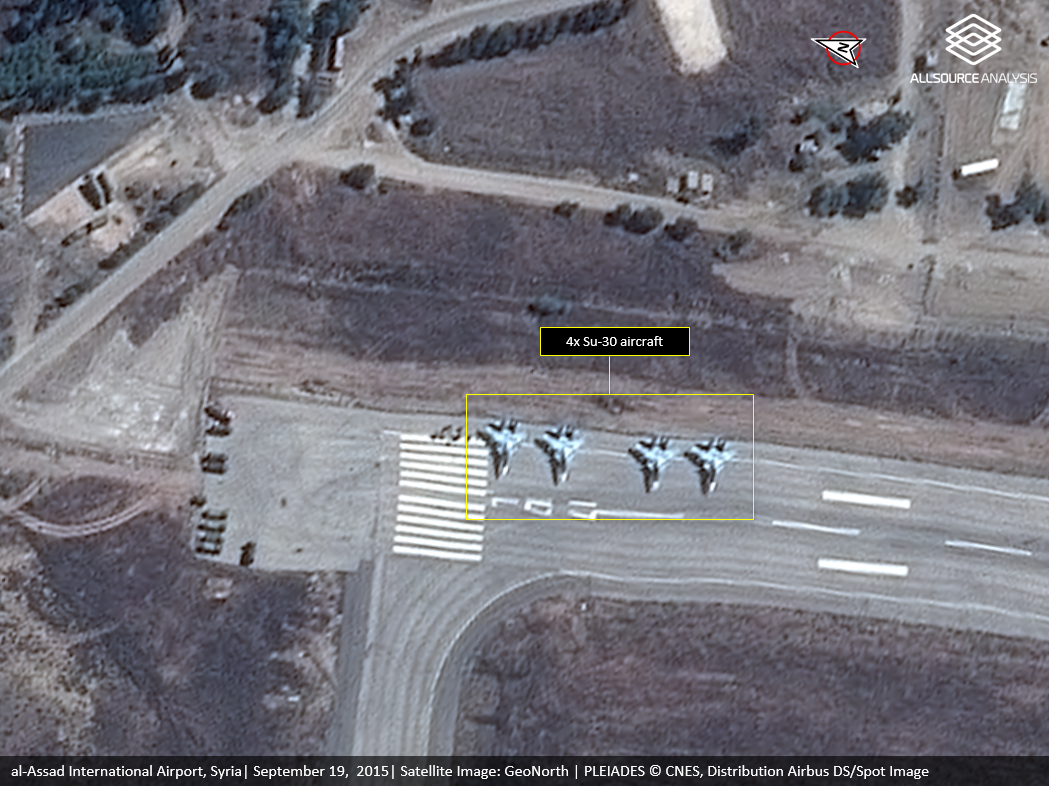
Satellite images already show Russian-made artillery guns and SU-30 combat planes in the northwestern Syrian city.

The presence of Russian soldiers in the country is an added obstacle for the IDF, which must now continue to prevent Israel’s enemies from obtaining dangerous weapons, without causing an international incident by killing an ally’s soldiers.

In 2013 and 2014, Israel was suspected of having carried out airstrikes on weapons sites in Latakia. With Russian military now present in the city, similar attacks may be more difficult to carry out.

An armored personnel carrier, likely a Russian made BTR-82A, firing large-caliber bullets during a battle in Latakia, Syria, is seen in a video posted online on August 23, 2015. (Screen capture YouTube)

Though the Israeli government has not released an itinerary for Monday’s trip, Eisenkot and Halevi will likely meet with their Russian army counterparts to address two related issues: preventing Hezbollah from obtaining Russian-made weaponry and Israel Air Force strikes against the advanced weapons systems already in the possession of the Iran-aligned militia.

Though some of Hezbollah’s arsenal comes from Iran, several of its deadliest weapons — the Kornet anti-tank missile, which has been deadly in combat against Israeli Merkava tanks, and the Katyusha rocket, which rained down on Israel’s northern cities during the Second Lebanon War in 2006 — come from Russia.

Though many of these weapons systems were intended for Syria, some have nevertheless ended up in the hands of Hezbollah, according to Nadav Pollak, a senior fellow at the Washington Institute for Near East Policy.

Some of the systems sold by Russia include anti-aircraft guns and surface-to-air missiles, which could be devastating to Israel’s air superiority in a future conflict with Hezbollah, Pollak said.

As head of intelligence, Halevi will likely present information to the Russian military, showing how these Russian-made weapons end up in the hands of Hezbollah, Pollak explained.

Brig. Gen. Herzi Halevi speaking Thursday. (photo credit: Mitch Ginsburg/Times of Israel)

In addition to attempting to prevent further such transfers, Netanyahu, Eisenkot and Halevi will also discuss Israel’s plans to destroy those advanced systems the terrorist organization has already acquired.

As Hezbollah has been closely aligned with Russia’s ally Assad, this may be a sticking point with Putin, though it is not one Israel is prepared to give up on, Yossi Cohen, national security adviser to the prime minister, told the Israel Hayom newspaper Monday.

Netanyahu will tell Putin that Israel won’t accept restrictions on its response capabilities in Syria, Cohen said.

As Israel’s strikes against Hezbollah have taken place on Syrian territory, which violates its sovereignty, Pollak explained, “there is a chance that Russia will express its objection to this policy.”

The United States has also voiced concerns over Putin’s role in the Syrian civil war.

“Continued military support for the regime by Russia or any other country risks the possibility of attracting more extremists and entrenching Assad, and hinders the way for resolution,” US Secretary of State John Kerry told reporters in Germany on Sunday.

Kerry has proposed military-to military talks with Russia to prevent any clashes between US and Russian forces in the region, to ensure that “there’s no potential of a mistake or of an accident of some kind that produces a greater potential of conflict.”

Mahmoud Abbas: Jews “Have No Right to Defile the Al-Aqsa Mosque with Their Filthy Feet”

September 21, 2015

Mahmoud Abbas: Jews “Have No Right to Defile the Al-Aqsa Mosque with Their Filthy Feet,” MEMRI-TV via You Tube, September 20, 2015

(This is the video, released with an English translation today, noted in an article titled Abbas: “Filthy” Jews’ Feet Not Allowed on Temple Mount. — DM)


Israel security forces may use live fire for Palestinian rocks, firebombs, and “popular terror”

September 20, 2015

Israel security forces may use live fire for Palestinian rocks, firebombs, and “popular terror”, DEBKAfile, September 20, 2015

Ruger_RifleThe Ruger rifle

Prime Minister Binyamin Netanyahu has approved tougher rules of engagement for security forces grappling with the latest surge of Palestinian terror, ready for the security cabinet’s endorsement Sunday, Sept. 20.

First cleared with the State Attorney Yehuda Weinstein was the use of the Ruger rifle by Jerusalem police.

This weapon fires light 0.22 (5.59mm) bullets packed with a small amount of explosive which can cause injury within a 100m radius. It was used against Palestinian terrorists during their Second Intifada in 2000-2007.

Under the amended rules, police officers and soldiers may use the Ruger for live fire in life-threatening circumstances, such as the throwing of rocks and fire bombs which have plagued East Jerusalem in recent months.

This rule goes into force in all parts of Israel, since one of the primary inciters of the unrest on Temple Mount is the Northern Wing of the Israeli Muslim Movement, which represents Israeli Arab Muslim extremists.

A delegation of Israeli Arabs, including members of parliament, has embarked on a tour of Arab-Muslim capitals to push their claim that Israel is violating the status quo at the shrine. They plan to meet Jordan’s King Abdullah, Turkish President Reccep Tayyip Erdogan and Egyptian President Abdel-Fatteh El-Sisi.

The Netanyahu government has circulated a counter-statement to world governments demonstrating that Israel is adhering strictly to the status quo on Temple Mount, which is sacred to three world faiths, and acting only in the interests of preserving the peace against violent distrubances [sic].

The new rules of engagement distinguish between legitimate demonstrations and “popular terrorism.” The disturbances and clashes of the past week between Palestinian stone- and firebomb throwers and security forces in Jerusalem come under the heading of “popular terrorism.”

The prime minister and security chiefs have also acted to bring special operations units of the police force to Jerusalem to help quell the unrest, as well as posting a police presence for maintaining order in the Palestinian districts of the capital. The police and Shin Bet internal security service have set up a joint task force for gathering intelligence and investigations.

Attached to the new measure which goes into effect later today is a draft law permitting courts to impose fines on the parents of minors found guilty of stoning attacks, as well as higher minimum jail sentences for stone and firebomb attackers.

Saturday, Sept. 19, DEBKAfile carried this report:

Following the clashes on Friday, Sept. 18 in the Jabal Mukabar neighborhood, a question has arisen on whether the Palestinians opened fire on undercover units and Border Police forces in the area.

Such shooting by Palestinians in the capital is not new, and it occasionally happens in the northern part of the city, emanating usually from the Shoafat refugee camp and the village of Issawiya. These are isolated incidents, occasional volleys at adjacent Jewish neighborhoods, such as Pisgat Zeev.

But the situation in Jabal Mukabar was completely different, with shoot-to-kill gunfire aimed at members of the Border Police.

On that day, the news reports of the Voice of Israel radio station at 17:00 and 18:00 opened with a story that was impossible to ignore: four border policemen were wounded from gunfire on their armored vehicle in Jabal Mukabar, with one of them wounded seriously. However, the item vanished from the 19:00 broadcast, with Molotov cocktail attacks and rock-throwing incidents reported instead.

There are several conflicting points to consider regarding this matter: the armored vehicle clearly had bullet holes, but no signs of firebomb attacks. Then too press photographers on the scene reported specifically that border policemen were wounded by gunfire; residents of Jerusalem’s Meir Nakar street, next to Jabal Mukabar, said in interviews to various news organizations that there were exchanges of fire between the border police and Palestinians; and police officers said late Friday night that undercover units had arrived and opened fire in order to save themselves, and that several border policemen were injured by a Molotov cocktail.

The suggestion was that the officers had been injured by friendly fire – not Palestinian gunshots.

Several hours after the clashes at Jabal Mukabar, there was another incident south of Jerusalem in which Palestinians who threw firebombs at an IDF post near the Tomb of Rachel were shot and seriously wounded.

That was not the only attack on an IDF position in the Jerusalem area during that 24-hour period. On Thursday, Sept. 17, a Home Front Command base on the Mount of Olives was attacked with firebombs and a section caught on fire.

In addition to these incidents, on several occasions last week, Palestinians who had barricaded themselves in the Al-Aqsa mosque threw stones and stone blocks at police and shot firecrackers directly at them, which might have caused serious injury and even permanent blindness, but luckily none of the policemen were injured.

In other words, the latest developments show a surge in clashes between Palestinians and the Israeli security forces.

Jerusalem’s Mayor Nir Barkat said on Friday, following incident at Jabal Mukabar, that he welcomed the increase of offensive police’s anti-terror operations which entered the city’s flashpoint neighborhoods.

His comment aimed at raising the morale of the police forces fighting the new wave of Palestinian terror for the past two weeks.  It also drew attention to the ongoing debate within the Israeli government over the choice of next police commissioner, who is the official in charge of the country’s strategy for fighting terrorism. While this appointment hangs fire, it is not clear who is in charge of this war, in the interim, Prime Minister Binyamin Netanyahu or Public Security Minister Gilead Erdan?

Gil Hirsch, Erdan’s choice for commisioner [sic], is out of the running.  We have learned that the prime minister is opting for an army general to shed his uniform and take charge of the police – against the wishes of the Public Security Minister.

Palestinian terror tacticians are no doubt exploiting the fact that the war on terror is bouncing between them, with no sign that the violence is about to be brought under control in the immediate future.

DEBKAfile’s military sources reported on September 15 that the latest rioting is the face of the third intifada, At least for now, the unrest is not in the form of suicide attacks of the last uprising but more like “localized armed clashes.”

Our military and counter-terrorism sources point out that armed Palestinian groups, including Israeli Arabs from the extremist Islamic movement, have made an ad-hoc agreement to carry out attacks. In light of such a development, gunfire at Israeli security forces is very likely to grow.