Posted tagged ‘Islamists in Britain’

UK: Another Massive Charity Commission Whitewash

December 4, 2016

UK: Another Massive Charity Commission Whitewash, Gatestone Institute, Samuel Westrop, December 4, 2016

In its report, the Charity Commission makes note of the iERA’s promotion of hate preachers, but treats the charity as a victim of such extremism, rather than an instigator.

According to the Commission, bureaucracy is the solution — the iERA’s extremism will be solved by more “adequate procedures… to prevent abuse of the charity, its status, facilities or assets.”

Those more familiar with the iERA will know that asking this Salafist charity to produce and follow its own counter-extremism plan is akin to demanding that the Ku Klux Klan introduce affirmative action hiring processes.

Extremist charities are not private institutions: charitable status affords extraordinary legal and financial benefits, including the opportunity for radical Islamist organisations to claim government subsidies. But no government should allow extremist networks to exploit charitable status. Shut these charities down, and ban those Islamist activists from ever again becoming trustees of a charitable organisation.

On November 4, the British charity regulator, the Charity Commission, published a report of its inquiry into the Islamic Education and Research Academy (iERA), a British Salafist group and religious training organisation. The inquiry was initially welcomed by moderate Muslim groups and counter-extremism analysts, but many will be disappointed with the Charity Commission’s recommendations.

More than a dozen pieces have been written for the Gatestone Institute examining the iERA’s links to extremism, as well as the failure of government, media and even Jewish organisations to tackle this fast-growing Salafist group. In 2014, one of these articles exclusively revealed that the “Portsmouth Five,” a notorious group of ISIS recruits from southern England, were all members of an iERA youth group.

In 2014, the Council of Ex-Muslims of Britain published their own comprehensive report, which looked even more closely at the officials, preachers and extremist links of the iERA. In the wake of significant media coverage, the Charity Commission launched their investigation. The “inquiry’s scope,” the Charity Commission claims, was to look at the iERA’s extremist links, as well as its “financial management.”

There was no shortage of evidence. The head of the iERA, Abdur Raheem Green, is a former jihadist who warns Muslims of a Jewish “stench,” encourages the death penalty as a “suitable and effective” punishment for homosexuality and adultery, and has ruled that wife-beating “is allowed.”
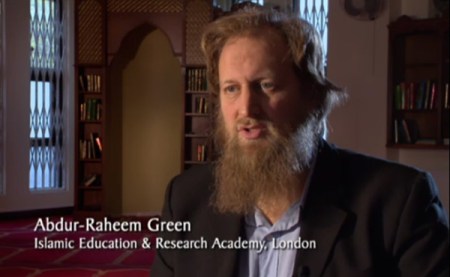
1074The head of the Islamic Education and Research Academy (iERA), Abdur Raheem Green, is a former jihadist who warns Muslims of a Jewish “stench,” encourages the death penalty as a “suitable and effective” punishment for homosexuality and adultery, and has ruled that wife-beating “is allowed.” (Image source: BBC video screenshot)

Other iERA officials have included Zakir Naik, an Islamic preacher whose NGO has just been raided and designated “unlawful” by Indian law enforcement; and Abdullah Hakim Quick, who has called upon God to “clean and purify al-Aqsa from the filth of the Yahood [Jews]” and “clean all of the lands from the filth of the Kuffar [non-believers].”

In its report, the Charity Commission makes note of the iERA’s promotion of hate preachers, but — as it has done in the past — treats the charity as a victim of such extremism, rather than an instigator. According to the Commission, bureaucracy is the solution: the iERA’s extremism will be solved by more “adequate procedures… to prevent abuse of the charity, its status, facilities or assets.” External speakers, the Charity Commission advises, should “sign the charity’s Anti-Extremism, Data Protection and Equal Opportunities disclaimers.” The iERA, concludes the Charity Commission, should produce “risk assessments” for all events and put in place an effective “counter-extremism policy.”

Those more familiar with the iERA will know that asking this Salafist charity to produce and follow its own counter-extremism plan is akin to demanding that the Ku Klux Klan introduce affirmative action hiring processes. But such demands make sense to civil servants in London, who adhere to the government line that because British Islam is inherently good, any real examples of extremism can only be the work of corrupting outside influences.

Counter-extremism analysts have seen such blindness from the Charity Commission before. In 2013, the Charity Commission reported on the offices of an unnamed charity:

“We visited the charity’s premises and saw images of the leader of the group that is a proscribed terrorist organisation were displayed on the walls of the charity’s offices. We also identified that the charity had organised marches at which supporters of the proscribed organisation were present.”

Was this charity, evidently dedicated to the support of a banned terrorist organisation, shut down? No. Instead, the Charity Commission decided to “instruct the trustees to develop and implement robust controls to manage the charity’s activities and the use of its premises.”

Also in 2013, the Charity Commission opened an investigation into International Islamic Link, a taxpayer-funded Shi’ite charity that previously described itself as “the office of … Ayatullah Nasir Makarem Shirazi.” Aytollah Shirazi is one of the Iranian’s regime most hardline clerics. He is known for issuing a fatwa for the murder of Iranian pro-democracy activist Roozbeh Farahanipour. He is also known for his unwavering commitment to Holocaust denial and his support for killing adulterers and homosexuals.

Once the Charity Commission opened an investigation into International Islamic Link, the organisation told the Charity Commission that they had no link with this Iranian cleric. Nevertheless, the Charity Commission, despite clear evidence to the contrary, declared that they were “satisfied” with the charity’s response.

The Charity Commission treats the claims made by trustees of extremist charities as irrevocable truth, and responds to evidence of extremism merely by urging more stringent bureaucratic oversight.

In 2014, Gatestone Institute published information about the Islamic Network. This extremist group’s website advocated the murder of apostates, encouraged Muslims to hate non-Muslims and claimed “The Jews scheme and crave after possessing the Muslim lands, as well as the lands of others.” After investigating the charity, the Charity Commission decided to give the Islamic Network booklets titled, “How to manage risks in your charity.”

The recent Charity Commission whitewash into the iERA is just one more example of a weak, ineffective charity regulator. Extremist charities are not private institutions: charitable status affords extraordinary legal and financial benefits, including the opportunity for radical Islamist organisations to claim government subsidies through a “tax-back” scheme named Gift Aid. Although the iERA’s accounts do not mention the amount if receives from the Gift Aid program, the group encourages donors to “consent yes to gift aid.”

If a private organisation wishes to promote non-violent, bigoted Islamist ideology, then a free society should allow them to do so. But no government should allow extremist networks to exploit charitable status. Shut these charities down, and ban those Islamist activists from ever again becoming trustees of a charitable organisation.

UK Cleric and High School Rector: “No Son of a Bastard Will Remain Alive After Swearing at My Prophet”

October 19, 2016

UK Cleric and High School Rector: “No Son of a Bastard Will Remain Alive After Swearing at My Prophet”, Counter JihadBruce Cornibe, October 19, 2016

shah-sadruddin

In the West governments have the duty to protect free speech as well as other freedoms (exceptions for reasonable censorship – for example, sexually explicit content). The point is that ideas and concepts should be up for debate in order for society to learn and advance. Unfortunately, in much of the Islamic world certain ideas are not only prohibited by they can be punishable up to a death sentence. Let’s take a look at some examples of Muslim support for blasphemy laws.

First, a case in the UK reveals how Mufti Shah Sadruddin, a prominent figure among Bangladeshi Brits, has advocated for the death of those who insult Islam. This is the same Sadruddin who apparently ran for a “local councillor” position a couple years ago, the UK’s Mirror reports:

Footage has emerged of Mufti Shah Sadruddin making a shocking hate speech in London – a year before he tried to become a local councillor.

In his hate-filled rant, he rages against atheists and suggests those who insult his religion should be killed.

The shocking comments were unearthed ahead of a documentary about the abuse, violence and hatred suffered by some Muslims who choose to leave the religion.

Raging against non-believers, Sadruddin says in the video clip: “No son of a b*****d will remain alive after swearing at my prophet.”

The comment was filmed a year before he stood as a Conservativecandidate for Newham council in 2014.

In the run-up to the election, he claimed: “I believe in equality, I believe in fairness, I believe in loving the human race and I hate to hate anybody.”

So basically equality, fairness, and love are being defined by Sharia standards or Sadruddin is blatantly lying in order to advance his Islamist agenda in the UK. An ICM Unlimited survey released earlier this year shows that other British Muslim adults (18 years and older) also have particular sensitivities in matters regarding Islam’s prophet. For example, when asked: “In your opinion, should any publication have the right to publish pictures of the Prophet?” – 4% of the Muslims surveyed said “Yes” while 78% responded by saying “No[.]” And that question just deals with simply posting a picture – whether it’s a positive or negative portrayal of Muhammad is irrelevant here! Another question the survey asked reads: “And in your opinion, should any publication have the right to publish pictures which make fun of the Prophet?” – 1% of Muslims said “Yes” while 87% said “No[.]” While no one who is serious about their faith typically enjoys when other people insult or mock one’s beliefs, the fact that just the mere drawing of Muhammad causes such ire within the Islamic community is a real cause for concern within the UK.

A second case reveals how blasphemy laws are not only enforced in Pakistan but they also apply to non-Muslims as well – and an influential segment of Pakistanis support such laws. A recent article from the Pakistan Christian Post shows that “about 150 top Muslim Clerics (Muftis) issued a religious decree and demanded from Government to hang Asia bibi and all other prisoners of blasphemy laws and also demanded speedy trial of pending cases of blasphemy in Pakistani courts.” Asia Bibi is the Christian mother of five children who has been behind bars since 2009, and is facing the death penalty because of “allegations of blasphemy.” This shouldn’t come as a huge surprise considering a 2013 Pew Research Center article shows that 81% of Muslims in Pakistan believe “sharia is the revealed word of God[.]” The same Pew article found that “[a]mong Muslims who support making sharia the law of the land” (84% in Pakistan) about one third (34%) of those believe Sharia should apply to non-Muslims as well.

Another case exposes how even in America there’s an influential sector of Muslims that essentially help enforce de-facto blasphemy laws by stoking anti-blasphemy anger within the Islamic community when a Muslim Reformer wants to be truthful about the life of Muhammad. Recently, Muslim Reformer (and writer at Counterjihad.com), Shireen Qudosi, testified in front of a House Homeland Security Committee about the subject of radical Islam. At one point during the hearing Qudosi explained how Muhammad switched from being non-violent to violent during his “prophethood[,]” while he and his followers conducted jihad on their adversaries – however, CAIR clipped the segment into a video and basically suggested that Qudosi insulted the Islamic prophet (video here). Not only does the Hamas linked CAIR (professed to be “America’s largest Muslim civil liberties organization”) know that such a video stirs up animosities within the Muslim community that threatens the very life of Qudosi, but they are also trying to shut down any reasonable analysis of Muhammad’s life. One would like to see CAIR try and refute the fact that Muhammad did wage jihad, which included the vicious killings of innocent people. How long are Islamists going to keep painting Muhammad as a peaceful saint when the Quran and Sunnah tell a different story? We must be able to discuss these things without the fear of physical retaliation for offending somebody’s religion.

Hugh Fitzgerald: May God Save “God Save The Queen”

October 15, 2016

Hugh Fitzgerald: May God Save “God Save The Queen” Jihad Watch, October 15, 2016

queen-elizabeth

A Muslim student at King’s College London, and an officer of its Student Union (3 of its 5 top officers are Muslims), one Mahamed Abdullahi, has called for “God Save the Queen,” Great Britain’s national anthem, to be omitted from the school’s graduation ceremonies. He claims the song is “outdated” and “not reflective of the global values the college espouses.” Abdullahi – who is, by the way, a Danish citizen, though not exactly a Dane – insists that this anthem is dangerous “in the context” of the “increasing far-right nationalism across Europe and the legacy of the British Empire.” His obscenity-filled rant can be read here.

What makes “God Save the Queen” outdated? Has the monarchy fallen out of favor with the people of Great Britain? Or is their interest and enthusiasm for the Queen and the idea of the monarchy perfectly understandable, for the Royals are a human symbol of stability and national identity, in a world more dizzyingly in flux than ever before? Look at the British popular press, which appears to devote half its space to Kate Middleton’s children, and another quarter to the Queen. Clearly the British people have no wish to jettison their monarchy. If there were no royal family on which to focus, popular attention might instead be given, as in the United States, to empty celebrities, such as the Kardashians, or to the mix-n’-match couplings and uncouplings of assorted jolies and pitts.

“God Save The Queen” is mild in its winsome expression of national fervor (compare, for example, the martial theme of La Marseillaise); the first two verses go like this:

God save our gracious Queen!
Long live our noble Queen!
God save the Queen!
Send her victorious,
Happy and glorious,
Long to reign over us,
God save the Queen.

O Lord our God arise,
Scatter her enemies
And make them fall;
Confound their politics,
Frustrate their knavish tricks,
On Thee our hopes we fix,
God save us all!

There is nothing conceivably “far right” about these sentiments. I doubt if Mahamed Abdulllahi comprehends the useful role of the constitutional monarch in Great Britain as a focus of national identity, unity, and pride, providing the British with a sense of continuity and stability. What enrages him is the very idea that the British people in this deuteroelizabethan age should permit themselves to have feelings of national pride, and what’s more, to express them. For Abdullahi, that is enough to constitute “far-right nationalism.” When your child pledges allegiance “to the flag and to the republic for which it stands” and wishes “liberty and justice for all,” is he being “far-right”? At a baseball game, do you feel part of a “far-right” crowd because you listen to, or even join in singing, “The Star-Spangled Banner”? Of course not.

Is there any expression of pride in a national identity that Mahamed Abdullahi would find acceptable? I don’t think so. I think that the only kind of “identity” he approves of is that of the supranational umma, or Community of Muslim Believers, and that he obscurely senses that a shared sense of affection and pride in one’s own nation (as expressed in England in many ways, including singing “God Save the Queen) is also, nowadays, a part of the West’s psychological defense against the encroachments of aggressive Islam. For Mahamed Abdullahi, that’s enough to make it “far-right” nationalism.

What about the charge that “God Save the Queen” carries with it the “legacy of the British Empire”? (The anthem itself was first published in 1745, before there was much of a British Empire to celebrate.) Perhaps Abdullahi objects to the fact that many former colonies, once part of that Empire, are now enthusiastic members of the British Commonwealth, keeping up ties to Great Britain, and delighting in receiving visits from Queen Elizabeth II and younger members of the Royal Family. It is not just Canada and Australia and New Zealand that are thrilled, but India, Singapore, Uganda, Nigeria, Jamaica, indeed every country in the Commonwealth (save for Rwanda and Cameroon, but only because they are the latest to join, and the Queen hasn’t yet fit them into her schedule), eager to bask in the reflected glory of a royal visit.

Apparently very few of those actually in the Commonwealth share Mahamed Abdullahi’s sour vision of the “legacy of the British Empire.” Mahamed Abdullahi may have forgotten that even Yassir Arafat once hoped that his future state of “Palestine” would be allowed to join the Commonwealth.

But since he contemptuously dismisses the “legacy of the British Empire” without discussing it, perhaps we should ask: just what was that legacy? First, the English language, which has been perhaps the greatest gift to colonized peoples anywhere, the language that has served as a lingua franca for many different peoples in Africa and in the subcontinent; and the spread of English has allowed them entrée into the worlds of science, technology, business, sport, entertainment, and that same English brings with it, of course, an unrivalled literary heritage. Among the former British colonies in Africa, the spread of English now permits Nigerians to talk to Tanzanians and Kenyans to talk to Ghanaians. And in India, with a multitude of tongues — Hindi, Bengali, Telugu, Marathi, Tamil, Urdu, Gujarati, and Punjabi being the most widely used – the educated in every state can communicate with each other, and with those similarly educated throughout India, in English. It is the English language that, paradoxically, unifies India.

Second, the British introduced the rule of law, specifically the Common Law, including what had been built up through centuries of cases as contract and property law, and rules of civil and criminal procedure. Third, public works – roads, bridges, canals, railroads – that the British built in so many of their colonies, and that promoted economic development.

Fourth – modern medicine, including vaccinations for many previously untreatable diseases. Fifth – free trade within the Empire, stimulating economic growth. Sixth—universal schooling, from elementary grades all the way up, in many of the colonies, to universities. And seventh, the abolition first of the slave trade, and then of slavery. The slave trade that the British abolished first was that vast and cruel enterprise conducted by Muslim Arabs in East and Central Africa and involving 17 million black Africans, many of them young boys castrated where they were captured and, if they survived the operation (only 20% did), were then brought to the slave markets of Islam, to be sold as eunuchs. It was the Royal Navy that finally stamped out that slave trade, preventing the Arab slavers from landing with their cargo on the Arabian peninsula.

Mahamed Abdullahi has nothing good to say about “legacy of the British Empire,” but we have a right and a duty to remind him of that positive legacy (language, law, public works, medicine, free trade, education), and particularly to remind him that it was the British who ended the brutal slave trade conducted by Muslim Arabs.

Finally, Mahamed Abdullahi claims that the British national anthem is “not reflective” of the “’global values’ the college espouses.” What are those “global values”? Would they include such values as equal treatment of all, including minorities and women, before the law? Would they include the free exercise of any religion or the right to believe in none? Would those “global values” include the right to change one’s religion? Would they include the right of both sexes to equal education?

Would they include the right to criticize religions, even if that offends some believers? Would they include the right of children not to be treated as their parents’ chattel? These are not so much “global” values, in fact, as values originating in the countries of the advanced West, and especially Great Britain and its political offspring, the United States. The university’s administrators, who had initially (and shamefully) shown themselves willing to discuss Abdullahi’s nauseating proposal, have fortunately been forced by public outrage to backtrack. Perhaps they need to be reminded – Mahamed Abdullahi can bring them up to snuff — on the Muslim version of “global values” espoused by such models of religious freedom and legal equality as Saudi Arabia, Pakistan, Iran, Libya, Syria, Iraq, the Sudan, and many dozens of other Muslim countries. And then he might also explain what the “legacy” of the Muslim Empire has been for so many different lands and peoples. That should prove most instructive.

And meanwhile, may God save “God Save The Queen.”

UK: Judge allows two Muslim teachers who fed students “diet of Islam” at state school back in classrooms

October 14, 2016

UK: Judge allows two Muslim teachers who fed students “diet of Islam” at state school back in classrooms, Jihad Watch

Please see also On the Road to a Sharia State – Investigating the UK’s Sharia Courts. The decision referenced in the current article was rendered, not by a Sharia court, but by one of Her Majesty’s courts. –DM)

The judge, in making this decision, are signaling that they accept the teaching of Islam as truth in state schools. They are paving the way for the total capitulation of free Britain, and its complete Islamization.

Britain is finished.

inamulhaq-anwar

“Two teachers in ‘Trojan horse’ school who fed pupils a ‘diet of Islam’, segregated assemblies and ignored sex education are allowed BACK into classrooms by a High Court judge,” by Jenny Awford, MailOnline, October 13, 2016:

Two teachers who were struck off for feeding pupils a ‘diet of Islam’ at a school linked to the ‘Trojan horse’ scandal are being allowed back into the classroom.

Inam Anwar and Akeel Ahmed, who taught at Park View in Birmingham and were part of WhatsApp group ‘Park View Brotherhood’, were banned in February.

But a High Court judge found the teachers were treated ‘unfairly’ and he overturned the ban today.

They claimed they were targeted after the ‘Trojan Horse’ letter was published in 2013 – which detailed a plot to introduce hardline Muslim teaching into schools.

Both men were struck off this year after a National College of Teaching and Leadership (NCTL) panel found they exercised ‘undue religious influence’ on pupils.

The panel heard the pupils at the 600-strong secondary school were never taught about safe sex, relationships or contraception.

Anwar, the head of modern languages, and Ahmed, in charge of religious studies, were accused of changing the curriculum so sex education was not taught.

NCTL officials also said Ahmed organised religious assemblies where boys were segregated from girls.

He was also said to have encouraged prayer during the school day through posters and a call to prayer on the school’s loudspeaker system.

Both men were also accused of taking part in a WhatsApp chat that discussed the murder of soldier Lee Rigby and the Boston Marathon bombings.

They were cleared of distributing or using leaflets, promoting the view that a married man has an ‘entitlement’ to have sex with his wife.

The NCTL said their misconduct was serious and Education Secretary, Nicky Morgan, agreed that they should be banned from teaching in England indefinitely.

But Mr Justice Phillips today ruled at London’s High Court that the men’s treatment had been ‘unjust’.

He accepted that important evidence had not been disclosed to the pair and there had been ‘serious procedural impropriety’ in the NCTL’s fact-finding process.

Upholding the pair’s judicial review challenge, he ruled their treatment had been ‘unfair’ and they were reinstated back into the profession….

On the Road to a Sharia State – Investigating the UK’s Sharia Courts

October 14, 2016

On the Road to a Sharia State – Investigating the UK’s Sharia Courts, Creeping Sharia, October 14, 2016

uksharia

Source: Machteld Zee: “Islamization is Planned” – Vlad Tepes

Machteld Zee Ph.D. is a Dutch scholar who investigated sharia courts in the UK for her Ph.D. thesis. This interview was published in the Algemeen Dagblad, a nationwide Dutch newspaper, on October 4, 2016.

The interview is relevant for several reasons:

  • Very few non-Muslims ever have gained access to the world of sharia courts in the UK. She has.
  • The University of Leiden is fairly highbrow in the Netherlands, because it is not only one of the oldest universities. but also because the heir to the Dutch throne traditionally studies at this university (for example, our former Queens Juliana and Beatrix did, just like our current head of state King Willem-Alexander). The reputation of this university gives authority to her voice.
  • She has become a target of attacks by leftist apologists for radical Islam since she published her thesis. She could do with some positive publicity. Similarly, Islam-sceptics could benefit from her work.

The translated interview:

“Islamization is Planned”

Investigating Sharia

The Islamization of Europe follows a strategy, according to Machteld Zee in her bookHoly Identities, which was published today. ‘Once you have knowledge of it, you understand what is going on.’

‘I discovered a comprehensive system of law that contradicts our secular laws.’

Investigating sharia courts

Machteld Zee (32), a Dutch political scientist from the University of Leiden, studied sharia courts in the UK and wrote her Ph.D. thesis on it in 2015.

She was one of the few outsiders who gained access to the sessions of these Islamic courts. 95% of the cases before these courts are divorce cases. Her investigations resulted in a pamphlet, Holy Identities.

‘If you compare the Netherlands in the 1980s with today,’ says the political scientist and law school graduate Machteld Zee, ‘you will see an increased influence of Islam everywhere. Saudi Arabia and other countries flooded the world with thousands of imams, Islamic text books, mosques and tons of money.’

Machteld Zee needed barely 150 pages to describe the background of Islamic fundamentalism, which is gaining ground in Western countries. Her book Holy Identities: On the Road to a Sharia State is an analysis of the problems of the multicultural society.

You say that conservative Muslims want to convince their fellow Muslims to embrace sharia, the religious law of Islam. These fundamentalists are being helped by ‘useful non-believers’, non-Islamic intellectuals, politicians and opinion leaders who don’t want to offend Muslims.

‘Yes, leading multiculturalists actually believe that Muslims should be shielded from criticism because it would inflict psychological damage on them. Although many Muslims consider this an idiotic point of view, others use it to call those who criticize Islam ‘Islamophobes’ and ‘racists’.

You described yourself as left-leaning liberal when you started your investigation on sharia courts in the UK. Now you warn against a lack of knowledge of and a lack of resistance against the advancing radical Islam.

‘I discovered a comprehensive system of law — far more systematic then I had expected — that contradicts our secular laws. Many Muslim women are locked into a religious marriage because their community thinks a divorce according secular law is insufficient. In these communities — Muslim communities — sharia law trumps secular law when it comes to marriage. Women have to ask a sharia judge or an imam to dissolve their marriage, for example when the husband physically abuses her. Even Dutch Muslim women travel to the UK to appear before sharia courts. It is a parallel society. I object to it because these practices go against women’s rights.’

You have analyzed the activities of the Muslim Brotherhood. It is a political and religious movement that aims for world domination, and is supported by lots of money from fundamentalist circles. The sharia courts are part of this project, you wrote.

‘That is why it is so important that we know what is going on. Authors that I studied for my investigation were generally benevolent towards sharia courts. It turned out, however, that none of them ever attended a session of such a court. They don’t know what is going on in these courts. Now they ask me to tell all about it. Women are advised by these courts to accept polygamy and to not file criminal complaints in case of domestic violence. Physically abusive fathers are given custody of their children. I have the impression that the tide of the public debate is turning now that these facts are becoming public. I hardly hear anyone pleading in favour of sharia courts anymore.’

In your book you call out the politically correct elites, who tries to cover up abuse within Islam and tries to downplay the threat of Islamic fundamentalism.

‘In the first place, I think I am reporting facts. Where I notice that influential Western intellectuals tend to discourage critics of Islam and help fundamentalists to isolate and ‘Islamize’ Muslim communities, that is a matter of fact. My book is a compact discourse that aims to bring its readers up to date on fundamentalist Islam.’

How do you see the future?

We will have to act more defensively and resist Islamization. We should not yield to demands that images of scantily dressed women in public have to be covered up, for example. Just say no. Citizens should not leave everything to the government. They can defend our beliefs and values themselves, too. Why does a college in The Hague decides to abandon the Christmas tree pre-emptively? Why is alcohol banned in places where Muslims show up? There is no need for that. We are doing it to ourselves.’

Do you fear criticism? Undoubtedly, you will be labeled as a right-winger.

‘I don’t experience that when I speak in public. Even a ‘leftist’ audience responds positively to my story. Right-wing? Come on, equal rights for women and resistance against representatives of a religion who make threats of violence — let’s call that common sense.’

London’s police ignore Muslim officers’ ‘extremist views’ for fear of being labeled ‘Islamophobic’

September 12, 2016

London’s police ignore Muslim officers’ ‘extremist views’ for fear of being labeled ‘Islamophobic’ Jihad Watch

In a generation or two, when Britain is engulfed in chaos and civil war, and the island’s remaining non-Muslims are subjugated as dhimmis under the rule of Islamic law, some young British non-Muslim may ask his or her parents or grandparents: “What did you do to resist our subjugation and the Islamization of Britain?” And the answer will come: “Why, I didn’t do anything. I was afraid of being called ‘racist’ and ‘Islamophobic.’”

It took a Muslim police officer to blow the whistle on this. None of the non-Muslim police officers had the courage. “Javaria Saeed, who worked for the Metropolitan police’s counterterrorism department, took exception to comments made by a Muslim constable who said that female genital mutilation was a ‘clean an [sic] honorable practice’ that ‘shouldn’t be criminalized.’…She also alleged that the same officer said that Muslims who had been victims of domestic violence should not go to the police, but, instead, seek resolution through sharia courts.”

But no significant action was taken. And that means that in the future, it will be even more difficult for police in Britain to do anything about female genital mutilation or wife-beating among Muslims. To make any move would be “Islamophobic.” That will be the epitaph of Britain.

uk-police2

“London’s police ignore Muslim officers ‘extremist views’ for fear of being labeled ‘Islamophobic,’”RT, September 11, 2016 (thanks to Lookmann):

A former female Muslim police officer has accused London’s Metropolitan police of being more worried about “political correctness” than tackling the extremist views of some Muslim officers because they fear being branded “Islamophobic.”

Speaking to the Sunday Times, Javaria Saeed, who worked for the Metropolitan police’s counterterrorism department, took exception to comments made by a Muslim constable who said that female genital mutilation was a “clean an [sic] honorable practice” that “shouldn’t be criminalized.”

The 35-year-old resigned from the capital’s police force in March after she became disillusioned by “political correctness,” which resulted in a culture of “us and them” to emerge among some Muslim officers who believed themselves to be above the law.

“My experiences were that it was Muslim officers being racist towards my individual views; also in private, holding racist views against white officers, and sexist views against females,” she said, speaking to the Sunday Times. “If such views were held and expressed by white officers, they would be fired.”

Saeed was a constable in the SO15 counterterrorism division, which was set up to improve relations with the Muslim community. She also alleged that the same officer said that Muslims who had been victims of domestic violence should not go to the police, but, instead, seek resolution through sharia courts.

No action was taken against the police sergeant when she raised both cases with senior officers. The 35-year-old, who had been part of the Metropolitan police for a decade, told the Sunday Times that she had been called a “bad Muslim” by other Muslim officers for not wearing a hijab and that some colleagues told her she was “better off at home looking after your husband.”

“Racism in the Met is not from white officers, in my case, but from Muslim officers who the service refused to properly investigate because they were afraid of being called Islamophobic and racist,” she added.

“You give management action to minor offences, so it’s pretty outrageous that the Met did not take proper action against him,” Saeed said. “If he was a white officer, he would have been fired.”

The former police officer mentioned that she had been told by other senior members of the force that complaining about Muslim policeman would “hinder” her hopes for promotion in the future….

Islamist Preacher Convicted in Britain

August 18, 2016

Islamist Preacher Convicted in Britain, Power LinePAUL MIRENGOFF, August 18, 2016

Anjem Choudary, the British hate-spewing Islamic preacher, has been found guilty of supporting Islamic State. He faces up to ten years of prison time.

Choudary will be familiar to some of our readers. He used to appear on Fox News talk shows to defend the actions of terrorists. Often with a smile. Or was it a smirk?

Choudary was convicted at the Old Bailey. Jurors heard testimony that he swore an oath of allegiance to ISIS and that he told his supporters to obey ISIS head Abu Bakr al-Baghdadi and travel to Syria to support “the caliphate.” ISIS has proudly beheaded British citizens, among its many other atrocities.

In a lecture he gave in 2013, Choudary said:

We don’t have any borders, my dear Muslims. It is about time we resumed conquering for the sake of Allah.

Next time when your child is at school and the teacher says ‘what do you want when you grow up, what is your ambition?’, they should say to dominate the whole world by Islam, including Britain, that is my ambition.

Choudary promoted this ambition mainly by radicalizing a string of terrorists, some of whom have stood trial in UK. Among them are Michael Adebolajo, convicted of the violent murder of British soldier Lee Rigby, and Siddhartha Dhar, suspected of replacing Jihadi John as ISIS executioner.

Choudary was thus convicted of “inviting support for a proscribed organization.”

At trial, Choudary admitted that he was media spokesman for a group called Islam4UK during a time when it called for Buckingham Palace to be turned into a mosque and Nelson’s Column to be destroyed. However, he denied inviting support for ISIS.

Apparently, the jury could not reconcile that claim with the testimony it heard, including that discussed above.

Choudary claimed to be a “lecturer in sharia law” giving “the Islamic perspective.” According to at least one report, his defense lawyer likened him to the poet William Wordsworth who praised the aims of the French revolution but not its means. But Wordsworth never swore allegiance to Robespierre.

Britain’s less radical Muslim community applauded Choudary’s conviction. Miqdaad Versi, of the Muslim Council of Britain, said:

Mr Anjem Choudary has long been condemned by Muslim organisations and Muslims across the country, who consider him and his support for Daesh [ISIS] to be despicable and contrary to the values of Islam and our nation.

Many Muslims have long been puzzled why this man was regularly approached by the media to give outrageous statements that inflamed Islamophobia. We hope the judgment serves as a lesson for anyone who follows this path of advocating hate and division.

To be fair, Choudary provided a window into what’s going on in a segment of the British Muslim community. More importantly, he was good for the BBC’s ratings.

Choudary was also good for ISIS. Now, neither television nor ISIS (I hope) will have the benefit of his services.

The UK’s Broken Labour Party

July 20, 2016

The UK’s Broken Labour Party, Gatestone Institute, Douglas Murray, July 20, 2016

(As the morass continues, how will the UK deal with its exit from the European Union? — DM)

♦ With the prospect of another Labour leadership election now gathering pace, tens of thousands more activists have joined the Labour party. It seems unlikely that they will be “moderates.”

♦ The election of an Islamist-sympathising, terrorist-sympathising, Israel-bashing hardliner at the head of the second largest party in the House of Commons undoubtedly changes the parameters of political discourse in the UK.

♦ However solidly Theresa May’s new Conservative government performs, it will always seem the point — so long as Corbyn is in office — that you are either for Britain or against it, for the Conservative party or against the country.

♦ A fractured and in-fighting opposition also means that there is no meaningful, organised voice challenging the government in Parliament. That principle — the principle on which our system is based — needs to work well even (perhaps especially) if you support the government of the day, because the government of the day needs to be kept alert to error and on top of sensible criticisms if it is going to pass the best legislation it can for the country.


Herbert Stein’s law, “Things that cannot go on, won’t,” is one of the best laws of politics. It works for fiscal issues and it usually works for politics as a whole. The British Labour party, however, is currently working to try to disprove this rule. To do them justice they are having a good stab at doing so, which suggests that the maxim should perhaps be re-written: “Things that cannot go on sometimes do.”

Consider the latest developments in the party’s recent unhappy history. Earlier this month the party’s specially commissioned inquiry into anti-Semitism within the party found the party not guilty of this bigotry for the second time in six months. Yet at the launch of these findings, a grassroots member of Jeremy Corbyn’s wing of the party verbally bullied a female Jewish Labour MP until she left in tears, and Jeremy Corbyn himself appeared to compare the Jewish state with ISIS. Although this episode captured some headlines, it was a mere footnote alongside the other catastrophes in the Labour party.

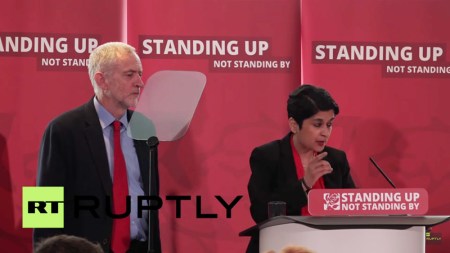
1678UK Labour party leader Jeremy Corbyn (left) appears at a press conference with left-wing campaigner Shami Chakrabarti (right), to present the findings of an inquiry into the Labour party’s anti-Semitism, June 30, 2016.

At the same time as this was going on, Labour MPs attempted a coup to get Jeremy Corbyn out of his position as head of the party. A carefully orchestrated set of resignations from his Shadow Cabinet came in every couple of hours until almost all of the Shadow Cabinet had resigned. Corbyn also lost the support of the deputy leader of the party, Tom Watson. A no-confidence motion saw 172 Labour MPs vote to say that they had no confidence in their party leader, while only 40 Labour MPs supported the party leader. This move meant that Jeremy Corbyn began to have significant trouble finding enough supporters in the Parliamentary Labour party to fill up his shadow cabinet. The joke in Westminster was that those few who did stay loyal to him would find themselves having to hold multiple briefs, so that somebody might easily find themselves being appointed Shadow Home Secretary and Shadow Foreign Secretary.

The trouble appears that all of Corbyn’s politics has a distinctly unfunny, nasty air. It emerged this week (from another declaration of no confidence in the leader) that earlier this year the Labour MP Thangam Debbonaire was both appointed and then sacked as the party’s Culture spokesperson, all within 24 hours and all without even being told, while she was undergoing treatment for cancer. Such stories of non-communication and cruelty towards individual MPs have fanned the rather understandable feeling that Jeremy Corbyn may not be suited to the highest peaks of politics.

Unfortunately for the Labour party, it is not only MPs who have a say. Under new rules unwisely drawn up under Corbyn’s predecessor, Ed Miliband, the Labour party can now be joined by anyone with £3 to spare. All such people then have the right to vote on who the Labour leader should be. Although the idea of having a say in any political party’s future for little more than the price of a cup of coffee may sound appealing, it also leaves a party open to the possibility of a hostile takeover from the most fanatical people in the country — whether they have the Labour party’s interests at heart or not. This is exactly what happened last year when Mr. Corbyn entered the Labour leadership race. Tens of thousands of people from the grassroots, who were soon to form themselves into the ‘Momentum’ movement, saw their chance to bring hard-left politics into the UK mainstream. Jeremy Corbyn won almost 60% of the vote in that election. In recent weeks, despite the formal no-confidence vote of the Labour MPs, this grassroots support for Corbyn only appears to have galvanised further. With the prospect of another Labour leadership election now gathering pace, tens of thousands more activists have joined the Labour party. It seems unlikely that they will be “moderates.”

Nevertheless, two “moderate” candidates for leader stepped forward, inevitably splitting the anti-Corbyn vote, until they seemed to realise this and one dropped out. Nevertheless, polls of party members suggest it looks overwhelmingly likely that in the coming weeks Corbyn will entrench his position by winning a landslide in a second ballot of the party’s members within a year.

Why does this matter? For two reasons. First, because the election of Corbyn has poisoned British politics. The election of an Islamist-sympathising, terrorist-sympathising, Israel-bashing hardliner at the head of the second largest party in the House of Commons undoubtedly changes the parameters of political discourse in the UK. However solidly Theresa May’s new Conservative government performs, it will always seem the point — so long as Corbyn is in office — that there is no party of the decent left available for the large proportion of voters who would like such a thing. This leaves countless patriotic, left-wing voters without a meaningful voice in Parliament.

A fractured and in-fighting opposition also means that there is no meaningful, organised voice challenging the government in Parliament. That principle — the principle on which our system is based — needs to work well even (perhaps especially) if you support the government of the day, because the government of the day needs to be kept alert to error and on top of sensible criticisms if it is going to pass the best legislation it can for the country.

The other reason why this principle matters is because it suggests that vested interests matter more than truth. Herbert Stein’s dictum lacked one crucial ingredient: people’s desire to look after themselves. There are Labour party MPs already looking for a way out, including looking to found a new party or parties. But they fear that way lies electoral oblivion. So they stay, in a party wracked with in-fighting and led by the most corrosive person their party has ever chosen in what had been a noble history. And all the while that person in charge of their party is busily mainstreaming the worst bigotries of our time. When pushed to decide between their morals and their careers, the dictum holds in the Labour party that things that cannot go on, find some way to do so.