Posted tagged ‘Islamic State’

Iran: Nuclear Deal Will Enable Support for Terrorism

August 26, 2015

Iran: Nuclear Deal Will Enable Support for Terrorism, Washington Free Beacon, August 25, 2015

Iranian Foreign Minister Mohammad Javad Zarif speaks at the New York University (NYU) Center on International Cooperation in New York April 29, 2015. REUTERS/Lucas Jackson Iranian Foreign Minister Mohammad Javad Zarif speaks at the New York University (NYU) Center on International Cooperation in New York April 29, 2015. REUTERS/Lucas Jackson

Multiple senior officials in recent days have said that the Iranian nuclear deal will help the Islamic Republic fund its global terrorist operations, including the financial backing of Hamas and other regional groups, according to a briefing by an Israeli intelligence group.

Iranian officials, speaking at multiple forums in recent days, stressed that the nuclear deal will embolden Iran’s support for its “regional allies” and that weapons and military support would continue to be delivered on the “resistance front,” according to a recent brief by the Meir Amit Intelligence and Terrorism Information Center.

The officials outlined Iran’s plan to bolster its global terrorism operation and stated that the recent nuclear deal between Tehran and global powers will do nothing to deter Iran’s pursuit of regional dominance.

Ali-Akbar Velayati, Supreme Leader Ali Khamenei’s adviser for international affairs, stated at a recent conference in Tehran that support for the “resistance front” is a top foreign policy objective.

The nuclear agreement, Velayati said, “would make it possible to increase Iran’s support for its regional allies,” according to recent comments noted in the brief. The official went on to say that “the situation of the resistance front had improved.”

Other senior Iranian officials have echoed these remarks.

Foreign Minister Javad Zarif, who led nuclear negotiations with the United States, recently travelled to Syria and Lebanon to announce Iran’s renewed support for Hezbollah and the embattled regime of President Bashar al-Assad in Syria, according to the brief.

Iran will “continue providing weapons to support the Middle Eastern countries fighting terrorism,” Zarif is quoted as saying by Iran’s state-controlled press.

In light of the nuclear deal, Iran will “preserve its defensive capabilities and send weapons to its regional allies,” according to Zarif, who stressed that “without Iran and the weapons it provided to the countries fighting terrorism, the capital cities of the Middle East would have been occupied by” the Islamic State (IS, also known as ISIS or ISIL).

Iran also intends to boost its support for fighters in Yemen and Palestinian terrorist groups.

More than 70 members of the Iranian parliament, for instance, recently petitioned President Hassan Rouhani to increase “Iranian support for the regional resistance front after the nuclear agreement,” according to the report.

“They called on the president to use the ministries of defense and foreign affairs to send aid to the Palestinians in accordance with instructions from the Supreme Leader to arm the Palestinians in the West Bank,” the report notes.

Another senior Iranian national security official, Javad Karimi Qoddousi, demanded this month that “all the senior Iranian officials … support aid for the Palestinian people and the resistance front so that the nuclear agreement [is not] exploited to strengthen Israel’s security,” according to the brief.

These remarks have been accompanied by aggressive military moves by Iran, which has conducted multiple war drills in recent weeks and announced the upcoming launch of missiles, a move that could violate current United Nations Security Council resolutions barring such activity.

Iran appears to be attempting “to impress its allies with its commitment to continue supporting them even after the nuclear agreement with the West,” the Meir Amit center concluded in its brief. “The speeches of senior officials also reflected Iran’s approach to the rise and strengthening of ISIS and radical Sunni Islam.”

Iran also has committed itself to preventing the United States from gaining a foothold in the Middle East.

Iran will “not allow the United States to again extend its political influence in the region,” Velayati said in another recent interview. “Middle Eastern countries and people, led by Iran, had awakened and were standing firm” against America.

Senior Hamas officials have also disclosed in recent days that a delegation would soon be visiting Tehran.

Since the nuclear deal was secured, “relations between Hamas and Iran [have been] good,” according to these officials.

Why the US government is on track to ‘normalizing’ ISIS

August 25, 2015

Why the US government is on track to ‘normalizing’ ISIS, NY PostAlex VanNess, August 23, 2015

(That “normalizing” the Islamic State would be lunacy is itself a good argument that Obama will do it. — DM)

Photo: AP

How long will it take the United States to recognize the Islamic State as a legitimate actor?

That may sound ridiculous. After all, ISIS is a barbaric and sociopathic band of terrorists who proudly highlight their brutality over the Internet. Unfortunately, recent history suggests this doesn’t disqualify them, as horrific as it sounds, from eventual recognition.

Since before 9/11, the Taliban laid claim to numerous terror attacks on civilian populations throughout Afghanistan. They harbored Osama bin Laden, and since the beginning of Operation Enduring Freedom, they’ve been directly responsible for the deaths of more than 2,000 American troops.

Yet in January, White House Press Secretary Josh Earnest cryptically explained that the Taliban was not a terrorist group but instead falls under a “different classification.”

Earnest’s verbal gymnastics were deployed in the service of explaining away the president’s decision to trade five members of the Taliban for the release of American soldier-captive Bowe Bergdahl.

Hamas is an openly anti-Semitic terrorist organization that has claimed responsibility for the deaths of hundreds of innocent civilians, including several Americans. Since its creation, the Gaza-based Hamas has been dedicated to the destruction of Israel and the murder of Jews. Hamas is brutally repressive toward women and gays; they have a tendency to savagely drag dead bodies through the streets.

Last year, Palestinian President Mahmoud Abbas swore in a new unity government that incorporated Hamas-appointed ministers. Instead of cutting off financial support to the new government, as required by US law, the Obama administration jumped through hoops to legitimize the new government. Officials said they would continue supporting the Palestinian government because the new ministers were “technocrats” that “don’t represent . . . hard-core Hamas leadership.”

The legitimacy granted to Hamas by this administration is a reflection of the trend held by many pro-Palestinian protestors who now brazenly chant, “we are Hamas!” through the streets of US cities such as Miami.

Cuba has a long history of human-rights abuse. The Cuban government regularly harasses and imprisons dissidents and has been a state sponsor of terrorism for decades. Cuba continues to serve as a safe haven for terrorists and maintains close ties to both North Korea and Iran.

In 2013, Cuba was caught sending weapons to North Korea. It aids terrorist groups like the Revolutionary Armed Forces of Colombia, Iranian proxy Hezbollah and the Basque Fatherland of Liberty (ETA).

Despite this behavior, the administration still decided to take Cuba off the list of State Sponsors of Terrorism and has begun the process of normalizing the relationship between the United States and Cuba.

The State Department justified this removal by stating that “Cuba has not provided any support for international terrorism during the previous six-months” and citing vague promises that they “will not support acts of international terrorism in the future.”

So to recap, within this past year we have stopped referring to the Taliban as terrorists, provided de facto recognition and funding to Hamas and have opened up to the repressive terror-sponsoring Cuban government.

Why should we assume that ISIS will be treated any differently than these groups?

As each day passes, ISIS solidifies its presence in the region. Sure, ISIS commits terrible atrocities. The group regularly — and indiscriminately — beheads innocent people; rapes women and sells them as sex slaves and employs children as executioners.

But its leaders have undeniably been working to establish the Islamic State as, well, as a functioning state. They issue identification cards, pave roads, pick up trash, operate power stations and offer social-welfare programs.

ISIS has carved out its territory by filling the Middle East’s power vacuums, and are thus, in some places, the only game in town. How long before the international community recognizes the ISIS government?

The past precedent of legitimizing various terrorist groups and repressive dictatorships make this all too real of an issue. It’s imperative that the United States stops this trajectory of providing legitimacy to these regimes and turns back the ISIS tide, or we may one day soon be debating the opening of an embassy to the Islamic State in what used to be Iraq.

Alex VanNess is the manager of public information for the Center for Security Policy.

Unveiling new missile, Rouhani says Iran will obtain ‘any weapons we need’

August 22, 2015

Unveiling new missile, Rouhani says Iran will obtain ‘any weapons we need’

‘We can negotiate with other countries only when we are powerful,’ says president at ceremony displaying precision solid-fuel rocket

By Times of Israel staff August 22, 2015, 12:00 pm

via Unveiling new missile, Rouhani says Iran will obtain ‘any weapons we need’ | The Times of Israel.

In this photo released by the official website of the office of the Iranian Presidency on Saturday, Aug. 22, 2015, Iran's President Hassan Rouhani, left, briefs the media as Defense Minister Hossein Dehghan listens after unveiling the surface-to-surface Fateh-313, or Conqueror, missile in a ceremony marking Defense Industry Day, Iran. (Iranian Presidency Office via AP)

In this photo released by the official website of the office of the Iranian Presidency on Saturday, Aug. 22, 2015, Iran’s President Hassan Rouhani, left, briefs the media as Defense Minister Hossein Dehghan listens after unveiling the surface-to-surface Fateh-313, or Conqueror, missile in a ceremony marking Defense Industry Day, Iran. (Iranian Presidency Office via AP)

Iran on Saturday unveiled a new surface-to-surface ballistic missile with a 500-kilometer (310 miles) range, saying military might was a precondition for peace and effective diplomacy.

The Fateh 313 missile was unveiled during a ceremony marking the anniversary of Iran’s military industry, attended by Iranian President Hassan Rouhani.

The military industry called the solid-fuel missile one of the most exact ever manufactured, boasting that it has successfully hit multiple targets with great precision, Israel’s Walla website reported.

“We will buy, sell and develop any weapons we need and we will not ask for permission or abide by any resolution for that,” Rouhani said in a speech at the ceremony, which was broadcast live on state television, according to Reuters.

“We can negotiate with other countries only when we are powerful. If a country does not have power and independence, it cannot seek real peace,” the president said.

A senior commander in Iran’s Revolutionary Guards said Friday that the country is planning massive “ballistic missiles war games,” adding that the announcement comes after Tehran said it plans to begin phasing in a new generation of missiles.

“The IRGC Aerospace Force will hold a large-scale ballistic missiles war-games soon,” Brigadier Gen. Amirali Hajizadeh said, according to the state-run Fars news agency.

Tehran said last month that its ballistic missile program was not connected to the UN Security Council resolution endorsing the July 14 accord with world powers that limits its nuclear program.

Under the terms of the agreement, Iran is barred from developing ballistic missiles capable of carrying a nuclear warhead.

Iran says it has ballistic missiles with a range of 2,000 kilometers (1,200 miles), which are capable of striking both Israel and Saudi Arabia. But the Foreign Ministry said that the UN’s resolution endorsing the deal did not have jurisdiction over its missile development.

“Iran’s military capacities, especially ballistic missiles, are strictly defensive and, as they have not been conceived to carry nuclear weapons, they are outside the scope and competence of the Security Council resolution,” the ministry wrote in a statement.

“The Islamic Republic of Iran is committed to implementing its commitments… so long as world powers keep their side of the agreement to lift sanctions in exchange for guarantees that Tehran will not develop a nuclear program,” the statement said.

The greater security threat: ISIS or Iran?

August 17, 2015

The greater security threat: ISIS or Iran? Front Page MagazineJoseph Puder, August 17, 2015

ii

JP: Who do you perceive to be a greater security threat, ISIS or the Islamic Republic of Iran?

HL: An Iran with nuclear weapons or a pathway to obtain them is a far more dangerous threat than ISIS.

HL: Iran should not have nuclear weapons, period. Any deal that allows for Iran to enrich uranium is a violation of the NPT (Non-Proliferation Treaty). That the U.S. and global powers have agreed to an arrangement that offers Iran a bridge to nuclear weapons is wrong and dangerous. It will set a notion nuclear proliferation in the region, thereby making the Middle East a tinderbox for explosion.

JP: Should Israel consider a preemptive strike on Iran’s nuclear facilities?

HL: A preemptive strike against Iran by Israel is fraught with complications, but an Iran with nuclear weapons, a delivery capacity and a motivation to destroy Israel leaves the Israeli government with very few alternatives. The choice is indeed existential. An attack will have consequences; blow back with many lives put in jeopardy. Hoping for the best, however, is not a policy since the very survival of Israel is at stake. Hence, I believe Israeli leaders must act to defend the state and its people which means it must make the difficult decision of attack. As Norman Podhoretz so eloquently put it, “fight a conventional war now or a nuclear war later.”

******************

Of the many speakers at the “Stop Iran Rally” on July 22, 2015 in New York’s Times Square, the comments of Dr. Herbert London aroused the most enthusiastic response. His large frame encompasses a magnetic personality, and an incredible gift as a speaker.  However, on a personal encounter, he reveals his gentle demeanor.

The 6’5” London played basketball for the Columbia University team, and was drafted by the Syracuse Nationals. He recorded several pop songs, achieving a hit record in 1959 with “Sorry, We’re Not Going Steady.” Herb has been primarily an intellectual steeped in academic life. He was listed among the “outstanding intellectuals of the 21st Century.” Yet, he became a force to be reckoned with far beyond the Ivory Towers of academia.

Dr. Herbert London is currently the president of the London Center for Policy Research, and senior fellow at the Manhattan Institute. He is the former president of the Hudson Institute. Herb is also professor emeritus and the former John M. Olin Professor of Humanities at New York University. He is responsible for creating the Gallatin School of Individualized Study in 1972, and was its dean until 1992. The school promotes the study of “great books and classic texts.”

Herb London graduated from Columbia University in 1960, and received his Ph.D. from New York University in 1966. London is also chairman of the National Association of Scholars and a member of the Council on Foreign Relations.

London believes in a better world for ordinary Americans. That is why he became a nominee of the Conservative party for Mayor of New York City and Governor of New York State. He is an author of a number of books, the latest being The BDS War against Israel.

Given Herb London’s global connections, and his involvement in framing foreign policy, this reporter addressed the following questions to him.

Joseph Puder (JP): Please tell us about the mission of the London Center for Policy Research. What are its goals, and how does it operate?

Herb London (HL): The London Center was organized to promote an independent, non-partisan analysis of “hot spots” on the globe and how to think strategically about them. In the areas where possible mitigation exits, the LCPR offers a variety of recommendations. Because of contacts cultivated in Washington, DC, the LCPR has established a regular seminar series on the Hill for staffers and elected officials, all designed to influence policy and future legislation.

JP: Millions of people from the Third World (mostly Muslims) will be flooding the West, especially Europe. What impact do you think this will have on the current Western democracies?

HL: Europe does not have a tradition of assimilation like the United States. As a consequence, minorities are generally not integrated into these societies. Separate communities, with separate conditions, and even separate laws within a host society is a recipe for tension and violence. Evidence for this can be found in every European nation. Malmo in Sweden, for example, the country’s third largest city, is organized as a Middle East Muslim community with imams determining who enters. Demographically, it is obvious a European population with a replacement level, on average of 1.5 and a Muslim replacement rate of 2.7 will result in significant political and attitudinal shifts in the next two decades rendering the continent an extension of Islamic positions to be.

JP: Who do you perceive to be a greater security threat, ISIS or the Islamic Republic of Iran?

HL: An Iran with nuclear weapons or a pathway to obtain them is a far more dangerous threat than ISIS. Moreover, Iran has created an empire of sorts with capitals in Damascus, Sanna, Bagdad, and Beirut. Should Iran obtain $150 billion with the lifting of sanctions, that money could be used to bolster its interests with Hezbollah, Hamas, and the Houthis. Using surrogates, the Iranians will likely extend their interests throughout the region with the prize being Saudi oil fields in the eastern part of the country which has a regional majority of Shia residents. Should Iran control Saudi and Iraqi oil along with its own deposits, it will control two-thirds of the world’s oil supply and be in a position to dictate oil prices.

ISIS is a relatively minor threat that has morphed into a formidable threat due to inaction and a hopelessly incompetent Iraqi military force. Using barbarism as a tactic, it has carved out a swath of territory in Iraq and Syria. If the U.S. were serious about launching a genuine attack against ISIS, it could be eliminated in a relatively short period.

JP: What alternatives to the nuclear deal with Iran would you propose?

HL: Iran should not have nuclear weapons, period. Any deal that allows for Iran to enrich uranium is a violation of the NPT (Non-Proliferation Treaty). That the U.S. and global powers have agreed to an arrangement that offers Iran a bridge to nuclear weapons is wrong and dangerous. It will set a notion nuclear proliferation in the region, thereby making the Middle East a tinderbox for explosion.

JP: Should Israel consider a preemptive strike on Iran’s nuclear facilities?

HL: A preemptive strike against Iran by Israel is fraught with complications, but an Iran with nuclear weapons, a delivery capacity and a motivation to destroy Israel leaves the Israeli government with very few alternatives. The choice is indeed existential. An attack will have consequences; blow back with many lives put in jeopardy. Hoping for the best, however, is not a policy since the very survival of Israel is at stake. Hence, I believe Israeli leaders must act to defend the state and its people which means it must make the difficult decision of attack. As Norman Podhoretz so eloquently put it, “fight a conventional war now or a nuclear war later.”

JP: How do you assess the performance of the Obama administration in the realm of foreign policy?

HL:  From the outset of his presidency, Barak Obama made it clear that U.S. involvement in foreign activity leads inexorably to chaos. With that as the overarching assumption, the president engaged in a precipitous withdrawal from Iraq and a hasty departure from Afghanistan. He claims he ended both wars, but the fact is he extricated the U.S. from the wars, but the wars continue.

Since U.S. foreign policy is regarded as “undesirable,” he wants less of it. That explains his belief that American international positions should be channeled through the United Nations. It also explains why he submitted the P5+1 proposal with Iran to the Security Council before it was given to the Congress.

Although it is often foolhardy to attempt to read minds, the president has seemingly developed his own skewed version of the Iraq war and the role of President Bush and his advisers. As a consequence, all his foreign policy initiatives are based on the experience of the recent past, most specifically his understanding of it. Therefore, the military has been hollowed out and troop deployments abroad have been shrinking. Presumably, this will lead to a more peaceful world. However, empirical evidence suggests the opposite. The U.S. may not want to be the world’s policeman, but a world without a policeman is fraught with tension and potential war.

Articulate and deep thinking, Herb London is a voice worth hearing, and unlike other intellectuals who hide behind the ivory towers of academia to express nefarious ideas, Herb London never sought shelter from the real world.

Britain: The “Struggle of Our Generation”

August 10, 2015

Britain: The “Struggle of Our Generation”, The Gatestone InstituteSamuel Westrop, August 10, 2015

  • “We’ve got to show that if you say ‘yes I condemn terror — but the Kuffar are inferior’, or ‘violence in London isn’t justified, but suicide bombs in Israel are a different matter’ — then you too are part of the problem. Unwittingly or not, and in a lot of cases it’s not unwittingly, you are providing succour to those who want to commit, or get others to commit to, violence.” — Prime Minister David Cameron.
  • In a series of religious rulings published on its website, the Islamic Network charity advocated the murder of apostates; encouraged Muslims to hate non-Muslims; stated that when non-Muslims die, “the whole of humanity are relieved;” and described Western civilisation as “evil.”
  • The Charity Commission’s solution, however, was to give the charity’s trustees booklets titled, “How to manage risks in your charity,” and warn them not to do it again.

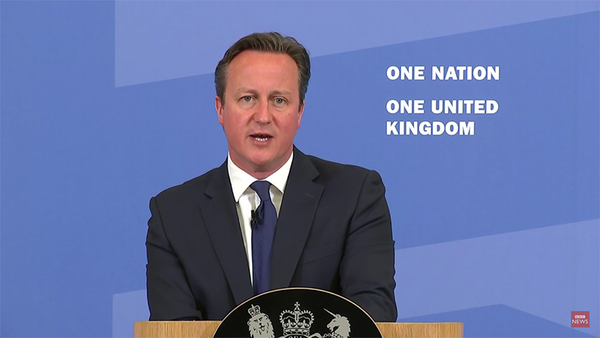
On July 20, Prime Minister David Cameron outlined his government’s plans to counteract Islamic extremism, which he described as the “struggle of our generation.”

In a speech before Ninestiles School, in the city of Birmingham, Cameron articulated a view of the Islamist threat that, just a couple of years ago, few else in British politics would have dared to support.

In a report for BBC Radio 4, the journalist John Ware described Cameron’s speech, and the government’s proposed counter-extremism measures, as “something no British government has ever done in my lifetime: the launch of a formal strategy to recognize, challenge and root out ideology.”

Cameron’s speech was wide-ranging. It addressed the causes, methods and consequences of Islamist extremism.

1199(Image source: BBC video screenshot)

We must recognize, Cameron reasoned, that Islamist terror is the product of Islamist ideology. It is definitely not, he argued, “because of historic injustices and recent wars, or because of poverty and hardship. This argument, what I call the grievance justification, must be challenged. … others might say: it’s because terrorists are driven to their actions by poverty. But that ignores the fact that many of these terrorists have had the full advantages of prosperous families or a Western university education.”

“Extreme doctrine” is to blame — a doctrine that is “hostile to basic liberal values … Ideas which actively promote discrimination, sectarianism and segregation. … which privilege one identity to the detriment of the rights and freedoms of others.” This is a doctrine “based on conspiracy: that Jews exercise malevolent power; or that Western powers, in concert with Israel, are deliberately humiliating Muslims, because they aim to destroy Islam.”

People are drawn to such extremist ideas, Cameron argued, because:

“[Y]ou don’t have to believe in barbaric violence to be drawn to the ideology. No-one becomes a terrorist from a standing start. It starts with a process of radicalisation. When you look in detail at the backgrounds of those convicted of terrorist offences, it is clear that many of them were first influenced by what some would call non-violent extremists.

“It may begin with hearing about the so-called Jewish conspiracy and then develop into hostility to the West and fundamental liberal values, before finally becoming a cultish attachment to death. Put another way, the extremist world view is the gateway, and violence is the ultimate destination.”

To counteract the extremist threat, Cameron concludes, the government will “tackle both parts of the creed — the non-violent and violent. This means confronting groups and organisations that may not advocate violence — but which do promote other parts of the extremist narrative.”

Further, no longer will extremist groups be able to burnish their moderate credentials by pointing to ISIS as the Islamic bogeyman:

“We’ve got to show that if you say ‘yes I condemn terror — but the Kuffar are inferior’, or ‘violence in London isn’t justified, but suicide bombs in Israel are a different matter’ – then you too are part of the problem. Unwittingly or not, and in a lot of cases it’s not unwittingly, you are providing succour to those who want to commit, or get others to commit to, violence.

For example, I find it remarkable that some groups say ‘We don’t support ISIL’ as if that alone proves their anti-extremist credentials. And let’s be clear Al-Qaeda don’t support ISIL. So we can’t let the bar sink to that level. Condemning a mass-murdering, child-raping organisation cannot be enough to prove you’re challenging the extremists.”

Rather radically for a Western leader, Cameron also asserted that, “simply denying any connection between the religion of Islam and the extremists doesn’t work… it is an exercise in futility to deny that. And more than that, it can be dangerous. To deny it has anything to do with Islam means you disempower the critical reforming voices; the voices that are challenging the fusing of religion and politics…”

Cameron’s speech was groundbreaking. No previous Prime Minister in past decades would have dared to make such statements. This is not to say, however, that it is without fault.

Cameron is not just talk. An “Extremism Analysis Unit” has been set up within the Home Office, which will serve to tackle Islamist extremism, including “non-violent” groups. According to the journalist John Ware, the new body is currently preparing lists of extremist preachers and groups.

More importantly, a variety of new legislation is being brought before Parliament. However, some of the proposed laws, critics argue, are draconian. “Banning Orders” will outlaw designated “extremist groups.” “Extremism Disruption Orders,” meanwhile, will restrict designated “extremists” from appearing on television, or publishing without the authorities’ approval. And “Closure Orders” will allow the government to close any institution deemed guilty of promoting extremism.

Cameron has correctly and radically diagnosed the problem of Islamic extremism. His solutions, however, do not appear promising.

A more useful next step would be for the government to tackle its own relationships with extremist groups. Britain’s registered charities offer a particularly vivid example of Islamist extremism going unchallenged.

In 2014, I wrote about the Islamic Network, a group that describes itself as “a da’wah[proselytizing] organisation which aims to promote awareness and understanding of the religion of Islam.”

In a series of religious rulings published on its website, the Islamic Network charity advocated themurder of apostates; encouraged Muslims to hate non-Muslims; stated that when non-Muslims die, “the whole of humanity are relieved;” and described Western civilisation as “evil.” Further, the Islamic Network directed a great deal of hatred towards the Jews. Its website claimed: “The Jews strive their utmost to corrupt the beliefs, morals and manners of the Muslims. The Jews scheme and crave after possessing the Muslim lands, as well as the lands of others.”

In spite of these views, the Islamic Network is a registered charity, which means it is entitled to subsidy from the taxpayer.

As a result of revealing the material published on the Islamic Network’s website, as well as several complaints submitted to the Charity Commission, the government opened an inquiry into the charity. After a year of deliberation, the Charity Commission published its report, which concluded that the Islamic Network had indeed published extremist material.

The Charity Commission’s solution, however, was to give the charity’s trustees booklets titled, “How to manage risks in your charity,” and warn them not to do it again.

Britain may finally have a government that understands the problem of Islamist extremism, but if government bodies fail to challenge extremist charities such as the Islamic Network, then what use is this enlightenment?

The Islamic Network is but one of many dozens of examples. Why is the British organizationInterpal, for example, still allowed to be a registered charity? Interpal is a designated terrorist organization under United States law. Its trustees regularly meet with senior leaders of the terror group Hamas. In 2013, for instance, Interpal trustee Essam Yusuf took part in a ceremony with the Hamas leader Ismail Haniyeh, at which they expressed praise for Hamas’ military wing, the Al Qassam Brigades, and glorified “martyrdom.”

Or what of Islamic Relief, one of Britain’s largest charities? Established by the Muslim Brotherhood, Islamic Relief’s directors have included Ahmed Al-Rawi, a Muslim Brotherhood leader who, in 2004, supported jihad against British and American troops in Iraq; and Essam El-Haddad, who is accused by an Egyptian court of divulging Egyptian state secrets to Hamas, Hezbollah and Iran, and using Islamic Relief to finance global terrorism.

Despite Islamic Relief’s links to Islamist extremism, the charity continues to receive millions of pounds from the British government.

David Cameron’s speech on July 20 should be applauded. If another political party had won the recent general election, no such speech would have been made. But before the Prime Minister turns his hand to censorship, perhaps the government should address extremist groups closer to home.

Islamic State building capacity for mass casualty attacks

August 10, 2015

Islamic State building capacity for mass casualty attacks

ByPamela Geller on August 9, 2015

Global jihad 2015

via Islamic State building capacity for mass casualty attacks | Pamela Geller.

Video added by me .

What, Obama worry? The “Junior Varsity” team is not Islamic, says our supreme leader.

The U.S. intelligence community warns that ISIS may be working to build the capability to carry out mass casualty attacks, calling it a “a significant departure from the terror group’s current focus on encouraging lone wolf attacks.” Nonsense. It’s merely in addition to. It’s a jihad, a holy war, on all fronts — individual Muslims, Muslim armies, et al: “kill the unbelievers wherever you find them.”

When are we going to actually deal with the enemy and its ideology?

“ISIS seen building capacity for mass casualty attacks,” By Jim Sciutto, Chief National Security Correspondent, CNN, August 8, 2015

Washington (CNN)Some in the U.S. intelligence community warn that ISIS may be working to build the capability to carry out mass casualty attacks, a significant departure from the terror group’s current focus on encouraging lone wolf attacks, a senior U.S. intelligence official told CNN on Friday.

To date, the intelligence view has been that ISIS is focused on less ambitious attacks, involving one or a small group of attackers armed with simple weapons. In contrast, al Qaeda in the Arabian Peninsula, or AQAP, has been viewed as both more focused on — and more capable of — mass casualty attacks, such as plots on commercial aviation. Now the intelligence community is divided.

Meanwhile, the U.S. effort to train rebels in Syria to fight ISIS is having trouble.

Having trouble?? The 50 that the US recruited at the mind-blowing cost of 500 million dollars have “disappeared.”

The few rebels that the U.S. has put through training are already in disarray, with defense officials telling CNN that up to half are missing, having deserted soon after training or having been captured after last week’s attack by the al-Qaeda-affiliated Nusra Front attack on a rebel site.

Al Nusra claims attack on U.S.-trained rebels in Syria

One defense official admitted to CNN that “they are no longer a coherent military unit,” and Pentagon officials acknowledged the approach of how to support the rebels has to change.

The potential change within ISIS itself is driven — in part — by a broadening competition between ISIS and AQAP for attention and recruits.

More nonsense. It’s a power struggle, no doubt, but both groups are the same. They are waging jihad to impose Islam on the world. Their playbook is the Qur’an. Their example is Muhammad.

There were struggles between the SA and SS in Nazi Germany. It hardly stopped the Nazis.

That same competition was evident this week when AQAP bomb-maker Ibrahim al-Asiri made an online appeal to supporters to carry out lone wolf attacks.

“I think they’re taking a lot of the new recruits that don’t have time to train, who have not been brought up in their systems, and they’re using them to create the type of mass casualty which produces the media attention, which is exactly what they want, that shows they’re still powerful,” said CNN Military analysts Lt. Gen. Mark Hertling. Meanwhile, ISIS is continuing to draw large numbers of new foreign recruits. U.S. intelligence assesses that the formidable flow of foreign fighters to Syria and Iraq has not abated.

isis tank

Currently, the total number of ISIS fighters is between 20,000 and 30,000, similar to the levels when the air campaign began, despite thousands of ISIS fighters believed to have been killed in coalition air strikes.

This number is far too low.

Turkey, the prime transit point into Syria, is still struggling to stem the flow. However, the U.S. believes its agreement to allow U.S. air strikes from a Turkish air base and to help establish a safe zone indicate Istanbul is stepping up.

The administration is also claiming gains on the ground.

UK: Anjem Choudary Charged With Supporting Islamic State

August 9, 2015

UK: Anjem Choudary Charged With Supporting Islamic State, The Gatestone InstituteSoeren Kern, August 9, 2015

(With which of Choudary’s precepts do the Mad Mullahs of Iran disagree? — DM)

  • A recent BBC poll found that 45% of British Muslims believe extremist clerics who preach violence against the West are not “out of touch” with mainstream Muslim opinion.
  • “Allah said very clearly in the Koran ‘Don’t feel sorry for the non-Muslims.’ So as an adult non-Muslim… if he dies in a state of disbelief then he is going to go to the hellfire… so I’m not going to feel sorry for non-Muslims.” — Anjem Choudary.
  • “Under the Shari’ah, the false Gods that people worship instead of Allah will be removed, like democracy, freedom, liberalism, secularism etc.” — Anjem Choudary.
  • “We are Muslims first and Muslim last. Passports are no more than travel documents. If you are born in a barn that doesn’t make you a horse!!” — Anjem Choudary.
  • Choudary urged his followers to quit their jobs and claim unemployment benefits so that they could have more time to plot holy war against non-Muslims. He said Muslims are entitled to welfare payments because they are a form of jizya, a tax imposed on non-Muslims in countries run by Muslims… as a reminder that non-Muslims are permanently inferior and subservient to Muslims.
  • Choudary says he is not afraid of going to prison, which he describes as a fertile ground for gaining more converts to Islam. “If they arrest me and put me in prison…” he warned, “I will radicalize everyone in prison.”

Anjem Choudary, one of the most outspoken and provocative Islamists in Britain today, has been remanded in custody, charged with the terrorism offense of encouraging people to join the Islamic State.

The charge is related to Choudary sending messages to his nearly 33,000 followers on Twitter, allegedly encouraging them to join the Islamic State — the radical Sunni Islamist group that has taken control over large parts of Syria and Iraq, and has threatened to attack targets in Europe and North America.

The effort to prosecute Choudary — well known for his relentless efforts to implement Islamic Sharia law in the UK — indicates that the British government intends to follow through on its recent pledge to crack down on radical Islam in the country.

It remains to be seen, however, if Choudary’s detention will serve as a deterrent to other Islamists in Britain. A recent BBC poll found that 45% of British Muslims believe extremist clerics who preach violence against the West are not “out of touch” with mainstream Muslim opinion.

Choudary was originally arrested in September 2014 during police raids in London, as part of an ongoing Metropolitan Police investigation into Islamist-related terrorism. He was subsequently released on bail while police continued their investigation.

On August 5, Choudary, 48, and an associate, Mohammed Rahman, 32, appeared at Westminster Magistrates’ Court and were charged with repeatedly violating Section 12 of the Terrorism Act 2000 between June 2014 and March 2015.

Addressing the court, Sue Hemming, the head of special crime and counter-terrorism at the Crown Prosecution Service, said:

“It is alleged that Anjem Choudary and Mohammed Rahman invited support for ISIS [also known as the Islamic State] in individual lectures which were subsequently published online. We have concluded that there is sufficient evidence and it is in the public interest to prosecute Anjem Choudary and Mohammed Rahman.”

When asked by the judge to indicate how he would plead, Choudary said: “Cameron and the police are guilty.” The judge replied that he took that to mean that he would be pleading not guilty. Choudary will remain in police custody until August 28, when he is set to appear at the Old Bailey, the Criminal Court of England and Wales. If convicted, Choudary faces up to ten years in prison.

Until now, Choudary, a lawyer by training, has managed to avoid prison by treading the fine legal line between the inflammatory rhetoric of Islamic supremacism and the right to free speech. He has never been convicted of any offense.

Choudary is the former leader of the Muslim extremist group, al-Muhajiroun (Arabic: “The Emigrants”). Al-Muhajiroun, which celebrated the terrorist attacks on the United States in September 2001, was banned in January 2010.

Since then, al-Muhajiroun has repeatedly reinvented itself under an array of successor aliases. These include, among others: Islam4UK, Call to Submission, Islamic Path, Islamic Dawa Association, London School of Sharia, Muslims Against Crusades and Need4Khalifah, all of which have also been banned.

A study published by the London-based Henry Jackson Society in September 2014 found that one in five terrorists convicted in Britain over more than a decade have had links to al-Muhajiroun.

A report published by the British anti-extremist group Hope Not Hate in November 2013 concluded that al-Muhajiroun was “the single biggest gateway to terrorism in recent British history.”

Al-Muhajiroun is said to have also played a major role in radicalizing Michael Adebolajo, who was found guilty of murdering (and attempting to decapitate) the British soldier Lee Rigby outside London’s Woolwich Barracks in May 2013.

Choudary said Rigby would “burn in hellfire” as a non-Muslim, and also praised Adebolajo as a “martyr.” He said:

“Allah said very clearly in the Koran ‘Don’t feel sorry for the non-Muslims.’ So as an adult non-Muslim, whether he is part of the Army or not part of the Army, if he dies in a state of disbelief then he is going to go to the hellfire.

“That’s what I believe so I’m not going to feel sorry for non-Muslims. We invite them to embrace the message of Islam. If they don’t, then obviously if they die like that they’re going to the hellfires.”

720Islamist preacher Anjem Choudary (right) praised one of the murderers of British solider Lee Rigby (left) as a “martyr” and said Rigby would “burn in hellfire” as a non-Muslim.

Police say that Choudary’s rhetoric has become more incendiary since June 2014, when the Islamic State proclaimed itself to be an Islamic Caliphate, a theocracy ruled according to Sharia law. Since then, police say, Choudary has repeatedly crossed the legal threshold for criminal prosecution for encouraging terrorism, such as justifying the beheading of the American journalist, James Foley, and the British aid worker, Alan Henning.

Choudary believes that the leader of the Islamic State, Abu Bakr al-Baghdadi, is “the caliph of all Muslims” and that Shariah law will eventually “be in command even in America and in Britain and in China and in Russia and everywhere else.”

The expansion of the Caliphate, the global implementation of Sharia law and Islamic supremacism are common themes in Choudary’s Twitter universe, where — through a daily barrage of anti-Western tweets — he repeatedly admonishes his nearly 33,000 followers to avoid assimilating into British culture.

In one tweet, Choudary wrote:

“Eventually the whole world will be governed by Shari’ah & Muslims will have authority over China Russia USA etc. This is the promise of Allah.”

He also tweeted:

“Under the Shari’ah, the false Gods that people worship instead of Allah will be removed, like democracy, freedom, liberalism, secularism etc.”

In another tweet, Choudary wrote:

“A Muslim always prefers: Shari’ah over Democracy, Submission over Freedom, Khilafah over Secularism, Jihad over oppression, Allah over [Prime Minister David] Cameron!”

Again, he tweeted:

“Cameron needs to accept that Islam is the fastest growing religion/way of life in Britain today & that one day Shari’ah will be implemented!”

On July 14, Choudary tweeted:

“The Khalifah [Caliphate] must ensure that no non-Muslim criticizes Islam or tries to convert Muslims to their own false belief, only Islam is propagated.”

On July 10, he tweeted:

“When the Shari’ah comes to UK/France/US/Russia/China we’ll ban Alcohol, Gambling, Fornication, Pornography, Usury, Democracy, Freedom, The UN etc.”

On July 6, Choudary wrote:

“The only time Muslims, Christians & Jews lived together peacefully with their honor protected in Europe was under the Shari’ah in Spain.”

After the July 2015 shootings of American servicemen by a Muslim in Chattanooga, Tennessee, Choudary tweeted:

“There’s a conflict in the world between those who believe Sovereignty belongs to Allah & those who believe it belongs to Obama! #Chattanooga.”

And again:

“The cycle of violence that we find ourselves in can be resolved. Muslims, Christians & Jews can live peacefully under Shari’ah! #Chattanooga.”

Choudary, who was born in the UK, has also explained how he feels about his British citizenship:

“We are Muslims first and Muslim last. Passports are no more than travel documents. If you are born in a barn that doesn’t make you a horse!!”

Choudary, who is married and has four children, enjoys a comfortable lifestyle that is being paid for, year after year, by British taxpayers. In 2010, the newspaper The Sun reported that he takes home more than £25,000 (€35,000; $38,000) a year in welfare benefits.

In February 2013, Choudary urged his followers to quit their jobs and claim unemployment benefits so that they could have more time to plot holy war against non-Muslims. He said Muslims are entitled to welfare payments because they are a form of jizya, a tax imposed on non-Muslims in countries run by Muslims. According to Sharia law, the jizya is a reminder that non-Muslims are permanently inferior and subservient to Muslims.

In a video, Choudary said:

“We [Muslims] take the jizya, which is ours anyway. The normal situation is to take money from the kuffar [non-Muslim]. They give us the money. You work, give us the money, Allahu Akhbar. We take the money.”

Meanwhile, Choudary’s Twitter followers have threatened violence unless he is released. In one tweet, a supporter used the hashtag #FreeAnjemChoudary with a picture of Big Ben and the flag of the Islamic State. Another tweet said: “The black days is coming to Britain if it doesnt [sic] release the Muslims.” Yet another said: “O Allah! Whoever has harmed them, then harm him, n whoever has shown enmity to them, then show enmity to them.” And another: “The shariah of Allah is the only solution for UK. #democracy is rotten.”

According to data compiled by an online analytics company, the hashtag #FreeAnjemChoudary was shared nearly 600 times in first the 24 hours after Choudary’s detention, potentially reaching 700,000 people. The data shows that most of Choudary’s supporters are living in the West: 69% of Choudary’s supporters are tweeting from Britain, Canada and the United States, and another 10% tweeting from Australia.

Choudary says he is not afraid of going to prison, which he describes as a fertile ground for gaining more converts to Islam. “If they arrest me and put me in prison, I will carry on in prison,” he warned. “I will radicalize everyone in prison.”

The day after the deal

August 9, 2015

The day after the deal, Israel Hayom, Prof. Eyal Zisser, August 9, 2015

(Please see also, Russia and US woo Saudis to help save Assad – albeit putting Israel and Jordan in danger from S. Syria.– DM)

[Soleimani] wanted Russia and Iran to agree on the division of the Middle East in a way that would serve their clients in the region (among them, Assad) and check their joint enemies (the Islamic State). After figuring that out, they probably moved on to the next topic: how to marginalize America in the region. As a means to both ends, Russia will continue to serve as Assad’s protector (despite his many crimes), all the while providing Iran with international backing. But above all it will send arms to Iran, to the Syrian regime, and if needed, to Hezbollah.

***********************

Over the weekend it transpired that Maj. Gen. Ghasem Soleimani, the commander of Iran’s Quds Force, had visited Moscow two weeks ago and met with President Vladimir Putin. The Quds Force, in case you forgot, is in charge of the Iranian Revolutionary Guards’ clandestine operations (including terrorism). The Quds Force is responsible for providing aid to Hezbollah and Hamas as well as to Syrian President Bashar Assad and the Houthi rebels in Yemen. In light of his direct involvement in terrorism, the international community imposed sanctions on Soleimani, including travel restrictions.

Only last week, at a hearing on Capitol Hill, U.S. Secretary of State John Kerry vowed that the U.S. will make sure the sanctions on Soleimani would stay in effect and that the Obama administration would counter Iran’s efforts to destabilize the Middle East. But no one takes Kerry seriously anymore. While Kerry continues to engage Iran’s unimportant Foreign Minister Mohammad Javad Zarif, the real wheeling and dealing is actually in Moscow.

Soleimani did not go to Moscow because he had tickets to the Bolshoi. Rather, he arrived because he wanted to discuss “the day after the nuclear deal” with Putin. Namely, he wanted Russia and Iran to agree on the division of the Middle East in a way that would serve their clients in the region (among them, Assad) and check their joint enemies (the Islamic State). After figuring that out, they probably moved on to the next topic: how to marginalize America in the region. As a means to both ends, Russia will continue to serve as Assad’s protector (despite his many crimes), all the while providing Iran with international backing. But above all it will send arms to Iran, to the Syrian regime, and if needed, to Hezbollah.

The Russians, unlike the Iranians, don’t consider Israel to be an enemy state. But as a famous Russian official once said: “When you chop wood, chips fly.” Israel has become the latest chip — the collateral damage. Soleimani’s visit is just the tip of iceberg. It shed light on the not-so-secret deals that are being negotiated in the wake of the “Vienna nuclear agreement.” Europe, as usual, is focused on profit and its corporate executives are already traveling in droves to Tehran to ink deals. There are also political deals Iran wants to secure, which are as important for Tehran. Their price, however, will be measured in blood rather than in euros or dollars.

No one in the Middle East, it seems, is keen on parsing each and every provision in the nuclear deal. Nor is there an attempt to see whether, in the grand scheme of things, it is will have been a worthwhile endeavor some 10 or 15 years from now, when its key elements expire. In this region, what counts is the way this agreement is perceived here and now — and what really matters to people is the way it is portrayed in the media. Under that criteria, Iran is the victor and America is the vanquished, because it caved to Iran. The deal, according to how the media has portrayed it, is a crushing political blow to Israel and the moderate Arab states, led by Saudi Arabia.

This knockout victory will likely produce a new Iranian-American partnership. At the very least, the two nations will mend fences. This will alienate many of Washington’s clients, who will have to look elsewhere for a more reliable ally. Egypt and the Saudis have already realized this and turned to Russia for aid and arms, figuring it would be more trustworthy than the “staff of this broken reed” (Isaiah 36:6).

Saudi Arabia is reportedly sending feelers to see if there is a deal to be had with Russia and Iran. Under the terms of the proposed deal, Saudi Arabia would withhold aid to the Syrian rebels if Iran ends its rogue presence in the state. Such a deal would secure Assad a victory over the insurgents, or a least ensure his regime survives.

The ongoing developments have caused panic, but not over the rising clout of Iran and Russia. The White House, it seems, is fretting over the possibility that Congress may vote against the Iran deal and further tarnish Obama’s image.

Russia and US woo Saudis to help save Assad – albeit putting Israel and Jordan in danger from S. Syria

August 9, 2015

Russia and US woo Saudis to help save Assad – albeit putting Israel and Jordan in danger from S. Syria, DEBKAfile, August 9, 2015

Lavrov_Kerry_and_al-Jubeir-_Doha_3.8.15Lavrov, Kerry, Al-Jubeir at Doha

[N]either Israel nor Jordan has been co-opted to this big power initiative, as though they are not concerned. However, both have a big stake in Saudi Arabia’s next decisions. If Riyadh is won over by US-Russian blandishments and goes back on its decision to boycott Assad, the Saudi-Israeli-Jordanian effort to support Syrian rebel control of southern Syria will fall apart. This will open up both countries to new perils on their  northern borders.

************************

Building on the nuclear accord signed in Vienna last month, the Obama administration has been in close communion with Moscow and Tehran on regional moves to save the Assad regime, as the key to their next regional policies, including a united front against the Islamic State.. Saudi Arabia and its Gulf partners are being assiduously wooed to join the new alignment being set up for this purpose. The live wire in getting them all together is Omani Foreign Minister Khalid bin Mohamed Al-Attiyah, the secret broker who brought Iran and the United States to the negotiating table for a nuclear accord. This was first reported in the last DEBKA Weekly.

Wednesday, Aug. 7, Obama threw out his first hint on this development: “The window has opened a crack for us to get a political resolution in Syria, partly because both Russia and Iran, I think, recognize that the trend lines are not good for Assad,” he said. “Neither of those patrons are particularly sentimental; they don’t seem concerned about the humanitarian disaster that’s been wrought by Assad and this conflict over the last several years, but they are concerned about the potential collapse of the Syrian state. And that means, I think, the prospect of more serious discussions than we’ve had in the past.”

The US president then affirmed more strongly in a CNN interview Sunday, Aug. 9:  “Is there the possibility that having begun conversations around this narrow issue [the nuclear accord with Iran] that you start getting some broader discussions about Syria, for example, and the ability of all the parties involved to try to arrive at a political transition that keeps the country intact and does not further fuel the growth of ISIL and other terrorist organizations? I think that’s possible,” Obama said. “But I don’t think it happens immediately.”

The administration and its prospective partners are united by the will to destroy ISIS – in its Syrian stronghold, for starters – but are divided on much else, DEBKA file reports. And so the process is moving forward in careful steps.

Their initial focus is on Syria, the bloody battleground which in less than five years has left at least 300,000 dead and more than 10 million people homeless.

The plan the group started out with in the last ten days was a swap as simple as it was ruthless: Saudi Arabia and the United Arab Emirates would slow their assistance to Syrian rebel groups, against whom President Bashar Assad’s army and allies would hold their fire; Iran, for its part, was to start withdrawing its support from the Yemeni Houthis insurgents.

The informal truce in Syria would be the stage for the Assad regime and rebel groups to start discussing a new government with room for opposition parties. The Islamists of the Islamic State and Al Qaeda’s Nusra Front would not be invited.

In Yemen, Tehran would cut back on the arms and intelligence which have enabled the Houthi insurgents to stand up to the combined forces of Saudi Arabia, the UAE and Egypt. The pro-Western Yemeni President Abd Rabo Mansour Hadi would be restored to his palace in Sanaa and invite the insurgent leader, Abdu Malik Al-Houthi, to discuss his partnership in a new government.

This deal was tantamount to a joint US-Russian guarantee of Bashar Assad survival in power in return for a Tehran-Riyadh compact for Hadi’s reinstatement in Sanaa.

These arrangements were debated back and forth in exchanges, some semi-secret, among the leading actors for most of July. The visit to Riyadh of the Syrian intelligence chief Maj. Gen. Ali Mamlouk was set up by Moscow as a major push forward.

The plan was for the entire enterprise to be brought out in the open and sealed in Doha, Qatar, Tuesday, Aug. 3 at a conference attended by US Secretary of State John Kerry, Russian Foreign Minister Sergey Lavrov, Saudi Foreign Minister Adel Al-Jubeir and other top Gulf diplomats.

Iranian Foreign Minister Mohammed Javad Zarif was not there. But he put a strong oar into the proceedings by calling in at Muscat, Oman the day before the conference and subsequently on Friday Aug. 7. Assad also kept his hand in by sending his foreign minister Walid Moallem to Tehran and Muscat last week.

But then, at Doha, just as the package was ready to unveil, the Saudi foreign minister pulled away and blew it up with two provisions: a) Riyadh would not countenance Bashar Assad being allowed to stay in office, and: b) Saudi Arabia would not do business with any representative of the Assad regime.

This put a large spoke in the main wheel of the initiative and also scuttled some of the secondary plans depending on it.

But by then, a lot was happening in the Yemeni and Syrian war arenas:

1. Saudi and UAE armored forces had landed in Aden and were closing in on the Yemeni capital, Sanaa. The Houthi rebels, trained and armed by Iran, were forced to retreat without negotiations on their future role in government.

2. Syrian rebel leaders, sensing the approaching betrayal, sent a secret delegation to Tehran to discuss terms for opening negotiations with Assad. They too were left at sea about the deals in play among Washington, Moscow, Tehran and Riyadh over their future.

Saturday, Aug.8, the Russians, egged on by the Americans, set about winning Riyadh into the fold, Foreign Minister Al-Jubeir was invited to pay a visit to Moscow Tuesday, Aug. 11, for talks about the Syrian conflict and the war on the Islamic State.

Refusing to accept that the new initiative had been grounded in Doha, Moscow presented the visit as continuing the ongoing dialogue on the issues raised at that encounter.

DEBKAfile’s military and intelligence sources note that neither Israel nor Jordan has been co-opted to this big power initiative, as though they are not concerned. However, both have a big stake in Saudi Arabia’s next decisions. If Riyadh is won over by US-Russian blandishments and goes back on its decision to boycott Assad, the Saudi-Israeli-Jordanian effort to support Syrian rebel control of southern Syria will fall apart. This will open up both countries to new perils on their  northern borders.

Newly-Declassified U.S. Government Documents: The West Supported the Creation of ISIS Washington’s Blog

August 8, 2015

Newly-Declassified U.S. Government Documents: The West Supported the Creation of ISIS

Posted on May 24, 2015 by WashingtonsBlog

via Newly-Declassified U.S. Government Documents: The West Supported the Creation of ISIS Washington’s Blog.

Judicial Watch has – for many years – obtained sensitive U.S. government documents through freedom of information requests and lawsuits.

The government just produced documents to Judicial Watch in response to a freedom of information suit which show that the West has long supported ISIS.   The documents were written by the U.S. Defense Intelligence Agency on August 12, 2012 … years before ISIS burst onto the world stage.

Here are screenshots from the documents. We have highlighted the relevant parts in yellow:

ISIS1Why is this important? It shows that extreme Muslim terrorists – salafists, Muslims Brotherhood, and AQI (i.e. Al Qaeda in Iraq) – have always been the “major forces driving the insurgency in Syria.”

This verifies what the alternative media has been saying for years: there aren’t any moderate rebels in Syria (and see this, this and this).

The newly-declassified document continues:

ISIS 2Yes, you read that correctly:

there is the possibility of establishing a declared or undeclared Salafist Principality in eastern Syria (Hasaka and Der Zor), and this is exactly what the supporting powers to the opposition want, in order to isolate the Syrian regime ….

In other words, the powers supporting the Syrian opposition – the West, our Gulf allies, and Turkey wanted an Islamic caliphate in order to challenge Syrian president Assad.

Sure, top U.S. generals – and vice president Vice President Joe Biden – have said that America’s closest allies support ISIS.  And mainstream American media have called for direct support of ISIS.

But the declassified DIA documents show that the U.S. and the West supported ISIS at its inception … as a way to isolate the Syrian government.  And see this.

This is a big deal.  A former British Army and Metropolitan Police counter-terrorism intelligence officer and a former MI5 officer confirm that the newly-released documents are a smoking gun.

This is a train wreck long in the making.