Posted tagged ‘Islamic slaughter’

Palestinian Author: We Can Sacrifice 1-2 Million Arabs a Year to Liberate Palestine

September 22, 2016

Published on Sep 20, 2016

Palestinian Author Yousef Jad Al-Haq

Palestinian researcher and author Yousef Jad Al-Haq recently rejected the two-state solution and called to conduct organized resistance in order to liberate Palestine “from the [Jordan] River to the [Mediterranean] Sea.” Extrapolating the percentages from the birthrate of the Arab nation, he said: “If a million of us die, but we get to liberate Palestine… Well, that’s fine by me.” Al-Haq was speaking on Syria News TV on August 16.

Added by J.K

Jerusalem Online did not approved my comment existing out of this video !

 Iran Threatens to Turn Tel Aviv, Haifa to ‘Dust’

September 22, 2016

Iran is again threatening Israel, saying it will “turn Tel Aviv and Haifa to dust” pending mistakes by the “Zionist regime.”

By: Hana Levi Julian

Published: September 21st, 2016

Source: The Jewish Press » » Iran Threatens to Turn Tel Aviv, Haifa to ‘Dust’

Missile Strike’ — a new anti-Israel game launched by Iran.
Photo Credit: FNA

Tehran is back to threatening Israel, this time during a parade marking the anniversary of the 1980 Iraqi invasion of Iran, a war that lasted eight years.

A wide variety of military hardware was on display Wednesday during the parade, which made its way down the main drag in the nation’s capital. Included was the Qadr H missile, which allegedly has a range of 2,000 kilometers.

Long-range ballistic missiles, tanks and the Russian-produced S-300 surface-to-air missile defense system were all in full view as the gala parade was broadcast on state television.

One military truck displayed a banner shown prominently on the broadcast that read:

“If the leaders of the Zionist regime make a mistake, then the Islamic Republic will turn Tel Aviv and Haifa to dust.”

The Iranian Navy showed off 500 vessels, along with submarines and helicopters, at the port of Bandar Abbas on the Persian Gulf.

Iran has tested American mettle more than 30 times so far this year with close encounters in the Gulf between its vessels and those of the United States Navy, according to U.S. officials quoted by Reuters.

White House: We’re in a ‘Narrative Battle’ With ISIS

September 19, 2016

White House: We’re in a ‘Narrative Battle’ With ISIS

BY:
September 19, 2016 9:11 am

Source: White House: We’re in a ‘Narrative Battle’ With ISIS


White House press secretary Josh Earnest said the U.S. was in a “narrative battle” with the Islamic State terrorist organization during an appearance Monday on CNN’s New Day.

Brought on to discuss the bombings in New York and New Jersey and the possible connections to international terrorism, Earnest cautioned against painting with a “broad brush” regarding terrorism and Islam.

“When it comes to ISIL, we are in a fight, a narrative fight with them, a narrative battle, and what ISIL wants to do is they want to project that they are an organization that is representing Islam in a fight and a war against the West, and a war against the United States,” he said. “That is a bankrupt, false narrative. It’s a mythology, and we have made progress in debunking that mythology.”

After laying out advances made militarily against ISIS, which the Obama administration calls ISIL, Earnest again repeated the U.S. had made progress in “debunking this mythology.”

“We can’t play into this narrative that somehow the United States or the West is fighting against the Muslim religion,” he said. “The fact is there are millions of patriotic Muslims in this country right now that make our country proud. They serve in our armed services. They serve in our law enforcement … These are individuals who make a substantial and positive contribution to our country, and that is an inconvenient fact for the ISIL narrative.”

Earnest used a similar line earlier on MSNBC’s Morning Joe, saying the fight against ISIS was in some ways “just a war of narratives.”

Turkey’s Erdogan plans to expand Syrian military op, wants ‘safe zones’

September 19, 2016

Turkey’s Erdogan plans to expand Syrian military op, wants ‘safe zones’

Published time: 19 Sep, 2016 12:22 Edited time: 19 Sep, 2016 12:25

Source: Turkey’s Erdogan plans to expand Syrian military op, wants ‘safe zones’ — RT News

Turkish soldiers on an armoured personnel carrier escort a military convoy on a main road in Karkamis on the Turkish-Syrian border in the southeastern Gaziantep province, Turkey, August 26, 2016. © Umit Bektas / Reuters

Ankara may continue its operation against Islamic State deeper into Syria – to within just 50km of Aleppo, as President Recep Tayyip Erdogan says the Turkish military plans to create a 5,000-sq-km safe zone within the country.

Erdogan says Turkey’s operation in Syria, Euphrates Shield, which started on August 24, has cleared border regions from Islamic State (IS, formerly ISIS/ISIL).

“As part of the Euphrates Shield operation, an area of 900 sq km has been cleared of terror so far. This area is pushing south,” Erdogan said, as cited by Reuters.

However, the Turkish president wants to increase the area of this safe zone, which is also aimed at stopping the advance of Syrian Kurdish forces. “We may extend this area to 5,000 sq km as part of a safe zone,” he added.

President Erdogan also stated that the Turkish military would continue its push further into Syria and its troops would look to capture the IS-held town of Al-Bab, which is some 50km north-east of Aleppo.

“Jarablus and Al-Rai have been cleansed, now we are moving towards Al-Bab… We will go there and stop [IS] from being a threat to us,” he said.

However, Turkey’s plans for a safe zone or a no fly zone have been questioned by its allies, who are unsure how feasible the plan is due to the number of ground troops and planes needed to patrol the area.

Read more

© Str

Turkey’s goal “is likely to require the deployment of thousands of Turkish soldiers in Syria for years and increase risks of a possible military confrontation with the Syrian forces,” Nihat Ali Ozcan, a strategist at the Economic Policy Research Foundation in Ankara, told Bloomberg.

Turkey has been supporting the Free Syrian Army (FSA) on the ground, which is a loose conglomeration of forces opposed to Syrian President Bashar Assad. However, Erdogan says he does not want the US military interfering in Ankara’s affairs and has blamed Washington for increasing tensions with the rebels.

The Turkish president was referring to a small number of US special forces who had entered Al-Rai to help coordinate airstrike against IS. However, the FSA, considered to be American allies, kicked the US military out, calling them “infidels” and “crusaders.”

“If you had rational people making rational policy – perhaps, but here is no evidence of that so far,” Jim Jatras, a former US diplomat, told RT when asked if the reports about Syrian rebels threatening American soldiers could be a turning point in the country’s conflict.

 “The Obama administration’s policy up to this point has been totally confused and contradictory, and now it is just reaching the point of bizarre,” Jatras added.

Russia Accuses US Of Defending ISIS, After Pentagon Admits Coalition Jets Killed 62 Syrian Soldiers

September 18, 2016

Russia Accuses US Of Defending ISIS, After Pentagon Admits Coalition Jets Killed 62 Syrian Soldiers

Source: Russia Accuses US Of Defending ISIS, After Pentagon Admits Coalition Jets Killed 62 Syrian Soldiers | Zero Hedge

Update 4:  The Obama administration officially expressed it’s “regret” for an airstrike that killed Syrian forces with a senior White House official saying “The United States has relayed our regret through the Russian Federation for the unintentional loss of life of Syrian forces.”

Meanwhile, the U.S. UN envoy called Russia’s request for an emergency Security Council meeting a “stunt.”


Russia’s U.N. Ambassador Vitaly Churkin responded by saying that the U.S. airstrike that struck Syrian government troops has put “a very big question mark” over the future of the U.S. and Russian-brokered cease-fire agreement in Syria adding that in his decades as a diplomat he had “never seen such an extraordinary display of American heavy-handedness as we are witnessing today.”

* * *

Update 3: Russia’s foreign ministry says it has “reached the terrifying conclusion” that the US is conniving with the Islamic State. As ABC reports, Russia has called for an emergency session of the United Nations Security Council over a U.S. air raid that it says struck Syrian troops battling the Islamic State group. Spokeswoman Maria Zakharova says Moscow is demanding “full and detailed explanations about whether this was deliberate support of the Islamic State or another mistake.”

Zakharova was quoted by the state news agency Tass as saying that “after today’s attack on the Syrian army, we come to the terrible conclusion that the White House is defending the Islamic State.”

The U.S. military says it halted an air raid against IS in eastern Syria after it was informed by Russia that it might have struck Syrian troops. If confirmed, it would be the first American strike on President Bashar Assad’s forces in the five-year-old conflict. The allegations come as Moscow and Washington are already at loggerheads over a five-day-old Syrian cease-fire, with each accusing the other of failing to fully implement it.

It appears this major diplomatic scandal is only starting to play out.

* * *

Update 2: it appears that Russia is angry, and has called a UN Security Council session, while reporting that Washington never announced any plans to conduct raids in the region in question:

Update: Centcom has issued a statement admitting the killing of over 60 Syrian troops was a mistake.


Earlier:

If the latest news out of Syria are confirmed, one can not only kiss last weekend’s so-called “ceasefire” goodbye, but a full blown war may be about to erupt. The reason: moments ago the Syrian Army General Command reported, and shortly thereafter the Russian military confirmed, that US-coalition forces struck the Syrian airbase at Deir el-Zour, killing at least 62 Syrian army troops, “paving the way” for ISIS militants to advance in the fiercely contested area..

According to Syria’s official SANA news agency, the bombing took place on al-Tharda Mountain in the region of Deir ez-Zor and caused casualties and destruction on the ground.

Sixty-two Syrian soldiers were killed and over 100 injured in the airstrike by the US-led coalition, Russia’s Defense Ministry spokesman, Major-General Igor Konashenkov, confirmed citing information received from the Syrian General Command.

There was no immediate comment from Washington. If confirmed, the attack could be tantamount to an act of war as it would be the first time the coalition has targeted Syrian government forces.  Subsequently, the Pentagon told RT that it is “aware of the reports and checking with Centcom and CJTF (Combined Joint Task Force).”


U.S. Secretary of State John Kerry (R) and Russian Foreign Minister

 Sergei Lavrov walk into their meeting room in Geneva, Switzerland

In a statement Saturday, the Syrian military says the airstrikes caused casualties and damage to equipment, and enabled an IS advance on the hill overlooking the air base. The statement calls it a “serious and blatant attack on Syria and its military” and “firm proof of the U.S. support of Daesh and other terrorist groups.” Daesh is an Arabic acronym for IS.

The Russian Defense Ministry said on Saturday that the aircraft which carried out the bombings had entered Syrian airspace from the territory of Iraq.  Four strikes against Syrian positions was performed by two F-16 jet fighters and two A-10 support aircraft, it added.

“Immediately after the airstrike by coalition planes, Islamic State militants launched their offensive. Fierce fighting with the terrorists is currently underway in the area of the airport where for a long a time humanitarian aid for civilians was parachuted,” Konashenkov said.

“If the airstrike was caused by the wrong coordinates of targets than it’s a direct consequence of the stubborn unwillingness of the American side to coordinate with Russia in its actions against terrorist groups in Syria,” Konashenkov stressed. Alternatively, the Syrians – and Russians – may claim that the US coalition attack meant to cripple Syrian army forces, taking the lethal conflict to an entirely new level, one where Syria and Russia are effectively at war with the US coalition.

Meanwhile, it appears that the Assad regime, which recently also garnered the support of Chinese military forces, is preparing for a full-blown escalation: the Syrian General Command has called the bombing a “serious and blatant aggression” against Syrian forces, and said it was “conclusive evidence” that the US and its allies support IS militants.

* * *

Earlier on Saturday, Russia accused the US of being reluctant to take measures to force rebels under its control to fall in line with the terms of the Syrian ceasefire. As RT reported, numerous Russian appeals to the American side remain unanswered, which “raises doubts over the US’s ability to influence opposition groups under their control and their willingness to further ensure the implementation of the Geneva agreements,” senior Russian General Staff official, Viktor Poznikhir, said. Poznikhir also said that the truce is being used by the militants to regroup, resupply and prepare an offensive against government troops.

Last week, Moscow and Washington agreed to influence the Syrian government and the so-called moderate rebel forces respectively in order to establish a ceasefire in the country “over pizza and vodka.”  We were skeptical, and for good reason: one week later it appears that not only is the ceasefire over but a whole new phase in the war may have broken out.

Russia has repeatedly alleged that the US is failing to keep its part of the bargain. The US, on its part, has blamed Russia for not pressuring Damascus enough to facilitate humanitarian access to Syria.

Both allegations may now be moot if Russia decides to retaliate against members of the US-led coalition, or directly against US forces.


VIDEO: American commandos ‘forced to run away’ from US-backed Syrian jihadis to the cheers of “ALLAH AKBAR”

September 16, 2016

VIDEO: American commandos ‘forced to run away’ from US-backed Syrian jihadis to the cheers of “ALLAH AKBAR”

ByPamela Geller

on September 16, 2016

Source: VIDEO: American commandos ‘forced to run away’ from US-backed Syrian jihadis to the cheers of “ALLAH AKBAR” | Pamela Geller


This must be what Obama means when he says, “leading from behind.”

Look what Obama and Hillary have done to our military. Unrecognizable. This is the poison fruit of their policies which supported and armed  the enemy. What was at first ridiculous and incoherent, is now catastrophic.

Iran is humiliating us at sea, ISIS on land.

Obama continues to be woefully unprepared to face the threat of ISIS and their acolytes: he CREATED the threat by leaving Iraq precipitously and giving an opportunity to this group. Hillary has vowed to follow this failed and reckless strategy.

He has armed the Syrian rebels — many of these arms fell into the hands of ISIS, and the Syrian rebels he armed have the same jihad goal that ISIS does.

“A spokesman for US Central Command said they were aware of the video and looking into the incident. ” Well that instills great confidence ….

“American commandos ‘forced to run away’ from US-backed Syrian rebels,” By Raf Sanchez, Middle East Correspondent, The Telegraph, 16 September 2016:

US commandos are operating in a complex web of alliances and enmities in Syria

Video footage appears to show US commandos fleeing a Syrian town under a barrage of abuse and insults hurled at them by fighters from the American-backed Free Syrian Army (FSA) rebel group.

video appears to be the first evidence of US special forces cooperating with Turkish troops in their battle against Islamic State.The incident illustrates the complex web of alliances and enmities in Syria, where many of America’s allies are fighting each other and some rebel groups that receive US support still harbour strong anti-American sentiments.The footage shows a crowd of rebel fighters in the town of al-Rai near the Turkish border, which was captured from the Islamic State (Isil) by Syrian rebel groups with the backing of Turkey. Turkey, which launched a military incursion into Syria in late August, has been backing the FSA.

The fighters scream anti-American chants as a column of pick-up trucks carrying US commandos drives away from them.

“Christians and Americans have no place among us,” shouts one man in the video. “They want to wage a crusader war to occupy Syria.”

Another man calls out: “They collaborators of America are dogs and pigs. They wage a crusader war against Syria and Islam. ”

The US troops are not wearing traditional uniform but they carry American weapons and are wearing the distinctive round helmets favored by US special forces.

Another video shows the US troops looking nonchalant and waving at the camera even as some of the rebels tell them to leave.

Salman Rushdie Reveals the Power of Today’s Islamism

September 9, 2016

Salman Rushdie Reveals the Power of Today’s Islamism, Counter JihadBruce Cornibe, September 8, 2016

Author Salman Rushdie, of the controversial novel The Satanic Verses, has spent a large stint underground being protected by the British government.  This is because he allegedly blasphemed Islam’s prophet  Muhammad. Rushdie, whose life has been greatly affected by Sharia inspired laws, is speaking out against the politically correct climate of our time, The Washington Times reports:

“Today, I would be accused of Islamophobia and racism. People would say I had attacked a cultural minority,” the writer [said].  He cited as an example of the change the handling of Charlie Hebdo, where an often scabrous satirical newspaper was threatened for years by Islamists and eventually numerous employees there were killed in a terrorist attack.

“Instead of responding to attacks against freedom of expression, voices were raised to decry blasphemy and to propose compromise with terrorism. There is no blasphemy in a democracy,” Mr. Rushdie said.

In the interview, the writer decried the reluctance of Western governments to use the words “Muslim” or “Islam,” preferring instead to attribute terrorist attacks to “unbalanced” people or to a generic thing like “radicalism” or “extremism,” even when the attackers themselves say Islam is their motive.

The ‘Islamophobia’ narrative that seeks to silence any kind of criticism of Islam is in fact a type of anti-blasphemy tactic used by Islamists. Quran 33:57 states, “Indeed, those who abuse Allah and His Messenger – Allah has cursed them in this world and the Hereafter and prepared for them a humiliating punishment.” The worst part is that prominent institutions and figures are pushing this narrative. The University of California, Berkeley’s Center for Race & Gender (CRG), has even released an “Islamophobia Reporting App” for one’s cell phone. The same CRG, whose definition of ‘Islamophobia’ includes, “a perceived or real Muslim threat[.]” Also, one can speculate that London’s new Islamic mayor, Sadiq Khan, is going to try and target critics of Islamic doctrine in his effort to police “online hate crimes[.]”

Rushdie also makes good points about the dangerous atmosphere caused by Islamists leading up to the Charlie Hebdo attack in January 2015, and the failure of many Western leaders to call out Islamic terrorism by name. The Obama Administration’s response, or lack thereof, after the attack is pretty telling of its hesitancy to confront Islamic terrorism – the U.S. President and top-ranking U.S. officials didn’t join the Hebdo rally in Paris. Whether President Obama approves of the provocative magazine or not, he needs to still stand in solidarity against terrorism and the shedding of innocent blood.

This hyper-sensitivity against offending Islam not only shows religious favoritism to a particular group in society but also enables the Islamists and jihadists to advance their Sharia agenda. If the Salman Rushdie case and others like Charlie Hebdo do not awaken the West to action, then we can continue to watch our Western civilization and its liberties slowly vanish.

What if Chaos Were Our Middle East Policy?

August 31, 2016

What if Chaos Were Our Middle East Policy? Front Page Magazine, Daniel Greenfield, August 31, 2016
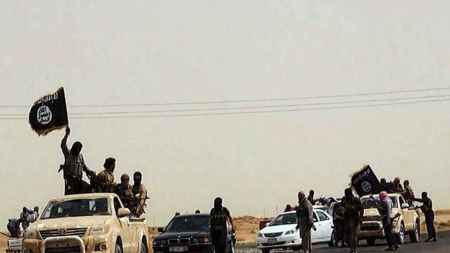
isis-caliphate

Sum up our failed Middle East policy in a nine-letter word starting with an S. Stability.

Stability is the heart and soul of nation-building. It’s the burden that responsible governments bear for the more irresponsible parts of the world. First you send experts to figure out what is destabilizing some hellhole whose prime exports are malaria, overpriced tourist knickknacks and beheadings. You teach the locals about democracy, tolerance and storing severed heads in Tupperware containers.

Then if that doesn’t work, you send in the military advisers to teach the local warlords-in-waiting how to better fight the local guerrillas and how to overthrow their own government in a military coup.

Finally, you send in the military. But this gets bloody, messy and expensive very fast.

So most of the time we dispatch sociologists to write reports to our diplomats explaining why people are killing each other in a region where they have been killing each other since time immemorial, and why it’s all our fault. Then we try to figure out how we can make them stop by being nicer to them.

The central assumption here is stability. We assume that stability is achievable and that it is good. The former is completely unproven and even the latter remains a somewhat shaky thesis.

The British wanted stability by replicating the monarchy across a series of Middle Eastern dependents. The vast majority of these survived for a shorter period than New Coke or skunk rock. Their last remnant is the King of Jordan, born to Princess Muna al-Hussein aka Antoinette Avril Gardiner of Suffolk, educated at the Royal Military Academy, Sandhurst, and currently trying to stave off a Muslim Brotherhood-Palestinian uprising by building a billion dollar Star Trek theme park.

The British experiment in stabilizing the Middle East failed miserably. Within a decade the British government was forced to switch from backing the Egyptian assault on Israel to allying with the Jewish State in a failed bid to stop the Egyptian seizure of the Suez Canal.

The American experiment in trying to export our own form of government to Muslims didn’t work any better. The Middle East still has monarchies. It has only one democracy with free and open elections.

Israel.

Even Obama and Hillary’s Arab Spring was a perverted attempted to make stability happen by replacing the old Socialist dictators and their cronies with the political Islamists of the Muslim Brotherhood. They abandoned it once the chaos rolled in and stability was nowhere to be found among all the corpses.

It might be time to admit that barring the return of the Ottoman Empire, stability won’t be coming to the Middle East any time soon. Exporting democracy didn’t work. Giving the Saudis a free hand to control our foreign policy didn’t work. Trying to force Israel to make concessions to Islamic terrorists didn’t work. And the old tyrants we backed are sand castles along a stormy shore.

Even without the Arab Spring, their days were as numbered as old King Farouk dying in exile in an Italian restaurant.

If stability isn’t achievable, maybe we should stop trying to achieve it. And stability may not even be any good.

Our two most successful bids in the Muslim world, one intentionally and the other unintentionally, succeeded by sowing chaos instead of trying to foster stability. We helped break the Soviet Union on a cheap budget in Afghanistan by feeding the chaos. And then we bled Iran and its terrorist allies in Syria and Iraq for around the price of a single bombing raid. Both of these actions had messy consequences.

But we seem to do better at pushing Mohammed Dumpty off the wall than at putting him back together again. If we can’t find the center of stability, maybe it’s time for us to embrace the chaos.

Embracing the chaos forces us to rethink our role in the world. Stability is an outdated model. It assumes that the world is moving toward unity. Fix the trouble spots and humanity will be ready for world government. Make sure everyone follows international law and we can all hum Lennon’s “Imagine”.

Not only is this a horrible dystopian vision of the future, it’s also a silly fantasy.

The UN is nothing but a clearinghouse for dictators. International law is meaningless outside of commercial disputes. The world isn’t moving toward unity, but to disunity. If even the EU can’t hold together, the notion of the Middle East becoming the good citizens of some global government is a fairy tale told by diplomats while tucking each other into bed in five-star hotels at international conferences.

It’s time to deal with the world as it is. And to ask what our objectives are.

Take stability off the table. Put it in a little box and bury it in an unmarked grave at Foggy Bottom. Forget about oil. If we can’t meet our own energy needs, we’ll be spending ten times as much on protecting the Saudis from everyone else and protecting everyone else from the Saudis.

Then we should ask what we really want to achieve in the Middle East.

We want to stop Islamic terrorists and governments from harming us. Trying to stabilize failed states and prop up or appease Islamic governments hasn’t worked. Maybe we ought to try destabilizing them.

There have been worse ideas. We’re still recovering from the last bunch.

To embrace chaos, we have to stop thinking defensively about stability and start thinking offensively about cultivating instability. A Muslim government that sponsors terrorism against us ought to know that it will get its own back in spades. Every Muslim terror group has its rivals and enemies waiting to pounce. The leverage is there. We just need to use it.

When the British and the French tried to shut down Nasser, Eisenhower protected him by threatening to collapse the British pound. What if we were willing to treat our Muslim “allies” who fill the treasuries of terror groups the way that we treat our non-Muslim allies who don’t even fly planes into the Pentagon?

We have spent the past few decades pressuring Israel to make deals with terrorists. What if we started pressuring Muslim countries in the same way to deal with their independence movements?

The counterarguments are obvious. Supply weapons and they end up in the hands of terror groups. But the Muslim world is already an open-air weapons market. If we don’t supply anything too high end, then all we’re doing is pouring gasoline on a forest fire. And buying the deaths of terrorists at bargain prices.

Terrorism does thrive in failed states. But the key point is that it thrives best when it is backed by successful ones. Would the chaos in Syria, Nigeria or Yemen be possible without the wealth and power of Saudi Arabia, Qatar and Iran? Should we really fear unstable Muslim states or stable ones?

That is really the fundamental question that we must answer because it goes to the heart of the moderate Muslim paradox. Is it really the Jihadist who is most dangerous or his mainstream ally?

If we believe that the Saudis and Qataris are our allies and that political Islamists are moderates who can fuse Islam and democracy together, then the stability model makes sense. But when we recognize that there is no such thing as a moderate civilizational Jihad, then we are confronted with the fact that the real threat does not come from failed states or fractured terror groups, but from Islamic unity.

Once we accept that there is a clash of civilizations, chaos becomes a useful civilizational weapon.

Islamists have very effectively divided and conquered us, exploiting our rivalries and political quarrels, for their own gain. They have used our own political chaos, our freedoms and our differences, against us. It is time that we moved beyond a failed model of trying to unify the Muslim world under international law and started trying to divide it instead.

Chaos is the enemy of civilization. But we cannot bring our form of order, one based on cooperation and individual rights, to the Muslim world. And the only other order that can come is that of the Caliphate.

And chaos may be our best defense against the Caliphate.

Sinai attacks decline as Egypt’s fight against IS yields results

August 29, 2016

Sinai attacks decline as Egypt’s fight against IS yields results Through targeted bombings on Islamic State’s Jabal Hilal stronghold, Egyptian military deals strong blow to terror group’s capabilities

By Avi Issacharoff

August 29, 2016, 2:51 pm

Source: Sinai attacks decline as Egypt’s fight against IS yields results | The Times of Israel

Smoke rises after a house was blown up in a military operation in Egypt’s Sinai peninsula on November 20, 2014. (Abed Rahim Khatib/Flash90)

There has been a steady and significant decline in terror attacks carried out by the Islamic State in the Sinai Peninsula in recent months, according to both Egyptian and Israeli sources.

Get The Times of Israel’s Daily Edition by email
and never miss our top stories
  Free Sign up!

Though the Islamic State’s armed activities continue apace in the northeast triangle framed by the Israel, Gaza and Egypt borders, there have been fewer terror attacks on the Egyptian army, with a smaller number of casualties than last year, and the attacks have been less ambitious than those IS carried out in 2014 and 2015, as a result of the group’s weakened force and diminished weapons supply.

The Egyptian military’s operations in the central Sinai Peninsula and a series of airstrikes in the Jabal Hilal region — a terrorist-controlled area — have dealt a powerful blow to IS’s military capabilities, the sources said.

For the past few years, Jabal Hilal has been the stronghold of the extremist group in the peninsula, mostly due to its topography.

The region’s extensive cave system — it is considered the “Tora Bora of the Sinai,” an allusion to the rugged region of Afghanistan that Taliban and al-Qaeda fighters made into a bastion against the United States — has made it the preferred destination for IS, the current iteration of the Ansar Bayt al-Maqdis group.

Three months ago, toward the end of May, the Egyptian military spokesperson, Col. Muhammad Samir announced the killings of “88 armed members of the jihadist group in central and northern Sinai.”

May’s large-scale aerial campaign not only took out nearly 100 IS operatives, it also injured hundreds more, dozens of them seriously. In addition to the human casualties, the bombings destroyed the group’s weapons storage facilities and ammunition caches, which had been kept hidden for years.

Essentially, the “logistic front” of the Islamic State in Sinai was destroyed, the sources said.

Around the same time, Egyptian President Abdel-Fattah el-Sissi also discussed the actions against IS, which focused on Jabal Hilal, an area that is seen as particularly problematic. According to Sissi, there had been a significant victory in the fight against terror. However, he clarified, the state of emergency for Egypt would continue.

An image taken from a video clip released by the Sinai affiliate of the Islamic State group on August 1, 2016. (MEMRI)

An image taken from a video clip released by the Sinai affiliate of the Islamic State group on August 1, 2016. (MEMRI)

Earlier this month, the Egyptian military announced another achievement, the execution of Abu Duaa al-Ansari, the presumed commander of the Islamic State in Sinai, formerly known as Ansar Bayt al-Maqdis.

According to the military’s statement, the series of bombings south of el-Arish — the provincial capital of the Sinai — in which al-Ansari was killed came as the result of precise intelligence. During the bombings, a number of weapons storehouses were destroyed and some 45 operatives were killed.

Illustrative: Egyptian security forces in the Sinai, in July 2013. (Mohamed El-Sherbeny/AFP)

Illustrative: Egyptian security forces in the Sinai, in July 2013. (Mohamed El-Sherbeny/AFP)

Throughout 2015, dozens of Egyptian soldiers were killed by IS, with the worst attack taking place during the month of Ramadan in simultaneous assaults on a number of Egyptian military outposts near the town of Sheikh Zuweid that left over 50 dead.

Since the July 1, 2015 attack, however, the Egyptian military’s intelligence has improved. In addition, security collaboration and cooperation with Israel has continued.

Recently, Egypt has made a number of significant gestures in the diplomatic realm, including a rare meet-up between its foreign minister and Prime Minister Benjamin Netanyahu, that testify to the closeness of the two sides.

Up to 75 Kurds said killed in Turkish bombardment in Syria

August 28, 2016

Up to 75 Kurds said killed in Turkish bombardment in Syria Scores reported injured in attacks on areas used by US-backed forces, as Ankara steps up its cross-border offensive

By Layal Abou Rahal and Stuart Williams

August 28, 2016, 11:54 am Updated: August 28, 2016, 2:55 pm

Source: Up to 75 Kurds said killed in Turkish bombardment in Syria | The Times of Israel

A Turkish army tank and an armored vehicle are stationed near the border with Syria, in Karkamis, Turkey, August. 23, 2016. (IHA via AP)

BEIRUT, Lebanon (AFP) — Turkish shelling and airstrikes killed at least 40 Syrians on Sunday, a monitor said, in the first significant civilian casualties in Turkey’s intensifying campaign in northern Syria.

Turkey’s state-run Anadolu news agency said the army had killed 25 Kurdish “terrorists” in airstrikes as part of its unprecedented operation inside Syria.

The bombardments came after Ankara suffered its first military fatality since it launched the two-pronged offensive against the Islamic State group and Syrian Kurdish militia inside Syria on Wednesday.

At least 20 civilians were killed and 50 wounded in Turkish artillery fire and airstrikes on the village of Jeb el-Kussa early on Sunday, the Syrian Observatory for Human Rights monitoring group said.

Another 20 were killed and 25 wounded, many seriously, in Turkish airstrikes near the town of Al-Amarneh, it said.

The monitor also said at least four Kurdish fighters had been killed and 15 injured in Turkish bombardment of the two areas.

A spokesman for the local Kurdish administration said 75 people had been killed in both villages.

The Britain-based Observatory said the bombardment targeted an area south of the former IS border stronghold of Jarabulus, which Turkish-led forces captured on the first day of the incursion.

Fighting has since intensified south of the town, where clashes erupted between Turkish troops and forces belonging to the Kurdish Democratic Union (PYD) party, which Ankara considers a terrorist group linked with Kurdish militants in Turkey.

US-backed Kurdish forces have also been fighting IS in Syria but Turkey fiercely opposes any move by Kurds to expand into territory lost by the jihadists.

Funeral for Turkish soldier

The latest fighting is likely to raise deep concerns for Turkey’s NATO ally the United States, which supports the Kurdish militia — known as the People’s Protection Units (YPG) — as an effective fighting force against IS.

The Turkish soldier was killed and three more wounded on Saturday in a rocket attack by Kurdish militia on two tanks taking part in an offensive against the pro-Kurdish forces south of Jarabulus.

Turkish media named the dead soldier as Ercan Celik, 28, and said a funeral for him would be held on Sunday in Gaziantep.

President Recep Tayyip Erdogan was due to visit the city on Sunday to express condolences for last weekend’s suicide bombing there at a Kurdish wedding that left 54 dead.

Turkey’s NTV television reported that Turkish artillery had struck YPG targets throughout the night and that Turkish warplanes had carried out new bombing sorties on Sunday morning.

Turkish forces carried out their first airstrikes on pro-Kurdish positions on Saturday as part of what Ankara is calling “Operation Euphrates Shield”.

Turkey says that the YPG — which it regards as the Syrian branch of the outlawed Kurdistan Workers’ Party (PKK) — has failed to stick to a promise to return across the Euphrates River after advancing west this month despite guarantees given by Washington.

Ankara fears the emergence of a contiguous autonomous Kurdish region in Syria would bolster the PKK rebels across the border in southeast Turkey.

Ankara’s military intervention in Syria has added another dimension to the country’s complex multi-front war, a devastating conflict that has killed more than 290,000 people and forced millions from their homes since it began in March 2011.

Much of the heaviest fighting this summer has focused on second city Aleppo, which is roughly divided between rebel forces and President Bashar Assad’s troops.

Push for 48-hour ceasefire

Global powers have been pushing for 48-hour humanitarian ceasefires in the embattled city and UN Syria envoy Staffan de Mistura has urged warring parties to announce by Sunday whether they will commit to a pause in the fighting.

The UN says it has “pre-positioned” aid to go to the city for some 80,000 people.

Russia, which backs Assad’s forces, has endorsed the proposal.

But some rebel groups have rejected the plan unless aid passes through opposition-held areas and the ceasefire applies to other areas of Syria under siege.

Opposition groups have repeatedly called for an end to regime sieges of rebel-held areas, accusing Assad’s government of using “starve or surrender” tactics.

On Saturday, the last rebel fighters were evacuated from the town of Daraya just outside Damascus, under a deal that followed a brutal four-year government siege.

Hundreds of fighters and their families were bused north into rebel-held territory in Idlib province, with other civilians transferred to government territory near Damascus for resettlement.

The Syrian army said it was in complete control of the town, from which roughly 8,000 civilians were due to be evacuated.


