Posted tagged ‘Islamic Jihad’

Turkish military repeatedly shell Assad forces; Kurds confirm to RT being hit by massive attack

February 14, 2016

Turkish military repeatedly shell Assad forces; Kurds confirm to RT being hit by massive attack

Published time: 13 Feb, 2016 16:17 Edited time: 14 Feb, 2016 00:56

Source: Turkish military repeatedly shell Assad forces; Kurds confirm to RT being hit by massive attack — RT News

The Turkish army has shelled Syrian government forces in Aleppo and Latakia provinces, while also hitting Kurdish targets near the city of Azaz in northwestern Syria, including an air base recently retaken from Islamist rebels, with a massive attack.

Anatolia news agency reported that the Turkish military hit Syrian government forces on Saturday, adding that the shelling had been in response to fire inflicted on a Turkish military guard post in Turkey’s southern Hatay region.

Turkish artillery targeted Syrian forces again late on Saturday, according to a military source quoted by RIA Novosti. The attack targeted the town of Deir Jamal in the Aleppo Governorate.

The agency also cited details of an earlier attack on Syrian government army positions in northwestern Latakia.

“Turkey’s artillery opened fire on the positions of the Syrian Army in the vicinity of Aliya mountain in the northwestern part of the province of Latakia,” the source said.

Meanwhile, the Turkish shelling of Kurdish positions continued for more than three hours almost uninterruptedly, a Kurdish source told RT, adding that the Turkish forces are using mortars and missiles and firing from the Turkish border not far from the city of Azaz in the Aleppo Governorate.

The shelling targeted the Menagh military air base and the nearby village of Maranaz, where “many civilians were wounded,” local journalist Barzan Iso told RT. He added that Kurdish forces and their allies among “the Syrian democratic forces” had taken control of the air base on Thursday.

According to Iso, the Menagh base had previously been controlled by the Ahrar ash-Sham Islamist rebel group, which seized it in August of 2013. The journalist also added that Ahrar ash-Sham militants at the base had been supported by Al-Nusra terrorists and some extremist groups coming from Turkey.

Ahrar ash-Sham is a militant group that has trained teenagers to commit acts of terror in Damascus, Homs, and Latakia provinces, according to data provided to the Russian Defense Ministry by Syrian opposition forces.

The group, which has intensified its attacks on the Syrian government forces since January, was getting “serious reinforcements from Turkey,” Russian Foreign Ministry spokeswoman Maria Zakharova said during a briefing in Moscow on January 21.

A source in the Turkish government confirmed to Reuters that the Turkish military had shelled Kurdish militia targets near Azaz on Saturday.

The Turkish Armed Forces fired shells at PYD positions in the Azaz area,” the source said, referring to the Syrian Kurdish Democratic Union Party (PYD), which Ankara views as a terrorist group.

A Turkish security official told Reuters that the shelling of the Kurds had been a response to a shelling of Turkish border military outposts by the PYD and forces loyal to Damascus, as required under Turkish military rules of engagement.

Turkey’s PM Davutoglu also confirmed that the country’s forces had struck Syrian Kurdish fighters and demanded that the Kurds retreat from all of the areas that they had recently seized.

“The YPG will immediately withdraw from Azaz and the surrounding area and will not go close to it again,” he told reporters, adding that Turkey “will retaliate against every step [by the YPG],” Reuters reports.

A Kurdish official confirmed to Reuters that the shelling had targeted the Menagh air base located south of Azaz.

According to the official, the base had been captured by the Jaysh al-Thuwwar rebel group, which is an ally of PYD and a member of the Syria Democratic Forces alliance.

Syrian Kurds are actively engaged in the fight against the Islamic State (IS, formerly ISIS/ISIL) terrorist group and have been recently described as “some of the most successful” forces fighting IS jihadists in Syria by US State Department spokesman John Kirby, AFP reports.

Earlier, the US also called the PYD an “important partner” in the fight against Islamic State, adding that US support of the Kurdish fighters “will continue.”

Read more

Russian Foreign Minister Sergei Lavrov (L) speaks to German Foreign Minister Frank-Walter Steinmeier at the Munich Security Conference in Munich, Germany, February 13, 2016. © Michael Dalder

Turkey’s shelling of the Syrian Kurds comes just days after a plan to end hostilities in Syria was presented in Munich after a meeting of the so-called International Syria Support Group (ISSG), in which Russian Foreign Minister Sergey Lavrov, US Secretary of State John Kerry, and UN Special Envoy on Syria Staffan de Mistura participated.

‘We will strike PYD’ – Turkish PM

Earlier on Saturday, Turkish Prime Minister Ahmet Davutoglu threatened Syrian Kurds with military action, saying that Turkey will resort to force against the Syrian Kurdish People’s Protection Units (YPG) if it considers the step “necessary.”

As I have said, the link between the YPG and the [outlawed Kurdistan Workers’ Party] PKK is obvious. If the YPG threatens our security, then we will do what is necessary,” Davutoglu said on February 10, as quoted by the Hurriyet Daily.

“The leadership cadre and ideology of the PKK and PYD is the same,” he argued in a televised speech in the eastern city of Erzincan on Saturday, AFP reports.

Davutoglu also said that if there is a threat to Turkey, “we will strike PYD like we did Qandil,” referring to a bombing campaign waged by Turkey against the PKK in its Qandil mountain stronghold in northern Iraq, Daily Sabah reports.

Turkey regards the Syrian Kurdish Democratic Union Party (PYD) and its military wing, the YPG, as affiliates of the outlawed Kurdistan Workers’ Party (PKK), which has waged a decade-long insurgency against Turkish authorities, demanding autonomy for Turkish Kurds.

The latest developments come as Turkey continues a relentless crackdown on Kurds in its southeastern region. Ankara launched a military operation against Kurdish insurgents from the outlawed Kurdistan Workers’ Party (PKK) in July of 2015, breaking a ceasefire signed in 2013.

Turkey’s General Staff claim that Turkish forces killed more than 700 PKK rebels during the offensive in the southeastern districts of Cizre and Sur. Meanwhile, Amnesty International has reported that at least 150 civilians, including women in children, were killed in the Turkish military operation, adding that over 200,000 lives have been put at risk.

According to the Turkish Human Rights Foundation, at least 198 civilians, including 39 children, have been murdered in the area since August of 2015.


49%-51%: Germany, Russia, UK disagree on odds of Syrian ceasefire holding

February 13, 2016

49%-51%: Germany, Russia, UK disagree on odds of Syrian ceasefire holding

Published time: 13 Feb, 2016 14:51

Source: 49%-51%: Germany, Russia, UK disagree on odds of Syrian ceasefire holding — RT News

Russian Foreign Minister Sergei Lavrov (L) speaks to German Foreign Minister Frank-Walter Steinmeier at the Munich Security Conference in Munich, Germany, February 13, 2016. © Michael Dalder


The foreign ministers of Germany, Russia and the UK attending a security conference in Munich gave conflicting views on how likely the negotiated ceasefire in Syria would hold and who it would depend on.

Responding to a question on how likely the Syrian Army and so-called moderate rebel groups are to observe the ceasefire negotiated by world powers, Germany’s Frank-Walter Steinmeier simply said, “51 percent.”

Sergey Lavrov, his Russian counterpart, was reluctant to voice any percentage, and said any success in the peace process would depend on the US military finally agreeing on coordinating their actions in Syria with Russia.

Read more

Russian Prime Minister Dmitry Medvedev delivers a speech at the Munich Security Conference in Munich, Germany, February 13, 2016. © Michael Dalder

He said that while his counterpart, Secretary of State John Kerry, in his Munich speech earlier said that military cooperation with Russia is what the US wants in Syria, statements from the Pentagon directly contradicted it. Moreover, the US insists on continuing its own military action in Syria while demanding that Russia put its campaign on hold, even though both campaigns are targeting terrorist groups.

“The fact that the discourse around this ceasefire is drifting toward prioritizing the halt of the operations of the Russian Air Forces makes me strongly suspect that our peace effort would end in a sour way. If the military are not maintaining an honest day-to-day contact… nothing can be achieved,” Lavrov said.

“If the Americans try to play it back now, it would be their responsibility,” he added.

Moderator Wolfgang Ischinger joked: “Sounds like a little less than 50 percent,” to which Lavrov glumly replied: “Forty-nine.”

“I don’t speak Russian, but I was judging something close to zero,” commented the third member of the panel, UK Foreign Secretary Philip Hammond.

Read more

Royal Saudi Air Force jets © Fahad Shadeed

He proceeded to say that it was Russia who can finally make or break the ceasefire, accusing Moscow of bombing the same moderate opposition that it expects to observe the ceasefire, an allegation that Russia denies.

“Whatever you call it, whatever the justification, whatever the language – over the last weeks Russia has been bombing the moderate opposition positions. In the name of fighting terrorism, whatever,” Hammond said. “Unless Russia over the next days is going to stop or at least significantly scale back that bombing, the moderate armed opposition will not join in this process.”

Ironically, Russia has been trying for months to get the sponsors of the “moderate Syrian opposition” provide the Russian military with accurate list of the armed groups, which should be considered moderate enough to be negotiated with, and their positions so that Russia wouldn’t bomb them. This information is exactly what Lavrov said the Pentagon is withholding from the Russian military, despite all Moscow’s requests.

What is collectively called the Syrian rebels are a fluid and disorganized assortment of armed groups with conflicting agendas and shifting allegiances. Agreeing who should be at the negotiations table was a major challenge during the organization of the peace talks in Munich, and eventually only the terrorist group Islamic State and the Al-Qaeda branch in Syria, the Nusra Front, were explicitly excluded.

Germany’s Migrant Crisis: January 2016

February 12, 2016

Germany’s Migrant Crisis: January 2016, Gatestone Institute, Soeren Kern, February 12, 2016

♦ Despite snow, ice and freezing temperatures across much of Europe, a total of 91,671 migrants entered Germany during January 2016.

♦ German taxpayers could end up paying 450 billion euros ($500 billion) for the upkeep of the million migrants who arrived in Germany in 2015. This would presumably double to nearly one trillion euros if another million migrants arrive in 2016.

♦ A 19-year-old migrant from Afghanistan sexually assaulted four girls between the ages of 11 and 13 at a swimming pool in Dresden. The migrant was arrested but then set free.

♦ Three teenage migrants from North Africa tried to stone to death two transsexuals in Dortmund after they were seen walking around in women’s clothing. The victims were saved by police.

♦ Bild reported that politicians in Kiel had ordered the police to overlook crimes perpetrated by migrants.

♦ “The topics we cover are determined by the government. … We must report in such a way that serves Europe and the common good, as it pleases Mrs. Merkel. … today we are not allowed to say anything negative about the refugees. This is government journalism.” – Wolfgang Herles, retired public media personality.

♦ The European Commission called for the “rejection of false associations between certain criminal acts, such as the attacks on women in Cologne on New Year’s Eve, and the mass influx of refugees.”

In January 2016, the German public appeared finally to wake up to the implications of their government’s decision to allow 1.1 million — mostly male — migrants from Africa, Asia and the Middle East to enter the country during 2015.

After more than a thousand Muslim migrants sexually assaulted hundreds of women in cities across Germany on New Year’s Eve, Chancellor Angela Merkel began to face a rising voter backlash to her open-door migration policy.

Merkel’s government has responded to the criticism by: 1) attempting to silence critics of the open-door migration policy; 2) trying to “export” the migrant problem to other countries in the European Union; and 3) announcing a series of measures — branded as unrealistic by critics — to deport migrants accused of committing crimes in Germany.

What Merkel has steadfastly refused to do, however, is reduce the number of migrants entering the country. Despite snow, ice and freezing temperatures across much of Europe, a total of 91,671 migrants — an average of around 3,000 migrants each day — entered Germany during the month of January 2016.

The following is a review of some of the more notable stories about the migration crisis in Germany during January 2016.

January 1. More than a thousand migrants sexually assaulted hundreds of German women in the cities of Cologne, Hamburg and Stuttgart. The government and the mainstream media were accused of trying to cover up the crimes, apparently to avoid fueling anti-immigration sentiment.

January 1. As Muslim migrants were causing mayhem on German streets, the Minister President of Baden-Württemberg, Winfried Kretschmann, said he could not understand public concerns about the “alleged Islamization” of Germany. In an interview with Die Welt, he said: “If you look at the facts, this fear is unfounded. We have a stable democracy and a free society. State and religion are separated. How should Muslims, who represent a minority, Islamize our society?” When asked why Germans are afraid, Kretschmann replied: “People are afraid of strangers they do not know.”

January 1. The International Monetary Fund (IMF) estimated that 1.3 million asylum seekers would enter the European Union annually during 2016 and 2017.

January 2. A fight between children as young as 11 at a refugee shelter in Stockach near Konstanz turned into a mass brawl after parents of the children joined in the fighting. Police were deployed to restore order. Seven people were injured.

January 3. A 16-year-old Moroccan migrant went on a rampage after a judge in Bremen ordered him to be jailed for stealing a man’s laptop at knife-point. On the way from the courthouse to the jail, the Moroccan seriously injured a police officer by kicking him in the face. Once inside the jail cell, the migrant ripped a toilet from the floor and smashed it against a wall.

The chairman of the Bremen Police Union, Jochen Kopelke, said that migrants were attacking city police with increasing frequency: “The tone has become extremely aggressive; sometimes the police must apply massive force to get a situation under control.” According to Bremen Senator Ulrich Mäurer, “the excesses of violence against police officers show that these people have no respect for our constitutional order and its representatives.”

January 3. More than 50 migrants were involved in a mass brawl at a refugee shelter inEllwangen near Stuttgart. Police said migrants attacked each other with fire extinguishers, metal pipes, rocks and stones. According to local media, mass brawls have become commonplace at migrant shelters in the area.

January 3. Hans-Werner Sinn, one of the best-known economists in Germany, cited estimates that German taxpayers could end up paying 450 billion euros ($500 billion) for the upkeep of the million migrants who arrived in Germany in 2015. This estimate would presumably double to nearly one trillion euros if another million migrants arrive in Germany in 2016.

January 4. An internal report written by a senior federal police officer revealed chaos “beyond description” in Cologne on New Year’s Eve. The report, which was leaked to the news magazineDer Spiegel and published in full by the newspaper Bild, said that women were forced to “run a gauntlet” of drunken men of a “migrant background” to enter or depart the main train station. “Even the appearance of the police officers and their initial measures did not stop the masses from their actions.” One migrant told a police officer: “I am Syrian; you have to treat me kindly! Mrs. Merkel has invited me.”

January 5. Cologne Mayor Henriette Reker said: “There is no reason to believe that those involved in the sexual assaults in Cologne were refugees.” Cologne Police Chief Wolfgang Alberssaid: “At this time we have no information about the offenders.”

January 6. Former Interior Minister Hans-Peter Friedrich said it was “scandalous that it took the mainstream media several days” to report on the sexual assaults in Cologne. He said public media was a “cartel of silence” exercising censorship to protect migrants from accusations of wrongdoing.

January 7. A charity called Refugees Welcome Bonn, which organized a Rhine River cruise as welcoming party for migrants in Bonn, apologized after it emerged that migrants groped and sexually harassed some female guests during the event.

January 8. The Interior Ministry revealed that of the 32 suspects identified in the Cologne assaults, 22 were asylum seekers. Cologne Police Chief Wolfgang Albers was fired for withholding information about the assaults from the public.

January 9. A vigilante group began patrolling the streets of Düsseldorf to “make the city safer for our women.” Similar groups emerged in Cologne and Stuttgart.

January 10. Three teenage migrants from North Africa tried to stone to death two transsexuals inDortmund after they were seen walking around in women’s clothing. The victims were saved by police, who happened to pass by in a car. One of the victims said: “I never could have imagined that something like this could happen in Germany.”

January 11. A 35-year-old migrant from Pakistan sexually assaulted a three-year-old girl at a refugee shelter in Kamen.

January 12. In an interview with Bild, Frank Oesterhelweg, a politician with the center-right Christian Democrats (CDU), caused a scandal when he said that police should be authorized to use deadly force to prevent migrants from raping German women:

“These criminals deserve no tolerance, they have to be stopped by the police. By force if necessary, and, yes, you read correctly, even with firearms. An armed police officer has a duty to help a desperate woman. One must, if necessary, protect the victims by means of force: With truncheons, water cannons or firearms.”

Police union leader Dietmar Schilff was irate: “These statements are outrageous and do not help the police at all. There are clear rules for using the service weapon. What would have happened in Cologne if the police had used clubs and guns?” According to Bild, many German police officers are afraid of using lethal force “because of the legal consequences.”

January 12. A YouGov poll showed that 62% of Germans believe the number of asylum seekers is too high, up from 53% in November. According to the poll, the growing resistance to immigration was being driven by the hardening of attitudes by German women.

January 13. An Interior Ministry report leaked to Bild warned that jihadist attacks like those in Paris could take place in Germany “at any time.” The report said that attacks would likely be spread over several days and against “various target categories.”

January 13. A 20-year-old migrant from Somalia was sentenced to four years in prison for raping an 88-year-old woman in Herford. His defense attorneys argued for leniency because, according to them, the man was traumatized by his flight from Somalia. In Gelsenkirchen, four migrantsattacked a 45-year-old man after he tried to prevent them from raping a 13-year-old girl.

January 14. The Bundestag, the lower house of the German parliament, approved a plan to provide all refugees with identity cards that will contain information such as fingerprints and country of origin. The cards will be linked to a centralized refugee data system. The plan may be too late: the German government has lost track of the whereabouts of hundreds of thousands of migrants who entered the country in 2015.

January 14. Prosecutors in Cologne said they were offering a reward of 10,000 euros ($11,000) for information leading to the arrest or identification of those who committed the sexual assaults and robberies on New Year’s Eve.

January 14. A Bavarian politician sent a bus carrying 31 refugees on a seven-hour journey to Chancellor Angela Merkel’s office in Berlin to protest her open-door refugee policy. Merkel sentthe migrants back to Bavaria.

January 14. City officials in Rheinberg cancelled this year’s carnival celebrations. Local police said that in wake of the sexual assaults in Cologne on New Year’s Eve, they were unable to guarantee the safety of female revelers.

January 15. A 36-year-old migrant sexually assaulted an eight-year-old girl at a public park in Hilden near Solingen. A 31-year-old migrant from Tunisia was arrested for attempting to rape a 30-year-old woman in Chemnitz. A 31-year-old migrant from Morocco appeared in court for raping a 31-year-old woman in Dresden. A migrant sexually assaulted a 42-year-old woman in Mainz. A migrant sexually assaulted a 32-year-old woman in Münchfeld. An African migrant sexually assaulted a 55-year-old woman in Mannheim.

January 15. Male migrants were banned from a public swimming pool in Bornheim, near Bonn, after they were accused of assaulting female patrons at the facility.

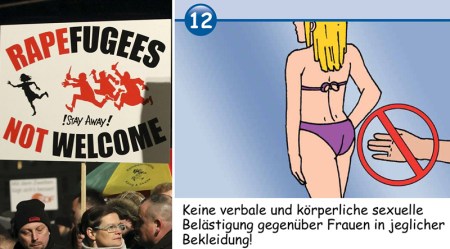
1470In January, there were thousands of cases of migrants sexually assaulting women in Germany, including many that took place in public pools. The government began to face a rising voter backlash to the open-door migration policy, including public protests (left). In some areas, authorities have distributed cartoon guides, to “educate” migrants that sexual assault is not acceptable (right).

January 15. Finance Minister Wolfgang Schäuble, in an interview with the Süddeutsche Zeitung, signaled his determination to export Germany’s migrant problem by calling for a Europe-wide gas tax to help pay for the cost of hosting millions of migrants. He said:

“If the funds in national budgets and the European budget are not enough, then let us agree, for example, to raise a levy on every liter of gasoline at a certain level. If a country refuses to pay, I am still prepared to do it. Then we will build a coalition of the willing.”

January 16. Norbert Röttgen, chairman of the foreign affairs committee in the German Bundestag and a lawmaker in Angela Merkel’s Christian Democratic Union (CDU), called upon the government to create a Ministry for Migration, Integration and Refugees. He said the migrant crisis had developed into a “primary and permanent task for the state” and is of “decisive importance for the future of our country and Europe.”

January 16. A 19-year-old migrant from Afghanistan sexually assaulted four girls between the ages of 11 and 13 at an indoor swimming pool in Dresden. The migrant was arrested but then set free. A migrant from Syria sexually assaulted a 12-year-old girl in Mudersbach. A 36-year-old migrant sexually assaulted an eight-year-old girl in Mettmann.

January 16. A group of between six and eight African migrants ambushed three people leaving a discotheque in Offenburg. The migrants were ejected from the discotheque after female clients complained that the men were sexually harassing them. After they left, at around 4AM, the migrants attacked them with metal rods, street signs and garbage bins.

January 17. In an interview with Bild am Sonntag, the president of the federal criminal police, Holger Münch, said that the number of crimes in refugee shelters had increased “significantly” since 2015, when the migrant influx began. He said that the migrants mostly responsible were from the Balkans and North Africa, especially Algerians, Tunisians and Moroccans. He added that half the offenses at the refugee shelters were physical assaults, but that there was also a growing number of homicides and sexual crimes.

January 17. In an interview with the Süddeutsche Zeitung, former Bavarian Prime Minister Edmund Stoiber warned that Chancellor Angela Merkel will “destroy Europe” if she refuses to reduce the number of migrants entering Germany.

January 17. Berlin clergyman Gottfried Martens accused German politicians and church leaders of ignoring the persecution of Christians by Muslims in German refugee shelters. He said that the Christians were facing “verbal threats, threats with knives, blows to the face, ripped crucifixes, torn bibles, insults of being an infidel, and denial of access to the kitchen because of uncleanness.”

January 18. A 26-year-old Algerian man was the first person to be arrested in connection with a string of sexual assaults during New Year’s celebrations in Cologne. He was apprehended at a refugee shelter in the nearby town of Kerpen. Cologne’s chief prosecutor, Ulrich Bremer, said that nearly 500 women had come forward with allegations of sexual assault, including three cases of rape.

January 18. A 24-year-old migrant from Sudan was released after being held for questioning at a police station in Hanover. After crossing the street, the man, who receives 300 euros ($335) a month in social welfare benefits, dropped his pants and exposed himself in public and shouted, “Who are you? You cannot do anything to me. Whatever I cannot get from the state, I will steal.”

January 19. Addressing the European Parliament in Strasbourg, European Council President Donald Tusk warned that the European Union had “no more than two months” to get control over the migration crisis or face the collapse of the Schengen passport-free travel zone.

January 19. A poll published by Bild showed that support for Chancellor Angela Merkel’s conservative bloc was down 2.5 points at 32.5%, its lowest result since the 2013 election. The poll showed that support for the anti-immigration Alternative for Germany (AfD) was up 1 point at 12.5%; support for the Social Democrats was up 1 point at 22.5%.

January 19. A 28-year-old migrant from Iran pushed a 20-year-old woman onto the tracks of an oncoming train in Berlin. She later died.

January 20. Bild reported that migrants invaded female changing rooms and showers at two public swimming pools in Leipzig. Migrants, dressed in their street clothes and underwear, also jumped into the swimming pools. According to Bild, the city hall had tried to keep the incidents quiet, but details were leaked to the media.

January 21. More than 200 migrants have sued the German government for delays in processing their asylum applications.

January 22. Facing political pressure over the migrant crisis, Chancellor Angela Merkel met in Berlin with Turkish Prime Minister Ahmet Davutoglu to discuss ways to stem the flow of Syrian and other refugees from Turkish shores. She renewed a pledge to provide Turkey with financial support. In November 2015, EU leaders pledged 3 billion euros ($3.4 billion) to Ankara to help care for an estimated 2.5 million Syrian refugees in Turkey; the deal has been delayed by a dispute among EU member states over who will pay.

January 22. A report by municipal authorities in Zwickau that was leaked to Bild revealed that migrants were defecating in public swimming pools. Security cameras also filmed migrants harassing women in the public sauna and attempting to storm the female dressing room.

January 22. Police in Hanover investigated four nightclub bouncers for allegedly beating an 18-year-old Algerian migrant after he tried to steal the purses of two teenage girls. Two days before the incident, the migrant had been sentenced to one year in juvenile detention for robbery, but he was free to roam the streets until his sentence began.

January 22. A migrant attempted to rape a 16-year-old girl in Feuerbach district of Stuttgart, and in downtown Stuttgart, four migrants sexually assaulted a 23-year-old woman.

January 23. The Süddeutsche Zeitung reported that migrants had attacked women in 12 of Germany’s 16 states on New Year’s Eve. In addition to the attacks Cologne, 195 women filed complaints in Hamburg; 31 in Hesse; 27 in Bavaria; 25 in Baden-Württemberg; 11 in Bremen; and six in Berlin.

January 23. Two migrants sexually assaulted an 18-year-old woman in Wiesbaden, and a 35-year-old migrant sexually assaulted a woman in a restroom on a train in Düsseldorf.

January 23. The Stuttgarter Nachrichten reported that dental work for migrants could end up costing German taxpayers billions of euros.

January 24. An official police report leaked to The Huffington Post showed that Interior Minister Thomas de Maizière was not being truthful when he said that between 100 and 200 migrants are being denied entry into Germany each day. The report stated that since September 14, border police had prevented 7,185 migrants from entering the country — or only about 60 migrants turned away each day.

January 25. A 30-year-old migrant from North African exposed himself to a 19-year-old woman on a public bus in Marburg, and then to passersby at the main train station.

January 26. In an interview with the German public radio, Deutschlandfunk, retired public media personality Wolfgang Herles admitted that public broadcasters receive “instructions from above” when it comes to reporting the news:

“We have the problem that we are too close to the government. The topics we cover are determined by the government. But many of the topics the government wants to prevent us from reporting about are more important than the topics they want us to cover…

“We must report in such a way that serves Europe [the European Union] and the common good, as it pleases Mrs. Merkel. There are written instructions … today we are not allowed to say anything negative about the refugees. This is government journalism, and this leads to a situation in which the public loses their trust in us. This is scandalous.”

Previously, Claudia Zimmermann, a reporter with the public television broadcaster WDR, said that public media outlets in Germany “have been warned to report the news from a pro-government perspective.”

January 26. A 24-year-old man on an evening stroll with his three-month-old baby daughter in the Eißendorf district of Hamburg was approached by two migrants who demanded his wallet and cellphone. When he said he was not carrying any valuables, the migrants attacked him with a knife. Fleeing for his life, the man ran onto a frozen pond and broke through the ice. A passerby heard the man calling for help. The baby, under water for an extended period, was revived by paramedics called to the scene. The baby remains in intensive care; the migrants remain at large.

January 26. A 28-year-old migrant from Algeria applied for asylum in Wesel. Authorities became suspicious because of his proficiency in German. They later determined that he had arrived in Germany in November 2014, rather than, as he claimed, in October 2015. It emerged that he had outstanding warrants for theft, but evaded police by using six different identities.

January 26. The Kieler Nachrichten reported that the proliferation of sexual assaults by migrants has women in the northern city of Kiel afraid to be out at night because the city is too dark. In an effort to save electricity, municipal officials decided to convert all of the city’s street lights to LED bulbs, but they do not provide sufficient light to keep the streets illuminated at night.

January 26. The mayor of Freiburg, Dieter Salomon, ordered police to take a hard line against migrants accused of snatching purses and assaulting women in the city’s discotheques. According to club owners, migrants have been robbing women on the dance floor and raping them in the restrooms. Many of the offenders are allegedly underage migrants from North Africa. Club owners say that the migrants are not afraid of authority: “They know that nothing will happen to them here.”

January 27. A 39-year-old migrant from Afghanistan tried to enter Germany at Simbach, a town on the border of Austria. A background check determined that in May 2000, a German court had sentenced the man to an eight-year prison term for rape. He had been deported to Afghanistan in 2006 with orders never to return.

January 27. The public radio and television channel, Mitteldeutscher Rundfunk, reported that German taxi drivers are profiting from the migrant crisis by taking migrants to doctors’ appointments and asylum interviews. The cab fares are being paid for by German taxpayers. MDR reported on a taxi company in Leipzig that had billed the government for 800 taxi fares for taking migrants to run errands. One taxi driver, for example, drove a migrant family on an 80 km (50 mile) journey for an appointment with migration authorities. The meter was left running while the driver waited for the migrants to return from their meeting. The fare was 309 euros ($344).

January 28. Bild reported that politicians in Kiel had ordered the police to overlook crimes perpetrated by migrants. According to the paper, the police in North Rhine-Westphalia and Lower Saxony have also been instructed to be lenient to criminal migrants.

January 28. A migrant from Sudan sexually assaulted a female police officer in Hanover as she was attempting to arrest him for theft. Public prosecutor Thomas Klinge confirmed the incident. “Such brazen behavior towards a police officer has been unheard of until now,” he said.

January 28. Berlin’s Tempelhof airport, the iconic site of the Berlin Airlift in 1948-49, is set to become the biggest refugee shelter in Germany. In a controversial move to alter the airport’s zoning regulations, Berlin’s municipal government — run by a coalition between the Christian Democratic Union and the Social Democratic Party — voted to build five massive structures to house 7,000 migrants there. Opposition politicians said the government was creating an “immigrant ghetto” in the heart of Berlin.

January 28. Police in Berlin said that a volunteer with the charity group Moabit Hilft hadfabricated a story about a 24-year-old migrant said to have died while waiting for days outside an asylum registration office. The story was allegedly faked in an effort to embarrass the government for its slow response to the migrant crisis.

January 29. The European Commission, the powerful administrative arm of the European Union, said that the sexual assaults in Cologne had nothing to do with the migrant crisis and were simply a matter of public order. A confidential memo leaked to The Telegraph stressed the importance of the Commission’s “continuing role in sounding the voice of reason to defuse tensions and counter populist rhetoric.” The Commission called for “the unconditional rejection of false associations between certain criminal acts, such as the attacks on women in Cologne on New Year’s Eve, and the mass influx of refugees.”

January 29. A public vocational school in the Wilhelmsburg district of Hamburg cancelled plans to host classes for refugees after male migrants sexually harassed dozens of female students at the school.

January 29. The German news magazine Focus published the results of a poll showing that 40% of Germans want Chancellor Angela Merkel to resign because of her migrant policies.

January 30. A gang of migrants on a Munich subway train were filmed attacking two elderly men who tried to stop them from groping a woman. Images show the migrants grabbing two men by the arms and neck and shouting abuse at them. It later emerged that the migrants were from Afghanistan; although they had been denied asylum in Germany four years ago, the German government refused to deport them because Afghanistan is “too dangerous.”

January 31. The Interior Minister of Saxony-Anhalt, Holger Stahlknecht, of the Christian Democrats, announced that he would delay releasing the 2015 crime statistics until March 29, two-and-half weeks after regional elections. The statistics are normally released in February or early March. Rüdiger Erben of the Social Democrats said: “The late release date reinforces my suspicion that the statistics are horrific.”

January 31. ISIS sympathizers defaced more than 40 gravestones at a cemetery in Konstanzwith slogans such as, “Germans out of Syria,” “Christ is Dead” and “Islamic State.”

January 31. A 30-year-old German, originally from Turkmenistan, raped a seven-year-old girl in Kiel. The man kidnapped the girl from a school playground at 11AM, took her to his apartment and, after abusing her, set her free. It later emerged that the man, who is the father of two children, had been accused of sexually assaulting a five-year-old girl at another kindergarten in Kiel on January 18, but the public prosecutors failed to pursue the case due to insufficient evidence. “In hindsight, we regret that decision,” the prosecutors said.

January 31. In an underhanded effort to silence critics of the government’s open door migration policy, Vice Chancellor Sigmar Gabriel called on German intelligence to begin monitoring the Alternative for Germany (AfD), the third-largest party in Germany. The AfD is surging in popularity because of its anti-immigration platform.

Syria crisis plan: Cessation of hostilities, humanitarian airdrops, peace talks laid out in Munich

February 12, 2016

Syria crisis plan: Cessation of hostilities, humanitarian airdrops, peace talks laid out in Munich

Published time: 12 Feb, 2016 00:10 Edited time: 12 Feb, 2016 06:38

Source: Syria crisis plan: Cessation of hostilities, humanitarian airdrops, peace talks laid out in Munich — RT News

 Russian Foreign Minister Sergei Lavrov, U.S. Secretary of State John Kerry and UN Special Envoy for Syria, Staffan de Mistura (L-R) arrive for a news conference after the International Syria Support Group (ISSG) meeting in Munich, Germany, February 12, 2016. © Michael Dalder
An ambitious plan to end hostilities in Syria with verifiable results within a week, revive the Geneva-3 peace talks, and immediately begin delivering humanitarian aid to civilians has been unveiled in Munich, Germany after talks including the US, Russia, and the UN.

Hostilities in Syria could come to a halt within a week after confirmation by the government of President Bashar Assad and the opposition, according to an official communiqué from the International Syria Support Group (ISSG) meeting.

A mechanism to help resolve humanitarian issues in Syria has been developed, which includes the creation of a task force that will begin work on Friday.

A press conference was held after the meeting of the so-called Syria Support Group, with the participation of Russian Foreign Minister Sergey Lavrov, US Secretary of State John Kerry, and UN Special Envoy on Syria Staffan de Mistura.

Read more

Russian Foreign Minister Sergey Lavrov.

Kerry noted that the commitments agreed upon during the Munich meeting are only on paper and that the “real test” of progress will be to get all of the parties involved in the Syrian conflict to sign on and honor them.

Russia is counting on the US and other ISSG countries to put pressure on the Syrian opposition to cooperate with the UN, Lavrov said.

The main objective that everyone agrees on is to destroy Islamic State, Lavrov added. He also called the notion that the situation in Syria would improve if Assad’s regime was to abdicate an “illusion.”

READ MORE: Terrorists’ supply routes from Turkey cut off during army offensive in northern Syria

Talk about the need to prepare ground troops for an invasion of Syria will only add fire to the conflict, Russia’s foreign minister stressed.

The aim now is to resume peace talks without preconditions between the Syrian government and the whole spectrum of the opposition, which is the only format in which they could be successful, Lavrov emphasized.

“The goal of resuming the negotiation process, which was suspended in an atmosphere where part of the [Syrian] opposition took a completely unconstructive position and tried to put forward preconditions, was stressed [at the ISSG meeting]. We noted [today] that the talks must resume as soon as possible in strict compliance with UN Security Council Resolution 2254, without any ultimatums or preconditions,” he said.

Read more

Policemen walk in front of the Bayerischer Hof hotel, the location for the 52nd Munich Security Conference (MSC), in Munich, southern Germany, on February 11, 2016. © Thomas Kienzle

While Lavrov, Kerry and Mistura held a press conference to explain the results of the ISSG meeting, separate statements came from several EU leaders. Germany’s foreign minister, Frank-Walter Steinmeier, was quoted by Reuters as saying that the US and Russia should coordinate their military actions in Syria “more closely.”

Lavrov made clear that an end in hostilities in Syria would not mean a halt in anti-terrorist activities in the region. Operations against all groups designated by the UN as terrorists will continue, including the fight against Islamic State and Al-Nusra Front.

READ MORE: Russia’s cutting edge Su-35 fighters to be on 24-hour alert at Latakia base

Lavrov added that militants are the only ones fleeing from the Syrian city of Aleppo, stressing that they have been receiving support from Turkey.

Meanwhile, Kerry argued that the Syrian government’s military advances would not be enough to win the war and urged for a peaceful resolution to conflict, as well as continued efforts to fight terrorism in the region.

During the press conference, both Russian and American diplomats employed a more friendly rhetoric, complementing their mutual efforts in Syria when it comes to delivering humanitarian by air and working to achieve progress in peace talks.

“We welcome the readiness of the US and other countries to join in the Russian-Syrian government operation to disseminate humanitarian aid from planes into the Syrian city of Deir ez-Zour, the location of the biggest number of citizens without humanitarian aid,” Lavrov stated.
Other options agreed upon include parachuting aid into other residential locations in need, Lavrov explained, adding that most of the efforts would have to be concentrated on the ground.

In turn, Kerry stressed that it was not Russia or Iran who had interfered with bringing a halt to hostilities in Syria.

READ MORE: Russia can’t ‘unilaterally’ impose Syria ceasefire while opposition rejects peace talks – Churkin

Syria Support Group talks ran longer than expected on Thursday, beginning at 7 pm local time and running over five hours, before resuming again for the finalizing of a communique. The last Syria Support Group meeting was held in Vienna on November 14.

In the beginning of February, the United Nations temporarily suspended peace talks aimed at resolving Syria’s five-year civil war. The UN said that the process was to be resumed on February 25 and called on the sides involved to do more to acheive progress.

READ MORE: Saudi, US-backed Syrian opposition undermines peace talks – Russian FM spokeswoman

“I have concluded, frankly, that after the first week of preparatory talks, there is more work to be done, not only by us but by the stakeholders,” the UN mediator, Staffan de Mistura, said after meeting with the opposition delegation at a Geneva hotel.

The latest inconclusive Syrian peace talks were attended by representatives of the Syrian government, the Saudi-backed coalition, and the High Negotiation Committee (HNC), which sent 35 leading members, excluding Syrian Kurdish groups, along with some additional moderate opposition members supported by Russia. Turkey insisted on the exclusion of the Syrian Kurdish party, the PYD.

Russian PM warns against triggering ‘permanent war’ in Syria

Meanwhile, Russian Prime Minister Dmitry Medvedev has warned against the initiation of any sort of foreign land operations in Syria, arguing that it could unleash “yet another war on Earth.”

 Russian Prime Minister Dmitry Medvedev © Ekaterina Shtukina

“All sides must be compelled to sit at the negotiating table, instead of unleashing yet another war on Earth,” Medvedev told Germany’s Handelsblatt newspaper. “Any kinds of land operations, as a rule, lead to a permanent war. Look at what’s happened in Afghanistan and a number of other countries. I am not even going to bring up poor Libya.”

The PM was commenting on recent statements from Saudi Arabia claiming that it was ready to send ground troops to Syria.

READ MORE: House of Saud losing its head over Syria (OP-ED)

“The Americans and our Arab partners must think well: do they want a permanent war? Do they think they can really quickly win it? It is impossible, especially in the Arab world. Everyone is fighting against everyone there,” Medvedev added.

Counter-terror expert warned US Senate: “13% of Syrian refugees support ISIS”

February 11, 2016

Counter-terror expert warned US Senate: “13% of Syrian refugees support ISIS” Counter-terror expert David Harris warned the US Senate about the dangers associated with Canada accepting so many Syrian refugees and the implications that it has for the United States.

Feb 11, 2016, 4:06PM

Rachel Avraham

Source: Counter-terror expert warned US Senate: “13% of Syrian refugees support ISIS” | JerusalemOnline.com

David Harris, a counter-terror expert who serves as the head of the international intelligence program INSIGNIS Strategic Research Inc., recently addressed the US Senate in order to discuss the dangers associated with the fact that the Canadian government has decided to fast-trek the arrival of 25,000 Syrian refugees into Canada and its implications for the United States: “Complications led the government to adjust intake goals to 10,000 before the end of 2015 and another 15,000 prior to 1 March, 2016. By last week, about 15,000 had entered Canada. Reports indicate that Canada might raise its target level and take in 50,000 Syrian refugees by the end of 2016. Given the threat picture in Syria and the scale of the intake, security considerations require thoughtful attention.”

According to Harris, FBI director James Corney highlighted screening difficulties if America would absorb 10,000 Syrians, warning that information gaps could lead to inadequate screening: “If the extensive US intelligence system would have trouble screening 10,000 Syrians in a year, how likely is it that Canada even with valuable US assistance could adequately screen two and a half times that number in four months?”

Harris emphasized that it is important to remember the risk associated with these refugees: “Apart from accounts of a suspected ISIS aim of penetrating international refugee streams, a Lebanese cabinet minister warned in September 2015 that at least two percent of the 1.1 million Syrians in Lebanon’s refugee camps were connected to ISIS extremism. Canada takes refugees from Lebanon’s UNHRC camps. More generally, Arab Center for Research and Policy Studies polls determined that 13% of Syrian refugees in Lebanon, Jordan and Turkey had positive views of ISIS. How many more might favor Al Qaeda, the Al Nusra Front, Hezbollah, Assad’s militias and other non-ISIS threats?”

He noted that it is critical to screen for these things when determining which Syrian refugees will be able to come to countries like Canada and the United States but he questioned how easily one can access the history of each Syrian refugee given that they come from a hostile and chaotic country: “We cannot reliably confer with the authorities of such jurisdictions, assuming that an authority exists about many prospective refugees.”

While Canada believes that the risk can be mitigated by barring single adult males, Harris warned that many people can lie about their age, adding that many children both male and female under the age of 18 are part of ISIS: “And what effect would an adult male embargo have on an adult-at-risk gay man and other males targeted by terrorists? Meanwhile, in favoring women with children and men with families, do we know who is actually married to whom and whose children are accompanying whom? Are some ISIS fighters families involved? Would they in turn sponsor relatives?”

Harris also is greatly concerned that there may be security risks for North America’s existing minority communities if there is a huge influx of Syrian refugees given the fact that in Syria, demonizing Jews is a national policy and threatening the lives of members of the LGBT community has reached a crisis point: “And what of importing the people from a region where anti-black racism is an especially serious matter?”

According to Harris, this situation in Canada can also adversely affect the US as Canadians require no visas to enter into the United States and terrorists have taken advantage of this in the past: “Failed milliunium bomber Ahmed Ressam and Ghazi Ibrahim Abu Mezar’s arrest in his Brooklyn bomb factory remind us of the cross border risks.” Harris noted that the Canadian government has assured that the process will be transparent and this should reassure the Canadian public as well as Canada’s allies but noted there is still a great risk involved in taking in so many Syrians: “There is little doubt that those in Canada tasked with the job of screening refugees are doing the best that they can given the constraints but the constraints are significant and we must be realistic about that fact.”

According to CBS News, Guidy Mamann, a Toronto immigration lawyer, also addressed the US Senate hearing and proclaimed: “There are people in our office waiting for years. Why is somebody being allowed to jump ahead of the line? This is not a rescue mission. This is a resettlement mission. The people we are helping have already 
escaped the conflict zone and have already reached safety in Jordan, Lebanon and Turkey. We are only relocating them and offering them permanent resettlement. We are making no attempt, whatsoever, to 
rescue people who are actually in Syria and who are in imminent danger. When compared to other large groups of refugees, one could easily argue that this group represents a relatively higher-risk demographic. Syria is widely considered to be a major hotbed of international terror. Large parts of Syria are controlled by ISIS which, sadly, enjoys some considerable local support. Virtually the entire country supports one of the three warring factions. All three groups have been associated with assorted atrocities and violations of human rights.” Given this, he argued that Canada should take more time to screen the Syrian refugees.

Turkey’s Haunted Border with Syria

February 11, 2016

Turkey’s Haunted Border with Syria

by Burak Bekdil

February 11, 2016 at 4:00 am

Source: Turkey’s Haunted Border with Syria

  • Erdogan and his prime minister, Ahmet Davutoglu, are now paying the price for their miscalculated Islamist aspirations to install a Muslim Brotherhood type of Sunni regime in Syria in place of the non-Sunni Assad regime. Assad, with Russia’s help, has become somewhat untouchable, and has never been so safe and secure since the outbreak of the Syrian civil war in 2011. By contrast, the Turks now face a multitude of threats on both sides of an apocalyptic border.
  • “With the Middle East ravaged by religious radicalism and sectarianism, the European Union and the United States can’t afford the Turkish government’s brutal military efforts against the Kurds or its undemocratic war on academics and journalists. Only a secular, democratic Turkey that can provide a regional bulwark against radical groups will bring stability to both the Middle East and Europe. As Mr. Erdogan seeks to eliminate all opposition and create a single-party regime, the European Union and the United States must cease their policy of appeasement and ineffectual disapproval and frankly inform him that this is a dead end.” — Behlul Ozkan, assistant professor at Istanbul’s Marmara University, writing in the New York Times.

Six years ago, Turkey’s official narrative over its leaders’ Kodak-moment exchanges of pleasantries with Syrian President Bashar al-Assad’s regime in Damascus promised the creation of a Muslim bloc resembling the European Union. Border controls would disappear, trade would flourish, armies would carry out joint exercises, and Turks and Syrians on both sides of the border would live happily ever after. Instead, six years later, blood is flowing on both sides of the 900 kilometer border.

Inside Turkey, clashes between security forces and members of the youth wing of the outlawed Kurdistan Workers’ Party (PKK) have been taking place for weeks. Many towns and neighborhoods have turned into ghost-towns, as strict curfews are now in place. As a result, tens of thousands of Kurds have been forced to flee their homes, seeking refuge in safer parts of the country. While the Turkish army struggles to diffuse the latest Kurdish urban rebellion, hundreds of Kurdish militants and members of Turkey’s security forces have lost their lives.

Worse, the conflict has the potential to trigger further violence in Turkey’s non-eastern regions, where there is a vast Kurdish population spread across large cities.

Already in Istanbul, violence erupted on February 2, 2016, when unidentified gunmen opened fire on the campus of an Islamic association; they killed one man and wounded three others. In a second incident in a suburb of Istanbul, two people were killed and seven wounded after armed assailants fired on a tea-house.

Across the border in northern Syria, Turkey’s “Kurdish problem” is equally pressing. The PKK’s Syrian faction, the Democratic Union Party (PYD), has been successfully fighting on the front-lines alongside the Western alliance that is waging war on the Islamic State (IS), and making itself highly regarded by the alliance, thereby further angering Ankara.

Turkey, which views the PYD as a terrorist organization like the PKK, fears that the Syrian Kurds’ fight against IS could, in the near future, earn the PYD international legitimacy.

On February 1, Brett McGurk, the U.S. envoy to the coalition against IS, visited a part of Kurdish-controlled northern Syria. On his visit, McGurk posed in front of cameras with a PYD commander — all smiles — while receiving an honorary plaque. The ceremony lent further legitimacy to the PYD. McGurk’s actions greatly angered Turkish President Recep Tayyip Erdogan. In a statement directed towards Washington, Erdogan asked: “How will we trust [you]? Am I your partner or are the terrorists in Kobane [the Kurdish town in northern Syria]?”

Ironically, Syrian Kurds are not only backed by the U.S., but also by Russia, which became another Turkish nightmare. On November 24, 2015, two Turkish F-16 jets shot down a Russian Su-24 military jet flying along Turkey’s border with Syria. Turkey justified its actions against Russia, citing a violation of Turkish airspace. Russian President Vladimir Putin pledged to punish Turkey by means “other than” a slew of severe commercial sanctions.

Immediately after the November 24th incident, in a clear signal to Turkey, Moscow began to reinforce its military deployments in Syria and on the eastern Mediterranean. These included installations of S-400 anti-aircraft and anti-missile defense batteries, lying in wait for the first Turkish plane to fly over Syrian skies, in order to shoot it down in front of the cameras. Russia’s scare tactics worked. The Turks halted their airstrikes against IS strongholds in Syria.

On January 29, 2016, another Russian jet, this time a Su-34, violated Turkish airspace and was not shot down. The Turks, already uneasy over tensions with Russia, did not pull the trigger. Most observers agree that the second violation and Turkey’s failure to shoot, despite earlier pledges that “all foreign aircraft violating Turkish airspace would be shot down,” was a major humiliation on the part of Ankara.

Left: A Russian Su-24 bomber explodes as it is hit by a missile fired from a Turkish F-16 fighter, on Nov. 24, 2015. Right: A Russian Su-34 fighter jet. On Jan. 29, 2016, a Russian Su-34 violated Turkish airspace and was not shot down, despite earlier pledges that “all foreign aircraft violating Turkish airspace would be shot down.”

Much to Turkey’s discomfort, the Russians are playing a tough game in Syria. Most recently, the Russian military deployed at least four advanced Sukhoi Su-35S Flanker-E aircraft to Syria; the move — shortly after the January violation of Turkish airspace by the Su-34 — further augmented its air superiority and boldly challenging Ankara.

“Starting from last week, super-maneuverable Su-35S fighter jets started performing combat missions at Khmeimim airbase,” Russian Defense Ministry spokesman Maj. Gen. Igor Konashenkov told the TASS news agency on February 1. But a more humiliating move by Moscow was to come: Russian forces in Syria bombed “moderate” anti-Assad Islamist groups, as well as Turkmen (ethnic Turks) in northwestern Syria.

Russian airstrikes have reinforced Assad’s forces that now encircle Aleppo, a strategic city in the north. More than 70,000 Syrians, mostly Turkmen, fled from their villages to the Turkish border to seek refuge inside Turkey, and potentially add to the country’s refugee problem. Turkey is home to more than 2.5 million Syrians who have fled the civil war. It is estimated that at least one million more would flee to Turkey if Aleppo fell to Assad’s forces.

Erdogan and his prime minister, Ahmet Davutoglu, are now paying the price for their miscalculated Islamist aspirations to install a Muslim Brotherhood type of Sunni regime in Syria in place of the non-Sunni Assad regime. Assad, with Russia’s help, has become somewhat untouchable and has never been so safe and secure since the outbreak of the Syrian civil war in 2011. By contrast, the Turks now face a multitude of threats on both sides of an apocalyptic border.

As Behlul Ozkan, an assistant professor at Istanbul’s Marmara University, warned in a recent article in the New York Times:

“With the Middle East ravaged by religious radicalism and sectarianism, the European Union and the United States can’t afford the Turkish government’s brutal military efforts against the Kurds or its undemocratic war on academics and journalists. Only a secular, democratic Turkey that can provide a regional bulwark against radical groups will bring stability to both the Middle East and Europe. As Mr. Erdogan seeks to eliminate all opposition and create a single-party regime, the European Union and the United States must cease their policy of appeasement and ineffectual disapproval and frankly inform him that this is a dead end.”

Burak Bekdil, based in Ankara, is a Turkish columnist for the Hürriyet Daily and a Fellow at the Middle East Forum.

Syria: Checkered Past, Uncertain Future

February 10, 2016

Syria: Checkered Past, Uncertain Future

by Amir Taheri

February 10, 2016 at 5:00 am

Source: Syria: Checkered Past, Uncertain Future

Perhaps i missed it, but the author of this peace forgot to mention the mingling in this process from the USA/England and so on for GEO political reasons !

  • Because almost every religious and/or ethnic community in Syria is divided, some siding with Assad and others fighting against him, it is difficult to establish clear sectarian demarcation lines. Syria today is a patchwork of emirates.
  • The Islamic Republic of Iran needed Syria to complete the “Shiite Crescent” which it saw as its glacis and point of access to the Mediterranean. Iran is estimated to have spent something like $12 billion on its Syrian venture. By the time of this writing, Iran had also lost 143 ranking officers, captain and above, in combat in Syrian battlefields.
  • Turkey’s “soft” Islamic leadership, the main source of support for anti-Assad forces, has always had ties to the global movement of the Muslim Brotherhood. It is likely that Turkey’s leaders see the Syrian imbroglio as an opportunity for them to “solve” the problem of Kurdish-Turkish secessionists based in Syrian territory since the 1980s.
  • Turkey has become host to more than 2.5 million Syrian refugees, posing a long-term humanitarian and security challenge. Ankara’s decision to goad large numbers of refugees into the European Union was an attempt at forcing the richer nations of the continent to share some of Turkey’s burden.
  • The country most dramatically, and perhaps permanently, affected by the Syrian conflict is Lebanon. More than 1.8 million Syrian refugees have arrived, altering the country’s delicate demographic balance. If the new arrivals stay permanently, Lebanon would become another Arab Sunni majority state.

Next March will mark the fifth anniversary of what started as another chapter in the so-called “Arab Spring” morphed into a civil war, degenerated into a humanitarian catastrophe and, finally, led to the systemic collapse of Syria as a nation-state.

That sequence of events has had a profound impact on virtually the whole of the region known as the Greater Middle East, affecting many aspects of its component nations ranging from demography, ethno-sectarian composition and security. Since the purpose of this presentation is not to offer an historic account of the events, a brief reminder of some key aspects would suffice.

Five years ago, when the first demonstration took place in Deraa, in southern Syria, much of the so-called “Arab World” was in a state of high expectations in the wake of uprisings in Tunisia, Egypt and Libya that seemed to have ended decades of despotic rule by military-security organs of the state. Despite important differences, the Syrian state at the time fitted the description of the typical model of the Arab state as developed after the Second World War.

It was, therefore, not fanciful to think that it might respond to the first signs of popular discontent in the same ways as similar states had done elsewhere in the Arab World. One important difference was that at the time the uprising started, the Syrian state, arguably the most repressive in the modern Arab World, apart from Saddam Hussein’s regime in Iraq, had embarked on a program of timid reform and liberalization. The new dictator, Bashar al-Assad, had tried to portray himself as a Western-educated reformer attracted to aspects of pluralism and a market economy. He had allowed the emergence of the first privately owned banks and privatized a number of state-owned companies. He had also allowed the private sector to take the lead in a number of new sectors, notably mobile phones and the Internet. To be sure, the new banks, the privatized companies and the new technology companies were almost all owned by members of the Assad clan and associates with the military-security apparatus keeping a close watch on all activities. Nevertheless, there was some consensus among Syria-watchers in the West that the young Assad was taking the first steps necessary towards reform. This impression was reinforced by the fact that the regime allowed the emergence of a number of Nongovernmental Organizations (NGOs) active on a range of issues, including human rights, albeit with security services keeping a close watch.

The Western powers tried to encourage what they saw as a slow-moving process of reform by offering Assad economic aid, largely though the European Union, and deference at the diplomatic level. Assad was invited to high-profile state visits, including to Britain and France, where he was given a front seat at the traditional 14thof July military parade in Paris.

At the time marchers were gathering in Deraa, the Obama administration was preparing the ground for Assad’s visit to Washington, with a number of high profile Democrats penning op-eds in praise of the Syrian leader as a reformer and moderate.

The then head of the Foreign Relations Committee in the US Senate, Senator John Kerry, had forged a personal friendship with Assad, whom he had met in a number of visits to Damascus, where their respective wives also developed a bond of sympathy.

Not long before the war in Syria began, Bashar Assad was hailed as a reformer and invited to high-profile state visits in the West. Above, Bashar Assad relaxing with Turkey’s then Prime Minister (now President) Recep Tayyip Erdogan (left), and with then Senator John Kerry (right).

The fact that Assad’s relations with the Bush administration had been stormy, to say the least, also helped Assad’s image with the Obama administration, which was building a foreign policy based on anti-Bush sentiments. (Bush had forced Assad to end Syria’s occupation of Lebanon; Assad had retaliated by allowing Islamist terrorists to pass through Syria to kill Americans in Iraq.) For three decades, Assad’s father, Hafez al-Assad had been the only Arab leader to have had tête-à-tête meetings with all US Presidents from Richard Nixon to Bill Clinton. President George W. Bush had broken that tradition by not bestowing the same distinction on Bashar al-Assad.

In the end, the Assad regime repeated the experience of virtually all authoritarian regimes that have tried the recipe for “guided reform.”

An authoritarian regime is never more in danger than when it attempts liberalization. Also, the fact is that not all authoritarian regimes have efficient mechanisms for reform. In some cases, the choice is between crushing popular demands for reform and the risk of regime change. As Latin Americans know well, while dictablanda (light dictatorship) could be reformed, dictadura (hard dictatorship) has to be overthrown.

After a brief period in which, Hamlet-like, he wondered whether to kill or not to kill, Assad opted for the latter, sending his tanks to crush Deraa. The recipe had been tried in 1982 under his father, General Hafez al-Assad, in Hama and had worked, ensuring almost three decades of stability for the regime.

Like other Arab authoritarian regimes facing popular revolts, the Assad regime was, at least in part, a victim of its own relative success.

The decades of stability after Hama and Syria’s effective, though not formal, end of the state of war with Israel, had allowed the formation of a new urban middle class, an impressive quantitative growth of educational facilities, and the revival of traditional sectors of the economy, notably agriculture and handicraft industries, that escaped central government control.

Assad’s record in such domains as literacy, improved health services that helped raise life expectancy levels, and access to higher education, was significantly better than the average for the 22 members of the Arab League. A new urban middle class with Western-style political aspirations had emerged only to find itself constrained by a Third World-style political system. The problem was that this new middle class, politically inexperienced not to say immature, could not go beyond expressing its aspirations in a haphazard way. It had no political structure and leadership to translate those aspirations into a strategy for a radical re-shaping of Syrian society.

Thus, like other nations experiencing the Arab Spring, not to mention the European Revolutions of 1848, the Syrian uprising faced the prospect of defeat by the authoritarian state it wished to reform. The failure of the uprising to develop a coherent strategy created a vacuum that other forces soon tried to fill.

The first of those forces was the Muslim Brotherhood, the longest-standing adversary of the Assad regime and its Arab Socialist Baath (“Resurgence”) Party machine. Having remained as mere spectator in the early phases of uprising, the Brotherhood, its leadership then based in exile in Germany, reactivated its dormant cells and started promoting sectarian themes: Sunni Muslims against the Alawite minority to which Assad belongs.

Paradoxically, the regime indirectly encouraged the ascent of the Brotherhood for two reasons. First, it hoped that a dose of sectarianism would unify the Alawite minority, 10 per cent of the population, around the regime, while persuading other minorities, notably Christians, some 8 per cent of the population, and Ismailis and Druze, another two per cent, that they would have a better chance with a secular authoritarian regime rather than a militant Sunni Islamist one. To drive that point home, the regime started releasing large numbers of militant Sunni Islamists, among them many future leaders of the Islamic Sate Caliphate (or ISIS). Assad also worked on Kurds, around 10 per cent of the population, many of whom had had their Syrian nationality withdrawn in the 1960s. In a presidential decree, he promised to restore their nationality while hinting at major concessions on the issue of internal autonomy for ethnic minorities.

By encouraging the sectarian aspects of the conflict, Assad also hoped to win sympathy and support from Western democracies that, then as now, were concerned about the rise of militant Islam as a threat to their own security.

By playing the sectarian card, Assad also won greater support from the Shiite regime in the Islamic Republic in Tehran. Shiism does not recognize Alawites, better known in clerical circles as Nusayris, as Muslims, let alone Shiites.

Nevertheless, Tehran knew that while the Nusayri-dominated regime in Damascus posed no ideological-theological threat to it, the Muslim Brotherhood and its doctrine of pan-Islamism did. Tehran needed a friendly regime in Damascus to ensure continued access to neighboring Lebanon, where the Islamic Republic was the major foreign influence, thanks to its sponsorship of the Lebanese branch of Hezbollah.

Already enjoying a major presence in Iraq, the Islamic Republic needed Syria to complete the “Shiite Crescent” which it saw as its glacis and point of access to the Mediterranean.

Even then, the struggle for Syria did not become, and even today is not, a sectarian war, although, within it we have a war of the sectarians. Other forces are present in this complex conflict. Among them are dissidents of the Ba’ath, especially members of its leftist tendencies who had been suppressed under Assad senior. The remnants of Syria’s various Communist parties are also active, as are small but experienced Arab nationalist (Nasserist) groups.

Because almost every religious and/or ethnic community is divided, some siding with Assad and others fighting against him, it is difficult to establish clear sectarian demarcation lines. Even the Kurds are deeply divided among themselves with the PKK, the Turkish Kurdish party, present in Syria as exiles for decades, holding the balance of power.

A further complication is due to the involvement of a growing number of foreign powers, the latest being Russia.

We have already mentioned Iran’s involvement in trying to protect a regime with which it never succeeded in forging a genuine friendship. This was an alliance of necessity, not of choice, from the start, because Tehran needed Damascus to split the Arab World during the eight-year long Iran-Iraq war against a background of rivalry between Assad senior and Saddam Hussein for the leadership of the pan-Arab Baath.

Assad senior visited Tehran only once, for a few hours, and took extra care to impose strict limits on Iranian presence in Syria, while profiting from Iranian largesse in the form of cut-price oil, cash handouts and delivery of weapons. It was only under Bashar that Syria allowed Iran to open consulates outside Damascus and, eventually, set up 14 “Cultural Centers” to promote Shiite Islam. It was also under Bashar that Tehran and Damascus concluded a relatively limited “Defense Cooperation Agreement” that included joint staff conversations and exchanges of military intelligence.

Although more than a million Iranians visited Syria each year on a pilgrimage to the Tomb of Lady Zeynab near Damascus, almost no Syrians visited Iran, while trade between the two allies remained insignificant. In an interview given shortly before his death in combat near Aleppo, Iranian General Hussein Hamadani, recalled how senior Syrian army officers were “extremely unwilling” to let the Iranian military have a say in planning, let alone conducting, operations against anti-Assad rebels. The Syrian generals had a secular upbringing, loved their drinks, and regarded the Iranians as medieval fanatics clinging to anachronistic dreams.

By 2015, however, Iran was the principal supporter of the Assad regime. Iran is estimated to have spent something like $12 billion on its Syrian venture, including the payment of the salaries of government employees in areas still under Assad’s control. By the time of this writing, Iran had also lost 143 ranking officers, captain and above, in combat in Syrian battlefields. Sent to fight in Syria on orders from Tehran, the Lebanese branch of Hezbollah has played a crucial role in limiting Assad’s territorial losses, especially in the south close to the border with Lebanon and the mountains west of Damascus. Conservative estimates put the number of Hezbollah’s losses in 2014 and 2015 at over 800, a third higher than its losses in the war with Israel in 2006.

Iran’s “Supreme Guide,” Ali Khamenei; has gone on record as saying he would not allow regime change in Damascus; he is the only foreign leader to do so.

While Iran is the major force backing Assad, Turkey has emerged as the main source of support for anti-Assad forces. In the first decade of the new century, Turkey, its economy experiencing sustained growth, invested more than $20 billion in Syria, thus turning Aleppo and adjacent provinces into part of the Turkish industrial hinterland. While Turkey’s critics accuse it of harboring neo-Ottoman dreams of domination in the Middle East, it is more likely that Ankara leaders see the Syrian imbroglio as an opportunity for them to “solve” the problem of Kurdish-Turkish secessionists based in Syrian territory since the 1980s.

Turkey’s “soft” Islamic leadership has always had ties to the global movement of the Muslim Brotherhood and is determined to see its Syrian allies end up with a big say in the future of that country.

Turkey has paid more for its Syrian involvement than has Iran for its meddling. Unlike Iran, which has not admitted a single Syrian refugee, Turkey has become host to more than 2.5 million Syrian refugees, posing a long-term humanitarian and security challenge at a time Ankara is grappling with economic recession and rising social tension.

Ankara’s decision to goad large numbers of refugees into the European Union was an attempt at forcing the richer nations of the continent to share some of Turkey’s burden. After four years of lobbying, Turkey has not succeeded in persuading its US ally to endorse the establishment of a “safe haven” and no-fly zone in Syria to persuade at least some Syrians to remain in their own homeland rather than become refugees in Turkey and other neighboring states.

However, the Iranian assumption that whatever happens in Syria will have no bearing on Iran’s own national security, while Turkey is in direct danger, may be misguided. The Islamic State Caliphate (ISIS) has already reached a tacit agreement not to go beyond a 40-kilometer line from Iran’s borders with Iraq, thereby indicating its desire to avoid a direct clash with Tehran at this point.

There is no guarantee that such self-restraint will remain in place in the context of failed states in Syria and parts of Iraq. Iranian authorities have publicly stated that some 80 Islamic State armed groups are present in Afghanistan and Pakistan close to Iranian borders. Iran’s security could also be threatened by a deeper involvement of various Kurdish communities, Syrian, Turkish, Iraqi and Iranian exiles in those countries, in a broader regional conflict. Iran’s total support for Assad may also land the Islamic Republic on the side of losers, when, and if, the remnant of the regime in Damascus collapses.

Russia, which has also entered the fray in support of Assad, may already be rethinking its rash decision to become involved in a conflict it does not quite understand and in a country where, a quarter of a century after the fall of the USSR, it has few reliable contacts.

Three events seem to have persuaded President Putin to soft-pedal his initial gang-ho posture. The first was the downing of the Russian passenger airliner by ISIS, a reminder of the vulnerability that Russia shares with all other states in the face of global terrorism. The second was the shooting down of a Russian fighter plane by Turkey, a reminder that in a situation as messy as the one in Syria, there is no way to guarantee that everything will remain under control all the time. The third event was the attack organized by a pro-Caliphate crowd on a Russian military base in Tajikistan, ostensibly to avenge the murder of a local girl by a Russian soldier.

Russia is home to an estimated 20 million Muslims, practicing or not, mostly of Sunni persuasion and at least theoretically sympathetic to the Syrian Sunni majority fighting Assad. Russia’s firm backing for Assad could provoke a terrorist response not only against Russian tourists, as we saw in Sharm al-Sheikh, but inside the federation itself.

The country most dramatically, and perhaps permanently, affected by the Syrian conflict is Lebanon. More than 1.8 million Syrian refugees have arrived, altering the country’s delicate demographic balance.

The current Lebanese caretaker government, with the Sunni Muslim Prime Minister holding immense executive powers, is keen to grant the new arrivals citizenship as fast as possible. If the new arrivals do stay permanently, Lebanon would become another Arab Sunni majority state with Christians, Shiites and Druze together accounting for no more than 45 per cent of the population.

Neighboring Jordan is also affected in a major way, this time in favor of the dominant Hashemite elite. The absorption of some 1.2 million Syrian refugees, most of them Sunni Muslims, and a further half a million Iraqi Sunni refugees would dilute the demographic mix in favor of non-Palestinian communities, notably Bedouin Arabs, Circassians, Druze, Turkic and Christian minorities, which account for no more than 35 per cent of the population.

The country most directly affected so far is Iraq, which has lost a good chunk of its territory, notably its third most populous city, Mosul, to the Islamic State caliphate centered at Raqqah in Syria. Baghdad’s leaders are concerned by the thought that Western powers may end up accepting a new partition of the Middle East that would include the emergence of a new Sunni-majority state composed of four Iraqi and five Syrian provinces.

The idea of talking to ISIS has already been raised in Britain by the new leader of the Labour Party, Jeremy Corbyn, with the suggestion that second-track channels be opened with the Caliphate to probe the possibility of peace talks and a compromise. Such a move would amount to a first step towards recognition of a separate new Sunni state.

Iraq is also concerned about the future of Kurdish areas taken back from the ISIS Caliphate by Kurdish fighters from Turkey, Syria and Iraq. Will the Kurds give back those lands to Baghdad once calm returns?

The idea of a new Sunni state on the Euphrates has promoted another idea, that of a state for minorities such as Alawites, Christians, Ismailis and Druze on the Mediterranean, extending from parts of Lebanon to the Syrian coastline along the mountains west of Damascus. That would roughly cover the portion of Syria that during their Mandate the French called “la Syrie utile” (useful Syria).

Russia, another state that has recently become involved in Syria, could secure the aeronaval facilities it seeks in the Mediterranean in the territory of that new state.

Needless to say, the Kurds, divided in communities present in Syria, Turkey, Iraq, Iran, Armenia and (former Soviet) Azerbaijan, are already affected by the Syrian conflict. The idea of a united Kurdish state has never been more present in the imagination of Kurds across the region. However, its realization has never seemed as remote as it is today. Various Kurdish communities and parties are engaged in a bitter struggle over control of the Kurdish narrative and agenda, at times even coming close to armed conflict. Conscious of the dangers involved, the Iraqi Kurdish leader Masood Barzani has been forced to hastily shelve his declared plan for declaring Kurdish independence in the three Iraqi provinces he controls in coalition with a number of other parties.

United in their fight against ISIS in their own neck of the woods, Kurds are deeply divided about what to do next; the danger of them using their guns — many supplied by the US — against each other cannot be ruled out.

Conflict in Syria also affects other Arab and Muslim countries, partly because of the magnet for jihadism created by the Caliphate and other Islamist groups such as Jabhat al-Nusra (Victory Front). By the time of this writing, groups claiming some links with Syrian jihadists have carried out or attempted acts of terror in 21 Muslim-majority countries from Indonesia to Burkina Faso, passing by Saudi Arabia, Turkey, Egypt, and Libya. Such groups were also responsible for attacks or attempted attacks in France, Belgium, Germany, Britain and the United States.

The oil-rich Arab states of the Persian Gulf have been active in support of various anti-Assad groups. But they, too, are in danger of repeating their disastrous experience in Afghanistan when they helped jihadis fight the local Communists and their Soviet sponsors only to end up with the Taliban and Al Qaeda.

In fact, for more than half a century, various jihadi leaders have dreamt of seizing control of at least one oil-rich Arab state capable of ensuring financial resources for their strategy of global conquest.

Later this month, a new international conference on Syria will open in Geneva. On the agenda is a plan for power-sharing, a new constitution and general elections under UN supervision within two years. Originally, the plan was developed by a New York-based think-tank in 2012 and conveyed to Assad through two prominent Lebanese political figures. Assad gave it a cautious welcome. The plan also enjoyed some support from the NSC in the Obama Administration. However, almost at the last minute, President Obama vetoed it, publicly stating that Assad must go.

If the plan had a slim chance in 2012, it has virtually none today. The reason is that no one is quite in charge of his own camp in Syria, assuming that one may discover easily recognizable camps capable of acting as distinct entities.

Syria had never been a distinct state entity until the French mandate, experimenting with at least five different versions of statehood, turned it into one after the First World War.

By 2011, when Deraa triggered the national uprising, Syria had become a proper nation-state with a sense of Syrianhood (in Arabic: Saryana) that had never before existed. This Saryana was evident in the nation’s literature, cinema, television, journalism and, more importantly, the version of Arabic people spoke from one end of the country to another.

With the collapse of the Syrian state, now in tenuous control of some 40 per cent of the national territory, and the intensification of the conflict with all its inevitable sectarian undertones, that sense of “Saryana” has come under strong pressure, and, in areas under the control of the ISIS Caliphate, singled out as enemy number-one. Syria today is a patchwork of emirates, large and small, coexisting and/or fighting in the context of a war economy and emphasis on local, ethnic, and religious particularism. Many of these emirates have developed a system of coexistence that allows them to run the communities under their control and guide them in different directions. In most cases, the direction in question is towards what is marketed as “pure Muhammadan Islam” in many different forms. But in a few cases, much to the surprise of many, timid experiments with pluralism and democracy are also under way.

The challenge today is not to rescue, through diplomatic gimmicks, a Syria that has largely ceased to exist but to help create a new Syria. That, however, is a challenge that no one today appears willing, let alone able, to face.

Amir Taheri, formerly editor of Iran’s premier newspaper, Kayhan, before the Iranian revolution of 1979, is a prominent author based on Europe. He is the Chairman of Gatestone Europe. These remarks on Syria were delivered at the Seminar on Regional Security organized by George C Marshall European Center for Security Studies, in Munich, Germany on January 25, 2016.

CAIR Intertwines with US-based, Terror-Linked Fuqra Group

February 9, 2016

CAIR Intertwines with US-based, Terror-Linked Fuqra Group, Clarion ProjectRyan Mauro, February 9, 2016

Gilani-HP_1Sheikh Mubarak Ali Gilani, the radical head of Jamaat ul-Fuqra, a terrorist organization fronted in the U.S. by Muslims of the Americas.

The Council on American-Islamic Relations (CAIR) and its “moderate” image is suffering from a self-inflicted wound now it has become intertwined with the Muslims of the Americas, a radical anti-Semitic front for the Jamaat ul-Fuqra terrorist group.

CAIR’s Massachusetts chapter now shares an official with MOA and two CAIR officials spoke at MOA’s International Islamophobia Conference.

The Massachusetts chapter of CAIR recently chose MOA’s general counsel, Tahirah Amatul Wadud, as a board member. CAIR, a U.S.Muslim Brotherhood entity banned for its own terror links in the UAE, wisely omitted mention of MOA. It described her generically as a “general counsel for a New York Muslim congregation.”

Wadud reportedly posted an article by MOA’s Pakistan-based leader, Sheikh Mubarak Ali Gilani, on her Facebook claiming the Islamic State (ISIS/ISIL) is a puppet of the British government and a Jewish conspiracy perpetrated the attacks on Pearl Harbor and September 11, 2001. The Clarion Project was the first to report on the inflammatory article.

“There was no need for America to go to war against Hitler. Hitler was not the enemy of America or the American people. There was a mutual animosity between Hitler and the Jews. So, the American people paid a very heavy price for fighting someone else’s war,” Gilani wrote.

American Taliban _ Mauro-240x145

Two CAIR officials spoke at MOA’s International Islamophobia Conference, which included a poster featuring the faces of the “American Taliban” that included Clarion Project national security analyst Ryan Mauro. They were CAIR-Michigan Executive Director Dawud Walid and CAIR-ArizonaExecutive Director Imraan Siddiqi. Walid was one of the CAIR officials who have questioned whether Muslims should honor fallen U.S. servicemen on Memorial Day, sparking a backlash from Muslims who appreciate the U.S. military.

Jamaat ul-Fuqra is led by Gilani. It is best known for a series of terrorist attacks and plots in the 1980s and early 1990s and for setting up “Islamic villages” across the country, including at least two that were shut down by the authorities. These “villages” are known to have been used for guerilla warfare training. Fuqra now goes primarily by the name of Muslims of the Americas (MOA), among other names. The group says it has 22 such “villages” in the U.S.

The Clarion Project obtained video of female members receiving basic paramilitary instruction in military fatigue at its “Islamberg” headquarters in New York. The date of the footage is cut off, only stating “Jan. 28 20,” presumably meaning it was made in 2000 or after. The best explanation MOA members have come up with is that it was a “self-defense class.”

View the video here:

The Clarion Project identified a Fuqra “village” in Texas in 2014 and retrieved an FBI intelligence report from 2007 that stated MOA “possess an infrastructure capable of planning and mounting terrorist campaigns overseas and within the U.S.” and “the documented propensity for violence by this organization supports the belief the leadership of the MOA extols membership to pursue a policy of jihad or holy war against individuals or groups it considers enemies of Islam, which includes the U.S. Government.”

The FBI also said “members of the MOA are encouraged to travel to Pakistan to receive religious and military/terrorist training from Gilani.” In 2001, ATF Special Agent Thomas P. Gallagher testified in court that “individuals from the organization are trained in Hancock, N.Y., and if they pass the training in Hancock, N.Y., are then sent to Pakistan for training in paramilitary and survivalist training by Mr. Gilani.”

After Clarion Project identified the Texas site and published the FBI report, a dozen Muslim groups have signed a statement calling for Fuqra’s designation as a Foreign Terrorist Organization. Of course, CAIR isn’t one of them. CAIR actually came to Fuqra/MOA’s defense. And now CAIR and Fuqra have shared leadership through CAIR-Massachusetts and hold events together.

CAIR Two Officials Siddiqi Walid-240x323

MOA’s International Islamophobia Conference took place at the Muslim Community Center of the Capital District in Schenectady, New York. CAIR-Arizona Executive Director Imraan Siddiqi is listed as a member of the Board of Directors, indicating he played more than a speaking role in setting the MOA event up.

The MOA’s event featured delegates representing the U.S., Canada, Pakistan, Senegal, India, Taiwan, Bangladesh and Egypt. Siddiqi was the delegate representing India. MOA flyers also list headquarters in Caracas, Venezuela and Las Lomas, Trinidad & Tobago. The MOA claims it had nearly 300 attendees and thousands watched online. It announced it would start a new political coalition named the “International United Muslim Forum.”

Ironically, MOA has tried to excuse itself from its terrorist and criminal history by claiming that it was infiltrated by Wahhabist/Muslim Brotherhood operatives who were sent to undermine Sheikh Gilani. It even claims that one operative was a shape-shifter who could go “through physical changes before speaking to people as if he were Sheikh Gilani.”

And now MOA is collaborating with a known Muslim Brotherhood entity. You can read our documented profiles of CAIR and MOA here and here.

ISIS: The Latest Phase of the Jihad

February 9, 2016

ISIS: The Latest Phase of the Jihad How Western acquiescence to al-Qaeda’s “grievance” narrative paved the way for the Islamic State.

February 9, 2016 Raymond Ibrahim

Source: ISIS: The Latest Phase of the Jihad | Frontpage Mag

Originally published by Hoover Institution’s Strategika.

Raymond Ibrahim is a Shillman Fellow at the David Horowitz Freedom Center.

The best way to understand the Islamic State (ISIS) is to see it as the next phase of al-Qaeda. All Sunni Islamic jihadi groups—Boko Haram, ISIS, Taliban, al-Shabaab, al-Qaeda, even Hamas—share the same motivations based on a literal and orthodox reading of Islamic history and doctrine: resurrecting a caliphate (which existed in various forms from 632 to 1924) that implements and spreads the totality of sharia, or Islamic law.

Accordingly, ISIS’s notorious atrocities—beheading, crucifixion, sexual enslavement, and destruction of non-Sunni places of worship—are being committed by other jihadi groups (e.g., Boko Haram and al-Shabaab, both of which pledged allegiance to ISIS) and even by some Muslim governments (e.g., Saudi Arabia) and individual Muslims around the world.

Conversely, although al-Qaeda (AQ) adheres to the same sharia that ISIS implements, it has long waged a propaganda war against the West. AQ portrays all terrorist attacks on the West, including 9/11, as mere payback for the West’s unjust polices against Muslims, including support for Israel and Arab dictators.[1]

To maintain this “grievance” narrative, AQ knows that the innately supremacist and violent aspects of sharia—for example ISIS’ destruction of churches and subjugation of “infidel” Christian minorities—need to be curtailed or hidden from the Western world.  Otherwise AQ’s efforts of portraying jihadis as “freedom fighters” resisting an oppressive West risk being undermined.[2]

Regardless, AQ’s strategy of turning Western opinion appears to have borne fruit in one pivotal area: canceling longtime Western support for secular Arab dictators. In the context of the “Arab Spring,” the Obama administration turned its back on America’s Egyptian ally of 30 years, Hosni Mubarak; helped ISIS-affiliated jihadis overthrow Libya’s Gaddafi (even though he was complying with Washington); and continues supporting ISIS-affiliated “moderates”[3] to overthrow Syria’s Assad. Idealists in both government and media forgot a primary reason the U.S. had formerly supported secular Arab dictators: they single-mindedly opposed the jihadis.

The result has been a new and emboldened phase of the jihad, a.k.a., ISIS. Born and entrenched in precisely those nations that U.S. leadership brought “freedom and democracy” to—Iraq, Syria, and Libya—ISIS (or al-Qaeda 2.0) is now indifferent to Western opinion. By widely broadcasting its savage triumphalism in the name of Islam, ISIS forfeits the “grievance card” but plays the “strength” card, thus inspiring millions of Muslims. According to the Pew Research Center, in 11 countries alone, at least 63 million and as many as 287 million Muslims support ISIS.[4]

Yet even ISIS works in stages. When criticized by Muslims for killing fellow Muslims and not attacking Israel—the supreme enemy—ISIS responded by saying it was following the pattern of the historic caliphate founded in 632.[5] Then, Caliph Abu Bakr beheaded and crucified tens of thousands of Muslims for apostatizing. Only after the rebel tribes were brought back into the fold of Islam were they set loose to conquer European/Christian territories during history’s early Muslim conquests (634–750). Indeed, it is believed that ISIS’ caliph Abu Bakr al-Baghdadi took this name to signify his focus, that is, terrorizing all “hypocrites” and “apostates” until they unify under the caliphate’s banner.

It still remains to be seen whether ISIS’ strategy—inspiring Muslims but losing Western opinion—will succeed. According to polls, “Islamophobia” is on the rise in the West, especially after the rise of ISIS, prompting several politicians to speak more candidly about the catalysts for terrorist violence.

The Obama administration’s weak responses feed into AQ’s narrative that Islamic terrorism at least in part reflects Islamic grievance; and it refuses to connect the actions of any jihadi organization—whether ISIS, al-Qaeda, Boko Haram, et al—to Islamic teaching.

Time will tell whether the next administration will remain willfully ignorant of the nature of its jihadi enemy—which is fatal in war according to Sun Tzu’s ancient dictum, “know your enemy”—or whether reality will trump political correctness.

Notes:

[1] See “An Analysis of Al-Qa’ida’s Worldview: Reciprocal Treatment or Religious Obligation?” Also, The Al Qaeda Reader, which separates the organization’s communiqués into two groups: “Propaganda” messages to the West portraying jihadi terrorists as mere freedom fighters, and “Theology” messages to fellow Muslims, preaching the same Islam of ISIS.

[2] See “Al-Qaeda: Defender of Christians?” for a more elaborate explanation of this theme.

[3] For the Syrian Free Army’s role: “Largest Massacre of Christians in Syria Ignored.”

The Insanity of Jewish Philanthropy Funding Hamas

February 9, 2016

The Insanity of Jewish Philanthropy Funding Hamas Only the insane think that Jews should help Hamas kill Jews.

February 9, 2016 Daniel Greenfield

Source: The Insanity of Jewish Philanthropy Funding Hamas | Frontpage Mag

Daniel Greenfield, a Shillman Journalism Fellow at the Freedom Center, is a New York writer focusing on radical Islam.

Jane Kahn and Michael Bien, two activists with the anti-Israel New Israel Fund, had a complaint about San Francisco’s Jewish Community Federation. They were unhappy that JCF wouldn’t fund Hamas.

Or more specifically, they whined that “we were unable to make donations through our JCF donor-advised philanthropic fund to certain organizations that we support”. One of those organizations was the American Friends Service Committee because the JCF narrow-mindedly refuses to help fund groups that “endorse or promote anti-Semitism” or promote BDS.

The American Friends Service Committee does these things and more. It promotes BDS as if that were its religion right down to a “BDS Summer Institute”. And it has a long and troubled history with anti-Semitism from urging Jews  to “tolerate some anti-Semitic remarks” to throwing a shindig for Iranian madman Ahmadinejad.

But, more importantly, the AFSC has urged the United States to deal with Hamas despite its call for the eradication of the Jewish people. It has a history of supporting Hamas front “charities” and its website defends Hamas and describes its murderous terror attacks against Israeli civilians as “the use of violence in resisting Israel’s occupation”. It tells supporters “U.S. government policy officially supports Israel’s continued siege on Gaza and the Isolation of Hamas.  This is a situation that must end.” It urges supporters to demand a, “complete end to Israel’s siege on Gaza and engagement with Hamas.”

AFSC Palestine-Israel program director Mike Merryman-Lotze justifies anti-Semitic terrorism by arguing that, “Violence is the inevitable response.” AFSC figures advocate the destruction of Israel in various forms. AFSC coordinates with other extreme anti-Israel groups, including JVP.  This isn’t a new development for the AFSC which has an ugly history of defending politically correct genocide.

Like many on the left, including Noam Chomsky, the American Friends Service Committee denied Pol Pot’s crimes for as long as they could, instead describing the horrifying atrocities as “the example of an alternative model of development and social organization.” There is doubtlessly an anti-Semitic component to the AFSC’s hostility toward the Jewish State, but the AFSC has supported enough horrifying dictatorships for ideological reasons that it is simply what the organization does.

The left has become so thoroughly corrupted that it is possible for Judith Butler, the Hannah Arendt Chair at the European Graduate School, and Zaid Jilani, formerly of the Center for American Progress, to argue that Hamas or Hezbollah are “progressive” organizations. The notion that there is a distinction between anti-Semitism and anti-Zionism is swiftly collapsing as a former Doctors Without Borders president argues that Jews wearing Kippahs  have it coming because Jewish religious clothing shows “allegiance to the policies of the state of Israel” or when a respected NPR host casually accuses Bernie Sanders of dual loyalty, despite his anti-Israel credentials, simply because he is Jewish.

The question though is should the Jewish Community Federation be expected to provide aid and comfort to the advocates for an organization that speaks of “Our struggle with the Jews” and states that, “The Day of Judgment will not come about until Moslems fight the Jews (killing the Jews)”?

Is it really too much to ask that a Jewish community group shouldn’t be funding organizations that “endorse or promote anti-Semitism” or promote the revival of Nazi boycotts of Jewish businesses?

According to Jane Kahn and Michael Bien of the New Israel Fund, an organization that is responsible for more than its own share of controversial funding programs to groups that libel, smear and wage an unceasing war against the Jewish State, it is.

This debate did not begin yesterday. The original open letter attacking the Jewish Community Federation’s “No anti-Semites” policy back in 2010 was signed by, among others, Cindy Shamban of the misleadingly named Jewish Voice for Peace, who more recently became the only speaker to oppose a call by Jewish faculty, alumni and students for the University of California to fight anti-Semitism.

There’s a pattern here and it’s a very ugly one. Advocates of boycotting Jews complain that it’s wrong for Jewish charities to boycott them. Endorsers of an academic boycott against Israel warn of a “chilling effect” if they and their groups don’t get the money they want. Activists with organizations that aid anti-Semitism demand civility and respectful dialogue even while their comrades scream hate outside Jewish synagogues and businesses in a twisted hateful reenactment of 1930’s Germany.

All of this is an obscene farce and it should have come to an end long ago.

Jewish charities should not be funding organizations that hate Jews, that kill Jews and that justify the murder of Jews. There is no dialogue, civil or otherwise, to be had about this subject.

These phenomena are not new. Max Naumann and his VNJ blamed Nazi anti-Semitism on the Zionists. They boycotted pro-Israel programming and sponsored a tour by an “Ex-Zionist” to reveal the “Truth About Palestine”. They endorsed Hitler. The Gestapo came for them anyway. The Marxist movements in Russia that became the Yevsektsiya, the Jewish Section, helped the NKVD round up and kill Rabbis and Zionists. Until their turn came and they ended up on the wrong side of the fence.  Just like the VNJ.

JVP is just VNJ. J Street is just the Yevsektsiya. And none of their twisted antics will stop a Muslim terrorist from killing them anyway. A great deal of spilled ink has been wasted on analyzing such pathological behavior.  But it’s a waste of time and energy. Arguing with the insane is insanity.

Aiding those who want to kill you or those who want to help kill you is suicide. Anyone who aids their own killers is by definition insane and their arguments and justifications should be viewed as the ravings of the utterly unhinged who have chosen to commit suicide and want to take everyone else with them.

The insane can have great charismatic powers of persuasion. Not everyone who drank the Kool -Aid at Jonestown was crazy. But those who had a choice, chose to participate in homicidal and suicidal insanity. The Jewish Anti-Israel left is just Jonestown on a multinational scale. Their Kool-Aid is routed through a sophisticated network of NGOs and delivered to students on campuses around the world.

But for all the cleverness and sophistication, the billionaire funders and policy papers, the front groups and brand names, it’s all just a Jewish Jonestown with a much better marketing campaign.

That’s all it was in 1930. That’s all it is today. That’s all it ever will be.

Instead of following insanity through its complex pathways of rationalization in which black turns white and up seems down, insanity is best met with common sense. If you follow the logic of madness far enough, you can come to a point at which mass suicide seems like the logical solution. It takes common sense to say that we should not kill ourselves and we should not fund our killers or those who aid them.

The San Francisco’s Jewish Community Federation’s policy of not funding those who hate Jews and the Jewish State is only controversial to those whose survival instincts have been drowned in ideological insanity. It is elementary common sense to everyone else.

The only people who really think that a policy of not funding anti-Semitism is controversial are anti-Semites and their insane Jewish accomplices.