Terrorist Nation, Truth Revolt via You Tube, Bill Whittle, January 9, 2014
(A brief history of “Palestine” and its friends.– DM)
Emerson on Fox’s Hannity: “No Go Zones and Sharia Courts…Europe is Finished.” Investigative Project, January 7, 2014
(Which is more deadly? The white flag of surrender flown in the name of multiculturalism throughout Europe and elsewhere, or the (non-Islamic, as we have repeatedly been told) Islamic State flag? The white flag flutters as it celebrates the killing of our souls, while the flag of Islam merely celebrates the killing of our bodies while “enriching” local culture with the “blessings” of multicultural diversity.– DM)
Sean Hannity: Welcome back to “Hannity.” So France is on high alert at this hour following today’s deadly terrorist attack that left 12 people dead. Investigators working around the clock to put the pieces together. So could a similar terrorist attack happen here at home? Joining me now terrorism expert Steve Emerson. Steve, I want to talk about the growth in population of people moving to France from Muslim countries. You have these no-go zones. You have sharia courts that they’ve allowed. I assume the French, they wanted to be accepting and accommodating and have not insisted on assimilation. Has that played a part in this and is that something we’ve got to be on alert for now?
Steve Emerson: Well certainly throughout Europe, Sean, you have “no-go zones.” When I was in Brussels a year ago when I asked the police to take me to the Islamic zone or the Islamic community area they refused. They said we don’t go there. This goes on in Belgium, this goes on in Sweden, in the Netherlands, in France, it goes on in Italy. It goes on throughout Europe. So there are no-go zones.
Sean Hannity: Hang on. “No-go zone” means no non-Muslims, no police, no fire, their own court system. So basically these countries have allowed Muslims to take over parts of their country, entire portions, towns.
Steve Emerson: These are semiautonomous countries within countries in which the federal governments there have basically given up, surrendered their autonomy, surrendered their authority and goes against the entire grain of what social democracy was after World War II, was to integrate everybody into a socialist democracy, which is really a pluralistic experiment which worked. And everybody was supposed to be egalitarian; at least everyone was supposed to be equal in a pluralist society. What has happened however with migration of Muslims – and [although the problem] not all Muslims, the problem is the domination of Muslims [communities] within European countries, particularly in France…by radical Islamic groups. The mosques and Islamic centers… infuse the Islamic population with a militant strain of Islam that teaches them the infidel has to be killed and that the Crusaders like the French, Jews and Americans have to be killed or punished like [we saw] today. And this goes on and on and on. And the reaction unfortunately as we saw this morning from the President or from the President [Hollande]… of France or from [Prime Minister] Cameron of Britain is this has nothing to do with Islam, this is just a simple act of [non-religious] violence and that Islam is a religion of peace. And when they say those things they exonerate the leaders of Islamic communities throughout Europe and the militants themselves are given a free pass.
Sean Hannity: The next logical question then, Steve, is, okay, what about visas for people coming from Muslim countries? What about people that come to America that are Muslim? I’m sure the average American believes in freedom of religion, they don’t want to discriminate, they don’t want to be called Islamophobic, all of these things. How do you balance the two if people are coming from Muslim countries, how do you determine if they hold radical views, if they want sharia implemented in America like this guy Chaudary that I talked about?
Steve Emerson: Well you raise a very good question because that’s the role – you know there are DHS officers planted, placed overseas in US embassies in certain countries that have produced disproportionate numbers of terrorists like in Egypt or Saudi Arabia or elsewhere. Their role is to collect the intelligence on the visa applicants coming to the United States. The problem has been under this administration is that DHS has specifically instructed DHS agents overseas to basically not do their job, to not collect this intelligence. And when the intelligence has been collected, to show that the applicants coming to the United States with the visas in hand have radical backgrounds are either connected to the Muslim Brotherhood, connected to the Taliban, connected even [tangentially] to ISIS, they’ve been told to look away. I can tell you that personally. having had discussions with DHS officials and other agents from DHS who operate in an environment that’s Orwellian. And so you’re right, there’s a real problem here and our national security being violated.
Sean Hannity: Do you think France can get control of their country again and take over these no-go zones, stop sharia courts? I know prayer rugs are in just about every hotel if you go to Paris, according to a friend of mine who travels there quite often. Do they have the ability now to stop this, to say no you either assimilate or you have to go?
Steve Emerson: That’s a great question. I think they’ve reached critical mass, frankly. I’ve said this before, I think Europe is finished.
Sean Hannity: You think it’s finished? Well there’s a poll out there. One in six people in France actually support ISIS. Over 1,000 French have gone to join ISIS. So you’re saying you don’t think they can recover, that’s there’s too many radical Islamists that have taken over this portion of that country and it would be a war to take it back?
Steve Emerson: They [the European governments] wouldn’t take it back. They refuse to take it back. Sweden just engineered this artificial political coalition designed to stop any type of immigration prohibitions until the year 2022. So we’re talking about a situation throughout Europe where there’s a refusal to acknowledge the problem. And two, even if they did acknowledge the problem, what are they going to do if six to seven to eight to nine percent constitute a serious radical threat, not every single person but within that percentage, [there exist] no-go zones with sharia courts? Who are they hurting the most? They’re hurting Muslim women the most. They’re the ones who get subject to beatings, to death, to honor crimes.
Sean Hannity: So women who live in France are subject to sharia. They’re not subject to the laws of the country.
Steve Emerson: Not all Muslim women.
Sean Hannity: If they live in the no-go zone.
Steve Emerson: Absolutely. You’re 100% right. That’s the problem.
Sean Hannity: All right. That’s a big problem, and a warning I think.
How to Answer the Paris Terror Attack, Wall Street Journal, Ayaan Hirsi Ali, January 7, 2015
If there is a lesson to be drawn from such a grisly episode, it is that what we believe about Islam truly doesn’t matter. This type of violence, jihad, is what they, the Islamists, believe.
Those responsible for the slaughter in Paris, just like the man who killed the Dutch filmmaker Theo van Gogh in 2004, are seeking to impose terror. And every time we give in to their vision of justified religious violence, we are giving them exactly what they want.
We appease the Muslim heads of government who lobby us to censor our press, our universities, our history books, our school curricula. They appeal and we oblige. We appease leaders of Muslim organizations in our societies. They ask us not to link acts of violence to the religion of Islam because they tell us that theirs is a religion of peace, and we oblige.
We have to acknowledge that today’s Islamists are driven by a political ideology, an ideology embedded in the foundational texts of Islam. We can no longer pretend that it is possible to divorce actions from the ideals that inspire them.
****************
After the horrific massacre Wednesday at the French weekly satirical magazine Charlie Hebdo, perhaps the West will finally put away its legion of useless tropes trying to deny the relationship between violence and radical Islam.
This was not an attack by a mentally deranged, lone-wolf gunman. This was not an “un-Islamic” attack by a bunch of thugs—the perpetrators could be heard shouting that they were avenging the Prophet Muhammad. Nor was it spontaneous. It was planned to inflict maximum damage, during a staff meeting, with automatic weapons and a getaway plan. It was designed to sow terror, and in that it has worked.
The West is duly terrified. But it should not be surprised.
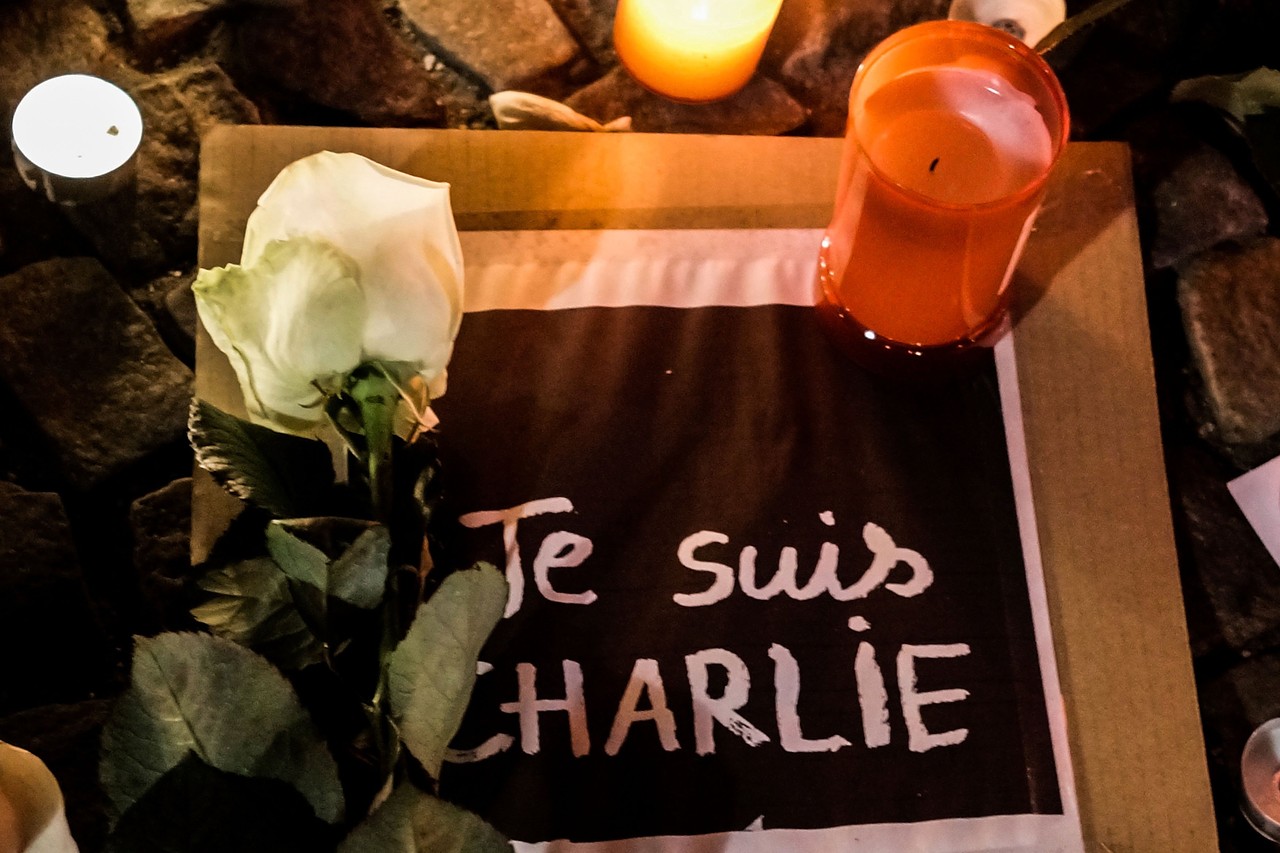 GETTY IMAGE
If there is a lesson to be drawn from such a grisly episode, it is that what we believe about Islam truly doesn’t matter. This type of violence, jihad, is what they, the Islamists, believe.
There are numerous calls to violent jihad in the Quran. But the Quran is hardly alone. In too much of Islam, jihad is a thoroughly modern concept. The 20th-century jihad “bible,” and an animating work for many Islamist groups today, is “The Quranic Concept of War,” a book written in the mid-1970s by Pakistani Gen. S.K. Malik. He argues that because God, Allah, himself authored every word of the Quran, the rules of war contained in the Quran are of a higher caliber than the rules developed by mere mortals.
In Malik’s analysis of Quranic strategy, the human soul—and not any physical battlefield—is the center of conflict. The key to victory, taught by Allah through the military campaigns of the Prophet Muhammad, is to strike at the soul of your enemy. And the best way to strike at your enemy’s soul is through terror. Terror, Malik writes, is “the point where the means and the end meet.” Terror, he adds, “is not a means of imposing decision upon the enemy; it is the decision we wish to impose.”
Those responsible for the slaughter in Paris, just like the man who killed the Dutch filmmaker Theo van Gogh in 2004, are seeking to impose terror. And every time we give in to their vision of justified religious violence, we are giving them exactly what they want.
In Islam, it is a grave sin to visually depict or in any way slander the Prophet Muhammad. Muslims are free to believe this, but why should such a prohibition be forced on nonbelievers? In the U.S., Mormons didn’t seek to impose the death penalty on those who wrote and produced “The Book of Mormon,” a satirical Broadway sendup of their faith. Islam, with 1,400 years of history and some 1.6 billion adherents, should be able to withstand a few cartoons by a French satirical magazine. But of course deadly responses to cartoons depicting Muhammad are nothing new in the age of jihad.
Moreover, despite what the Quran may teach, not all sins can be considered equal. The West must insist that Muslims, particularly members of the Muslim diaspora, answer this question: What is more offensive to a believer—the murder, torture, enslavement and acts of war and terrorism being committed today in the name of Muhammad, or the production of drawings and films and books designed to mock the extremists and their vision of what Muhammad represents?
To answer the late Gen. Malik, our soul in the West lies in our belief in freedom of conscience and freedom of expression. The freedom to express our concerns, the freedom to worship who we want, or not to worship at all—such freedoms are the soul of our civilization. And that is precisely where the Islamists have attacked us. Again.
How we respond to this attack is of great consequence. If we take the position that we are dealing with a handful of murderous thugs with no connection to what they so vocally claim, then we are not answering them. We have to acknowledge that today’s Islamists are driven by a political ideology, an ideology embedded in the foundational texts of Islam. We can no longer pretend that it is possible to divorce actions from the ideals that inspire them.
This would be a departure for the West, which too often has responded to jihadist violence with appeasement. We appease the Muslim heads of government who lobby us to censor our press, our universities, our history books, our school curricula. They appeal and we oblige. We appease leaders of Muslim organizations in our societies. They ask us not to link acts of violence to the religion of Islam because they tell us that theirs is a religion of peace, and we oblige.
What do we get in return? Kalashnikovs in the heart of Paris. The more we oblige, the more we self-censor, the more we appease, the bolder the enemy gets.
There can only be one answer to this hideous act of jihad against the staff of Charlie Hebdo. It is the obligation of the Western media and Western leaders, religious and lay, to protect the most basic rights of freedom of expression, whether in satire on any other form. The West must not appease, it must not be silenced. We must send a united message to the terrorists: Your violence cannot destroy our soul.
We Are Charlie: Free Speech v. Self-Censorship, Gatestone Institute, Douglas Murray, January 8, 2015
(How many of our “allies” against the (non-Islamic, we are told) Islamic State, et al, take comparable measures under their laws against those who “insult” Islam or its prophet? Why does Obama persist in advancing, directly or indirectly, the notion that “the future must not belong to those who slander the prophet of Islam?” Does the future instead belong to Islam and its prophet? Unless and until the evil that is Islam is recognized as an existential evil that threatens our lives as well as our freedoms, rather than ignored and/or tolerated, the future may well belong to it. How will the appeasers of all things Islamic react when Iran gets “the bomb” and uses it, not only on the “evil” they perceive as Israel, but on them as well?– DM)
— DM)
It is easier to denigrate the people warning us about a danger . . . than it is to address the danger they are warning us about. The same holds true for Europe’s policy toward Israel: It is easier to bully an open, pluralistic democracy than to take on all those terrorists and the countries that support them, and it is to do what is necessary to get them to stop.
***********************
Will we keep on blaming the victims? Perhaps the media assume that it is easier to force good people to keep quiet, or keep their own media offices from being attacked, than to than to tackle the problem of Islamic extremism head-on. It is easier to blame Geert Wilders, Ayaan Hirsi Ali, Lars Hedegaard, Suzanne Winters, Salman Rushdie or Charlie Hebdo — and even put some of them on trial — than to attack the attackers, who might even attack back!
The press and the media seem to prefer coerced self-censorship: It is your own fault if you get hurt: none of this would be happening to you if you had only kept your mouth shut. It is easier to denigrate the people warning us about a danger than it is to address the danger they are warning us about.
Do you think a country should change its policies because segments of one community will run into newspaper offices and gun people down if you don’t?
If those in positions of influence do not deal with this problem now, we will not like those who deal with it later.
Wednesday’s massacre at the Paris offices of the magazine Charlie Hebdo was not just a barbaric act of jihadist violence. It was also a test for the West and for the freedom of speech in the West. It is a test that we all have been failing.
Those of us who have proposed that all Western — and in particular European — news outlets should multilaterally publish the Charlie Hebdo cartoons have been greeted in return with a terrified and terrifyingly self-conscious silence. The papers and broadcasters do not want to do it. Last time they refused to republish the cartoons, from Denmark’s Jyllands Posten, they said it was because the cartoons were from a “right wing” newspaper. This time they refuse to republish cartoons from a “left-wing” newspaper. It does not matter what the politics are — it is not about the politics, it is about the cartoons. The sooner the press at least has the guts to admit this, the better.
But there has been much worse than the cringing surrender that this refusal denotes. Consider just a couple of even worse examples from the mainstream media’s coverage of these barbaric events.
In the United Kingdom on Wednesday, the Daily Telegraph newspaper was straight out of the starting blocks. Within a couple of hours of the attack, as the bodies of the slain journalists had not even been identified, The Telegraph chose to run a report headlined, “France faces rising tide of Islamophobia“!
The press was already blaming the victims. Commentators on CNN opined that Charlie Hebdohad been “provoking Muslims” for some time. Perhaps they assum that it is easier to force good people to keep quiet, or keep their own media offices from being attacked, than to tackle to the problem of Islamic extremism head-on. It is easier blame Geert Wilders, Ayaan Hirsi Ali, Lars Hedegaard, Suzanne Winters, Salman Rushdie or Charlie Hebdo — and even put some of them on trial — than to attack the attackers, who might even attack back!
The press and the media seem to prefer a policy of coerced self-censorship: It is your own fault if you get hurt; none of this would be happening to you if you had only kept your mouth shut. It is easier to denigrate the people warning us about a danger on than it is to address the danger they are warning us about. The same holds true for Europe’s policy toward Israel: It is easier to bully an open, pluralistic democracy than to take on all those terrorists and the countries that support them, and it is to do what is necessary to get them to stop. That is also what Germany’s Chancellor Angela Merkel broadcast in her New Year’s message when she warned against the anti-Islamic “Pegida” marches in Germany: she said it was the marchers against Islamic extremism that have “coldness” in their hearts, not the propagators of Islamic extremism.
And so the Telegraph’s first response piece listed the terrible events of the rise of right-wing and other forces — as though the attack were the response to radical Islam, rather than even suggest that it might be radical Islam itself that was at fault. Once again, the “backlash” against Muslims took precedence over the actual murder of non-Muslims at the hands of Muslim fanatics.
Over in New York, The New York Daily News is not a newspaper that tends to pull its punches. But consider what it did while the dead were still lying in the magazine’s offices. It ran a story which showed images of a Parisian policeman at the moment that the terrorists — shouting “Allahu Akhbar” [“Allah is Greater!”] — gunned him down in cold blood. It also showed an image from 2011 of Charlie Hebdo editor and publisher Stéphane Charbonnier standing outside his firebombed offices, the last time the magazine was attacked, holding up an edition of the paper with an image of Mohammed on the front. But the image was pixelated. Yes — that’s right. The paper was willing to show a man who had been alive that morning in the process of being murdered. But they chose not to publish a cartoon of a historical figure who died 1400 years ago.
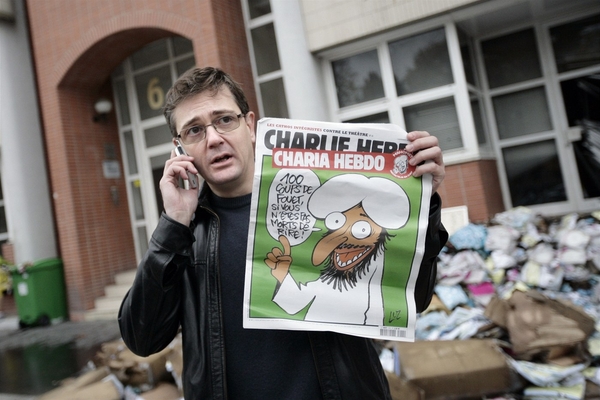 Stéphane Charbonnier, the editor and publisher of Charlie Hebdo, who was murdered yesterday along with many of his colleagues, is shown here in front of the magazine’s former offices, just after they were firebombed in November 2011.
This is the pass that the free press has come to, even in countries such as America, and even in places where there has been no attack on a newspaper’s offices for “insulting” somebody else’s prophet. And then again, in the tide-wave of bafflement, the same excuses have begun to get rolled out:
“Has this to do with France’s foreign policy?” interviewers and pundits have mused. In this particular instance, the answer to that question is “no more than usual.” But the follow-on bit of the answer should be even more easily said: “So what if it were?” Let us say that you do not like France’s foreign policy. Do you think that a country should change its policies because segments of one community will run into newspaper offices and gun people down if you don’t?
Another diversionary question has been, has been, “Does this have something to do with the situations in which many French Muslims find themselves – the banlieues (less-affluent French suburbs) and so forth?” The only answer I have so far managed to give to this question is that there are really people out there who may not like where they live but do not run into newspaper offices with Kalashnikov rifles and start firing off. Many people do not like their neighborhoods. It is not the point.
Other media have gone straight for the placatory option. Across in Britain, from left to right, the response was the same: “British Muslim leaders all come out in opposition to Paris magazine attack.” As though head-shaking constituted some great breakthrough. There seems to be a long-term pattern — no matter how often the attackers shout “Allahu Akbar!” or announce, as yesterday, that, “The Prophet [Mohammad] has been avenged” — of condemning terrorist attacks in general, accompanied by bewilderment at the thought that they that it could have anything do with “Islam.”
There are also great loud woolly condemnations of “terrorism,” but never accompanied by naming the men or groups involved. And will we keep on blaming the victims? This all bodes very ill.
Charlie Hebdo was — I hope I can still say “is” — a magazine that satirizes any and all ideas. Their targets have included not only Mohammed, but also Christians, Jews, the French novelist Michel Houellebecq and the Front National leader Marine le Pen. At this moment, mainstream media and politicians should be ensuring that they understand the concerns of their publics, rather than treating them as radioactive “racists” and “Islamophobes.” If those in positions of influence do not deal with this problem now, we will not like those who deal with it later.
Muslim Leaders in Australia Say Banning Terrorism Will Ban Islam, Front Page Magazine, Daniel Greenfield, January 1, 2015

They have a point. It’s just usually one that they aren’t willing to admit in public. The Jihad comes from the Koran. Every act of Muslim violence that is religiously sanctioned, from terrorism to rape, is derived from the Koran. If you ban incitement to violence against non-Muslims, you criminalize the Koran.
A Muslim cleric who preaches from certain passages of the Koran could be caught in the “broad” net of the government’s new anti-terror law, Islamic leaders have warned.
Grand Mufti of Australia Ibrahim Abu Mohammad and the Australian National Imams Council have called for the offence of “advocating terrorism” to be removed from the so-called Foreign Fighters Bill, currently before Parliament.
Islam and terrorism. The two are intertwined.
Quran (2:191-193) – “And kill them wherever you find them, and turn them out from where they have turned you out. And Al-Fitnah [disbelief] is worse than killing.”
Quran (8:12) – “I will cast terror into the hearts of those who disbelieve. Therefore strike off their heads and strike off every fingertip of them”
Quran (9:5) – “So when the sacred months have passed away, then slay the idolaters wherever you find them.”
You can’t ban terrorism without banning Islam.
In its submission, the Islamic Council of Victoria said the new law would incriminate Muslims who support “legitimate forms of armed struggle”, including resistance to the Assad regime in Syria and the Palestinian conflict with Israel.
So the argument is that they want to promote “good terrorism” against Jews and they don’t want to be sanctioned for it. Muslim settlers. Australia clearly needs more of them to create a tolerant society. A tolerant society which promotes the “legitimate” murder of Jews.
“Criminalising the act of ‘advocating terrorism’ adds another layer of complexity to this issue. The scope of what constitutes ‘advocating terrorism’ is unclear.”
It’s not that unclear, except to Muslims, who insist that killing terrorists is terrorism… but terrorism is legitimate.
The council identified what it says is a double standard in Muslims wanting to go to Syria and Iraq to provide aid having their passports cancelled “while ignoring the travel of Zionist Jews wishing to travel to Israel – a state which illegally occupies Palestinian territory with intention of fighting in a war against Gazans and has been accused of war crimes”.
#IllridewithyouallthewaytoISIS
But setting aside whatever views anyone may have on Israel, Aussies traveling to Israel to fight with the IDF are not going to go back to Sydney and kill people. The same can’t be said for Muslim settlers in Australia traveling to join terrorist groups.
It’s not a double standard. Australia is trying to prevent terror attacks on its own soil. Muslim leaders insist that banning terrorism will outlaw their legitimate right to kill Jews and promote the murder of non-Muslims for “legitimate” reasons.
Egypt’s Sisi: Islamic “Thinking” Is “Antagonizing the Entire World” Raymond Ibraham, January 1, 2015
Speaking before Al-Azhar and the Awqaf Ministry on New Year’s Day, 2015, in connection to Prophet Muhammad’s upcoming birthday, Egyptian President Abdel Fattah al-Sisi, a vocal supporter for a renewed vision of Islam, made what must be his most forceful and impassioned plea to date on the subject.
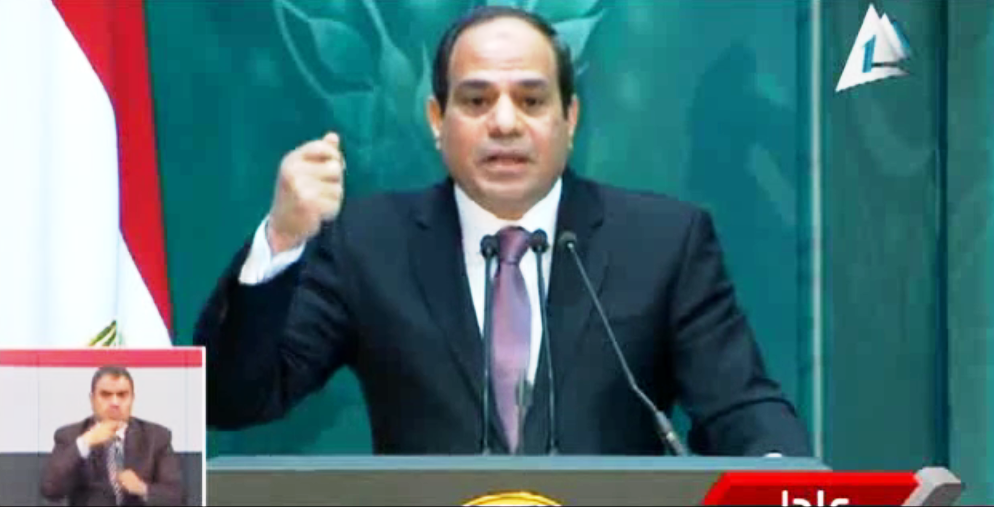 Sisi during his New Year’s Day speech before Al Azhar
Among other things, Sisi said that the “corpus of [Islamic] texts and ideas that we have sacralized over the years” are “antagonizing the entire world”; that it is not “possible that 1.6 billion people [reference to the world’s Muslims] should want to kill the rest of the world’s inhabitants—that is 7 billion—so that they themselves may live”; and that Egypt (or the Islamic world in its entirety) “is being torn, it is being destroyed, it is being lost—and it is being lost by our own hands.”
The relevant excerpt from Sisi’s speech follows (translation by Michele Antaki):
I am referring here to the religious clerics. We have to think hard about what we are facing—and I have, in fact, addressed this topic a couple of times before. It’s inconceivable that the thinking that we hold most sacred should cause the entire umma[Islamic world] to be a source of anxiety, danger, killing and destruction for the rest of the world. Impossible!
That thinking—I am not saying “religion” but “thinking”—that corpus of texts and ideas that we have sacralized over the years, to the point that departing from them has become almost impossible, is antagonizing the entire world. It’s antagonizing the entire world!
Is it possible that 1.6 billion people [Muslims] should want to kill the rest of the world’s inhabitants—that is 7 billion—so that they themselves may live? Impossible!
I am saying these words here at Al Azhar, before this assembly of scholars and ulema—Allah Almighty be witness to your truth on Judgment Day concerning that which I’m talking about now.
All this that I am telling you, you cannot feel it if you remain trapped within this mindset. You need to step outside of yourselves to be able to observe it and reflect on it it from a more enlightened perspective.
I say and repeat again that we are in need of a religious revolution. You, imams, are responsible before Allah. The entire world, I say it again, the entire world is waiting for your next move… because this umma is being torn, it is being destroyed, it is being lost—and it is being lost by our own hands.
Note: It is unclear if in the last instance of umma Sisi is referring to Egypt (“the nation”) or if he is using it in the pan-Islamic sense as he did initially to refer to the entire Islamic world.
A Sad State of Affairs: The Kerry Record, World Affairs Journal, Joshua Muravchik, November/December, 2014
(Kerry likely agrees with Obama as to his quite foreign foreign policies and, equally likely, we are stuck with both at least until Obama leaves the White House.

The most bothersome current aspects of Obama-Kerry foreign policies are the extent to which they trust Iran and how they deal with it and the P5+1 negotiating group. — DM)

Although Kerry’s anti-American ideology has moderated to some degree from his fiery days as an antiwar leader, he has misrepresented but never repudiated his past. Especially consistent has been his inclination to see the best in America’s enemies, from Madame Binh to Comandante Ortega to Bashar Assad. Israelis were shocked this summer that Kerry came up with a plan molded by Turkey and Qatar to fit the interests of Hamas at their own expense. Had they known him and his record better, they might not have been.
***************
The Gaza war of July and August 2014 occasioned the sharpest frictions in memory between the United States and Israel, highlighted by a cease-fire proposal offered by Secretary of State John Kerry that Israel’s security cabinet rejected unanimously. Kerry’s plan envisioned a seven-day cease-fire, during which the parties would negotiate “arrangements” to meet each of Hamas’s demands about the free flow of people and goods into Gaza and the payment of salaries of Hamas’s tens of thousands of employees. As for Israel’s demands about destruction of tunnels and rockets and the demilitarization of Gaza, these were not mentioned at all, except in the add-on phrase that the talks would also “address all security issues.”
The document cited the important role to be played by “the United Nations, the Arab League, the European Union, the United States, Turkey, [and] Qatar.” Conspicuous by their absence from this list were Israel, Egypt, and the Palestinian Authority. These three had also not been invited to the Paris meetings where Kerry worked on his ideas with leaders of the countries and bodies mentioned.
Barak Ravid, diplomatic correspondent for the liberal Israeli newspaper Haaretz, wrote that the proposal “might as well have been penned by Khaled Meshal [head of Hamas]. It was everything Hamas could have hoped for.” The centrist Times of Israel’s characteristically circumspect editor, David Horovitz, branded Kerry’s initiative “a betrayal.” And left-leaning author Ari Shavit commented that “Kerry ruined everything. [He] put wind in the sails of Hamas’ political leader Khaled Meshal, allowed the Hamas extremists to overcome the Hamas moderates, and gave renewed life to the weakened regional alliance of the Muslim Brotherhood.”
Turkey and Qatar are the mainstays of that alliance and were chosen by Kerry as his principal interlocutors because they are Hamas’s main backers. This brought protests from the Palestinian Authority, led by President Mahmoud Abbas’s movement, Fatah, the secularist rival to Hamas. That group declared that “whoever wants Qatar and Turkey to represent them can emigrate and go live there. Our only legitimate representative is the PLO.”
The shock of Palestinian and Israeli leaders would have been less, however, if they had been more familiar with the record of John Kerry. Spurning America’s friends in pursuit of deals with their nemeses was perfectly in character for the secretary of state. The hallmark of his career has been to denigrate America itself, while supporting the claims of its enemies.
That career began in 1969, when, months after returning from a tour of duty in Vietnam, Kerry sought and received a military discharge so that he might run for Congress. His campaign as a peace candidate sputtered, but his authenticity as a Vietnam vet established him as a presence in the burgeoning antiwar movement. In May 1970, he traveled to Paris for an unpublicized meeting with Viet Cong representatives, and, perhaps at their suggestion, he joined up upon his return with Vietnam Veterans Against the War. VVAW was headed by Al Hubbard, a former Black Panther. Kerry was instantly given a top role, twinning with Hubbard as the public face of the organization.
At a VVAW protest in Washington, DC, in April 1971, Kerry joined other veterans in throwing away their military medals in front of news cameras. The entire demonstration was punctuated by Kerry’s appearance before the Senate Foreign Relations Committee, where he offered dramatic testimony about American atrocities in Vietnam based on accounts heard at a VVAW inquest a few months earlier. He spoke of veterans who said:
They had personally raped, cut off ears, cut off heads, taped wires from portable telephones to human genitals and turned up the power, cut off limbs, blown up bodies, randomly shot at civilians, razed villages . . . poisoned food stocks, and generally ravaged the countryside.
These acts, Kerry emphasized, “were not isolated incidents but crimes committed on a day-to-day basis with the full awareness of officers at all levels of command.”
When, at the behest of aghast senators, the Naval Criminal Investigative Service conducted a formal inquiry into the stories presented at the VVAW inquest, it reported that many of the VVAW witnesses cited by Kerry refused to cooperate, although promised immunity. Others were clearly crackpots, and several swore, and provided witness corroboration, that they had not participated at the inquest at all and had no idea who had appeared in their names. The entire exercise had been inspired and largely engineered by Mark Lane, whose book on the same subject earlier that year had been panned by New York Times columnist James Reston Jr. as “a hodgepodge of hearsay,” while that paper’s book reviewer, Neil Sheehan, who had reported from Vietnam and would soon break the Pentagon Papers, revealed that some of Lane’s “witnesses” had not served in Vietnam. (The political scientist Guenter Lewy documents these events in his 1978 book America in Vietnam.)
In August 1971, four months after his Senate appearance, Kerry made another trip to Paris, to meet with Madame Nguyen Thi Binh, foreign minister of the Viet Cong, this time in full view, for his first exercise in international diplomacy. He returned touting the “peace plan” of the Viet Cong, explaining: “If the United States were to set a date for withdrawal, the prisoners of war would be returned.” Although he frequently accused American leaders of lying, he took the Communist leaders’ statements at face value, asserting that their peace plan “negates very clearly the argument of the president [Nixon] that we have to maintain a presence in Vietnam to use as a negotiating [chip] for the return of those prisoners.”
Kerry’s dismissal of the statements of US leaders as lies and his credulity toward those of the Vietnamese Communists reflected a broader difference in attitude toward the two sides to the conflict. Ho Chi Minh, who had spent long years as a henchman of Stalin’s, serving the Comintern in several countries, was in Kerry’s admiring eyes “the George Washington of Vietnam” who aimed only “to install the same provisions into the government of Vietnam” that appeared in the American Constitution. America, in contrast, had itself strayed so far from those principles that it needed a “revolution” to restore them.
Kerry’s colleagues in VVAW undoubtedly shared this sentiment, and in November 1971, at a conference of its leadership in Kansas, the group considered just how far down the path of revolution it was willing to go. It debated, although ultimately rejected, a proposal to commence a campaign of terrorist violence and assassination of pro-war US senators. When he ran for president in 2004, Kerry denied he had been present at this conclave, but when FBI files secured by the Los Angeles Times under the Freedom of Information Act placed him there, he retracted that denial in favor of the statement that he had “no personal recollection” of it.
Is this plausible? Gerald Nicosia, author of a highly sympathetic history of the antiwar movement, reported, in May 2004, that “several people at the Kansas City meeting recently said to me or to mutual friends that they had been told by the Kerry campaign not to speak about those events without permission.” Why the urgency to cover up? And how would the campaign know who was there, that is, whose silence to seek, if Kerry had no recollection of the meeting? One of Nicosia’s interviewees, John Musgrave, said “he was asked by Kerry’s veterans coordinator to ‘refresh his memory’ after he told the press Kerry was in Kansas City. Not only is Musgrave outraged that ‘they were trying to make me look like a liar,’ but he also says ‘there’s no way Kerry could have forgotten that meeting—there was too much going on.’”
This puts it mildly: the event was memorably raucous, with debates over the proposals for violence and for napalming the national Christmas tree, furious factional fighting, the discovery of eavesdropping bugs in the building leading to a quick move to another location, and above all an angry showdown between Kerry and Hubbard over revelations that the latter had never been in Vietnam. This particular contretemps was punctuated by Hubbard’s dramatically pulling down his pants to show scars he claimed he sustained in Vietnam. The mayhem culminated in Kerry’s announcing his resignation from the group’s executive. And Kerry had “no personal recollection” of being there?
Although Kerry appeared as a speaker for VVAW for about a year following this resignation, he then faded from national view for a decade, climbing the ladder of local and state politics in Massachusetts before winning election to the US Senate in 1984. The Senate, he later said, “was the right place for me in terms of . . . my passions. The issue of war and peace was on the table again.” What put it on the table were the anti-communist policies of President Ronald Reagan, which Kerry deeply opposed. A year earlier, Reagan had ordered the invasion of Grenada, which Kerry scorned as “a bully’s show of force [that] only served to heighten world tensions and further strain brittle US-Soviet and North-South relations.”
In contrast, Kerry ran on a platform of the Nuclear Freeze, a popular movement opposing US plans to counterbalance a large Soviet nuclear buildup over the previous decade. Kerry made sure to score one hundred percent on a test of candidates’ positions presented by a group called Freeze Voter ’84, and he proposed to cut the defense budget by nearly twenty percent, including “cancellation of twenty-seven weapons systems” and “reductions in eighteen other[s],” according to the Boston Globe. He cited his own work with VVAW as a counterpoint: “We were criticized when we stood up on Vietnam. . . . But we’ve been borne out. We were correct. Sometimes you just have to stand and hold your ground.”
In the Senate, he secured a coveted seat on the Foreign Affairs Committee and turned his attention to the fraught issue of policy toward Central America, a small region that had assumed inordinate geopolitical importance by becoming one of the front lines in the Cold War. A Marxist-Leninist party, the Sandinista National Liberation Front, had seized power in Nicaragua and was aiding likeminded movements in El Salvador and other nearby states while the Reagan administration supported anti-Communist guerrillas inside Nicaragua, the so-called “Contras.”
Kerry lent his name to Medical Aid for El Salvador, which gave non-lethal aid to the Communist side in that civil war. On February 16, 1982, an Associated Press story quoted actor Ed Asner, leader of a Hollywood group that raised much of the funding for this project, as explaining that “medical supplies are to be purchased in Mexico and shipped clandestinely to the Democratic Revolutionary Front in El Salvador.” However, the issue of US aid to El Salvador’s anti-Communist government became overshadowed by debate about aid to the Nicaraguan “Contras.”
As the Senate neared a decisive vote, Kerry and Senator Tom Harkin undertook a dramatic maneuver to try to head off approval of the Reagan administration’s request for Contra funding. They flew to Managua, the Nicaraguan capital, for their own summit meeting with the country’s strongman, “Comandante” Daniel Ortega. The results resembled those of his 1971 meeting with Madame Binh. Ortega handed Kerry a “peace plan” according to which the US would first end all aid to the Contras, and the Sandinistas would then initiate a cease-fire and restore civil liberties. Kerry justified undercutting the US government in this way by faulting Reagan’s failure “to create a climate of trust” with the Sandinistas. He, in contrast, offered them trust in abundance, calling Ortega’s plan “a wonderful opening.” He took to the Senate floor to say, “Here, in writing, is a guarantee of the security interest of the United States.”
A year later, in 1986, in another Senate debate on Contra aid, Kerry voiced one of the odder claims about his Vietnam experience. Warning against the slippery slope of military involvement and against the duplicity of our own government, Kerry delivered a floor speech containing this assertion:
I remember Christmas of 1968, sitting on a gunboat in Cambodia. I remember what it was like to be shot at by Vietnamese and Khmer Rouge and Cambodians, and have the president of the United States telling the American people that I was not there; the troops were not in Cambodia. I have that memory which is seared—seared—in me.
The “seared” part was a nice touch, especially in view of the fact that the whole thing had not happened (although Kerry had been repeating the story since as early as 1979). In the course of Kerry’s 2004 presidential campaign, the Swift Boat Veterans for Truth, former crewmen on the type of vessel on which Kerry served who were angered by his antiwar activities, attacked this claim among other aspects of Kerry’s military history. In this case, however, unlike in response to some points raised by Kerry’s detractors, no shipmate of Kerry’s could be found to corroborate his version. Soon, his spokesmen began to hedge. One aide explained that Kerry’s boat had been “between” Vietnam and Cambodia. But the two countries are contiguous: there is no “between,” so another spokesman backed down further, explaining that Kerry had merely been “near” Cambodia.
Then, Douglas Brinkley, who authored a laudatory history of Kerry’s military service, issued another explanation, apparently at the behest of the campaign. On Christmas 1968, the moment of Kerry’s “seared” memory, he was fifty miles from Cambodia, said Brinkley, but his boat “went into Cambodia waters three or four times in January and February 1969.” Oddly, however, Brinkley’s book, which covered those two months in painstaking detail at a length of nearly one hundred pages, even to the extent of locating the sites of battles, made no mention of Kerry’s having crossed into Cambodia. And the campaign soon pulled the rug from under Brinkley by issuing a new claim, namely, that Kerry’s boat had “on one occasion crossed into Cambodia.” Three of Kerry’s shipmates, two of whom were supporting his campaign, categorically denied even this minimized claim.
In that, they are supported by no less a source than Kerry himself, in the form of a journal he kept while on duty. Substantial passages of it are reproduced in Brinkley’s book, and one of them reads:
The banks of the [Rach Giang Thanh River] whistled by as we churned out mile after mile at full speed. On my left were occasional open fields that allowed us a clear view into Cambodia. At some points, the border was only fifty yards away and it then would meander out to several hundred or even as much as a thousand yards away, always making one wonder what lay on the other side.
He was never to learn the answer because this diary entry was from his final mission.
Kerry was of course right to link Central America to Southeast Asia. They were both nodes in the Cold War, the epic struggle that defined international politics for forty years, including the first two decades of Kerry’s political engagement, from the time he returned from Vietnam in 1969 until the Berlin Wall came down in 1989. Whatever the rights and wrongs of America’s entry into Vietnam, or its actions in Central America or elsewhere, Kerry perverted the basic issue of the Cold War, always viewing America’s actions as bellicose and malign, while casting those of the Communists, like “George Washington” Ho Chi Minh, in the most favorable light.
To many, the Cold War’s benign denouement—the fall of the Wall and the USSR’s disappearance into the ash bin of history—vindicated Reagan’s approach, but Kerry appears to have entertained no second thoughts despite these outcomes. When it came to addressing post–Cold War issues, he remained reflexively averse to the exercise of American power. Kerry had lamented as “not proportional” Reagan’s 1986 bombing of Libyan dictator Muammar el-Qaddafi’s residence in response to a Libyan terror attack on US servicemen in Germany. The Middle East was also the scene of the first military showdown after the Cold War, when Saddam Hussein’s Iraq swallowed whole the neighboring state of Kuwait, in 1990. At the time, Kerry opposed the Bush administration’s request for authorization of military action, saying that those “of the Vietnam generation . . . come to this debate with a measure of distrust [and] a resolve . . . not [to be] misled again.” He concluded his Senate speech by reading a passage from an antiwar novel by the American Communist Dalton Trumbo.
With the Cold War’s end, and America’s demonstration of will and strength in driving Hussein’s forces from Kuwait, the defining issue of the 1990s became the wars of Yugoslavia’s dissolution. Here, the prime issue was whether or not to lift an international arms embargo that rendered Bosnia’s Muslims naked before their predators, the well-armed Serbs. As public opinion reacted to news accounts of the grisly results of this imbalance, the Senate voted to lift the embargo, over the objections of Kerry, who helped to lead the opposition.
With the terrorist attacks of September 11, 2001, the American public was awakened from its post–Cold War indifference toward foreign affairs. A fierce patriotism burst forth, and with it a determination to take down those who had attacked us. Thus, preparing for a 2004 presidential bid, Kerry moved to reconfigure his image. The antiwar veteran was suddenly replaced by the military hero, and the Democratic nominating convention was replete with uniforms and military gestures, highlighted by Kerry’s sharp salute to the assemblage while uttering the words, “reporting for duty.” Already, his rejected service medals had miraculously reappeared mounted and framed on his Senate office wall. Asked how that was possible, as he had been photographed throwing them away, Kerry explained that the medals he tossed were not his own but actually belonged to another veteran.
The dramatic reincarnation did not quite come off, as Kerry was dogged by Vietnam veterans, led by fellow Swift Boat crewmen, still furious at how he had blackened their names. And the awkwardness of his transformation was symbolized by his much-ridiculed explanation of his stance on funding the 2003 US invasion of Iraq: “I actually did vote for the $87 billion before I voted against it.”
In his later years in the Senate, Kerry made the issue of Syria his own. He took several trips to Damascus where, according to a June 2011 account in the Wall Street Journal, he “established something approaching a friendship with [Syrian dictator Bashar] Assad.” When Barack Obama came to office, he made Kerry his point man in efforts to improve US-Syrian relations. Kerry put his endorsement on diplomatic proposals he received in Damascus, including an offer by Assad to engineer a Palestinian unity government embracing Fatah and Hamas. The benefits to the US, not to mention Israel, of such unity were not self-evident, but in any event, talks between the two Palestinian factions were already under way, mediated by Egypt, which was closer to Fatah. Why it would be advantageous to switch the sponsorship to Syria, the ally of Hamas, was hard to grasp. Nonetheless, Kerry saw in Assad’s proposal the prospect of “a major step forward in terms of how you reignite discussions for the two-state solution . . . . Syria indicated to me a willingness to be helpful in that respect.” In all, as the Journal put it, “Kerry . . . became . . . Assad’s champion in the US, urging lawmakers and policymakers to embrace the Syrian leader as a partner in stabilizing the Mideast.”
In sum, although Kerry’s anti-American ideology has moderated to some degree from his fiery days as an antiwar leader, he has misrepresented but never repudiated his past. Especially consistent has been his inclination to see the best in America’s enemies, from Madame Binh to Comandante Ortega to Bashar Assad. Israelis were shocked this summer that Kerry came up with a plan molded by Turkey and Qatar to fit the interests of Hamas at their own expense. Had they known him and his record better, they might not have been.
Censorship, “Mental Illness” Overrun France, The Gatestone Institute, Guy Millière, January 1, 2015
(Who are the real lunatics? — DM)
On December 23, a fourth man screaming “Allahu Akbar” was arrested for “violent behavior” in the city of Le Mans. He was sent directly to a psychiatrist, of course. He is a “mental patient.” Authorities strangely said he might be “contagious.”
****************
France is a country where so-called “anti-racist” organizations, heavily subsidized by the government, fight for the most part only a single “racism”: “Islamophobia.”
It is now a country where the only people allowed to speak freely of Islam to large audiences are those who describe it as a religion of peace and unlimited love.
People prosecuted and fined for uttering critical remarks on Islam, such as Christine Tasin, say out loud what thousands think without daring to speak.
Polls show that French citizens in ever-increasing numbers are concerned about the rising proportion of unintegrated Muslims in the country, the endless expansion of no-go zones, the increasing number of Islamic converts, and the “replacement” of the French people.
“Mental patients,” screaming “Allahu Akbar,” are storming France.
France is now a country where critical remarks on Islam are systematically banned from mainstream media and where any negative sentence about the Muslim religion leads to fines, payment of damages, and censorship.
And it is a country where so-called “anti-racist” organizations, heavily subsidized by the government, fight for the most part only a single “racism”: “Islamophobia.”
Words such as “Islamism” or “radical Islam” have disappeared from the vocabulary of journalists and politicians, and are replaced by fuzzy words: “radicalism” and “extremism”.
The only people apparently allowed to speak freely of Islam to large audiences are those who describe it as a religion of peace and unlimited love.
Take, for example the recent case of Christine Tasin, a founder of Riposte Laïque [Secular Response].
She went to Belfort on October 15, 2013, to make a video news report on a temporary slaughterhouse installed for the Muslim feast day of Eid El Adha, which commemorates Ibrahim’s obedience to Allah in offering to sacrifice his only son. Upon her arrival at the slaughterhouse, the manager asked her to leave. He also called her an “Islamophobic racist.” She answered that she is, actually, Islamophobic, but not racist; and added that “Islam is rubbish.” The verbal exchange was filmed. Muslim associations filed complaints against her.
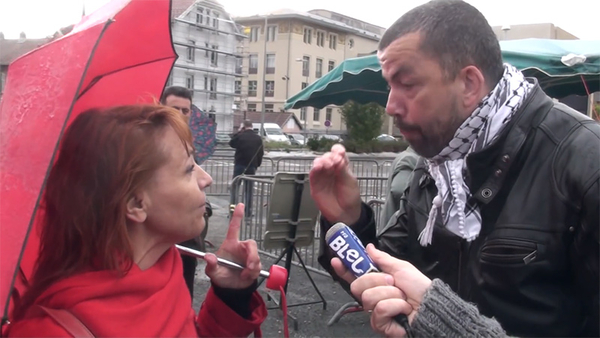 Christine Tasin engages in a verbal exchange on October 15, 2013, which led to here being charged with the crime of making “statements likely to provoke rejection of Muslims.”
On August 9, 2014, a court declared Tasin guilty of making “statements likely to provoke rejection of Muslims,” and she was sentenced to a heavy fine of 3,000 euros ($3,700).
Tasin responded by saying that the court had acted as if it were an “Islamic court” and that it was showing “submission to Sharia.” She appealed the judgment. The appeal judgment, delivered on December 18, constituted a repudiation of the first judgment; all charges against Christine Tasin were dropped.
The same day, a case against Marine Le Pen, president of the populist National Front party, concerning statements she made in 2010 about the “occupation” of the street by illegal Muslim prayers, was also dropped.
Some might think that these two decisions are encouraging signs, showing that the French justice is not completely muzzled and that some judges still maintain an independent spirit.
A broader look, however, calls for caution. In the previous months, many French who publicly criticized Islam and its consequences were severely condemned by France’s justice system:
On June 5, Pierre Cassen and Pascal Hillout, two other members of Riposte Laïque, weresentenced to an extremely heavy fine of 21,200 euros ($26,000) for having written that “street prayers, veils and mosques” were “symbols of occupation and conquest.”
On April 10, author Renaud Camus was fined 4,000 euros ($5,000) for having said in 2010 that Muslim culture was slowly “replacing” French culture.
Three years earlier, in February 2011, writer and political journalist Eric Zemmour was sentenced to a fine of 1,000 euros ($1,250) and a payment of 10,000 euros ($12,500) to various associations and leagues. He had said during a talk show that “the majority of drug dealers in France are black and Arab Muslims.” The judges considered this was an “incitement to racial discrimination.”
Zemmour is currently facing a media storm because of an interview he granted to an Italian newspaper, Corriere della Sera, in which he said that “Muslims have their own Civil Code, the Koran” and live “in neighborhoods that the French are gradually leaving.” He added that France faced a “risk of chaos and civil war,” and that Muslims might have to go. In writing his article, the Italian journalist used the word “deport”. Zemmour did not use the word; he was, nevertheless, accused of having used it.
Countless complaints were filed against him. The main French “anti-racist” organizations asked all his employers to fire him. One of them, I-television (a rolling news TV channel), did so immediately.
The French Interior Minister, Bernard Cazeneuve, called for street demonstrations against Zemmour. This is the first time in the history of modern France that an Interior Minister has publicly called for street demonstrations against a journalist.
Faced with incessant complaints and attacks, Riposte Laïque decided in March 2013 to relocate its operations and its website to Switzerland, where laws are less severe and where judges are less politicized than in France.
France is nonetheless the country where the two perpetrators of the worst anti-Semitic terrorist attacks committed in the name of radical Islam on European soil were born and raised: Mohamed Merah, the killer of three Jewish children and a rabbi in a schoolyard in Toulouse in March 2012, and Mehdi Nemmouche, the murderer of four people at the Jewish Museum in Brussels in May 2014.
France is also the main European provider of jihadist recruits to the Islamic State. More than 1,000 French citizens are fighting in Syria and Iraq. Two of them have been spotted in a beheading video.
Polls show that French citizens in ever-increasing numbers are concerned about the rising proportion of unintegrated Muslims in the country, the endless expansion of no-go zones, the increasing number of Islamic converts, and the “replacement” of the French people.
Christine Tasin, Pierre Cassen, Pascal Hillout, Renaud Camus, and Eric Zemmour say out loud what thousands of people think without daring to speak.
Judicial harassment exacerbates frustration and leads many to believe that the mainstream media and leaders of major traditional parties lie about the facts and conceal the truth.
The National Front is now the top political party in France. Marine Le Pen is presently leading the polls for the 2017 presidential election. Her victory is unlikely, but it is no longer impossible. The “risk of chaos and civil war,” evoked by Eric Zemmour, is constantly growing.
On December 20, Bertrand “Bilal” Nzohabonayo, walked into a police station in Joué-les-Tours, in the Loire Valley, and, screaming “Allahu Akbar” [“Allah is Greater”], stabbed three police officers. He was then shot and killed. The police and media said immediately that he was a not an Islamist but a “mental patient,” although they later admitted that he seemed to be a supporter of the Islamic State.
On December 21, another man (no word yet on his identity), also screaming “Allahu Akbar,” drove his car into a crowd in Dijon, and was then captured by police. The police and the media also said that he was a “mental patient,” but they admitted he has family ties in North Africa.
On December 22, a third man, also screaming “Allahu Akbar” ploughed his van into a Christmas market in Nantes. He then stabbed himself, and is in hospital. The police and the media said that he was a “mental patient.” He will be sent to an insane asylum.
No one knows how many “mental patients” are ready to act and scream “Allahu Akbar” in France. Police unions have said that if too many “mental patients” decided to act, the police would not able to protect the population. They added that there were not even enough police to protect police officers likely to be attacked.
Mental patients, screaming “Allahu Akbar,” are storming France.
French Prime Minister Manuel Valls said, “We have never faced such a danger.” He has not defined the danger. He decided to send a thousand soldiers to patrol the streets. He did not say if they were supposed to fight mental illness.
On December 23, a fourth man screaming “Allahu Akbar” was arrested for “violent behavior” in the city of Le Mans. He was sent directly to a psychiatrist, of course. He is a “mental patient.” Authorities strangely said he might be “contagious.”
The Islamization of Britain in 2014, The Gatestone Institute, Soeren Kern, December 30, 2014
“Britain remains the world’s leading recruiting ground for al-Qaeda.” — Con Coughlin, Daily Telegraph.
When she sought help from the police and a lawyer, “the family of the defendants were insulted that she had gone to the law. They wanted her back within the family fold… Therefore, it was decided that she should be forced to comply or be killed.” — Prosecutor of Ahmed A-Khatib, who murdered his wife for becoming “too westernized.”
British school teachers are afraid to teach their students about Christianity out of fear of offending Muslims. — Roger Bolton, BBC Radio 4’s Feedback program.
Rather than taking steps to protect British children, police, social workers, teachers… and the media deliberately played down the severity of the crimes [of Muslim sexual grooming gangs] in order to avoid being accused of “Islamophobia” or racism. — From the report “Easy Meat: Multiculturalism, Islam and Child Sex Slavery.”
A group of British lawyers launched a website, Sharia Watch UK. The group called Sharia law “Britain’s Blind Spot.”
After Adebolajo, who murdered and tried to behead British soldier Lee Rigby with a meat cleaver, was given a “whole-life” prison term, his brother said his sibling was the victim of “Islamophobia.”
“The problem of honor-based violence and forced marriages in England is “worse than people think.” — Claire Phillipson, Wearside Women in Need
The Muslim population of Britain reached 3.4 million in 2014 to become around 5.3% of the overall population of 64 million, according to figures extrapolated from a recent study on the growth of the Muslim population in Europe. In real terms, Britain has the third-largest Muslim population in the European Union, after France and Germany.
Islam and Islam-related issues were omnipresent in Britain during 2014, and can be categorized into four broad themes: 1) Islamic extremism and the security implications of British jihadists in Syria; 2) the continuing spread of Islamic Sharia law in Britain; 3) the sexual exploitation of British children by Muslim gangs; and 4) Muslim integration into British society.
What follows is a chronological review of some of the main stories involving the rise of Islam in Britain during 2014.
In January, an analysis of census data showed that nearly 10% of the babies and toddlers in England and Wales are Muslim. The percentage of Muslims among children under five is almost twice as high as in the general population. By way of comparison, fewer than one in 200 people over the age of 85 are Muslim, an indication of the extent to which the birth rate is changing the religious demographic in Britain.
Also in January, Muslim fundamentalists threatened to behead a fellow British Muslim after he posted an innocuous image of Mohammed and Jesus on his Twitter account. The death threats against Maajid Nawaz, a Liberal Democrat Party candidate for British Parliament, added to the growing number of cases in which Islamists are using intimidation tactics to restrict the free speech rights of fellow Muslims in Europe.
On January 16, a Muslim woman was arrested by counter-terrorism police at Heathrow Airport as she was preparing to board a flight to Turkey. Nawal Masaad, 26, is accused of trying to smuggle £16,500 ($27,000; €20,000) in her underwear to jihadists in Syria. She and her alleged co-conspirator, Amal El-Wahabi, 27—a Moroccan who does not work and claims British social welfare benefits for herself and two young sons—were the first British women to be charged with terrorism offenses linked to the conflict in Syria.
On January 23, the head of Scotland Yard’s counter-terrorism unit, Commander Richard Walton,revealed that 14 British minors were arrested on charges linked to the Syrian conflict in January alone, compared to 24 for the whole of 2013. He said it was “almost inevitable” that some fighters would try to mount attacks in Britain upon their return.
On January 16, British Islamist Abu Waleed outlined his vision of an Islamic state in Britain, and called for Christians to be humiliated so that they would convert to Islam. In a video, he said:
“If the Muslim sees a kaffir [non-Muslim] with nice clothes, the kaffir has to take his clothes off and give them to the Muslim. The kaffir, when he walks down the street, he has to wear a red belt around his neck, and he has to have his forehead shaved, and he has to wear two shoes that are different from one another. He [the non-believer] is not allowed to walk on the pavement, he has to walk in the middle of the road, and he has to ride a mule. That is, my dear brothers, the Islamic state.”
In Bristol, the city council approved a controversial plan to convert a former comedy club into a mosque. In Cambridgeshire, a Muslim group submitted plans to convert a warehouse into a new mosque. In Cambridge, locals opposed a plan to build a £17.5 million ($28.5 million; €21 million) mega-mosque, claiming it could be “a front for terrorism.” In Blackburn, home to nearly 100 mosques, city councilors were urged to reject a plan to open a mosque in a residential neighborhood.
In Southend, local residents celebrated after a four-year battle resulted in the closing of an illegal mosque. In Newton Mearns, south of Glasgow, plans were abandoned to build a mosque within the grounds of a school in one of the most affluent suburbs of Scotland, due to local criticism of the move.
In Catherine-de-Barnes, a tiny village in western central England, local residents objected to plans for a large, Muslim-only cemetery, which will include space for 4,000 followers of Islam to be buried, and 75 parking spaces for visitors. The village has a population of just 613, which means the cemetery could eventually hold six-and-a-half times as many people as Catherine-de-Barnes itself.
In February, official statistics showed that net immigration to the United Kingdom surged to 212,000 in the year ending September 2013, a significant increase from 154,000 in the previous year. The new immigration data cast doubt on a pledge by Prime Minister David Cameron to get net migration—the difference between the number of people entering Britain and those leaving—down to the “tens of thousands” before the general election in May 2015.
Separately, data released by the National Crime Agency showed a 155% rise in British children groomed by sex gangs during 2013.
Also in January, a Muslim extremist who hacked a soldier to death on a London street in May 2013, launched a taxpayer-funded appeal against his murder conviction. Michael Adebolajo, 29, who tried to behead the British soldier Lee Rigby with a meat cleaver, maintained that he should not have been convicted because he is a “soldier of Allah” and therefore Rigby’s killing was an act of war rather than premeditated murder.
Adebolajo and his co-defendant, Michael Adebowale, 22, were found guilty by a jury in December 2013, and were sentenced on February 26. Adebolajo was given a “whole-life” prison term and Adebowale was given a minimum term of 45 years. Adebolajo’s brother said his sibling was the victim of “Islamophobia.”
On February 16, The Sunday Times reported that about 250 British jihadists who went to train and fight in Syria had returned to the UK and were being monitored by the security services. Senior officials said the high number of “returnees”—five times the figure that had been previously reported—underlined the growing danger posed by “extremist tourists” going to the war-torn region. MI5 and police said they feared that “returnees” could be preparing a Mumbai-style gun attack on civilians, possibly in a crowded public place in London.
On February 14, three Muslim vigilantes who terrorized innocent members of the public as the self-styled “Muslim Patrol” were banned from promoting Sharia Law in Britain for a period of five years.
In March, British authorities launched an investigation into the source of a document that purportedly outlined a plot by Muslim fundamentalists to Islamize public schools in England and Wales. The four-page document described a strategy—dubbed Operation Trojan Horse—to oust non-Muslim head teachers and staff at state schools in Muslim neighborhoods and replace them with individuals who would run the schools according to strict Islamic principles.
Also in March, a report entitled, “Easy Meat: Multiculturalism, Islam and Child Sex Slavery,”showed how officials in England and Wales were aware of rampant child grooming—the process by which sexual predators befriend and build trust with children in order to prepare them for abuse—by Muslim gangs since at least 1988. Rather than taking steps to protect British children, however, police, social workers, teachers, neighbors, politicians and the media deliberately downplayed the severity of the crimes perpetrated by the grooming gangs in order to avoid being accused of “Islamophobia” or racism.
Meanwhile, official figures revealed that record levels of Muslims are serving jail sentences and that the numbers are still growing. Across England and Wales the proportion has risen from 8% one decade ago to 14% now. In London, the figure is 27%, which is more than double the 12% of the capital’s population who are Muslim.
On March 27, ITV News reported that the problem of honor-based violence and forced marriages in England is “worse than people think,” but that many people are afraid of speaking out because they do not want to be branded as being “racist.” Claire Phillipson from Wearside Women in Need said:
“I have no doubt that all over the North East [England] first, second, third generation English young women are being forced into marriage.
“Schools and communities are keeping silent about it, because they are concerned that they would be called racist, Islamophobic. They don’t quite know where the line between culture, religion and human rights should be drawn.”
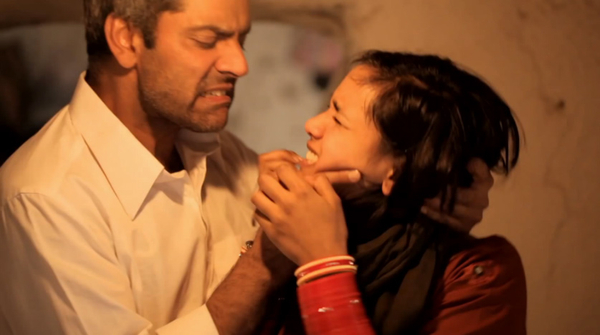 An image from the video “Right to choose: Spotting the signs of forced marriage – Nayana”, produced by the UK Foreign & Commonwealth Office.
On March 13, the Law Society, the main professional association representing and governing the legal profession in England and Wales, issued ground-breaking guidance to help lawyers draft Sharia-compliant wills and estate planning documents. The move effectively enshrined Islamic Sharia law in the British legal system for the first time.
In April, the British government launched a public consultation on whether or not to introduce student loans that are compliant with Islamic Sharia law, which forbids loans that involve the payment of interest.
Critics said that the dispute over interest-bearing student loans follows stepped-up demands for Sharia-compliant banking and insurance as well as credit cards, mortgages and pension funds, which—taken together—are contributing to the establishment of parallel Islamic financial and legal systems in Britain.
Separately, Lloyds Bank was accused of reverse religious discrimination after dropping overdraft fees for Muslims but not for others. The bank said that non-Muslims would have to pay up to £80 (€97, $135) a month for an overdraft, but that for Muslims “there won’t be any charges.”
Meanwhile, the fast food giant Subway removed ham and bacon from almost 200 outlets in Britain and switched to halal (Arabic for “permitted” or “lawful”) meat alternatives, apparently in an attempt to please its Muslim customers.
On April 9, Home Secretary Theresa May published her annual report on the government’s strategy for countering terrorism. The report concluded that battle-hardened British jihadists returning from the war in Syria now pose the most serious threat to British security.
On April 17, the Sheffield Crown Court found Aras Hussein, 21, guilty of beheading his girlfriend, Reema Ramzan, 18, with a kitchen knife in her apartment in Sheffield in June 2013. He was sentenced to life, with a minimum of 20 years in prison.
On April 30, a jury at the Manchester Crown Court heard how Ahmed Al-Khatib, 35, murdered his wife for becoming “too westernized.” The prosecution told the jury that the mother of three had been “in fear of her husband” and “believed he might one day kill her.” She eventually sought help from the police and a lawyer. The prosecutor said:
“The family of the defendants were insulted that she had gone to the law. They wanted her and her children back within the family fold… Therefore, it was decided that she should either be forced to comply or be killed.”
On April 19, the Charity Commission, a government agency that regulates charities in the UK,announced a crackdown on Muslim charities that send money to jihadist groups in Syria.
On April 24, British counter-terrorism officials launched a nationwide campaign aimed at encouraging Muslim women to contact the police if they were concerned that their family members or close friends might be preparing to travel to Syria to fight.
Also on April 24, a group of British lawyers launched a new organization called “Sharia Watch UK” to “highlight and expose those movements in Britain which advocate and support the advancement of Islamic law in British society.” The group called Sharia law “Britain’s Blind Spot.”
In May, a senior adviser to Lutfur Rahman, the extremist-linked mayor of the heavily Islamized London Borough of Tower Hamlets, threatened Muslim riots unless people stop questioning the manner of his re-election. Rahman narrowly won re-election on May 23 as an independent, but the result was cast into doubt amid dozens of reports of voter intimidation and a chaotic count that took more than five days to declare a final result. Rahman was expelled from the Labour Party in 2010 after The Telegraph revealed his close links to an Islamic extremist group, the Islamic Forum of Europe.
On May 19, a jury in New York found Abu Hamza, the former imam of Finsbury Park mosque in north London, guilty on all 11 counts following a four-week trial. The one-eyed, handless Hamza was charged with organizing a terrorist camp in the US, taking hostages in Yemen and sending one of his followers from London to train with al-Qaeda in Afghanistan. The guilty verdicts followed a lengthy battle over his extradition from the UK, which began in 2004 but was only carried out in 2012. At the same time, Scotland Yard and MI5 were accused of ignoring warnings that Hamza was establishing an international hub of terrorism in London as far back as 1999. Despite Abu Hamza’s conviction, Britain remains the world’s leading recruiting ground for al-Qaeda.
On May 16, the Telegraph reported that Aminu Sadiq Ogwuche, a British-born “ringleader” of the Islamist group Boko Haram, responsible for kidnapping hundreds of schoolgirls in Nigeria, was radicalized while studying at a British university. Ogwuche, the son of a retired Nigerian colonel, was said by fellow students at the University of Glamorgan in Wales to call himself “The Lion of Allah” and threatened to cut off the hands and feet of non-Muslims while living in the UK.
On May 9, the mother of Nicky Reilly—a convert to Islam who tried to blow up a restaurant packed with diners in Exeter in 2008—told the BBC’s Radio 4 that the would-be suicide bomber was turned into “a loaded gun” by Islamic extremists in Britain. The 22-year-old changed his name to Mohammad Abdulaziz Rashid Saeed-Alim in 2004 in tribute to the jihadists who attacked New York on September 11, 2001. Kim Reilly said: “They were telling him he would be in paradise with 44 virgins, and he believed it.”
On May 7, Pizza Express, a British restaurant chain, revealed that halal meat was being used in all of its chicken dishes in all of its 434 restaurants across the UK. Under Islamic law, chicken can only be eaten if the bird’s throat has been slit while it is still alive. A Koranic verse is also recited during the ritual. On May 15, it emerged that at least a dozen top universities, including Oxford University, have been secretly serving halal meat to unsuspecting students.
On May 30, a Somalian doctor with a practice in Birmingham was struck off the medical register after he was found by a medical malpractice tribunal to have told an undercover reporter how to arrange female genital mutilation abroad for her two nieces.
In June, Tablighi Jamaat, a radical Islamic group committed to “perpetual jihad” to spread Islam around the world, edged one step closer to building one of the world’s largest mosques in London after a star Muslim opponent of the controversial project was intimidated into silence. The proposed mega-mosque would be built on a 16-acre site near the Olympic Stadium, and would have a capacity for more than 9,000 worshippers.
On June 17, British Prime Minister David Cameron warned that British citizens and other Europeans fighting alongside Islamist insurgents in Iraq and Syria posed the biggest threat to Britain’s national security.
But on June 22, the Financial Times reported: “The Foreign and Commonwealth Office has halved its counter-terrorism budget even as officials warn of the most severe threat to the UK from overseas terror groups since the London bombings in 2005.”
Also on June 22, the Sunday Times reported that British jihadists are faking their deaths on the battlefield in Syria in an attempt to return to the UK undetected. In one instance, the martyrdom of a fighter in Syria was announced by his colleagues on social media, only for police to arrest the “dead” individual at the port town of Dover.
The Times also reported that a British jihadist using the nom de guerre Abu Rashash Britani recently posted a message on Twitter that said: “When we establish khilafah [an Islamic state], a battalion of mujahideen shud head to UK & capture David Cameron & Theresa May n behead them both :)”
Another jihadist from Birmingham named Junaid Hussain tweeted that the “black flag of jihad” will soon fly over Downing Street. He also tweeted: “Imagine if someone were to detonate a bomb at voting stations or ambushed the vans that carry the casted votes. It would mess the whole system up.” Hussain re-tweeted a warning from a like-minded countryman for British people to “watch out,” because “we’ll come back to the UK and wreak havoc.”
Meanwhile, a 19-year-old jihadist from Portsmouth named Muhammad Hassan promised a “killing spree” of British citizens if he were ever to return to Britain.
On June 16, a new law entered into effect, which makes forced marriage a self-standing criminal offense in England and Wales and is punishable by up to seven years in prison. Research commissioned by the government estimates that up to 8,000 young women in Britain are the victims of forced marriages each year, but charities say the actual number is far higher because many victims are afraid to come forward.
On June 12, the BBC reported that some Muslim families in Britain have begun hiring bounty hunters to track down the victims of forced marriage who try to run away.
On June 25, Britain became the first Western nation to issue Islamic bonds, completing a plan that was more than seven years in the making. Investors placed £2.3 billion ($3.9 billion) of orders, more than 11 times the amount of bonds on offer.
On June 24, the Minister of State for Universities and Science, David Willetts, said that a Sharia-compliant alternative to the conventional student loan could become available in the UK beginning in 2016. He said: “It would be a tragedy if any student, particularly a Muslim student because of concerns about so-called interest rates, were put off from going to university.” He added: “This does not mean we are introducing Sharia law in the UK.”
On June 6, the British Ministry of Defense (MoD) admitted that non-Muslim soldiers are unknowingly being fed halal meat on military bases.
Also in June, an investigation found that all of the chicken and lamb meat being served at the University of Warwick is halal. A first-year student commented:
“It’s disgusting that only Islamic meat is provided and no others. How is it acceptable for me to eat blessed meat of another religion that is different to my own? To effectively impose a monopoly on my choice leads me to question whether their religion (Islam) is prioritized over my own.”
On June 9, government inspectors found that the library at Olive Tree Primary School, a Muslim school in Luton, included books that advocate stoning and lashing. Leaders of the school accused the inspectors of “Islamophobia.”
In July, analysts at SITE, a group that monitors radical Islamic propaganda, reported that a growing number of British women have moved to Syria to raise children under the Islamic State. One such woman is Aqsa Mahmood, a 20-year-old woman from Glasgow, Scotland who left for Syria in November 2013.
Mahmood attended private schools and had wanted to become a doctor, but she dropped out of university without warning and vanished overnight in order to become a jihadist and marry an IS fighter. Using the jihadist name of Umm Layth (Arabic for “Mother of the Lion”) Mahmood uses social media to encourage other British Muslim women to leave their families behind and join the jihad in Syria. She wrote: “Once you arrive in the land of jihad, the Islamic State is your family.”
On July 3, the Inner London Crown Court sentenced six Muslims to a combined 36 years in prison for attacking two black men with a baseball bat because they were not Muslim. Judge Ian Darling said: “Not only was there a religious aspect to this offense, but there was an undoubted racial element.”
On July 4, a British jihadist who uses the nom de guerre Abu Osama told the BBC’s Radio 5:
“If and when I come back to Britain it will be when this Khilafah, the Islamic state, comes to conquer Britain, and I come to raise the black flag of Islam over Downing Street, over Buckingham Palace, over Tower Bridge and over Big Ben.”
On July 6, a British jihadist using the alias Abu Dugma al-Britani, warned that the Islamic State would capture Downing Street and hold executions in Trafalgar Square. Using Twitter, he wrote: “Downing Street will be a base for Muslims. Trafalgar Square is where public executions will take place. Army of Islamic State is coming.”
On July 8, Lord Richard Scott, a former British Supreme Court judge, called on Christians to marry Muslims to tackle Islamophobia. He said:
“Of my two sons one has become a Muslim and of my two daughters one of those has become a Muslim, and I have 12 lovely grandchildren, seven of whom are little Muslims.
“The family relationships since those events took place have been as happily familial, as close and as good as any parent or grandparent could wish.
“I do just wonder that if an improvement is needed between the faith groups, one way of promoting that might be to encourage interfaith marriages.”
On July 14, a Muslim checkout worker at a Tesco supermarket in London refused to sell non-Muslim customer ham and wine because it was Ramadan. The checkout clerk told Julie Cottle that he would not touch the items because they are considered forbidden by Islam and advised her to use the self-service tills instead. When Cottle complained to the manager, he backed the worker’s right to refuse to serve her because it was the holy month of Ramadan and he was fasting. Tesco later apologized for the incident and said the worker had been “spoken to.”
On July 18, a government report leaked to the Guardian revealed that a group of Islamic fundamentalists, mostly men of Pakistani origin, infiltrated the management of at least ten schools in Birmingham, sometimes breaking the law in order to introduce Muslim worship and sex segregation. Their activities were unimpeded by council officials who were fearful of allegations of Islamophobia and who forced ousted teachers to sign gagging clauses rather than treating their complaints seriously as whistleblowers.
On July 28, the Star City entertainment complex in Birmingham barred non-Muslims from entering a cinema because they were not celebrating the Islamic festival Eid. One non-Muslim complained on Facebook:
“My friends family have just been refused entry at VUE cinema as they are not Muslim this is a shocking disgrace. If the shoe was on the other foot there would be uproar. Can you imagine banning all Muslims to star city because it’s Christmas.”
In August, data released by the Office of National Statistics [ONS] showed that Mohammed was the most popular given to boys born in Britain in 2013. Although the ONS claimed that Oliver was the top name with 6,949 boys, it was in fact Mohammed when the top three spellings for the name (Muhammad, 3,499; Mohammed, 2,887 and Mohammad, 1,059) are combined to yield 7,445 boys.
On August 21, it emerged that there are now more British Muslims fighting for the Islamic State than for Britain’s military.
On August 23, the former Archbishop of Canterbury, Lord Carey, warned that radical Islam is on the rise and “imperiling our way of life, threatening to undermine the values that have been bitterly won over the centuries.” He called on Britons to “recover a confidence in our own nation’s values. For too long we have been self-conscious and even ashamed about British identity.” He added:
“By embracing multiculturalism and the idea that every culture and belief is of equal value we have betrayed our own traditions of welcoming strangers to our shore.
“The fact is that for too long the doctrine of multiculturalism has led to immigrants establishing completely separate communities in our cities. This has led to honor killings, female genital circumcision and the establishment of sharia law in inner-city pockets throughout the UK.”
On August 26, Alexis Jay, the leader of an independent inquiry in the sexual abuse of children in Rotherham, released a horrifying report that found that gangs of mainly Muslim men of Pakistani heritage had groomed, terrorized and abused at least 1,400 girls, some as young as 11, in Rotherham over a 16-year period between 1997 and 2013.
On August 31, the Independent on Sunday reported that a House of Commons committee would launch an investigation into whether Tony Blair’s Labour government knew about the Rotherham child abuse scandal as far back as 2001, but refused to act because of his government’s desire to pacify Muslim communities.
On August 30, a straw poll conducted by the BBC’s Saturday Morning Live Show found that 95% of respondents said that they think multiculturalism in Britain is a failure.
In September, new census data showed that the number of Muslim children in Birmingham was greater than the number who are Christian for the first time. Of Birmingham’s 278,623 children, 97,099 were registered as Muslim and 93,828 as Christian. There were also 54,343 children who were recorded as following no religion, showing the rising trend of atheism in the country.
On September 12, London Deputy Mayor Stephen Greenhalgh warned that London children under the age of ten are being “trained to be junior jihadis,” a disturbing sign of the growing extremist threat in the capital. He said:
“It’s pretty horrendous when you hear how some of these children are being radicalized. The threat of radicalization of young people is real and this is a problem that is going to be with us not just for a couple of years, but for the next generation.”
On September 5, it emerged that networks of Islamic radicals are recruiting British jihadists through mosques and prayer centers. Previously, most British jihadists were recruited via online networks. But a combination of a Turkish border clampdown and a focus by counter-terrorist police on taking down online networks has made recruitment on the ground more important.
On September 3, eight Muslim men were charged with sexually abusing girls under the age of 16. The charges followed series of police raids involving 120 officers in the Thames Valley. On September 9, five Muslim men went on trial in Sheffield, accused of trafficking a 13-year-old girl for sex.
On September 10, the government announced that Muslim students will be offered Sharia-compliant interest free student loans in an effort to get more Islamic pupils to go to university.
In September, a customer at a Leicester branch of KFC was refused a hand-wipe as it might offend Muslims. Graham Noakes, 41, said staff at the fast food chain’s outlet in St George’s retail park refused to give him a hand-wipe because it was against its halal policy. Staff said this was because the wipes are soaked in an alcohol-infused liquid and alcohol is forbidden in the Koran.
In October, a 75-year-old retiree was arrested for “racism” after saying “I’m not Muslim” when he was asked to remove his shoes at security at Stansted Airport. Paul Griffith was charged with causing “racially or religiously aggravated harassment, alarm or distress.”
In October, a taxi company in Rochdale, a town tainted by a child sex-grooming scandal perpetrated by Muslim gangs, began offering customers “white” or “local” drivers on demand. The move came after two local drivers of Pakistani origin were jailed for their part in the rape and trafficking of young white girls.
On October 23, the BBC reported that a memorial for Lee Rigby, a British soldier who was murdered by two Muslim converts in May 2013, will not bear his name. Greenwich Council said a stone would be placed in St George’s Chapel garden, opposite Woolwich Barracks where Rigby was based, but that the memorial would pay tribute to all fallen servicemen and woman. Local MP Nick Raynsford said that a Rigby memorial would attract “undesirable interest from [Islamic] extremists.”
On October 16, a new report showed that in just six months, nearly 2,000 women and girls in England were treated by the National Health Service after undergoing female genital mutilation [FGM]. In September alone, 467 female patients in England were newly identified as having been subjected to FGM. The data published by the Health and Social Care Information Centre [HSCIC] were the first official figures to have been published on the numbers of FGM cases seen in hospitals in England.
On October 30, a new study found that child sexual exploitation has become “the social norm” in many parts of Greater Manchester. The report—Real Voices, Child Sexual Exploitation In Greater Manchester—estimated that nearly 650 children reported missing in towns across Greater Manchester in 2014 were at risk of child sexual exploitation or serious harm. But despite almost 13,000 reports of child sex abuse in the past six years, only about 1,000 people have been convicted. The report’s author—Labour MP Ann Coffey—was criticized for failing to address the fact that many street grooming gangs are made up of Muslim men. She said it would be “wrong” to focus on “Asian” gangs targeting teenage girls.
On October 30, a Populus survey found that one in seven young British adults has “warm feelings” towards Islamic State. A tenth of Londoners and one in 12 Scots view Islamic State favorably, but sympathy for the militant group reaches its highest levels among the under-25s.
In November, British police foiled an Islamist plot to behead Queen Elizabeth at a Remembrance Day event at the Cenotaph, a war memorial situated on Whitehall in London.
In London Borough of Croydon, a couple from Afghanistan threatened to kill their daughter if she rejected a forced marriage and to behead her if she contacted authorities for help.
On November 5, Sir Bernard Hogan-Howe, the Metropolitan Police Commissioner, told an international terrorism conference that his officers are “struggling to cope” with the speed of immigration and because many of those coming to Britain speak different languages and hold different views of authority.
On November 16, senior officials at Scotland Yard advised British police officers not to wear their uniforms on the way to and from work amid concerns that Islamic extremists are plotting to target them on the streets.
On November 10, The Times reported that British intelligence officials warned senior ministers that the scale of terrorist activity is so great that an attack is “almost inevitable” in the coming months.
On November 26, the British government unveiled sweeping new counter-terrorism measures which—if approved by Parliament—would give the United Kingdom some of the “toughest powers in the world” to fight Islamic terrorism.
On November 12, the BBC reported that the British Islamist Abu Rumaysah skipped bail after being arrested on terrorism charges and is thought to be in Syria, despite being banned from leaving the UK. Rumaysah left London on a bus bound for Paris after blundering police failed to confiscate his passport. On November 2, 60 Minutes aired an interview with Rumaysah, who said:
“Ultimately, I want to see every single woman in this country [Britain] covered from head to toe. I want to see the hand of the thief cut. I want to see the adulterer stoned to death. I want to see Sharia law in Europe. And I want to see it in America, as well. I believe our [Sharia] patrols are a means to an end.”
On November 1, a new report by Sharia Watch UK exposed the activities of Islamist speakers on British university campuses. The report—Learning Jihad—documented how Islamists are making anti-Semitic remarks, deriding Western notions of human rights, advocating female genital mutilation and calling for a raft of strict Sharia punishments such as stoning adulterers to death.
On November 11, the new Muslim owner of the exclusive Bermondsey Square Hotel in London abruptly banned alcohol and pork from the bar and grill at the hotel, in order to run it “in accordance with Sharia law.” The £220 ($340)-a-night hotel is believed to be one of the first in the UK to introduce the strict Muslim policy, but staff said the changes have caused business to plummet, with many reservations cancelled.
Also on November 11, it was reported that thousands of Muslim school children in East Lancashire were being offered a pork-based vaccine as part of a major new flu immunization program. The new nasal spray, which is made with gelatin derived from pigs, is part of a pilot project, but Muslim leaders complained that the decision not to offer an alternative was “outrageous” because they consider the spray to be ‘haram’ or sinful. Public Health England, which is leading the project, said in a statement: “There is no suitable alternative to [the porcine-based] Fluenz [vaccine].”
On November 13, police in Manchester arrested 13 members of human trafficking gang after a pregnant woman was duped into travelling to England before being sold into a sham Sharia law marriage. The 20-year-old Slovakian woman, who was 25 weeks pregnant, was tricked into flying to Luton airport in May believing that she would be able to meet her sister. After meeting a man at the airport who claimed to be her sister’s friend, however, she was taken to an address in Oldham. She then discovered that she had been sold to a Muslim man who had paid the gang £15,000 (€19,000; $23,000) to provide her a sham marriage. Police say the purpose of the marriage, which took place under a Sharia ceremony in Rochdale in July, was to improve the man’s chances of avoiding deportation from the UK.
On November 10, the BBC reported that police in Rotherham not only ignored, but actively obstructed investigations into child abuse victims, apparently because the perpetrators were Muslim. On November 19, the Birmingham Mail reported that the Birmingham City Council “buried” a politically incorrect government-funded report that revealed to sexual exploitation of young white girls by Muslim men. The author of the report, Jill Jesson, told the newspaper that the report was never published and all copies were to be destroyed. She said:
“I was employed to do the work because I think they thought I would be objective,” she said. “I was told to reveal what I saw. I did – and some people didn’t like it.
“Every time a news item has come on about sexual grooming of young girls and girls in care, and the link, too, between private hire drivers, I have thought, ‘I told them about that in 1991 but they didn’t want to acknowledge it.’ I think the problem has got worse and worse over time.”
On November 24, the Law Society withdrew controversial guidelines for lawyers on how to draft “Sharia compliant” wills amid complaints that they encouraged discrimination against women and non-Muslims. The guidelines advised lawyers on how to write Islamic wills in a way that would be recognized by courts in England and Wales. They set out principles that meant women could be denied an equal share of inheritances while unbelievers could be excluded altogether.
In December, a radio presenter for the BBC Radio 4’s Feedback program, Roger Bolton, wrotean article for the Radio Times, a weekly magazine, in which he warned that British school teachers are afraid to teach their students about Christianity out of fear of offending Muslims. Bolton said that this was creating a generation of British youth who are ignorant about Christian culture and its role in British history. He cited a study that found that a quarter of British children indicated that they have never read, seen or heard of Noah’s Ark,’ that a similar proportion had never heard of the Nativity, that 43% had never heard of the Crucifixion of Jesus Christ, and that 53% had never read, seen or heard of Joseph and his coat of many colors.
On December 10, a new report by a human rights group exposed the vulnerability of Muslim women living in Islamic “marriages” in the UK. The report—Equal and Free? 50 Muslim Women’s Experiences of Marriage in Britain Today—found that the widespread practice of polygamy has left Muslim women without legal rights upon “divorce,” entirely dependent on their “husbands” for financial support, and often unable to leave sham “marriages” for fear of social ostracism or bringing “shame” to their family.
On December 11, the House of Lords held debates on female genital mutilation [FGM] and the “impact of Sharia Law on the United Kingdom.” Lord Faulks, Minister of State for Civil Justice and Legal Policy, cited research that “revealed that approximately 60,000 girls are at risk of FGM in the UK.” In the following debate, Baroness Cox said: “The establishment of Sharia courts or councils in this country has promoted the application of gender-discriminatory provisions in ways which are currently causing considerable distress for many women.” She also asked why “polygamy is allowed to flourish” in Britain even though bigamy is illegal.
Finally, December saw the launch of the faceless “Deeni Doll,” (deeni is Arabic for “faith”) which is adorned with a traditional hijab headdress, but has no nose, mouth, or eyes, in order to comply with Islamic rulings regarding the depictions of facial features. The toy, which retails for £25 ($40), was designed by a former teacher at a Muslim school in Lancashire. She said:
“I came up with the idea from scratch after speaking to some parents who were a little concerned about dolls with facial features. Some parents won’t leave the doll with their children at night because you are not allowed to have any eyes in the room. There is an Islamic ruling which forbids the depiction of facial features of any kind and that includes pictures, sculptures and, in this case, dolls.”
Palestinians submit revised statehood draft to UN
Washington calls resolution ‘unconstructive,’ signaling it will veto the bid when it comes up for a Security Council vote
By AFP and Times of Israel staff
December 29, 2014, 10:54 pm
via Palestinians submit revised statehood draft to UN | The Times of Israel.

UNITED NATIONS — The Palestinian leadership on Monday presented changes to a UN draft resolution on statehood that could come up for a vote at the Security Council as early as this week.
The United States again rejected the text that would pave the way to a Palestinian state by setting a 12-month deadline to reach a final peace deal and calling for Israel to withdraw to the pre-1967 lines by the end of 2017.
Arab ambassadors endorsed the text, which contains new provisions on declaring East Jerusalem the capital of a Palestinian state, settling the issue of Palestinian prisoner releases and halting Jewish settlements.
But a final decision on the timing for a vote on the draft resolution at the Security Council rests with Palestinian and Jordanian leaders.
“Both our leaderships will be discussing, to find the best way and the best timing to vote on the Security Council resolution,” Jordanian Ambassador Dina Kawar told reporters.
“Realistically, it could happen tomorrow,” added Palestinian envoy Riyad Mansour.
The draft resolution was formally presented to the council on December 17, but the United States quickly rejected the text over Palestinian insistence that deadlines be set.
The Palestinians had said they were open to negotiations on the text and Jordan began talks on a measure that could garner a consensus among the 15 council members.
But the latest push showed that prospects for a resolution that would satisfy both the Palestinians and the United States were bleak.
Discussions on the draft resolution come amid mounting international alarm over the ongoing violence and the failure to re-start negotiations.
US Secretary of State John Kerry spoke to Palestinian Authority President Mahmoud Abbas on Sunday about the latest Palestinian push at the United Nations.
“We don’t think this resolution is constructive,” said State Department spokesman Jeff Rathke. “We don’t believe this resolution (…) advances the goal of a two-state solution.
“We think it sets arbitrary deadlines for reaching a peace agreement and for Israel’s withdrawal from the West Bank, and those are more likely to curtail useful negotiations than to bring them to a successful conclusion.
“Further, we think that the resolution fails to account for Israel’s legitimate security needs, and the satisfaction of those needs, of course, integral to a sustainable settlement,” Rathke said.
It remained unclear if the Palestinians would seek a quick vote or hold off until January 1, when five new members with a pro-Palestinian stance join the Security Council.
Diplomats said it was unlikely that the resolution would garner nine votes under the current makeup of the council — a scenario that would allow the United States to avoid resorting to its veto power.
A US veto risks angering key Arab allies, including partners in the US-led coalition carrying out airstrikes against the Islamic State in Syria and Iraq.
Angola, Malaysia, New Zealand, Spain and Venezuela begin their two-year stint at the council on January 1, replacing Argentina, Australia, Luxembourg, Rwanda and South Korea.
Several European parliaments have adopted non-binding motions calling for recognition of Palestine and there are fears of a return to war unless peace efforts are revived.
The Palestinians have warned that if the bid to win support for a UN resolution fails, they are prepared to join the International Criminal Court to file suits against Israel.
They will also take action at the UN General Assembly and in other international fora to force the issue of Palestinian statehood on the agenda.
“If the Arab-Palestinian initiative submitted to the Security Council to put an end to occupation doesn’t pass, we will be forced to take the necessary political and legal decisions,” Abbas said last week.
“If it fails, we will no longer deal with the Israeli government, which will then be forced to assume its responsibilities as an occupier.”
Israel’s Prime Minister Benjamin Netanyahu has repeatedly rejected efforts to impose terms via the UN, and calls for a negotiated resolution of the conflict. However, he has refused to restart talks with the Abbas-led PA so long as it remains partnered with Hamas, the Gaza-based Islamist terror group that seeks to destroy Israel, in a Palestinian unity government.




 anneinpt
 artaxes
 danmillerinpanama
 davidking1530
 Peter Hofman
 Joseph Wouk
 Peter
Peter Louisiana Steve

Recent Comments