Posted tagged ‘Islam’

Palestinians desire only true Islamic peace with Jews.

December 28, 2014

Palestinians desire only true Islamic peace with Jews, Dan Miller’s Blog, December 28, 2014

Palestinians are Islamic and Islam is the religion of peace. Don’t forget it, unless you are a hateful Islamophobe and look forward to being murdered.

A You Tube copy of a heart-warming Palestinian instructional video on how to achieve blessed Islamic peace with Jewish oppressors is embedded a few paragraphs below. The video has “gone viral” in the Palestinian social media.

The 1 minute and 13 second-video, as seen below, shows the “teacher” calmly walking up to a “victim,” stabbing him, and walking away.

One of the tactics appears to imitate the Islamic State method of beheading.

The guide to killing Jews teaches that after stabbing the victim, the knife should be twisted to maximize wounds and cause death.

To put the video in proper perspective, here’s an excerpt from Imam Obama’s October 3, 2014 Eid al-Adha greeting to Muslims around the world:

As our Muslim neighbors and friends gather for Eid celebrations, Muslim Americans are among the millions of pilgrims joining one of the world’s largest and most diverse gatherings.  Hajj brings together Muslims from around the world – Sunni and Shiite – to share in reverent prayer, side by side.  It serves as a reminder that no matter one’s tribe or sect, race or religion, gender or age, we are equals in humanity. [Emphasis added.]

On Eid, Muslims continue the tradition of donating to the poor and joining efforts with other faith communities in providing assistance to those suffering from hunger, sickness, oppression, and conflict.  Their service is a powerful example of the shared roots of the world’s Abrahamic faiths and how our communities can come together in shared peace, with dignity and a sense of justice. [Emphasis added.]

And now, the beautiful video showing Palestinian pathways to a shared humanitarian peace between Muslims and Jews with dignity and (social) justice for all:

In similar vein, a Palestinian envoy to Iran recently “said that ‘Israel is a cancer’ that ‘will be destroyed’ . . . ”

anti-Israel-allah

He is the envoy from the Palestinian Authority, Israel’s peace partner in discussions which Secretary Kerry has pushed ever since he first honored and delighted Israel by becoming the U.S. Secretary of State.

Kerry I'm an idiot

Here’s an Andrew Klavan video condemning Israel’s own brutal war on innocent cancer cells. They are probably not the types of cancer cells to which the esteemed Palestinian Authority envoy referred.

Finally, here’s an uplifting video from November of 2011 about the glories of the Arab Islamic Spring and the peace, enlightenment and happiness it is bringing to all whom it touches.

Hamas left out of loop on UN draft proposal, official charges

December 28, 2014

Hamas left out of loop on UN draft proposal, official charges

Leader blasts Abbas for not consulting group on eight amendments to statehood bid; chief Palestinian negotiator says vote Wednesday

By Elhanan Miller and Marissa Newman December 28, 2014, 2:39 pm

via Hamas left out of loop on UN draft proposal, official charges | The Times of Israel.


Gaza Hamas leaders Ismail Haniya, center, and Mousa Abu Marzouq, right, brandish a weapon as they greet supporters during a parade marking the 27th anniversary of the Islamist movement’s creation on December 14, 2014 in Gaza City. (photo credit: AFP/MAHMUD HAMS)

Gaza Hamas leaders Ismail Haniya, center, and Mousa Abu Marzouq, right, brandish a weapon as they greet supporters during a parade marking the 27th anniversary of the Islamist movement’s creation on December 14, 2014 in Gaza City. (photo credit: AFP/MAHMUD HAMS)


alestinian Authority President Mahmoud Abbas has not consulted his government’s partner Hamas on a draft resolution calling on the UN Security Council to set a binding timetable for ending Israel’s presence in the West Bank and East Jerusalem, a Hamas official charged Saturday.

The accusation from Hamas deputy political chief Moussa Abu Marzouk came as other Palestinian officials also panned the statehood bid for not going far enough to secure Palestinian rights.

“It is not enough to say that eight points have been amended in the paper submitted to the Security Council,” Abu Marzouk wrote on his Facebook page. “Our Palestinian people must know what these amended points are, and why the provisional leadership framework wasn’t summoned to approve the proposed resolution. Who submitted the previous resolution, which relinquished the rights and principles of the Palestinian people? Whoever did so should be held to account.”

Abu Marzouk was referring to comments made by chief Palestinian negotiator Saeb Erekat on Friday to the Al-Arabiya news channel, saying that the Palestinian leadership has introduced eight amendments to the draft resolution that was submitted to the Security Council by Jordan on December 18.

Erekat wouldn’t specify the exact changes made to the document, mentioning only the insertion of a clause defining East Jerusalem as the capital of the future Palestinian state and a demand to release Palestinian prisoners according to a fixed timetable.

Erekat told Palestinian radio on Sunday that the draft proposal — stipulating a full Israeli withdrawal to the pre-1967 lines by the end of 2017 — will be submitted to the Security Council by Jordan on Monday, and voted on by Wednesday at the latest.


Palestinian Authority President Mahmoud Abbas (R) signs a request to join 15 United Nations-linked and other international treaties at his headquarters in the West Bank city of Ramallah on Tuesday, April 1, 2014 (photo credit: AFP/Abbas Monami)

Palestinian Authority President Mahmoud Abbas (R) signs a request to join 15 United Nations-linked and other international treaties at his headquarters in the West Bank city of Ramallah on Tuesday, April 1, 2014 (photo credit: AFP/Abbas Monami)


On December 22, Abu Marzouk complained that the original draft resolution submitted to the UN was “different from one presented to the national and Islamic factions” and included “many compromises on our national rights and principles.”

“Abbas has submitted a shameful document to the Security Council, void of all our rights and with no one knowing its contents, and they want us to stand behind it!” he told labor union leaders in Gaza Saturday.

Hamas and Fatah have been at odds over diplomatic issues since the swearing in of a national-unity government in June, officially ending a seven-year political schism between the two movements.

Meanwhile, Gaza-based Hamas official Mahmoud al-Zahar said the Palestinian resolution was “disastrous” and had “no future in the land of Palestine.” He also opposed any deal that would have Jerusalem as a shared capital or be based on the 1967 “borders” rather than the 1948 demarcations.

The Palestinian resolution was opposed last week by jailed Palestinian leader Marwan Barghouti, who said he supported the unilateral move to go to the UN but slammed the current bid as an “unjustified fallback which will have a very negative impact on the Palestinian position,” Palestinian news agency Ma’an reported.

The senior Fatah leader said any mention of land swaps with Israel must be removed and that the bid should focus on the major issues: settlement expansion, Jerusalem, and the blockade on Gaza.

Barghouti also said the Palestinian prisoners issue should take a central place in the document.

Palestinian Authority Envoy to Tehran Says Israel will be Destroyed

December 28, 2014

Iran is aiding terrorism in Judea and Samaria, Netanyahu says.

By: Tzvi Ben-Gedalyahu

Published: December 28th, 2014

via The Jewish Press » » Palestinian Authority Envoy to Tehran Says Israel will be Destroyed.


A message from an ambassador of the Palestinian Authority, Israel's "peace partner."
A message from an ambassador of the Palestinian Authority, Israel’s “peace partner.”

The Palestinian Authority ambassador to Iran has said that Israel is a cancer” that “will be destroyed,” Prime Minister Binyamin Netanyahu told the Cabinet Sunday morning.

He also said, ‘We have seen increased Iranian efforts for terrorist activities in Judea and Samaria. ”The PA ambassador’s remarks, quoted by the Prime Minister, are a carbon copy of those of Hamas and exposes the Ramallah regime headed by Mahmoud Abbas as a terrorist organization in a shirt and tie.

Netanyahu said:

The ambassador said he is happy with orders from the ruler of Iran, [Ali Hosseini] Khamenei, to send weapons to the West Bank.He added, and I quote, ‘The Zionist regime is an aggressive cancerous regime that sooner or later will be eliminated.’

Netanyahu emphasized that the ambassador is not a Hamas official but one from the Palestinian Authority headed by “peace partner” Mahmoud Abbas.

He asked rhetorically what will be the reaction of the United Nations.

“They give Iran a place of honor instead of dealing with incitement like this, which leads to terrorism such as we have experienced lately,” referring to last week’s firebombing of an 11-year-old and her father by two Palestinian Authority terrorists.

Netanyahu said Israel will not allow the Palestinian Authority “to force a second Hamastan on us and endanger our security” by going to the U.N. Security Council to circumvent negotiations with Israel.

“This is the same United Nations whose Human Rights Council last year brought 20 decisions against Israel, one against Iran and one against Syria,” Netanyahu added.

The Prime Minister said he expects the international community to unite against the Palestinian Authority effort.

We also can expect  the Palestinian Authority  observer to the United Nations tell the international community how much Abbas  wants peace and that Israel refuses to make peace with a regime that publicly states that Israel is a “cancer that, sooner or later, will be eliminated.”

The Destruction of the Middle East

December 27, 2014

The Destruction of the Middle East, The Gatestone InstituteDenis MacEoin, December 27, 2014

We must learn to speak the truth, especially in high places. In the tenth century, Islam abandoned reason and rational pursuits in favor of revelation and revealed law that could not be challenged. Ethics were defined by what Allah said was good or evil in Sharia law. Islam has remained frozen ever since. We cannot go on patronizing this, and nodding acceptance that Muslims know best. Very few grasp the quandary in which non-extremist Muslims, like their ancestors, are captured. Western rationalism, Western ethics, and Western standards of peace and justice need to remain, or the world we know could be trampled underfoot by men and women who prefer death to co-existence, and fundamentalism to tolerance.

****************

The heritage of centuries has been wiped out in little more than a year.

Eventually the need to wipe out all traces of unbelief becomes obsessive. At one time, for instance, Egyptian law demanded that any house found to contain a copy of The Apology of al-Kindi (a book containing a polemical dialogue between a Muslim and a Christian) would be demolished along with 40 houses around it.

Ethics were defined by what Allah said was good or evil in Sharia law. The Islamic State’s behaviour is solidly rooted in Islamic ideology, law and practice. It is only when this fundamental fact is grasped that we will be able to address what confronts us.

There are many wise and sensible Muslims who favour a shift to a more updated way of thinking. It is their mosques and shrines that are being crushed; it is their heritage. Today, such Muslims use the freedoms bestowed on them in the West to write, network and debate their opposition to fundamentalist interpretation of Islam by the Islamic State and other supporters of murder and destruction.

We are living through ferocious times. Stories about the self-proclaimed Islamic State [ISIS/ISIL/Da’esh] abound in the media, in what has now become a daily round of beheadings, suicide bombings, and general mayhem from Nigeria to Malaysia. It seems that wherever there is a Muslim country, there is extreme violence. But one part of the Islamic State narrative has received less attention than the gruesome rounds of killings: the continuing onslaughts on cities such as Mosul, Aleppo, Raqqa and Kobani. The Islamic State and related movements have rampaged across parts of Iraq and Syria, destroying the entire heritage of ancient regions, demolishing historic churches, synagogues, mosques, Sufi and Shi’i shrines, and major archaeological sites. All this vandalism is driven by a relentless passion to enforce religious purity on the regions they now control.

Around the world, art historians, antiquities experts, and archaeologists scarcely dare open their e-mails every day, fearing loss of another irreplaceable site. Physical destruction in the Islamic realms has now reached proportions of the Mongol invasions of the thirteenth century.

In Mosul, the Islamic State set out on an operation of “cultural and historical cleansing” across the city. The group deploys a unit called the Kata’ib Taswiyya, or settlement battalions, who are ordered to identify sites for culling. The unit razes to the ground any mosques, churches or, invariably, shrines that have been built over tombs; such places may attract devotees to pray in them, thereby creating polytheism — in Islam one of the crimes most censured. In addition, the painting or sculpting of the human form is anathema; if man was created in God’s image, to represent man is to presume to know God and therefore to diminish Him.

Graveyards are flattened, headstones are bulldozed, and statues of cultural significance to the people of Mosul are destroyed.

As we face the Islamic State and all the rapidly expanding jihadist movements in the Middle East and beyond, we are starting to recognize that airstrikes have only limited results. If we are to contain or defeat the adversaries in our midst, we have to understand their motivation, their psychology, and their sense of rootedness.

Politicians who proclaim that Islam is a religion of peace do us a disservice; Islam has never been at peace with the world around it. The Islamic State’s behavior is solidly rooted in Islamic ideology, law and practice. Only when this fundamental fact is grasped will we be able to address what confronts us. It is time that not only active jihadists, but their ideological sponsors in Salafi, Wahhabi, Mawdudist, and other classical and modern interpretations of Islam, be discussed openly before they do more harm. They and we do not have the leisure to wait until the oil money runs out and leaves the Saudis or Qataris weak.

We must learn to speak the truth, especially in high places. In the tenth century, Islam abandoned reason and rational pursuits in favor of revelation and revealed law that could not be challenged. Ethics were defined by what Allah said was good or evil in Sharia law. Islam has remained frozen ever since. We cannot go on patronizing this, and nodding acceptance that Muslims know best. Very few grasp the quandary in which non-extremist Muslims, like their ancestors, are captured. Western rationalism, Western ethics, and Western standards of peace and justice need to remain, or the world we know could be trampled underfoot by men and women who prefer death to co-existence, and fundamentalism to tolerance.

There are many wise and sensible Muslims who favour a shift to a more updated way of thinking. Many cannot openly declare their thoughts for fear of reprisals and even execution; others are faithful Muslims who see a desperate need for a valid reinterpretation of their religion.

Today, such Muslims use the freedoms bestowed on them in the West to write, network, and debate their thoughts about the fundamentalist interpretation of Islam by the Islamic State, other Salafis, Wahhabis, Mawdudists, and all other clerics and extremist supporters of murder and destruction. It is their mosques and shrines and ancient monuments that are being crushed; it is their heritage — as much as that of Jews, Christians, Yazidis and Baha’is — that is being wiped from the pages of history.

Losses so far include:

The statues of Mulla ‘Uthman al-Mawsili (1845-1923), a famous musician and poet, of a woman carrying an urn, and of Abu Tammam (788-845), author of the celebrated Hamasa, one of the greatest literary compilations ever made in Arabic.

  • The destruction of the greatly venerated tomb of ‘Ali ibn al-Athir al-Jazari (1160-1233), a major landmark that had stood in the centre of Mosul for centuries. Ibn al-Athir is celebrated as the author of The Complete History, one of the most important histories of Islam ever written.
  • The Islamic State’s destruction of the Tomb of Yunus (Jonah) Mosque, which was blown to pieces along with all its contents. Even before the explosion, fighters took sledgehammers to ancient tombstones in the building. The mosque was of importance not just to the Muslims of the city, but as a place of pilgrimage for Jews and Christians. St. George’s Monastery church, one of the oldest in the region, has also gone forever.
  • In Kirkuk, the Islamic State has destroyed the tomb of the Prophet Daniel, and in Nineveh, the ancient ruins of which lie across the River Tigris from Mosul, sprawl damaged archaeological ruins.
  • In Mosul, the 13th-century shrine of Imam Awn al-Din — with a stunning vaulted ceiling, designed to resemble a honeycomb, inside a pyramid-shaped tower on the banks of the Tigris, and among the city’s most precious sites — was one of the very few structures to have survived the devastation of the 13th-century Mongol invasion On July 25, 2014, members of the Islamic State reduced it to rubble.
  • In Tikrit, the city’s most famous and most beautiful church of St. Ahoadamah, known as the Green Church, dating from the 7th century, has been erased from history.
  • In Syria, the Jabhat al-Nusra’s destruction of the Deir el-Zour Armenian Church, that stood as a memorial to the 1.5 million slaughtered in the Armenian genocide in Turkey, was blown up.
  • In Mali, much of UNESCO’s World Heritage Site of Timbuktu (Mali) was destroyed during the battles of Gao and Timbuktu, fought between the National Movement for the Liberation of Azawad and the Islamist Movement for Oneness and Jihad in West Africa between June 26 and 27, 2012. Afterwards, the Islamist group Ansar Dine went on a rampage identical to that of the Islamic State. An official for the group, Abou Dardar, boasted that “not a single mausoleum will remain in Timbuktu.”
  • Sufi shrines have been pulverized in Egypt, Libya, Mali, Pakistan, Iran, Somalia, Sudan, Tunisia, Morocco, India, and the Balkans.
  • In Bahrain, 43 Shi’i mosques and tens of other religious structures have been destroyed and damaged by the ruling Sunni government there.
  • Across Syria and Iraq, ancient archaeological sites have been wrecked. They were not just the heritage of those countries, they were central to our understanding of the ancient world, where human civilization first developed in city-states. Apamea, with its famous colonnade and beautiful mosaic, capital of the Seleucid empire, was a major center of Roman rule in the Levant, a leading city in Byzantine Syria, and at one time among the best-preserved archaeological sites in the region. Today, it looks like the face of the moon. Its devastation, the work of demolition done by looters using heavy earth-moving machines, took a mere four or five months.
  • In eastern Syria, one of the world’s richest archaeological remains, Dura-Europos, the “Pompeii of the Syrian Desert,” was obliterated. Remarkable finds had been brought to light: temples, wall decorations, inscriptions, military equipment, and tombs. It had been home to a third-century painted synagogue as well as to the oldest example in the world of a Christian house-church, which contained the earliest depictions of Jesus Christ ever found, dating back to 235 AD. The Islamic State looted the site and, as elsewhere, has apparently sold its treasure on the black market of the antiquities trade, presumably using the proceeds to inflate their already swollen coffers for the promotion of jihad.
  • Both Shi’i and Sufi shrines and mosques have fallen afoul of the Islamic State’s fanaticism. Jewish sites have been targeted so extensively that UNESCO has held a special session on threats posed to them. UNESCO’s Director-General Irina Bokova has described the Islamic State’s activities in this respect as “a form of cultural cleansing.” Many other Jewish sites were also destroyed or under threat from Islamist entities in Libya, where an ancient Jewish heritage was all but wiped out under the regime of Mu’ammar Qadhafi, and where what is left is succumbing to fresh attacks.
  • 855Locals survey the hill of rubble that resulted from the destruction of the Tomb of Yunus (Jonah), in Mosul, Iraq. The Islamic State blew up the tomb and mosque on July 24, 2014.

    The Islamic State, however, does not restrict its demolition to Christian, Jewish or pagan sites. Its members have also evidently culled what may be thought of as their own heritage. In Tikrit, theydemolished the country’s oldest Islamic site, the Arba’in (Forty) Shrine and mosque, where forty of the companions (Salaf) of the Prophet were buried.

    In this, there is desperate irony, for the form of Islam followed by the Islamic State is Salafism, based on imitating the ways of Muhammad and his companions.

    The heritage of centuries has been wiped out in little more than a year. There will be many who argue that this devastation is, at root, the fault of the West; that its colonization, imperial ambitions, and general interference have forced the people of the Middle East to rise up against Europe and America, and find their only solution in the creation of an Islamic state where Shari’a law will dominate and justice prevail. Nothing could be farther from the truth. Syria was never a French colony, but a mandate territory between 1922 and 1936 — fourteen years. Lebanon was a mandate territory from 1922 to 1943 — twenty-one years. Iraq was a British mandate from 1922 to 1932 — ten years. All were colonies of the Muslim Ottoman empire for centuries: Iraq between 1543 and 1918, Syria from 1516 to 1918, and were, before that, colonies of earlier Islamic empires from the Umayyads to the Abbasids to the Mamluks — and so on.

    This alone exposes the reality, that the actions of groups such as the Islamic State have their true roots in Islam itself. The Prophet and his companions fought jihad wars and destroyed pagan idols as well as places they may have been concerned would become centers for cults. During the Arab conquests, many religious centers were destroyed, notably in India, where temples were looted and razed, and whole towns ruined by the Ghaznavids and Timurids.

    Eventually the need to wipe out all traces of unbelief became more or less obsessive. At one time, for instance, Egyptian law demanded that any house found to contain a copy of The Apology of al-Kindi (a book containing a polemical dialogue between a Muslim and a Christian) would be demolished, along with forty houses around it.[1]

    In more recent times, in 1802, during the first of the three Saudi states, Wahhabi armies attacked the major Shi’i religious town of Karbala in Ottoman Iraq, where they killed 5,000 inhabitants and destroyed the shrines of Muhammad’s son-in-law ‘Ali (the first Shi’i imam and the fourth Sunni caliph) and his son Husayn, the prophet’s grandson. The following year, Wahhabi forces under the leadership of the first Saudi ruler, ‘Abd al-‘Aziz, entered Mecca, where they destroyed tombs and shrines, and in the process, removed much of the city’s history — as is being repeated today in Mecca and Medina.

    Between 1913 and 1927, extremist Wahhabi forces, known as the Ikhwan, rampaged through the Arabian peninsula, much as members of the Islamic State do now, killing and destroying anyone and anything they deem contrary to the Puritanism of their creed, which extremists interpret as preaching the annihilation of all that is not Islam.

    Today, the Mecca and Medina of the first and second centuries of the Islamic faith have been all but wrecked, not by the Islamic State or any other radical entity, but by the Wahhabi Saudi government. Over the past two decades, major historical sites in Mecca and Medina, all related to the lifetime of the Prophet and shortly after, have been destroyed or disfigured to the point where neither city is recognizable save for the Ka’ba and the Grand Mosque in Mecca, and the Prophet’s Mosque in Medina.

    Although much has been done to accommodate the increasing millions of pilgrims who go there for the hajj pilgrimage, most of the demolition appears to relate to a Wahhabi and Salafi fear that pilgrims may pray at the graves of Muhammad’s companions, at the house where he was born, or at other buildings associated with the first era of Islam. There seems to be an insistence that anything that might compromise God’s oneness must be eradicated, and this concern may have prompted the country’s rulers to destroy them.

    The vast Jannat al-Baqi cemetery, which holds so many remains of Muhammad’s family, close companions and the earliest Muslim saints, has been levelled, and all domes and mausoleums turned to dust. That act followed earlier levelings by Wahhabis in 1206 and the Ikhwan in 1925. Those included the graves of the martyrs of the Battle of Uhud and that of Hamza, the prophet’s uncle and most beloved supporter. So too the Mosque of Fatima (Muhammad’s daughter), the Mosque of the Manaratayn (the twin minarets), and the cupola that marked the burial place of the prophet’s incisor tooth.

    In Medina as well, the home of Muhammad’s Ethiopian wife, Maryam, where his son Ibrahim was born, has been paved over.

    In Mecca, the house of his first wife, Khadija, the first person to whom he divulged his mission, has been turned into public toilets. In 1998, the grave of the prophet’s mother, Amina bint Wahb, was bulldozed in Abwa, after which gasoline was poured on it. There is much more.[2]

    Destruction of the sacred places of rival faiths or denominations is nothing new; it has happened throughout history. Henry VIII wrecked Catholic abbeys and monasteries; their ruins still pepper the English countryside. The destruction of the Babri Mosque in Ayodhya by Hindus in 1992 led to two thousand deaths. The Roman demolition of Judaism’s Second Temple marks a watershed in world history and is central to the current conflict in the Holy Land. But the most consistent use of elimination through the centuries has been the Muslim war on non-Muslims. Despite much controversy, it has been claimed that over 2000 Hindu, Jain and Buddhist temples and holy places were destroyed by Muslim conquerors in India. Churches and synagogues have been demolished or converted into mosques in many places.

    When Jordan controlled East Jerusalem between 1948 and 1967, all but one of the Old City’s synagogues was reduced to rubble or converted into stables and chicken coops; the main Jewish cemetery was desecrated, and Jewish homes destroyed.

    Today, in Iran, the Islamic regime has demolished all the holy sites and graveyards of an indigenous faith, the Baha’i religion.

    If the depredations of the Islamic State are to have any meaning in the end, perhaps it will be because they will have shown how right the non-extremist Muslims are in calling for a deep change within Islam.


    [1] Robert Reilly, The Closing of the Muslim Mind, Wilmington, 2010, p. 36.

    [2] Websites where readers can read of these destructions at length include: Irfan Ahmed, “The Destruction of the Holy Sites in Mecca and Medina,” Islamica Magazine; Laith Abou-Ragheb, “Dr. Sami Angawi on Wahhabi Desecration of Mecca: Developers and Purists Erase Mecca’s History,” Center for Islamic Pluralism/Reuters, 12 July 2005; Ziauddin Sardar, ” The Destruction of Mecca,” The New York Times, 30 September 2014; Carla Power, “Saudi Arabia Bulldozes Over Its Heritage,” Time, 14 November, 2014; Jerome Taylor, “Medina: Saudis take a bulldozer to Islam’s history,” The Independent, 26 October 2012; Jerome Taylor, “The photos Saudi Arabia doesn’t want seen – and proof Islam’s most holy relics are being demolished in Mecca,” The Independent, 11 December 2014.

    Mashaal: ‘A strong Turkey means a strong Palestine’

    December 27, 2014

    Mashaal: ‘A strong Turkey means a strong Palestine’In address to ruling party supporters,

    Hamas leader praises Erdogan, Davutoglu; crowd shouts ‘down with Israel’

    By Ricky Ben-David December 27, 2014, 4:15 pm

    via Mashaal: ‘A strong Turkey means a strong Palestine’ | The Times of Israel.


    Hamas chief Khaled Mashaal answers AFP journalists' questions during an interview in the Qatari capital of Doha, on August 10, 2014. (photo credit: AFP/al-Watan Doha/Karim Jaafar)

    Hamas chief Khaled Mashaal answers AFP journalists’ questions during an interview in the Qatari capital of Doha, on August 10, 2014. (photo credit: AFP/al-Watan Doha/Karim Jaafar)

    xiled Hamas leader Khaled Mashaal hailed Turkey’s leaders Saturday in Konya province in central Anatolia during a surprise speech to officials and supporters of the ruling AK party, saying he hoped to “liberate Palestine and Jerusalem” with them.

    Mashaal congratulated the people of Turkey for “for having [Prime Minister Ahmet] Davutoğlu and President Recep Tayyip Erdoğan” as heads of state, adding that “a strong Turkey means a strong Palestine … Inshallah, God is with us and with you on the road to victory.”

    “Inshallah we will liberate Palestine and Jerusalem again in the future,” Mashaal said.

    The Hamas leader was introduced to the crowd gathered for the annual event by Davutoglu himself. His speech was frequently interrupted by supporters shouting “down with Israel!” and “God is great.”

    “A democratic, stable and developed Turkey is a source of power for all Muslims,” Mashaal went on, adding “I greet all the brave people who claim Jerusalem … Our flag is the symbol of all the oppressed in the world.”

    Mashaal often shows up at the ruling party’s events. He also attended the AKP’s congress in 2012 when President Recep Tayyip Erdogan was serving as prime minister.

    Davutoglu, in his speech Saturday said Turkey’s red flag featuring a crescent with a star was a “symbol of the innocent in the world.”

    “God is witness … we will make this red flag a symbol of the innocent. This red flag will fly side by side with the flags of Palestine, free Syria and all other innocents’ flags anywhere in the world,” he told the congress.

    Turkey and Hamas have seen a rapid rapprochement as Israel’s ties with Ankara continued to deteriorate. The AK party has had close ties with Hamas since its rise in 2001, led by Davutoglu and Erdogan. The two have been known for their frequent outbursts against Israel over the years.

    In August during Israel’s Operation Protective Edge, Erdogan accused Israel of being “more barbaric than Hitler.” Israel launched the campaign on July 8 to stop rocket fire from Gaza and destroy tunnels dug under the border by Hamas for attack purposes.

    Jerusalem has also accused Turkey of allowing Hamas to operate on its soil, a charge Ankara strongly denies.

    Last month, Israel appealed to the NATO coalition — of which Turkey is a member – and to the US leadership to take steps against Ankara for enabling Hamas terrorists to operate and plan terror attacks against Israelis from its territory.

    Israel has alleged on several recent occasions that Hamas cells operating in the West Bank and planning major terror attacks were doing so under the guidance and leadership of Hamas’s Saleh al-Arouri, who was deported from the West Bank to Turkey in 2010, while Ankara turns a blind eye to his actions.

    Last month, the Shin Bet security service said members of a Hamas terror ring in the West Bank, run from the organization’s headquarters in Turkey, sought to carry out an array of major attacks, including on Jerusalem’s main soccer stadium and its light rail line.

    Arouri, they said, built up and funded the network, and has effectively established a Hamas command post in Turkey which is leading terror efforts in the West Bank. Arouri is reportedly aided by dozens of operatives, some of whom were deported by Israel in the wake of the Gilad Shalit prisoner deal in 2011.

    The officials accused Turkey as well as Qatar — the current home of Hamas leader Khaled Mashaal — of enabling Hamas to operate freely within their territories to carry out attacks against Israel and undermine the Palestinian Authority.

    In October, Defense Minister Moshe Ya’alon said Hamas had two command centers: one in the Gaza Strip, which has been ruled by the Islamist group since 2007, and one in Turkey.

    Israel’s ties with Turkey became strained after Israel’s Operation Cast Lead in Gaza in 2008-2009, but nosedived in May 2010 when the Mavi Marmara ferry was boarded by Israeli commandos as it attempted to break the naval blockade of the Gaza Strip. In the ensuing melee, after the Israeli soldiers were attacked with iron bars and wooden bats, troops opened fire and nine Turkish activists were killed; 10 Israeli soldiers were injured.

    AFP and Times of Israel staff contributed to this report.

    Report: Nasrallah is pushing for Hamas reconciliation with Syria and Iran

    December 27, 2014

    Report: Nasrallah is pushing for Hamas reconciliation with Syria and Iran

    via Report: Nasrallah is pushing for Hamas reconciliation with Syria and Iran – Arab-Israeli Conflict – Jerusalem Post.


    Hamas has urged the urged Hezbollah to withdraw its forces from Syria, where they are battling for Syrian President Bashar Assad.

    Hassan Nasrallah

    hezbollah chief Hassan Nasrallah.. (photo credit:REUTERS)

    Hezbollah’s leader Hassan Nasrallah is reportedly mediating between Hamas on the one hand and Iran and Syria on the other in order to patch up the alliance that has been damaged due to the war in Syria.

    The reconciliation efforts were reported on Saturday in the Lebanese newspaper As-Safir.

    According to a senior official, Nasrallah is playing a key role in the mediation effort which is also being encouraged by Tehran, that is planning to invite Hamas Political Bureau Chief Khaled Mashaal to the Iranian capital.

    Possible signs of the mediation could also be seen from Gaza, where in a ceremony earlier this month marking 27 years since the founding of the Islamist movement, Abu Ubaida the spokesman for the Kassam Brigades, the armed wing of Hamas, recognized Iran’s role in supporting the Palestinian resistance.

    Hamas has urged Hezbollah to withdraw its forces from Syria, where they are battling for Syrian President Bashar Assad, and focus on fighting Israel instead. Iran is Syria and Hezbollah’s strongest regional ally.

    The Islamist group which controls the Gaza Strip, was once an Assad ally, but in 2012 it endorsed the revolt against him in a shift that at the time deprived the Syrian leader of an important Sunni Muslim supporter in the Arab world.

    “We call on Hezbollah to take its forces out of Syria and to keep their weapons directed against the Zionist enemy,” Moussa Abu Marzouk, a Cairo-based Hamas leader, said on his Facebook page last year.

    Before the rift overt the war in Syria, Hamas and Hezbollah, were two long-time allies who have each fought against Israel and advocate its destruction.

    Hamas’s leaders in exile were once based in Damascus but left, mainly for Egypt and Qatar, in 2012 as the civil war escalated.

    Reuters contributed to this report.  

    The unlikely founding fathers of the Islamic State

    December 24, 2014

    The unlikely founding fathers of the Islamic State

     By Missing Peace

    via The unlikely founding fathers of the Islamic State | Missing Peace | missingpeace.eu | EN.


    Islamic State

    The rise of the Islamic State (sometimes called ISIL) is commonly seen in the West as something that emerged more or less out of the blue. US President Obama for instance has said the dramatic rise of IS was not anticipated by the intelligence services of the US.

    That’s not true, however. At about the time that Obama made this claim, European diplomats stationed in Syria told a journalist working for an Asian newspaper that the CIA had repeatedly warned the US government of the danger posed to America by the IS. The CIA termed it the greatest threat to the US since the Second World War, according to the diplomats.

    So it may be more accurate to say it was Obama himself who underestimated the danger of the Islamist movement, and who chose to ignore the CIA’s warnings.

    Why? Because heeding those CIA warnings would have meant admitting that US policy in Syria and Iraq had failed, and that his disengagement policy in the Middle East needed significant adjusting.

    Von Oppenheim’s Jihad strategy

    As we will see,the Islamic State ‘s current campaign of Jihad is not only unsurprising but is in large measure the result of a strategy that has been known for  more than a hundred and twenty years and was devised by a German diplomat of Jewish origin.

    That diplomat was Max von Oppenheim, born in Cologne in 1860 to a Jewish banking family whose members converted to Catholicism after his birth.

    Von Oppenheim traveled throughout the Middle East in the last years of the 19th century, visiting Syria, Mesopotamia (now called Iraq), the Persian Gulf, Morocco and Egypt. After his return to Germany, he published his observations in a two-volume book. He studied law and, later, Arabic in Egypt, and in 1896 was became an attaché at German’s embassy in Cairo, Egypt.

    During that Egyptian stint, von Oppenheim authored 467 reports on the Middle East, including a lengthy report on the rise of the Pan-Islamic movement. These influenced and to an extent even determined German policies in the region. He eventually became a key adviser to the German emperor Wilhelm.

    On the eve of Wilhelm’s visit to the Middle East in 1889, von Oppenheim recommended that Germany support the emerging Islamist movement. This, he argued, would benefit German interests in the region. On one hand, the Germans were without colonies in the Middle East. On the other, the area’s Muslims sought an end to the dominance of the Christian powers – Great Britain, France and Russia – in a region with a Muslim-majority population. There was therefore a shared interest. The Muslims alone were not able to bring an end to foreign domination. And German was anxious to expand its influence in the Middle East at the expense of the French and British.

    In his report to the emperor on Pan-Islamism, Von Oppenheim explained that the Muslims already had established a Caliphate, an overarching state, in the Middle East in the seventh century and that state had existed for centuries. The German diplomat argued that the Ottoman Turks had managed to breathe new life into this state and had succeeded in attracting Muslimloyalty to the Sultan/Caliph.

    The Muslim masses increasingly viewed the Ottoman leader as the protector of Islam and its holy sites, Von Oppenheim wrote. He concluded that if the Sultan would issue a fatwa calling for Jihad, three hundred million Muslims could be counted upon to rise in revolt and put an end to Anglo-French dominance in the Middle East.

    The mission, in his words, was therefore “to unleash Muslim fanaticism that would border on madness”.

    Von Oppenheim’s plan led to a pact between Germany and the Ottoman Empire.  However, the concept of a massive jihad that might have produced a German-Turkish victory over the Allies in the First World War failed completely.

    Mainly, this was the result of fundamental errors in his analysis. Von Oppenheim ignored the internal divisions in the Muslim world, for instance. And he over-estimated the extent of Arab acceptance of the Turkish Caliph’s authority.

    But along with a group of German Middle East experts, Von Oppenheim succeeded in establishing Islamist groups that did in fact begin to execute the planned Jihad in certain Muslim countries.

    In November 1914, he dispatched a 136-page plan entitled “Revolutionizing the Islamic territories of our enemies” to his emperor. The plan was quickly approved and Von Oppenheim’s team was provided with the necessary funds. Shortly afterwards, Von Oppenheim’s terrorist groups began deploying suicide attacks as a means of achieving their goals. In India, for instance, a group of 25 Jihadists attacked British targets.

    German experts

    The German experts recognized that there was a risk the forces of jihad would eventually be out of control and turn into an offensive against the West. The unfolding of events after the defeat of Germany and Turkey in World War I and the emergence of Franco-British domination over the Middle East resulting in the Sykes Picot agreement proved them right.

    Sykes-Picot, in particular, resulted in a redefined Middle East of states whose borders were drawn by the French and British. These borders however failed to take account of the tribal nature that had long characterized the Middle East. They also ignored the sharp divisions between Sunni and Shiite Muslims.

    The so-called Arab Spring in 2010 represented a kind of turning point. Dictatorships in the area had prevented some of the states that emerged under British-French influence from falling apart. Their leaders had more or less succeeded in curbing sectarian violence within their borders.

    But then came the fall of dictators like Iraq’s Saddam Hussein, Egypt’s Hosni Mubarak and Gaddafi of Libya. These changes, plus the uprising against Assad in Syria and the reduction in the United States’ Middle East influence finally offered Islamists the opportunity to establish a new order based on their interpretation of Islam.

    Immediately after proclaiming the establishment of an Islamic State in Iraq and Syria, ISIL was able to triumphantly announce – with a certain degree of justification – that the Sykes-Picot era had finally come to an end.

    Hitler and Husseini

    Following the failure of Von Oppenheim’s plan in World War I, a second German attempt was made by Hitler through his alliance with the Islamist, Haj Amin al-Husseini.

    Husseini originally harbored pan-Arab ambitions, aspiring to become the leader of the Arab world. He eventually settled for becoming the Grand Mufti of Palestine and the de facto leader of the Palestinian Arabs.

    Husseini and Hitler shared a deep hatred of the Jews and other common interests. Hitler sought an Arab leader who would promote his agenda of world domination in the Middle East. Husseini in turn needed a Western ally who would prevent the creation of a Jewish state in Palestine and put an end to Western domination of Muslim countries.

    Husseini’s collaboration with the Nazis is well known. It went well beyond preventing the emergence of a Jewish state in the Middle East. For example, Hitler took the decision to embrace the so-called ‘Entlosung ’, the strategy of systematically exterminating European Jewry, a few hours after a meeting with Husseini. During that meeting, Husseini had exerted pressure on Hitler to solve the “Jewish problem” once and for all.

    In 1944, Husseini succeeded in preventing a deal between the Germans and the Allied forces in which 5,000 Jewish children would be exchanged for Allied prisoners of war, and frustrated the escape of 14,000 Jewish children from Hungary. Almost all of these children were later murdered in the Nazi death camps.

    Husseini spent much of World War II living in Berlin, establishing his headquarters in a confiscated Jewish mansion. The Nazis provided him with funds to undertake a range of Islamic projects in Europe and beyond.

    He developed a plan to establish death camps in Arab countries for the intended extermination of the Jews in the Middle East. This failed because of the 1942 defeat of the advancing German army at El Alamein, Egypt and the collapse of Hitler’s Africa Korps.    Most of the Middle East’s Jews thus escaped the Holocaust.

    Husseini escaped prosecution for war crimes after World War II, largely for political reasons. He was thus able to continue to lead the jihad against Israel and keep the Islamist movement alive. In May1946, carrying a false passport, he escaped from French custody and fled to Egypt. Once in Cairo, he founded a new army al-Jihad al-Muqaddas, under the leadership of another Nazi collaborator, al-Qawuqii. With a training camp near the Libyan border, its soldiers prepared for the ”struggle against the Zionists” and participated in the War of Independence in 1948.

    Following the Arab defeat in the 1948 war, Husseini united the Islamists under his leadership in a new organization called the Islamic World Congress (IWC). Among its other prominent members: Sayyid Qutb, the ideologue of the Muslim Brotherhood; and the Iranian Islamic spiritual leader Abd al-Qasim al-Kashani. One of Kashani students was Ruhollah Khomeini who went on in 1979 to lead Iran’s Islamic revolution.

    Husseini moved the headquarters of the Islamic World Congress (IWC) to Karachi, Pakistan,in 1949. He appointed Dr. Inamullah Khan as its Secretary General. Khan, known for his hatred of Jews, nevertheless became the recipient of the prestigious 1988 Templeton Prize for Progress in. This prize had been awarded in previous years to Mother Teresa and Aleksandr Solzhenitsyn.

    Syrian Islamist Maaruf al-Dawalibi, who had also collaborated with the Nazis, was Husseini’s successor. In 1984, he declared at a United Nations seminar that Hitler had been right when he wanted to exterminate the Jews because of their belief that they were God’s chosen people. In the same speech, he repeated the classic anti-Semitic blood libel that the Talmud commands the Jews to drink the blood of non-Jews at Passover.

    Jihad in Europe

    Said Ramadan, the son-in-law of the founder of the Muslim Brotherhood, Hassan al-Banna, was asked by Husseini to spread the Islamist ideology in Europe. In 1958, Ramadan fled to Geneva due to the repression of the Muslim Brotherhood in Egypt and Syria. In 1959, Ramadan wrote a dissertation on Islamic Sharia law called “Islamic Law: Its Scope and Equity” for the University of Cologne in which he called upon European Muslims to fight against Western secular culture in Europe.

    Ramadan, aided by money from al-Husseini’s Nazi funds and later with the financial help of Saudi Arabia, began a process whereby local Muslim communities in Europe came under the control of the IWC and the Muslim Brotherhood. By 2000, many Muslim communities in Europe had adopted the Islamist ideology of the Muslim Brotherhood and were led by members of the organization.

    After Ramadan’s death, Ali GhalebHimmat, one of his lieutenants, became the leader of one of Europe’s most important beachheads of radicalIslam – a mosque in the German city of Munich. The mosque had beenestablished by Muslims who had fought for the Nazis.

    Together with the Syrian Islamist Yusuf Mustafa Nada Ibada, Himmat built a global financial network for the Muslim Brotherhood. In 1988, they founded the al-Taqwa bank that was involved in financing the Al Qaeda attack on the United States on 11 September 2011. The main architect of the attack on the US was Aiman al-Zawahiri, the current leader of Al Qaeda. He is the grandson of Abd al-WahhabAzzam, who was the spiritual leader of Hajj Amin al-Husseini. Al-Wahhab was the brother of Abd al-Rahman Azzam , the first Secretary General of the Arab League. During World War II, Abd al-Rahman Azzam worked as a secret agent for the Nazis under al-Husseini.

    From Hassan al-Banna to ISIL

    Prior to his membership of Al-Qaeda, the Egyptian Al-Zawahiri was the leader of Tanzim al-Jihad, the group responsible for the assassination of President Anwar Sadat. He was strongly influenced by Sayyid Qutb, the ideologue of the Muslim Brotherhood.

    In one of his writings, he wrote that Qutb started the Islamic revolution against the enemies of Islam in the Middle East and beyond. This bloody revolution continues up to this day, wrote Al-Zawahiri. He fully endorsed Qutb’s view that the establishment of the kingdom of Allah on earth cannot be achieved through prayer and preaching alone. In order to reach this goal, it was necessary that those who did not recognize Allah’s authority should be killed.

    According to Qutb and al-Zawahiri, Islam permits killing people in Jihad for Allah.

    Al-Zawahiri also explained the importance of the mobilization for Jihad against the enemies of Islam. Since the end of the Anglo-French domination in the Middle East, these enemies had been replaced by the United States and Israel.

    This Jihad is not – like the Sufi version of Islam says – a spiritual struggle of the Muslim, but is the ultimate battle between Islam and the infidels and their societies. This is the main theme that connects all Islamist groups and that is practiced by Al Qaeda, Hamas, Hezbollah, Islamic State, Boko Haram (whose name means Western education is forbidden) and many other Islamist movements.

    In this view, Jihad against the Jews (and other infidels) becomes a primary religious duty. In this respect, there is no difference between the ideas of Khomeini, Khamenei, Al Qutb, Bin Laden, Al-Zawahiri, al-Husseini, IS leader al-Baghdadi, the current Brotherhood ideologue Yusuf al-Qaradawi and Hamas leaders.

    All have said publicly that the Jews control the world and that they are the enemies of Allah and must be expelled from Muslim land (meaning Palestine) or they are to be killed. They also stated that Jihad should continue until Islam rules the world.

    So the ideology of the Islamic State is not new. It is rooted in the ideology of Islamists who previously, not coincidentally, collaborated with the Nazis.

    The similarities between the methods of IS and those of the Nazis are striking as well as the ideology that underlies those methods. For Islamic State, the ‘ubermensch’ is a Muslim who has abandoned the state of barbaric negligence (Jahaliyah) which in IS view also prevails in Arab countries and that is typical of the West. Jahaliyah existed before the advent of Muhammad and the goal of Islamists is to bring the Umma, the Islamic world community, back to the early days of Islam and the path of the upright Caliphs who led the Islamic empire at the time.

    Muslim Brotherhood founder Hassan al-Banna, who was an admirer of Hitler and Mussolini, had the model of the SS in mind when he founded the so-called shock battalions. These battalions intended to do what ISIL is now doing in Iraq and Syria. So it comes as no surprise that a variation on al-Banna’s slogan can now be seen on the black flags of Islamic State: ‘Allah is our objective, the Koran is our constitution, the Prophet our leader; struggle is our way and death for Allah is our highest aspiration. ‘

    This article is partly based on research by Middle East expert professor Barry Rubin

    IS captures Jordanian pilot after warplane crashes in Syria

    December 24, 2014

    IS captures Jordanian pilot after warplane crashes in Syria

    via BBC News – IS captures Jordanian pilot after warplane crashes in Syria.


    Photo posted online by Raqqa Media Center purportedly showing Jordanian pilot Flight Lieutenant Moaz Youssef al-Kasasbeh captured by Islamic State militants near the Syrian city of Raqqa (24 December 2014)
    The pro-IS Raqqa Media Center posted photos purportedly showing the captured Jordanian pilot

    slamic State (IS) militants have captured the pilot of a Jordanian warplane that crashed in northern Syria, Jordan’s military has confirmed.

    The jihadist group claimed it had shot down the jet with a heat-seeking missile near the city of Raqqa.

    It published photographs showing the pilot, who has been named as Flight Lieutenant Moaz Youssef al-Kasasbeh.

    This is the first US-led coalition aircraft to be lost on IS territory since air strikes began in September.

    Jordan is one of four Arab states which have bombed targets in Syria.

    Plea for mercyThe confirmation that a Jordanian pilot had been captured came in a statement carried by the state news agency, Petra.


    Photo published by Raqqa Media Center purportedly showing wreckage of downed Jordanian warplane near IS-held Syrian city of Raqqa (24 December 2014)
    IS fighters were shown loading the wreckage of the Jordanian aircraft on to a vehicle
    Photo published by Raqqa Media Center purportedly showing wreckage of downed Jordanian warplane near IS-held Syrian city of Raqqa (24 December 2014)
    Jordan’s military said the jet was one of several involved in a raid on IS hideouts in the Raqqa region
    Photo published by Raqqa Media Center purportedly showing wreckage of downed Jordanian warplane near IS-held Syrian city of Raqqa (24 December 2014)
    The aircraft appeared to come down near a river or lake, outside the city of Raqqa

    “During a mission Wednesday morning conducted by several Royal Jordanian Air Force planes against hideouts of the IS terrorist organisation in the Raqqa region, one of the planes went down and the pilot was taken hostage,” a military source was quoted as saying.

    “Jordan holds the group and its supporters responsible for the safety of the pilot and his life,” the source added.

    The source did not name the pilot, but Petra published a photo of Flt Lt Kasasbeh above its report.

    line

    Analysis: Jonathan Marcus, BBC defence correspondent

    We do not know yet if the Jordanian aircraft suffered an engine failure or other technical problem, or if it was actually downed by IS air defences.

    IS has been assumed to have a limited air defence capability – based not least on the sorts of shoulder-fired missiles that are rife in the region.

    IS fighters have downed Iraqi and Syrian government aircraft and helicopters in the past. We also know that IS has overrun a number of Syrian air defence bases.

    It is not clear if IS has personnel capable of operating any of these more sophisticated Soviet or Russian-supplied systems.

    The US-led coalition permanently monitors the nature of the air defence threat and if the Jordanian aircraft was shot down then any potential lessons will be fed into the ongoing air campaign.

    line

    Earlier, the UK-based Syrian Observatory for Human Rights, said it had received reports from its network of activists that IS members had taken “an Arab pilot prisoner after shooting his plane down with an anti-aircraft missile near the city of Raqqa”.

    The pro-IS Raqqa Media Center also posted a photo on its Facebook page showing armed men taking the pilot out of what appeared to be a lake or river.

    The man appeared able to stand but was bleeding from the mouth. He was wearing only a white T-shirt and was soaking wet.

    A caption identified him as Lt Kasasbeh and later a photo appearing to show his military ID card was published.


    Moaz Youssef al-Kasasbeh

    Photo on Moaz Youssef al-Kasasbeh's Facebook page showing him standing next to a Jordanian air force jet
    • Born in the city of Karak in Jordan in 1988, he is 26 years old
    • Has been a Royal Jordanian Air Force pilot for six years
    • Currently holds the rank of flight lieutenant
    • One of eight children, he got married in July
    line

    Lt Kasasbeh’s father, Youssef al-Kasasbeh, confirmed his son had been captured in Syria in an interview with the Jordanian newspaper, Saraya.

    Youssef al-Kasasbeh said he found out the news after the head of the RJAF informed another of his sons.

    He appealed to IS leaders: “May Allah plant mercy in your hearts and may you release my son.”

    The air forces of Jordan, the US, UAE, Saudi Arabia, and Bahrain have carried out hundreds of air strikes on IS in Syria in the past three months.

    Many of the targets have been in and around Raqqa, which is the de facto capital of the “caliphate” whose creation IS proclaimed in June.

    German author Juergen Todenhoefer recently met Islamic State fighters in Raqqa and filmed daily life

    Syrian government warplanes also regularly bomb Raqqa and the surrounding province. On Tuesday, an air strike killed more than 20 people, according to the Syrian Observatory.

    Australia, Belgium, Canada, Denmark, France, the Netherlands and UK have joined the US in conducting air strikes on IS in neighbouring Iraq.

    The BBC’s Jim Muir in Beirut says the latest news will raise concern among the coalition nations about the level of armament available to the militants and the defensive measures deployed by coalition jets.

    It may further diminish the appetite of Arab nations to take part in such operation, our correspondent adds.

    Map of IS areas of control

    ISIS Closing in on Israel from the North and the South

    December 24, 2014

    SIS Closing in on Israel from the North and the South

    The Fiscal Times

    By Riyadh Mohammed December 23, 2014 6:30 AM

    via ISIS Closing in on Israel from the North and the South – Yahoo Finance.


    The war against ISIS is taking a dangerous, perhaps inevitable turn. The terror organization has been keen to expand to southern Syria and the Syrian capital of Damascus. Now it says it has recruited three Syrian rebel groups operating in the south of the country in an area bordering the Israeli occupied Golan Heights — that have switched their loyalties to ISIS.

    This switch means that Israel, the U.S.’s closest ally in the Middle East, could be threatened from the southwest by the Egyptian ISIS group of Ansar Bait al-Maqdis in Sinai and by ISIS in southern Syria.

    The ISIS war is not going well at all for the US-led alliance in Syria. ISIS and al-Nusra Front, al-Qaeda’s branch in Syria, are still the dominant rebel groups in the country. The U.S.-backed Free Syrian Army is still not a reliable fighting force.

    Related: Reports of U.S. Ground Fighters Emerge as ISIS Gains in Iraq

    The three rebel groups that just joined ISIS could make that situation even worse. Two of the groups are small in number, but the Yarmouk Martyrs Brigade has hundreds of fighters. The Yarmouk Brigades has been at odds with al-Nusra Front and switched now to join what leaders of all thrwee groups believe is the future of Islam.

    “If Israel was attacked by ISIS, America would expect a proportionate response by Israel, which is militarily capable of defending itself,” said Geoffrey Levin, a professor at New York University. “America would counsel against sustained Israeli involvement because it could threaten the tacit alliance between America, Iran, Turkey, and several Arab states against ISIS.”

    “More recent reports indicated a closer alliance with [the Islamic State] due to tensions with JN [al-Nusra Front],” said Jasmine Opperman, a researcher at Terrorism Research & Analysis Consortium (TRAC). She said al-Nusra attacked the headquarters of the Yarmouk Brigade in southern Syria in early December 2014 following clashes between the two groups.

    Al-Yarmuk Martyrs Brigade controlled an area near the Jordan-Israel border in March 2013. That same month, the brigade took as hostages some of the United Nations peacekeeping mission soldiers. Even so, Israel reportedly allowed the brigade to have its wounded fighters treated in Israeli hospitals.

    Related: Iraq’s ‘Bodyguards’ Subvert the War Against ISIS

    ISIS has been known for launching surprise attacks and opening new battlefronts when it seems to be losing. ISIS also has been criticized by many Arabs and Muslims for not taking its fight to Israel and instead fighting fellow Arabs and Muslims. An attack aimed at Israel may boost ISIS’s popularity in the Arab world and refresh its recruitment and funding efforts.

    On the other hand, some of ISIS’s top military commanders were former officers in Saddam Hussein’s army, and they may resort to what Saddam did in the 1991 Gulf War when he attacked Israel with mid-range rockets, hoping to drag the Israelis into a conflict that he was losing.

    An Israeli retaliation in 1991 could have jeopardized the U.S-led coalition that then included Arab countries like Egypt, Syria and Saudi Arabia. The same is true now.

    WHY THIS MATTERS

    Despite some recent tensions between the countries, Israel remains America’s closest ally in the Middle East. Attacks on Israel by ISIS or affiliated groups could further escalate war in the region, or they could further strain ties between the Obama administration and the Israeli government.

    Related: This Laser Could Take Out ISIS

    “It would be more likely a sign of desperation, as were Saddam’s attempts to lure Israel into the 1991 war as a way of breaking the Arab coalition against him,” said NYU’s Levin. At that time, continuous pressure from the first Bush administration and the installation of the Patriot anti-rocket system convinced the Israelis to refrain from reacting to Saddam’s attack.

    Israel could launch a preemptive attack to destroy or significantly damage these ISIS-affiliated units whether by air or by ground forces. Israel used its advanced air force to launch attacks in Syria several times since the beginning of Syrian civil war in 2011.

    Meanwhile, Israel has recently boosted its defenses in the Golan Heights, saying its main concern was to prevent any major weapon transfer from Syria to Hezbollah, the Lebanese guerrilla organization that has engaged in several rounds of war with the Israelis since the 1980s.

    This article was updated at 3 p.m. on Tuesday, Dec. 23.

    EU Gives Hamas Green Light to Attack Israel

    December 22, 2014

    EU Gives Hamas Green Light to Attack Israel, Gatestone InstituteKhaled Abu Toameh, December 22, 2014

    Although the EU court has said that its controversial decision was “technical” and was not a reassessment of Hamas’s classification as a terrorist group, leaders of the Islamist movement believe that the move will eventually earn them legitimacy in the international arena.

    The EU court’s decision represents a “severe blow to the Palestinian Authority and Egypt,” according to Palestinian political analyst Raed Abu Dayer.

    Any victory for Hamas, albeit a small and symbolic one, is a victory for the Islamic State, Al-Qaeda, Islamic Jihad, the Muslim Brotherhood and other fundamentalist groups, and causes tremendous damage to those Muslims who are opposed to radical Islam.

    Hours before the EU court’s decision was made public, Hamas leader Mahmoud Zahar announced that his movement would never recognize Israel, and that Hamas seeks to overthrow the Palestinian Authority and seize control of the West Bank.

    The EU court’s decision also coincided with a rapprochement between Hamas and Iran. Now, the Iranians and other countries, such as Turkey and Qatar, are likely to interpret the EU court’s decision as a green light to resume financial and military aid, including rockets and missiles, to Hamas — not only to Gaza but to the West Bank as well — to support those Palestinians whose aim it is to eliminate Israel.

    Less than 48 hours after a top European Union court ruled that Hamas should be removed from the bloc’s list of terrorist groups, supporters of the Palestinian Islamist movement responded by firing a rocket at Israel. The attack, which did not cause any casualties or damage, did not come as a surprise.

    Buoyed by the EU court’s ruling, Hamas leaders and spokesmen see it as a “political and legal achievement” and a “big victory” for the “armed struggle” against Israel.

    Musa Abu Marzouk, a top Hamas leader, issued a statement thanking the EU court for its decision. He hailed the decision to remove his movement from the terrorist list as a “victory for all those who support the Palestinian right to resistance.”

    When Hamas leaders talk about “resistance,” they are referring to terrorist attacks, such as the launching of rockets and suicide bombings against Israel. In other words, Hamas has interpreted the court’s decision as a green light to carry out fresh attacks as part of its ambition to destroy Israel.

    The rocket that was fired from the Gaza Strip at Israel only days after the court decision is not likely to be the last.

    Although the EU court has said that its controversial decision was “technical” and was not a reassessment of Hamas’s classification as a terrorist group, leaders of the Islamist movement believe that the move will eventually earn them legitimacy in the international arena.

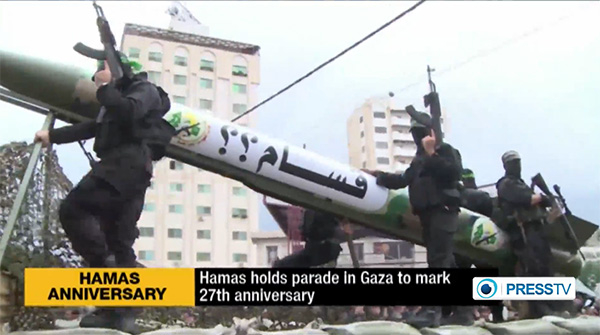
    Ironically, the EU court’s decision coincided with Hamas celebrations marking the 27thanniversary of its founding. Once again, Hamas used the celebrations to remind everyone that its real goal is to destroy Israel. And, of course, Hamas used the event to display its arsenal of weapons that include various types of rockets and missiles, as well as drones.

    845 (1)Thousands of armed Hamas troops showed off their military hardware at a Dec. 14, 2014 parade in Gaza, marking the organization’s 27th anniversary. (Image source: PressTV video screenshot)

    Hours before the EU court decision was made public, Hamas leader Mahmoud Zahar announced that his movement would never recognize Israel. Zahar also made it clear that Hamas seeks to overthrow the Palestinian Authority [PA] regime and seize control over the West Bank.

    The EU court’s decision also coincided with increased efforts to achieve rapprochement between Hamas and Iran. Recently, a senior Hamas leadership delegation visited Tehran as part of efforts to mend fences between the two sides. The main purpose of the visit was to persuade the Iranians to resume military and financial aid to Hamas. The visit, according to senior Hamas officials, appears to have been “successful.”

    “There are many signs that our relations are back on the right track,” explained Hamas’s Musa Abu Marzouk. “Hamas and Iran have repaired their relations, which were strong before the Syrian crisis.” Relations between Hamas and Iran deteriorated due to the Islamist movement’s refusal to support the regime of Syrian President Bashar Assad.

    Now the Iranians are likely to interpret the EU court decision to remove Hamas from the list of terrorist groups as a green light to resume financial and military aid to the movement.

    Iran’s leaders recently announced that they intend to dispatch weapons not only to the Gaza Strip, but to the West Bank as well, as part of Tehran’s effort to support those Palestinians who are fighting to eliminate Israel.

    Moreover, the EU court’s move will also embolden other countries that provide Hamas with political and financial aid, first and foremost Qatar and Turkey. Oil-rich Gulf countries such as Kuwait, Bahrain, Oman and Saudi Arabia will now face pressure from many Arabs and Muslims to join Qatar, Turkey and Iran in extending their support to Hamas.

    The biggest losers, meanwhile, are Palestinian Authority President Mahmoud Abbas and Egypt’s President Abdel Fattah el-Sisi. Over the past few months, the two men have been doing their utmost to undermine Hamas and end its rule over the Gaza Strip.

    Abbas has been fighting Hamas by blocking financial and humanitarian aid and arresting its supporters in the West Bank, while Sisi continues to tighten the blockade on the Gaza Strip and destroy dozens of smuggling tunnels along the border with Egypt.

    The EU court’s decision represents a “severe blow to the Palestinian Authority and Egypt,” noted Palestinian political analyst Raed Abu Dayer. “As far is Abbas is concerned, the decision grants Hamas political legitimacy and challenges his claim to be the sole legitimate leader [of the Palestinians]. With regards to Egypt, the European court decision calls into question rulings by Egyptian courts that Hamas is a terrorist organization.”

    Even if the EU court decision is reversed in the future, there’s no doubt that it has already caused tremendous damage, especially to those Muslims who are opposed to radical Islam.

    Any victory for Hamas, albeit a small and symbolic one, is a victory for the Islamic State, Al-Qaeda, Islamic Jihad, the Muslim Brotherhood and other fundamentalist groups around the world.

    The decision has left many Arabs and Muslims with the impression that Hamas, after all, is not a terrorist organization, especially if non-Muslims in Europe say so through one of their top courts. Even worse, the decision poses a real and immediate threat to Israel, as evident from the latest rocket attack.

    If the Europeans have reached the conclusion that Hamas is not a terrorist organization, then why don’t their governments openly invite tens of thousands of Hamas members and supporters to move to London, Paris and Rome? And they should not forget to ask the Hamas members to bring along with them their arsenal of weapons.