Posted tagged ‘Islam’

Inside the Fight against ISIS in Iraq

January 21, 2015

Inside the Fight against ISIS in Iraq

January 21, 2015 by Victor Soehngen

via Inside the Fight against ISIS in Iraq | FrontPage Magazine.


Kurdish Brigadier General Qadir points to a plume of smoke that emerged immediately following a US airstrike on an ISIS target. Kirkuk, Iraq (Victor Soehngen).

Amongst the wheat fields of Iraq’s Fertile Crescent, the battle for the nation’s future and the safety of the Kurdistan regional capital of Erbil, continues to rage.

In this sector of the 650-mile Kurdish front Against ISIS (or its Arabic acronym- DAESH, as it is referred to locally) the fight is close quarters, intimate, and fought between relatively small groups of men. The terrain is wide, open, and grassy with features Americans would associate more with the state of Nebraska than with Iraq.

Just a few days ago this area was completely under the control of DAESH militants. They had taken over peoples homes, held local women captive for months, and implemented their own brand of Sharia Law. That just changed due to the brave actions of the Kurdish Peshmerga (with the help of closely coordinated US airstrikes) who liberated the town of Makhmour and several neighboring villages.

I met with the commander of Peshmerga forces in the area, General Najad, who candidly explained the situation from the Kurdish point of view. Holding a BA in political science and his masters in Foreign Policy, the general spoke (in English) with an air that was as much statesman as it was field commander. He was understandably busy; men under his command just retook 6 villages each with 25-30 ISIS fighters in them over the last 48 hours.

When asked if US airstrikes were helping his forces on the ground, his leathered and serious face produced a child like grin. “They have taken out their heavy weapons.” He went on to explain that DAESH has proven to be deadly accurate with artillery, armor, and mortars alike. Is that because some of its members had specialized military training or had experience from foreign armies? He simply replied, “I don’t know, no prisoners have been taken.”

Obama Not Doing Enough

When asked about whether or not he felt that President Obama was doing enough to help the Kurdish people, Najad pointed out how large and powerful America is and how (comparatively) small the fight is here. “If Mr. Obama really wanted to, DAESH could be destroyed in days,” he told me. That is a feeling I heard echoed up and down the front. One Peshmerga Sgt. told me in broken English plainly, “Bush good for Kurdistan, Obama bad,” adding a thumb up and thumb down sign to illustrate his point.

Historically, US support for the Kurds has been erratic going all the way back to the days when the Shah of Iran was Iraq’s greatest threat. The CIA worked with the Iranians at the time to arm the Kurdish rebels against the government in Baghdad, but after Iraq and Iran signed the Algiers Agreement in 1975, support ceased. To make matters worse, as the Iraqi army renewed its campaign to exterminate the (now almost defenseless) Kurds, the Shah denied them access to escape to Iran. For our part, the US under the Carter Administration did nothing to intervene. When asked about the crisis, Henry Kissinger famously quipped, “covert action should not be confused for missionary work.”

The Kurds Have Two Friends: The Mountains and the United States of America

Although temporarily soured, US-Kurdish relations would have a major turn around under the first Bush Administration. Not only did the US-led coalition blunt Saddam Hussein’s territorial ambitions, but Bush Senior also helped implement “Operation Southern Watch,” the no-fly zone that protected the Kurdish region from the feared chemical attacks for the next 12 years. This relationship was only to grow stronger when George W. Bush’s administration ordered Operation Iraqi Freedom (in which the Kurds were actively involved).

These are not things the Kurdish people have forgotten. The Bush family is spoken of more highly here than in west Texas. For the Kurds, who are literally surrounded by enemies on all sides, it is comforting to know you have a friend in the strongest military power on earth. More so than other allies, they have enthusiastically worked with US special operation units and have been strong advocates of democracy in a region not known for its free principles. Maybe because of their simple and good-hearted nature, the Kurds have always been a people who appreciate action over talk. After all the work previous administrations have done to create such a strong alliance, it would be very unwise for the current administration to use hot air and half measures to lose one of its only strong allies in the region.

The Flag of ISIS Flew Proudly in the Distance

Back on the front line, the General provided me with a military escort and allowed me to tour villages still being contested with ISIS. Aliawa, Geheba, Jewerla — these small hamlets are little know even amongst Kurds and would probably mean nothing to an American, but this is where the modern war on terror is playing out. Populated with not more than 100 people per village (mostly by wheat farmers and their families), these villages are of both a strategic importance for the Kurdistan Regional Government (KRG) and ISIS.

To begin with, they’re less than 50 miles from the regional capital of Erbil, which has served as an impromptu refugee camp for thousands of Christians, Yazidis, and other minorities seeking safety behind the Peshmerga line. Beyond that, they sit near a major crossroads between DAESH-occupied Mosul and the contested area around Kirkuk.

I first visited the village of Aliawa, where I met with Captain Ziryan and a small group of 20-25 soldiers. Theirs was the unit that just reclaimed the village — and the ISIS fighters did not leave without a fight. The captain took me to a house where two mornings prior he led a group of men in to a fierce firefight with eight militants who were lying in wait for them. Pools of blood were still damp on the floor where the Captain said he personally shot one of them who came charging down the stairs firing in either a last ditch effort at escape or suicide. Three more were killed in the house, while four others managed to escape, speeding away in a lightly armored pickup truck over the open expanse to the next ISIS-controlled village.

This is the type of combat that has come to characterize the fight against DAESH, at least along the Kurdish Front. They were able to achieve remarkable success fighting “symmetrically” at first — that is to say, using relatively conventional tactics to capture and control territory. However, as air strikes, numerical superiority, and the dogged determination of its adversaries begin to prevail against it, a serious question arises: Will we start to see ISIS begin returning to the tactics of one of its predecessors, Al Qaida?

If the fighting method DAESH has been using most recently is evidence of anything, then all signs point to yes.

When I visited the commander of the last Kurdish-controlled village before ISIS took control of the territory, buildings still smoldered in the aftermath of a US airstrike and the smell of burnt gasoline from destroyed enemy trucks lingered in the air. Colonel Shabak met me in traditional Kurdish style; sitting cross-legged on the floor and with a piping hot cup of tea waiting. When I asked him point blank what supplies he believed that America could offer him that would help most on the ground, he did not hesitate: “Military engineers to help train us against the bombs.” By that, of course, he meant specialized training in IED detection.

He told me that when DAESH first attacked, it used heavy weapons, even Abrams tanks (recently seized from an Iraqi brigade in nearby Mosul), but as American and European airstrikes have degraded its capability to utilize these weapons, the open plains of this territory have left small groups of militants defending increasingly isolated “island” villages that scatter the open countryside every few kilometers.

As the Peshmerga is “systematically” over running these positions one by one (with infantry, light armor, and air strikes), ISIS fighters are doing what the Kurdish officers are telling me they have been seeing up and down the front: They are littering roads, fields, and neighborhoods with IEDs. This has been slowing the advance of Kurdish forces and is perhaps evidence that the now highly visible ISIS might soon be shrinking in to a more shadowy, subversive role.

A role that is all too familiar for US military personnel, who spent years fighting that type of fight in the region.

The shrinking of ISIS will obviously not happen overnight. DAESH still occupies large swaths of territory, the recapturing of which will take the consolidated effort of several unlikely bedfellows. In much of the land that it occupies, there is a genuine support base amongst some of the populace, mostly old Ba’ath Party loyalists and Sunni Arabs who felt ostracized by Malaki’s government in Baghdad. In addition, the militants still have an arsenal at their disposal — an arsenal that, mind you, would put dozens of legitimate armies to shame — and they don’t appear to be giving up anytime soon.

Yet sipping tea with a Peshmerga Colonel on the front line, I couldn’t help but think that ISIS commanders, in this region at least, might just have bitten off more than they can chew.

Canada’s FM: A Jewish state today is more important than even a few years ago

January 21, 2015

Canada’s FM: A Jewish state today is more important than even a few years ago

‘We have a fundamental difference with the Palestinians’ about their path to statehood, a thoroughly unapologetic John Baird tells The Times of Israel

By Raphael Ahren January 21, 2015, 3:32 pm

via Canada’s FM: A Jewish state today is more important than even a few years ago | The Times of Israel.


ohn Baird has no intention of apologizing. The Palestinians would like the Canadian foreign minister to say he’s sorry for his government’s unabashedly pro-Israel stance. They shouldn’t hold their breath.

In fact, Baird is waiting for an apology from Ramallah — not for having his car pelted with eggs and shoes Sunday during his visit there, but for a top Palestinian official’s comparison between Israel and terrorists of the Islamic State.

“People may disagree with our position with respect to Israel, but so be it,” Baird said Tuesday in Tel Aviv, as he wrapped up a three-day visit to the region. “It’s always wise to speak with moral clarity,” he submitted, adding that despite Ottawa’s unflinching friendship with the Jewish state, “we have a pretty good relationship with most of the Arab countries in the region.”

But evidently not so much with the Palestinians, as his visit to Ramallah Sunday underlined. While Palestinian protestors booed, hurled shoes and eggs at Baird and told him he was unwelcome in their land, senior Palestine Liberation Organization official and ex-chief peace negotiator Saeb Erekat released a statement denouncing Baird and urging him to ask the Palestinian people for forgiveness for his country’s consistent support for Israel.

“The Palestinian people as well as the rest of the Arab and Muslim countries deserve an apology from the Canadian government for years of systematic attempts at blocking the right of the Palestinian people to a state of their own,” Erekat declared. Canada stands “on the wrong side of history” by blindly supporting Israel’s “apartheid policies,” Erekat charged, attacking Baird personally for contributing to alleged Israeli violations of Palestinian rights.

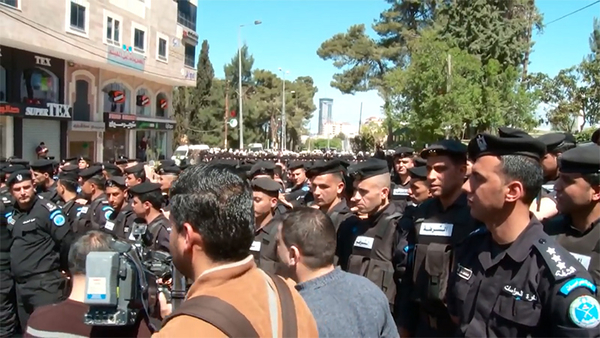
Policemen stand guard in front of Palestinian protesters holding placards before a meeting between Palestinian Authority Minister of Foreign Affairs Riyad al-Maliki and his Canadian counterpart John Baird on January 18, 2015, Ramallah. (AFP/ABBAS MOMANI)

Speaking to The Times of Israel in his Tel Aviv hotel, Ottawa’s top diplomat made crystal clear he makes no apology for his government’s positions on Israel. Instead, he noted that he is awaiting an apology from Erekat, who earlier this month said Israel’s settlement building in the West Bank was “terrorism” tantamount to that practiced by the Islamic State.

“That speaks volumes,” Baird said of Erekat’s comparison. “I’ll leave it to any fair-minded observer to come to conclusions about him,” he added diplomatically.

At the time, Baird’s spokesperson, Rick Roth, said Erekat’s comments “are offensive and ridiculous, and he should apologize immediately.” Such comparisons undermine efforts to combat the IS terrorists and could “inflame tensions in the region,” Roth stated in Baird’s name.

‘We strongly support a Palestinian state. We just believe it’s a byproduct of negotiations with Israel’

“We have a fundamental difference of opinion with the Palestinian leadership,” Baird said Tuesday. But he added that he has a “good relationship” with Palestinian Authority President Mahmoud Abbas and Foreign Minister Riyad al-Maliki, despite Ottawa’s opposition to their unilateral efforts to gain statehood recognition without having to negotiate without Israel.

“They know our position. We don’t say one thing to their face and another thing when we go back home. We strongly support a Palestinian state,” said Baird. “We just believe it’s a byproduct of peace negotiations with Israel. The way to accomplish a Palestinian state is dialogue with Israel and not taking unilateral action.”

A Palestinian protester holds a poster with a photo of Canadian Foreign Minister John Baird that reads in Arabic, "You should be ashamed of your biased position towards Israel," during Baird's meeting with Palestinian Authority Foreign Minister Riad Maliki, in the West Bank city of Ramallah, Sunday, Jan. 18, 2015. Dozens of Palestinian protesters have hurled eggs and shoes at the convoy of the visiting Canadian foreign minister. (photo credit: AP Photo/Nasser Nasser)

The Palestinians “made a huge mistake” by pressing war crimes charges against Israel at the International Criminal Court in The Hague, Baird declared Monday. On Tuesday, he reiterated his opposition to the PA’s move, but was reluctant to discuss which steps, if any, his government would take to in response. “We’ve registered our objection and will continue to advocate for them to take a different course,” he said.

Some pro-Israel activists have called on member states to defund the ICC if it doesn’t reject the Palestinians’ charges, but Baird said it was his government’s call and unfitting for him to speculate on such moves. “We’ll take it one step at a time.”

‘Palestinians should understand the importance of the Jewish state’

Canada is one of the few countries that recognizes Israel as a Jewish state, but Baird steered clear of endorsing Prime Minister Benjamin Netanyahu’s demand that the Palestinians need to recognize “Jewish” Israel as well before any peace deal could be signed.

Not wanting to interfere in an Israeli election campaign, Baird said he won’t tell the Palestinians what they should be doing. He did say, however, that “the Palestinians should have an understanding of the Israeli position and the importance of the Jewish state.”

The existence of a country that all Jews can call their home was important in the aftermath of World War II, and remains so in 2015, the 45-year-old foreign minister said. “With the anti-Semitism rising in so many parts of the world it’s probably more important today than it was even a few short years ago that there be a Jewish state where people can seek refuge.”

‘We will judge Iran by the action that it takes, not by its words’

On the topic of Iran, Baird sees mostly eye to eye with Netanyahu, saying that Tehran must not acquire the means to produce a nuclear weapon and condemning the regime for supporting terrorism and for human rights violations. However, he did not echo Netanyahu’s position that Iran must not be allowed to retain a single centrifuge in a future nuclear agreement with world powers, and hinted that Tehran could be allowed to keep a limited number.

“There is no right to enrichment; there is no need for enrichment,” he said. “In a perfect world, that’s what a deal would look like. We don’t live in a perfect world. Could you have a save facing few dozen, few hundred [centrifuges]? That’s one thing. Obviously, the higher the number goes the more concern that would cause Canada.”

Prime Minister Benjamin Netanyahu (right) shakes hands with Canada's Minister of Foreign Affairs John Baird (left) in Jerusalem, on January 19, 2015. (photo credit: Kobi Gideon/GPO)

Baird suggested that those hoping for rapprochement between Ottawa and Tehran in the wake of progressing nuclear negotiations between Tehran and the so-called P5+1 powers will probably be disappointed.

“We will judge Iran by the action that it takes, not by its words,” he said, adding that the country’s approach to human rights and its support for terrorism have gotten worse over the last two years.

“Iran could be a stabilizing element in the region — if they gave up their support of terrorism, cleaned up their human rights record and took a different path on the nuclear program. Iran can play a leadership role in the region and the world. But they have to change course.”

U.S. to Award Iran $11.9 Billion Through End of Nuke Talks

January 21, 2015

U.S. to Award Iran $11.9 Billion Through End of Nuke Talks

Another $490 million released on Tuesday under deal

via U.S. to Award Iran $11.9 Billion Through End of Nuke Talks | Washington Free Beacon.

BY:
January 21, 2015 5:00 am

The Obama administration on Wednesday paid $490 million in cash assets to Iran and will have released a total of $11.9 billion to the Islamic Republic by the time nuclear talks are scheduled to end in June, according to figures provided by the State Department.

Today’s $490 million release, the third such payment of this amount since Dec. 10, was agreed to by the Obama administration under the parameters of another extension in negotiations over Tehran’s contested nuclear program that was inked in November.

Iran will receive a total of $4.9 billion in unfrozen cash assets via 10 separate payments by the United States through June 22, when talks with Iran are scheduled to end with a final agreement aimed at curbing the country’s nuclear work, according to a State Department official.

Iran received $4.2 billion in similar payments under the 2013 interim agreement with the United States and was then given another $2.8 billion by the Obama administration last year in a bid to keep Iran committed to the talks through November, when negotiators parted ways without reaching an agreement.

Iran will have received a total of $11.9 billion in cash assets by the end of June if current releases continue on pace as scheduled.

The release of this money has drawn outrage from some Republican lawmakers who filed legislation last year to prevent the release of cash due to a lack of restrictions on how Iran can spend the money.

These cash payments by the United States have been made with no strings attached, prompting concerns that Iran could use the funds to finance its worldwide terror operations, which include the financial backing of Hamas, Hezbollah, and other rogue entities.

Senators—including Mark Kirk (R., Ill.), Kelly Ayotte (R., N.H.), and John Cornyn (R., Texas)—sought last year to put a hold on the cash infusions until the White House could certify that Iran was not using the money to support terrorism.

Kirk, who is preparing to offer legislation that would tighten sanctions on Iran, said that the ongoing payments could help Iran fuel its terror empire well into the near future.

“Between November 2014 and July 2015, the interim deal’s direct forms of sanctions relief will allow Iran access to roughly $4.9 billion in frozen money,” Kirk told the Washington Free Beacon “That’s equal to what it’d cost Iran to fund Hezbollah for as much as 50 years.”

The Pentagon estimates Iran has spent $100 to $200 million per year funding Hezbollah.

Entities likely to receive support from Iran include the Palestinian Islamic Jihad (PIJ) and the regime of President Bashar al-Assad of Syria, the legislation suggests.

When final negotiations between the United States and Iran failed in November, negotiators decided once more to extend the talks through June of this year. The terms of that extension granted Iran the 10 payments of $490 million, a State Department official said.

“With respect to sanctions relief, the United States will enable the repatriation of $4.9 billion of Iranian revenue held abroad during the extension,” the official said.

The first two payments were made in December, followed by Wednesday’s payment.

The next release is scheduled for Feb. 11, with two more scheduled for March. The rest of the frozen cash assets will be given back to Iran on April 15, May 6, May 27, and June 22, respectively.

Mark Dubowitz, the executive director of the Foundation for Defense of Democracies (FDD), said the ongoing release of these assets has provided Iran with a critical “financial lifeline.”

“The Obama administration provided Iran with a financial lifeline through both direct sanctions relief and the de-escalation of sanctions pressure that helped the regime stabilize its economy after a severe sanctions-induced economic crisis in 2012 and 2013,” Dubowitz said. “It is not a surprise that this has increased Iranian negotiating leverage and hardened the supreme leader’s nuclear intransigence.”

In addition to decrying the lack of restrictions in place to ensure that Iran does not use the released funds to sponsor terrorism, critics of the sanctions relief protest that Iran is benefitting while the United States receives little in return.

Iran has continued to enrich uranium under the interim deal, adding what one critic, Rep. Brad Sherman (D., Calif.) referred to as “about one bomb’s worth” to its reserves.

Iran also has continued to make advances on the plutonium track, which provides it with a second path to a nuclear bomb.

President Hassan Rouhani of Iran announced last week that the country has begun constructing two new light water nuclear reactors, a move that the U.S. State Department said is permissible under the terms of the interim agreement.

The West Bank Army of the “State of Palestine,” Thanks to the United States

January 21, 2015

The West Bank Army of the “State of Palestine,” Thanks to the United States, The Gatestone InstituteShoshana Bryen, January 21, 2015

(????????????? — DM)

The U.S. Consulate’s determination to provide the trappings of Palestinian statehood to the Palestinian Authority outside the negotiating process should come under scrutiny.

What plan do we have if the Palestinian army attacks the IDF in the future — instead of its presumed enemy, Hamas?

It is revealing that the U.S. appears determined to provide the Palestinian Authority with an army while it is still at war with our ally, Israel.

Last week, officials from the U.S. Consulate in East Jerusalem attended a Palestinian protest over Israel’s removal of olive trees illegally planted in the West Bank. Coordinated with the Palestinian Authority [PA] but not Israel, the Consulate personnel ended up clashing with Israelis living nearby. It was, perhaps, the quietest international almost-incident you never heard of.

This week, with the focus off Paris, the Middle East Quartet (the U.S., EU, Russia & the UN) plans to meet. The U.S. Consulate’s determination to provide the trappings of Palestinian statehood to the PA outside the negotiating process should come under scrutiny.

The olive tree incident prompted an article in the Israeli press about the Consulate, including the use of Palestinian security, rather than IDF combat veterans as required by a 2011 agreement. Some IDF guards were fired, according to the article. Others resigned, blaming the appointment of a new consulate security officer, who they said, established a Palestinian armed militia. “He is training them with weapons, combat and tactical exercises. There is a lack of responsibility here – who ensures that such weapons, once given over to Palestinian guards, won’t make their way to terror groups?”

The change in personnel from IDF veterans to a Palestinian Security Force [PSF] is part of a long series of steps to transform the Palestinian body politic into a state. If the U.S. Consulate becomes the U.S. Embassy to Palestine — a function it already observes — it is understandable that the PA would not want “occupying Israeli soldiers” to guard the symbol of America from Palestinian citizens in “its capital, Jerusalem.” The Consulate, with its mission to the PA, would agree.

Palestinian security forces have been in existence since 1994 and have steadily changed mandates. They have gone from a “police force” under the Oslo formulation of “dismantling the terrorist infrastructure” so Israel could have confidence in security after withdrawing from territory, to a protection force for Mahmoud Abbas so he would continue negotiations under U.S. auspices — but now to an army for the nascent state.

The Clinton Administration signed on to the police phase, but asked how Arafat could be expected to defeat “terrorists” without weapons. Unmentioned were a) Arafat was the prime funder and organizer of the terrorist organizations in question, and b) the PLO had already proven perfectly capable of killing its enemies.

The first funds for equipment and training came in 1994 from international donors including the U.S. Arafat, having a reasonable sized arsenal of his own, wanted arms, but settled for nonlethal items.

In 1996, Western trained Palestinian “police” attacked IDF personnel with weapons, killing 15 soldiers and border guards, after the opening of an exit from an ancient Hasmonean tunnel in Jerusalem, near the Western Wall in the Old City.

Despite these attacks, according to Jeffrey Boutwell, Director
 of the Pugwash Conferences on Science and World Affairs, the 1997 Hebron Protocol “provided for a Palestinian police force of some 30,000 personnel, equipped with 15,000 automatic rifles and pistols, 240 heavy machine guns, 45 armored vehicles, lightly armed shore patrol vessels, and associated communications and transportation equipment.” An Israeli-Palestinian Joint Security Coordination and Cooperation Committee [JSC] was formed to oversee “arrangements for entry of the Palestinian Police and the introduction of police arms, ammunition, and equipment.”

Between the onset of Western arms deliveries and a thriving black market, the PA “police” had all the lethal equipment they could handle.

Training stopped during the 2001-2004 so-called “second intifada” with the (unsurprising) revelation that the PA “police” found their Western assets invaluable in attacking Israelis. In 2005, however, history began again and the U.S. decided that the Palestinians should have a new security service. LTG William Ward USA (Deputy Commanding General, U.S. Army Europe, and Chief of Staff, U.S. Seventh Army) was the point man. In the words of then-Secretary of State Condoleezza Rice, his mission was:

  • “To make sure the parties understand each other and we understand what the parties are doing, so we can raise it at the appropriate level” if action is required.
  • “To provide a focal point for training, equipping, helping the Palestinians to build their security forces and also for monitoring, and if necessary, to help the parties on security matters.”

The missions were incompatible and inappropriate. The first involved “translating for the parties” with an eye toward U.S. intervention, a political job that should not have been done by a military officer. Further, having part of the mission directed toward a Palestinian force gave the General a stake in the success of the Palestinians over the concerns of Israel.

And so it happened. The Ward mission, the sole conduit for U.S. aid to the new Palestinian Security Force, resulted only in better-trained terrorists.

LTG Keith Dayton (Director of Strategy, Plans and Policy, Office of the Deputy Chief of Staff, G-3, U.S. Army), well respected and liked by Israel and the IDF, succeeded LTG Ward. His job, however, was complicated by the deterioration relations Hamas-Fatah in Gaza. According to acontemporaneous Ha’aretz story, Dayton was to arm and train “the Presidential Guard of PA Chairman Mahmoud Abbas to prepare it for a potential violent confrontation with Hamas forces in Gaza. Palestinian sources say the training of 400 Force 17 troops… started [in November 2006] in Jericho under the guidance of an American military instructor.” Force 17 had been Arafat’s Praetorian Guard, attacking recalcitrant Palestinians as well as Israelis. Abbas had inherited it.

Throwing American support to one Palestinian faction over another was a political decision to side with what our government assumed was “better” or more “moderate” Palestinians, hoping it would use our help to put down Hamas rather than using it to kill ever more Israelis.

What it did was legitimize the creeping movement of the Palestinians toward a full-fledged army.

This new mission needed IDF participation — which Israel approved in part because of its relations with LTG Dayton, and because it allowed Israel to operate in West Bank territory with a relatively free hand to arrest both Hamas operatives and Fatah bad guys. It also made Abbas beholden to Israel for his personal security and that of his kleptocracy. That part worked, and even now, PA figures have admitted publicly that without IDF cooperation, the PA would fall.

Dayton’s successors, LTG Michael Moeller, USAF and ADM Paul Bushong, USN, have quietly continued and upgraded both training and weapons.

893Hundreds of troops from the Palestinian Security Force line a street in Ramallah, in order to block anti-American protestors, during President Obama’s 2013 visit to the city.

The question always was twofold: What constitutes “appropriate” weapons for the PSF, and how does the U.S. justify training security forces the ultimate loyalty of whom will be a government that we cannot foresee and may become something — or already is something — we don’t like? The corollary is: What plan do we have if the Palestinian Army attacks IDF forces in the future — instead of its presumed enemy, Hamas?

To raise the questions is to understand that there are no sound answers from either the Consulate or the State Department. In their absence, concern over the choice of security guards by the U.S. Consulate in Jerusalem is appropriate, but insufficient. It is revealing that the U.S. appears determined to provide the PA with an army while it is still at war with our ally, Israel.

European ‘No-Go’ Zones: Fact or Fiction? Part 1: France

January 20, 2015

European ‘No-Go’ Zones: Fact or Fiction? Part 1: France, The Gatestone InstituteSoeren Kern, January 20, 2015

(Please see also Fox News “Apologizes” to Radical Islam — DM)

A 120-page research paper entitled “No-Go Zones in the French Republic: Myth or Reality?” documented dozens of French neighborhoods “where police and gendarmerie cannot enforce the Republican order or even enter without risking confrontation, projectiles, or even fatal shootings.”

In October 2011, a 2,200-page report, “Banlieue de la République” (Suburbs of the Republic) found that Seine-Saint-Denis and other Parisian suburbs are becoming “separate Islamic societies” cut off from the French state and where Islamic Sharia law is rapidly displacing French civil law.

The report also showed how the problem is being exacerbated by radical Muslim preachers who are promoting the social marginalization of Muslim immigrants in order to create a parallel Muslim society in France that is ruled by Sharia law.

The television presenter asks: “What if we went to the suburbs?” Obertone replies: “I do not recommend this. Not even we French dare go there anymore. But nobody talks about this in public, of course. Nor do those who claim, ‘long live multiculturalism,’ and ‘Paris is wonderful!’ dare enter the suburbs.”

The jihadist attack on the Paris offices of Charlie Hebdo, a French magazine known for lampooning Islam, has cast a spotlight on so-called no-go zones in France and other European countries.

No-go zones are Muslim-dominated neighborhoods that are largely off limits to non-Muslims due to a variety of factors, including the lawlessness and insecurity that pervades a great number of these areas. Host-country authorities have effectively lost control over many no-go zones and are often unable or unwilling to provide even basic public aid, such as police, fire fighting and ambulance services, out of fear of being attacked by Muslim youth.

Muslim enclaves in European cities are also breeding grounds for Islamic radicalism and pose a significant threat to Western security.

Europe’s no-go zones are the by-product of decades of multicultural policies that have encouraged Muslim immigrants to create parallel societies and remain segregated from — rather than become integrated into — their European host nations.

The problem of no-go zones is well documented, but multiculturalists and their politically correct supporters vehemently deny that they exist. Some are now engaged in a concerted campaign to discredit and even silence those who draw attention to the issue.

Consider Carol Matlack, an American writer for Bloomberg Businessweek, who recently penned a story — entitled “Debunking the Myth of Muslim-Only Zones in Major European Cities” — in which she claims that no-go zones are nothing more than an “urban legend” that is “demonstrably untrue.” She then goes on to ridicule those who disagree with her.

The American cable television channel Fox News has also issued at least four apologies for referring to Muslim no-go zones in Europe, after one commentator erroneously claimed that the entire city of Birmingham, England, was Muslim. Had he simply said that “parts” of Birmingham are Muslim, he would have been correct.

Despite such politically correct denials, Muslim no-go zones are a well-known fact of life in many parts of Europe.

What follows is the first in a multi-part series that will document the reality of Europe’s no-go zones. The series begins by focusing on France and provides a brief compilation of just a few of the literally thousands of references to French no-go zones from academic, police, media and government sources that can easily be found on the Internet by doing a simple search on Google.

Fabrice Balanche, a well-known French Islam scholar who teaches at the University of Lyon, recently told Radio Télévision Suisse: “You have territories in France such as Roubaix, such as northern Marseille, where police will not step foot, where the authority of state is completely absent, where mini Islamic states have been formed.”

French writer and political journalist Éric Zemmour recently told BFM TV: “There are places in France today, especially in the suburbs, where it is not really in France. Salafi Islamists are Islamizing some neighborhoods and some suburbs. In these neighborhoods, it’s not France, it’s an Islamic republic.” In a separate interview, Zemmour — whose latest book is entitled, “The French Suicide” — says multiculturalism and the reign of politically correct speech is destroying the country.

French politician Franck Guiot wrote that parts of Évry, a township in the southern suburbs of Paris, are no-go zones where police forces cannot go for fear of being attacked. He said that politicians seeking to maintain “social peace” were prohibiting the police from using their weapons to defend themselves.

The Socialist mayor of Amiens, Gilles Demailly, has referred to the Fafet-Brossolette district of the city as a “no-go zone” where “you can no longer order a pizza or get a doctor to come to the house.” Europe 1, one of the leading broadcasters in France, has referred to Marseille as a “no-go zone” after the government was forced to deploy riot police, known as CRS, to confront warring Muslim gangs in the city. The French Interior Ministry said it was trying to “reconquer” 184 square kilometers (71 square miles) of Marseille that have come under the control of Muslim gangs.

The French newspaper Le Figaro has referred to downtown Perpignan as a “veritable no-go zone” where “aggression, antisocial behavior, drug trafficking, Muslim communalism, racial tensions and tribal violence” are forcing non-Muslims to move out. Le Figaro also reported that the Les Izards district of Toulouse was a no-go zone, where Arab drug trafficking gangs rule the streets in a climate of fear.

Separately, Le Figaro reported that large quantities of assault rifles are circulating in French no-go zones. “For a few hundred dollars you can buy Kalashnikovs,” political scientist Sebastian Roché said. “The price of an iPhone!”

The newspaper France Soir published poll results showing that nearly 60% of French citizens are in favor of sending the army into troubled suburbs to restore order.

The newspaper Le Parisien has called parts of Grigny, a township in the southern suburbs of Paris, a “lawless zone” plagued by well-organized Muslim gangs, whose members believe they are “masters of the world.” The weekly newsmagazine Le Point reported on the spiraling Muslim lawlessness in the French city of Grenoble.

The French magazine L’Obs (formerly known as Le Nouvel Observateur) has reported on the deteriorating security situation in Roubaix, a city in northern France that is located close to the Belgian border. The magazine reported that local citizens are “exiled within their own country” and want to create their own militia to restore order because police are afraid to confront Muslim gangs.

In August 2014, the French magazine Valeurs Actuelles (Contemporary Values) reported that “France has more than 750 areas of lawlessness” where the law of the French Republic no longer applies. Under the headline “Hell in France,” the magazine said that many parts of France are experiencing a “dictatorship of riffraff” where police are “greeted by mortar fire” and are “forced to retreat by projectiles.”

Separately, Valeurs Actuelles reported on the lawlessness in Trappes, a township located in the western suburbs of Paris, where radical Islam and endemic crime go hand in hand. “Criminals are pursued by Islamic fundamentalists to impose an alternative society, breaking links with the French Republic,” according to local police commander Mohammed Duhan. It is not advisable to go there, he says, adding, “You will be spotted by so-called chauffeurs (lookouts for drug traffickers) and be stripped and smashed.”

Valeurs Actuelles has also reported on no-go zones in Nantes, Tours and Orléans, which have turned into “battlefields” where the few remaining native French holdouts are confronted with “Muslim communalism, the disappearance of their cultural references and rampant crime.”

A graphic 20-minute documentary (in French) about the no-go zone in Clichy Montfermeil, a suburb of Paris, can be viewed here. At around the 3-minute mark, the video shows what happens when French police enter the area.

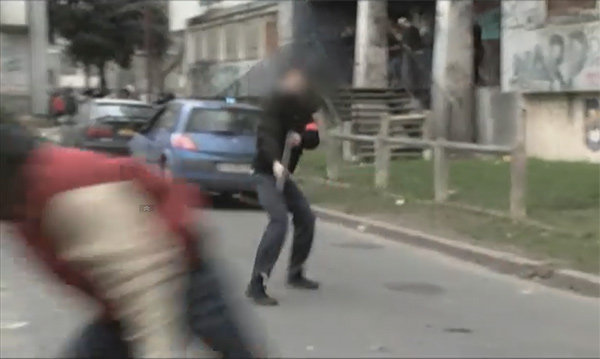
891A policeman uses a shotgun to try to keep an attacking gang at bay, in the Parisian suburb of Clichy Montfermeil. (Image source: Dailymotion video screenshot)

A 1.5 hour documentary (in French) produced by France’s TF1 about Muslim gangs in Parisian no-go zones can be viewed here. A 50-minute documentary (in French) produced by France’s TV3 about the no-go zones of Clos Saint-Lazare in northern Paris can be viewed here. A 45-minute documentary (in English) about the no-go zones of Marseilles can be viewed here.

A four-minute video of the most dangerous neighborhoods of France in 2014 can be viewed here. A three-and-a-half-minute video of the most dangerous neighborhoods in Greater Paris Metropolitan Area can be viewed here. A two-minute video of a no-go zone in Lille can be viewedhere. A five-minute video about life in the suburbs of Lyon can be viewed here.

A Russian television (Russia-1) documentary about no-go zones in Paris can be viewed here. The presenter says: “We are in Paris, the Barbès quarter, a few minutes from the famous Montmartre. Finding a European here is almost a mission impossible. Certain Paris streets remind one of an oriental bazaar.” He continues: “The Paris banlieues have become criminal ghettoes where even the police dare not enter.” Hidden cameras record widespread lawlessness and drug dealing in the area.

A 120-page research paper entitled “No-Go Zones in the French Republic: Myth or Reality?”documented dozens of French neighborhoods “where police and gendarmerie cannot enforce the Republican order or even enter without risking confrontation, projectiles, or even fatal shootings.”

Some of the most notorious no-go zone areas in France are situated in the department of Seine-Saint-Denis, a northeastern suburb (banlieue) of Paris that has one of the highest concentrations of Muslims in France. The department is home to an estimated 600,000 Muslims (primarily from North and West Africa) out of a total population of 1.4 million.

Seine-Saint-Denis is divided into 40 administrative districts called communes (townships), 36 of which are on the French government’s official list of “sensitive urban zones” or ZUS.

Seine-Saint-Denis — also known locally as “ninety-three” or “nine three” after the first two digits of the postal code for this suburb — has one of the highest unemployment rates in France; more than 40% of those under the age of 25 are jobless. The area is plagued with drug dealing and suffers from some of the highest rates of violent crime in France.

In October 2011, a landmark 2,200-page report, “Banlieue de la République” (Suburbs of the Republic) found that Seine-Saint-Denis and other Parisian suburbs are becoming “separate Islamic societies” cut off from the French state, and where Islamic Sharia law is rapidly displacing French civil law. The report said that Muslim immigrants are increasingly rejecting French values and instead are immersing themselves in radical Islam.

The report — which was commissioned by the influential French think tank, L’Institut Montaigne — was directed by Gilles Kepel, a highly respected political scientist and specialist in Islam, together with five other French researchers.

The authors of the report showed that France — which now has 6.5 million Muslims (the largest Muslim population in European Union) — is on the brink of a major social explosion because of the failure of Muslims to integrate into French society.

The report also showed how the problem is being exacerbated by radical Muslim preachers, who are promoting the social marginalization of Muslim immigrants in order to create a parallel Muslim society in France that is ruled by Sharia law.

The research was primarily carried out in the Seine-Saint-Denis townships of Clichy-sous-Bois and Montfermeil, two suburbs that were ground zero for Muslim riots in the fall of 2005, when Muslim mobs torched more than 9,000 cars.

The report described Seine-Saint-Denis as a “wasteland of de-industrialization” and said that in some areas, “a third of the population of the town does not hold French nationality, and many residents are drawn to an Islamic identity.”

Another township of Seine-Saint-Denis is Aubervilliers. Sometimes referred to as one of the “lost territories of the French Republic,” it is effectively a Muslim city: more than 70% of the population is Muslim. Three quarters of young people under 18 in the township are foreign or French of foreign origin, mainly from the Maghreb and sub-Saharan Africa. French police are said to rarely venture into some of the most dangerous parts of the township.

The southern part of Aubervilliers is well known for its vibrant Chinese immigrant community along with their wholesale clothing and textile warehouses and import-export shopping malls. In August 2013, the weekly newsmagazine Marianne reported that Muslim immigrants felt humiliated by the economic dynamism of the Chinese, and were harassing and attacking Chinese traders, who were increasingly subject to robberies and extortion. The situation got so bad that the Chinese ambassador to France was forced to pay a visit to the area.

In response, the Socialist mayor of Aubervilliers, Jacques Salvator, suggested that the violence could be halted if Chinese companies would agree to hire more Arabs and Africans. The Chinese countered that Muslims do not work as hard as the Chinese, that they are more demanding, and that they complain too much, according to Marianne.

After local officials refused to act in the face of increasing Muslim violence, the Chinese threatened to “call on the Chinese mafia” for protection. Muslims responded by launching a petition to have the Chinese expelled from the area.

Also in Aubervilliers, the magazine Charlie Hebdo reported in 2012 that the town hall was obligating non-Muslim men who want to marry Muslim women to convert to Islam first, even though France is ostensibly a secular republic. One such man, Frédéric Gilbert, a journalist, was told:

“You can convert in any mosque in three minutes. All you need do is to repeat ‘with conviction and sincerity’ this sentence: ‘I recognize that there is no god but Allah and that Mohammed is his prophet,’ and the Imam will agree that you have converted to Islam.'”

In a story entitled, “When Town Hall Mayors become Imams,” Charlie Hebdo wrote:

“In other words, Moroccan law prevails over French law in cases of mixed marriages and the same situation pertains with regard to other former French colonies such as Tunisia and Algeria as well as with Egypt.”

According to the newspaper Le Parisien, the practice of “false conversions” to Islam is widespread because most non-Muslim grooms prefer fake conversions rather than to suffer “administrative complications.”

In 2014, Le Figaro published the contents of a leaked intelligence document that warns about the imposition of Islamic Sharia law in French schools in Muslim ghettoes. The 15-page document provides 70 specific examples of how Muslim radicals are taking over ostensibly secular schools throughout the country. These include: veiling in playgrounds, halal meals in the canteen, chronic absenteeism (bordering 90% in some parts of Nîmes and Toulouse) during religious festivals, clandestine prayer in gyms or hallways. The report details how “self-proclaimed young guardians of orthodoxy” are circumventing the March 2004 law banning religious symbols in French schools. In Marseille, a high school principal testified that some of her students pray with such fervor that they have “blue foreheads.”

A video showing a radical Islamic rally in Saint-Denis can be viewed here. A video showing radical Muslims commandeering a French bus amid screams of “Allahu Akbar!” (Allah is greater!) can be viewed here. A series of eight videos documenting Muslim street prayers in Paris can be viewed here. (Street prayers have now been outlawed.) A series of 25 videos documenting the Islamization of France can be viewed here.

In July 2012, the French government announced a plan to reassert state control over 15 of the most notorious no-go zones. The crime-infested districts, which the French Interior Ministry has designated as Priority Security Zones (Zones de Sécurité Prioritaires, or ZSP), include heavily Muslim parts of Amiens, Aubervilliers, Avignon, Béziers, Bordeaux, Clermont-Ferrand, Grenoble, Lille, Lyon, Marseilles, Montpellier, Mulhouse, Nantes, Nice, Paris, Perpignan, Strasbourg, Toulouse and many others. The number of ZSPs now stands at 64; a complete list of ZSPs can be found here.

Meanwhile, a 13-minute Hungarian television documentary (with English subtitles) about no-go zones in Paris can be viewed here. The presenter interviews a French crime reporter named Laurent Obertone, who is the author of a bestselling new book entitled, “La France Orange Méchanique” (France: A Clockwork Orange).

In his book, Obertone writes that France is descending into a state of savagery and that the true magnitude of crime and violence across the country is being deliberately under-reported by politically correct media, government and police.

In the documentary, Obertone states: “The French elite became outraged when [former French President Nicolas] Sarkozy referred to [Muslim] immigrants attacking police as ‘mobs’.”

The Hungarian presenter then asks: “What if we went to the suburbs?” Obertone replies: “I do not recommend this. Not even we French dare go there anymore. But nobody talks about this in public, of course. Nor do those who claim, ‘long live multiculturalism,’ and ‘Paris is wonderful!’ dare enter the suburbs.”

Iran Promises ‘Crushing Response’ to Israeli Strike

January 20, 2015

Iran Promises ‘Crushing Response’ to Israeli Strike

Strike killed six Iranian agents, five Hezbollah members

BY Adam Kredo
January 20, 2015 5:00 am

via Iran Promises ‘Crushing Response’ to Israeli Strike | Washington Free Beacon.


Lebanese Hezbollah supporters shout slogans as they march during Ashoura day in Beirut’s southern suburbs, Lebanon, Tuesday, Dec. 6, 2011 / AP

Iran on Monday promised that Hezbollah would deliver “crushing response” to the Israeli attack over the weekend, which killed six Iranian agents, including a top-level commander, and five Hezbollah members.

“The experience of the past shows that the resistance current will give a crushing response to the Zionist regime’s terrorist moves with revolutionary determination and in due time and place,” Ali Shamkhani, the secretary of Iran’s Supreme National Security Council (SNSC), was quoted as saying.

The Israeli strike came just days after Hezbollah leader Hassan Nasrallah declared that the terror group was preparing for a war in Israel’s northern Galilee region.

It also occurred just a week after Iranian military leaders announced that they are operating missile sites in Syria, which potentially include a nuclear facility.

Senior Iranian and Hezbollah commanders were likely planning a sophisticated invasion of Israel’s northern border in the weeks before they were killed by an Israeli airstrike over the weekend, according to Major General Eyal Ben Reuven, the former deputy head of the Israeli Defense Forces Northern Command.

The accuracy of Israel’s strike and the high-level nature of those Iranian and Hezbollah commanders killed indicates planning for a militant incursion into Israel’s northern region, according to Reuven, who said the airstrike shows a “very high level of intelligence” on Israel’s part.

The high-level nature of the Iranian and Hezbollah operatives targeted by Israel suggests that an attack on Israel was imminent, according to Reuven, who handled top intelligence in the region during his time serving in the IDF.

“If the highest level of Hezbollah commanders were in the Golan Heights and the high level of Iranians, it means that their idea, [what] they’re planning could be a kind of operation, an act against Israel on a high level,” Reuven said during a conference call Monday organized by the Israel Project (TIP). “It’s significant, the high level of this meeting, of this reconnaissance of the Iranians and Hezbollah.”

“It says something about what they plan, what kind of operation they planned,” he added. “If Israel has intelligence that says there is a kind of operation on the way to act against Israel, I think Israel would have a legitimate [reason] to do all we can to prevent it.”

The strike that killed these 11 militants was “very, very professional,” according to Reuven, and would require “very, very high level intelligence” and “very accurate” targeting information.

Iran quickly confirmed that one of its top commanders had been killed in the strike, according to Farsi language reports.

Multiple state-controlled Iranian news agencies confirmed that Iranian Revolutionary Guard Corps (IRGC) Brigadier General Mohammad Ali Allahdadi had been killed by “a military helicopter of the Zionist regime during a visit to the ‘Quneitra’ region of Syria.”

“As a result of this crime, this heroic general along with several members of Hezbollah reached martyrdom,” the Iranian Students News Agency (ISNA) wrote in a Persian language report independently translated for the Washington Free Beacon by the Foundation for Defense of Democracies (FDD).

Allahdadi had been sent to Syria by top Iranian commanders “so that he could combat the Zionist regime in Lebanon and Syria,” according to the Iranian media.

The IRGC official press organ also confirmed the death in a statement published by Iranian news outlets.

“Brigadier General Mohammad Ali Allahdadi was of the brave, devoted, and wise commanders of the Islamic Revolutionary Guard Corps whose effective contributions during the Holy Defense (the Iran-Iraq War) and after during his Commanding of the Al-Ghadir IRGC unit of Yazd province will always be enduring and inspiring to the generation of today and tomorrow of the Islamic nation,” read the IRGC communiqué also issued in Farsi.

The IRGC claimed that Allahdadi was in Syria to help embattled leader Bashar al-Assad combat “terrorists” there.

Allahdadi also helped in “neutralizing the atrocities and conspiracies [of] this Zionist-terrorist sedition in Syria’s geography,” according to the IRGC.

The IRGC went on to lash out at Israel for “violating the airspace of the country of Syria” and accused the Jewish state of emboldening terrorists affiliated with the Islamic State (IS), which is battling against Assad.

Israel’s actions against Iran and Syria are being “planned” along with “the cooperation [of] the heads of the White House and the occupying regime of Quds [Jerusalem],” the IRGC said in its statement.

Information about the other Iranians killed remains minimal at this point. Conflicting reports have emerged about whether the top militant killed, Abu Ali Tabatabai, was officially working on behalf of Iran or Hezbollah.

Tabatabai had been linked to Iran’s Al Radwan Special Operations Units, which is known to conduct combat operations, according to TIP.

“His presence would have suggested, and probably indicates, operations aimed at overrunning Israeli border towns,” TIP reported in an email to reporters.

The Hezbollah members killed include Mohammed Issa, a senior Hezbollah figure closely tied to Iran, and Jihad Mughniyeh, Hezbollah’s leading figure in the Golan Heights area near Israel’s border with Syria.

Behnam Ben Taleblu, an Iran expert and researcher for FDD, told the Free Beacon that Iran is expected to boost its presence in Syria and increase its support for Hezbollah.

“Given Iran’s heightened resolve and dedication to keeping Assad in power, we can expect the Islamic Republic to continue, if not deepen its commitment to the Assad regime and Hezbollah by way of such mercenaries,” he said.

Taleblu also noted that Iran continues to blame the rise of IS (also known as ISIL or ISIS) on America and Israel.

“The notion contained in the IRGC’s communiqué in the aftermath of the death of Commander Mohammad Ali Allahdadi, that the Islamic State (or DAESH, in Persian and Arabic) is linked to Israel and the U.S. is a common one promoted by the Islamic Republic’s hardline political elite and regime media,” he explained.

“Beyond narrative, this false linkage underscores an analytical shortcoming, Iran’s military and political class have failed to attribute agency to the Islamic State, be it in Syria or Iraq, and by claiming they are Western agents, misread and misdiagnosed the violent sectarian milieu that was growing in Iraq and Syria before the group’s emergence last summer,” he said.

Iranian IRGC chief vows ‘devastating thunderbolts’ on Israel

January 20, 2015

Iranian IRGC chief vows ‘devastating thunderbolts’ on Israel

Tehran threatens Israel after strike attributed to the IAF killed six Hezbollah fighters and six Iranian military men, including a general.

Roi Kais

Published: 01.20.15, 14:45 / Israel News

via Iranian IRGC chief vows ‘devastating thunderbolts’ on Israel – Israel News, Ynetnews.


After confirming one of its generals was among those killed in an airstrike attributed to Israel in the Syrian Golan on Sunday, the commander of Iran’s Revolutionary Guards (IRGC) said Tuesday that Israel should expect “devastating thunderbolts” in response to the attack.

This, Mohammad Ali Jafari said, will be “a new beginning point for the imminent collapse of the Zionist Regime.”

IRGC commander Mohammad Ali Jafari (Photo: Reuers)

IRGC commander Mohammad Ali Jafari (Photo: Reuers)

 Tensions in the Golan Heights have been high since Sunday, when a helicopter fired two missiles, killing Jihad Mughniyeh, Hezbollah’s commander of the Syrian Golan sector and the son of master terrorist Imad Mughniyeh, along with five other Hezbollah fighters and six Iranian military personnel – including Iranian General Mohammed Ali Allah Dadi of Iran’s Revolutionary Guard. The attack was largely attributed to Israel, but so the IDF has neither confirmed nor denied the reports.

Meanwhile, Iranian Defense Minister Hossein Dehqan said Tuesday in a meeting with his Russian counterpart Sergei Shoigu that “the terrorist act by the Zionist regime in the Golan Heights was the continuation of the regime’s crimes in Palestine, Syria, Iraq and Lebanon and their open support for Takfiri terrorists.”

Better days in Iran:Jihad Mughniyeh meets with Ayatollah Khamenei.

Better days in Iran:Jihad Mughniyeh meets with Ayatollah Khamenei.

The IDF raised its alert level on the northern front on Monday, in positions along the border with Syrian and Lebanon, as foreign media outlets reported that Iron Dome batteries were being deployed in the North.

Apart from the deployment of the missile interceptor batteries on the northern front – reported by Sky News in Arabic – there has not been a significant reinforcement of the forces on the border.

Better days in Iran:Jihad Mughniyeh meets with Ayatollah Khamenei.

Better days in Iran:Jihad Mughniyeh meets with Ayatollah Khamenei.

Yet, there are concerns in the security establishment that Hezbollah will attempt a retaliatory terror attack against Israeli forces which operate along the border. Thus, the soldiers were ordered to increase their level of alert and preparedness.

The international community is also concerned of a retalitory attack – France and the United States were working together on the diplomatic level in an attempt to keep restraint among all sides, Lebanese newspaper An-Nahar reported.

Hezbollah sources told the paper the organization’s response to the attack will likely happen outside of Lebanon.

Newspapers affiliated with Hezbollah estimated that organization chief Hassan Nasrallah will make a speech soon to respond to the attack. Nasrallah was scheduled to speak on February 16 on the 7th anniversary of Imad Mughniyeh’s death, as he does every year, but some believe he will speak as early as next week.


ISIS Ultimatum to Japan: $200 Million or Execution of Two Japanese Citizens

January 20, 2015

The Islamic State wants to punish Japan for spending $200 million on the war against ISIS.

By: Tzvi Ben-Gedalyahu

Published: January 20th, 2015

via The Jewish Press » » ISIS Ultimatum to Japan: $200 Million or Execution of Two Japanese Citizens.


ISIS executioner flanked by his next two victims.
Photo Credit: screenshot

The Islamic State (ISIS) has released a video in which it demands $200 million from the Japanese government to save the lives of two its citizens being held hostage.

The ransom matches the same sum of money that Japanese Prime Minister Shinzo Abe pledged last week for non-military assistance to countries fighting the ISIS.

“Should we leave terrorism or weapons of mass destruction to spread in this region, the loss imparted upon the international community would be immeasurable,” said Abe, who by coincidence or not is visiting in Israel at the time ISIS posted its ultimatum.

The hostages were identified as journalist Kenji Goto Jogo and private military contractor Haruna Yukawa, who traveled to Syria for unknown reasons.

The audio in the video, which YouTube has banned, features a British-accented man, probably the same barbarian who beheaded other hostages.

He said to Japan in the video, “You have proudly donated $100 million to kill our women and children, to destroy the homes of the Muslims.” The actual amount was $200 million, which the ISIS badly needs to funds is operations in the wake of falling revenues from the plunge in the price of oil, on which it has depended for revenues.

The ISIS has attracted members from all over the world, including Japan. An Israeli official has said that nine Japanese citizens have joined the ranks of the ISIS

Iron Dome Deployed in North, Border Farms on War Footing

January 19, 2015

Farmers at northern border ordered off their fields. UNIFIL, Israeli and Lebanese soldiers on high alert.

By: Tzvi Ben-Gedalyahu

Published: January 19th, 2015

via The Jewish Press » » Iron Dome Deployed in North, Border Farms on War Footing.


Iron Dome system seen being transported at an undisclosed location in the north Monday night.
Iron Dome system seen being transported at an undisclosed location in the north Monday night. 

The IDF reportedly moved Iron Dome anti-missile systems to defend northern communities Monday night in the wake of Hezbollah threats to punish Israel for Sunday’s spectacular counter-terror bombing raid that killed approximately a dozen Hezbollah and Iranian Revolutionary Guards fighters.

The IDF told The Jewish Press, “We do not confirm or deny movements” of the Iron Dome systems, although the military previously has announced their redeployment against rockets from Gaza.

A picture of the Iron Dome being transported was posted on social media, but its location could not be verified.

Farmers in Metulla, which is smack on the northern border, were ordered off their fields by the IDF in SMS messages sent out Monday morning. Farmer Chaim Hod was quoted by Yediot Acharonot as saying that he and is workers began pruning apples tress at 6 a.m. and were ordered away from the orchards by mid-morning.

Several Metulla farms are located at the border, beyond a barbed wire fence, and are off-limits to anyone except the farmers and the IDF.

Reserve units stationed along the Lebanese border are on high alert, and several leaves of absence for regular soldiers have been cancelled.

Increased patrols were observed on both sides of the border, with UNIFIL, Lebanese and Israeli troops keeping an eye out for any suspicious activity.

UNIFIL troops are using night goggle and binoculars, according to sources quoted by the Beirut Daily Star.

Israel soldiers were seen patrolling the streets of Metulla, but civilians on both sides of the border do not seem concerned,

Hod said he actually feels safer when he sees both UNIFIL and Israeli soldiers beefing up patrols, and a Lebanese construction worker told the Star, “We are not afraid. As you see we are continuing construction work just a few kilometers from the Israelis.”

IDF Chief of Staff Benny Gantz said, “The IDF is prepared, tracking all developments, and ready to act as needed.” The air strike highlights the excellent level of Israeli intelligence operations, which are the key to carrying out counter-terror strikes and make Hezbollah leader Hassan Nasrallah think twice and three times every time he moves.

As in the past, Israel warned Lebanon that it will be held responsible for any attacks by Hezbollah, which controls southern Lebanon and is an influential part of the fragile government.

The threat of a fierce Israeli retaliation to any Hezbollah aggression is a strong deterrent. Hezbollah has fallen into growing disfavor in strife-torn Lebanon because it has brought the war in Syria into Lebanon by fighting rebels to the Assad regime. Lebanese hate Israel but a devastating retaliation by the IDF to Hezbollah rockets would make the terrorist army and party even more unwanted.

Below is a video of the aftermath of the attack on Hezbollah and Iranian commanders, as seen in a telecast from southern Lebanon.


Op-Ed: The West Cannot Win this War

January 19, 2015

Op-Ed: The West Cannot Win this War, Israel National News, Giulio Meotti, January 19, 2015

(Can’t win, or refuses to win? — DM)

Take another look at the video filmed under the Charlie Hebdo’s building, the black car of the terrorists who had no fear of death and are advancing by shooting, while the white car of the policemen is forced to retreat.

We are capitulating.

The West cannot win this war. Take the last French mass rally with dozens of heads of states from around the world: it was a silent march, a mute show where nobody took the podium. As if these people didn’t know what to say. As if these Western leaders didn’t really believe in what they were doing in Paris.

A few days ago, Martin Wolf in the British daily Financial Times gave voice to the deep estrangement of Europe’s élite. He suggested using massive doses of multicultural recognition of equality between different cultures in order to combat Islamism. Mr. Wolf is implicitly saying that we must surrender, that we cannot win, that we have to contain terror and finally find a way to coexist with it.

The French horror doesn’t lie in the killings per se. A few hours later, in Nigeria, Boko Haram destroyed many villages and burned hundreds of people to death. Europe’s horror lies in the fact that the terrorists came from the heart of the continent. The Chouaci’s brothers, the British bombers and Theo Van Gogh’s killer didn’t came from Raqqa, in Syria, or Al Qaeda in Yemen. No, they were born and raised in European democracies.

Europe gave everything to these terrorists: schools, education, entartainment, sexual pleasures, salaries and freedom. The French terrorists rejected the French values of liberté, egalité and fraternité; the British suicide bombers rejected British multiculturalism, while Dutch terrorist Mohammed Bouyeri, who slaughtered the film maker in Amsterdam, rejected the Dutch mute values of moral indifference.

A few days ago, I was talking with Flemming Rose, the Danish journalist who first published the cartoons in 2006 and now lives protected by the police. He told me the shocking truth nobody wants to hear:

“I am pretty pessimistic about the future of free speech, though I am delighted that so many people came out to support Charlie Hebdo”, Rose told me. “I knew several of the cartoonists who were killed, and I was a witness in a criminal case against CH in 2007. My fear is that this support will not translate into real decisions and changed behavior when we get back to our day-to-day life. We have seen that before. Madrid 2004, Theo van Gogh 2004, London 2005, Kurt Westergaard 2008 and 2010 (one planned attack and another real attack in which he was nearly killed). Every time lots of support and solidarity with the victims, but very little has changed in reality, quite to the contrary, apart from CH no European newspapers have dared to publish Mohammed cartoons since 2008”.

Charlie Hebdo’s journalists were brave people, defiant, but if they are the Western heroes, we have already lost. “Charb” and the other cartoonists didn’t believe in anything.

A few years ago, at my newspaper in Italy. I suggested we publish a letter that Mohammed Bouyeri released from his Dutch prison. Bouyeri says he does not feel remorse for what he did. The tone of the letter is marked by a kind of puerile candor. Bouyeri never mentions Van Gogh, but he makes it clear that he has fulfilled a religious duty by killing him.

The West cannot win this war. The price it would have to pay is the loss of European values: reducing the civil rights of many people, deporting them, declaring a war of values, sending boots on the ground in the Middle East, imposing Western civilization on them. Europe will never do that. Europe itself doesn’t believe in these values anymore. This is also one of the reason why Europe hates Israeli Jews who daily confront evil and fight it, so deeply.

The terrorists of Charlie Hebdo talk a religious language and use terms like honor, faith, prophet and loyalty, while the West replies to them with words such as freedom, democracy, rights, respect and tolerance. They speak theology, we reply with logic. They use bullets, we march in the streets.

It is a sad joke. The truth is that people in the West are relieved that they don’t have to fight, that we are surrendering, that life goes on as usual. Hurray, we are capitulating!