John Bolton on WMAL 1-22-15, via You Tube, January 22, 2015
(Audio only. Amb. Bolton speaks of PM Netanyahu’s address to Congress, no-go zones and Obama’s fantasies about Islamic terrorism, the Islamic State and Iran. — DM)
John Bolton on WMAL 1-22-15, via You Tube, January 22, 2015
(Audio only. Amb. Bolton speaks of PM Netanyahu’s address to Congress, no-go zones and Obama’s fantasies about Islamic terrorism, the Islamic State and Iran. — DM)
Islamic State Deepens Grip in Future Palestine, The Gatestone Institute, Khaled Abu Toameh, January 23, 2015
According to Israeli security forces, dozens of Hamas and Islamic Jihad members in the West Bank have defected to the Islamic State in recent months. Their main goal, according to sources, is to topple the Palestinian Authority and launch terror attacks on Israel.
Some 200 supporters of the Islamic State, who held up Islamic State flags, took to the streets of Gaza City to protest the latest cartoons published by the French satirical magazine, Charlie Hebdo. They also chanted slogans that called for slaughtering French nationals, and burned French flags. Attempts by Hamas to impose a news blackout on the protest failed, as photos and videos found their way to social media.
The glorification of terrorists and jihadists by the Palestinian Authority, and the ongoing anti-Israel incitement by both Hamas and the Palestinian Authority, is driving many Palestinians into the open arms of the Islamic State.
Hamas and other Palestinian groups are continuing to deny the obvious, namely that the Islamic State terror group has managed to set up bases of power in the West Bank and Gaza Strip.
The Palestinians do not feel comfortable talking about the fact that Islamic State is working hard to recruit Palestinians to its ranks.
The presence of Islamic State in the West Bank and Gaza Strip is an embarrassing development for both Hamas and the Palestinian Authority.
For Hamas, the fact that Islamic State has long been operating in the Gaza Strip is something that it does not want the world to know about.
Hamas cannot afford a situation where another Islamist terror group poses a challenge to its exclusive control over the Gaza Strip. Since it seized control over the Gaza Strip in 2007, Hamas has successfully suppressed the emergence of rival forces, first and foremost the secular Fatah faction headed by Mahmoud Abbas.
But if until recently it was Fatah that posed a challenge and threat to Hamas’s rule, now it is the Islamic State and its supporters in the Gaza Strip are openly defying the Islamist movement’s regime.
When the first reports about Islamic State’s presence in the Gaza Strip emerged last year, Hamas and other Palestinians were quick to dismiss them as “false.”
Salah Bardaweel, a senior Hamas official, said in February 2014 that the Islamic State “does not exist” in the Gaza Strip.
This week, however, it became evident that Hamas was lying when it denied the presence of Islamic State in the Gaza Strip.
Some 200 supporters of the Islamic State, who held up Islamic State flags, took to the streets of Gaza City to protest the latest cartoons published by the French satirical magazine, Charlie Hebdo.
The protesters tried to storm the offices of the French Cultural Center in Gaza City. They also chanted slogans that called for slaughtering French nationals, and burned the French flag.
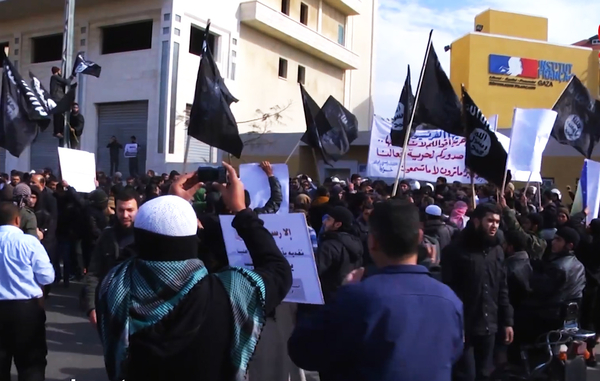 Palestinians waving Islamic State flags attempt to storm the French Cultural Center in Gaza City. Some in the crowd carried posters glorifying the terrorists who carried out this month’s attacks in Paris. (Image source: ehna tv YouTube screenshot)
The protest apparently caught Hamas by surprise. Hamas security forces that were rushed to the scene dispersed the protesters and arrested seven Islamic State supporters.
Attempts by Hamas to impose a news blackout on the Islamic State protest failed, as photos and videos of the demonstration found their way to social media. Needless to say, Hamas-affiliated media outlets ignored the protest. They were hoping that the world would also not see the Islamic State demonstrators on the streets of Gaza City.
Hamas’s biggest fear is that scenes of Islamic State supporters marching in the heart of Gaza City will scare international donors and dissuade them from providing badly needed funds for the reconstruction of the Gaza Strip. Hamas is also afraid that Western officials working with the United Nations and relief agencies will stop visiting the Gaza Strip after watching the footage of Islamic State supporters.
In recent weeks, it has also become evident that Islamic State has some kind of a presence in the West Bank — a fact that poses a serious threat to Abbas’s Palestinian Authority [PA].
Just last week, Israel announced arrests of members of an Islamic State terror cell in the West Bank city of Hebron. The three Palestinian members of the cell confessed during interrogation that had planned to launch a series of terror attacks against Israel. The three suspects were identified as Waddah Shehadeh, 22, Fayyad al-Zaru, 21 and Qusai Maswaddeh, 23.
Until recently, Hamas was considered the number one threat to the Palestinian Authority in the West Bank. Now, however, it has become evident that Islamic State is also trying to set up bases of power in the West Bank. According to Israeli security sources, dozens of Hamas and Islamic Jihad members in the West Bank have defected to Islamic State in recent months. Their main goal, the sources, said, is to topple the PA and launch terror attacks on Israel.
Abbas is lucky that the Israeli security forces are still operating in the West Bank, including inside cities and towns controlled by the Palestinian Authority. Were it not for the IDF and various branches of the Israeli security establishment, Hamas, Islamic Jihad and Islamic State would have toppled the Palestinian Authority and beheaded Abbas and his officials a long time ago.
Still, Abbas does not feel comfortable acknowledging the fact that a growing number of Palestinians in the West Bank are joining Islamic State. Abbas fears is that if he admits that Islamic State is already operating in the West Bank, this could dissuade many Western countries from supporting his effort to persuade the world to support the creation of an independent Palestinian state. Like Hamas, Abbas also fears that Westerners would stop visiting Ramallah and other West Bank Palestinian cities once they learn about Islamic State’s presence in these areas.
Although Hamas and the Palestinian Authority are continuing to bury their heads in the sand and deny what is there, they cannot avoid responsibility for the emergence of Islamic State in the Gaza Strip and West Bank. The glorification of terrorists and jihadists by the PA and the ongoing anti-Israel incitement by both the PA and Hamas, are driving many Palestinians into the open arms of the Islamic State.
This is something that the UN Security Council members will have to consider the next time they are asked to vote in favor of the establishment of a Palestinian state. Otherwise, they will be voting for the creation of an Islamic, and not a Palestinian, state.
IDF sends reinforcement to north amid tensions with Syria, Hezbollah, Iran
After airstrike attributed to Israel kills top Iranian general alongside six Hezbollah fighters, IDF shifts forces to north.
Yoav Zitun
Published: 01.22.15, 16:41 / Israel News
via IDF sends reinforcement to north amid tensions with Syria, Hezbollah, Iran – Israel News, Ynetnews.
The IDF is sending reinforcements to the north Thursday and Friday amid tensions along the border with Syria and Lebanon in wake of a deadly attack attributed to Israel by foreign media on military officials from Hezbollah and Iran in Syria.

Massive IDF movement is expected in the upcoming day within Israel’s northern communities, top IDF sources told Ynet. The forces, they said, are part of the IDF’s attempt to address growing tensions in the north, which have seen both Hezbollah and Iran vow to take revenge for the alleged Israeli attack.

Meanwhile, reports in Lebanon claimed that supposed Israeli military aircraft were flying over the country’s south. According to the reports, the planes were launching decoy balloons that leave a white trail of smoke.
Report also said IAF helicopters were spotted flying at low altitude over Lebanese villages in the south of the country.
Security forces on the Lebanese border went on high alert briefly on Wednesday evening over an initial fear of a suspected infiltration in the upper Galilee, after suspicious figures were identified near the border fence.
Close to 6pm, residents of Manara, Yiftah, Malkia, Dovev and Avivim in the Ramim mountain range area were instructed to stay in their homes, while kibbutz security squads from Malkia to Metula were called to the area. Roads in the area were also closed for traffic.
After sending troops to the area, the IDF Spokesman announced no infiltration has occurred, but asked that residents remained in their homes.
Al Arabiya reported that five people, who were suspected to be infiltrators, disappeared when the IDF arrived in the area.
A senior Iranian Revolutionary Guard commander said Israel will be punished for killing one of its generals in the airstrike in Syria that also killed six Lebanese Hezbollah fighters.
Nasser Soltani says “Israel will certainly pay for what it did.” He spoke during a ceremony Wednesday for Brig. Gen. Mohammad Ali Allahdadi, who will be buried in his hometown of Sirjan in southeastern Iran on Thursday.
Soltani is quoted by the state TV as saying Allahdadi was “martyred while performing his advisory mission” in Syria.
The Kuwaiti newspaper Al Rai reported Thursday morning that – despite an Israeli official denying the claim to Reuters – Israel was well aware of who was in the convoy and that the Iranian general was the intended target.
Roi Kais, AP and AFP contributed to this report
Iran: We Will Continue Arming Terrorists in Judea and Samaria
Iran plans to continue its efforts to “destroy the Zionist entity” – and that includes arming terrorists in Judea and Samaria, it said.
By Yaakov Levi
First Publish: 1/22/2015, 8:51 AM
via Iran: We Will Continue Arming Terrorists – Defense/Security – News – Arutz Sheva.

Iran plans to continue its efforts to “destroy the Zionist entity” – and that includes arming terrorists in Judea and Samaria.
“The arming policy of the West Bank is one of the policies of Iran and we will use all our capabilities in this way,” said Iranian Defense Minister Hossein Dehghan.
Dehghan made the comments at a memorial service for General Abu Ali Tabtabai, who along with Jihad Mughniyeh and a crew of Hezbollah terrorists, were eliminated in an Israel Air Force strike Monday. The vehicles in which the two were riding had left Lebanon a few hours earlier, Lebanese sources said. The purpose of the tour, the sources said, was to allow Tabtabai to review the situation on the border with the purpose of developing new attacks on Israel.
Commenting on the attack, Deghan said “The Zionist attack will not be passed over,” and that Iran would take the “appropriate action” when it wished to.
Tensions remained high in northern Israel in the aftermath of the elimination of Mughniyeh, said to be Hezbollah’s “commander of the Golan Heights area,” and Iranian General Tabtabai.
Roads in the area of the Israel-Lebanon border have been closed, and tanks and armored personnel carriers were reportedly deployed along the northern border. Lebanese media outlets are reporting Israeli jets and helicopters over the Har Dov area along the Lebanese border.
Late Wednesday, the US issued a travel warning to American citizens and government personnel in Israel, citing the recent tensions along Israel’s northern borders and the terrorist stabbing attack in Tel Aviv.
“Because of concerns about security on Israel’s northern borders, U.S. government personnel are currently required to obtain advance approval if they wish to travel within 1.5 miles (2.4 kilometers) of the Lebanon border, or travel on or east of Route 98 in the Golan Heights,” the advisory said.
“Further, in light of the stabbing attack on a public bus in Tel Aviv on January 21, U.S. citizens are reminded that due to security concerns, U.S. government employees are prohibited from using public buses throughout Israel and the West Bank (Judea and Samaria -ed.),” the statement added.
Despite the increased tension, residents have been urged to continue with their regular daily routines.
Giora Zeltz, chairman of the Upper Galilee Regional Council, said Wednesday that despite the large deployment of IDF troops and the increased police and border guard presence in the area, “we have not received any instructions to change our normal activities. The message we are getting from security officials is that life should continue as usual.”
Zeltz said that IDF officials had given him three reasons for the increased vigilance: Besides concerns that Hezbollah will try to carry out revenge terror attacks against Israel – “for which we must be ready,” he said – “the IDF is also sending a message to our neighbors that we will not tolerate attacks, and to give residents a sense of safety
Op-Ed: Is the Middle East on the Verge of Exploding? Israel National News, Dr. Mordechai Kedar, January 21, 2015
The potential for destruction posed by all these disputes is enormous, and the explosion may shake Europe and even cross the Atlantic when Islamic extremists blow their minds at the deep crisis affecting the entire Middle East.
*************
Five separate sets of potential fireworks have been igniting simultaneously in the Middle East for the last few weeks, each of them adding fuel to the fires caused by the others. If and when these developments reach the kindling point, the entire region may go up in uncontrollable flames.
These are the sources of the fires:
a. the rivalry between Al Qaeda and ISIS
b. the intensifying struggle between the Sunni Jabhat al Nusra and the Shiite Hezbollah.
c. the successes of the Houthis in Yemen
d. Islamic fury at what is happening in Egypt
e. the struggle between Islamic extremists and European regimes
Here are the details::
a. In the militant Sunni arena there is a fierce struggle going on between organizations that identify with Al Qaeda’s ideology, headed by Jabhat al Nusra – and ISIS, which is in control over large swathes of Syria and Iraq and has established the most stringent form of Sharia law in those areas. The rivalry has caused Al Qaeda to increase its attacks on the Yemeni government, abort an American attempt to rescue two hostages from Yemen last December, accept responsibility for the Charlie Hebdo murders in Paris and announce that the brothers who perpetrate the murders received their training in an Al Qaeda camp in Yemen.
b. The war between the Shiite Assad regime and Hezbollah on the one hand and Sunni Jabhat al Nusra on the other is getting more fierce. Jabhat al Nusra managed to cause Hezbollah painful losses recently, near the Hermon Mountain range and in a daring infiltration into the Bekaa Valley in Lebanon, by way of the city of Arsal. Hezbollah is feeling pressured, leading the Iranian revolutionary guards to send some top officers to help the organization plan its next operation and improve its results.
c. In Yemen, the Shiite Houthi militias have succeeded in taking over the capital city of Sana’a and appear as the winning side in the long, drawn out war the Houthis have been waging against that nation. Iran is backing the Houthis, the US is helping the regime, both against al Qaeda and the Houthis. Without doubt, Yemen is a battlefield where Iran is forcing its enemies to follow its agenda, including nearby Saudi Arabia, which sees the Houthis as a direct threat to its security. Several years ago, the Saudis built a separation fence all along their border with Yemen, in an attempt to keep out Al Qaeda and Houthi militants.
d. There is a fierce struggle in Egypt between the Muslim Brotherhood – the mother of all Sunni Jihad organizations – and the regime of Al Sisi. As far as this struggle goes, Sisi is reinstating the government of Gamal abdel Nasser, Sadat and Mubarak, all of whom waged relentless and bloody war against the “Brothers”. As of now, Sisi has succeeded in pushing the “Brothers” from positions of rule into jail cells and from the streets to the cemetery. His successes are infuriating his detractors. The fight is to the finish, and it is also being waged in the Sinai Desert between the government and the militias of Anṣār Bayt al-Maqdis, who recently switched its loyalties from al Qaeda to ISIS.
Europe is a relatively new battleground, but the last few weeks showed mounting escalation, both in jihadist activities against governments (see France) and in governmental activity against jihad cells (Belgium, Germany). Jihad activities in Europe are encouraged by ISIS as well as Al Qaeda, both sides of the rivalry mentioned above. People who return from Jihad in Syria, Iraq and Libya – but not just they – are participating in the heated struggle for Europe’s image.
These struggles are synergetic, they influence one another because an Islamic militant sees what is happening in one area and decides to take revenge for Allah in another. This sinking into chaos can lead to large number of large scale conflicts, with many more participants and deaths, especially if these organizations succeed in drawing Israel and the US into the fray. We have already heard of ground troups from the West fighting ISIS.
Israel must understand the dangers now permeating the atmosphere of the MIddle East with oil vapors that any spark can set on fire and that no one will be able to put out before the entire region is ablaze. The potential for destruction posed by all these disputes is enormous, and the explosion may shake Europe and even cross the Atlantic when Islamic extremists blow their minds at the deep crisis affecting the entire Middle East.
The massive Islamic immigration to Europe turned that continent into a branch of the Middle East’s disputes, so that Europe will not be immune to the many deep seated and broad Middle Eastern problems. And America is on the same planet, so that the Middle East disasters will find their way to its shores as well.
Iran escalates threats, vows to shower Israel with ‘Shahab’ missiles
via Iran escalates threats, vows to shower Israel with ‘Shahab’ missiles – Middle East – Jerusalem Post.
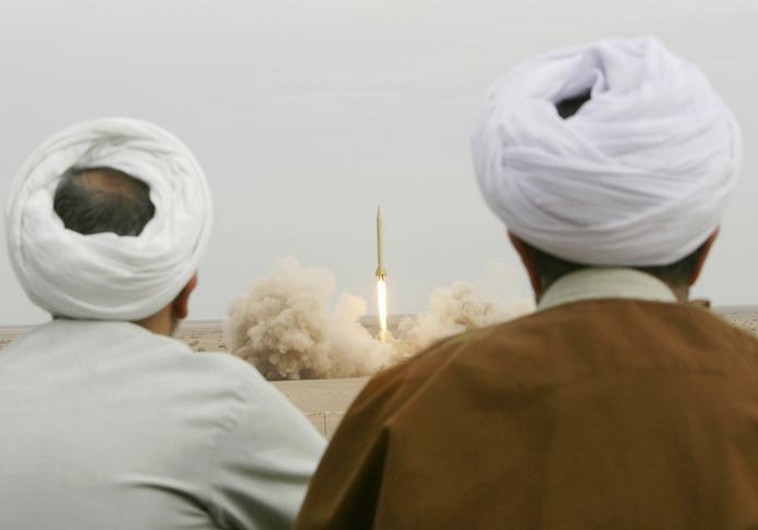
Iranian clerics watch the firing of a Shahab-3 missile during a war game in a desert near the city of Qom. (photo credit:REUTERS)
Iranian clerics watch the firing of a Shahab-3 missile during a war game in a desert near the city of Qom. (photo credit:REUTERS)
Senior Iranian military officials on Thursday continued to threaten “crushing responses” against Israel for the death of a top Revolutionary Guards officer in an airstrike on the Syrian side of the Golan Heights earlier this week.
The attack also killed senior Hezbollah operatives, among them the son of the late arch-terrorist Imad Mughniyeh.
Brigadier General Hossein Salami, the second-in-command in the Revolutionary Guards, told Iranian state media on Thursday that his troops are capable of firing Shahab-3 missiles on Israel.
“[Israel] should be waiting for crushing responses,” Salami is quoted as saying.
The Iranian officer said that the Golan attack was an attempt to “change the balance of power in Syria” and help “the takfirist,” a reference to the Islamist elements working to topple the government of Tehran’s key ally, President Bashar Assad.
“[The Golan strike] was the reflection of numerous defeats that both Americans and Israelis have suffered in their current strategies,” he said.
“They have seen IRGC’s reactions before, and [therefore] they are worried, and they will witness destructive thunderbolts in practice,” he said.
Hamas Commander Deif to Hezbollah Leader Nasrallah: “Let’s fight Israel together”
The head of Hamas’ military wing signed a letter of condolence sent to Hezbollah’s Secretary General after the eliminations in Syria.
Jan 22, 2015, 04:00 PM | Gal Cohen

Photo Credit: Channel 2 News
Five months after the elimination attempt targeting the head of Hamas’ military wing, Mohammed Deif sent a message from hiding in Gaza and expressed his condolences regarding the attack that killed senior level Hezbollah officials, according to a report from Hezbollah’s television station.
Deif sent condolences to Hezbollah Secretary Genral Hassan Nasrallah following the elimination of senior level officials in his terror organization by Israel. “We must unite our forces against the Zionist enemy and its allies,” Deif wrote to Nasrallah.
“Israel is the real enemy of the Islamic State and all guns should be pointed in its direction,” the Hamas terrorist added. “We must carry out the next act together, so there will be crossfire throughout the occupied land.”
Sources close to Hezbollah said that earlier this week, the decision was made to respond to the attack in Syria that killed six senior level officials of the terror organization. According to the report, the decision to respond was accepted by the joint resistance forces in Iran, Syria, and Hezbollah.

Photo Credit: Channel 2 News/AP
According to the sources, the IDF’s attack did not weaken the terror organization in the Golan and did not disconnect the activities of Hezbollah from Rosh Ha-Nikra to Syria. They claim Israel’s actions will not prevent the terror organization’s fighters from invading the Galilee in the next confrontation with the IDF.
Iran, for its part, also addressed Israel’s actions. Tehran admitted that one of their generals was killed in the incident and said they are committed to responding to the “Israeli aggression.” An Iranian news site said “following the Zionist attack against the opposition in Syria, General Allahdadi, a former commander of the Iranian Revolutionary Guards, was killed along with Jihad Mughniyeh and three others, who were in the same car.” An Iranian official added that “the resistance will respond forcefully at the right place and time to this terrorist attack.”
CNN: Pentagon Pushing for Evacuation of US Embassy in Yemen Before Situation Worsens
21 Jan 2015Washington, DC
via CNN: Pentagon Pushing for Evacuation of US Embassy in Yemen Before Situation Worsens – Breitbart.

CNN made that revelation on Tuesday citing an unnamed U.S. official with direct knowledge of the evacuation planning.
“The military is aware the State Department wants to keep the embassy open as long as possible, the official said, noting that it’s a valuable tool to monitor Al Qaeda in Yemen,” revealed CNN. “But behind the scenes the Pentagon is pressing the point that if an evacuation becomes necessary they want to do it before the chaos in Sanaa descends into a ‘non permissive environment,’ akin to combat.”
An unnamed defense official told NBC News that the embassy is “not at risk,” adding that the Shiite Muslim Houthi fighters sympathetic to Iran “do not pose a risk to Americans.”
Iran is considered a major state sponsor of terrorism by the United States.
CNN reported on Wednesday that al-Qaeda, a Sunni jihadist group, is expected to benefit from the Houthi takeover of “government buildings, the main airport and a share of power” in Sanaa.
Al-Qaeda’s Yemeni branch is considered a “significant threat” by the United States.
The decision to evacuate State personnel and other Americans in Yemen ultimately lies within the State Department.
Unnamed defense officials “stressed that an evacuation would be ordered if Americans come under serious threat,” noted NBC News.
Roughly 100 U.S. Marines are providing security at the U.S. Embassy in Sanaa.
CNN reported that the Pentagon is prepared to evacuate Americans if necessary.
Two U.S. Navy warships, the USS Iwo Jima and the USS Fort McHenry, were reportedly moved into the Red Sea late on Monday as the Pentagon prepared to evacuate Americans from Yemen if asked to do so by the State Department.
The two Navy amphibious ships were moved “because they will be in the best position if asked,” by the State Department to remove Americans from the embassy, the U.S. official told CNN.
According to the official, the evacuation of “several hundred Americans” from the embassy would be complex and could take several days to carry out.
“Nobody should think this would be easy,” the official told CNN.
A U.S. Embassy vehicle was fired upon on Tuesday in the Yemeni capital of Sanaa where U.S.-backed government security forces are clashing with Houthi rebels.
That same day, Houthi fighters reportedly stormed the presidential palace in Sanaa.
Yemeni security forces mounted a brief resistance before relinquishing control of the palace. Yemeni President Abdu Rabu Mansour is reportedly being held captive by the Houthi rebels.
“Unity”? About What Exactly? The Gatestone Institute, Jeremy Havardi, January 22, 2015
Meanwhile, Saudi Arabia tried to fool the world by joining France’s “Unity March” for free speech just two days after a young Saudi blogger, Raif Badawi, received the first installment of 50 lashes — out of the 1000 he is to get — “very severely,” the lashing order says. Badawi still has 950 lashes to complete.
Mahmoud Abbas, whose genocidal, jihadi partner, Hamas, was just declared not a terrorist group by the European Union, joined the forefront of the “Unity March” at the same time as a Palestinian human rights groups published a report accusing the Palestinian Authority of “waging war” against university students in the West Bank.
What “Islamophobia” motivated the killing of Jewish customers in a kosher supermarket? What had those victims done to deserve that?
We may like to imagine that this is not Islam, and that the faith promotes peace and nothing else. But the murderers say it is Islam, and they act accordingly.
Much of the media has offered up a context for these killings that is false.
The real story is that despite a few sporadic incidents, there has been no backlash against the Muslim community.
The recent rally for free speech and against the terrorism in Paris initially appeared to have generated a surge of defiance and resolve, not just in France but around the world. People were actually talking about a turning point in the battle against terrorism and radical Islam.
If only it were true.
The reality is that much of the political class and media remain in denial about the events in Paris.
Ban Ki Moon explained that the tragic events had nothing to do with religion. Signing a condolence book for the victims of the attacks, he said: “This is not a country, a war against religion or between religions… This is a purely unacceptable terrorist attack – criminality.”
France’s President François Hollande said that the Charlie Hebdo fanatics had “nothing to do with Islam,” and he was joined in this view by commentators on France24, as well as the German Interior Minister, Thomas de Maizière.
The Guardian’s Jonathan Freedland condemned the actions of a “handful of wicked fanatics against the rest of us.” The implication was that they merely acted in the name of Islam — purely coincidentally, as it were.
In the Daily Mail, Piers Morgan wrote that the perpetrators were “not ‘real’ Muslims” and that this was “not a religious war.” Why he thought he could act as the arbiter on that question is still unclear.
As for President Obama, he has effectively outlawed the term “Islamic terror.”
The United States, in what was widely seen as a snub, was only represented at the rally by the U.S. Ambassador to France, Jane Hartley. Since the President had declared in 2012 that “[t]he future must not belong to those who slander the prophet of Islam” — the implication was that they were not acting purely coincidentally.
There is in those comments a mixture of political correctness, wishful thinking and staggering ignorance. It is understandable and commendable not to lump a majority of law-abiding, patriotic and peaceful Muslims together with their violent counterparts. But calling for “unity” in a march leaves one asking: Unity about what exactly?
To pretend that there is a complete disconnect between Islam and terror is to ignore reality. Jihadis are gaining ideological succour from the tenets of their faith, drawing upon teachings promulgated by imams, including the late Anwar al Awlaki. We may like to imagine that this is not Islam, and that the faith promotes peace and nothing else. But the murderers say it is Islam, and they act accordingly.
To confront this problem properly, the ideological underpinnings of jihad need to be tackled comprehensively at source.
It is not enough to unite against terrorism, as every community must. We need to know what we are uniting for — free speech. And we need to know what we are uniting against — namely the militant war of extremist Islamism.
It is equally inaccurate to describe these jihadis as “lone wolves.” They will have spent time gaining combat experience abroad, perhaps in Yemen, Syria or Iraq, and will have received ideological indoctrination and funding from a network of other jihadis. They are recruits in a theocratic, totalitarian death-cult spread across the planet. It comes in different forms: Boko Haram, which slaughtered 2,000 people in Nigeria the weekend before last; the Taliban, which murdered schoolchildren in Pakistan; Hamas with its genocidal doctrine and many years of bombings, and the Islamic State, which seems busy ethnically cleansing nearly everyone in Syria and Iraq.
The murders in Paris, therefore, were merely the latest salvo in a global confrontation between jihadist Islam and its declared enemies, this time in the West.
Much of the media has offered up a context for these killings that is false. Within hours of the massacre at Charlie Hebdo, the Telegraph led with a feature on the growing problem of “Islamophobia” in France. The Guardian, too, weighed in; one story headlined: “Muslims fear backlash after Charlie Hebdo deaths as Islamic sites attacked”. The Spectator spoke of the killings as an “attack on Islam;” and Robert Fisk in the UK Independent referred to the legacy of the Algerian war as a motive for the attackers. Other news outlets voiced fears of a “backlash” against Muslims in France and elsewhere.
But the real story is that while there have been some sporadic incidents against mosques and Muslim owned businesses in France following the Charlie Hebdo attacks, there has been no backlash against the Muslim community. Muslims across France even joined in the unity rally, an act that would have been impossible were there a climate of widespread public hostility.
The majority of hate crimes in France, as in a number of other countries, affects the Jewish community. It was a Jewish supermarket that was attacked. This does not mean that there will not be attacks — all of them naturally deplorable — against Muslim innocents, only that fears of a major widespread assault seem highly exaggerated. The same fears of widespread attacks against the Muslim community also proved unfounded after the 7/7 London bomb attacks.
Lumping terrorism and “Islamophobia” together ignores the real motivation of the latest killers in France. One of them, Amedy Coulibaly, pledged allegiance to the Islamic State in a video address prior to the supermarket attack. This hardly suggests a rant against perceived intolerance or racism. Invoking racism here also suggests, in a shifting of blame, that we in the West are somehow at fault for the violent behaviour of these Islamist terrorists. What “Islamophobia” motivated the killing of Jewish customers in a kosher supermarket? What had those victims done to deserve that?
Another reason this is no turning point is that the press continues to engage in self-righteous self-censorship. Not one broadcaster — including the BBC, Fox, NBC and CNN — showed any of the Charlie Hebdo images that had been deemed provocative. Those outlets were joined by the Associated Press, which deliberately cropped a photograph of the magazine’s now-dead editor to avoid showing an image of the Prophet Muhammad. In a cringe replicated across almost all of Europe, not one major British newspaper published any of Charlie Hebdo’s satirical images of Islam, and only The Guardian showed the full front cover of the edition that the survivors published after the attack.
Big mistake. These newspapers and broadcasters are denying the public a dispassionate view of what the killers themselves say is causing them to kill. Worse again, by drawing a line against possibly offending Muslims — many of whom seem to have no problem offending Jews and Christians, among others, if not killing them — the media have acted as if there is already in place an unofficial blasphemy law: the terrorists’ key demand.
A violent mob, disastrously undermining Western values, is effectively dictating the boundaries of free speech.
It is all very well to praise Charlie Hebdo as an icon of free speech, but after the riots that followed the publishing of Muhammad cartoons in Denmark’s Jyllands Posten in 2006, Charlie Hebdo was virtually alone in reprinting them, and it was condemned widely for doing so.[1]
Time magazine, in 2011, likened Charlie Hebdo’s reprinting the cartoons as “the right to scream ‘fire’ in an increasingly over-heated theater.” In other words, the “Islamophobic” cartoonists were to blame for their own misfortune. There is a notion permeating Europe, that if you speak out, not only can you can be put on trial — as is the Dutch MP, Geert Wilders[2] — but that it will also, in an Orwellian twist, be your own fault; if you had just kept quiet, nothing unpleasant would be happening to you. Try telling that to the four Jews lying murdered on the floor of the French supermarket. What did they ever say?
Meanwhile, Saudi Arabia tried to fool the world by joining France’s “Unity March” for free speech just two days after a young Saudi blogger, Raif Badawi, received the first installment of 50 lashes — out of the 1000 he is to get — “very severely,” the lashing order says. He was taken after Friday prayers to a public square outside a mosque in Jeddah. His declared “crime” is “insulting Islam,” for writing thoughts such as, “My commitment is to reject any repression in the name of religion… a goal we will reach in a peaceful and law-abiding way.” Badawi still has 950 lashes to complete. If he lives. There is no medical help.
Palestinian Authority President Mahmoud Abbas — whose genocidal, jihadi partner, Hamas, was, in a burst of surrealism, declared not a terrorist group by the European Union — joined the forefront of the Unity March in Paris at the same time as a report was published by a Palestinian human rights group, accusing the Palestinian Authority of “waging war” against university students in the West Bank.
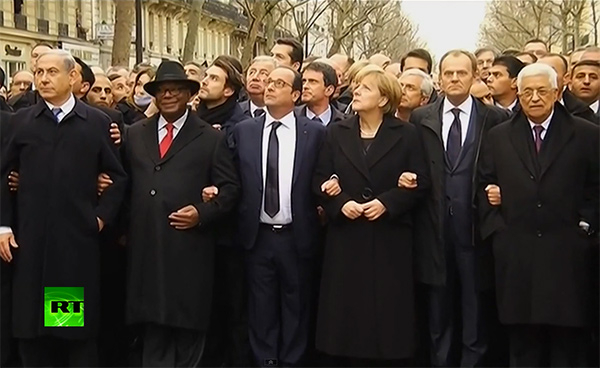 World leaders link arms at the Paris anti-terror rally on January 11, 2014. Palestinian Authority President Mahmoud Abbas stands at the far right of the front row. (Image source: RT video screenshot)
Turkey, “named the world’s biggest jailor of journalists in 2012 and 2013” according to theWashington Post, was also there. Turkey “ended 2014 by detaining a number of journalists … including Ekrem Dumanli, editor in chief of Zaman, a leading newspaper” with links to an opposition movement.
Meanwhile, between January 8 and January 14, as over three million copies of Charlie Hebdowere selling out and four million more being printed, there was already talk in France of hardening its laws against free speech. So this may not be a turning point either for free speech or against radical Islam. So it may be a while before we can truly say, “Nous sommes Charlie.”
Jeremy Havardi is a historian and journalist based in London. His books include The Greatest Briton, analytical essays on Churchill.
[1] Ezra Levant, who reprinted the cartoons in Canada, was then compelled to appear before the Alberta Human Rights Commission to defend their publication, because of a complaint lodged by Syed Soharwardy of the Islamic Supreme Council of Canada and the Edmonton Council of Muslim Communities.
[2] As also was Lars Hedegaard (for speaking in his own drawing room), Suzanne Winters, Elisabeth Sabaditsch-Wolff, or at the very east need round-the-clock-bodyguards, such asFrench journalist Eric Zemmour, for saying that France might be facing a virtual civil war.
Sisi’s Brave New Egypt? Front Page Magazine,
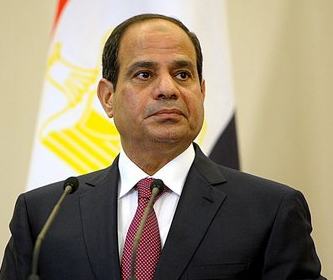
Originally published by PJ Media.
Egyptian President Abdel Fattah al-Sisi continues to be the antithesis of longstanding mainstream media portrayals of him.
First there was his historic speech where he, leader of the largest Arab nation, and a Muslim, accused Islamic thinking of being the scourge of humanity—in words that no Western leader would dare utter. This remarkable speech—which some say should earn him the Nobel Peace Prize—might have fallen by the wayside had it not been posted on my website and further disseminated by PJ Media’s Roger L. Simon, Michael Ledeen, Roger Kimball, and many others, including Bruce Thornton and Robert Spencer.
Instead, MSM headlines on the day of and days after Sisi’s speech included “Egypt President Sisi urged to free al-Jazeera reporter” (BBC, Jan 1), “Egyptian gays living in fear under Sisi regime” (USA Today, Jan. 2), and “George Clooney’s wife Amal risks arrest in Egypt” (Fox News, Jan. 3).
Of course, the MSM finally did report on Sisi’s speech—everyone else seemed to know about it—but, again, to portray Sisi in a negative light. Thus, after briefly quoting the Egyptian president’s call for a “religious revolution,” the New York Times immediately adds:
Others, though, insist that the sources of the violence are alienation and resentment, not theology. They argue that the authoritarian rulers of Arab states — who have tried for decades to control Muslim teaching and the application of Islamic law — have set off a violent backlash expressed in religious ideas and language.
In other words, jihadi terror is a product of Sisi, whom the NYT habitually portrays as an oppressive autocrat—especially for his attempts to try to de-radicalize Muslim sermons and teachings (as discussed in this article).
Next, Sisi went to the St. Mark Coptic Cathedral during Christmas Eve Mass to offer Egypt’s Christian minority his congratulations and well wishing. Here again he made history as the first Egyptian president to enter a church during Christmas mass—a thing vehemently criticized by the nation’s Islamists, including the Salafi party (Islamic law bans well wishing to non-Muslims on their religious celebrations, which is why earlier presidents—Nasser, Sadat, Mubarak, and of course Morsi—never attended Christmas mass).
Accordingly, the greetings Sisi received from the hundreds of Christians present were jubilant. His address was often interrupted by applause, clapping, and cheers of “We love you!” and “hand in hand”—phrases he reciprocated. Part of his speech follows:
Egypt has brought a humanistic and civilizing message to the world for millennia and we’re here today to confirm that we are capable of doing so again. Yes, a humanistic and civilizing message should once more emanate from Egypt. This is why we mustn’t call ourselves anything other than “Egyptians.” This is what we must be—Egyptians, just Egyptians, Egyptians indeed! I just want to tell you that Allah willing, Allah willing, we shall build our nation together, accommodate each other, make room for each other, and we shall like each other—love each other, love each other in earnest, so that people may see… So let me tell you once again, Happy New Year, Happy New Year to you all, Happy New Year to all Egyptians!
Sisi stood side-by-side with Coptic Christian Pope Tawadros II—perhaps in remembrance of the fact that, when General Sisi first overthrew President Morsi and the Muslim Brotherhood, Pope Tawadros stood side-by-side with him—and paid a heavy price: the Brotherhood and its sympathizers unleashed a Kristallnacht of “reprisals” that saw 82 Christian churches in Egypt attacked, many destroyed.
It is also significant to recall where Sisi came to offer his well-wishing to the Christians: the St. Mark Cathedral—Coptic Christianity’s most sacred church which, under Muhammad Morsi was, for the first time in its history, savagely attacked, by both Islamists and the nation’s security (see pictures here).
Once again, all of this has either been ignored or underplayed by most mainstream media.
There is, of course, a reason the MSM, which apparently follows the Obama administration’s lead, has been unkind to Sisi. One will recall that, although Sisi led the largest revolution in world history—a revolution that saw tens of millions take to the streets and ubiquitous signs and banners calling on U.S. President Obama and U.S. ambassador to Egypt Anne Patterson to stop supporting terrorism (i.e., the Brotherhood)—U.S. leadership, followed by media, spoke only of a “military coup” against a “democratically elected president,” without pointing out that this president was pushing a draconian, Islamist agenda on millions who rejected it.
So what is the significance of all this—of Sisi? First, on the surface, all of this is positive. That Sisi would criticize the Muslim world and Islamic texts and thinking—in ways his Western counterparts could never—and then continue his “controversial” behavior by entering the Coptic Christian cathedral during Christmas mass to offer his greetings to Christians—a big no-no for Muslim leaders—is unprecedented. Nor can all this be merely for show. In the last attack on a Coptic church, it was two Muslim police officers guarding the church who died—not the Christian worshipers inside—a rarity.
That Sisi remains popular in Egypt also suggests that a large percentage of Egyptians approve of his behavior. Recently, for instance, after the Paris attacks, Amru Adib, host of Cairo Today, made some extremely critical comments concerning fellow Muslims/Egyptians, including by asking them “Are you, as Muslims, content with the fact that today we are all seen as terrorists by the world?… We [Egyptians] used to bring civilization to the world, today what? — We are barbarians! Barbarians I tell you!” (More of Adib’s assertions here.)
That said, the others are still there—the Muslim Brotherhood, the Salafis, those whom we call “Islamists,” and their many sympathizers and allies.
Worst of all, they have that “corpus of [Islamic] texts and ideas” that has been “sacralized over the centuries” (to use Sisi’s own words) to support them—texts and ideas that denounce Sisi as an “apostate” deserving of death, and thus promising a continued struggle for the soul of Egypt.




 anneinpt
 artaxes
 danmillerinpanama
 davidking1530
 Peter Hofman
 Joseph Wouk
 Peter
Peter Louisiana Steve

Recent Comments