Posted tagged ‘Islam’

Humor: How to deal with enemies, foreign and domestic

February 2, 2015

How to deal with enemies, foreign and domestic, Dan Miller’s Blog, Sen. Ima Librul, February 2, 2015

(The views expressed this article are mine and those of my imaginary guest author. They do not necessarily represent the views of Warsclerotic or its other editors. — DM)

Editor’s note: This is a post by my (imaginary) guest author, the Very Honorable Ima Librul, Senator from the great State of Confusion Utopia. He is a founding member of CCCEB (Climate Change Causes Everything Bad), a charter member of President Obama’s Go For it Team, a senior member of the Senate Foreign Relations Committee and Chairman of the Meretricious Relations Subcommittee. He is also justly proud of his expertise in the care and breeding of unicorns, for which his Save the Unicorns Foundation has received substantial Federal grants. We are honored to have a post of this caliber by a quintessential Librul such as the Senator. Without further delay, here is the Senator’s article.

***********************

As the anointed leader of my Librul kingdom, countless methods for dealing with “enemies” are at my disposal. I, along with my loyal Secretary of Slyness (SOS) Sir Ketchup, bring happiness to all. Many “enemies” of my kingdom have yielded to my wisdom without even knowing that they have. I owe everything to my dear leader Obama, my rock of ages in the past and hope for years to come.

Ketchup Kerry

Example One

When my kingdom was threatened by wolves and foxes, which intended to eat all of my free range chickens, I bravely sent Sir Ketchup to deal with the problem. At my direction, he immediately put half of my chickens into secure coops and invited the invaders to do as they desired with the rest. That satisfied them only briefly, so he dispatched half of my remaining chickens to be eaten. The process continued until I had only one chicken left.

Here’s why I can humbly wear the label “The Won,” along with my dear leader Obama. The invaders, stuffed pleasantly full of chicken and amazed at my brilliance, resolved not to attack my kingdom again until my chicken population had been restored and it was once again worthwhile to invade. Unfortunately for them, a single chicken cannot reproduce, so they will never again have any reason to return.

chicken

Example Two

A few weeks later, my kingdom was again invaded by “wild and vicious” packs of wolves and foxes. They divided their attentions between slaughtering each other and slaughtering and eating my sheep. I solved the problem by giving ample sheep to both packs and explaining to them that they were neither wild nor vicious, but simply misguided in attacking each other. Their mistake lay in believing that the traditions of their ancestors mandated such activities, even though it is not true. As a widely acknowledged expert on the traditions of wolves and foxes, I understand these matters far better than they do. Hence, I was able to convince them that with reality-based understanding such as I possess, they too would seek the beauties and benefits of unity permitting them to slaughter and eat my sheep peacefully and together.

Some who do not fully understand the inherent beauty and fairness of multiculturalism might contend that my actions were unfair to the sheep. They would be wrong. Sheep are gentle creatures and have been good to me; I have always ensured that they have plenty to eat and I have fleeced them only to provide for their well-being. We are as one and, to the extent that I am able, these benign practices will continue.

However, it is far more important to bring happiness and unity to creatures which have suffered for ages because of their erroneous but stereotypical characterization as evil. There is no evil and there is no good; all is relative. Who are we to declare that sheep are good and that wolves and foxes are evil? Don’t we also kill sheep and eat mutton? Wolves and foxes are neither better nor worse than human carnivores and it is prudent to act only on the basis of what is best for all.

My plan was successful. Happy with their full bellies, the wolves and foxes departed my kingdom in peace, promising to return together and in harmony only when they need my sheep. In the interim, they will devote their attentions to visiting neighboring farms in hopes that the owners will see the justice in my methods and adopt them. I promised to help my neighbors to adopt my enlightened multicultural views and to accord wolves and foxes every courtesy. As wolves and foxes come to understand the beauty and benefits of true multiculturalism, they will cease to be significant threats to anyone. That is a hope for change we can — and must — believe in.

Sheep

In fairness, I must acknowledge that my dear leader Obama demonstrated the efficacy of this solution several years ago when, with remarkable success, He persuaded diverse groups of Muslims to unite against America to force her to reject her old ways of dealing with what she wrongly characterized, not only as enemies, but even as evil enemies. Since then, we have made great progress in defeating the Non Islamic Islamic State (NIIS) and others allegedly intent upon endangering our national security. The world be a far better place now if President Roosevelt had fully accepted Nazi Germany, not as an evil enemy or even as an enemy, but as a friend and a humanitarian force for peace and enlightenment of civilization. Had my dear leader then been our President, that would have happened and there would have been no more war.

Example Three

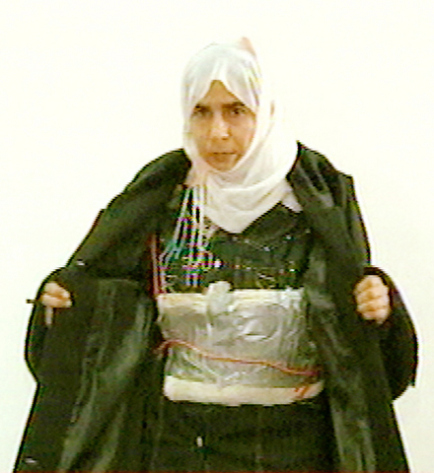
This year, representatives of the Non-Islamic Taliban (NIT) sought to use several acres of my kingdom for an insurgent training camp. They explained that since my dear leader Obama has declared that they are not foreign terrorists, I should have no objection. On that basis, I saw no problem in dealing with them. They offered to pay me $5,000 per acre per week and I accepted, subject to the requirement that they wear Girl Scout costumes rather than their traditional attire so that none of my Islamophobic neighbors would be offended irrationally. The deal was struck.

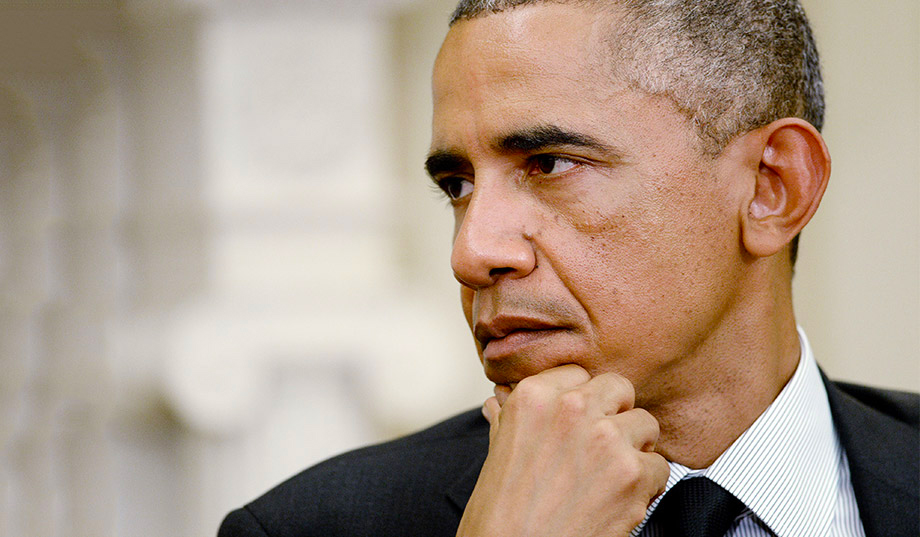
Since they had not stated which part of my kingdom they wanted to use, I provided land on which my free range unicorns frolic. I assumed that they would not notice, and they didn’t. Only truly superior beings, like our own glorious dear leader Obama, myself and unicorns can communicate with unicorns; the NIT members couldn’t even see them.

obama-unicorn

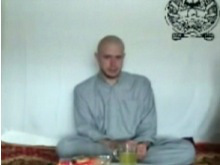
I promptly advised my dear leader of my findings, and He stated that He will soon dispatch brigades of well trained unicorns, under the command of Brevet General Bowe Bergdahl, to do battle with both NIT insurgents and NIIS terrorists. When the unicorn brigades triumph, dear leader Obama will be able to proclaim yet another grand mission accomplished and demonstrate, once again, that we stand firmly, shoulder to shoulder, behind our gallant friends and allies who have been harmed by our dastardly non-Islamic enemies. No longer will we be viewed as impotent.

It may be true that, until now,

Nothing in all that standing together has been potent enough to stop these barbaric, brutal, heinous beheadings of American and British and Japanese citizens.

Brevet General Bergdahl and his brigades of unicorns will change that!

MissionAccomplished0067

I have many more inspiring stories to tell, but must leave immediately to chair a meeting of my Meretricious Relations Subcommittee of the Senate Foreign Relations Committee. Former President Clinton, the principal speaker on “How to lie with impunity,” will be accompanied by his lovely wife and confidant, Saint Hillarion, also a long recognized expert on that topic as well as concerning infamous right-wing conspiracy theories.

Their talents, like those of our current dear leader Obama, are much needed in dealing with our domestic enemies, evil right-wing terrorists all!

I look forward to serving under Saint Hillarion when she becomes our next dear leader, just as I have served under dear leader Obama.

Clinton1web_2831249b

******************

Editor’s comments

Senator Librul words of wisdom will be of great assistance to Obama in His war on non-Islamic terror and insurgency. Ideas such as the Senator’s are badly needed because in the aggregate they are far better, and hence far more likely to bring success, than what Obama has tried thus far.

Booze

If the spirits shine brightly and in copious quantities upon us, we may be able to believe that even before Obama’s son Trayvon II becomes our President, our enemies will have ceased to be our enemies and unicorns will again be able to frolic in peace throughout the entire world, Insha’Allah.

ISIS in full swing under ex-Iraqi general: 70 deaths in a month, on the march in 10 countries

February 1, 2015

ISIS in full swing under ex-Iraqi general: 70 deaths in a month, on the march in 10 countries, DEBKAfile, February 1, 2015

Kenji-Goto_31.1.15Kenji Goto in ISIS hands

ISIS strategists, not content with these “successes,” are still in full thrust and believed to be planning to expand their operations and hit Israel – whether from the south or the north.

*********************

Saturday night, January 31, the Islamic State of Iraq and Levant capped a month of atrocities by beheading its second Japanese hostage, Kenjo Goto, a 47-year old journalist. Jordan vows to do everything its power to save the Jordanian pilot Lt. Moaz al-Kasasbeh, but it may be too late.

In March alone, the Islamists are known to have killed at least 70 people in 10 targeted European and Middle East countries. This is a modest estimate since exact figures are not available everywhere – like in Saudi Arabia and Egypt. ISIS terrorists trailed their horror that month through France, Spain, Belgium, Iraq, Saudi Arabia, Syria, Jordan, Egypt and Libya.

US President Barack Obama, who heads a 20-state coalition fighting ISIS in Iraq, strongly condemned the Goto murder. Secretary of State John Kerry, trying to sound positive, commended the recovery of the Syrian town of Kobani by Kurdish forces as “a big deal.”

ISIS was indeed forced to concede defeat in battle under US air strikes. But Kerry forgot to mention that the battle is far from over:  the Islamists pulled back from Kobani’s districts, but are still pressing hard on the walls of the town and heavy fighting for its control continues.

If Kobani is the only military gain achieved by US-backed forces in months of coalition effort, who will be able to stop the brutal ISIS offensive going forward in Europe, North Africa and the Middle East?

The British government keeps on warning that an Islamist attack is coming soon. Foreign Secretary Philip Hammond said Sunday that this was a “generational struggle that must be fought in other parts of the world in addition to the Middle East.”

It was obvious from these lame comments that the West is totally at a loss for ways to pre-empt the thrusting danger.

Some Western intelligence agencies have sought cold comfort by pointing to the Islamists’ willingness to negotiate the release of the Jordanian pilot held hostage since his capture in Syria in December as a symptom of weakness, signaling its readiness to part with its murderous image. Others judged the latest video clips unprofessional and a sign that ISIS leadership was in disarray.

Neither of these judgments is supported by the facts.

DEBKAfile’s counter-terrorism and intelligence sources report that the high command of the Islamic State functions at present with machinelike efficiency in pursuit of its goals. The name of Abu Baqr al-Baghdadi has been circulated widely as ruler of the Islamic “caliphate” he founded in parts of Syria and Iraq. But behind the scenes, he is assisted by a tight inner group of 12-15 former high officers from the Baath army which served the Saddam Hussein up until the 2003 US invasion of Iraq. Members of this group ranged in rank from lieutenant-colonel to general.

Ex-Maj. Gen. Abu Ali al-Anbari, its outstanding figure, acts as Al Baghdadi senior lieutenant.

He also appears to be the brain that has charted ISIS’s current military strategy which, our sources learn, focuses on three major thrusts: the activation of sleeper cells in Europe for coordinated terrorist operations: multiple, synchronized attacks in the Middle East along a line running from Tripoli, Libya, through Egyptian Suez Canal cities and encompassing the Sinai Peninsula; and the full-dress Iraqi-Syrian warfront, with the accent currently on the major offensive launched Thursday, March 29, to capture the big Iraq oil town of Kirkuk.

DEBKAfile was first to report the arrival in Sinai during the first week of December of a group of ISIS officers from Iraq to take command of their latest convert, Ansar Beit Al-Miqdas.

Another former Iraqi army officer was entrusted with coordinating ISIS operations between the East Libyan Islamist contingent and the Sinai movement. Their mission is to topple the rule of President Abdel-Fatteh El-Sisi.

The imported Iraqi command made its presence felt in Libya Tuesday, Jan. 27 with the seizure of the luxury Corinthia Hotel in Tripoli and execution of the foreigners taken there, including an American and a British man. Two days later, ISIS terrorists fanned out across Sinai for their most devastating attack ever on Egyptian military and security forces. They launched simultaneous attacks in five towns, Rafah on the border of the Gaza Strip, El Arish and Sheikh Suweid in the north and  the Suez Canal cities of Port Said and Suez to the west – killing some 50 Egyptian personnel and injuring more than double that figure.

ISIS strategists, not content with these “successes,” are still in full thrust and believed to be planning to expand their operations and hit Israel – whether from the south or the north.

How Iran Is Making It Impossible for the US to Beat ISIS

February 1, 2015

How Iran Is Making It Impossible for the US to Beat ISIS, Daily Beast, Michael Weiss, Michael Pregent, February 1, 2015

1422791113178.cachedAhmed Saad/Reuters

Washington needs to quit pretending it can work with Iran to defeat the Islamic State. Tehran’s real objective is to defeat Washington.

It was August 2007, and General David Petraeus, the top commander of U.S. forces in Iraq, was angry.  In his weekly report to then-Defense Secretary Robert Gates, Petraeus wrote:  “I am considering telling the President that I believe Iran is, in fact, waging war on the U.S. in Iraq, with all of the U.S. public and governmental responses that could come from that revelation. … I do believe that Iran has gone beyond merely striving for influence in Iraq and could be creating proxies to actively fight us, thinking that they can keep us distracted while they try to build WMD and set up [the Mahdi Army] to act like Lebanese Hezbollah in Iraq.”

There was no question there and then on the ground in Iraq that Iran was a very dangerous enemy. There should not be any question about that now, either. And the failure of the Obama administration to come to grips with that reality is making the task of defeating the so-called Islamic State more difficult—indeed, more likely to be impossible—every day.

There are lessons to be learned from the experience of the last decade, and of the last fortnight, but what is far from clear is whether Washington, or the American public, is likely to accept them because they imply much greater American re-engagement in the theater of battle. As a result, what we’ve seen is behavior like the proverbial ostrich burying its head in the desert sand, pretending this disaster just isn’t happening. But at a minimum we should be clear about the basic facts. In Iraq and Syria, as we square off against ISIS, the enemy of our enemy is not our friend, he is our enemy, too.

In 2007, there were 180,000 American troops in Iraq. Under Petraeus’s oversight, U.S. Joint Special Operations Command (JSOC), the elite forces responsible for hunting terrorists around the world, was divided into two task forces. Task Force 16 went after al Qaeda in Iraq, the group that eventually would spawn ISIS, while Task Force 17 was dedicated to “countering Iranian influence,” chiefly by killing or capturing members of Iraq’s Shia militias—though in some cases, it even arrested operatives of Iran’s Revolutionary Guards Corps-Quds Force (IRGC-QF) who were arming and supervising those militias’ guerrilla warfare against coalition troops.

At one point, in the summer of 2007, Petraeus concluded that the Mahdi Army, headed by the Shiite demagogue Muqtada al-Sadr, posed a greater “hindrance to long-term security in Iraq” than al Qaeda did. As recounted in The Endgame, Michael Gordon and Bernard E. Trainor’s magisterial history of the Second Iraq War, two-thirds of all American casualties in Iraq in July 2007 were incurred by Shiite militias.  Weapons known as explosively formed penetrators, or EFPs, were especially effective against the U.S. forces. They were Iranian designed and constructed roadside bombs that, when detonated, became molten copper projectiles able to cut through the armor on tanks and other vehicles, maiming or killing the soldiers inside.

So it came as a surprise to many veterans of the war when Secretary of State John Kerry, asked in December what he made of the news that Iran was conducting airstrikes against ISIS in Iraq, suggested “the net effect is positive.” Similarly, Chairman of the U.S. Joint Chiefs of Staff Gen. Martin Dempsey—formerly the commander of the 1st Armored Division in Baghdad—told reporters last month, “As long as the Iraqi government remains committed to inclusivity of all the various groups inside the country, then I think Iranian influence will be positive.”

Whatever the Iraqi government says it is committed to, “inclusiveness” is not what’s happening on the ground.

Iran’s influence in Iraq since ISIS sacked Mosul last June has resulted in a wave of sectarian bloodletting and dispossession against the country’s Sunni minority population, usually at the hands of Iranian-backed Shia militia groups, but sometimes with the active collusion of the Iraq’s internal security forces. Indeed, just as news was breaking last week that ISIS’s five-month siege on the Syrian-Turkish border town Kobane finally had been broken, Reutersreported that in Iraq’s Diyala province at least 72 “unarmed Iraqis” —all Sunnis—were “taken from their homes by men in uniform; heads down and linked together, then led in small groups to a field, made to kneel, and selected to be shot one by one.”

Stories such as these out of Iraq have been frequent albeit under-publicized and reluctantly acknowledged (if at all) by Washington both before and after Operation Inherent Resolve got underway against ISIS.

For instance, 255 Sunni prisoners were executed by Shia militias and their confederates in the government’s internal security forces between June 9 and mid-July, according to Human Rights Watch. Eight of the victims were boys below the age of 18.  “Sunnis are a minority in Baghdad, but they’re the majority in our morgue,” a doctor working at Iraq’s Health Ministry, told HRW at the end of July. Three forensic pathologists found that most of the victims in Baghdad were shot clean through the head, their bodies often left casually where they were killed. “The numbers have only increased since Mosul,” one doctor said.

On August 22, 2014, the Musab Bin Omair mosque in Diyala—the same province where last week’s alleged executions occurred—was raided by officers of the security forces and militants of Asaib Ahl al-Haq (the League of the Righteous), which slaughtered 34 people, according to HRW.  Marie Harf, the U.S. State Department spokeswoman, said at the time: “This senseless attack underscores the urgent need for Iraqi leaders from across the political spectrum to take the necessary steps that will help unify the country against all violent extremist groups.”

Since then, however,  U.S. warplanes have provided indirect air support to Asaib Ahl al-Haq and Kataib Hezbollah, a U.S.-designated terrorist entity, both of which were at the vanguard of the troops that ended ISIS’s months-long siege of Amerli, a Shia Turkomen town of about 15,000, in November 2014.  These militias have also been seen and photographed or videoed operating U.S. Abrams tanks and armored vehicles intended for Iraq’s regular army, which means that there are now two terrorist organization, Sunni ISIS and Kataib Hezbollah, armed with heavy-duty American weapons of war.

The Hezbollah-ization of Iraq’s military and security forces has been overseen by the IRGC-QF, another U.S.-designated terrorist entity, which is headed by Maj. Gen. Qassem Suleimani, a man personally sanctioned by the Treasury Department for his role in propping up Bashar al Assad’s mass murderous regime in Syria.

Suleimani is the same Iranian operative Petraeus  once called “evil” because of his well-documented role orchestrating attacks on U.S. servicemen. The most notorious episode happened in Karbala in 2007—in a raid that was carried out by Asaib Ahl al-Haq and resulted in the death of five G.I.s  One of the founders of this militia and a main perpetrator of the attack, Qais al Khazali, was captured by coalition forces and subsequently released in a prisoner swap for a British hostage in 2009. Today, al Khazali moves freely around Iraq, dressed in battle fatigues, commanding Asaib militants.

Another one of Suleimani’s major proxies, the Badr Corps, is headed by Hadi al-Amiri, who happens to be Iraq’s current minister of transport, in which capacity he’s been accused by the U.S. government of helping to fly Iranian weapons and personnel into Syria. Not only was one of al-Amiri’s Badr henchmen, the group’s intelligence chief Abu Mustafa al-Sheibani, the man chiefly responsible for importing explosively formed projectiles into Iraq from Iran’s Mehran province during the occupation, but another of his subordinates, Mohammed Ghabban, is currently Iraq’s Interior Minister. This gives the Badr Corps purview over all of Iraq’s internal security forces, including its federal police—that is to say, the men in uniform who have allegedly acquiesced or connived in the Shia militias’ anti-Sunni pogroms.

Indeed, Iraq’s Interior Ministry gained notorious reputation in the last decade for being a clearinghouse for sectarian bloodletting. During the civil war in the mid-2000s, its agents, nominally aligned with U.S. troops, moonlighted as anti-Sunni death squads that functioned with the impunity of officialdom. The ministry also ran a series of torture-prisons in Baghdad, such as Site 4, where, according to a 2006 U.S. State Department cable, 1,400 detainees were held in “in squalid, cramped conditions,” with 41 of them bearing signs of physical abuse. Ministry interrogators, the cable noted, “had used threats and acts of anal rape to induce confessions and had forced juveniles to fellate them during interrogations.”

Needless to add, Badr has hardly mended its ways with the passage of time and the exit of U.S. troops from Iraq. Today, the militia has been accused of “kidnapping and summarily executing people…[and] expelling Sunnis from their homes, then looting and burning them, in some cases razing entire villages,” in thewords of Human Rights Watch’s Iraq research Erin Evers, who added for good measure that the current White House strategy in Iraq is “basically paving the way for these guys to take over the country even more than they already have.”

As if taunting the Obama administration’s, Suleimani has takento popping up, Zelig-like, in photographs all over Iraq, usually from a front-line position from which ISIS has just been expelled.  It is hard to overestimate the propaganda value such images now carry.

Consider this week’s blockbuster disclosure that the CIA and Israel’s Mossad collaborated in the 2008 assassination of one of Suleimani’s other high-value proxies, Hezbollah security chief Imad Mughniyeh. In close collaboration with Iran, Mughniyeh coordinated suicide attacks ranging from the 1983 U.S. Marine barracks bombings in Beirut to the blowing up of the AMIA Jewish center in Buenos Aires in 1994.  Mughniyeh also was linked to the kidnapping of several Europeans and Americans in Lebanon in the 1980s, including CIA Station Chief William Buckley, believed to have died in 1985 after months of torture by Iranian and Iranian-trained interrogators.

So it is not surprising that Langley wanted Mughniyeh dead. What is suprising is that according to the Washington Post the CIA and Mossad had “a chance to kill” the Iranian master-spy Suleimani as he strolled through Damascus with Mughniyeh in 2008, but passed it up because of potential collateral damage. No doubt U.S. satellite surveillance is currently tracking Suleimani’s plain-sight movements in Iraq and Syria, too.

Last month, an Israeli attack in the Syrian sector of the Golan Heights killed Mughniyeh’s son, Jihad, who was said to have been an “intimate” protégé of Suleimani.

While segments of the U.S. intelligence establishment and punditocracy believe Iran to be a credible or necessary force for counterterrorism, the fighters associated with Suleimani’s paramilitaries profess a different agenda entirely.

In October, ISIS was driven from Jurf al-Sakher, a town about 30 miles southwest of Baghdad. The operation was said to have been planned personally by Suleimani. It featured Quds Force agents and Lebanese Hezbollah militants embedded with some 7,000 troops form the Iraqi Security Forces.

Ahmed al Zamili, the head of the 650-strong Al Qara’a Regiment, one of the militias party to that fight, told the Wall Street Journal that he actually welcomed the invasion of Iraq by ISIS because this dire event would only hasten the return of the Hidden Imam, a religious prophecy which in Shia Islam precedes the founding of a worldwide Islamic state.  Al Zamili made it clear that his notion of counterinsurgency was holy war. Meanwhile, 70,000 Sunnis were driven from Jurf al-Sakher, which means “rocky bank” and has now been renamed Jurf al-Nasr (“victory bank”). The provincial council told them they would not be allowed to return for eight or ten months.

“Iran has used Iraq as a petri dish to grown new Shia jihadist groups and spread their ideology,” says Phillip Smyth, an expert on Shia militias. By Smyth’s count, there are more than 50 “highly ideological, anti-American, and rabidly sectarian” Shia militias operating in Iraq today, and recruiting more to their ranks, all with the acquiescence of the central government.

Some of Iraq’s Shia politicians have acknowledged the dismal reality that has attended Baghdad’s outsourcing of its security to “Khomeinists” — and the potential it carries for the kind of all-out sectarian bloodletting that nearly tore the country apart in the mid-2000s.

One unnamed  Shia politician told the Guardian newspaper last August that groups of Shia extremists “equal in their radicalization to the Sunni Qaeda” are being created. “By arming the community and creating all these regiments of militias, I am scared that my sect and community will burn,” he said.

More recently, Iraq’s Vice President for Reconciliation, Ayad Allawi, a secular Shia who once served as the interim prime minister, told the same broadsheet that pro-government forces have been ethnically cleansing Sunnis from Baghdad. This is a starker admission of the atrocities being committed by America’s silent partner than currently is on offer by the State Department or Pentagon, and many Sunnis now suspect Washington of full collaboration with Tehran, whatever the protestations to the contrary.

When Michael Pregent, one of the authors of this essay, briefed a team of U.S. military advisors headed to Iraq recently, he warned them that they are now operating in an environment in which Iranian and Shia-militia targeting choices take priority over the recommendations of U.S. advisors and intelligence officers.

The consequence of this tacit collaboration with the Quds Force and its assets is obvious: the United States will be portrayed by ISIS propagandists as a helpmeet in the indiscriminate murder and dispossession of Sunnis.

Kerry and Dempsey would do well to pay closer attention to Iran’s air war, too. According to one Kurdish Iraqi pilot interviewed by the Guardian, Suleimani’s command center in Iraq, the Rasheed Air Base south of Baghdad, is where “the Iranians make barrel bombs” and then use Antonov planes and Huey helicoptetrs to drop them in Sunni areas — thus replicating one of the nastiest tactics of Assad’s air force in Syria.

The Anbar Awakening critical to stabilizing Iraq in the middle of the last decade was made possible by the presence of U.S. ground forces who represented to the influential Sunni tribes an impartial bulwark against the draconian rule of al Qaeda in Iraq.

Many in the Obama administration express the hope that another such awakening can be fomented, given the current political and military dynamics in Iraq. But how? ISIS has cleverly exploited the sensitivities and fears of Iraq’s Sunni tribes, offering those it hasn’t rounded up and murdered the chance to “repent” and reconcile with the so-called “Calihpate.”

ISIS: Inside the Army of Terror, a new book by the co-author of this piece, documents the tragic situation of those Sunni tribesmen who have risen up against ISIS only to be slaughtered mercilessly, sometimes with the help of their fellow tribesmen, whom ISIS had already won over. The rest of the constituents of this bellwether Sunni demographic are thus given a choice between cutting a pragmatic deal with ISIS or embracing Shia death squads as their saviors and liberators. Most have, predictably, opted for the former.

“The American approach is to leave Iraq to the Iraqis,” Sami al-Askari, a former Iraqi MP and senior advisor to former Prime Minister Nouri al-Maliki, told Reuters last November. “The Iranians don’t say leave Iraq to the Iraqis. They say leave Iraq to us.”

For the White House, that ought to define the problem, not the solution.

Defining The Taliban as the Enemy

February 1, 2015

Defining The Taliban as the Enemy, Fox News via You Tube, January 31, 2015


Pakistan: Between Civility and Fanaticism

January 31, 2015

Pakistan: Between Civility and Fanaticism, The Gatestone InstituteSalim Mansur, January 31, 2015

(The history of Pakistan, “the land (or home) of the pure,” may provide insights into the future of Egypt and other Islamic nations. — DM)

A country made for Muslims has turned into a nightmare for Muslims.

The wish of Mohammad Ali Jinnah, the father of Pakistan, was that the country evolved into a modern democratic state where Muslims, as a majority population, could feel at ease.

But the modernizers who succeeded the colonial authorities in taking power aroused expectations that were simply beyond their abilities to deliver.

But religious authorities were agitating, warning the bewildered masses that these defeats were divine punishments for betraying the true message of Islam by not faithfully abiding by its requirements.

Qutb in his writings recast the division in the world from the classic Muslim one between the House of Islam and the House of War, to one between Islam and jahiliyya, a condition of paganism that preceded the coming of Islam to Arabia. Jahiliyya has now become all-pervasive in the modern world, supposedly sparing none, including Muslims, except for that small coterie of Muslims who took flight [hijra] from the corrupted world and prepared for jihad [armed struggle].

Together, Hasan al-Banna, Abul A’la Maududi and Sayed Qutb fashioned political Islam as a closed system, in opposition to all other competing ideologies.

The theology of takfir — declaring other Muslims apostates or unbelievers; excommunication — obsessed with “unbelief,” has provided the politics of jihad [armed struggle] with the theological justification that arms any Muslim to freelance as a soldier of Allah.

The strategic requirement for advancing global jihad was to convince Muslims that they are liable to be found committing heresy if they support non-Muslim or infidel authorities, such as the United States and its allies, or if they wage war against Muslims, such as members of al-Qaeda.

The theology of takfir and jihad has now come full circle. Many Pakistanis, when they disagree, now find themselves trapped in denunciations that they are unbelievers.

It is from these madrasas that the jihadi fighters come forth as cannon fodder for an endless jihad that has become a growth industry in Pakistan. The entire political elite in Pakistan has profited, just as the Iranian elite continues profiting by doing the same.

For many, being “pure” required separating oneself from non-Muslims.

“The Taliban were not providing strategic depth to Pakistan, but Pakistan was providing strategic depth to the Taliban.” — Ahmed Rashid, foremost scholar of the Taliban.

The recent massacre of school children by Taliban jihadists in a Peshawar army school just lowered even further the bar of atrocities carried out under the banner of Islam in Pakistan. As authorities floundered in the face of mounting violence, with serious implications for new wars in the region, the 2014 Global Terrorism Index ranked Pakistan third behind Iraq and Afghanistan among countries most impacted by terrorism. In addition, the “failed states index” elevated the status of Pakistan to being among the top dozen failed states of the world.

According to the intelligence report of the last conversation before the murders, monitored by Pakistan’s security agency, one of the jihadists informed his handler, “We have killed all the children in the auditorium.” He then asked, “What do we do now?” The handler answered, “Wait for the army people, kill them before blowing up yourself.”[1]

When the mayhem was over, 132 children were dead, among 145 people killed by the jihadists.

The Peshawar massacre has once again, just as in 1971, opened a window onto internal fault lines rupturing the country: those of ideology, ethnicity, sectarianism, and class. Of these, the most severe is the rupture over ideology — between those who insist that the country is insufficiently Islamic and those who fear that religious extremism has brought the country to ruin. This ideological fault line also intensifies the other divisions.

There is not only the immense risk of Pakistan’s nuclear arsenal getting into the hands of Islamist terrorists, but that Pakistan has more or less turned into a safe-haven for them. For religious extremists of Islam, Pakistan has become a secure fortress, from which they can wage their global jihad.

The injunction against the deliberate killing of children has, unfortunately, often been breached in times of war; the Peshawar massacre of children by militants of Tehreek-e-Taliban Pakistan [TTP] were, apparently, revenge killings for the loss of their women and children as a result of Pakistan’s military operations in North Waziristan, along the border with Afghanistan.

The TTP leaders, however, went further. They defended their revenge killing in the name of Islam, as a jihad against their enemies. Umar Khorasani, a spokesman for the TTP, justified the massacre by comparing it to the massacre by the Prophet Muhammad of the Jewish tribe of Banu Qurayza, in which children were also killed.

In offering this justification, Khorasani’s reference to Sahih Bukhari — one of the authoritative sources for Sunni Muslims on the traditions (Sunnah) of the Prophet — carried the message that those who even question the religious legitimacy of the killings would be held responsible for igniting any violence against them by the Pakistani Taliban and their supporters, on the charge of having insulted the Prophet. Such a denunciation by the Taliban of their opponents is consistent with Pakistan’s blasphemy law; it forbids any remark that might be taken as insulting the Prophet or the Quran, with the maximum penalty of death, under which some members of the minority religious communities have been indicted — often unfairly — and held in prison.

The Peshawar massacre and the manner in which the TTP offered its justification for it, have roped the Pakistan’s political and military elite into a fix on how to refute Taliban’s interpretation of Islam’s sacred texts, without getting drawn into a potentially deadly conflict that would only deepen sectarian and ideological differences even more.

If the country is not to slide deeper into the lethal mix of Taliban-type fanaticism and armed globaljihad, the elite need to respond forcefully. The prospect, however, is gloomy.

The Pakistani Taliban is the creature of the ruling elite, especially the directorate of the Inter-Services Intelligence [ISI]. There is also a problem of widespread pride, nurtured by the elite over the past four decades, in Pakistan’s identity as an Islamic state. And since the identity of the elite is closely bound with the ideology of the religious establishment — and not merely with that of the Taliban — it follows that the various Islam-oriented parties and their supporters will fight to preserve their Islamist ideology.

The impasse in which Pakistan finds itself needs explaining. Pakistan was established on the basis of religion, on Islam, and the claim that Muslims in an undivided British India deserved a state of their own to preserve their religion and culture, for fear of losing both if ruled by the Hindu majority population once the British departed from the subcontinent.

The argument to have a separate state based on religion was flawed. But that flaw would only become apparent during the break-up of Pakistan in 1971 — despite the shared belief in Islam.

The circumstances under which India was partitioned in August 1947 still remains contentious, given the subsequent history of wars fought by the successor states, the unsettled nature of the Kashmir conflict, and the break up of Pakistan in 1971 as a reminder that this could happen again.

The pressure for partitioning India in 1947 largely succeeded because an exhausted Britain, after the Second World War in 1945, did not have the stomach to suppress the communal violence escalating between those who supported a separate Pakistan, and their opponents who insisted on keeping India united.

The seeds of religious extremism — adherence to Islam as the line of demarcation, using violence, if necessary, against non-Muslims — were embedded in the initial demand made to Britain for creating Pakistan.

The father of Pakistan, Mohammed Ali Jinnah (1876-1948), exploited this demand. He persuaded the British authorities to partition India. Jinnah himself was a nominal Muslim with a taste for things British. He was an Anglophile who barely spoke Urdu, the vernacular language of Muslims of northern India. He married a non-Muslim woman, the daughter of a wealthy Parsi (Zoroastrian) industrial magnate of Bombay (now Mumbai); and he died a little over a year after Pakistan had been launched in a sea of immense communal violence that accompanied its beginning.

For Jinnah, ironically, religion had been a matter of personal choice. He had taken to Islam as a lawyer, not as a theologian. He had been persuaded, against his earlier political inclinations as an Indian nationalist, that the Muslims in India deserved to have a state of their own in the eventuality that Britain granted India independence. His wish[2] was that the country evolve into a modern democratic state where Muslims, as a majority population, could feel at ease, as opposed to the unease they had felt as a minority population in an undivided India.

As Jinnah said to the assembled politicians of the new country, “Now I think we should keep in front of us as our ideal and you will find that in course of time Hindus would cease to be Hindus and Muslims would cease to be Muslims, not in the religious sense, because that is the personal faith of each individual, but in the political sense as citizens of the State.”[3]

But Jinnah was old, gravely ill, and probably could not even imagine that the forces of religious extremism he had unleashed would devour his vision of Pakistan as simply a peaceful homeland for the Muslims of India.
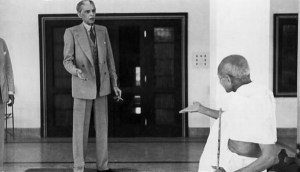
910Mohammed Ali Jinnah, the founder of Pakistan, in conversation with India’s Mahatma Gandhi

It did not take long, however, for all the various contradictions of ethnicity, language, sect, and class, to surface soon after Pakistan’s birth, between the Muslim refugees from India and the people who had been born there.

The country was also physically divided into two halves, separated in the middle by over a thousand miles of northern India. The demand for a Pakistan based on Islam had carried emotional appeal, but what Pakistan would mean as a Muslim state had not been given much thought.

Then there was a problem with Kashmir. Jinnah, according to biographers, felt cheated by the British. Kashmir, with a Muslim majority population, but ruled by a hereditary Hindu prince, was left to India, instead of Pakistan. Jinnah was prepared to force Kashmir’s union with Pakistan. But after pressure from the British military officers still in command of British India’s joint armed forces, Jinnah dropped his plans.[4]

Much of the divisiveness within Pakistan resulted in the inability of politicians to draft and ratify a constitution for nearly a decade – unlike India, where, after independence, a republican constitution for a parliamentary system of government was drafted, ratified, and adopted in fewer than thirty months.

In Pakistan, the irresolvable differences were over the nature of the Islamic state, its ideals and objectives, and how such a state was to be organized.

There were, on one side, modernist or reform-oriented Muslims, educated within the Western liberal tradition, with Jinnah as their model. They believed the Quran and the Sunnah (traditions of the Prophet) could be reconciled through liberal-reformist interpretation with the requirements of a modern democratic and representative form of government.

The religious establishment, on the other side, with its traditionalist-minded ulema (religious scholars), was insistent that the law of the land could be based only on the Quran and the Sunnah, which provided the complete and unalterable social and political code for an Islamic society. They required, therefore, that Shariah – Islamic law compiled in the 9th-12th centuries C.E. – was made the law of the land.

Then there was Abul A’la Maududi (1903-79), with the title of Maulana (a learned scholar), bestowed by his followers, as the founder and leader of Jamaat-i-Islami – the South Asian counterpart of Ikhwan-i-Muslimin (the Muslim Brotherhood), founded by the Egyptian, Hasan al-Banna (1906-49). Maududi went even farther by demanding that the constitution recognize the sole sovereignty of Allah, and the state as His agent, be limited only to implementing the Shariah.

Ultimately the difference in these two views was unbridgeable. As a result, holding the country together by authoritarian means became unavoidable.

Men in uniform replaced feckless politicians. General (later made Field Marshal) Ayub Khan, a military chief, seized power in October 1958, and set the pattern of military rule for the country. During the decade he ruled, he imposed on the country a constitution of his making; supervised economic development; invested in the defense establishment; worked to undermine the religious establishment; and in 1965 launched a poorly conceived war against India over Kashmir, which backfired. He was eventually forced, in the midst of political unrest across the country, to hand over power in 1969 to yet another general.

The military rule of Ayub Khan’s successor, General Yahya Khan, ended dismally in December 1971 with the break-up of Pakistan. It was preceded by an election for a national assembly in 1970, which Yahya Khan had arranged with the express purpose of handing power to a civilian government. But when a political party from East Pakistan won the largest number of seats in the assembly and was poised to form a government, Yahya Khan reneged on his promise. The people in East Pakistan (now Bangladesh) – estranged from those in West Pakistan (now Pakistan) over ethnic and language differences, and grievances over socioeconomic disparities – rose in opposition to military rule. The situation rapidly deteriorated, a civil conflict turned into a bloody military repression and massacre of unarmed people by the military. It ended with Pakistan declaring war against India, and the surrender of the Pakistani army to Indian forces in Dhaka, the capital of East Pakistan (now independent Bangladesh), on December 16, 1971.

After this humiliating defeat, Pakistanis in general were demoralized and the military discredited. In these circumstances, Zulfikar Ali Bhutto and the party he founded, the Pakistan People’s Party, maneuvered to fill the void. Bhutto belonged to the wealthiest landlord family in the province of Sind; as a young lawyer-politician, he had been appointed a junior minister in the military regime of Ayub Khan. His later disagreements with Ayub Khan’s policies, following the 1965 war fought by Pakistan and India over Kashmir, forced him out of the government and into opposition against military rule.

In the 1970 election Bhutto’s party had emerged with second largest number of seats in the national assembly, behind the party from East Pakistan. Bhutto claimed this as his mandate to form a civilian government, with himself as president, to replace military rule.

In 1973 he presented the country with its third constitution, and had it adopted by the national assembly. But, as the old differences over the nature of an Islamic state and the place of the Shariah resurfaced, the constitution failed to win the support of the religious establishment.

Bhutto was a populist and a demagogue. Although he was one of the most powerful feudal landlords in Pakistan, he nevertheless appealed for electoral support from students, workers and peasants by posing as a defender of the poor and oppressed in society, and, as an ally of China’s then supreme leader Mao Zedong, by embracing the left-wing politics of anti-imperialism. There was showmanship here, and some grandstanding as a leader of a third world nation. It was at this time – and soon after India tested a nuclear device in 1974 – that he determined that Pakistan must acquire nuclear capability of its own. His populism however would not save him from the wrath of the religious establishment.

But, as the country searched for an identity in the aftermath of 1971, Bhutto was temperamentally unsuited to calm the tensions around him. The Muslim religious leaders and their followers distrusted him as another liberal-secularist; he tried to appease them by meeting their demand in declaring as non-Muslims those belonging to the minority Ahmediyya sect within Islam.

In 1977, the military under General Zia ul-Haq staged a comeback, removed Bhutto from office and put him under arrest. While in prison he was indicted for plotting the murder of his political opponent, and put on trial. The court found him guilty, his appeal was denied, and he was hanged in April 1979.

Zia ul-Haq, the third military dictator to take power, ruled until his death in a mysterious plane crash in August 1988. He was a devout orthodox Sunni Muslim, and, unlike his two military predecessors – Ayub Khan and Yahya Khan – he publicly showed respect for Muslim religious leaders and their various organizations. He sought their support, and embraced their religiously directed political agenda to turn Pakistan officially into an Islamic society (Nizam-i-Islam).

ii.

The decades of sixties and seventies in the twentieth century were times of social and political unrest in the West. There was a crisis of values as the young questioned the dominant secular politics mostly concerned with material gain and economic well being, while America’s involvement in the war in Vietnam became increasingly divisive at home. The youth in general defied the authorities on both the Soviet and Western sides of the Cold War. They pushed counter-cultural movements and sought “enlightenment” through sexual freedom, drugs, music, and experimenting with the rites of non-European cultures.

In the Muslim world, the situation was vastly different. The thin veneer of modernity barely penetrated the surface of a world steeped in traditional culture. Islam as understood and practiced for generations sustained the vast majority of people at the edge of poverty. Colonialism had made only a small difference, once independence came, in preparing Muslim societies to meet the immense challenge the modern world posed for them. A tiny segment of the population had received a modern liberal education and had risen in the ranks of colonial administrations as junior civil servants, technocrats, and military officers. On their shoulders fell the task, as in Pakistan after 1947, to lead the country forward and somehow meet the swelling demands of the people for the promise of a better life.

The political leadership of the newly independent states generally looked to the West in terms of their own respective economic and social developments. Within the Muslim world – apart from the few oil-rich Arab states on the Gulf – there was a general consensus among those who held power that there was no alternative to the path for development as historically charted by the advanced Western countries, irrespective of whether those countries were capitalist democracies or socialist.

But the modernizers who succeeded the colonial authorities in taking power – the men in uniform who seized power through military coups due to the fecklessness of politicians, as in Egypt (Colonel Gamal Abdel Nasser) or in Pakistan (General Ayub Khan) – aroused expectations that were simply beyond their abilities to deliver.

The sixties and the seventies of the last century were the decades when the political roof caved in over the heads of the Muslim world’s modernizers. The immediate cause was military defeat. In the Arab world, the June war of 1967 with Israel was a catastrophic defeat for Egypt under Nasser; and, similarly, for Pakistan the December 1971 war with India was a colossal humiliation in which the army lost half the country when East Pakistan, with support of the Indian military, seceded to become an independent Bangladesh.

On the political margins of these Muslim countries, religious parties were agitating, warning the bewildered masses that these defeats were divine punishments for betraying the true message of Islam by not faithfully abiding by its requirements.

These were the decades when old theological debates from the medieval past of the Muslim world re-surfaced and were widely disseminated. Muslims were repeatedly told by religious scholars that to reverse their humiliations, they needed to return to their authentic past, to emulate the ways of their revered ancestors (salaf) and the companions of the Prophet, and to establish the rule of Islam.

In the Arab world, the Muslim Brotherhood of Hasan al-Banna and Syed Qutb (1906-66), and in Pakistan the Jamaat-i-Islami of Maulana Maududi, gained in popularity with a populace increasingly frustrated with its own political authorities.

In Egypt, Syed Qutb, as one of the leaders of the Muslim Brotherhood that declared a jihadagainst Nasser’s military-led government, was sent to the gallows. In death, Qutb became a martyr-scholar for a whole new generation of Muslims who were searching for meaning in the midst of cultural despair and political authoritarianism.

An earlier generation before 1967 in the Middle East – as elsewhere in Asia and Africa – had sought answers in the revolutionary politics of Marx and Lenin; had supported the Vietnamese communists in their war against the United States, and had admired Mao Zedong and the Chinese revolution.

In the period after 1967, and before the 1973 October war that brought the Arab oil-producing states to quadruple the price of oil and turn it into a political weapon, it was the writings of Syed Qutb that appealed to the young in the Middle East. Hasan al-Banna and the Muslim Brotherhood had turned Islam into a political doctrine – Islamism – as a total answer to all the problems of the Muslim world. Qutb had described the solution in terms of an Islamic state implementing Shariah as the fundamental law of the land. Al-Banna’s message was also directed at the lslamic ummah,the whole Muslim nation.

Qutb in his writings refined and deepened the message of al-Banna. In a significant departure from other Muslim thinkers of his time, Qutb recast the binary division in the world made by Muslim traditionalists, one between Dar al-Islam (House of Islam) and Dar al-Harb (House of War), into one between Islam and jahiliyya (a condition of barbarism or paganism) that had preceded the coming of Islam in Arabia.

Qutb developed this concept of jahiliyya as one of the key explanations for the decline of Islam in the world, and the miserably broken condition of Muslims in it. In his ultimately extreme view, and one that caught the imagination of his most devoted followers, jahiliyya had become all pervasive in the modern world, sparing none, including Muslims, except for that small coterie of Muslims who understood the situation, took flight (hijra) or withdrew from the corrupted world, and prepared for jihad (holistic struggle, including warfare) in the cause of Islam.

Qutb’s views were in part influenced by the writings of Abul A’la Maududi, in the extent to which Maududi had revived the theological views of medieval Muslim jurists on matters of God’s sovereignty in human affairs. Maududi’s innovation was in insisting that Islam was a complete system of faith and politics, in other words a totalitarian ideology promoting a social revolution, and the necessity of jihad as the instrument for realizing God’s plan on earth.

Together, Hasan al-Banna, Maududi, and Syed Qutb had fashioned political Islam as a closed system, in opposition to all other competing ideologies confronting Muslims. It was at once simple, rigidly based on the Quran and the Sunnah (traditions) of the Prophet, and provided Muslims with an armed doctrine of jihad to quell their doubts, overcome their fears, and direct them towards the objective of establishing an Islamic state or gaining martyrdom in the pursuit of it. When the Islamic revolution did successfully occur, however, it was in Iran, and in February 1979.

The Iranian followers of a religious leader in exile, Ayatollah Khomeini (1902-89), seized control of the popular uprising and eventually turned Iran into a theocratic Islamic republic.

Iran had been a monarchical regime, and the anti-monarchist revolution, even though Iranians followed the minority Shi’ite version of Islam, caught the imagination of the majority Sunni Muslims on either side of its borders. The leader of the Palestinian movement, Yasser Arafat, for instance, travelled to Tehran and embraced the founder of Iran’s Islamic revolution, Ayatollah Ruhollah Khomeini, as the leader of anti-imperialist revolution.

If Iranians could topple the Shah of Iran, an ally of the United States, then it was not unimaginable that Muslims elsewhere could also overthrow similarly pro-American or pro-Soviet authoritarian regimes that they felt had been repressing them into a state of jahiliyya. As a result, the year 1979 – the beginning of the fifteenth century in the Islamic calendar – became a pivotal year in the Muslim world.

Earlier, in November 1979, there had been a failed attempt by a small group of Saudi Wahhabi extremists to ignite a movement against the ruling House of Saud. They seized the grand mosque in Mecca, at the center of which stands the Ka’aba (the ancient cube-like structure), and held the grand mosque for several days until French paratroopers flushed them out. Although this effort was doomed to fail, it signified unrest within the most conservative Arab state, and the messianic wish for an even stricter version of Islam than the one practiced by Saudi rulers.

Then, at the end of 1979, came the Soviet invasion of Afghanistan. The occupation of a Muslim country by an infidel power became a magnet around which to rally Muslim jihadists, and encourage them to head for Afghanistan and join Afghan mujahideen (freedom fighters) in theirjihad against a military superpower.

iii.

Zia ul-Haq (1924-88), an army general who was then president, turned Pakistan into a frontline state in the decade long Afghan war. Zia viewed the Afghan war as the opportunity to reverse the humiliation of 1971, rebuild the morale of the army, and make Pakistan the key ally of the United States in the war against Soviet Communism.

Under Zia’s direction Islamabad forged a new strategic partnership with President Ronald Reagan’s Washington and the Saudi monarchy to help the Afghan mujahideen (freedom fighters) liberate their country from Soviet occupation.

But the blowback from the Afghan war in time has turned Pakistan from a cockpit of global jihadinto a land increasingly torn and bloodied by armed warriors of Islam.

On seizing power, Zia reached out to the religious establishment and made Islamization of Pakistan his military regime’s domestic priority. He believed the country suffered from a crisis of identity, for which it had paid dearly in 1971. Although the country had been established on the basis of Islam, Zia would regularly remind the people in public speeches and interviews, that the political leadership had failed to establish an Islamic-based society.

Zia’s solution was to encourage an Islamic identity to replace, or supersede, ethno-linguistic and sectarian identities that had weakened and divided the country. Accordingly, the measures he adopted were to make the fundamental law of the land, the Constitution, conform to the dictates of the Quran and the Sunnah, and implement the requirements of the Shariah in society. To push for the Islamization of the country, Zia established the Federal Shariah Court and the Shariah Appellate Bench of the Supreme Court.

What Zia could not have foreseen was how the Afghan war would become the petri-dish of Islamist theology and jihadi politics. As Arabs attracted by the appeal of jihad congregated in and around Peshawar, Afghanistan and the Afghan war became the cradle of the global jihadistmovement. The actual contribution of these “Afghan Arabs” in defeating the Soviet Union was negligible, but it was here they found a safe haven to engage in arcane theological debates that shaped the thinking and politics of those who had been radicalized through the writings of Syed Qutb and Maududi.

The Afghan war may be divided into three phases. The first was the war against the Soviet forces, ending with their full withdrawal in February 1989. The Soviet withdrawal marked the beginning of the second phase until 9/11. During this period, the war turned into an internal struggle among the various tribal groups and factions for the control of Afghanistan. Despite the fall of Kabul, the capital, to Afghan Taliban warriors under Mullah Omar in September 1996, this internal conflict raged on. The third phase began after the 9/11 terrorist attacks on New York and Washington, and led to the U.S. sending forces into Afghanistan to search out and destroy the al Qaeda leadership and network.

In Pakistan during the summer and fall of 1988 after the airplane crash that killed Zia, one could see that although the first phase of the Afghan war was winding down, the country was on edge and the military and security forces were everywhere. In Islamabad, at the Institute of Strategic Studies, one could hear the elite opinion about the Afghan war: that the Soviet defeat had been brought about by Pakistan, and that, despite risks, Zia’s bold vision had turned out right.

In helping the Afghan mujahideen liberate their country, Pakistan had acquired strategic depth in its confrontation with India. The victory also celebrated undoing the defeat of 1971, and providing the military establishment with experience in conducting asymmetrical warfare against an enemy larger in size and resources. Pakistan has always been obsessed with India, and the Afghan war gave its men in uniform new confidence on how to engage with India in Kashmir.

The build-up of the military with the offshore money that flowed into Pakistan from Saudi Arabia in aid of the Afghan war further entrenched the special place it occupies in the country. The observation first made by Sir John Morrice James, Britain’s High Commissioner to Pakistan during the rule of Ayub Khan – that re-arming the military by the Americans “was to risk creating a situation where it would not be so much a case of Pakistan having an army as of the Army having Pakistan”[5] – seemed uncannily true at the end of the Zia era. Since Pakistan’s independence in 1947, and at the end of the first phase of the Afghan war, the military had ruled Pakistan for more than half the period, and the men in uniform, given their self-important role as the guarantor of the country’s security, had acquired a sense of entitlement.

During subsequent visits, it seemed as if the victory in the Afghan war that gave most Pakistanis pride and the right to boast was an illusion. War had laid waste to Afghanistan. Virtually the entire Afghani population within the country – as well as in the neighboring countries of Pakistan and Iran – had been turned into refugees. Pakistan had become home for several million Afghan refugees, mostly of Pashtun/Pathan ethnicity, indistinguishable from Pathans on the Pakistani side of the frontier. With these refugees, the war inside Afghanistan was imported across the border into Pakistan, and the struggles of the Afghan mujahideen against Soviet occupation of their country invariably began to change the political landscape inside Pakistan.

The Afghan Taliban emerged from the ranks of its own refugee population in Pakistan. Their struggles against the Soviet forces in their country in turn persuaded their ethnic brethren, the Pakistani Pathans, to join them. In time, the distinction between Afghani and Pakistani Taliban dissolved even as the frontier between the two countries became irrelevant.

Ahmed Rashid, the world’s foremost expert on the Taliban, observed:

“Throughout Afghan history no outsider has been able to manipulate the Afghans, something the British and the Soviets learnt to their cost. Pakistan, it appeared, had learnt no lessons from history while it still lived in the past, when CIA and Saudi funding had given Pakistan the power to dominate the course of the jihad. Moreover, the Taliban’s social, economic and political links to Pakistan’s Pashtun borderlands were immense, forged through two decades of war and life as refugees in Pakistan. The Taliban were born in Pakistani refugee camps, educated in Pakistanimadrassas and learnt their fighting skills from Mujaheddin parties based in Pakistan. Their families carried Pakistan identity cards.”[6]

The Pakistani military, through its ISI intelligence services, had raised, trained, and armed the Taliban to be its proxy inside Afghanistan. The ISI provided key material and logistic support to the Taliban leader, Mullah Omar through the 1990s right to the present. In addition, the ISI’s deep connection with the Taliban, approved at the highest levels of the Pakistani military leadership, became the preferred approach for raising and supporting other Islamist militias to wage secret warfare against India in Kashmir. The ISI’s investment in Taliban was made for returns to its own liking, when needed, in terms of Pakistan’s strategic interests. So the idea of Afghanistan as a strategic depth for Pakistan, was made by Pakistan’s political establishment into an article of faith not to be doubted.

Ahmed Rashid also noted, however, that “the backwash from Afghanistan was leading to the ‘Talibanization’ of Pakistan. The Taliban were not providing strategic depth to Pakistan, but Pakistan was providing strategic depth to the Taliban.”[7] This was shown in the Afghan war, after September 11, 2001, when American and the allied forces under NATO/ISAF (North Atlantic Treaty

Organization/International Security Assistance Force) command found how difficult it was – and still is – to pacify Afghanistan when the Taliban have continued to operate out of safe havens inside Pakistan. The leaders of both the Pakistani and Afghani Talibans are able to slip back and forth across the border to hide with ease.

The Taliban were raised, on both sides of the border, in the Deobandi school of fundamentalist Islam, different in tradition from what the “Afghan Arabs” brought with them to Pakistan.

The “Afghan Arabs” are Arabs who headed for Afghanistan in 1979 following the Soviet invasion of that country. Osama bin Laden and his entire al Qaeda crew, for instance, came to be referred to as “Afghan Arabs” to distinguish them from native Afghans and this is why the quotes. The “Afghan Arabs” introduced the doctrine of takfir [excommunication] theology to non-Arab Muslimjihadis, especially the Afghani and Pakistani Talibans in their pursuit of global jihad.

The Deobandi school, originating out of the nineteenth century Darul Ulum Deoband – an Islamic school that took its name from the town, Deoband, located in north India where it was foundedcirca 1867 – has been, since it was established, the flag-bearer of jihadi movements in India and Central Asia.

The religious scholars at Deoband, were practitioners of taqlid (imitation): of strictly adhering to the authoritative interpretations of the traditional four schools of fiqh (jurisprudence) in Sunni Islam. They insisted that Muslims follow the Shariah-code as required by their faith and tradition.

The “Afghan Arabs” brought with them to Afghanistan and Pakistan the more rigid teachings of the medieval jurist, Ibn Taymiyya (1263-1328), especially his stringent pronouncements on apostasy and jihad.

The mainline consensus of Sunni Muslim jurists on what constitutes Muslim belief, in accordance with the Shariah’s minimal requirement, is the utterance of the Shahada, or the formula of the Islamic creed: “There is no god other than Allah and Muhammad is His Messenger.” The saying of obligatory prayers, keeping the fast during the month of Ramadan, making pilgrimage at least once in lifetime, and giving charity (zakat) have been traditionally considered the key pillars of Islam, as stipulated in the Quran, and abiding by them is evidence of Muslim piety.

Ibn Taymiyya ruled, however, that such minimal requirement was insufficient, especially when a Muslim ruler failed to implement the Shariah, and when any Muslim failed to engage in jihad(armed struggle) to demand the rule of Shariah. From such a standpoint, as Ibn Taymiyya underscored, when a Muslim ruler transgressed the Shariah-code, or set aside the rule of Shariah in territory under his control, he turned into an infidel, or apostate, and thereupon became a legitimate object for jihad.

Ibn Taymiyya’s medieval excursions into jurisprudence and theology, once revived, became the hallmark of the new generation of Arab Islamists. They made takfir (declaring someone to be an apostate or an unbeliever, excommunication) a signature instrument of their jihad, and readily used such pronouncements to attack their opponents.

The most striking example of this from recent history was in pronouncing takfir on President Anwar Sadat for signing the peace agreement with Israel. That act turned him into an object ofjihad, which eventually brought about his public assassination in October 1981.

Ibn Taymiyya’s hard line extremist thinking was a result of the upheaval in Arab lands during the Mongol invasion of the thirteenth century. His views were a marginal innovation in medieval Islamic theology, but nonetheless became the signature of the contemporary jihadis, the “Afghan Arabs.” In mainline traditional Sunni jurisprudence, the ulema (religious scholars) stressed the importance of obeying Muslim rulers and in avoiding fitnah (disorder or internecine warfare) as a major sin.

The theology of takfir, declaring other Muslims apostates, was, and is, riddled with Muslim-on-Muslim violence. From the earliest decades of Islamic history, Muslim extremists have given a theological justification for their violence against Muslims with whom they disagree, such as Shiites, and other minority sects.

Consequently, in contemporary times within the Muslim world, the fear or apprehension of early Muslim jurists – based on lessons, drawn from the earliest phase of Islamic history, of fratricide and tribal conflicts – has become widespread.

iv.

The theology of takfir, obsessed with “unbelief,” has provided the politics of jihad with the sort of theological justification that arms any Muslim to freelance as soldier of Allah.

A soldier, for instance, in the security detail of Salman Taseer – the governor of Punjab and Pakistan’s largest province with an estimated population of around one hundred million – shot him dead in January 2011 to punish him for his efforts to amend the blasphemy law in the penal code. Furthermore, Pakistani lawyers praised his murderer.

The law was first introduced in the colonial period, and the Zia regime further broadened its scope, as part of the Islamization process, by requiring anyone accused of insulting the Prophet or desecrating the Quran to be imprisoned ahead of an investigation.

After the swift defeat of the Taliban by American forces in Afghanistan in 2001, the “Afghan Arabs” of the al-Qaeda network were on the run in search of sanctuary. Many of them, including Osama bin Laden and his deputy, Ayman al-Zawahiri, found safe haven in the Pathan tribal areas of Waziristan within Pakistan, and dug in there for the long struggle of the global jihad. They indoctrinated the Taliban and other elements of the Pakistani jihadi militias based in Punjab with their highly polarized doctrine of takfir theology, culled from the writings of Ibn Taymiyya. (Among the most well known militias besides the Pakistani Taliban are the fiercely anti-Shia and Deobandi trained jihadists of Sipah-e-Sahaba and Lashkar-e-Jhangvi; the Jaish-e-Mohammad operatives in Kashmir; and jihadists of Laskar-e-Taiba, funded by the ISI, and accused of plotting the 2001 attack on the Indian parliament in New Delhi, and of carrying out the 2008 attack in Mumbai.)

For the jihadi theorists among “Afghan Arabs,” the strategic requirement for advancing globaljihad was to convince Muslims that they are liable to be found committing heresy if they support non-Muslim or infidel authorities, such as the United States and its allies, or if they wage war against Muslims, such as members of al Qaeda network.

The “Afghan Arabs” also sought to convince their jihadi allies among Muslims in the Afghanistan-Pakistan region, especially the Islamists among them, to declare their co-religionists apostates if they were found unwilling to establish Shariah rule in society and assist the global jihad.

The logic behind the doctrine of takfir theology for “Afghan Arabs” – as they instructed the Pakistani Islamists – was straightforward: Once Islamists in Pakistan – with many inside the military, and especially those inside the ISI – became convinced that Pakistan could not be considered any longer an Islamic state due to its role as a junior partner of the United States in the war against the global jihad – represented by Islamist organizations, such as al Qaeda – then the Pakistani Islamists would likely lead a revolt. A successful revolt in Pakistan would then make the country the most important base of global jihad.

The theology of takfir has borne fruit within Pakistan. The assassination in 2007 of Benazir Bhutto – a former prime minister and opposition leader and daughter of Ali Bhutto (hanged by the military in 1979) – and then of Salman Taseer, the governor of Punjab, in 2011, were two high profile jihadi executions. Since 2001, there has been a steady toll of victims from jihadi violence inside Pakistan. Taliban and jihadi militias have directed terrorist attacks and suicide missions against the minority Shia population; against Ahmediyyas, declared non-Muslims; against Christian and Hindu minorities; against Sufi shrines and Sufi Muslims (those devoted to a mystical tradition of spiritual Islam) as heretics; and even against Pakistani military targets, such as the naval base in Karachi in May 2011 and an air force installation in Peshawar in December 2012.[8]

In nearly four decades of strife, warfare, and jockeying for power inside Afghanistan, with the epicenter in the mountainous areas bordering on Pakistan, a culture of jihad and takfir took root. The Pakistan army, answerable to no higher authority than itself, contributed to the making of this culture. The Pakistan army is in part responsible for creating the jihadi militias, which have become monsters that cannot be entirely controlled by the ISI. It is also widely believed that the ISI and some segment of the military establishment are in league with Islamists, and supportive of the goals of global jihad.

The fecklessness and corruption of politicians and civilian authorities work to the advantage of the military establishment, still viewed by a majority of the people as the one institution – in spite of the record – trusted to maintain Pakistan’s security.

Because of Pakistan’s rivalry with India and the unwillingness of the Pakistani population, pushed by Islamist rhetoric, to negotiate with India a peaceful settlement of the Kashmir conflict – which, with rising civilian casualties has worsened over the years as a result of jihadi organized terrorism – the military establishment is unlikely to end its support for jihadi militias operating inside Kashmir from bases inside Pakistan. Similarly, by hanging onto the illusion of Afghanistan as some sort of strategic depth for Pakistan, the military will not disband the Pakistani Taliban.

The Islamization of Pakistan has given more official encouragement and “teeth” to Islamists armed with the theology of takfir. These Islamists have shown, that, when squeezed too hard by the military or civilian authorities, they are ready to bite with attacks on military installations, such as one on the naval base in Karachi, or by assassinations, such as in the killings of Salman Taseer and Benazir Bhutto.

Large segments of the Pakistani population live in poverty. The most impoverished region is in the tribal areas of northwest Pakistan, and home to the Taliban. For a vast majority of the people, basic needs in terms of medicine, clean water, nutrition, education and jobs are barely met by the state. The insult to the human dignity of those more or less abandoned to endless destitution is compounded by the lifestyle of the rich and the privileged. The people in the military are the most privileged among the Pakistanis, and resentment against them is not far below the surface of a society seething with tensions.

The Taliban attack on the Peshawar army school, and the murder of the children there, most of whom came from military homes, went beyond revenge. It signified class-based hostility against a system of privilege for a tiny minority. There are over one hundred specially built army schools, such as the one in Peshawar, for children of the military establishment and the civilian elite, to provide for modern education.

In contrast, there are nearly 14,000 madrasas (religious seminaries) where, under the supervision of Deobandi scholars, a Quran-based education of rote learning and memorization, ill-equipped for modern needs, is provided to an estimated two million children of the poor. It is from these madrasas that the jihadi fighters come forth as cannon fodder for an endless jihad that has become a growth industry in Pakistan. The entire political elite in Pakistan has profited, just as the entire Saudi elite has profited by funding the Islamists, and just as the entire Iranian elite continues to profit by doing the same.

Politics in Pakistan has carried in its blood stream the virus of religious fanaticism right from the outset of its creation. The name chosen for the country at birth, “Pakistan,” in Urdu means “the land (or home) of the pure.” For many, the significance of being a Pakistani came to mean striving, as Muslims, to be “pure,” and that a true believer required separating themselves from non-Muslims. But this mentality turned full circle. Infected by the theology of takfir and the politics of jihad, Pakistanis, when they disagree, now find themselves trapped in denunciations that they are unbelievers. A country made for Muslims has now turned into a nightmare for Muslims. The children killed in the Peshawar army school by Taliban were innocent of the politics of their elders, even as these children were their sad victims.


[1] Ismail Khan, “We have killed all the children… What do we do now?” Reported in Dawn(Karachi), 18 December 2014.

[2] As he indicated in his address to Pakistan’s Constituent Assembly meeting for the first time in Karachi in August 1947

[3] See Stanley Wolpert, Jinnah of Pakistan (New York: Oxford University Press, 1984), pp. 337-340.

[4] See Wolpert, Jinnah, pp. 347-354.

[5] Cited in Shuja Nawaz, Crossed Swords: Pakistan, its Army, and the Wars Within (Karachi: Oxford University Press, 2008), p. 200.

[6] Ahmed Rashid, Taliban: Militant Islam, Oil and Fundamentalism in Central Asia (New Haven & London: Yale University Press, 2000), p. 185.

[7] Rashid, Taliban, p. 187.

[8] See Declan Walsh, “Pakistani commandos regain control of Karachi military base,” in The Guardian (UK), 23 May 2011, for report on the attack on the naval base in the port city of Karachi; and see Ismail Khan, “Audacious attack on Peshawar PAF base,” in Dawn (Karachi), 16 December 2012 for report on the attack on the air force base in Peshawar.

Taliban claim insider attack at Kabul Airport that killed 3 US contractors

January 31, 2015

Taliban claim insider attack at Kabul Airport that killed 3 US contractors, Long War Journal, Bill Roggio, January 30, 2015

(Nothing to see here; they are just insurgents. Please see White House Struggles To Distinguish Between The Islamic State and Taliban Prisoner Swaps. — DM)

The Taliban claimed last evening’s attack at Kabul International Airport that killed three American contractors. The insider or green-on-blue attack, where a member of the Afghan security forces kills Coalition personnel, is the first of its kind recorded this year.

The attacker, who was dressed in an Afghan military uniform, killed the three contractors and wounded one, Major General Haq Nawaz Haqyar, the commander of Afghan police at the airport, told Pajhwok Afghan News. An Afghan was also killed in the shooting, Haqyar said. It is unclear if the Afghan who was killed was the shooter.

The US Department of Defense confirmed that three Americans and an Afghan were killed in the shooting.

Taliban spokesman Zabihullah Muhajid claimed the attack in two statements on his Twitter account, and said it was executed by Ihsanullah, an “infiltrator … from Laghman province working inside Kabul airport.”

“The attack killed 3 American terrorists and wounded 4 others before the infiltrator was martyred by return fire,” Muhajid claimed. The tweet included the hashtag “Khaibar,” a reference to the Taliban’s offensive that was announced in May 2014. The Taliban said it will continue to launch insider attacks, as well as encourage Afghan soldiers to execute such operations.

The Taliban have devoted significant effort into attempts to kill NATO troops and foreigners by infiltrating the ranks of Afghan security forces. Mullah Omar affirmed this in a statement released on Aug. 16, 2012, when he claimed that the group had “cleverly infiltrated in the ranks of the enemy according to the plan given to them last year [2011],” and he urged government officials and security personnel to defect to the Taliban as a matter of religious duty. Omar also noted that the Taliban had created the “Call and Guidance, Luring and Integration” department, “with branches … now operational all over the country,” to encourage defections. [See Threat Matrix report, Mullah Omar addresses green-on-blue attacks.]

Overall number of insider attacks still unknown

The last known insider attack took place on Sept. 16, 2014 in the western province of Farah. In that attack, an Afghan soldier gunned down a Coalition trainer inside a military base.

The previous attack occurred on Aug. 5 at a training center in Kabul. An Afghan soldier killed a US major general and wounded 16 more military personnel, including a US brigadier general, a German general, five British troops, and at least one Afghan officer. The Taliban did not claim credit for the attack, but praised the Afghan soldier who executed it.

There were four insider attacks recorded in Afghanistan in 2014, according to The Long War Journal’s statistics. The number of reported green-on-blue attacks on Coalition personnel in Afghanistan has dropped steeply since a peak of 44 in 2012. In 2013, there were 13 such attacks. [For in-depth information, see LWJ special report, Green-on-blue attacks in Afghanistan: the data.]

The decline in attacks may be due to several factors, including the continuing drawdown of Coalition personnel, reduced partnering with Afghan forces, and the adoption of heightened security measures in interactions between Coalition and Afghan forces.

However, many insider attacks remain unreported. If an attack by Afghan personnel does not result in a death or injury, and it is not reported in the press, the Coalition will not release a statement on the incident.

The International Security Assistance Force (ISAF), which was disbanded at the end of 2014, told The Long War Journal in March 2012 that “these statistics,” the number of attacks that did not result in a casualty, are “classified.”

“[A]ttacks by ANSF on Coalition Forces … either resulting in non-injury, injury or death … these stats as a whole (the total # attacks) are what is classified and not releasable,” Lieutenant Colonel Jimmie Cummings, ISAF’s former Press Desk Chief, told The Long War Journal. Cummings said that ISAF is “looking to declassify this number.” The number was never declassified.


Deadly Fighting Between Hezbollah and Israel

January 30, 2015

Deadly Fighting Between Hezbollah and Israel, Fox News with Oliver North via You Tube, January 29, 2015

(Obama: acting like a “petulant child.” — DM)


White House Struggles To Distinguish Between The Islamic State and Taliban Prisoner Swaps

January 30, 2015

White House Struggles To Distinguish Between The Islamic State and Taliban Prisoner Swaps, Jonathan Turley’s Blog, Jonathan Turley, January 30, 2015

(President Humpty Dumpty:

‘When I use a word,’ Humpty Dumpty said, in rather a scornful tone, ‘it means just what I choose it to mean — neither more nor less.’

‘The question is,’ said Alice, ‘whether you can make words mean so many different things.’

‘The question is,’ said Humpty Dumpty, ‘which is to be master — that’s all.’

Hence, Islam is the religion of peace and terrorists aren’t terrorists. Will all of the king’s horses and all of the king’s men be able to put him back together again?– DM)

bergdahl
150124201815-nr-dnt-harlow-sajida-al-rishawi-explainer-00001707-large-169

The White House again seems to be struggling with barriers of both language and logic as many raise comparisons between the controversial Bergdahl swap and the effort this week of Jordan to swap a terrorist for one of its downed pilots with Islamic State. During a week where one of the five Taliban leaders released by the Administration has been found trying to communicate with the Taliban, the Jordanian swap has reignited the criticism of the swap for Army Sgt. Bowe Bergdahl, which violated federal law and released Taliban leaders with long and bloody records. The White House seems to be trying to argue that the Taliban are not terrorists in direct contradiction to its prior position that they are indeed terrorists. It shows the fluidity of these terms and how the government uses or withdraws designations as terrorists to suit its purposes. The familiarities between Islamic State (IS) and the Taliban appear to be something in the eye of beholder or, to quote a certain former president, “It depends on what the meaning of the word ‘is’ is.”

As a refresher, the Taliban has long been viewed as terrorists, even when they were in power. They have destroyed religious sites, art, and in one of the most infamous acts in modern history, blew up the giant ancient Buddhas at Bamiyan.The United Nations and human rights groups have documented a long list of civilian massacres and bombings carried out by the Taliban. One report described “15 massacres” between 1996 and 2001. The UN estimates that the Taliban were responsible for 76% of civilian casualties in Afghanistan in 2009, 75% in 2010 and 80% in 2011. The Human Rights Watch estimates that “at least 669 Afghan civilians were killed in at least 350 armed attacks, most of which appear to have been intentionally launched at non-combatants.” This includes the widespread use of suicide belts. The Taliban has always had a close alliance with al Qaeda.

That record was put into sharp relief with the swap for Bergdahl with ties to terrorism including one who was the head of the Taliban army, one who had direct ties to al-Qaeda training operations, and another who was implicated by the United Nations for killing thousands of Shiite Muslims. While we have always said that we do not negotiate with terrorists, we not only negotiated for Bergdahl but gave them what they wanted.

20051114181303

The Jordanian swap raised the same obvious concerns. Many have objected, for good reason, to the idea of releasing Sajida al-Rishawi, who participated with her husband in a terrorist attack on a wedding party at the luxury Radisson hotel in the Jordanian capital of Amman on Nov. 9, 2005. al-Rishawi hoped to be welcomed to paradise by walking into a wedding of 300 people enjoying a family gathering with children and murdering them in cold blood. Her husband’s bomb went off but not her bomb. It goes without saying that she is a hero to the murderous Islamic State for her effort to kill men, women, and children at a wedding.

The swap appears in part the result of pressure from Japan to secure the release of one of its citizens. In my view, such a propose swap was disgraceful. al-Rishawi is as bad as it gets as a terrorist. To yield to terrorists who engage in weekly demonstrations of beheading unarmed captives is morally wrong and practically suicidal. Just as the West is funding this terrorist organization through millions of ransom payments, the exchange of a terrorist only fuels their effort to capture and torture more Western captives.

This brings us back to the White House. When asked about the proposed swap with Islamic State, the White House was aghast. White House spokesman Eric Schultz stated “Our policy is that we don’t pay ransom, that we don’t give concessions to terrorist organizations. This is a longstanding policy that predates this administration and it’s also one that we communicated to our friends and allies across the world.”

The media understandably sought guidance on why the swap with Bergdahl was the right thing to do (despite the flagrant violation of federal law) while the swap for the pilot was not. The White House acknowledged that the Taliban are still on a terrorist list but then tried to rehabilitate the organization into something else. The White House is now referring to the Taliban as an “armed insurgency.” It notes that the Taliban are not listed by the State Department as a terrorist organization. However, they are listed as one of the “specially designated global terrorist” groups by the Department of the Treasury. Indeed, they have been on that list since 2002. Worse yet, the statement from the White House came in the same week that the Taliban claimed responsibility for killing three U.S. contractors.

John Earnest tried to thread the needle by explaining “They do carry out tactics that are akin to terrorism, they do pursue terror attacks in an effort to try to advance their agenda.” He seems to struggle to explain what is terrorist attacks and what are attacks “akin to terrorism.” Most people view suicide belts and civilian massacres to be a bit more than “akin to terrorism.”

Earnest also note that, while the Taliban has links to al Qaeda, they “have principally been focused on Afghanistan.” However, “Al Qaeda is a terrorist organization that has aspirations that extend beyond just the border between Afghanistan and Pakistan.” That is diametrically opposed to the position of the Administration in claiming sweeping powers to strike targets around the world against any forces linked to al Qaeda and many who have few such links. Indeed, while referencing to the authorization to attack al Qaeda, the Administration attacked Islamic State, which was actively fighting with al Qaeda.

The spin of the White Hosue also ignores the role of the Taliban-aligned Haqqani network in holding Bergdahl, a well-known terrorist group.

There are obviously arguments to make for the Bergdahl swap (though I find little compelling in the arguments that justify the violation of federal law by the White House). However, the argument must acknowledge that we negotiated with a group of hostage taking terrorists and we need to address the implications of that fact. Alternatively, if the White House now believes that the Taliban is no longer a terrorist organization, it needs to take it off its listing of such groups (a listing that subjects people to criminal charges for material support or assistance with the group). It cannot have it both ways and call it a terrorist group unless such a label is inconvenient.

Swapping Prisoners with Terrorists

January 30, 2015

Swapping Prisoners with Terrorists, National Review Online, Andrew C. McCarthy, January 29, 2015

pic_giant2_092214_SM_Barack-Obama-G_0

Obama’s disastrous policy dates back to his earliest days in office.

Suddenly, there is outrage in the land over President Obama’s policy of negotiating prisoner swaps with terrorist organizations, a national-security catastrophe that, as night follows day, is resulting in more abductions by terrorist organizations.

Well, yes, of course. But what took so long? Sorry if I sometimes sound like I work the “I Told You So” beat at the counter-jihad press. But as recounted in these pages, immediately upon assuming power in 2009, Obama started negotiating exchanges of terrorists — lopsided exchanges that sell out American national security for a net-zero return.

Critics now point to the indefensible swap Obama negotiated with our Taliban enemies in 2012 as if it were the start of the problem. In reality, the springing of five top Taliban commanders in exchange for the Haqqani terror network’s release of U.S. soldier Bowe Bergdahl was fully consistent with what was by then established Obama policy. There was nothing new in our president’s provision of material support to terrorists even as those terrorists continued to conduct offensive terrorist operations against our troops.

Clearly, the Bergdahl–Taliban swap was a disaster. As I’ve previously noted, it would be a profound dereliction of duty for a commander-in-chief to replenish enemy forces in this manner even if the captive we received in exchange had been an American war hero. To the contrary, Obama replenished our enemies in exchange for a likely deserter who may have voluntarily provided intelligence to the enemy and whose treachery cost the lives of American soldiers who tried to find and rescue him.

Even the conservative media are now suggesting it was the Bergdahl–Taliban swap that marked Obama’s reckless departure from longstanding American policy against negotiation with terrorists, and in particular against exchanging captured terrorists for hostages. This policy reversal has indeed incentivized jihadists to capture more Westerners, and prompted state sponsors of jihadists, such as Qatar, to propose more prisoner swaps. Moreover, the Obama strategy has deprived the U.S. of any moral authority or leadership influence to dissuade other countries, such as Jordan, from releasing anti-American jihadists in similar prisoner exchanges.

But the disaster did not begin with the Bergdahl–Taliban swap.

As I detailed in a column soon after Obama took office — specifically, on June 24, 2009 (“Negotiating with Terrorists: The Obama administration ignores a longstanding — and life-saving — policy”):

Even as the mullahs [i.e., the rulers of Iran’s Shiite regime] are terrorizing the Iranian people, the Obama administration is negotiating with an Iranian-backed terrorist organization and abandoning the American proscription against exchanging terrorist prisoners for hostages kidnapped by terrorists. Worse still, Obama has already released a terrorist responsible for the brutal murders of five American soldiers in exchange for the remains of two deceased British hostages.

To summarize: The Iranian government implanted a network of Shia jihadist cells in Iraq in order to spearhead the terror campaign against American troops. The point was to duplicate the Hezbollah model by which Iran controls other territory beyond its borders. In fact, the network of cells, known as Asaib al-Haq (League of the Righteous), was organized by Hezbollah veteran Ali Musa Daqduq.

The network was run day-to-day by two brothers, Qais and Layith Qazali. Both brothers and Daqduq were captured by U.S. forces in Basrah after they orchestrated the assassination-style murders of five American soldiers abducted in Karbala on January 20, 2007.

A few months later, in May 2007, the terror network kidnapped five British civilians. As American troops put their lives on the line to protect Iraq, the terrorist network told Iraq’s Iran-friendly prime minister, Nouri al-Maliki, that they would release the Brits in exchange for Daqduq and the Qazali brothers. The Bush administration refused the offer.

But soon after entering office in 2009, President Obama decided to change course and entertain the offer. The new administration rationalized that the trade could serve the purpose of Iraqi political reconciliation — which is to say: Obama, in the midst of pleading for negotiations with the “Death to America” regime in Tehran, prioritized the forging of political ties between Iraq and an Iran-backed terror network over justice for the murderers of American soldiers.

Conveniently, Iran’s influence over Maliki ensured that Iraq would play ball: Maliki’s government would serve as the cut-out, enabling Obama to pretend that (a) he was negotiating with Iraq, not terrorists; and (b) he was releasing terrorists for the sake of Iraqi peace, not as a ransom for hostages.

Layith Qazali was released in July. This failed to satisfy the terror network, which continued to demand the release of Daqduq and Qais Qazali. The terrorists did, however, turn over two of the British hostages — or rather, their remains.

I know you’ll be shock-shocked to hear this, but while Obama’s minions were practicing their so-very-smart diplomacy, the jihadists were killing most of their hostages. At least three of the Brits were murdered. Yet even that did not cause Obama to reconsider his position.

In late 2009, the administration released Qais Qazali in a trade for the last living British hostage, Peter Moore. As The Long War Journal’s Bill Roggio reported at the time, an enraged U.S. military official aware of the details of the swap presciently observed: “We let a very dangerous man go, a man whose hands are stained with U.S. and Iraqi blood. We are going to pay for this in the future.”

Meanwhile, as I related in July 2009, Obama released the “Irbil Five” — five commanders from the Iranian Revolutionary Guard’s Quds force. Like Daqduq, the Quds force was coordinating Iran’s terror cells in Iraq. At the time, General Ray Odierno, then the top U.S. military commander in Iraq, publicly stated that Iran was continuing to support, fund, and train the terrorists attacking American and allied forces.

As Michael Ledeen pointed out, the release of the five Iranian terrorist commanders – three years before Obama’s release of the five Taliban commanders – was the price the mullahs had demanded to free Roxana Saberi, a freelance journalist the mullahs had been holding. The Obama administration, naturally, claimed that it was not negotiating with terrorists but with sovereign governments (just as it claimed only to be negotiating with Qatar as it cut the Bergdahl deal with the Taliban and the Haqqanis). Besides, said the administration, the president’s hands were tied by the status-of-forces agreement, which purportedly required turning prisoners over to the Iraqi government (for certain return to Iran) — even prisoners responsible for killing hundreds of Americans, even prisoners sure to persevere in the ongoing, global, anti-American jihad.

And then there was Daqduq. His comparative notoriety, coupled with a smattering of negative publicity over the other terrorist negotiations and swaps, caused a delay in his release. But in July 2011, with the Beltway distracted by the debt-ceiling controversy, the Obama administration tried to pull off Daqduq’s stealth transfer to Iraq.

As I noted at the time, however, the Associated Press got wind of the terrorist’s imminent release, and its short report ignited fury on Capitol Hill. Several senators fired off a letter, outraged that the United States would surrender “the highest ranking Hezbollah operative currently in our custody” — a man who would surely return to the jihad “to harm and kill more American servicemen and women” when Iraq inevitably turned him over to Iran, as it had done with other released terrorists.

The administration retreated . . . but only for the moment. Realizing it would be explosive to spring Daqduq during his reelection campaign, Obama waited until the Christmas recess after the election. The president then had the terrorist quietly handed over to Iraq, which, after acquitting Daqduq at a farce of a “trial,” duly released him to Hezbollah in Lebanon.

There is a reason why the Arab press was reporting that the Obama State Department was entertaining discussions with Egyptian authorities about freeing the Blind Sheikh — Omar Abdel Rahman, the convicted terrorist serving a life sentence for running the jihadist cell that bombed the World Trade Center and plotted other attacks against New York City landmarks. There is a reason why, when he assumed power in 2011, Muslim Brotherhood–leader-turned-Egyptian-president Mohamed Morsi proclaimed that his top priorities included pressuring the United States to return the Blind Sheikh to Egypt.

Long before the Bergdahl–Taliban swap, it was well known that the Obama administration was open for business — if the business meant releasing terrorists.

Are Liberals Actually Admitting Islamic Terrorists Exist?!?

January 30, 2015

Are Liberals Actually Admitting Islamic Terrorists Exist?!? PJ Media Trifecta via You Tube, January 29, 2015

(The phrase “literal Islam” is an excellent substitute for “radical Islam.” Literal readings of the Koran and other Islamic “holy” texts support and demand what so called “radical Islamic extremists” do. Perhaps Obama and others who claim that Islam is “the religion of peace” should be labeled “extremist” and/or “radical”  because they — rather than the Islamic State, et al — pervert the basic teachings of Islam. They apparently want us to believe, all evidence to the contrary notwithstanding, that Islam is just another peaceful religion much like others and is therefore not a problem for secular societies. — DM)