Posted tagged ‘Isis’

Turkish army shells Kurds ‘refusing to retreat’ near Jarablus

August 26, 2016

Turkish army shells Kurds ‘refusing to retreat’ near Jarablus – state media Published time: 26 Aug, 2016 01:57

Source: Turkish army shells Kurds ‘refusing to retreat’ near Jarablus – state media — RT News

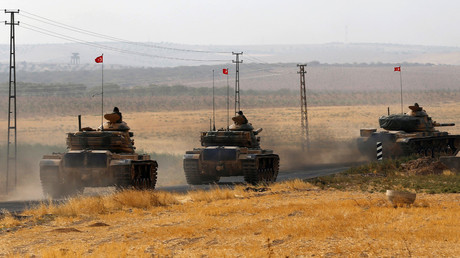
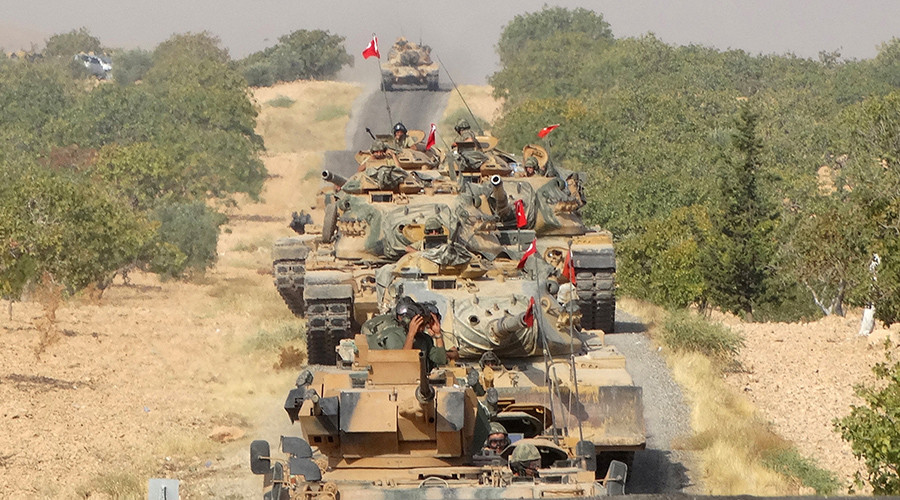
Turkish army tanks make their way towards the Syrian border town of Jarablus, Syria August 24, 2016. © Revolutionary Forces of Syria Media Office / Reuters

Turkish military have targeted US-backed Kurdish YPG militia with artillery fire south of the Syrian border town of Jarablus on Thursday, Anadolu state agency reported, citing a security source. The units allegedly refused to withdraw from the area despite warnings.

The group of YPG fighters were attacked with howitzers at about 6pm local time after they were spotted by Turkish intelligence advancing to Jarablus from the north of Manbij, the report said. Earlier, Washington assured Ankara that the US-backed Kurdish formations have been pulling out forces from the area to the east of the Euphrates River as demanded by Turkey.

READ MORE:Women burn burqas, men cut beards: Manbij celebrates liberation from ISIS (VIDEO, PHOTOS) 

“Kerry [US State Secretary John Kerry] emphasized that the PYD/YPG forces have been withdrawing to the east of the Euphrates,” a Turkish security source was quoted by Hürriyet Daily News as saying following a telephone conversation between the US top diplomat and Turkey’s foreign minister Mevlut Cavusoglu on Thursday morning.

While on a visit to Ankara on August 24, US Vice President Joe Biden pledged to withdraw the support of American forces to Kurdish fighters battling terrorists in Syria if they did not comply with Turkey’s request to remain east of the river.

READ MORE:Turkey shells ISIS & Kurdish positions in Syria

“They cannot, will not and under no circumstances get American support if they do not keep that commitment. Period,” Biden said at a joint news conference with Turkish PM Binali Yildirim.

Read more

Turkish army tanks drive towards to the border in Karkamis on the Turkish-Syrian border in the southeastern Gaziantep province, Turkey, August 25, 2016. © Umit Bektas

Turkey has been conducting Operation Euphrates Shield since Wednesday after its troops entered the borderline territory in the north of Syria with the focus on retaking Jarablus from the Islamic State (IS, ISIS/ISIL) terrorists, which has been occupying it since July 2013. Justifying the incursion, which had not been authorized by the Syrian government, Turkey’s President Recep Tayyip Erdogan said it is aimed at stopping frequent cross-border attacks and repelling “terror groups which constantly threaten our country like Daesh [Arabic derogatory name for IS] and the PYD [the Democratic Union Party of Syria]”.

READ MORE:‘Blatant violation of sovereignty’: Damascus condemns Turkish operation in Jarablus

Meanwhile, Damascus slammed the offensive as “a blatant violation of sovereignty.”

The shelling follows a statement by YPG command saying that Kurdish militia under its control had left Manbij and returned to its bases, turning over the control over the city to the Manbij Military Council, according to Al-Masdar News.

On Wednesday, the YPG denounced the Turkish military offensive in Syria as “a hostile intervention,” refusing to cave in to pressure coming from Turkey.

“We won’t listen to the demands of Turkey or powers outside of Turkey. Turkey cannot impose its own agenda, its own interests on us. Our forces are there. We will not withdraw from west of the Euphrates,” YPG spokesman Redur Xelil said, as cited by Rudaw.

“Its main goal, more than ISIS, is the Kurds,” he pointed out.

Read more

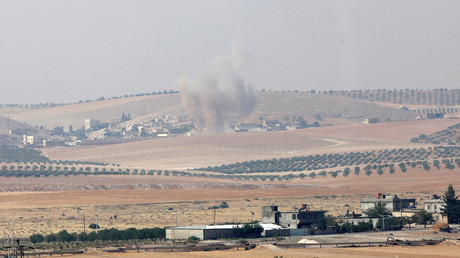
Smoke rises from the Syrian border town of Jarablus as it is pictured from the Turkish town of Karkamis, in the southeastern Gaziantep province, Turkey, August 24, 2016. © Stringer

At the moment, at least 20 Turkish tanks are taking part in operation inside Syria with more armored vehicles are expected to join the effort in the coming days as the Syrian rebels supported by Turkish forces are “cleansing” the city from jihadists.

The former IS stronghold of Manbij was freed by Kurdish-led SDF from jihadists just two weeks ago after months of intense fighting.

The Kurdish People’s Protection Units (YPG) are the armed wing of the Kurdish Democratic Union Party (PYD), close to the Kurdistan Workers’ Party, which Ankara considers a terrorist organization. Turkey has been leading a military campaign against PKK insurgency in the country’s south-eastern Kurdish-populated regions, which has been criticized by rights groups for its brutality. Numerous reports have also suggested that Ankara bombed Kurdish targets inside Syria while allegedly sparing Islamist militants that the YPG have been in bitter battle with.

No ISIS There – Are U.S. Troops In Hasakah “Advising” Kurds To Attack The Syrian Army?

August 20, 2016

No ISIS There – Are U.S. Troops In Hasakah “Advising” Kurds To Attack The Syrian Army?

August 19, 2016

Source: M of A – No ISIS There – Are U.S. Troops In Hasakah “Advising” Kurds To Attack The Syrian Army?

Yesterday a fight broke out between Syrian Arab Army troops and local Kurdish forces in the predominately Kurdish city of Hasakah in north-eastern Syria. Hasakah, with some 200,000 inhabitants, has held a SAA garrison for years. There is some enmity between the Kurds and the soldiers but the situation is generally peaceful.

There have been earlier fights but these were local rivalries between Syrian auxiliary National Defense Forces from local Arab (Christian) minorities and some gangs who form a Kurdish internal security force under the label Asayish. Such fights usually ended after a day or two when grown-ups on both sides resolved the conflict over this or that checkpoint or access route.

The Islamic State (grey on the map) once threatened Hasakah but that danger is now far away.


Map via ISW

Yesterday another fight broke out, but got serious. The Syrian air force was called in to defend against direct attacks on the SAA garrison and minority quarters:

Syrian government warplanes bombed Kurdish-held areas of the northeastern city of Hasaka on Thursday for the first time in the five-year-old civil war, the Syrian Kurdish YPG militia and a monitoring group said.

The Syrian government still has footholds in the cities of Qamishli and Hasaka, both in Hasaka governorate, co-existing largely peacefully with YPG-held swathes of territory.The cause of this week’s flare-up was unclear.

Xelil said government forces were bombarding Kurdish districts of Hasaka with artillery, and there were fierce clashes in the city.

The Syrian Observatory for Human Rights, which tracks the war using a network of activists, said warplanes had targeted Kurdish security forces’ positions in the northwest and northeast of the Hasaka city.

The reason that fighting started might have to do with U.S. troops who, for whatever reason, seem to be in Hasakah. The U.S. military now laments that these troops came under Syrian air force fire:

The Syrian airstrikes took place in the northeastern city of Hasaka, an area that has seen increasing ground clashes between the Kurdish YPG fighters present and the Syrian regime forces. There was a small number of U.S. Special Operators acting as advisers to the YPG when the Syrian airstrikes began.After the Syrian Su-24s began to strike, the U.S. immediately contacted the Russians, Davis said, and made clear that American aircraft would respond if coalition forces were under attack.

The Russians explained that they were not the ones conducting the strikes and the U.S. scrambled manned fighter aircraft to the area to protect the Americans and allies under attack.

By the time the U.S. and coalition aircraft arrived the Syrian attack jets had left.

There is no Islamic State in the area which is now far away from the front line.

  • Why are U.S. troops, who have zero legal grounds of being in Syria at all, in Hasakah city or the wider area?
  • Who are they “advising” there and for what purpose?
  • Why does rare local fighting starts to get serious just when U.S. troops are in the area?

The U.S. has the chutzpah to “warn” the Syrians of defending their own troops on Syrian grounds:

Additional U.S. combat air patrols have been sent to the area yesterday and have been flying there today, as well.Davis said that the Syrians would be “well-advised” not to interfere with coalition forces on the ground in the future.

Syrian government forces are attacked by Kurdish troops who are “advised” by U.S. special forces. According to the U.S. spokesperson the Syrian air force is not allowed to defend them? What has this to do with “fighting ISIS” in eastern Syria which is allegedly the sole reason for U.S. troops being in Syria?

The Syrian air force was back over Hasakah today and continued to bomb position from which the Syrian army was attacked. They would not be flying there without Russian consent. Does the U.S. military want to start a fight with the Syrian air force and its Russian backers?

The YPG Kurds claim they are now evacuating civilians from some city quarters. They seem to expect a prolonged conflict.

Any move against the Syrian army in Hasakah will be watched carefully from Ankara. Turkey fears, with valid reason, that the U.S. supports the Kurdish aim of a  national entity in Syria and Iraq. This would endanger Turkey with its own large Kurdish minority.

If the Kurds expel the Syrian forces from Hasakah with U.S. support, Turkey would know that any U.S. claim to not work against its Turkish ally interest is false. This would deepen already high Turkish animosity against the U.S. and would accelerate its move towards some alliance with Russia and Iran.

Julian Assange says “1,700 emails in Hillary Clinton’s collection” proves she sold weapons to ISIS in Syria [Video]

August 4, 2016

Julian Assange says “1,700 emails in Hillary Clinton’s collection” proves she sold weapons to ISIS in Syria [Video]

Alex Christoforou

3 days ago

Source: Julian Assange says “1,700 emails in Hillary Clinton’s collection” proves she sold weapons to ISIS in Syria [Video] – The Duran

Then Secretary of State Hillary Clinton knew that the US was sending arms from Libya to Syria in 2011, a year before the Benghazi attacks.

The Iran-Contra scandal almost brought down Reagan’s second term. Essentially Oliver North and other senior administration officials secretly facilitated the sale of arms to Iran, which was the subject of an arms embargo.

The Reagan administration officials hoped to secure the release of several U.S. hostages, and then take proceeds from the arms sales to Iran, to fund the Contras in Nicaragua.

Sounds familiar?

In Obama’s second term, Secretary of State Hillary Clinton authorized the shipment of American-made arms to Qatar, a country beholden to the Muslim Brotherhood, and friendly to the Libyan rebels, in an effort to topple the Libyan/Gaddafi government, and then ship those arms to Syria in order to fund Al Qaeda, and topple Assad in Syria.

Clinton took the lead role in organizing the so-called “Friends of Syria” (aka Al Qaeda/ISIS) to back the CIA-led insurgency for regime change in Syria.

Under oath Hillary Clinton denied she knew about the weapons shipments during public testimony in early 2013 after the Benghazi terrorist attack.

In an interview with Democracy Now, Wikileaks’ Julian Assange is now stating that 1,700 emails contained in the Clinton cache directly connect Hillary to Libya to Syria, and directly to Al Qaeda and ISIS.

Here is the transcript and the revelation by Assange…

JUAN GONZÁLEZ: Julian, I want to mention something else. In March, you launched a searchable archive for over 30,000 emails and email attachments sent to and from Hillary Clinton’s private email server while she was secretary of state. The 50,547 pages of documents span the time from June 2010 to August 2014; 7,500 of the documents were sent by Hillary Clinton herself. The emails were made available in the form of thousands of PDFs by the U.S. State Department as the result of a Freedom of Information Act request. Why did you do this, and what’s the importance, from your perspective, of being able to create a searchable base?

JULIAN ASSANGE: Well, WikiLeaks has become the rebel library of Alexandria. It is the single most significant collection of information that doesn’t exist elsewhere, in a searchable, accessible, citable form, about how modern institutions actually behave. And it’s gone on to set people free from prison, where documents have been used in their court cases; hold the CIA accountable for renditions programs; feed into election cycles, which have resulted in the termination of, in some case—or contributed to the termination of governments, in some cases, taken the heads of intelligence agencies, ministers of defense and so on. So, you know, our civilizations can only be as good as our knowledge of what our civilisation is. We can’t possibly hope to reform that which we do not understand.

So, those Hillary Clinton emails, they connect together with the cables that we have published of Hillary Clinton, creating a rich picture of how Hillary Clinton performs in office, but, more broadly, how the U.S. Department of State operates. So, for example, the disastrous, absolutely disastrous intervention in Libya, the destruction of the Gaddafi government, which led to the occupation of ISIS of large segments of that country, weapons flows going over to Syria, being pushed by Hillary Clinton, into jihadists within Syria, including ISIS, that’s there in those emails. There’s more than 1,700 emails in Hillary Clinton’s collection, that we have released, just about Libya alone.

Via: http://www.democracynow.org/2016/7/25/assange_why_i_created_wikileaks_searchable

Report: French Government Covered-Up Torture of Bataclan Victims to Avoid Offending Muslims

July 15, 2016

Report: French Government Covered-Up Torture of Bataclan Victims to Avoid Offending Muslims Victims allegedly had testicles cut off and shoved in their mouth

July 14, 2016

Source: Report: French Government Covered-Up Torture of Bataclan Victims to Avoid Offending Muslims » Alex Jones’ Infowars: There’s a war on for your mind!

Did the French government cover-up details about how victims of the Bataclan Theatre massacre were tortured and killed in order to avoid offending Muslims?

That’s the charge being made by French nationalist Boris Le Lay, whose website points to newly released documents from a parliamentary inquiry into the November 13 ISIS massacre in Paris that claimed the lives of 130 people.

The documents discuss reports of how some Bataclan victims had their testicles cut off and stuffed in their mouth, a common atrocity committed by jihadist militants across the Middle East.

Other victims were “gutted” or “decapitated” while others had their eyes gouged out as Islamists filmed the gruesome scenes.

A father of one of the victims claimed that the Institut médico-légal de Paris told him that his son had had his testicles cut off. When the father went to identify the body, he was only shown the left half of his son’s face, but subsequently noticed that the victim’s right eye had been removed.

François Molins, the public prosecutor for Paris, denies claims that any of the victims were tortured in such a manner, asserting that no bladed weapons were found at the scene.

However, people who escaped the Bataclan later told media outlets said they heard the screams of people being being tortured, with some claiming that ISIS jihadists sliced open the stomachs of their victims.

According to the website that highlighted the documents, the information about how the victims were tortured and killed was withheld from the public “to protect the image of Islam and Muslim masses, both in France and in Europe and beyond.”

If true, the issue wouldn’t be the only facet of the Bataclan attack that has prompted accusations of a cover-up.

As we previously reported, Eagles of Death Metal singer Jesse Hughes, who was playing at the Bataclan Theatre when it was targeted by ISIS jihadists, claimed that he saw Muslims celebrating in the streets after the Paris massacre.

Despite pressure to retract his comments Hughes also re-iterated his belief that security guards who were working at the Bataclan Theatre on the night of the attack were complicit in the massacre.

All the Horrible news, video,s and pictures from Nice

July 15, 2016

Dramatic moment ISIS fanatic was shot dead by police: French-Tunisian truck terrorist Mohamed Lahouaiej Bouhlel is gunned down after killing 84 including 10 children at Nice Bastille Day firework show

  • WARNING GRAPHIC CONTENT: Terrorist uses lorry to mow down crowds during Bastille Day celebrations in Nice
  • Local paper Nice Matin names suspect as Mohamed Lahouaiej Bouhlel, a French Tunisian man, 31, from Nice
  • Death toll currently stands at 84 and dozens more people were injured in terror attack on the French Riviera
  • At least 10 babies and children were killed, some in buggies, with least 54 children also being treated in hospital
  • Eyewitnesses said driver zig-zagged at 40mph to hit crowds of people who were sent flying or jammed under wheels
  • Terrorist then opened fire with a gun from cab of the lorry before being killed by a police marksman in shootout
  • President Francois Hollande extends state of emergency by three months and pledges to hit ISIS even harder

This is the moment the ISIS fanatic who killed 84 people including at least ten children was shot dead by police as he fired at them from the 25-tonne lorry he used as a murder weapon on his mile-long killing spree.

The killer, a 31-year-old French Tunisian named by local newspaper Nice Matin as Mohamed Lahouaiej Bouhlel, mounted pavements at high speed and ploughed through crowds celebrating Bastille Day in Nice last night.

One eyewitness filmed armed officers approaching the cab of the lorry and firing repeatedly through its windscreen and doors before it appears Bouhlet can be heard screaming after being hit by a police bullet.

The shootout came after his 30 minute rampage where he aimed at crowds watching firework and sent ‘bodies flying like bowling pins’ and left others ‘jammed’ under the lorry’s wheels at around 10.30pm local time last night.

Witness Nadar El Shafei told the BBC: ‘He died inside the vehicle – I saw his head getting out of the window I could see it clearly, they kept shooting him from all sides just to be sure. They were afraid that maybe he was not alone but he was alone, I never saw anyone beside him. They used a light to make sure no one else was inside the car then they asked us to run away in case there were others inside the car or a bomb.’

Heartbroken men and women refused to leave the bodies of their loved ones and the dead remain strewn across the famous Promenade des Anglais today.

At least ten of the victims were children, with young girls and boys lying dead covered in a blankets with their dolls and buggies still next to them. Footage taken at the time of the attack shows bodies piled up in the roads and people running from their lives as they tried to avoid the zig-zagging lorry while paramedics treated the injured and dying in the street.

The truck driver, who was known to police, was said to have shouted ‘Allahu Akbar’ – God is great in Arabic – before being killed in a clear suicide mission. Pro-ISIS groups have been celebrating the attack, orchestrated to coincide with France’s most important national holiday.

A huge cache of guns, grenades and ‘larger weapons’ and the terrorist’s identity papers were later found inside the lorry, which mounted the pavement at approximately 40mph and steered directly towards hundreds of people watching a fireworks display.

ISIS supporters have been celebrating the attack, orchestrated to coincide with France’s most important national holiday. The gunman was known to police for crimes of theft and violence, but not intelligence services, a police source said. A suspected accomplice is on the run.

France today declared three days of national mourning after the truck attack – its third major terror attack in 18 months – and President Francois Hollande said: ‘France is in tears, it is hurting but it is strong and she will be stronger – always stronger than the fanatics who wish to hurt us.’

For a lot more please follow this link.

 https://www.rt.com/news/351229-police-shoot-nice-truck/

‘Hamas constantly trying to destabilize Jerusalem’

July 12, 2016

‘Hamas constantly trying to destabilize Jerusalem’ In report to Knesset Committee, Shin Bet head Nadav Argaman surveys number from recent terror wave as well as state of Fatah, Hamas.

Shai Landesman, 12/07/16 16:41

Source: ‘Hamas constantly trying to destabilize Jerusalem’ – Defense/Security – News –

Shin Bet head Nadav Argaman appeared at a meeting of the Knesset Foreign Affairs and Defense Committee headed by MK Avi Dichter (Likud) today (Tuesday), and delivered a report about the wave of Palestinian terror that started last October.

Here are the main findings Argaman presented in the report:

Since the beginning of the current escalation on the 10th of October, 2015, over 300 significant terror attacks have been carried out or attempted (this excludes stone or Molotov cocktail throwing). Of these 180 were stabbing attacks, 90 were shooting attacks, and 30 involved running over with cars, (all rounded figures). Though October 2015 saw a dramatic increase in the scale of these attacks, this can be seen as a continuation of a more slow increase of attacks in Judea and Samaria starting in 2012.

The majority of the attacks were “lone wolf” attacks, with only a few perpetrated by the established terror organizations.

Security forces and the Shin Bet have thwarted some 240 attacks since October, and in the first five months of 2016 alone they’ve prevented 11 suicide attack attempts, 10 kidnapping attempts, and over 60 shooting attempts, most planned by Hamas, who are constantly acting to destabilize Judea and Samaria.

There is a decrease in attacks over the past few months versus October of 2015, when some 600 attacks were perpetrated, of which 81 were significant. In June of this year 103 were perpetrated, of which 9 were significant.

The decrease is attributed to the large number of thwarted attacks, improvements in intelligence, and deterrence focused in the immediate surroundings of the terrorists. All of these measures have produced a widespread feeling among the Palestinian population of Judea and Samaria that there is little to be gained by continuing to escalate hostilities, a feeling reflected in opinion polls conducted by Palestinian institutions.

Though the actual number of attacks is decreasing, the situation remains highly volatile, with the threat still very real (as evidenced by the number of thwarted attacks). Thus any significant event may cause a renewed breakout of hostilities.

It is also important to note that there is a general feeling in PA and Fatah circles that the Mahmoud Abbas-era is nearing its end (as he has announced his intentions to retire several times). There is therefore much jostling for position among Fatah leaders, as is usual in transition periods, and many of them are using belligerent language to bolster their status as strong leaders.

The report also dealt with the Gaza Strip; the quiet reigning there is deceptive, it said. The economic situation is worsening, ISIS is gaining power, and Hamas are rebuilding their strength.

Approximately 80 terror attacks were perpetrated from the Gaza Strip since operation Protective Edge, making this the most quiet period in a decade. Fringe Salafist groups are behind most of the attacks. The quiet is mainly due to Hamas’ feeling of lack of readiness for war, and the stability of Israeli policy in dealing with the Gaza Strip.

Hamas is in strategic crisis due to diplomatic isolation as a result of its feuds with the Sunni states led by Egypt, difficulties in its relationship with the Iranian led Shi’ite camp, and internal divisions between the military wing in Gaza and the political leadership outside. In practice this has led to greater control by the military wing.

Hamas is rebuilding its arsenal and operational capabilities in preparation for the next round of fighting, from which it plans to extract strategic gains such as the removal of the IDF blockade of the Gaza coast.

As to public opinion in Gaza, the Shin Bet has found that there is rising resentment toward Hamas for its inability to improve the economic situation. Yet it is unlikely that any overthrow will be attempted, due to widespread fear of Hamas reprisals, economic dependency, and general distaste for the alternative, namely ISIS.

ISIS Comes to Gaza

July 11, 2016

ISIS Comes to Gaza

by Khaled Abu Toameh

July 11, 2016 at 5:00 am

Source: ISIS Comes to Gaza

  • Recent reports leave no doubt as to cooperation between Hamas and ISIS groups in Sinai. These reports, the Egyptians and Palestinian Authority argue, provide further evidence that the Gaza Strip remains a major base for various jihadi terror groups that pose a real threat.
  • The report said that terrorists wanted by the Egyptian authorities were admitted to the Gaza Strip hospital in return for weapons given to Hamas by the Islamic State in the Sinai.
  • Mahmoud Abbas and the leaders of the Palestinian Authority (PA) can continue to talk all they want about a Palestinian state that would be established in the West Bank, Gaza Strip and east Jerusalem. But when ISIS-inspired groups are active in Gaza and there are no signs that the Hamas regime is weakening, it is rather difficult to imagine a Palestinian state.
  • The jihadi groups clearly seek to create an Islamic emirate combining the Gaza Strip and Sinai. Abbas might thank Israel for its presence in the West Bank — a presence that allows him and his government to be something other than infidel cannon fodder for the jihadis.

Hamas denies it up and down. Nonetheless, there are growing signs that the Islamist movement, which is based in the Gaza Strip, is continuing to cooperate with other jihadi terror groups that are affiliated with Islamic State (ISIS), especially those that have been operating in the Egyptian peninsula of Sinai in recent years.

This cooperation, according to Palestinian Authority security sources, is the main reason behind the ongoing tensions between the Egyptian authorities and Hamas. These tensions have prompted the Egyptians to keep the Rafah border crossing mostly closed since 2013, trapping tens of thousands of Palestinians inside the Gaza Strip.

In 2015, the Egyptians opened the Rafah terminal for a total of twenty-one days to allow humanitarian cases and those holding foreign nationalities to leave or enter the Gaza Strip.

This year so far, Rafah has been open for a total of twenty-eight days. Sources in the Gaza Strip say there are about 30,000 humanitarian cases that need to leave immediately. They include dozens of university students who haven’t been able to go back to their universities abroad and some 4,000 patients in need of urgent medical treatment.

Surprisingly, last week the Egyptians opened the Rafah terminal for five days in a row, allowing more than 4,500 Palestinians to leave and enter the Gaza Strip. The unusual gesture came on the eve of the Muslim feast of Eid al-Fitr. However, the terminal was closed again at the beginning of the feast on July 6.

The renewed closure of the Rafah terminal coincided with reports that efforts to end the tensions between Hamas and Egypt hit a snag. According to the reports, the Egyptian authorities decided to cancel a planned visit to Cairo by senior Hamas officials. The decision to cancel the visit, the reports said, came in the wake of the dissatisfaction of the Egyptians with the way Hamas has been handling security along the border between the Gaza Strip and Egypt. The closure of the border crossing came as a blow to Hamas’s efforts to patch up its differences with Egypt and pave the way for easing severe travel restrictions imposed by Cairo on the Palestinians in the Gaza Strip.

In recent weeks, Hamas announced that it had deployed hundreds of its border guards along the shared border with Egypt in order to prevent infiltration both ways, especially of jihadi terrorists who have been targeting Egyptian security personnel and civilians in Sinai. However, the Egyptian authorities remain extremely skeptical about Hamas’s measures.

Egyptian security officials are convinced that Hamas is not serious about preventing jihadi terrorists from crossing the border in either direction. Moreover, the Egyptians suspect that Hamas maintains close relations with some of the ISIS-affiliated groups in Sinai, and is providing them with weapons and medical treatment.

Egyptian President Abdel Fattah el-Sisi has refused to conduct high-level contacts with Hamas since he came to power in 2013. His regime views Hamas as a threat to Egypt’s national security. The few meetings that did take place between the two sides were restricted to security issues; that was why Sisi entrusted his General Intelligence officials to conduct the discussions with the leaders of the Islamist movement who visited Cairo in the past months.

Apparently, the Egyptian skepticism towards Hamas is not unjustified.

In recent weeks, reports have surfaced that leave no doubt as to cooperation between Hamas and ISIS groups in Sinai. These reports, the Egyptians and Palestinian Authority argue, provide further evidence that the Gaza Strip remains a major base for various jihadi terror groups that pose a real threat not only to Egypt’s national security, but also to Israel and the Palestinian Authority in the West Bank, as well as neighboring countries such as Jordan and Lebanon.

Reports have also emerged that some of the jihadi terrorists in Sinai have been receiving medical treatment in hospitals in the Gaza Strip, with the approval of Hamas. The terrorists, who are wanted by the Egyptian authorities, are believed to have entered the Gaza Strip through smuggling tunnels along the border with Egypt.

According to one report, one of the terrorist leaders from Sinai, Abu Sweilem, was documented lying in bed at the Abu Yusef al-Najjar Hospital in the city of Rafah, in the southern Gaza Strip. The report said that Abu Sweilem was hospitalized under the heavy guard of members of Hamas’s armed wing, Ezaddin al-Qassam. It said that he, and other terrorists wanted by the Egyptian authorities, were admitted to the Gaza Strip hospital in return for weapons given to Hamas by the Islamic State in Sinai, which is known as Wilayat Sina’.

Another report by the same source claimed that Mohamed Abu Shawish, a senior member of Ezaddin al-Qassam in the Gaza Strip, has been helping train and organize the jihadi terrorists in Sinai. Hamas claimed that the man had fled the Gaza Strip to join ISIS and was wanted by its armed wing for defection. The report, however, noted that Abu Shawish was moving freely between the Gaza Strip and Sinai and was even using Hamas vehicles to commute between the two areas. It added that Abu Shawish has even set up a vast network of relations along the Palestinian side of the border with Egypt to facilitate the smuggling of weapons and terrorists in both directions.

The report goes on to reveal that the top Hamas operative is in touch with Eyad al-Khaldi, the owner of a clothing factory in the Gaza Strip, who has been supplying him with military uniforms and other equipment for the terrorists in Sinai. The report cites this as evidence of the growing activities of the Sinai-based jihadi terrorists inside the Gaza Strip, which is taking place with the blessing of top Hamas officials.

Hamas has in the past indeed cracked down on ISIS-affiliated groups and individuals in the Gaza Strip. But this happens only when they seem to pose some kind of a threat or challenge to Hamas’s rule over the Gaza Strip.

This crackdown, however, has clearly not stopped Hamas members, especially those belonging to Ezaddin al-Qassam, from collaborating with other groups that are linked to ISIS and that are engaged in terror attacks against the Egyptians in Sinai. Isolated and desperate for cash in the Gaza Strip, Hamas seems prepared to cooperate with anyone in order to retain its control and survive.

Some Palestinians in the Gaza Strip argue that the double standard Hamas employs in dealing with the jihadi terrorists is the result of a split between its political and military wing. While the top political leaders of Hamas appear to be keen to distance themselves from the jihadi terrorists, the commanders of Ezaddin al-Qassam are acting independently and working with anyone who hands them weapons.

These Palestinians also point out that an increasing number of Ezaddin al-Qassam members have in recent years fled the Gaza Strip to join ISIS in Sinai, Syria and Iraq — a development that continues to worry the political leadership of Hamas. Those who have not been able to flee the Gaza Strip are joining other jihadi groups that are operating inside the Gaza Strip.

Reports indicate that an increasing number of Hamas gunmen have in recent years fled the Gaza Strip to join ISIS in Sinai, Syria and Iraq. Pictured above: An August 2014 image of terrorists from the Islamic State in Sinai (then known as Ansar Bayt al-Maqdis), preparing to behead four Egyptians they accused of spying for Israel.

Last month, further evidence of this trend was provided by the death of Khaled al-Tarabin, a former Hamas operative killed while fighting alongside ISIS in Syria. He is the seventh Hamas-affiliated Palestinian to be killed while fighting alongside ISIS in Iraq and Syria in recent months, according to sources in the Gaza Strip.

Regardless of the level of cooperation between Hamas and jihadi terrorists in Sinai, the Palestinians living in the Gaza Strip will pay the price. Reports about this cooperation simply entrench in the minds of the Egyptians the need to close the borders, humanitarian needs be damned.

As for the Palestinian Authority, all it can do for now is watch the Gaza Strip — which it is hoping will become part of a future Palestinian state — descend into hell.

Mahmoud Abbas and the leaders of the Palestinian Authority can continue to talk all they want about a Palestinian state that would be established in the West Bank, Gaza Strip and east Jerusalem. But when ISIS-inspired groups are active in the Gaza Strip and there are no signs that the Hamas regime is weakening, it is rather difficult to imagine a Palestinian state. Abbas has not been able to set foot in the Gaza Strip since 2007. Even his private residence in Gaza City is off-limits to him. But Hamas is just the beginning of the story for Abbas. The jihadi groups clearly seek to create an Islamic emirate combining the Gaza Strip and Sinai. The Palestinian Authority president might thank Israel for its presence in the West Bank — a presence that allows him and his government to be something other than infidel cannon fodder for the jihadis.

Khaled Abu Toameh is an award-winning journalist based in Jerusalem.
Boston police captain’s son indicted in ISIS-inspired plot

July 2, 2016

Boston police captain’s son indicted in ISIS-inspired plot

ByPamela Geller

on July 1, 2016

Source: Boston police captain’s son indicted in ISIS-inspired plot | Pamela Geller

The Muslim convert son of the Boston police chief is charged with plotting ISIS attacks:  “explosives filled with black powder, nails, ball bearings and glass, in places where large numbers of people congregate, like college cafeterias.”

Here is a Police Captain whose own son is ISIS. If he couldn’t see it in his own home, how can we expect him and his underlings to be effective against jihad in their cities?

 Boston is a hotbed of jihad terror-related activity. In each case the Muslim terrorists were tied to the notorious Islamic Society of Boston (ISB). What was Abu Al-Ameriki’s connection to ISB, and why hasn’t that mosque been shuttered? The Boston bombings and jihadists who plotted to behead policemen and me were tied to that mosque. What is being done about ISB?

How did this misunderstanding of Islam become so widespread? And why do so many converts understand it in exactly the same way? And while Muslims in the US condemn the Islamic State, where are they teaching against the ideology that gave rise to it?

Boston police captain’s son indicted in ISIS-inspired plot

By Associated Press, NY Post, July 1, 2016:
Modal Trigger Boston police captain’s son indicted in ISIS-inspired plot

BOSTON — A police captain’s son accused of plotting an attack on a college campus to support the Islamic State group was indicted Thursday on terrorism charges.

A federal grand jury indicted Alexander Ciccolo on one count each of attempting to provide material support to a foreign terrorist organization and attempting to use weapons of mass destruction. Those charges were added to a pending indictment charging Ciccolo with being a convicted person in possession of firearms and stabbing a nurse with a pen during a jail intake process.

Ciccolo was arrested last July in a plot to detonate homemade bombs similar to the pressure cooker bombs used in the deadly 2013 Boston Marathon attack. Twin bombs placed near the marathon finish line killed three people and injured more than 260 others.

Ciccolo’s lawyer, David Hoose, declined to comment on the new charges Thursday.

Boston police Capt. Robert Ciccolo alerted the FBI after his son, who’s 23, said he wanted to join the Islamic State group. Alexander Ciccolo was arrested after he received four guns he ordered from a person cooperating with authorities.

The indictment said that Ciccolo, who also used the name Ali Al Amriki, plotted to bomb an unidentified state university outside Massachusetts.

During a detention hearing after his arrest last year, prosecutors said he received four guns from a person cooperating with members of the Western Massachusetts Joint Terrorism Task Force.

Prosecutors say Ciccolo had spoken with the cooperating witness in recorded conversations about his plans to commit acts of terrorism inspired by the Islamic State, including setting off improvised pressure cookers filled with black powder, nails, ball bearings and glass in places where large crowds gather, such as college cafeterias. They also said Ciccolo was seen buying a pressure cooker similar to those used in the marathon bombings the day before his arrest.

Ciccolo has been held without bail since his arrest a year ago. He is scheduled to appear in US District Court in Springfield on July 7.

Two Glock pistols and two assault rifles purchased by Ciccolo

EXCLUSIVE – Islamic State Supporters Celebrate Deadly Istanbul Airport Attack

June 29, 2016

EXCLUSIVE – Islamic State Supporters Celebrate Deadly Istanbul Airport Attack

by Aaron Klein and Ali Waked

29 Jun 2016

Source: EXCLUSIVE – Islamic State Supporters Celebrate Deadly Istanbul Airport Attack – Breitbart

TEL AVIV – The Islamic State has not claimed official responsibility for Tuesday’s deadly Istanbul airport attack as if this writing, but users in an encrypted messaging forum for Islamic State fighters and supporters are praising the triple assaults and hoping IS was behind the carnage that left 41 people dead and wounded more than 239.

Breitbart Jerusalem has gained insider access to the encrypted Telegraph forum, which consists of known IS leaders, lower and mid-level IS fighters, IS supporters, and propagandists. Some members utilize their own names, while others use screen names. The forum serves as a Twitter of sorts for IS and its supporters.

Inside the forum, users explained with great conviction why they hope and believe the attack was IS “retaliation” against Turkey.

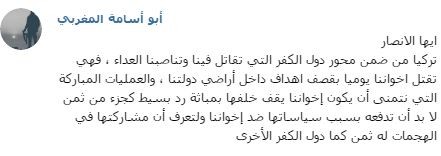
Abu Usama Almagrebi, a Moroccan jihadi, wrote: “Friends, Turkey has become a member of the axis of infidel countries fighting and showing hostility against us. They kill our brothers on a daily basis by launching airstrikes on our country, and the blessed bombings that we hope our brothers are responsible for is a natural reaction and only a small part of the price Turkey has to pay for its policy against our brothers.”

abu usama almagrebi

“She (Turkey) should know that she will pay for participating in the attacks against us just like any other infidel country,” he added.

Another IS activist, writing under the pseudonym “Attacking Barriers,” wrote: “Our friends and dearly beloved, the community of mujahedeen, for us an American Muslim is better than an Arab supporting the infidels. Don’t forget the teachings of Ibn Taimiyah [an Islamic cleric who serves as an inspiration to IS] who said: ‘If I side with the infidels kill me, even if I do it carrying the Quran…’ There are Muslims among the infidels.”

attacking barriors

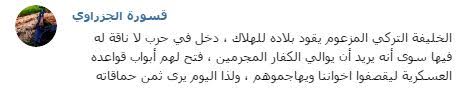
Kassura Aljazrawi wrote: “The Turkish ruler who pretends to be a caliph leads his country to oblivion. He joined a war that’s not his out of support for the infidels, opened the doors to his military bases for them to raid our brothers, and now realizes what price he has to pay for his stupidity.”

kassura aljazrawi (1)

Telegraph user “Tyrant Shaker” mentioned the normalization pact Turkey had signed with Israel just one day before Tuesday’s attack. “I think that the operation is a message from our State that if you think you sign a deal with the Jews to help your economy, it actually depends on our suicide bombers.”

tyrant maarid

“Ironclad Determination” wrote: “Erdogan entered the gates of the world of infidelity and therefore bears the brunt of our Islamic fighters. He started this war by attacking our brothers, and it’s time for him the pay the price. We pray to Allah that this attack was the work of our brothers, and with Allah’s help the mujahedeen will take control of Turkey just like the Prophet promised.”

iron determination

IS is being implicated in the attack in which three suspected suicide bombers opened fire and then detonated themselves in Istanbul’s main airport.

Aaron Klein is Breitbart’s Jerusalem bureau chief and senior investigative reporter. He is a New York Times bestselling author and hosts the popular weekend talk radio program, “Aaron Klein Investigative Radio.” Follow him on Twitter @AaronKleinShow. Follow him on Facebook.

Turkish airport blast caught on camera (GRAPHIC VIDEO)

June 29, 2016

Turkish airport blast caught on camera (GRAPHIC VIDEO)

Published time: 28 Jun, 2016 21:03

Source: Turkish airport blast caught on camera (GRAPHIC VIDEO) — RT News

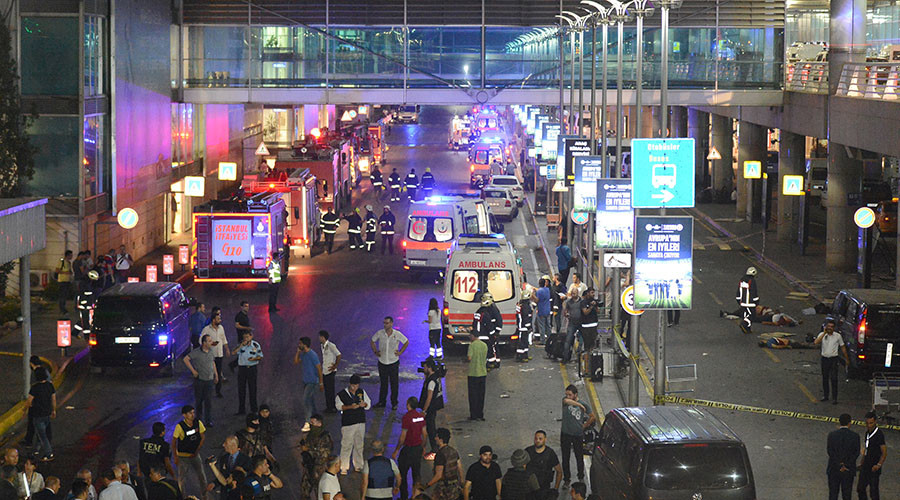
People walk outside Turkey’s largest airport, Istanbul Ataturk, Turkey, following a blast June 28, 2016. © Ismail Coskun / IHLAS News Agency / Reuters

CCTV footage showing one of the two deadly explosions that took the lives of at least 10 people at Istanbul’s Ataturk Airport has emerged online.

The video shows a bright flash in a crowded terminal, which is followed by a cloud of thick black smoke and panic among the passengers.

https://twitter.com/MahirZeynalov/status/747890126966112256?ref_src=twsrc%5Etfw


The blasts occurred late Tuesday in the airport’s International Arrivals Terminal.

The Turkish media claims that the explosions were terrorist attacks targeting two separate locations in the airport.

READ MORE: At least 2 blasts rock Istanbul’s Ataturk Airport, multiple injuries reported

Al least 10 people were killed and around 60 others injured in the blasts, according to reports.

From FOX