Posted tagged ‘Iranian proxies’

Guest Column: Washington Finally Designates Iran’s Revolutionary Guard Corps

February 4, 2017

Guest Column: Washington Finally Designates Iran’s Revolutionary Guard Corps, Investigative Project on Terrorism, Raymond Tanter and Edward Stafford, February 3, 2017

1962

The U.S. Treasury Department announced sanctions Friday on a host of Iranian companies and individuals as terrorists. It is a welcome development, which hopefully sends a signal to Tehran to rein in its global terror support, ballistic missile testing, and oppression of its people.

The action targets people and entities involved in procuring technology and/or materials to support Iran’s ballistic missile program, as well acting for or on behalf of, or providing support to, Iran’s Islamic Revolutionary Guard Corps (IRGC)-Qods Force.

The Iranian entities operate like a network out of Lebanon. It is the base of Hizballah (Party of God), an IRGC proxy, which was designated in 1997, but the IRGC was not designated.

Friday’s sanctions could help liberal democracy grow in Iran by showing Iranians that their leadership would face consequences for violating civil liberties at home and international relations norms abroad.

Per the Iranian Constitution (See Articles 107, 110), Iran is a theocratic dictatorship. Its parliament is under the sway of the Supreme Leader and other ayatollahs who select themselves. There is no such thing as a separation of powers by an independent authority.

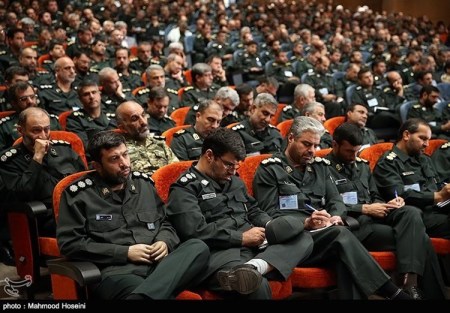
Iran’s military is subordinated to the IRGC, which also controls most of the economy. Electoral results that do not satisfy the leadership are ignored and protests of anti-democratic governmental action are ruthlessly and systematically suppressed.

In the aftermath of the 2009 presidential elections, the Greens and the National Council of Resistance of Iran (NCRI) led protests. There is evidence the NCRI continues to exist despite facing heavy persecution. But the Greens have faded away, with their leaders Mir Hossein Mousavi and Mehdi Karroubi under house arrest in Tehran, subject to the whims of Supreme Leader Ayatollah Khamenei.

It appears as if Iran’s leaders face few domestic consequences for their illiberal and anti-democratic rule; so, to paraphrase Burke, the fewer consequences from within, the more needed from without.

Candidates for Designation

A 2015 study by Israel’s Meir Amit of the Intelligence and Terrorism Information Center, Portrait of Qasem Soleimani, commander of the Iranian Islamic Revolutionary Guards Corps’ Qods Force, provides ample evidence of the IRGC’s role in fomenting global terrorism.

Starting in 2012, the IRGC recruited several thousand Shi’ite volunteer fighters from among Afghan refugees living in Iran. The IRGC also cultivated terrorist networks in the Golan Heights. These activities morphed into terrorism on Aug. 20, 2015, when local forces, including Hizballah operatives supported and supplied by the IRGC, fired four rockets at Israel from the Syrian-controlled Golan Heights. Two hit Israeli territory in the Upper Galilee and two fell in the Golan.

Last April, Hizballah with the backing of the IRGC, began building new military installations in Syria, according to a report from the Foundation for Defense of Democracies. These appear to be geared toward a future, conventional war with Israel, but they offered Hizballah a venue from which it can launch strikes against northern Israeli cities.

Deliberately targeting civilians is a textbook example of terrorism. During this same time, the IRGC helped Hizballah operate complex weapons rockets that increased Hizballah’s ability to target Israeli cities.

A study published last fall by Iranian specialist Alireza Jafarzadeh and his colleagues shows how Iran fuels the Syrian civil war by placing the IRGC on the ground and transporting some Afghan refugees living in Iran to fight in Syria. The IRGC combined its troops and those of surrogates on the ground in terrorist assaults on civilians in places like Aleppo, Syria. This combination of forces on land with Syrian airstrikes proved to be a toxic mix of terrorism: “Syria is our 35th province, and is a strategic province for us,” Mehdi Taeb, a former commander of IRGC intelligence said in 2013. Because Taeb retains influence in the IRGC, his statements were and are indicative of the depth of the IRGC commitment to Syrian regime capabilities to conduct terrorism against civilians:

“If the enemy attacks us and seeks to take Syria or Khuzestan [an Iranian province], our priority would be to keep Syria, because if we keep Syria, we can retake Khuzestan. But if we lose Syria, we cannot keep Tehran.”

These three studies show the IRGC meets the legal criteria for an FTO designation. They are: 1) It must be a foreign organization; 2) engage in terrorist activity or terrorism, or retain the capability and intent to engage in terrorist activity or terrorism; and 3) the organization’s terrorist activity or terrorism must threaten the security of U.S. nationals or the national security (national defense, foreign relations, or the economic interests) of the United States).

To designate an organization or individual, there must be evidence they threaten the United States’ national security, foreign policy, or economy. The studies cited show that the IRGC is a threat to U.S. national security interests.

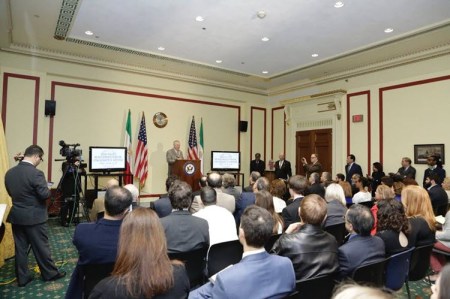
As evidence of congressional interest in designation, on Friday, MSNBC reported a bipartisan letter to President Trump in favor of sanctions against the IRGC. In addition,The Iranian Revolutionary Guard Corps (IRGC) Terrorist Designation Act” was introduced in the House and Senate in January. These identical bills emphasize that the IRGC meets the criteria for designation as a foreign terrorist organization under U.S. law.

“If a foreign organization looks like a terror group, operates like a terror group, and supports terrorism, then it should be called for what it is–a foreign terrorist organization,” said House co-sponsor Michael McCaul, R-Texas. “As obvious as that seems, for years the IRGC has been allowed to operate clandestinely using front companies and illicit networks to evade formal designation.”

Fellow Texas Republican and Senate co-sponsor Ted Cruz added that, by designating IRGC as a foreign terror organization, the U.S. would be “signaling to financial institutions and companies who facilitate or conduct business with the IRGC that they may be held liable.”

The Way Forward

Regarding the executive branch, President Trump made excellent choices for his national security team—Secretary of State Rex Tillerson; Defense Secretary James Mattis; National Security Adviser, Mike Flynn; Homeland Security Secretary, John Kelly; Director of National Intelligence, Dan Coats; and Director of Central Intelligence, Mike Pompeo.

These talented officials need not sing from the same songbook, that is, they need not agree. But it is important that their views be taken into account in the interagency process. That said, consider two major benefits of designation their consultation might produce.

First, tagging the IRGC would give succor to democratic forces within Iran by imposing costs on anti-democratic ones, including those who lead the IRGC. The IRGC leader Qasem Soleimani, who goes virtually unchallenged, would be weakened. A weaker Soleimani could give rise to splits within the regime and place Iran on its back foot. Now, Tehran can spend money abroad on Afghan fighters, Hizballah in Lebanon and Syria, Hamas in Gaza, and ignore unmet economic needs of the population.

Second, designating the IRGC sends a strong signal to the Arab Gulf States, led by Saudi Arabia: Washington is serious about regime change in Tehran. Prince Turki al Faisal, former Saudi intelligence chief, spoke to a group of Iranian dissidents in Paris in July 2016. Although he was not then in the government, Prince Turki remains an influential player in Riyadh.

A crowd of over 100,000 Iranian oppositionists chanted in Farsi that they wanted regime change in Iran. Prince Turki spoke to the dissidents in Arabic, saying he also wanted to see regime change in Tehran. This remark brought the house down.

In a subsequent brief conversation with Tanter, Turki said that designating the IRGC would be a good start toward unraveling of the Iranian regime.

The bottom line is that designation could help bring liberal democracy to Iran by weakening the grip of its key repressive institution—the Islamic Revolutionary Guard Corps and its proxies like Hizballah.
Russia freezes Syrian, Iranian military movements

January 31, 2017

Russia freezes Syrian, Iranian military movements, DEBKAfile, January 31, 2017

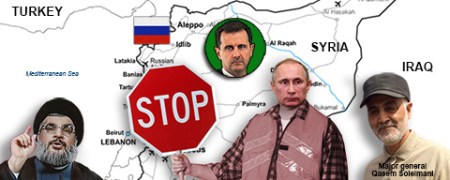
putinstopsyriaeng480

The ban came from Moscow to prevent military reprisals against the Putin-Trump deal for Syria.

Iran can no longer doubt that the two powers, America and Russia, have ganged up to push the Islamic Republic out of their way. Trepidation in Tehran was articulated on Monday, Jan. 30, at a convention staged in the Iranian capital to celebrate 515 years of Iranian-Russian relations, an anniversary that would not normally be marked by a special event.

****************************

An order to remain stationary was issued Thursday night, Jan. 26, by the Russian Commander in Syria Lt. Gen. Alexander Zhuravlev to the high commands of the Syrian army and of the Iranian and Shiite forces positioned in Aleppo, as well as Hizballah units in all parts of Syria. Gen. Zhuravlev, acting on instructions from Moscow, prohibited any movement by those forces out of their current positions as of noon local time.

DEBKAfile’s military and intelligence sources report that the order banned the opening of new battlefronts anywhere in Syria and the movement of Syrian air force units between bases.

This order has been obeyed to date.

The ban came from Moscow to prevent military reprisals against the Putin-Trump deal for Syria. There was no mention of penalties for disobedience, but the tone was peremptory. The three army commanders did not need reminding that the Russians are capable of using their electronic warfare systems to disrupt unauthorized military movements, jam their communications, and withhold fuel, ammo and spare parts to create havoc in their armies.

lieutenant_general_alexander_zhuravlev_120Russian Lt. Gen. General Alexander Zhuravlev

Moscow has never resorted to extreme action of this kind in previous Russian military interventions in Middle East lands.

The decision was taken shortly after the Kremlin was notified that US President Donald Trump had agreed to join forces with President Vladimir Putin in Syria.

Since then, the Trump administration has kept all dealings with Moscow over Syria under a cloak of secrecy, including the outcome of President Trump’s first phone conversation with his Russian counterpart Vladimir Putin. All other concerned parties, such as Israel, have been left groping in the dark about what happens next.

The Russian standstill order in Syria came shortly before the US presidential decree that barred Iranians from entering the United States (along with the nationals of six other terror-prone Muslim countries)

Iran can no longer doubt that the two powers, America and Russia, have ganged up to push the Islamic Republic out of their way. Trepidation in Tehran was articulated on Monday, Jan. 30, at a convention staged in the Iranian capital to celebrate 515 years of Iranian-Russian relations, an anniversary that would not normally be marked by a special event.

In his opening remarks, Foreign Minster Mohammed Zarif Javad said: that Iran and Russia “need to have far more extensive relations,” and “few countries in the world have relations as deep and historical as Iran and Russia.” This sounded like an appeal to Moscow for protection against the new US president. It most likely fell on deaf ears. Putin is fully engaged in promoting his new relations with Donald Trump.

US Lawmakers Promise Iranian Opposition that there will be Tougher Laws on Iran

January 28, 2017

US Lawmakers Promise Iranian Opposition that there will be Tougher Laws on Iran, Iran News Update, January 28, 2017

unnamed-2

A bipartisan group of US lawmakers have promised the Iranian Opposition that they will press for tougher sanctions on the Iranian Regime. The House members made this pledge to the Organization of Iranian-American Communities (OIAC) on Tuesday. 

The OIAC is allied with the Iranian dissident group Mujahedin-e-Khalq (MEK)  and advocates for a “democratic, secular and non-nuclear government”, and overthrowing the  “religious dictatorship” in Iran.

Republican Congresswoman Ileana Ros-Lehtinen called for an expansion of the sanctions against Iran’s Islamic Revolutionary Guard Corps (IRGC), which were not removed during the nuclear deal.

She said: “It is time that we put the tools that we have created to use, broadening our sanctions so that they include IRGC-controlled businesses and subsidiaries. We must target the (Iranian) regime at every turn, not only enforcing the sanctions that have been too long neglected, but expanding their scope whenever and wherever possible.”

The lawmakers also want to stop IRGC-affiliated companies from buying US-made passenger planes, which would likely be used to ship weapons, troops and even money to terrorist cells.

Democratic Congressman Brad Sherman co-sponsored a bill to require the Trump administration to report any signs of Iran using US-made aircraft for “illicit military or other activities” which would violate the terms of the 2015 nuclear deal.

He said: “We need an ironclad system that makes sure (any newly-acquired planes with American technology) are not used for military or terrorist purposes (by Iran).”

During his campaign, Trump promised to renegotiate the Iranian Nuclear Deal- unlike his Republican opponents, Ted Cruz and Marco Rubio, who promised to “rip up” the deal, on their first day in office- but has not made steps towards it yet.

Sherman also wanted to prevent US banks from loaning Iran any money to pay for new planes.

Republican Congressman Dana Rohrabacher called for increased political pressure against the Iranian despots, especially to protect the human rights of the people living there.

He said: “One strategy is to help pro-democracy movements who would replace the mullahs. I’m willing to help the Azeris, Baluch and Kurds, who are not part of the Persian majority, to create a situation where you have autonomous regions similar to the states of the United States so that those people’s rights will feel secure as well.”

Democratic Congressman Eliot Engel explained that he wanted to help the Iranian dissidents who were previously exiled to Camp Liberty in Iraq, but have since been safely relocated to Albania.

He noted that they still have not received the money from the sale of their property in Iraq; an estimated $50 million left at Camp Liberty and $500 million at Camp Ashraf. This money is needed to help them make a new life, without handouts.

He said: “As all of their expenses in Albania are paid by MEK, they need their money to be returned as soon as possible. So, I urge Iraq, which the United States has helped for so many years, to honour its commitment to return the money to MEK.”

The Islamic Revolutionary Guard Corps (IRGC) Has Become More Influential and Powerful

January 25, 2017

The Islamic Revolutionary Guard Corps (IRGC) Has Become More Influential and Powerful, Iran News Update, January 24, 2017

(Please see also, What Is Iran’s Policy-Making Mechanism? — DM)

10611

The IRGC has successfully suppressed domestic opposition. Examples  include supporters and leaders of the Green Movement, and religious and ethnic minorities such as Kurds, Sunnis and Arabs. As well, other political factions, such as the moderates, have come to the conclusion that they need the blessing of the IRGC in order to survive politically.

The reintegration of Tehran into the global financial system is deepening, and more countries are committing themselves to trade with Iran and investment in its markets.The IRGC and the office of the supreme leader are the main beneficiaries of the increased revenues, which have been diverted into upgrading the IRGC’s military capabilities.  Iran’s lawmakers voted to increase the military budget despite the high unemployment rate.

Regional stability was an obstacle for the IRGC’s objective of expanding its influence beyond Iran’s borders. Rafizadeh writes, “In fact, it was through domestic conflicts that the IRGC expanded its stranglehold by penetrating other countries such as Lebanon and Iraq, and gave birth to several critical Shia proxies. In the long term, these proxies increase Iran’s political and ideological influence.”  He adds, “The more tensions and conflicts there are, the more the militaristic role of the IRGC increases in the region in order to achieve its regional ambitions. This has led to a vicious series of heightened conflicts.”

Once the child that Iran’s Islamic revolution gave birth to, the IRGC is now becoming the father of the Islamic republic. This can only be reversed if global powers or a coalition of regional nations stand against the IRGC’s increasing influence in the region.

*************************************

Majid Rafizadeh, Iran¬ian-American political scientist, Harvard University scholar and president of the International American Council, writes in an article for The National on January 23, 2017 about the Islamic Revolutionary Guard Corps, who were given birth to during Iran’s 1979 revolution.

Ayatollah Ali Khamenei, after becoming the country’s second supreme leader in 1989, gave considerable power to the IRGC, while sidelining other powerful clerics.

Although the IRGC still had obstacles preventing it from expanding its influence, recent developments suggest that those barriers are being lifted, allowing Iran’s military to be the key decision-maker in Iran’s policy-making.

Many people, who once had considerable amount of political weight and influence, which counterbalanced the IRGC’s increasing power, do not play a crucial role any more. The late Ali Akbar Rafsanjani, who was one of the founding fathers of the Islamic republic was sidelined by Khamenei towards the end of his life, still enjoyed a considerable amount of political legitimacy in creating challenges for the IRGC and others. However, Rafsanjani died this month.

Rafsanjani had significant power as a member of the Assembly of Experts, which is given the power to supervise, elect or remove the supreme leader. After his death, the IRGC is now much stronger, suggesting that the next supreme leader will be under the IRGC’s influence. If the IRGC controls the next supreme leader, it rules Iran’s political establishment unequivocally.

While the nuclear agreement remains in place, the Iranian government’s global legitimacy expands, leading to less scrutiny from the international community on how the IRGC treats domestic opposition.

The IRGC has successfully suppressed domestic opposition. Examples  include supporters and leaders of the Green Movement, and religious and ethnic minorities such as Kurds, Sunnis and Arabs. As well, other political factions, such as the moderates, have come to the conclusion that they need the blessing of the IRGC in order to survive politically.

The reintegration of Tehran into the global financial system is deepening, and more countries are committing themselves to trade with Iran and investment in its markets.The IRGC and the office of the supreme leader are the main beneficiaries of the increased revenues, which have been diverted into upgrading the IRGC’s military capabilities.  Iran’s lawmakers voted to increase the military budget despite the high unemployment rate.

Reuters reported, “Iranian lawmakers approved plans to expand military spending to 5 per cent of the budget, including developing the country’s long-range missile programme which US president-elect Donald Trump has pledged to halt. The vote is a boost to Iran’s military establishment – the regular army, the elite IRGC and the defence ministry.”

Regional stability was an obstacle for the IRGC’s objective of expanding its influence beyond Iran’s borders. Rafizadeh writes, “In fact, it was through domestic conflicts that the IRGC expanded its stranglehold by penetrating other countries such as Lebanon and Iraq, and gave birth to several critical Shia proxies. In the long term, these proxies increase Iran’s political and ideological influence.”  He adds, “The more tensions and conflicts there are, the more the militaristic role of the IRGC increases in the region in order to achieve its regional ambitions. This has led to a vicious series of heightened conflicts.”

The IRGC, more than ever before, is capable of exploiting the rise of Sunni extremist groups such as the ISIL, not only to justify its military presence in the region, but also to increase its global legitimacy by arguing that it is fighting extremism. Without a specific agenda for fighting ISIL, western powers have allowed a certain amount of leeway to the IRGC.  Additionally, some global and regional powers have been reluctant to address counterbalancing the increasing role of the IRGC across the region for economic or geopolitical reasons.

Although founded as a theocracy, Iran is becoming more of a military state as the IRGC pursues its regional ambitions. According to Rafizadeh, “We are more likely to witness the increasing influence and domination of the IRGC domestically and regionally as several major obstacles against Iran’s military have been lifted.”

Once the child that Iran’s Islamic revolution gave birth to, the IRGC is now becoming the father of the Islamic republic. This can only be reversed if global powers or a coalition of regional nations stand against the IRGC’s increasing influence in the region.

Astana floored by Russian pick as Assad successor

January 23, 2017

Astana floored by Russian pick as Assad successor, DEBKAfile, January 23, 2017

(The rift between Russia and Iran deepens. — DM)

2-2

Gen. Tlass, 53, son of the eminent Gen. Mustafa Tlass, defense minister under President Hafez Assad, was awarded high honors by his son Bashar as one of his closest friends. Although appointed commander of the prestigious 104thBrigade in the Syrian Republican Guard, Manas chose to defect and flee the country in 2012, not long after the outbreak of the Syrian uprising.

Iran threatens to be one of the main obstacles to any reduction in Assad’s powers. For Tehran, he stands as a bulwark against the expulsion of its own and Hizballah forces from the country. As long as he is in charge, Iran will have the use of a land bridge to Lebanon and its proxy, Hizballah, via Iraq and Syria.

**************

Syrian government and rebel groups launch a fresh peace conference in the Kazakh capital of Astana Monday, Jan.23 in freezing temperatures of minus 20 Centigrade. Although the event is jointly sponsored by Russia, Turkey and Iran, Moscow is the real power-broker.

DEBKAfile’s intelligence sources reveal that the delegations on both sides of the table were caught off-balance by the arrival of Bashar Assad’s former close friend, Gen. Manas Tlass, whom Russia flew in from his place of exile in a Gulf emirate to a prominent seat with the opposition delegation.

Gen. Tlass, 53, son of the eminent Gen. Mustafa Tlass, defense minister under President Hafez Assad, was awarded high honors by his son Bashar as one of his closest friends. Although appointed commander of the prestigious 104th Brigade in the Syrian Republican Guard, Manas chose to defect and flee the country in 2012, not long after the outbreak of the Syrian uprising.

Our sources report that Moscow has chosen him as lead player in Syria’s post-Assad era, initially in the transition government in Damascus which is scheduled to start evolving from the peace process kicked off at Astana this week. This does not imply that Bashar Assad will be gone in a day – only that a new mechanism will be put in place to start curtailing his powers.

How quickly and how far this process will unfold cannot yet be determined.

Iran threatens to be one of the main obstacles to any reduction in Assad’s powers. For Tehran, he stands as a bulwark against the expulsion of its own and Hizballah forces from the country. As long as he is in charge, Iran will have the use of a land bridge to Lebanon and its proxy, Hizballah, via Iraq and Syria.

At the same time, Russia, Turkey and the Syrian rebel groups backed by Turkey and Saudi Arabia are demanding the removal from Syrian soil of Iranian forces and pro-Iranian Afghan and Pakistani Shiite militias (30,000 fighters in all)  as well as the 10,000 Hizballah combatants.

Neither Hizballah, nor the Shiite militias are represented at the Astana conference which leaves them deliberately at a disadvantage.

But Iran is preparing to make its removal from Syria as difficult as possible. One way is to start dominating Syria’s strategic infrastructure. And so, on Jan. 18. Syrian Prime Minister Emad Khamis, who was on a visit to Tehran, signed five accords granting Iran exclusive rights as the sole operator and developer of Syria’s country’s cell phone network.

And, according to our intelligence sources, a number of secret provisions were buried in those deals. One gave Iran permission to interlink the cell phone networks between Syria and Hizballah in Lebanon as a device to guarantee the Lebanese terror group’s permanent presence in Syria.

Deliberations at the Astana conference will focus at its first sessions Monday on stabilizing the ceasefire between government and Syrian rebel groups (excluding the jihadist ISIS and Nusra Front). This ceasefire has for the most part held up since it went into effect late last month.

The effort to turn the truce into a more permanent cessation of hostilities will be long and arduous, entailing negotiations on such tough issues as land swaps and rights to use main traffic and supply routes.  Only when they are resolved, can the two sides approach the next stage, a discussion of Syria’s political future, i.e. the fate of the regime headed by Bashar Assad.

Although Moscow invited the new Trump administration to send a representative to the Kazakh conference, it was declined. Washington only sent the US ambassador to Kazakhstan to attend as an observer.

This does not mean that President Donald Trump has decided to leave the resolution of the Syrian issue solely in Russian hands. Washington and Moscow are still in the middle of discussing this and other critical questions and no final decisions have been reached in either capital.

After Trump Inauguration, Netanyahu Wastes No Time Putting Iran Back on Agenda

January 21, 2017

After Trump Inauguration, Netanyahu Wastes No Time Putting Iran Back on Agenda, Jerusalem PostHerb Keinon, January 21, 2017

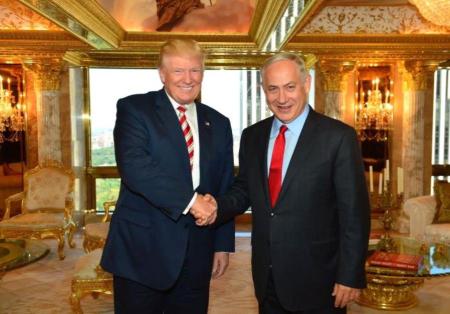
bibiandtrumpDonald Trump and Benjamin Netanyahu meet at the Trump tower. (photo credit:KOBI GIDON / GPO)

“This ruthless regime continues to deny you your freedom,” Netanyahu said in the English video, accompanied by Farsi subtitles.  “It prevents thousands of candidates from competing in elections, it steals money from your poor to fund a mass murderer like [Syrian President Bashar] Assad. By calling daily for Israel’s destruction, the regime hopes to instill hostility between us. This is wrong. We are your friend, not your enemy.”

***************************

Just 24 hours after US President Donald Trump spoke in his inaugural address about the need to eradicate radical Islamic terrorism, Prime Minister Benjamin Netanyahu put a brief video clip on social media aimed at placing the Iranian threat squarely back on the international agenda.

“I plan to speak soon with President Trump about how to counter the threat of the Iranian regime, which calls for Israel’s destruction,” Netanyahu said in the two-and-a-half minute video addressed directly to the Iranian people.

“This ruthless regime continues to deny you your freedom,” Netanyahu said in the English video, accompanied by Farsi subtitles.  “It prevents thousands of candidates from competing in elections, it steals money from your poor to fund a mass murderer like [Syrian President Bashar] Assad. By calling daily for Israel’s destruction, the regime hopes to instill hostility between us. This is wrong. We are your friend, not your enemy.”

This was the first video of this sort Netanyahu has put out in months, after putting out several in the spring and summer that addressed issues such as Palestinian incitement and the settlements. It is also the first time in a while that he has exclusively addressed the Iranian issue, other than in a  couple of sentences in public appearances here and there.

The release of the video now, just 24-hours after Trump took over from Barack Obama, is an obvious effort to get the world’s leaders – first and foremost Trump – to one again focus on the Iranian regime.

Trump has come out squarely against the Iranian nuclear deal.  The sense among sources close to Netanyahu is that when dealing with the new administration, Netanyahu will not only have a more receptive ear regarding the dangers that the Iranians pose, but also find an administration more willing to shine the light on Iran’s part in the spread of radical Islamic terrorism, and more vigilant in ensuring that Tehran lives up to its commitments under the nuclear deal.

“We’ve always distinguished between the Iranian people and the Iranian regime,” Netanyahu said in the video.

“The regime is cruel, the people are not; the regime is aggressive, the people are warm. I yearn for the day when Israelis and Iranians can once against visit each other freely – in Tehran and Isfahan, in Jerusalem and Tel Aviv,” he said. “The fanatics must not win, their cruelty must not conquer our compassion. Our two peoples can work together for a more peaceful and hopeful future for both of us. We must defeat terror and tyranny, and we must ensure that freedom and friendship win the day.”

Netanyahu referenced the Iranian student protests of 2009, which some say was a golden opportunity for change in Iran which was squandered by a lack of unequivocal moral and material support by Obama in the early days of his presidency.

“I will never forget the images of brave young students , hungry for change, gunned down in the streets of Tehran in 2009,” Netanyahu said. “And I will never forget beautiful Neda Soltan – gasping for her last breath on that sidewalk.”

This was a reference to Iranian student Neda Agha-Soltan, whose shooting-death during the protests was caught on video and went viral.

“You have a proud history, you have a rich culture,” Netanyahu said. “Tragically, you are shackled by a technocratic tyranny. In a free Iran you will once again be able to flourish without limit , but today a cruel regime is trying to keep you down.”

While Netanyahu said he will speak to Trump about Iran soon, no announcement has yet been made about when their first meeting will be held, though there have been recent reports it could be as early as the first week in February. Government officials said that the issue will be determined in the coming days.

Netanyahu congratulated Trump on his inauguration in a tweet Friday afternoon: “Congratulations to my friend President Trump,” he wrote. “I look forward to working closely with you to make the alliance between Israel and America stronger than ever. Shabbat Shalom.”

Iran threatens the Syria ceasefire effort

January 17, 2017

Iran threatens the Syria ceasefire effort, American ThinkerHeshmat Alavi, January 17, 2017

(Please see also, Mystery blasts in Damascus: Syria accuses Israel. “DEBKAfile’s military and intelligence sources disclose that the regime has reached an awkward crossroads. The Russians have taken charge of the Syrian war and no longer bother to consult with the Syrian president or Iran on its conduct. They are deeply immersed in preparing the Syrian peace conference they are sponsoring which is scheduled to open at Astana, Kazakhstan on Jan. 23.” — DM)

Following nearly six years of bloody warfare and an atrocious takeover of Aleppo by the Russia-Iran-Assad axis, the world has finally reached a relatively reliable settlement in this war-ravaged country. Unfortunately, Iran continues to pose a serious threat to this yet shaky and fledgling settlement.

Russia, replacing the United States, has become the main counterparty involved in the ceasefire talks with the Syrian opposition and its ally, Turkey.

Considering the lame-duck season between November 8th and January 20th before the new U.S. president-elect takes the helm at the White House, these efforts to establish a lasting ceasefire — and hopefully tangible peace — in Syria need to be respected by the international community. This is especially true since the Syrian opposition have blessed this campaign, directly engaging Russia and Turkey.

The new Russia-Turkey relationship has also led to actions against Daesh (ISIS/ISIL) targets in Syria.

“Turkish warplanes and artillery have struck Daesh targets in Syria, killing 22 of the group’s terrorists, while Russian aircraft hit terrorists near the Daesh-controlled town of al-Bab,” reports indicate citing Turkish military officials.

In addition to Turkey, the Syrian opposition also enjoys the support of a majority of its neighbors and Middle East countries, all believing Assad’s departure is key to reach a true political solution for this crisis that has taken the lives of nearly half a million and displaced over 11 million Syrians inside the country and abroad.

The dilemma, however, lies in the fact that Iran and its slate of proxy groups are erecting barriers in the path of establishing true ceasefire and peace conditions. Tehran is in full-speed mode to disrupt the entire process, as the mullahs in Iran seek nothing but the Syrian opposition’s all-out annihilation and to completely repaint the country’s social fabric in favor of Assad, ultimately maintaining his regime in power.

The Lebanese Hizb’allah, perhaps the main Iran-backed proxy entity, is feeling the heat following the latest developments in relation to Syria. Hizb’allah desperately relies on a land route from Iran to northern Lebanon to maintain the ongoing flow of support from Tehran.

“Sources in Lebanon told the London-based pan-Arab daily Al-Arab that Hezbollah has rejected the Russia-Turkey-mediated ceasefire agreement for the Syrian civil war,” algemeiner reported.

The Lebanese Hizb’allah, known to be fighting in Syria on behalf of Assad as its army has dwindled during the years, is furious over the fact that Ankara has demanded all foreign fighters depart Syria even prior to any discussion of a possible diplomatic solution.

To add insult to injury for Hizb’allah, and Tehran for that matter, is the fact that Moscow has discussed Ankara’s demands with the mullahs, meaning that the Kremlin supports the measure and is seeking an all-out diplomatic solution. This is completely against Iran’s domination and destructive policy to derail the peace process.

Such a turn of events would be the final nail in the coffin for Iran as it continues to rely on foreign recruits and the Hizb’allah to provide the ground forces necessary in Syria.

This is especially significant considering the fact that dissent inside Iran regarding the regime’s participation in the war in Syria is growing.

“On December 16th, 2016, the fans of Foolad Khuzestan B F.C chanted slogans against the dictator Assad in support of Syrians and the people of Aleppo during the football match,” opposition National Council of Resistance of Iran (NCRI) website reported.

The NCRI is a conglomerate of Iranian opposition organizations, including the People’s Mojahedin Organization of Iran (PMOI/MEK), advocating democratic regime change.

Videos posted on the internet show demonstrations inside Iran demanding the regime stop meddling in Syria and plunging billions to shore up the faltering Bashar Assad regime, and actually think of the Iranian people’s needs and demands.

Iranian Supreme Leader Ali Khamenei has comissioned the Revolutionary Guards to pursue his lethal policy in Syria, resulting in horrific death and destruction across the Levant.

As long as the IRGC and its proxy militias, including the Hizb’allah, remain on Syrian soil, this country will never witness peace and tranquility. The IRGC is a major threat to any campaign to bring an end to the mayhem devastating this land.

The IRGC deserves to be designated as a terrorist organization, being Iran’s main leverage to export terrorism abroad.

It is also high time for the international community to call for the very eviction of Iran, the IRGC and all of Tehran’s proxy elements from Syria.


Iran Steps Up Threats to Israel, U.S.

January 11, 2017

Iran Steps Up Threats to Israel, U.S., Gatestone InstituteMajid Rafizadeh, January 11, 2017

(This can’t be accurate. Obama has told us that Islam is the religion of peace and tolerance. Isn’t it odd that he has not told us that the Islamic Republic has “nothing to do with Islam?” — DM)

“En Sha’a Allah [God willing], there will be no such thing as a Zionist regime in 25 years. Until then, struggling, heroic and jihadi morale will leave no moment of serenity for Zionists.” — Iran’s Supreme Leader, Ayatollah Ali Khamenei, September, 2015.

“If the Supreme Leader’s orders [are] to be executed, with the abilities and the equipment at our disposal, we will raze the Zionist regime in less than eight minutes.” — Ahmad Karimpour, a senior adviser to the Iranian Revolutionary Guards’ elite unit, the Quds Force.

Iran is also attempting to intimidate Donald Trump from taking a tough stance against Iran. Trump ought to be wary of falling into Iran’s tactical game of fear-mongering. For Iran, US concessions and silence in the face of Iran’s threats mean weakness and fear. On the other hand, when Iran sees that the US is taking a robust stance and that the military option is always on the table, Tehran retreats.

As long as Iran’s Supreme Leader is alive and as long as the ruling clerics preserve the political establishment, Iran will maintain the core pillars of its foreign policies and revolutionary principles: these are anchored in anti-Israeli, anti-American and anti-Semitic politics. Iranian politicians across the political spectrum totally agree on these fundamentals.

Iran’s threats against Israel and the US are becoming bolder and louder. Iran’s Supreme Leader, Ayatollah Ali Khamenei, is now repeatedly threatening Israel’s annihilation relatively soon.

According to Iran’s Press TV, Khamenei recently stated:

“The Zionist regime — as we have already said — will cease to exist in the next 25 years if there is a collective and united struggle by the Palestinians and the Muslims against the Zionists.”

In addition, Iranian officials are warning President-elect Donald Trump that if he makes any wrong move, it would lead to a World War, wiping Israel from the face of earth and destroying the smaller Gulf states.

Iranian leaders are adopting their classic tactics and strategy of threatening in advance — and frequently — probably to obtain concessions, push the next US administration to pursue policies of appeasement, and, more importantly, to drive the US to abandon Israel.

In addition, through anti-Israeli and incendiary statements, Khamenei and Iran’s Islamic Revolutionary Guards Corps (IRGC) are inciting Palestinians and the Muslim world to use violence against the Israeli nation. As a result, Khamenei heightens even further his anti-Israeli and anti-Semitic sentiments. Many who follow his beliefs consider it their Islamic duty to fulfill his policies, religious doctrines and prophesies.

Ahmad Karimpour, a senior adviser to the Revolutionary Guards’ elite unit, the Quds Force, previously said that Iran is ready to follow Khamenei’s orders once the leader gives the green light. According to the semi-official Fars News Agency, Karimpour said, “If the Supreme Leader’s orders [are] to be executed, with the abilities and the equipment at our disposal, we will raze the Zionist regime in less than eight minutes.”

In order to project himself as the leader of the Muslim world (both Shia and Sunni) and to mobilize opposition to Israel and the US, Khamenei reaffirmed the Islamic Republic’s support for groups that stand against Israel and America:

“Despite being engaged in certain regional issues, the Islamic Republic has always announced explicitly that Palestine is the number one issue in the Muslim world and has fulfilled its obligations in this regard.”

Iran’s leader then went on to lash out at the United States as “the most arrogant [power] and the Great Satan.”

Khamenei is correct that his generals and he have previously threatened Israel’s destruction.

In July 2016, the deputy commander of the (IRGC) warned that Iran possesses tens of thousands of missiles outside Iran to hit Israel. According to Iran’s state-owned news agency Tasnim, General Hossein Salami pointed out:

“Hezbollah has 100,000 missiles ready to hit Israel to liberate the occupied Palestinian territories if the Zionist regime repeats its past mistakes… today, the grounds for the annihilation and collapse of the Zionist regime are (present) more than ever.”

In addition, Khamenei has already published a 9-point plan on how to destroy Israel. In September 2015, he called on violence and jihad against Israel, until it is completely destroyed:

“En Sha’a Allah [God willing], there will be no such thing as a Zionist regime in 25 years. Until then, struggling, heroic and jihadi morale will leave no moment of serenity for Zionists.”

Beside exploiting people’s grievances and inciting violence against Israel, Khamenei primarily relies on Hezbollah, Hamas and the IRGC to pursue his anti-Israel agenda.

Hassan Nasrallah, the leader of Lebanon’s Hezbollah, previously disclosed that Iran is lifeline of Hezbollah. In a speech broadcast by the Shiite party’s Al-Manar TV station, he said:

“We do not have any business projects or investments via banks… We are open about the fact that Hezbollah’s budget, its income, its expenses, everything it eats and drinks, its weapons and rockets, come from the Islamic Republic of Iran. We have no money in Lebanese banks, neither in the past nor now. We do not transfer our money through the Lebanese banking system…. We totally reject this [U.S.] law until the Day of Judgment. … Even if the law is applied, we as a party and an organizational and jihadi movement, will not be hurt or affected”.

Nasrallah also insisted that, “as long as Iran has money, we have money… Just as we receive the rockets that we use to threaten Israel, we are receiving our money. No law will prevent us from receiving it.”

Notably, there are no differences across Iran’s political spectrum when it comes to opposing and threatening Israel. Moderates, reformist, principalists [in Farsi, Osolgarayan: ultra revolutionary and conservatives] and hardliners all pursue the core anti-Israel pillar of the Islamic Republic’s foreign policy.

The so-called moderate Iranian president, Hassan Rouhani, said previously:

“The Zionist regime (Israel) is a regional base for America and the global arrogance … Disunity and discord among Muslim and terrorist groups in the region … have diverted us from the important issue of Palestine… We stand with the dispossessed Palestinian nation.”

Iranian leaders believe that arming groups and people who oppose Israel is critical. Khamenei tweeted that “I announced and it will absolutely happen that, just like #Gaza, the #WestBank must also be armed…”

Iran is also attempting to intimidate Trump from taking a tough stance against Iran. Trump ought to be wary of falling into Iran’s tactical game of fear-mongering. For Iran, US concessions and silence in the face of Iran’s threats mean weakness and fear. The fact is that whenever the US surrenders to Iran’s threats, Iranian leaders become louder and bolder in their threats. On the other hand, when Iran sees that the US is taking a robust stance and that military option is always on the table, Tehran retreats.

2204

Finally, at least as long as Iran’s Supreme Leader is alive, and as long as the ruling clerics preserve the political establishment, the Islamic Republic of Iran will maintain the core pillars of its foreign policies and revolutionary principles: these are anchored in anti-Israel, anti-American and anti-Semitic politics. Iranian politicians across the political spectrum totally agree on these fundamentals.

Obama’s Enabling of Palestinian Terror

January 11, 2017

Obama’s Enabling of Palestinian Terror, Front Page MagazineJoseph Puder, January 11, 2017

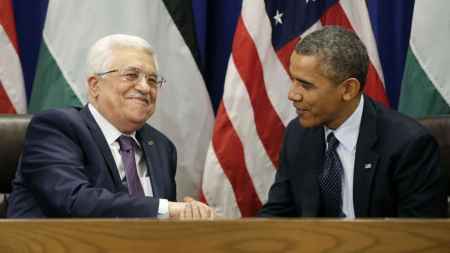
abbasobama

When we consider last month’s United Nations Security Council resolution (UNSC) 2334 that passed with deliberate U.S. abstention and later, justified in a speech by U.S. Secretary of State John Kerry, it makes the adage below come to mind. The Midrash (commentary on part of the Hebrew Scriptures) tells us, “He who becomes compassionate to the cruel will ultimately become cruel to the compassionate.”  Maimonides wrote in The Guide of the Perplexed that “the wicked and calculating person who killed intentionally and was sentenced to death – if he seeks sanctuary among us, we must not provide him with asylum, and not have mercy upon him, because compassion toward the wicked is cruelty to all beings.

In supporting the Palestinian regime that seeks the destruction of the Jewish State as its ultimate goal, the Obama administration is being compassionate toward the wrong party.  The Obama administration is knowingly and deliberately supporting the creation of another unstable Arab authoritarian regime that has failed its people.  Mahmoud Abbas, like Arafat before him, albeit more subtle, seeks the same goal: undermining the Jewish state, and replacing it with an undemocratic Palestinian state.  Abbas wouldn’t return to the negotiating table unless he is heavily bribed, and like Arafat, at the crucial moment when all reasonable concessions had been made, he walked out.

At their September 16, 2008 meeting in Jerusalem, Israeli Prime Minister Olmert agreed to forgo sovereignty over the Temple Mount in Jerusalem, Judaism’s holiest site, and proposed that in the framework of the peace agreement, the area containing the religious sites in Jerusalem would be managed by a special committee consisting of representatives from five nations: Saudi Arabia, Jordan, Palestinians, the U.S. and Israel.  The advisors and Fatah officials heard that Olmert laid out for Abbas not only the details of the agreement but also a large map upon which he outlined the borders of the future Palestinian state.  Abbas, like Arafat in July, 2000, walked out.

Considering Palestinian terrorism incited by Hamas and the Palestinian Authority against Jewish civilians and soldiers alike, it becomes clear that the Obama administration has shown compassion toward Palestinian aspirations and contempt for Jews aspiring to settle in their ancestral regions of Judea and Samaria.  The Administration would be quite content on a “judenrein” West Bank.   In fact, the U.S. and its European allies support the PA with huge grants, portions of which goes to pay salaries to Palestinian terrorists with blood on their hands and their families.  They have likewise funded Palestinian-Arab construction projects, built illegally throughout the West Bank and Jerusalem.

The Obama administration has also shown compassion for the Iranian regime by ending the economic sanctions against the radical Islamic Iranian regime, which hangs gays and lesbians as well as juveniles.  Amnesty International reported on January 26, 2016, that “Iran remains the leading executioner of juvenile offenders.”  The New York Post reported on August 3, 2016 that “The Obama administration quietly shipped $400 million stacked on wooden pallets in an unmarked plane to Iran in January – just as Tehran was releasing four Americans who had been detained there.”  This was done to appease the Islamic Republic, which is the leading state sponsor of terror around the world, and that has taken Americans in Iran as hostages.

U.S. Mideast mediator Dennis Ross pointed out that the Obama administration was so enamored with the so-called “moderate” Iranian President Rouhani, that it “showed readiness to accept an industrial-scale Iranian nuclear program and not to roll it back.”  The Obama administration was willing to bend its principles in order to foster a relationship and perhaps an alliance of sorts (against the Islamic State in Iraq) with the Ayatollahs regime that promised “to wipe Israel off the map.”

In the summer of 2009, the Iranian people voted for freedom and against the choices of the theocratic regime that oppressed them. They demonstrated in the millions with signs that read “Obama, are you with them or with us.”  Obama did not respond. He proved to have little compassion for the oppressed.

In Syria, the Shiite-Iranian Revolutionary Guards and their supported Iraqi-Shiite militias, as well as the Lebanese-Shiite terrorist group Hezbollah, are murdering hundreds of thousands of innocent Syrian Sunni Muslims, Christians, and others civilians with impunity.  They are bolstering the dictatorship of the Alawi (offshoot of Shiite Islam) minority ruler Bashar Assad.  The Russians have also joined in the killing of Syrian civilians in the name of combatting so-called “terrorists.”

The Palestinians of Hamas and the PA raise their children on hate and expound on the destruction of the Jewish state in schools, mosques, in the media, and in their policy directives.  The Palestinian intolerance towards Jews and Christians is deeply embedded, but due to political correctness, it has never been sufficiently reported in the western media, or by western governments.  Under the Palestinian regime, Christian Arabs have been victims of frequent human rights abuse by Muslims. There are many examples of intimidation, beatings, land theft, firebombing of churches and other Christian institutions, denial of employment, economic boycotts, torture, kidnapping, forced marriage, sexual harassment, and extortion. Palestinian Authority (PA) officials are directly responsible for many of the human rights violations. Muslims who have converted to Christianity are in the greatest danger. They are often left defenseless against cruelty by Muslim fundamentalists. Some have been murdered.

There is a clear dichotomy in determining who the compassionate side is, and who is the cruel. It comes together perfectly clear in the Syrian civil war arena.  Thousands of Palestinians are fighting on behalf of the Syrian dictator, and help in slaughtering the Syrian people who are fighting for their freedom.  The Palestinian radical group, the Popular Front for the Liberation of Palestine-General Command (PFLP-GC) led by Ahmed Jibril, provided the Assad war machine with intelligence and ground support, when he laid siege to the Palestinian populated Yarmouk refugee camp.  The PFLP-GC, once a member of the Palestinian Liberation Organization (PLO) joined the Assad troops in killing fellow Palestinians.

Conversely, Israel has opened its hospital gates to wounded Syrians, both civilians and soldiers.  Prime Minister Netanyahu announced last month “We are prepared to take in wounded women and children, and also men if they are not combatants. Bring them to Israel, we will take care of them in our hospitals as we have done with thousands of Syrian civilians. We are looking into ways of doing this. It is being explored as we speak.”  Netanyahu added, “The suffering is great, and the one initiative we took is to help – as I said – thousands of Syrians who are sometimes mutilated beyond belief. We help them. I offered to do more today. I don’t know if we can resolve [the crisis in] Syria, but we can help mitigate some of the suffering. That is the best that Israel can do.”

Being compassionate toward the Palestinian’s aspirations to destroy the Jewish state in stages by forming a terrorist supporting state, the Obama administration is being cruel toward the Jewish state, which seeks to defend its people from the ongoing Palestinian terror.

Straun Stevenson Blames President Obama for the Legacy of Death and Destruction in Middle East

January 8, 2017

Straun Stevenson Blames President Obama for the Legacy of Death and Destruction in Middle East, Iran News Update, January 8, 2017

(Please see also, In its Last Days, Obama Administration Clings to Hope of a Positive Role for Iran. — DM)

obama-750

Struan Stevenson, president of the European Iraqi Freedom Association, former member of the European Parliament representing Scotland (1999-2014), president of the Parliament’s Delegation for Relations with Iraq (2009-14) and chairman of Friends of a Free Iran Intergroup (2004-14), writes in his January 6, 2017 article for UPI, that the legacy of President Barack Obama will be death and destruction in the Middle East. His vision cooperation between  the United States and Iran “has unlocked a Pandora’s box of conflict and sectarian strife across the zone.”

During the closing days of the Obama administration the controversial nuclear deal with Iran and his policies regarding that ruthless regime have allowed the mullahs to threaten the security of the Middle East, and perhaps, while Saudi Arabia, the Gulf states and Turkey have tried to prevent Iran’s aggressive expansionism in the region.

The U.S. and other countries is the West failed the Syrian opposition and allowed a civil war to continue into its seventh year, costing hundreds of thousands of lives, and setting off the huge migration crisis in Europe.

$150 billion of frozen assets were released to Iran by the U.S. as part of the nuclear deal, which the Tehran government was expected to use to shore up their economy, on the brink of collapse. Instead, the regime redouble its spending the Islamic Revolutionary Guards Corps and Quds Force, both of which are listed terrorist organizations in the West and are involved in many conflicts in the Middle East. Not only does Iran support Bashar al-Assad in Syria, and Yemen’s Houthi rebels, it funds and supplies Hezbollah in Lebanon and the brutal Shi’ia militias in Iraq.

The nuclear deal has been breached, which Stevenson says demonstrates Iran’s complete disdain for the West. Two Qadr-H missiles were fired last March, in defiance of a U.N. Security Council resolution tied to the agreement. “Israel must be wiped out” was marked on the missiles, and the test firing took place on the day that the U.S. Vice President Joe Biden was visiting Israel. Vladimir Putin sent the first shipment of Russian S-300 surface-to-air missiles to Iran last August.

President Obama attempted to make deals with the so-called “moderate” and “smiling” Iranian President Hassan Rouhani, which he interpreted as having a green light for Tehran’s expansionist policy. Rouhani is in fact in charge of a government which has executed around 3,000 people since he took office in 2013, ten just this year. Mass hangings are now carried out in public, even in football stadiums. Many of the officials in his government were complicit in the 1988 massacre of some 30,000 political prisoners, most of whom were part of the opposition People’s Mojahedin of Iran. In fact, it was supervised by Mostafa Pour-Mohammadi, who is Rouhani’s justice minister.

Obama began his administration by agreeing with Iran, and backing Nouri al-Maliki as prime minister in Iraq. Stevenson writes, “Maliki was a puppet of the mullahs, doing their bidding by opening a direct route for Iranian troops and equipment heading to Syria to bolster the murderous Assad regime. Iran’s support for Maliki in Iraq and for Assad in Syria, two corrupt dictators who repressed and brutalized their own people, resulted in the rise of Daesh, also known as the Islamic State.Thanks to U.S. acquiescence over Tehran, Daesh grew and became a threat to the whole world.”  He continues, “Obama compounded this grievous mistake by providing American military support and air cover for the genocidal campaign being waged by pro-Iranian Shi’ia militias in Iraq. Once again Iran exploited its role in ousting Daesh as a means for implementing its ruthless policy of ethnic cleansing to annihilate the Sunnis in Iraq’s al-Anbar Province. Horrific sectarian atrocities were committed during the so-called “liberation” of the ancient cities of Fallujah and Ramadi. The Shi’ia militias, who formed the main part of the force fighting to recapture these cities from Daesh and are now engaged in the battle to recapture Mosul, are led by Gen. Qasem Soleimani, commander of the Iranian terrorist Quds Force. Soleimani has also played a key role in Syria and the massacre in Aleppo.”

Tehran is gaining strength in Iraq. The Iraqi army is poorly trained, and the Iranian has Prime Minister Haider al-Abadi’s agreement to allowing Iranian-funded militias to take control of military operations. Political disarray in Baghdad, has paved the way for Iran to consolidate its hold in Iraq.

The unenviable task of trying to sort out the Middle East mess will be left to President-elect Donald Trump. Many people on his team believe that Iran is the main source of conflict in the Middle East and poses a greater threat to the West than North Korea or even Russia. It will be interesting to see how Trump will fare.